

Submitted:
06 November 2026
Posted:
09 November 2026
You are already at the latest version
Abstract
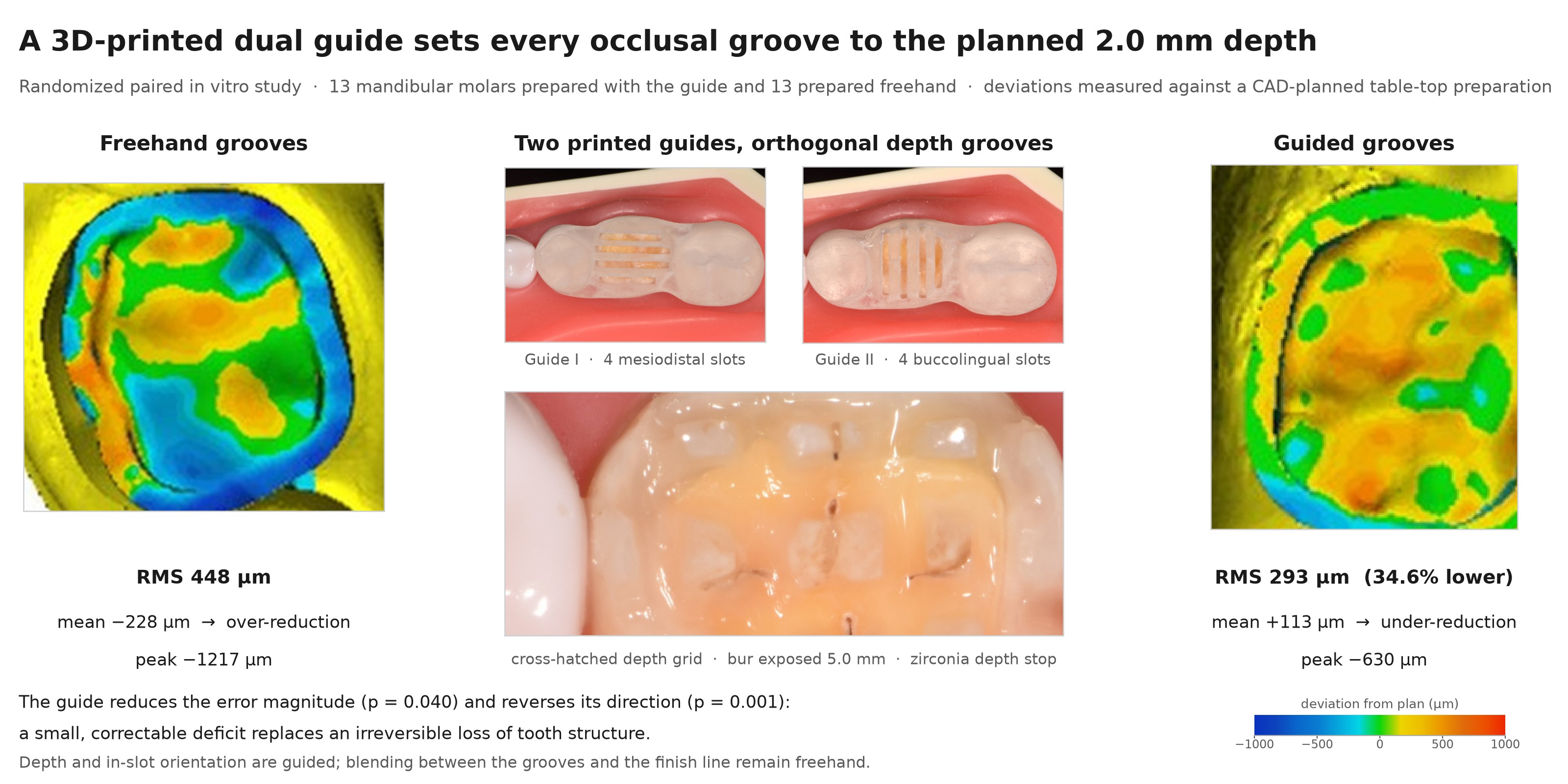
Background/Objectives: In posterior table-top (occlusal veneer) preparations, a uniform, anatomy-following reduction of about 2 mm is difficult to control freehand. This in vitro study compared a three-dimensionally (3D) printed dual-guide system that programs a cross-hatched depth-groove grid with the conventional freehand depth-groove technique. Methods: Thirteen pairs of extracted mandibular molars were mounted in dental models; within each model, one tooth was randomly assigned to guided and the other to freehand preparation, with an individual reference table-top preparation (2.0 mm reduction, 1.0 mm chamfer) designed for both. Two printed guides with four mesiodistal and four buccolingual 1.2 mm slots oriented a 1.2 mm spherical bur limited to 5.0 mm penetration by a zirconia stop; control teeth received three to four freehand grooves. Superimposition of post-preparation scans onto the reference preparations yielded signed (bias) and root mean square (RMS) 3D deviations and 2D deviations at four sections, analysed with paired tests and repeated-measures ANOVA. Results: The guided group had a lower RMS deviation (293.0 ± 113.6 vs. 448.1 ± 179.1 µm; p = 0.040) and a bias in the opposite direction (+113.4 ± 216.5 vs. −227.7 ± 268.9 µm; p = 0.001): guided preparations under-reduced, freehand preparations over-reduced, with an approximately twofold deeper peak of over-reduction in the freehand group (−1217 ± 201 vs. −630 ± 321 µm; p < 0.001). Section position changed the magnitude but not the direction of the difference (interaction p = 0.004). Conclusions: The guide reduced the magnitude of the deviation and converted a largely non-correctable over-reduction into a correctable one; because it controls the depth rather than the path of the bur, peripheral blending remains freehand.
Keywords:
posterior occlusal veneer
; table-top preparation
; tooth preparation
; 3D printing
; guided preparation
; depth control
; minimally invasive dentistry
Copyright: This open access article is published under a Creative Commons CC BY 4.0 license, which permit the free download, distribution, and reuse, provided that the author and preprint are cited in any reuse.