

Submitted:
06 November 2026
Posted:
09 November 2026
You are already at the latest version
Abstract
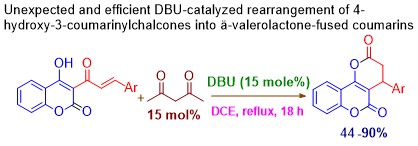
The reaction of 4-hydroxy-3-coumarinylchalcone with acetylacetone in the presence of base was expected to result in Michael adduct. During this reaction in the presence of catalytic amount of DBU a rearrangement led to δ-valerolactone [3,4]-fused coumarin. The outcome of this rearrangement was almost the same in the presence or absence of active methylene compounds. Preliminary screening tests of the synthesized derivatives for LOX (lipoxygenase) inhibition activity and anticancer activity were performed.
Keywords:
4-hydroxy-3-coumarinylchalcones
; DBU-catalysis
; [3
; 4]-fused pyranonocoumarins
; acetylacetone
; active methylene compounds
; lipoxygenase inhibition
1. Introduction
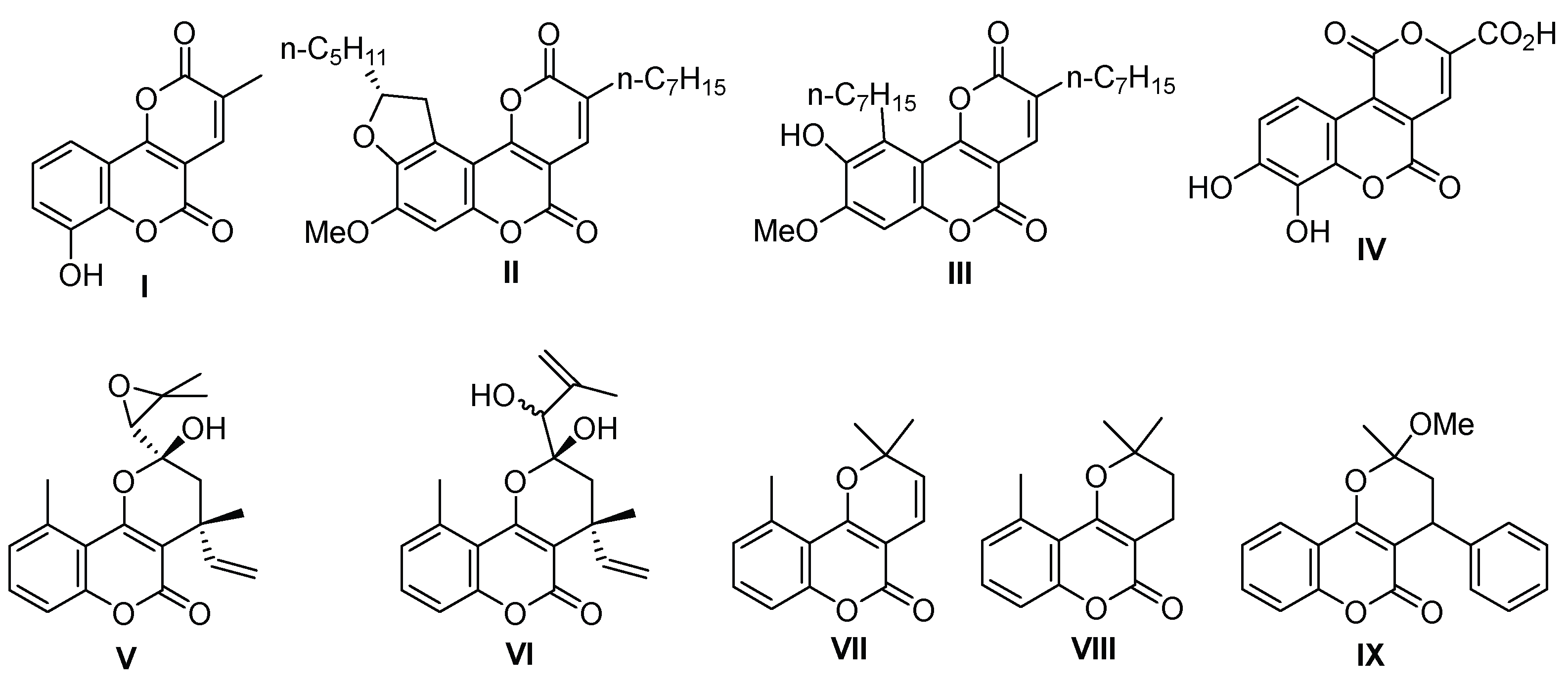
Coumarin derivatives, natural or synthetic [1,2,3,4,5,6,7,8,9], constitute a class of compounds exhibiting diverse biological properties, such as anticancer [10,11], anti-HIV [12], anti-inflammatory [8,13], antioxidant [8,13], antibacterial [14], anticonvulsant [15], antidepressant [1], antifungal [3], anti-Alzheimer’s [17], and antitubercular [18] activities. Fused coumarins with pyran, furan, pyridine, or pyrrole rings are, also, present in nature showing interesting pharmacological activities [19,20,21,22]. Especially, pyran framework fused on the benzene ring of the coumarin skeleton is common in numerous natural products, like seselin, xanthy- letin, calanolides, khellactones etc [19,23]. Besides them, [3,4]-fused pyranocoumarins are found in a lot of natural products exhibiting outstanding biological activities. For example, norneolambertellin (I) shows antifungal activity [24], fordianin A (II), and fordianin B (III) present cytotoxicity against human lung cancer and HeLa human cervical carcinoma cell lines [25], lumnitzeralactone (IV) exhibits antibacterial activity [26], ethulia-coumarin A (V), and isoethuliacoumarin A (VI) possess molluscicidal activity [27], both-rioclinin (VII) has cytotoxic activity against human leukemia and human hepatoma cells [28], pterophyllin III (VIII) exhibits inhibitory activity against proliferation of human lymphocytes [29], and cyclocoumarol (IX) shows anti-inflammatory and anticancer activities [30,31] (Figure 1).
4-Hydroxycoumarin-3-ylchalcones (3-cinnamoyl-4-hydroxy-2H-chromen-2-ones) exhibit, also, a variety of biological [32,33,34,35,36,37,38,39,40,41], photophysical, and nonlinear optical proper-ties [42]. The biological activities include neuroprotective [32], antibacterial [33,34], cytoto-xic [33,34], anti-inflammatory [33], hA3 adenosine receptor [36], antimalarial [37], antioxi-dant [38], antiviral [39], and chemosensory [40,41] activities. These chalcones of 4-hydroxycoumarin were reacted, mainly, with different reagents to produce 4-hydroxycoumarin derivatives bearing heterocyclic moieties at 3-position, under cyclocondensation at the α,β-unsaturated carbonyl part of the chalcone. Pyrazoline [43], pyrazole [44], isoxazole [45], pyrimidine [45], thiazepine [45], pyridine [46] is included in these heterocyclic moieties. Another type of reaction of 4-hydroxycoumarin-3-ylchalcones is the Michael addition to the α,β-unsaturated carbonyl. Sangshetti et al. prepared indolyl-coumarin hybrids by the Michael addition of indoles to chalcones in the presence of Ho3+ CoFe2O4 NPs as the catalyst [47], which exhibit antileishmanial and antioxidant activities. Michael adducts have been, also, synthesized, by the addition of cyclopentanone or cyclohexanone to chalcones in the presence of L-proline as the catalyst during the one-pot reactions of 3-acetyl-4-hydroxycoumarin with benzaldeydes and cyclic ketones [48]. The treatment of chalcones with Bu3P and aroyl chlorides in the presence of Et3N resulted in the unexpected formation of a furo[2,3-c]coumarin ring [49]. The reaction is proposed to proceed via initial Michael addition of Bu3P followed by C-acylation and subsequent intramolecular cyclization by the 4-hydroxyl to afford this product.
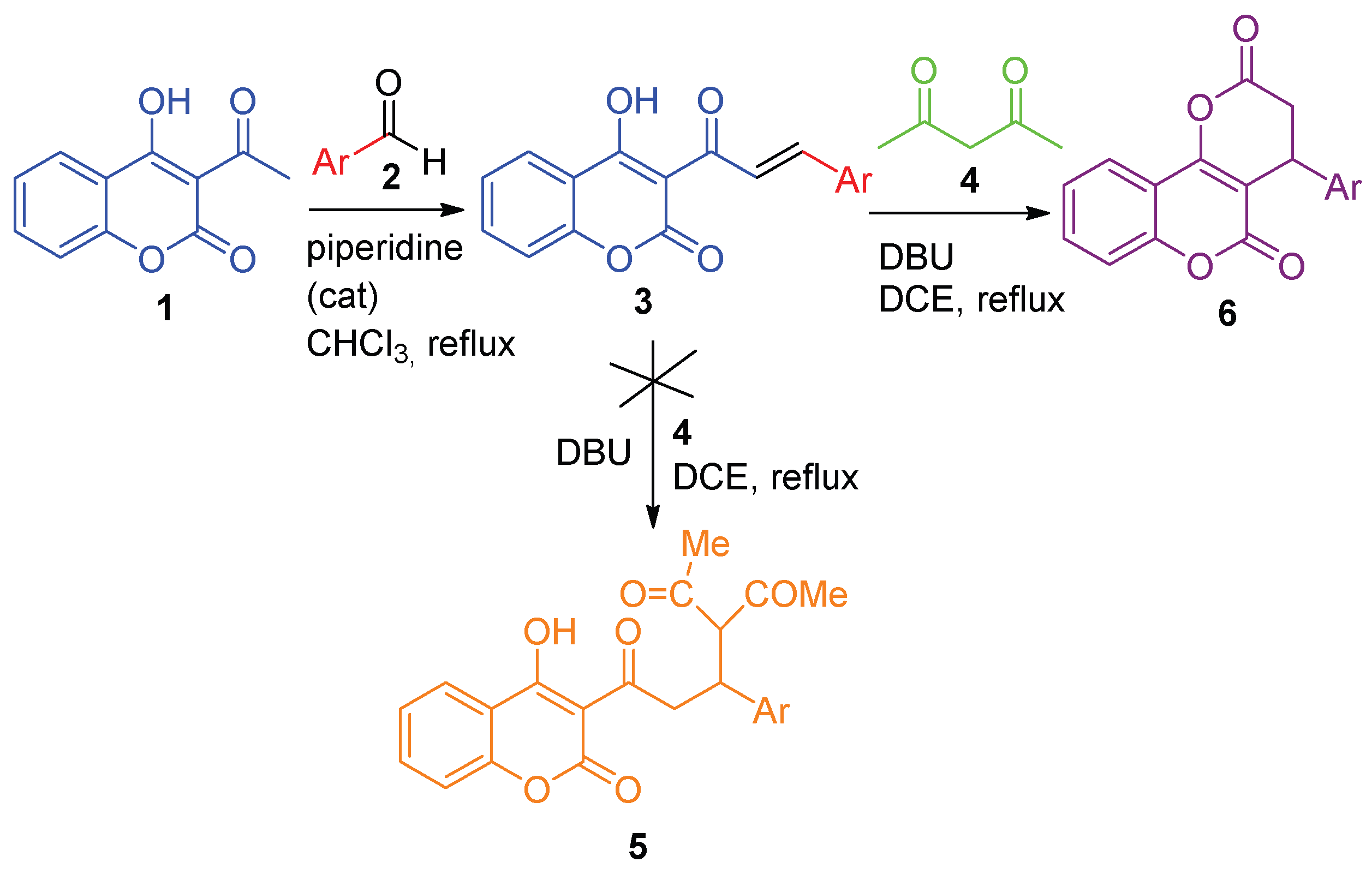
To date, there are a few reports concerning the reactions of 4-hydroxycoumarin-3-ylchalcones with active methylene compounds. Based on our long-lasting interests in coumarin derivatives [8,19,21,22,50], we set out to investigate the reactivity of those chalcones with active methylene compound to examine further biological activities of the expected Michael adducts, 5. During the performed reactions the expected derivatives were not obtained or were obtained in low yields. Instead, through rearrangement the isomeric δ-valerolactone [3,4]-fused coumarins 6 were isolated as the major product (Scheme 1). The synthesis of [3,4]-fused pyranocoumarins is achieved mainly by the reactions of 4-hydroxycoumarin with α,β-unsaturated carbonyl compounds, 1,3-dienes, or three-component reactions. The reactions with α,β-unsaturated carbonyl compounds were performed under metal catalysis [51,52,53,54] or organocatalysis [55,56,57]. The reaction with isoprene was accomplished under Bronsted acid catalysis [58]. The three-component reactions were performed under DBU [59] or proline [60] or metal nanoparticles [2,61] catalysis.
2. Results and Discussion
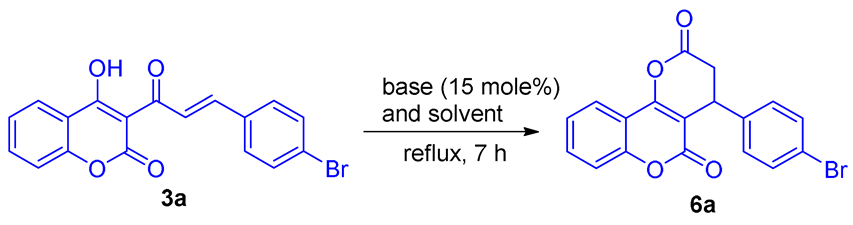
The starting compounds, 4-hydroxy-3-coumarinylchalcones 3 were prepared from 3-acetyl-4-hydroxycoumarin (1) and aldehydes 2 in the presence of catalytic amount of piperidine (Scheme 1) according to the literature [38,63]. For a screening of the reaction conditions, we selected the reaction of (E)-3-[3-(4-bromophenyl) acryloyl]-4-hydroxy-2H-chromen-2-one (3a) [49] and acetylacetone (4) in the presence of different bases, as catalysts, solvents and reaction conditions (Table 1). Initially, piperidine was used as a catalyst, following the literature [64], in CHCl3 for 2 days at r. t. and led to the new adduct of Michael reaction 5a in 33% yield, while 65% of starting compound 3a was recovered (Table 1, entry 1). The analogous reaction of (E)-3-[3-(4-chlorophenyl) acryloyl]-4-hydroxy-2H-chromen-2-one (3c) [63] with 4 resulted in the corresponding Michael adduct 4-acetyl-3-(4-chlorophenyl)-1-(2-oxo-4-hydroxy-2H-chromen-3-yl) hexane-1,5-dione (5c) in 20% yield, while 75% of the starting material 3c was recovered. By increasing the reaction temperature and time, the yield of 5a was further decreased, while a new compound identified as the lactone 6a, was detected in the reaction mixture (Table 1, entries 2,3). The heating in higher boiling point solvents, such as toluene and DCE (1,2-dichloroethane), favored the formation of pyranone 6a in 55% and 69% isolated yield, while the yield of derivative 5a dropped to 2% and 14%, respectively (Table 1, entries 4,5). Afterwards, several catalysts were evaluated. The S-proline [48] as base or anhydrous FeCl3 as catalyst [65] left unreacted compound 3a and only traces (1%) of 5a detected (Table 1, entries 6,7). By contrast, DABCO [66] in DCE afforded 5a in 16% yield (Table 1, entry 8).
The use of DBU as a base, according to the literature [67], in DMSO at r.t. left the starting compound 3a unchanged (Table 1, entry 9). Upon heating at 60°C the reaction resulted to a complicated mixture containing 6a (22%) and 5a (14%), as indicated by the 1H-NMR spectrum (Table 1, entry 10). Then, other solvents were examined in the presence of DBU, revealing that DCE was superior to CHCl3 for the synthesis of δ-valerolactone 6a (86%) (Table 1, entries 11,12). The Et3N as the base afforded 6a in 50% yield (Table 1, entry 13), while tBuOK in dry THF led to compound 6a in only 1% yield with most of the starting material 3a to be recovered (Table 1, entry 14). Thus, the study of the reaction conditions revealed that the use of piperidine in CHCl3 at r.t. provided better results for the synthesis of Michael adduct 5a, whereas the heating in higher boiling point solvents decreased the amount of 5a and favored the formation of the unexpected pyranone derivative 6a. The investigation of the conditions for the synthesis of this interesting rearrangement product 6a, indicated entry 12, with DBU in DCE, as the optimal conditions.
The structure of compound 5a, as well as derivative 5c (Supplementary Materials) was confirmed by its 1H NMR spectra as there are, besides the corresponding aromatic protons, two acetyl protons at 1.88 and 2.29 ppm, two geminal protons of -C(=O)CH2- group at 3.18 (dd, J1 = 2.9 Hz, J2 =17.3 Hz, 1H), and 3.73 (dt, J1 = 3.0 H, J2 =4.8 Hz, J3= 17.4, Hz, 1H) ppm, and one peak assigned to the benzylic proton and the (MeCO)2CH proton at 4.20-4.30 (m, 2H) ppm, as indicated by gHSQC analysis. Compound 6a presented in the 1H-NMR spectrum the expected aromatic protons in addition to three characteristic peaks attributed to the new pyranone ring. A doublet of doublets at 4.49 (dd, J1=2.0 Hz, J2=7.7 Hz, 1 H) ppm for the benzylic proton and two peaks for the geminal protons of OCOCH2 group at 3.21 (dd, J1=7.7 Hz, J2=16.2 Hz, 1 H) and 3.11 (dd, J1=2.0 Hz, J2=16.2 Hz, 1 H) ppm, revealing the axial-axial coupling for the protons and the equatorial position for the aryl group. HSQC and HMBC experiments further confirmed this structure.
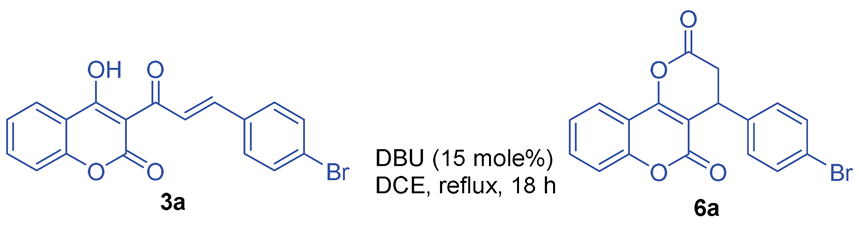
Profoundly, the unexpected product 6a is an isomer of starting compound 3a, as they have the same molecular ion in MS spectra. To investigate the possibility of transformation of chalcone 3a to pyranone 6a without the participation of acetylacetone (4), a series of experiments was performed using different bases and solvents (Table 2). No reaction was observed during the treatment of 3a with piperidine, Et3N, or S-Proline in refluxing DCE for 7 h (Table 2, entries 1-3). However, chalcone 3a reacted in the presence of DBU in DCE affording δ-valerolactone 6a in 68% yield (Table 2, entry 4). Treatment of 3a with DBU in refluxing DCM or CHCl3 left the starting material unchanged (Table 2, entries 5,6). THF (tetrahydrofuran), ethyl acetate or MeCN as solvents under reflux led to the formation of derivative 6a (Table 2, entries 8-10). In refluxing methanol or ethanol, which is the recrystallization solvent of 3a, no reaction was noticed (Table 2, entries 7,11). The use of toluene with DBU, also, resulted in the formation of 6a in 65% yield (Table 2, entry 12). As indicated from the above-mentioned results, higher-boiling solvents favour the transformation of 3a to the isomer 6a in the presence of DBU as the base, however, the yield remains lower compared to reactions involving acetylacetone (4) (Table 1).
In addition, we investigated the utilization of other active methylene compounds for the transformation of chalcone 3a into pyranone 6a (Table 3). The use of catalytic amount of acetylacetone (4) resulted in the preparation of 6a in nearly the same yield as with the 1.5 equivalents of 4 (Table 3, entries 1,2). The reaction with ethyl acetoacetate (7) afforded 76% yield of 6a, while the ethyl malonate (8) led to 57% of 6a after refluxing in DCE for 2 days (Table 3, entries 3,4).
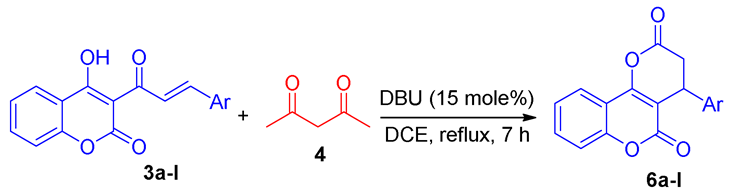
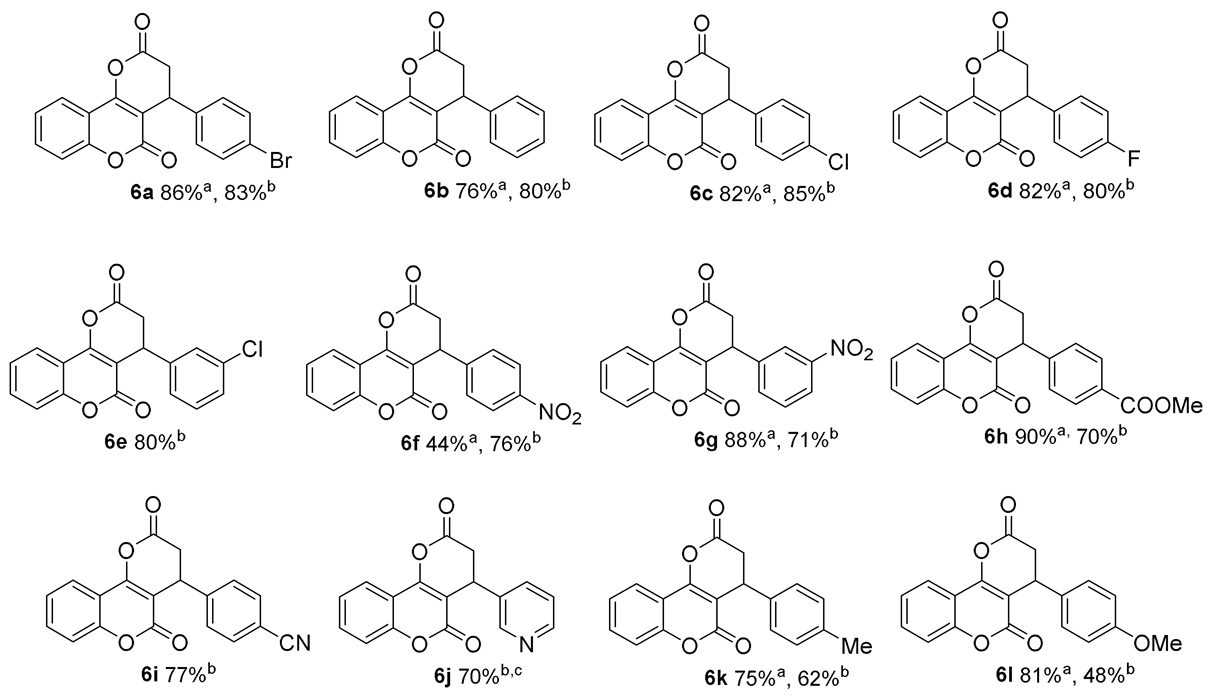
Following the optimization of the reaction conditions, the reaction scope was further broadened using various chalcones 3 with acetylacetone (4) (1.5 equivalents under Method A or 0.15 equivalents under Method B) in the presence of DBU under reflux for 7 h (Table 4). The resulted δ-valerolactones 6a-I with both electron-withdrawing or electron-donating substituents isolated in good to excellent yields (44-90%) using 1.5 equivalents of 4. The use of acetylacetone in catalytic amount 15 mol% afforded the desired products 6a-I in good to very good yields (48-85%), highlighting the catalytic role of acetylacetone in this transformation.
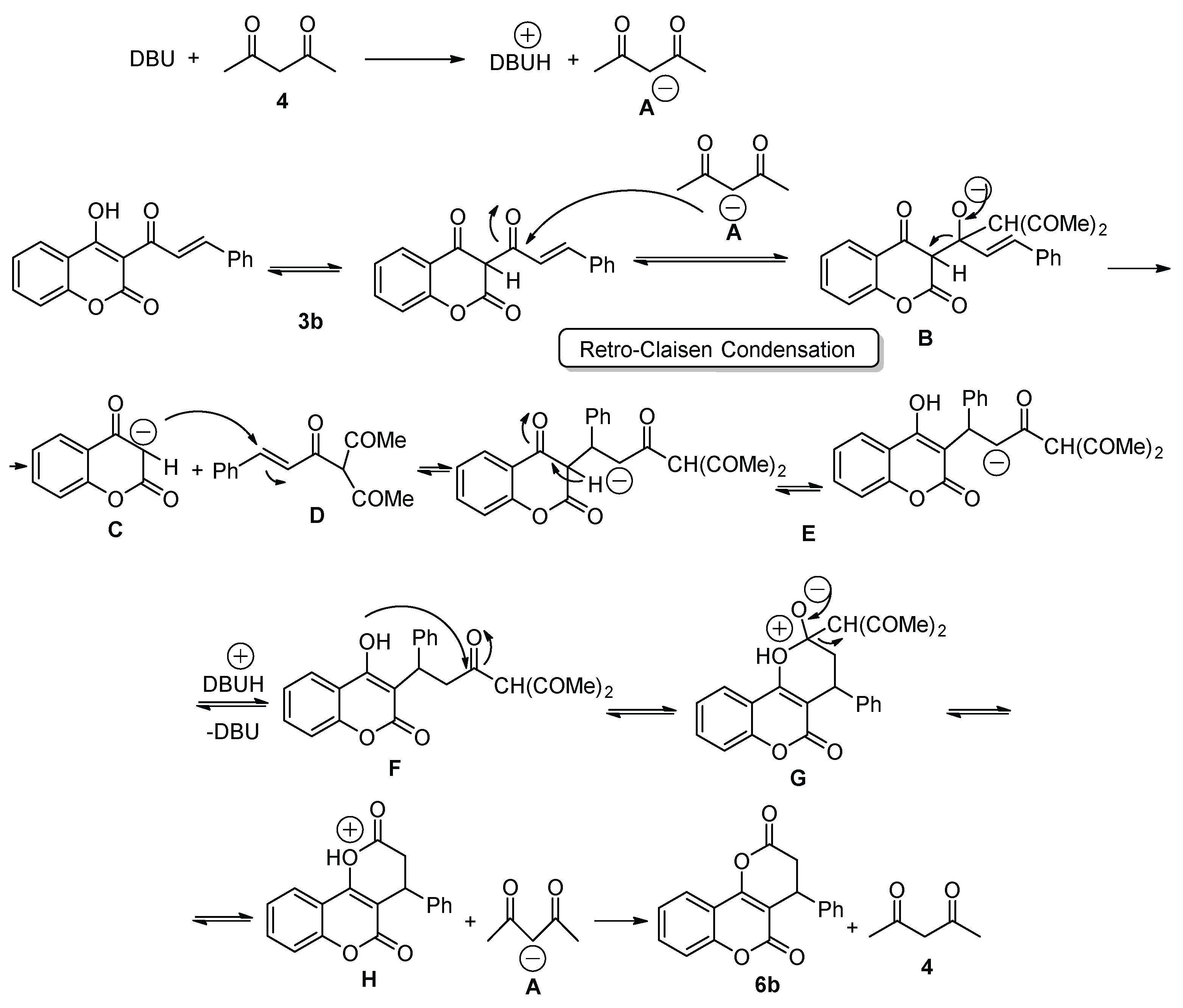
A plausible reaction pathway for the rearrangement of compound 3b in the presence of acetylacetone is depicted in Scheme 2. DBU deprotonated 4 to give acetylacetone carbanion A, which reacted possibly with the carbonyl carbon of the hydrogen-bonded stabilized carbonyl moiety [38], of β-diketone tautomer of 3b, to form the intermediate B. Retro-Claisen reaction of the later resulted to the coumarin carbanion C and the α,β-unsaturated ketone D. Michael addition of C to D afforded adduct E, which protonated to 3-coumarin derivative F by removing a proton from DBU+H. Intermediate F was transformed to fused pyranocoumarin G by intramolecular cyclization. Elimination of acetylacetone carbanion A from the later gave the pyranone intermediate H, which upon deprotonation by A afforded the final product 6b.
For the rearrangement of derivative 3b to 6b in the absence of acetylacetone or any active methylene compound on the other hand, the mechanism possibly begins with a nucleophilic attack of DBU, which could act as nucleophile [68,69], at the ketonic carbonyl of the coumarin–chalcone tautomer of 3b, followed by collapse of the resulting tetrahedral intermediate A and C–C bond cleavage to give the resonance-stabilized coumarin carbanion B in a retro-Claisen reaction (Scheme 3). Subsequently, B undergoes Michael addition to the α,β-unsaturated intermediate C. Proton transfer in intermediate D resulted to carbanion E, which upon enolization to F followed by intramolecular attack of the C-4 oxygen on the amide carbonyl, and subsequent elimination of DBU from intermediate G furnished the lactonized product 6b.
As we described earlier, [3,4]-fused pyranocoumarins exhibit cytotoxic, and anti-inflammatory activities [25,28,29,30,31]. Therefore, the synthesized pyranonocoumarin derivatives were evaluated preliminarily for their anti-inflammatory, as lipoxygenase (LOX) inhibitors. LOXs play a dual role in inflammatory conditions. They catalyze the oxygenation of polyunsaturated fatty acids to form leukotrienes and lipoxins. Nordihydro guaiaretic acid (NDGA) is involved in this study as standard for comparison (Table 5) [49]. Their antioxidant activity was checked through the antilipid peroxidation ability in vitro using the protocol of water soluble 2,2'-azobis(2-amidinopropane) dihydrochloride (AAPH) [49]. Selected potent inhibitors were tested for their cytotoxic activity against two different cancer cell lines (Table 6).
Compounds 6g and 6e are the most potent LOX inhibitors among the synthesized derivatives with IC50 = 7.5 and 8.75 μM, respectively (Table 5, entries 7 and 5) in comparison to standard NDGA (IC50 = 0.45 μM). Compounds 6a-d, 6f, 6h-j presented moderate inhibition of LOX (Table 5, entries 1-4, 6, 8-10), while 6k showed low inhibition to LOX (Table 5, entry 11). 3-Substituted derivatives are more potent than the 4-substituted. It seems that electron acceptors in 3-position led to higher inhibition. Electron donor substituent in 4-position like CH3 did not give high bioactivity. The presence οf bulky substituents in 4-position leads to lower inhibition. The compounds 6f and 6g displayed moderate to high inhibition (75% and 82%, respectively) of lipid peroxidation compared to the standard Trolox (93% inhibition). The remaining compounds showed limited or no antioxidant activity (results not given in Table).
The pyranono derivatives were, also, tested for anticancer activity in two cell lines derived from different cancer types. The cervical cancer cell line HeLa, and MCF7 from breast cancer were utilized to assess the cytotoxic activity of those compounds at a concentration range of 5-100 μM for 48 h by using the colorimetric method 3-(4,5-dimethylthiazol-2-yl)-3,5-diphenyl tetrazolium bromide (MTT) [70]. The results were expressed as EC50 (the concentration that causes 50% loss of cell viability). The tested compounds were inactive as evidenced by their very low impact on cells’ viability (Table 6).
3. Materials and Methods
3.1. Materials
All the chemicals were purchased from either Sigma–Aldrich Co. or Merck & Co., Inc.
Melting points were determined with a Kofler hotstage apparatus and are uncorrected.
IR spectra were obtained with a Perkin–Elmer Spectrum BX spectrophotometer as KBr pellets. NMR spectra were recorded with an Agilent 500/54 (DD2) (500 MHz and 125 MHz for 1H and 13C, respectively) using TMS as an internal standard. J values are reported in Hz. HRMS (ESI-MS) were recorded with a ThermoFisher Scientific (168 Third Avenue, Waltham, MA USA 02451) model LTQ Orbitrap Discovery MS. Silica gel No. 60, Merck KGAA (Frankfurter Strasse 250, Darmstadt, 64293, Germany) was used for column chromatography. Chalcones 3a [38], 3b [38], 3c [63], 3d [63], 3e [63], 3f [38], 3g [63], 3i [63], 3j [70], 3k [63], 3l [37], were prepared according to the literature [38].
3.2. Chemistry
3.2.1. Methyl (E)-4-[3-(2-oxo-4-hydroxy-2H-chromen-3-yl)-3-oxoprop-1-en-1-yl] benzoate (3h)
Methyl 4-formylbenzoate (2h) (0.397 g, 2.42 mmol) was added to the solution of 3-acetyl-4-hydroxycoumarin (1) (0.51 g, 2.5 mmol) in chloroform (3 mL). Piperidine (0.1373 g, 0.1593 mL, 1.61 mmol) was then added and the solution was refluxed for 20 h. The solvent was evaporated, and the residue was washed with methanol to give 3h (0.603 g, 69% yield) as a light yellow solid, m.p. 192-194°C (MeOH); IR (Neat): 3101, 3050, 2971, 1733, 1710, 1629, 1615, 1536 cm–1; 1H NMR (500 MHz, CDCl3): δ 8.49 (d, J = 15.8 Hz, 1H), 8.10 – 8.06 (m, 3H), 8.02 (d, J = 15.8 Hz, 1H), 7.76 (d, J = 8.2 Hz, 2H), 7.69 (t, J = 7.7 Hz, 1H), 7.36 – 7.29 (m, 2H), 3.94 (s, 3H) ppm; 13C NMR (126 MHz, CDCl3): δ 192.6, 181.4, 166.5, 160.2, 154.9, 145.4, 138.9, 136.4, 132.2, 130.3, 129.2, 125.9, 125.2, 124.6, 117.2, 116.1, 101.1, 52.5 ppm; HRMS-ESI: Calcd for C20H14O6H: 351.0863 [M+H]+ ; found 351.0854.
3.2.2. 4-Acetyl-3-(4-bromophenyl)-1-(2-oxo-4-hydroxy-2H-chromen-3-yl) hexane-1,5-dione (5b)
Acetylacetone (4) (0.0406 g, 0.0416 mL, 0.405 mmol) and piperidine (0.0034 g, 0.004 mL, 0.041 mmol) were added to the solution of (E)-3-[3-(4-bromophenyl) acryloyl]-4-hydroxy-2H-chromen-2-one (3b) (0.1 g, 0.27 mmol) in CHCl3 (5 mL) and the resulted mixture was stirred at r. t. for 2 days. After evaporation of the solvent the residue was washed with methanol. The remaining solid was unreacted 3b (65 mg, 65%). The filtrate was separated by column chromatography (silica gel, hexane/EtOAc 2:1) to give 5b (41.7 mg, 33% yield) as a white solid, m.p. 131-133°C (hexane/EtOAc); IR (Neat): 3116, 3042, 2975, 2921, 2835, 1716, 1691, 1616, 1604 cm–1; 1H NMR (500 MHz, CDCl3): δ 8.00 (d, J = 8.7 Hz, 1H), 7.68 (t, J = 8.3 Hz, 1H), 7.39 (d, J = 8.1 Hz, 2H), 7.35 – 7.24 (m, 2H), 7.18 (d, J = 8.1 Hz, 2H), 4.20-4.30 (m, 2H), 3.73 (dt, J = 17.4, 4.8 Hz, 1H), 3.18 (dd, J = 17.3, 2.9 Hz, 1H), 2.29 (s, 3H), 1.88 (s, 3H) ppm; 13C NMR (125 MHz, CDCl3): δ 205.1, 202.6, 202.5, 178.3, 160.1, 154.7, 139.54, 136.5, 132.0, 130.3, 125.7, 124.7, 121.3, 117.1, 115.1, 101.3, 74.7, 46.5, 39.8, 30.2, 29.8 ppm; HRMS-ESI: Calcd for C23H19BrO6Na: 493.0257/495.0240 [M+Na]+ ; found 493.0241/495.0245.
3.2.3. 4-Acetyl-3-(4-chlorophenyl)-1-(2-oxo-4-hydroxy-2H-chromen-3-yl) hexane-1,5-dione (5c)
In the solution of 3c (98 mg, 0.3 mmol) in CHCl3 (5 mL), 4 (0.0388 g, 0.0398 mL, 0.39 mmol) and piperidine (0.0038 g, 0.004 mL, 0.045 mmol) were added and stirred for 2 days. Evaporation of the solvent and washing of the residue with MeOH left as solid unreacted 3c (776.5 mg, 75%). Column chromatography (silica gel, hexane/EtOAc 2:1) of the filtrate gave 5c (25 mg, 0.586 mmol, 20% yield) as a white solid; m.p. 109-111°C ((hexane/EtOAc); IR (Neat): 3116, 3050, 2924, 2834, 1728, 1691, 1647, 1620, 1607 cm–1; 1H NMR (500 MHz, CDCl3): δ 8.00 (d, J = 7.8 Hz, 1H), 7.68 (t, J = 7.3 Hz, 1H), 7.32 (t, J = 7.6 Hz, 1H), 7.27 (d, J = 8.4 Hz, 1H), 7.24 (s, 4H), 4.22 - 4.27 (m, 2H), 3.73 (ddd, J = 17.4, 6.3, 2.8 Hz 1H), 3.18 (dd, J = 17.4, 2.9 Hz, 1H), 2.29 (s, 3H), 1.88 (s, 3H) ppm; 13C NMR (75 MHz, CDCl3): δ 205.2, 202.6, 202.6, 178.3, 160.1, 154.7, 139.0, 136.4, 133.2, 129.9, 129.0, 125.7, 124.7, 117.1, 115.0, 101.4, 74.8, 46.5,
39.8, 30.1, 29.8 ppm; HRMS-ESI: Calcd for C23H19ClO6Na: 449.0762/451.0751 [M+Na]+ ; found 449.0741/451.0729.
3.2.4. General Procedure for the Synthesis of 4-(4-Bromophenyl)-3,4-dihydro-2H,5H-pyrano[3,2-c]chromene-2,5-dione (6a)
Method A. Acetylacetone (4) (0.082 g, 0.0843 mL, 0.825 mmol) and DBU (0.0137 g, 0.01345 mL, 0.083 mmol) were added to the solution of (E)-3-[3-(4-bromophenyl) acryloyl]-4-hydroxy-2H-chromen-2-one (3a) (0.204 g, 0.55 mmol) in DCE (10 mL) and the resulted mixture was refluxed for 7 h and monitored by TLC. After evaporation of the solvent the residue was washed with methanol to give 6a (0.175 g, 86% yield).
Method B. In the solution of 3a (74 mg, 0.2 mmol) in DCE (4 mL), 4 (0.0388 g, 0.0049 mL, 0.03 mmol) and DBU (0.0031 g, 0.00306 mL, 0.03 mmol) were added, and the mixture was refluxed and monitored by TLC for 7 h. Evaporation of the solvent and washing of the residue with methanol resulted to 6a (62 mg, 83% yield).
3.2.4.1.6a: White solid, m.p. 132-134°C (hexane/EtOAc) (lit [71]. m.p. 149°C); 1H NMR (500 MHz, CDCl3): δ 7.91 (d, J = 8.0 Hz, 1H), 7.63 (t, J = 7.9 Hz, 1H), 7.44 (d, J = 8.2 Hz, 2H), 7.41 – 7.37 (m, 2H), 7.14 (d, J = 8.1 Hz, 2H), 4.49 (d, J = 7.6 Hz, 1H), 3.21 (dd, J = 16.2, 7.7 Hz, 1H), 3.11 (d, J = 16.2 Hz, 1H) ppm; 13C NMR (125 MHz, CDCl3): δ 164.0, 160.8, 157.5, 153.3, 138.5, 133.3, 132.5, 128.5, 124.9, 123.0, 122.2, 117.1, 113.5, 105.9, 35.9, 35.6 ppm; HRMS-ESI: Calcd for C18H12BrO4: 370.9913/372.9908 [M+H]+ ; found 370.9907/372.9892.
3.2.4.2. 4-Phenyl-3,4-dihydro-2H,5H-pyrano[3,2-c]chromene-2,5-dione (6a): White solid (76% under Method A, 60% under Method B); m.p. 165-167°C (hexane/EtOAc) (lit [61]. m.p. 168-170°C); 1H NMR (500 MHz, CDCl3): δ 7.92 (d, J = 8.2 Hz, 1H), 7.62 (t, J = 7.8 Hz, 1H), 7.40 7.35 (m, 2H), 7.32 (t, J = 7.2 Hz, 2H), 7.26 (t, J = 8.2 Hz, 3H), 4.53 (d, J = 7.3 Hz, 1H), 3.21 (dd, J = 16.2, 7.5 Hz, 2H), 3.14 (dd, J = 16.1, 1.4 Hz, 2H) ppm; 13C NMR (125 MHz, CDCl3): δ 164.4, 160.9, 157.4, 153.3, 139.5, 133.1, 129.4, 128.2, 126.8, 124.8, 122.9, 117.0, 113.7, 106.5, 36.2, 36.0 ppm.
3.2.4.3. 4-(4-Chlorophenyl)-3,4-dihydro-2H,5H-pyrano[3,2-c]chromene-2,5-dione (6c): White solid (82% under Method A, 85% under Method B); m.p. 195-196°C (hexane/EtOAc) (lit [61]. m.p. 196-197°C); 1H NMR (500 MHz, CDCl3): δ 7.92 (d, J = 8.1 Hz, 1H), 7.63 (t, J = 7.8 Hz, 1H), 7.41 – 7.36 (m, 2H), 7.29 (d, J = 8.4 Hz, 2H), 7.20 (d, J = 8.4 Hz, 2H), 4.51 (d, J = 7.4 Hz, 1H), 3.21 (dd, J = 16.2, 7.7 Hz, 1H), 3.11 (d, J = 16.1 Hz, 1H) ppm; 13C NMR (125 MHz, CDCl3): δ 164.0, 160.8, 157.5, 153.4, 138.0, 134.1, 133.3, 129.6, 128.2, 124.9, 123.0, 117.1, 113.5, 106.0, 36.0, 35.5 ppm.
3.2.4.4. 4-(4-Fluorophenyl)-3,4-dihydro-2H,5H-pyrano[3,2-c]chromene-2,5-dione (6d): White solid (79% under Method A, 80% under Method B); m.p. 193-195°C (hexane/EtOAc); 1H NMR (500 MHz, CDCl3): δ 7.92 (dd, J = 8.1, 1.2 Hz, 1H), 7.63 (dt, J = 7.8, 1.6 Hz, 1H), 7.42 – 7.36 (m, 2H), 7.23 (dd, J = 8.6, 5.2 Hz, 2H), 7.01 (t, J = 8.6 Hz, 2H), 4.52 (d, J = 7.2 Hz, 1H), 3.21 (dd, J = 16.2, 7.7 Hz, 1H), 3.12 (d, J = 16.1 Hz, 1H) ppm; 13C NMR (75 MHz, CDCl3) δ: δ 164.2, 162.5 (d, J = 247.2 Hz), 160.8, 157.4, 153.4, 135.3 (d, J = 3.3 Hz), 133.4, 128.5 (d, J = 8.2 Hz), 124.9, 123.0, 117.1, 116.4 (d, J = 21.8 Hz), 113.6, 106.3, 36.2 (d, J = 0.8 Hz), 35.4 ppm. (lit [57].)
3.2.4.5. 4-(3-Chlorophenyl)-3,4-dihydro-2H,5H-pyrano[3,2-c]chromene-2,5-dione (6e): White solid (80% under Method B); m.p. 193-195°C (hexane/EtOAc); IR (Neat): 3078, 2920, 1788, 1704, 1644 cm–1; 1H NMR (300 MHz, CDCl3): δ 7.93 (dd, J = 8.0, 1.2 Hz, 1H), 7.65 (dt, J = 7.6, 1.8 Hz, 1H), 7.44 – 7.36 (m, 2H), 7.30-7.25 (m, 2H), 7.24 (s, 1H), 7.17 – 7.10 (m, 1H), 4.51 (dd, J = 7.3, 1.6 Hz, 1H), 3.22 (dd, J = 16.2, 7.5 Hz, 1H), 3.12 (dd, J = 16.2, 1.8 Hz, 1H) ppm; 13C NMR (75 MHz, CDCl3): δ 163.9, 160.8, 157.7, 153.4, 141.4, 135.3, 133.4, 130.7, 128.5, 127.1, 124.9, 124.9, 123.0, 117.1, 113.5, 105.7, 36.0, 35.8
ppm; HRMS-ESI: Calcd for C18H12ClO4: 327.0419/329.0396 [M+H]+ ; found 327.0416/329.0395.
3.2.4.6. 4-(4-Nitrophenyl)-3,4-dihydro-2H,5H-pyrano[3,2-c]chromene-2,5-dione (6f): White solid (44% under Method A, 76% under Method B); m.p. 146-148°C (hexane/EtOAc) (lit [72]. m.p. 154-156°C); 1H NMR (500 MHz, DMSO-d6): δ 8.18 (d, J = 8.6 Hz, 2H), 7.89 (d, J = 7.8 Hz, 1H), 7.77 (t, J = 7.8 Hz, 1H), 7.61 – 7.53 (m, 3H), 7.50 (t, J = 7.6 Hz, 1H), 4.64 (dd, J = 7.9, 2.1 Hz, 1H), 3.64 (dd, J = 16.2, 8.0 Hz, 1H), 3.05 (dd, J = 16.1, 2.2 Hz, 1H) ppm; 13C NMR (125 MHz, DMSO-d6): δ 164.6, 160.2, 157.8, 152.8, 147.8, 146.9, 133.4, 128.4, 125.0, 124.2, 122.6, 116.8, 113.4, 105.0, 35.7, 35.3 ppm.
3.2.4.7. 4-(3-Nitrophenyl)-3,4-dihydro-2H,5H-pyrano[3,2-c]chromene-2,5-dione (6g): White solid (88% under Method A, 71% under Method B); m.p. 191-193°C (hexane/EtOAc) (lit [57]. m.p. 126-128°C, lit.48 181-183°C ); 1H NMR (300 MHz, DMSO-d6): δ 8.18 (s, 1H), 8.15 (d, J = 8.1 Hz, 1H), 7.90 (d, J = 7.7 Hz, 1H), 7.81 – 7.68 (m, 2H), 7.63 (t, J = 7.9 Hz, 1H), 7.57 – 7.46 (m, J = 16.4, 8.2 Hz, 2H), 4.67 (dd, J = 8.3, 2.0 Hz, 1H), 3.63 (dd, J = 16.2, 7.9 Hz, 1H), 3.09 (dd, J = 16.2, 1.8 Hz, 1H) ppm; 13C NMR (75 MHz, DMSO-d): δ 164.7, 160.2, 157.7, 152.8, 148.2, 142.3, 133.3, 133.3, 130.6, 124.9, 122.6, 122.5, 122.0, 116.7, 113.4, 105.0, 35.6, 35.0.
3.2.4.8. Methyl 4-(2,5-dioxo-3,4-dihydro-2H,5H-pyrano[3,2-c]chromen-4-yl) benzoate (6h): White solid (90% under Method A, 70% under Method B); m.p. 211-213°C (hexane/EtOAc); (500 MHz, CDCl3): δ 7.99 (d, J = 8.2 Hz, 2H), 7.93 (d, J = 8.1 Hz, 1H), 7.64 (t, J = 7.8 Hz, 1H), 7.40 (m, 2H), 7.33 (d, J = 8.2 Hz, 2H), 4.59 (d, J = 7.5 Hz, 1H), 3.89 (s, 3H), 3.24 (dd, J = 16.2, 7.8 Hz, 1H), 3.14 (d, J = 16.2 Hz, 1H) ppm; 13C NMR (125 MHz, CDCl3): δ 166.6, 163.9, 160.8, 157.7, 153.4, 144.4, 133.3, 130.7, 130.1, 126.9, 124.9, 123.0, 117.1, 113.5, 105.73, 52.3, 36.1, 35.8 ppm. (lit [73].)
3.2.4.9. 4-(4-Cyanophenyl)-3,4-dihydro-2H,5H-pyrano[3,2-c]chromene-2,5-dione (6i): White solid (77% under Method B); m.p. 164-166°C (hexane/EtOAc) (lit [57]. m.p. 158-160°C); 1H NMR (500 MHz, DMSO-d6): δ 7.88 (d, J = 7.7 Hz, 1H), 7.81 (d, J = 8.2 Hz, 2H), 7.77 (t, J = 7.8 Hz, 1H), 7.54 (d, J = 8.3 Hz, 1H), 7.52 – 7.47 (m, 3H), 4.57 (d, J = 7.4 Hz, 1H), 3.62 (dd, J = 16.2, 7.9 Hz, 1H), 3.02 (d, J = 16.2 Hz, 1H) ppm; 13C NMR (125 MHz, DMSO-d6): δ 164.7, 160.1, 157.7, 152.7, 145.7, 133.3, 133.0, 128.0, 124.9, 122.6, 118.5, 116.7, 113.4, 110.5, 109.5, 105.0, 35.6, 35.4 ppm.
3.2.4.10.4-(3-Pyridyl)-3,4-dihydro-2H,5H-pyrano[3,2-c]chromene-2,5-dione (6j): White solid (70% under Method B); m.p. 227-228°C (hexane/EtOAc); IR (Neat): 3033, 2963, 1780, 1716, 1646 cm–1; 1H NMR (500 MHz, CHCl3): δ 8.61 (s, 1H), 8.55 (d, J = 4.8 Hz, 1H), 7.93 (d, J = 7.8 Hz, 1H), 7.65 (t, J = 7.8 Hz, 1H), 7.60 (d, J = 7.8 Hz, 1H), 7.40 (t, J = 7.0 Hz, 1H), 7.39 (d, J = 7.5 Hz, 1H), 7.29 (dd, J = 7.4, 5.0 Hz, 1H), 4.58 (d, J = 7.6 Hz, 1H), 3.28 (dd, J = 16.3, 7.9 Hz, 1H), 3.16 (d, J = 16.2 Hz, 1H) ppm; 13C NMR (125 MHz, CHCl3): δ 163.6, 160.7, 157.9, 153.4, 149.1, 148.1, 135.5, 134.8, 133.5, 125.0, 124.3, 123.0, 117.2, 113.4, 105.2, 35.7, 33.9 ppm; HRMS-ESI: Calcd for C17H12NO4: 294.0761 [M+H]+ ; found 294.0758.
3.2.4.11. 4-(4-Methylphenyl)-3,4-dihydro-2H,5H-pyrano[3,2-c]chromene-2,5-dione (6k): White solid (75% under Method A, 62% under Method B); m.p. 171-172°C (hexane/EtOAc) (lit [74]. m.p. 168-170°C); 1H NMR (500 MHz, CDCl3): δ 7.92 (dd, J = 8.1, 1.4 Hz, 1H), 7.62 (dt, J = 8.6, 1.4, 1H), 7.40 – 7.35 (m, 2H), 7.17 – 7.10 (m, 4H), 4.50 (d, J = 7.3 Hz, 1H), 3.19 (dd, J = 16.1, 7.5 Hz, 1H), 3.12 (d, J = 16.2 Hz, 1H), 2.30 (s, 3H) ppm; 13C NMR (126 MHz, CDCl3): δ 164.5, 160.9, 157.2, 153.3, 137.9, 136.4, 133.0, 130.1, 126.2, 124.8, 122.9, 117.0, 113.71, 106.7, 36.3, 35.7, 21.2 ppm; HRMS-ESI: Calcd for C19H15O4: 304.0965 [M+H]+ ; found 307.0969.
3.2.4.12. 4-(4-Methoxyphenyl)-3,4-dihydro-2H,5H-pyrano[3,2-c]chromene-2,5-dione (6l): White solid (81% under Method A, 48% under Method B); m.p. 151-152°C (hexane/EtOAc) (lit [74]. m.p. 143-145°C, lit [57]. m.p. 160-162°C); 1H NMR (500 MHz, CDCl3): δ 7.92 (d, J = 8.2 Hz, 1H), 7.62 (t, J = 7.7 Hz, 1H), 7.41 – 7.36 (m, 2H), 7.18 (d, J = 8.6 Hz, 2H), 6.84 (d, J = 8.7 Hz, 2H), 4.49 (dd, J = 7.2, 1.4 Hz, 1H), 3.76 (s, 3H), 3.18 (dd, J = 16.1, 7.3 Hz, 1H), 3.12 (dd, J = 16.0, 1.7 Hz, 1H) ppm; 13C NMR (75 MHz, CDCl3): δ 164.6, 160.9, 159.4, 157.1, 153.3, 133.0, 131.5, 127.9, 124.8, 122.9, 117.0, 114.8, 113.7, 106.8, 55.4, 36.3, 35.3 ppm.
3.3. Biological Experiments. In Vitro Assays
The assays of each experiment were performed at a concentration of 100 μM (a 10 mM stock solution in DMSO was used, from which several dilutions were made) in triplicate and the standard deviation of absorbance was less than 10% of the mean. Statistical comparisons were made using the Student’s t-test. A statistically significant difference was defined as p < 0.05.
3.3.1. Soybean Lipoxygenase Inhibition Study In Vitro
The in vitro study was evaluated as reported previously by our group.77 The tested compounds were incubated in a tris buffer (pH 9), at room temperature, with sodium linoleate (0.1 mM) and 0.2 mL of enzyme solution (1/9 × 10−4 w/v in saline, 1000 U/mL) for 5 min, and after that the inhibition was measured. EC 1.13.11.12 from soybean was used. The method was based on the conversion of sodium linoleate to 13-hydroperoxylinoleic acid at 234 nm by the appearance of the conjugated diene. Nordihydroguaiaretic acid NDGA (IC50 = 0.45 μM) was used as a standard (positive control). Different concentrations were used to determine the IC50 values. A blank determination was used first to serve as a negative control.
3.3.2. Inhibition of Linoleic Acid Lipid Peroxidation
The in vitro study was evaluated as previously reported by our group.77 10 μL of the 16 mM sodium linoleate solution was added to the UV cuvette containing 0.93 mL of a 0.05 M phosphate buffer, pH 7.4, pre-thermostated at 37°C. The oxidation reaction was initiated at 37°C under air by the addition of 50 μL of a 40 mM AAPH solution, which was used as a free-radical initiator. Oxidation was carried out in the presence of the samples (10 μL from the stock solution of each compound) in the assay without antioxidants and monitored at 234 nm. Lipid oxidation was recorded in the presence of the same level of DMSO and served as a negative control. Trolox was used as the appropriate standard (positive control).
3.4. Biochemical Experiments
3.4.1. Cell Culture
HeLa (cervical cancer), MCF7 and MDA-MB-231 (breast cancer) cell lines were provided by ATCC (American Type Culture Collection) and were grown in medium supplemented with 10% fetal bovine serum (FBS) and antibiotics/antimycotics as monolayers at 37° C in a 5% CO2 incubator.
3.4.2. MTT Assays
HeLa (2x10³ cells per well), and MCF7 (6x10³ cells per well) cells were seeded in 96-well plates and grown in a medium supplemented with 10% FBS. One day after seeding, cells were exposed to increasing concentrations (2.5-100) of compounds 6c, 6e, 6g, 6h, and 6j for 48 h. The viability of the cells was estimated by an (3-(4,5-dimethylthiazol-2-yl)-2,5-diphenyltetrazolium bromide MTT metabolic colorimetric assay as described previously.83 The absorbance values were normalized to the untreated cells, which was set as 100% viability. Values shown represent the mean ± SE of three independent experiments.
4. Conclusions
δ-Valerolactone [3,4]-fused coumarins have been synthesized in good to excellent yields by the DBU-catalyzed rearrangement of 4-hydroxy-3-coumarinylchalcones in the presence of active methylene compounds. Catalytic amount of acetylacetone resulted in almost the same yield to these rearrangement products. In preliminary experiments, pyranonocoumarins present significant LOX inhibition with compounds 6g and 6e with IC50 = 7.5 and 8.75 μM, respectively, to be the more potent.
Supplementary Materials
The following supporting information can be downloaded at the website of this paper posted on Preprints.org, 1H-NMR, 13C- NMR and HR-MS spectra of all new compounds.
Author Contributions
Conceptualization, writing—original draft preparation, supervision, K.E.L.; performing the biological tests, reviewing and editing the manuscript, D.J.H.-L.; performing the experiments, editing the manuscript, A.M.A..; performing the biochemical tests, reviewing and editing the manuscript, I.M.S.; reviewing and editing the manuscript, E.N. All authors have read and approved the final version of the manuscript.
Funding
This research received no external funding.
Acknowledgments
We are grateful to Dr. C. Gabriel and “Health and Exposome Research: Assessing Contributors to Lifetime Exposure and State of Health (HERACLES)”, KEDEK, Aristotle University of Thessaloniki, Thessaloniki, Greece for obtaining the HRMS spectra.
Conflicts of Interest
The authors declare no conflicts of interest. .
References
- Battula, S.; Bhumannagari, H.; Ambadibudi, S. S. S. S. S.; Andugulapati, S. B.; Nayani, K. Diastereoselective Cascade Double Michael Addition to Access Bridged Coumarins, Oxindoles and Spirooxindoles: A Sustainable Strategy for Synthesis of Anticancer Molecules. ChemMedChem 2025, e202400946. [Google Scholar] [CrossRef]
- Elmusa, S.; Elmusa, M.; Elmusa, B.; Kasimogullari, R. Coumarins Chem. Synth. Prop. Appl. Duzce Univ. J. Sci. Techn. 2025, 13, 131–170. [CrossRef]
- Citarella, A.; Vittorio, S.; Dank, C.; Ielo, L. Syntheses, reactivity, and biological applications of coumarins. Front. Chem. 2024, 12, 1362992. [Google Scholar] [CrossRef]
- Fernandez-Pena, L.; Matos, M. J.; Lopez, E. Recent Advances in Biologically Active Coumarins from Marine Sources: Synthesis and Evaluation. Mar. Drugs 2023, 21, 37. [Google Scholar] [CrossRef]
- Flores-Morales, V.; Villasana-Ruiz, A. P.; Garza-Veloz, I.; Gonzalez-Delgado, S.; Martinez-Fierro, M. Therapeutic Effects of Coumarins with Different Substitution Patterns. Molecules 2023, 28, 2413. [Google Scholar] [CrossRef]
- Hussain, M. I.; Syed, Q. A.; Khattak, M. N. K.; Hafez, B.; Reigosa, M. J.; El-Keblawy, A. Natural product coumarins: biological and pharmacological perspectives. Biologia 2019, 74, 863–888. [Google Scholar] [CrossRef]
- Matos, M. J.; Santana, L.; Uriarte, E.; Abreu, O. A.; Molina, E.; Yord, E. G. Coumarins—An Important Class of Phytochemicals. In Phytochemicals—Isolation, Characterisation and Role in Human Health; Rao, V., Rao, L., Eds.; IntechOpen: Rijeka, Croatia, 2015; Volume Chapter 5. [Google Scholar]
- Fylaktakidou, K. C.; Hadjipavlou-Litina, D. J.; Litinas, K. E.; Nicolaides, D. N. Natural and Synthetic Coumarin Derivatives with Anti-Inflammatory/Antioxidant Activities. Curr. Pharm. Des. 2004, 10, 3813–3833. [Google Scholar] [CrossRef]
- O’Kennedy, R.; Thornes, R. D. Coumarins: Biology, Applications and Mode of Action; John Wiley & Sons: Chichester, UK, 1997. [Google Scholar]
- Aqib, M.; Khatoon, S.; Ali, M.; Sajid, S.; Assiri, M. A.; Ahamad, S.; Saquib, M.; Hussain, M. K. Exploring the anticancer potential and mechanisms of action of natural coumarins and isocoumarins. Eur. J. Med. Chem. 2025, 282, 117088. [Google Scholar] [CrossRef]
- Thanh, T. D.; Thach, V. X.; Cuong, H. D.; Van Chinh, L.; Dung, N. T.; Thao, D. T.; Quy, D. Q.; The, H.-P.; Vu, T. K. Novel N-Hydroxyheptanamides Incorporating 7-Hydroxy-2-Oxo-2H-Chromene-3-Carboxamides as Histone Deacetylase Inhibitors and Cytotoxic Agents: Design, Synthesis, and Biological Evaluation. ChemistrySelect 2025, 10, e202405219. [Google Scholar] [CrossRef]
- Sharapov, A. D.; Fatykhov, R. F.; Khalymbadzha, I. A.; Zyryanov, G. V.; Chupakhin, O. N.; Tsurkan, M. V. Plant Coumarins with Anti-HIV Activity: Isolation and Mechanism of Action. Int. J. Mol. Sci. 2023, 24, 2839. [Google Scholar] [CrossRef]
- Alshibl, H. M.; Al-Abdullah, E.; Haiba, M. E.; Alkahtani, H. M.; Awad, G. E. A.; Mahmoud, A. H.; Ibrahim, B. M. M.; Bari, A.; Villinger, A. Synthesis and Evaluation of New Coumarin Derivatives as Antioxidant, Antimicrobial and Anti-Inflammatory Agents. Molecules 2020, 25, 3251. [Google Scholar] [CrossRef]
- Sahoo, C. R.; Sahoo, J.; Mahapatra, M.; Lenka, D.; Sahu, P. K.; Dehury, B.; Padhy, R. N.; Paidesetty, S. K. Coumarin derivatives as promising antibacterial agent(s). Arab. J. Chem. 2021, 14, 102922. [Google Scholar] [CrossRef]
- Keri, R. S.; Budagumpi, S.; Balappa Somappa, S. Synthetic and natural coumarins as potent anticonvulsant agents: A review with structure-activity relationship. J. Clin. Pharm. Ther. 2022, 47, 915–931. [Google Scholar] [CrossRef]
- Ogawa, K.; Shima, K.; Korogi, S.; Kotematsu, N.; Morinaga, O. Locomotor-Reducing, Sedative, and Antidepressant-Like Effects of Confectionery Flavours Coumarin and Vanillin. Biol. Pharm. Bull. 2024, 47, 1768–1773. [Google Scholar] [CrossRef]
- Abd El-Mageed, M. M. A.; Ezzat, M. A. F.; Moussa, S. A.; Abdel-Aziz, H. A.; Elmasry, G. F. Rational design, synthesis and computational studies of multi-targeted anti-Alzheimer’s agents integrating coumarin scaffold. Bioorg. Chem. 2025, 154, 108024. [Google Scholar] [CrossRef]
- Reddy, D.S.; Kongot, M.; Kumar, A. Drug re-engineering and repurposing: A significant and rapid approach to tuberculosis drug discovery. Tuberculosis 2021, 127, 102050. [Google Scholar] [CrossRef]
- Vlachou, E.-E. N.; Litinas, K. E. An Overview on Pyranocoumarins: Synthesis and Biological Activities. Curr. Org. Chem. 2019, 23, 2679–2721. [Google Scholar] [CrossRef]
- Borah, P.; Roy, S.; Saikia, P.; Yadav, L.; Kharbteng, O. Recent Advances on Sustainable Synthesis of Furocoumarins. ChemistrySelect 2024, 9, e202304732. [Google Scholar] [CrossRef]
- Douka, M. D.; Litinas, K. E. An Overview on the Synthesis of Fused Pyridocoumarins with Biological Interest. Molecules 2022, 27, 7256. [Google Scholar] [CrossRef]
- Kapidou, E.; Litinas, K. E. Overview of the Synthesis of 3,4-Fused Pyrrolocoumarins of Biological Interest. Molecules 2024, 29, 2748. [Google Scholar] [CrossRef]
- Khandy, M. T.; Sofronova, A. K.; Gorpenchenko, T. Y.; Chirikova, N. K. Plant Pyranocoumarins: Description, Biosynthesis, Application. Plants 2022, 11, 3135. [Google Scholar] [CrossRef]
- Murakami, T.; Takada, N.; Hehre, W. Structure and biosynthesis of norneolambertellin produced by Lambertella sp. 1346. Bioorg. Med. Chem. Lett. 2008, 18, 4547–4549. [Google Scholar] [CrossRef]
- Huang, X. A.; Yang, R.; Cai, X.; Ye, S.; Hu, Y. Analysis of new benzo-di-lactones and quinones from LysimachiafordianaOliv. J. Mol. Struct. 2007, 830, 100–105. [Google Scholar] [CrossRef]
- Kappen, J.; Manurung, J.; Fuchs, T.; Vemulapalli, S. P. B.; Schmitz, L. M.; Frolov, A.; Agusta, A.; Muellner-Riehl, A. N.; Griesinger, C.; Franke, K.; Wessjohann, L. A. Challenging Structure Elucidation of Lumnitzeralactone, an Ellagic Acid Derivative from the Mangrove Lumnitzera racemosa. Mar. Drugs 2023, 21, 242. [Google Scholar] [CrossRef]
- Kady, M. M.; Brimer, L.; Furu, P.; Lemmich, E.; Nielsen, H. M.; Thiilborg, S. T.; Thastrup, O.; Christensen, S. B. The Molluscicidal Activity of Coumarins from Ethulia conyzoides and of Dicumarol. Planta Med. 1992, 58, 334–337. [Google Scholar] [CrossRef]
- Qiang, Y.; Chen, Y.-J.; Li, Y.; Zhao, I.; Gao, K. Coumarin derivatives from Gerbera saxatilis. Planta Med. 2011, 77, 175–178. [Google Scholar] [CrossRef]
- Hsieh, W.-C.; Lin, C.-H.; Yang, Y.-J.; Yang, D.-Y. Multicomponent synthesis of pyrano[2,3-c]coumarins. RSC Adv. 2018, 8, 39162–39169. [Google Scholar] [CrossRef]
- Rayar, A. M.; Lagarde, N.; Martin, F.; Blanchard, F.; Liagre, B.; Ferroud, C.; Zagury, J.-F.; Montes, M.; Veitía, M. S.-I. New selective cyclooxygenase-2 inhibitors from cyclocoumarol: Synthesis, characterization, biological evaluation and molecular modeling. Eur. J. Med. Chem. 2018, 146, 577–587. [Google Scholar] [CrossRef]
- Karaky, R.; Al-Akhdar, J.; Saab, F.; Rostom, B.; Shebaby, W.; Mroueh, M.; Diab-Assaf, M.; Kassab, I.; Veitía, M. S.-I. Anticancer effect of new cyclocoumarol derivatives. Eur. J. Med. Chem. Rep. 2024, 12, 100220. [Google Scholar] [CrossRef]
- Chi, S.-T.; Wei, P.-C.; Chiu, Y.-J.; Lin, C.-H.; Chen, C.-M.; Yao, C.-F.; Lin, W.; Lee-Chen, G.-J.; Chang, K.-H. Indole and Coumarin Derivatives Targeting EEF2K in Aβ Folding Reporter Cells. J. Neurochem. 2025, 169, e16300. [Google Scholar] [CrossRef]
- Bensalah, D.; Amri, N.; Mukhrish, Y. E.; Koko, W. S.; Hamdi, N. Synthesis and pharmacological properties of coumarin-chalcones. MethodsX 2023, 11, 102488. [Google Scholar] [CrossRef]
- Špirtović-Halilović, S.; Salihović, M.; Džudžević-Čančar, H.; Trifunović, S.; Roca, S.; Softić, D.; Završnik, D. DFT study and microbiology of some coumarin-based compounds containing a chalcone moiety. J. Serb. Chem. Soc. 2014, 79, 435. [Google Scholar] [CrossRef]
- Patel, K.; Karthikeyan, C.; Raja Solomon, V.; Moorthy, N. S. H. N.; Lee, H.; Sahu, K.; Deora, G. S.; Trivedi, P. Synthesis of some coumarinyl chalcones and their antiproliferative activity against breast cancer cell lines. Lett. Drug Des. Discov. 2011, 8, 308–311. [Google Scholar] [CrossRef]
- Vazquez-Rodriguez, S.; Matos, M.J.; Santana, L.; Uriarte, E.; Borges, F.; Kachler, S.; Klotz, K. Chalcone-Based Derivatives as New Scaffolds for Ha3 Adenosine Receptor Antagonists. J. Pharm. Pharmacol. 2013, 65, 697–703. [Google Scholar] [CrossRef]
- Patel, K.; Karthikeyan, C.; Moorthy, N. S. H. N.; Deora, G. S.; Solomon, V. R.; Lee, H.; Trivedi, P. Design, synthesis and biological evaluation of some novel 3-cinnamoyl-4-hydroxy-2H-chromen-2-ones as antimalarial agents. Med. Chem. Res. 2012, 21, 1780. [Google Scholar] [CrossRef]
- Hamdi, N.; Fischmeister, C.; Puerta, M. C.; Valerga, P. A rapid access to new coumarinyl chalcone and substituted chromeno[4,3-c]pyrazol-4(1H)-ones and their antibacterial and DPPH radical scavenging activities. Med. Chem. Res. 2011, 20, 522. [Google Scholar] [CrossRef]
- Trivedi, J. C.; Bariwal, J.B.; Upadhyay, K. D.; Naliapara, Y. T.; Joshi, S.K.; Pannecouque, C. C.; De Clercq, E.; Shah, A.K. Improved and rapid synthesis of new coumarinyl chalcone derivatives and their antiviral activity. Tetrahedron Lett. 2007, 48, 8472–8474. [Google Scholar] [CrossRef]
- Shaily; Kumar, A.; Ahmed, N. A coumarin–chalcone hybrid used as a selective and sensitive colorimetric and turn-on fluorometric sensor for Cd2+ detection. New J. Chem. 2017, 41, 14746. [Google Scholar] [CrossRef]
- Shan, Y.; Liu, Z.; Cao, D.; Liu, G.; Guan, R.; Sun, N.; Wang, C.; Wang, K. Coumarinic chalcone derivatives as chemosensors for cyanide anions and copper ions. Sens. Actuators B Chem. 2015, 221, 463. [Google Scholar] [CrossRef]
- Blanco-Acuna, E. F.; A. Texon-Garcia, I.; Vazquez-Lopez, L. A.; Perez-Gamboa, A.; Garcia-Ortega, H. Tuning the photophysical and NLO properties of β-diketonates derived from coumarin-triphenylamine-chalcones: Effect of the BF2 group. Tetrahedron 2024, 168, 134338. [Google Scholar] [CrossRef]
- Pawar, R. B.; Mulwad, V. V. Synthesis of some biologically active pyrazole, thiazolidinone, and azetidinone derivatives. Chem. Heterocycl. Comp. 2004, 40, 219. [Google Scholar] [CrossRef]
- Batran, R. Z.; Ebaid, M. S.; Nasralla, S. N.; Son, N. T.; Ha, N. Z.; Ibrahim, H.; A, A.; Alkabbani, M. A.; Kasai, Y.; Imagawa, H.; Al-Sanea, M. M.; Ibrahim, T. M.; Elshamy, A. I.; Bekhit, A. A.; Eldehna, W. M.; Sabt, A. Synthesis and mechanistic insights of Coumarinyl-Indolinone hybrids as potent inhibitors of Leishmania major. Eur. J. Med. Chem. 2025, 288, 117392. [Google Scholar] [CrossRef]
- Mulwad, V.V.; Pawar, R. B. Synthesis of some antibacterial compounds from 4-hydroxycoumarin. Indian J. Chem. 2003, 42B, 2091. [Google Scholar]
- AbdelHafez, O. M.; Nassar, M. I.; El-Kousy, S. M.; Abdel- Razik, A. F.; Atalla, S. M. M.; El-Ghonemy, M. M. Synthesis of some new carbonitriles and pyrazole coumarin derivatives with potent antitumor and antimicrobial activities. Acta Pol. Pharm. Drug Res. 2014, 71, 593–601. [Google Scholar]
- Sangshetti, J. N.; Khan, F. A. K.; Kulkarni, A. A.; Patil, R. H.; Pachpinde, A. M.; Lohar, K. S.; Shinde, D. B. Antileishmanial activity of novel indolyl–coumarin hybrids: Design, synthesis, biological evaluation, molecular docking study and in silico ADME prediction. Bioorg. Med. Chem. Lett. 2016, 26, 829. [Google Scholar] [CrossRef]
- Waheed, M.; Ahmed, N.; Alsharif, M. A.; Alahmdi, M. I.; Mukhtar, S. One-pot synthesis of 1,5-diketones from 3-acetyl-4-hydroxycoumarin and effective cyclization to unexpected 3,4-dihydropyridines. Org. Biomol. Chem. 2018, 16, 3428. [Google Scholar] [CrossRef]
- Lee, C.-J.; Tsai, C.-C.; Hong, S.-H.; Chang, G.-H.; Yang, M.-C.; Mohlmann, L.; Lin, W. Preparation of Furo[3,2-c]coumarins from 3-Cinnamoyl-4-hydroxy-2H-chromen-2-ones and Acyl Chlorides: A Bu3P-Mediated C-Acylation/Cyclization Sequence. Angew. Chem. Int. Ed. 2015, 54, 8502. [Google Scholar] [CrossRef]
- Vlachou, E.-E.; Fotopoulos, I.; Gabriel, C.; Pontiki, E.; Hadjipavlou-Litina, D. J.; Litinas, K. E. Synthesis and biological evaluation of fused dipyranoquinolinones as inhibitors of acetylcholinesterase with antioxidant properties. Eur. J. Med. Chem. Rep. 2022, 5, 100063. [Google Scholar] [CrossRef]
- Talapatra, S. K.; Chakrabarti, R.; Mukhopadhyay, P. K.; Das, P. K.; Talapatra, B. Studies on the condensation products of α,β-unsaturated carbonyl compounds with -hydroxycoumarin. Heterocycles 1984, 22, 519. [Google Scholar] [CrossRef]
- Appendino, G.; Cravotto, G.; Giovenzana, G. B.; Palmisano, G. A straightforward entry into polyketide monoprenylated furanocoumarins and pyranocoumarins. J. Nat. Prod. 1999, 62, 1627–1631. [Google Scholar] [CrossRef]
- Halland, N.; Velgaard, T.; Jorgensen, K. A. Direct asymmetric michael reactions of cyclic 1, 3-dicarbonyl compounds and enamines catalyzed by chiral bisoxazoline− copper (II) complexes. J. Org. Chem. 2003, 68, 5067–5074. [Google Scholar] [CrossRef]
- Wang, X.-B.; Tian, Y.; Zhou, L.; Xie, M.-S.; Qu, G.-R.; Guo, H.-M. Rational design of chiral tridentate ligands: bifunctional cobalt (II) complex/hydrogen bond for enantioselective Michael reactions. Org. Lett. 2022, 24, 3861–3866. [Google Scholar] [CrossRef]
- Kostenko, A. A.; Bykova, K. A.; Kucherenko, A. S.; Komogortsev, A. N.; Lichitsky, B. V.; Zlotin, S. G. 2-Nitroallyl carbonate-based green bifunctional reagents for catalytic asymmetric annulation reactions. Org. Biomol. Chem. 2021, 19, 1780–1786. [Google Scholar] [CrossRef]
- Zhang, G.; Zhang, Y.; Yan, J.; Chen, R.; Wang, S.; Ma, Y.; Wang, R. One-Pot Enantioselective Synthesis of Functionalized Pyranocoumarins and 2-Amino-4H-chromenes: Discovery of a Type of Potent Antibacterial Agent. J. Org. Chem. 2012, 77, 878–888. [Google Scholar] [CrossRef]
- Yetra, S. R.; Roy, T.; Bhunia, A.Q.; Porval, D.; Biju, A. T. Synthesis of Functionalized Coumarins and Quinolinones by NHC Catalyzed Annulation of Modified Enals with Heterocyclic C−H Acids. J. Org. Chem. 2014, 79, 4245–4251. [Google Scholar] [CrossRef]
- Li, Y.; Hu, Y.-C.; Zheng, H.; Ji, D.-W.; Cong, Y.-F.; Chen, Q.-A. Acid-Catalyzed Regiodivergent Annulation of 4-Hydroxycoumarins with Isoprene: Entry to Pyranocoumarins and Pyranochromones. Eur. J. Org. Chem. 2019, 6510–6514. [Google Scholar] [CrossRef]
- Khurana, J. N.; Nand, B.; Saluja, P. DBU: a highly efficient catalyst for one-pot synthesis of substituted 3,4-dihydropyrano[3,2-]chromenes, dihydropyrano[4,3-b]pyranes, 2-amino-4Hbenzo[h]chromenes and 2-amino-4H benzo[g]chromenes in aqueous medium. Tetrahedron 2010, 66, 5637–5641. [Google Scholar] [CrossRef]
- Yavari, I.; Sabbaghan, M.; Hossaini, Z. Proline-Promoted Efficient Synthesis of 4-Aryl-3,4-dihydro-2H,5H-pyrano[3,2-c]chromene-2,5-diones in Aqueous Media. Synlett 2008, 1153–1154. [Google Scholar] [CrossRef]
- Abdolmohammadi, S.; Ghiasi, R.; Ahmadzadeh-Vatani, S. A highly efficient CuI nanoparticles-catalyzed synthesis of tetrahydrochromenediones and dihydropyrano[c]chromenediones under grinding Z. Naturforsch 2016, 71b, 777–782. [Google Scholar] [CrossRef]
- Ebrahimi, M.; Abdolmohammadi, S.; Kia-Kojoori, R. Ag2Cr2O7 nanoparticles: An eco-friendly and reusable catalyst for synthesis of pyrano[c]chromenediones and [1,3] dioxolo[g]chromeneones in aqueous media at ambient temperature. J. Chin. Chem. Soc. 2020, 67, 1895–1902. [Google Scholar] [CrossRef]
- Bian, J.; Li, X.; Xu, L.; Wang, N.; Qian, X.; You, Q.; Zhang, X. Affinity-based small fluorescent probe for NAD (P) H: quinone oxidoreductase 1 (NQO1). Design, synthesis and pharmacological evaluation. Eur. J. Med. Chem. 2017, 127, 828–839. [Google Scholar] [CrossRef]
- Upadhyay, K.; Manvar, A.; Rawal, K.; Joshi, S.; Trivedi, J.; Chaniyara, R.; Shah, A. Evaluation of Structurally Diverse Benzoazepines Clubbed with Coumarins as Mycobacterium tuberculosis Agents. Chem. Biol. Drug Des. 2012, 80, 1003–1008. [Google Scholar] [CrossRef]
- Zhu, Y.; Li, C.; Zhang, J.; She, M.; Sun, W.; Wan, K.; Wang, Y.; Yin, B.; Liu, P.; Li, J. A Facile FeCl3/I2-Catalyzed Aerobic Oxidative Coupling Reaction: Synthesis of Tetrasubstituted Imidazoles from Amidines and Chalcones. Org. Lett. 2015, 17, 3872–3875. [Google Scholar] [CrossRef]
- Bhagat, U. K.; Beddinti, K. R. K. Regiospecific aza-Michael addition of 4-aryl-1H-1, 2, 3-triazoles to chalcones: Synthesis of 2, 4-disubstituted 1, 2, 3-triazoles in basic medium. Synlett 2018, 29, 99–105. [Google Scholar] [CrossRef]
- Miao, C.-B.; Chen, M.-L.; Sun, X.-Q.; Yang, H.-T. DBU-Catalyzed Michael Reaction of Enones with 1,3-Diketones and the Subsequent Iodine-Mediated Transformation of the Adducts to Polysubstituted Phenols. Synthesis 2019, 51, 2945–2958. [Google Scholar] [CrossRef]
- Aggarwal, V. K.; Mereu, A. Superior amine catalysts for the Baylis–Hillman reaction: the use of DBU and its implications. Chem. Commun. 1999, 35, 2311–2312. [Google Scholar] [CrossRef]
- Kukushkin, M.; Petrova, J.; Grishin, Y.; Beloglazkina, E. DBU as a Nucleophilic Agent in the Reactions with Nitrile Imines. Russ. J. Gen. Chem. 2026, 96, 171. [Google Scholar] [CrossRef]
- Sigala, I.; Tsamis, K. I.; Gousis, A.; Alexiou, G.; Voulgaris, S.; Giannakouros, T.; Kyritsis, A. P.; Nikolakaki, E. Expression of SRPK1 in gliomas and its role in glioma cell lines viability. Tumor Biol. 2016, 37, 8699. [Google Scholar] [CrossRef]
- Itoh, K.; Hasegawa, M.; Tanaka, J.; Kanemasa, S. Enantioselective enol lactone synthesis under double catalytic conditions. Org. Lett. 2005, 7, 979–981. [Google Scholar] [CrossRef]
- Das, P.; Ray, S.; Bhanja, P.; Baumik, A.; Mukhopadhyay, C. Serendipitous Observation of Liquid-Phase Size Selectivity inside a Mesoporous Silica Nanoreactor in the Reaction of Chromene with Formic Acid. ChemCatChem 2018, 10, 2260–2270. [Google Scholar] [CrossRef]
- Rueping, M.; Merino, E.; Sugiono, E. Enantioselective Organocatalytic Reactions of 4-HydroxyACHTUNGTRENUNG coumarin and 4-Hydroxypyrone with a,b-Unsaturated Aldehydes– An Efficient Michael Addition-Acetalization Cascade to Chromenones, Quinolinones and Pyranones. Adv. Synth. Catal. 2008, 350, 2127–2131. [Google Scholar] [CrossRef]
- Hossaini, Z.; Sabbaghan, M. Synthesis of functionalized chromenes using ketones and aldehydes. Iran. J. Org. Chem. 2010, 2, 314–318. [Google Scholar]
Figure 1.
Natural coumarin derivatives with 3,4-fused pyran ring.
Scheme 1.
Unexpected formation of the products 6 by treating chalcones 3 with DBU, and acetylacetone (4) in DCE.
Scheme 1.
Unexpected formation of the products 6 by treating chalcones 3 with DBU, and acetylacetone (4) in DCE.
Scheme 2.
Proposed mechanism for the formation of pyranone 6b in the presence of acetylacetone.
Scheme 3.
Proposed mechanism for the formation of pyranone 6b in the absence of acetylacetone.
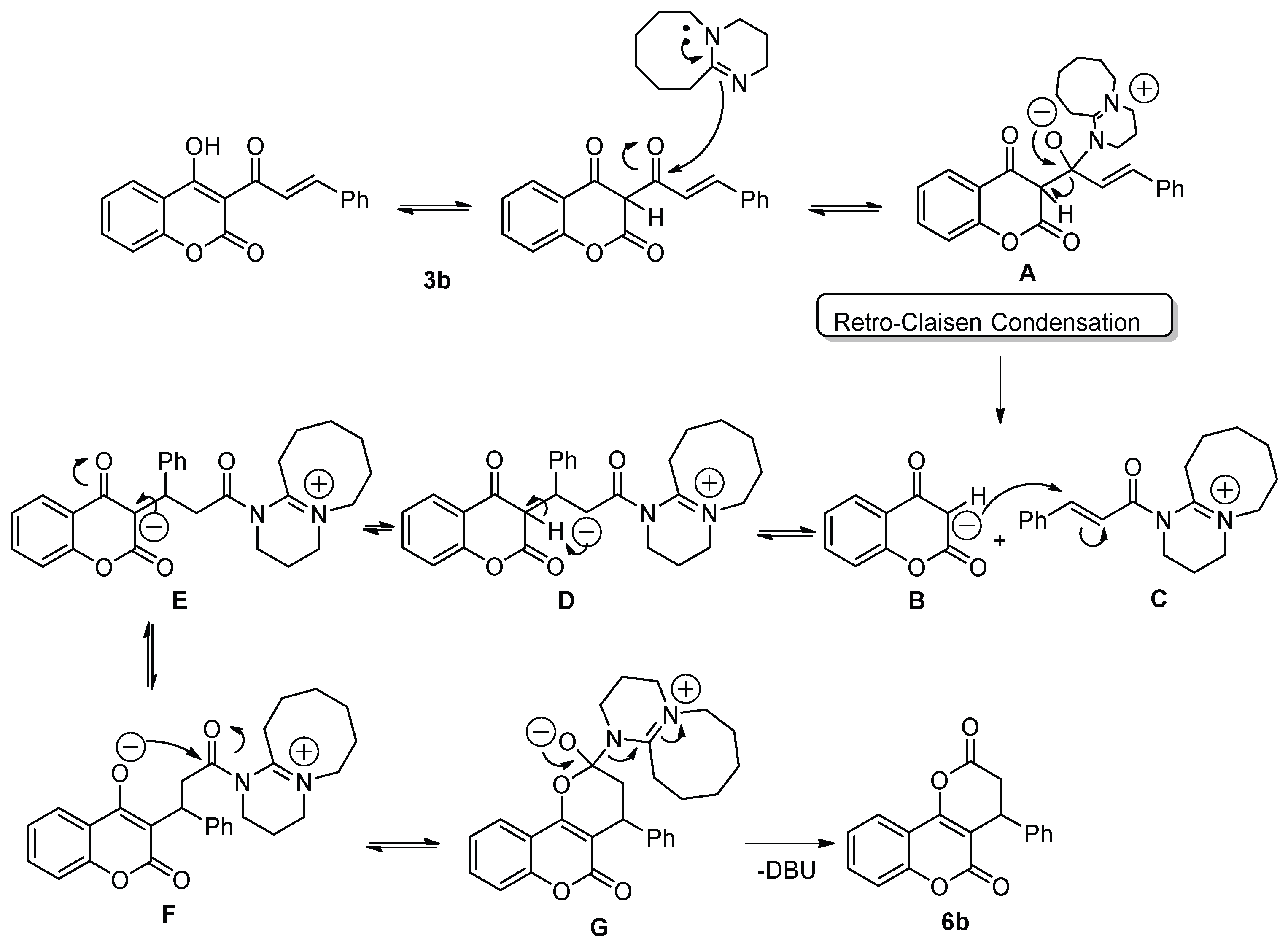

Table 1.
Screening of the reaction conditions. a.
 | ||||
| Entry | Catalyst (15 mol%) |
Solvent | Temperature, Time | 5a, 6a, 3a (yield %)b |
| 1 | Piperidine | CHCl3 | r. t., 2 d | 5a (33), 3a (65) |
| 2 | Piperidine | CHCl3 | reflux, 7 h | 5a (18), 6a (6), 3a (66) |
| 3 | Piperidine | CHCl3 | reflux, 18 h | 5a (15), 6a (11), 3a (53) |
| 4 | Piperidine | Toluene | reflux, 18 h | 5a (2), 6a (55), 3a (35) |
| 5 | Piperidine | DCE | reflux, 18 h | 5a (14), 6a (69), 3a (10) |
| 6 | S-Proline | CHCl3 | reflux, 18 h | 5a (1), 3a (95) |
| 7c | Anh. FeCl3 | Toluene (dry) | reflux, 18 h | 5a (1), 3a (96) |
| 8 | DABCO | DCE | reflux, 18 h | 5a (16), 3a (72) |
| 9 | DBU | DMSO | r. t., 18 h | 3a (100) |
| 10d | DBU | DMSO | 60°C, 20 h | 5a (14), 6a (22), 3a (7) |
| 11 | DBU | CHCl3 | reflux, 18 h | 6a (70) |
| 12 | DBU | DCE | reflux, 7 h | 6a (86) |
| 13 | Et3N | DCE | reflux, 18 h | 6a (50), 3a (39) |
| 14 | tBuOK | THF (dry) | reflux, 18 h | 5a (17), 6a (1), 3a (77) |
| a: 3a (0.1 mmol, 1 equiv.), acetylacetone (0.15 mmol, 1.5 equiv.), base/catalyst (0.015 mmol, 0.15 equiv.), solvent (2 mL), 7 h, the reaction was monitored by tlc; b: Isolated yields; c: N2 atmosphere; d: Complicated reaction mixture | ||||
Table 2.
Reaction of chalcone 3b in the presence of bases and solvents without the presence of 4.a.
 | |||
| Entry | Base (15 mole%) | Solvent | 6a, 3a (yield %)b |
| 1 | Piperidine | DCE | 3a (100) |
| 2 | Et3N | DCE | 3a (100) |
| 3 | S-Proline | DCE | 3a (100) |
| 4 | DBU | DCE | 6a (68%) |
| 5 | DBU | DCM | 3a (100) |
| 6 | DBU | CHCl3 | 3a (100) |
| 7 | DBU | MeOH | 3a (100) |
| 8 | DBU | THF | 6a (57), 3a (17) |
| 9 | DBU | Ethyl acetate | 6a (27), 3a (63) |
| 10 | DBU | MeCN | 6a (40) |
| 11 | DBU | EtOH | 3a (100) |
| 12 | DBU | Toluene | 6a (65) |
|
a: 3a (0.1 mmol, 1 equiv.), base (0.015 mmol, 0.15 equiv.), solvent (2 mL); b: Isolated yields unless otherwise stated | |||
Table 3.
Screening of active methylene compounds for the transformation of 3a to 6a.a.
 | |||
| Entry | Compound | Equivalents | 6a (yield %)b |
| 1 | 4 (R1=R2=Me) | 1.5 | 86 |
| 2 | 4 (R1=R2=Me) | 0.15 | 83 |
| 3 | 7 (R1=Me, R2=OEt) | 1.5 | 76 |
| 4c | 8 (R1=R2=OEt) | 1.5 | 57 |
| a: 3a (0.1 mmol, 1 equiv.) DBU (0.15 equiv.), DCE (2 mL); b: Isolated yields unless otherwise stated; c: reflux for 2 days | |||
Table 4.
Substrate scope of chalcones 3a-l with acetylacetone (4) in the presence of DBU. Synthesis of pyranonocoumarins 6a-l.
Table 4.
Substrate scope of chalcones 3a-l with acetylacetone (4) in the presence of DBU. Synthesis of pyranonocoumarins 6a-l.
 |
 |
|
a: Method A with 1.5 equiv. of 4. b: Method B with 0.15 equiv. of 4. c: 8 h reflux. |
Table 5.
In vitro activities of compounds. Inhibition of soybean lipoxygenase (LOX)/IC50 μM. Inhibition of lipid peroxidation (ILP) % at 100 μM.
Table 5.
In vitro activities of compounds. Inhibition of soybean lipoxygenase (LOX)/IC50 μM. Inhibition of lipid peroxidation (ILP) % at 100 μM.
| Entry | Compounda | LOX/IC50μM |
| 1 | 6a | 50 |
| 2 | 6b | 37.5 μΜ |
| 3 | 6c | 36 |
| 4 | 6d | 35 |
| 5 | 6e | 8.75 μΜ |
| 6 | 6f | 24 |
| 7 | 6g | 7.5 μΜ |
| 8 | 6h | 40.5 μΜ |
| 9 | 6i | 49 |
| 10 | 6j | 35 |
| 11 | 6k | 67.5 μΜ |
| 12 | 6l | no |
| 13 | NDGA | 0.45 μΜ |
|
α : Compounds tested at 100 μM. Values are means ± SD of three or four different determinations. Means within each column differ significantly (p < 0.05). no: no results were given under the reported experimental conditions. | ||
Table 6.
Half maximal effective concentration (EC50) of 6c, 6e, 6g, 6h, 6j in HeLa, and MCF7 Cell lines. Results are presented as mean ± SE of three independent experiments.
Table 6.
Half maximal effective concentration (EC50) of 6c, 6e, 6g, 6h, 6j in HeLa, and MCF7 Cell lines. Results are presented as mean ± SE of three independent experiments.
| Entry | Compound | EC50 | Viability (%) in 100μM | ||
| HeLa | MCF7 | HeLa | MCF7 | ||
| 1 | 6c | >100 | >100 | 72.4 | 76.45 |
| 2 | 6e | >100 | >100 | 70.21 | 71.94 |
| 3 | 6g | >100 | >100 | 73.22 | 78.89 |
| 4 | 6h | >100 | >100 | 88.37 | 80.29 |
| 5 | 6j | >100 | >100 | 68.70 | 77.49 |
Disclaimer/Publisher’s Note: The statements, opinions and data contained in all publications are solely those of the individual author(s) and contributor(s) and not of MDPI and/or the editor(s). MDPI and/or the editor(s) disclaim responsibility for any injury to people or property resulting from any ideas, methods, instructions or products referred to in the content. |
© 2026 by the authors. Licensee MDPI, Basel, Switzerland. This article is an open access article distributed under the terms and conditions of the Creative Commons Attribution (CC BY) license (http://creativecommons.org/licenses/by/4.0/).
Copyright: This open access article is published under a Creative Commons CC BY 4.0 license, which permit the free download, distribution, and reuse, provided that the author and preprint are cited in any reuse.