

Submitted:
06 November 2026
Posted:
09 November 2026
You are already at the latest version
Abstract
Background: Computational drug repurposing increasingly combines electronic health records (EHRs), genomic data and other related omics resources, but the methods used for this purpose and particular datasets have not been fully assessed. Objective: To retrieve and characterise computational approaches that use EHR, genomic or related omics data to identify and prioritise medicines for drug repurposing. Eligibility criteria: We included original research articles, preprints and conference abstracts that described or applied computational methods for drug repurposing using eligible clinical, genomic or related omics data. Literature reviews were used for supplementary reference searching but were not included in the analysis. Publications not written in English were excluded. Sources of evidence: Embase, MEDLINE, Web of Science Core Collection and Epistemonikos were searched from database inception to 30 September 2025. References of relevant reviews were also examined.Charting and synthesis: One reviewer screened the records and extracted publication, data source, methodological, validation and accessibility information using a structured data-charting framework. Findings were summarised with counts, percentages, tables and graphical mapping of methods and data-source combinations. Results: After deduplication and screening, 117 documents were included. Genomic and transcriptomic data were the most common data types, while EHR-based studies commonly used observational causal inference or large-scale target-trial emulation approaches. Functional annotation and integration with drug-target databases were the most frequent methodological strategies. Independent validation of prioritised targets and complete open-source code availability were uncommon. Among studies reporting cohort location, Europe and North America were most frequently represented. Conclusions: Computational drug-repurposing research is expanding and increasingly integrates multiple data domains. Important gaps remain in geographical representation, validation, reproducibility and open-source analytical code availability.
Keywords:
scoping review
; methods
; drug repurposing
; electronic health records
; genomic data
; EHR
Introduction
The expansion of the health and biomedical research domains over the past decade has been substantial. With the digitalisation of healthcare resources, vast amounts of clinically relevant data are generated continuously and at increasing pace and resolution [1,2,3]. Electronic health records (EHRs), which were built mainly for administrative purposes, are now increasingly recognised as valuable sources of evidence generation with potential to aid research and clinical decision-making, including by bodies such as the European Medicines Agency (EMA) and the U.S. Food and Drug Administration (FDA) [4,5]. This shift, together with related technological advances, has facilitated a large number of epidemiological and translational research studies [6].
Analogously, genomics has emerged as the basis of precision medicine [7,8]. By studying the association between genetic variation and disease risk, clinical presentation, and therapeutic response, genomic medicine has been able to provide insights into disease mechanisms, therefore potentially recognising therapeutic avenues, health risks, or tailoring therapeutics to specific patient subgroups [9,10]. Some considerable projects like the NIH-funded All of Us Research Program or the UK Biobank are good examples of how integration of genomic and health data, thanks to technological advances, has enabled scalable genetic discoveries [2,11]. Similar, larger and more diverse efforts like Our Future Health plan to recruit, phenotype, and genotype up to 5 million people residing in the UK in the coming years.
At the same time, drug repurposing research has gained momentum as a strategy to accelerate drug development and reduce costs [12]. By studying potential new indications of drugs already on the market, drug repositioning avoids many of the risks and costs of discovering a drug de novo. There have been several successful examples in recent years, such as sildenafil or remdesivir, which support the promise of these methodologies for areas of urgent clinical need such as the COVID-19 pandemic [13]. Their feasibility has also been boosted by improvements in computational power and methodology [14].
Therefore, the convergence of EHR data, genomics and drug repurposing reflects a shift in health data science. These advances have been reported to be the beginning of the future of medicine as a more data-driven, patient-centred space [15]. There have been previous reviews on this topic, the majority of them addressing broad aspects of this landscape, including overviews of case studies, comparisons of methods or discussions on strengths and limitations of existing pipelines [16,17,18,19]. However, these reviews have often been somehow limited, focusing, for instance, on disease-specific applications. Many remain conceptual rather than methods-focused, and methods-focused reviews rarely explore both types of data sources in the context of drug repurposing. To our knowledge, no comprehensive review has aimed to extract all published research specifically for the following scenario: given a disease of interest, and given access to either real-world clinical or genetics-related data, what computational approaches can be used to identify candidate drugs for repurposing? This review aims to address this gap by systematically identifying and screening the literature at the intersection of EHRs, genomics and computational methods for drug repurposing.
Objective and Aims
The objective of this scoping review was to identify and characterise computational methods that use EHR, genomic or other related omics data to identify or prioritise candidates for drug repurposing.
The review addressed four questions: (1) What computational methods have been used for drug repurposing in this setting? (2) Which data sources, or combinations of data sources, have been used? (3) How have final prioritised drug-repurposing candidates been validated? (4) What methodological, geographical and reproducibility gaps remain?
A scoping review was chosen because the objective was to map the range, characteristics and combinations of methods and data sources rather than to estimate a pooled effect or compare intervention effectiveness.
Methods
Methodological and reporting guidance
The reporting of this completed scoping review was revised with reference to the updated JBI methodological guidance for scoping reviews and the PRISMA extension for Scoping Reviews (PRISMA-ScR) [47,48].
No protocol was developed or registered prospectively before this review was undertaken.
Search strategy
A systematic search was performed on Embase, Medline, Web of Science Core Collection, and Epistemonikos to identify all studies related to drug repurposing, real-world data, such as electronic health records (EHR), and genetic-related data. These four databases were selected to ensure comprehensive coverage of health and biomedical research. This search query was executed on the 30th of September 2025 and only articles published (as pre-prints or in journals) until then are eligible for this review.
The search strategies used for each of them were as follows:
Embase (Ovid, 1974–present):
(“drug repurposing” OR “drug repositioning” OR “drug reprofiling”)
AND
(“real-world data” OR “electronic health record*” OR EHR OR EHRs OR
“electronic medical record*” OR EMR OR EMRs OR “clinical data” OR
“real-world evidence” OR RWD OR “genetic data” OR biobank* OR
“genomic data” OR “phenotypic data” OR “big data”)
Medline (Ovid, 1946–present):
(“drug repurposing” OR “drug repositioning” OR “drug reprofiling”)
AND
(“real-world data” OR “electronic health record*” OR EHR OR EHRs OR
“electronic medical record*” OR EMR OR EMRs OR “clinical data” OR
“real-world evidence” OR RWD OR “genetic data” OR biobank* OR
“genomic data” OR “phenotypic data” OR “big data”)
Epistemonikos:
(title:(“drug repurposing” OR “drug repositioning” OR “drug
reprofiling”) OR abstract:(“drug repurposing” OR “drug repositioning”
OR “drug reprofiling”))
AND
(title:(“real-world data” OR “electronic health record” OR EHR OR EHRs
OR “electronic medical record” OR EMR OR EMRs OR “clinical data” OR
“real-world evidence” OR RWD OR “genetic data” OR biobank*)
OR
abstract:(“real-world data” OR “electronic health record” OR EHR OR
EHRs OR “electronic medical record” OR EMR OR EMRs OR “clinical data”
OR “real-world evidence” OR RWD OR “genetic data” OR biobank*))
Web of Science Core Collection:
TS=(“drug repurposing” OR “drug repositioning” OR “drug reprofiling”)
AND
TS=(“real-world data” OR “electronic health record*” OR EHR OR EHRs OR
“electronic medical record*” OR EMR OR EMRs OR “clinical data” OR
“real-world evidence” OR RWD OR “genetic data” OR biobank*)
Eligibility criteria
Sources were eligible when they (1) described or applied a computational or statistical method to identify and prioritise medicines for drug repurposing; (2) used EHR, real-world clinical, genomic or related omics data relevant to the review questions; and (3) were available as an original research article, preprint or conference abstract with sufficient methodological information for classification.
No restrictions were applied by disease, therapeutic area, country or healthcare setting. Eligible publication dates extended from database inception to 30 September 2025. Only publications written in English were included.
Other literature or scoping reviews were excluded from the final document list to avoid double-counting, but their reference lists were examined to identify additional potentially eligible sources.
Evidence selection
Records were imported into Rayyan for deduplication and screening [49]. Rayyan’s automated duplicate-detection function flagged exact and potential duplicate records. Confirmed duplicates were removed, while uncertain ones were reviewed manually before further screening.
After deduplication, one reviewer screened all titles and abstracts and assessed potentially eligible documents in full text. The same reviewer made all final inclusion decisions; no independent duplicate screening was undertaken.
Titles and abstracts were screened against the following exclusion criteria:
- They were not focused on drug repurposing.
- They were not focused on methodological aspects.
- They used the wrong data or had the wrong setting. For instance, we did exclude papers focussed on methods revolving around chemical binding, molecular dynamics or animal testing. We also excluded papers focused on methods testing a pre-defined set of candidate drugs against a disease, or combined multiple diseases in their analyses. This block was separated into three sub-criteria: EHR-based, which refers to those which were excluded because they tested a set of candidate drugs against a disease using EHR data; MR-based, a tag used for analyses which tested a set of candidate drugs using Mendelian Randomisation; and the rest.
- They were the wrong publication type. Given that the focus of this review is on the methods, some exclusions were warranted due to a lack of pertinent or available information in the documents extracted, such as editorial letters. Therefore, all original research papers (both traditionally published or pre-prints) and conference abstracts were included. Other publication types, like editorials, were not.
Afterwards, some full text papers could not be retrieved for further screening, and those were also naturally excluded from the analysis.
Finally, all previous literature reviews were excluded from the analysis, but their references were scanned to add additional relevant methodological papers to the set of studies to assess.
Data extraction
From each included manuscript, we extracted a structured common set of variables reflecting publication details, study design and methodological features. These included:
- Bibliographic details: year of publication, first author, journal.
- Therapeutic area: disease or therapeutic area studied.
- Geographic context: region or country of data origin.
- Size: sample size of the underlying cohort studied, if applicable.
- Publication details: pre-print or not, method development or application.
- Data: EHR, genomics, proteomics, transcriptomics, other.
- Methodological approach: Genome-Wide Association Study (GWAS), Proteome-Wide Association Study (ProWAS), Phenome-Wide Association Study (PheWAS), Transcriptome-Wide Association Study (TWAS), functional annotation (e.g., FUMA), large-scale trial emulation studies, supervised machine learning (ML), deep learning (DL), network analysis, colocalisation (for instance, using Bayesian approaches), drug-target db (adding drug-target data from common databases like DrugBank to the pipeline, irrespective of other methods used to analyse it), or other.
- Data accessibility: whether datasets used were open source or proprietary.
- Validation strategy: type of validation (in vivo, in vitro, with an independent cohort, in silico, etc.).
For the data methodological approaches, the geographic context, the data type and the validation strategies, multiple options were allowed.
Summary tables and plots were created from this extracted dataset to gauge popularity of methods and datasets, explore correlation, and highlight any other points of interest.
Categorical characteristics were summarised using counts and percentages. Because individual sources could use more than one data type, method or validation strategy, these categories were not mutually exclusive, and percentages can sum to more than 100%. Co-occurrence plots were used to map combinations of methods and data types; a Sankey diagram was used to display the relationships between data types and methods. Annual counts were plotted to describe changes over time. Rare method combinations occurring in fewer than two sources were omitted from the main combination plot for visual clarity and are retained in the Supplementary Materials.
Critical appraisal
No formal critical appraisal or risk-of-bias assessment was undertaken because the purpose of the review was to assess the range and characteristics of computational approaches rather than to estimate intervention effects or make clinical recommendations.
Results
Attrition
Figure 1 shows the flow of sources through the review. Searches identified 1,594 records, of which 724 were removed as duplicates, leaving 870 records for title-and-abstract screening. Of these, 712 were excluded: 197 were not focused on drug repurposing, 140 were not methods-focused, 335 used an ineligible data source or setting, and 40 had an ineligible publication type. This left 158 reports sought for retrieval; 13 could not be retrieved, and 145 full texts were assessed. Forty-five reviews were excluded from the analytic dataset, but examination of their reference lists identified 17 additional eligible sources. The final review therefore included 117 sources for data extraction.
Characteristics of the selected papers
Basic characteristics of the 117 papers included are summarised in Table 1 and Figure 2. A full list of all papers and their basic information (title, authors, year of publication, journal, data and methods) can be found in Supplementary Table S1.
We can see there was a clear increase in the publication of this type of paper after 2020, where in one year the number of articles practically doubled. As of 2024, this increase was less pronounced but still steady, that year being the most prolific with 26 (22.2%) articles published.
Of the extracted papers, 16.2% were methodological in nature, with 90.6% being case studies (some articles qualified for both classes). The most commonly investigated therapeutic areas were psychiatry (14.5%), neurology (11.1%) and metabolic/endocrine (7.7%).
Of those reporting geography of cohorts studied (or where pertinent), European (45.3%) and North American (23.1%) were the most represented, while other geographical areas, such as Africa (4.3%), South America (1.7%) or Oceania (0.9%) appeared in almost no studies. Of those reported, sample sizes were usually between 100k-1M (30 articles, 25.6%) and 10k-100k (23 articles, 19.7%). Only 7 articles (6%) had a sample size >1M.
The vast majority of included manuscripts were peer-reviewed (100 papers, or 85.5%), with only 17 pre-prints included (14.5%). The majority did not include publicly available analytical code (76 papers, or 65%), with a few partially reporting code (15 articles, 12.8%) and only 26 of them with full code disclosure (22.2%).
Validation of drug candidates was also rare. Most articles did not perform any validation (88, or 75.2%). Of the ones that did, the most common method was validation using EHR data (10 articles, 8.5%), followed by validation in an independent population -usually another genomic dataset- (6 articles, 5.1%) or through manual literature search (5 articles, 4.3%).
Regarding data sources, genomics data was by far the most popular, with 89 papers (76.1%), followed by transcriptomics (62 articles, 53%) and both proteomics and EHR data tied with 25 articles each (21.4%).
The most common analytical method was integrating information from a drug-target database (84 projects, or 71.8%), with functional annotation (67, 57.3%) coming as a close second. Transcriptome-wide association studies were also quite popular, with 32 studies employing it (27.4%), as well as colocalisation (28 papers, 23.9%), Mendelian randomisation (24 articles, 20.5%) and GWAS (22 articles, 18.8%). Newer methodologies in this area, such as network analyses (16 papers, 13.7%), Deep learning (8 papers, 6.8%) or supervised Machine learning (5 papers, 4.3%), were also notably present.
In-depth analysis of methods and data used
This section details the data and methods used and, in particular, how they occur in combination. Figure 3 shows the most common combinations of methods implemented in the included sources. Methods are shown on the y-axis, and selected combinations are shown on the x-axis; marginal bar plots are also included. Uncommon methods were aggregated in the ‘Other’ category, and combinations occurring in fewer than two sources were omitted. The complete plot is provided in Supplementary Figure S1.
The most common combination was functional annotation in conjunction with data from a drug-target database (16 reports). That was followed by both EHR-related methods: observational causal inference analyses (12 reports); and performing a large-scale emulation of a trial through an observational study (5 reports). These two methods were almost exclusively used on their own, and that is also why the counts are quite large. For genetic-related methods, many different techniques were used, which explains the small counts for all combinations available. For instance, multiple combinations emerge from integrating functional annotation, drug-target database and a third method: TWAS (4 times), network analysis (3 times), ProWAS (2 times), or GWAS (2 times), among others. Newest methods tend to appear alone or together, like network analysis (2 times on its own), or together with deep learning (2 times as well).
A similar plot can be explored for the data used in the selected papers in Figure 4. By far, using genomics and transcriptomics together was the most common (co-occurring 45 times), followed by EHR data (22 times), which as expected tends to be used on its own. Genomics data was the second most popular for single data-type studies, with 18 counts. The most common triangulation included genomics, proteomics and transcriptomics, which appeared 12 times.
As for the intersection between data and methods, many occurrences were to be expected. That correlation can be seen in a Sankey plot: Figure 5. For instance, large-scale trial emulations or observational causal inference were mostly done with EHR data. Papers using GWAS often mined genomic data, and TWAS methods were usually applied to transcriptomics data (though, due to the co-occurrence of both methods, articles usually included both data types and analyses). Notably, DL methods were mostly applied to EHR and genomics, and network analyses to all of genomics, proteomics and transcriptomic datasets.
All of these methods have seen an increase in use over time. This can be seen in Figure 6. Some methods precede others (observational causal inference, functional annotation, integration of drug-target data), while some have appeared recently (TWAS, PheWAS). Regarding data sources, EHR is the oldest type of data included, while transcriptomics is the latest, first seen in 2016.
Selected examples
The following section describes selected examples of the source types identified. Table 2 summarises these examples, which illustrate the diversity of methods applied to single and integrated data sources.
Genomics-based drug repurposing studies
Several articles primarily used functional annotation together with incorporated drug-target datasets. Tragante et al. (2018) [20] identified candidate drugs for cardiovascular traits using genomic and proteomic data. Chen et al. (2023) [21] combined this approach with transcriptomic data, implementing a TWAS to link genetic variation with gene expression alongside ancestry information. Yun et al. (2025) [22] used genomic and transcriptomic data and performed a GWAS as the first step of the pipeline. They also applied a deep-learning algorithm to select relevant cancer-related genes.
EHR-based drug repurposing studies
Regarding projects based on EHR data, two main pipelines arise. One, employed for instance by Ryu et al. (2023) [23], could be defined as “observational causal inference”, and includes a multiplicity of core statistical and more complex ML methods combined with causal inference. In their case, they train an XGBoost survival model to assess treatment effects in cancer. Another example is the article by Liu et al. (2021) [24], where they devise a deep learning framework to predict probability of treatment and demonstrate it with a cohort of patients with coronary artery disease. The second pipeline revolves around emulating many randomised control trials, in a large-scale fashion. Jung et al. (2024) [25] analysed Danish cohort and nine major disease outcomes using this approach, with an added layer of targeted inference.
Combined approaches
Other studies highlight the breadth of combining different approaches, usually in the context of genetics-related datasets. Toikumo et al. (2024) [26] presented one of the most comprehensive multi-omics pipelines, integrating genomics, proteomics, and transcriptomics with colocalisation, Mendelian randomisation (MR), polygenic risk scores (PRS), phenome- and proteome-wide association studies (PheWAS/ProWAS), heritability, GWAS and TWAS. This study is a good example of a multi-perspective multi-omics integration which has become standard practice in this area.
Network analysis methods
Network analysis, meaning methods using data in a graph format, has been steadily used in conjunction with other methods. Tsuji et al. (2018) [50] integrated that approach with deep learning and machine learning by combining drug and gene data into a represented network via a deep autoencoder and then summarising the network with usual statistics and building a ML model for drug candidate prediction in cancer genomics. Dou et al. (2025) [28] provide another example, as they combined EHR, genomics, proteomics, and transcriptomics in a network framework to uncover mechanisms underlying Parkinson’s disease, by calculating the shortest path between relevant nodes in the graph.
Discussion
Overview of findings
Across the 117 included sources, genomics was the most frequently used data type (89 sources, 76.1%), followed by transcriptomics (62, 53.0%). The dominant methods were integration with drug-target databases (84, 71.8%) and functional annotation (67, 57.3%). TWAS (32, 27.4%), colocalisation (28, 23.9%), Mendelian randomisation (24, 20.5%) and GWAS (22, 18.8%) were also commonly employed. EHR data were used in 25 sources (21.4%), while network analysis (16, 13.7%), deep learning (8, 6.8%) and supervised machine learning (5, 4.3%) formed smaller but distinct methodological approaches. Because categories were not mutually exclusive, these percentages do not sum to 100%.
Trends over time suggest a gradual shift toward multi-modal and data-driven approaches, reflecting both the growing availability of large-scale datasets and advances in computational methods. Many methods are employed rather ubiquitously in the area, therefore allowing us to group certain articles together from a methodological viewpoint, yet many papers present unique techniques as well, standing out as the sole example of their selected combination of data domains and methods applied.
Several studies used EHR, with either a causal inference approach [23,25], a large-scale target trial emulation method [29], or integrating with more data-driven approaches, like deep learning frameworks [24,30].
A great number of them relied on genomics and functional annotation, often supplemented with additional omics layers. Some integrated proteomics to the pipeline [20], some integrated transcriptomics [21,22,31], or both [32,33,34,35], sometimes with additional techniques such as PRS calculation, network analysis, TWAS or ProWAS analyses. Other larger multi-omics efforts combined functional annotation, colocalisation, clustering, ProWAS, TWAS, PRS, or Mendelian randomisation to provide a more comprehensive pipeline [26,36,37,38,39,40,41].
A recurring theme is the integration of network analysis and machine learning, sometimes in combination with deep learning. Examples include applications in Alzheimer’s disease [27,42], for vesicular hand eczema [43], neurological disease [28], diabetes [44] and heart failure [45]. This group also includes early methods development on supervised ML [46].
Among studies reporting a cohort location, Europe and North America were most frequently represented, with fewer studies from Asia, Africa, Oceania and South America. This concentration may limit the generalisability of the findings and may reflect differences in infrastructure, data access, privacy regulation and funding. Furthermore, complete open-source analytical code was uncommon, limiting transparency, reproducibility and opportunities for methodological development. These gaps support broader international collaboration, improved data-sharing practices and stronger commitments to open science.
Validation of candidate drugs or targets was reported in 29 studies (24.8%), including cross-referencing genetic findings with EHR data, testing in independent populations, in vivo or in vitro experiments, and in silico analyses such as molecular docking. No prospective clinical validation or randomised controlled trial of a candidate identified by these computational pipelines was reported. This limits conclusions about whether the methods yield clinically effective candidates. Further evaluation of their robustness and clinical relevance will be needed as evidence on prioritised candidates accumulates.
Methodological considerations and limitations
Several limitations should be discussed. Firstly, the screening and data extraction were performed by only one reviewer which might have introduced selection bias, data extraction errors or inconsistent classification. Secondly, some heterogeneity in terminology and reporting existed between studies, making direct comparison of methods and results difficult, and particularly at the abstract stage, with limited information available. Finally, even though this review aimed to be comprehensive, some literature might have been missed due to database indexing or language barriers. For instance, a dedicated grey-literature search was not included.
Future directions
This discipline is still growing and is likely to expand substantially. The increasing availability of large-scale, multi-modal datasets, combined with advances in computation technologies and pipelines, will likely support the identification of more candidate drugs for new and old diseases. Further, the addition of open-access code and more cross-country collaborations, as well as added funding and accessibility to datasets from under-represented communities, may help address current geographical inequality gaps. Integration of other data types, like real-time patient monitoring or imaging data, could also improve the effectiveness of these methods in the future. All these opportunities offer an unprecedented chance for precision medicine and expeditious drug repurposing.
Conclusions
Computational drug-repurposing research in this review was dominated by genomics- and transcriptomics-based pipelines integrating drug-target databases and functional annotation. EHR-based causal inference and target-trial emulation, together with network and deep-learning approaches, represented smaller but distinct methodological strands. Reported cohort locations were concentrated in Europe and North America, and most studies did not provide complete open-source analytical code. The field is likely to expand as computational methods and open-access resources advance, but important gaps remain in population coverage, reproducibility and methodological validation.
Declarations
Supplementary Materials
The following supporting information can be downloaded at the website of this paper posted on Preprints.org.
Author Contributions
Conceptualisation: DPA and KLG. Formal analysis: DPA, KLG and JX. Software: KLG. Writing - original draft: KLG and DPA. Writing - review and editing: KLG, JX, DPA, AJ and MC.
Funding
KLG was supported by the Medical Research Council (grant number MR/W006731/1) and Bayer AG. DPA is funded through a National Institute for Health and Care Research Senior Research Fellowship (grant number SRF-2018-11-ST2-004). The views expressed in this publication are those of the authors and not necessarily those of the National Institute for Health and Care Research or the Department of Health and Social Care.
Data availability
All data underlying this scoping review were extracted from published sources. The complete list of included sources and the corresponding data-charting fields are provided in Supplementary Table S1.
Acknowledgments
We especially thank Katherine Steiner, Library Manager at the Bodleian Health Care Libraries in Oxford, for her support and expertise in the data extraction process.
Competing interests
DPA’s department has received grants from Amgen, Chiesi-Taylor, Lilly, Janssen, Novartis and UCB Biopharma. His research group has received consultancy fees from AstraZeneca and UCB Biopharma. Amgen, Astellas, Janssen, Synapse Management Partners and UCB Biopharma have funded or supported training programmes organised by DPA’s department. The other authors declare no competing interests.
Ethics statement
This study used information from published reports and involved no participant recruitment, intervention, or identifiable individual-level human data; therefore, ethics approval and participant consent were not required.
References
- World Health Organization. Global strategy on digital health 2020–2025; WHO: Geneva, 2021.
- The All of Us Research Program Genomics Investigators. Genomic data in the All of Us Research Program. Nature 2024, 627, 340–346. [CrossRef] [PubMed]
- Cook, M.B.; Sanderson, S.C.; Deanfield, J.E.; et al. Our Future Health: a unique global resource for discovery and translational research. Nat. Med. 2025, 31, 728–730. [Google Scholar] [CrossRef] [PubMed]
- U.S. Food and Drug Administration. Real-World Data: Assessing Electronic Health Records and Medical Claims Data To Support Regulatory Decision-Making for Drug and Biological Products. FDA Guidance for Industry, 2024. [Google Scholar]
- European Medicines Agency. Real-world evidence framework to support EU regulatory decision-making: 3rd report on the experience gained with regulator-led studies from February 2024 to February 2025. EMA, 2025.
- Park, K. The use of real-world data in drug repurposing. Transl. Clin. Pharmacol. 2021, 29(3), 117–124. [Google Scholar] [CrossRef] [PubMed] [PubMed Central]
- Roden, D.M.; Wilke, R.A.; Kroemer, H.K.; Stein, C.M. Pharmacogenomics: the genetics of variable drug responses. Circulation 2011, 123(15), 1661–70. [Google Scholar] [CrossRef] [PubMed] [PubMed Central]
- Khan, A.; Barapatre, A.R.; Babar, N.; Doshi, J.; Ghaly, M.; Patel, K.G.; Nawaz, S.; Hasana, U.; Khatri, S.P.; Pathange, S.; Pesaru, A.R.; Puvvada, C.S.; Billoo, M.; Jamil, U. Genomic medicine and personalized treatment: a narrative review. Ann. Med. Surg. (Lond) 2025, 87(3), 1406–1414. [Google Scholar] [CrossRef] [PubMed] [PubMed Central]
- Weinshilboum, R.M.; Wang, L. Pharmacogenomics: Precision Medicine and Drug Response. Mayo Clin. Proc. 2017, 92(11), 1711–1722. [Google Scholar] [CrossRef] [PubMed] [PubMed Central]
- Mani, S.; Lalani, S.R.; Pammi, M. Genomics and multiomics in the age of precision medicine. Pediatr. Res. 2025, 97, 1399–1410. [Google Scholar] [CrossRef] [PubMed]
- Sudlow, C.; Gallacher, J.; Allen, N.; Beral, V.; Burton, P.; Danesh, J.; Downey, P.; Elliott, P.; Green, J.; Landray, M.; Liu, B.; Matthews, P.; Ong, G.; Pell, J.; Silman, A.; Young, A.; Sprosen, T.; Peakman, T.; Collins, R. UK biobank: an open access resource for identifying the causes of a wide range of complex diseases of middle and old age. PLoS Med. 2015, 12(3), e1001779. [Google Scholar] [CrossRef] [PubMed] [PubMed Central]
- Parvathaneni, V.; Kulkarni, N.S.; Muth, A.; Gupta, V. Drug repurposing: a promising tool to accelerate the drug discovery process. Drug Discov. Today 2019, 24(10), 2076–2085. [Google Scholar] [CrossRef] [PubMed] [PubMed Central]
- Akinosoglou, K.; Rigopoulos, E.A.; Schinas, G.; Kaiafa, G.; Polyzou, E.; Tsoupra, S.; Tzouvelekis, A.; Gogos, C.; Savopoulos, C. Remdesivir Use in the Real-World Setting: An Overview of Available Evidence. Viruses 2023, 15(5), 1167. [Google Scholar] [CrossRef] [PubMed] [PubMed Central]
- Saranraj, K.; Kiran, P.U. Drug repurposing: Clinical practices and regulatory pathways. Perspect. Clin. Res. 2025, 16(2), 61–68. [Google Scholar] [CrossRef] [PubMed] [PubMed Central]
- Dzau, V. J.; Ginsburg, G. S.; Chopra, A.; Goldman, D.; Green, E. D.; Leonard, D. G. B.; McClellan, M.; Plump, A.; Terry, S. F.; Yamamoto, K. R. Realizing the Full Potential of Precision Medicine in Health and Health Care: A Vital Direction for Health and Health Care. NAM Perspectives. Discussion Paper; National Academy of Medicine: Washington, DC, 2016. [Google Scholar] [CrossRef]
- Kulkarni, V.S.; Alagarsamy, V.; Solomon, V.R.; Jose, P.A.; Murugesan, S. Drug Repurposing: An Effective Tool in Modern Drug Discovery. Russ. J. Bioorg Chem. 2023, 49(2), 157–166. [Google Scholar] [CrossRef] [PubMed] [PubMed Central]
- Zong, N.; Wen, A.; Moon, S.; et al. Computational drug repurposing based on electronic health records: a scoping review. npj Digit. Med. 2022, 5, 77. [Google Scholar] [CrossRef] [PubMed]
- Tanoli, Z.; Fernández-Torras, A.; Özcan, U.O.; et al. Computational drug repurposing: approaches, evaluation of in silico resources and case studies. Nat. Rev. Drug Discov. 2025, 24, 521–542. [Google Scholar] [CrossRef] [PubMed]
- Herráiz-Gil, S.; Nygren-Jiménez, E.; Acosta-Alonso, D.N.; León, C.; Guerrero-Aspizua, S. Artificial Intelligence-Based Methods for Drug Repurposing and Development in Cancer. Appl. Sci. 2025, 15(5), 2798. [Google Scholar] [CrossRef]
- Tragante, V.; Hemerich, D.; Alshabeeb, M.; Brænne, I.; Lempiäinen, H.; Patel, R.S.; den Ruijter, H.M.; Barnes, M.R.; Moore, J.H.; Schunkert, H.; Erdmann, J.; Asselbergs, F.W. Druggability of Coronary Artery Disease Risk Loci. Circ. Genom. Precis Med. 2018, 11(8), e001977. [Google Scholar] [CrossRef] [PubMed] [PubMed Central]
- Chen, F.; Wang, X.; Jang, S.K.; et al. Multi-ancestry transcriptome-wide association analyses yield insights into tobacco use biology and drug repurposing. Nat. Genet 2023, 55, 291–300. [Google Scholar] [CrossRef] [PubMed]
- Yun, D.; Yang, J.H.; Sim, Ja.; et al. Identification of MMP14 and MKLN1 as colorectal cancer susceptibility genes and drug-repositioning candidates from a genome-wide association study. J. Transl. Med. 2025, 23, 543. [Google Scholar] [CrossRef] [PubMed]
- Ryu, A.J.; Kumar, S.; Dispenzieri, A.; Kyle, R.A.; Rajkumar, S.V.; Kingsley, T.C. Artificial intelligence-enabled screening strategy for drug repurposing in monoclonal gammopathy of undetermined significance. Blood Cancer J. 2023, 13(1), 28. [Google Scholar] [CrossRef] [PubMed] [PubMed Central]
- Liu, R.; Wei, L.; Zhang, P. A deep learning framework for drug repurposing via emulating clinical trials on real-world patient data. Nat. Mach. Intell. 2021, 3(1), 68–75. [Google Scholar] [CrossRef] [PubMed] [PubMed Central]
- Jung, A.W.; Louloudis, I.; Brunak, S.; Mortensen, L.H. Targeted inference to identify drug repositioning candidates in the Danish health registries. medRxiv 2024. [Google Scholar] [CrossRef]
- Toikumo, S.; Vickers-Smith, R.; Jinwala, Z.; et al. A multi-ancestry genetic study of pain intensity in 598,339 veterans. Nat. Med. 2024, 30, 1075–1084. [Google Scholar] [CrossRef] [PubMed]
- Tsuji, S.; Hase, T.; Yachie-Kinoshita, A.; Nishino, T.; Ghosh, S.; Kikuchi, M.; Shimokawa, K.; Aburatani, H.; Kitano, H.; Tanaka, H. Artificial intelligence-based computational framework for drug-target prioritization and inference of novel repositionable drugs for Alzheimer’s disease. Alzheimers Res. Ther. 2021, 13(1), 92. [Google Scholar] [CrossRef] [PubMed] [PubMed Central]
- Dou, L.; Xu, Z.; Xu, J.; et al. A network-based systems genetics framework identifies pathobiology and drug repurposing in Parkinson’s disease. npj Park. Dis. 2025, 11, 22. [Google Scholar] [CrossRef] [PubMed]
- Zang, C.; Zhang, H.; Xu, J.; et al. High-throughput target trial emulation for Alzheimer’s disease drug repurposing with real-world data. Nat. Commun. 2023, 14, 8180. [Google Scholar] [CrossRef] [PubMed]
- Miranda, O.; Jiang, C.; Qi, X.; Kofler, J.; Sweet, R.A.; Wang, L. Exploring Potential Medications for Alzheimer’s Disease with Psychosis by Integrating Drug Target Information into Deep Learning Models: A Data-Driven Approach. Int. J. Mol. Sci. 2025, 26, 1617. [Google Scholar] [CrossRef] [PubMed]
- McDonald, M.N.; Lakshman Kumar, P.; Srinivasasainagendra, V.; Nair, A.; Rocco, A.P.; Wilson, A.C.; Chiles, J.W.; Richman, J.S.; Pinson, S.A.; Dennis, R.A.; Jagadale, V.; Brown, C.J.; Pyarajan, S.; Tiwari, H.K.; Bamman, M.M.; Singh, J.A. Novel genetic loci associated with osteoarthritis in multi-ancestry analyses in the Million Veteran Program and UK Biobank. Nat. Genet. 2022, 54(12), 1816–1826. [Google Scholar] [CrossRef] [PubMed]
- Reay, William R.; et al. Genetics-informed precision treatment formulation in schizophrenia and bipolar disorder. Am. J. Hum. Genet. Volume 109(Issue 9), 1620–1637. [CrossRef] [PubMed]
- Ni, F.; et al. Proteome-wide Mendelian randomization and functional studies uncover therapeutic targets for polycystic ovarian syndrome. Am. J. Hum. Genet. Volume 111(Issue 12), 2799–2813. [CrossRef] [PubMed]
- Chen, L.; Kelleher, E.; Meng, R.; Liu, D.; Guo, Y.; Wang, Y.; Gao, Y.; Huang, Z.; Liang, Z.; Yuan, S.; Zeng, C.; Ma, J.; Dong, Y.; Irani, A.; Lei, G.; Xie, J.; Prieto-Alhambra, D. Diagnosis, Prognosis, and Drug Target Discovery for Chronic Widespread Pain: A Large Proteogenomic Study. Adv. Sci. (Weinh) 2025, 12(47), e07691. [Google Scholar] [CrossRef] [PubMed] [PubMed Central]
- Liu, J.; Zeng, D.; Wang, Y.; et al. Identification of druggable targets in acute kidney injury by proteome- and transcriptome-wide Mendelian randomization and bioinformatics analysis. Biol. Direct 2025, 20, 38. [Google Scholar] [CrossRef] [PubMed]
- International League Against Epilepsy Consortium on Complex Epilepsies. GWAS meta-analysis of over 29,000 people with epilepsy identifies 26 risk loci and subtype-specific genetic architecture. Nat. Genet 2023, 55, 1471–1482. [Google Scholar] [CrossRef] [PubMed]
- Woodward, D.J.; Thorp, J.G.; Akosile, W.; Ong, J.S.; Gamazon, E.R.; Derks, E.M.; Gerring, Z.F. Identification of drug repurposing candidates for the treatment of anxiety: A genetic approach. Psychiatry Res. 2023, 326, 115343. [Google Scholar] [CrossRef] [PubMed] [PubMed Central]
- Lim, A.M.W.; et al. Unsupervised clustering identified clinically relevant metabolic syndrome endotypes in UK and Taiwan Biobanks. iScience Volume 27(Issue 7), 109815. [CrossRef] [PubMed]
- Wang, X.; Pang, W.; Hu, X.; et al. Conventional and genetic association between migraine and stroke with druggable genome-wide Mendelian randomization. Hum. Genet. 2025, 144, 391–404. [Google Scholar] [CrossRef] [PubMed]
- The MULTI consortium; Boquet-Pujadas, A.; Anagnostakis, F.; Duggan, M.R.; Joynes, C.M.; et al. Brain-heart-eye axis revealed by multi-organ imaging, genetics and proteomics. medRxiv 2025. [Google Scholar] [CrossRef] [PubMed]
- Wang, J.H.; Dong, S.S.; Huang, W.; et al. Blood plasma proteome-wide association study implicates novel proteins in the pathogenesis of multiple cardiovascular diseases. Cardiovasc Diabetol. 2025, 24, 312. [Google Scholar] [CrossRef] [PubMed]
- Xu, J.; et al. Interpretable deep learning translation of GWAS and multi-omics findings to identify pathobiology and drug repurposing in Alzheimer’s disease. Cell Rep. Volume 41(Issue 9), 111717. [CrossRef] [PubMed]
- Rosenberg, F.M.; Kamali, Z.; Voorberg, A.N.; Oude Munnink, T.H.; van der Most, P.J.; Snieder, H.; Vaez, A.; Schuttelaar, M.L.A. Transcriptomics- and Genomics-Guided Drug Repurposing for the Treatment of Vesicular Hand Eczema. Pharmaceutics 2024, 16, 476. [Google Scholar] [CrossRef] [PubMed]
- Zhong, X.; Wei, Q.; Tiwari, A.; Wang, Q.; Tan, Y.; Chen, R.; Yan, Y.; Cox, N.J.; Li, B. A Genetics-guided Integrative Framework for Drug Repurposing: Identifying Anti-hypertensive Drug Telmisartan for Type 2 Diabetes. medRxiv [Preprint] 2025, 2025.03.22.25324223. [Google Scholar] [CrossRef] [PubMed] [PubMed Central]
- Zong, N.; Chowdury, S.; Zhou, S.; et al. Advancing Efficacy Prediction for EHR-based Emulated Trials in Repurposing Heart Failure Therapies. medRxiv 2023. [Google Scholar] [CrossRef] [PubMed]
- Lötsch, J.; Lippmann, C.; Kringel, D.; Ultsch, A. Integrated computational analysis of genes associated with human hereditary insensitivity to pain: A drug repurposing perspective. Front. Mol. Neurosci. 2017, 10, 252. [Google Scholar] [CrossRef] [PubMed]
- Peters, M.D.J.; Marnie, C.; Tricco, A.C.; Pollock, D.; Munn, Z.; Alexander, L.; McInerney, P.; Godfrey, C.M.; Khalil, H. Updated methodological guidance for the conduct of scoping reviews. JBI Evid. Synth. 2020, 18(10), 2119–2126. [Google Scholar] [CrossRef] [PubMed]
- Tricco, A.C.; Lillie, E.; Zarin, W.; O’Brien, K.K.; Colquhoun, H.; Levac, D.; et al. PRISMA extension for scoping reviews (PRISMA-ScR): checklist and explanation. Ann. Intern Med. 2018, 169(7), 467–473. [Google Scholar] [CrossRef] [PubMed]
- Ouzzani, M.; Hammady, H.; Fedorowicz, Z.; Elmagarmid, A. Rayyan—a web and mobile app for systematic reviews. Syst. Rev. 2016, 5, 210. [Google Scholar] [CrossRef] [PubMed]
- Tsuji, S.; Hase, T.; Tanaka, H.; Aburatani, H. AI technology-based drug discovery method with protein interaction network for cancer drug repositioning. Cancer Sci. 2018, 109, 786. [Google Scholar]
Figure 1.
Flowchart of the abstracts screened for the literature review.
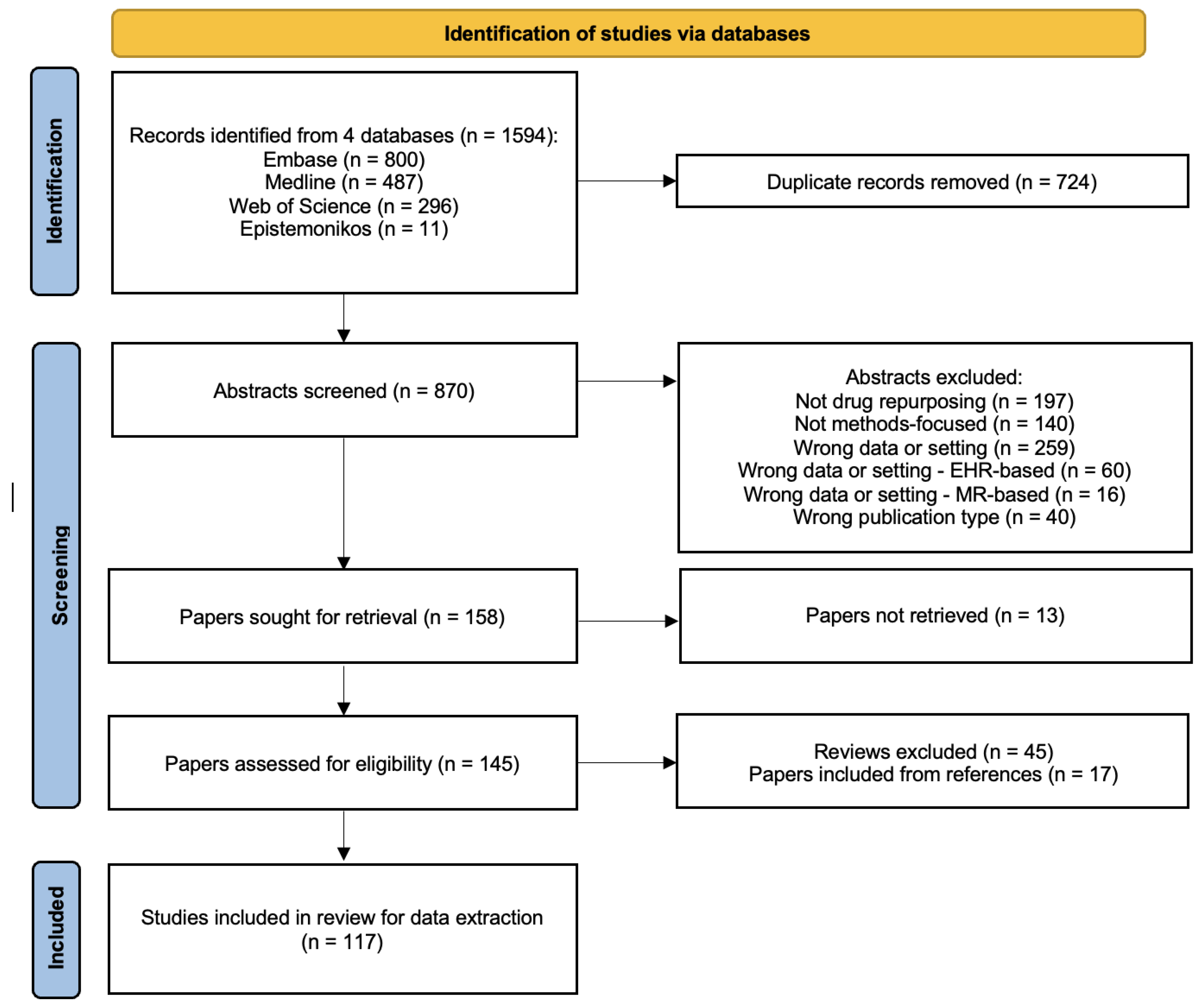
Figure 2.
Characteristics of the selected papers in the literature review.
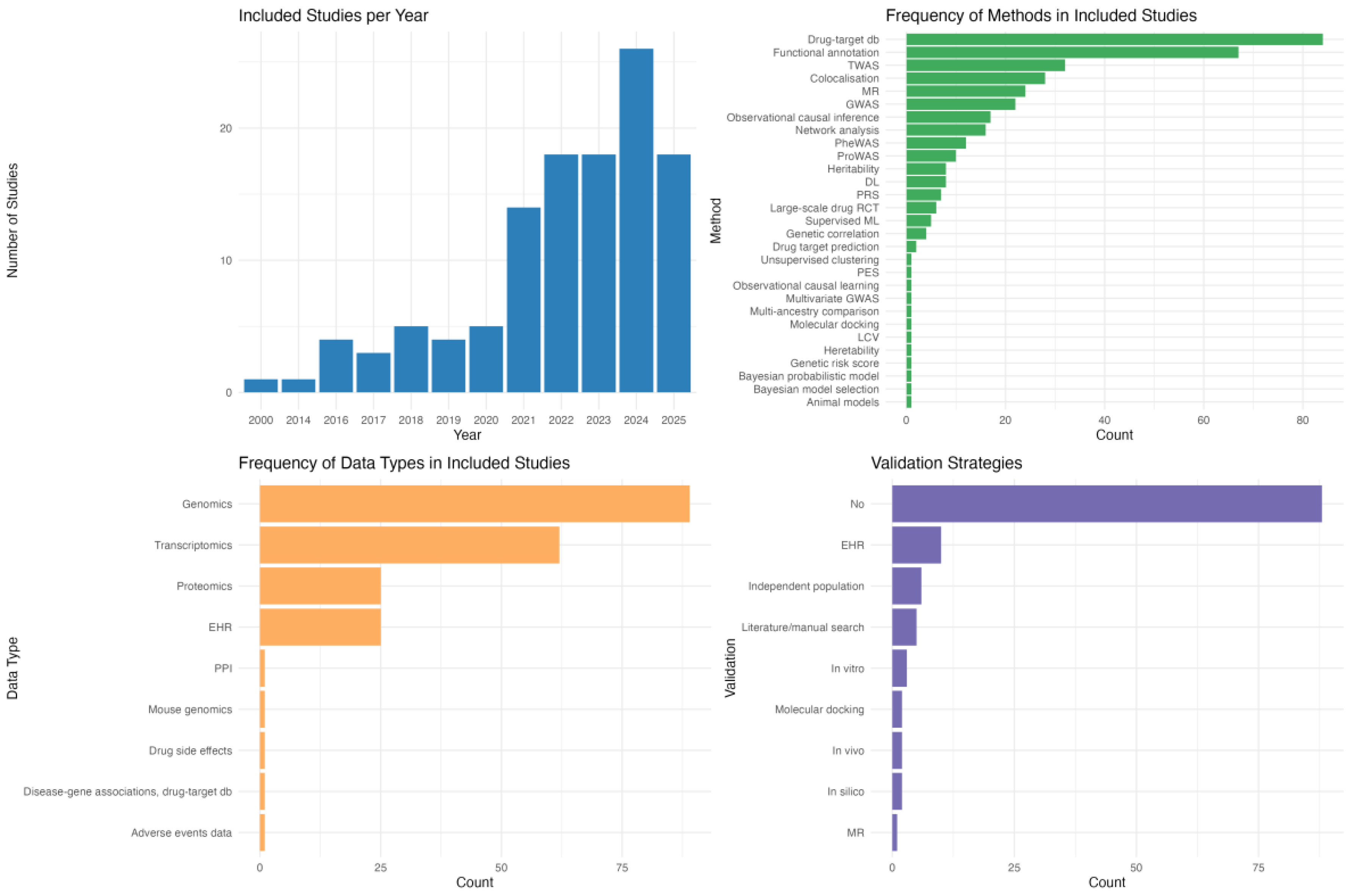
Figure 3.
Summary of methods used in the selected papers. Combinations with less than 2 counts have been discarded for visualisation clarity.
Figure 3.
Summary of methods used in the selected papers. Combinations with less than 2 counts have been discarded for visualisation clarity.
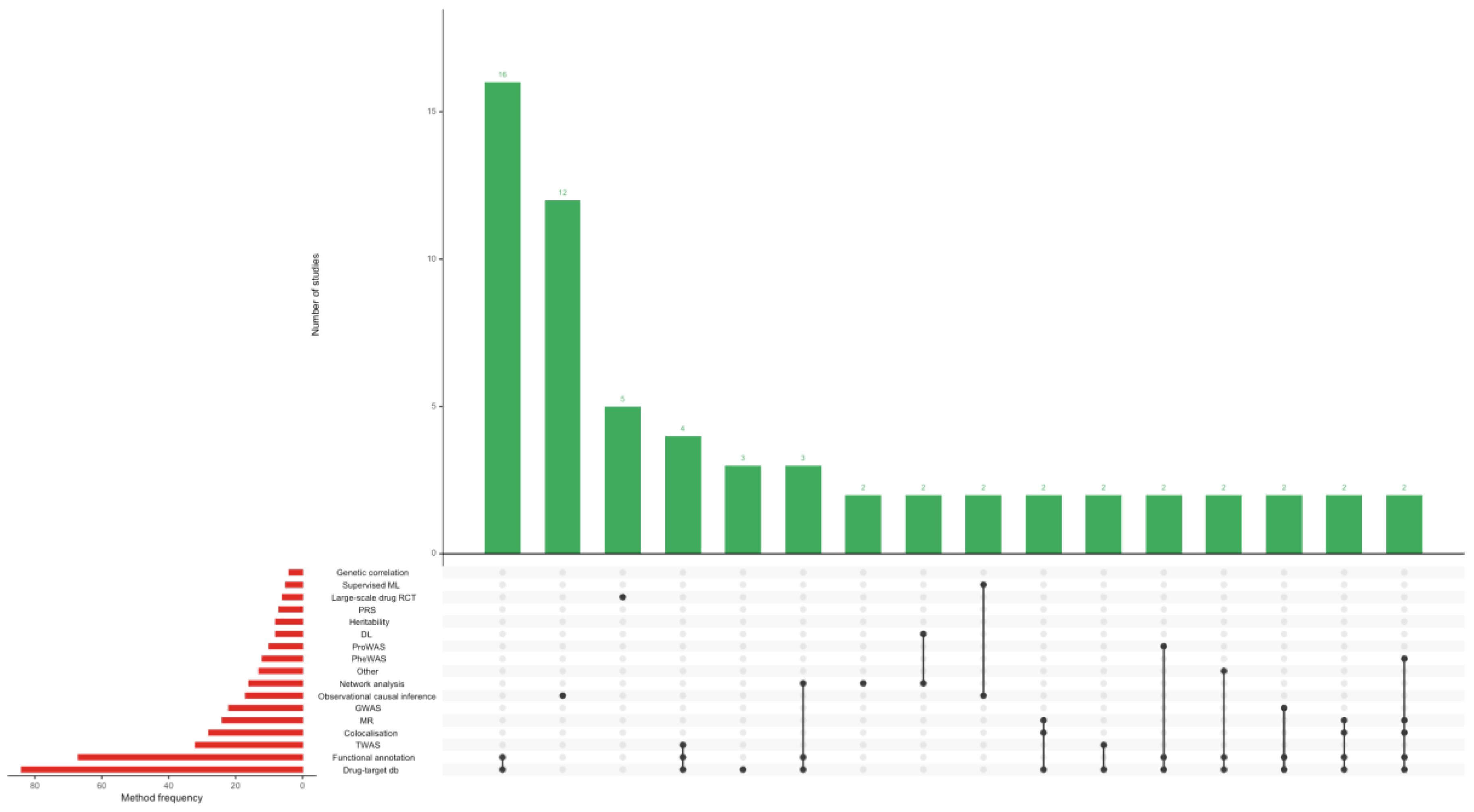
Figure 4.
Summary of data used in the selected papers.
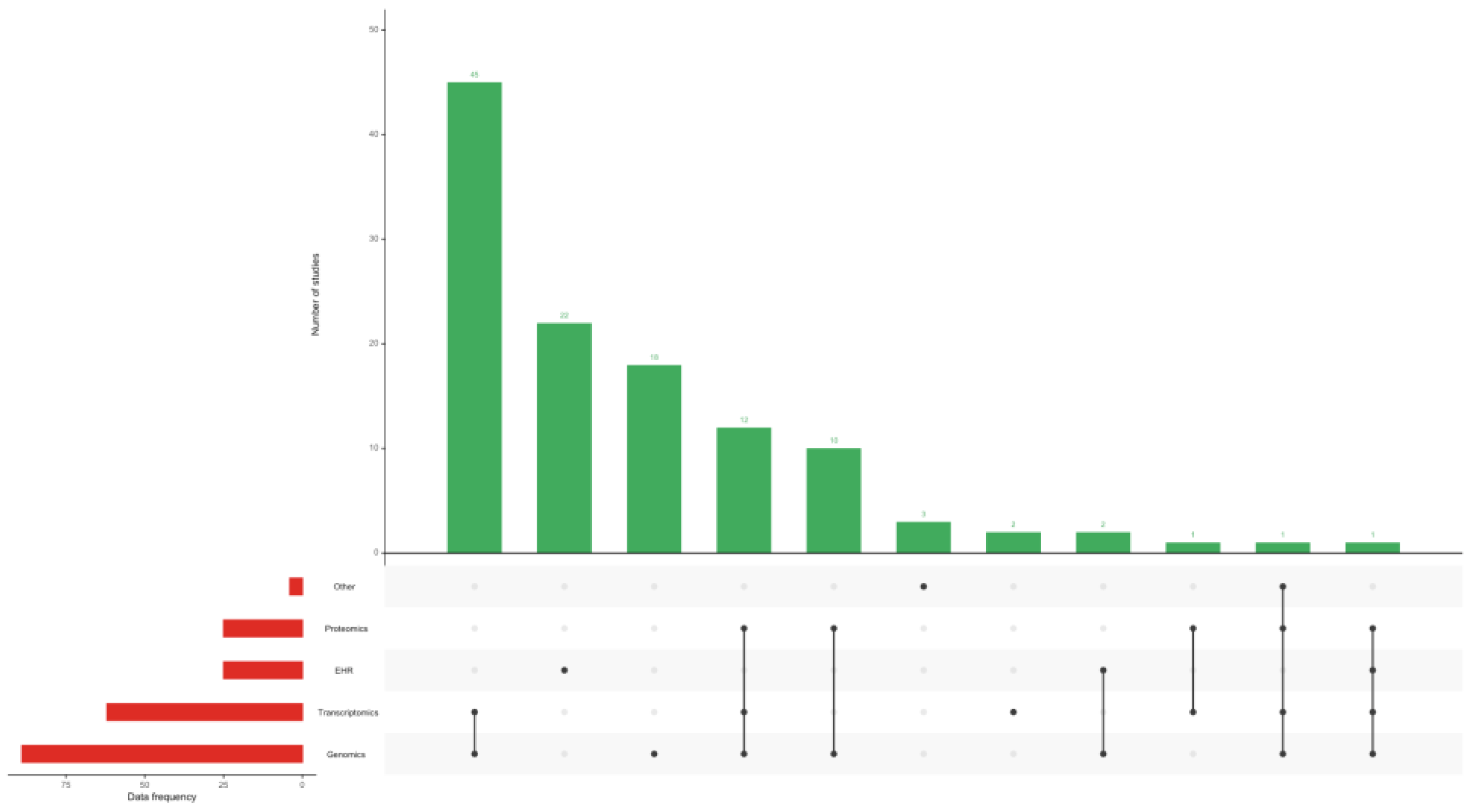
Figure 5.
Summary of data types and methods appearing in the selected papers.
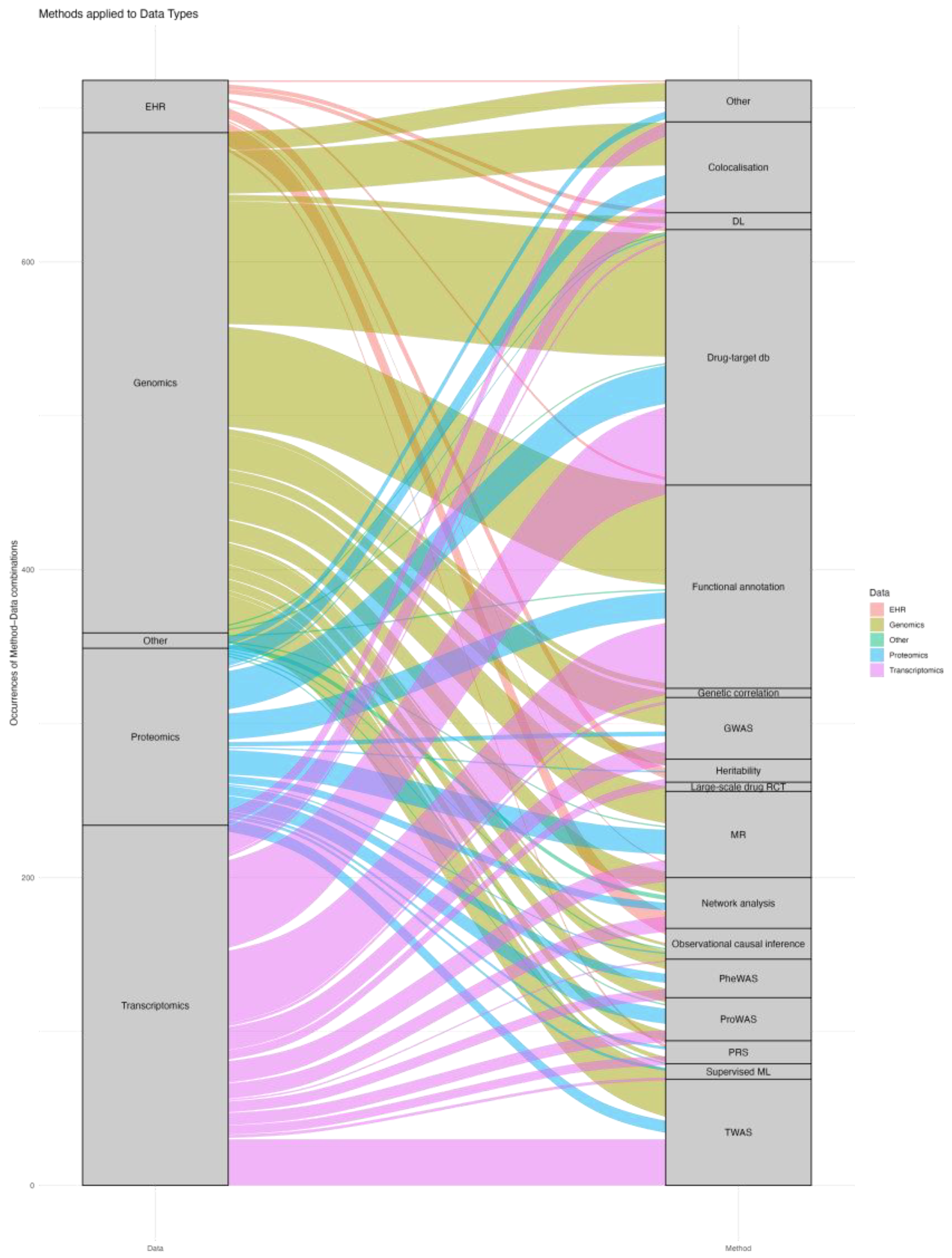
Figure 6.
Types of methods and data used over time. Number of occurrences per year, coloured by method or data type.
Figure 6.
Types of methods and data used over time. Number of occurrences per year, coloured by method or data type.
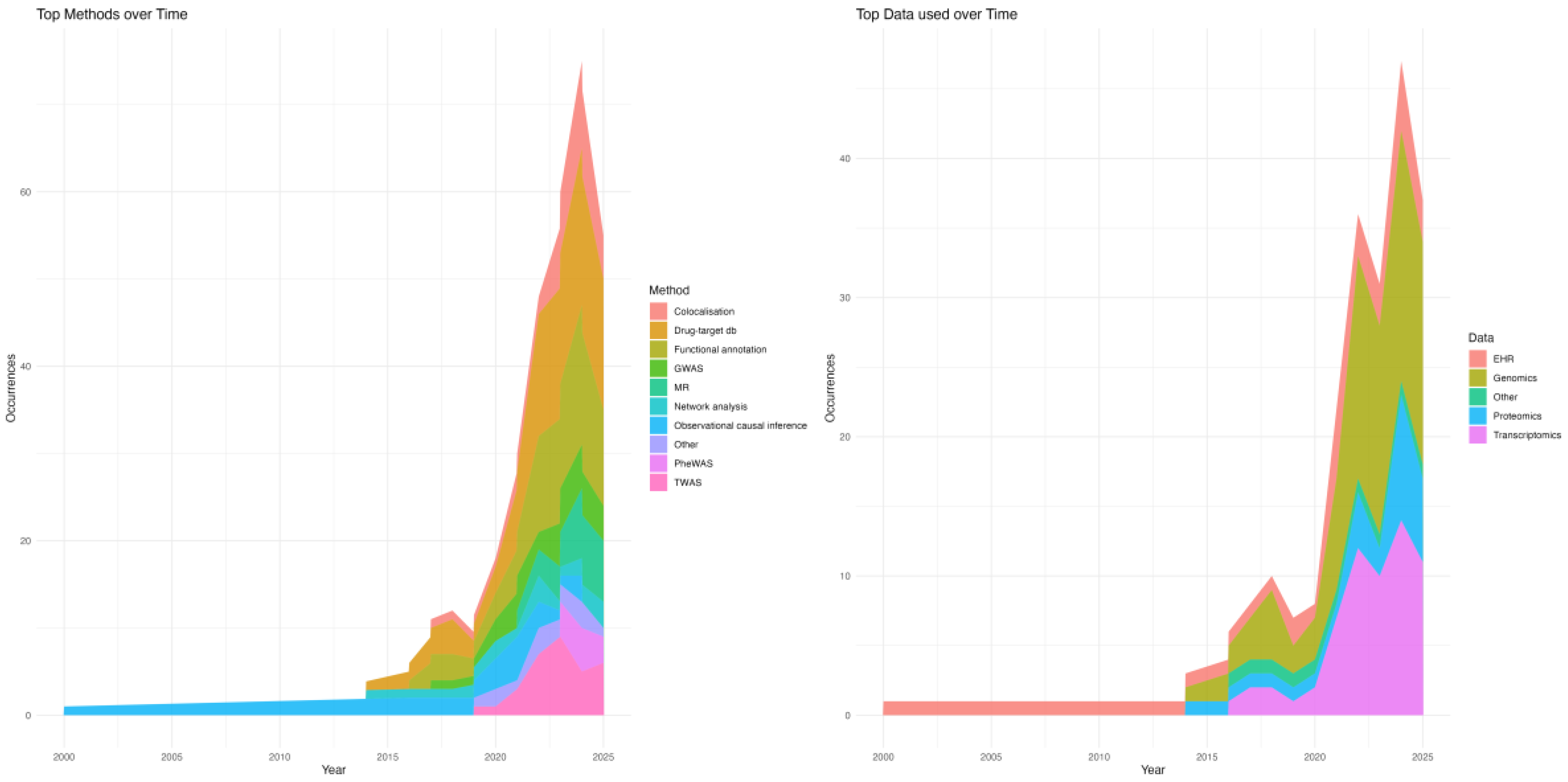

Table 1.
Summary of the characteristics of all selected papers in the literature review.
| Category | Characteristic | Count | Percent (%) |
|---|---|---|---|
| Year | 2000 | 1 | 0.9 |
| Year | 2014 | 1 | 0.9 |
| Year | 2016 | 4 | 3.4 |
| Year | 2017 | 3 | 2.6 |
| Year | 2018 | 5 | 4.3 |
| Year | 2019 | 4 | 3.4 |
| Year | 2020 | 5 | 4.3 |
| Year | 2021 | 14 | 12.0 |
| Year | 2022 | 18 | 15.4 |
| Year | 2023 | 18 | 15.4 |
| Year | 2024 | 26 | 22.2 |
| Year | 2025 | 18 | 15.4 |
| Method | Colocalisation | 28 | 23.9 |
| Method | DL | 8 | 6.8 |
| Method | Drug-target db | 84 | 71.8 |
| Method | Functional annotation | 67 | 57.3 |
| Method | GWAS | 22 | 18.8 |
| Method | Genetic correlation | 4 | 3.4 |
| Method | Heritability | 8 | 6.8 |
| Method | Large-scale trial emulation studies | 6 | 5.1 |
| Method | MR | 24 | 20.5 |
| Method | Network analysis | 16 | 13.7 |
| Method | Observational causal inference | 17 | 14.5 |
| Method | PRS | 7 | 6.0 |
| Method | PheWAS | 12 | 10.3 |
| Method | ProWAS | 10 | 8.5 |
| Method | Supervised ML | 5 | 4.3 |
| Method | TWAS | 32 | 27.4 |
| Method | Other | 13 | 11.1 |
| Data | EHR | 25 | 21.4 |
| Data | Genomics | 89 | 76.1 |
| Data | Proteomics | 25 | 21.4 |
| Data | Transcriptomics | 62 | 53.0 |
| Data | Other | 4 | 3.4 |
| Category | Characteristic | Count | Percent (%) |
| Discipline | Autoimmune / Inflammatory | 7 | 6.0 |
| Discipline | COVID-19 | 7 | 6.0 |
| Discipline | Cardiovascular | 6 | 5.1 |
| Discipline | Gastrointestinal | 1 | 0.9 |
| Discipline | Metabolic / Endocrine | 9 | 7.7 |
| Discipline | Methods | 14 | 12.0 |
| Discipline | Musculoskeletal / Pain | 8 | 6.8 |
| Discipline | Neurology | 13 | 11.1 |
| Discipline | Oncology | 8 | 6.8 |
| Discipline | Psychiatry | 17 | 14.5 |
| Discipline | Pulmonology | 6 | 5.1 |
| Discipline | Other | 28 | 23.9 |
| Study type | Case study | 106 | 90.6 |
| Study type | Method development | 19 | 16.2 |
| Validation | EHR | 10 | 8.5 |
| Validation | Independent population | 6 | 5.1 |
| Validation | Literature/manual search | 5 | 4.3 |
| Validation | No | 88 | 75.2 |
| Validation | Other | 10 | 8.5 |
| Geography | Africa | 5 | 4.3 |
| Geography | Asia | 12 | 10.3 |
| Geography | Europe | 53 | 45.3 |
| Geography | North America | 27 | 23.1 |
| Geography | Oceania | 1 | 0.9 |
| Geography | South America | 2 | 1.7 |
| Geography | Not reported | 42 | 35.9 |
| Sample size | 1-1k | 3 | 2.6 |
| Sample size | 100k-1M | 30 | 25.6 |
| Sample size | 10k-100k | 23 | 19.7 |
| Sample size | 1k-10k | 9 | 7.7 |
| Sample size | >1M | 7 | 6.0 |
| Sample size | Not reported | 45 | 38.5 |
| Open source | No | 76 | 65.0 |
| Open source | Partial | 15 | 12.8 |
| Open source | Yes | 26 | 22.2 |
| Preprint | No | 100 | 85.5 |
| Preprint | Yes | 17 | 14.5 |
Table 2.
Example papers of special interest from the literature review. DL stands for Deep Learning, db for database, GWAS for Genome-wide Association Study, MR for Mendelian randomisation, PRS for Polygenic risk scores, PheWAS for Phenome-wide Association Study, ProWAS for Proteine-wide Association Study, ML for Machine learning and TWAS for Transcriptome-wide Association study.
| Ref | Authors | Year | Journal | Data | Method |
|---|---|---|---|---|---|
| [50] | Tsuji S. et al. | 2018 | Cancer Science | Genomics | DL; Network analysis |
| [20] | Tragante V. et al. | 2018 | Circ. Genom. Precision Med. | Genomics; Proteomics | Drug-target db; Functional annotation |
| [24] | Liu et al. | 2021 | Nat. Mach. Intell. | EHR | DL; Observational causal inference |
| [21] | Chen F. et al. | 2023 | Nat. Genet. | Genomics; Transcriptomics | Drug-target db; Functional annotation; TWAS |
| [23] | Ryu A.J. et al. | 2023 | Blood Cancer J. | EHR | Observational causal inference |
| [26] | Toikumo S. et al. | 2024 | Nat. Med. | Genomics; Proteomics; Transcriptomics | Colocalisation; GWAS; Drug-target db; MR; PRS; PheWAS; ProWAS; TWAS; Heritability |
| [22] | Yun D. et al. | 2025 | J. Transl. Med. | Genomics; Transcriptomics | Functional annotation; GWAS; DL |
| [25] | Jung A.W. et al. | 2024 | medRxiv | EHR | Large-scale trial emulation study |
| [28] | Dou L. et al. | 2025 | npj Parkinson’s Disease | EHR; Genomics; Proteomics; Transcriptomics | Drug-target db; Functional annotation; Network analysis |
Disclaimer/Publisher’s Note: The statements, opinions and data contained in all publications are solely those of the individual author(s) and contributor(s) and not of MDPI and/or the editor(s). MDPI and/or the editor(s) disclaim responsibility for any injury to people or property resulting from any ideas, methods, instructions or products referred to in the content. |
© 2026 by the authors. Licensee MDPI, Basel, Switzerland. This article is an open access article distributed under the terms and conditions of the Creative Commons Attribution (CC BY) license (http://creativecommons.org/licenses/by/4.0/).
Copyright: This open access article is published under a Creative Commons CC BY 4.0 license, which permit the free download, distribution, and reuse, provided that the author and preprint are cited in any reuse.