

Submitted:
07 November 2026
Posted:
09 November 2026
You are already at the latest version
Abstract
Type 1 diabetes (T1D) is a staged, heterogeneous autoimmune disease in which immune injury, inflammatory signaling, antigen presentation, beta-cell stress, and loss of regulatory control interact over time. Human intervention studies establish that the disease course can be modified, yet benefits are commonly partial, heterogeneous, or treatment-dependent, and durable treatment-free tolerance remains uncommon. This article integrates randomized and prospective T1D trials, long-term follow-up, human mechanistic studies, negative and transient therapeutic studies, contemporary beta-cell-directed interventions, and cell-replacement evidence to examine why biological activity at individual targets has not consistently produced durable system control. Our central hypothesis is that, because the dominant biological bottleneck can change over time, a conditional multi-step treatment strategy that sequentially targets measured residual mechanisms may achieve greater and more durable disease modification than a single-agent strategy directed at one target alone. This does not imply indiscriminate polytherapy: each additional step should be entered only when a defined biological objective remains unmet and should be withdrawn when its task is complete. We therefore propose a conditional statetransition framework comprising seven research operations: baseline staging and stabilization; finite immune induction; optional immune-recovery control; mechanism-directed continuation or finite reinforcement; tolerance consolidation; withdrawal and surveillance; and mechanismmatched reintervention or transition to beta-cell replacement. A parallel beta-cell axis is selected independently to address metabolic load, tissue stress, and recoverable function. The framework is not a treatment protocol and the superiority of the proposed multi-step strategy has not been clinically established. It is a falsifiable hypothesis intended to generate component-controlled trials that directly compare state-guided sequencing with appropriate monotherapy or inductionalone controls.
Keywords:
type 1 diabetes
; disease modification
; hypothesis
; multi-step treatment
; immune tolerance
; beta-cell preservation
; treatment sequencing
; translational framework
1. Introduction: T1D Has Entered the Disease-Modification Era
Insulin transformed type 1 diabetes (T1D) from an acutely fatal disease into a chronic condition, and continuous glucose monitoring, automated insulin delivery, modern insulin analogues, and structured education have further reduced the burden of glycemic management. These advances do not extinguish the autoimmune process that initiates disease. The central translational question has therefore shifted from whether glucose can be replaced to whether the natural history of beta-cell loss can be altered safely and durably. [1,2,3,4]
Human intervention studies show that T1D can be modified in defined settings. Cyclosporine demonstrated that potent immune suppression can induce remission in recent-onset disease while also defining the toxicity and treatment-dependence boundary. Anti-CD3 studies showed that finite immune intervention can alter endogenous insulin-secretion trajectories, and teplizumab subsequently delayed progression from stage 2 to stage 3 disease and preserved C-peptide after recent diagnosis. These results establish disease modification as clinically actionable biology, although durable treatment-free tolerance remains uncommon. [3,5,6,7,8]
The wider literature resists a one-target narrative. Rituximab, abatacept, golimumab, baricitinib, verapamil, regulatory-cell approaches, and negative IL-1 trials each identify different immune, inflammatory, or beta-cell bottlenecks. Collectively, they suggest that target engagement may slow decline without permanently resetting the system. [9,10,11,12,13,14,15,16]
Importantly, partial efficacy should not be interpreted as failure of the entire disease-modification concept. Instead, partial and transient effects can identify which biological compartment was changed and which compensatory or persistent processes remained active. This interpretation is especially relevant when considering sequential designs, because a later intervention should address a demonstrated residual mechanism rather than simply add another plausible drug.
This pattern motivates a state-based research approach: identify the biological operation needed at a given disease state, verify that it occurred, and add or change treatment only when a defined residual mechanism remains. The objective is a measurable state transition rather than indefinite exposure to a predetermined drug sequence.
This Hypothesis article integrates human intervention evidence, mechanistic biology, biomarkers, safety, negative trials, and replacement therapy to develop an evidence-supported state-transition framework for T1D disease modification. The central proposition is explicit: a mechanism-guided, conditional multi-step strategy may produce greater and more durable preservation than monotherapy because different pathogenic bottlenecks can dominate at different times, and a single intervention may modify one compartment while leaving others active. This does not advocate a fixed multidrug protocol or clinical use of unvalidated combinations. Instead, it asks whether immune-state transitions and longitudinal beta-cell support can be selected independently, tested with interpretable comparators, stopped when their biological task is complete, and adapted when a defined failure mode remains. The literature synthesis therefore serves as the evidentiary foundation for a testable hypothesis rather than evidence that the proposed sequence has already been clinically validated.
2. Evidence Base and Scope
This Hypothesis article is grounded in a structured narrative synthesis of four decades of T1D disease-modification research. The purpose of the evidence synthesis is to identify recurring mechanistic and trial-design lessons, determine why single-target interventions often yield partial or transient benefit, and organize those lessons into a testable multi-step translational framework. Evidence was assembled iteratively from randomized and prospective T1D trials, long-term follow-up, human mechanistic studies, staging cohorts, regulatory materials, trial registries, contemporary cell-replacement studies, and selected preclinical studies used only for mechanistic interpretation.
Priority was given to randomized human trials and their follow-up, followed by prospective human and mechanistic evidence. Negative primary outcomes were retained explicitly; post hoc subgroup findings were treated as hypothesis-generating unless prospectively confirmed. Preclinical evidence was used to define plausibility, interaction hazards, or unresolved mechanisms rather than as a substitute for human efficacy.
Because most interventions have not been compared head-to-head, no comparative-efficacy ranking is attempted. The framework separates what was directly observed from extrapolated timing, sequencing, biomarker-selection, maintenance, retreatment, or combination hypotheses.
No registered systematic-review protocol, exhaustive reproducible search, duplicate screening, formal risk-of-bias instrument, GRADE assessment, or quantitative pooling was performed. The article should therefore be read as an evidence-supported Hypothesis grounded in structured narrative synthesis, not as a systematic estimate of comparative treatment effects or as evidence that multi-step treatment is already superior to monotherapy.
3. Four Decades of Disease Modification: What the Field Has Actually Learned
3.1. Broad Immunosuppression Proved Reversibility, but also Defined the Toxicity Boundary
Early cyclosporine studies showed that sufficiently strong immune suppression can restore clinically meaningful endogenous function in recent-onset T1D, but benefit depended on continued exposure and was limited by nephrotoxicity, hypertension, and other harms. This established both biological reversibility and a risk ceiling for chronic broad immunosuppression. A pioneering Brazilian collaboration led by Voltarelli, Couri, Stracieri and colleagues later tested autologous nonmyeloablative hematopoietic stem-cell transplantation after intensive conditioning; selected participants experienced periods of insulin independence, but the uncontrolled design and substantial treatment burden prevent interpretation as routine preservation therapy. [5,17]
3.2. Anti-CD3 Converted Immune Modulation from Concept to Clinically Actionable Biology
Non-Fc-binding anti-CD3 antibodies established that a brief intervention can preserve C-peptide beyond drug exposure. Development was not linear: PROTÉGÉ missed its prespecified composite primary endpoint, lower-dose otelixizumab improved tolerability at the cost of efficacy, and response heterogeneity remained substantial. The TrialNet stage 2 teplizumab study nevertheless demonstrated delayed progression to stage 3, while PROTECT showed preservation of stimulated C-peptide after recent diagnosis. Together, these trials support two principles: timing matters, and a finite T-cell-directed intervention can alter disease trajectory without permanently eliminating the autoimmune network. [3,6,18,19,20,21,22,23,24,25]
3.3. Other Immune Interventions Reveal Distinct Bottlenecks
Rituximab and abatacept identify distinct network bottlenecks. Rituximab preserved C-peptide transiently, but B-cell repopulation and persistent tolerance defects limited durability. Abatacept slowed C-peptide decline after diagnosis, yet loss continued and a stage 1 prevention trial did not meet its primary progression endpoint. These programs illustrate that a biologically relevant target can be insufficient for durable control and that efficacy is stage- and context-dependent. [9,10,11,12,26,27,28,29]
Other interventions broaden the mechanistic map. Low-dose ATG supports finite broader induction; golimumab implicates TNF signaling; baricitinib links JAK1/2 signaling to immune and beta-cell biology; imatinib and ustekinumab provide signals for kinase and IL-12/23-directed strategies; and alefacept suggests that memory-T-cell targeting can influence the effector-regulatory balance. None of these source trials establishes a universal sequence or interchangeability among agents. [14,15,30,31,32,33,34,35,36,37,38]
The lessons from these studies are not equivalent. Some interventions were tested as finite courses, others as prolonged exposure; some altered immune-cell compartments, others inflammatory signaling or beta-cell stress; and their populations differed in age, disease stage, and residual function. The framework therefore treats each positive trial as evidence of activity in its tested context rather than as evidence that the agent belongs in a particular sequence.
3.4. Beta-Cell-Directed and Replacement Therapies Broaden the Definition of Disease Modification
Beta-cell-directed therapy and replacement broaden the meaning of disease modification. Verapamil provides randomized evidence that a low-immunosuppression, tissue-directed intervention can partially preserve stimulated C-peptide, while DFMO and other stress-directed approaches remain earlier in translation. By contrast, intensive closed-loop glucose control improves glycemia without independently preventing C-peptide decline. Islet transplantation and stem-cell-derived islets show that restoring glucose-responsive beta-cell mass can be clinically powerful, while emphasizing immune protection as a continuing bottleneck. [39,40,41,42,43,44,45,46,47,48,49] Representative intervention evidence is summarized in Supplementary Table S1.
4. T1D is a Coupled Immune–Beta-Cell System, Not a Single-Pathway Disorder
The classical description of T1D as T-cell-mediated autoimmunity is correct but incomplete. Autoreactive CD8 and CD4 T cells operate within a network that includes antigen-presenting cells, B cells, co-stimulation, cytokines, tissue trafficking, innate sensing, regulatory failure, and the beta cell itself. The dominant mechanisms vary with age, HLA background, disease stage, tissue state, prior treatment, and time. [9,26,58,59,60,61,62]
This network contains reinforcing loops: beta-cell antigens are presented to autoreactive lymphocytes; inflammatory cytokines and interferons increase HLA expression and chemokine release; stressed beta cells generate danger signals and noncanonical antigens; continued injury releases additional antigen; and defective regulation permits persistence. A therapy can suppress one loop while others remain active. [9,58,59,60,63,64,65,66,67]
The beta cell is therefore not a passive victim. High biosynthetic demand makes it vulnerable to ER stress, oxidative and mitochondrial stress, defective autophagy, abnormal proinsulin processing, and inflammatory changes in antigen presentation. Hybrid insulin peptides, defective ribosomal products, and other altered epitopes provide a mechanistic bridge between tissue stress and diversification of autoreactivity. [59,60,63,64,65,66,67,68]
This coupled-system view explains why immune suppression may produce temporary recovery, why antigen-specific therapy can fail in an inflammatory environment, and why a beta-cell-directed therapy can improve secretion without extinguishing autoimmunity. It also provides a rationale for sequential or parallel biological operations without implying simultaneous maximal polyimmunosuppression.
5. The Therapeutic Window: Residual Beta-Cell Function Is Both an Endpoint and a State Variable
Residual endogenous insulin secretion is clinically meaningful. Higher C-peptide is associated with better glycemic control, lower severe-hypoglycemia risk, more time in range, and lower observed microvascular risk. Stimulated C-peptide during a mixed-meal tolerance test therefore remains the most mature postdiagnosis efficacy anchor for preservation trials. [1,2,69,70,71,72,73,74,75,76]
Residual function also provides a common quantitative anchor across otherwise heterogeneous disease-modification trials. Although stimulated C-peptide is not a direct measure of beta-cell mass, it captures glucose-responsive endogenous secretion and has greater biological specificity for preservation than HbA1c or insulin dose alone, both of which are strongly influenced by technology, behavior, insulin sensitivity, and treatment intensity. [69,70,71,72,73,74,75,76]
C-peptide should be interpreted continuously and in context. Baseline reserve, glucose during testing, age, and longitudinal trajectory all matter; there must be recoverable function to preserve, and reported decline profiles differ across populations and follow-up periods. [73,75,76,77,78,79,80,81]
Therapeutic timing is consequently biological rather than purely chronological. Stage 1 offers abundant cell mass but a very low acceptable toxicity ceiling; recent stage 3 may justify greater finite risk when residual function is substantial and decline is active. The preservation window is the intersection of salvageable beta-cell function, treatable biology, expected untreated trajectory, and risk tolerance. [77,78,79,80,81]
6. Adaptive Immune Targets: Induction, Network Organization, and Persistent Memory
6.1. Anti-CD3 and the Concept of Immune Reprogramming
Anti-CD3 is best viewed as finite immune reprogramming rather than chronic blockade. Clinical studies show effects persisting beyond exposure in some participants, with altered T-cell states and partial preservation of beta-cell function. The key unresolved issues are heterogeneity, durability, predictors of response, and whether retreatment should be fixed or response-guided. [3,6,18,19,24,25]
PROTECT used two teplizumab courses 26 weeks apart and showed greater stimulated C-peptide at 78 weeks, but it did not randomize one course against two or test an intervening therapy. Repeat-course administration is therefore supported only in the studied regimen; the incremental value, optimal timing, and any new sequence remain separate research questions. [6]
A proposed response-guided reinforcement strategy would therefore require prespecified pharmacodynamic and metabolic criteria, documentation of residual effects from prior therapy, and a no-reinforcement comparator. The objective would be to test whether an additional finite perturbation adds durable benefit in participants with residual active biology, rather than to convert anti-CD3 into chronic maintenance.
6.2. Low-Dose ATG: Broad Finite Induction and Immune Reconstitution
Low-dose ATG produces a broader finite immune perturbation than teplizumab and has preserved C-peptide in recent-onset T1D. The failure of added G-CSF to improve the principal signal is an important combination lesson: mechanistic plausibility does not guarantee incremental benefit. MELD-ATG further emphasizes that dose optimization must preserve biological effect while reducing serum sickness, cytokine reactions, cytopenias, and other harms. [30,31,32,33]
Because ATG reshapes several lymphocyte compartments at once, its interpretation differs from pathway-selective agents. The clinically useful question is not whether broader perturbation is intrinsically superior, but whether a finite exposure can create a sufficiently durable state change at a risk acceptable for the disease stage and patient population.
6.3. Co-Stimulation Blockade: Preventing Recruitment of Newly Activated T Cells
Abatacept blocks CD80/CD86-CD28 co-stimulation and slowed C-peptide decline during two years of recent-onset treatment, with a residual between-group difference after cessation. These data support the relevance of co-stimulation but do not establish a post-induction bridge, exact transition timing, or a universal maintenance role. TN25 is informative because it explicitly tests rituximab followed by abatacept versus rituximab alone. [11,28,84]
Mechanistically, this distinction matters because co-stimulation blockade is more likely to affect recruitment and propagation than every established effector-memory or tissue-resident population. A post-induction use would therefore test a new biological role: limiting renewed activation as the immune compartment recovers. That role remains plausible but unproven.
6.4. B Cells: Antigen Presentation, T-Cell Support, and the Limits of Depletion
B cells contribute through antigen presentation, co-stimulation, cytokines, and tissue organization in addition to autoantibody production. Rituximab demonstrates biological relevance but also the limits of depletion: long-lived plasma cells are spared, tissue depletion may be incomplete, vaccine responses can be impaired, and repopulation does not automatically restore tolerance. A future role should therefore be endotype-directed and should test how the repopulated compartment is controlled. [9,10,26,27,80,81]
The most informative future B-cell studies may therefore combine tissue or circulating endotype markers with longitudinal measures of repopulation, antigen presentation, immunoglobulins, vaccine responses, and T-cell activation. Such designs could distinguish whether relapse reflects re-emergence of the same pathogenic network or persistence of mechanisms that were never removed.
7. Inflammatory Signaling, Cross-Compartment Strategies, and Trigger-Directed Therapy
Inflammation is integral to T1D, but anti-inflammatory therapy is not a single strategy. Negative IL-1 trials are informative because they show that IL-1 blockade alone was insufficient in the tested recent-onset populations. By contrast, the T1GER trial showed that 52 weeks of golimumab preserved stimulated C-peptide and reduced insulin requirements in youth, with a relative difference persisting during follow-up. These data support the studied exposure, not a shorter induction course or an untested combination. [13,14,38]
TNF is an inflammatory pathway with direct human recent-onset intervention evidence, but timing and duration are separate variables. In the randomized T1GER trial, 84 participants aged 6–21 years with recent-onset stage 3 T1D received golimumab or placebo for 52 weeks; stimulated C-peptide preservation and lower insulin requirement were reported at week 52, and a relative C-peptide difference persisted during a subsequent year off protocol treatment. This is evidence for the studied prolonged early course, not for a short course restricted to Phase 1, use alongside ATG/anti-CD3, a biomarker-selected regimen, or Phase 6 retreatment. [14,38]
7.1. TNF as an Early and Potentially Recurrent Inflammatory Operation
TNF-directed treatment therefore raises two distinct questions: whether early TNF blockade adds value to a defined induction strategy and whether a later inflammatory relapse identifies a subgroup for retreatment. Neither question is answered by initial T1GER efficacy. Serum TNF alone cannot establish pancreatic activity, and transition to or from other immunomodulators requires explicit interaction-safety assessment. [14,38,83]
The distinction between early initiation and treatment duration is particularly important. T1GER demonstrates efficacy for a 52-week regimen in a defined population; it does not establish that a brief induction-only course would retain the same benefit. Any shorter strategy should therefore be tested directly rather than inferred from the timing of treatment initiation.
7.2. Interferon, JAK/TYK2 Signaling and Pathway-Selective Hypotheses
Type I interferon is relevant to both immunity and beta-cell visibility through HLA class I hyperexpression, CXCL10 production, ER stress, and apoptosis. BANDIT demonstrated that 48-week baricitinib treatment can preserve C-peptide in recent-onset T1D, but did not test post-induction bridging or prospective interferon-high selection. Selective TYK2 inhibition is mechanistically attractive but has less mature direct T1D efficacy evidence. [15,37,59,60,63,64]
An interferon-associated signature might ultimately function as a theratype only if it predicts differential treatment response rather than simply more active disease. The same principle applies to TYK2 or IL-12/23-directed approaches: pathway activity can support biological plausibility, but predictive use requires prospective interaction testing.
7.3. Imatinib as a Cross-Compartment Strategy
Imatinib produced a randomized recent-onset preservation signal but affects multiple immune and tissue pathways and has nontrivial tolerability constraints. It should therefore be treated as a cross-compartment candidate whose timing, mechanism attribution, and biomarker selection require separate testing. [36]
7.4. Trigger-Directed Therapy and the Viral-Endotype Hypothesis
Pleconaril plus ribavirin produced a C-peptide preservation signal in a randomized phase 2 study of newly diagnosed youth. Because participants were not selected by a validated persistent-enterovirus biomarker, the result supports further study of the specific regimen rather than a universal viral cause or a validated viral endotype. [85]
8. Sirolimus: A Distinct Immune-Tolerance Hypothesis and Unresolved Metabolic Effects
Sirolimus is considered here as an investigational immune-regulatory strategy rather than an established beta-cell adjunct. mTOR biology is context dependent: mTORC1 and mTORC2 influence lymphocyte differentiation, Treg function, insulin signaling, protein translation, and beta-cell adaptation, and sustained systemic inhibition can impair secretion or viability under some conditions. Human studies show immunologic and metabolic signals but do not establish durable treatment-independent islet tolerance. [52,53,54,55,56,82,86,87,88]
8.1. mTOR Biology and Context-Dependent Tissue Effects
Small sirolimus monotherapy studies reported improved ex vivo Treg suppressive capacity and exploratory fasting C-peptide signals, whereas the randomized MONORAPA trial did not restore stimulated C-peptide. A small sirolimus-plus-IL-2 study increased circulating Tregs while beta-cell function transiently worsened, illustrating that favorable immune biomarkers can coexist with unfavorable net tissue biology and that component attribution requires appropriate controls. [52,53,54,55]
These studies also illustrate why immune and metabolic readouts should not be collapsed. Increased Treg function, reduced insulin requirement, fasting C-peptide changes, stimulated secretion, and durable off-treatment tolerance represent different biological claims. A future sirolimus study would need to specify which claim is primary and avoid interpreting improvement in one domain as proof of benefit in another.
Experimental evidence also imposes a sequencing caution. Sirolimus-associated secretory impairment can be reversible in some human-islet models, but Valle et al. found that concurrent sirolimus markedly impaired anti-CD3-induced diabetes reversal in NOD mice, with delayed exposure also worsening glycemia during treatment. These findings do not establish a human teplizumab-sirolimus interaction, but they argue against assuming compatibility or a safe washout interval. [82,86,87]
The anti-CD3 interaction is especially relevant because the proposed framework otherwise places sirolimus after induction rather than concurrently. Delayed administration does not remove the uncertainty: residual anti-CD3 pharmacodynamics, immune recovery, metabolic effects, and the duration of sirolimus action would all need direct measurement. A safe transition interval cannot be derived from the mouse experiment or from unrelated human schedules.
The resulting research question is deliberately narrow: could a post-induction sirolimus exposure improve islet-relevant immune regulation and then be withdrawn with durable off-treatment control? No dose, duration, taper, transition interval, or compatibility with preceding anti-CD3, ATG, anti-CD20, or co-stimulation blockade is established. Any study should measure immune target engagement, stimulated C-peptide, metabolic context, tissue safety, infection and hematologic risk, and off-treatment durability. [52,53,54,55,82,87,88]
9. Beta-Cell Stress, Immunogenicity, Metabolic Support, and Metformin-Directed Translational Control
9.1. The Beta Cell as a Disease Amplifier
Surviving beta cells operate under high biosynthetic demand and can develop ER stress, oxidative and mitochondrial stress, abnormal protein processing, impaired autophagy, and inflammatory changes in antigen presentation. These processes may both reduce functional resilience and increase immune visibility, providing a rationale for a parallel tissue-support axis. [59,60,63,65,66,67,68]
9.2. Verapamil, TXNIP, and Direct Beta-Cell Protection
Verapamil is the clearest low-burden human example of direct beta-cell support. Randomized adult and pediatric studies showed partial preservation of stimulated C-peptide, consistent with TXNIP- and calcium-linked stress mechanisms. Its effect is incomplete, durability after withdrawal is uncertain, and cardiovascular selection matters, but its limited immune burden makes it attractive for independent or factorial testing. [39,40]
9.3. Metabolic Unloading as Supportive Care, Not Immune Disease Modification
Optimized insulin therapy, CGM, and automated insulin delivery remain universal background care. The CLOuD trial showed that tighter closed-loop glucose control did not prevent C-peptide decline, demonstrating that metabolic optimization and immune disease modification are distinct. Glucose context and background technology should nevertheless be standardized because they affect clinical outcomes and interpretation of C-peptide. [41,43,76]
9.4. Metformin and Translational-Load Control: The mTOR/4E-BP1 Interface
Metformin raises a newer tissue-directed hypothesis distinct from its established systemic metabolic effects. Inoue et al. reported 4E-BP1-dependent protection from ER-stress-associated beta-cell apoptosis across mouse and human islet/cell models, with reduced protein translation and remodeling of stress pathways. This mechanism should not be equated with generic mTOR inhibition; rapamycin did not reproduce the same stress-response pattern. [56,86]
The mechanistic attraction is that translational-load control could theoretically reduce beta-cell stress without adding conventional systemic immunosuppression. However, the therapeutic aim would not be chronic suppression of protein synthesis. A useful intervention would need to reduce maladaptive stress while preserving the ability of beta cells to recover glucose-responsive insulin secretion; target engagement and functional recovery should therefore be evaluated together.
Translation to clinical T1D remains uncertain because experimental exposures may exceed physiological systemic concentrations and the models did not reproduce the full autoimmune microenvironment. REMOVAL provides long-term metabolic and tolerability data in established T1D but did not test recent-onset stimulated-C-peptide preservation or 4E-BP1 target engagement. A future study would therefore need direct tissue-stress and functional endpoints rather than assuming benefit from routine metformin use. [56,57]
If tested clinically, a recent-onset study should distinguish systemic metabolic effects from direct beta-cell protection. Stimulated C-peptide, concurrent glucose, insulin requirement, proinsulin:C-peptide or other stress markers, tolerability, and feasible measures of 4E-BP1-related pathway engagement would be complementary endpoints. A factorial design would be preferable if metformin were paired with an immune intervention.
9.5. GLP-1-Based Metabolic Support and Immune–Metabolic Factorial Designs
The anti-IL-21 plus liraglutide factorial trial illustrates the value of component-controlled immune-metabolic studies: the combined regimen produced a preservation signal during treatment, but benefit diminished after withdrawal. Combination significance does not by itself prove synergy, and reduced insulin requirement cannot distinguish improved sensitivity from preserved secretion. [16]
9.6. DFMO and Emerging Cell-Autonomous Stress Strategies
DFMO and other cell-autonomous stress strategies remain earlier in translation. A small recent-onset study primarily established safety and tolerability and reported preliminary C-peptide signals at higher exposures, while experimental work supported an islet-intrinsic mechanism. These approaches require confirmatory efficacy, durability, and interaction studies. [42]
10. Regulatory T Cells and Antigen-Specific Tolerance: From Suppression to Durable Control
The long-term objective of disease modification is not indefinite immunosuppression but durable control after systemic therapy can be withdrawn. Regulatory T cells and antigen-specific strategies therefore address consolidation rather than simple suppression. Autologous expanded polyclonal Tregs have established human feasibility and short-term safety, but the 2024 pediatric phase 2 trial did not preserve residual beta-cell function versus placebo. [50,51]
Tolerance should therefore be defined operationally rather than by a single laboratory phenotype. A credible tolerance signal would require durable off-treatment beta-cell stability together with evidence that islet-relevant immune activity remains controlled. Circulating Treg frequency, cytokine changes, or temporary metabolic improvement can support mechanism assessment but cannot by themselves establish self-tolerance.
Treg efficacy depends on lineage stability, suppressive potency, antigen specificity, tissue trafficking, metabolic fitness, and resistance to inflammatory conversion. Low-dose IL-2 can preferentially engage Tregs within a narrow therapeutic window, but higher exposure recruits NK and effector populations; the sirolimus/IL-2 experience cautions against treating a rise in circulating Tregs as proof of tissue protection. [52,53,54,55,89]
Antigen-specific approaches remain attractive because they could restore regulation without generalized immune impairment, but the antigenic landscape is heterogeneous and dynamic. Oral insulin and GAD-based studies show how overall null results can coexist with subgroup signals that require prospective validation. Tolerogenic dendritic cells, antigen-coupled nanoparticles, engineered Tregs, and related platforms are promising but remain early in T1D translation. [65,66,67,89,90,91,92]
The principal translational challenge is context. A tolerogenic signal delivered during strong inflammatory activation may behave differently from the same signal after pathogenic pressure has been reduced. This is why the framework places antigen-specific or regulatory consolidation conceptually after, rather than necessarily alongside, stronger induction; the sequence is a hypothesis to be tested, not an established therapeutic rule.
11. Negative and Transient Trials Are a Primary Scientific Asset
Negative and transient trials are mechanistic assets. A neutral result can reflect an irrelevant target, target non-sufficiency, inadequate exposure, mistimed treatment, endotype dilution, an insensitive endpoint, limited durability, or unacceptable toxicity. Conversely, a favorable biomarker can coexist with harmful net biology. [12,13,21,23,55,90,91]
Examples include IL-1 blockade as target non-sufficiency, low-dose otelixizumab as exposure failure, stage-dependent abatacept effects, time-limited rituximab benefit, ATG plus G-CSF as combination redundancy, and the sirolimus/IL-2 regimen as a warning against equating immune biomarkers with beta-cell benefit. A failed monotherapy should enter a combination only when a testable mechanism explains why it could contribute in a new context. [9,10,11,12,13,23,28,55] A concise failure taxonomy is provided in Supplementary Table S2.
12. Mechanism-Based Combination and Sequencing: A Translational Research Framework
T1D biology supports combining or sequencing mechanisms, but not indiscriminate polypharmacy. Every component should address a defined failure mode, have a stage-appropriate role, show target engagement, and add enough benefit to justify its own risk and any interaction risk. Start time, duration, biological role, residual drug effect, and pharmacologic overlap should be treated as distinct variables. [16,55]
Relevant architectures include concurrent complementary mechanisms, induction followed by lower-burden maintenance, immune plus beta-cell support, induction followed by antigen-specific consolidation, depletion followed by regulatory-cell replacement, and adaptive modular platforms. Synergy requires a formal interaction effect and cannot be inferred because only a combination arm is statistically significant. [16]
Human examples are mixed: anti-IL-21 plus liraglutide provides a factorial prototype, ATG plus G-CSF shows that an added component may contribute no benefit, and sirolimus plus IL-2 demonstrates an unfavorable regimen-level signal without resolving individual-drug causality. These findings favor component-controlled and biomarker-rich designs. [16,51,55]

Table 1.
Mechanism-based combination and sequencing architectures.
| Architecture | Sequence | Biological objective | Evidence requirement |
|---|---|---|---|
| Concurrent dual mechanism | A + B in same window | Attack complementary active mechanisms simultaneously | Factorial/component arms, interaction testing, overlapping-safety monitoring |
| Induction → maintenance | Finite stronger A followed by lower-burden B | Create state transition then prevent re-expansion | Sequential randomization or maintenance/withdrawal comparison |
| Induction → antigen-specific tolerance | Broad modulation followed by tolerogenic module | Create a quieter immune context for retraining | Antigen-specific pharmacodynamics and durable off-treatment follow-up |
| Immune + beta-cell protection | Immune module ± tissue-support module | Reduce attack while improving target resilience | Immune target engagement + beta-cell stress/function metrics |
| Depletion → regulatory-cell replacement | Reduce pathogenic repertoire then add regulation | Shift effector:regulatory balance in two directions | Cell persistence, function, infection risk, component contribution |
| Adaptive modular platform | Start with one module; add/switch by biomarker | Avoid unnecessary exposure and learn individualized sequences | Prespecified adaptation rules and validated intermediate biomarkers |
12.1. Proposed Framework and Testable Predictions
Central hypothesis. Durable T1D disease modification may be more effectively achieved by a conditional multi-step strategy than by monotherapy when different biological mechanisms remain active or emerge sequentially over time. In this model, a first intervention addresses the dominant bottleneck; subsequent treatment is added, continued, withdrawn, or reintroduced only if biomarkers, pharmacodynamics, or metabolic trajectory indicate a defined residual or recurrent mechanism. The hypothesis therefore predicts superiority of mechanism-guided sequencing over single-agent treatment in appropriately selected patients, while also predicting less unnecessary exposure than fixed multidrug packages. A finite intervention should be judged by whether it produces its intended state transition. Beta-cell support is partly independent of immune sequencing and may therefore begin at baseline and continue across selected immune operations.
The most direct test of the hypothesis is a component-controlled or sequentially randomized comparison in which state-guided multi-step treatment is compared with the best appropriate monotherapy or induction-alone strategy. The framework predicts that successful induction should produce a measurable pharmacodynamic state change; a second mechanistically matched step should add benefit mainly when its target remains active; independently randomized beta-cell support may improve tissue outcomes without parallel immune target engagement; biomarker-adaptive sequencing should reduce unnecessary exposure compared with fixed packages; and tolerance should be defined by durable off-treatment stability. Greater and more durable preservation of stimulated C-peptide, delayed progression, or longer treatment-free stability would support the multi-step hypothesis only if incremental benefit can be attributed to the added step rather than to uncontrolled treatment overlap.
The model would be weakened if state-guided additional steps do not improve clinically meaningful durability over appropriate monotherapy or induction-alone controls, if phase-specific biomarkers fail to identify differential effects, if beta-cell support provides no separable signal, or if fixed single-agent or fixed multi-agent strategies consistently outperform adaptive sequencing with a better benefit-risk profile.
13. Seven Conditional Research Operations with an Independently Selected Parallel Beta-Cell Axis
The proposed architecture is a research model, not a treatment guideline. It comprises seven conditionally entered immune-state operations (Phases 0–6) and one independently selected longitudinal beta-cell axis. Phase labels organize trial questions rather than prescribe patient care, and they must not be confused with clinical T1D stages 1–3. Figure 3 summarizes the architecture. [11,14,28,38,82,83,84]
Each operation is therefore defined by a biological objective and an exit or reassessment criterion. This separates the framework from a conventional treatment ladder, in which failure at one step automatically triggers the next. In the proposed model, observation without additional immune treatment is itself a legitimate branch whenever the intended transition appears complete.
The logic is conditional rather than chronological. A participant may require no bridge after induction, may not qualify for a mechanism-directed continuation strategy, or may transition directly to surveillance. Likewise, beta-cell support can be studied independently from immune sequencing. This structure is intended to reduce unnecessary exposure and preserve causal interpretability rather than to increase the number of therapies used.
Across the framework, disease stage, residual C-peptide, endotype, prior response, organ function, infection and reproductive risk, treatment burden, and residual pharmacodynamic activity determine eligibility. Evidence for a drug in one population does not validate a new sequence, predictive biomarker, or combination.
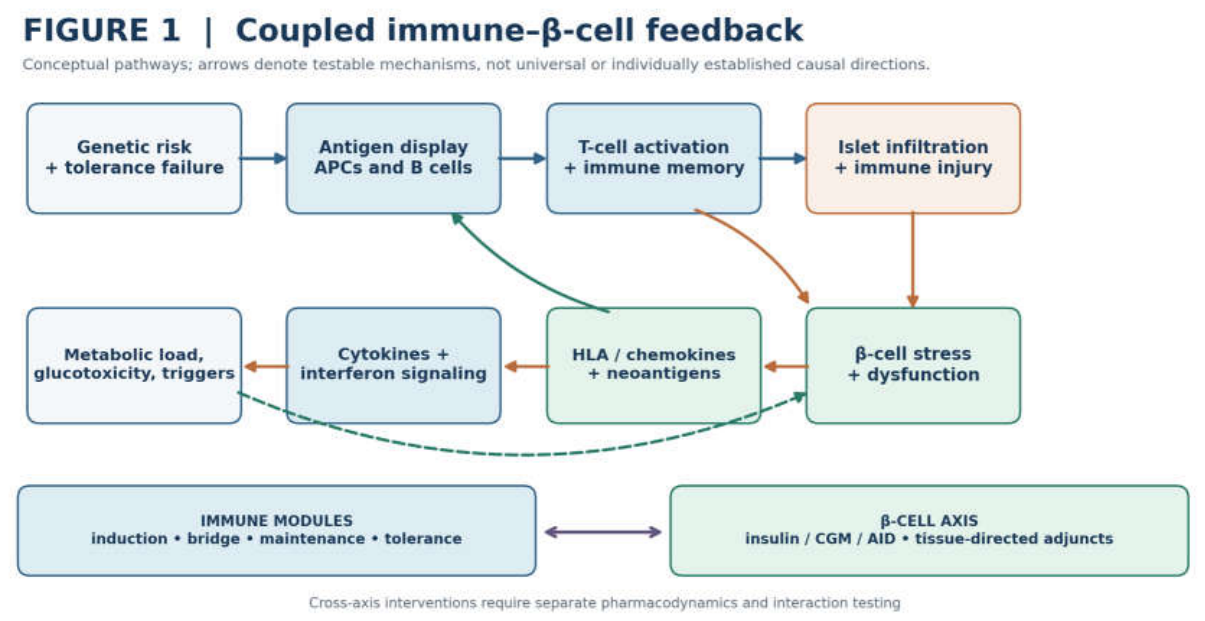
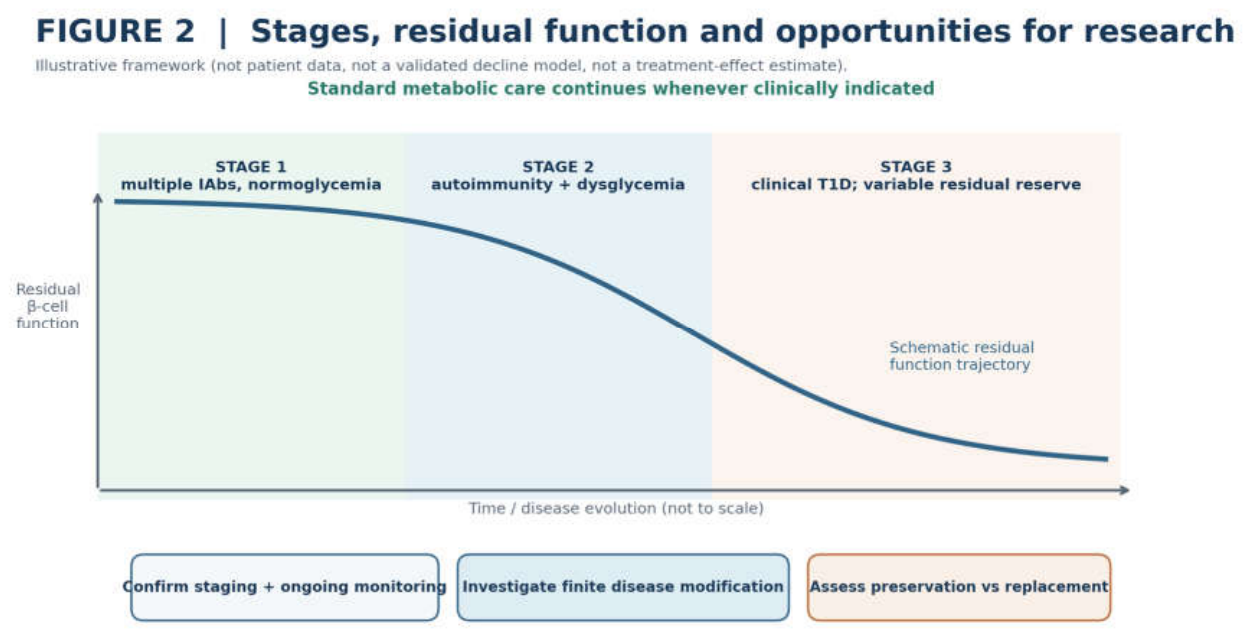
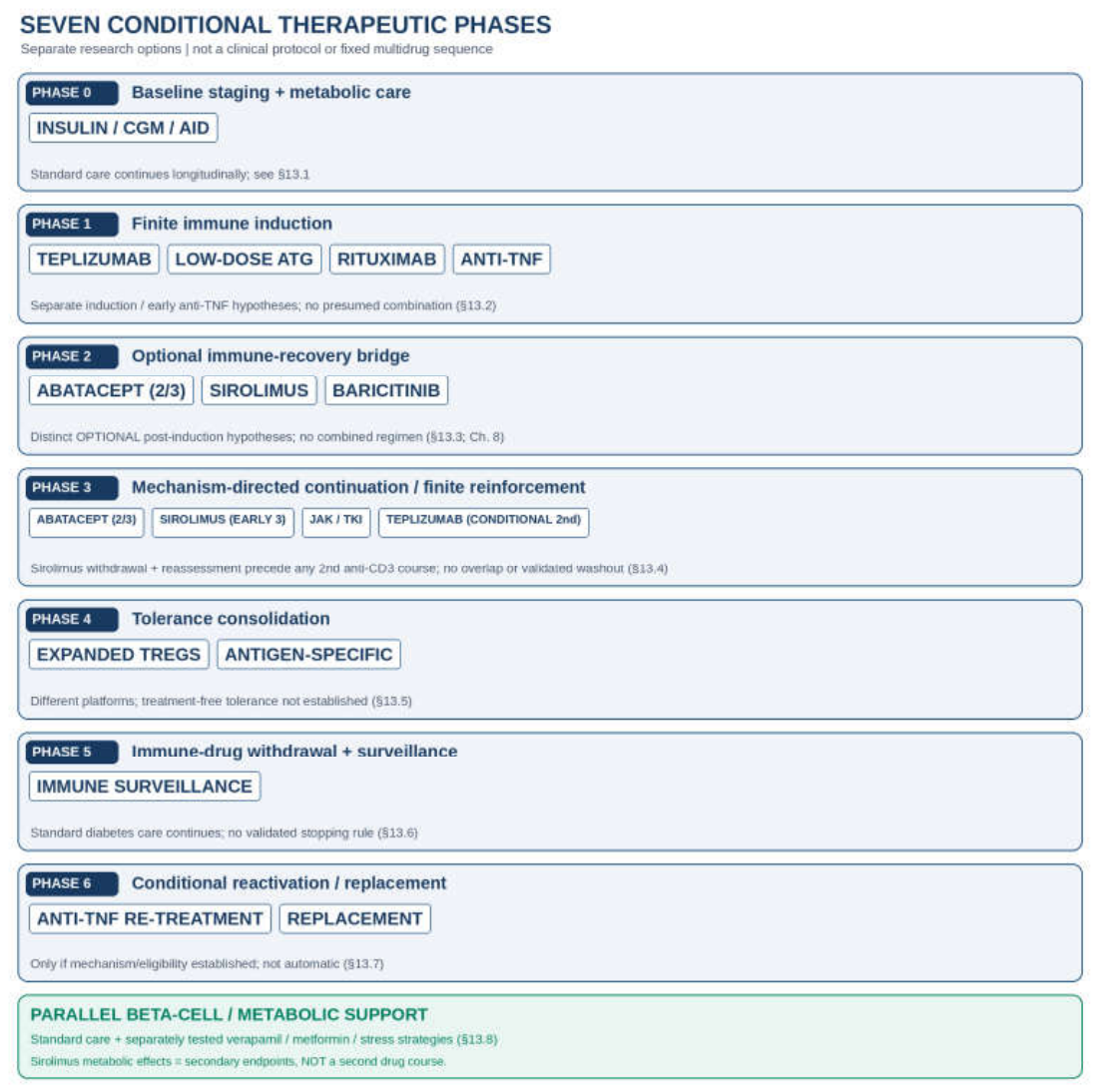
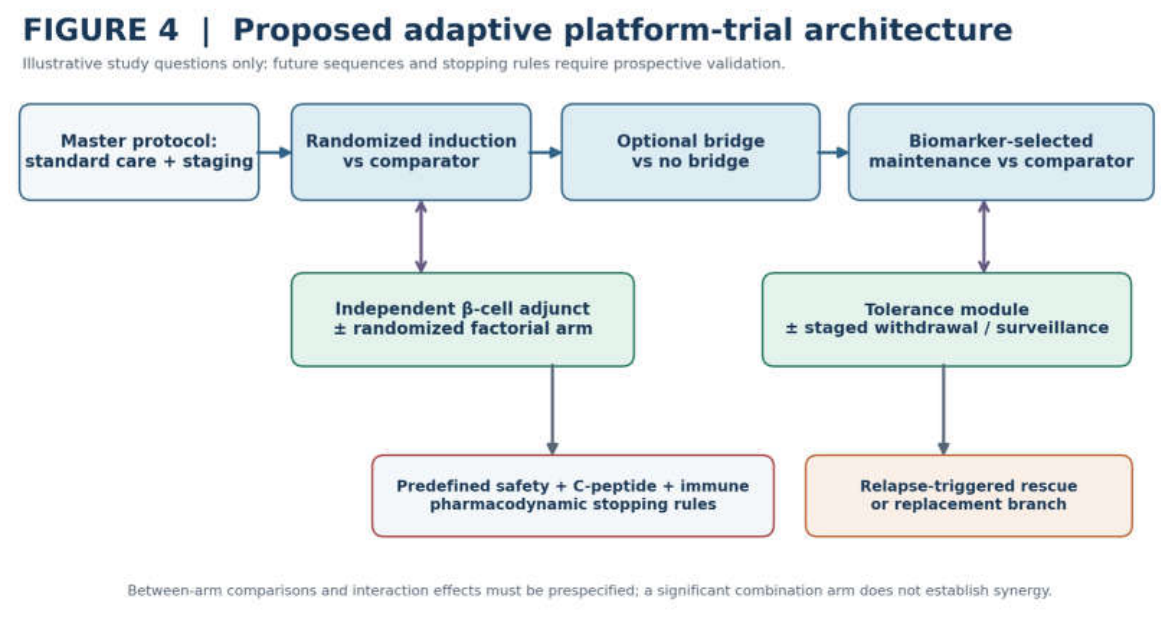
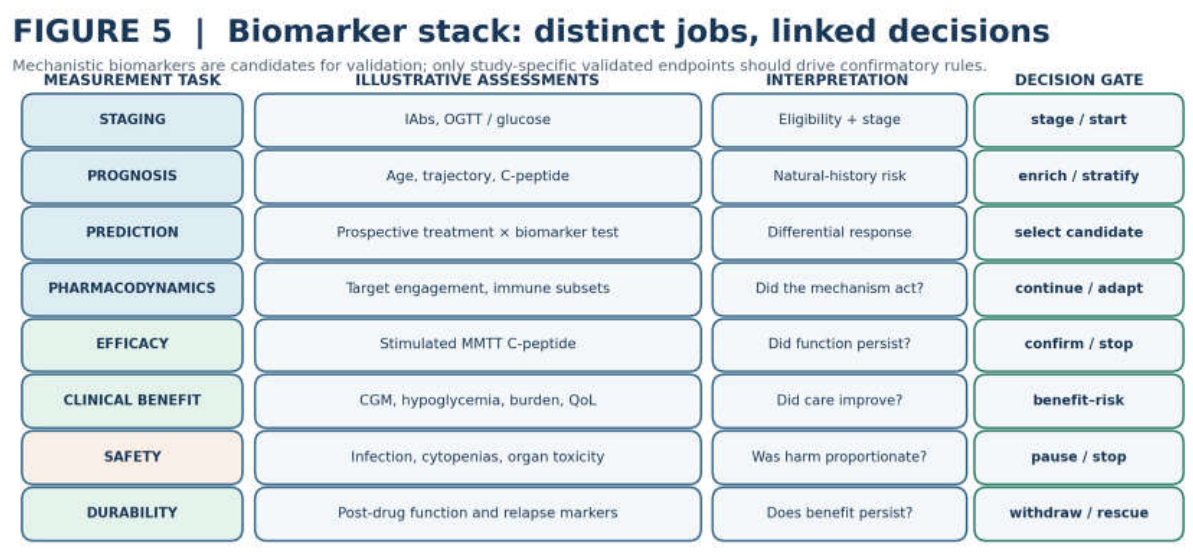
Figure 1.
Coupled immune–beta-cell feedback. The schematic links antigen presentation, T-cell activation and memory, islet injury, beta-cell stress, inflammatory signaling and metabolic load. Immune modules and tissue support address interacting compartments; arrows represent mechanistic hypotheses rather than universally established causal directions or a validated treatment sequence.
Figure 1.
Coupled immune–beta-cell feedback. The schematic links antigen presentation, T-cell activation and memory, islet injury, beta-cell stress, inflammatory signaling and metabolic load. Immune modules and tissue support address interacting compartments; arrows represent mechanistic hypotheses rather than universally established causal directions or a validated treatment sequence.
Figure 2.
Therapeutic window across stages 1–3 and beta-cell reserve. A longitudinal schematic relating autoantibody positivity, dysglycemia, residual C-peptide, recoverable beta-cell function, standard metabolic care, disease-modifying preservation, tolerance strategies, and the transition to replacement.
Figure 2.
Therapeutic window across stages 1–3 and beta-cell reserve. A longitudinal schematic relating autoantibody positivity, dysglycemia, residual C-peptide, recoverable beta-cell function, standard metabolic care, disease-modifying preservation, tolerance strategies, and the transition to replacement.
Figure 3.
Seven conditional research operations with an independent beta-cell-support axis. Options within and across phases are separate research questions, not a fixed regimen. Phase-spanning labels denote possible continuation of one exposure rather than mandatory coadministration. Conditional teplizumab reinforcement after any optional sirolimus exposure requires withdrawal, reassessment, and dedicated sequence-safety testing. [6,11,14,15,28,36,38,52,53,54,55,82,83,88].
Figure 3.
Seven conditional research operations with an independent beta-cell-support axis. Options within and across phases are separate research questions, not a fixed regimen. Phase-spanning labels denote possible continuation of one exposure rather than mandatory coadministration. Conditional teplizumab reinforcement after any optional sirolimus exposure requires withdrawal, reassessment, and dedicated sequence-safety testing. [6,11,14,15,28,36,38,52,53,54,55,82,83,88].
Figure 4.
Adaptive platform-trial architecture. The schema separates induction, optional bridge, biomarker-selected continuation, independently randomized beta-cell support, tolerance, withdrawal, and relapse-triggered rescue or replacement. Component effects, cross-axis interactions, stopping rules, and sequence-specific safety require prospective testing; the maintenance branch does not imply chronic anti-CD3 treatment. [6,82].
Figure 4.
Adaptive platform-trial architecture. The schema separates induction, optional bridge, biomarker-selected continuation, independently randomized beta-cell support, tolerance, withdrawal, and relapse-triggered rescue or replacement. Component effects, cross-axis interactions, stopping rules, and sequence-specific safety require prospective testing; the maintenance branch does not imply chronic anti-CD3 treatment. [6,82].
Figure 5.
Biomarker stack and decision points. Staging, prognosis, predictive selection, pharmacodynamics, efficacy, clinical benefit, safety and treatment burden are distinct measurement domains; the diagram links them to conditional initiation, continuation, withdrawal, switching and reintervention, not to validated patient-level thresholds.
Figure 5.
Biomarker stack and decision points. Staging, prognosis, predictive selection, pharmacodynamics, efficacy, clinical benefit, safety and treatment burden are distinct measurement domains; the diagram links them to conditional initiation, continuation, withdrawal, switching and reintervention, not to validated patient-level thresholds.
13. Cross-Phase Timing: Initiation, Continuation, Withdrawal and Reintroduction
Initiation, duration, withdrawal, residual drug effect, and reintroduction are distinct variables. An exposure may span two research phases without implying coadministration with another agent; adjacent labels do not imply safe overlap. Interaction surveillance is therefore a core design requirement, particularly for combinations with known or plausible cumulative immune risk. [82,83]
13.1. Phase 0 — Staging, Baseline Characterization, and Metabolic Stabilization
Phase 0 establishes clinical stage, residual stimulated C-peptide and trajectory, autoantibodies, metabolic state, candidate immune and tissue endotypes, comorbidities, vaccination status, and risk budget. Standard insulin, CGM, and automated delivery are optimized and continue as indicated. [4,75,76,93,94,95]
13.2. Phase 1 — finite Immune Induction and Early Inflammatory Control
Phase 1 tests a finite immune perturbation or reprogramming strategy. Teplizumab/anti-CD3, low-dose ATG, and rituximab are distinct candidates rather than interchangeable or routinely combinable options. Early anti-TNF is a separate duration question because T1GER studied a 52-week course. [3,5,6,9,14,30,31,32,33,38]
13.3. Phase 2 — Immune-Recovery Transition and Optional Repopulation Control
Phase 2 begins with reassessment after meaningful immune perturbation; a bridge is optional. Abatacept, baricitinib, or sirolimus illustrate mechanistically different bridge hypotheses, but source trials do not establish a universal post-induction role, timing, or duration. [11,15,28,52,53,54,55,82,83,84]
13.4. Phase 3 — Mechanism-Directed Continuation or Conditional Finite Reinforcement
Phase 3 asks whether residual disease biology justifies continuation, an alternative mechanism-directed intervention, finite reinforcement, or no further immune drug. Candidate JAK/TYK2, IL-12/23, B-cell, TKI, and co-stimulation strategies remain distinct questions whose post-induction or biomarker-selected use is largely extrapolative. [11,15,28,36,37,84]
A repeat anti-CD3 course is a separate reinforcement question. PROTECT supports two-course teplizumab administration in its studied regimen, but not the incremental contribution of course two or an intervening sirolimus exposure. Any such sequence requires withdrawal, reassessment, a no-second-course comparator, and dedicated interaction testing. [6,82]
13.5. Phase 4 — Tolerance Consolidation
Phase 4 tests whether pharmacologic control can be converted into durable regulation through antigen-specific, regulatory-cell, tolerogenic, or related approaches. The defining outcome is the ability to withdraw immune therapy without rebound, not a favorable immune phenotype while treatment continues. [50,51,55,89,90,91,92]
13.6. Phase 5 — Withdrawal and Surveillance
13.7. Phase 6 — Immune Reactivation, Mechanism-Matched Reintervention or Beta-Cell Replacement
Phase 6 distinguishes renewed immune activity from nonspecific metabolic deterioration and from loss of recoverable reserve. Mechanism-matched reintervention requires a validated relapse signal, preserved beta-cell reserve, a true retreatment comparator, and cumulative-safety assessment. When preservation is no longer proportionate, transition to islet or beta-cell replacement becomes the relevant branch. [3,6,9,10,14,38,44,45,46,47,48,49,83]
13.7.1. Experimental Safeguards for Reintervention and Replacement Decisions
Reintervention studies should prespecify the relapse definition, target-pathway selector, prior-drug carryover, residual beta-cell function, independent adverse-event surveillance, and criteria for transition to replacement.
13.8. Parallel Beta-Cell Axis — Longitudinal Metabolic Support and Beta-Cell Resilience Across Phases 0–6
The parallel beta-cell axis may begin during baseline metabolic stabilization and continue across selected immune phases according to beta-cell reserve, tissue biology, safety, and intervention-specific evidence. Standard metabolic care is foundational; verapamil, DFMO, metformin/4E-BP1 translational-load control, GLP-1-based support, and other stress-directed approaches are research modules whose tissue effects should be measured independently. [16,39,40,41,42,43,56,57]
The rationale for keeping this axis separate is causal as well as organizational. An immune intervention may reduce destructive pressure without directly improving cellular resilience, while a tissue-directed intervention may improve secretion or stress tolerance without altering autoimmunity. Independent randomization or prespecified factorial testing is therefore needed when both are used.
13.9. Integrated Evidence-to-Phase Alignment and Summary Tables
A concise evidence-to-phase summary should distinguish direct human observations from untested timing, sequence, selection, and interaction assumptions. Detailed alignment matrices can be supplied as supplementary material; Table 2 summarizes the main operations and reassessment logic.
14. Biomarkers, Endotypes, and Theratypes: How to Decide Who Needs Which Operation
Precision disease modification requires a biomarker stack rather than a single test. Staging, prognosis, prediction of treatment response, pharmacodynamic confirmation, efficacy, clinical benefit, and safety are distinct measurement jobs. Stimulated C-peptide should anchor postdiagnosis efficacy, whereas CGM and other clinical outcomes capture benefit but can improve without changing beta-cell biology. [2,72,73,75,76,79,94]
This distinction prevents several common errors: using a prognostic marker as if it were predictive, interpreting peripheral target engagement as proof of pancreatic effect, or treating improved CGM metrics as direct evidence of preserved beta-cell mass. Each biomarker should have a prespecified decision role and an evidentiary standard appropriate to that role.
Candidate endotype dimensions include B-cell-rich immunopathology, interferon activity, TNF/myeloid inflammation, Th17/IL-12/23 biology, T-cell activation states, beta-cell stress, autoantibody/HLA profiles, and residual secretion. A clinically useful theratype requires a marker that predicts differential response to a specific therapy, not merely natural-history risk. [29,37,79,80,81]
Predictive and prognostic biomarkers must therefore be separated. Post hoc responder signals can generate hypotheses but should not allocate treatment until validated through prospective stratification or treatment-by-marker interaction tests.
For adaptive sequencing, an early relapse marker may be especially valuable if it identifies renewed immune or beta-cell injury before substantial C-peptide loss. Candidate signals include interferon activity, B-cell/APC repopulation, pathogenic T-cell expansion, proinsulin:C-peptide changes, antigen-specific repertoires, and worsening metabolic trajectories. [2,73,77,78] Biomarker roles are summarized in Supplementary Table S3.
15. Safety and Reversibility Constrain Translational Feasibility
Safety is part of translational feasibility because pathways targeted for disease modification also support infection control, vaccine responses, tumor surveillance, tissue repair, and normal metabolism. The acceptable risk budget changes across the disease continuum: stage 1 requires highly selective and reversible exposure, while recent stage 3 or severe hypoglycemia may justify greater risk when expected benefit is larger. [4,5,7,9,11,14,15,33,46,94,95]
Risk tolerance should also be linked to expected untreated trajectory and available alternatives. The same adverse-event profile can be disproportionate in presymptomatic disease yet potentially acceptable in severe, treatment-refractory disease. This argues for stage-specific stopping rules and cumulative exposure accounting rather than a single universal safety threshold.
Risk follows exposure rather than phase labels. Finite anti-CD3 or ATG concentrates acute risks; B-cell depletion, chronic cytokine blockade, co-stimulation blockade, or JAK inhibition can create longer biologic tails; repeated exposure adds cumulative risk. New sequences therefore require fresh infectious, hematologic, metabolic, reproductive, and interaction assessment. [7,8,9,14,15,31,32,33,55,82,87]
Combination safety cannot be inferred from mechanistic complementarity. Concurrent abatacept and TNF-antagonist exposure is a known concern in other autoimmune populations, while the anti-CD3/sirolimus mouse data and sirolimus/IL-2 human regimen provide separate warnings against assuming compatibility. [55,82,83]
The provisional Safety and Reversibility Score (SRS) is retained only as a research-appraisal framework. It summarizes seven domains on an ascending 0–28 scale but is not a calibrated risk probability, efficacy ranking, or prescribing instrument; severe domain-specific hazards and interactions override a favorable total. The provisional SRS domains are summarized in Supplementary Table S4; the full rubric is provided in Supplementary Appendix A.
16. Trial Design: From Fixed Packages to Adaptive Platform Science
The framework generates separable trial questions rather than a fixed package. A master protocol could randomize induction, optional bridge, mechanism-directed continuation, beta-cell support, tolerance strategies, withdrawal, and rescue independently. Because most source evidence comes from stand-alone treatment near diagnosis, every new temporal role should be tested against an appropriate comparator. [14,38,83,84]
Sequential multiple-assignment designs are particularly attractive when the next intervention depends on observed response, whereas factorial designs are useful when the independent and interaction effects of immune and tissue-directed modules are both of interest. In either case, adaptation rules should be prespecified and based on sufficiently validated intermediate outcomes rather than post hoc clinical judgment.
Post-induction studies should retain an induction-alone arm and prespecify recovery criteria, target engagement, and exposure-specific safety. Biomarker-selected studies should validate prediction through treatment-by-marker interactions. Eligible tissue adjuncts can be randomized independently or factorially with immune therapy so that component and interaction effects remain identifiable.
Repeat-course questions similarly require sequential decomposition. First-course response, any intervening experimental bridge, withdrawal, reassessment, and later reinforcement should be separable whenever feasible; source trials do not automatically validate a new sequence. [6,82]
Common infrastructure should include standardized MMTT C-peptide, CGM, patient-reported burden, infection and reproductive surveillance, and mechanism-specific pharmacodynamics. Long-term off-treatment follow-up is essential because transient slowing and durable modification are biologically different endpoints. [2,72,73,75,76]
17. Screening, Staging, and Implementation: the Therapeutic Window Must First Be Found
Presymptomatic disease modification depends on accurate staging and longitudinal follow-up. Multiple confirmed islet autoantibodies define established presymptomatic autoimmunity, and dysglycemia distinguishes stage 2 from stage 1. A single confirmed islet autoantibody remains an at-risk state rather than stage 1, although phenotype, metabolic trajectory, and associated autoimmunity can inform prognostic research. [4,93,94,95,96,97]
Population screening can identify early-stage disease beyond affected families and may reduce diabetic ketoacidosis through education and surveillance, but benefit depends on confirmatory testing, counseling, metabolic staging, follow-up, and access to treatment. Implementation outcomes should therefore include psychological burden, loss to follow-up, travel, equity, and treatment access as well as antibody detection. [93,94,96]
Teplizumab illustrates the implementation challenge because treatment requires accurate staging, eligibility and infection assessment, infusion capacity, laboratory monitoring, and continued follow-up. Screening and disease-modifying therapy must therefore be developed as a linked care pathway. [3,6,7,96]
18. Preservation and Replacement Are Different Phases of the Same Therapeutic Continuum
Preservation and replacement address different biological moments. Preservation attempts to interrupt destruction while endogenous cells remain recoverable; replacement restores insulin-producing mass after reserve becomes insufficient and adds the challenge of alloimmunity unless cells are autologous or effectively immune-evasive. [1,44,46,47,69]
Replacement also sharpens the meaning of immune control. A newly implanted beta-cell population can fail through alloimmunity, recurrent autoimmunity, inadequate engraftment, or tissue-specific stress. These mechanisms overlap only partly with preservation of native beta cells, so success in one setting should not be assumed to transfer directly to the other.
Donor islet transplantation established proof that glucose-responsive secretion and insulin independence can be restored in selected patients, while long-term experience revealed graft attrition and the burden of systemic immunosuppression. Stem-cell-derived islets now change the supply equation, but immune protection, durability, manufacturing, and long-term safety remain central constraints. [44,45,46,47,48,49]
These fields should inform one another: replacement provides a defined cell population for studying immune protection, while selective strategies developed in early T1D may eventually support safer graft survival. The therapeutic continuum is therefore to preserve native beta cells when proportionate and replace them when necessary.
19. Priority Research Questions
The framework prioritizes a small set of prospective questions: which finite induction strategy best fits a given stage and endotype; whether optional post-induction bridging adds benefit over induction alone; whether biomarkers predict benefit from mechanism-directed continuation; whether beta-cell-supportive modules add independent functional preservation; which tolerance strategies permit durable immune-drug withdrawal; how relapse should be defined before major C-peptide loss; and when replacement becomes more proportionate than further immune exposure. Component-controlled, factorial, or sequentially randomized designs should estimate the incremental value of timing, duration, overlap, withdrawal, and reintervention while maintaining explicit safety and implementation criteria.
20. Discussion: A Change in Therapeutic Philosophy
Four decades of T1D intervention studies are more informative when read as experiments on disease biology rather than as a competition among partially successful drugs. Cyclosporine established reversibility and a toxicity boundary; anti-CD3 demonstrated durable effects after finite exposure; rituximab and abatacept identified B-cell and co-stimulation bottlenecks without permanent reset; IL-1 blockade demonstrated target non-sufficiency; ATG plus G-CSF showed that an added plausible component need not improve outcome; and baricitinib, verapamil, and emerging tissue-directed approaches link immune signaling and beta-cell state to preservation. [3,5,9,11,13,15,16,39,40,55,56,57]
Together, these findings argue against both universal monotherapy and indiscriminate polytherapy. They motivate the central hypothesis of this article: a conditional, mechanism-guided multi-step strategy may outperform monotherapy when residual or recurrent disease is driven by biological processes not adequately controlled by the first intervention. The proposed alternative is modular: perform the smallest biological operation needed to move the system into a more favorable state, verify that transition, and add, switch, withdraw, or reintroduce treatment only when a defined residual mechanism remains. Temporal adjacency does not establish compatibility, and efficacy in one population does not validate a different bridge, maintenance, or rescue role.
Sirolimus and repeat-course teplizumab illustrate the boundary between evidence and hypothesis. Human data support repeat-course teplizumab in a specific studied regimen and provide limited sirolimus immune and metabolic observations, but they do not validate an intervening sirolimus bridge, the benefit of a second course after that bridge, or a safe transition interval. The unfavorable NOD anti-CD3/sirolimus interaction justifies particular caution. [6,52,53,54,55,82,88]
The same discipline applies to the parallel beta-cell axis. Better glucose metrics, lower insulin requirements, favorable stress markers, or reversible secretory suppression are not interchangeable with preserved beta-cell mass or immune tolerance. Tissue modules need independent functional and stress endpoints, and cross-axis combinations require component attribution and interaction testing. [1,2,16,39,40,41,42,43,56,69,70,71,72,73,87]
The framework is intentionally falsifiable: candidates can be removed because of negative efficacy, stage mismatch, inadequate durability, tissue harm, or disproportionate cumulative risk. Success is a clinically meaningful and durable state change, not maximal mechanism coverage. When recoverable endogenous reserve becomes inadequate, restoration of beta-cell mass may be more rational than escalating immune exposure.
As disease-modifying therapy moves earlier in the disease course, screening, staging, biomarker validation, safety, and trial design become increasingly interdependent. The practical research problem is to identify the necessary biological operation, measure whether it worked, determine when it can stop, and preserve benefit within an acceptable lifetime risk budget. [3,4,6,7,95,96,98]
20.1. Methodological Scope and Limitations
This work is limited by its structured narrative design. It did not use a registered systematic-review protocol, exhaustive reproducible search, duplicate screening, formal risk-of-bias scoring, GRADE assessment, or quantitative pooling; study selection may therefore reflect availability, historical prominence, and mechanistic relevance.
The seven-phase framework, parallel beta-cell axis, alignment logic, and SRS are research tools rather than validated clinical decision instruments. Proposed timing, biomarker selectors, retreatment rules, interaction safety, and generalizability across ages and health systems require prospective validation.
21. Conclusions
Human intervention studies establish that T1D can be modified in defined populations while showing that biological activity at a single target rarely produces durable, treatment-independent control. The evidence is therefore useful as a map of stage-dependent immune, inflammatory, regulatory, and beta-cell bottlenecks rather than as a ranking of interchangeable monotherapies. This pattern supports, but does not prove, the hypothesis that sequentially addressing different active bottlenecks may yield more durable disease modification than targeting one mechanism alone.
The central practical consequence is methodological: future studies should ask not only whether an intervention changes C-peptide or progression, but which biological operation it accomplished, in whom, for how long, and at what cumulative cost. Those questions determine whether a signal is worth repeating, consolidating, or abandoning.
We hypothesize that disease modification can be improved by a conditional multi-step strategy organized as state transitions comprising seven immune operations and an independently selected beta-cell-support axis. The key comparative prediction is that mechanism-guided sequencing will produce greater and more durable preservation than appropriate monotherapy when a defined residual mechanism persists after the first intervention. Evidence from one disease stage or treatment context should not be assumed to establish efficacy, safety, or timing in another sequence; each operation requires explicit component attribution, pharmacodynamic endpoints, stopping criteria, and cumulative-safety assessment.
The next advance may therefore depend not on empirical accumulation of drugs, but on testing whether the right biological operation is applied at the right time and whether a subsequent step adds measurable benefit over monotherapy or induction alone. Adaptive, component-controlled trials integrating residual beta-cell function, mechanistic biomarkers, tissue stress, treatment burden, interaction safety, and off-treatment durability provide a practical way to falsify or support this multi-step hypothesis.
Supplementary Materials
The following supporting information can be downloaded at the website of this paper posted on Preprints.org.
Author Contributions
Mario José do Canto Filho: Conceptualization; Methodology; Investigation; Resources; Writing - original draft; Writing - review & editing; Visualization; Project administration.
Funding
This research received no external funding and was supported solely by the author.
Ethics Statement
This article does not contain studies with human or animal subjects performed by the author.
Research Data Availability Statement
No new research datasets were generated or analyzed in this work. This Hypothesis article is based exclusively on previously published literature and publicly available sources cited in the manuscript.
Conflicts of Interest
The author declares no conflicts of interest.
Use of Artificial Intelligence
During preparation of this manuscript, the author used OpenAI ChatGPT, including GPT-5.6 Sol during the final preparation stage, to assist with manuscript organization, language refinement, preliminary citation matching, and drafting of original conceptual figures. The author reviewed, verified, and edited all AI-assisted content and takes full responsibility for the scientific content, interpretation of the literature, accuracy of the references, figures, and final manuscript.
References
- The Diabetes Control and Complications Trial Research Group. Effect of intensive therapy on residual beta-cell function in patients with type 1 diabetes in the Diabetes Control and Complications Trial: a randomized, controlled trial. Ann. Intern Med. 1998, 128, 517–523. [Google Scholar] [CrossRef] [PubMed]
- Rickels, M.R.; Evans-Molina, C.; Bahnson, H.T.; et al. High residual C-peptide likely contributes to glycemic control in type 1 diabetes. J. Clin. Invest. 2020, 130, 1850–1862. [Google Scholar] [CrossRef] [PubMed]
- Herold, K.C.; Bundy, B.N.; Long, S.A.; et al. An anti-CD3 antibody, teplizumab, in relatives at risk for type 1 diabetes. N Engl. J. Med. 2019, 381, 603–613. [Google Scholar] [CrossRef] [PubMed]
- American Diabetes Association Professional Practice Committee for Diabetes. 2. Diagnosis and classification of diabetes: Standards of Care in Diabetes—2026. Diabetes Care 2026, 49 (Suppl 1), S27–S49. [Google Scholar] [CrossRef] [PubMed]
- Feutren, G.; Papoz, L.; Assan, R.; et al. Cyclosporin increases the rate and length of remissions in insulin-dependent diabetes of recent onset: results of a multicentre double-blind trial. Lancet 1986, 2, 119–124. [Google Scholar] [CrossRef] [PubMed]
- Ramos, E.L.; Dayan, C.M.; Chatenoud, L.; et al. Teplizumab and beta-cell function in newly diagnosed type 1 diabetes. N Engl. J. Med. 2023, 389, 2151–2161. [Google Scholar] [CrossRef] [PubMed]
- US Food and Drug Administration. FDA Approves New Indication for Tzield (teplizumab) for Certain Pediatric Patients with Recently Diagnosed Stage 3 Type 1 Diabetes. 2026. [Google Scholar] [PubMed]
- US Food and Drug Administration. TZIELD (teplizumab-mzwv) prescribing information. June 2026. Available online: https://www.accessdata.fda.gov/drugsatfda_docs/label/2026/761183s010lbls014lbl.pdf (accessed on 26 September 2026).
- Pescovitz, M.D.; Greenbaum, C.J.; Krause-Steinrauf, H.; et al. Rituximab, B-lymphocyte depletion, and preservation of beta-cell function. N Engl. J. Med. 2009, 361, 2143–2152. [Google Scholar] [CrossRef] [PubMed]
- Pescovitz, M.D.; Greenbaum, C.J.; Bundy, B.; et al. B-lymphocyte depletion with rituximab and beta-cell function: two-year results. Diabetes Care 2014, 37, 453–459. [Google Scholar] [CrossRef] [PubMed]
- Orban, T.; Bundy, B.; Becker, D.J.; et al. Co-stimulation modulation with abatacept in patients with recent-onset type 1 diabetes. Lancet 2011, 378, 412–419. [Google Scholar] [CrossRef] [PubMed]
- Russell, W.E.; Bundy, B.N.; Anderson, M.S.; et al. Abatacept for delay of type 1 diabetes progression in stage 1 relatives at risk. Diabetes Care 2023, 46, 1005–1013. [Google Scholar] [CrossRef] [PubMed]
- Moran, A.; Bundy, B.; Becker, D.J.; et al. Interleukin-1 antagonism in type 1 diabetes of recent onset: two multicentre, randomised, double-blind, placebo-controlled trials. Lancet 2013, 381, 1905–1915. [Google Scholar] [CrossRef] [PubMed]
- Quattrin, T.; Haller, M.J.; Steck, A.K.; et al. Golimumab and beta-cell function in youth with new-onset type 1 diabetes. N Engl. J. Med. 2020, 383, 2007–2017. [Google Scholar] [CrossRef] [PubMed]
- Waibel, M.; Wentworth, J.M.; So, M.; et al. Baricitinib and beta-cell function in patients with new-onset type 1 diabetes. N Engl. J. Med. 2023, 389, 2140–2150. [Google Scholar] [CrossRef] [PubMed]
- von Herrath, M.; Bain, S.C.; Bode, B.; et al. Anti-interleukin-21 antibody and liraglutide for the preservation of beta-cell function in adults with recent-onset type 1 diabetes. Lancet Diabetes Endocrinol. 2021, 9, 212–224. [Google Scholar] [CrossRef] [PubMed]
- Voltarelli, J.C.; Couri, C.E.B.; Stracieri, A.B.P.L.; et al. Autologous nonmyeloablative hematopoietic stem cell transplantation in newly diagnosed type 1 diabetes mellitus. JAMA 2007, 297, 1568–1576. [Google Scholar] [CrossRef] [PubMed]
- Herold, K.C.; Hagopian, W.; Auger, J.A.; et al. Anti-CD3 monoclonal antibody in new-onset type 1 diabetes mellitus. N Engl. J. Med. 2002, 346, 1692–1698. [Google Scholar] [CrossRef] [PubMed]
- Herold, K.C.; Gitelman, S.E.; Masharani, U.; et al. A single course of anti-CD3 monoclonal antibody hOKT3γ1(Ala-Ala) results in improvement in C-peptide responses and clinical parameters for at least 2 years after onset of type 1 diabetes. Diabetes 2005, 54, 1763–1769. [Google Scholar] [CrossRef] [PubMed]
- Keymeulen, B.; Vandemeulebroucke, E.; Ziegler, A.G.; et al. Insulin needs after CD3-antibody therapy in new-onset type 1 diabetes. N Engl. J. Med. 2005, 352, 2598–2608. [Google Scholar] [CrossRef] [PubMed]
- Sherry, N.; Hagopian, W.; Ludvigsson, J.; et al. Teplizumab for treatment of type 1 diabetes (PROTÉGÉ study): 1-year results from a randomised, placebo-controlled trial. Lancet 2011, 378, 487–497. [Google Scholar] [CrossRef] [PubMed]
- Hagopian, W.; Ferry, RJJr; Sherry, N.; et al. Teplizumab preserves C-peptide in recent-onset type 1 diabetes: two-year results from the randomized, placebo-controlled PROTÉGÉ trial. Diabetes 2013, 62, 3901–3908. [Google Scholar] [CrossRef] [PubMed]
- Aronson, R.; Gottlieb, P.A.; Christiansen, J.S.; et al. Low-dose otelixizumab anti-CD3 monoclonal antibody DEFEND-1 study. Diabetes Care 2014, 37, 2746–2754. [Google Scholar] [CrossRef] [PubMed]
- Sims, E.K.; Bundy, B.N.; Stier, K.; et al. Teplizumab improves and stabilizes beta cell function in antibody-positive high-risk individuals. Sci. Transl. Med. 2021, 13, eabc8980. [Google Scholar] [CrossRef] [PubMed]
- Perdigoto, A.L.; Preston-Hurlburt, P.; Clark, P.; et al. Treatment of type 1 diabetes with teplizumab: clinical and immunological follow-up after 7 years from diagnosis. Diabetologia 2019, 62, 655–664. [Google Scholar] [CrossRef] [PubMed]
- Chamberlain, N.; Massad, C.; Oe, T.; Cantaert, T.; Herold, K.C.; Meffre, E. Rituximab does not reset defective early B cell tolerance checkpoints. J. Clin. Invest. 2016, 126, 282–287. [Google Scholar] [CrossRef] [PubMed]
- Linsley, P.S.; Greenbaum, C.J.; Rosasco, M.; Presnell, S.; Herold, K.C.; Dufort, M.J. Elevated T cell levels in peripheral blood predict poor clinical response following rituximab treatment in new-onset type 1 diabetes. Genes Immun. 2019, 20, 293–307. [Google Scholar] [CrossRef] [PubMed]
- Orban, T.; Bundy, B.; Becker, D.J.; et al. Costimulation modulation with abatacept in patients with recent-onset type 1 diabetes: follow-up 1 year after cessation of treatment. Diabetes Care 2014, 37, 1069–1075. [Google Scholar] [CrossRef] [PubMed]
- Cabrera, S.M.; et al. Innate immune activity as a predictor of persistent insulin secretion and association with responsiveness to CTLA4-Ig treatment in recent-onset type 1 diabetes. Diabetologia 2018, 61, 2356–2370. [Google Scholar] [CrossRef] [PubMed]
- Gitelman, S.E.; Gottlieb, P.A.; Rigby, M.R.; et al. Antithymocyte globulin treatment for patients with recent-onset type 1 diabetes: 12-month results. Lancet Diabetes Endocrinol. 2013, 1, 306–316. [Google Scholar] [CrossRef] [PubMed]
- Haller, M.J.; Schatz, D.A.; Skyler, J.S.; et al. Low-dose anti-thymocyte globulin preserves beta-cell function and improves HbA1c in new-onset type 1 diabetes. Diabetes Care 2018, 41, 1917–1925. [Google Scholar] [CrossRef] [PubMed]
- Haller, M.J.; Long, S.A.; Blanchfield, J.L.; et al. Low-dose anti-thymocyte globulin preserves C-peptide, reduces HbA1c, and increases regulatory to conventional T-cell ratios in new-onset type 1 diabetes: two-year clinical trial data. Diabetes 2019, 68, 1267–1276. [Google Scholar] [CrossRef] [PubMed]
- Mathieu, C.; Wych, J.; Hendriks, A.E.J.; et al. Minimum effective low dose of antithymocyte globulin in people aged 5-25 years with recent-onset stage 3 type 1 diabetes (MELD-ATG). Lancet 2025, 406, 1375–1388. [Google Scholar] [CrossRef] [PubMed]
- Rigby, M.R.; DiMeglio, L.A.; Rendell, M.S.; et al. Targeting memory T cells with alefacept in new-onset type 1 diabetes. Lancet Diabetes Endocrinol. 2013, 1, 284–294. [Google Scholar] [CrossRef] [PubMed]
- Rigby, M.R.; Harris, K.M.; Pinckney, A.; et al. Alefacept provides sustained clinical and immunological effects in new-onset type 1 diabetes. J. Clin. Invest. 2015, 125, 3285–3296. [Google Scholar] [CrossRef] [PubMed]
- Gitelman, S.E.; Bundy, B.N.; Ferrannini, E.; et al. Imatinib therapy for patients with recent-onset type 1 diabetes: a multicentre, randomised, double-blind, placebo-controlled, phase 2 trial. Lancet Diabetes Endocrinol. 2021, 9, 502–514. [Google Scholar] [CrossRef] [PubMed]
- Tatovic, D.; Marwaha, A.; Taylor, P.; et al. Ustekinumab for type 1 diabetes in adolescents: a multicenter, double-blind, randomized phase 2 trial. Nat. Med. 2024, 30, 2657–2666. [Google Scholar] [CrossRef] [PubMed]
- Rigby, M.R.; Hayes, B.; Li, Y.; et al. Two-year follow-up from the T1GER study. Diabetes Care 2023, 46, 561–569. [Google Scholar] [CrossRef] [PubMed]
- Ovalle, F.; Grimes, T.; Xu, G.; et al. Verapamil and beta-cell function in adults with recent-onset type 1 diabetes. Nat. Med. 2018, 24, 1108–1112. [Google Scholar] [CrossRef] [PubMed]
- Forlenza, G.P.; McVean, J.; Beck, R.W.; et al. Effect of verapamil on pancreatic beta cell function in newly diagnosed pediatric type 1 diabetes: a randomized clinical trial. JAMA 2023, 329, 990–999. [Google Scholar] [CrossRef] [PubMed]
- McVean, J.; Forlenza, G.P.; Beck, R.W.; et al. Effect of tight glycemic control on pancreatic beta cell function in newly diagnosed pediatric type 1 diabetes. JAMA 2023, 329, 980–989. [Google Scholar] [CrossRef] [PubMed]
- Sims, E.K.; et al. Inhibition of polyamine biosynthesis preserves beta cell function in type 1 diabetes. Cell Rep. Med. 2023, 4, 101261. [Google Scholar] [CrossRef] [PubMed]
- Boughton, C.K.; Allen, J.M.; Ware, J.; et al. The effect of closed-loop glucose control on C-peptide secretion in youth with newly diagnosed type 1 diabetes: the CLOuD RCT. Effic. Mech. Eval. 2024, 11(8). [Google Scholar] [CrossRef] [PubMed]
- Shapiro, A.M.J.; Lakey, J.R.T.; Ryan, E.A.; et al. Islet transplantation in seven patients with type 1 diabetes mellitus using a glucocorticoid-free immunosuppressive regimen. N Engl. J. Med. 2000, 343, 230–238. [Google Scholar] [CrossRef] [PubMed]
- Shapiro, A.M.J.; Ricordi, C.; Hering, B.J.; et al. International trial of the Edmonton protocol for islet transplantation. N Engl. J. Med. 2006, 355, 1318–1330. [Google Scholar] [CrossRef] [PubMed]
- US Food and Drug Administration. Lantidra (donislecel-jujn) approval and prescribing information. 2023. [Google Scholar]
- Reichman, T.W.; Markmann, J.F.; Odorico, J.; et al. Stem Cell–Derived, Fully Differentiated Islets for Type 1 Diabetes. N Engl. J. Med. 2025, 393, 858–868. [Google Scholar] [CrossRef] [PubMed]
- Wang, S.; Du, Y.; Zhang, B.; et al. Transplantation of chemically induced pluripotent stem-cell-derived islets under abdominal anterior rectus sheath in a type 1 diabetes patient. Cell 2024, 187, 6152–6164.e18. [Google Scholar] [CrossRef] [PubMed]
- Carlsson, P.O.; Hu, X.; Scholz, H.; et al. Survival of Transplanted Allogeneic Beta Cells with No Immunosuppression. N Engl. J. Med. 2025, 393, 887–894. [Google Scholar] [CrossRef] [PubMed]
- Bluestone, J.A.; Buckner, J.H.; Fitch, M.; et al. Type 1 diabetes immunotherapy using polyclonal regulatory T cells. Sci. Transl. Med. 2015, 7(315), 315ra189. [Google Scholar] [CrossRef] [PubMed]
- Bender, C.; Wiedeman, A.E.; Hu, A.; et al. A phase 2 randomized trial with autologous polyclonal expanded regulatory T cells in children with new-onset type 1 diabetes. Sci. Transl. Med. 2024, 16, eadn2404. [Google Scholar] [CrossRef] [PubMed]
- Monti, P.; Scirpoli, M.; Maffi, P.; et al. Rapamycin monotherapy in patients with type 1 diabetes modifies CD4+CD25+FOXP3+ regulatory T-cells. Diabetes 2008, 57, 2341–2347. [Google Scholar] [CrossRef] [PubMed]
- Piemonti, L.; Maffi, P.; Monti, L.; et al. Beta cell function during rapamycin monotherapy in long-term type 1 diabetes. Diabetologia 2011, 54, 433–439. [Google Scholar] [CrossRef] [PubMed]
- Bolla, A.M.; Gandolfi, A.; Borgonovo, E.; et al. Rapamycin plus vildagliptin to recover β-cell function in long-standing type 1 diabetes: a double-blind, randomized trial. J. Clin. Endocrinol. Metab. 2021, 106, e507–e519. [Google Scholar] [CrossRef] [PubMed]
- Long, S.A.; Rieck, M.; Sanda, S.; et al. Rapamycin/IL-2 combination therapy in patients with type 1 diabetes augments Tregs yet transiently impairs beta-cell function. Diabetes 2012, 61, 2340–2348. [Google Scholar] [CrossRef] [PubMed]
- Inoue, R.; Tajima, K.; Okuyama, T.; et al. Metformin suppresses β-cell apoptosis under ER stress by inhibiting protein translation. Metabolism 2026, 180, 156607. [Google Scholar] [CrossRef] [PubMed]
- Petrie, J.R.; Chaturvedi, N.; Ford, I.; REMOVAL Study Group; et al. Cardiovascular and metabolic effects of metformin in patients with type 1 diabetes (REMOVAL): a double-blind, randomised, placebo-controlled trial. Lancet Diabetes Endocrinol. 2017, 5(8), 597–609. [Google Scholar] [CrossRef]
- Pinkse, G.G.M.; Tysma, O.H.M.; Bergen, C.A.M.; et al. Autoreactive CD8 T cells associated with beta cell destruction in type 1 diabetes. Proc. Natl. Acad. Sci. U S A 2005, 102, 18425–18430. [Google Scholar] [CrossRef] [PubMed]
- Richardson, S.J.; Rodriguez-Calvo, T.; Gerling, I.C.; et al. Islet cell hyperexpression of HLA class I antigens: a defining feature in type 1 diabetes. Diabetologia 2016, 59, 2448–2458. [Google Scholar] [CrossRef] [PubMed]
- Marroqui, L.; Dos Santos, R.S.; Op de Beeck, A.; et al. Interferon-alpha mediates human beta cell HLA class I overexpression, endoplasmic reticulum stress and apoptosis. Diabetologia 2017, 60, 656–667. [Google Scholar] [CrossRef] [PubMed]
- Herold, K.C.; Vignali, D.A.A.; Cooke, A.; Bluestone, J.A. Type 1 diabetes: translating mechanistic observations into effective clinical outcomes. Nat. Rev. Immunol. 2013, 13, 243–256. [Google Scholar] [CrossRef]
- Atkinson, M.A.; Roep, B.O.; Posgai, A.; Wheeler, D.C.S.; Peakman, M. The challenge of modulating beta-cell autoimmunity in type 1 diabetes. Lancet Diabetes Endocrinol. 2019, 7, 52–64. [Google Scholar] [CrossRef] [PubMed]
- Coomans de Brachène, A.; Dos Santos, R.S.; Marroqui, L.; et al. IFN-α induces a preferential long-lasting expression of MHC class I in human pancreatic beta cells. Diabetologia 2018, 61, 636–640. [Google Scholar] [CrossRef] [PubMed]
- Quesada-Masachs, E.; Zilberman, S.; Rajendran, S.; et al. Upregulation of HLA class II in pancreatic beta cells from organ donors with type 1 diabetes. Diabetologia 2022, 65, 387–401. [Google Scholar] [CrossRef] [PubMed]
- Delong, T.; Wiles, T.A.; Baker, R.L.; et al. Pathogenic CD4 T cells in type 1 diabetes recognize epitopes formed by peptide fusion. Science 2016, 351, 711–714. [Google Scholar] [CrossRef] [PubMed]
- Kracht, M.J.L.; van Lummel, M.; Nikolic, T.; et al. Autoimmunity against a defective ribosomal insulin gene product in type 1 diabetes. Nat. Med. 2017, 23, 501–507. [Google Scholar] [CrossRef] [PubMed]
- Baker, R.L.; Rihanek, M.; Hohenstein, A.C.; et al. Hybrid insulin peptides are autoantigens in type 1 diabetes. Diabetes 2019, 68, 1830–1840. [Google Scholar] [CrossRef] [PubMed]
- Roep, B.O.; Thomaidou, S.; van Tienhoven, R.; Zaldumbide, A. Type 1 diabetes mellitus as a disease of the beta-cell (do not blame the immune system?). Nat. Rev. Endocrinol. 2021, 17, 150–161. [Google Scholar] [CrossRef]
- Lachin, J.M.; McGee, P.; Palmer, J.P.; DCCT/EDIC Research Group. Impact of C-peptide preservation on metabolic and clinical outcomes in the Diabetes Control and Complications Trial. Diabetes 2014, 63, 739–748. [Google Scholar] [CrossRef] [PubMed]
- Jeyam, A.; Colhoun, H.M.; McGurnaghan, S.; et al. Clinical impact of residual C-peptide secretion in type 1 diabetes on glycemia and microvascular complications. Diabetes Care 2021, 44, 390–398. [Google Scholar] [CrossRef] [PubMed]
- Gubitosi-Klug, R.A.; Braffett, B.H.; Hitt, S.; et al. Residual beta cell function in long-term type 1 diabetes associates with reduced incidence of hypoglycemia. J. Clin. Invest. 2021, 131, e143011. [Google Scholar] [CrossRef] [PubMed]
- Taylor, P.N.; Collins, K.S.; Lam, A.; et al. C-peptide and metabolic outcomes in trials of disease-modifying therapy in new-onset type 1 diabetes: an individual participant meta-analysis. Lancet Diabetes Endocrinol. 2023, 11, 915–925. [Google Scholar] [CrossRef] [PubMed]
- Latres, E.; Greenbaum, C.J.; Oyaski, M.L.; et al. Evidence for C-peptide as a validated surrogate to predict clinical benefits in trials of disease-modifying therapies for type 1 diabetes. Diabetes 2024, 73, 823–833. [Google Scholar] [CrossRef] [PubMed]
- Fuhri Snethlage, C.M.; Hanssen, N.M.J.; et al. Residual β-cell function is associated with longer time in range in individuals with type 1 diabetes. Diabetes Care 2024, 47, 1114–1121. [Google Scholar] [CrossRef] [PubMed]
- Palmer, J.P.; Fleming, G.A.; Greenbaum, C.J.; et al. C-peptide is the appropriate outcome measure for type 1 diabetes clinical trials to preserve beta-cell function: report of an ADA workshop, 21–22 October 2001. Diabetes 2004, 53, 250–264. [Google Scholar] [CrossRef] [PubMed]
- Greenbaum, C.J.; Mandrup-Poulsen, T.; McGee, P.F.; et al. Mixed-meal tolerance test versus glucagon stimulation test for the assessment of beta-cell function in therapeutic trials in type 1 diabetes. Diabetes Care 2008, 31, 1966–1971. [Google Scholar] [CrossRef] [PubMed]
- Greenbaum, C.J.; Beam, C.A.; Boulware, D.; et al. Fall in C-peptide during the first 2 years from diagnosis. Diabetes 2012, 61, 2066–2073. [Google Scholar] [CrossRef] [PubMed]
- Shields, B.M.; McDonald, T.J.; Oram, R.; et al. C-peptide decline in type 1 diabetes has two phases: an initial exponential fall and a subsequent stable phase. Diabetes Care 2018, 41, 1486–1492. [Google Scholar] [CrossRef] [PubMed]
- Battaglia, M.; Ahmed, S.; Anderson, M.S.; et al. Introducing the endotype concept to address the challenge of disease heterogeneity in type 1 diabetes. Diabetes Care 2020, 43, 5–12. [Google Scholar] [CrossRef] [PubMed]
- Leete, P.; Willcox, A.; Krogvold, L.; et al. Differential insulitic profiles determine the extent of beta-cell destruction and the age at onset of type 1 diabetes. Diabetes 2016, 65, 1362–1369. [Google Scholar] [CrossRef] [PubMed]
- Leete, P.; Oram, R.A.; McDonald, T.J.; et al. Studies of insulin and proinsulin in pancreas and serum support the existence of aetiopathological endotypes of type 1 diabetes associated with age at diagnosis. Diabetologia 2020, 63, 1258–1267. [Google Scholar] [CrossRef] [PubMed]
- Valle, A.; Jofra, T.; Stabilini, A.; Atkinson, M.; Roncarolo, M.G.; Battaglia, M. Rapamycin prevents and breaks the anti-CD3-induced tolerance in NOD mice. Diabetes 2009, 58, 875–881. [Google Scholar] [CrossRef] [PubMed]
- US National Library of Medicine. ORENCIA (abatacept) full prescribing information: concomitant TNF antagonist use and infection warning. DailyMed. Available online: https://dailymed.nlm.nih.gov/dailymed/drugInfo.cfm?setid=0836c6ac-ee37-5640-2fed-a3185a0b16eb (accessed on 23 September 2026).
- ClinicalTrials.gov. Rituximab-pvvr and abatacept versus rituximab-pvvr alone in new-onset type 1 diabetes (TN25). NCT03929601. Available online: https://clinicaltrials.gov/study/NCT03929601 (accessed on 23 September 2026).
- Krogvold, L.; Mynarek, I.M.; Ponzi, E.; et al. Pleconaril and ribavirin in new-onset type 1 diabetes: a phase 2 randomized trial. Nat. Med. 2023, 29, 2902–2908. [Google Scholar] [CrossRef] [PubMed]
- Barlow, A.D.; et al. Rapamycin toxicity in MIN6 cells and rat and human islets is mediated by the inhibition of mTOR complex 2 (mTORC2). Diabetologia 2012, 55, 1355–1365. [Google Scholar] [CrossRef] [PubMed]
- Dai, C.; Walker, J.T.; Shostak, A.; et al. Tacrolimus- and sirolimus-induced human β cell dysfunction is reversible and preventable. JCI Insight 2020, 5(1), e130770. [Google Scholar] [CrossRef] [PubMed]
- Zeng, H.; Yang, K.; Cloer, C.; et al. mTORC1 couples immune signals and metabolic programming to establish Treg-cell function. Nature 2013, 499, 485–490. [Google Scholar] [CrossRef] [PubMed]
- Todd, J.A.; Evangelou, M.; Cutler, A.J.; et al. Regulatory T cell responses in participants with type 1 diabetes after a single dose of interleukin-2: an adaptive dose-finding trial. PLoS Med. 2016, 13, e1002139. [Google Scholar] [CrossRef] [PubMed]
- Writing Committee for the Type 1 Diabetes TrialNet Oral Insulin Study Group Effect of oral insulin on prevention of diabetes in relatives of patients with type 1 diabetes. J.A.M.A. 2017, 318, 1891–1902. [PubMed]
- Ludvigsson, J.; et al. GAD65 antigen therapy in recently diagnosed type 1 diabetes mellitus. N Engl. J. Med. 2012, 366, 433–442. [Google Scholar] [CrossRef] [PubMed]
- Ludvigsson, J.; Sumnik, Z.; Pelikanova, T.; et al. Intralymphatic glutamic acid decarboxylase with vitamin D supplementation in recent-onset type 1 diabetes: a double-blind, randomized, placebo-controlled phase IIb trial. Diabetes Care 2021, 44, 1604–1612. [Google Scholar] [CrossRef] [PubMed]
- Ziegler, A.G.; Rewers, M.; Simell, O.; et al. Seroconversion to multiple islet autoantibodies and risk of progression to diabetes in children. JAMA 2013, 309, 2473–2479. [Google Scholar] [CrossRef] [PubMed]
- Insel, R.A.; Dunne, J.L.; Atkinson, M.A.; et al. Staging presymptomatic type 1 diabetes: a scientific statement of JDRF, the Endocrine Society, and the American Diabetes Association. Diabetes Care 2015, 38, 1964–1974. [Google Scholar] [CrossRef] [PubMed]
- American Diabetes Association Professional Practice Committee for Diabetes. 3. Prevention or delay of diabetes and associated comorbidities: Standards of Care in Diabetes—2026. Diabetes Care 2026, 49 (Suppl 1), S50–S60. [Google Scholar] [CrossRef] [PubMed]
- Ziegler, A.G.; Rewers, M.J.; Achenbach, P.; et al. International consensus guidance for general population screening for islet autoantibodies to diagnose early-stage type 1 diabetes: a nominal group technique process. Diabetologia. Published online 10 September 2026. [CrossRef] [PubMed]
- Nakhleh, A.; Beeri, G.; Sudri, O.; Rotkopf, S.; Shehadeh, N. Impact of autoimmune hypothyroidism and celiac disease on progression to diabetes in individuals positive for GAD65 or IA-2 autoantibodies. Diabetes Obes. Metab. 2026, 28, 8452–8459. [Google Scholar] [CrossRef] [PubMed]
- Mathieu, C.; Sims, E.K.; Chatenoud, L.; et al. Toward disease-modifying therapies in type 1 diabetes: focus on teplizumab. Diabetes Care 2026, 49, 365–374. [Google Scholar] [CrossRef] [PubMed]
Table 2.
Integrated summary of seven-phase operations, representative modules, reassessment criteria, and the parallel beta-cell axis.
Table 2.
Integrated summary of seven-phase operations, representative modules, reassessment criteria, and the parallel beta-cell axis.
| Operation | Biological objective | Representative candidates / modules | Exit or reassessment criterion | Initiation / continuation / reintroduction (research only) |
|---|---|---|---|---|
| 0 | Stage and characterize; stabilize metabolic care | Standard insulin/CGM/AID as indicated; immune and tissue-baseline assessment. | Baseline risk, reserve and eligibility documented | Metabolic care continues across all phases; no fixed immune-drug start. |
| 1 | Finite immune induction; early inflammatory intervention only if indicated | First teplizumab course, low-dose ATG or rituximab as distinct induction candidates; separate early anti-TNF hypothesis. No concomitant sirolimus–anti-CD3. | Induction reassessment; anti-TNF optimal early duration requires prospective testing | Anti-TNF may start early; 52-week golimumab study does not prove short-course efficacy. No presumed simultaneous sirolimus or later abatacept overlap. |
| 2 | Optional post-induction immune-recovery bridge | Abatacept Phase 2/3 start; separate baricitinib hypothesis; sirolimus optional post-induction immune-tolerance research candidate, NOT routine bridge. | Reassess co-stimulation, immune recovery, Treg function, beta-cell function and safety | Abatacept Phase 2 start can continue into Phase 3; sirolimus may begin AFTER Phase 1 and continue conditionally into early Phase 3 as ONE experimental exposure. Exact prior-agent interactions untested. |
| 3 | Mechanism-directed continuation or conditional finite reinforcement | Abatacept continuation; separate JAK/TKI options; early sirolimus withdrawal. Conditional second teplizumab course only after withdrawal and reassessment. | Residual disease, immune/metabolic recovery, residual exposure and safety; compare reinforcement with no second course | New sequence hypothesis: sirolimus withdrawal → reassessment → conditional second anti-CD3 course. Finite reinforcement, not chronic maintenance; no pharmacologically relevant overlap or established washout. |
| 4 | Tolerance consolidation | Antigen-specific approaches, expanded or engineered regulatory cells; sirolimus not established as a Phase 4 tolerance therapy. | Antigen-relevant regulation and future treatment-free durability | Continuation of sirolimus into Phase 4 is NOT proposed or validated. |
| 5 | Immune-drug withdrawal and surveillance | Study finite immune-drug cessation and continue necessary insulin/CGM/AID. | Off-treatment durability or validated relapse assessment | Taper versus direct discontinuation must be tested per agent; sirolimus withdrawal hypothesized in early Phase 3, not deferred automatically to Phase 5. |
| 6 | Mechanism-matched reintervention or cell replacement transition | Conditional TNF-pathway re-treatment study with proven target relevance or other separately selected intervention/replacement. | Assess immune relapse, residual reserve, cumulative toxicity and replacement eligibility | Anti-TNF reintroduction is a NEW Phase 6 hypothesis, distinct from early Phase 1 exposure; do not assume safe overlap with lingering abatacept. |
| Axis β (parallel) | Maintain glucose-responsive beta-cell function | Standard metabolic care; selected verapamil / experimental metformin-4E-BP1 translational-load control and other stress approaches. Sirolimus effects measured only as secondary tissue readouts of its immune-axis exposure. | Independent stimulated C-peptide, stress and safety criteria | Parallel metabolic management persists; imatinib or sirolimus are not administered twice simply because effects cross axes. |
Disclaimer/Publisher’s Note: The statements, opinions and data contained in all publications are solely those of the individual author(s) and contributor(s) and not of MDPI and/or the editor(s). MDPI and/or the editor(s) disclaim responsibility for any injury to people or property resulting from any ideas, methods, instructions or products referred to in the content. |
© 2026 by the authors. Licensee MDPI, Basel, Switzerland. This article is an open access article distributed under the terms and conditions of the Creative Commons Attribution (CC BY) license (http://creativecommons.org/licenses/by/4.0/).
Copyright: This open access article is published under a Creative Commons CC BY 4.0 license, which permit the free download, distribution, and reuse, provided that the author and preprint are cited in any reuse.