
Submitted:
06 November 2026
Posted:
09 November 2026
You are already at the latest version
Abstract
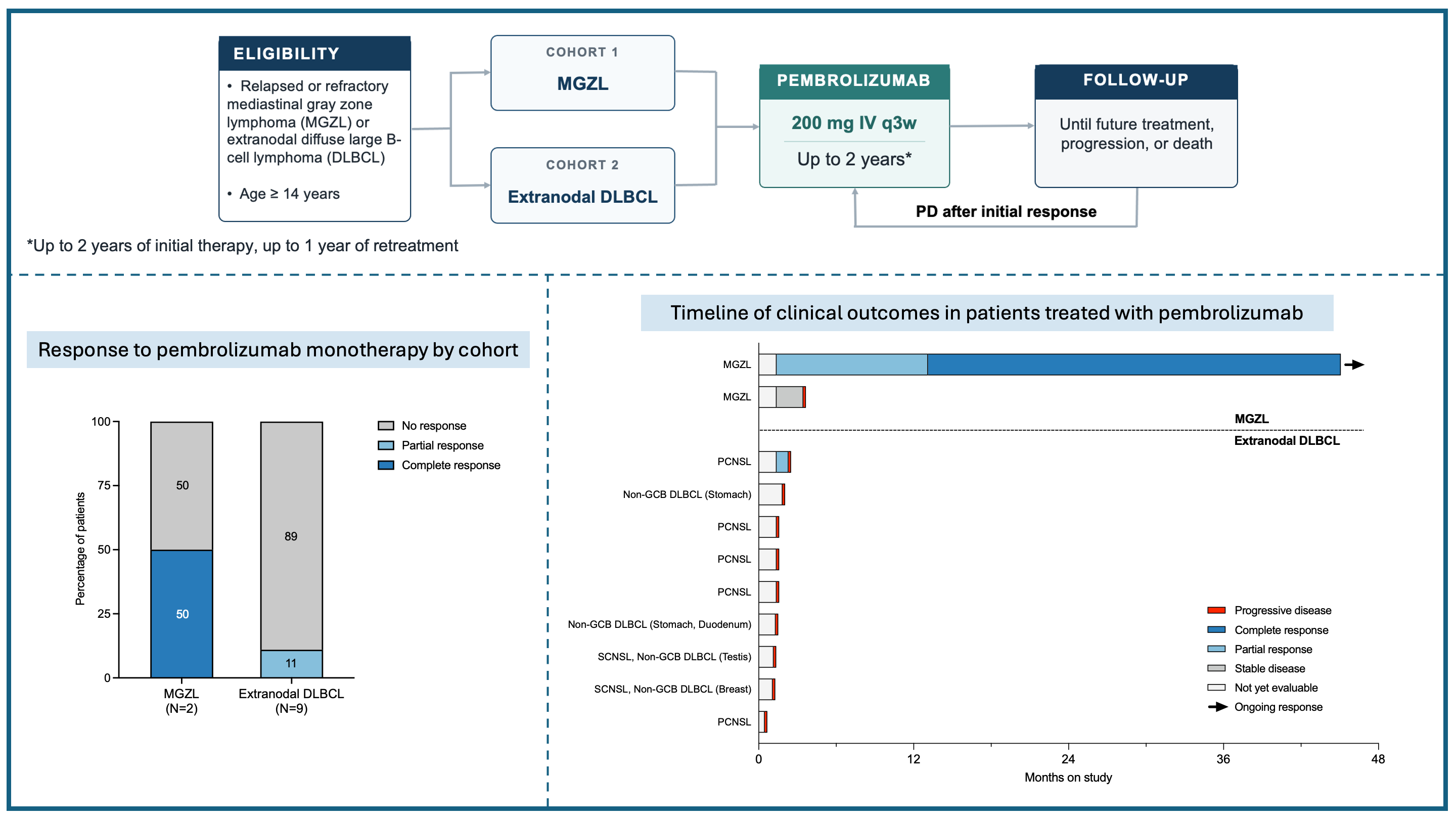
PD-1 is an inhibitory receptor on T cells that, when bound by PD-L1 or PD-L2, suppresses anti-tumor immunity. Tumors can exploit this pathway through overexpression of PD-L1, often driven by 9p24.1 chromosomal alterations. Within aggressive lymphomas, Chromosome 9p24.1 alterations occur in approximately 60% of mediastinal gray zone lymphoma (MGZL) cases, 14% of non-germinal center B-cell (non-GCB) diffuse large B-cell lymphomas (DLBCL), and over 50% of primary central nervous system (CNS) lymphoma and primary testicular lymphoma (PTL) cases. Outcomes for relapsed or refractory disease remain dismal across these histologies. Given the frequent chromosome 9p24.1 alterations in these lymphomas, PD-1/PD-L1 inhibition represents a rational therapeutic strategy in these malignancies. We conducted a single-institution, open-label, phase 2 study of time-limited pembrolizumab monotherapy 200 mg every 21 days for up to 2 years (35 cycles) in patients with relapsed or refractory MGZL, primary CNS lymphoma, or DLBCL subtypes that share biologic features with primary CNS lymphoma, including PTL and non-GCB DLBCL with extranodal involvement. Eligible patients were aged ≥14 years with adequate organ function and no prior anti-PD-1/PD-L1 therapy. Disease assessment was performed via CT and/or MRI at baseline, after cycles 2, 6, 13, 17, 26, and 35. The primary endpoint was overall response rate (ORR); secondary endpoints included safety, progression free survival (PFS), and overall survival (OS). The study was terminated early due to slow accrual, and 11 patients were evaluable for response. Patients had a median of 2 prior lines of therapy and histologies included 5 primary CNS lymphoma, 2 MGZL, 2 non-GCB DLBCL without CNS involvement, and 2 non-GCB DLBCL with secondary CNS involvement. Responses were observed in two patients: 1 patient with PCNSL with a partial response and 1 patient with MGZL with a CR that was ongoing at 3 years. Overall, the 2-year PFS was 9.1% and the 2-year OS was 64%. No unexpected toxicities were observed. Single-agent pembrolizumab had limited activity in relapsed or refractory extranodal DLBCL including PCNSL. In PCNSL, this may party reflect the immunosuppressive tumor microenvironment, which can impair effective antitumor T-cell responses despite frequent activation of the PD-1/PD-L1 pathway. Clinical factors may also contribute, as even limited CNS progression can cause significant neurologic symptoms and create an urgent need for disease control, potentially narrowing the therapeutic window for agents with delayed response kinetics such as PD-1 inhibitors. However, a durable CR was observed in the one MGZL patient treated, supporting continued investigation of this treatment in select LBCL subtypes.
Keywords:
pembrolizumab
; mediastinal gray zone lymphoma
; extranodal diffuse large B-cell lymphoma
; CNS lymphoma
; immunotherapy
Copyright: This open access article is published under a Creative Commons CC BY 4.0 license, which permit the free download, distribution, and reuse, provided that the author and preprint are cited in any reuse.