
Submitted:
06 November 2026
Posted:
09 November 2026
You are already at the latest version
Abstract
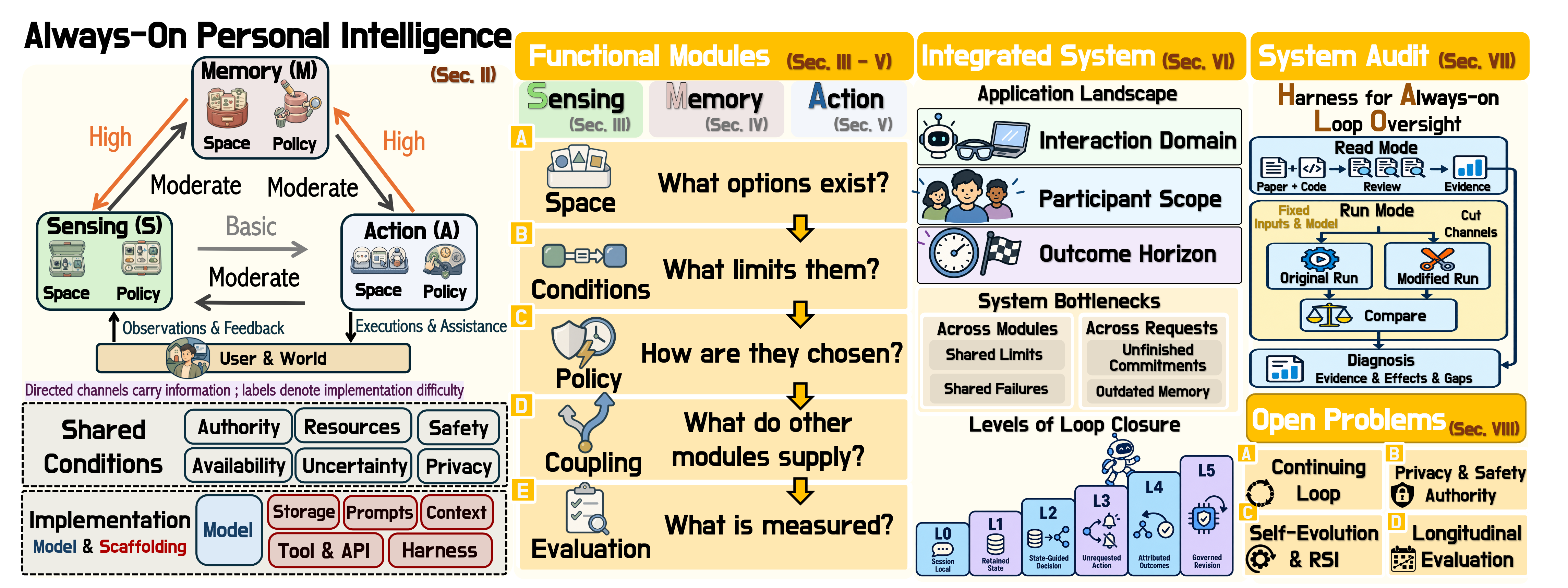
Always-on personal intelligence demands more than episodic, task-driven agents. To remain always-on, it requires a continuing loop that sustains assistance between requests, retains personal context, and carries unfinished commitments forward. To grow more personal over time, this loop can also become self-evolving, revising how it works based on past experience. Yet sustaining and improving this loop as a whole remains an open challenge. We therefore organize the assistant into three functional modules, Sensing, Memory, and Action, connected by six directed channels that pass information between them. These modules operate under real-world limits, from battery life to privacy and user permissions, and run on models and the scaffolding around them. We review each module's capabilities, policies, and evaluation methods, and then trace cross-module dependencies across integrated systems to identify bottlenecks. To assess the loop completeness of existing systems, we introduce the Harness for Always-On Loop Oversight (HALO), combining literature and code reviews with executable tests. Our synthesis reveals the thinnest support for two channels: Memory guiding Sensing, and Action outcomes returning to Memory. These gaps motivate two research priorities: keeping sensing open to unexpected change for reliable operation, and attributing outcomes to earlier decisions for self-evolution. By identifying missing interfaces and evidence requirements, this roadmap offers the research community an actionable blueprint for building future always-on personal intelligence systems.
Keywords:
always-on personal intelligence
; personal AI assistants
; proactive agents
; self-evolving agents
Copyright: This open access article is published under a Creative Commons CC BY 4.0 license, which permit the free download, distribution, and reuse, provided that the author and preprint are cited in any reuse.