

Submitted:
05 November 2026
Posted:
06 November 2026
You are already at the latest version
Abstract
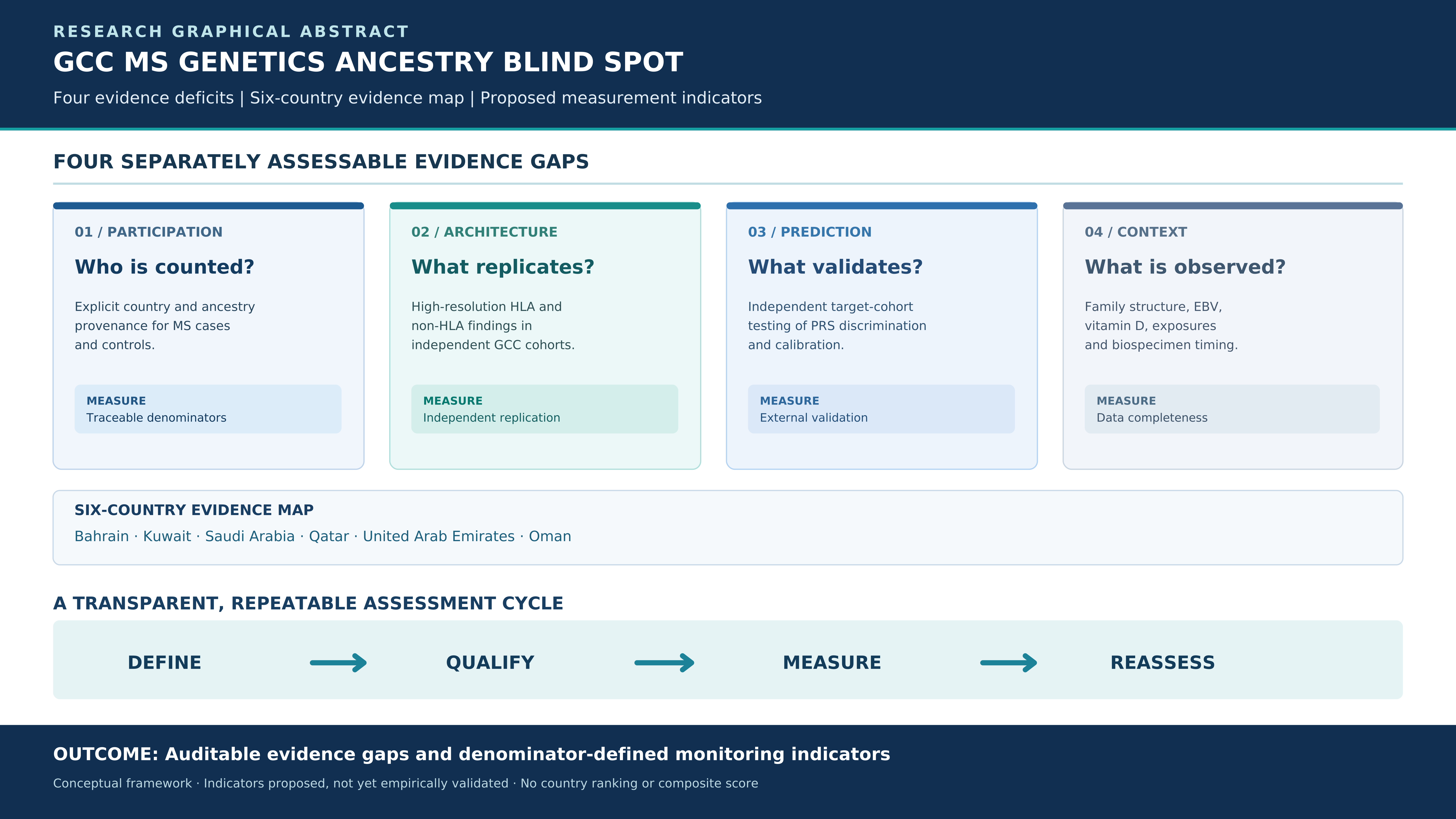
Background: Arab and Gulf Cooperation Council (GCC) populations remain poorly characterized in multiple sclerosis (MS) genomics despite advances in global multi-ancestry discovery. Previous regional reviews describe available associations, while a related commentary addresses clinical implementation. The present study asks a different question: which specific evidence deficits constitute the GCC MS Genetics Ancestry Blind Spot, and how could progress in closing them be documented? Objectives: To formalize a four-domain evidence-gap taxonomy; map published GCC findings across six countries and distinct evidentiary layers; distinguish absence of retrieval from absence of biological evidence; and propose transparent, denominator-based indicators for future regional assessment. Methods: A benchmark-informed narrative and conceptual synthesis reinterpreted the authors’ previously published 14-study GCC scoping evidence map in light of selected peer-reviewed MS ancestry studies published through 5 November 2026, the 2025 Arab pangenome, and documented regional genomic resources. Evidence was categorized as reported susceptibility association, exploratory/familial or molecular observation, contextual population-genomics resource, or study not identified within the cited corpus. No new systematic search, pooled MS-wide ancestry proportion, or validation exercise was claimed. Results: The 2019 IMSGC map included 47,429 cases and 68,374 controls; two September 2026 studies expanded multi-ancestry analyses but did not report Arab/GCC participants as major explicit strata. The approximately 0.17% Arab GWAS Catalog benchmark is cross-disease, not MS-specific. GCC evidence was heterogeneous: a Saudi high-resolution HLA study reported an HLA-DRB1*15:01 association, Bahrain provided small low-resolution HLA and downstream molecular observations, Kuwait contributed targeted non-HLA and vitamin D-pathway studies, and Saudi Arabia also supplied familial/mitochondrial data. Historical Omani HLA testing and an Abu Dhabi familial series do not establish validated genomic prediction. A six-country matrix and proposed indicators specify what is observable, missing, or unverified without assigning unsupported country rankings. Conclusions: The ancestry blind spot is best treated as four separately auditable evidence deficits—representation, genetic architecture, prediction validity, and contextual ascertainment. A denominator-defined monitoring framework, not another clinical-implementation pathway, provides the distinctive contribution and a testable agenda for multicountry GCC MS genomics.
Keywords:
multiple sclerosis
; Gulf Cooperation Council
; ancestry representation
; evidence-gap taxonomy
; HLA
; polygenic risk score
; genomic diversity
; regional evidence map
; measurement indicators
; Arab pangenome
Copyright: This open access article is published under a Creative Commons CC BY 4.0 license, which permit the free download, distribution, and reuse, provided that the author and preprint are cited in any reuse.