

Submitted:
05 November 2026
Posted:
06 November 2026
You are already at the latest version
Abstract
During the burning of wood, various toxic compounds are produced; therefore, fire retardants are used. However, fire retardants also produce toxic compounds, so the effort is to find low-cost, efficient, and environmentally friendly alternatives. We combined a highly durable polyurea (P) coating with expandable graphite (EG), which is very effective against fire. We thermally loaded untreated spruce wood and specimens treated with different coating combinations using an infrared heater. Volatile compounds were analysed by gas chromatography coupled with mass spectrometry (GC-MS) and high-performance liquid chromatography (HPLC). Various groups of volatile substances were determined, including terpenes (alpha- and beta-pinene, limonene), acids (formic, acetic), carbonyl compounds (formaldehyde, acetaldehyde, furfural, 5-hydroxymethylfurfural), and sulfur trioxide. The addition of EG to polyurea significantly increases the resistance of spruce wood to thermal loading while simultaneously reducing the amount of arisen volatile gases. An optimal combination of EG and P was identified to ensure effective thermal resistance and low concentrations of evolved gases.
Keywords:
fire retardants
; emissions
; polyurea
; expandable graphite
; carbonyl compounds
1. Introduction
Wood is widely used material in building construction, furniture, musical instrument as well as for domestic heating during cool months. Its advantages lie mainly in its ease of processing, very good mechanical and physical properties, as well as environmental and aesthetic aspect [1,2]. Its burning is considered one of the sources of pollution [3]. Nowadays it is replaced by other construction materials such as concrete or steel, but there are some studies, such as Börjesson and Gustavsson [4] or Sathre and González-García [5] suggesting that wood is one of the most suitable building materials. Wood can very easily undergo biodegradation by fungi, bacteria as well as it can be degraded by fire. Its combustion consists of three steps, but in the context of this paper, the most important are substances that are produced. Modification of wood has advantages from the point of view of wood protection.
Fire retardants are able to change wood surface combustion characteristics – they act as physical barrier between wood and fire, reduce heat release, amount of flammable volatile products. It is necessary for fire retardants to be environmentally friendly as well as harmless to human and animal health [1]. The modification can be chemical, including chemical reagents reacting with hydroxyl and phenyl groups of the wood polymers; thermal modification, which is a very effective way of protection against biodegradation as well as to improve its dimensional stability; or impregnation [6]. These methods not only protect wood from biodegradation but also from burning when flame retardants are used, for example, ZnO powder seems to be a very promising flame retardant, that can delay the ignition time of wood [7]. Wood mainly consists of cellulose and hemicelluloses as well as lignin, which are carbohydrates, and which contain different extractives and organic chemicals with low molecular weight, their content ranges between 0.5 – 20 weight %. These extractives affect wood properties like colour, odour, flammability, density, etc. [8]. Burning is a complex process that includes thermal degradation, oxidation processes as well as production of volatile products; their composition can be affected by the composition of wood itself, its type, species, hardwood, softwood as well as its treatment with fire retardants or heat treatment. When wood is burning different products arise; the most known are carbon monoxide and carbon dioxide, from organic compounds e.g. aldehydes – acetaldehyde, formaldehyde, furfural, furan, terpenes – α-pinene, β-pinene, organic acids – acetic acid, formic acid, aromatic hydrocarbons such as benzene, phenol, toluene, etc. [9,10,11]. Many of them are flammable and can ignite at sufficient temperature; moreover, these products represent dangerous substances to human health, benzene, formaldehyde are known carcinogens, and acrolein, acetaldehyde, phenols are respiratory irritants. It is known that wood smoke contains more than five chemical groups that are classified by IARC (International Agency for Research of Cancer) as human carcinogens [12,13]. Their effect on human health depends on the time of exposure, concentration, and chemical properties.
As previously stated, fire retardants can protect wood from combustion, these can be halogenated, boron-based, phosphorus-based, etc., but due to their carcinogenetic – mainly of halogen-based flame retardants they are regulated [7,14]. For fire retardants is necessary to be environmentally friendly, one of these substances is phytic acid, that can be extracted from oilseeds, grains and other natural materials [14], or expandable graphite (EG). Phytic acid creates a protective char layer that can reduce the transfer of heat between the environment and the protected material [14]. Similarly, EG works as an intumescent fire retardant, substance that creates insulating, protecting layer from flames, also in created char there are void spaces, that allow airflow. The result is a lower temperature of environment, causing a longer time to ignition. EG is produced in the process of intercalation, where graphite flakes are combined with sulphuric acid and other oxidative agents such as nitric acid. In this process the structure of EG is created – layers of graphite connected by chemical bonds. EG starts to expand due to high temperature, which ranges from 140 °C to 230 °C, with different expansion rates (100 – 400 mL·g-1). In the context of thermostability, it can be divided into three groups – low, middle, and high, where the expansion starts at different temperatures depending on the mentioned thermostability [15,16].
Polyurea is employed in different applications due to its thermal stability, mechanical strength, water and chemical resistance as well as its durability and absence of volatile organic compounds (VOCs). Nowadays, it is known as one the essential components for high-performance protective materials. Polyurea is produced by the reaction of isocyanates with amines, which makes polyurea a flexible, environmentally stable material. If combined with fire retardants, it makes polyurea a promising material for fire resistant applications [17].
It is necessary to take into account the type of volatile products that can be produced during burning when applying any kind of coating on wood. Protecting wood from burning does not necessarily mean a lower amount of volatile products that are dangerous for human health, so it is extremely important to analyse these substances by appropriate methods, such as gas chromatography – mass spectrometry (GC – MS) or high-performance liquid chromatography (HPLC).
In this study, polyurea coating as a protective layer was used; more specifically, the coating consisted of two layers of polyurea with expandable graphite (EG). For comparison, reference samples and samples with commercial fire-retardant were used. The aim is to characterize compounds that are produced during thermal loading of specimens. For determination, gas chromatography coupled with mass spectrometry (GC – MS) and high-performance liquid chromatography (HPLC) were utilized. The results can help with better understanding of the effect of coatings on the chemical composition of compounds produced during thermal loading of spruce wood.
2. Materials and Methods
2.1. Materials, Specimens, and Thermal Loading
The experiments used Norway spruce wood (Picea abies L.) specimens measuring 50 mm × 40 mm × 10 mm. The first group of five specimens was untreated and served as a reference (REF). The second group (POL) was treated with one layer of NEOPROOF Polyurea R (Neotex, Mandra, Greece), 1.0 g, and one layer of NEODUR Fast Track (Neotex, Mandra, Greece), 0.4 g. The third group was treated with a commercial fire retardant containing ferric phosphate, citric acid, and special additives (COM). Additional specimen groups contained the bottom coat NEOPROOF Polyurea R with varying contents of Thermographite 25 K + 180 expandable graphite (Epinikon, Vodňany, Czech Republic). Based on the amount of expandable graphite (EG) per specimen (0.5, 0.4, 0.3, 0.2, and 0.1 g), the specimens were denoted as EG5, EG4, EG3, EG2, and EG1, respectively. After 24 hours, the NEODUR Fast Track layer (0.4 g) was applied. Specimens were thermally loaded in the apparatus (Figure 1) for 10 minutes; the surface heat flux was 30 kW·m-2, and the specimens were 40 mm from the infrared heater. Mass loss was recorded using PS 3500.R2 electronic scales (Radwag, Radom, Poland). The mass of the samples was recorded every 10 seconds using the RLAB programme.
2.2. Volatile Compounds Sampling and Analyses
Gaseous compounds were collected using three different methods. The gas flow rate of the air sampling pump was adjusted to 1 L∙min−1 for 10 minutes in all three modes. Each sample was collected in duplicate and analysed twice, so four results were obtained for each specimen.
In the first sampling method, the gas sample was absorbed in a gas washing bottle containing 20 mL of ultrapure demineralized water. Volatile compounds were analysed by high-performance liquid chromatography (HPLC) as follows. Agilent 1260 Infinity II (Agilent Technologies, Waldbronn, Germany) with a refractive index (RI) detector, column Shodex RSpak Column KC-811 (8 x 300 mm), 6 µm, (Resonac Corporation, Tokyo, Japan), mobile phase 0.1% H3PO4, flow rate 1 mL·min−1, T = 40 °C. Analysed compounds were identified by retention times.
For the second sampling method, adsorption tubes (6 × 110 mm) containing silica gel modified with 2,4-dinitrophenylhydrazine (SKC, Eighty Four, PA, USA) were used. After sampling, the sorbent was placed into a glass vial and extracted with 3 mL of acetonitrile. Samples were periodically shaken for 30 minutes and filtered with a 0.2 µm PTFE filter (Agilent Technologies, Palo Alto, CA, USA).
The resulting 2,4-dinitrophenylhydrazones of carbonyl compounds were analysed by HPLC using an Agilent 1260 Infinity II instrument (Agilent Technologies, Palo Alto, CA, USA) equipped with a diode array detector (DAD) at wavelength of 360 nm, a Kinetex 2.6 µm C18 100 Å column (4.6 × 150 mm) with a guard column (Phenomenex, Torrance, CA, USA), in a gradient mode, a flow rate of 1 mL·min−1, and a temperature of 40 °C. The following gradient was used: A - water/tetrahydrofuran 5/2, B – acetonitrile; 0 min: A/B = 70/30, 5 min: A/B = 65/35, 9 min: A/B = 30/70, 12 min: A/B = 30/70, 13 min: A/B = 70/30, 15 min: A/B = 70/30. Aldehyde/Ketone-DNPH Stock Standard-13 (ERA-028-1.2mL) containing of acetaldehyde-DNPH, acetone-DNPH, acrolein-DNPH, benzaldehyde-DNPH, 2-butanone-DNPH, n-butyraldehyde-DNPH, crotonaldehyde-DNPH, formaldehyde-DNPH, hexaldehyde-DNPH, methacrolein-DNPH, propionaldehyde-DNPH, m-tolualdehyde-DNPH and valeraldehyde-DNPH was used as a standard mixture of 13 carbonyl compounds (Merck, Darmstadt, Germany). During the thermal decomposition of wood, 5-hydroxyfurfural forms in addition to the substances present in the standard solution; therefore, the 2,4-DNPH derivatives of these two aldehydes were also included in the analysis. The analysed compounds were identified by retention times and UV-Vis spectra.
The last method involved the use of ANASORB CSC sampling tubes (SKC Ltd., Blandford Forum, UK) with activated carbon. The adsorbed volatiles were extracted with 3 mL of carbon disulfide for 20 min on a shaker. Subsequently, 1 mL of the extract was transferred to vials and analysed using gas chromatography–mass spectrometry (GC-MS) under the following conditions: Agilent 7890B gas chromatograph (Agilent Technology, Palo Alto, CA, USA); column: HP5-MS; 30 m; 0.25 mm; 0.25 μm; carrier gas: He; carrier gas flow: 1 mL·min−1; temperature program: 40 °C for 4 min, increase 5 °C·min−1 to 220 °C, and then increase to 250 °C·min−1. Detection of the analysed compounds was performed using mass spectrometry under the following conditions: Agilent 7895C mass spectrometer (Agilent Technologies, Palo Alto, CA, USA), ion source temperature: 150 °C; quadrupole temperature: 200 °C; ionization energy: 70 eV. We identified the volatile products based on retention times and by comparing the mass spectra with the NIST 17 library.
3. Results and Discussion
The mass loss (ML) of wood due to thermal degradation is one of the most important features of thermal modification. It is commonly used as an indicator of treatment intensity and can potentially be used to predict decay resistance, dimensional stability, and mechanical properties [18,19,20]. However, the wood mass is not lost; it is primarily converted into gaseous products, many of which are harmful to living organisms or technical equipment. ML is therefore a significant indicator, both in terms of health and safety at work and in terms of fire safety. Flame retardants, which reduce ML, thus not only protect property but also contribute effectively to the protection of the public. Figure 2 shows the high effectiveness of expandable graphite in significantly reducing ML, even when used in small quantities. Even the EG3 sample, which contained 0.3 grams of EG, reduced ML by approximately eightfold compared with native wood (UNT). The change in samples can be seen in Figure 3.
Under thermal loading, hemicelluloses change first, even at relatively low temperatures. Their degradation begins with deacetylation, and the acetic acid produced acts as a catalyst for depolymerisation reactions, further accelerating the breakdown of polysaccharides. Acid-catalysed reactions form formaldehyde, furfural, and other aldehydes. 5-Hydroxymethylfurfural is a degradation product of hexoses and, in an acidic environment, decomposes into levulinic acid and formic acid [21,22].
Aliphatic carboxylic acids (mainly acetic and formic acids) are the major volatile degradation products formed during the heat treatment [23,24].
Sundqvist et al. [25] reported that the ratio between acetic and formic acid was about 5.2 during heat treatment of birch wood. In untreated spruce wood (UNT), the ratio of acetic acid to formic acid is approximately 3 (Table 1), which is due to the lower number of acetyl groups in the hemicelluloses of coniferous wood species compared to deciduous wood species. The highest concentration was found to be that of acetic acid, followed by formic acid, in the untreated sample (UNT). These acids were also detected in the ambient air of an Alpine valley in Switzerland, caused by residential wood burning [26]. A slight decrease in both acids was observed in the COM sample, while a significant decrease was recorded in the POL sample. The POL sample also released small amounts of carbonyl compounds (Table 2), but the retarding effect was negligible. A dramatic decrease in carboxylic acids was observed in samples treated with expandable graphite, which protected the wood from decomposition through its retarding effect (Table 1).
As expected, no sulfur trioxide was detected in the original wood samples (UNT), the COM samples, or the POL samples, since sulfur is not present in native wood or the substances used to modify it — polyurea and a commercial flame retardant.
Expandable graphite (EG) is a class of graphite intercalation compounds formed by inserting atomic or molecular layers of a different chemical species as an intercalant between layers in a graphite host material. The most widely used intercalate species for preparing exfoliated graphite is sulfuric acid. The resulting intercalation compound, known as graphite bisulfate, consists of carbon layers with HSO4¯ radical ions and H2SO4 molecules between the layers [27,28]. During EG exfoliation, sulfuric acid decomposes into gases that increase EG volume and form an insulating layer that protects the wood from burning. The resulting gaseous products depend on the temperature: SO₃ and H₂O are produced at temperatures up to 450 °C, while at higher temperatures these products decompose into SO₂, H₂O, and O₂ [29,30]. In this study, only sulfur trioxide was detected; sulfur dioxide was not present in the gases. As expected, the SO₃ concentration increased with the amount of EG used (Table 1). The absence of sulfur dioxide in the gaseous products is due to EG's excellent retardant effect. In our previous work, we measured the temperature of flame-retardant-treated spruce wood, which remained below 300 °C [31].
Some aldehydes are known or suspected to be toxic and potentially carcinogenic, and exposure to high concentrations can adversely affect human health [32]. They are generated through various natural and industrial processes and are widely used across different sectors. Catalano et al. [33] provide a detailed overview of aldehydes; therefore, we present only basic information on the carbonyl compounds identified in our study. Formaldehyde is toxic, allergenic, and potentially carcinogenic to the human body. It may derive from smoking, cooking, heating, wood-based furniture, paints and textiles, building materials, decoration materials, furniture finishings, household products, cosmetics, plastics, and medicines. Acetaldehyde can cause upper respiratory tract disease and acts as an irritant to the eyes and skin. Acetone causes eye, nose, and throat irritation, headaches, dizziness, confusion, and central nervous system depression. Acrolein damages tissues, causes inflammation, and disrupts cell function upon inhalation, ingestion, or absorption. Propionaldehyde causes irritation to the nose, throat, and eyes. Crotonaldehyde has a strong lacrimatory effect and is a potential human carcinogen. Butyraldehyde has a pungent odor and causes irritation of the respiratory tract. Hexanal can cause toxic pulmonary effects. 5-hydroxymethylfurfural can, at higher concentrations in food, have toxic, genotoxic, or mutagenic effects [33,34,35,36].
The highest quantity of carbonyl compounds is found in the gaseous products generated when untreated spruce wood (UNT) is thermally exposed (Table 2). The highest concentrations are reached by formaldehyde, followed by 5-hydroxymethylfurfural and acetaldehyde. Cerqueira et al. [32] reported that the average formaldehyde to acetaldehyde concentration ratio in stove flue gas ranged from 2.1 to 2.9. In our experiment, this ratio was approximately 12 for the reference sample, whereas for samples modified with a flame retardant, it dropped to approximately 1. The discrepancy observed in the untreated samples is likely due to differences in wood species and, more importantly, differences in thermal exposure methods. This is because the aforementioned authors burned the wood in a commercially manufactured cast-iron wood stove. The ratio of formaldehyde to 5-hydroxymethylfurfural is relatively constant, ranging from 1.5 to 2.5. The flame-retardant treatment is clearly effective: when the highest amounts of expandable graphite are used (samples EG4 and EG5), the total quantity of carbonyl compounds in the gas phase is reduced by around 60% compared to the original (UNT) sample (Table 2). Surprisingly, few carbonyl compounds were released from samples treated with polyurea (POL) alone. However, this modification had almost no retarding effect (Figure 2)
GC – MS analysis allowed the identification of volatile organic compounds (VOCs) arising from spruce wood after thermal loading. The average peak areas are in Table 3. As can be seen, there are differences in the response of the identified compounds depending on the treatment utilized. These differences are related not only to the thermal decomposition of the wood itself but also to the protective layer.
The highest peak area were identified in reference samples (UNT) for α-pinene, reaching up to 107.2, β-pinene (54.3), commercial (COM) fire-retardant reached up to 214.7 for α-pinene. α-pinene, β-pinene, 3-carene, and limonene are the most typical substances in coniferous wood, but their composition varies depending on the wood type [37,38]. Some authors indicate that these substances may be dangerous for human health [39,40,41]. Samples with expandable graphite (EG) showed average areas ranging up to 126.4. This may be related to different transport of VOCs and their lower release of some compounds due to protective layer of polyurea with EG. Interestingly, the highest area of p-xylene (aromatic hydrocarbon) was measured for samples EG5, while in POL samples it reached only 10.0. Moreover, high areas can be seen for other aromatic compounds such as toluene, o-xylene, or ethylbenzene. The average peak area of β-pinene in EG5 samples is approximately 3 times lower in comparison with UNT samples; interestingly, the average area in POL samples is approximately 12 times lower. A similar trend can be seen for α-pinene. These differences may be caused by different release of VOCs during the thermal stress. The amount of identified VOCs varies depending on the surface treatment, which is consistent with Trojanová et al. [42]. Significant differences can be seen for aromatic hydrocarbons from EG5 samples in comparison to POL or EG1 samples. The least number of VOCs were identified in EG3 samples. This might be consistent with Trojanová et al. [43], who found that samples treated with 0.3 g of expandable graphite showed the least mass loss, meaning that the decomposition of wood did not take place in such a great extent. Furfural, as one of the main compounds proving the decomposition of hemicelluloses [44], was identified only for UNT and EG1 samples, leading to the conclusion that the layer of EG with polyurea might have a positive effect on protection of wood. The low number of VOCs identified in POL samples might be related to fact, that lots of flammable compounds were produced that did burn during the process of thermal loading of the samples.
4. Conclusions
During thermal loading, decomposition of wood takes place, during this process different volatile organic products (VOCs) are released. In this work, we investigated what VOCs are produced from spruce wood (Picea abies, L.) treated with expandable graphite (EG) and polyurea. During the depolymerization of wood, formic acid and acetic acid are produced. Their amount released from treated wood is significantly lower than from untreated wood. Another group of compounds was aldehydes, which have different toxicity. Similarly, it can be stated that the treatment of samples has a positive effect on lowering the production of aldehydes. Some of the aldehydes investigated were not produced by the treated samples, namely hexanal, butyraldehyde, and crotonaldehyde. Similar results were obtained for other VOCs, investigated by GC-MS. The lowest number of identified compounds was obtained by EG3 samples. The low number of identified VOCs for UNT and POL samples can be explained by the production of flammable compounds that burned during the thermal loading. As can be seen from these results, EG with polyurea has a significant positive impact on the production of VOCs during the thermal loading of wood.
Author Contributions
Conceptualization, F.K. and K.T.; methodology, F.K., V.V., K.T.; formal analysis, V.V., E.K.; resources, E.K.; data curation, K.T., F.K.; writing—original draft preparation, K.T., F.K.; writing—review and editing, F.K., K.T.; visualization, K.T.; supervision, F.K.; funding acquisition, E.K. All authors have read and agreed to the published version of the manuscript.
Funding
This work was supported by the Scientific Grant Agency of the Ministry of Education, Research, Development and Youth of the Slovak Republic, and the Slovak Academy of Sciences (Grant No. 1/0677/26).
Data Availability Statement
The original contributions presented in this study are included in the article; further inquiries can be directed to the corresponding author.
Acknowledgments
Figure 1 was created with BioRender.com.
Conflicts of Interest
The authors declare no conflicts of interest.
References
- Popescu, C.-M.; Pfriem, A. Treatments and Modification to Improve the Reaction to Fire of Wood and Wood Based Products—An Overview. Fire Mater. 2020, 44, 100–111. [Google Scholar] [CrossRef]
- Jaďuďová, J.; Gašpercová, S.; Osvaldová, L.M.; Valla, L. Evaluation of Fire Characteristics of Different Norway Spruce (Picea Abies) Fractions in the Wood-Processing Industry. Fire 2026, 9, 271. [Google Scholar] [CrossRef]
- Languille, B.; Gros, V.; Petit, J.-E.; Honoré, C.; Baudic, A.; Perrussel, O.; Foret, G.; Michoud, V.; Truong, F.; Bonnaire, N.; et al. Wood Burning: A Major Source of Volatile Organic Compounds during Wintertime in the Paris Region. Sci. Total Environ. 2020, 711, 135055. [Google Scholar] [CrossRef] [PubMed]
- Börjesson, P.; Gustavsson, L. Greenhouse Gas Balances in Building Construction: Wood versus Concrete from Life-Cycle and Forest Land-Use Perspectives. Energy Policy 2000, 28, 575–588. [Google Scholar] [CrossRef]
- Sathre, R.; González-García, S. 14 - Life Cycle Assessment (LCA) of Wood-Based Building Materials. In Eco-efficient Construction and Building Materials; Pacheco-Torgal, F., Cabeza, L.F., Labrincha, J., de Magalhães, A., Eds.; Woodhead Publishing, 2014; pp. 311–337. ISBN 978-0-85709-767-5. [Google Scholar]
- Ramage, M.H.; Burridge, H.; Busse-Wicher, M.; Fereday, G.; Reynolds, T.; Shah, D.U.; Wu, G.; Yu, L.; Fleming, P.; Densley-Tingley, D.; et al. The Wood from the Trees: The Use of Timber in Construction. Renew. Sustain. Energy Rev. 2017, 68, 333–359. [Google Scholar] [CrossRef]
- Öhrn, O.; Sykam, K.; Gawusu, S.; Mensah, R.A.; Försth, M.; Shanmugam, V.; Karthik Babu, N.B.; Sas, G.; Jiang, L.; Xu, Q.; et al. Surface Coated ZnO Powder as Flame Retardant for Wood: A Short Communication. Sci. Total Environ. 2023, 897, 165290. [Google Scholar] [CrossRef] [PubMed]
- Adamová, T.; Hradecký, J.; Pánek, M. Volatile Organic Compounds (VOCs) from Wood and Wood-Based Panels: Methods for Evaluation, Potential Health Risks, and Mitigation. Polymers 2020, 12, 2289. [Google Scholar] [CrossRef] [PubMed]
- Bruns, E.A.; Slowik, J.G.; El Haddad, I.; Kilic, D.; Klein, F.; Dommen, J.; Temime-Roussel, B.; Marchand, N.; Baltensperger, U.; Prévôt, A.S.H. Characterization of Gas-Phase Organics Using Proton Transfer Reaction Time-of-Flight Mass Spectrometry: Fresh and Aged Residential Wood Combustion Emissions. Atmos. Chem. Phys. 2017, 17, 705–720. [Google Scholar] [CrossRef]
- Schauer, J.J.; Kleeman, M.J.; Cass, G.R.; Simoneit, B.R.T. Measurement of Emissions from Air Pollution Sources. 3. C1 −C29 Organic Compounds from Fireplace Combustion of Wood. Environ. Sci. Technol. 2001, 35, 1716–1728. [Google Scholar] [CrossRef] [PubMed]
- Pohleven, J.; Burnard, M.D.; Kutnar, A. Volatile Organic Compounds Emitted from Untreated and Thermally Modified Wood - A Review. Wood Fiber Sci. 2019, 51, 231–254. [Google Scholar] [CrossRef]
- Paul, T.; Paul, T.; Katwal, S.; Aroori, P.; Dawer, P.; Bhatia, H.; Njideaka-Kevin, T.; Guntipalli, P.; Yadav, T. Benzene and Human Health: A Comprehensive Review of Carcinogenic Risks, Mechanisms, and Preventive Strategies. Ann. Med. Surg. (Lond) 2025, 87, 7206–7212. [Google Scholar] [CrossRef] [PubMed]
- Naeher, L.P.; Brauer, M.; Lipsett, M.; Zelikoff, J.T.; Simpson, C.D.; Koenig, J.Q.; Smith, K.R. Woodsmoke Health Effects: A Review. Inhal. Toxicol. 2007, 19, 67–106. [Google Scholar] [CrossRef] [PubMed]
- Sykam, K.; Försth, M.; Sas, G.; Restás, Á.; Das, O. Phytic Acid: A Bio-Based Flame Retardant for Cotton and Wool Fabrics. Ind. Crops Prod. 2021, 164, 113349. [Google Scholar] [CrossRef]
- Mazela, B.; Batista, A.; Grześkowiak, W. Expandable Graphite as a Fire Retardant for Cellulosic Materials—A Review. Forests 2020, 11, 755. [Google Scholar] [CrossRef]
- Kmeťová, E.; Kačík, F.; Kubovský, I.; Kačíková, D. Effect of Expandable Graphite Flakes on the Flame Resistance of Oak Wood. Coatings 2022, 12, 1908. [Google Scholar] [CrossRef]
- Pan, D.; Jia, D.; Yuan, Y.; Pan, Y.; Wang, W.; Xu, L. Flame-Retardant Polyurea Coatings: Mechanisms, Strategies, and Multifunctional Enhancements. Fire 2025, 8, 334. [Google Scholar] [CrossRef]
- Čermák, P.; Hess, D.; Suchomelová, P. Mass Loss Kinetics of Thermally Modified Wood Species as a Time–Temperature Function. Eur. J. Wood Prod. 2021, 79, 547–555. [Google Scholar] [CrossRef]
- Hill, C.; Altgen, M.; Rautkari, L. Thermal Modification of Wood—a Review: Chemical Changes and Hygroscopicity. J. Mater. Sci. 2021, 56, 6581–6614. [Google Scholar] [CrossRef]
- Jančíková, V.; Jablonský, M. Thermal Modification of Wood—A Review. Sustain. Chem. 2025, 6, 19. [Google Scholar] [CrossRef]
- Werner, K.; Pommer, L.; Broström, M. Thermal Decomposition of Hemicelluloses. J. Anal. Appl. Pyrolysis 2014, 110, 130–137. [Google Scholar] [CrossRef]
- Gérardin, P. New Alternatives for Wood Preservation Based on Thermal and Chemical Modification of Wood— a Review. Ann. For. Sci. 2016, 73, 559–570. [Google Scholar] [CrossRef]
- Hyttinen, M.; Masalin-Weijo, M.; Kalliokoski, P.; Pasanen, P. Comparison of VOC Emissions between Air-Dried and Heat-Treated Norway Spruce (Picea Abies), Scots Pine (Pinus Sylvesteris) and European Aspen (Populus Tremula) Wood. Atmos. Environ. 2010, 44, 5028–5033. [Google Scholar] [CrossRef]
- Sikora, A.; Hájková, K.; Jurczyková, T. Degradation of Chemical Components of Thermally Modified Robinia Pseudoacacia L. Wood and Its Effect on the Change in Mechanical Properties. Int. J. Mol. Sci. 2022, 23, 15652. [Google Scholar] [CrossRef] [PubMed]
- Sundqvist, B.; Karlsson, O.; Westermark, U. Determination of Formic-Acid and Acetic Acid Concentrations Formed during Hydrothermal Treatment of Birch Wood and Its Relation to Colour, Strength and Hardness. Wood Sci. Technol. 2006, 40, 549–561. [Google Scholar] [CrossRef]
- Gaeggeler, K.; Prevot, A.S.H.; Dommen, J.; Legreid, G.; Reimann, S.; Baltensperger, U. Residential Wood Burning in an Alpine Valley as a Source for Oxygenated Volatile Organic Compounds, Hydrocarbons and Organic Acids. Atmos. Environ. 2008, 42, 8278–8287. [Google Scholar] [CrossRef]
- Lorenzetti, A.; Dittrich, B.; Schartel, B.; Roso, M.; Modesti, M. Expandable Graphite in Polyurethane Foams: The Effect of Expansion Volume and Intercalants on Flame Retardancy. J. Appl. Polym. Sci. 2017, 134, 45173. [Google Scholar] [CrossRef]
- Chung, D.D.L. A Review of Exfoliated Graphite. J. Mater. Sci. 2016, 51, 554–568. [Google Scholar] [CrossRef]
- Qian, Y.; Xu, G.; Lu, P.; Chen, C.; Shen, F.; Zhang, Q.; Zhou, Q. SO3 Removal Characteristics from Flue Gas of FCC Regeneration Process by Activated Carbon Modified Red Mud Adsorbent. Chem. Eng. Res. Des. 2024, 203, 280–292. [Google Scholar] [CrossRef]
- Corgnale, C.; Gorensek, M.B.; Summers, W.A. Review of Sulfuric Acid Decomposition Processes for Sulfur-Based Thermochemical Hydrogen Production Cycles. Processes 2020, 8, 1383. [Google Scholar] [CrossRef]
- Kmeťová, E.; Kačíková, D.; Kačík, F. The Effect of Intumescent Coating Containing Expandable Graphite onto Spruce Wood. Coatings 2024, 14, 490. [Google Scholar] [CrossRef]
- Cerqueira, M.; Gomes, L.; Tarelho, L.; Pio, C. Formaldehyde and Acetaldehyde Emissions from Residential Wood Combustion in Portugal. Atmos. Environ. 2013, 72, 171–176. [Google Scholar] [CrossRef]
- Catalano, A.; Mariconda, A.; D’Amato, A.; Iacopetta, D.; Ceramella, J.; Marra, M.; Saturnino, C.; Sinicropi, M.S.; Longo, P. Aldehydes: What We Should Know About Them. Organics 2024, 5, 395–428. [Google Scholar] [CrossRef]
- Almeida, M.L.; Gonçalves, F.D.; Martins, J.M.; Magalhães, F.D.; Ramos, R.M.; Carvalho, L.H. Addressing Formaldehyde Emissions in Wood-Based Panels: Evaluation of Production Processes, Measurement Strategies, and Novel Solutions. J. Adhes. 2025, 101, 1252–1274. [Google Scholar] [CrossRef]
- Ptaszyńska-Sarosiek, I.; Nesterowicz, M.; Gołaś, E.; Niemcunowicz-Janica, A.; Zalewska, A.; Żendzian-Piotrowska, M.; Maciejczyk, M. Assessment of Blood and Urine Total Antioxidant and Oxidative Status in Alcohol and Acetone Fatal Poisonings. Sci. Rep. 2025, 15, 24163. [Google Scholar] [CrossRef] [PubMed]
- Gonçalves, F.D.; Martins, J.M.; Carvalho, L.H.; Rodrigues, J.A.; Ramos, R.M. Volatile Carbonyl Compounds Emission in Dry-Process Fibreboard: Identification through a Selective GDME-HPLC-DAD-MS/MS Method. Separations 2024, 11, 92. [Google Scholar] [CrossRef]
- Bakó, E.; Böszörményi, A.; Vargáné Szabó, B.; Engh, M.A.; Hegyi, P.; Ványolós, A.; Csupor, D. Chemometric Analysis of Monoterpenes and Sesquiterpenes of Conifers. Front. Plant Sci. 2024, 15. [Google Scholar] [CrossRef] [PubMed]
- Velic, A.; Soldán, M.; Ház, A.; Šurina, I.; Jablonský, M. Determination of Volatile Organic Compounds´ Emmisions from Wood Processing. Wood Res. 2019, 64. [Google Scholar]
- Kasanen, J.-P.; Pasanen, A.-L.; Pasanen, P.; Liesivuori, J.; Kosma, V.-M.; Alarie, Y. Evaluation of Sensory Irritation of 3-Carene and Turpentine, and Acceptable Levels of Monoterpenes in Occupational and Indoor Environment. J. Toxicol. Environ. Health A 1999, 57, 89–114. [Google Scholar] [CrossRef] [PubMed]
- Kim, T.; Song, B.; Cho, K.S.; Lee, I.-S. Therapeutic Potential of Volatile Terpenes and Terpenoids from Forests for Inflammatory Diseases. Int. J. Mol. Sci. 2020, 21, 2187. [Google Scholar] [CrossRef] [PubMed]
- Sivrikaya, H.; Tesařová, D.; Jeřábková, E.; Can, A. Color Change and Emission of Volatile Organic Compounds from Scots Pine Exposed to Heat and Vacuum-Heat Treatment. J. Build. Eng. 2019, 26, 100918. [Google Scholar] [CrossRef]
- Trojanová, K.; Veľková, V.; Kačík, F. Volatile Organic Compounds Arising from Wood Polymers on Thermal Loading of Spruce Wood. Polymers 2025, 17, 875. [Google Scholar] [CrossRef] [PubMed]
- Trojanová, K.; Kmeťová, E.; Kačíková, D.; Eštoková, A.; Kačík, F. Effect of Application Method and Amount of Expandable Graphite with Polyurea on Wood Thermal Resistance. Coatings 2026, 16, 231. [Google Scholar] [CrossRef]
- Peng, F.; Ren, J.L.; Xu, F.; Sun, R.-C. Chemicals from Hemicelluloses: A Review. In Sustainable Production of Fuels, Chemicals, and Fibers from Forest Biomass; Zhu, J. (J. Y.), Zhang, X., Pan, X. (Jun), Eds.; American Chemical Society, 2011; Vol. 1067, ISBN 978-0-8412-2643-2. [Google Scholar]
Figure 1.
Schematic of the apparatus for thermal loading and sampling of gaseous products.
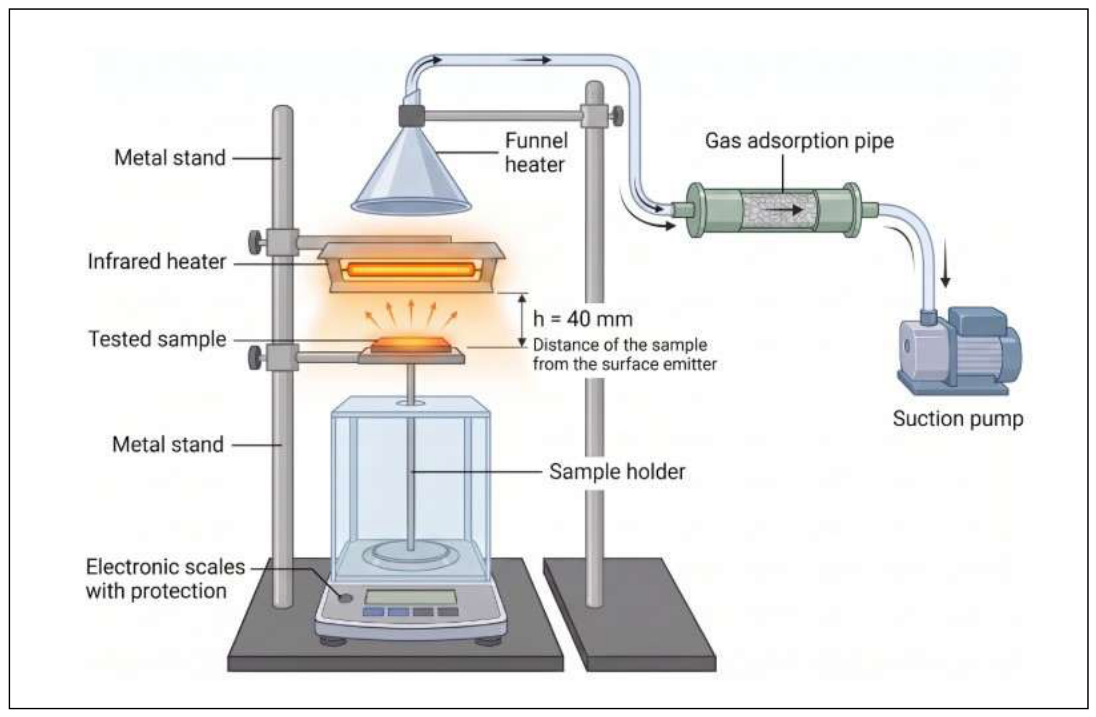
Figure 2.
Mass loss at thermal loading of samples.
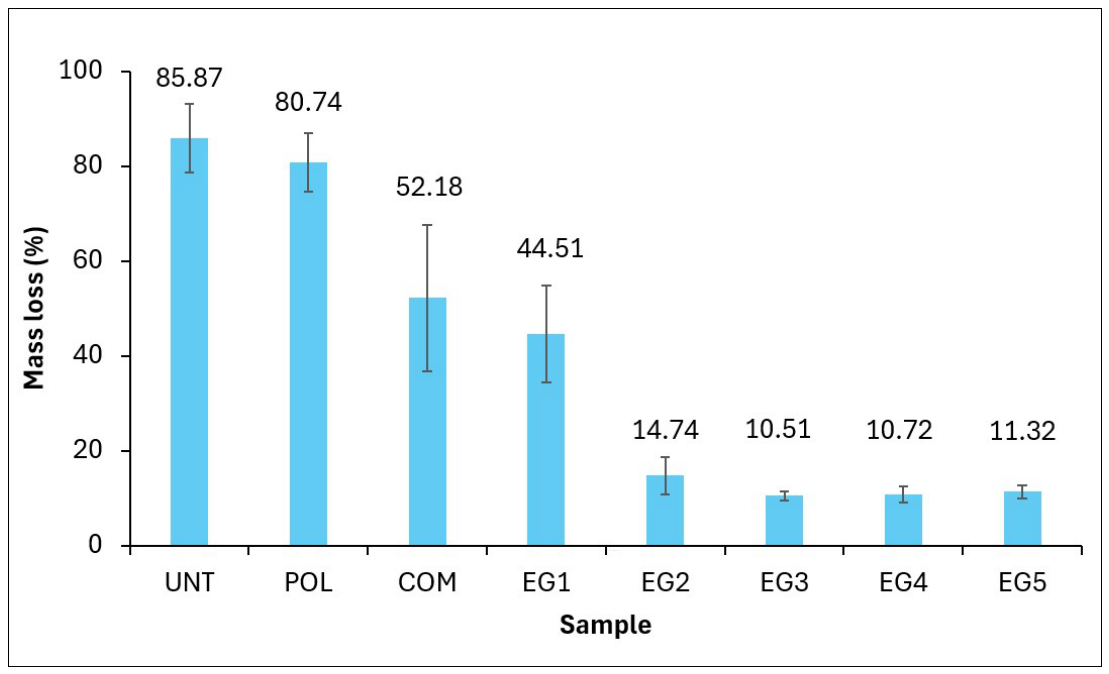
Figure 3.
Samples before and after thermal loading.
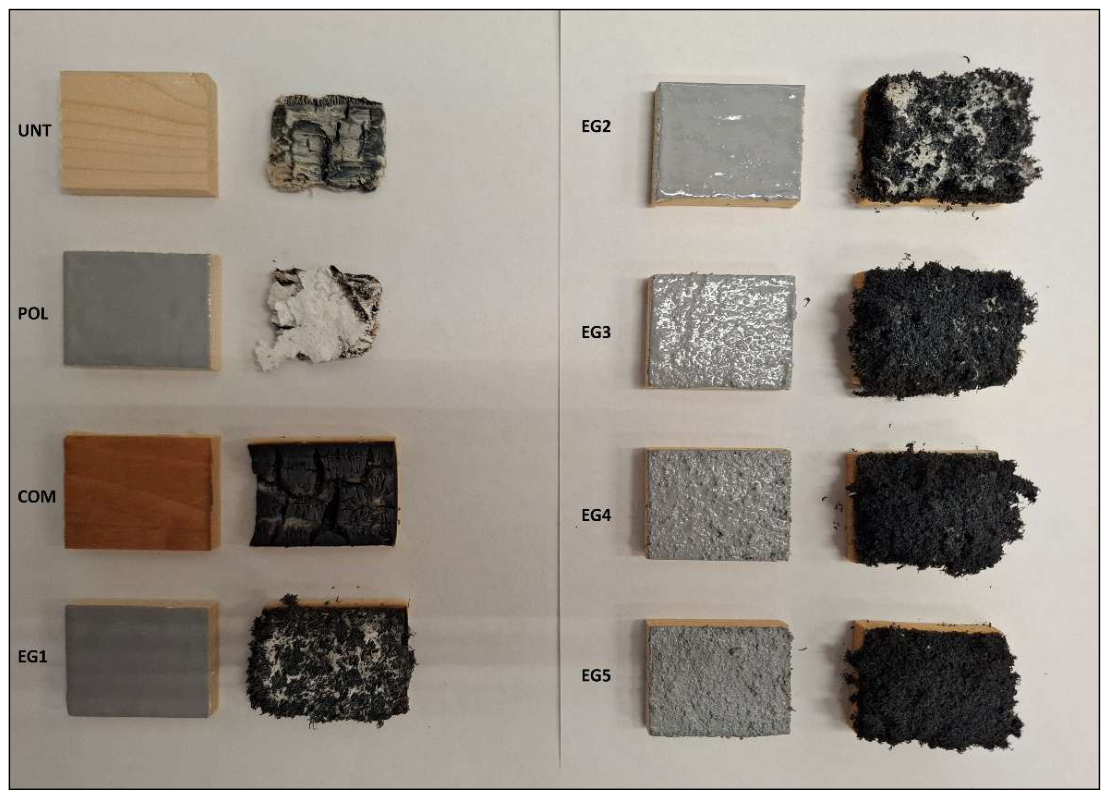

Table 1.
Released carboxylic acids and sulfur trioxide (mg·m-3).
| Sample | Formic acid | Acetic acid | Sulfur trioxide |
|---|---|---|---|
| UNT | 78.56 | 232.49 | 0.00 |
| SD | 2.44 | 5.47 | 0.00 |
| POL | 2.66 | 9.79 | 0.00 |
| SD | 0.21 | 0.68 | 0.00 |
| COM | 73.30 | 201.50 | 0.00 |
| SD | 2.26 | 7.53 | 0.00 |
| EG1 | 2.64 | 2.57 | 2.21 |
| SD | 0.14 | 0.08 | 0.17 |
| EG2 | 1.34 | 2.54 | 2.86 |
| SD | 0.04 | 0.13 | 0.22 |
| EG3 | 0.94 | 1.68 | 3.40 |
| SD | 0.04 | 0.05 | 0.32 |
| EG4 | 0.79 | 1.62 | 3.45 |
| SD | 0.10 | 0.13 | 0.30 |
| EG5 | 0.34 | 1.36 | 3.49 |
| SD | 0.03 | 0.11 | 0.34 |
Table 2.
Released carbonyl compounds (mg·m-3).
| Sample | Form- aldehyde |
Acet- aldehyde |
Acetone | Acrolein | Propion- aldehyde |
Croton- aldehyde |
Butyr- aldehyde |
Hexanal | 5-Hydroxy-metylfural |
|---|---|---|---|---|---|---|---|---|---|
| UNT | 148.80 | 41.80 | 6.48 | 5.93 | 2.90 | 10.43 | 1.02 | 0.40 | 92.63 |
| SD | 6.26 | 0.98 | 0.24 | 0.40 | 0.09 | 0.12 | 0.05 | 0.02 | 6.59 |
| POL | 47.92 | 19.02 | 11.90 | 3.60 | 3.80 | 9.55 | 1.10 | 0.85 | 32.67 |
| SD | 2.19 | 1.20 | 1.16 | 0.12 | 0.17 | 0.14 | 0.07 | 0.08 | 1.82 |
| COM | 148.73 | 24.68 | 6.80 | 12.20 | 5.67 | 0.00 | 1.02 | 0.97 | 60.42 |
| SD | 11.49 | 2.17 | 0.27 | 0.73 | 0.09 | 0.00 | 0.06 | 0.04 | 8.09 |
| EG1 | 125.91 | 43.16 | 4.67 | 20.83 | 27.77 | 0.00 | 0.62 | 0.00 | 81.00 |
| SD | 5.57 | 1.80 | 0.04 | 1.04 | 0.08 | 0.00 | 0.03 | 0.00 | 4.71 |
| EG2 | 100.11 | 42.67 | 5.47 | 12.15 | 18.85 | 0.00 | 0.00 | 0.00 | 49.46 |
| SD | 4.36 | 2.27 | 0.40 | 2.14 | 1.87 | 0.00 | 0.00 | 0.00 | 35.87 |
| EG3 | 58.18 | 41.27 | 4.02 | 5.43 | 15.32 | 0.00 | 0.00 | 0.00 | 29.65 |
| SD | 3.02 | 0.73 | 0.56 | 0.54 | 1.02 | 0.00 | 0.00 | 0.00 | 1.13 |
| EG4 | 34.87 | 37.23 | 3.56 | 2.99 | 14.45 | 0.00 | 0.00 | 0.00 | 20.01 |
| SD | 3.79 | 4.43 | 0.36 | 0.44 | 1.18 | 0.00 | 0.00 | 0.00 | 2.32 |
| EG5 | 36.81 | 36.15 | 3.06 | 2.13 | 15.58 | 0.00 | 0.00 | 0.00 | 21.34 |
| SD | 0.85 | 3.79 | 0.22 | 0.11 | 1.52 | 0.00 | 0.00 | 0.00 | 1.08 |
Table 3.
Compounds released from wood samples (peak area × 103).
| Sample | Toluene | 3-Carene | Furfural | Benzo- furan |
p+m- Xylene |
o-Xylene | α-Pinene | β-Pinene | Mesitylene | d-Limonene | Ethyl-benzene |
|---|---|---|---|---|---|---|---|---|---|---|---|
| UNT SD |
- | - | 21.1 7.5 |
- | - | - | 107.2 5.2 |
54.3 6.5 |
- | 14.4 0.8 |
- |
| POL SD |
27.7 0.8 |
2.8 3.9 |
- | 2.8 4.0 |
10.0 2.6 |
25.6 0.3 |
- | 4.6 6.5 |
13.0 0.8 |
- | 18.2 6.7 |
| COM SD |
12.4 5.2 |
- | 38.6 9.1 |
- | 10.7 0.5 |
- | 214.7 33.8 |
137.1 17.8 |
- | 15.6 1.8 |
- |
| EG1 SD |
31.4 17.7 |
24.0 0.5 |
6.8 9.6 |
- | 8.5 12.0 |
24.9 8.0 |
50.0 13.9 |
10.8 15.3 |
9.0 12.7 |
3.8 5.4 |
- |
| EG2 SD |
17.9 0.2 |
23.2 2.7 |
- | - | - | 20.5 0.4 |
26.1 1.2 |
- | - | - | - |
| EG3 SD |
- | - | - | - | 7.9 11.1 |
- | 18.9 26.8 |
6.2 8.8 |
19.2 27.2 |
- | - |
| EG4 SD |
9.3 13.1 |
12.1 17.1 |
- | - | 22.4 0.01 |
46.6 0.6 |
59.6 1.6 |
11.8 16.8 |
35.8 11.7 |
- | 29.4 0.2 |
| EG5 SD |
43.4 25.9 |
12.8 18.1 |
- | - | 126.4 103.1 |
55.7 44.7 |
79.2 0.4 |
18.2 25.8 |
60.1 69.0 |
25.8 21.7 |
84.9 64.0 |
Disclaimer/Publisher’s Note: The statements, opinions and data contained in all publications are solely those of the individual author(s) and contributor(s) and not of MDPI and/or the editor(s). MDPI and/or the editor(s) disclaim responsibility for any injury to people or property resulting from any ideas, methods, instructions or products referred to in the content. |
© 2026 by the authors. Licensee MDPI, Basel, Switzerland. This article is an open access article distributed under the terms and conditions of the Creative Commons Attribution (CC BY) license (http://creativecommons.org/licenses/by/4.0/).
Copyright: This open access article is published under a Creative Commons CC BY 4.0 license, which permit the free download, distribution, and reuse, provided that the author and preprint are cited in any reuse.