
Submitted:
05 November 2026
Posted:
06 November 2026
You are already at the latest version
Abstract
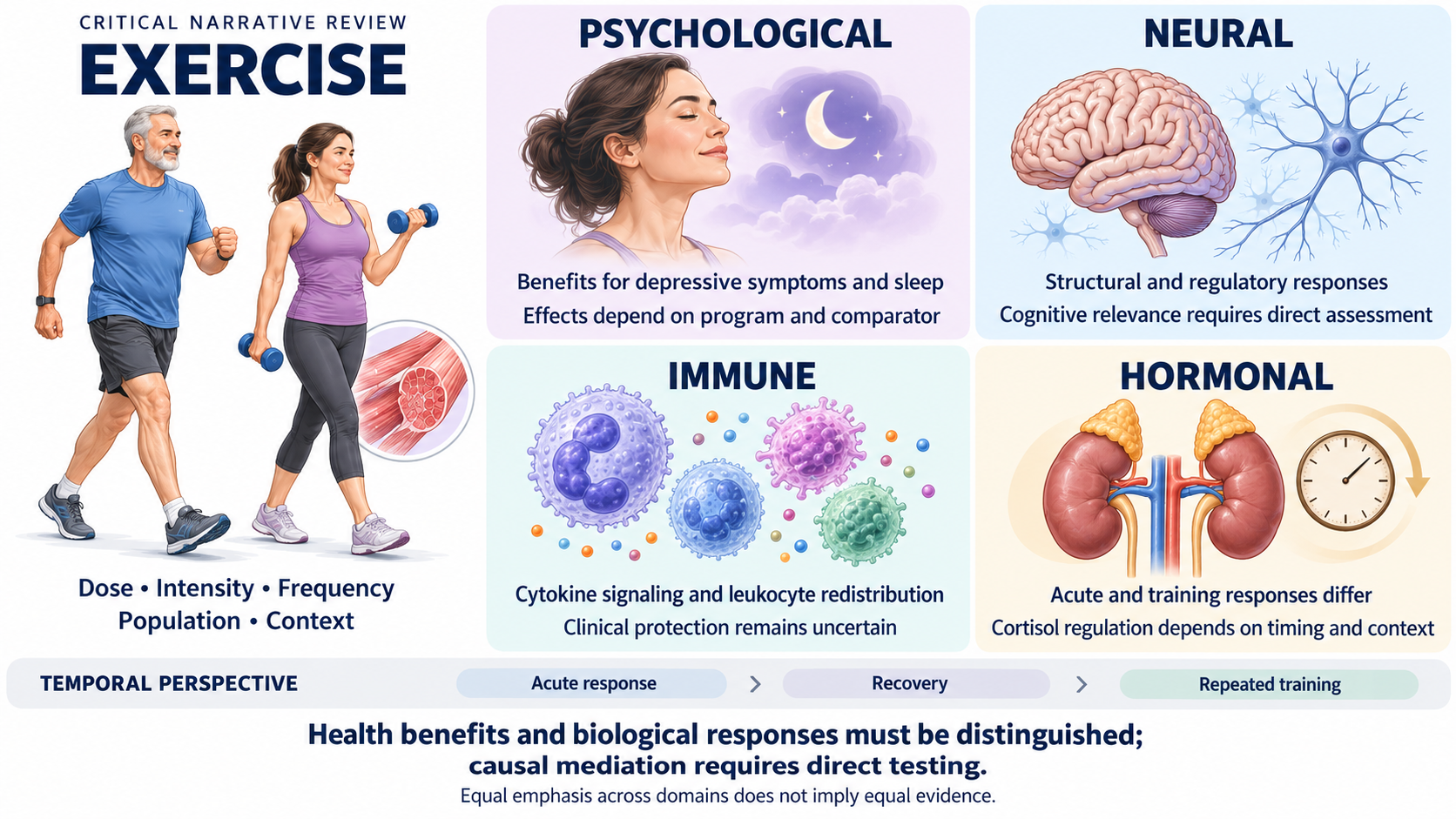
Exercise affects psychological, neural, immune, and hormonal processes, but evidence linking these responses to health varies across domains. This critical narrative review synthesizes evidence from human intervention studies, recent meta-analytic syntheses and selected mechanistic experiments identified through structured literature searches conducted up to 25 October 2026. Psychological trials support benefits for depressive symptoms and sleep in certain populations, although uncertainty remains regarding comparators, durability, and treatment components. Neural studies show some structural and functional change, although pooled effects on hippocampal volume are small, and circulating neurotrophic factors do not reliably indicate their cerebral origin or cognitive benefit. Immune experiments support cytokine signaling and leukocyte redistribution, with qualified evidence for vaccine and respiratory-illness responses. Hormonal studies show that acute cortisol responses and longer-term stress regulation depend on protocol, sampling time, and participant context, with selective rather than generalized training effects. Across domains, clinical improvement, physiological responsiveness, and causal mediation are distinct findings. We integrate these findings within a response and recovery framework that specifies domain-specific measures, temporal sequence, competing explanations, and conditions that would weaken a proposed mechanism. Domain-specific health benefits must be interpreted relative to the population studied and the comparator. Coordinated longitudinal studies are needed before psychological, neural, immune, or hormonal measures can inform individualized exercise prescription.
Keywords:
exercise
; psychological health
; neural regulation
; immune function
; hormones
; stress
; recovery
; causal mediation
Copyright: This open access article is published under a Creative Commons CC BY 4.0 license, which permit the free download, distribution, and reuse, provided that the author and preprint are cited in any reuse.