

Submitted:
05 November 2026
Posted:
06 November 2026
You are already at the latest version
Abstract
Background/Objectives: Personal recovery is an important outcome in mental healthcare. This study evaluated the psychometric properties of the 20-item Recovery Assessment Scale–Short Form in 334 adults receiving inpatient care who were assessed at discharge from four Chilean hospitals. Reporting followed the Strengthening the Reporting of Observational Studies in Epidemiology guidelines. Methods: Confirmatory factor analysis for ordered categorical indicators compared unidimensional, correlated four-factor, and second-order models. Internal consistency, measurement invariance across gender, and associations with perceived family functioning were examined. Results: The unidimensional model showed inadequate fit, whereas the correlated four-factor model showed acceptable-to-good fit (χ²(164) = 448.23; comparative fit index = .972; root mean square error of approximation = .072; standardised root mean square residual = .049). The second-order model also showed acceptable-to-good fit and did not significantly worsen fit relative to the correlated four-factor model (Δχ²(2) = 4.35, p = .113). Ordinal McDonald’s omega was .958 for the total score and ranged from .809 to .932 across domains. Although robust difference tests were significant, changes in approximate fit indices were minimal, providing preliminary support for scalar invariance across women and men. Family functioning was positively associated with the total score (r = .323) and all four domains, with the strongest association for Connecting and Belonging (r = .391). Conclusions: Overall, the scale showed favourable psychometric performance and provided support for both a multidimensional representation and an overall personal recovery score, although the differentiation of some domains and items warrants further investigation.
Keywords:
Chile
; factor analysis
; statistical
; mental health recovery
; psychiatric nursing
; psychometrics
1. Introduction
The World Health Organisation has identified mental health recovery as a priority [1,2], which is in line with the provisions of the United Nations Convention on the Rights of Persons with Disabilities (CRPD) [3]. It is a multifaceted construct that has attracted growing interest in recent years [4,5] and is highly complex [6]. When recovery is approached from a biomedical perspective, it is limited to the alleviation of symptoms and other deficits associated with the disorder, with a return to a pre-existing state of health [1,5]. The problem with this approach is that it excludes the subjectivity or perspective of service users from decision-making regarding their health [1,4], possibly due to a lack of resources (time and trained staff) [7], an emphasis on metrics such as readmission rates [8] or criticisms of existing instruments and their psychometric properties [1,9]. In this regard, people affected by severe mental illness have argued that a categorised and objective view of recovery is inappropriate [1,8].
Measuring subjective recovery provides valuable and meaningful information for individuals and the teams caring for them by focusing on life goals [10], within a context of hope, despite the symptoms they experience [2,11]. This approach can enrich the assessment process and strengthen the therapeutic relationship by suggesting areas for discussion and facilitating the setting of shared goals [12], whilst incorporating cultural norms [13], social expectations, and community interactions [14]. The care and concern shown by family members are particularly valuable, as their support and interpersonal connections foster hope and confidence in recovery [15]. This cannot be achieved through traditional clinical outcomes such as the reduction or disappearance of symptoms, which do not provide information about the mental health recovery process [1,8] or which have a limited effect in pharmacological or psychotherapeutic terms, leading to a re-evaluation of interventions focused on other aspects [16,17].
Since the CHIME Framework was proposed [3,9,18], an opportunity has arisen to shift the perspective on recovery from a symptom-reduction approach to a framework in which control lies with the individual rather than the professional [4]. It comprises five interrelated processes described as connection, hope and optimism for the future, identity, meaning in life, and empowerment [1]. Intervention approaches that take these aspects into account can mitigate the effects of mental illness [8] by focusing on improving coping skills [10], social support [19] and participation in activities that are meaningful to individuals [2,3]. Such approaches do not necessarily require the elimination of symptoms [4,9,16], as goals are defined by the individuals themselves [2] and life trajectories play a significant role [5]. Viewing recovery as an individual process akin to a ‘journey’ [5,20] opens the door to considering phenomena such as empowerment and resilience [5], with highs and lows that may vary over time, but highlights how autonomy can be improved by regaining control over one’s own life [19,21], functioning, and reintegration [8,16], whilst reducing the stigma associated with mental illness, which constitutes a significant barrier to recovery [20], by creating a distance between the individual and society at large [5,16]. From a nursing perspective, Barker’s Tidal Model [22], stands out as a person-centred approach in which healthcare professionals collaborate in the pursuit of recovery and the reclaiming of one’s life, focusing their care on the therapeutic alliance [20,23], which emerges from each person’s narrative [7].
Recovery can be assessed using scales that measure the components of recovery and others that describe the steps involved in its development. A pioneering tool for measuring recovery is the 24-item Recovery Assessment Scale (RAS-24) [24]. This self-report measure comprises five dimensions of recovery, described as personal confidence and hope, willingness to seek help, goal orientation and success, dependence on others, and freedom from symptom dominance. Originally developed for people with psychosis, the RAS-24 has shown favourable measurement properties, including evidence of content validity [1]. However, the overall quality of the available evidence regarding some of its measurement properties remains limited, and the instrument may not fully capture components associated with later stages of the recovery process [1].
Subsequently, in 2007, the Self-Identified Stage of Recovery (SISR) was published [25]. This brief, self-administered scale assesses both the stage of recovery (SISR-A) and the components of the personal recovery process (SISR-B). A Spanish-language version of the SISR has shown favourable evidence of validity and reliability [25].
The Recovery Assessment Scale–Domains and Stages (RAS-DS) [26], a 38-item self-report scale based on Corrigan’s RAS [24], assesses four dimensions described as ‘doing things I value’, ‘looking ahead’, ‘managing my illness’, and ‘connecting and belonging’. It meets the criteria for structural validity, internal consistency, and convergent validity, with high-quality evidence [1]. In terms of content, it demonstrates good relevance and comprehensiveness, covering all CHIME processes, with an emphasis on post-recovery stages [1].
The 20-item Recovery Assessment Scale–Short Form (RAS-SF) was subsequently developed from the RAS-DS in a sample of adults with anxiety and related disorders [27]. The short form retains five items from each of the four RAS-DS domains and demonstrated a four-factor structure, high internal consistency, and strong correspondence with the full-length domain scores [27]. However, evidence for the RAS-SF remains limited beyond the population and cultural context in which it was developed. Although other versions of the RAS have been examined in Spanish-speaking Latin American populations, including Argentina [28], these findings do not constitute a validation of the RAS-SF-20. To our knowledge, the psychometric performance of the RAS-SF-20 has not been evaluated among Chilean mental health service users.
Therefore, the present study aimed to examine its internal structure and internal consistency in a Chilean inpatient psychiatric sample, together with its associations with perceived family functioning. Measurement invariance across women and men was additionally examined as a secondary analysis.
2. Materials and Methods
Study design and settings
This multicentre, cross-sectional psychometric study was conducted in four hospitals in Santiago, Chile, three of which belong to the public health system. Reporting followed the Strengthening the Reporting of Observational Studies in Epidemiology (STROBE) guidelines. Data were collected between 2022 and 2025 in inpatient psychiatric units, with participants assessed at discharge. Eligible service users were recruited using non-probability consecutive sampling.
Participants
The sample comprised 334 adults receiving inpatient psychiatric care. Eligibility criteria were: (a) age ≥18 years; (b) Chilean nationality; (c) discharge from the inpatient psychiatric unit; (d) ability to read and write; and (e) no communication or cognitive difficulties precluding questionnaire completion. Participants with an acute psychiatric emergency at the time of assessment, including a recent suicide attempt, psychomotor agitation, alcohol or drug intoxication or withdrawal, acute anxiety, or stupor, were excluded.
The largest age groups were 18–25 (35.9%), 26–35 (26.0%), and 36–45 years (21.3%). Women comprised 53.9% of the sample, men 43.4%, and participants of another gender 2.7%. Participants were most commonly salaried employees (26.9%), students (21.0%), unemployed (18.3%), or self-employed (14.7%); 94.9% resided in the Santiago Metropolitan Region. Most had public health coverage, and 38.0% lived with one or both parents. Household income was most commonly CLP 300,001–600,000 (34.1%); 91.0% reported no specific ethnic affiliation, and 43.7% reported no religion. The mean length of hospitalisation was 25.37 days (SD = 20.87; median = 18.50; range = 2–150). The most frequent diagnoses were mood disorders (33.8%), substance use disorders (19.5%), psychotic disorders (13.5%), anxiety disorders (8.7%), and personality disorders (7.5%).
Sample size adequacy
The available sample size was determined by the number of eligible participants consecutively recruited during the study period. As a post hoc sensitivity analysis, the performance of the prespecified ordinal CFA at the obtained sample size (N = 334) was evaluated using a Monte Carlo simulation following Muthén and Muthén [29]. The population model reproduced the correlated four-factor RAS-SF structure reported by De Silva et al. [27], comprising 20 four-category ordinal indicators, with five indicators per factor. Standardised population factor loadings ranged from .47 to .88 and latent factor correlations from .44 to .76. Item-specific thresholds were calibrated from the observed response distributions using a Jeffreys correction (+0.5 per response category) and ranged from −2.96 to 0.80 on the probit scale. The simulated data were analysed using WLSMV estimation with theta parameterisation, consistent with the empirical CFA. Across 2,000 replications, convergence was 100%, relative parameter bias was negligible (−0.19% to 0.56%), 95% confidence interval coverage ranged from .914 to .944, and power was 1.00 for all factor loadings. Absolute relative standard error bias ranged from 2.25% to 7.65%, with 17 of the 20 loadings remaining within the 5% criterion. Overall, the simulation indicated stable estimation and accurate recovery of the prespecified CFA parameters at N = 334, with only modest underestimation of standard errors for a small subset of loadings.
Instruments
- (a)
- Sociodemographic and clinical questionnaire
A study-specific questionnaire assessed age, gender, occupational status, health insurance, residence, household income, ethnic background, religion, household composition, hospitalisation length, and primary diagnosis. Household income was recorded in predefined Chilean-peso categories.
- (b)
- Recovery Assessment Scale-Short Form (RAS-SF)
The 20-item Recovery Assessment Scale–Short Form (RAS-SF), derived from the 38-item Recovery Assessment Scale–Domains and Stages (RAS-DS), comprises four five-item domains: Doing Things I Value, Looking Forward, Mastering My Illness, and Connecting and Belonging [27,30]. Items are rated from 1 (Untrue) to 4 (Completely true), with higher scores indicating greater personal recovery. The Chilean Spanish items were drawn unchanged from the previously translated and back-translated Chilean RAS-DS adaptation [31], following the RAS-SF item configuration established by De Silva et al. [27].
For scale-score analyses, available item responses were averaged within domains and across all items, divided by 4, and multiplied by 100, yielding scores ranging from 25 to 100 [32]. Confirmatory factor analyses used the original four-category item responses.
- (c)
- Family APGAR
The Family APGAR [33] is a five-item self-report measure assessing perceived family functioning. Items are rated from 0 (hardly ever) to 2 (almost always), yielding a total score ranging from 0 to 10, with higher scores indicating better perceived family functioning. Previous studies have supported its unidimensional structure and internal consistency in Spanish-speaking populations [34]. In the present sample, the Family APGAR showed good internal consistency (Cronbach’s α = .864; ordinal α = .921; ordinal ω = .921).
Procedure
Following institutional and ethical approvals, 18 nurses were trained in standardised administration of the study measures. At discharge, eligible participants provided written informed consent and completed the questionnaires electronically on a computer in the unit. Ethical approval was obtained from the Scientific Ethical Committee of Hospital Clínico La Florida (CEC-HLF; 13 May 2021), the Research Ethics Committee of the North Metropolitan Health Service (CEI-SSM; 18 May 2022), the Scientific Ethical Committee of Universidad de Los Andes Clinic (CEC-CUA; 12 September 2022), and the Scientific Ethical Committee of the Southeast Metropolitan Health Service (CEC-SSMSO; 4 May 2023). The study was conducted in accordance with the Declaration of Helsinki and the international ethical guidelines of the Council for International Organisations of Medical Sciences.
Data Analysis
Item-level response frequencies, missing data, and score distributions were examined before the psychometric analyses; item-level descriptives are reported in Supplementary Table S1. Descriptive statistics were calculated for each RAS-SF domain and the total score.
Internal structure was examined using confirmatory factor analysis (CFA) in Mplus 8.3 [35]. Because the indicators used four ordered categories, models were estimated using robust weighted least squares with mean- and variance-adjusted statistics (WLSMV), theta parameterisation, and a probit link. Missing responses were handled using Mplus pairwise-present information for categorical outcomes. Item 16 had 13 missing responses; thus, 321 participants had complete item data, while all 334 contributed available information to the CFA.
Three prespecified models were tested: (a) a unidimensional model; (b) the correlated four-factor RAS-SF model comprising Doing Things I Value, Looking Forward, Mastering My Illness, and Connecting and Belonging; and (c) a second-order model in which the four domains loaded onto a higher-order personal recovery factor.
Model fit was evaluated using χ², the Comparative Fit Index (CFI), the Tucker–Lewis Index (TLI), the root mean square error of approximation (RMSEA; 90% confidence interval), and the standardised root mean square residual (SRMR). Indices were interpreted jointly rather than using rigid cut-offs; CFI/TLI values of approximately .95 or higher and SRMR around .08 or lower indicated good fit, while RMSEA below .08 was considered acceptable [36]. Because WLSMV χ² statistics cannot be directly subtracted, the correlated four-factor and second-order models were compared using Mplus DIFFTEST. Standardised loadings, factor correlations, residuals, and modification indices were inspected. Data-driven residual covariances were examined only in post hoc sensitivity analyses.
Internal consistency was assessed using conventional Cronbach’s alpha, ordinal alpha, and ordinal McDonald’s omega. Ordinal coefficients were estimated from polychoric correlations. Conventional RAS-SF alpha was calculated using complete cases for each score: n = 321 for Looking Forward and the total score because of the missing responses on Item 16, and n = 334 for the remaining domains. Ordinal omega was the primary reliability estimate, while conventional alpha was retained to facilitate comparison with previous validation studies. The same ordinal reliability approach was applied to the Family APGAR.
Measurement invariance across women and men was examined as a secondary analysis using configural, metric, and scalar models for ordered categorical indicators. Nine participants reporting another gender were retained in total-sample analyses but excluded from multigroup analyses because of the small group size. Because one response category for Item 5 was endorsed by only one participant, the two lowest response categories were collapsed for invariance analyses only. Metric models constrained factor loadings to equality and scalar models additionally constrained thresholds. Models were compared using DIFFTEST and changes in approximate fit indices; ΔCFI ≤ .010, ΔRMSEA ≤ .015, and ΔSRMR ≤ .030 for metric and ≤ .010 for scalar invariance were considered compatible with invariance [37].
Associations between RAS-SF and Family APGAR scores were examined using Pearson correlations. Spearman correlations were conducted as sensitivity analyses because of upper-category concentration and are reported in the Supplementary Material. All tests were two-tailed, with α = .05.
3. Results
The primary analyses included 334 participants. Complete responses were available for all RAS-SF indicators except Item 16, which had 13 missing responses (3.9%). Item-level responses showed a general concentration in the upper response categories (Supplementary Table S1). Looking Forward had the highest mean score (M = 86.64, SD = 15.73), followed by Doing Things I Value (M = 85.27, SD = 17.05), Mastering My Illness (M = 82.87, SD = 16.40), and Connecting and Belonging (M = 77.87, SD = 15.99). The mean total score was 83.17 (SD = 13.87). The maximum possible score was observed in 28.4% of participants for Doing Things I Value, 27.8% for Looking Forward, 21.6% for Mastering My Illness, 10.5% for Connecting and Belonging, and 4.5% for the total score (Supplementary Table S2).

Table 1.
Descriptive Statistics, Reliability, and Associations with Family Functioning.
| RAS-SF-20 score | M | SD | Cronbach's α | Ordinal α | Ordinal ω | Family APGAR, r |
|---|---|---|---|---|---|---|
| Doing Things I Value | 85.27 | 17.05 | .893 | .921 | .921 | .199*** |
| Looking Forward | 86.64 | 15.73 | .792 | .914 | .916 | .264*** |
| Mastering My Illness | 82.87 | 16.40 | .900 | .932 | .932 | .255*** |
| Connecting and Belonging | 77.87 | 15.99 | .688 | .784 | .809 | .391*** |
| Total score | 83.17 | 13.87 | .870 | .955 | .958 | .323*** |
Note: Scores were transformed to a 25–100 scale and calculated from available item responses. Conventional Cronbach’s alpha was estimated using complete cases for each score; therefore, alpha for Looking Forward and the total score used n = 321, whereas the remaining domain alphas used n = 334. Ordinal alpha and omega were estimated from polychoric correlation matrices. ***p < .001.
Confirmatory Factor Analysis
The unidimensional model did not provide an adequate representation of the data, χ²(170) = 900.98, p < .001, CFI = .929, TLI = .920, RMSEA = .113, 90% CI [.106, .121], and SRMR = .076. In contrast, the prespecified correlated four-factor model showed acceptable-to-good fit, χ²(164) = 448.23, p < .001, CFI = .972, TLI = .968, RMSEA = .072, 90% CI [.064, .080], and SRMR = .049 (Table 2).
All standardised factor loadings were positive and statistically significant (p < .001; Figure 1). Loadings were moderate to high for Doing Things I Value (.817–.922), Looking Forward (.715–.900), and Mastering My Illness (.767–.917). Greater heterogeneity was observed for Connecting and Belonging: Items 32 and 33 showed high loadings (.935 and .949), Item 38 a moderate loading (.625), and Items 35 and 37 comparatively low loadings (.406 and .305).
Correlations among the four first-order factors were positive and substantial, ranging from .638 to .939 (Figure 1). The strongest association was observed between Looking Forward and Mastering My Illness (r = .939), indicating substantial overlap between these domains and providing a rationale for examining a higher-order personal recovery factor.
The second-order model also showed acceptable-to-good fit, χ²(166) = 423.87, p < .001, CFI = .975, TLI = .971, RMSEA = .068, 90% CI [.060, .076], and SRMR = .050. The DIFFTEST indicated that imposing the second-order structure did not significantly worsen model fit relative to the correlated four-factor model, Δχ²(2) = 4.35, p = .113.
All four first-order domains loaded strongly on the higher-order personal recovery factor: Doing Things I Value, λ = .795; Looking Forward, λ = .990; Mastering My Illness, λ = .949; and Connecting and Belonging, λ = .808. These loadings corresponded to explained variances of 63.2%, 98.0%, 90.1%, and 65.3%, respectively. However, the residual variance of Looking Forward was small and non-significant, indicating that this domain accounted for little variance beyond the general recovery factor. The standardised second-order model is presented in Supplementary Figure S1.
Overall, the correlated four-factor model was consistent with the multidimensional structure originally proposed for the RAS-SF-20. The second-order model was also compatible with the data, providing preliminary support for a higher-order personal recovery construct and suggesting that an overall score may be interpretable alongside domain-specific scores. Nevertheless, the near-unity loading of Looking Forward and its limited residual specificity indicate that this domain, particularly its distinction from Mastering My Illness, should be interpreted cautiously.
Local Dependence: Sensitivity Analysis
Inspection of modification indices identified evidence of local dependence between Items 35 and 37. Allowing their residuals to correlate significantly improved fit in both the correlated four-factor model, Δχ²(1) = 25.65, p < .001, and the second-order model, Δχ²(1) = 25.66, p < .001. Because this modification was identified after inspection of the data and requires independent substantive justification, the models without correlated residuals were retained as the primary models. The modified models were therefore interpreted only as sensitivity analyses.
Internal Consistency
Conventional and ordinal reliability estimates are presented in Table 1. Using complete cases for each score, conventional Cronbach's alpha was .870 for the total score (n = 321) and ranged from .688 to .900 across domains; Looking Forward was also based on n = 321 (α = .792), whereas the other domain estimates used n = 334. Ordinal reliability estimates were consistently higher. Ordinal omega was .921 for Doing Things I Value, .916 for Looking Forward, .932 for Mastering My Illness, .809 for Connecting and Belonging, and .958 for the total score.
The results indicated strong internal consistency for the total score and for Doing Things I Value, Looking Forward, and Mastering My Illness. Connecting and Belonging showed lower reliability than the remaining domains, consistent with the greater heterogeneity of its item loadings. Nevertheless, its ordinal omega remained above .80.
The Family APGAR also showed good internal consistency, with conventional Cronbach’s α = .864 and both ordinal α and ordinal ω = .921.
Measurement Invariance Across Gender: Secondary Analysis
Measurement invariance was examined among 325 participants who identified as women (n = 180) or men (n = 145). The configural model showed acceptable fit, χ²(328) = 615.03, p < .001, CFI = .974, TLI = .969, RMSEA = .073, 90% CI [.064, .082], and SRMR = .058. The metric model also showed acceptable fit, χ²(344) = 634.66, p < .001, CFI = .973, TLI = .971, RMSEA = .072, 90% CI [.063, .081], and SRMR = .059. The scalar model showed similarly acceptable fit, χ²(378) = 664.43, p < .001, CFI = .974, TLI = .974, RMSEA = .068, 90% CI [.060, .077], and SRMR = .061.
Robust chi-square difference tests were statistically significant for the metric versus configural comparison, Δχ²(16) = 27.83, p = .033, and for the scalar versus metric comparison, Δχ²(34) = 50.98, p = .031. However, changes in the approximate fit indices were minimal. From the configural to the metric model, ΔCFI = −.001, ΔRMSEA = −.001, and ΔSRMR = .001; from the metric to the scalar model, ΔCFI = .001, ΔRMSEA = −.004, and ΔSRMR = .002. Although these changes were within commonly used practical criteria for invariance, both robust DIFFTEST comparisons were statistically significant. Accordingly, the findings were interpreted as providing preliminary rather than definitive evidence of scalar invariance. The collapse of the two lowest response categories for one sparsely endorsed item further warrants caution. Because participants reporting another gender could not be included in the multigroup analysis, these findings should not be generalised beyond women and men included in the analysis.
Associations With Family Functioning
Family functioning was positively associated with the RAS-SF-20 total score and all four domains. Pearson correlations were .199 for Doing Things I Value, .264 for Looking Forward, .255 for Mastering My Illness, .391 for Connecting and Belonging, and .323 for the total score, all ps < .001. The strongest association was observed for Connecting and Belonging, consistent with the interpersonal and relational content of this domain.
Spearman correlations showed the same pattern, ranging from .277 to .396, supporting the robustness of the observed associations to non-normality and concentration in the upper response categories. Family functioning should nevertheless be considered a theoretically related external variable rather than an alternative measure of personal recovery
4. Discussion
To our knowledge, this study provides the first psychometric evaluation of the RAS-SF in a Chilean inpatient psychiatric sample. Overall, the findings were consistent with the correlated four-factor structure proposed by De Silva et al. [27], while also providing preliminary support for representing the four domains through a higher-order personal recovery factor. Internal consistency was adequate to strong, the measurement invariance analyses provided preliminary rather than definitive evidence of scalar invariance across women and men, and recovery scores showed theoretically meaningful positive associations with perceived family functioning.
The evidence supporting the correlated four-factor model is consistent with the structure originally proposed for the RAS-SF by De Silva et al. [27], in which five items represent each of the domains Doing Things I Value, Looking Forward, Mastering My Illness, and Connecting and Belonging. Importantly, the unidimensional model provided substantially poorer fit in the present study, suggesting that personal recovery should not be treated as a completely undifferentiated construct. These findings extend previous evidence for the RAS-SF to a culturally distinct Latin American setting and to a diagnostically heterogeneous inpatient psychiatric population. This is relevant given that previous research on personal recovery measures has highlighted the importance of structural validity and the need to examine their performance across different populations and cultural contexts [1,13].
At the same time, the adequate fit of the second-order model suggests that the four domains share substantial variance attributable to a broader personal recovery construct. The nonsignificant DIFFTEST comparison further indicated that imposing a higher-order structure did not result in a statistically significant worsening of model fit relative to the correlated four-factor solution. This finding provides empirical support for the interpretation of an overall RAS-SF score alongside domain-specific scores. Nevertheless, the strong association between Looking Forward and Mastering My Illness, together with their high loadings on the higher-order factor, indicates limited empirical differentiation between these two domains in the present sample. Conceptually, this overlap is plausible because hope, perceived self-efficacy, and the capacity to manage mental health difficulties represent closely interconnected aspects of personal recovery, as also reflected in broader recovery frameworks such as CHIME [18]. However, the near-unity second-order loading for Looking Forward suggests that the unique contribution of this domain beyond general recovery may be limited and warrants replication in independent samples.
Connecting and Belonging showed a more complex psychometric pattern. Items 35 and 37 exhibited comparatively weak factor loadings, with evidence of local dependence, between the two items, whereas the remaining indicators showed moderate to strong loadings. The comparatively weak performance of Item 35 does not appear to be unique to the Chilean sample, as it was also the only item with a loading below .50 in the original RAS-SF development study [27]. In the present study, however, Item 37 also showed a comparatively low loading. Consistent with this heterogeneity, conventional Cronbach’s alpha was lower for Connecting and Belonging than for the other domains, although ordinal omega remained above .80. Importantly, this domain showed the strongest association with perceived family functioning, providing substantive coherence given that connectedness and supportive interpersonal relationships are central components of personal recovery [18,19]. Taken together, these findings do not suggest that Connecting and Belonging lacks relevance; rather, they indicate that some of its indicators may function less uniformly in this clinical and cultural context. Future qualitative and psychometric research should therefore examine the wording and cultural interpretation of Items 35 and 37 among Chilean mental health service users before considering any modification to the scale.
Associations with perceived family functioning provided additional information about the nomological context of RAS-SF scores. All four domains and the total score were positively associated with Family APGAR scores, with correlations ranging from small to moderate in magnitude. The strongest association was observed for Connecting and Belonging, as would be expected given its relational content. Previous research has emphasized social support, connectedness, and meaningful relationships as important resources in personal recovery [18,19]. At the same time, the modest magnitude of the correlations is also conceptually appropriate because family functioning and personal recovery are related but distinct constructs. Accordingly, these associations should be interpreted as evidence of relationships with a theoretically relevant external variable rather than as evidence that the Family APGAR [33] represents an alternative measure of personal recovery.
The measurement invariance analyses provided preliminary evidence regarding the comparability of RAS-SF scores across women and men. Although changes in CFI, RMSEA, and SRMR remained within commonly used practical criteria, the robust DIFFTEST comparisons were statistically significant. The evidence for scalar invariance should therefore be regarded as provisional and warrants replication, particularly because the two lowest response categories of one item had to be collapsed owing to sparse endorsement of one category. Furthermore, the present analysis provides no evidence regarding measurement equivalence for people identifying outside the women–men groups examined here.
Another finding requiring consideration was the concentration of responses towards the upper end of the scale. Although only 4.5% of participants obtained the maximum total RAS-SF score, maximum scores were more frequent for Doing Things I Value (28.4%), Looking Forward (27.8%), and Mastering My Illness (21.6%), indicating that upper-end concentration was more pronounced at the domain level. Because participants completed the RAS-SF at discharge from inpatient psychiatric care, one possible explanation is that assessment occurred at a point of greater clinical stability and readiness for transition from hospital care. However, this interpretation cannot be established from the present cross-sectional data. Concentrated in the upper responses categories may reduce the ability of the scale to discriminate among individuals reporting higher levels of recovery. Longitudinal studies assessing the RAS-SF at different stages of hospitalisation and following discharge would therefore be valuable in determining whether this response pattern reflects the timing of assessment, characteristics of the inpatient population, or limitations in the measurement range of particular items.
Limitations
Several limitations should be considered. First, participants were recruited from inpatient psychiatric units in Santiago, and most resided in the Metropolitan Region, limiting the generalisability of the findings to community settings and other regions of Chile. Second, the cross-sectional design precluded examination of temporal stability, responsiveness to change, and predictive validity. Third, associations with an external variable were evaluated using family functioning rather than another established measure of personal recovery; future studies should incorporate additional recovery measures to further examine convergent and discriminant validity. Fourth, measurement invariance analyses were restricted to women and men because the number of participants reporting another gender was insufficient for multigroup analysis. Finally, some indicators showed highly concentrated response distributions, and the Connecting and Belonging domain exhibited comparatively heterogeneous factor loadings, warranting further examination in independent Chilean samples.
5. Conclusions
The Chilean RAS-SF showed favourable psychometric performance in adults receiving inpatient psychiatric care. The correlated four-factor structure was consistent with the data, and the second-order model provided preliminary support for interpreting an overall personal recovery score. Internal consistency was generally strong, measurement invariance analyses provided preliminary rather than definitive evidence of scalar invariance across women and men, and associations with perceived family functioning were theoretically coherent. These findings indicate that the RAS-SF is a potentially useful brief measure of personal recovery for Chilean mental health settings. Further research should examine its temporal stability, responsiveness to change, performance in community and outpatient populations, and the functioning of specific items within the Connecting and Belonging domain.
Supplementary Materials
The following supporting information can be downloaded at the website of this paper posted on Preprints.org.
Author Contributions
a) conceptualization: Fuentes-Olavarría D.; b) methodology: Fuentes-Olavarría D., Rodríguez-Rivas ME., Pérez Ewert JC. and Lirola Manzano MJ.; c) software: Rodríguez-Rivas ME.; d) validation: Pérez Ewert JC. and Lirola Manzano MJ.; e) formal analysis: Fuentes-Olavarría D., Rodríguez-Rivas ME., Pérez Ewert JC. and Lirola Manzano MJ.; f) investigation: Fuentes-Olavarría D.; g) resources: Fuentes-Olavarría D.; h) data curation: Fuentes-Olavarría D.; i) writing—original draft preparation: Fuentes-Olavarría D.; j) writing—review and editing: Fuentes-Olavarría D., Rodríguez-Rivas ME.; k) visualization: Fuentes-Olavarría D., Rodríguez-Rivas ME.; l) supervision: Pérez Ewert JC. and Lirola Manzano MJ.; m) project administration: Fuentes-Olavarría D.; n) funding acquisition: no funding.
Funding
This research received no external funding.
Institutional Review Board Statement
The research was reviewed by: (a) Comité Ético Científico Hospital Clínico La Florida Dra. Eloísa Díaz Insunza (CEC-HLF) del Servicio de Salud Metropolitano Sur Oriente, 13 May 2021, approval code or reference number Ámbito DP Característica 3.1; (b) Comité de Ética de la Investigación del Servicio de Salud Metropolitano Norte (CEI-SSM), 18 May 2022, approval code or reference number Carta N◦010/2022; (c) Comité Ético Científico Universidad de los Andes (CEC), 12 September 2022, approval code or reference number CEC2022075; (d) Comité Ético Científico Servicio de Salud Metropolitano Sur Oriente (CEC-SSMSO), 4 May 2023, approval code or reference number N◦2886. According to the postulates of the Declaration of Helsinski, the International Ethical Guidelines for Health-Related Research Involving Human Subjects CIOMS 2016, and the Good Clinical Practice Guidelines of ICH 1996, the research complies with Social Value, Scientific Validity, Risk/Benefit Assessment, Declaration of Conflicts of Interest, use of Informed Consent, and Protection of Participants’ Rights.
Informed Consent Statement
Written informed consent was obtained from all subjects involved in the study.
Data Availability Statement
Research data are available to anyone who wishes to request them and can be obtained by writing to the author’s email address.
Public Involvement Statement
According to the GRIPP Guide, this article’s report details: (a) the objective of the research; (b) a clear description of the methods used in the study; (c) the results of the study, including positive and negative results; (d) a discussion and conclusions, including an analysis of how the participation of individuals influenced the study as a whole; and (e) a critical reflection on what went well and what did not.
Guidelines and Standards Statement
This manuscript was drafted against the (International Comitee of Medical Journal Editors (ICMJE) and STROBE Checklist.
Use of Artificial Intelligence
The author declares that no artificial intelligence resources or software were used in the preparation of the manuscript.
Acknowledgments
To all those receiving care within the Chilean Mental Health Network who agreed to take part in this study. To all the nurses who made it possible to administer the assessment tools. To the hospitals that opened their doors to us so that we could investigate the recovery of people affected by mental illness.
Conflicts of Interest
The authors declare that they have no conflicts of interest in the preparation, analysis or publication of this manuscript.
References
- Felix S, Valery KM, Caiada M, Guionnet S, Bonilla-Guerrero J, Destaillats JM, et al. Personal recovery self-report outcome measures in serious mental illness: A systematic review of measurement properties. Clinical Psychology Review. Elsevier Inc.; 2024. PubMed PMID: 38943916. [CrossRef]
- World Health Organization. Comprehensive mental health action plan 2013–2030 [Internet]. 2021 [cited 2025 Feb 28]. Available from: https://iris.who.int/bitstream/handle/10665/345301/9789240031029-eng.pdf?sequence=1.
- Martín-Ordiales N, Hidalgo MD, Martín-Chaparro MP, Ballester-Plané J, Barrios M. Assessing the Psychometric Properties of the Illness Management and Recovery Scale: A Systematic Review Using the Consensus-Based Standards for the Selection of Health Measurement Instruments (COSMIN). Behavioral Sciences. Multidisciplinary Digital Publishing Institute (MDPI); 2024. [CrossRef]
- Aoki Y, Yaju Y, Utsumi T, Sanyaolu L, Storm M, Yoshikazu T, et al. Shared decision-making interventions for people with mental health conditions. Cochrane Database of Systematic Reviews. 2022 Nov 11;2022(11). PubMed PMID: 36367232. [CrossRef]
- Moberg J, Skogens L, Schön UK. Review: Young people’s recovery processes from mental health problems – a scoping review. Child and Adolescent Mental Health. John Wiley and Sons Inc; 2023. p. 393–407. PubMed PMID: 35960215. [CrossRef]
- Saavedra J, Vázquez-Morejón A, Vázquez-Morejón R, Arias-Sánchez S, González-Álvarez S, Corrigan P. Spanish Validation of the Recovery Assessment Scale (RAS-24). Psicothema. 2021 Aug 1;3(33):500–8. [CrossRef]
- Hallberg P, Graneheim UH, Olsson-Tall M. Promoting Personal Recovery Within Psychiatric Inpatient Care—Nurses’ Experiences. International Journal of Mental Health Nursing. John Wiley and Sons Inc; 2025. PubMed PMID: 39887917. [CrossRef]
- Giannios P, Chainey F, Degré C, Borduas Pagé S, Hudon A. Components and Effectiveness of Adult Inpatient Psychiatric Rehabilitation Programs: A Scoping Review. Healthcare (Switzerland). Multidisciplinary Digital Publishing Institute (MDPI); 2025. [CrossRef]
- Chirio-Espitalier M, Schreck B, Duval M, Hardouin JB, Moret L, Bronnec MG. Exploring the Personal Recovery Construct in Bipolar Disorders: Definition, Usage and Measurement. A Systematic Review. Frontiers in Psychiatry. Frontiers Media S.A.; 2022. [CrossRef]
- Dell NA, Long C, Mancini MA. Models of mental health recovery: An overview of systematic reviews and qualitative meta-syntheses. Psychiatr Rehabil J. 2021 Sep 1;44(3):238–53. [CrossRef]
- Corrigan PW, Larson JE, Smelson D, Andra M. Recovery, peer support and confrontation in services for people with mental illness and/or substance use disorder. The British Journal of Psychiatry. 2019 Mar 18;214(3):130–2. [CrossRef]
- Yildiz M, Erim R, Soygur H, Tural U, Kiras F, Gules E. Development and validation of the Subjective Recovery Assessment Scale for patients with schizophrenia. Psychiatry and Clinical Psychopharmacology. 2018 Apr 3;28(2):163–9. [CrossRef]
- Panadevo J, Kotera Y, Køcks NR, Kring LD, Møller SB. Personal recovery after mental illness from a cultural perspective: A scoping review. International Journal of Social Psychiatry. SAGE Publications Ltd; 2025. p. 444–68. PubMed PMID: 40260942. [CrossRef]
- Hawsawi T, Stein-Parbury J, Orr F, Roche M, Gill K. Exploring recovery-focused educational programmes for advancing mental health nursing: An integrative systematic literature review. Int J Ment Health Nurs. 2021;30:1310–41. PubMed PMID: WOS:000670098100001. [CrossRef]
- Zhuang S, Chen Y, Zhang Y, Qu Y, Hou Y, Zhou X, et al. Relationship between family functioning and psychological distress among young and middle-aged patients with stroke: a moderated mediation model. Sci Rep. 2025;15:45192. [CrossRef]
- Crowe M. Psychiatry and/or recovery: a critical analysis. Int J Ment Health Nurs. 2022 Dec 1;31(6):1542–51. PubMed PMID: 36379908. [CrossRef]
- Roach A, Stanislaus Sureshkumar D, Elliot K, Hidalgo-Padilla L, Van Loggerenberg F, Hounsell L, et al. One-year recovery rates for young people with depression and/or anxiety not receiving treatment: A systematic review and meta-analysis. BMJ Open. 2023 Jul 21;13(7). PubMed PMID: 37479525. [CrossRef]
- Leamy M, Bird V, Boutillier C Le, Williams J, Slade M. Conceptual framework for personal recovery in mental health: systematic review and narrative synthesis. British Journal of Psychiatry. 2011 Dec 2;199(6):445–52. [CrossRef]
- Bjørlykhaug KI, Karlsson B, Hesook SK, Kleppe LC. Social support and recovery from mental health problems: a scoping review. Nordic Social Work Research. 2022;12(5):666–97. [CrossRef]
- Foster K, Coventry L, Middlewick Y, Smith L, Ewens B. Collaboration Between People Admitted to Acute Mental Health Units, Their Family Members and Nurses in the Detection of Mental State Changes and Recovery: A Qualitative Systematic Review. International Journal of Mental Health Nursing. John Wiley and Sons Inc; 2026. [CrossRef]
- Inta N, Phetlerthirunkul P, Kaewchuchuen J, Khanthavudh C, Sakharang W. Recovery-Oriented Care Planning in Mental Healthcare Services: A Combined Concept Analysis and Scoping Review. Int J Ment Health Nurs. 2026 Aug 19;35(4). [CrossRef]
- Barker PJ, Buchanan-Barker P. Mental Health Nursing and the Politics of Recovery: A Global Reflection. Arch Psychiatr Nurs. 2011;25(5):350–8. PubMed PMID: WOS:000295859000006. [CrossRef]
- Desmet K, Vrancken B, Bergs J, Van Hecke A, Deproost E, Bracke P, et al. Patient-Reported Outcomes, Influencing Factors, Nursing Care/Intervention(s) and Measurement Scales of Psychiatric and/or Mental Health Nursing in Hospitals: A Systematic Review. Journal of Psychiatric and Mental Health Nursing. John Wiley and Sons Inc; 2025. p. 1159–83. PubMed PMID: 40637268. [CrossRef]
- Corrigan PW, Salzer M, Ralph RO, Sangster Y, Keck L. Examining the Factor Structure of the Recovery Assessment Scale. Schizophr Bull. 2004 Jan 1;30(4):1035–41. [CrossRef]
- Sampietro HM, Barrios M, Berrío ÁI, Rojo JE, Guilera G, Gómez-Benito J. Evidence of Validity and Reliability for the Spanish Version of the SelfIdentified Stage of Recovery. Psicothema. 2024;36(2):165–73. PubMed PMID: 38661163. [CrossRef]
- Hancock N, Scanlan JN, Kightley M, Harris A. Recovery Assessment Scale-Domains and Stages: Measurement capacity, relevance, acceptability and feasibility of use with young people. Early Interv Psychiatry. 2020 Apr 5;14(2):179–87. [CrossRef]
- De Silva KT, Cockshaw WD, Rehm IC, Hancock N. A short form of the Recovery Assessment Scale-Domains and Stages: Development and validation among adults with anxiety disorders. Clin Psychol Psychother. 2021 Sep 10;28(5):1135–45. [CrossRef]
- Zalazar V, Castro Valdez J, Mascayano F, Vera N, Scorza P, Agrest M. Feasibility and Psychometric Properties of the Recovery Assessment Scale (RAS) in People with Mental Illness for Its Use in Argentina. J Psychosoc Rehabil Ment Health. 2017 Dec 1;4(2):179–88. [CrossRef]
- Muthén LK, Muthén BO. How to Use a Monte Carlo Study to Decide on Sample Size and Determine Power. Struct Equ Modeling. 2002 Oct;9(4):599–620. [CrossRef]
- Hancock N, Scanlan JN, Honey A, Bundy AC, O’Shea K. Recovery Assessment Scale – Domains and Stages (RAS-DS): Its feasibility and outcome measurement capacity. Australian & New Zealand Journal of Psychiatry. 2015 Jul 19;49(7):624–33. [CrossRef]
- Fuentes D, Astorga S. Facultad de Medicina Clínica Alemana de Santiago - Universidad del Desarrollo [Internet]. 2018 [cited 2026 Aug 6]. Escala de Evaluación de la Recuperación: Dominios y Etapas. Available from: https://ras-ds.net.au/wp-content/uploads/2018/10/RAS-DS_2016_Spanish.pdf.
- Hancock N, Scanlan JN, Bundy AC, Honey A. Recovery Assessment Scale-Domains and Stages (RAS-DS) Manual [Internet]. Sydney; 2019 [cited 2026 Aug 6]. Available from: https://ras-ds.net.au/wp-content/uploads/2019/09/RASDS-Manual-Version-3-2019-FINAL.pdf.
- Smilkstein G. The family APGAR: a proposal for a family function test and its use by physicians. J Fam Pract. 1978 Jun;6(6):1231–9.
- Mayorga-Muñoz C, Gallardo-Peralta L, Galvez-Nieto JL. Propiedades psicométricas de la escala APGAR-familiar en personas mayores residentes en zonas rurales multiétnicas chilenas. Rev Med Chil. 2019 Oct;147(10):1283–90. [CrossRef]
- Muthén LK, Muthén BO. Los Angeles, CA [Internet]. 2017 [cited 2026 Aug 27]. Mplus: Statistical Analysis with Latent Variables: User’s Guide (Version 8). Available from: https://www.statmodel.com/download/usersguide/MplusUserGuideVer_8.pdf.
- Hu L, Bentler PM. Cutoff criteria for fit indexes in covariance structure analysis: Conventional criteria versus new alternatives. Struct Equ Modeling. 1999 Jan;6(1):1–55. [CrossRef]
- Chen FF. Sensitivity of Goodness of Fit Indexes to Lack of Measurement Invariance. Struct Equ Modeling. 2007 Jul 31;14(3):464–504. [CrossRef]
Figure 1.
Standardised correlated four-factor model of the RAS-SF-20 in the Chilean clinical sample. Note: Values are completely standardised (STDYX) estimates obtained using WLSMV with theta parameterisation. All factor loadings were statistically significant at p < .001.
Figure 1.
Standardised correlated four-factor model of the RAS-SF-20 in the Chilean clinical sample. Note: Values are completely standardised (STDYX) estimates obtained using WLSMV with theta parameterisation. All factor loadings were statistically significant at p < .001.
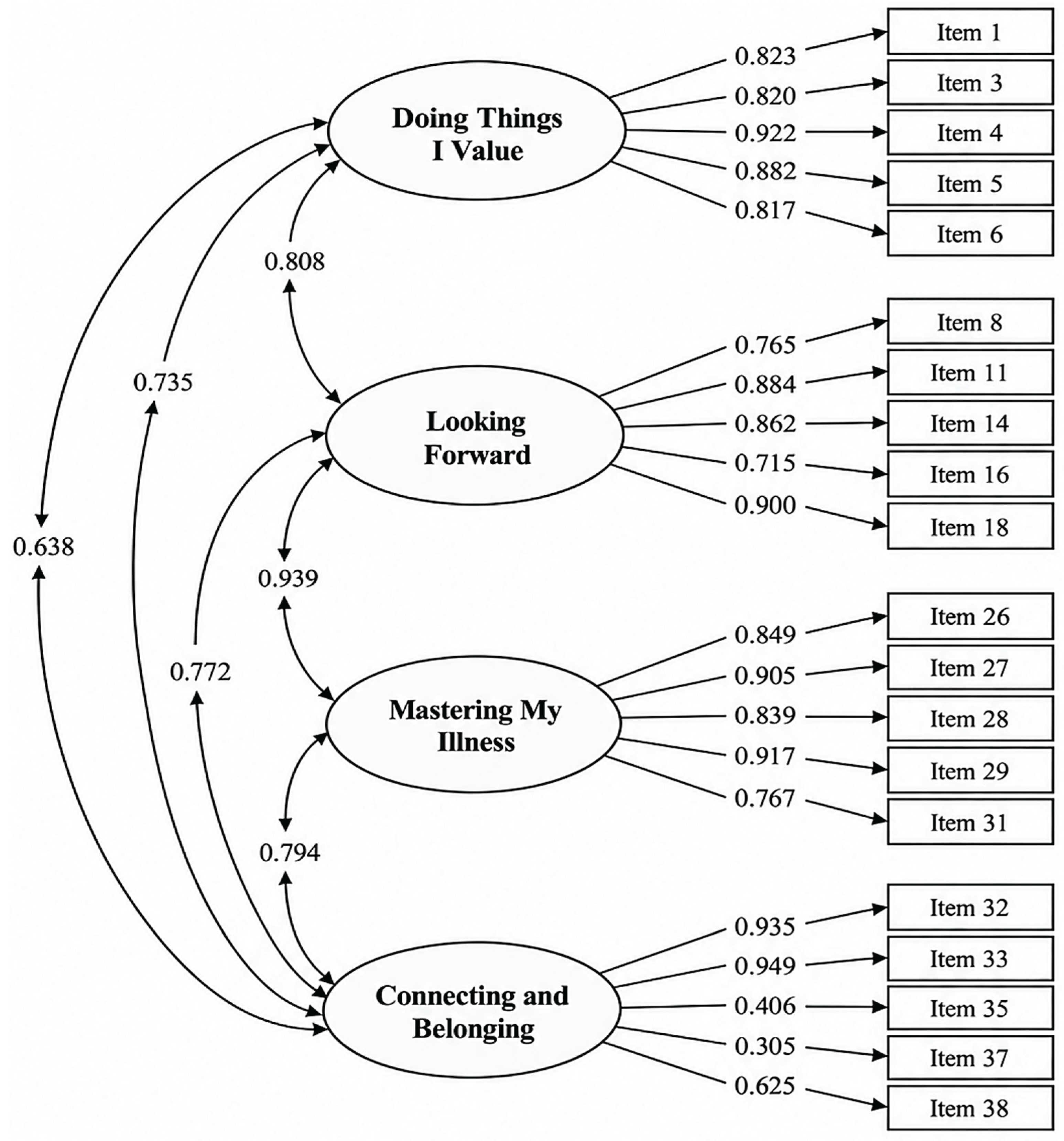
Table 2.
Fit Indices for the RAS-SF-20 Confirmatory Factor Models.
| Model | χ² | df | CFI | TLI | RMSEA [90% CI] | SRMR |
|---|---|---|---|---|---|---|
| Unidimensional | 900.98 | 170 | .929 | .920 | .113 [.106, .121] | .076 |
| Correlated four-factor | 448.23 | 164 | .972 | .968 | .072 [.064, .080] | .049 |
| Second-order | 423.87 | 166 | .975 | .971 | .068 [.060, .076] | .050 |
Note: Models were estimated using WLSMV with theta parameterisation. The DIFFTEST comparison between the correlated four-factor and second-order models was Δχ²(2) = 4.35, p = .113.
Disclaimer/Publisher’s Note: The statements, opinions and data contained in all publications are solely those of the individual author(s) and contributor(s) and not of MDPI and/or the editor(s). MDPI and/or the editor(s) disclaim responsibility for any injury to people or property resulting from any ideas, methods, instructions or products referred to in the content. |
© 2026 by the authors. Licensee MDPI, Basel, Switzerland. This article is an open access article distributed under the terms and conditions of the Creative Commons Attribution (CC BY) license.
Copyright: This open access article is published under a Creative Commons CC BY 4.0 license, which permit the free download, distribution, and reuse, provided that the author and preprint are cited in any reuse.