

Submitted:
05 November 2026
Posted:
06 November 2026
You are already at the latest version
Abstract
Background/aims: To identify predictors of long-term major adverse cardiovascular events (MACE) and investigate the association between reduced kidney function (KF) and MACE in patients with diabetes mellitus (DM) presenting with STEMI as their first clinically recognized manifestation of cardiovascular disease (CVD). Methods: We analyzed 512 patients with DM and STEMI without previous CVD. KF was assessed at admission and categorized as mildly, moderately, or severely reduced. The composite endpoint (MACE) included cardiovascular death, non-fatal recurrent myocardial infarction, target vessel revascularization, and non-fatal stroke. The follow-up lasted 8 years. Results: Reduced KF was present in 312 (60.9%) patients: 175 (56.1%) had mildly, 98 (31.4%) moderately, and 39 (12.5%) severely reduced KF. MACE was more frequent among patients with reduced KF across all severity stages. Moderately and severely reduced KF were independent predictors of 8-year MACE (HR 3.12, 95% CI 1.58–6.91 and HR 5.22, 95% CI 1.68–12.70, respectively). Other independent predictors included predischarge ejection fraction < 50%, new-onset atrial fibrillation, left main stenosis, heart failure at admission, and post-procedural TIMI flow < 3. Conclusion: In patients with DM presenting with their first STEMI, moderately and severely reduced KF were associated with approximately three-fold and five-fold higher risks of 8-year MACE, respectively. Mildly reduced KF was not independently associated with MACE. Assessment of KF severity may help identify patients requiring more intensive cardiovascular and multidisciplinary follow-up after STEMI.
Keywords:
diabetes mellitus
; STEMI
; reduced kidney function
; major adverse cardiovascular events
Introduction
Primary percutaneous coronary intervention (pPCI), dual antiplatelet therapy, increasing expertise, and improvements in secondary prevention have significantly reduced mortality and the occurrence of adverse events in patients with ST-elevation myocardial infarction (STEMI). Despite these advances, a substantial proportion of patients remain at high risk of adverse events after STEMI. Diabetes mellitus (DM) and reduced kidney function (KF) are important factors associated with an increased risk of adverse cardiovascular outcomes following STEMI, particularly when they coexist [1,2,3,4,5].
DM is associated with a broad spectrum of microvascular and macrovascular complications. Macrovascular complications of DM are primarily driven by accelerated atherosclerosis, resulting in various manifestations of coronary, cerebrovascular, and peripheral arterial disease. In some patients with DM, STEMI can represent the first clinically recognized manifestation of cardiovascular disease (CVD) [3,6]. Since DM is associated with an increased residual long-term risk of major adverse cardiovascular events (MACE), patients with DM represent a particularly high-risk STEMI population [3,6,7,8,9,10,11,12].
Although reduced kidney function is common among patients with DM, it is independently associated with an increased risk of adverse events in patients with coronary artery disease (CAD). This negative prognostic impact of reduced KF appears to increase as kidney function worsens, suggesting that assessing the severity of kidney dysfunction may provide more prognostic information than treating reduced KF as simply present or absent [6,10,13,14,15,16,17,18].
Finally, because of the progressive nature of atherosclerosis, patients with established CAD remain at high risk, although the magnitude of this risk varies according to additional factors [19,20].
The long-term prognostic significance of reduced KF after the first STEMI in patients with DM remains incompletely defined. Previous studies have evaluated either heterogeneous acute coronary syndrome (ACS) or PCI populations; they have included patients with and without DM; or assessed KF using binary definitions (preserved vs. reduced). In contrast, data specifically addressing the degree of association between KF and long-term outcomes after the first STEMI in patients with DM are limited [2,5,10,15,16,17,21]. Whether assessment of KF severity provides additional prognostic information beyond a binary classification of KF in this specific high-risk population remains unclear.
Consequently, this study aims to identify predictors of long-term major adverse cardiovascular events and to investigate the association between the severity of reduced kidney function and long-term MACE in patients with DM presenting with STEMI as their first clinically recognized manifestation of cardiovascular disease.
Materials and Methods
Study population, inclusion and exclusion criteria, data collection, and definitions
The study included 512 consecutive patients with STEMI and DM without previously clinically recognized CVD (previous coronary artery disease, stroke, or peripheral artery disease) who were hospitalized in our cardiology intensive care unit between December 1, 2005, and June 30, 2018. The STEMI patients analyzed were included in two consecutive local registries. The first Clinical Center of Serbia STEMI Registry enrolled patients with STEMI without cardiogenic shock at admission between December 1, 2005, and December 31, 2016. As of January 1, 2017, the STEMI registry was expanded and became the Registry of Patients with Acute Chest Pain of Ischemic Etiology Hospitalized in the Coronary Unit of the Cardiology Clinic of the Clinical Center of Serbia, enrolling all patients with acute coronary syndrome without cardiogenic shock at admission. The present analysis included only patients from the expanded registry diagnosed with STEMI. Patients received written information about their inclusion in the registries and long-term follow-up. Written and verbal informed consent was obtained from the patients. Before analysis, all data were anonymized, with all personal identifiers removed, ensuring the complete anonymity of data processing.
The flowchart of patient selection is presented in Figure 1.
All patients were treated with pPCI in the University Clinical Center of Serbia Catheterization Laboratory. Coronary angiography, pPCI, and stenting of the infarct-related artery (IRA) were performed using standard techniques. The femoral approach was the preferred vascular access in patients hospitalized between 2005 and 2012, whereas the radial approach was preferred in patients hospitalized between 2013 and 2018. Loading doses of aspirin (300 mg), clopidogrel (600 mg), or ticagrelor (180 mg) were administered to all patients before pPCI, depending on guideline recommendations and clinical practice at the time of the index procedure. Selected patients were also administered a glycoprotein IIb/IIIa receptor inhibitor during the procedure. After pPCI, patients were treated in keeping with the guidelines applicable at the time.
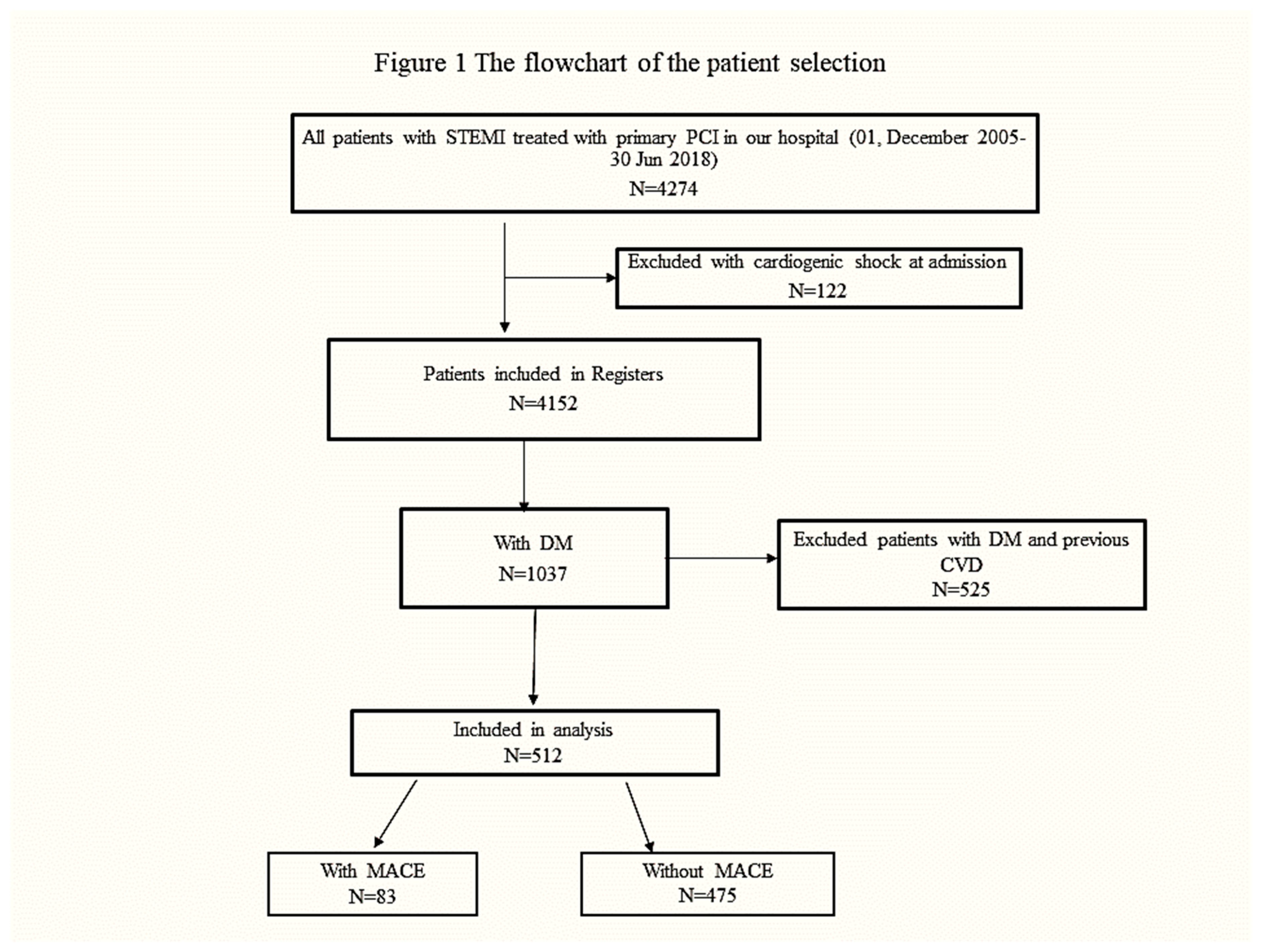
DM = diabetes mellitus; CVD = cardiovascular disease; MACE = major adverse cardiovascular events
Demographic, baseline clinical, laboratory, angiographic, and procedural data were collected and analyzed. Echocardiographic examination was performed within the first three days after pPCI. Left ventricular ejection fraction (LVEF) was assessed using the biplane method.
The treating physician determined the patients’ diabetic status at hospital admission, based on careful assessment of the medical history. Patients in whom DM was first diagnosed and treatment was initiated during the index hospitalization were also included in the analysis.
Baseline kidney function was assessed using the Modification of Diet in Renal Disease (MDRD) equation. Blood samples for measuring serum creatinine were obtained at admission, before pPCI and administration of iodinated contrast. An estimated glomerular filtration rate (eGFR) of <90 ml/min/1.73 m² was considered indicative of reduced kidney function. Reduced KF was categorized as mildly reduced (eGFR 60–89 ml/min/1.73 m²), moderately reduced (eGFR 30–59 ml/min/1.73 m²), severely reduced (eGFR 15–29 ml/min/1.73 m²), and kidney failure (eGFR <15 ml/min/1.73 m²) [20,22]. Because only one patient had kidney failure, this patient was included in the group with severely reduced KF for statistical analysis.
Patients were followed up at eight years after enrolment in the registers. Follow-up data were obtained through telephone interviews, outpatient visits, and patient medical records if the patient was hospitalized. We analyzed the composite endpoint of major adverse cardiovascular events, which included cardiovascular death, non-fatal reinfarction, non-fatal ischemic stroke, and target vessel revascularization (TVR). The cause of death was obtained from death certificates or hospital discharge forms. Cardiovascular death included any death due to a proximate cardiac cause (myocardial infarction, low-output heart failure, fatal arrhythmia, sudden death) or death due to non-coronary vascular causes, such as cerebrovascular disease. Recurrent myocardial infarction (MI) was defined as an increase in cardiac troponin above the upper reference limit associated with symptoms consistent with acute myocardial ischemia, new or presumed new ischemic changes on the electrocardiogram, development of new regional wall motion abnormalities, or identification of acute coronary pathology on coronary angiography. TVR was defined as ischemia-driven revascularization of the target vessel. Stroke was defined as new-onset focal or global neurological deficit lasting more than 24 hours. Computed tomography (CT) was used to diagnose ischemic stroke. The Emergency Hospital neurologist was responsible for the diagnosis and treatment of stroke [23].
Ethics
The study protocol was approved by the University of Belgrade Faculty of Medicine Ethics Committee (Approval No. 470/II-4, February 21, 2008) and the University Clinical Center of Serbia Ethics Committee (Approval No. 473/1, November 16, 2017). The study was conducted in keeping with the principles outlined in the Declaration of Helsinki.
Statistical Analysis
Categorical variables are presented as frequencies and percentages, whereas continuous variables are expressed as medians with interquartile ranges (IQRs; 25th–75th percentiles). The distribution of continuous variables was assessed using the Kolmogorov–Smirnov test. Differences between groups were evaluated using the Mann–Whitney U test for continuous variables and the Pearson χ² test for categorical variables. The probability of MACE during follow-up was estimated using the Kaplan–Meier method, and differences in MACE rates among patients with different stages of reduced KF and those with preserved KF were compared using the log-rank test. Predictors of MACE were assessed using multivariable Cox proportional hazards regression analysis. Variables significantly associated with MACE in the univariable analysis were entered into the multivariable Cox regression model using a backward stepwise selection procedure, with a significance level of p < 0.10 for retention in the model. Hazard ratios (HRs) with corresponding 95% confidence intervals (CIs) were calculated. All statistical tests were two-sided, and a p-value of < 0.05 was considered statistically significant. Statistical analyses were performed using SPSS software, version 19.0 (SPSS Inc., Chicago, IL, USA).
Results
Of the 512 patients analyzed, 216 (38.7%) were women. The median age of all analyzed patients was 64 (57, 72) years. Reduced KF at admission was present in 312 (60.9%) patients. Among patients with reduced KF, 175 (56.1%) had mildly reduced KF, 98 (31.4%) had moderately reduced KF, and 39 (12.5%) had severely reduced KF. Insulin therapy combined with oral antidiabetic drugs (OADs) was used in 89 (17.4%) patients.
During the eight-year follow-up, the composite endpoint of MACE was recorded in 89 (17.4%) patients. Cardiovascular death occurred in 63 (12.3%) patients, non-fatal recurrent myocardial infarction in 35 (6.8%), ischemic stroke in 11 (2.1%), and target vessel revascularization in 54 (10.5%) patients. The highest MACE rate was observed during the first year of follow-up. After the first year, the MACE rate was lower than in the first year but continued to increase slightly through the end of the follow-up period.
Compared with patients without MACE, patients who experienced eight-year MACE were older and were more likely to present with new-onset atrial fibrillation, complete atrioventricular block, heart failure, and a higher heart rate. They were also more likely to have multivessel coronary artery disease at the initial angiogram, left main (LM) artery stenosis, and post-procedural TIMI flow <3 through the infarct-related artery, as well as a lower predischarge left ventricular ejection fraction. In contrast, they were less likely to undergo stent implantation in the infarct-related artery and were more often treated with balloon dilatation alone. Finally, patients with MACE were more likely to have reduced KF across all stages.
There was no difference in treatment strategy at hospital discharge between patients with and without MACE, except for insulin therapy. Patients receiving insulin combined with oral antidiabetic (OAD) therapy had a higher incidence of MACE than those treated with OADs alone.
Baseline characteristics, laboratory, angiographic, and procedural characteristics, as well as discharge therapy of patients with and without MACE are presented in Table 1.
The Kaplan–Meier curves showing the probability of MACE during eight-year follow-up in all patients, and in relation to KF, are presented in Figure 2.
After adjustment for confounders, moderately and severely reduced KF remained independently associated with the occurrence of eight-year MACE. Predictors of eight-year MACE are presented in Table 2.
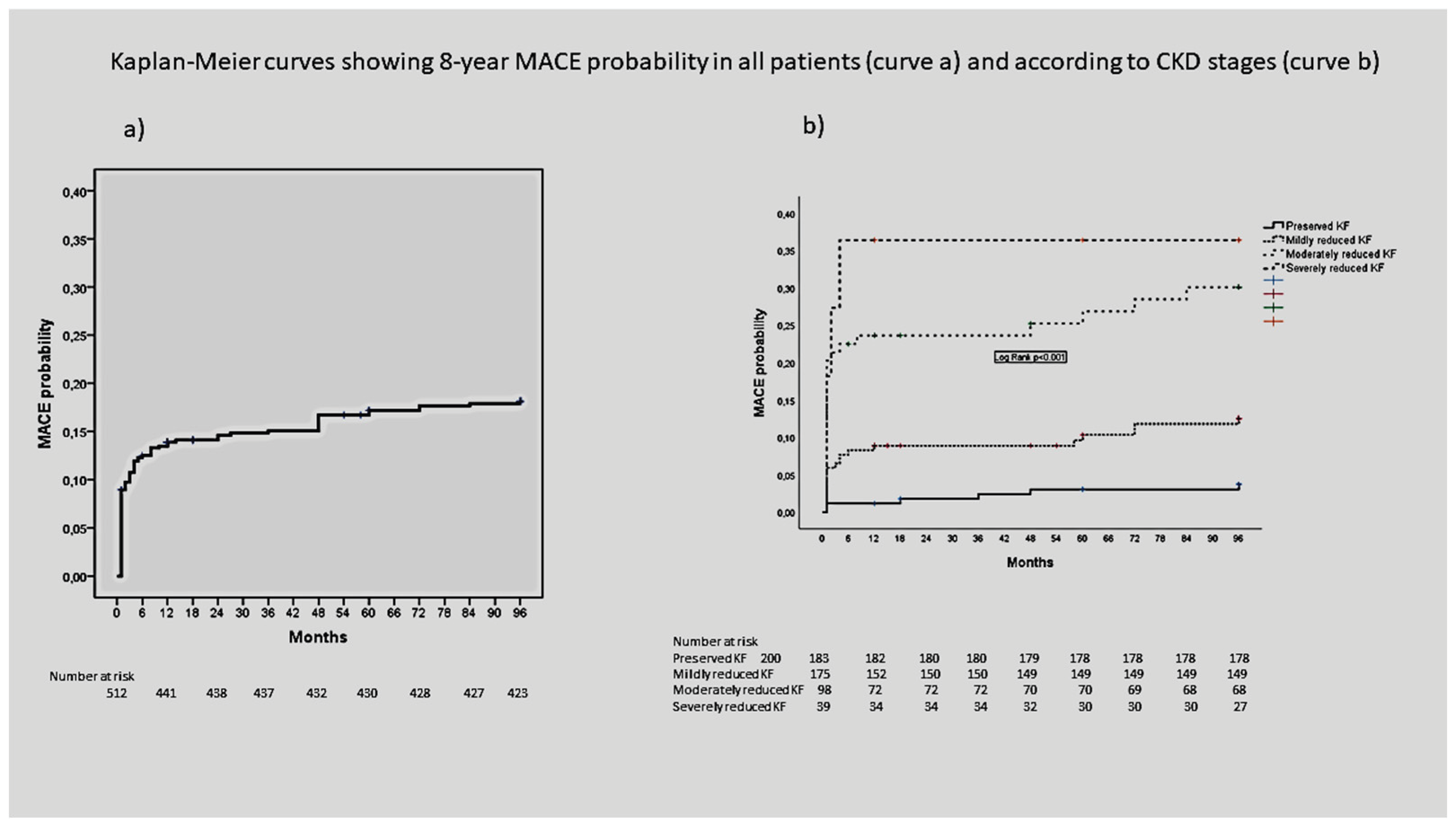
MACE = major adverse cardiovascular events; KF = kidney function

Table 3.
Predictors for 8-years MACE.
| Univariable analysis | Multivariable analysis | |||
|---|---|---|---|---|
| HR (95%CI) | p value | HR (95%CI) | p value | |
| Reduced KF | 3.25(1.18-5.82) | <0.001 | 2.26(1.26-4.15) | 0.008 |
| Severely reduced KF | 5.86(1.91-17.86) | <0.001 | 5.22(1.88-12.70) | <0.001 |
| Moderately reduced KF | 4.86(2.56-9.22) | <0.001 | 3.12(1.58-6.91) | 0.004 |
| Mildly reduced KF | 1.64(1.02-2.93) | 0.048 | ||
| Postprocedural flow TIMI<3 | 5.84(3.19-10.87) | <0.001 | 2.31(1.16-2.89) | 0.017 |
| New-onset AF | 3.21(1.78-5.74) | <0.001 | 2.02(1.08-3.27) | 0.028 |
| Complete AV block* | 1.51(1.01-2.78) | 0.058 | ||
| Left main stenosis ≥50% | 2.36(1.18-4.37) | 0.006 | 2.01(1.06-4.02) | 0.040 |
| Heart failure at admission | 1.92(1.16-3.27) | 0.029 | 1.84(1.18-3.33) | 0.018 |
| Insulin therapy (+OAD) | 1.91(1.15-3.29) | 0.012 | 1.77(1.11-3.18) | 0.046 |
| Three-vessel disease | 1.83(1.02-2.14) | 0.056 | ||
| Age, years | 1.04(1.02-1.07) | 0.001 | ||
| Predischarge LVEF (%) | 0.91(0.91-0.95) | <0.001 | 0.92(0.89-0.98) | <0.001 |
| Glycemia at admission | 1.03(1.01-1.06) | 0.003 | 1.02(1.0-1.03) | 0.071 |
| Troponin max.value | 1.02(1.01-1.04) | 0.079 | ||
*at admission; MACE=major adverse cardiovascular events; KF=kidney function; LVEF=left ventricular ejection fraction; AF=atrial fibrillation; AV=atrioventricular; OAD=oral antidiabetics.
Discussion
The most important findings of this study can be summarized as follows: (1) in patients with DM in whom STEMI was the first presentation of CVD, the highest MACE rate was observed during the first year of follow-up; (2) moderately reduced KF and severely reduced KF at admission were the strongest independent predictors and were associated with a three-fold and five-fold increased risk of eight-year MACE, respectively; (3) although mildly reduced KF was more prevalent among patients who developed MACE in the unadjusted analysis, this association did not remain significant after multivariable adjustment.
Our findings are consistent with previous studies demonstrating an independent association between reduced KF and adverse cardiovascular outcomes [6,9,12,13,15,18,20], but expand on these observations by demonstrating the particularly strong prognostic value of moderately and severely reduced KF in diabetic patients experiencing their first STEMI.
In a study by Smitslund et al., the prognostic impact of chronic kidney disease (CKD) was analyzed in patients with type 1 DM after the first MI. Moderate CKD and severe CKD, with staging performed according to eGFR values identical to those used for our reduced KF staging, were found to be the strongest independent predictors of long-term mortality, recurrent MI, and coronary revascularization in the analyzed patients. These findings are consistent with our results, although the study by Smitslund et al. included only patients with type 1 DM, whose baseline demographic and clinical characteristics differ from those of patients with type 2 DM, who comprised our study population [6].
The strong prognostic impact of kidney function on outcomes in patients with MI and no previous CVD was also demonstrated in a study by Hubbard et al. In these patients, the presence of CKD alone was associated with higher rates of cardiovascular events than the presence of DM alone. As expected, patients with both CKD and DM had a higher cardiovascular risk than patients with either condition alone. These findings confirm that patients with DM and CKD represent a high-risk group for recurrent cardiovascular events. However, this study did not specifically analyze the risk of cardiovascular events in relation to the CKD stage [16].
Studies including patients with ACS as well as patients undergoing PCI have also demonstrated that reduced KF or CKD is an independent predictor of mortality and/or MACE, regardless of the presence of DM [9,12,13,15,18,21,24,25]. The negative prognostic impact became particularly pronounced among patients with moderate CKD, corresponding to eGFR values of < 60 ml/min/1.73 m², and increased substantially with more advanced kidney dysfunction. Mild CKD, with eGFR values of 60–89 ml/min/1.73 m², did not have an independent effect on adverse cardiovascular outcomes in most studies. Furthermore, in unselected STEMI patients treated with pPCI, CKD indicated a greater risk of net adverse cardiovascular events than traditional STEMI risk factors such as a higher Killip class or reduced ejection fraction (EF) [21], which is consistent with our findings.
In a study by Potier et al., kidney function decrease was associated with an increased risk of long-term mortality after MI among participants with DM at an eGFR threshold of < 60 ml/min/1.73 m², whereas in participants without DM, this association became apparent below an eGFR threshold of 45 ml/min/1.73 m² [10].
In a study by Lin et al., advanced CKD stages (stages 4 and 5) in patients undergoing PCI were associated with higher all-cause and cardiovascular mortality compared with earlier CKD stages. However, there was no difference in recurrent MI or repeat PCI among patients with different CKD stages, which differs from our findings and may be explained by differences in the study populations. These findings were independent of diabetic status; i.e., the negative prognostic impact was observed in both diabetic and non-diabetic patients [5].
In a study by Arnold et al., elevated serum creatinine at admission was an independent predictor of one-year and five-year mortality, but not of angina at one year after MI in patients with DM. Unlike our study, the study by Arnold et al. included only patients with MI (STEMI and non-STEMI), of whom approximately 35% had STEMI, while PCI during hospitalization was performed in approximately 60% of patients. Although these results suggest that reduced KF may be a predictor of mortality, eGFR was not determined in their study. eGFR is a substantially more precise indicator of KF than serum creatinine alone [2].
Unlike the findings of the previously mentioned studies, He et al. reported that mild CKD (eGFR 60–89 ml/min/1.73 m²) was also independently associated with 2.4-year MACE in patients with DM who had undergone PCI, with an HR of 1.53 (95% CI, 1.02–2.15) for mild CKD. A J-shaped association between eGFR and the risk of adverse events was observed in these patients regardless of DM status: adjusted MACE risk increased sharply when eGFR decreased below 90 ml/min/1.73 m² but also increased slowly when eGFR was > 90 ml/min/1.73 m², indicating that kidney hyperfiltration was also associated with an increased risk of MACE. The difference between these findings and our results may be due to differences in the study populations. In the study by He et al., all patients undergoing PCI were included, and only a small proportion of the analyzed patients had acute MI [26].
Finally, in a systematic review by Jiang et al., the presence of CKD in patients with DM undergoing PCI was associated with significantly increased risks of early and late mortality and MI. However, because of inter-study heterogeneity and inadequate reporting of data, a quantitative analysis of the impact of CKD severity on patient outcomes could not be performed in this systematic review [17].
The negative impact of reduced KF/CKD on prognosis in patients with CAD can be attributed to concomitant conventional cardiovascular risk factors, as well as so-called non-traditional kidney disease-related risk factors, which are not limited to advanced CKD [9,26]. Starting from the mild stage, CKD contributes to the progression of atherosclerosis, often accompanied by calcification of atherosclerotic plaques and the development of multivessel coronary artery disease. In addition, coronary artery stenoses and occlusions are usually located more proximally in patients with CKD, resulting in a larger area of ischemic myocardial injury [13]. Several mechanisms contribute to diffuse and progressive atherosclerosis in patients with CKD, including chronic inflammation stimulation, increased production of reactive oxygen species, and inhibition of nitric oxide (NO) production. These mechanisms are already present in patients with mildly reduced KF but become more pronounced with progressive reductions in eGFR and more advanced stages of CKD, particularly in severe CKD with eGFR < 30 ml/min/1.73 m² [14,15,20,27].
In patients with severely reduced KF (i.e., severe CKD), uremic toxins exert prothrombotic effects, leading to an increased risk of arterial thrombosis, ACS, and recurrent cardiovascular events. Finally, hyperphosphatemia, together with fibroblast growth factor 23, activates cellular signaling pathways in cardiomyocytes, leading to myocardial hypertrophy and remodeling of the already infarct-damaged myocardium and contributing to increased cardiovascular mortality [14]. Therefore, reduced KF should be considered a marker of overall CAD severity [15,20].
Increased activation of the renin–angiotensin–aldosterone system (RAAS) has been reported even in patients with mildly reduced KF (eGFR 60–89 ml/min/1.73 m²) and may contribute to left ventricular remodeling and the development and progression of heart failure (HF) after STEMI, independently of the presence of DM. This observation is consistent with the well-established beneficial role of RAAS inhibitors in improving prognosis after STEMI and preventing the progression of CKD, i.e., further decline in eGFR [27].
Some authors have suggested that the underuse of guideline-directed therapies proven to improve prognosis after STEMI in patients with reduced KF or CKD may be one explanation for their poorer prognosis. In our study, as well as in many previous studies, there were no significant differences in medical therapy after STEMI between patients with and without CKD/reduced KF. However, treatment prescription does not necessarily reflect treatment adherence, achievement of therapeutic targets, or longitudinal treatment optimization, and these factors could not be fully assessed in our study. This finding suggests that the higher long-term cardiovascular risk associated with CKD was unlikely to be explained solely by differences in the prescription of secondary prevention therapies. Rather, the persistent excess risk may reflect the complex pathophysiological burden associated with CKD, as described above [13].
Other independent predictors of MACE in the patients analyzed included lower predischarge EF, post-procedural TIMI flow < 3, new-onset AF, complete AV block, left main coronary artery stenosis on the initial angiogram, heart failure at admission, and insulin therapy. These predictors are generally consistent with findings from the literature related to patients with STEMI, regardless of the presence of DM. It is well established that infarct-related complications and infarct size, reflected by a lower EF, are indicators of residual left ventricular systolic function and among the most important independent predictors of prognosis after STEMI, regardless of the presence of DM [13,18,23,25]. In addition, patients with DM receiving insulin therapy generally have a higher frequency of recurrent events, and insulin therapy has been independently associated with an increased risk of MACE [8,29]. Finally, higher admission glycemia is also a well-known independent predictor of MACE in patients with CAD [23,26]. In our analysis, which included only patients with DM presenting with their first STEMI, higher admission glycemia showed a possible trend toward an independent association with the occurrence of MACE after multivariable adjustment, but this association did not reach conventional levels of statistical significance.
Clinical implications
Our findings add to the existing evidence regarding long-term prognosis in patients with DM following STEMI. Prevention of recurrent cardiovascular events and mortality remains an important clinical priority after myocardial infarction, particularly among patients with DM [8]. The degree of association between the severity of reduced kidney function and long-term MACE suggests that kidney function assessment may provide clinically relevant information for identifying residual cardiovascular risk beyond conventional post-STEMI risk factors. In particular, patients with moderately or severely reduced KF represent a high-risk subgroup that may warrant closer clinical follow-up and intensive implementation of evidence-based secondary prevention strategies.
These findings also support the importance of systematic KF assessment (with both eGFR and albuminuria) in patients with CAD and DM [20,30]. In patients with established CKD and DM, guideline-directed therapies with proven cardiovascular and renal benefits, including renin–angiotensin system inhibition and SGLT2 inhibitors, should be considered depending on individual clinical characteristics. In selected patients with type 2 DM and CKD, particularly those with persistent albuminuria, additional therapies such as finerenone and glucagon-like-peptide-1 (GLP-1) receptor agonists may further reduce cardiovascular and renal risk. Lipid-lowering therapy should also be optimized according to contemporary recommendations, with combination therapy considered when LDL-cholesterol targets are not achieved with statin therapy alone [20,30].
Overall, our findings support a comprehensive cardiorenal approach to the management of diabetic patients after STEMI, integrating cardiovascular secondary prevention with systematic assessment and management of kidney disease. Collaboration among cardiologists, diabetologists/endocrinologists, and nephrologists may be particularly valuable in patients with more advanced kidney dysfunction.
Study limitations
This study should be interpreted in the context of several limitations. First, this was a single-center observational study. Although consecutive patients were included, which may have reduced the potential for selection bias, the observational design does not allow causal inferences, and the possibility of residual confounding cannot be excluded.
Second, albuminuria and the urinary albumin-to-creatinine ratio were not available for all patients. In addition, repeated eGFR measurements over a period of at least three months were not available in all patients, and therefore the chronicity of reduced KF could not be established in all patients. This is why we used the term reduced KF rather than CKD throughout the study. Furthermore, eGFR was estimated using the MDRD equation, which has recognized limitations, particularly compared with more contemporary equations [31,32].
Third, data on the duration of DM were not available for all patients, nor were HbA1c measurements. Therefore, the potential influence of diabetes duration and long-term glycemic control on clinical outcomes could not be fully assessed.
Fourth, we did not have eGFR measurements during follow-up for all patients and therefore could not evaluate changes in KF over time or determine whether progression of kidney dysfunction contributed to subsequent clinical outcomes.
Finally, more contemporary glucose-lowering therapies with established cardiovascular and renal benefits, including SGLT2 inhibitors and GLP-1 receptor agonists, were not routinely available in clinical practice during the period of patient inclusion. Changes in pharmacological treatment during the eight-year follow-up were not systematically evaluated, and therefore we could not determine whether differences in treatment over time influenced long-term outcomes. These limitations reflect the long-term observational nature of the study and should be considered when interpreting the findings.
Conclusion
In patients with DM who develop STEMI as their first recognized cardiovascular event, moderately reduced KF and severely reduced KF at admission were the strongest independent predictors and were associated with a three-fold and five-fold increased risk of eight-year MACE, respectively. Mildly reduced KF was more prevalent among patients who developed MACE in the unadjusted analysis, but this association did not remain significant after multivariable adjustment. These findings suggest that reduced KF severity assessment may help refine long-term risk stratification and identify diabetic patients presenting with their first STEMI, who require particularly intensive cardiovascular and multidisciplinary follow-up.
Author Contributions
Conceptualization, L.S. and D.S.; methodology, L.S., M.A. and S.S.; software, D.S.; validation, L.S., M.A. and S.S.; formal analysis, L.S.; investigation, L.S.; resources, L.S. and D.S. A.R. and A.I; data curation, L.S.; writing—original draft preparation, L.S., R.L. and D.S.; writing—review and editing, L.S., G.K. and S.S.; visualization, L.S., N.V., M.P. and G.K. All authors have read and agreed to the published version of the manuscript.
Funding
This research received no external funding.
Institutional Review Board Statement
The study was conducted in keeping with the Declaration of Helsinki guidelines and approved by the Ethics Committee of the University of Belgrade Faculty of Medicine (approval number 470/II-4, 21 February 2008) and the University Clinical Center of Serbia Ethics Committee (Approval No. 473/1, November 16, 2017).
Informed Consent Statement
Informed consent was obtained from all subjects involved in the study.
Data Availability Statement
The data presented in this study are available on request from the corresponding author due to ethical reasons.
Acknowledgments
The authors would like to express their gratitude to the physicians and nurses of the Cardiology Intensive Care Unit and the Catheterization Laboratory who participated in the primary PCI program.
Conflicts of Interest
The authors report that there are no competing interests to declare.
References
- Christensen, D.M.; Zahir, D.; Garred, C.H.; Nouhravesh, N.; Elmegaard, M.; Malmborg, M.; et al. Long-Term Outcomes of Recurrent Myocardial Infarction: A Nationwide Danish Study. Eur. Heart J. Acute Cardiovasc. Care 2026, 14, 723–731. [Google Scholar] [CrossRef] [PubMed]
- Arnold, S.V.; Spertus, J.A.; Jones, P.G.; McGuire, D.K.; Lipska, K.J.; Xu, Y.; et al. Predicting Adverse Outcomes after Myocardial Infarction among Patients with Diabetes Mellitus. Circ. Cardiovasc. Qual. Outcomes 2016, 9, 372–379. [Google Scholar] [CrossRef] [PubMed]
- Glynn, L.; Lind, M.; Andersson, T.; Eliasson, B.; Hofmann, R.; Nyström, T. Trends in Survival after First Myocardial Infarction in People with Diabetes. J. Am. Heart Assoc. 2024, 13, e034741. [Google Scholar] [CrossRef] [PubMed]
- van der Heijden, A.A.; van ’t Riet, E.; Bot, S.D.; Cannegieter, S.C.; Stehouwer, C.D.; Baan, C.A.; et al. Risk of a Recurrent Cardiovascular Event in Individuals with Type 2 Diabetes or Intermediate Hyperglycemia: The Hoorn Study. Diabetes Care 2013, 36, 3498–3502. [Google Scholar] [CrossRef] [PubMed]
- Lin, M.J.; Lee, J.; Chen, C.Y.; Huang, C.C.; Wu, H.P. Chronic Kidney Disease and Diabetes Associated with Long-Term Outcomes in Patients Receiving Percutaneous Coronary Intervention. BMC Cardiovasc. Disord. 2017, 17, 242. [Google Scholar] [CrossRef] [PubMed]
- Smidtslund, P.; Jansson Sigfrids, F.; Ylinen, A.; Elonen, N.; Harjutsalo, V.; Groop, P.H.; et al. Prognosis after First-Ever Myocardial Infarction in Type 1 Diabetes Is Strongly Affected by Chronic Kidney Disease. Diabetes Care 2023, 46, 197–205. [Google Scholar] [CrossRef] [PubMed]
- King, R.J.; Grant, P.J. Diabetes and Cardiovascular Disease: Pathophysiology of a Life-Threatening Epidemic. Herz 2016, 41, 184–192. [Google Scholar] [CrossRef] [PubMed]
- Giorda, C.B.; Avogaro, A.; Maggini, M.; Lombardo, F.; Mannucci, E.; Turco, S.; et al. Diabetes and Informatics Study Group. Recurrence of Cardiovascular Events in Patients with Type 2 Diabetes: Epidemiology and Risk Factors. Diabetes Care 2008, 31, 2154–2159. [Google Scholar] [PubMed]
- Chou, C.L.; Chiu, H.W.; Hsu, Y.H.; Yu, S.M.; Liou, T.H.; Sung, L.C. Impact of Chronic Kidney Disease and End-Stage Renal Disease on the Mid-Term Adverse Outcomes in Diabetic Patients with Cardiovascular Diseases. Sci. Rep. 2024, 14, 15770. [Google Scholar] [CrossRef] [PubMed]
- Potier, L.; Roussel, R.; Zeller, M.; Schiele, F.; Puymirat, E.; Simon, T.; et al. Chronic Kidney Disease, Diabetes, and Risk of Mortality after Acute Myocardial Infarction: Insight from the FAST-MI Program. Diabetes Care 2020, 43, e43–e44. [Google Scholar] [CrossRef] [PubMed]
- Haffner, S.M.; Lehto, S.; Rönnemaa, T.; Pyörälä, K.; Laakso, M. Mortality from Coronary Heart Disease in Subjects with Type 2 Diabetes and in Nondiabetic Subjects with and without Prior Myocardial Infarction. N. Engl. J. Med. 1998, 339, 229–234. [Google Scholar] [CrossRef] [PubMed]
- Skoda, R.; Nemes, A.; Bárczi, G.; Vágó, H.; Ruzsa, Z.; Édes, I.F.; et al. Survival of Myocardial Infarction Patients with Diabetes Mellitus at the Invasive Era (Results from the Városmajor Myocardial Infarction Registry). J. Clin. Med. 2023, 12, 917. [Google Scholar] [CrossRef] [PubMed]
- Hashimoto, Y.; Ozaki, Y.; Kan, S.; Nakao, K.; Kimura, K.; Ako, J.; et al. Impact of Chronic Kidney Disease on In-Hospital and 3-Year Clinical Outcomes in Patients with Acute Myocardial Infarction Treated by Contemporary Percutaneous Coronary Intervention and Optimal Medical Therapy—Insights from the J-MINUET Study. Circ. J. 2021, 85, 1710–1718. [Google Scholar] [CrossRef] [PubMed]
- Moriyama, T.; Fukami, K. Management of Patients with Advanced Chronic Kidney Disease and Preexisting Acute Myocardial Infarction. Circ. J. 2021, 85, 1719–1721. [Google Scholar] [CrossRef] [PubMed]
- Skalsky, K.; Talmor-Barkan, Y.; Itelman, E.; Lerman, T.T.; Rotmensh, A.; Perl, L.; et al. Prognostic Implications of Chronic Kidney Disease Stage on Outcomes after Percutaneous Coronary Intervention. J. Cardiovasc. Dev. Dis. 2025, 13, 4. [Google Scholar] [CrossRef] [PubMed]
- Hubbard, D.; Colantonio, L.D.; Rosenson, R.S.; Brown, T.M.; Jackson, E.A.; Huang, L.; et al. Risk for Recurrent Cardiovascular Disease Events among Patients with Diabetes and Chronic Kidney Disease. Cardiovasc. Diabetol. 2021, 20, 58. [Google Scholar] [CrossRef] [PubMed]
- Jiang, W.; Zhou, Y.; Chen, S.; Liu, S. Impact of Chronic Kidney Disease on Outcomes of Percutaneous Coronary Intervention in Patients with Diabetes Mellitus: A Systematic Review and Meta-Analysis. Tex. Heart Inst. J. 2023, 50, e227873. [Google Scholar] [CrossRef] [PubMed]
- Engelbertz, C.; Feld, J.; Makowski, L.; Lange, S.A.; Günster, C.; Dröge, P.; et al. Contemporary Secondary Prevention in Survivors of ST-Elevation Myocardial Infarction with and without Chronic Kidney Disease: A Retrospective Analysis. Clin. Kidney J. 2023, 16, 1947–1956. [Google Scholar] [CrossRef] [PubMed]
- Hageman, S.H.J.; McKay, A.J.; Ueda, P.; Gunn, L.H.; Jernberg, T.; Hagström, E.; et al. Estimation of Recurrent Atherosclerotic Cardiovascular Event Risk in Patients with Established Cardiovascular Disease: The Updated SMART2 Algorithm. Eur. Heart J. 2022, 43, 1715–1727. [Google Scholar] [CrossRef] [PubMed]
- Damman, K.; ter Maaten, J.M.; Mayne, K.J.; Bolignano, D.; Brown, E.M.; da Costa, B.R.; et al. 2026 ESC Guidelines for the Management of Cardiovascular Disease and Chronic Kidney Disease, in Collaboration with the European Renal Association (ERA): Developed by the Task Force on the Management of Cardiovascular Disease and Chronic Kidney Disease of the European Society of Cardiology (ESC). Eur. Heart J. 2026, ehag098. [Google Scholar] [CrossRef] [PubMed]
- Saltzman, A.; Stone, G.W.; Claessen, B.; et al. Long-Term Impact of Chronic Kidney Disease in Patients with ST-Segment Elevation Myocardial Infarction Treated with Primary Percutaneous Coronary Intervention: The HORIZONS-AMI (Harmonizing Outcomes with Revascularization and Stents in Acute Myocardial Infarction) Trial. JACC Cardiovasc. Interv. 2011, 4, 1011–1019. [Google Scholar] [PubMed]
- Navaneethan, S.D.; Bansal, N.; Cavanaugh, K.L.; Chang, A.; Crowley, S.; Delgado, C.; et al. KDOQI US Commentary on the KDIGO 2024 Clinical Practice Guideline for the Evaluation and Management of CKD. Am. J. Kidney Dis. 2025, 85, 135–176. [Google Scholar] [CrossRef] [PubMed]
- Mrdovic, I.; Savic, L.; Krljanac, G.; Asanin, M.; Perunicic, J.; Lasica, R.; et al. Predicting 30-Day Major Adverse Cardiovascular Events after Primary Percutaneous Coronary Intervention: The RISK-PCI Score. Int. J. Cardiol. 2013, 162, 220–227. [Google Scholar] [CrossRef] [PubMed]
- Spirito, A.; Itchhaporia, D.; Sartori, S.; Camenzind, E.; Chieffo, A.; Dangas, G.D.; et al. Impact of Chronic Kidney Disease and Diabetes on Clinical Outcomes in Women Undergoing PCI. EuroIntervention 2023, 19, 493–501. [Google Scholar] [CrossRef] [PubMed]
- Kwong, W.L.; Yau, K.H.; Sin, E.; et al. The Impact of Renal Insufficiency upon Admission on the Clinical Outcome of Patients with Acute ST-Elevation Myocardial Infarction Undergoing Primary Percutaneous Coronary Intervention. J. HK Coll. Cardiol. 2023, 29, 147–160. [Google Scholar] [CrossRef]
- He, J.; Song, C.; Wang, H.; Zhang, R.; Yuan, S.; Dou, K. Diabetes Mellitus with Mild or Moderate Kidney Dysfunction Is Associated with Poor Prognosis in Patients with Coronary Artery Disease: A Large-Scale Cohort Study. Diabetes Res. Clin. Pract. 2023, 200, 110693. [Google Scholar] [CrossRef] [PubMed]
- Polianska, O.; Tashchuk, V.; Hulaha, O.; Olinchuk, V.; Moskaliuk, I.; Kushnir, Y. Neurohumoral Dysregulation in Acute Myocardial Infarction with Chronic Kidney Disease: Implications for Prognosis and Management. Cureus 2025, 17, e93692. [Google Scholar] [CrossRef] [PubMed]
- Pieterse, M.M.; Teraa, M.; van der Meer, M.G.; Ruigrok, Y.M.; Peters, M.J.L.; Vaartjes, I.; et al. Age at First Cardiovascular Diagnosis and Risk of Subsequent Cardiovascular Events in Patients with Different Types of Cardiovascular Disease. Eur. J. Prev. Cardiol. 2026, 33, 1961–1969. [Google Scholar] [CrossRef] [PubMed]
- Savic, L.; Mrdovic, I.; Asanin, M.; Stankovic, S.; Lasica, R.; Krljanac, G.; et al. Prognostic Impact of Insulin-Treated and Non-Insulin-Treated Diabetes in Patients with a Reduced Ejection Fraction after ST-Elevation Myocardial Infarction. CJC Open 2024, 7, 10–18. [Google Scholar] [CrossRef] [PubMed]
- Marx, N.; Federici, M.; Schütt, K.; Müller-Wieland, D.; Ajjan, R.A.; Antunes, M.J.; et al. 2023 ESC Guidelines for the Management of Cardiovascular Disease in Patients with Diabetes. Eur. Heart J. 2023, 44, 4043–4140. [Google Scholar] [CrossRef] [PubMed]
- McAlister, F.A.; Ezekowitz, J.; Tarantini, L.; Squire, I.; Komajda, M.; Bayes-Genis, A.; MAGGIC Investigators; et al. Renal Dysfunction in Patients with Heart Failure with Preserved versus Reduced Ejection Fraction: Impact of the New Chronic Kidney Disease-Epidemiology Collaboration Group Formula. Circ. Heart Fail. 2012, 5, 309–314. [Google Scholar] [PubMed]
- Ekmekci, A.; Uluganyan, M.; Gungor, B.; Tufan, F.; Cekirdekci, E.I.; Ozcan, K.S.; et al. Comparison of Cockcroft-Gault and Modification of Diet in Renal Disease Formulas as Predictors of Cardiovascular Outcomes in Patients with Myocardial Infarction Treated with Primary Percutaneous Coronary Intervention. Angiology 2014, 65, 838–843. [Google Scholar] [CrossRef] [PubMed]
Table 1.
Baseline clinical, laboratory, angiographic, procedural characteristics, therapy at discharge of the study patients.
Table 1.
Baseline clinical, laboratory, angiographic, procedural characteristics, therapy at discharge of the study patients.
| Characteristics | Without MACE N=423 |
With MACE N=89 |
P value |
|---|---|---|---|
| Age, years med(IQR) | 63(55, 70) | 67(60, 75) | <0.001 |
| Female, n(%) | 162(38.2) | 31(34.8) | 0.540 |
| BMI, med (IQR) | 26.6(24.8, 29.2) | 27.5(25.3, 29.4) | 0.937 |
| Hypertension, n(%) | 339(80.1) | 78(87.7) | 0.098 |
| HLP, n(%) | 270(63.9) | 49(55.1) | 0.121 |
| Smoking, n(%) | 158(37.3) | 26(29.1) | 0.146 |
| Family hystory, n(%) | 116(27.4) | 19(21.3) | 0.237 |
| Pain duration, hours, med(IQR) | 3.5(2, 6) | 4.5(2, 7.5) | 0.095 |
| New-onset atrial fibrillation, n(%) | 21(4.9) | 18(20.2) | <0.001 |
| Complete AV block*, n(%) | 16(3.8) | 9(10.1) | 0,038 |
| Heart failure at admission, n(%) | 54(12.7) | 43(48.3) | <0.001 |
| Systolic BP at admission, med(IQR) | 140(120, 150) | 140(130, 165) | 0.386 |
| Heart rate at admission med(IQR) | 82(10, 90) | 85(80, 105) | 0.007 |
| Multivessel disease, n(%) | 273(64.5) | 59(66.9) | 0.753 |
| Three-vessel disease, n(%) | 138(32.6) | 39(43.8) | 0.039 |
| LM stenosis, n(%) | 27(6.4) | 12(13.4) | 0.020 |
| Stent implanted, n(%) | 407(96.1) | 75(84.3) | <0.001 |
| Postprocedural flow TIMI <3, n(%) | 12(2.8) | 18(20.2) | <0.001 |
| Troponin max, med (IQR) | 28.6(11, 87.6) | 28.4(9.86, 110) | 0.312 |
| WBC at admission, med(IQR) | 8.9(6.6, 11.9) | 10.1(10.1, 10.7) | 0.131 |
| Hemoglobin at admission g/L, med (IQR) | 138(128, 150) | 138(128, 152) | 0.452 |
| Glycemia at admission, mmol/L med (IQR) | 13.4(9.6, 17.2) | 12.9(10.1, 19.7) | 0.005 |
| Creatinine at admission μmol/L, med (IQR) | 78(75, 97) | 100(77, 112) | <0.001 |
| eGFR ml/min/m2 at admission, med (IQR) | 85.8(65.3, 107.2) | 65.7(48.7, 99.5) | <0.001 |
| Reduced KF n(%) | 232(54.8) | 80(89.8) | <0.001 |
| Mildly reduced KF, n(%) | 150(35.4) | 25(28.3) | 0.046 |
| Moderately reduced KF, n(%) | 70(16.5) | 28(31.4) | <0.001 |
| Severely reduced KF, n(%) | 12(2.8) | 27(30.3) | <0.001 |
| EF, med(IQR) | 45(40, 55) | 40(35, 50) | <0.001 |
| Therapy at discharge** | |||
| Beta blockers, n(%) | 404(95.5) | 80(89.9) | 0.279 |
| ACE inhibitors, n(%) | 386(91.2) | 81(91.1) | 0.678 |
| Statin, n(%) | 398(94.1) | 85(95.5) | 0.378 |
| Diuretic, n(%) | 84(19.8) | 14(15.7) | 0.294 |
| Amiodarone, n(%) | 6(1.4) | 2(2.2) | 0.217 |
| Calcium antagonist, n(%) | 12(2.8) | 0 | 0.210 |
| Insulin (+OAD), n(%) | 62(14.7) | 28(31.4) | <0.001 |
*At admission **All patients were receiving aspirin and a P2Y12-receptor blocker at discharge. med = median; IQR = interquartile range; BMI = body mass index; AF = atrial fibrillation; AV = atrioventricular; HLP = hyperlipidemia; HF = heart failure; BP = arterial blood pressure; LM = left main artery; LVEF = left ventricular ejection fraction; WBC = white blood cell count at admission; eGFR = estimated glomerular filtration rate; KF = kidney function; OAD = oral antidiabetic drugs.
Disclaimer/Publisher’s Note: The statements, opinions and data contained in all publications are solely those of the individual author(s) and contributor(s) and not of MDPI and/or the editor(s). MDPI and/or the editor(s) disclaim responsibility for any injury to people or property resulting from any ideas, methods, instructions or products referred to in the content. |
© 2026 by the authors. Licensee MDPI, Basel, Switzerland. This article is an open access article distributed under the terms and conditions of the Creative Commons Attribution (CC BY) license (http://creativecommons.org/licenses/by/4.0/).
Copyright: This open access article is published under a Creative Commons CC BY 4.0 license, which permit the free download, distribution, and reuse, provided that the author and preprint are cited in any reuse.