

Submitted:
04 November 2026
Posted:
06 November 2026
You are already at the latest version
Abstract
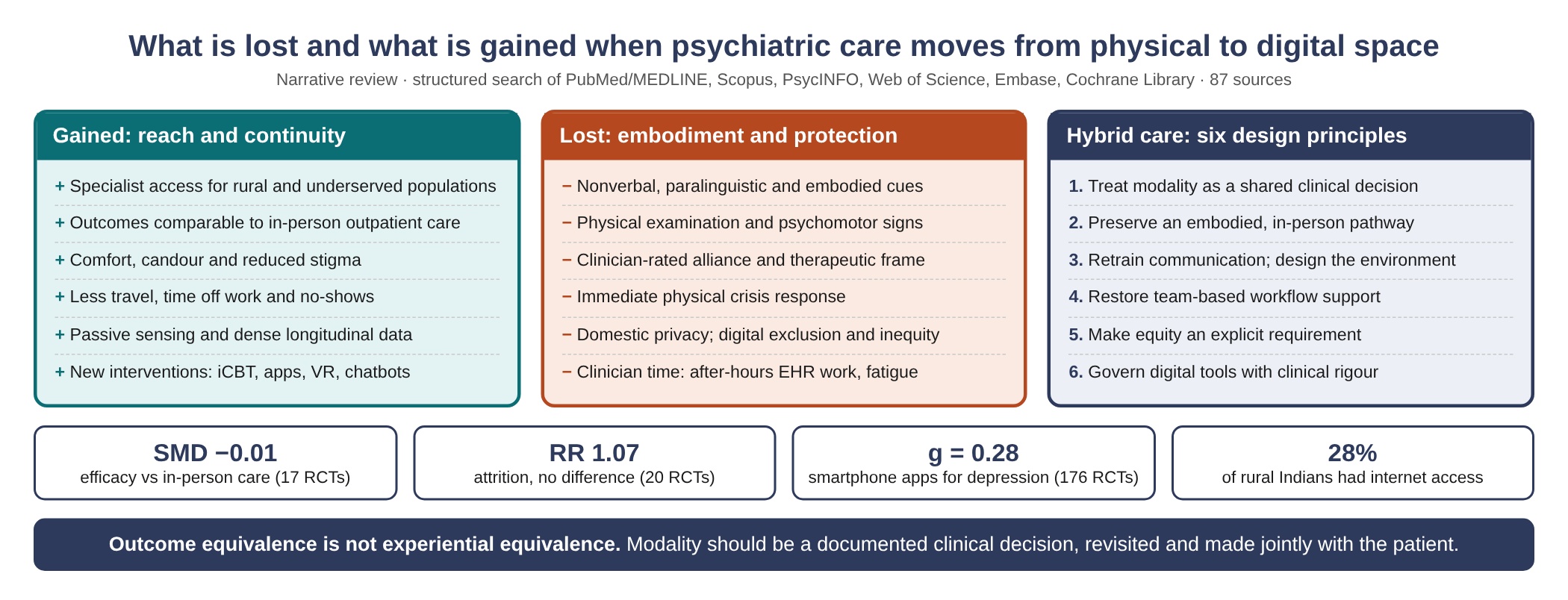
The migration of psychiatric care from shared physical rooms to video, telephone and asynchronous platforms has been rapid, necessity-driven and unevenly evaluated. This narrative review, underpinned by structured searches of PubMed/MEDLINE, Scopus, PsycINFO, Web of Science, Embase and the Cochrane Library with citation chasing, synthesises evidence on what is gained and what is lost when psychiatric care moves into digital space. Randomised and pooled evidence shows that telepsychiatric assessment, medication management and structured psychotherapy achieve outcomes comparable to in-person care; one meta-analysis found no difference in efficacy (standardised mean difference −0.01, 95% CI −0.12 to 0.09) or attrition (risk ratio 1.07, 95% CI 0.94–1.21). Gains cluster in reach, convenience, continuity, candour, reduced stigma and novel data streams such as passive sensing. Losses are consistent and reproducible: attenuated nonverbal and embodied information, loss of physical examination and psychomotor observation, lower clinician-rated alliance, erosion of the protected therapeutic setting, constrained crisis response, domestic privacy exposure, digital exclusion that amplifies inequity, documentation burden, videoconference fatigue, and fragmented licensure and prescribing frameworks. Apps, virtual reality and conversational agents add new therapeutic affordances, but with small-to-moderate effects and immature safety governance. Gains and losses are therefore asymmetrically distributed, and outcome equivalence is not experiential equivalence. We propose six design principles for hybrid care: treat modality as a shared clinical decision, preserve an embodied pathway, retrain communication, restore team-based workflow, make equity an explicit requirement, and govern digital tools with clinical rigour.
Keywords:
telepsychiatry
; digital mental health
; therapeutic alliance
; hybrid care
; digital divide
; videoconferencing
1. Introduction
The COVID-19 pandemic transformed healthcare significantly, and telepsychiatry became the primary means of treatment in some countries [1]. Between 2019 and 2021, telemedicine use in the United States rose from 3% to 49% of visits, with psychiatry among the specialties most reliant on videoconferencing [2]. The evidentiary picture that has emerged is simultaneously reassuring and incomplete. Psychiatric consultation and short-term follow-up delivered by telepsychiatry can be as effective as face-to-face care [3], and videoconference-based treatment has demonstrated equivalence to conventional outpatient treatment in randomised trials [4]. Yet the reassurance is confined to a specific band of the clinical task: one early equivalence trial explicitly cautioned that its findings did not necessarily extend to other types of mental health services, including various forms of psychotherapy [3]. Meanwhile, clinicians and service users have consistently described something intangible going missing — a loss of the embodied, sensory and spatial conditions within which psychiatric work has traditionally been conducted [5].
This review asks a deliberately double-barrelled question: what is lost, and what is gained, when psychiatric care moves from physical to digital space? The framing matters because literature is dominated by equivalence claims (is telepsychiatry "as good as" in-person care?) that can obscure the fact that a modality may be clinically equivalent in outcome while being experientially, ethically and distributionally different. We therefore treat the digital shift not as a substitution of one delivery channel for another, but as a reconfiguration of the conditions of care — sensory, spatial, relational, informational and regulatory — and ask what each configuration affords and what it forecloses.
2. Methods
This is a narrative review with a systematic search underpinning. We searched PubMed/MEDLINE, Scopus, PsycINFO, Web of Science, EMBASE and the Cochrane Library using combinations of the terms telepsychiatry, telemental health, telemedicine, videoconferencing, digital mental health, smartphone application, digital phenotyping, therapeutic alliance, nonverbal communication, digital divide, health equity, licensure, privacy and measurement-based care. We prioritised systematic reviews, meta-analyses and randomised controlled trials, and supplemented database searching with backward and forward citation searching of landmark trials and reviews. Evidence was then organised thematically into domains of gain and domains of loss. Given the heterogeneity of designs, outcomes and settings, no formal meta-analysis was attempted; where quantitative pooled estimates exist they are reported directly from their source reviews. Sources from India and other low- and middle-income countries were deliberately retained to ensure coverage of under-represented settings. A large language model–based tool was used to assist with condensing the abstract, language editing, conversion of references to the journal style and the layout of tables and figures; all content was derived from the author's own text and verified against the source literature by the author, who takes full responsibility for the manuscript.
3. What Is Gained
3.1. Access, Reach and the Geography of Care
The clearest and least contested gain is reach. Telepsychiatry extends specialist expertise into places that have never had it, using inexpensive equipment and basic technical know-how to reach distant suburbs and villages from urban centres of excellence [6]. In India, where a wide discrepancy exists between the available mental health workforce and the burden of need, this geography of scarcity has made remote delivery an instrument of equity as well as of convenience [6]. The Schizophrenia Research Foundation's telepsychiatry network in Chennai demonstrated early that a functioning remote service requires a specific chain of tasks — identifying suitable technology, location and local collaborator; providing training and creating awareness; establishing peripheral centres; and ensuring case documentation and accountability [7].
The gains are quantifiable at the level of the individual visit. A US Department of Veterans Affairs study found that telemedicine saved patients an average of 145 miles and 142 minutes per visit [8]. Patients describe saving transportation time and costs and requesting less time off work [9]. These are not trivial gains: they are the difference between attending and not attending for people with mobility impairment, caregiving responsibilities, precarious employment or no transport.
Reach also has a workforce dimension. Telemedicine-based collaborative care virtually co-locates and integrates mental health providers into primary care settings that lack on-site mental health staff — precisely the small, rural and under-resourced practices where evidence-based depression care is hardest to implement [10]. In a multi-site pragmatic randomised comparative effectiveness trial, patients at federally qualified health centres serving medically underserved populations were screened for depression, and 364 patients screening positive were enrolled and followed for 18 months; the trial compared practice-based collaborative care with telemedicine-based collaborative care [10]. The off-site, telemedicine-mediated model was approximately three times as likely to achieve remission as the practice-based model [11].
3.2. Clinical Effectiveness and Diagnostic Reliability
The strongest evidence for equivalence concerns psychiatric assessment, medication management and short-term follow-up. A randomised equivalence trial concluded that psychiatric consultation and short-term follow-up can be as effective when delivered by telepsychiatry as when provided face to face [3]. A randomised clinical trial of 140 psychiatric outpatients, of whom 130 completed 24 weeks of treatment across 534 teleconsultations and 522 face-to-face consultations, found significant improvement in both groups on the Clinical Global Impressions and SCL-90-R global indexes, with no statistically significant difference in efficacy between videoconference telepsychiatry and face-to-face treatment [4].
Pooled evidence reinforces this. A meta-analysis of individual psychiatric outpatient treatment for post-traumatic stress disorder, mood disorders and anxiety disorders — 20 trials, with the largest subgroup being PTSD (9 trials), followed by depressive disorder (6 trials), mixed disorders (4 trials) and generalised anxiety disorder (1 trial) — found telemedicine comparable with in-person treatment for treatment efficacy (standardised mean difference −0.01, 95% CI −0.12 to 0.09; P=.84; I²=19%; 17 trials, n=1814), patient satisfaction (mean difference −0.66, 95% CI −1.60 to 0.28; P=.17; I²=44%; 6 trials, n=591) and attrition (risk ratio 1.07, 95% CI 0.94–1.21; P=.32; I²=0%; 20 trials, n=2804); certainty of evidence for efficacy was rated moderate [12]. A separate meta-analysis of telepsychiatry versus face-to-face treatment identified 32 randomised controlled trials involving 3592 participants across 11 mental illnesses [1].
Diagnostic reliability has been examined most directly in emergency settings, where the stakes are highest. In a 39-month study, 73 emergency department patients were interviewed by a psychiatrist either face to face or remotely by video, with a second psychiatrist observing in the room and completing an independent assessment; 48% had a depressive disorder, 18% a substance use disorder, 14% bipolar disorder, 11% a psychotic disorder, 6% an anxiety disorder and 4% other disorders. Raw agreement on disposition was 84% when both assessments were face to face and 86% when one was by telemedicine, with no significant differences in disposition recommendation, diagnostic category, HCR-20 dangerousness scores or suicide scale intraclass correlations [13]. A systematic review of 23 papers on telepsychiatry in acute settings similarly found that patients hold positive attitudes, that the quality of clinical interaction is similar to face-to-face care, that admissions to psychiatric inpatient units are reduced, and that telepsychiatry appears cost-effective [14].
Evidence-based guidance developed during the pandemic rated telepsychiatry as outstanding on feasibility, validity, reliability and satisfaction, with cost and cost-effectiveness similar to or better than in-person care, and interviewing, assessment and cognitive testing rated outstanding; settings that were less well studied — accident and emergency departments, prisons, inpatient units and schools — were rated merely similar to in-person care [15]. That distinction is important: equivalence is well established for outpatient assessment and management, and much thinner for complex, high-acuity or highly institutionalised contexts.
For depression specifically, a systematic review found satisfaction either equivalent to face-to-face or significantly higher in every group receiving televideo, with differences in symptom relief between televideo and control either insignificant or in favour of televideo [16]. In a fully virtual outpatient telepsychiatry practice, 201 treatment-seeking adults showed a 41.1% improvement in anxiety symptoms (d=1.16, P<.001) and a 38.8% improvement in depressive symptoms (d=1.07, P<.001) from baseline, and higher therapeutic alliance scores independently predicted clinically significant improvement for both anxiety (OR=1.08, 95% CI 1.04–1.14) and depression (OR=1.05, 95% CI 1.01–1.09) [17]. This last finding is consequential: it suggests that what is retained relationally in digital space continues to do the same therapeutic work it does in physical space.
For severe mental illness, the picture is more mixed. There is consensus that videoconferencing-based telemental health may be feasible, usable and acceptable for people with serious mental illness, with promising outcomes for self-management, medication adherence, psychoeducation and symptom monitoring [18]. Telephone- and internet-based approaches in schizophrenia have been associated with improvements in patient–staff communication, medication adherence, insight, psychopathological symptoms, emergency room visits and hospitalisation rates [19], and an information-technology-aided relapse prevention programme using weekly mobile phone monitoring produced a statistically significant 60% decrease in hospitalisations over a mean of nine months [20]. Yet a review across schizophrenia, schizoaffective disorder and bipolar disorder found little evidence that the modality affected hospital readmission rates [18]. A cohort study of 118,670 Medicare beneficiaries with schizophrenia or related psychotic disorders and/or bipolar I disorder found that greater telemental health use in non-metropolitan counties was associated with modest increases in contact with outpatient specialty mental health professionals and greater likelihood of follow-up after hospitalisation, but no substantive change in medication adherence and an increase in mental health hospitalisations [21]. Gains in access, in other words, do not automatically translate into gains in the outcome that matters most.
3.3. Efficiency, Cost and Service-Level Outcomes
Cost evidence is directionally favourable but methodologically fragile. Telepsychiatry is usually reported as less expensive for patients once travel and lost time are considered, particularly for prison populations, remote clinics and otherwise isolated populations, though services have also been estimated to be as expensive or more expensive than in-person care depending on scale and model [22]. Several studies have found telepsychiatry more cost-effective than in-person care, or at least not more costly [16], while one nurse-administered, tailored behavioural intervention delivered at nominal cost was found to be cost-effective but produced no apparent lowering of healthcare utilisation or costs over two years of follow-up [23]. A retrospective cost analysis compared synchronous telepsychiatry, asynchronous telepsychiatry and in-person consultation in the primary care setting, comparing fixed and marginal costs including equipment, provider and support staff time and salaries [23]. A small Israeli comparison found that one hour of telepsychiatry treatment was more expensive than face-to-face care, with a tendency toward increased hospitalisations, although adherence ratios were twice as high as in the matched comparison group [24].
Service-level savings can nevertheless be substantial. At one US inpatient unit with an average length of stay of 16 days and a blended cost of about $1,500 per patient-day, 4,952 patients enrolled in both 2019 (in-person care) and 2020 (virtual care) experienced 80 fewer hospitalisations in 2020, representing cost savings of approximately $1,920,000 — though the authors caution that increased telepsychiatry is unlikely to be the sole determinant [25]. Telepsychiatry has also been used to reduce emergency department length of stay by allowing more rapid access to psychiatric expertise and to reduce admissions to psychiatric inpatient units [14].
Efficiency also accrues through reduced no-shows — an effect that, as Section 4.8 shows, is not unambiguously good for clinicians.
3.4. Relational Gains: Comfort, Candour and the Softening of Stigma
Patients do not merely tolerate digital care; many prefer it. In what its authors describe as the largest evaluation of patient attitudes toward telepsychiatry to date, patients across the United States reported highly favourable attitudes: they found telepsychiatry safe and convenient, felt more comfortable at home, could express themselves more freely, saved transportation time and costs, and requested less time off work [9]. A thematic review found that patients consistently report high satisfaction, emphasising reduced waiting times, increased flexibility and reduced need to travel [26]. Even in resource-scarce areas where some patients still voice a preference for in-person encounters, satisfaction is higher when the alternative is no care or higher cost with more travel time [8].
Two relational mechanisms deserve emphasis. The first is disinhibition. Features of anonymity, accessibility and control over self-disclosure enable the internet to function as a safe place to seek help; online counselling has been perceived by young people as more confidential than offline support, with fewer risks such as parental notification [27]. Self-stigma is a documented driver of help-seeking avoidance, and anonymous or private e-mental health interventions may be experienced as less stigmatising than face-to-face psychological treatment [28]. Research on mental health discourse in online communities found that anonymity via throwaway accounts was associated with feedback that was more involving and emotionally engaging, not less [29], and that online settings allow individuals to circumvent the impression-management constraints that govern stigmatised disclosure in physical settings [30].
The second is comfort in one's own environment. Qualitative work found patients appreciated participating from home, where they felt most comfortable and in some cases most safe, and that they did not have to confront crowded waiting rooms [31]. Patients who are satisfied with telemedicine encounters describe relational experiences and patient-centred communication skills, supporting the notion that clinician–patient relationships can be established in a video-first model without any previous in-person encounter, and that positive ratings are not driven solely by prescription receipt [32].
3.5. New Information: Digital Phenotyping and Measurement-Based Care
Digital space does not only transmit the encounter; it generates data the physical room cannot. Passive data collected automatically through smartphone or wearable sensors — device use metrics, accelerometry, GPS, and increasingly voice tone and facial expression — offer a means of capturing digital markers of behaviour while reducing patient burden [33]. Personal sensing research provides a layered model for translating raw sensor data into markers of behaviours and states relevant to mental health, while flagging privacy and dimensionality as central challenges [34]. In a smaller study of 31 people with clinical levels of depression, passively collected smartphone data predicted hour-to-hour depressed mood with an average out-of-sample correlation of 0.587 (95% CI 0.552–0.621), raising the prospect of just-in-time adaptive intervention [35].
Digital phenotyping is now among the most studied applications of machine learning in psychiatry, with mood, anxiety and schizophrenia-spectrum disorders the three most studied conditions; relapse detection in schizophrenia and symptom prediction in mood disorders have strong pilot results with replication and external validation, though the field still requires larger and longer validation studies [36]. The same infrastructure also allows measurement to move beyond the walls of the office: sensor-derived behavioural metrics such as sleep patterns, sedentary periods and environmental exposures can supply personalised context and temporal trajectories for how individuals experience mental illness, complementing office-based observation [36]. This is a genuine epistemic gain: a richer, temporally dense, ecologically valid picture of the patient's life.
3.6. New Therapeutic Affordances: Apps, Virtual Reality and Conversational Agents
Digital space hosts interventions that have no straightforward physical analogue. Internet-delivered cognitive behavioural therapy is effective, acceptable and practical health care for anxiety and depressive disorders [37]; a meta-analysis of 12 randomised controlled trials with 13 contrast groups and 2334 participants found moderate-to-large mean effect sizes (fixed-effects d=0.40, mixed-effects d=0.60), with large effects for anxiety (d=0.96) and small effects for depression (d=0.27 fixed-effects, d=0.32 mixed-effects) [38]. A meta-analysis restricted to randomised controlled trials of computerised CBT for people meeting diagnostic criteria for major depressive disorder, social phobia, panic disorder with or without agoraphobia, or generalised anxiety disorder established the underlying trial base [39]. Where guided internet-based CBT has been directly compared with face-to-face CBT, 13 studies with a total of 1053 participants met criteria for inclusion [40]. Under routine care conditions, guided internet-based CBT showed pooled effects of 1.78 for depression and 0.94 for anxiety, with average deterioration of 2.9% [41].
Smartphone app evidence is broader but more modest. A meta-analysis of 66 randomised controlled trials of app-supported smartphone interventions established the evidence base [42]. An updated meta-analysis of 176 randomised controlled trials found small but significant effects on depressive symptoms (N=33,567, g=0.28, P<.001; number needed to treat 11.5) and generalised anxiety (N=22,394, g=0.26, P<.001, NNT 12.4), with moderate effects on social anxiety (g=0.52) and obsessive-compulsive symptoms (g=0.51), a small effect on post-traumatic stress symptoms (g=0.12), a large effect on acrophobia (g=0.90), and a non-significant negative effect on panic symptoms (g=−0.12); effects were larger when apps incorporated CBT features, mood monitoring or chatbot technology [43]. Yet a meta-review of seven meta-analyses noted that fewer than 5% of available mental health apps have actually been studied, and that evidence was of poorer quality when mental health issues were analysed together [44]. An earlier systematic review and meta-analysis concluded that using smartphone apps as standalone psychological interventions cannot be recommended based on the then-current level of evidence [45].
Virtual reality offers the most distinctive new affordance: the capacity to construct feared or avoided situations for controlled exposure. A meta-review of 11 meta-analyses found effect sizes for virtual reality exposure treatments overall moderate to large and typically maintained at follow-up, with emerging evidence for depression, schizophrenia and eating disorders, but little evidence of superiority over traditional treatment and generally low-to-moderate quality of evidence [33]. A meta-analysis of 10 randomised controlled trials found virtual reality exposure therapy had a moderate, significant effect on PTSD symptoms (g=0.327) and was equally effective as trauma-focused CBT, with more sessions enhancing effects [46]. A meta-review of meta-analyses rated the quality of evidence as varying from very low to moderate [47], and the foundational review of the field found methodological quality generally low despite an extensive literature [48].
Conversational agents are the newest and least governed affordance. A systematic review and meta-analysis of AI-based conversational agents found effects more pronounced in agents that were multimodal, generative-AI-based, integrated with mobile or instant messaging apps, and targeting clinical, subclinical and elderly populations — but no significant improvement in overall psychological well-being (Hedges g=0.32, 95% CI −0.13 to 0.78) [49]. Uptake is already substantial: in a nationally representative sample of more than 1800 individuals, 24% reported having used large language models for mental health needs [50]. The safety record is not reassuring. A 2022 review found that across all of health care, 96% of chatbots were driven by decision-tree logic rather than actual artificial intelligence [36]. In 2023, a generative AI code embedded in an eating disorder chatbot led it to make harmful statements to users and was removed within days of public release [36]. Clinical audits have found that large language models frequently express societal stigma toward people with mental health conditions and fail to adhere to foundational therapeutic practices, and that chatbots often exhibit sycophancy — an algorithmic tendency to unconditionally validate the user — which in clinical settings can encourage and reinforce delusional thinking and is highly inappropriate in addressing high-risk crisis markers such as suicidal ideation [51]. Companion AI also raises unresolved questions about whether regulators should regulate not only medical devices but also non-medical apps deploying generative AI, and whether such apps may be held liable for harm a user inflicts on themselves or others [52].
4. What Is Lost
4.1. The Embodied Encounter: Sensory and Nonverbal Channels
The most consistently reported loss is the embodied dimension of the encounter. Uniting the accounts of service users, carers and staff in a qualitative study was the loss of the embodied dimension of therapeutic interactions, including the physical space where these used to take place; many described remote consultations as "not the same," noting that even where facial expressions were visible, not being together in a room made building and maintaining connection problematic [5]. When eye contact was mediated by a camera it hampered the reciprocity normally experienced face to face, as did the emphasis on verbal over bodily communication; one service user described remote consultations as feeling "more perfunctory," adding that "it felt like there was a barrier and I was just less inclined to open up" [5]. The same study documents a precise phenomenological loss: looking at the camera gives the other person the experience that you are looking into their eyes, but you do not have that experience yourself, creating "a really weird asynchrony" [5].
In-person psychotherapy uses a physical shared space, entailing the immediacy of the sensory experience and therefore a qualitatively different exchange [53]. Direct eye contact, tone of voice, the ability to hold an open posture, body movements, synchrony and attunement are all communicative channels that may be hampered in videoconferenced psychotherapy — the paralinguistic, nonverbal and prosodic aspects of communication [53]. Because physicality is integral to information processing, bodily signals that carry clinical meaning are simply not transferable: "a stooped posture, a shaking leg or a clenched fist are invisible" in videoconferenced psychotherapy, and that information is missed by both therapists and patients [53].
Clinicians describe a broader sensory narrowing. Teleconsultation tends to hinder both verbal and nonverbal communication; beyond difficulty grasping body language, it is no longer possible to smell odours, see how patients are dressed, or perceive certain attitudes; communication must do without physical contact such as a greeting handshake, and empathy can no longer be manifested through comforting gestures [54]. Videoconferencing introduces a new mode of presence that can induce a feeling of dissonance arising from audiovisual presence combined with bodily absence; the feeling of intimacy and confidence is not the same as in a closed office, and the consultation no longer benefits from a separate space and time but is embedded in everyday life [54].
Even the clinical use of language changes. In a direct comparison of telemedicine and face-to-face consultations, telemedicine consultations were substantially longer and showed no significant differences in the number of closed or open-ended questions, but empathy utterances, praise utterances and facilitation utterances were all seen less in telemedicine than in face-to-face consultations; the volume of medical records was statistically smaller; and while patients were satisfied, doctors were dissatisfied and felt hampered by communication barriers [55]. This has prompted calls for new training programmes to help clinicians develop improved communication skills and the ability to express empathy in telemedicine consultations [55]. Some compensatory mechanisms appear to operate: consistent with social information processing theory, doctors may show empathy more verbally in video interactions to compensate for the lack of nonverbal routes, and both parties may hold lower expectations of web-based consultations and therefore be less critical of communicative shortcomings [56]. A Delphi study with 37 experts and patients identified nine key nonverbal cues for assessing physician empathy in telemedicine — facial expression, eye contact, tone of voice, smiling, head nodding, body posture, hand gesture, distance and environmental cues — with facial expression, eye contact and tone of voice judged most crucial [57]. That such a list must be constructed and validated at all is itself evidence of what has been lost by default.
4.2. The Observable Body: Physical Examination and Psychomotor Signs
Psychiatry may be less reliant on physical examination than other specialties, but it remains a key component of a comprehensive assessment [58]. Separate from any structured examination, enormous amounts of information are gleaned from physical presence: the odour of alcohol, loose-fitting clothes indicating weight loss, and gait abnormalities are integral pieces of information that are lost with telepsychiatry, and arrangements for physical examination and investigation must be made separately [58].
Clinicians' accounts are granular and consistent. Psychiatrists transitioning to telemedicine during the pandemic identified a specific set of negative impacts: reduced ability to observe nonverbal cues to support diagnosis and treatment; less patient privacy; challenges hearing patients clearly by phone or video; more distractions for patients in the home environment; inability to do a physical examination and take vitals; difficulty assessing extrapyramidal symptoms from antipsychotics; shorter visits; and challenges managing time within the visit [59]. A survey found that only about one-third of respondents felt they could conduct a thorough physical examination using telemedicine [8], and poor visual transmission limits the ability to detect physical examination findings such as tics, tremors and subtle facial expressions [8]. Remote evaluators have described the loss in stark, itemised terms: inability to make visual observations of dress, grooming, general physical appearance or bodily movements; inability to observe hyperactivity, tics or abnormal movements; inability to see the condition of skin, nails or hair; inability to see body type or weight; inability to observe gait; and, consequently, greater difficulty making a psychiatric diagnosis [60].
The most philosophically interesting observation in this literature is that these omissions appear to matter less than expected. Observing the patient's outfit, belongings and movement of limbs during the interview is very difficult via video and impossible via telephone — yet the fact that omitting or substantially reducing these aspects of the mental state examination appears to have limited effect on diagnostic accuracy, therapeutic alliance and patient outcome should itself be of interest [61]. This is not an argument that the information was worthless; it is an argument that clinical judgement is more robust, and more reliant on verbal and narrative information, than the traditional teaching of the mental state examination implies.
4.3. Presence and the Therapeutic Relationship
Therapeutic alliance is an essential factor underlying successful therapy across therapeutic models [62], and psychotherapy outcome research has found therapeutic alliance to account for nearly 30% of the variance in treatment outcomes independent of moderating factors [8]. This is why the question of alliance in digital space is not peripheral but central.
The evidence here is strikingly asymmetric between patients and clinicians. A review of 23 studies that formally measured therapeutic alliance in videoconferencing psychotherapy found that studies overwhelmingly supported the notion that alliance can be developed by videoconference, with clients rating bond and presence at least equally as strongly as in in-person settings across a range of diagnostic groups; therapists also rated high levels of alliance, but often not quite as high as their clients early in treatment [62]. Clinicians reported lower therapeutic alliance in telemental health conditions when randomly assigned to evaluate in-person or videoconference therapy sessions, and remain hesitant to use videoconference therapy because they believe the alliance is at risk [8]. They are understandably concerned about the quality of therapeutic relationships and the ability to establish rapport, given that alliance accounts for so much outcome variance [8]. A review of client–psychologist relationships in videoconferenced psychotherapy found the same split: clients are generally satisfied in terms of relationship and alliance, while psychologists continue to highlight difficulties in establishing the same quality of relationship, and the computer appears to participate in the interaction not only as a vehicle for transmitting messages but as an active part of the communication [63]. A thematic review reached the same conclusion — patients consistently report high satisfaction while clinicians are more varied — but also found that once clinicians integrate telepsychiatry into practice, many change their minds and perceive it as effective [26].
The ethical weight of this asymmetry has been examined directly. Because videoconferencing produces extensive changes in communication behaviour, and because the therapeutic relationship plays a prominent role in psychiatry, there is evidence for ethically relevant changes to that relationship, which need more careful consideration in practice and in future studies [64].
There is, however, a countervailing finding. In the fully virtual outpatient practice described above, therapeutic alliance scores independently predicted meaningful clinical improvement, which speaks to the importance of fostering strong therapeutic relationships even when treatment is delivered virtually [17]. The working-alliance meta-analytic estimate in telemedicine versus in-person care was comparable in direction but with substantial-to-considerable heterogeneity (mean difference 0.95, 95% CI −0.47 to 2.38; P=.19; I²=75%; 6 trials, n=539) [12]. Alliance in digital space, in short, appears to be achievable but not automatic, and clinicians' perceptions of it are systematically more pessimistic than patients'.
A related construct from communication research is useful here. Social presence — "the degree of salience of the other person in the interaction and the consequent salience of the interpersonal relationships" — is treated as a quality of a medium, rated along dimensions such as sociable, sensitive, warm and personal, and media differ in the degree to which they convey verbal and nonverbal cues that make the other person seem physically real and present [65]. Media with higher social presence, such as face-to-face interaction, are better suited for relational communication than text-based media [66]. Telepsychiatry therefore does not merely reduce bandwidth; it changes the medium's relational affordances.
4.4. The Therapeutic Setting: Space, Time and Ritual
A psychiatric consultation is not only a conversation; it is an event in a protected place at a protected time. Digital delivery dissolves both. The consultation no longer benefits from a separate space and time but is embedded in everyday life [54]. For some service users, the loss of a particular — even sacred — therapeutic setting undermined the quality of care [5].
The home as a clinical site is a mixed inheritance. Psychiatrists identified benefits of seeing the home environment alongside negative impacts including more distractions for patients at home [59]. Patients themselves valued being at home, but a minority found it more difficult to find privacy at home, away from the people they lived with, and others found themselves more prone to distraction [31]. The therapeutic frame — the ritualised boundaries that contain anxiety and mark the encounter as clinical — is thinner when the encounter happens at the kitchen table.
4.5. Safety, Crisis and the Limits of Remote Risk Management
Concern has been expressed about the ability to respond to psychiatric emergencies from a remote standpoint [58]. Ethical analysis identifies clinical safety as one of six core ethical challenge areas in telepsychiatry and psychotherapy, alongside data security and confidentiality, clinician competency and preparedness, legal/regulatory/financial concerns, informed consent, and social justice [67]. Crucially, telepsychotherapy may not be suitable for patients with concrete suicidal ideation, because rapid reaction to emergency situations may be hindered by physical distance, even while there is a consensus that most patients with any mental disorder are treatable telepsychiatrically unless they are acutely dangerous to themselves or others [67].
Against this, emergency telepsychiatry has a reasonable safety record. The literature on emergency telepsychiatry was initially limited to a case report and four programme descriptions, all concluding that videoconferencing was an acceptable means of conducting emergency assessments and treatment [68]. Agreement between telepsychiatric and face-to-face assessment for emergency department patients extends to disposition, diagnosis, violence risk and suicide scales [13]. Telepsychiatry has been used to reduce emergency department length of stay by allowing more rapid access to psychiatric expertise and to reduce admissions to psychiatric inpatient units [14]. The loss, however, is one of response capability: a remote clinician can identify risk but cannot physically intervene, and with the expansion of telepsychiatry the traditional use of catchment areas may become null, such that patients may be receiving care from geographically distant providers — a separation that may limit providers' ability to collaborate with local resources and emergency response teams, thereby obstructing the continuum of care [25].
4.6. Privacy, Confidentiality and the Domestic Clinic
Privacy concerns are among the most frequently reported barriers, shared by clinicians and patients alike [8]. Clinicians and patients worry about others accessing telepsychiatry sessions or protected health information, with particular concern about network security and encryption, and about equipment situated outside traditional clinical areas that could increase the risk of intercepting tele-mental health interactions — a risk that grows as teleconference technology becomes ever more mobile [8]. Although videoconferencing over mobile devices is technically possible, lack of information security on those devices may not meet clinical standards, and patients have attempted to create cell phone hotspots and called in from restaurants, libraries and their cars, creating obvious privacy and security problems [8].
The domestic clinic also creates privacy problems that no encryption can solve. During the pandemic, some patients eschewed video visits, being discouraged by lack of privacy in crowded homes during periods of restricted social movement; similarly, some clinicians moved from their home office back to the clinic in the name of preserving patient privacy [69]. The loss here is not confidentiality in the legal sense but confidentiality in the phenomenological sense — the ordinary, unremarked assurance that no one else is listening.
Legal and ethical frameworks have struggled to keep pace. Telepsychiatry poses a wide range of legal and ethical challenges relating to licensure, credentialing, privacy, security, confidentiality, informed consent and professional liability, and there is a clear need to create legal instruments and formal professional ethical guidelines for the practice of telepsychiatry [70]. Should telepsychiatry continue its broad use, new regulatory guidelines will need to assure patient privacy and quality of care — including proper licensure of eligible clinicians and prevention of fraud — balanced against ease of access [69].
4.7. Equity: The Digital Divide and New Exclusions
The most serious distributive loss is the potential for digital delivery to entrench rather than reduce inequity. Disparities in health outcomes persist in spite of, and are occasionally exacerbated by, new technologies intended to improve health care, producing a "digital divide" in which populations with poorer health outcomes continue to have poorer outcomes despite technological improvement [71]. Being impoverished, female and Black all correlate with decreased probability of completing a telehealth visit, and millions of Americans have insufficient internet access to complete telehealth visits [71].
Digital inequalities span a multidimensional continuum including socioeconomic status and location, age, level of education, quality of social support network, immigration status and health literacy, and these inequalities align with social determinants of health; as reliance on digital approaches increases, digital inequalities may further exacerbate existing health disparities and reduce access for those most likely to be affected [72].
The infrastructure gap is concrete and quantifiable. In the United States, 19 million people living in rural or tribal areas — 6% of the population — lack access to high-speed broadband internet according to the 2020 Federal Communications Commission report; in India, per the Telecom Regulatory Authority of India, only 28% of people residing in rural areas had access to the internet [73]. These financial and technological access issues require infrastructure investment and technology acquisition assistance [73].
The evidence on who is excluded is detailed. Older adults are at risk of complete digital exclusion where they lack the skills or resources to engage with remote therapy or assessment, and implementation of telemental health across service systems is only likely to be beneficial if there are clear plans to prevent patients with limited access to technology from being disadvantaged — either by supporting engagement or by ensuring equivalent face-to-face care remains available [74]. Digital exclusion may exacerbate existing inequalities where already disadvantaged groups, including older adults, people with sensory or cognitive impairment, and members of some Black, Asian and minority ethnic groups, are at greater risk of exclusion [74].
There is also a subtler equity loss. Culturally tailored digital mental health programmes remain scarce. A systematic review and meta-analysis found that culturally adapted digital mental health interventions for racial and ethnic minorities produced a large and significant effect across outcomes (g=0.90) compared with waitlist and treatment-as-usual conditions, although average attrition was high at 42%, and a lack of research with Black and Indigenous populations was highlighted [36]. A study of a freely available meditation app found that African Americans were much less likely to access and utilise it [36]. The default digital product is not culturally neutral, and an untailored app may reproduce, in software, the same barriers that exist in bricks and mortar.
4.8. The Clinician: Workload, Fatigue and the Erosion of Clinical Craft
Where patients gained convenience, clinicians frequently lost time and attention. With the expansion of telemedicine, total physician time on the electronic health record rose to nearly 11 hours for every eight hours of patient care — an increase of almost three hours — of which more than four hours was spent outside scheduled patient hours; time on clinical documentation rose to more than eight hours for every eight hours of patient care, a nearly two-hour increase; and the number of weekly portal messages physicians received from patients nearly doubled from 17 to 30, while messages from doctors to patients rose from 14 to 30 [2]. For the average psychiatrist spending 26 hours a week on patient care, that translates to 35 hours of total electronic health record time a week — 10 hours over pre-pandemic levels — with about 17 of those hours occurring after hours [2]. One driver is structural: with telehealth, health systems have not built in the same team-based care and workflow supports that exist for in-person care, so instead of having front-desk staff, nurses and assistants to help with scheduling, billing and patient questionnaires, "we've gone back to the traditional one-person shop with the doctor doing everything" [2]. Fewer patient no-shows with telemedicine mean clinicians deliver more care within the same schedule, leaving less down time for documentation and callbacks [2]. After-hours documentation also takes longer because the precise details of a session are harder to recall [2].
This sits within a pre-existing burnout crisis. Among workplace inefficiencies, health information technology such as electronic health records has been suggested to contribute to physician burnout in psychiatry, and a systematic review calculated a 33.7% burnout rate for psychiatry residents [75]. In a 2019 survey of 2084 psychiatrists, 78% reported high burnout levels [76].
The second clinician-side loss is physiological and cognitive. Prolonged and inappropriate use of videoconferencing tools produces a stress-related depletion of physiological and cognitive resources — videoconference fatigue, or "Zoom fatigue" [77]. The phenomenon has been modelled along four causal dimensions — personal, organisational, technological and environmental factors [78] — and validated instruments such as the Zoom Exhaustion and Fatigue Scale have been developed to quantify it [79]. A within-person study of 81 employees across two weeks, with 988 meetings nested within persons, found that video conferences are more exhausting than meetings held through other media, although objective characteristics such as meeting size, duration and presence of a supervisor did not moderate this relationship [80]. A leading theoretical account attributes the effect to nonverbal overload: dedicating cognitive resources to managing technological aspects of a videoconference, and the conscious monitoring and deliberate generation of nonverbal cues — centring oneself in the camera's field of view, nodding in exaggerated fashion, looking directly into the camera rather than at faces on the screen to simulate eye contact — add up, and people have been shown to speak 15% louder when interacting on video [81]. For a psychiatrist conducting six to eight video sessions a day, this is a sustained attentional tax imposed on exactly the faculty — careful observation — that the work requires.
4.9. Epistemic, Legal and Regulatory Losses
Finally, the digital shift has produced losses that are institutional rather than interpersonal. Diagnostic and therapeutic information is thinner: the volume of medical records was statistically smaller in telemedicine than in face-to-face consultations [55]. Verification of clinical identity and physical state is partial. Prescribing is constrained: the US Ryan Haight Online Pharmacy Consumer Protection Act of 2008 requires, in most circumstances, at least one in-person medical evaluation before controlled substances can be prescribed via telehealth, a requirement relaxed only temporarily through public health emergency flexibilities enacted by the Drug Enforcement Administration and the Department of Health and Human Services [82]. Consent must also be adjusted to disclose modality-specific limits — the nature and purpose of the interaction must be fully explained in advance, together with known limitations such as the inability to perform a physical examination or to identify other diagnostic cues [58].
5. Weighing Losses and Gains: A Synthesis
The central analytical point of this review is that gains and losses are not symmetrically distributed across the same dimensions. Gains cluster in reach, convenience, continuity and data richness. Losses cluster in embodiment, relational texture, setting, safety response, privacy, equity and clinician sustainability. Table 1 summarises the evidence, and Figure 1 maps this asymmetry.
6. Reconstructing the Encounter: Toward Digitally Mature, Hybrid Care
The evidence does not support a choice between physical and digital space; it supports the deliberate design of a blend. Blended care — treatment programmes that use elements of both face-to-face and internet-based intervention, either integrated within the same period or sequenced across treatment stages — has been described systematically, with a distinction between integrated and sequential blends [83]. Promising results have been reported, but descriptions and operationalisations vary, and it is currently unclear what type of blend works for whom, and why [84]. Two postulates are nonetheless well grounded: the two modalities should complement rather than duplicate each other, and the choice of blend should be based on shared decision-making between patient and therapist [84]. A practical instrument — Fit for Blended Care — has been developed to structure that conversation around barriers such as risk of crisis and communication at a distance, and facilitators such as social support [84].
A more recent framework describes hybrid care as the combination of synchronous in-person or telehealth appointments with asynchronous digital tools such as smartphone applications, wearable devices or digital therapeutics, with three key components: the digital intervention, human support, and the target population [85]. The rationale is that standalone technology has seen limited engagement and efficacy on its own, while traditional care alone cannot meet the demand for services [85]. The idea of digital tools as "digital glue" that joins in-person sessions to the patient's real-world life — allowing service users to engage in channel switching between digital and non-digital interventions — captures the constructive version of hybridity, provided the field avoids the trap of technological solutionism, whereby technology is naively presumed to solve all problems [86].
A hybrid care pathway built on these principles, in which modality is a clinical decision revisited at each step rather than fixed at entry, is shown in Figure 2.
Six design principles follow from the evidence reviewed here; they are summarised, with operational actions for services, in Table 2.
First, treat modality as a clinical decision, not an administrative one. The Fit for Blended Care logic of matching modality to patient abilities, needs and preferences, using shared decision-making, operationalises this [84]. Some patients will be better served remotely — for children and adolescents on the autistic spectrum and adults with disabling anxiety, telepsychiatry may be preferable — and telepsychiatry may have significant added value in emergency departments and primary care [15].
Second, preserve an embodied pathway. The evidence that information about dress, grooming, gait, weight, tremor and extrapyramidal signs is lost remotely is not disputable [58,59,60]. The practical response is scheduled in-person review at a frequency determined by the clinical question — not the abandonment of remote care, and not the pretence that remote examination is equivalent.
Third, invest in communication retraining and environmental design. Because empathy utterances, praise and facilitation are measurably reduced on screen [55], and because specific nonverbal cues have been validated as markers of physician empathy in telemedicine [57], deliberate skills training is warranted — including attention to camera framing, lighting, audio quality, and the deliberate verbalisation of empathic responses that would otherwise be conveyed bodily. Clinicians have been shown to prioritise audio quality over video quality, which has implications for equipment specification [8].
Fourth, build team-based workflow supports into telehealth. The single largest clinician-side loss is the reversion to a "one-person shop" in which the doctor performs scheduling, billing, questionnaire administration and documentation in addition to clinical work [2]. Restoring the ancillary roles that exist in physical clinics is the most direct mitigation available.
Fifth, make equity an explicit design requirement. Because implementation of telemental health is only beneficial if there are clear plans to prevent patients with limited technology access from being disadvantaged — whether by supporting engagement or by guaranteeing equivalent face-to-face care [74] — services should audit modality uptake and outcome by age, socioeconomic status, rurality, literacy and language, and should maintain low-tech routes (telephone, assisted telepsychiatry with local facilitation) alongside video. Assisted telepsychiatry integrated into routine primary care has been shown to make scarce specialist services accessible in low-resource settings, with patients reporting the experience as comparable to face-to-face consultation and finding delivery in primary care non-stigmatising, even as some struggled to communicate over a screen and poor connectivity interfered with calls [87].
Sixth, govern the digital layer with clinical rigour. Digital phenotyping and passive sensing raise privacy and dimensionality problems that remain unresolved [34]. Apps are overwhelmingly unstudied relative to their number [44]. Generative conversational agents have produced documented harms and exhibit sycophancy that is actively dangerous in the presence of suicidal ideation [36,51]. Virtual reality interventions carry low-to-moderate quality evidence [33,47]. None of this argues for abstinence; it argues for the same evidentiary and regulatory standards that would be demanded of a new medication or a new manualised psychotherapy.
7. A Research Agenda
Several questions remain inadequately answered. First, head-to-head and non-inferiority trials in the areas where equivalence has not been established: complex case management, personality disorders, a range of anxiety disorders, and highly institutionalised settings such as inpatient units, prisons and schools, where evidence-based guidance rates the literature as merely "similar" to in-person care rather than outstanding [15]. Second, modality-specific process research that measures what is actually lost — observational studies of bond and presence rather than self-report alone [62], and validated measurement of nonverbal cue expression [57]. Third, equity-focused implementation trials that test whether assisted, low-tech and culturally tailored models close rather than widen the access gap [36,87]. Fourth, longitudinal safety research on generative AI in mental health, including regulation of non-medical companion apps [52]. Fifth, clinician-sustainability research quantifying the documentation and cognitive load of hybrid practice and evaluating mitigations [2,81]. Sixth, work on the hybrid model itself: which blends, for whom, with what sequencing, and why [84,85].
8. Conclusions
When psychiatric care moves from physical to digital space, what is gained is principally reach, convenience, continuity and information density: specialist expertise travels to places it has never been, patients attend more easily and sometimes speak more freely, stigma barriers soften, and the encounter begins to generate longitudinal behavioural data that no clinic visit could produce. What is lost is principally embodiment, texture and protection: the sensory and paralinguistic channels through which clinicians read the body and convey care; the physical examination and psychomotor observation; the felt presence and ritual containment of a shared room; the ordinary assurance of privacy; the capacity for immediate physical response to crisis; and, for many, the guarantee of equitable access.
The most important finding of this review is that these losses and gains are not two sides of one ledger. Patients and clinicians do not experience them symmetrically — patients are consistently more satisfied than clinicians, and clinicians frequently revise their pessimism after sustained experience [26,62]. Outcome equivalence and experiential equivalence are not the same claim. And the losses are concentrated among those who already carry the greatest burden of illness and disadvantage, for whom the digital route is least accessible and the physical route is least available [71,73].
The task, therefore, is not to decide whether digital psychiatry is good or bad. It is to specify, with the same precision the field applies to drugs and psychotherapies, which patients, at which points in which episodes of care, should be seen in which space — and to build the hybrid services, the communication training, the team supports, the equity safeguards and the regulatory instruments that make that specification real. Modality should be a clinical decision, documented, revisited, and made jointly with the person receiving care.
Author Contributions
Details are provided on the separate title page to preserve anonymity during peer review.
Funding
No funding was received for conducting this study or preparing this manuscript.
Ethics Approval
Not applicable. This is a narrative review of previously published literature and involved no human participants or animals.
Consent to Participate
Not applicable.
Consent for Publication
Not applicable.
Data Availability
No new data were generated or analysed in this study. All sources are published and cited in the reference list.
Acknowledgments
Not applicable.
Competing Interests
The author has no relevant financial or non-financial interests to disclose.
References
- Hagi K, Kurokawa S, Takamiya A, Fujikawa M, Kinoshita S, Iizuka M, Furukawa S, Eguchi Y, Kishimoto T (2023) Telepsychiatry versus face-to-face treatment: systematic review and meta-analysis of randomised controlled trials. Br J Psychiatry 223(3):407–414. [CrossRef]
- Richmond LM (2024) Virtual Visits Increasing After-Hours Work for Doctors. Psychiatr News 59(1). [CrossRef]
- Reilly RB, Bishop J, Maddox KEJ, Hutchinson L, Fisman M, Takhar J (2007) Is Telepsychiatry Equivalent to Face-to-Face Psychiatry? Results From a Randomized Controlled Equivalence Trial. Psychiatr Serv 58(6):836–843. [CrossRef]
- De las Cuevas C, Arredondo MT, Cabrera MF, Sulzenbacher H, Meise U (2006) Randomized Clinical Trial of Telepsychiatry through Videoconference versus Face-to-Face Conventional Psychiatric Treatment. Telemed J E Health 12(3):341–350. [CrossRef]
- Liberati EG, Richards N, Parker J, Willars J, Scott DAH, Boydell N, Pinfold V, Martin GP, Dixon-Woods M, Jones PB (2021) Remote care for mental health: qualitative study with service users, carers and staff during the COVID-19 pandemic. BMJ Open 11(4):e049210. [CrossRef]
- Naskar S, Victor R, Das H, Nath K (2017) Telepsychiatry in India - Where Do We Stand? A Comparative Review between Global and Indian Telepsychiatry Programs. Indian J Psychol Med 39(3):223–242. [CrossRef]
- Thara R, John S, Rao K (2008) Telepsychiatry in Chennai, India: The SCARF experience. Behav Sci Law 26(3):315–322. [CrossRef]
- Cowan KE, McKean AJS, Gentry MT, Hilty DM (2019) Barriers to Use of Telepsychiatry: Clinicians as Gatekeepers. Mayo Clin Proc 94(12):2510–2523. [CrossRef]
- Guinart D, Marcy P, Hauser M, Dwyer M, Kane JM (2020) Patient Attitudes Toward Telepsychiatry During the COVID-19 Pandemic: A Nationwide, Multisite Survey. JMIR Ment Health 7(12):e24761. [CrossRef]
- Fortney JC, Pyne JM, Mouden SB, Mittal D, Hudson TJ, Schroeder G, Williams D, Bynum CA, Mattox R, Rost K (2013) Practice-Based Versus Telemedicine-Based Collaborative Care for Depression in Rural Federally Qualified Health Centers: A Pragmatic Randomized Comparative Effectiveness Trial. Am J Psychiatry 170(4):414–425. [CrossRef]
- Goodrich DE, Kilbourne AM, Nord KM, Bauer MS (2013) Mental Health Collaborative Care and its Role in Primary Care Settings. Curr Psychiatry Rep 15(8):383. [CrossRef]
- Shaker AA, Austin SF, Storebø OJ, Schaug JP, Ayad A, Sørensen JA, Tarp K, Bechmann H, Simonsen E (2023) Psychiatric treatment conducted via telemedicine versus in-person modality in posttraumatic stress disorder, mood disorders, and anxiety disorders: systematic review and meta-analysis. JMIR Ment Health 10:e44790. [CrossRef]
- Seidel RW, Kilgus MD (2014) Agreement between telepsychiatry assessment and face-to-face assessment for Emergency Department psychiatry patients. J Telemed Telecare 20(2):59–62. [CrossRef]
- Salmoiraghi A, Hussain S (2015) A Systematic Review of the Use of Telepsychiatry in Acute Settings. J Psychiatr Pract 21(5):389–393. [CrossRef]
- Smith K, Ostinelli EG, Macdonald O, Cipriani A (2020) COVID-19 and Telepsychiatry: Development of Evidence-Based Guidance for Clinicians. JMIR Ment Health 7(8):e21108. [CrossRef]
- Guaiana G, Mastrangelo J, Hendrikx S, Barbui C (2021) A Systematic Review of the Use of Telepsychiatry in Depression. Community Ment Health J 57(1):93–100. [CrossRef]
- Phillips N, Gaveras G, Person C (2025) Therapeutic Alliance Predicts Clinical Outcomes in a Fully Virtual Telepsychiatry Practice. medRxiv [preprint]. [CrossRef]
- Chiauzzi E, Clayton A, Huh J (2020) Videoconferencing-Based Telemental Health: Important Questions for the COVID-19 Era From Clinical and Patient-Centered Perspectives. JMIR Ment Health 7(12):e24021. [CrossRef]
- Kasckow J, Felmet K, Appelt CJ, Thompson RJ, Rotondi AJ, Haas GL (2014) Telepsychiatry in the Assessment and Treatment of Schizophrenia. Clin Schizophr Relat Psychoses 8(1):21–27A. [CrossRef]
- Španiel F, Vohlídka P, Hrdlička J, et al (2008) ITAREPS: information technology aided relapse prevention programme in schizophrenia. Schizophr Res 98(1–3):312–317. [CrossRef]
- Wang B, Huskamp HA, Rose S, Busch AB, Uscher-Pines L, Raja P, Mehrotra A (2022) Association Between Telemedicine Use in Nonmetropolitan Counties and Quality of Care Received by Medicare Beneficiaries With Serious Mental Illness. JAMA Netw Open 5(6):e2218730. [CrossRef]
- Reardon T (2005) Research Findings and Strategies for Assessing Telemedicine Costs. Telemed J E Health 11(3):348–369. [CrossRef]
- Bashshur RL, Shannon GW, Bashshur N, Yellowlees P (2016) The Empirical Evidence for Telemedicine Interventions in Mental Disorders. Telemed J E Health 22(2):87–113. [CrossRef]
- Modai I, Jabarin M, Kurs R, Barak P, Hanan I, Kitain L (2006) Cost Effectiveness, Safety, and Satisfaction with Video Telepsychiatry versus Face-to-Face Care in Ambulatory Settings. Telemed J E Health 12(5):515–520. [CrossRef]
- Lin B, Costakis A, John M, Linder H (2023) Decreased inpatient psychiatric admissions with telepsychiatry use during the COVID-19 pandemic. Front Psychiatry 14:1172019. [CrossRef]
- Sharma G, Devan K (2023) The effectiveness of telepsychiatry: thematic review. BJPsych Bull 47(2):82–89. [CrossRef]
- Prescott J, Hanley T, Gomez KU (2017) Peer Communication in Online Mental Health Forums for Young People: Directional and Nondirectional Support. JMIR Ment Health 4(3). [CrossRef]
- Wallin E, Maathz P, Parling T, Hursti T (2018) Self-stigma and the intention to seek psychological help online compared to face-to-face. J Clin Psychol 74(7):1207–1218. [CrossRef]
- De Choudhury M, De S (2014) Mental Health Discourse on reddit: Self-Disclosure, Social Support, and Anonymity. Proc Int AAAI Conf Web Soc Media 8(1):71–80. [CrossRef]
- Pavalanathan U, De Choudhury M (2015) Identity management and mental health discourse in social media. In: Proceedings of the 24th International Conference on World Wide Web (WWW ’15 Companion). ACM, New York, pp 315–321. [CrossRef]
- Smith AH, Touchett H, Chen P, Fletcher TL, Arney J, Hogan J, Wassef M, Cloître M, Lindsay JA (2024) Patient Satisfaction With a Coach-Guided, Technology-Based Mental Health Treatment: Qualitative Interview Study and Theme Analysis. JMIR Ment Health 11:e50977. [CrossRef]
- Elliott T, Tong I, Sheridan A, Lown BA (2020) Beyond Convenience: Patients’ Perceptions of Physician Interactional Skills and Compassion via Telemedicine. Mayo Clin Proc Innov Qual Outcomes 4(3):305–314. [CrossRef]
- Torous JB, Bucci S, Bell IH, Kessing LV, Faurholt-Jepsen M, Whelan P, Carvalho AF, Keshavan MS, Linardon J, Firth J (2021) The growing field of digital psychiatry: current evidence and the future of apps, social media, chatbots, and virtual reality. World Psychiatry 20(3):318–335. [CrossRef]
- Mohr DC, Zhang M, Schueller SM (2017) Personal Sensing: Understanding Mental Health Using Ubiquitous Sensors and Machine Learning. Annu Rev Clin Psychol 13:23–47. [CrossRef]
- Jacobson NC, Chung YJ (2020) Passive Sensing of Prediction of Moment-To-Moment Depressed Mood among Undergraduates with Clinical Levels of Depression Sample Using Smartphones. Sensors 20(12):3572. [CrossRef]
- Torous JB, Linardon J, Goldberg SB, Sun S, Bell IH, Nicholas J, Hassan L, Hua Y, Milton AC, Firth J (2025) The evolving field of digital mental health: current evidence and implementation issues for smartphone apps, generative artificial intelligence, and virtual reality. World Psychiatry 24(2):156–174. [CrossRef]
- Andrews G, Basu A, Cuijpers P, Craske MG, McEvoy PM, English C, Newby JM (2018) Computer therapy for the anxiety and depression disorders is effective, acceptable and practical health care: An updated meta-analysis. J Anxiety Disord 55:70–78. [CrossRef]
- Spek V, Cuijpers P, Nyklíček I, Riper H, Keyzer JJ, Pop VJM (2007) Internet-based cognitive behaviour therapy for symptoms of depression and anxiety: a meta-analysis. Psychol Med 37(3):319–328. [CrossRef]
- Andrews G, Cuijpers P, Craske MG, McEvoy PM, Titov N (2010) Computer Therapy for the Anxiety and Depressive Disorders Is Effective, Acceptable and Practical Health Care: A Meta-Analysis. PLoS One 5(10):e13196. [CrossRef]
- Andersson G, Cuijpers P, Carlbring P, Riper H, Hedman-Lagerlöf E (2014) Guided Internet-based vs. face-to-face cognitive behavior therapy for psychiatric and somatic disorders: a systematic review and meta-analysis. World Psychiatry 13(3):288–295. [CrossRef]
- Etzelmueller A, Vis C, Karyotaki E, Baumeister H, Titov N, Berking M, Cuijpers P, Riper H, Ebert DD (2020) Effects of Internet-Based Cognitive Behavioral Therapy in Routine Care for Adults in Treatment for Depression and Anxiety: Systematic Review and Meta-Analysis. J Med Internet Res 22(8):e18100. [CrossRef]
- Linardon J, Cuijpers P, Carlbring P, Messer M, Fuller-Tyszkiewicz M (2019) The efficacy of app-supported smartphone interventions for mental health problems: a meta-analysis of randomized controlled trials. World Psychiatry 18(3):325–336. [CrossRef]
- Linardon J, Torous J, Firth J, Cuijpers P, Messer M, Fuller-Tyszkiewicz M (2024) Current evidence on the efficacy of mental health smartphone apps for symptoms of depression and anxiety. A meta-analysis of 176 randomized controlled trials. World Psychiatry 23(1):139–149. [CrossRef]
- Lecomte T, Potvin S, Corbière M, Guay S, Samson C, Cloutier B, Francoeur A, Pennou A, Khazaal Y (2020) Mobile Apps for Mental Health Issues: Meta-Review of Meta-Analyses. JMIR Mhealth Uhealth 8(5):e17458. [CrossRef]
- Weisel KK, Fuhrmann L, Berking M, Baumeister H, Cuijpers P, Ebert DD (2019) Standalone smartphone apps for mental health—a systematic review and meta-analysis. npj Digit Med 2(1):118. [CrossRef]
- Emmelkamp PMG, Meyerbröker K (2021) Virtual Reality Therapy in Mental Health. Annu Rev Clin Psychol 17:495–519. [CrossRef]
- Dellazizzo L, Potvin S, Luigi M, Dumais A (2020) Evidence on Virtual Reality–Based Therapies for Psychiatric Disorders: Meta-Review of Meta-Analyses. J Med Internet Res 22(8):e20889. [CrossRef]
- Freeman D, Reeve S, Robinson A, Ehlers A, Clark DM, Spanlang B, Slater M (2017) Virtual reality in the assessment, understanding, and treatment of mental health disorders. Psychol Med 47(14):2393–2400. [CrossRef]
- Li H, Zhang R, Lee Y, Kraut RE, Mohr DC (2023) Systematic review and meta-analysis of AI-based conversational agents for promoting mental health and well-being. npj Digit Med 6(1):236. [CrossRef]
- Scholich T, Barr M, Stirman SW, Raj S (2025) A Comparison of Responses from Human Therapists and Large Language Model–Based Chatbots to Assess Therapeutic Communication: Mixed Methods Study. JMIR Ment Health 12:e69709. [CrossRef]
- MirzaeiGhazi S, Osman M (2026) Agential harms of chatbots: an ethical perspective. AI Ethics 6(4). [CrossRef]
- De Freitas J, Uğuralp AK, Oğuz-Uğuralp Z, Puntoni S (2024) Chatbots and mental health: Insights into the safety of generative AI. J Consum Psychol 34(3):481–491. [CrossRef]
- Fernández-Álvarez J, Fernández-Álvarez H (2021) Videoconferencing psychotherapy during the pandemic: exceptional times with enduring effects? Front Psychol 12:589536. [CrossRef]
- Kane H, Baumgart JG, El-Hage W, Deloyer J, Maes C, Lebas MC, Marazziti D, Thome J, Fond-Harmant L, Denis F (2022) Opportunities and Challenges for Professionals in Psychiatry and Mental Health Care Using Digital Technologies During the COVID-19 Pandemic: Systematic Review. JMIR Hum Factors 9(1):e30359. [CrossRef]
- Liu X, Sawada Y, Takizawa T, Sato H, Sato M, Sakamoto H, Utsugi T, Sato K, Sumino H, Okamura S, Sakamaki T (2007) Doctor-patient communication: a comparison between telemedicine consultation and face-to-face consultation. Intern Med 46(5):227–232. [CrossRef]
- Tates K, Antheunis ML, Kanters S, Nieboer TE, Gerritse MBE (2017) The Effect of Screen-to-Screen Versus Face-to-Face Consultation on Doctor-Patient Communication: An Experimental Study with Simulated Patients. J Med Internet Res 19(12):e421. [CrossRef]
- Rahmanti AR, Yang H, Huang C, Huang CT, Lazuardi L, Lin C, Li Y (2025) Validating nonverbal cues for assessing physician empathy in telemedicine: a Delphi study. Med Educ Online 30(1):2497328. [CrossRef]
- O’Brien M, McNicholas F (2020) The use of telepsychiatry during COVID-19 and beyond. Ir J Psychol Med 37(4):250–255. [CrossRef]
- Uscher-Pines L, Sousa J, Raja P, Mehrotra A, Barnett ML, Huskamp HA (2020) Suddenly Becoming a “Virtual Doctor”: Experiences of Psychiatrists Transitioning to Telemedicine During the COVID-19 Pandemic. Psychiatr Serv 71(11):1143–1150. [CrossRef]
- Mishori R, Hampton K, Habbach H, Raker E, Niyogi A, Murphey DK (2021) “Better than having no evaluation done”: a pilot project to conduct remote asylum evaluations for clients in a migrant encampment in Mexico. BMC Health Serv Res 21(1):508. [CrossRef]
- Brunt TJ, Gale-Grant O (2023) Telepsychiatry: what clinicians need to know about digital mental healthcare. BJPsych Adv 29(4):230–238. [CrossRef]
- Simpson S, Reid C (2014) Therapeutic alliance in videoconferencing psychotherapy: A review. Aust J Rural Health 22(6):280–299. [CrossRef]
- Cataldo F, Chang S, Mendoza A, Buchanan G (2021) A Perspective on Client-Psychologist Relationships in Videoconferencing Psychotherapy: Literature Review. JMIR Ment Health 8(2):e19004. [CrossRef]
- Frittgen EM, Haltaufderheide J (2022) ‘Can you hear me?’: communication, relationship and ethics in video-based telepsychiatric consultations. J Med Ethics 48(1):22–30. [CrossRef]
- Kreijns K, Xu KM, Weidlich J (2022) Social Presence: Conceptualization and Measurement. Educ Psychol Rev 34(1):139–170. [CrossRef]
- Papneja H, Yadav N (2025) Self-disclosure to conversational AI: a literature review, emergent framework, and directions for future research. Pers Ubiquitous Comput 29(2):119–151. [CrossRef]
- Stoll J, Sadler JZ, Trachsel M (2020) The Ethical Use of Telepsychiatry in the Covid-19 Pandemic. Front Psychiatry 11:665. [CrossRef]
- Shore JH, Hilty DM, Yellowlees P (2007) Emergency management guidelines for telepsychiatry. Gen Hosp Psychiatry 29(3):199–206. [CrossRef]
- Chin HK, Palchik G (2021) Telepsychiatry in the Age of COVID: Some Ethical Considerations. Camb Q Healthc Ethics 30(1):37–41. [CrossRef]
- Hyler SE, Gangure D (2004) Legal and Ethical Challenges in Telepsychiatry. J Psychiatr Pract 10(4):272–276. [CrossRef]
- Saeed SA, Masters RM (2021) Disparities in Health Care and the Digital Divide. Curr Psychiatry Rep 23(9):61. [CrossRef]
- Friis E, Nagy GA, Kollins SH (2021) It Is Time to REACT: Opportunities for Digital Mental Health Apps to Reduce Mental Health Disparities in Racially and Ethnically Minoritized Groups. JMIR Ment Health 8(1):e25456. [CrossRef]
- Batra K, Morgan A, Sharma M (2020) COVID-19 and Social Isolation Endangering Psychological Health of Older Adults: Implications for Telepsychiatry. Signa Vitae. [CrossRef]
- Barnett P, Goulding L, Casetta C, Jordan H, Rains LS, Steare T, Williams J, Wood L, Gaughran F, Johnson S (2021) Implementation of Telemental Health Services Before COVID-19: Rapid Umbrella Review of Systematic Reviews. J Med Internet Res 23(7):e26492. [CrossRef]
- Tajirian T, Stergiopoulos V, Strudwick G, Sequeira L, Sanches M, Kemp J, Ramamoorthi K, Zhang T, Jankowicz D (2020) The Influence of Electronic Health Record Use on Physician Burnout: Cross-Sectional Survey. J Med Internet Res 22(7):e19274. [CrossRef]
- Mosquera MJ, Ward HB, Holland C, Boland R, Torous J (2021) Using objective clinical metrics to understand the relationship between the electronic health record and physician well-being: observational pilot study. BJPsych Open 7(5). [CrossRef]
- Riedl R (2022) On the stress potential of videoconferencing: definition and root causes of Zoom fatigue. Electron Mark 32(1):153–177. [CrossRef]
- Döring N, De Moor K, Fiedler M, Schoenenberg K, Raake A (2022) Videoconference Fatigue: A Conceptual Analysis. Int J Environ Res Public Health 19(4):2061. [CrossRef]
- Fauville G, Luo M, Queiroz ACM, Bailenson JN, Hancock JT (2021) Zoom Exhaustion & Fatigue Scale. Comput Hum Behav Rep 4:100119. [CrossRef]
- Shoshan HN, Wehrt W (2022) Understanding “Zoom fatigue”: A mixed-method approach. Appl Psychol 71(3):827–852. [CrossRef]
- Bailenson JN (2021) Nonverbal overload: A theoretical argument for the causes of Zoom fatigue. Technol Mind Behav 2(1):1–6. [CrossRef]
- Kannarkat JT, Kannarkat JT, Torous J (2023) Rebalancing Controlled Substance Regulations in Telemedicine. JAMA Health Forum 4(10):e233251. [CrossRef]
- Erbe D, Eichert HC, Riper H, Ebert DD (2017) Blending Face-to-Face and Internet-Based Interventions for the Treatment of Mental Disorders in Adults: Systematic Review. J Med Internet Res 19(9):e306. [CrossRef]
- Wentzel J, van der Vaart R, Bohlmeijer ET, van Gemert-Pijnen JEWC (2016) Mixing Online and Face-to-Face Therapy: How to Benefit From Blended Care in Mental Health Care. JMIR Ment Health 3(1):e9. [CrossRef]
- Chen K, Huang J, Torous J (2024) Hybrid care in mental health: a framework for understanding care, research, and future opportunities. NPP Digit Psychiatry Neurosci 2(1):16. [CrossRef]
- Bond R, Mulvenna M, Potts C, O’Neill S, Ennis E, Torous J (2023) Digital transformation of mental health services. npj Ment Health Res 2(1):13. [CrossRef]
- Nadkarni A, Garg A, Agrawal R, Sambari S, Mirchandani K, Velleman R, Gupta D, Bhatia U, Fernandes G, D’Souza E, Amonkar A, Rane A (2023) Acceptability and feasibility of assisted telepsychiatry in routine healthcare settings in India: a qualitative study. Oxf Open Digit Health 1:oqad016. [CrossRef]
Figure 1.
Asymmetric distribution of gains and losses when psychiatric care moves from physical to digital space. Gains cluster in reach, convenience, continuity and information density; losses cluster in embodiment, relational texture, setting, crisis response, privacy, equity, clinician sustainability and governance. Outcome equivalence does not imply experiential or distributional equivalence.
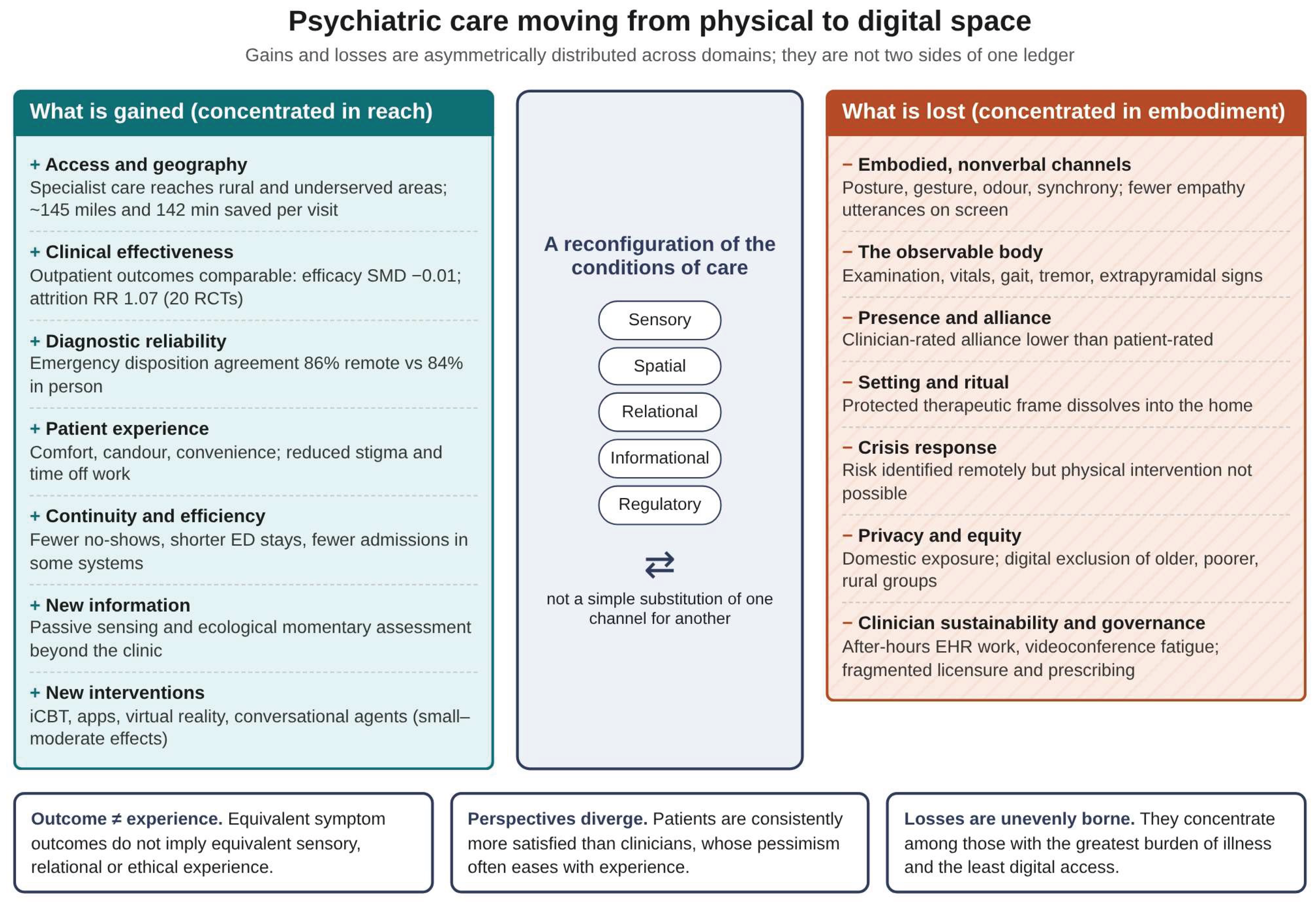
Figure 2.
A hybrid care pathway in which modality is a shared clinical decision, revisited at each step rather than fixed at entry. Synchronous remote, in-person and asynchronous digital routes converge on periodic in-person review and measurement-based care.
Figure 2.
A hybrid care pathway in which modality is a shared clinical decision, revisited at each step rather than fixed at entry. Synchronous remote, in-person and asynchronous digital routes converge on periodic in-person review and measurement-based care.
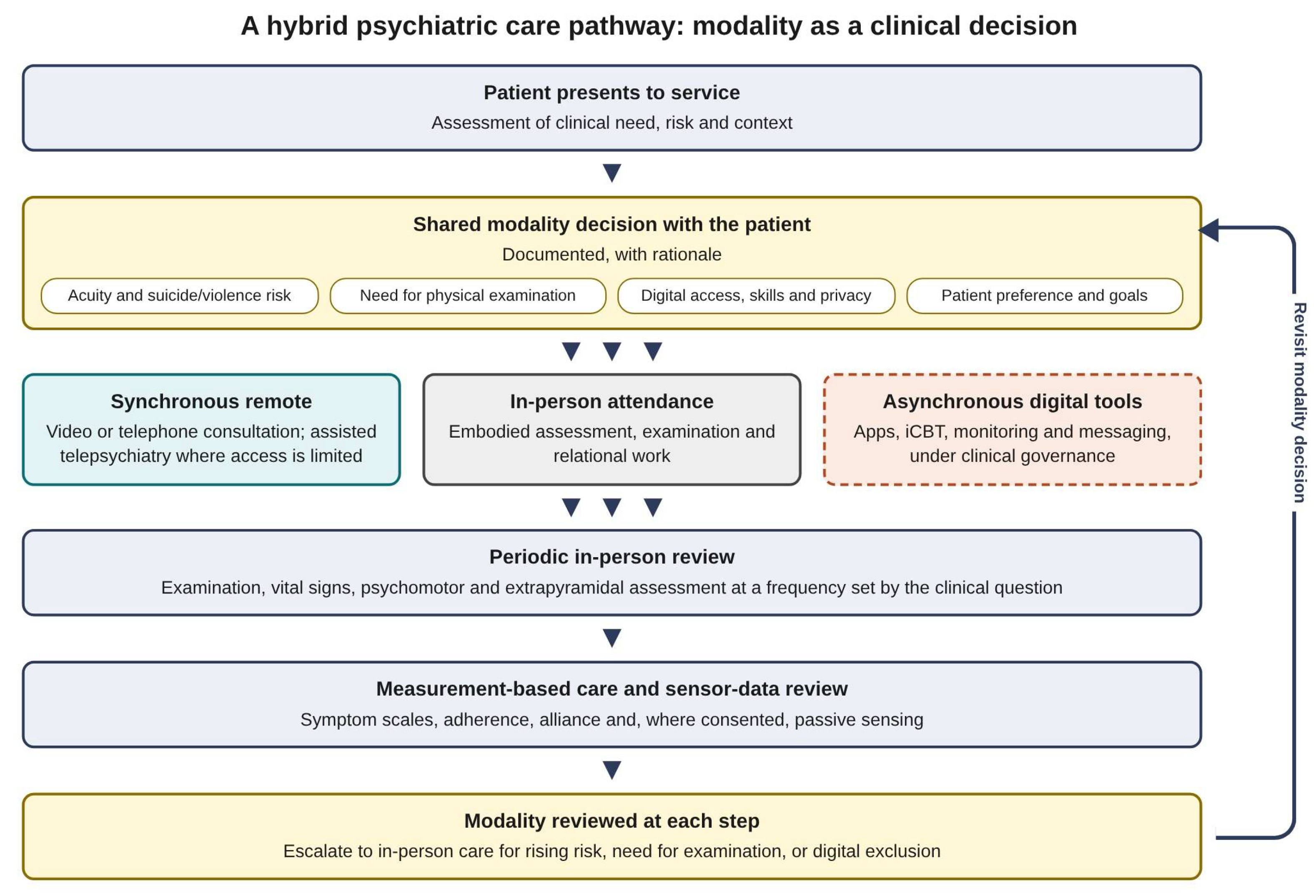

Table 1.
Domains of gain and loss in the migration of psychiatric care from physical to digital space.
Table 1.
Domains of gain and loss in the migration of psychiatric care from physical to digital space.
| Domain | What is gained | What is lost | Illustrative evidence |
|---|---|---|---|
| Access and geography | Specialist expertise reaches rural, remote and underserved populations; travel avoided | Digital exclusion of those without devices, connectivity or skills | Telemedicine saved patients an average of 145 miles and 142 minutes per visit [8]; 19 million rural/tribal US residents (6%) lack high-speed broadband; only 28% of rural Indians had internet access [73] |
| Clinical effectiveness | Equivalence for assessment, medication management and short-term follow-up | Equivalence not established for all psychotherapy, complex case management or institutional settings | Efficacy SMD −0.01 (95% CI −0.12 to 0.09); attrition RR 1.07 (95% CI 0.94–1.21) [12]; equivalence trial cautioned findings may not extend to psychotherapy [3] |
| Diagnostic reliability | Comparable disposition, diagnosis, violence-risk and suicide-scale agreement in emergency settings | Loss of physical examination, vitals, and psychomotor observation | Disposition agreement 84% face-to-face vs 86% telemedicine [13]; only one-third of respondents felt able to conduct a thorough physical examination [8] |
| Service efficiency | Reduced emergency department length of stay and reduced inpatient admissions; substantial cost savings in some systems | Higher per-hour costs and increased hospitalisations in some small-scale models | 80 fewer hospitalisations and ~$1,920,000 saved across 4,952 patients [25]; one hour of telepsychiatry more expensive than face-to-face with a tendency to increased hospitalisations [24] |
| Patient experience | Greater comfort, candour, convenience; reduced stigma; less time off work | Distraction, poor privacy at home, technical frustration | Patients felt more comfortable at home, expressed themselves more freely, saved time and costs [9]; online counselling perceived as more confidential than offline by young people [27] |
| Therapeutic relationship | Alliance achievable and predictive of outcome; clients rate bond and presence as high as in-person | Clinicians rate alliance lower and fear rapport loss; reduced empathy, praise and facilitation utterances | Alliance predicted improvement (anxiety OR=1.08, 95% CI 1.04–1.14) [17]; empathy, praise and facilitation utterances seen less in telemedicine [55] |
| Information | Digital phenotyping and passive sensing; dense temporal data; measurement beyond the office | Thinner documentation; loss of olfactory, gait and grooming data | Hour-to-hour mood prediction correlation 0.587 (95% CI 0.552–0.621) [35]; odour of alcohol, loose clothing and gait abnormalities lost [58] |
| Novel interventions | Internet-based CBT, apps, virtual reality exposure, conversational agents | Small effect sizes, low study quality, ungoverned generative AI risks | Depression g=0.28, NNT 11.5 [43]; 96% of chatbots used decision-tree logic; chatbot made harmful statements and was withdrawn [36] |
| Safety and crisis | Emergency assessment feasible; reduced ED length of stay and inpatient admissions | No capacity for physical intervention; catchment-area fragmentation | Telepsychotherapy may be unsuitable for concrete suicidal ideation as rapid reaction may be hindered by distance [67]; catchment areas may become null, obstructing the continuum of care [25] |
| Privacy | Confidentiality from familiar social settings; anonymity reduces stigma | Domestic exposure, network insecurity, shared-device risk | Patients eschewed video visits for lack of privacy in crowded homes; clinicians moved back to clinic to protect privacy [69] |
| Clinician sustainability | Flexibility; reduced exposure risk; expanded workforce reach | Documentation burden, after-hours work, videoconference fatigue | Total EHR time rose to nearly 11 hours per 8 hours of care, >4 hours after hours [2]; video conferences more exhausting than other media [80] |
| Governance | Policy attention and new guidelines | Fragmented licensure, prescribing limits, liability uncertainty | Ryan Haight Act in-person evaluation requirement relaxed only temporarily [82]; licensure, credentialing, informed consent and liability remain unsettled and formal telepsychiatry ethics guidance is still needed [70] |
CI confidence interval; ED emergency department; EHR electronic health record; NNT number needed to treat; OR odds ratio; RR risk ratio; SMD standardised mean difference.
Table 2.
Six design principles for digitally mature hybrid psychiatric care, with supporting evidence and operational actions.
Table 2.
Six design principles for digitally mature hybrid psychiatric care, with supporting evidence and operational actions.
| Design principle | Evidence base | Operational actions for services |
|---|---|---|
| 1. Treat modality as a clinical decision | Matching modality to patient abilities, needs and preferences through shared decision-making; some groups (e.g., autism spectrum, disabling anxiety) may be better served remotely [15,84] | Record the modality chosen and its rationale at intake; use a structured aid such as Fit for Blended Care; revisit modality at every review |
| 2. Preserve an embodied pathway | Dress, grooming, gait, weight, tremor and extrapyramidal signs are not reliably observable remotely [58,59,60] | Schedule in-person review at a frequency set by the clinical question (e.g., antipsychotic monitoring, physical comorbidity); arrange local examination and investigations |
| 3. Retrain communication and design the environment | Empathy, praise and facilitation utterances are reduced on screen; nonverbal empathy cues have been validated; clinicians prioritise audio over video quality [8,55,57] | Train camera framing, lighting and deliberate verbalisation of empathy; specify high-quality audio equipment |
| 4. Restore team-based workflow | Reversion to a “one-person shop”; electronic health record and after-hours work increased [2] | Re-embed scheduling, billing, questionnaire and triage support; protect documentation time within clinic schedules |
| 5. Make equity an explicit design requirement | Digital exclusion concentrates among older, poorer, sensory- or cognitively impaired and minority groups; assisted telepsychiatry is acceptable in Indian primary care [71,74,87] | Audit uptake and outcomes by age, socioeconomic status, rurality, literacy and language; maintain telephone, assisted and in-person routes |
| 6. Govern the digital layer with clinical rigour | Privacy problems in passive sensing remain unresolved; fewer than 5% of apps have been studied; generative chatbots have caused documented harm and show sycophancy [34,36,44,51] | Apply evidentiary and regulatory standards equivalent to those for medicines and psychotherapies; vet apps before recommending them; avoid reliance on unsupervised generative agents for risk assessment |
Principles are derived from the evidence synthesised in this review; operational actions are proposed by the author for service implementation.
Disclaimer/Publisher’s Note: The statements, opinions and data contained in all publications are solely those of the individual author(s) and contributor(s) and not of MDPI and/or the editor(s). MDPI and/or the editor(s) disclaim responsibility for any injury to people or property resulting from any ideas, methods, instructions or products referred to in the content. |
© 2026 by the author. Licensee MDPI, Basel, Switzerland. This article is an open access article distributed under the terms and conditions of the Creative Commons Attribution (CC BY) license.
Copyright: This open access article is published under a Creative Commons CC BY 4.0 license, which permit the free download, distribution, and reuse, provided that the author and preprint are cited in any reuse.