

Submitted:
05 November 2026
Posted:
06 November 2026
You are already at the latest version
Abstract
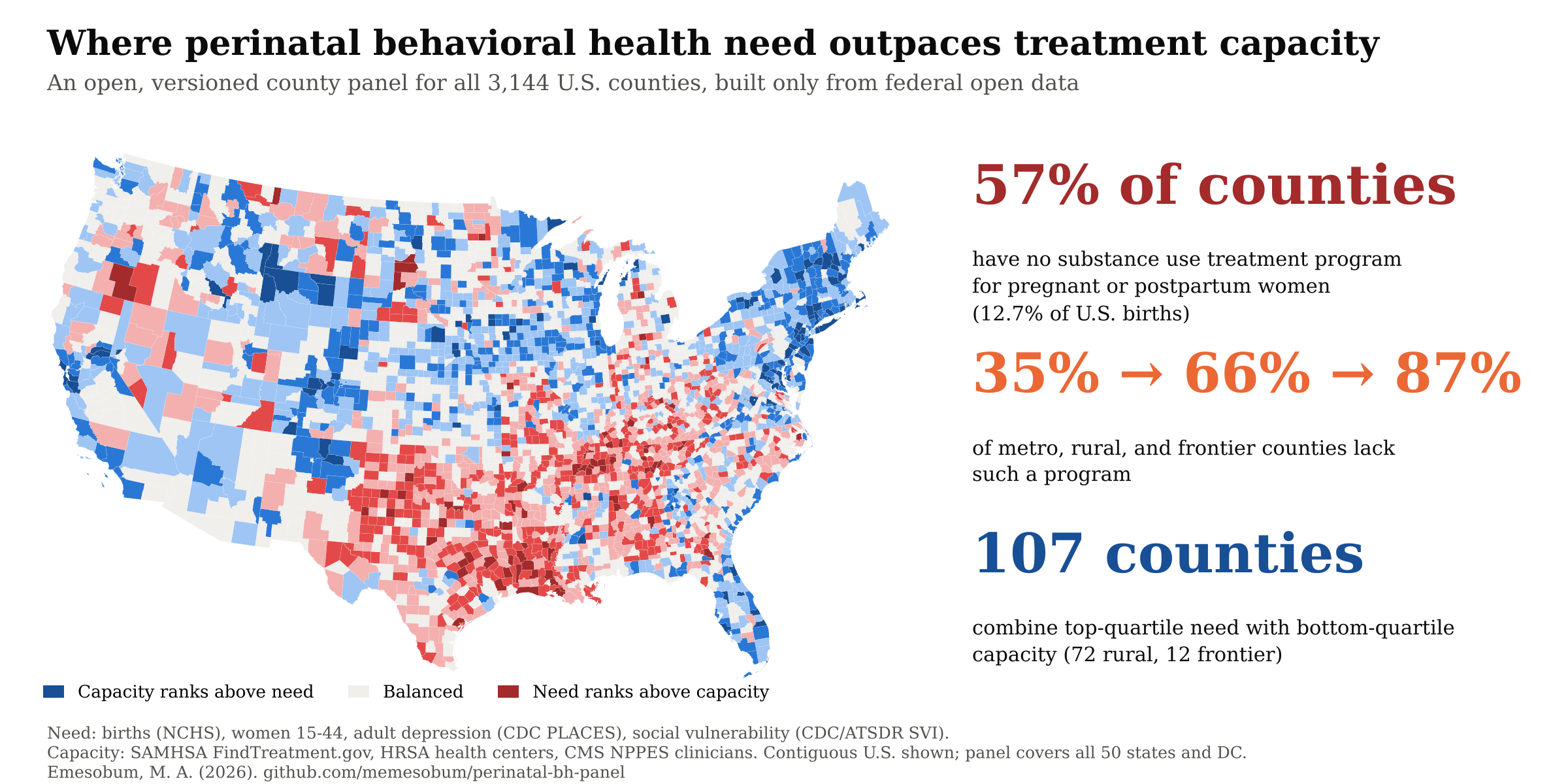
Mental health conditions, including substance use disorders, are a leading underlying cause of pregnancy-related death in the United States, yet agencies deciding where to add perinatal screening, referral, and treatment have had no open national table that sets county need beside county treatment capacity. We built the U.S. County Perinatal Behavioral Health Need and Capacity Panel, a versioned, fully reproducible county-level dataset for all 3,144 counties and county-equivalents of the 50 states and the District of Columbia, assembled only from open federal sources. Need is described by births (NCHS natality via the Area Health Resources Files), women aged 15–44, model-based adult depression prevalence (CDC PLACES), and the CDC/ATSDR Social Vulnerability Index. Capacity is described by 26,642 SAMHSA FindTreatment.gov treatment listings (99.7% placed in a county) coded for preg- nant/postpartum (PPW) programs, 11,769 HRSA health center sites, and 1,544,251 obstetric, behavioral health, and family medicine clinicians identified by NUCC taxonomy codes in the CMS NPPES registry. Each county receives percentile-based need and capacity scores, a need-minus-capacity gap score, rural and frontier flags, data-year fields, and small-number flags. We find that 1,793 counties (57.0%), home to 12.7% of U.S. births, have no substance use treatment listing with a PPW program; the share rises from 35.1% of metro to 65.5% of rural and 86.6% of frontier counties. The PPW program field exists only for substance use listings, so open data cannot identify perinatal-specific mental health facilities. Need and capacity are only weakly related across counties (Spearman ρ = 0.24), and 107 counties combine top-quartile need with bottom-quartile capacity, 72 of them rural. Clinician counts agree closely with independent AMA-based counts (log-scale r = 0.93 obstetric, 0.89 psychiatric), and gap rankings are robust to eight alternative specifications (Spearman ρ ≥ 0.973). The panel, code, codebook, and provenance log are openly released in three versioned parts.
Keywords:
perinatal mental health
; maternal substance use
; treatment capacity
; health workforce
; rural and frontier health
; open data
; county health indicators
Copyright: This open access article is published under a Creative Commons CC BY 4.0 license, which permit the free download, distribution, and reuse, provided that the author and preprint are cited in any reuse.