

Submitted:
04 November 2026
Posted:
06 November 2026
You are already at the latest version
Abstract
Background. Eryxin (Reptilin), an aqueous snake autolysate developed in Uzbekistan, has been used since the 1990s as an immunomodulating agent. Its clinical evidence is dispersed across published and grey literature.Objective. To identify and appraise human studies of Eryxin or Reptilin and summarise their clinical, immunological, biochemical and safety outcomes.Methods. We searched PubMed, Europe PMC, Google Scholar, eLIBRARY.ru, CyberLeninka, three trial registries, libraries and archives; the last search update was on 30 September 2026. Human studies of any design with extractable data were eligible. Authors independently extracted data with artificial-intelligence assistance; discrepancies were checked against original scans. Two reviewer pairs independently assessed risk of bias for prioritised outcomes using the 2016 Risk Of Bias In Non-randomised Studies of Interventions tool for controlled studies and the National Heart, Lung, and Blood Institute before–after tool for uncontrolled studies. Synthesis was descriptive without meta-analysis. Certainty was summarised by condition and for adverse events using the Grading of Recommendations Assessment, Development and Evaluation approach.Results. Twenty-two non-randomised studies across 16 conditions were included (64 reports), all conducted in Uzbekistan. A reliable total number of unique participants was unavailable because of uncertain cohort overlap and inconsistent participant counts. Most reports were retrieved from libraries and archives. Eleven of 16 controlled studies were at serious and five at critical risk of bias; all six uncontrolled studies were rated poor. Eryxin was added to other treatment in all but one arm. Favourable clinical and laboratory findings were reported, but interpretation was limited by confounding, incomplete reporting and, in some studies, differing co-interventions. Immunological findings varied across conditions and regimens without establishing a consistent response. Reporting gaps or inconsistencies were identified in 18 studies. Reported adverse events included transient taste or odour, flushing, tachycardia, fever and rash; ascertainment and denominators were inconsistent. Recorded certainty ratings were very low across conditions and for adverse events.Conclusions. The evidence does not establish effectiveness for any studied condition. This does not demonstrate absence of an effect. Overall and comparative safety remain uncertain. Well-conducted randomised controlled trials are needed to determine clinical benefits and harms.
Keywords:
Eryxin
; Reptilin
; snake autolysate
; systematic review
; grey literature
; immunomodulation
; safety
Key Points
- The review brought together 22 studies of Eryxin (Reptilin), drawing mainly on dissertations and institutional reports retrieved from libraries and archives.
- Limitations in study design and reporting leave substantial uncertainty about whether Eryxin benefits patients in any of the conditions studied.
- Adverse events and treatment discontinuations were reported, but incomplete safety information prevents reliable conclusions about how frequently harms occur or how Eryxin compares with other treatments.
1. Introduction
Eryxin (Reptilin) is an injectable aqueous autolysate of snakes of the genus Eryx, developed in Uzbekistan from a traditional remedy and used as an immunomodulating and ‘biostimulating’ agent. Its metabolite composition and proposed mechanisms of action have been described [1]. The substance was authorised for medical use in Uzbekistan in October 1998, and the 1% solution for injection in August 2001 (RPT-0125, RPT-0063, RPT-0064, unpublished documents are cited throughout by the report identifiers listed in Online Resource 2). An institutional report describes Reptilin as the same substance produced by an improved manufacturing process and compares its composition and preclinical properties with Eryxin (RPT-0124). These comparisons do not establish pharmacokinetic bioequivalence or clinical interchangeability in humans.
Our searches identified no previous systematic review of human studies of Eryxin or Reptilin. The evidence is dispersed across dissertations, dissertation abstracts, institutional clinical-trial reports and local journals, mainly in Russian or Uzbek. Although a clinical article on periodontitis was identified through PubMed [2], most reports were located through libraries and archives. This fragmentation complicates assessment of the product’s clinical benefits and harms.
We therefore aimed to identify published and unpublished human studies of Eryxin or Reptilin across conditions and study designs; describe their methods; assess their risk of bias and the certainty of the evidence; and summarise their clinical, immunological, biochemical and safety outcomes. The review maps the available clinical evidence across indications and identifies limitations relevant to its interpretation and future research.
2. Methods
2.1. Protocol and Registration
2.2. Eligibility Criteria
Studies were eligible if human participants of any age, sex or clinical condition received Eryxin, an aqueous autolysate of snakes of the genus Eryx [1], for therapeutic, prophylactic or adjunctive use, by any route, dose or schedule, either alone or alongside other treatment. Eryxin and Reptilin were treated as a single intervention based on an institutional report describing Reptilin as the same substance produced by an improved manufacturing process and comparing pharmacopoeial composition, acute toxicity, immunomodulatory activity and pyrogenicity (RPT-0124). This grouping did not imply pharmacokinetic bioequivalence or clinical interchangeability in humans. Spelling and transliteration variants were accepted after verification against the source. The lipid extract of Eryx snakes was excluded as a different product.
Randomised and non-randomised controlled studies, before–after studies, open-label clinical studies and case series with extractable data were eligible, including those reported in journal articles, dissertations, dissertation abstracts (avtoreferaty), institutional clinical-trial reports and conference materials. Incomplete sources were eligible and labelled as such. Animal-only and in vitro-only studies, narrative reviews, commentaries, reports without patient- or group-level data, and duplicate publications without additional data were excluded. Regulatory documents, including registration certificates and pharmacovigilance correspondence, provided context for product characteristics and adverse-event reporting but were not used as sources of outcome data.
2.3. Information Sources and Search
We combined electronic searches with searches of local libraries and archives to identify published and grey literature. Electronic sources included PubMed, Europe PMC, Google Scholar, eLIBRARY.ru and CyberLeninka, together with ClinicalTrials.gov, ISRCTN and the WHO International Clinical Trials Registry Platform. Searches used the trade names Eryxin and Reptilin, their Cyrillic and Latin spelling and transliteration variants, source-species names, and terms for snakes and tissue extracts. Author- and title-based searches were also used to locate reports. Consensus was used as a supplementary AI-assisted search tool. Scopus, Embase and Web of Science were not searched directly because subscription access was unavailable.
Local searches covered the electronic and card catalogues and holdings of the State Scientific Medical Library and the Alisher Navoi National Library of Uzbekistan, medical university libraries in Tashkent, and the state archive. Additional material was sought in institutional and personal archives, dissertation repositories and local journal archives. Reference lists and publication lists in retrieved dissertations, dissertation abstracts and other reports were screened for further sources. Authors and institutions were contacted to obtain reports that could not otherwise be located.
The last search update was on 30 September 2026. Search strategies, source-specific dates and information sources are described in Online Resource 1; detailed search logs and available exports are retained in the Zenodo data package (see Data availability).
2.4. Study Selection
Reports were assessed against the eligibility criteria by the review authors, and inclusion of each report was confirmed by a second author. Inclusion decisions were usually reached through discussion following library visits. These discussions also informed subsequent searches. Initial screening was conducted by U. Akbarov and R. Rozumbetov, with additional discussion among all authors.
2.5. Data Extraction and Data Items
U. Akbarov and R. Rozumbetov converted PDF reports to Markdown using Docling and Claude Opus 5.1 (Anthropic). Conversion accuracy was checked through random spot checks of numerical values and sentences against the original reports. Akbarov and Rozumbetov independently extracted data with assistance from Claude (Anthropic) and ChatGPT (OpenAI), respectively. Data from ISRCTN13331870, for which Akbarov was the principal investigator, were independently extracted by Rozumbetov and Talipova. Extraction discrepancies were adjudicated by Talipova against the original scans. A random sample of 20 extracted data items was also checked against the scans.
Extracted information included setting, recruitment and publication dates, clinical condition and diagnostic criteria, study design and allocation method, comparators, treatment regimens and co-interventions, group sizes, all reported outcomes and time points, adverse-event counts, denominators and ascertainment methods, and statements on funding, ethics approval and conflicts of interest.
Values and statistical annotations were recorded as reported. When the meaning of m in M±m was unspecified, dispersion was recorded as undefined and no conversion was performed. Outcome-specific denominators were taken from the corresponding tables where reported.
Study classification considered the reported allocation method and available comparison data. Healthy reference groups were not considered treatment comparators. For this review, studies that described a comparison group but reported no outcome data for that group were reclassified as uncontrolled; the missing comparator results were recorded as reporting gaps. Random sampling alone was not considered evidence of random allocation.
2.6. Risk of Bias
Risk of bias was assessed for the prioritised outcome of each study using ROBINS-I (2016 version) [5] for controlled studies and the National Heart, Lung, and Blood Institute Quality Assessment Tool for Before-After (Pre-Post) Studies With No Control Group [6] for single-arm studies. Two reviewer pairs conducted independent assessments with AI assistance: Rozumbetov and Akbarov, and Kasymova and Talipova. Ismailova replaced Akbarov in the first pair for ISRCTN13331870 and for studies co-authored by Akbarov’s father. Disagreements between pairs were discussed, with the higher risk judgement adopted by default. The overall ROBINS-I judgement was no lower than the highest domain-level risk rating.
2.7. Synthesis Methods
Findings were synthesised narratively with structured tables, following SWiM [4]. Studies were grouped by condition and design, with controlled comparisons and uncontrolled changes from baseline presented separately. Meta-analysis required at least two studies within the same condition and design stratum that were comparable in population, regimen, comparator, outcome and timing, reported defined dispersion measures and analysed sample sizes, and were not at serious or critical risk of bias or rated poor using the NIH tool. These criteria were finalised after data extraction and risk-of-bias assessment. No set of studies met them, so pooling was not performed. Results were presented as reported, without calculating additional effect measures.
One outcome per study was prioritised for the main results table using a rule established before table construction: the source-designated primary outcome or, if absent, the first clinical outcome in its conclusions, with clinical outcomes preferred over laboratory measures. End-of-treatment and latest follow-up values were selected, together with baseline values for uncontrolled studies. Data were taken from the highest-priority linked report, with before–after values drawn from the same table. Ambiguous selections were confirmed by the authors.
An additional descriptive synthesis of immunological outcomes was prepared during manuscript revision, grouped by condition and marker family. Baseline and healthy-reference findings, correlations and source-derived coefficients were distinguished from treatment comparisons. Variation between studies was explored descriptively by design, regimen, source completeness, calendar period, risk of bias, institution and research group. Vote counting by statistical significance was not used.
2.8. Reporting Completeness and Certainty of Evidence
Reporting completeness was assessed across all retrieved reports linked to each study by comparing the groups and outcomes described in the methods with the results provided. Missing group or outcome results, incomplete numerical reporting, inconsistent denominators and unavailable source pages were recorded as reporting gaps. A gap alone was not considered evidence of selective suppression. Funnel plots were not used.
Overall certainty profiles were prepared by clinical condition and for adverse events using the GRADE domains of risk of bias, inconsistency, indirectness, imprecision and publication bias [7,8]. Non-randomised evidence started at low certainty. Separate ratings were not assigned to individual outcomes, comparisons and follow-up times.
2.9. Use of Automation Tools
The authors used Claude (Anthropic), ChatGPT and Codex (OpenAI), and Gemini (Google) to assist with document processing, data extraction, risk-of-bias assessment, supplementary searches, record keeping and manuscript drafting. The extraction, assessment and verification procedures are described in Section 2.5 and Section 2.6. The authors retained responsibility for methodological decisions, interpretation and the final manuscript. The extraction workbooks, analysis dataset and code are publicly available (see Data availability); the decision log and source-page images used for verification are available from the corresponding author on request.
3. Results
3.1. Study Selection
The electronic searches represented in Figure 1 yielded 198 database records and two registry records for the same trial. After removal of 34 duplicates, 166 records were screened and 161 excluded. Seven reports were sought, of which four were retrieved and included. Other methods identified 117 documents; after removal of four duplicates, 113 reports were sought, 99 were assessed in full text and 39 were excluded. Overall, 22 studies described in 64 reports were included. Most reports were identified through libraries and archives. Excluded and unretrieved reports are listed in Online Resource 2.
3.2. Characteristics of Included Studies
The 22 studies covered 16 conditions and were conducted in Uzbekistan, predominantly in Tashkent (Table 1). Reported recruitment dates ranged from 1990 to 2024, and primary reports were issued between 1997 and 2025, mainly as dissertations or institutional clinical-trial reports in Russian or Uzbek. Studies conducted before product registration were authorised by Uzbekistan’s Pharmacological Committee and formed part of the clinical evidence supporting registration.
Sixteen studies were classified as non-randomised controlled trials and six as single-arm before–after studies. None reported the use of random allocation, allocation concealment or blinding. Comparators included background therapy alone and other active treatments. Eryxin was added to other treatment in all but one rheumatoid arthritis arm. Most regimens involved intravenous administration of a 1% solution with dose escalation over three to four weeks. Individual Eryxin-treated groups contained 10–101 patients.
Numbers are source-reported group sizes, not necessarily analysed denominators. Groups and linked reports may overlap; sizes must not be added. Studies with a declared comparator but no comparator results were reclassified as uncontrolled. The registered trial planned randomisation, but its current record describes non-randomised allocation.
RPT-0067 included 30 pregnant women and 20 gynaecological patients given Reptilin; its pregnancy subgroup probably overlaps Asrankulova 2004 and is counted once (Online Resource 2, Overlap sheet). Shodieva’s article comparator was excluded because some patients later received Eryxin. Reference numbers identify publications; report IDs identify unpublished documents (Online Resource 2).
BA, single-arm before–after study; BT, background therapy; CMV, cytomegalovirus; CT, conventional therapy; HPV, human papillomavirus; HRT, hormone replacement therapy; IM, intramuscular; IV, intravenous; MTX, methotrexate; NRCT, non-randomised controlled trial.
Written informed consent was specified as an inclusion criterion only in the 2010 study and the registered trial. The registered trial was also the only study to report ethics committee approval, trial registration and funding. No study reported a sample-size calculation or a conflict-of-interest statement. Studies declaring comparison groups without reporting their outcomes were reclassified as uncontrolled.
3.3. Risk of Bias
Of the 16 controlled studies assessed with ROBINS-I, 11 were at serious and five at critical risk of bias (Table 2). All six single-arm studies assessed with the NIH tool were rated poor. Confounding was rated serious or critical in all controlled studies, with allocation by disease severity reported in several. No study reported blinded outcome assessment, and incomplete outcome reporting was a further concern.
The registered trial was rated at serious risk owing to confounding, missing outcome data, unblinded assessment of pain and DAS-28, and removal of registered outcome time points after enrolment ended. The study on female infertility was rated at critical risk because Eryxin was combined with intrauterine ozone, preventing isolation of its effect. For chronic pelvic pain, the ROBINS-I assessment concerned a between-group pain comparison, whereas Table 3 presents a within-group result.
Assessments concern the prioritised outcome in each study. For Shodieva 2006, ROBINS-I concerns between-group pain, whereas Table 3 presents a single-group result. Poor is a NIH/NHLBI quality rating, not a ROBINS-I category.
ROBINS-I, Risk Of Bias In Non-randomised Studies of Interventions; NIH/NHLBI, National Institutes of Health/National Heart, Lung, and Blood Institute. The NIH/NHLBI Quality Assessment Tool for Before-After (Pre-Post) Studies With No Control Group was used for single-arm studies.
3.4. Effectiveness Outcomes
Prioritised findings from the 22 studies are summarised in Table 3. Panel A presents controlled comparisons; Panel B presents findings without a usable treatment comparison, including the single-group result from the controlled pelvic pain study.
Controlled studies reported lower relapse rates in some brucellosis subgroups [9,10], lower aminotransferase values in hepatitis B [16,17,18,19,20], and lower rheumatoid arthritis symptom or disease-activity scores with Eryxin-containing regimens [21,22]. At six months, microbiological cure was similar across regimens in complicated urogenital infection [27,28,29,30]; in male infertility, cure after treatment was complete in both groups [31,32,33]. Skin and Raynaud scores in systemic sclerosis [25,26] and short-term tumour response in liver cancer [55,56,57,58,59,60] were also similar between groups (Table 3, panel A).
Differing co-interventions limited attribution of findings to Eryxin in the HPV and female-infertility studies [41,48]. The registered rheumatoid arthritis trial reported no between-group analysis or outcome-specific analysed sample sizes [22]. Reports without a usable comparison described symptomatic or clinical findings but provided no controlled estimate of benefit (Table 3, panel B).
Immunological outcomes
Immunological findings varied by condition and regimen. Several studies reported higher post-treatment T-cell measures with Eryxin than with comparator treatment [9,10,11,12,13,14,15,16,17,18,19,20,27,28,29,30,31,32,33,34,35,36,37,38,39,40,42,43,44]. The registered trial reported decreases in CD3+, CD4+ and CD8+ within the Eryxin arm [22].
Cytokine patterns also differed. Post-treatment TNF-α and IL-8 were lower with Eryxin in cytomegalovirus infection in pregnancy [34,35,36,37,38,39,40], but IL-1β and IL-8 were higher and IL-10 lower with Eryxin plus Vibramycin than with a different regimen in complicated chlamydiosis [30]. The registered trial showed mixed between-group cytokine patterns without reported between-group P values [22]. Pooled baselines, differing regimens and changing sample sizes limited comparison. These findings did not establish a common immunological response.
Panel B includes the single-group result from Shodieva 2006, which remains classified as a controlled study. Its ROBINS-I assessment concerns between-group pain.
ALT, alanine aminotransferase; AST, aspartate aminotransferase; BT, background therapy; CMV, cytomegalovirus; DAS-28, Disease Activity Score in 28 joints; HRT, hormone replacement therapy; HPV, human papillomavirus; IV, intravenous; PCR, polymerase chain reaction; PIP, proximal interphalangeal; VAS, visual analogue scale.
3.5. Adverse Events
Nineteen of 22 studies mentioned tolerability, and 14 provided numerators for at least one event (Table 4). Only the 2010 Reptilin trial and the registered trial described assessment procedures; implementation of the planned procedures was not consistently documented.
Reported symptoms included transient taste or odour, flushing, heat, tachycardia, fever and headache. In the 2010 trial, odour was reported in 30/30 Reptilin recipients, a combined cluster of chest tightness, tachycardia, flushing and heat in 7/30, and fever with chills in 2/30; no treatment was discontinued. The registered trial reported transient odour, tachycardia and dyspnoea as a combined category in 30/30 Eryxin recipients, without separate component counts.
In the registered trial, 2/30 Eryxin recipients discontinued treatment, one because of gastrointestinal symptoms and one because of worsening joint pain. Four of 30 controls had mild events; no serious adverse event was recorded in either group. Two patients with systemic sclerosis were withdrawn because of rash, but their treatment group was unreported. Two of 27 patients with tuberculosis refused further treatment because of unpleasant oral odour and a temperature reaction.
Other reports contained general tolerability claims, uncertain group attribution or event percentages without denominators. The 2004 Reptilin report listed reactions despite stating that none occurred. These reporting limitations prevent a reliable overall or comparative safety assessment.
Selected source-specific examples are shown. General tolerability claims and absent reporting are distinct from documented event counts. Cohort sizes do not supply missing event denominators.
Registered trial, ISRCTN13331870. GI, gastrointestinal.
3.6. Reporting Gaps and Institutional Correspondence
Reporting gaps or inconsistencies were identified in 18 of 22 studies (Table 5A). None were identified in the available pages for three studies, and one could not be assessed because a chapter was unavailable. Four studies described or implied comparators without reporting their results; treatment-arm results were partly omitted in reports from three studies; and five had unexplained differences between enrolled and reported participant numbers. Other gaps included unreported outcomes or time points, outcomes not separated by arm, incomplete or contradictory denominators, and conclusions unsupported by the reported data. Results omitted from individual reports were sometimes available in linked reports. These gaps do not by themselves demonstrate selective suppression.
Categories may overlap. A dash means no category frequency is presented. An omission from one report may be resolved by another linked report and need not represent missing study-level results. A gap alone does not establish selective suppression.
CMV, cytomegalovirus; HPV, human papillomavirus; VAS, visual analogue scale.
Replies from seven institutions to a July 2004 pharmacovigilance enquiry by the national Pharmacological Committee described clinical use beyond the cohorts included in the review (Table 5B; RPT-0126 to RPT-0133). These were institution-reported treatment totals, not independently verified study populations. Differences in reporting periods, clinical scope and possible cohort overlap, together with the distinction between routine care and research, preclude valid estimates of publication fractions or unpublished-patient numbers. Some reports may also remain unretrieved. The correspondence therefore provides historical context without quantifying publication bias.
Treating the 2004 Reptilin report (RPT-0067) as a separate study would increase the total from 22 to 23 studies and the controlled-study count from 16 to 17. However, its treated pregnancy subgroup probably overlaps with the linked dissertation cohort. This alternative adds no prioritised clinical result and does not establish independent replication (Online Resource 2, Sensitivity sheet).
3.7. Certainty of Evidence
The recorded GRADE profiles rated certainty as very low for all condition-level summaries and for adverse events (Table 6; Online Resource 3). The contributing evidence was non-randomised and limited by serious methodological concerns, incomplete outcome reporting and uncertain analysed sample sizes.
Non-randomised evidence started at low certainty. Study characteristics and risk-of-bias assessments are given in Table 1 and Table 2.
NRCT, non-randomised controlled trial; single-arm, uncontrolled before–after study; NIH/NHLBI, National Institutes of Health/National Heart, Lung, and Blood Institute; GRADE, Grading of Recommendations Assessment, Development and Evaluation; CMV, cytomegalovirus; HPV, human papillomavirus.
4. Discussion
4.1. Principal Findings and Interpretation
This review identified 22 non-randomised studies of Eryxin (Reptilin) across 16 conditions, reported largely in dissertations and institutional clinical-trial reports retrieved from libraries and archives. Favourable clinical and laboratory findings were reported, but the evidence does not establish effectiveness for any studied condition. The recorded certainty ratings were very low across conditions and for adverse events. This uncertainty does not demonstrate absence of an effect.
Interpretation depends on the comparison available. An add-on design with identical background therapy in both groups can address the incremental effect of Eryxin. However, the included comparisons were limited by confounding, incompletely reported allocation and outcome data, and, in some studies, additional interventions received only by the Eryxin group. Improvements in uncontrolled studies cannot be separated from concomitant treatment or the natural course of disease. Studies within the same condition also differed in populations, comparators, outcomes and follow-up, limiting their ability to corroborate a common treatment effect.
The laboratory findings did not establish a consistent immune response. Marker directions varied across conditions and comparisons, with differences in baseline values, treatment regimens, sampling times and assay reporting. These patterns do not demonstrate a beneficial ‘normalising’ action or establish a mechanism of clinical benefit.
Reported reactions included transient taste or odour, flushing, tachycardia and fever; treatment discontinuations were also described. Some studies provided event counts, but inconsistent ascertainment, uncertain denominators and group attribution, and limited follow-up prevent a reliable overall or comparative safety assessment. General statements of good tolerability cannot resolve these limitations.
4.2. Limitations of the Evidence
No study described an implemented method of random allocation, allocation concealment or blinded outcome assessment. In several controlled studies, treatment assignment reflected disease severity, introducing confounding by indication. Comparisons involving additional treatments received only by the Eryxin group, such as Reptin cream or intrauterine ozone, could not isolate the contribution of Eryxin. Subjective clinical outcomes were also vulnerable to unblinded assessment.
Numerical reporting further limited interpretation. Dispersion measures were often undefined, denominators differed between tables and linked reports, and some printed values or units were implausible. Missing comparator results, incomplete participant accounting and outcomes reported without separation by treatment group weakened the available comparisons. Reporting gaps or inconsistencies were identified in 18 of 22 studies, although omissions from individual reports were sometimes resolved by linked reports and did not necessarily indicate selective suppression (Table 5A). In the registered trial, intermediate assessment time points were removed from the registry after enrolment had ended, and several protocol outcomes remained unreported.
All studies were conducted in Uzbekistan, and all but one before 2011. Their concentration within linked institutions and research groups limits independent confirmation and applicability to other settings, without establishing that their participant data overlap. The pre-registration studies were authorised by the national Pharmacological Committee and contributed to the evidence supporting product registration; their historical role should be distinguished from their methodological limitations.
Consistency of product composition across manufacturing periods was insufficiently documented. The institutional comparison of composition and preclinical properties (RPT-0124), used to support grouping Eryxin and Reptilin in this review, did not establish pharmacokinetic bioequivalence or clinical interchangeability in humans.
4.3. Strengths and Limitations of the Review
Library and archive searches were a major strength, bringing together evidence dispersed across dissertations, institutional reports and local journals. Nevertheless, some reports could not be retrieved, and several dissertations were available only as partial scans. Scopus, Embase and Web of Science were not searched directly because subscription access was unavailable. Relevant evidence may therefore remain unidentified or inaccessible.
Data were independently extracted by authors with AI assistance. PDF-to-Markdown conversion was checked selectively against the original scans; extraction discrepancies and 20 randomly selected data items were also checked against the scans. These procedures provided safeguards against extraction errors but did not constitute comprehensive verification of every value and its outcome, group, timing, units and denominator.
The criteria for meta-analysis were finalised after extraction and risk-of-bias assessment. The immunological synthesis was added during manuscript revision using the existing dataset and should be interpreted as exploratory. Risk-of-bias assessments concerned each study’s prioritised outcome, while GRADE profiles summarised evidence by condition and for adverse events. Neither provided separate assessments of every laboratory comparison.
The first author is the son of the originator of Eryxin and was the principal investigator of the registered trial included in the review. Some primary documents were obtained from the originator’s personal archive. These relationships require consideration when interpreting the review. Data from the registered trial were independently extracted by two other authors. Risk of bias was assessed by two independent reviewer pairs, with the first author replaced for his own trial and studies co-authored by his father. Disagreements between pairs were discussed, with the higher risk judgement adopted by default.
4.4. Implications for Practice and Research
The available evidence provides an insufficient basis for recommending Eryxin or Reptilin for the conditions studied. This does not establish ineffectiveness, while incomplete adverse-event reporting leaves important uncertainty about overall and comparative safety.
An immediate priority is a complete report of the registered trial, clarifying allocation, treatment delivered, participant flow and analysed numbers for each outcome. Prespecified outcomes and time points should be reported, with missing data and protocol departures explained and appropriate between-group analyses provided.
Future trials should address a clearly defined condition using concealed random allocation, comparable background treatment and clinically relevant primary outcomes specified before enrolment. Masking should be considered in light of the product’s characteristic taste and odour, with blinded outcome assessment wherever feasible. Adverse events, treatment discontinuations and follow-up should be recorded prospectively using defined procedures and explicit denominators. Documentation of product composition and batch consistency would improve interpretability across studies, while research by groups independent of the product’s development would strengthen external confirmation.
5. Conclusions
This review identified 22 non-randomised studies of Eryxin (Reptilin) across 16 conditions. Recorded certainty ratings were very low. Some clinical and laboratory findings were favourable, but the evidence does not establish effectiveness for any studied condition. This does not demonstrate absence of an effect. Incomplete adverse-event ascertainment, uncertain group attribution and inconsistent denominators prevent a reliable overall or comparative safety assessment. Well-conducted randomised controlled trials are needed to determine the clinical benefits and harms of Eryxin.
Supplementary Materials
The following supporting information can be downloaded at the website of this paper posted on Preprints.org. Online Resource 1. Search strategies and information sources: search dates, electronic search strings, manual Europe PMC search results, and library and archive search methods. Online Resource 2. Source registry and study linkage: included studies and reports, context documents, full-text exclusions, reports not retrieved, overlap decisions and alternative-linkage sensitivity analysis. Online Resource 3. GRADE evidence profiles by clinical condition and for adverse events, including domain judgements, overall certainty ratings, prioritised findings and reasons for downgrading.
Author Contributions
U.A. conceived and designed the review, wrote the protocol, conducted database and library searches, retrieved documents and wrote the first manuscript draft. U.A. and R.R. conducted initial screening, converted PDF reports to Markdown and checked conversion accuracy. Data were independently extracted with AI assistance by U.A. and R.R., except for ISRCTN13331870, which was independently extracted by R.R. and A.T. A.T. adjudicated extraction discrepancies against the original scans and checked a random sample of 20 extracted data items. Independent AI-assisted risk-of-bias assessments were conducted by two reviewer pairs: U.A. and R.R., and M.K. and A.T. A.I. replaced U.A. for ISRCTN13331870 and studies co-authored by his father. Disagreements between pairs were discussed, with the higher risk judgement adopted by default. U.A. checked the values in Table 3 and Table 4 against the source pages, except those from the registered trial and the study on female infertility. A.T. checked the registered-trial values against the source, and R.R. checked all extracted values from the female-infertility study. T.A. and A.I. supervised the review. A.R. contributed to data processing. L.S. contributed to searches of local libraries and archives, retrieval of grey-literature reports and verification of bibliographic information. All authors participated in discussions of study eligibility and interpretation of the findings and retained responsibility for the final manuscript.
Funding
No funding was received for conducting this review or preparing this manuscript; the work was carried
out at the authors’ own expense.
Ethics approval
Not applicable.
Consent to participate
Not applicable.
Consent for publication
Not applicable.
Data availability
The review dataset and associated reproducibility materials are available in Zenodo at https://doi.org/10.5281/zenodo.23253948 [62] (data package version 1.4; analysis dataset version 1.6). The package contains the complete outcome and adverse-event data, extraction and verification records, search logs and code. Detailed records of values excluded from synthesis are retained in archived ESM_6.xlsx, and the study-level reporting-gaps matrix is in the Table5A_matrix sheet of archived ESM_8.xlsx. Online Resources 1–3 provide search documentation, the source registry and study linkage, and GRADE evidence profiles, respectively. No patient names or case-history numbers are included in the review dataset. The source documents are listed in Online Resource 2; availability of copies of unpublished documents remains subject to source permissions.
Competing interests
Umidbek Akbarov is the son of S.V. Akbarov, the originator of Eryxin and a co-author of several studies included in this review. He is the founder and sole shareholder of SV-BIO PHARM GROUP LLC, a company engaged in the development of Eryxin. He served as principal investigator of ISRCTN13331870, a trial included in this review and sponsored and funded by Namangan Pharm Plant LTD. He did not participate in data extraction, risk-of-bias assessment or source-value checking for that trial. Tamara Aripova is the director of the Institute of Immunology and Human Genomics, where immunological analyses for many clinical studies of Eryxin were performed. She signed the institute’s 2004 reply to the regulator concerning the use of Eryxin (RPT-0129) and is a co-author of one report of an included study [40]. The other authors have no relevant financial or non-financial interests to disclose.
Code availability
Python code for recomputing the agreement statistics, reproducing the PRISMA counts and performing documented consistency checks between the analysis files and extraction workbooks is included in the data package [62] under the MIT licence. These checks concern reproducibility and data transfer; they do not independently validate every source-page interpretation, clinical attribution or methodological judgement.
References
- Akbarov, U.S.; Pozharitskaya, O.N.; Laakso, I.; et al. Metabolite profiling and mechanisms of bioactivity of snake autolysate – a traditional Uzbek medicine. J. Ethnopharmacol. 2020, 250, 112459. [Google Scholar] [CrossRef]
- Khasanova, L.E. Eryxine effect on hydroxyproline metabolism in patients with chronic periodontitis. Stomatologiia (Mosk) 2002, 81(6), 24–6. (in Russian). [Google Scholar]
- Page, M.J.; McKenzie, J.E.; Bossuyt, P.M.; et al. The PRISMA 2020 statement: an updated guideline for reporting systematic reviews. BMJ 2021, 372. [Google Scholar] [CrossRef]
- Campbell, M.; McKenzie, J.E.; Sowden, A.; et al. Synthesis without meta-analysis (SWiM) in systematic reviews: reporting guideline. BMJ 2020, 368. [Google Scholar] [CrossRef]
- Sterne, J.A.C.; Hernán, M.A.; Reeves, B.C.; et al. ROBINS-I: a tool for assessing risk of bias in non-randomised studies of interventions. BMJ 2016, 355. [Google Scholar] [CrossRef]
- National Heart; Lung; and Blood Institute. Study quality assessment tools: quality assessment tool for before-after (pre-post) studies with no control group. Available online: https://www.nhlbi.nih.gov/health-topics/study-quality-assessment-tools (accessed on 28 Sep 2026).
- Balshem, H.; Helfand, M.; Schünemann, H.J.; et al. GRADE guidelines: 3. Rating the quality of evidence. J. Clin. Epidemiol. 2011, 64, 401–6. [Google Scholar] [CrossRef]
- Murad, M.H.; Mustafa, R.A.; Schünemann, H.J.; Sultan, S.; Santesso, N. Rating the certainty in evidence in the absence of a single estimate of effect. Evid. Based Med. 2017, 22, 85–7. [Google Scholar] [CrossRef]
- Dzhalalova, N.A. Clinical and immunological characteristics of chronic forms of brucellosis and criteria for the effectiveness of Eryxin in combination therapy. Cand. Med. Sci. dissertation, Tashkent Paediatric Medical Institute, Tashkent, 2008. (in Russian). [Google Scholar]
- Dzhalalova, N.A. Clinical and immunological characteristics of chronic forms of brucellosis and criteria for the effectiveness of Eryxin in combination therapy. Cand. Med. Sci. dissertation abstract, Research Institute of Epidemiology, Microbiology and Infectious Diseases, Tashkent, 2008. (in Russian). [Google Scholar]
- Akhadova, G.M. Effectiveness of Eryxin in the pre-gravid preparation of women of reproductive age with chronic brucellosis. Cand. Med. Sci. dissertation, Research Institute of Obstetrics and Gynaecology, Tashkent, 2008. (in Russian). [Google Scholar]
- Akhadova, G.M. Effectiveness of Eryxin in the pre-gravid preparation of women of reproductive age with chronic brucellosis. Cand. Med. Sci. dissertation abstract, Tashkent Medical Academy, Tashkent, 2008. (in Russian). [Google Scholar]
- Akhadova, G.M.; Kurbanov, D.D.; Gulyamov, N.G. Clinical and immunological assessment of the effectiveness of Eryxin in women of reproductive age with chronic brucellosis. Byulleten Assotsiatsii Vrachey Uzb. 2006, (3), 42–7. (in Russian). [Google Scholar]
- Akhadova, G.N.; Kurbanov, D.D. Principles of combined therapy of chronic brucellosis in pregnant women: methodological recommendations; Tashkent, 2006. (in Russian) [Google Scholar]
- Akhadova, G.M.; Kurbanov, D.D. Immunological effectiveness of Eryxin in pregnant women with chronic brucellosis. Nov. Dermatovenerol. I Reproduktivnogo Zdorovya 2007, 21. (in Russian). [Google Scholar]
- Azimov, N.R. Clinical and pathogenetic rationale for the effectiveness of Eryxin in chronic viral hepatitis B. Cand. Med. Sci. dissertation, Tashkent Paediatric Medical Institute, Tashkent, 2007. (in Russian). [Google Scholar]
- Azimov, N.R. Clinical and pathogenetic rationale for the effectiveness of Eryxin in chronic viral hepatitis B. Cand. Med. Sci. dissertation abstract, Research Institute of Epidemiology, Microbiology and Infectious Diseases, Tashkent, 2007. (in Russian). [Google Scholar]
- Kasymov, I.A.; Azimov, N.R. Effect of Eryxin on cellular immunity in patients with chronic hepatitis B. Infektsiya Immun. I Farmakol. 1999, (1), 56–7. (in Russian). [Google Scholar]
- Azimov, N.R.; Kosimov, I.A.; Mirkamalova, L.I. Features of cellular immunity in the treatment of chronic hepatitis B with Eryxin. Meditsinskiy Zhurnal Uzb. 2003, (1), 26–8. (in Uzbek). [Google Scholar]
- Azimov, N.R.; Kasymov, I.A.; Aripkhodzhaeva, F.A. Effect of Eryxin and Immunomodulin on the course of chronic hepatitis and the immune system. Pediatriya 2003, (1), 57–61. (in Russian). [Google Scholar]
- Mirzakhanova, M.I. The significance of endocrine-immune disorders in the early diagnosis of rheumatoid arthritis (pathogenetic and therapeutic aspects). Dr. Med. Sci. dissertation, Tashkent Medical Academy, Tashkent, 2006. (in Russian). [Google Scholar]
- Akbarov, U. A study of the safety and efficacy of ‘Eryxin’ in patients with rheumatoid arthritis. ISRCTN registry, ISRCTN13331870. Registered 7 Feb 2024; last edited 14 Apr 2025 (record, basic results file and protocol). https://doi.org/10.1186/ISRCTN13331870. Accessed 27 Sep 2026.
- Muxsimova, N.R.; Miraxmedova, X.T.; Tojiddinova, X.S. Characteristics of the course of rheumatoid arthritis and measures to improve its treatment. Toshkent Tibbiyot Akad. Axborotnomasi 2025, (3), 104–6. (in Uzbek). [Google Scholar]
- Muxsimova, N.R.; Choriyeva, E.G. Effectiveness of the immunomodulator Erixin in patients with rheumatoid arthritis. Zamonaviy Tibbiyot Jurnali 2025, 1(8), 887–90. (in Uzbek). [Google Scholar]
- Akhmedov, KhS. Clinical and immunological status and its relationship with female sex hormones in patients with systemic scleroderma; effectiveness of Eryxin treatment. Cand. Med. Sci. dissertation abstract, First Tashkent State Medical Institute, Tashkent, 2001. (in Russian). [Google Scholar]
- Akhmedov, KhS; Karaboeva, R.A. Use of Eryxin in the combined treatment of patients with systemic scleroderma. Meditsinskiy Zhurnal Uzb. 2000, (4), 57–8. (in Russian). [Google Scholar]
- Porsokhonova, D.F. Epidemiological and medico-biological aspects of urogenital infections in women and the treatment of their complicated forms. Dr. Med. Sci. dissertation, First Tashkent State Medical Institute, Tashkent, 2004. (in Russian). [Google Scholar]
- Porsokhonova, D.F. Epidemiological and medico-biological aspects of urogenital infections in women and the treatment of their complicated forms. Dr. Med. Sci. dissertation abstract, First Tashkent State Medical Institute, Tashkent, 2004. (in Russian). [Google Scholar]
- Porsokhonova, D.F.; et al. Methods of treating urogenital infections in women according to the topical diagnosis and stage of the inflammatory process: methodological recommendations; Research Institute of Dermatology and Venereology: Tashkent, 2002. (in Russian) [Google Scholar]
- Porsokhonova, D.F.; Kurbanov, D.D.; Akbarov, S.V.; Musakhodzhaeva, D.A. Use of Eryxin in the therapy of complicated chlamydiosis. Meditsinskiy Zhurnal Uzb. 2003, (3), 46–9. (in Russian). [Google Scholar]
- Vaisov, I.A. Comprehensive assessment of the reproductive system of men with infertility associated with sexually transmitted infections and optimisation of their treatment. Cand. Med. Sci. dissertation, Tashkent Paediatric Medical Institute, Tashkent, 2006. (in Russian). [Google Scholar]
- Vaisov, I.A. Comprehensive assessment of the reproductive system of men with infertility associated with sexually transmitted infections and optimisation of their treatment. Cand. Med. Sci. dissertation abstract, Tashkent Medical Academy, Tashkent, 2006. (in Russian). [Google Scholar]
- Shodiev, KhK; Vaisov, I.A. Effectiveness of adding Eryxin to the combined treatment of men with sexually transmitted infections in infertile marriages. Nov. Dermatovenerol. I Reproduktivnogo Zdorovya 2004, (4), 8–11. (in Russian). [Google Scholar]
- Asrankulova, D.B. Perinatal protection of the fetus and newborn in pregnant women with acute cytomegalovirus infection. Dr. Med. Sci. dissertation, First Tashkent State Medical Institute, Tashkent, 2004. (in Russian). [Google Scholar]
- Asrankulova, D.B. Perinatal protection of the fetus and newborn in pregnant women with acute cytomegalovirus infection. Dr. Med. Sci. dissertation abstract, First Tashkent State Medical Institute, Tashkent, 2004. (in Russian). [Google Scholar]
- Asrankulova, D.B.; Kurbanov, D.D. Dynamics of immune indices and pro-inflammatory cytokines in the combination therapy of acute cytomegalovirus infection in pregnant women [abstract]. Zhurnal Teor. I Klin. Meditsiny 2003, (3), 16. (in Russian). [Google Scholar]
- Asrankulova, D.B.; Kurbanov, D.D. Clinical and morphological assessment of the effectiveness of Eryxin in the combination therapy of acute cytomegalovirus infection in pregnant women. In Pediatriya (Tashkent); 2003; Volume (special issue), pp. 77–80. (in Russian) [Google Scholar]
- Asrankulova, D.B.; Vorozheykin, V.M.; Kurbanov, D.D. Effect of Eryxin on the compensatory and adaptive mechanisms of the placenta in acute cytomegalovirus infection in pregnant women. Umumiy Amaliyot Doʻxtiri Axborotnomasi 2003, (1), 105–9. (in Russian). [Google Scholar]
- Asrankulova, D.B. New developments in the treatment of acute cytomegalovirus infection in pregnant women. Infektsiya Immun. I Farmakol. 2004, (1), 148–9. (in Russian). [Google Scholar]
- Asrankulova, D.B.; Kurbanov, D.D.; Akbarov, S.V.; Aripova, T.U. Effect of Eryxin on clinical and immunological parameters in the combined treatment of acute cytomegalovirus infection in pregnant women. Meditsinskiy Zhurnal Uzb. 2004, (1–2), 57–60. (in Russian). [Google Scholar]
- Aripdzhanova, D.S. Use of Eryxin and Reptin cream in the combined treatment of cervical dysplasia associated with genital papillomavirus infection. Nov. Dermatovenerol. I Reproduktivnogo Zdorovya 2007, (3), 16. (in Russian). [Google Scholar]
- Abdullaeva, L.F. Optimisation of pre-gravid preparation of women with chronic pyelonephritis. Cand. Med. Sci. dissertation, Republican Specialised Scientific and Practical Medical Centre of Obstetrics and Gynaecology, Tashkent, 2009. (in Russian). [Google Scholar]
- Abdullaeva, L.F. Optimisation of pre-gravid preparation of women with chronic pyelonephritis. Cand. Med. Sci. dissertation abstract, Tashkent Medical Academy, Tashkent, 2009. (in Russian). [Google Scholar]
- Alieva, T.M.; Teplova, T.A.; Abdullaeva, L.F. Effect of Eryxin on immune status in pregnant women with fetoplacental insufficiency and chronic pyelonephritis. Patologiya 2007, (3), 36–8. (in Russian). [Google Scholar]
- Shodieva, KhT. Methods of examination, monitoring and treatment of chronic pelvic pain in women with gynaecological disease. Cand. Med. Sci. dissertation, Tashkent Medical Academy, Tashkent, 2006. (in Russian). [Google Scholar]
- Shodieva, KhT. Methods of examination, monitoring and treatment of chronic pelvic pain in women with gynaecological disease. Cand. Med. Sci. dissertation abstract, Tashkent Medical Academy, Tashkent, 2006. (in Russian). [Google Scholar]
- Shodieva, KhT; Pakhomova, ZhE. Perspectives in the diagnosis and treatment of chronic pelvic pain in women with inflammatory genital disease. In Pediatriya (Tashkent); 2003; Volume (special issue), pp. 128–30. (in Russian) [Google Scholar]
- Khalilov, U.S.; Kurbanov, D.D. Effectiveness of medical ozone and Eryxin in the pre-gravid preparation of the endometrium in women with infertility. Vrach-Aspirant 2009, (10), 923–30. (in Russian). [Google Scholar]
- Khasanova, L.E. Eryxin in the combined treatment of moderate generalised periodontitis. Cand. Med. Sci. dissertation, First Tashkent State Medical Institute, Tashkent, 2004. (in Russian). [Google Scholar]
- Khasanova, L.E. Eryxin in the combined treatment of moderate generalised periodontitis. Cand. Med. Sci. dissertation abstract, First Tashkent State Medical Institute, Tashkent, 2004. (in Russian). [Google Scholar]
- Khasanova, L.E.; Kamilov, KhP. Effect of Eryxin on periodontal microcirculation in moderate generalised chronic periodontitis. Meditsinskiy Zhurnal Uzb. 2001, (4), 82–3. (in Russian). [Google Scholar]
- Khasanova, L.E.; Kamilov, KhP. State of the pro- and antioxidant system in patients with moderate chronic periodontitis treated with Eryxin. Meditsinskiy Zhurnal Uzb. 2001, (2–3), 115–6. (in Russian). [Google Scholar]
- Khasanova, L.E.; Kamilov, KhP. Effectiveness of the treatment of generalised chronic periodontitis with laser therapy and Eryxin. Stomatologiya 2001, (4), 14–6. (in Russian). [Google Scholar]
- Kamilov, KhP; Khasanova, L.E. Prospects for the use of the domestic preparation Eryxin in the treatment of moderate chronic generalised periodontitis. Stomatologiya 2003, (1–2), 51–4. (in Russian). [Google Scholar]
- Pulatov, D.A. Primary liver cancer: molecular and metabolic aspects of pathogenesis and ways to improve the effectiveness of treatment (an experimental and clinical study). Dr. Med. Sci. dissertation, Republican Oncology Research Centre, Tashkent, 2005. (in Russian). [Google Scholar]
- Pulatov, D.A. Primary liver cancer: molecular and metabolic aspects of pathogenesis and ways to improve the effectiveness of treatment (an experimental and clinical study). Dr. Med. Sci. dissertation abstract, Republican Oncology Research Centre, Tashkent, 2005. (in Russian). [Google Scholar]
- Navruzov, S.N.; Pulatov, D.A.; Dzhuraev, M.D. Comparative study of the results of Eryxin combined with chemotherapy for unresectable primary liver cancer. Probl. Onkol. Sb. Nauchnykh Statey 2002, Vol. 2, 117–21. (in Russian). [Google Scholar]
- Navroʻzov, S.N.; Poʻlatov, D.A. Immunomodulating effects of Eryxin in the combined treatment of patients with primary liver cancer. Meditsinskiy Zhurnal Uzb. 2003, (1), 23–6. (in Uzbek). [Google Scholar]
- Pulatov, D.A.; Madalikhodzhaev, R.S.; Yuldasheva, NSh; Islamova, KhB. Dynamics of haemorheological parameters during chemotherapy in patients with unresectable primary liver cancer. Ilmiy-Amaliy Tibbiyot Jurnali 2004, (1), 55–7. (in Russian). [Google Scholar]
- Pulatov, D.A. Quality of life of patients with unresectable primary liver cancer during treatment. Umumiy Amaliyot Doʻxtiri Axborotnomasi 2002, (4), 51–3. (in Russian). [Google Scholar]
- Ubaydullaev, A.M.; Uzakova, G.T.; Akbarov, S.V. New domestic immunomodulating and biostimulating preparation Eryxin in the combined therapy of chronic obstructive bronchitis. Meditsinskiy Zhurnal Uzb. 1999, (6), 88–90. (in Russian). [Google Scholar]
- Akbarov, U.S.; Rozumbetov, R.J.; Talipova, A.A.; Raximjonov, A.A.; Ismailova, A.A.; Kasimova, M.S.; Sher, L.V.; Aripova, T.U. Eryxin (Reptilin) in human studies — systematic review: data, search logs and code (data package version 1.4) [dataset]. Zenodo 2026. [Google Scholar] [CrossRef]
Figure 1.
PRISMA 2020 flow diagram of study selection. The two registry records referred to one trial; its registry entry, results file and protocol were counted as three reports. ISRCTN, International Standard Randomised Controlled Trial Number; PRISMA, Preferred Reporting Items for Systematic Reviews and Meta-Analyses; WHO ICTRP, World Health Organization International Clinical Trials Registry Platform.
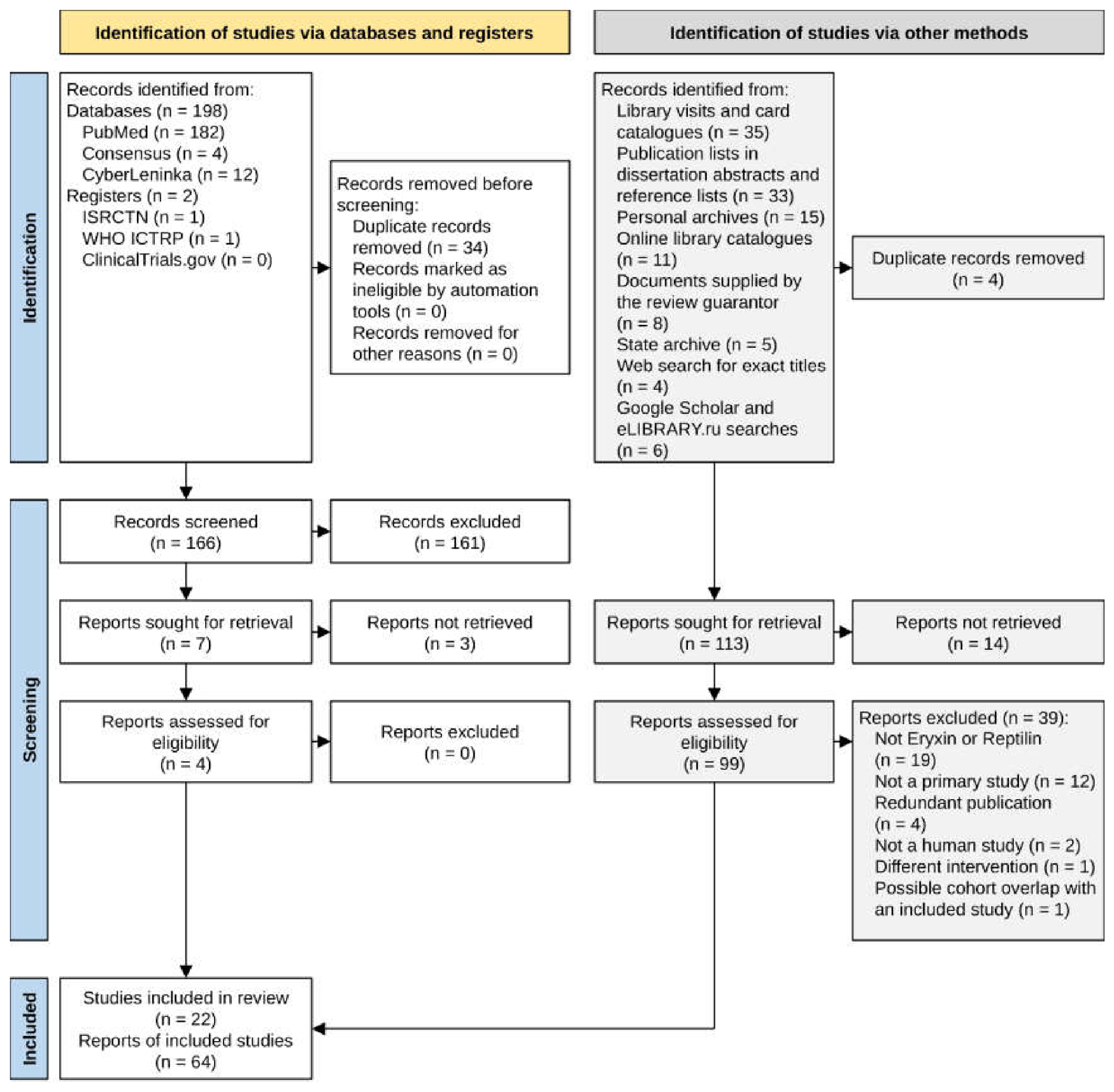

Table 1.
Characteristics of the 22 included studies.
| Study | Condition | Design | Treatment groups and reported n | Route and duration |
|---|---|---|---|---|
| Dzhalalova 2008 [9,10] | Chronic brucellosis | NRCT | Eryxin + CT 101; CT 86. | IV daily; 30 days. |
| Akhadova 2008 [11,12,13,14,15] | Brucellosis before/during pregnancy | NRCT | Non-pregnant: Eryxin 27, Immun-5 30, CT 26. Pregnant: Eryxin 20; Immun-5 and CT 22–23 each (report/table dependent). | IV twice daily; 40 days before pregnancy, 30–40 days after pregnancy week 20. |
| Nazarov 1998 (RPT-0066) | Chronic brucellosis | BA | Eryxin 10. | IV daily; 30 days. |
| Azimov 2007 [16,17,18,19,20] | Chronic hepatitis B | NRCT | BT + Eryxin 54; BT 26; BT + Immunomodulin 22. Outcome denominators vary. | IV daily; 30 days. Incompatible IM schedule also described. |
| Nazarov 1998 (RPT-0066) | Chronic viral hepatitis | BA | Eryxin 30 declared; 15/14 in the immunological before/after table. No comparator results. | IV daily; 30 days. |
| Mirzakhanova 2006 [21] | Rheumatoid arthritis | NRCT | BT 30; Eryxin alone 32; BT + Eryxin 39; + HRT 37; + HRT + prednisolone 38 (results unavailable). | IV daily; 30 days. Monotherapy dose unreported in available pages. |
| Saidova 1997 (RPT-0061) | Rheumatoid arthritis | BA | Eryxin 30 declared; 18 at weeks 2/4 in reported follow-up. No comparator described. | IV/IM; 21–28 inpatient days, continued to 42–49 days. |
| ISRCTN13331870 (2025) [22,23,24] | Rheumatoid arthritis | NRCT | Eryxin + MTX + tofacitinib 30 (28 completed); MTX + tofacitinib 30. Analysed n unreported. | Planned IV course, 30 days; registry and protocol schedules differ. Actual regimen unreported. |
| Akhmedov 2001 [25,26] | Systemic sclerosis | NRCT | Eryxin + CT 20; CT 16 (40 patients described overall). | IV daily; 21 days. |
| Porsokhonova 2004 [27,28,29,30] | Complicated chlamydial/ureaplasma infection | NRCT | Eryxin regimen 25; other regimens 74, 105 and 51. | IV twice daily; 30–45 days; antibiotics and Reptin cream. |
| Vaisov 2006 [31,32,33] | Male infertility associated with infection | NRCT | Eryxin + CT 48; CT 30. Semen follow-up pooled (56 men). | IV twice daily; 30 days. |
| Asrankulova 2004 [34,35,36,37,38,39,40]; RPT-0067 | Acute CMV infection in pregnancy | NRCT | Eryxin 31; Viusid 32; symptomatic treatment 33–38. Linked Reptilin report: 50 treated, 30 comparison. | IV twice daily; 20–45 days across reports. |
| Aripdzhanova 2007 [41] | HPV-associated cervical dysplasia | NRCT | Eryxin + Reptin cream 32; different immunomodulatory regimen 20. | IV for 45 days; vaginal Reptin cream for 14–16 days. |
| Abdullaeva 2009 [42,43,44] | Chronic pyelonephritis before/during pregnancy | NRCT | Before pregnancy: Eryxin 20, CT 30. Pregnancy: Eryxin before conception 20; Eryxin in trimester 2, 30; CT 30. | IV twice daily; 30 days. |
| Shodieva 2006 [45,46,47] | Chronic pelvic pain | NRCT | Dissertation: Wobenzym 19; Eryxin + physiotherapy 40; Eryxin + Wobenzym 13. Article: Eryxin 37; ibuprofen 31 (comparator excluded). | IV for 20 days; ultrasound and Reptin cream. Schedules differ across reports. |
| Kostsov 2010 (RPT-0065) | Chronic pelvic inflammatory disease | NRCT | Reptilin + BT 30; BT 20. | Reptilin IV twice daily; 30 days. |
| Khalilov 2009 [48] | Female infertility of inflammatory origin | NRCT | IV/intrauterine ozone + intrauterine Eryxin 42; IV ozone 37; neither 33. Outcome denominators unreported. | Intrauterine 1 mL daily; 10 days, with IV/intrauterine ozone. |
| Khasanova 2004 [2,49,50,51,52,53,54] | Generalised periodontitis | NRCT | Eryxin + CT 31; CT 32 (dissertation); articles describe other group structures. | IV for 10 days; topical solution also given. |
| Pulatov 2005 [55,56,57,58,59,60] | Unresectable primary liver cancer | NRCT | Chemotherapy + Eryxin 30; chemotherapy 54 (other reports: 23 or 29). | IV daily; 20 days; schedules differ across reports. |
| Ubaydullaev 1999 [61]; RPT-0062 | Chronic obstructive bronchitis | BA | Eryxin + BT 56; 43 declared controls without results. | IV daily; 28 days. |
| Ismailov 1998 (RPT-0062) | Destructive pulmonary tuberculosis | BA | Eryxin 27; comparison-group size/results unreported. | IV daily; 28 days. |
| Alyavi 1998 (RPT-0068, RPT-0069) | Mixed severe somatic disease | BA | Eryxin 30. | IM on day 1, then IV; 10–15 days. |
Eryxin was added to other treatment except in one arm of Mirzakhanova 2006. Most IV regimens used a 1% solution with stepwise dose escalation. CT denotes source-described conventional therapy; BT denotes background therapy.
Table 2.
Risk of bias for the prioritised outcome of each study.
| Study | D1 | D2 | D3 | D4 | D5 | D6 | D7 | Overall |
|---|---|---|---|---|---|---|---|---|
| A Controlled studies assessed with ROBINS-I 2016 | ||||||||
| Dzhalalova 2008 [9,10] | S | M | L | M | M | S | NI | Serious |
| Akhadova 2008 [11,12,13,14,15] | S | M | L | M | M | S | NI | Serious |
| Azimov 2007 [16,17,18,19,20] | S | M | L | M | M | S | NI | Serious |
| Mirzakhanova 2006 [21] | S | NI | M | NI | NI | S | S | Serious |
| ISRCTN13331870 (2025) [22,23,24] | S | M | L | NI | S | S | S | Serious |
| Akhmedov 2001 [25,26] | S | M | L | M | S | S | NI | Serious |
| Porsokhonova 2004 [27,28,29,30] | C | NI | L | NI | NI | S | S | Critical |
| Vaisov 2006 [31,32,33] | S | M | L | M | S | M | NI | Serious |
| Asrankulova 2004 [34,35,36,37,38,39,40] | S | NI | L | S | S | M | S | Serious |
| Aripdzhanova 2007 [41] | S | M | L | C | S | S | S | Critical |
| Abdullaeva 2009 [42,43,44] | S | M | M | M | S | S | NI | Serious |
| Shodieva 2006 [45,46,47] | C | S | L | S | S | S | S | Critical |
| Kostsov 2010 (RPT-0065) | S | M | L | NI | L | S | M | Serious |
| Khalilov 2009 [48] | S | NI | M | C | S | S | S | Critical |
| Khasanova 2004 [2,49,50,51,52,53,54] | S | S | L | L | L | M | S | Serious |
| Pulatov 2005 [55,56,57,58,59,60] | S | L | L | S | C | M | S | Critical |
| B Single-arm studies assessed with the NIH/NHLBI before–after tool | ||||||||
| Nazarov 1998 (brucellosis) (RPT-0066) | NIH/NHLBI tool | Poor | ||||||
| Nazarov 1998 (hepatitis) (RPT-0066) | NIH/NHLBI tool | Poor | ||||||
| Saidova 1997 (RPT-0061) | NIH/NHLBI tool | Poor | ||||||
| Ubaydullaev 1999 [61] | NIH/NHLBI tool | Poor | ||||||
| Ismailov 1998 (RPT-0062) | NIH/NHLBI tool | Poor | ||||||
| Alyavi 1998 (RPT-0068, RPT-0069) | NIH/NHLBI tool | Poor | ||||||
D1, confounding; D2, selection of participants; D3, classification of interventions; D4, deviations from intended interventions; D5, missing data; D6, measurement of outcomes; D7, selection of the reported result. L, low; M, moderate; S, serious; C, critical; NI, no information.
Table 3.
Summary of prioritised outcomes.
| Study and condition | Outcome and timing | Reported findings | Key limitation |
|---|---|---|---|
| A Controlled comparisons | |||
| Dzhalalova 2008 [9,10] Chronic brucellosis |
One-year relapse across eight subgroups | Lower with add-on Eryxin in five; similar in three. | No overall arm-level rate. |
| Akhadova 2008 [11,12,13,14,15] Brucellosis in pregnancy |
Hypoxia/preterm birth at delivery; miscarriage during pregnancy | Each listed complication was less frequent with Eryxin than with either comparator regimen. | Denominators differ elsewhere. |
| Azimov 2007 [16,17,18,19,20] Chronic hepatitis B |
ALT/AST after treatment | Lower with add-on Eryxin in both activity strata. | Group sizes differ between tables; printed units uncertain. |
| Mirzakhanova 2006 [21] Rheumatoid arthritis |
Stiffness, PIP circumference and articular index; day 30 | Values lower with Eryxin alone or add-on Eryxin than BT, and lowest with additional HRT. | Regimens differ; group V results unavailable. |
| ISRCTN13331870 (2025) [22,23,24] Rheumatoid arthritis |
DAS-28 and VAS pain; day 30 | Lower reported means with add-on Eryxin than with background therapy alone. | No between-group analysis; analysed n unreported. |
| Akhmedov 2001 [25,26] Systemic sclerosis |
Skin/Raynaud/articular scores; week 3 | Skin/Raynaud similar with and without Eryxin. | Articular value apparently misprinted. |
| Porsokhonova 2004 [27,28,29,30] Complicated chlamydial/ureaplasma infection |
Aetiological efficacy; day 10/six months | Higher with Eryxin at day 10; similar at six months. | Severity/regimens differ; topical Reptin included. |
| Vaisov 2006 [31,32,33] Male infertility associated with infection |
Cure after treatment; normospermia at 6–12 months | Cure 100% in both arms; normospermia 55.4% (31/56) in pooled follow-up subsample. | Semen results pooled across groups. |
| Asrankulova 2004 [34,35,36,37,38,39,40] CMV infection in pregnancy |
PCR negativity, days 30/45; congenital infection at birth | Clearance higher with Eryxin: day 45, 92.6% vs 89.6% (Viusid) and 70.4% (symptomatic treatment). Congenital infection least frequent with Eryxin. | Outcome denominators vary. |
| Aripdzhanova 2007 [41] HPV-associated cervical dysplasia |
HPV clearance/dysplasia regression, 2–6 months; HPV negativity, 2.5–3 years | HPV clearance 93.7% with Eryxin/cream vs none; long-term negativity described. | Regimens differ; regression comparator-only; long-term n unreported. |
| Abdullaeva 2009 [42,43,44] Chronic pyelonephritis |
Renal function after treatment; exacerbations during pregnancy | Renal measures favoured Eryxin; pregnancy exacerbations: none among 20 treated before conception, 12/30 treated in trimester 2, and 17/30 receiving conventional treatment. | Pregnancy groups differ in treatment timing and population. |
| Kostsov 2010, RPT-0065 Pelvic inflammatory disease |
“Biostimulating effect” (0–3), 30-day course | Reported with add-on Reptilin; absent with background therapy. | Open trial; subjective score, defined as 0 at baseline. |
| Khalilov 2009 [48] Female infertility |
Secretory endometrial transformation; following cycle | Transformation increased in both treated groups; identical untreated baseline/follow-up values were printed. | Eryxin inseparable from intrauterine ozone; biopsy n unreported; untreated follow-up unclear; no pregnancy outcome. |
| Khasanova 2004 [2,49,50,51,52,53,54] Generalised periodontitis |
Peripheral resistance, elasticity, tone and rheographic index; days 10–21 | More favourable with add-on Eryxin. | Instrumental indices; timing/groups differ between reports. |
| Pulatov 2005 [55,56,57,58,59,60] Primary liver cancer |
Tumour response (regression, stabilisation, progression); one month after discharge | Similar with and without Eryxin added to chemotherapy. | Outcome data: 23/30 and 37/54, respectively. |
| B Findings without a usable treatment comparison | |||
| Nazarov 1998, RPT-0066 Chronic brucellosis |
Pain, anaemia and inflammation; during/end of treatment | Rapid pain relief, prevention of anaemia and resolving inflammation claimed. | Single arm; qualitative only. |
| Nazarov 1998, RPT-0066 Chronic viral hepatitis |
Symptom resolution during treatment | Symptom resolution reportedly 7–10 days earlier; comparator data absent. | Uncontrolled; analysed n unreported. |
| Saidova 1997, RPT-0061 Rheumatoid arthritis |
Stiffness, inflamed joints and Ritchie index; week 4 or later | All decreased in the single-group series. | Analysed denominators unreported. |
| Shodieva 2006 [45,46,47] Chronic pelvic pain |
Pain absence, end of course | Eryxin with ultrasound and Reptin cream: 88.3% pain-free. | Controlled study; displayed result single-group after comparator exclusion. |
| Ubaydullaev 1999 [61] Chronic obstructive bronchitis |
Dyspnoea, sputum difficulty and night awakenings; week 4 | All decreased within the single-group series. | Declared controls’ results unreported. |
| Ismailov 1998, RPT-0062 Destructive pulmonary tuberculosis |
General condition, cough/sputum and fever; after treatment | Improvement reported; both symptom counts fell within single group. | No comparator results; response undefined; no radiological/bacteriological outcomes. |
| Alyavi 1998, RPT-0068/RPT-0069 Mixed severe somatic disease |
General condition/vitality by diagnosis; days 7–10/course | 80% improved; four unchanged; greater improvement described in renal failure/pyelonephritis. | Response definition/overlap with administration reactions unclear. |
Table 4.
Summary of adverse-event reports and reporting limitations.
| Safety finding | Study and cohort | Source-reported number | Essential qualification |
|---|---|---|---|
| Oral odour or taste | Reptilin 2010 (RPT-0065); systemic sclerosis, 2000 article [26]; bronchitis [61]; Reptilin 2004, pregnancy/gynaecological cohort (RPT-0067). | 2010: 30/30. Systemic sclerosis: “almost all” (cohort 25). Bronchitis: “practically all” (cohort 56). 2004: 100%, denominator unstated. | Source-specific frequencies; qualitative terms are not converted into counts. |
| Combined transient infusion symptoms | Registered trial [22]; Reptilin 2010 (RPT-0065). | Registered, Eryxin: 30/30, combined odour/tachycardia/dyspnoea entry. Reptilin 2010: 7/30, combined chest tightness/tachycardia/flushing/heat entry. | Components were not counted separately. Registered-trial symptoms reportedly resolved within one minute; the 2010 symptoms within 1–5 minutes. |
| Tachycardia and chest discomfort | Systemic sclerosis, 2000 article [26]; bronchitis [61]; Nazarov 1998, combined hepatitis/brucellosis cohorts (RPT-0066). | Tachycardia: systemic sclerosis, 7/25; bronchitis, 5/56; hepatitis/brucellosis, 1/40. Chest pain: hepatitis/brucellosis, 2/40. | Within-patient overlap was not reported; the combined hepatitis/brucellosis counts were not separated by condition. |
| Fever, chills and headache | Reptilin 2010 (RPT-0065); mixed somatic disease (RPT-0068); tuberculosis (RPT-0062). | 2010 fever/chills: 2/30. Somatic-disease pyrogenic reaction: 2/30. Tuberculosis: fever, 1/27; headache, 4/27. | 2010 fever/chills resolved within 5–6 hours. The somatic-disease reaction included chills, temperature to 38 °C and lumbar pain. Other reports described delayed fever without numerators. |
| Withdrawal or treatment refusal | Registered trial [22]; Reptilin 2010 (RPT-0065); systemic sclerosis [25,26]; tuberculosis (RPT-0062). | Registered, Eryxin: 2/30 (one GI symptoms; one worsening arthritis). Reptilin 2010: 0/30. Systemic sclerosis: two patients, arm unstated. Tuberculosis: 2/27. | Systemic sclerosis: rash. Tuberculosis: the source cited unpleasant oral odour and a temperature reaction. |
| Reported serious adverse events | Registered trial [22]. | Eryxin group: 0/30. Control group: 0/30. | These zero-event findings are specific to the registered trial, not the entire evidence base. |
| Events in background-treatment groups | Registered trial [22]; Reptilin 2010 (RPT-0065). | Registered controls: 4/30, nausea/weakness or raised blood pressure. 2010 controls: 4/20, nausea/dyspepsia. | The 2010 source attributed these GI events to background therapy. |
| Events during cancer treatment | Primary liver cancer [55,56,57,58,59,60]. | Chemotherapy-only group: hypercoagulation requiring discontinuation, 5/54; toxicity-related discontinuation, 3/54. Eryxin plus chemotherapy: thrombotic complications, 0/30. | Hypercoagulation and thrombotic complications are differently reported outcomes. Overlap between the two comparator counts was not reported. |
| Incompletely quantified or absent reporting | Brucellosis [9,10]; Reptilin 2004 (RPT-0067); hepatitis B [16,17,18,19,20], cervical dysplasia [41] and female infertility [48]. | Brucellosis exacerbation during Eryxin therapy: numerator unreported (cohort 101). The 2004 percentages lacked denominators. The other three studies provided no adverse-event/tolerability information. | Brucellosis exacerbation occurred on days 14–16. Some tolerability claims lacked event data; the 2004 report contradicted its own no-reactions statement. Absent reporting does not equal zero events. |
Unless specified otherwise, figures concern Eryxin/Reptilin recipients. Events can overlap within patients and across linked reports; counts must not be added. No pooled incidence or comparative safety effect was calculated.
Table 5.
Reporting gaps and institutional correspondence.
| Category | Extent | Selected examples and interpretation |
|---|---|---|
| A Reporting gaps and inconsistencies across linked reports | ||
| Declared comparator without results | 4 studies | Bronchitis: 43 controls described without outcomes [61]; controlled or comparative claims without comparator data in the 1997 rheumatoid arthritis report (RPT-0061), tuberculosis (RPT-0062) and viral hepatitis (RPT-0066). |
| Arm omitted from some reports | 3 studies | Immun-5 omitted from an Akhadova article; immunomodulin partly omitted from the hepatitis B dissertation; Viusid omitted from one CMV article. Other linked reports contained some of these results. |
| Unexplained differences between enrolled and reported numbers | 5 studies | Liver-cancer response reported for 23/30 and 37/54 patients [55,56,57,58,59,60]; changing table denominators in hepatitis B [16,17,18,19,20], and incomplete participant accounting in other reports. |
| Declared outcomes or time points unreported | — | Registered trial: intermediate time points removed after enrolment and several protocol outcomes unreported [22]. Pelvic pain: VAS follow-up absent [45,46,47]. Reptilin 2010: gynaecological examination and ultrasound findings absent (RPT-0065). |
| Incomplete numerical, arm-specific or denominator reporting | — | Male infertility: semen results pooled across arms [31,32,33]. Long-term HPV negativity: denominator unreported [41]. Pyelonephritis: identical measurements linked to different group sizes [42,43,44]. Reptilin 2004: event percentages without denominators (RPT-0067). |
| Unclear follow-up or claims without corresponding results | — | Female infertility: untreated follow-up biopsies not described despite printed follow-up values; improved results claimed without pregnancy outcomes [48]. Reptilin 2004: stated Eryxin comparison and some conclusion figures absent from results (RPT-0067). |
| B Institutional correspondence | ||
| Clinical use reported to the Pharmacological Committee | 7 replies | Institutional replies from July 2004 (RPT-0127–0133) described use beyond the included cohorts. These were self-reported treatment totals. Differences in clinical scope, periods and possible cohort overlap, and the distinction between routine care and research, prevent estimation of publication fractions or numbers of unpublished patients. |
At least one gap or inconsistency was recorded in 18 of 22 studies; none was identified in the available pages for three, and one was not assessable because relevant pages were unavailable.
Table 6.
Recorded certainty of evidence by condition.
| Condition or evidence summary | Studies and design | Main limitations of the available evidence | GRADE certainty |
|---|---|---|---|
| Chronic brucellosis | 3: 2 NRCTs; 1 single-arm | Serious risk of bias in controlled studies; small disease subgroups; qualitative single-arm findings. | Very low |
| Chronic viral hepatitis (B or unspecified) | 2: 1 NRCT; 1 single-arm | Serious risk of bias; enzyme outcomes; varying denominators and incomplete comparator data. | Very low |
| Rheumatoid arthritis | 3: 2 NRCTs; 1 single-arm | Serious risk of bias; differing regimens; registered trial lacked between-group analysis and analysed sample sizes. | Very low |
| Chronic pelvic inflammatory disease, including pelvic pain | 2 NRCTs | Serious/critical risk of bias; pelvic-pain comparator withdrawn from synthesis; subjective biostimulation score. | Very low |
| Unresectable primary liver cancer | 1 NRCT | Critical risk of bias; incomplete outcome reporting; short-term tumour response. | Very low |
| Chronic pyelonephritis before/during pregnancy | 1 NRCT | Serious risk of bias; pregnancy comparisons differ in timing and population. | Very low |
| Generalised periodontitis | 1 NRCT | Serious risk of bias; instrumental outcomes; group structures differ across reports. | Very low |
| Complicated chlamydial/ureaplasma infection | 1 NRCT | Critical risk of bias; disease severity and treatment regimens differ between groups. | Very low |
| Male infertility associated with infection | 1 NRCT | Serious risk of bias; semen outcomes pooled across treatment groups. | Very low |
| Acute CMV infection in pregnancy | 1 NRCT | Serious risk of bias; inconsistent group sizes and outcome-specific denominators. | Very low |
| Systemic sclerosis | 1 NRCT | Serious risk of bias; incomplete participant accounting; apparently misprinted articular value. | Very low |
| Chronic obstructive bronchitis | 1 single-arm | Poor NIH/NHLBI assessment; results of the declared comparator group unavailable. | Very low |
| Destructive pulmonary tuberculosis | 1 single-arm | Poor NIH/NHLBI assessment; no comparator results; undefined clinical response. | Very low |
| HPV-associated cervical dysplasia | 1 NRCT | Critical risk of bias; different co-interventions; long-term denominator unreported. | Very low |
| Mixed severe somatic disease | 1 single-arm | Poor NIH/NHLBI assessment; uncontrolled findings and undefined response. | Very low |
| Female infertility of inflammatory origin | 1 NRCT | Critical risk of bias; intrauterine ozone imbalance; unclear follow-up; no pregnancy outcome. | Very low |
| Adverse events (all conditions) | 22 studies; mixed designs | Inconsistent ascertainment, group attribution and denominators; limited follow-up. | Very low |
Certainty was summarised by condition and for adverse events; separate ratings were not assigned to individual outcomes, comparisons or follow-up times. Full profiles are in Online Resource 3.
Disclaimer/Publisher’s Note: The statements, opinions and data contained in all publications are solely those of the individual author(s) and contributor(s) and not of MDPI and/or the editor(s). MDPI and/or the editor(s) disclaim responsibility for any injury to people or property resulting from any ideas, methods, instructions or products referred to in the content. |
© 2026 by the authors. Licensee MDPI, Basel, Switzerland. This article is an open access article distributed under the terms and conditions of the Creative Commons Attribution (CC BY) license.
Copyright: This open access article is published under a Creative Commons CC BY 4.0 license, which permit the free download, distribution, and reuse, provided that the author and preprint are cited in any reuse.