

Submitted:
03 November 2026
Posted:
06 November 2026
You are already at the latest version
Abstract
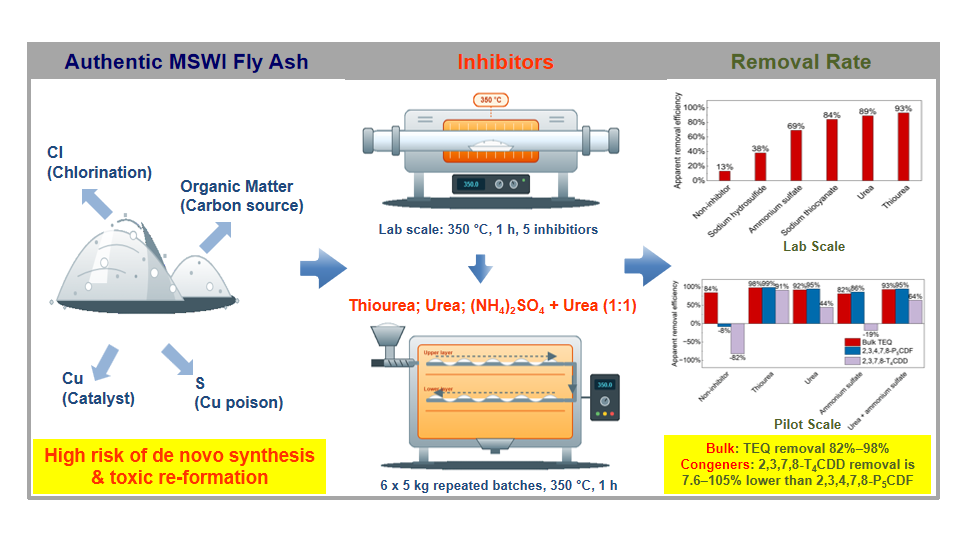
Low-temperature pyrolysis for detoxifying municipal solid waste incineration (MSWI) fly ash is hindered by the synthesis of polychlorinated dibenzo-p-dioxins and dibenzofurans (PCDD/Fs). In this study, we evaluated the inhibitory effects of nitrogen- and sulfur-based agents on PCDD/F formation using authentic MSWI fly ash through bench-scale screening and 30-kg repeated-batch pilot-scale experiments. Fly ash with high chlorine and organic-matter contents proved highly susceptible to de novo synthesis, triggering severe toxicity rebound. Among single inhibitors, thiourea exhibited the highest removal efficiency (98%) but lacked economic viability for full-scale application. To balance cost and performance, an ammonium sulfate–urea composite inhibitor (1:1 mass ratio) was developed and tested under repeated-batch pilot-scale conditions. This composite inhibitor achieved a 93% toxic equivalent quantity (TEQ) solid-phase apparent removal efficiency while effectively suppressing high-toxicity congeners. Cost estimation demonstrated that this approach reduced reagent expenses by nearly 87%, overcoming the limitations of single-element inhibitors in complex high-chlorine matrices. Across the inhibitor treatments in the pilot-scale tests, however, removal of the highest-TEF congener 2,3,7,8-T4CDD lagged 7.6%–105% behind that of 2,3,4,7,8-P5CDF, indicating that lowering bulk TEQ and eliminating the most toxic congener are not equivalent goals. These findings provide a practical and scalable strategy for the safe thermal treatment of MSWI fly ash.
Keywords:
municipal solid waste incineration (MSWI)
; fly ash
; low-temperature pyrolysis
; polychlorinated dibenzo-p-dioxins and polychlorinated dibenzofurans
; S–N-containing inhibitor
1. Introduction
Municipal solid waste incineration (MSWI) fly ash containing toxic contaminants such as polychlorinated dibenzo-p-dioxins and dibenzofurans (PCDD/Fs) accounts for the largest volume of hazardous waste disposed of in landfills in China [1]. Improper disposal may result in the release of PCDD/Fs into the environment, posing severe risks to ecosystems and human health [2,3,4]. To address this issue, the Ministry of Ecology and Environment of China formally designated low-temperature pyrolysis as a viable technology for environmentally sound fly ash management in its 2020 technical specifications [5]. Compared with conventional high-temperature melting, low-temperature pyrolysis has prominent advantages, such as lower theoretical energy consumption, a smaller footprint, reduced equipment wear, and negligible secondary pollution, thereby attracting substantial research attention in recent years [6,7].
During low-temperature pyrolysis, temperature and oxygen concentration act as critical determinants governing the degradation and formation of PCDD/Fs. Under strictly anoxic conditions, the 250–400 °C range serves as a highly efficient degradation window for PCDD/Fs [8,9]. Conversely, when the pyrolysis temperature drops below 200 °C, the formation rate far outpaces the degradation rate. In this regime, highly chlorinated PCDD/Fs are susceptible to incomplete dechlorination, culminating in the formation of lower-chlorinated, highly toxic dioxin congeners [10,11]. Maintaining a strictly oxygen-free environment—typically requiring continuous purging with high-purity inert gases—significantly increases both energy consumption and capital investment. In practical engineering applications, localized micro-aerobic zones inevitably form, providing favorable conditions for the secondary formation of PCDD/Fs [12]. Under such micro-aerobic conditions, active metal species inherent to the fly ash, particularly Cu, catalyze the Deacon reaction. This process oxidizes hydrogen chloride or chloride salts to generate highly reactive free chlorine (Cl2) [13]. This Cl2 subsequently attacks the organic carbon skeleton via electrophilic substitution, yielding chlorinated aromatic intermediates that ultimately trigger the secondary formation of PCDD/Fs [7,14]. Oxygen plays a detrimental dual role here: it not only induces the Deacon reaction but also disrupts the reducing atmosphere of the system. This disruption impairs the dechlorination and degradation pathways of PCDD/Fs, occasionally resulting in a net increase in toxic equivalent (TEQ) after treatment [15]. Therefore, reducing the dependence of low-temperature pyrolysis on stringent temperature controls and absolute anoxic conditions—while stabilizing PCDD/F removal efficiency under realistic operational scenarios—will lay essential theoretical and technical foundations for the diversified development of the MSWI fly ash co-disposal industry.
To block the secondary formation pathways of PCDD/Fs, chemical inhibitors, particularly sulfur- or nitrogen-based agents, are commonly utilized. Upon heating, sulfur-based inhibitors release elemental sulfur (S), which reduces highly active Cu(II) to lower-valent copper or forms copper sulfide species (e.g., Cu2S, CuS). This process effectively “poisons” the metal catalytic sites [14], thereby severing the catalytic pathway for active chlorine generation. Concurrently, elemental S can directly scavenge free chlorine through reduction reactions [16]. For instance, under ideal laboratory conditions, the sulfur-based agent Na2S has been shown to reduce PCDD/F formation by 80%–90% [17]. Alternatively, nitrogen-based inhibitors release nitrogen-containing species upon thermal decomposition. These species not only consume free chlorine and organic precursors via acid–base neutralization but also form coordination complexes with surface metal catalytic sites, effectively hindering the generation of active chlorine [16]. Furthermore, S–N-based inhibitors containing both sulfur and nitrogen (e.g., thiourea) exert their effects through a synergistic “dual-blocking” mechanism. In low-temperature pyrolysis experiments using simulated fly ash, thiourea demonstrated a 99.8% inhibition efficiency against the formation of chlorinated aromatics [18]. However, its relatively high cost restricts its widespread application in full-scale industrial operations.
At present, the practical performance of sulfur-, nitrogen-, and S–N-based inhibitors under continuous operational conditions remains subject to considerable uncertainty. First, the majority of experimental studies have relied on simulated fly ash. In reality, real MSWI fly ash is characterized by highly complex compositions and pronounced heterogeneity [3,19], exhibiting substantial discrepancies in morphology, elemental composition, and physicochemical properties compared to simulated counterparts [20]. Furthermore, continuous production facilities differ significantly from laboratory-scale apparatuses across multiple engineering parameters, including material conveyance, heating modes, heat transfer characteristics, gas atmospheres, and cooling configurations. Consequently, it is imperative to evaluate the actual performance of various inhibitors using actual fly ash samples under pilot-scale operating conditions.
In this study, multiple real fly ash samples were collected from representative municipal solid waste incineration (MSWI) plants across China. By characterizing changes in fly ash morphology and chemical composition before and after low-temperature pyrolysis, this research elucidates the key physicochemical properties controlling PCDD/F removal efficiency. Various inhibitors were systematically screened to obtain high-efficiency candidates, and their practical performance was further tested in a pilot-scale repeated-batch processing apparatus. Ultimately, this work aims to provide an experimental basis for full-scale deployment of low-temperature pyrolysis for MSWI fly ash treatment.
2. Materials and Methods
2.1. Source of Fly Ash Samples
Real fly ash samples (FA1–FA4, Figure 1), previously subjected to washing and drying processes, were obtained from Wuhu Luzhou Environmental Protection Energy Co., Ltd. Specifically, FA1 was utilized for the laboratory-scale screening of inhibitors. FA2 and FA3 were employed for the comparative analysis of basic physicochemical properties. FA4 was dedicated to the 30 kg-scale repeated-batch processing experiment (six sequential batches of 5 kg each). The industrial washing and drying pretreatment process for these samples was conducted as follows: raw fly ash and washing water were thoroughly mixed in a slurry tank, with each washing stage lasting approximately 30 min. Solid–liquid separation for the first and second washing stages was achieved using a centrifuge, whereas a filter press was employed for deep dewatering after the third washing stage. The resulting fly ash filter cake was subsequently treated in a steam dryer with a heat source temperature ranging from 200 to 230 °C. As the evaporation of moisture absorbed a substantial amount of latent heat of vaporization, the actual heating temperature of the fly ash material remained between 100 and 120 °C, thereby preventing the secondary formation of PCDD/Fs. Consequently, the initial PCDD/F content in these fly ash samples was primarily determined by the composition of the raw municipal solid waste and the specific incineration process.
2.2. Low-Temperature Pyrolysis Experiments
Tube furnace heating experiments (Figure S1a): Specifically, 60 g of each fly ash sample (FA1–FA3) was accurately weighed, mixed with 0.6 g of an inhibitor (1 wt.%, including thiourea, urea, sodium thiocyanate, ammonium sulfate, or sodium hydrosulfide), homogenized, spread evenly in a quartz boat, and placed into the constant-temperature zone of a tube furnace (OTF-1200XΦ80, Hefei Kejing, China). To simulate practical treatment conditions, no inert purge gas was introduced. The experimental temperature was set to 350 °C, the temperature commonly adopted in conventional low-temperature pyrolysis tests [10], to reduce energy consumption in subsequent scale-up experiments.
The tube furnace was heated to 350 °C within 20 min and maintained at this temperature for 1 h. As the formation rate of PCDD/Fs outpaces their degradation rate at temperatures below 200 °C—a condition that favors the generation of lower-chlorinated, highly toxic congeners [10,11]—a rapid cooling protocol was immediately initiated upon reaction completion. The temperature was reduced to below 50 °C within 40 min to minimize the residence time of the fly ash in this low-temperature zone. Once cooled to room temperature, the samples were retrieved and stored in sealed containers. Each experiment was performed in triplicate. The three replicate samples were individually analyzed for conventional physicochemical parameters, such as organic matter and heavy metals. Equal portions of the three replicates were homogeneously blended into one composite sample for PCDD/F analysis. This composite was analyzed in duplicate, that is, two subsamples were carried independently through the whole isotope-dilution HRGC-HRMS procedure described in Section 2.3, and the arithmetic mean of the two parallel determinations is reported.
Repeated-batch small-scale pilot experiments using a double-layer drying furnace (Figure S1b): For each inhibitor treatment, 30 kg of fly ash sample FA4 was accurately weighed and mixed with 0.9 kg of the inhibitor. Considering that the heat transfer and material mixing efficiencies of scaled-up equipment are lower than those of laboratory-scale apparatuses, the inhibitor dosage was increased to 3 wt.% to ensure sufficient contact between the inhibitor and the fly ash. For the 1:1 ammonium sulfate and urea composite inhibitor, 0.45 kg of ammonium sulfate and 0.45 kg of urea were added. After thorough mixing, the material was equally divided into six batches (each containing 5 kg of fly ash). These batches were fed one after another via a screw feeding system into the constant-temperature zone of the double-layer drying furnace, which had been preheated to 350 °C, for tumbling pyrolysis treatment. By adjusting the frequency of the screw conveyor, the average residence time of the material was maintained at 1 h. During the experiment, the discharged materials from all six batches were fully collected and weighed to calculate the overall mass retention rate of the system (based on the initial feed mass, m0 = 30 kg). However, for subsequent PCDD/F compositional analysis, to eliminate interference from residual materials of previous experiments trapped in furnace dead zones and the conveying mechanism, no sample was taken from batches 1–3, only the discharged materials from batches 4–6—collected after the system had reached a steady state—were retained. These three batches were cooled to room temperature and homogeneously blended into one composite sample, which was subsequently analysed in duplicate, and the arithmetic mean of the two parallel determinations is reported.
2.3. Determination of PCDD/Fs
The 17 PCDD/F congeners (Table S1) were determined in accordance with the Chinese standard method HJ 77.3-2008 (Solid Waste—Determination of polychlorinated dibenzo-p-dioxins and polychlorinated dibenzofurans—Isotope dilution HRGC-HRMS) [21]. Briefly, the samples were spiked with 13C-labeled extraction internal standards, treated with hydrochloric acid, and subjected to Soxhlet extraction with toluene to yield a crude extract. This extract was subsequently purified via a multilayer silica gel column and an alumina column to remove matrix interferences. Following concentration, the samples were spiked with 13C-labeled injection standards. Qualitative and quantitative analyses were conducted using a high-resolution gas chromatography system equipped with a DB-5ms capillary column coupled to a double-focusing magnetic sector high-resolution mass spectrometer (HRMS). The HRMS was operated in selected ion monitoring mode with a resolving power greater than 10,000. Finally, the total toxic equivalent quantity (TEQ) of the samples was calculated based on the International Toxicity Equivalency Factor (TEF) of each congener [22].
Quality control procedures were strictly implemented in accordance with HJ 77.3-2008. One method blank was prepared for each batch of samples. The concentrations of all target PCDD/F congeners in the blanks were below the method detection limits (MDLs), confirming no exogenous contamination during the analytical process. The recoveries of the 13C-labeled extraction internal standards ranged from 50% to 120%, falling well within the acceptable range specified by the standard. The MDLs for individual PCDD/F congeners in the fly ash matrix ranged from 0.06 to 0.2 ng·kg-1, and the MDL for 2,3,7,8-T4CDD was below 0.08 ng·kg-1. For TEQ calculation, non-detected (ND) congeners with concentrations below the MDL were assigned a value of one-half the MDL (1/2 MDL). For target congeners with detected concentrations greater than three times the MDL, the arithmetic mean of the two parallel determinations is reported. The relative percent difference between the two determinations was below 13% for every pair, within the criterion specified for parallel determinations in HJ 77.3-2008 [21].
2.4. Elemental and Morphological Characterization of Fly Ash Samples
The pre- and post-pyrolysis fly ash samples were sieved through a 200-mesh sieve. Briefly, 5 g of the sieved sample was weighed into a powder sample ring and pressed into a pellet using a hydraulic press. Residual loose powder on the pellet surface was gently removed with a rubber dust blower, after which the pellet was placed in a sample holder. Quantitative analysis was performed using an X-ray fluorescence (XRF) spectrometer (ZSX Primus III NEXT, Rigaku, Japan) in accordance with the Chinese standard HJ 780-2015 (Soil and Sediment—Determination of Inorganic Elements—Wavelength Dispersive X-ray Fluorescence Spectrometry) [23] and relevant literature [24]. The analytical results were expressed as mass fractions (wt.%) of elements or their corresponding oxides.
For morphological observation, a trace amount of fly ash sample was uniformly dispersed onto conductive carbon tape. The sample was then sputter-coated with gold for 45 s at a current of 10 mA using a Quorum SC720 sputter coater. Morphological imaging was conducted using a scanning electron microscope (SEM; ZEISS Sigma 300, Carl Zeiss, Germany). The instrument was operated at an accelerating voltage of 3 kV and a working distance of 6.4 mm. A secondary electron (SE2) detector was used, and images were acquired at a magnification of 20,000×.
2.5. Determination of Organic Matter
The organic matter content in the fly ash samples was determined using the loss on ignition (LOI) method, in accordance with the Chinese standard HJ 761-2015 [25]. Briefly, a porcelain crucible was pre-ignited at 600 ± 20 °C to a constant weight (defined as a mass difference of ≤ 0.001 g between two consecutive weighings). Approximately 1 g of the sample was weighed using an analytical balance, spread evenly in the crucible, and dried at 105 ± 5 °C for 1 h. Upon removal, the sample was transferred to a desiccator, cooled to room temperature, and weighed. This drying procedure was repeated at 30-min intervals until a constant weight was achieved.
Subsequently, 0.5 g of the dried sample was evenly spread in a porcelain crucible, covered with a lid, and ignited in a tube furnace at 600 ± 20 °C for 3 h. The sample was allowed to cool in the air for 5 min, transferred to a desiccator to reach room temperature, and weighed. This ignition process was similarly repeated at 30-min intervals until the weight remained constant.
The organic matter content was calculated based on the mass difference before and after ignition using Eq. (1):
where, w is the organic matter content of the sample on a dry basis (wt.%); m0 is the total mass of the crucible and the dried fly ash sample prior to ignition (g); m1 is the total mass of the crucible and the residual ash after ignition (g); m is the net mass of the dried fly ash sample (g).
2.6. Calculation of Solid-Phase Apparent Removal Efficiency
During the pyrolysis process, PCDD/Fs in fly ash may undergo secondary formation or be removed via thermal degradation and volatilization. Concurrently, the decomposition or volatilization of components such as organic matter and chloride salts results in mass reduction of the residual solid phase. Therefore, to account for this mass variation, the apparent removal efficiency of TEQ or a specific component was calculated using Eq. (2) and Eq. (3), respectively:
where, TEQ1 is the total toxic equivalent quantity of PCDD/Fs in the solid residue after pyrolysis (ng·kg-1); TEQ0 is the total toxic equivalent quantity of PCDD/Fs in the raw fly ash (ng·kg-1); C1 is the concentration of a specific component in the solid residue after pyrolysis (mg·kg-1 or wt.%); C0 is the concentration of the specific component in the raw fly ash (mg·kg-1 or wt.%); m1 is the mass of the residual solid after pyrolysis (g); m0 is the mass of the fly ash prior to pyrolysis (g).
3. Results
3.1. Morphology and Chemical Composition of Fly Ash
The microscopic morphologies of fly ash samples FA1–FA3 are illustrated in Figure 2. Before pyrolysis, FA1 was composed of large, irregularly shaped agglomerates, exhibiting a rough and uneven surface (Figure 2a). FA2 consisted of fine, irregular agglomerates with a relatively loose structure (Figure 2c). In contrast, the surface of FA3 was relatively smooth, presenting a dense, block-like structure (Figure 2e). This observation aligns with the findings of Shrivastava et al. [26] regarding typical dense fly ash from high-temperature zones. Such dense structures result from the cooling and solidification of localized components in the fly ash following high-temperature melting.
After pyrolysis, a large number of fine particles and distinct rod-like crystalline structures formed on the surface of FA1 (Figure 2b). Based on the results of SEM-EDS elemental mapping (Figure S2) and XRD characterization (Figure S3), these rod-like substances were confirmed to be inorganic calcium sulfate (CaSO4) crystals with high thermal stability. The morphology of FA2 remained largely unchanged (Figure 2d). However, the dense, block-like structure of FA3 underwent fragmentation, with numerous small particles appearing on its surface (Figure 2f).
The BET results (Table S2) revealed that FA2 exhibited the highest specific surface area (6.83 m2·g-1), total pore volume (0.046 cm3·g-1), and average pore diameter (26.91 nm), followed by FA1 (5.31 m2·g-1, 0.023 cm3·g-1, and 17.46 nm, respectively). In contrast, FA3 exhibited a significantly lower specific surface area (2.66 m2·g-1) and total pore volume (0.0095 cm3·g-1) than the other two samples, along with the smallest average pore diameter (14.25 nm). This observation aligns well with its dense surface structure. Previous studies have demonstrated that well-developed porosity and a loose morphology facilitate heat transfer and the diffusion of internal volatile components. Conversely, a dense surface structure may hinder the interaction between internal reaction sites and the gas phase [27,28].
The initial TEQ and the contents of Cu, Cl, S, and organic matter in the fly ash samples were depicted in Figure 3a–d, while the contents of the remaining metal elements or corresponding oxides were detailed in Table S3 and Table S4. The initial TEQ of FA1 was 220 ng·kg-1, significantly higher than those of FA2 (48 ng·kg-1) and FA3 (70 ng·kg-1). Regarding metallic components, the Cu content of FA2 (626.3 ± 3.4 mg·kg-1) was notably higher than that of FA1 (329.7 ± 5.2 mg·kg-1) and FA3 (477.0 ± 3.6 mg·kg-1). Cu at such a high concentration may serve as a key catalytic species for the de novo synthesis of PCDD/Fs [14], increasing the difficulty of detoxification during thermal treatment. In terms of precursors (Figure 3c,d), FA1 had the highest Cl and organic matter contents, reaching 77271 ± 5768 mg·kg-1 and 10.4 ± 1.8 wt.%, respectively. In contrast, FA2 exhibited an exceptionally low chlorine content (466 ± 23 mg·kg-1). The organic matter contents of FA2 and FA3 were highly comparable, at 3.8 ± 0.74 wt.% and 3.8 ± 0.50 wt.%, respectively.
3.2. Effect of Low-Temperature Pyrolysis on the Chemical Composition of Fly Ash
For the non-inhibitor group, the changes in mass concentrations and apparent removal efficiencies of PCDD/F congeners are illustrated in Figure S4. Following pyrolysis, the mass concentrations of PCDD/F congeners in FA2 and FA3 decreased by 81%–100% and 76%–98%, respectively. Conversely, four polychlorinated dibenzofuran (PCDF) congeners in FA1 showed elevated mass concentrations. Notably, the mass concentration of 1,2,3,4,6,7,8-H7CDF increased to approximately 3.8 times that of the raw fly ash (from 180 ng·kg-1 to 680 ng·kg-1), yielding an apparent removal efficiency of −261%. Similarly, the apparent removal efficiencies for 1,2,3,4,7,8-H6CDF, 2,3,4,6,7,8-H6CDF, and 1,2,3,6,7,8-H6CDF were −81%, −77%, and −27%, respectively. Although the mass concentrations of the remaining congeners in FA1 decreased by 29%–87%, its overall detoxification performance was far inferior to that of FA2 and FA3. Previous studies have demonstrated that secondary formation dominated by PCDFs is a distinct characteristic of the de novo synthesis pathway [29,30[]. The TEQ of FA2 decreased from 48 ng·kg-1 to 1.5 ng·kg-1, achieving an apparent removal efficiency of 97%. This was followed by FA3, which exhibited a TEQ apparent removal efficiency of 83%. In contrast, the TEQ of FA1 only decreased marginally from 220 ng·kg-1 to 200 ng·kg-1, corresponding to a mere 13% apparent removal efficiency (Figure 3a).
Following pyrolysis, the residual masses of the fly ash samples were 57.34 g, 59.12 g, and 58.49 g for FA1, FA2, and FA3, respectively, corresponding to mass loss rates of 4.4%, 1.5%, and 2.5%. Pyrolysis resulted in a decrease in the organic matter contents of FA3, FA1, and FA2 by 67%, 54%, and 43%, respectively (Figure 3d). Unburned organic carbon originating from upstream incineration is ubiquitously present in fly ash. During the initial stage of low-temperature pyrolysis, the residual oxygen in the system induced incomplete oxidative cracking of this carbon, releasing CO and CO2 [29], which accounted for the decline in organic matter content. The fragmentation of the carbon skeleton generated small-molecule carbon. This process not only provided active organic carbon sources for the de novo synthesis of PCDD/Fs but also exposed metal catalytic sites (e.g., Cu) that were previously encapsulated within the carbon layers [30]. Although the organic matter removal efficiency of FA1 (54%) was lower than that of FA3, its high initial organic content resulted in a large consumption of organic carbon, thereby providing abundant small-molecule substrates and catalytic sites for de novo synthesis. By contrast, the content of Cl, which is essential for PCDD/F synthesis, exhibited no significant variation before and after pyrolysis (Figure 3c). This phenomenon can be attributed to two factors: first, chlorine in fly ash predominantly exists as crystalline salts such as KCl or NaCl[19], which resisted thermal decomposition and volatilization at 350 °C; second, the Cl involved in the de novo synthesis of PCDD/Fs was retained within the solid sample, resulting in a negligible apparent change in the solid-phase Cl content.
Following pyrolysis, the contents of Cu and S in FA2 increased from 626.3 ± 3.4 mg·kg-1 and 3290 ± 10.0 mg·kg-1 to 639.2 ± 8.2 mg·kg-1 and 3650 ± 30.0 mg·kg-1, respectively (Figure 3b and Figure 3c). Given the mass loss of the fly ash during pyrolysis, mass-balance calculations revealed that the absolute masses of Cu and S in the solid phase apparently increased by 0.6% and 9.3%, respectively. Conversely, the contents of Cu and S in the solid phases of FA1 and FA3 decreased significantly. Specifically, in FA1, Cu and S dropped from 329.7 ± 5.2 mg·kg-1 to 280.0 ± 1.0 mg·kg-1 and from 51662 ± 859 mg·kg-1 to 45133 ± 252 mg·kg-1, respectively. In FA3, they decreased from 477.0 ± 3.6 mg·kg-1 to 336.0 ± 0.7 mg·kg-1 and from 29251 ± 331 mg·kg-1 to 28400 ± 265 mg·kg-1, respectively. These reductions corresponded to apparent removal efficiencies of 19% and 16% for FA1, and 31% and 5.4% for FA3. This was primarily because FA1 and FA3 exhibited high organic matter removal efficiencies of 54% and 67%, respectively. The decomposition of the organic carbon skeleton exposed a substantial amount of previously encapsulated Cu and S, which could subsequently be transformed into highly volatile forms—such as copper chlorides and gaseous sulfur-containing species—and escape from the system [31,32,33]. By contrast, FA2 presented the lowest organic matter removal efficiency, resulting in less volatilization loss of Cu and S. Superimposed with the “matrix concentration effect” induced by the mass loss of the fly ash, this led to a slight increase in their apparent contents.
FA1 exhibited the highest contents of organic matter (10.4 ± 1.8 wt.%) and chlorine (7.7 ± 0.58 wt.%). This abundant supply of precursors for de novo synthesis consequently led to the lowest TEQ apparent removal efficiency. Although the organic matter contents of FA2 and FA3 were highly comparable, FA3 had a substantially higher chlorine content (42592.6 mg·kg-1, approximately 4.26 wt.%). In contrast, FA2 exhibited an exceptionally low chlorine content (465.8 mg·kg-1)—approximately 1/90 of that in FA3. Lacking the chlorine source essential for de novo synthesis, FA2 achieved the highest TEQ apparent removal efficiency. Although Cu serves as a crucial catalyst for the de novo synthesis of PCDD/Fs[34,35], its catalytic role is intrinsically constrained by the availability of key precursors. Despite having the highest Cu content (626.3 ± 3.4 mg·kg-1), FA2 did not exhibit significant de novo synthesis due to its chlorine deficiency. Therefore, an analysis of the contents and variations of these key components revealed that the TEQ apparent removal efficiency was more strongly correlated with the contents of precursors (organic matter and Cl) required for de novo synthesis.
Although a portion of unstable sulfur (e.g., organic sulfur) volatilized during pyrolysis, the vast majority of sulfur in the fly ash existed as stable inorganic sulfates (such as CaSO4). SEM-EDS elemental mapping revealed that S coexisted with highly abundant Ca and O (Figure S2). Furthermore, XRD characterization demonstrated that the characteristic diffraction peak of CaSO4 at 2θ ≈ 25.4° exhibited no significant alteration before and after pyrolysis (Figure S3). Under low-temperature pyrolysis conditions, such inorganic sulfates failed to release sufficient active sulfur to passivate the Cu catalytic sites [36]. Consequently, although FA1 possessed the highest endogenous sulfur content (51662 ± 859 mg·kg-1) among the three samples, pronounced de novo synthesis still occurred due to the lack of effective sulfur passivation, coupled with an abundant supply of precursors.
3.3. Effects of Inhibitors on the Pyrolysis Process
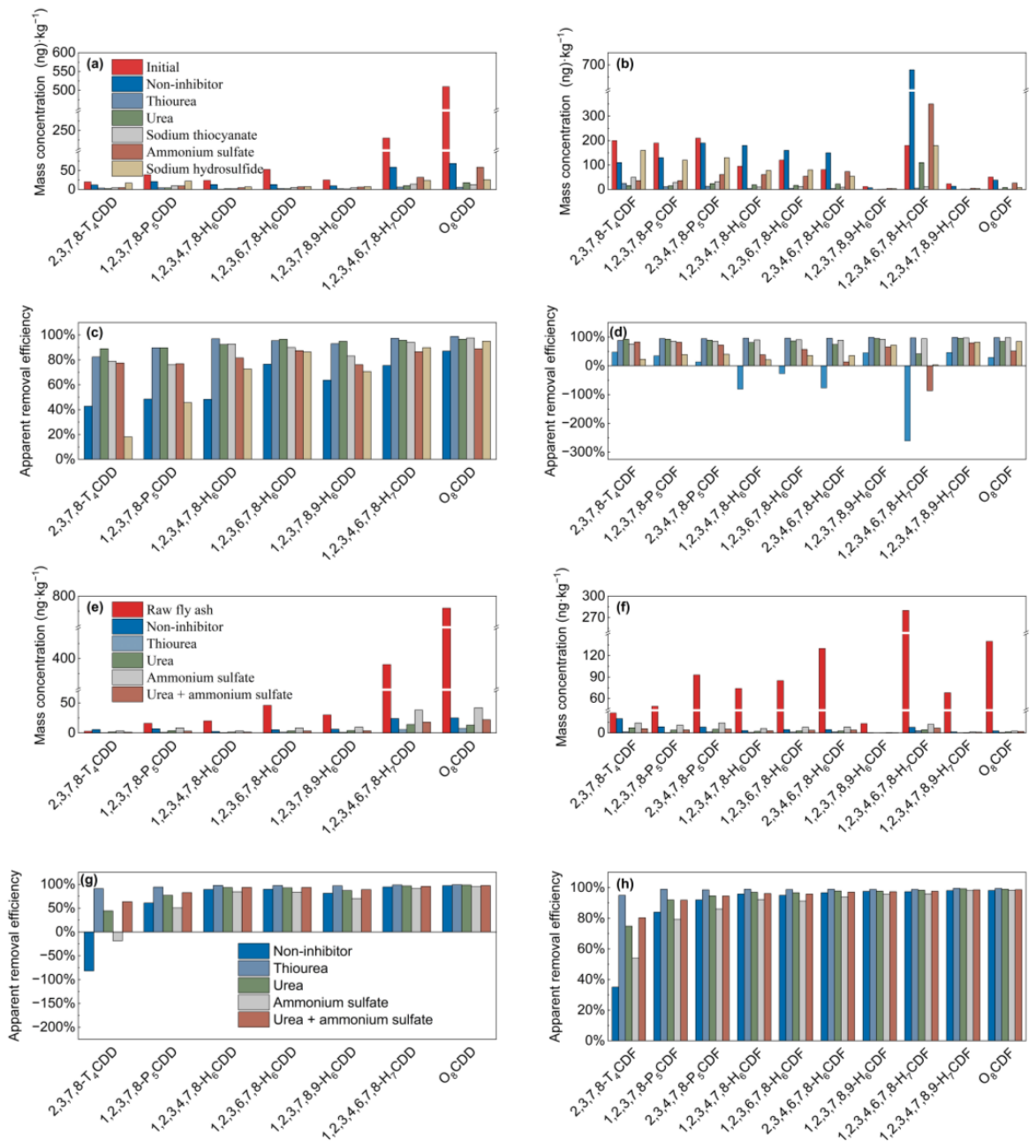
The effects of five distinct inhibitors on the pyrolysis process were evaluated using FA1 as a representative sample. The TEQ apparent removal efficiencies are illustrated in Figure 3e, while the mass concentrations and apparent removal efficiencies of individual congeners are depicted in Figure 4a–d. With the exception of 1,2,3,4,6,7,8-H7CDF in the ammonium sulfate treatment, which exhibited an apparent removal efficiency of −87% (compared to −261% in the non-inhibitor group), the apparent removal efficiencies for the vast majority of congeners across the other inhibitor treatments were greater than zero. These results indicated that the de novo synthesis of PCDD/Fs was effectively suppressed. Following the addition of inhibitors, the TEQ apparent removal efficiencies decreased in the following order: 93% (thiourea), 89% (urea), 84% (sodium thiocyanate), 69% (ammonium sulfate), and 38% (sodium hydrosulfide).
Thiourea and urea, both being organic inhibitors characterized by relatively low thermal decomposition temperatures, exhibited superior inhibitory effects on the de novo synthesis of PCDD/Fs. Notably, thiourea not only controlled the mass concentration of 1,2,3,4,6,7,8-H7CDF—a congener highly susceptible to de novo synthesis—at a mere 5.4 ng·kg-1, which was far lower than the levels in the urea treatment (110 ng·kg-1) and the non-inhibitor group (680 ng·kg-1), but also achieved apparent removal efficiencies exceeding 82% for high-TEF congeners (e.g., 2,3,4,7,8-P5CDF, 1,2,3,7,8-P5CDD, and 2,3,7,8-T4CDD). This performance can be primarily attributed to the synergistic dual-element (N–S) mechanism within the thiourea molecule [37]. Acting as a soft base, the active organic sulfur in thiourea can effectively passivate the copper catalytic sites on the fly ash surface, thereby cutting off the supply of active chlorine at the source [18]. Simultaneously, the organic nitrogen-containing groups can form a protective layer on the surface of unburned carbon, restricting the condensation of organic carbon precursors [16]. Furthermore, SO2 and NH3 released during the thermal decomposition of thiourea can consume active chlorine (Cl2) via reduction and acid-base reactions, respectively, converting it into HCl or NH4Cl [14]. This gas-phase depletion further mitigates the chlorination of organic carbon.
In contrast, urea primarily inhibits the de novo synthesis of PCDD/Fs by releasing NH3 upon heating. NH3 can undergo coordination complexation with metal chlorides (e.g., Cu) to form stable copper-ammine complexes, thereby blocking the Deacon reaction and severing the generation pathway of active chlorine sources [38]. Simultaneously, nitrogen-containing groups can competitively adsorb onto the metal catalytic sites on the fly ash surface, reducing the density of active sites for catalytic chlorination reactions [39]. Driven by these mechanisms, the apparent removal efficiency of 2,3,4,7,8-P5CDF increased from 14% in the non-inhibitor group to 89% (Figure 4d).
However, Ren et al. [40] investigated simulated fly ash using an SiO2 support spiked with aromatic hydrocarbons (e.g., dibenzo-p-dioxin, dibenzofuran, or naphthalene), 0.5 wt.% Cu/Fe, and 10 wt.% NaCl. Upon heating at 300 °C, they observed that NH3 released from urea pyrolysis could complex with metal chlorides (e.g., FeCl3) to form double salts such as (NH4)2FeCl5·H2O. This complexation prevented the conversion of these metals into low-activity iron oxides. Consequently, the fly ash retained its surface catalytic capacity for precursor condensation and cyclization, ultimately increasing the formation of mono- and low-chlorinated aromatic congeners. Therefore, they proposed that urea’s inhibitory mechanism alone may have limitations when applied to complex matrices with high chlorine and metal contents.
In the present study, the Fe2O3 content of FA1 was 1.46% (Table S3), corresponding to an elemental Fe concentration of approximately 10210 mg·kg-1, roughly twice that reported by Ren et al. [40]. Moreover, the urea dosage (1.0 wt.%) was twice their loading (0.5 wt.%). Nevertheless, urea achieved a TEQ apparent removal efficiency of 89% for FA1 (Figure 3e), and no elevation in PCDD/F congener concentrations was observed (e.g., the apparent removal efficiencies for both 2,3,7,8-T4CDD and 2,3,4,7,8-P5CDF reached 89%).
An analysis of the parameter discrepancies between the two fly ash matrices reveals two primary factors. First, although the Cl content in FA1 (7.7 wt.%) was slightly higher than that in the simulated fly ash used by Ren et al. [40] (approx. 6.1 wt.%), the Fe in FA1 predominantly existed as oxides with low catalytic activity. Second, the Cu content in FA1 (329.7 mg·kg-1, approx. 0.033 wt.%)—the primary catalyst for the de novo synthesis of PCDD/Fs—was substantially lower than the 0.5 wt.% present in their simulated matrix. Furthermore, unlike the highly porous SiO2 support adopted by Ren et al. [40], the authentic fly ash (FA1) featured a densely sintered structure, which hindered the complexation reaction between NH3 and metal chlorides to form double salts.
The other three inorganic inhibitors exhibited higher thermal decomposition temperatures than the organic inhibitors. Among them, sodium thiocyanate and ammonium sulfate contain both nitrogen and sulfur (N–S) and exhibited better inhibitory performance than sodium hydrosulfide. Upon heating, sodium hydrosulfide decomposes only to release active sulfur-bearing gases such as H2S [41], which passivate copper catalytic sites or slightly scavenge active chlorine species [42].
For FA1, which was characterized by high chlorine (77271 ± 5768 mg·kg-1), abundant organic matter (10.4 ± 1.8 wt.%), and low metal content (Cu: 329.7 ± 5.2 mg·kg-1), the inhibitory efficiency of sodium hydrosulfide was inherently limited by sulfur’s single inhibitory pathway. Consequently, its apparent removal efficiency for the high-TEF congener 2,3,4,7,8-P5CDF reached only 40% (14% for the non-inhibitor group and 72%–94% for the other inhibitor treatments) (Figure 4d). Furthermore, the apparent removal efficiency for 2,3,7,8-T4CDD was merely 18%, while the value for the non-inhibitor group was 43% (Figure 4c). These results preliminarily indicate that for fly ash matrices rich in chlorine and organic matter, inhibitors containing both N and S (e.g., thiourea and sodium thiocyanate) or low-temperature-decomposable organic inhibitors (e.g., urea) show more prominent advantages.
3.4. Pilot-Scale Evaluation of Inhibitor Performance
In the repeated-batch pilot-scale experiments, each treatment comprised six sequential batches of 5 kg, giving an actual feed mass (m0) of 30 kg. Following pyrolysis at 350 °C (1 h residence time per batch), the collected masses of discharged materials (m1) for the non-inhibitor, thiourea, urea, ammonium sulfate, and ammonium sulfate–urea composite treatments were 27.28, 27.92, 29.25, 27.68 and 27.83 kg, respectively. The corresponding mass retention rates (m1/m0) were 90.9%, 93.1%, 97.5%, 92.3%, and 92.8%, respectively. These measured mass retention rates for each treatment were subsequently substituted into Equations (2) and (3) to calculate the solid-phase apparent removal efficiencies.
To verify the universal applicability of composite inhibitors under typical operational conditions, low-chlorine fly ash (FA4) was selected as the target matrix for this set of continuous pyrolysis experiments. Although previous fundamental experiments demonstrated that high-chlorine fly ash exhibited greater potential for the de novo synthesis of PCDD/Fs, the physicochemical properties of low-chlorine FA4 more closely match the actual fly ash output from most municipal solid waste incineration plants, thus offering better engineering representativeness. Furthermore, pyrolysis tests without inhibitors revealed that even under low-chlorine conditions, highly toxic congeners (e.g., 2,3,7,8-T4CDD) still carried a risk of toxicity rebound, as evidenced by the doubling of their concentrations. Therefore, scale-up experiments using FA4 enable a more objective assessment of the necessity and blocking performance of composite inhibitors in practical engineering applications.
Three inhibitors (thiourea, urea, and ammonium sulfate) were selected. A composite inhibitor was prepared by mixing ammonium sulfate and urea at a mass ratio of 1:1. The treatment performance of these four inhibitor formulations was evaluated under continuous operation in a 30 kg-scale double-layer drying furnace. The initial physicochemical properties of fly ash FA4 used in the pilot-scale tests were summarized in Table S5. Specifically, the contents of organic matter, chlorine, sulfur, and copper were 6.0 ± 0.1 wt.%, 527 ± 23 mg·kg-1, 33345 ± 18 mg·kg-1, and 625.13 ± 2.76 mg·kg-1, respectively.
After pyrolysis at 350 °C for 1 h, the mass concentrations and apparent removal efficiencies of PCDD/F congeners are illustrated in Figure 4e–h. For each treatment, the discharged solids from batches 4–6 were homogenized into one composite sample, so the pilot-scale values shown in Figure 3f and Figure 4e–h are the means of two parallel determinations of that composite and therefore constrain the analytical repeatability of the measurement rather than the batch-to-batch variation of the pilot process. In the non-inhibitor treatment, although the concentrations of some congeners decreased after pyrolysis, the high-TEF congener 2,3,7,8-T4CDD increased from 2.8 ng·kg-1 in raw fly ash to 5.6 ng·kg-1 (Figure 4e), doubling its initial mass concentration.
With thiourea addition, the apparent removal efficiencies of PCDFs ranged from 95.0% to 99.6% (Figure 4h). Specifically, 2,3,4,7,8-P5CDF—the dominant contributor to the TEQ of raw fly ash—decreased to 1.4 ng·kg-1 (Figure 4f), yielding an apparent removal efficiency of 98.6%. Meanwhile, the apparent removal efficiencies of PCDDs were 91%–99% (Figure 4g), and the concentration of 2,3,7,8-T4CDD decreased to 0.27 ng·kg-1 (91% apparent removal efficiency) (Figure 4e).
When urea was applied alone, the apparent removal efficiencies of PCDFs spanned 74.9%–99.3%, among which 2,3,4,7,8-P5CDF reached 94.7% (Figure 4h). For PCDDs, the efficiencies ranged from 44% to 98% (Figure 4g). Notably, 2,3,7,8-T4CDD showed the lowest apparent removal efficiency, with a residual concentration of 1.6 ng·kg-1 (only 44%) (Figure 4e,g).
In the ammonium sulfate treatment, the post-pyrolysis concentration of 2,3,7,8-T4CDD was 3.6 ng·kg-1 (apparent removal efficiency of −18.7%) (Figure 4e,g). Although this value was lower than that of the non-inhibitor treatment (5.6 ng·kg-1), it remained higher than that of raw fly ash (2.8 ng·kg-1), indicating that de novo synthesis was not fully suppressed. Furthermore, the residual concentration of 2,3,4,7,8-P5CDF was 14 ng·kg-1 (86% apparent removal efficiency) (Figure 4f,h), which exceeded the 8.2 ng·kg-1 measured in the non-inhibitor treatment.
Lastly, when ammonium sulfate and urea were used in combination, the apparent removal efficiencies of 2,3,4,7,8-P5CDF and 2,3,7,8-T4CDD reached 94.6% and 63.5%, respectively (Figure 4g,h). This composite inhibitor exhibited a stronger inhibitory effect on de novo synthesis This composite inhibitor exhibited a stronger inhibitory effect on 2,3,7,8-T4CDD than the individual application of ammonium sulfate or urea, while its effect on 2,3,4,7,8-P5CDF was comparable to that of urea and higher than that of ammonium sulfate.
Taken together, the congener-resolved pilot-scale results reveal a pattern common to all four inhibitor formulations: the apparent removal efficiency of 2,3,7,8-T4CDD, the congener carrying the highest TEF, was lower than that of 2,3,4,7,8-P5CDF, the dominant contributor to the TEQ of the raw ash, in every treatment, and the gap ranged from 7.6% to 105% (thiourea, 7.6%; ammonium sulfate–urea composite, 31%; urea, 50%; ammonium sulfate, 105%). The same divergence appeared when no inhibitor was used, where pyrolysis lowered the total TEQ by 84% yet doubled the concentration of this congener from 2.8 to 5.6 ng·kg-1. Lowering the bulk toxicity of fly ash and eliminating its most toxic single congener are therefore not the same task, and congener-resolved profiles should be reported alongside TEQ when judging whether a treatment has succeeded.
The TEQ of raw FA4 was 110 ng·kg-1 (Figure 3f). After pyrolysis in the non-inhibitor treatment, the TEQ decreased to 19 ng·kg-1, yielding an apparent removal efficiency of 84%. After inhibitor addition, the residual TEQ values were ranked as follows: thiourea (2.4 ng·kg-1) < ammonium sulfate–urea composite (8.3 ng·kg-1) < urea (8.9 ng·kg-1) < ammonium sulfate (22 ng·kg-1). Consistent with the laboratory screening results obtained earlier, the thiourea treatment achieved the highest TEQ apparent removal efficiency of 98%, followed by the ammonium sulfate–urea composite (93%) and the urea treatment (92%). Within the analytical uncertainty of the duplicate determination, the difference between the ammonium sulfate–urea composite inhibitor (93%) and the urea treatment (92%) cannot be resolved. The apparent removal efficiency of the ammonium sulfate treatment was 82%, lower than that of the non-inhibitor treatment (84%). For the ammonium sulfate–urea composite inhibitor, the TEQ apparent removal efficiency reached 93%, comparable to that of the individual urea treatment and markedly higher than that of the individual ammonium sulfate treatment.
Based on industrial-grade procurement prices obtained from a major domestic bulk commodity and chemical raw material wholesale platform (Alibaba 1688, April 2026) (Table S6), standalone urea and the ammonium sulfate–urea composite inhibitor achieved relatively high TEQ apparent removal efficiencies at lower costs. Although ammonium sulfate had the lowest unit price, its TEQ apparent removal efficiency was markedly lower than those of the other inhibitors and even inferior to that of the non-inhibitor treatment. In contrast, thiourea yielded the highest TEQ apparent removal efficiency but presented no price advantage. Preparing this composite inhibitor using low-cost ammonium sulfate and urea helps overcome the inherent drawbacks of pure nitrogen-based agents, which lack sulfur, when applied to complex high-chlorine matrices [18,43]. Notably, the physicochemical composition of fly ash varies greatly among different sources. Although the ammonium sulfate–urea composite inhibitor exhibited favorable inhibitory performance toward FA4 in the present pilot-scale tests, additional bench-scale or larger industrial trials using fly ash from various sources are still required to fully verify its broad applicability.
4. Conclusions
In this study, authentic municipal solid waste incineration (MSWI) fly ash was used as the target matrix to investigate the removal behaviors of PCDD/Fs during low-temperature pyrolysis (350 °C, 1 h). High-efficiency inhibitors were screened at the laboratory scale, and their practical performance was further validated in 30 kg repeated-batch pilot-scale experiments. The primary conclusions are drawn as follows:
(1) The variations in PCDD/F concentrations and solid-phase apparent removal efficiencies in FA1–FA3 after low-temperature pyrolysis were more strongly affected by organic matter and chlorine contents than by Cu and S contents. High-chlorine and organic-rich FA1 was prone to de novo synthesis of PCDFs during pyrolysis, while low-chlorine and low-organic FA2 readily achieved effective PCDD/F removal under identical pyrolysis conditions.
(2) Under laboratory conditions, inhibitor addition did not aggravate the de novo synthesis of PCDD/F congeners. The apparent removal efficiencies of most congeners were greater than zero, demonstrating significant suppression of the secondary synthesis of typical PCDFs. For high-chlorine, organic-rich fly ash, inhibitors containing both N and S (e.g., thiourea) and organic nitrogen-based inhibitors with low thermal decomposition temperatures (e.g., urea) exhibited better inhibitory performance than the single-sulfur inorganic inhibitor (sodium hydrosulfide).
(3) In the 30 kg repeated-batch pilot-scale experiments, thiourea, urea, and the ammonium sulfate–urea composite inhibitor all achieved apparent removal of TEQ and key highly toxic congeners. The inhibitory efficacies of urea alone and the ammonium sulfate–urea composite inhibitor were comparable to those of thiourea. Meanwhile, they offered distinct procurement cost advantages and thus possessed greater potential for engineering scale-up applications.
(4) In the 30 kg repeated-batch pilot-scale experiments, across the four inhibitor formulations, the apparent removal efficiency of 2,3,7,8-T4CDD, the congener with the highest toxic equivalency factor, was 7.6%–105% lower than that of 2,3,4,7,8-P5CDF, which dominated the TEQ of the raw fly ash. A decrease in bulk TEQ therefore does not guarantee removal of the most toxic congener, and congener-resolved profiles should be considered together with TEQ when evaluating fly ash detoxification.
Supplementary Materials
The following supporting information can be downloaded at the website of this paper posted on Preprints.org, Figure S1: Appearance of the thermolysis setups; Figure S2: SEM-EDS elemental mapping (Ca, S, and O) of the fly ash samples before and after thermolysis; Figure S3: XRD patterns of the fly ash samples (FA1, FA2, and FA3) before and after pyrolysis; Figure S4: Mass concentrations and removal efficiencies of PCDD/Fs congeners before and after inhibitor-free thermolysis; Table S1: Chemical names and toxic equivalency factors (TEFs) of 17 dioxin congeners; Table S2: Specific surface area, pore volume, and pore size characteristics of fly ash samples; Table S3: Trace elements and major oxide compositions of three fly ash samples before thermolysis; Table S4: Trace elements and major oxide compositions of three fly ash samples after thermolysis; Table S5: Trace elements, major oxide compositions, and organic matter content of FA4; Table S6: Comparison of apparent TEQ removal efficiency and reference unit price of different inhibitors under pilot-scale conditions.
Author Contributions
Conceptualization, Z.C. and S.Z.; methodology, Z.C. and T.Y.; validation, Z.C., Q.Z. and X.Z.; formal analysis, Z.C.; investigation, Z.C.; data curation, Z.C. and Q.Z.; writing—original draft preparation, Z.C.; writing—review and editing, S.Z.; visualization, Z.C.; supervision, S.Z.; funding acquisition, S.Z. All authors have read and agreed to the published version of the manuscript.
Funding
This research was funded by the National Natural Science Foundation of China (Grant Nos. 42525708, 42192574, 42377417, 42277423, 42577309, and 22176196), the Major Project of Basic and Applied Basic Research of Guangdong Province (Grant No. 2023B0303000006), and the Special Fund Project of Guangdong Academy of Sciences (Grant No. 2022GDASZH-2022010105).
Institutional Review Board Statement
Not applicable.
Informed Consent Statement
Not applicable.
Data Availability Statement
The original contributions presented in the study are included in the article and Supplementary Materials. Further inquiries can be directed to the corresponding author.
Acknowledgments
The authors would like to thank Wuhu Conch Cement Plant for their administrative and technical support during the pilot-scale experiments.
Conflicts of Interest
The authors declare no conflict of interest. The funders had no role in the design of the study; in the collection, analyses, or interpretation of data; in the writing of the manuscript; or in the decision to publish the results.
Abbreviations
The following abbreviations are used in this manuscript:
| MSWI | Municipal Solid Waste Incineration |
| PCDD/Fs | Polychlorinated dibenzo-p-dioxins and dibenzofurans |
| TEQ | Toxic equivalent quantity |
| TEF | Toxic equivalency factor |
| XRF | X-ray fluorescence |
| SEM | Scanning electron microscope |
| HRGC-HRMS | High-resolution gas chromatography-high-resolution mass spectrometry |
| LOI | Loss on ignition |
References
- Zhang, Z.; Zhao, C.; Rao, Y.; et al. Solidification/stabilization and risk assessment of heavy metals in municipal solid waste incineration fly ash: A review. Sci. Total Environ. 2023, 892, 164451. [Google Scholar] [CrossRef] [PubMed]
- Shi, Y.; Li, Y.; Yuan, X.; et al. Environmental and human health risk evaluation of heavy metals in ceramsites from municipal solid waste incineration fly ash. Environ. Geochem. Health 2020, 42, 3779–3794. [Google Scholar] [CrossRef] [PubMed]
- Xue, Y.; Liu, X. Detoxification, solidification and recycling of municipal solid waste incineration fly ash: A review. Chem. Eng. J. 2021, 420, 130349. [Google Scholar] [CrossRef]
- Chen, H.Y. New process turns fly ash into treasure. Shanghai Chem. Ind. (In Chinese) 2025, 50, 66. [Google Scholar]
- Ministry of Ecology and Environment of the People’s Republic of China. HJ 1134-2020; Technical Specification for Pollution Control of Fly Ash from Municipal Solid Waste Incineration. China Environment Publishing Group: Beijing, China, 2020.
- Gao, C.; Li, W.; Li, M.; et al. Dual positive effects of pre-dechlorine and low-temperature deep reduction-keeping on the PCDD/F removal of incineration fly ash. ACS EST Eng. 2024, 4, 2341–2350. [Google Scholar] [CrossRef]
- Yue, M.; Wang, Q.; Zhang, Y.; et al. Study on the destruction of PCDD/Fs and synergistic solidification of heavy metals in fly ash by low-temperature thermolysis with the assistant of N-doped hierarchical porous carbon. Processes 2025, 13, 1202. [Google Scholar] [CrossRef]
- Hagenmaier, H.; Kraft, M.; Brunner, H.; et al. Catalytic effects of fly ash from waste incineration facilities on the formation and decomposition of polychlorinated dibenzo-p-dioxins and polychlorinated dibenzofurans. Environ. Sci. Technol. 1987, 21, 1080–1084. [Google Scholar] [CrossRef]
- Ishida, M.; Takahashi, S.; Masuda, S. Dechlorination of polychlorinated dibenzo-p-dioxins and polychlorinated dibenzofurans in fly ash under oxygen-free conditions. Chemosphere 1998, 37, 2299–2308. [Google Scholar] [PubMed]
- Trinh, M.M.; Chang, M.B. Elucidating the degradation and synthesis of PCDD/Fs during low-temperature thermal treatment of MSWI fly ash. Sci. Total Environ. 2021, 797, 149202. [Google Scholar]
- Trinh, M.M.; Chang, M.B. Recent advances in thermal treatment of municipal solid waste incineration fly ash for the degradation of PCDD/Fs. J. Hazard. Mater. 2022, 421, 126768. [Google Scholar]
- Wang, Y.; Liang, Y.; Wang, X.; et al. Chlorine removal technologies for resource utilization of municipal solid waste incineration fly ash. Environ. Res. 2025, 268, 120784. [Google Scholar] [CrossRef] [PubMed]
- Altarawneh, M.; Dlugogorski, B.Z.; Kennedy, E.M.; et al. Mechanisms for formation, chlorination, dechlorination and destruction of polychlorinated dibenzo-p-dioxins and dibenzofurans (PCDD/Fs). Prog. Energy Combust. Sci. 2009, 35, 245–274. [Google Scholar] [CrossRef]
- Wang, P.; Xie, F.; Yan, F.; et al. Inhibitory effect and mechanism of an N-S-based inhibitor (CH4N2S) on PCDD/Fs in flue gas and fly ash in a full-scale municipal solid waste incinerator. ACS EST Eng. 2023, 3, 1546–1555. [Google Scholar] [CrossRef]
- Li, W.; Guo, Z.; Li, L.; et al. Integrated multi-scale study of dioxin degradation in municipal solid waste incineration fly ash (MSWIFA) by low-temperature thermal treatment: Mechanisms and validation. J. Hazard. Mater. 2025, 500, 140442. [Google Scholar] [CrossRef] [PubMed]
- Chen, T.; Yan, M.; Lu, S.; et al. Mechanism study on the synergistic inhibition of PCDD/Fs formation by N-S composite inhibitors in municipal solid waste incineration fly ash. Chem. Eng. J. 2019, 361, 304–312. [Google Scholar]
- Addink, R.; Paulus, R.H.W.L.; Olie, K. Prevention of polychlorinated dibenzo-p-dioxins/dibenzofurans formation on municipal waste incinerator fly ash using nitrogen and sulfur compounds. Environ. Sci. Technol. 1996, 30, 2350–2354. [Google Scholar] [CrossRef]
- Ren, M.; Zhang, H.; Fan, Y.; et al. Inhibition effect and mechanism of thiourea on electrophilic chlorination of aromatics in combustion flue gas. Environ. Sci. Technol. 2021, 55, 700–708. [Google Scholar] [CrossRef] [PubMed]
- Wang, P.; Hu, Y.; Cheng, H. Municipal solid waste (MSW) incineration fly ash as an important source of heavy metal pollution in China. Environ. Pollut. 2019, 252, 461–475. [Google Scholar] [CrossRef] [PubMed]
- Fujimori, T.; Takaoka, M.; Takeda, N. Influence of Cu, Fe, Pb, and Zn chlorides and oxides on formation of chlorinated aromatic compounds in MSWI fly ash. Environ. Sci. Technol. 2009, 43, 8053–8059. [Google Scholar] [CrossRef] [PubMed]
- Ministry of Environmental Protection of the People’s Republic of China. HJ 77.3-2008; Solid Waste—Determination of Polychlorinated Dibenzo-p-dioxins (PCDDs) and Polychlorinated Dibenzofurans (PCDFs)—Isotope Dilution HRGC-HRMS. China Environmental Science Press: Beijing, China, 2008.
- NATO/CCMS. International Toxicity Equivalency Factor (I-TEF) Method of Risk Assessment for Complex Mixtures of Dioxins and Related Compounds; North Atlantic Treaty Organization: Brussels, Belgium, 1988. [Google Scholar]
- Ministry of Environmental Protection of the People’s Republic of China. HJ 780-2015; Soil and Sediment—Determination of Inorganic Elements—Wavelength Dispersive X-ray Fluorescence Spectrometry. China Environmental Science Press: Beijing, China, 2015.
- Tokoro, M.; Zhiyuan, S.; Yamaji, I.; et al. Quantitative analysis of iodine and bromine in soil using an energy-dispersive X-ray fluorescence spectrometer with three-dimensional polarized optics. Anal. Sci. 2024, 40, 1157–1166. [Google Scholar] [CrossRef] [PubMed]
- Ministry of Environmental Protection of the People’s Republic of China. HJ 761-2015; Solid Waste—Determination of Organic Matter—Ignition Loss Method. China Environmental Science Press: Beijing, China, 2015.
- Shrivastava, U.; Khan, M.Z.; Mishra, V. A study on components of fly ash of different locations and its utilization for production of improved quality materials: A review. IOP Conf. Ser. Mater. Sci. Eng. 2020, 798, 012004. [Google Scholar] [CrossRef]
- Milligan, M.S.; Altwicker, E.R. Chlorophenol reactions on fly ash. 2. Equilibrium surface coverage and global kinetics. Environ. Sci. Technol. 1996, 30, 230–236. [Google Scholar] [CrossRef]
- Lu, Y.; Rostam-Abadi, M.; Chang, R.; et al. Characteristics of fly ashes from full-scale coal-fired power plants and their relationship to mercury adsorption. Energy Fuels 2007, 21, 2112–2120. [Google Scholar] [CrossRef]
- Huang, H.; Buekens, A. De novo synthesis of polychlorinated dibenzo-p-dioxins and dibenzofurans - Proposal of a mechanistic scheme. Sci. Total Environ. 1996, 193, 121–141. [Google Scholar] [CrossRef]
- Cai, P.; Fu, J.; Zhan, M.; et al. Formation mechanism and influencing factors of dioxins during incineration of mineralized refuse. J. Clean. Prod. 2022, 342, 130762. [Google Scholar] [CrossRef]
- Nowak, B.; Rocha, S.F.; Aschenbrenner, P.; et al. Heavy metal removal from MSW fly ash by means of chlorination and thermal treatment: Influence of the chloride type. Chem. Eng. J. 2012, 179, 178–185. [Google Scholar] [CrossRef]
- Yu, J.; Sun, L.; Borthwick, A.G.L.; et al. Heavy metal removal from municipal solid waste fly ash through chloride volatilization using poly(vinyl chloride) as chlorinating agent. Waste Manage. 2020, 105, 10–17. [Google Scholar]
- Wang, M.; Hu, Y.; Wang, J.; et al. Transformation of sulfur during pyrolysis of inertinite-rich coals and its correlation with their properties. J. Anal. Appl. Pyrolysis 2013, 104, 215–223. [Google Scholar] [CrossRef]
- Takaoka, M.; Shiota, A.; Nishimura, K.; et al. Dynamic change of copper in fly ash during de novo synthesis of dioxins. Environ. Sci. Technol. 2005, 39, 5878–5884. [Google Scholar] [CrossRef] [PubMed]
- Chen, Z.; Zhang, S.; Lin, X.; et al. Decomposition and reformation pathways of PCDD/Fs during thermal treatment of municipal solid waste incineration fly ash. J. Hazard. Mater. 2020, 394, 122526. [Google Scholar] [CrossRef] [PubMed]
- Samaras, P.; Blumenstock, M.; Lenoir, D.; et al. PCDD/F prevention by novel inhibitors: Addition of inorganic S- and N-compounds in the fuel before combustion. Environ. Sci. Technol. 2000, 34, 5092–5096. [Google Scholar] [CrossRef]
- Fujimori, T.; Nakamura, M.; Takaoka, M.; et al. Synergetic inhibition of thermochemical formation of chlorinated aromatics by sulfur and nitrogen derived from thiourea: Multielement characterizations. J. Hazard. Mater. 2016, 301, 164–171. [Google Scholar] [CrossRef] [PubMed]
- Wang, S.J.; He, P.J.; Lu, W.T.; et al. Amino compounds as inhibitors of de novo synthesis of chlorobenzenes. Sci. Rep. 2016, 6, 23197. [Google Scholar] [CrossRef] [PubMed]
- Fujimori, T.; Takaoka, M. Competition of catalytic active sites between nitrogen-containing compounds and carbon for preventing de novo synthesis of polychlorinated dibenzo-p-dioxins and dibenzofurans. Environ. Sci. Technol. 2009, 43, 5822–5827. [Google Scholar]
- Ren, M.; Zhang, H.; Zhou, H.; et al. Effect of urea on chlorinated aromatics formation mediated by copper and iron species in combustion flue gas. Chemosphere 2021, 280, 130963. [Google Scholar] [CrossRef] [PubMed]
- Haynes, W.M. CRC Handbook of Chemistry and Physics, 95th ed.; CRC Press: Boca Raton, FL, USA, 2014. [Google Scholar]
- Raghunathan, K.; Gullett, B.K. Role of sulfur in reducing PCDD and PCDF formation. Environ. Sci. Technol. 1996, 30, 1827–1834. [Google Scholar] [CrossRef]
- Ruokojärvi, P.; Halonen, I.; Tuppurainen, K.; et al. Urea as a PCDD/F inhibitor in municipal waste incineration. J. Air Waste Manag. Assoc. 2001, 51, 422–431. [Google Scholar] [CrossRef] [PubMed]
Figure 1.
Appearance of fly ash samples.
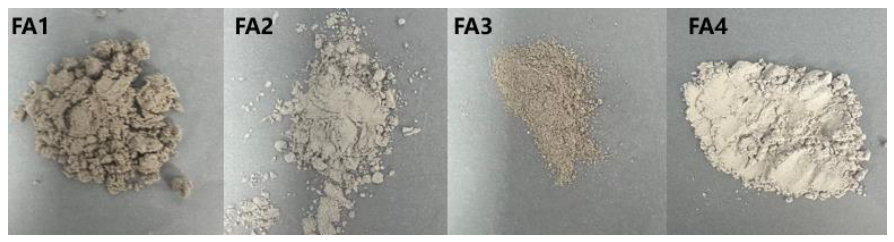
Figure 2.
SEM images of the three fly ash samples: (a) FA1 before thermolysis; (b) FA1 after thermolysis; (c) FA2 before thermolysis; (d) FA2 after thermolysis; (e) FA3 before thermolysis; (f) FA3 after thermolysis.
Figure 2.
SEM images of the three fly ash samples: (a) FA1 before thermolysis; (b) FA1 after thermolysis; (c) FA2 before thermolysis; (d) FA2 after thermolysis; (e) FA3 before thermolysis; (f) FA3 after thermolysis.
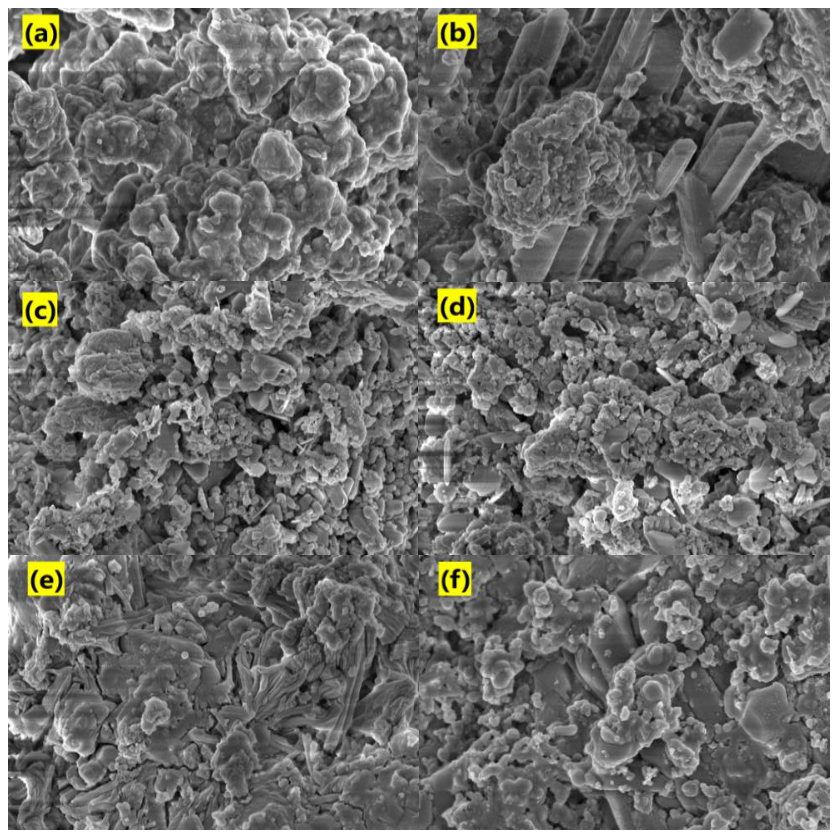
Figure 3.
Changes in physicochemical properties and TEQ values of fly ash under different pyrolysis conditions. (a) TEQ, (b) Cu, (c) Cl and S, and (d) organic matter contents of fly ash before and after pyrolysis without inhibitors. (e) TEQ values and solid-phase apparent removal efficiencies of FA1 before and after thermolysis with and without inhibitors. (f) TEQ values of fly ash after pilot-scale thermolysis. Note: The TEQ values in (a) are the means of two parallel determinations (n = 2) of an equal-mass mixture of the solids from independent thermal treatment experiments. Data in (b)–(d) represent the mean ± standard deviation (SD) of three independent thermal treatment experiments; statistical significance between groups was determined by the independent-samples t-test, and * indicates a significant difference between groups (p < 0.05). The TEQ values in (e) and (f) are the means of two parallel determinations (n = 2) of one composite sample per treatment.
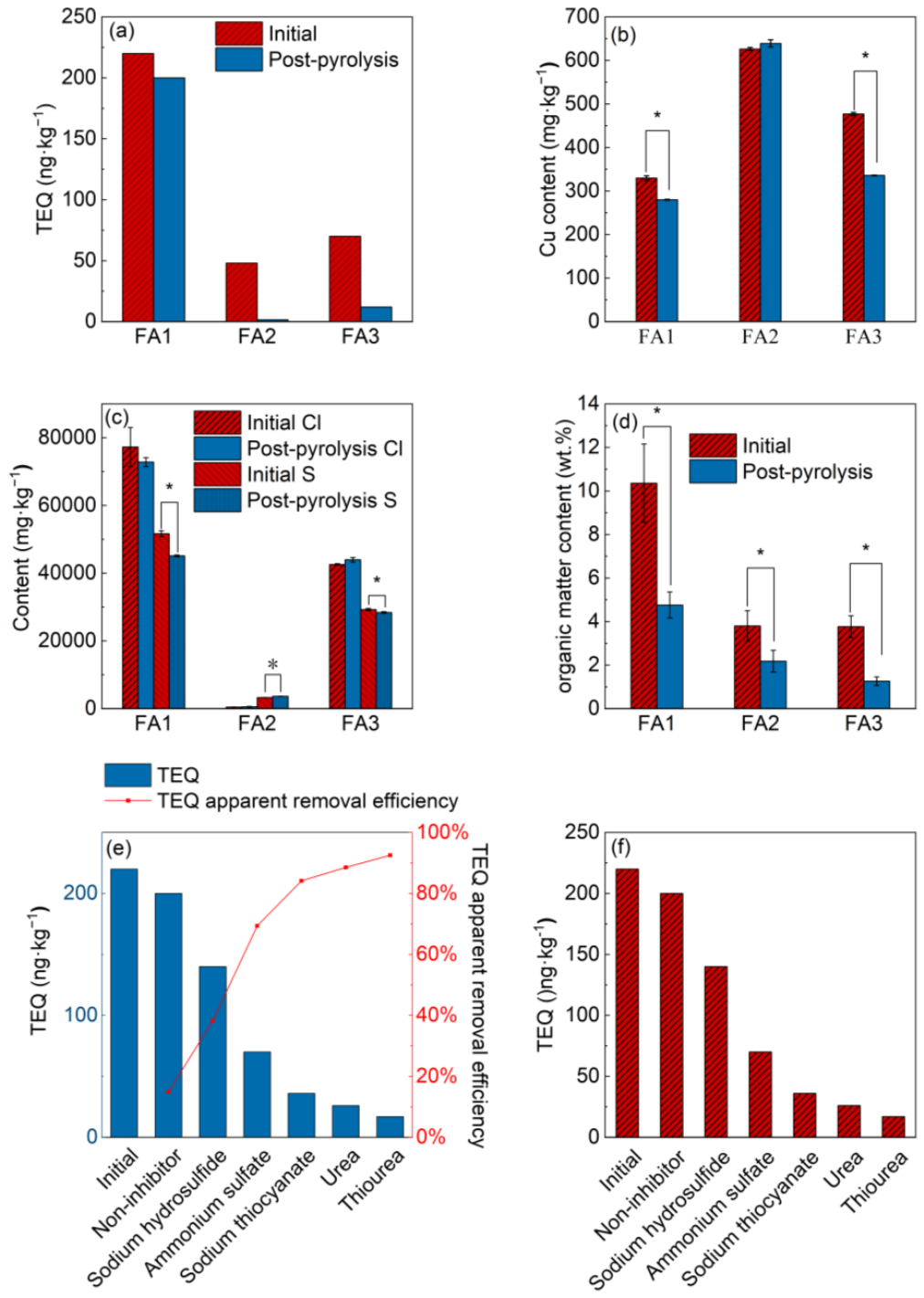
Figure 4.
Mass concentrations and removal efficiencies of PCDD/Fs congeners under different thermolysis trials. (a)–(d) Mass concentrations and removal efficiencies of PCDD/Fs congeners in FA1 before and after thermolysis with and without inhibitors. (e)–(h) Measured mass concentration changes and solid-phase apparent removal efficiencies of PCDD/Fs in the fly ash samples after the pilot-scale thermolysis trial. Note: All values are the means of two parallel determinations (n = 2) of one composite sample per treatment.
Disclaimer/Publisher’s Note: The statements, opinions and data contained in all publications are solely those of the individual author(s) and contributor(s) and not of MDPI and/or the editor(s). MDPI and/or the editor(s) disclaim responsibility for any injury to people or property resulting from any ideas, methods, instructions or products referred to in the content. |
© 2026 by the authors. Licensee MDPI, Basel, Switzerland. This article is an open access article distributed under the terms and conditions of the Creative Commons Attribution (CC BY) license.
Copyright: This open access article is published under a Creative Commons CC BY 4.0 license, which permit the free download, distribution, and reuse, provided that the author and preprint are cited in any reuse.