
Submitted:
03 November 2026
Posted:
05 November 2026
You are already at the latest version
Abstract
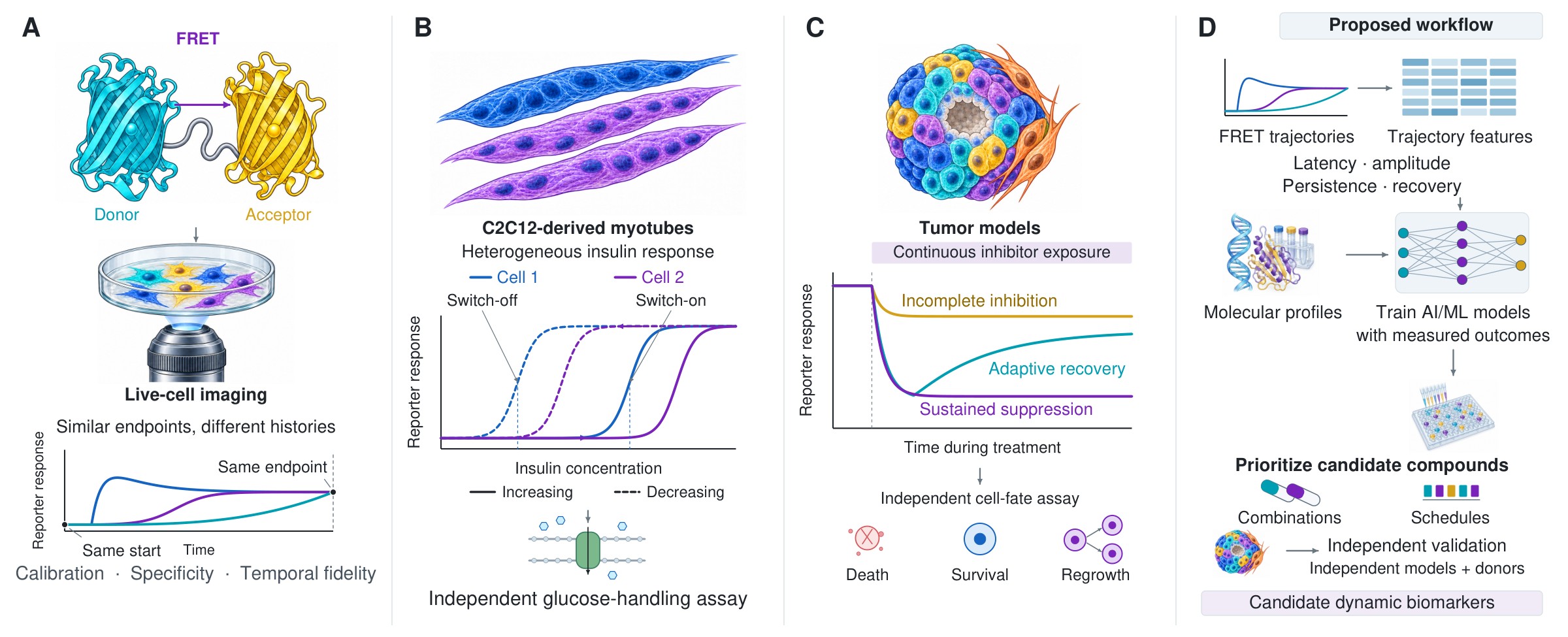
Cells with similar endpoint measurements can have different biochemical response histories. Time-lapse single-cell Förster resonance energy transfer (FRET) imaging can distinguish these histories and test their relationship to metabolic function and cancer-cell fate. We connect FRET biophysics, biosensor design, and quantitative measurement to interpret cellular heterogeneity in metabolic dysfunction and cancer drug resistance. We emphasize corrected sensitized emission FRET imaging, distinguish corrected ratios from physical transfer efficiency, and describe controls for reporter specificity, temporal fidelity, and reproducibility. In metabolism, FRET imaging can reveal graded or bistable behavior and characterize sensitivity, response amplitude, history dependence, and coupling between signaling and substrate handling. In cancer, time-lapse signaling measurements paired with independent cell-fate outcomes can distinguish incomplete inhibition, adaptive recovery, and survival despite sustained pathway suppression. Cell culture, organoid, and intravital studies illustrate these capabilities and limits. Linking calibrated response histories to independent functional outcomes provides a robust foundation for candidate dynamic biomarkers. Integrating trajectory features with molecular profiles using machine learning could identify candidate predictors of treatment response. Future studies should test whether these dynamic features improve compound selection, combination design, and treatment schedules beyond baseline activity, initial inhibition, and endpoint measurements, with validation in independent patient-derived and in vivo models.
Keywords:
single-cell FRET
; sensitized emission
; genetically encoded biosensors
; cellular heterogeneity
; metabolic dysfunction
; cancer drug resistance
; akt signaling
; bistability
; time-lapse imaging
; dynamic biomarkers
Copyright: This open access article is published under a Creative Commons CC BY 4.0 license, which permit the free download, distribution, and reuse, provided that the author and preprint are cited in any reuse.