

Submitted:
04 November 2026
Posted:
05 November 2026
You are already at the latest version
Abstract
The development of anti-drug antibodies (ADAs) represents a critical challenge in therapeutic protein development, potentially compromising drug efficacy and safety. Predicting biologically and clinically meaningful immunogenicity remains challenging with current approaches. Using data processed by AI tools from IEDB (Immune Epitope Database) to generate training data for our “homemade” machine learning model, this study explored whether mechanism of actions (immunomodulatory effects, presence of payload, solubility of target, and human similarity) plus antibody variable-region sequence features derived from MHC-peptide binding affinity, proteolytic processivity of the therapeutic antibody, and MHC-II allele population frequencies, could explain reported treatment-emergent ADA incidence. We have shown that the optimized classification AI/ML model could achieve strong performance as evidenced by standard metrics, where ROC-AUC is 0.796 and PR-AUC is 0.706, which is comparable to those of other available models for evaluating antibody immunogenicity. Therefore, sequence-derived MHC-II presentation features plus engineered MOA-related features may provide a useful starting point for developing preclinical immunogenicity risk assessment AI/ML tools.
Keywords:
anti-drug antibody (ADA)
; AI
; machine learning
; MHC-II/HLA-II
; mechanism of action (MOA)-informed
1. Introduction
Immunogenicity of therapeutic proteins, defined as the propensity to elicit unwanted immune responses, poses a major obstacle to successful development and clinical application of biologics. Anti-drug antibodies (ADAs) can manifest through multiple mechanisms: neutralizing antibodies that directly inhibit therapeutic activity, clearing antibodies that accelerate antibody drug elimination [1]. The clinical consequences range from loss of efficacy to severe adverse events including anaphylaxis, pure red cell aplasia, and life-threatening hypersensitivity reactions [1].
ADAs are categorized into pre-existing ADAs, which exist before treatment begins, and treatment emergent ADAs. Pre-existing ADAs generally bind to conserved regions of the therapeutic antibody and are typically non-neutralizing with minimal clinical consequences [2]. Treatment emergent ADAs can be further classified by immunoglobin isotype into two categories: class-switched ADAs (IgGs, IgAs, IgEs) and non-class-switched ADAs (IgM). Class-switched ADAs typically emerge during late-stage ADA response and are elicited by highly immunogenic therapeutic antibodies with helper T cells assistance, whereas non-class-switched ADAs are seen in early response with relatively lower titer [3]. Importantly, prolonged treatment regimens can lead to a gradual increase in high-affinity class-switched ADAs, as exemplified by the anti-tumor necrosis factor α (TNF-α) drug adalimumab [4]. These high-affinity, high-titer class-switched ADAs exhibit more powerful neutralizing capacity and therefore pose significant threats to therapeutic efficacy, as observed in immune cell engagers [5], anti-cytokine antibody [4], immune checkpoint inhibitors [6].
The immunogenicity for highly immunogenic therapeutic antibodies is initiated when an antigen-presenting cell (APC) processes the protein of interest into peptides and presents them via MHC-II towards T cell receptor (TCR) of helper T cell. Upon activation, these helper T cells activate B cells to produce antibodies, including high-affinity class-switched antibody clones [7]. This process can be examined in vitro to a limited extent with T cell activation assays performed in wet-lab setting. However, traditional laboratory approaches face a fundamental limitation: HLA population diversity us underrepresented due to small donor sample sizes from donors, thus encumbered by inability to capture holistic real-world population scale immunogenicity.
To provide prediction for population-level immunogenicity, numerous AL machine learning (ML) models have emerged as state-of-the-art in silico methodologies for assessing immunogenicity of peptides and proteins, including AbImmPred [8], SITA [9], ISPRI [10], PITHA [11], BioPhi [12], and IEDB [13,14,15]. Among them, IEDB (the Immune Epitope Database) remains one of the largest sources for immune epitope data, which has a repository of over 1.6 million epitopes derived from 6.8 million assays in 25,000 publications [13,14,15]. The IEDB database utilizes experimental data to train predictive AI/ML models for MHC class II binding affinity and peptide processivity—the likelihood that peptide will be proteolytically cleaved from the parent protein that serves as a prerequisite for MHC-II binding [13,14,15].
While these models and tools offer valuable capabilities, a significant gap remains current; no freely accessible tool can directly predict the risk of anti-drug antibodies from a holistic perspective, where both antibody peptide sequence and known mechanism of actions could be taken into consideration for assessment of immunogenicity. This limitation reflects the scarcity of publicly available clinical and translational data linking antibody sequences to ADA incidence rates. Moreover, mechanism of action (MOA) of the antibodies can play key role in determining the formation of ADA. MOA such as modulation of immune system (e.g., depletion of B cells), solubility of antigen or target, presence of drug payload, may play biologically meaningful roles to affect formation of anti-drug antibody. Last but not the least, whether the antibody is fully human, partially humanized, or fully murine, can also affect baseline immunogenicity.
This study presents a machine learning approach based on biologically meaningful mechanisms: the MHC-II-mediated antigen presentation pathway, where the protein is cleaved into peptide, and binding affinity of peptide to MHC/HLA receptor. We leveraged the IEDB database [13,14,15] as an AI tool for generating training data for downstream house-built machine learning model to assess peptide immunogenicity. Reported clinical ADA incidence data [16] was used as labels or correct answers to train a supervised machine learning model. We further enhance the accuracy of the baseline model by incorporating engineered feature from scores assigned according to mechanism of action (MOA) and humanness of the antibody samples. The outcome of the model was a binary classification of clinical ADA incidence risk (using a threshold of 5% ADA incidence), which represents a composite clinical and bioanalytical endpoint. Therefore, the model is intended to evaluate the association between sequence-derived antigen-presentation features and high-risk ADA incidence.
2. Material and Methods
Programming and the Utilization of Generative AI
Perplexity Pro, Gemini 3.1 pro, and Gemini 3.8 flash, were employed for Python script development, debugging, generation of pipeline workflow (Figure 1), literature search, and proofreading of the manuscript. Each debugging or scripting query included: 1) the current version of the Python code, 2) Python shell and terminal output messages from the MacOS, and 3) model perform plots. Codes were composed and modified in PyCharm IDE under an academic license.
Antibody Data Sourcing and Peptide Data Processing on IEDB
ADA incidence rates, humanization status, variable region sequences (VH and VL) from 200 therapeutic antibodies were obtained from supplement of publication by Marks, et al. [16]. Mechanism of actions of therapeutic antibodies were derived from literature search [17,18,19] and from the YAbS, which is the Antibody Society’s antibody therapeutics database [20].
To generate peptide sequence-derived MHC-II training data, VH and VL sequences from each antibody were uploaded into the IEDB database, which provides tools for quantifying antibody digestion (processivity) into peptides and measuring peptide binding affinity to MHC-II molecules. We utilized the “T cell prediction – class II” with a panel of 27 HLA alleles covering approximately 97% of the globe population (according to IEDB website [13,14]). The following parameters were specified: (I) prediction method for “MHC-II Binding/Elution” was set to “NetMHCIIpan 4.1 EL”, (II) prediction method for “MHC-II Processing” were set to “MHCII-NP”. (III) “Peptide Length” was set to 15 amino acids and (IV) “Peptide Shift Length” was set to 5 amino acids.
The HLA allele frequencies for MHC-II were determined from publication by Greenbaum and colleagues [21]. To integrate population-level immunogenicity, we weighted each peptide-MHC-II binding score by multiplying it by two factors: (I) the global population frequency of the specific MHC-II/HLA allele, and (II) the processivity score (cleavage probability) of the peptide as determined by the “MHCII-NP Cleavage Probability Score” algorithm. This approach accounts for both the likelihood that a peptide will be generated from the parent antibody and the frequency with which the cognate MHC-II allele is present in the global population.
Engineering of Mechanism of Action-Informed Features
A set of scores for the mechanism of action and humanness of the antibody is generated to be fed into training the final model. The categorization of the mechanism of action of antibodies is based on four categories: 1) Immunomodulatory effect of the antibody (MOA_Immune), 2) degree of humanization (Host_origin), 3) availability of the target as solubility form (Target_solubility), and 4) payload conjugation status (Is_ADC), with a trinary score or -1, 0, and 1.
For immunomodulatory effect (Table 1), a score of 1 is assigned to immune stimulatory agents, such as immune checkpoint blocker, a score of -1 is assigned to immunosuppressive agent, such as B-cell depletion antibodies, and a score of 0 is assigned to relative immune-neutral antibody. B-cell depletion antibodies can reduce the production of ADA by directly killing the ADA-producing B cells, whereas immune checkpoint blockers can modulate the response of T cells and therefore alter the process of producing potent class-switched ADAs which is orchestrated by both T cells and B cells interactions [22]. Solubility of the target is assigned based on availability of the target as soluble or free form (including bacteria and virus) with a score of 1, or insoluble/membrane bound (0). Cross-linking soluble antigen by antibody can facilitate the complex for uptake by antigen-presenting cells as well as processing [23]. Humanness of the antibody is based on whether the antibody is fully human origin (-1), humanized or chimeric (0), or fully murine (1). Humanizing an antibody, such as by grafting murine CDR into human framework, is known to reduce its immunogenicity [24,25]. Payload conjugation status is based on whether the antibody is known to conjugate with an external pharmacologically active molecule. The linker and payload conjugated to the antibody may potentially create neoepitope [26] or promote formation of aggregates due to altered hydrophobicity of the antibody [27].
Data Preprocessing for Machine Learning
Due to the severe right-skewness of the dataset (where most therapeutic antibodies exhibit low-to-moderate immunogenicity with ADA < 10%), the task was reframed as a classification problem with a risk threshold of 10%. The antibodies were categorized into a binary target (ADA ≥ 10%, 5%, or 2% as threshold for high risk). Subsequently, the train/test dataset split was made using stratified k-folds to preserve the target ADA risk distribution.
To address the imbalanced nature of the dataset during training, balanced sample weights were computed dynamically within the training pipeline to mitigate the scarcity of high immunogenicity data. This shifted the framework away from synthetic oversampling methods (like SMOTE, Synthetic Minority Oversampling Technique) to a more robust, statistically sound weighting paradigm [28,29].
Feature Scaling and Selection
To minimize the influence of outliers, features were standardized using either a Standard Scaler or a Robust Scaler. SelectKBest with ANOVA F-value (f_classif) was used for feature selection directly within the cross-validation folds to prevent data leakage during parameter tuning [30,31].

Table 2.
preprocessed data features derived from IEDB database output to be used in training the machine learning model for predicting immunogenicity.
Table 2.
preprocessed data features derived from IEDB database output to be used in training the machine learning model for predicting immunogenicity.
| Feature Name | Mathematical Definition | Intended Use |
|---|---|---|
| iedb_binding_weighted_mean | Weighted average of binding scores | Assess expected binding affinity adjusted for allele/target prevalence |
| iedb_binding_weighted_min | Binding score of the highest-weighted instance | Determine the binding affinity for the most prominent allele/target |
| iedb_binding_mean | Arithmetic average of binding scores | Establish general unweighted binding tendency |
| iedb_binding_min | Lowest binding score in the array | Identify the single strongest binding interaction |
| iedb_binding_max | Highest binding score in the array | Identify the weakest binding interaction |
| iedb_binding_std | Standard deviation of scores | Measure consistency vs. variability in binding across targets |
| iedb_binding_q75, q90, q95 | 75th, 90th, 95th percentiles of scores | Evaluate the upper boundaries and tail distribution of affinities |
| iedb_binding_range | Maximum minus minimum score | Capture the total spread of binding affinities |
| iedb_strong_binders | Count of scores < 1.0 | Quantify the number of high-affinity (strong) interactions |
| iedb_weak_binders | Count of scores > 10.0 | Quantify the number of non-binding or very weak interactions |
| iedb_binding_entropy | Shannon entropy of score distribution | Measure the informational diversity of the binding profile |
| iedb_ultra_binders | Count of scores < 0.5 | Quantify exceptionally strong (ultra-high affinity) interactions |
| iedb_promiscuous_epitopes | Count of scores < 1.0 AND weights > 75th percentile | Identify strong binders that are also broadly applicable/prevalent |
Model Architecture: Machine Learning Models
Classification algorithms—Random Forest, Histogram-based Gradient Boosting, and Logistic Regression models—were utilized. Each of the models has its own advantages for addressing small imbalanced datasets with intricate biological and logical relationships. Random Forest [32] was suitable for handling small-sized datasets and mitigating overfitting through bootstrapped ensemble averaging. Histogram-based Gradient Boosting [33] performs recursive, stagewise fitting, allowing it to uncover complex interactions and nonlinearities in small-sample and high-feature environments. Logistic Regression provided a robust linear baseline [34].
Bayesian Hyperparameter Optimization
Bayesian optimization using the Tree-structured Parzen Estimator (TPE) acquisition functions was implemented with Optuna framework. Optuna was utilized to automate both model type and its optimal hyperparameters using a surrogate probabilistic model, allowing the algorithm to find the best setting for each classifier according to cross-validated performance. The optimization objective maximized the cross-validated Recevier Operating Characteristic Area Under the Curve (ROC-AUC) score over up to 80 trials.
For each optimization trial, the Optuna suggests values for: (I) model type (e.g., random forest), (II) hyperparameters tailored for each model, and (III) data preprocessing method (scaling method and number of features for SelectKBest).
Cross-Validation and Model Selection
The training data were split using stratified k-fold cross-validation for more robust evaluation. For each fold, training pipeline (regressor, preprocessing, and feature selection) is filed to the training data. Optuna collet mean validation performance for updating. The best performing model with tuned hyperparameters/pipeline was chosen as the final estimator.
3. Results
From the original dataset for incidence or anti-drug antibody (ADA), the clinical incidence rate of ADA rate is significantly right-skewed, with more than 50% of the antibodies having an ADA rate less than 8% (Figure 2A,B). Such skewness motivated the shift from continuous exact-percentage prediction to clinical risk stratification, evaluating antibodies against a pragmatic 10% risk threshold.
Features derived from IEDB processing, such as the binding affinity towards MHC-II (netmhciipan_el score) and probability of peptide generation due to protease cleavage (MHCII-NP cleavage probability scores), exhibited similar distributions across the defined Low (<10%), Medium (10-30%), and High (>30%) ADA risk groups (Figure 2C,D). Furthermore, other variables, such as the count of strong binding peptides (<10% percentile), mean of top 10% strongest binders, and cleavage scores, were distributed differently depending on the ADA incidence bracket (Figure 3A–D).
We first examined the performance of machine learning trained only by features extracted from IEDB dataset (nicknamed “IEDB-only”) without incorporation of the in-house generated engineered features for MOA. Using a 10% ADA incidence threshold to define high versus low immunogenicity, the receiver operating characteristics (ROC) curve achieved an area under the curve (AUC) of 0.632 for separating low- versus high-risk ADA antibodies for the IEDB-only model (Figure 4). For distinguishing true high-immunogenicity versus low immunogenicity samples, a precision recall (PR) of 0.398 was achieved (Figure 4). Note that although a value of 0.398 for PR is low, the baseline for PR is 0.257, meaning the model can result in 50% higher accuracy than random guessing. On the test set, the model accurately identified 81% (21/26) of the low-risk antibodies as low-risk, but only 33% (3/9) of the high-risk antibodies (Figure 4).
Due to the limit of available antibody immunogenicity dataset and the lack of highly immunogenic sample set (which resulted in a skewed training dataset), we also tested whether lowering the immunogenicity threshold would improve model performance. By lower the threshold to 5% to artificially increase the ratio of high-immunogenicity to low-immunogenicity dataset, the model achieved an enhanced ability to identify true high immunogenic samples based on precision-recall and the confusion matrix, while further lowering the threshold to 2% improved both ROC and precision-recall mathematically but significantly worsen the ability of the model to correctly identify low immunogenic sample, suggesting that altering data cutoff threshold cannot address the bottleneck of IEDB-only algorithm in future improving performance metric (Figure 4).
Subsequently, we designed four additional parameters to be used for training the model (Figure 5). These four parameters were intended to reflect the biological nature of the antibody that originates from factors beyond their peptide-derived immunogenicity. Host origin, MOA_Immune, and Is_ADC appear to exhibit ability in stratifying antibody immunogenicity risk.
Using these new parameters ad input and building upon the same framework of the IEDB-only model with 5% ADA threshold, the newer MOA-informed-IEDB model was able to achieve high-performance metrics (Figure 6), in terms of ROC, PR, and confusion matrix. Notably, improved performance is seen in identification of high risk-immunogenicity sample set, not only in terms of ROC and PR but also the ability to perform significantly more accurately in prediction in the test sample sets in confusion matrix (Figure 6), as evidenced by accuracies of 84% (16/19) and 75% (12/16) in correctly identifying high risk and low risk testing samples, respectively. In comparison, the IEDB-only model has accuracies of 77% (20/26) and 44% (4/9) in correctly identifying high risk and low risk samples, respectively.
4. Discussion
Anti-drug antibodies have been a significant issue for the development of biologics. While wet-lab approaches using donor-derived PBMCs serve as workhorses in pharmaceutical and biotechnology industry, these assays have limitations [35]. In this study, we explored the possibility of utilizing peptide sequence data and mechanism of action data to train an AI/ML model in order to predict the clinical risk of anti-drug antibodies (ADAs) to provide in silico, low-cost assessment of immunogenicity.
The performance of IEDB-only model suggests that MHC-II-derived features by themselves can be useful for training ML model. However, due to the skewed nature of available ADA dataset, the IEDB-only model lacked sufficient training in high immunogenicity samples, and therefore performed fairly poor in identifying highly immunogenic antibody candidate as evidenced by the PR-AUC and test set performance (Figure 5). In conventional training of machine learning model, large dataset is preferred. Due to the limitation of numbers of available training data set (therapeutic antibody with anti-drug antibody incidence rate from clinical trials), providing additional “high-quality” input data features (e.g., scores for antibody MOA parameters) would be crucial for model training [36,37].
We have shown that incorporating the mechanism of action MOA of the antibody as an input feature for future model training could boost the performance of models built upon data derived from antibody peptide sequence. With engineered mechanism-relevant features, the final MOA-informed IEDB model was able to achieve significantly better performance, as evidenced by ROC-AUC of 0.796 and PR-AUC of 0.706, compared to the ROC-AUC and PR-AUC of 0.718 and 0.478 by the IEDB-only model (Figure 6). While this project serves as an exploratory effort towards feature engineering for MOA and can be fairly immature, the impact is clear, especially in improving the ability of the model to correctly identify high-risk samples (Figure 6).
Commercial tools, such as AbImmPred [8] and PITHA [11] have been reported to yield ROC-AUC of 0.781 and 0.594, and PR-AUC of 0.927 and 0.737, respectively. PITHA was developed based on cavities and hydrophobicity in the CDR region, which potentially calculates for B-cell receptor (BCR) paratope immunogenicity [11]. AbImmPred is based upon antibody VH and VL region features, followed by processing with an encoder and principal component analysis (PCA), followed by training with series of basic machine learning model as well as a weighted ensemble model. Our models in this paper can reach a comparable level of mathematical performance with these two published models, with additional advantage in utilizing biologically meaningful antibody MOA information. Since the input data of this manuscript is based on MHC-II-derived immunogenicity, future efforts may include pipelining this model with B cell receptor (BCR) data, such as the output from the ElliPro prediction [38] or other BCR epitope prediction. Such effort may prove beneficial in capturing impact from direct ADA contibution by B cells [2,3]. Utilization of future updated AI tools for generating MHC-II raw data by IEDB may be able to generate higher quality training data for training similar ML models.
Many published prediction models were trained exclusively on antibody sequence and structural features, not on the mechanism-of-action parameters, and can potentially miss biologically critical input factors. Further stratifying antibodies based on MOA subclasses under existing input factor categories or input additional features (e.g., antibody format, Fc status) could be proven useful as more anti-drug antibody data set become available in the future. Further incorporation of clinical factors in training, while complicated, may also provide benefit for model fitting, if properly parameterized. For example, patient disease state and concurrent medications can significantly influence ADA incidence. Patients with certain rheumatoid conditions may tend to have a higher incidence rate of ADA than others [39]. While co-administering immunosuppressants (e.g., infliximab) can reduce ADA incidence [40], co-administering immunostimulatory therapies (e.g., ipilimumab) can increase the incidence of ADA for other co-administered therapeutic antibodies [41].
As an typical caveat for many AI/ML models, integration and validation with wet-lab data should be accompanied as an indispensable means for cross-validation in case of strongly immunogenic antibody candidate where wet lab-generated MHC proteomics data can be analyzed by algorithm workflows on IEDB as reported in the literatures [42]. Moreover, the NetMHCIIpan tool used in this study, despite being one of the best source of immunogenicity database and pipeline, has critical issues such as bias towards co-immunoprecipitated HLA irrelevant so-called “contaminations” during mass spectrometry analysis and may require in-depth bioinformatic analysis [43]. Thus, wet-lab approach still remains an indispensable input for determine immunogenicity profile of antibody.
5. Conclusions
This study demonstrates the feasibility of utilizing sequence-derived MHC-II presentation features from the IEDB to predict the clinical incidence of anti-drug antibodies (ADAs) with aid from additional parameterized factors related to antibody mechanism of actions and humanness. Future in silico predictive models must adopt a multi-modal approach by integrating B-cell receptor (BCR) paratope data, and real-world clinical factors such as patient disease state and concurrent medications. Until these multifactorial models mature, AI-driven sequence analysis will remain a powerful early-stage screening tool that must be complemented by robust wet-lab cross-validation for comprehensive immunogenicity evaluation.
Supplementary Materials
The following supporting information can be downloaded at the website of this paper posted on Preprints.org.
Author Contributions
Conceptualization, G.Y.; methodology, G.Y.; software, G.Y.; validation, G.Y.; data curation, G.Y. and T.L.; writing—original draft preparation, G.Y.; writing—review and editing, G.Y., A.H.; visualization, G.Y.; supervision, A.H., G.Y.; All authors have read and agreed to the published version of the manuscript.
Funding
This research received no external funding.
Data Availability Statement
All training data and python script packages can be found in github (https://github.com/gy118/Prediction-of-Antibody-Immunogenicity-with-IEDB-Input).
Acknowledgments
During the preparation of the study, the authors applied generative AI, including Perplexity Pro, Gemini 3.1 pro, and Gemini 3.8 flash, were used for programing and debugging of python code, proofreading of manuscript, search of literature. The authors have reviewed and edited the output and take full responsibility for the content of this publication.
Conflicts of Interest
The authors declare no conflicts of interest.
Abbreviations
The following abbreviations are used in this manuscript:
| ADA | Multidisciplinary Digital Publishing Institute |
| IEDB | Immune Epitope Database |
| MHC | Major Histocompatibility Complex |
| HLA | Human Leukocyte Antigen |
| BCR | B-Cell Receptor |
| PR | Precision Recall |
| ROC | Receiver Operating Characteristics |
| AUC | Area Under the Curve |
| MOA | Mechanism of Action |
References
- Krishna M, Nadler SG. Immunogenicity to Biotherapeutics - The Role of Anti-drug Immune Complexes. Front Immunol. 2016;7:21. [CrossRef]
- van Schie KA, Wolbink GJ, Rispens T. Cross-reactive and pre-existing antibodies to therapeutic antibodies--Effects on treatment and immunogenicity. MAbs. 2015;7(4):662-71. [CrossRef]
- Gorovits B. Current Considerations for Immunoglobulin Isotype Characterization of Antibody Response against Biotherapeutics. Aaps j. 2020;22(6):144. [CrossRef]
- Ding X, Xue L, Wang M, Zhu S, Zhu K, Jiang S, et al. Dynamics and implications of anti-drug antibodies against adalimumab using ultra-sensitive and highly drug-tolerant assays. Front Immunol. 2024;15:1429544. [CrossRef]
- Lotz GP, Lutz A, Martin-Facklam M, Hansbauer A, Schick E, Moessner E, et al. Characterization of anti-drug antibody responses to the T-cell engaging bispecific antibody cibisatamab to understand the impact on exposure. Front Immunol. 2024;15:1406353. [CrossRef]
- Galle P, Finn RS, Mitchell CR, Ndirangu K, Ramji Z, Redhead GS, et al. Treatment-emergent antidrug antibodies related to PD-1, PD-L1, or CTLA-4 inhibitors across tumor types: a systematic review. J Immunother Cancer. 2024;12(1). [CrossRef]
- Murphy KM, Weaver C. Janeway’s Immunobiology: Ninth International Student Edition: Garland Science; 2016.
- Wang H, Hao X, He Y, Fan L. AbImmPred: An immunogenicity prediction method for therapeutic antibodies using AntiBERTy-based sequence features. PLoS One. 2024;19(2):e0296737. [CrossRef]
- Cun Y, Ding H, Mao T, Wang Y, Wang C, Li J, et al. SITA: Predicting site-specific immunogenicity for therapeutic antibodies. J Pharm Anal. 2025;15(6):101316. [CrossRef]
- Mattei AE, Gutierrez AH, Seshadri S, Tivin J, Ardito M, Rosenberg AS, et al. In silico methods for immunogenicity risk assessment and human homology screening for therapeutic antibodies. MAbs. 2024;16(1):2333729. [CrossRef]
- Liang S, Zhang C. PITHA: A Webtool to Predict Immunogenicity for Humanized and Fully Human Therapeutic Antibodies. Methods Mol Biol. 2023;2552:143-50. [CrossRef]
- Prihoda D, Maamary J, Waight A, Juan V, Fayadat-Dilman L, Svozil D, et al. BioPhi: A platform for antibody design, humanization, and humanness evaluation based on natural antibody repertoires and deep learning. MAbs. 2022;14(1):2020203. [CrossRef]
- Yan Z, Kim K, Kim H, Ha B, Gambiez A, Bennett J, et al. Next-generation IEDB tools: a platform for epitope prediction and analysis. Nucleic Acids Research. 2024;52(W1):W526-W32. [CrossRef]
- Dhanda SK, Mahajan S, Paul S, Yan Z, Kim H, Jespersen MC, et al. IEDB-AR: immune epitope database-analysis resource in 2019. Nucleic Acids Res. 2019;47(W1):W502-w6. [CrossRef]
- Vita R, Blazeska N, Marrama D, Members ICT, Duesing S, Bennett J, et al. The Immune Epitope Database (IEDB): 2024 update. Nucleic Acids Research. 2025;53(D1):D436-D43. [CrossRef]
- Marks C, Hummer AM, Chin M, Deane CM. Humanization of antibodies using a machine learning approach on large-scale repertoire data. Bioinformatics. 2021;37(22):4041-7. [CrossRef]
- Manso T, Kushwaha A, Abdollahi N, Duroux P, Giudicelli V, Kossida S. Mechanisms of action of monoclonal antibodies in oncology integrated in IMGT/mAb-DB. Frontiers in Immunology. 2023;Volume 14 - 2023. [CrossRef]
- Redman JM, Hill EM, AlDeghaither D, Weiner LM. Mechanisms of action of therapeutic antibodies for cancer. Molecular Immunology. 2015;67(2, Part A):28-45. [CrossRef]
- Sharma P, Joshi RV, Pritchard R, Xu K, Eicher MA. Therapeutic Antibodies in Medicine. Molecules. 2023;28(18):6438.
- Rawat P, Crescioli S, Prabakaran R, Sharma D, Greiff V, Reichert JM. YAbS: The Antibody Society’s antibody therapeutics database. mAbs. 2025;17(1):2468845. [CrossRef]
- Greenbaum J, Sidney J, Chung J, Brander C, Peters B, Sette A. Functional classification of class II human leukocyte antigen (HLA) molecules reveals seven different supertypes and a surprising degree of repertoire sharing across supertypes. Immunogenetics. 2011;63(6):325-35. [CrossRef]
- Yang G, Massumi M. Fragment-Based Immune Cell Engager Antibodies in Treatment of Cancer, Infectious and Autoimmune Diseases: Lessons and Insights from Clinical and Translational Studies. Antibodies (Basel). 2025;14(3). [CrossRef]
- Junker F, Gordon J, Qureshi O. Fc Gamma Receptors and Their Role in Antigen Uptake, Presentation, and T Cell Activation. Frontiers in Immunology. 2020;Volume 11 - 2020. [CrossRef]
- Harding FA, Stickler MM, Razo J, DuBridge R. The immunogenicity of humanized and fully human antibodies. mAbs. 2010;2(3):256-65.
- Howard EL, Goens MM, Susta L, Patel A, Wootton SK. Anti-Drug Antibody Response to Therapeutic Antibodies and Potential Mitigation Strategies. Biomedicines. 2025;13(2):299. [CrossRef]
- Hock MB, Thudium KE, Carrasco-Triguero M, Schwabe NF. Immunogenicity of Antibody Drug Conjugates: Bioanalytical Methods and Monitoring Strategy for a Novel Therapeutic Modality. The AAPS Journal. 2015;17(1):35-43. [CrossRef]
- McCombs JR, Owen SC. Antibody Drug Conjugates: Design and Selection of Linker, Payload and Conjugation Chemistry. The AAPS Journal. 2015;17(2):339-51.
- Lin T-Y, Goyal P, Girshick R, He K, Dollár P, editors. Focal loss for dense object detection. Proceedings of the IEEE international conference on computer vision; 2017. doi:10.1109/TPAMI.2018.2858826.
- Torgo L, Ribeiro RP, Pfahringer B, Branco P, editors. SMOTE for Regression. Progress in Artificial Intelligence; 2013 2013//; Berlin, Heidelberg: Springer Berlin Heidelberg.
- Pedregosa F, Varoquaux G, Gramfort A, Michel V, Thirion B, Grisel O, et al. Scikit-learn: Machine learning in Python. Journal of Machine Learning Research. 2011;12.
- Cawley GC, Talbot NLC. On Over-fitting in Model Selection and Subsequent Selection Bias in Performance Evaluation. J Mach Learn Res. 2010;11:2079–107.
- Breiman L. Random Forests. Machine Learning. 2001;45(1):5-32.
- Ke G, Meng Q, Finley T, Wang T, Chen W, Ma W, et al. LightGBM: a highly efficient gradient boosting decision tree. Proceedings of the 31st International Conference on Neural Information Processing Systems; Long Beach, California, USA: Curran Associates Inc.; 2017. p. 3149–57.
- Hastie T, Tibshirani R, Friedman J. The elements of statistical learning. Springer series in statistics New-York; 2009.
- Walsh RE, Nix A, Ackaert C, Mazy A, Schockaert J, Pattyn S, et al. Preclinical immunogenicity risk assessment of biotherapeutics using CD4 T cell assays. Front Immunol. 2024;15:1406040. [CrossRef]
- Silvey S, Liu J. Sample Size Requirements for Popular Classification Algorithms in Tabular Clinical Data: Empirical Study. J Med Internet Res. 2024;26:e60231. [CrossRef]
- Domingos P. A Few Useful Things to Know About Machine Learning. Commun ACM. 2012;55:78–87. [CrossRef]
- Ponomarenko J, Bui HH, Li W, Fusseder N, Bourne PE, Sette A, et al. ElliPro: a new structure-based tool for the prediction of antibody epitopes. BMC Bioinformatics. 2008;9:514. [CrossRef]
- Pizano-Martinez O, Mendieta-Condado E, Vázquez-Del Mercado M, Martínez-García EA, Chavarria-Avila E, Ortuño-Sahagún D, et al. Anti-Drug Antibodies in the Biological Therapy of Autoimmune Rheumatic Diseases. J Clin Med. 2023;12(9). [CrossRef]
- Bots SJ, Parker CE, Brandse JF, Löwenberg M, Feagan BG, Sandborn WJ, et al. Anti-Drug Antibody Formation Against Biologic Agents in Inflammatory Bowel Disease: A Systematic Review and Meta-Analysis. BioDrugs. 2021;35(6):715-33. [CrossRef]
- Harris CT, Cohen S. Reducing Immunogenicity by Design: Approaches to Minimize Immunogenicity of Monoclonal Antibodies. BioDrugs. 2024;38(2):205-26. [CrossRef]
- Van Doninck T, Thijs L, Ackaert C, Boonen K, Mazy A, Pattyn S, et al. MHC-Associated Peptide Proteomics (MAPPs) as a Tool for Assessment of Immunogenicity Risk Potential of Therapeutic Monoclonal Antibodies. LCGC International. 2025;2:22–9. [CrossRef]
- Hickling TP, Nielsen M, Meysman P, Rose RH, Obrezanova O. Review: application and opportunities for machine learning and artificial intelligence in preclinical immunogenicity risk assessment. Frontiers in Immunology. 2026;Volume 17 - 2026. [CrossRef]
Figure 1.
Framework of the project. In step 1, the peptide sequence of therapeutic antibody is fed into IEDB to generate raw data for peptide immunogenicity, followed by data preprocessing and feeding of scores of engineered MOA-informed features in step 2, and machine learning to train the model (step 3).
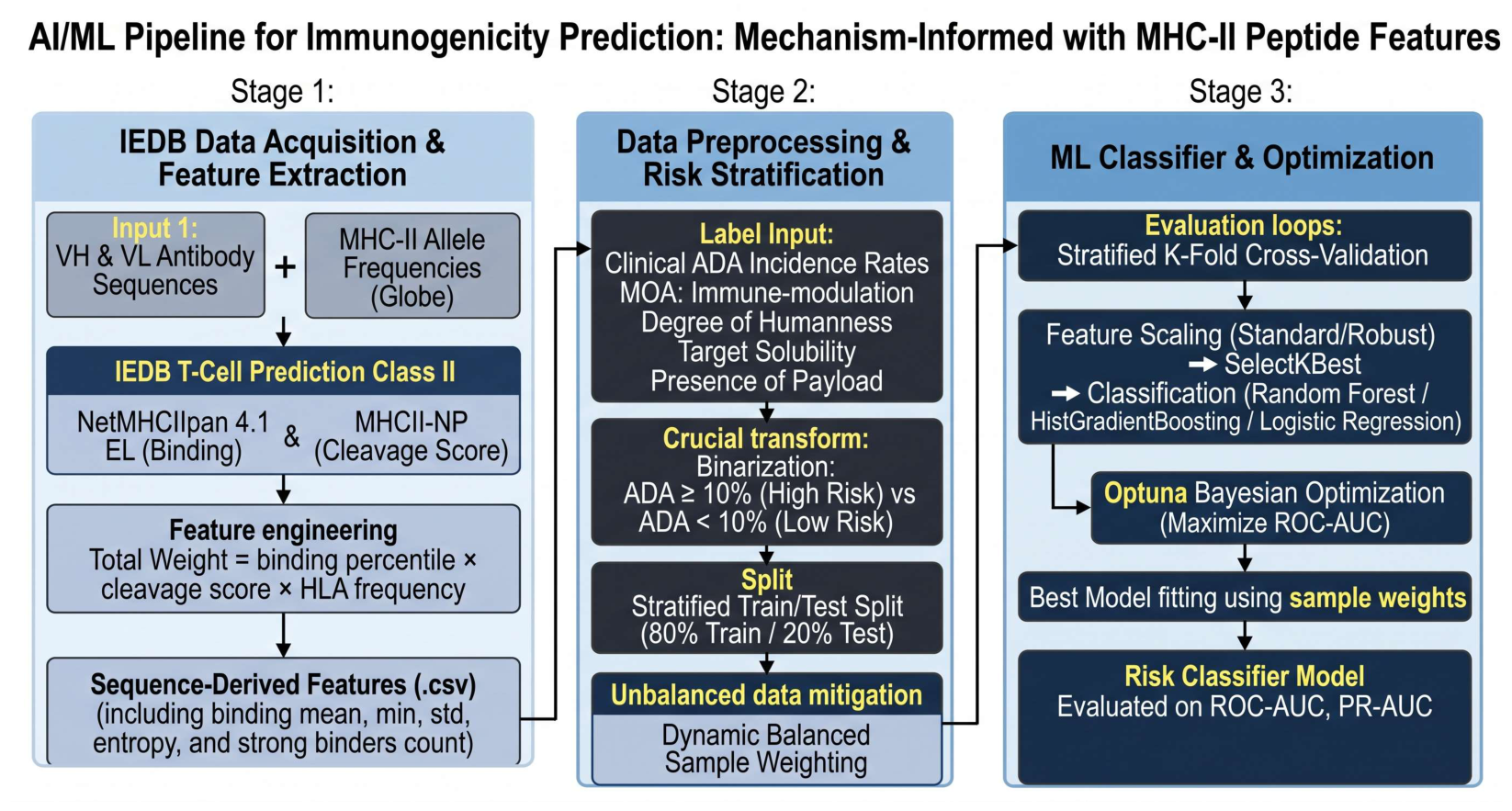
Figure 2.
distribution for the clinical incidence rate of anti-drug antibody by samples used in training the IEDB-based model (A-B). Distribution of the IEDB raw output metrics, netmhciipan_el score and MHCII-NP cleavage probability scores by stratified ADA incidence group.
Figure 2.
distribution for the clinical incidence rate of anti-drug antibody by samples used in training the IEDB-based model (A-B). Distribution of the IEDB raw output metrics, netmhciipan_el score and MHCII-NP cleavage probability scores by stratified ADA incidence group.
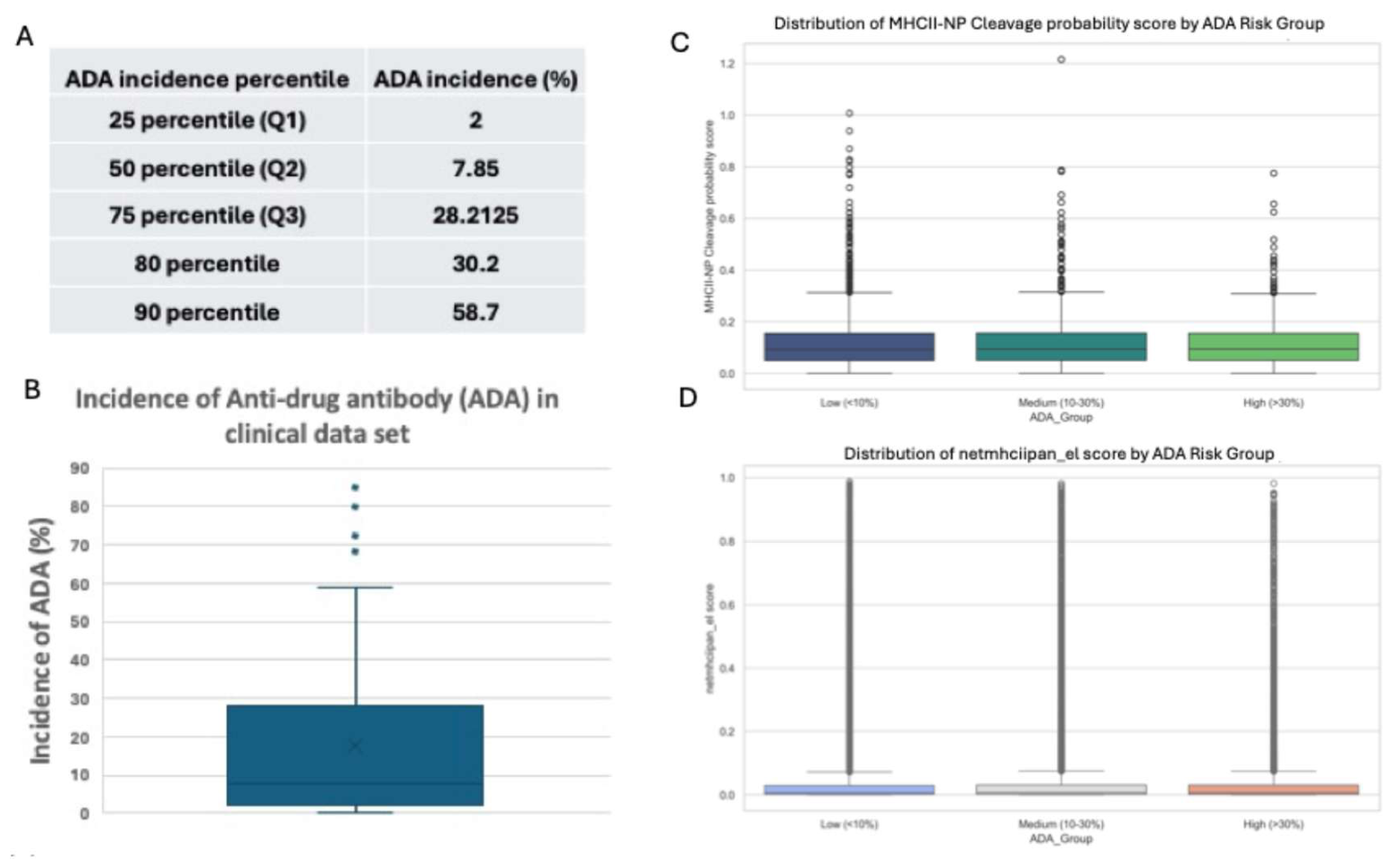
Figure 3.
distribution of ADA versus preprocessed data from IDEB (color-coded by ADA incidence level).
Figure 3.
distribution of ADA versus preprocessed data from IDEB (color-coded by ADA incidence level).
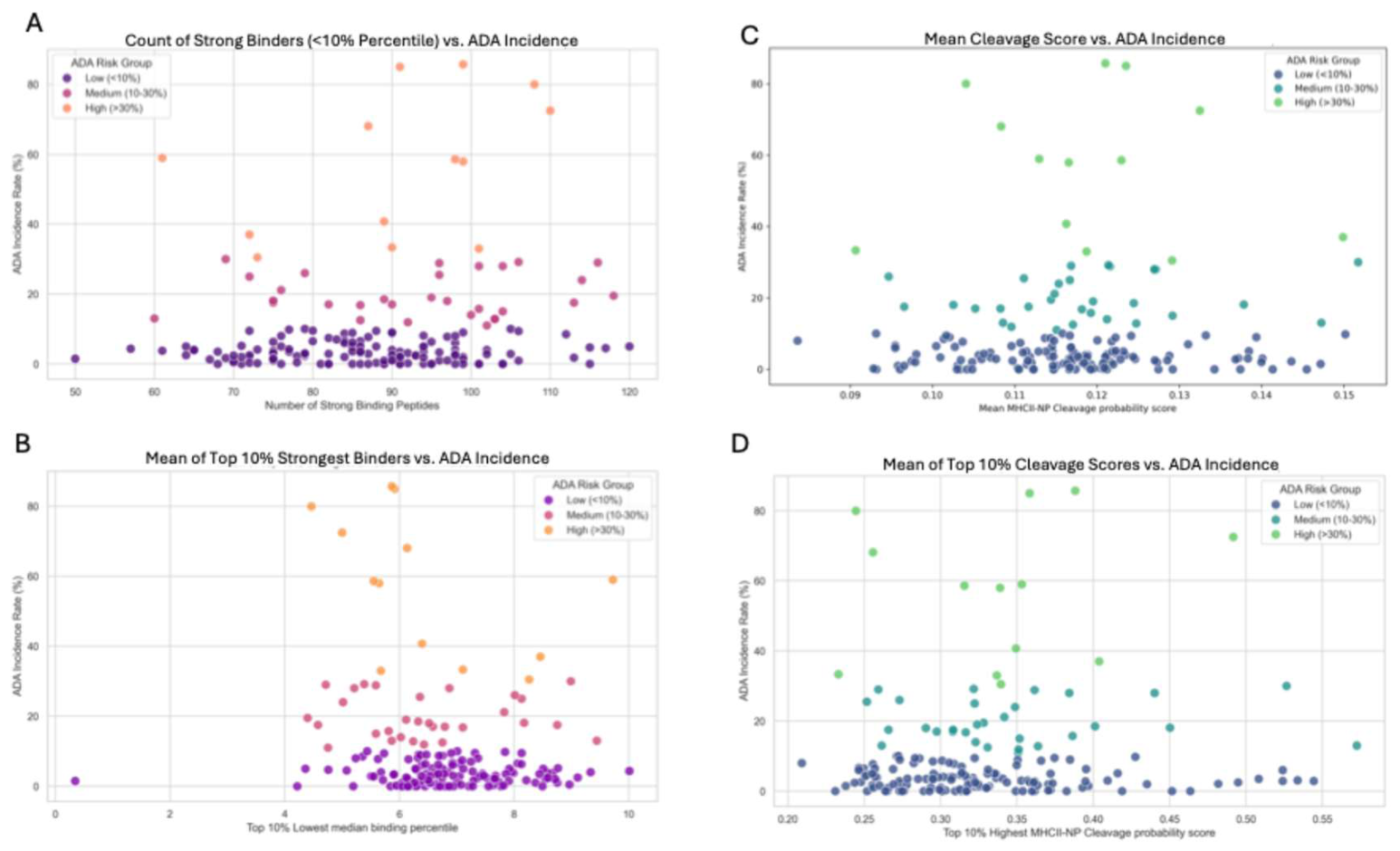
Figure 4.
Performance of the model using MHC-II-based data in “IEDB-only” model. Training threshold of % ADA incidence at 10%, 5%, and 2% were used as cutoff for definition of high immunogenicity risk versus low immunogenicity risk in terms of ROC, Precision-Recall (PR), and confusion matrix.
Figure 4.
Performance of the model using MHC-II-based data in “IEDB-only” model. Training threshold of % ADA incidence at 10%, 5%, and 2% were used as cutoff for definition of high immunogenicity risk versus low immunogenicity risk in terms of ROC, Precision-Recall (PR), and confusion matrix.
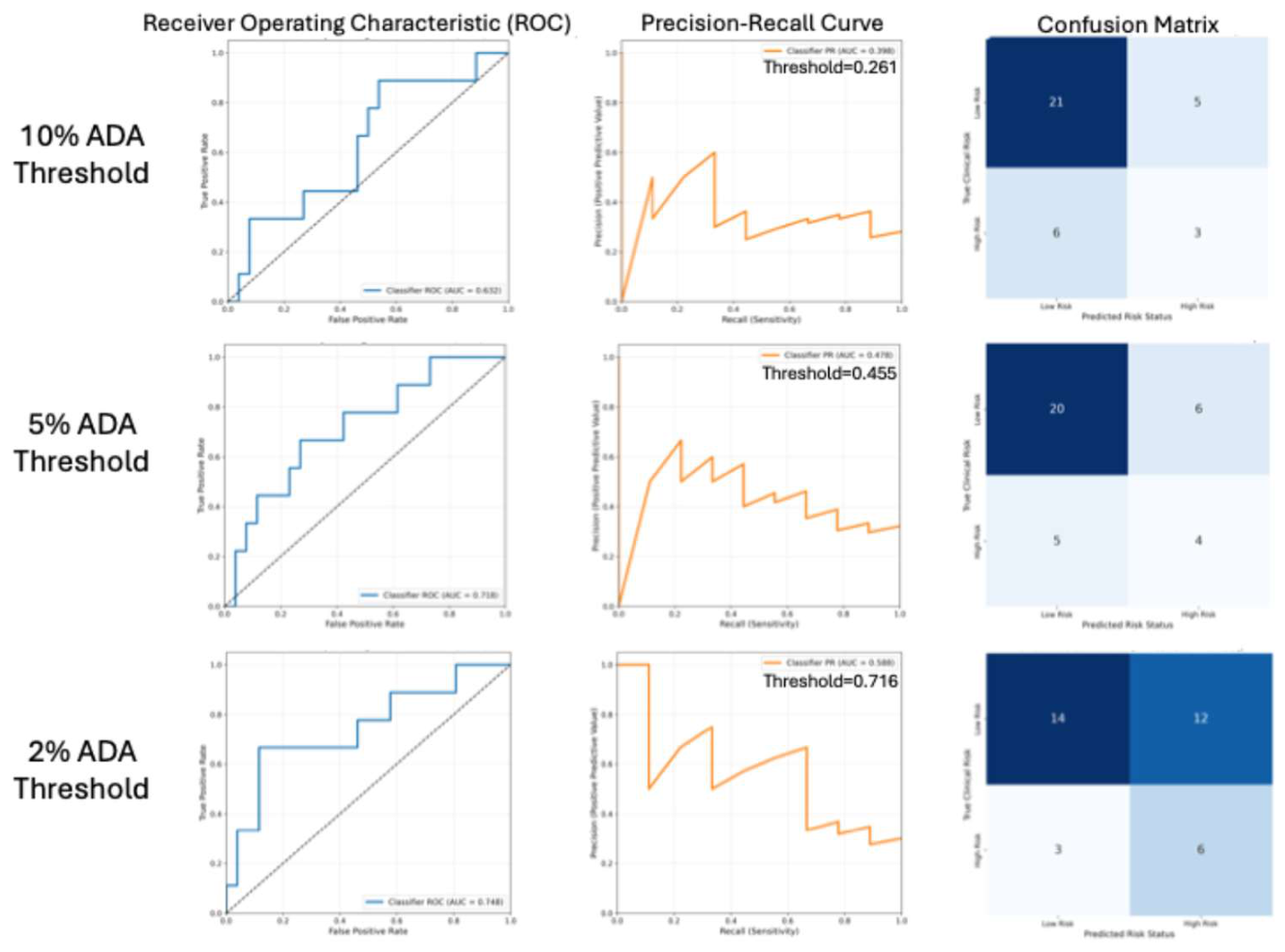
Figure 5.
engineered parameters related mechanism-informed prediction of immunogenicity, in terms of humanization level (Host_origin), immunomodulatory effects (MOA_Immune), availability as soluble form (Target_solubility), and payload-conjugation status (Is_ADC).
Figure 5.
engineered parameters related mechanism-informed prediction of immunogenicity, in terms of humanization level (Host_origin), immunomodulatory effects (MOA_Immune), availability as soluble form (Target_solubility), and payload-conjugation status (Is_ADC).
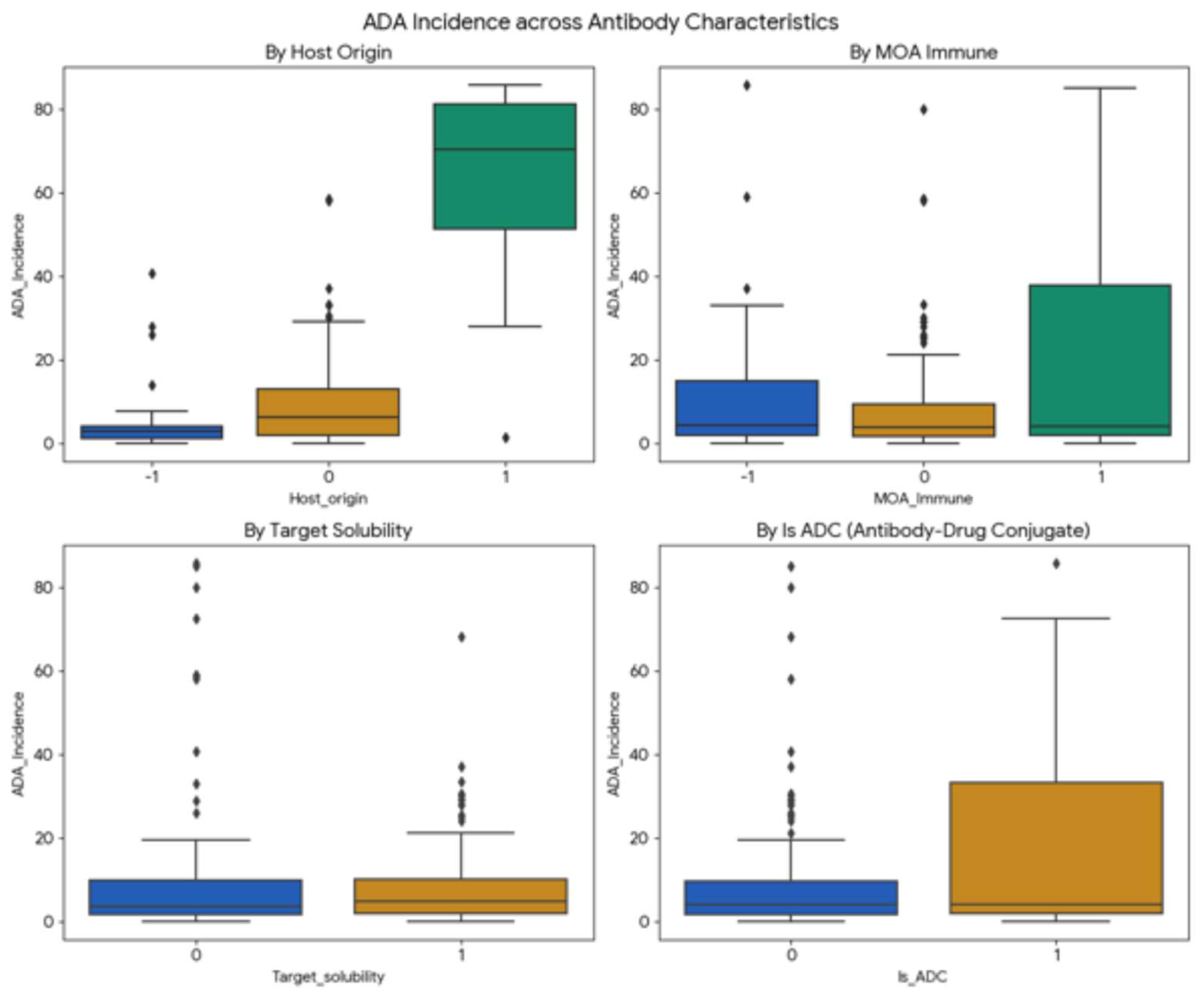
Figure 6.
performance of the mechanism of action-informed IEDB-based model. Improvements were observed in comparison to IEDB-only-model in terms of ROC, Precision-recall, and confusion matrix.
Figure 6.
performance of the mechanism of action-informed IEDB-based model. Improvements were observed in comparison to IEDB-only-model in terms of ROC, Precision-recall, and confusion matrix.
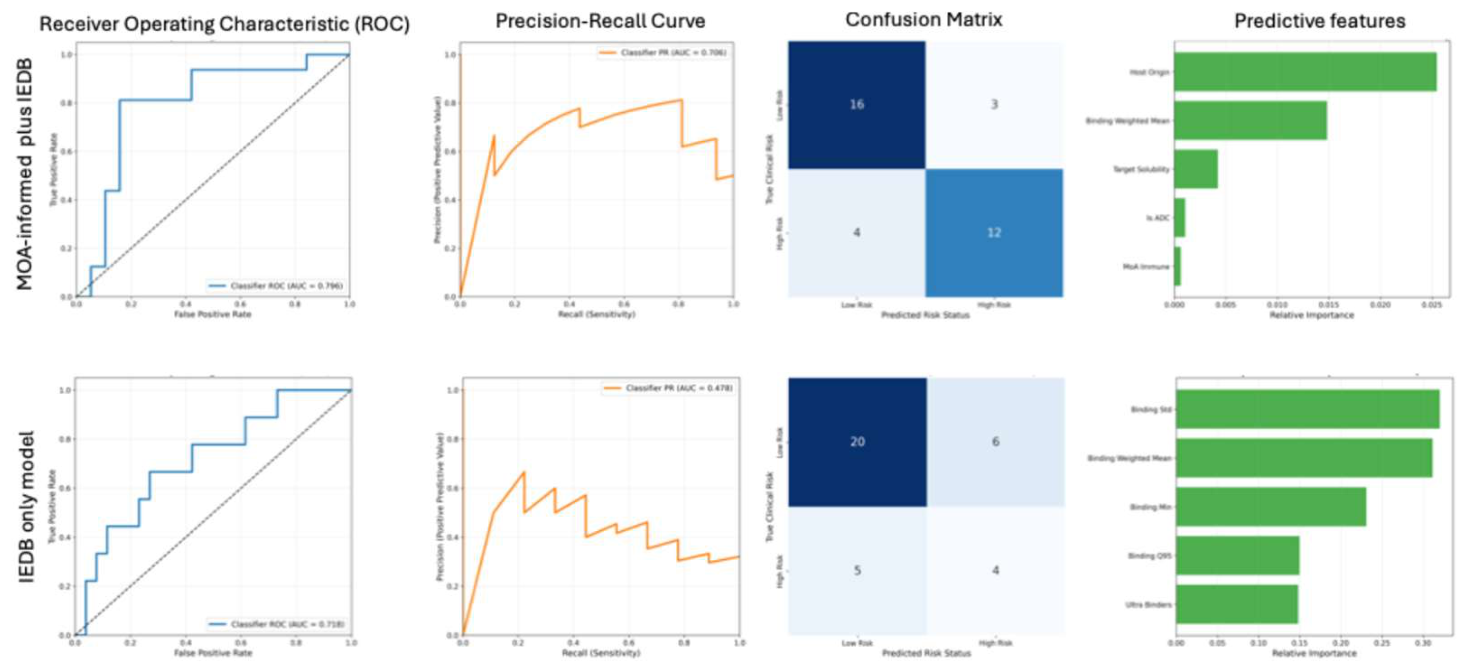
Table 1.
scoring system for MOA_Immune or Immunomodulatory effect.
| Perturbation Category | Mechanism / Target Description | Target Examples |
| Immune Activating (score 1) | Antibodies designed to break peripheral tolerance, lower the threshold for immune activation, or act as an active antigen. | • Immune checkpoint inhibitors (e.g., anti-PD-1, anti-PD-L1, anti-CTLA-4) • Activating receptor agonists (e.g., 4-1BB) • T-cell stimulating superantigens • Anti-idiotype vaccines |
| Immune Suppressive (score -1) | Antibodies that systemically ablate or suppress the core effector cells required for antibody generation. | • Direct B-cell and T-cell depleting agents • CD38 targets • CD40 antagonists • BAFF neutralizers (starving B-cells) • Master upstream inflammatory cytokine neutralizers (TNF-α, IFN-γ, IL-1, IL-6/IL-6R) |
| Immune Neutral (score 0) | Antibodies acting on targets outside core systemic immune activation and regulation. | • Peripheral or Th2/Th17 cytokines mediating localized tissue inflammation (IL-4, IL-5, IL-13, IL-17, IL-23) • Solid tumor and tissue antigens • Viral, bacterial, and toxin antigens • Neurological targets • Metabolic and coagulation factors |
Disclaimer/Publisher’s Note: The statements, opinions and data contained in all publications are solely those of the individual author(s) and contributor(s) and not of MDPI and/or the editor(s). MDPI and/or the editor(s) disclaim responsibility for any injury to people or property resulting from any ideas, methods, instructions or products referred to in the content. |
© 2026 by the authors. Licensee MDPI, Basel, Switzerland. This article is an open access article distributed under the terms and conditions of the Creative Commons Attribution (CC BY) license (http://creativecommons.org/licenses/by/4.0/).
Copyright: This open access article is published under a Creative Commons CC BY 4.0 license, which permit the free download, distribution, and reuse, provided that the author and preprint are cited in any reuse.