

Submitted:
04 November 2026
Posted:
05 November 2026
You are already at the latest version
Abstract
Various studies have proposed using plasma treatment prior to anaerobic digestion to enhance the degradation of organic dry residue (oDR) and increase biogas production. This disintegration process also significantly affects phosphorus release by disrupting cell walls. Several studies show that the driving disintegration process through plasma implementation occurs due to the production of hydrogen peroxide. Since targeted plasma treatment is still technically demanding, this study proposes to estimate the related P release by applying defined hydrogen peroxide dosage to the test medium. Here, the approach was implemented on washed activated sludge (WWAS) in batch tests using H₂O₂ at two different temperatures: 20 °C and 60 °C. Results show only heating treatment mobilised approximately 23% P as PO₄-P, while only 9% P was mobilised by applying 3.4 g H₂O₂ / g DR at 20 °C. The reason behind this scenario is the low reactivity of H₂O₂ as catalase is active at ambient temperature, which also caused only 3% COD solubilisation. However, complete COD solubilisation was achieved by applying similar dosage of H₂O₂ at 60 °C. In this treatment condition, dissolved P mobilisation increased to 40% while PO₄-P mobilisation reduced by 11%. The reduction of PO₄-P can be occurred by parallel formation of P related precipitants, since metal ions like Ca and Mg released in this study. Additionally, the oxidation of ammonia to nitrate is also observed, resulting in lower pH (4.41). Also, the oxidation of Fe²⁺ to Fe³⁺ could cause FePO₄ precipitation. These observed effects are probably transferrable to activated sludge from other wastewater treatment plants (WWTPs). Summarizing these effects, high temperature developed in intense wet plasma treatment can prevent the intended P recovery from the wet sludge phase or sludge liquor.
Keywords:
washed activated sludge (WWAS)
; H2O2
; sCOD
; pH and P mobilisation
Introduction
Advanced Oxidation Processes (AOPs) utilizing hydrogen peroxide (H2O2) were historically introduced to waste water treatment to remove recalcitrant organic matter and pollutants (Deng and Zhao 2015; Verma and Samanta 2018; Miklos et al. 2018). Furthermore, they are found to degrade Extracellular Polymeric Substances (EPS) and cause cell lysis, that’s why they were considered for sewage sludge treatment, especially for dewatering, biomass reduction, sanitation, solubilization and enhanced anaerobic digestibility (Guan et al. 2018).
H2O2 is widely used for AOP processes but requires an activation mechanism to overcome its homolytic cleavage barrier to liberate the highly reactive hydroxyl radical (∙OH), which in highly turbid media (like sewage sludge) can be achieved by transition metal catalysis (Fenton reactions) or thermal induction (Andreozzi 1999). Especially microwave heating (= microwave-enhanced AOP) has gained attention for sewage sludge treatment in recent years (Cao et al. 2023). Additionally, ∙OHs can be generated in-situ by plasma discharges ignited directly within sludge (Timmermann et al. 2025), which solubilize it subsequently (Lee and Lee 2023).
Moreover, pre-treatments like AOPs were also evaluated in the framework of decentralized phosphorus (P) recovery from sewage sludge, as increasing orthophosphate (PO4) solubilization directly enhances subsequent struvite precipitation efficiency (Liu et al. 2019). Within this context, it was assumed that PO4 release occurs synchronously with the liberation of intracellular organic matter.
However, a pioneering study by (Liao et al. 2005) found that adding H2O2 (2.5 gH2O2/gDR) to waste activated sludge (WWAS) prior to a thermal treatment (60 °C) yielded less PO4 release (74 mg/L) than the sole heating (96 mg/L). A similar trend was observed at 100 °C, whereas it reversed at higher temperatures. Liao and his team hypothesized that this phenomenon was due to the preferential release of phosphorus in the form of polyphosphate within this intermediate temperature range.
A similar effect was reported by (Wong et al. 2006) who observed that increasing the concentration of added H2O2 at 60 °C reduced the dissolved PO4 concentration, whereas it enhanced release at 120 °C. This inhibitory effect at 60 °C was likewise attributed to the preferential release of polyphosphates. Notably, these observed effects were qualitatively identical regardless of whether microwave or conventional heating was applied. Because the target enhancement of PO43− release is successfully achieved at sufficiently high temperatures, the reversal trend occurring in the intermediate temperature range between 60 °C and 90 °C—which was also documented by (Yu et al. 2010; K.V. Lo and P.H. Liao 2011; Yin et al. 2008)—was not investigated further in this study.
Conversely, a few studies have reported a slight increase in PO4 release upon the addition of H2O2 at 60 °C (Pan et al. 2006; Chan et al. 2010; Qureshi et al. 2008). However, it is critical to note that all of these investigations utilized acidified cattle manure (pH = 4) as the initial substrate.
Overall, however, most studies have observed a reduction in PO4 release upon the addition of H2O2 at moderate temperatures, a phenomenon consistently attributed to polyphosphate formation. While this explanation stems from findings during purely thermal treatment (Kuroda et al. 2002), thus it has far only been systematically verified for an H2O2-based AOP by (Kenge et al. 2008). In that study, WAS was treated with 0.9 gH2O2/gDR and heated conventionally to 80 °C for 10 min, with two control groups pre-acidified to distinct levels (pH 2.9 and pH 5.1 compared to the unadjusted pH 6.3). Since the dissolved PO4 concentration was higher in the acidified samples after treatment, polyphosphate formation was deemed unlikely to be the underlying cause of the PO4 decline.
To further validate this, a control experiment was conducted using a pure KH2PO4 solution (100 mg PO4/L) under identical conditions, including an acidified control. Both samples subsequently exhibited the exact same PO4 concentration as the initial solution, effectively ruling out abiotic polyphosphate synthesis. Consequently, (Kenge et al. 2008) hypothesized that instead of polymerization, the released phosphate in the sewage sludge matrix complexed with divalent cations and EPS, thereby reducing the measurable orthophosphate fraction.
The present study aims to further elucidate the mechanisms underlying the reduced orthophosphate release during H2O2-based AOPs within the economically significant temperature range up to 60 °C. To achieve this, the treatment was exemplarily applied to WAS sourced from a municipal wastewater treatment plant in Rostock, Germany. Sludge disintegration efficiency and the release of selected nutrients were analyzed as a function of treatment temperature and H2O2 dosage. Furthermore, the observed limitations of P mobilization were critically evaluated in detail, allowing for the identification and derivation of critical scientific knowledge gaps in this field.
Materials and Methods
2.1. Chemicals
Hydrogen peroxide (30% solution, stabilized with phosphate ≤ 5ppm, CAS number: 7722-84-1) was purchased from Carl Roth GmbH + Co. KG, Germany.
2.2. Sample Collection and Preparation
WAS was collected from a wastewater treatment plant in Rostock, Germany. The sample was allowed to settle for 30 min, reducing the volume from 10 L to 4 L by decanting the supernatant. The resulting thickened WWAS was then transported to the laboratory.

Table 1.
Characteristics of washed waste activated sludge. Values are given as (mean ± standard deviation) from three replicates.
Table 1.
Characteristics of washed waste activated sludge. Values are given as (mean ± standard deviation) from three replicates.
| Dry Residue (DR) | (23.25 ± 0.02) g/kg |
| Organic Dry Residue (oDR) | (77.74 ± 0.78) % of DR |
| pH | 6.48 |
| Conductivity | 90 µS/cm |
| Total COD | (1230 ± 70) mg/g DR |
| Total P | (38.88 ± 0.44) mg/g DR |
| Total N | (75.19 ± 0.13) mg/g DR |
| Total Fe | (3.53 ± 0.88) mg /g DR |
To remove non-biomass contaminants that could interfere with the H2O2 reaction, the thickened WWAS was washed twice via centrifugation at 5,000 RPM for 10 minutes, each time replacing the supernatant with deionized (DI) water. The resulting washed activated sludge (WWAS) was then utilized for subsequent batch tests. Its initial characteristics are summarized in WAS collected from a wastewater treatment plant in Rostock, Germany. The sample was allowed to settle for 30 min, reducing the volume from 10 L to 4 L by decanting the supernatant. The resulting thickened WWAS was then transported to the laboratory.
2.3. Pre-Tests
Pre-tests were conducted to evaluate the effects of various H2O2 dosages on sludge disintegration and phosphate release at 20 °C and 60 °C, establishing the optimal dosage for subsequent experiments.
Accordingly, reactors vessels were filled with 400 mL WWAS diluted with DI water to at a concentration of approximately 3.4 gDR/L. The mixtures were continuously stirred at 300 RPM. For the 60 °C series, the experiments were conducted in a temperature-controlled water bath, injecting H2O2 once the sample temperature stabilized. To prevent evaporation while allowing gas escape, reactor openings were partially sealed. After 3 h of reaction, the liquid phase was analyzed for soluble chemical oxygen demand (sCOD), PO4-P, and pH.
Furthermore, H2O2 stability was assessed in DI water (10 g/L) for 3 h; as no significant decomposition was observed at either temperature, thermal degradation was considered negligible.
2.4. Batch Tests
WWAS, equivalent to 0.58 gDR, was diluted with DI water to a sample volume of 200 ml (2.9 gDR/L). Four treatment groups were designed to isolate and evaluate the individual and synergistic effects of H2O2 at a dosage of 10 g/L (3.45 gH2O2/gDR) and thermal stress on sludge disintegration and phosphorus release. Group 1 involved only heating-up the sample from 20 °C to 60 °C within 45 mins without H2O2 addition. Groups 2 and 3 replicated the pre-test conditions, with stirred samples maintained at either 20 °C or 60 °C for 3 h, with or without H2O2. In Group 4, the thermal pretreated sample (Group 1) was cooling back to 20 °C before the 3-hour reaction period (with or without H2O2). The experimental matrix for all treatment groups is summarized in Table 2.
2.5. Analysis
After the batch tests, the dissolved fraction of the samples was analyzed for pH, solubilized COD, PO4-P, Fe2+/3+, Ca2+, Mg2+, NH4–N, NO3–N and residual H2O2 using HACH test kits (LCK 1414, LCK 350, LCK 320, LCK 327, LCK 327, LCK 305, LCK 339 and HYP-1 (2291700), respectively). The sCOD values were corrected for residual H2O2 interference according to (Kang et al. 1999).
For the measurement of total COD, N and Fe with same test kits, the samples were homogenized first using a disperser (T25 basic ULTRA-TURRAX®, IKA®-WERKE, Germany) at 11,000 RPM for 5 min. Standard deviation war calculated from triplicate measurements of the WAS.
PP = TP − DP
DRNP = DP − DRP
P was fractionated according to procedures illustrated in Figure 1 and subsequently determined using HACH test kits (LCK 350). Total P (TP) concentration corresponds to the value measured after aforementioned sample homogenization and subsequent chemical digestion. Dissolved P is defined as the fraction passing through a 1-2 µm glass fibre filter and is measured following chemical digestion. Dissolved reactive P (DRP, analyzed as PO4-P) represents a subfraction of DP and is determined directly without prior chemical digestion. The non-directly measured fractions, namely dissolved non-reactive P (DNRP) and particulate P (PP), were calculated according to Equations 1 and 2.
All parameters were measured in triplicates; mean and standard deviation are provided. Availability and mobilization of selected parameters were calculated using equation 3 and 4, respectively, with CS(end) and CS(initial) being concentrations in solution after and before treatment and Ctotal as the total concentration.
Results and Discussion
3.1. Pre-Test
The results of the pre-tests are shown in Figure 2. H2O2 was applied up to a maximum dosage of 3.0 g, corresponding to a concentration of 7.5 g/L or a specific load of 2.2 gH2O2/gDR.
COD solubilization, indicating the extent of sludge disintegration, increased with H2O2 dosage at both temperatures, albeit at different orders of magnitude. At 20 °C, the initial sCOD of 14 mg/L rose to 98 mg/L at the highest dosage of 3.0 g H2O2. In comparison, thermal treatment alone at 60 °C resulted in an sCOD of 567 mg/L, which further escalated to 2687 mg/L upon the addition of 3.0 g H2O2.
At 20 °C, the P release mirrored the trend of sCOD solubilization, increasing from below the detection limit (0.05 mg/L) without H2O2 to 32 mg/L at the highest dosage, albeit with a diminishing rate of increase. In contrast, the P release at 60 °C exhibited the opposite trend: thermal treatment without H2O2 yielded the highest concentration of PO4-P. Despite the pronounced effect of H2O2 on sCOD solubilization, the PO4-P concentration stagnated or marginally declined with increasing H2O2 dosages.
The H2O2 dosage also exerted a distinct effect on the pH value. At 20 °C, the pH slightly increased from 6.2 (without H2O2) to 6.6 at the highest dosage. Thermal treatment alone at 60 °C resulted in a marginal pH increase to 6.4; however, the subsequent addition of H2O2 led to a continuous decline, reaching a minimum of 4.7 at the maximum dosage.
These results, in particular the declining trend of PO4-P release with increased H2O2 dosage at 60 °C, are well aligned with previous studies, why a more comprehensive analysis could be conducted subsequently.
3.3. Batch Tests
The raw analytical results after all treatments are provided in Table 3. The data of the untreated WWAS before the treatments is shown for comparison (“Heating-up, before treatment”).
Figure 3 summarizes the effect of the four different treatments on the Availability of PO4-P, DP, sCOD, NH4-N, NO3-N, Fe3+ and Fe2+ with regard to the total mass of P, COD, N and Fe, respectively.
Figure 3.
Effect of the different treatments on the availability of various parameters.
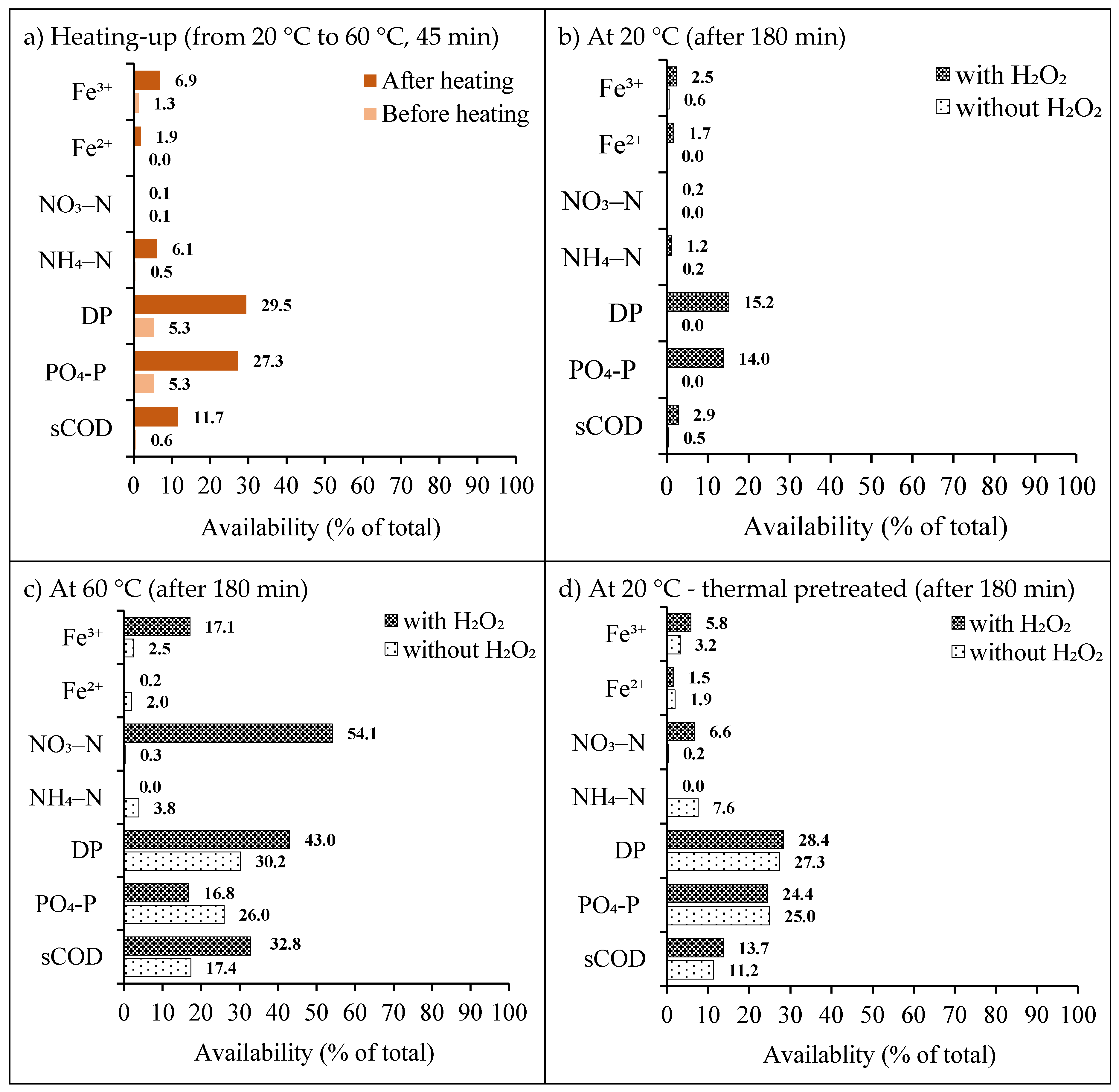
Figure 4.
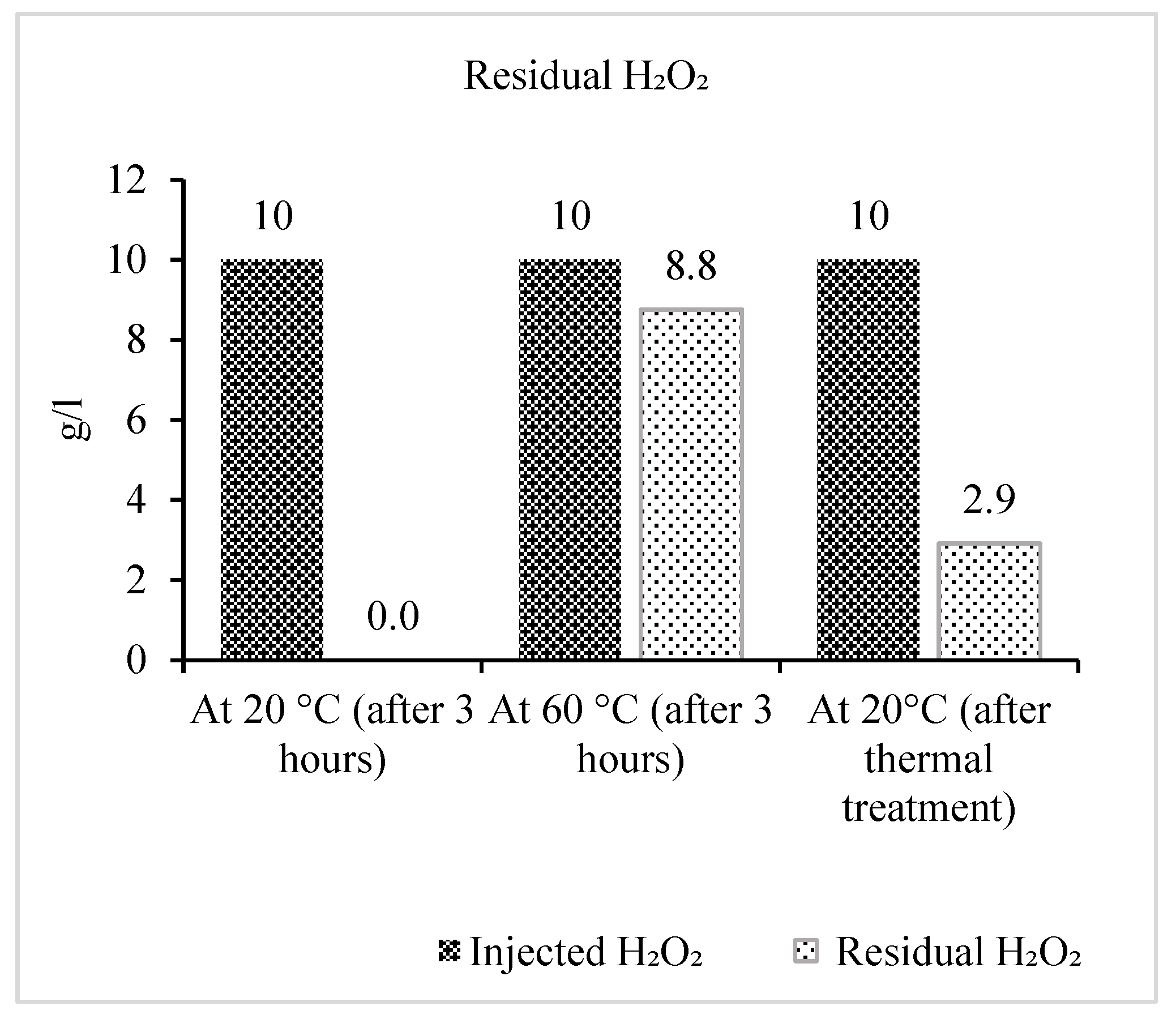
Injected and residual H2O2 concentration after treatments.
3.3.1. Cod and Residual H2o2
The trends observed in the pre-test regarding COD solubilization could be replicated. Thermal treatment alone increased the available sCOD by 17.4% (Figure 3c), whereas H2O2 treatment at 20 °C resulted in only 2.9% solubilization (Figure 3b). Combining H2O2 addition with an elevated treatment temperature resulted in an elevated 32.8% COD solubilization.
Additional COD solubilization was similarly low, independently if H2O2 was added to the raw (Figure 3b) or the thermally pretreated sample at 20 °C (Figure 3d).
Although H2O2 did not appear to react effectively at room temperature, no residual H2O2 was detected in the sample. In contrast, the treatment that achieved the highest degree of solubilization at 60 °C contained only 1.25 g/L less H2O2 than the initial concentration. This difference is attributed to the temperature-dependent activity of catalase, which decomposes H2O2 into water and molecular oxygen and loses activity at temperatures above approximately 40 °C (Wang et al. 2009; Gabbita, Kasi V and Hzuang, Jerry YC 1984). In agreement with this explanation, (Wang et al. 2009) observed a rapid decrease in H2O2 concentration in WAS at room temperature, whereas H2O2 degradation was considerably lower at 60 °C. Thus, the complete depletion of H2O2 after 3 h at room temperature observed in the present study appears plausible.
H2O2 injected to a thermally pretreated sample at 20 °C was still measured after 3 hours (2.9 g/L). Apparently, the heating-up procedure inactivated parts of the catalase irreversibly, why its degradation activity on H2O2 became limited. Nevertheless, an increased solubilization by H2O2 was not observed, indicating the missing thermal activation.
3.3.2. Ammonium and Nitrate
The treatments resulted in distinct differences on mobilization and fate of ammonium (Figure 5). The heating-up procedure alone mobilized 5.7% of the total N as ammonium, which probably is directly related to thermally-induced COD solubilization (Figure 3a). When H2O2 is added to the thermal treatment, no ammonium but 113 mg/L NO3-N are detected corresponding to an apparent mobilization of 54% of total N and subsequent oxidation.
Several parallel or consecutive processes may be involved in this case. By disintegrating microbial cells, ammonium and intercellular organic N-compounds become solubilized. H2O2 highly likely cleaved amino groups from these amino compounds by oxidative deamination, hydrolysis or broke the amino compound itself into keto acid and free ammonia (Targhan et al. 2021). Also, nitrate was found to be a direct reaction product from AOPs of organic amides (Leitner et al. 2002).
The released NH4+ was seemingly completely oxidized. In clear water, H2O2 is to weak for oxidizing ammonia into nitrate. Therefore, Fe ions present in the WAS were highly likely crucial catalysts to initiate Fenton reactions and produce ∙OH. But even then, the reaction kinetics of ∙OH with NH4+ are inherently slow in acidic media (Siddiqui et al. 2013). The observed conversion to nitrate in this study is therefore be due to the specific operational conditions. The combination of an elevated temperature, the extended reaction time of three hours and a large stoichiometric excess of H2O2 successfully probably overcame the kinetic limitations, driving the multi-step radical oxidation to its thermodynamic end point (NO3-) (Equation 5).
This assumption is also supported by the reducing pH. The oxidation of one mole ammonium with H2O2 produces two mole H+. Since 113 mg/L NO3-N correspond to 8 mmol/L, about 16 mmol/L H+ must have been produced, which would correspond to an endpoint pH of 2.0 in an unbuffered system. Actually, in this experiment, the pH dropped from 6.5 to 4.4, indicating the presence of buffer systems. This is probably mainly due functional groups of the WAS and its solubilization products, in particular protonation of particular carboxylic groups (COO- → COOH). The pKa value of many carboxylic acids is in the range between 4 and 5 (Namazian and Halvani 2006) supporting this assumption.
With regard to the intended improvement of anaerobic degradability by oxidative COD solubilisation, the oxidation of ammonia to nitrate is undesirable. The reduction of 1 g nitrate to N2 requires stoichiometrically 2.86 g COD (Daigger 2014) which is lost for methane production.
No ammonium was detected in the experiment with H2O2 dosage at 20 °C after thermal pretreatment either, while nitrate increased to 13 mg/l (6.5% of total N). Considering the remarkably high 53.1% COD solubilization in parallel indicates that most N stayed organically bound N in this case (and could not be oxidized).
3.3.3. Phosphorous
The mobilization of DP and its sub-fraction PO4-P is compiled in Figure 6. H2O2 dosage at room temperature resulted in a slight P-mobilization of 10.5%, of which nearly 90% was dissolved as PO4-P. This significant increase is in contrast to a very low solubilization of sCOD (2.9%). In this case, it may be due to the specific characteristics of WAS as it comes from a wastewater treatment plant performing enhanced biologic phosphorous removal. Normally, phosphate accumulating organisms (PAO) release PO4-P under anaerobic conditions and fill their polyphosphate storage under aerobic conditions (Mino et al. 1998). As hypothesis, the extreme oxidative stress and the above discussed probable catalase production/release may have triggered the activation of the phosphate driven energy metabolism with an according P release.
Thermal treatment alone mobilized 26.4% of the total P, of which more than 80 % were released as readily available PO4-P. This is the highest value for all treatments. Again, the presence of PAOs in the WAS may partly explain this strong release, but here probably initiated by heating stress and oxygen limitation. Additionally, disintegration and improved chemical dissolution of P-salts are probable sources of the increased DRP.
The additional treatment with H2O2 at 60 °C resulted in an additional significant increase of DP (40% of P). However, the mobilized PO4-P is reduced compared to thermal treatment alone (12.2%). That means the strong increase of DP is related to dissolved organic P-fractions. Regarding the high solubilization of COD, the increase of DP is likely caused by cell disintegration. It is probable, that solubilization of organic matter is incomplete and cell internal P remains organically bound. However, this does not explain the reduced availability as PO4-P compared to thermal treatment alone.
Applying H2O2 to the thermally pretreated sample at 20 °C did only insignificantly change DP and PO4-P compared to thermal treatment alone. That means, in these experiments, no reduction of PO4-P was observed. This is in line with the COD solubilization. It can be assumed, that the P mobilization was already accomplished by thermal treatment and the low reactivity of H2O2 at 20 °C could not access new P sources.
However, the question remains, why originally mobilized PO4-P at 60 °C is reduced by H2O2 dosage. Since biologic uptake can be excluded in these conditions, it suggests that phosphates are somehow chemically bound. Potentially relevant cations for precipitation reactions are Fe3+, Ca2+ and Mg2+.
3.3.4. Ca and Mg and Fe
In the experiment with combined thermal and H2O2 treatment at 60 °C, pH dropped to 4.41, mainly due to the oxidation of ammonia to nitrate. This leads also to a nearly complete protonation of orthophosphate (PO43-) to mono-hydrogen phosphate (H2PO4−). Stoichiometrically, about 99% of the phosphates are available in this form at pH 4.4. This is another relevant buffer system, explaining the dampened pH drop with regard to the stoichiometric H+ production by ammonia oxidation. The solubility of Calcium and Magnesium mono-hydrogen Phosphates is in range of several Gramm per Liter. Accordingly, the precipitation with Ca2+ and Mg2+ ions can be excluded.
The WWAS contained 3.5 mg Fe/g DR even after washing. This is due to iron dosage at the wastewater inflow for sulfide precipitation to mitigate H2S problems. Accordingly, it can be assumed that a large ratio of iron is bound as FeS. However, since the WAS is aerated at the activated sludge system, some transformation to three valent ion is probable, which itself could already react with phosphate to FePO4. As shown in Figure 7, all treatments resulted in some mobilization of Fe3+.
The increase in case of pure thermal treatment might be due to improved solubility of iron compounds in combination with oxidation of Fe2+ with eventually available dissolved oxygen after washing. The strong difference with additional H2O2 treatment is probable due to oxidation of Fe2+ to Fe3+. This effect has been already observed by (Ismail et al. 2022) for WAS containing iron (II) sulfide. They found that H2O2 dosage could dissociate FeS, thereby releasing Fe2+, which then quickly is further oxidized by H2O2 to Fe3+ (Fenton reaction).
They measured a complete dissociation and oxidization of FeS to Fe3+ within 1 min at room temperature, when the molar H2O2 dosage was at least two times of FeS content. The ferric iron then undergoes quick hydrolysis in water forming hydrous ferric oxides (HFO), mainly Fe(OH)3. Available PO43- is then precipitated by the HFO forming ferric hydroxyl phosphates with very low solubility.
Ismail et al. experimentally verified in their experiments a nearly ideal stoichiometric ratio of one mole of PO43- removed per mole of released Fe3+, or a ratio of 0.55 g P/g Fe3+ on mass basis. Also other studies show that precipitation of phosphate stops when H2O2 dosage exceeds the dosage of Fe2+ (Li et al. 2009; Ghodsi et al. 2021).
However, the total iron mass in the sample (2 mg) is clearly a limiting factor and could explain only precipitation of 1.1 mg PO4-P if a molar ratio of 1:1 is applied.
Still, over proportional binding of phosphorus is possible if iron humic phosphate compounds (Fe-HS-P) are considered. The underlying processes and formed products are well investigated in soil science and plant nutrition context (Gerke 2021) and can be shortly characterized as follows. Fe3+ possesses a high affinity to carboxylic acids (-COOH) and phenolic hydroxyls (-OH). These functional groups wrap around the Fe3+ iron and forming iron-humic chelates. These provide multiple vacant water ligand spots and can bind more H2PO- or HPO42- ions than Fe3+ directly. The resulting product is an amorphous, rather colloidal compound. The treatment at 60 °C with H2O2 in combination with the assumed protonation of carboxylic groups are exactly fostering conditions for the formation of Fe-HS-P. Also, the strong increase of the organic dissolved P-fraction supports this probable P-fixation pathway.
In the last years Fe-HS-P became also relevant in research on P recovery in sludge treatment, since the ionic and chelatic iron bridges limit the efficiency of standard chemical extraction and subsequent precipitation (Wilfert et al. 2015; Lu et al. 2022). Various approaches have been developed to overcome this challenge, either aiming at destabilizing the Fe-HS-P complex (Wilfert 2018) or direct concentration/drying of the amorphous flocs (Wang et al. 2022).
Summarizing, the apparent reduced PO4-P mobilization of the thermally-assisted H2O2 AOP treatment compared to the sole thermal treatment is probably due to a chain of reactions. COD solubilization produces organic acids. In parallel, NH4+ is oxidized by hydroxylic radicals. The related production of protons yields in a protonation of phosphate to H2PO4− and organic functional groups, in particular carboxylic groups of the produced organic acids. The parallel oxidation of Fe2+ to Fe3+ provides the basis for the formation of ternary iron-humic-phosphate complexes measured here as strong increase of the dissolved organic P-fraction.
Conclusion
The oxidative disintegration of WWAS using H2O2 at normal operational temperature (20 °C) was not effective. The main reasons seem to be an enzymatic degradation of H2O2 in combination with a low activity of hydrogen peroxide in this temperature range. In contrast a combined treatment of heating and H2O2 at 60 °C resulted in a strong mobilization of particulate COD which suggests a significantly improved aerobic degradability. However, this positive effect generally comes with some disadvantages. At this treatment, released ammonia was completely oxidized to nitrate. The produced nitrate will be reduced in an anaerobic fermenter by consumption of COD (stoichiometric value 2.86 g COD/g NO3-N). The oxidation of ammonia produces can significantly decrease pH. Although phosphorus mobilization into dissolved P is generally highly effective but was under these conditions probably largely bounded in Fe-HS-P complexes, which would hinder a targeted P precipitation. Iron plays in this chain of reactions a complex role, by fostering the formation of hydroxyl radicals and as “scavenger” of the mobilized P. However, the observed and - so far- partly supposed processes are matrix specific, in this case a WAS from a plant with EHPR and additional dosage of divalent Iron. This underlines that applying oxidative disintegration processes requires a comprehensive prior-consideration of potential side effects and downstream impacts.
Funding
Open Access funding enabled and organized by the project BIOADVAN.
Acknowledgments
This research was financed by the Leibniz Association within the cooperation between Leibniz Institute for Plasma Science and Technology (INP), Leibniz Institute for Agricultural Engineering and Bioeconomy (ATB) and University of Rostock (UoR).
Declarations
The authors declare that they have no conflict of interest.
References
- He, Dong-Qin; Wang, Long-Fei; Jiang, Hong; Yu, Han-Qing. A Fenton-like process for the enhanced activated sludge dewatering. In Chem. Eng. J. 2015, 272, 128–134. [Google Scholar] [CrossRef]
- Honnorat, B.; Brüser, V.; Kolb, J. F. Microwave plasma discharges for biomass pretreatment: Degradation of a sodium carboxymethyl cellulose model. AIP Adv. 2020a, 10(9), 095025. [Google Scholar] [CrossRef]
- Honnorat, B.; Brüser, V.; Kolb, J. F. Microwave plasma discharges for biomass pretreatment: Degradation of a sodium carboxymethyl cellulose model. AIP Adv. 2020b, 10(9), 095025. [Google Scholar] [CrossRef]
- Horikoshi, S.; Serpone, N. In-liquid plasma: a novel tool in the fabrication of nanomaterials and in the treatment of wastewaters. RSC Adv. 2017, 7(75), 47196–47218. [Google Scholar] [CrossRef]
- Imlay, J. A.; Chin, S. M.; Linn, S. Toxic DNA damage by hydrogen peroxide through the Fenton reaction in vivo and in vitro. Science 1988, 240(4852), 640–642. [Google Scholar] [CrossRef] [PubMed]
- Li, Shengli; Hu, Sheng; Zhang, Han. Formation of Hydroxyl Radicals and Hydrogen Peroxide by a Novel Nanosecond Pulsed Plasma Power in Water. IEEE Trans. Plasma Sci. 2012, 40(1), 63–67. [Google Scholar] [CrossRef]
- Liao, Ping Huang; Wong, Wayne T.; Lo, Kwang Victor. Advanced oxidation process using hydrogen peroxide/microwave system for solubilization of phosphate. J. Environ. Sci. Health Part A Toxic/hazardous Subst. Environ. Eng. 2005, 40(9), 1753–1761. [Google Scholar] [CrossRef] [PubMed]
- Liu, Jiaqi; Deng, Shaoyu; Qiu, Bin; Shang, Yue; Tian, Jingbao; Bashir, Amna; Cheng, Xiang. Comparison of pretreatment methods for phosphorus release from waste activated sludge. In Chem. Eng. J. 2019, 368, 754–763. [Google Scholar] [CrossRef]
- Lo, K.V.; Liao, P.H. Microwave enhanced advanced oxidation in the treatment of dairy manure. Microwave heating 2011, 91–106. [Google Scholar]
- Machnicka, A.; Nowicka, E.; Grübel, K. Disintegration as a key-step in pre-treatment of surplus activated sludge. J. Water Chem. Technol. 2017, 39(1), 47–55. [Google Scholar] [CrossRef]
- Nicoll, W.D.; Smith, A.F. Stability of Concentrated Hydrogen Peroxide Solutions. Ind. \ Eng. Chem. 1955, 47(12), 2548–2554. [Google Scholar] [CrossRef]
- Parvulescu; Vasile, I.; Magureanu, Monica; Lukes, Petr (Eds.) Plasma Chemistry and Catalysis in Gases and Liquids, 1st ed.; Wiley, 2012. [Google Scholar]
- Tiehm, A.; Nickel, K.; Zellhorn, M.; Neis, U. Ultrasonic waste activated sludge disintegration for improving anaerobic stabilization. Water Res. 2001, 35(8), 2003–2009. [Google Scholar] [CrossRef] [PubMed]
- Timmermann, Eric; Brueser, Volker; Kolb, Juergen F.; Traenckner, Jens. Experimental study and optimization of a microwave plasma biomass pretreatment using highly viscous sodium carboxymethyl cellulose solutions. J. Phys. D. Appl. Phys. 2025, 58(37), 375204. [Google Scholar] [CrossRef]
- Tunile, I.; Srinivasan, A.; Liao, P. H.; Lo, K. V. Microwave enhanced advanced oxidation treatment of dairy manure. Journal of environmental science and health. Part. B, Pesticides, food contaminants, and agricultural wastes 2018, 53(12), 824–830. [Google Scholar] [CrossRef] [PubMed]
- Wang, Fen; Lu, Shan; Ji, Min. Components of released liquid from ultrasonic waste activated sludge disintegration. Ultrason. Sonochemistry 2006, 13(4), 334–338. [Google Scholar] [CrossRef] [PubMed]
- Wang, Yawei; Wei, Yuansong; Liu, Junxin. Effect of H2O2 dosing strategy on sludge pretreatment by microwave-H2O2 advanced oxidation process. J. Hazard. Mater. 2009, 169(1-3), 680–684. [Google Scholar] [CrossRef] [PubMed]
- Wende, Kristian; von Woedtke, Thomas; Weltmann, Klaus-Dieter; Bekeschus, Sander. Chemistry and biochemistry of cold physical plasma derived reactive species in liquids. Biol. Chem. 2018, 400(1), 19–38. [Google Scholar] [CrossRef] [PubMed]
- Wong, W. T.; Chan, W. I.; Liao, P. H.; Lo, K. V.; Mavinic, D. S. Exploring the role of hydrogen peroxide in the microwave advanced oxidation process: solubilization of ammonia and phosphates. J. Environ. Eng. Sci. 2006, 5(6), 459–465. [Google Scholar] [CrossRef]
- Wu, Chen; Zhang, Guangming; Zhang, Panyue; Chang, Chein-Chi. Disintegration of excess activated sludge with potassium permanganate: Feasibility, mechanisms and parameter optimization. Chem. Eng. J. 2014, 240, 420–425. [Google Scholar] [CrossRef]
- Xu, Qiongying; Wang, Huidi; Wang, Qiandi; Zhang, Weijun; Wang, Dongsheng. Characterization of changes in extracellular polymeric substances and heavy metal speciation of waste activated sludge during typical oxidation solubilization processes. J. Environ. Sci. 2019, 80, 146–158. [Google Scholar] [CrossRef] [PubMed]
- Yin, Gui Q.; Liao, Ping H.; Lo, Kwang V. Sewage sludge treatment using microwave-enhanced advanced oxidation process. J. Environ. Sci. Health Part A Toxic/hazardous Subst. Environ. Eng. 2008, 43(2), 191–201. [Google Scholar] [CrossRef] [PubMed]
- Yu, Y.; Chan, W. I.; Liao, P. H.; Lo, K. V. Disinfection and solubilization of sewage sludge using the microwave enhanced advanced oxidation process. J. Hazard. Mater. 2010, 181(1-3), 1143–1147. [Google Scholar] [CrossRef] [PubMed]
- Zhang, Chen; Tan, Xuejun; Yang, Xue; Wu, Fengjie; Liu, Xiang. Acid treatment enhances phosphorus release and recovery from waste activated sludge: Performances and related mechanisms. Sci. Total Environ. 2021, 763, 142947. [Google Scholar] [CrossRef] [PubMed]
- Andreozzi, R. Advanced oxidation processes (AOP) for water purification and recovery. Catal. Today 1999, 53(1), 51–59. [Google Scholar] [CrossRef]
- Cao, Menghan; Xu, Peng; Tian, Ke; Shi, Fengyin; Zheng, Qingzhu; Ma, Dong; Zhang, Guangshan. Recent advances in microwave-enhanced advanced oxidation processes (MAOPs) for environmental remediation: A review. In Chem. Eng. J. 2023, 471, 144208. [Google Scholar] [CrossRef]
- Chan, W. I.; Liao, P. H.; Lo, K. V. Effects of irradiation intensity and pH on nutrients release and solids destruction of waste activated sludge using the microwave-enhanced advanced oxidation process. Water Environ. Res. A Res. Publ. Water Environ. Fed. 2010, 82(11), 2229–2238. [Google Scholar] [CrossRef] [PubMed]
- Daigger, Glen T. Oxygen and carbon requirements for biological nitrogen removal processes accomplishing nitrification, nitritation, and anammox. Water Environ. Res. A Res. Publ. Water Environ. Fed. 2014, 86(3), 204–209. [Google Scholar] [CrossRef] [PubMed]
- Deng, Yang; Zhao, Renzun. Advanced Oxidation Processes (AOPs) in Wastewater Treatment. Curr. Pollut. Rep. 2015, 1(3), 167–176. [Google Scholar] [CrossRef]
- Gabbita, Kasi V; Hzuang, Jerry YC. Catalase Act. Act. Sludge 8 1984, 133–150.
- Gerke, Jörg. Review Article: The effect of humic substances on phosphate and iron acquisition by higher plants: Qualitative and quantitative aspects. J. Plant Nutr. Soil Sci. 2021, 184(3), 329–338. [Google Scholar] [CrossRef]
- Ghodsi, Vahid; Sarathy, Siva R.; Walton, John R.; Watson, Ian; Elbeshbishy, Elsayed; Santoro, Domenico. Enhancing sludge dewaterability and phosphate removal through a novel chemical dosing strategy using ferric chloride and hydrogen peroxide. In Water Environ. Res. 2021, 93(2), 232–240. [Google Scholar] [CrossRef] [PubMed]
- Guan, Renpeng; Yuan, Xingzhong; Wu, Zhibin; Jiang, Longbo; Li, Yifu; Zeng, Guangming. Principle and application of hydrogen peroxide based advanced oxidation processes in activated sludge treatment: A review. In Chem. Eng. J. 2018, 339, 519–530. [Google Scholar] [CrossRef]
- Ismail, Amr; Jang, Eunkyung; Schraa, Oliver; Walton, John R.; Zamanzadeh, Mirzaman; Elbeshbishy, Elsayed; Santoro, Domenico. Model-based investigation of the chemical phosphorus removal potential of the peroxide regenerated iron-sulfide control technology. Water Environ. Res. A Res. Publ. Water Environ. Fed. 2022, 94(7), e10754. [Google Scholar] [CrossRef] [PubMed]
- Lo, K.V.; Liao, P.H. Microwave Enhanced Advanced Oxidation in the Treatment of Dairy Manure. 2011. [Google Scholar] [CrossRef] [PubMed]
- Kang, Yun Whan; Cho, Min-Jung; Hwang, Kyung-Yup. Correction of hydrogen peroxide interference on standard chemical oxygen demand test. undefined 1999, 33(5), 1247–1251. [Google Scholar] [CrossRef]
- Kenge, Anju A.; Liao, Ping H.; Lo, Kwang V. Role of mixing on microwave-enhanced advanced oxidation process in treating sewage sludge. J. Environ. Sci. Health Part A Toxic/hazardous Subst. Environ. Eng. 2008, 43(12), 1431–1440. [Google Scholar] [CrossRef] [PubMed]
- Kuroda, Akio; Takiguchi, Noboru; Gotanda, Takafumi; Nomura, Kazutaka; Kato, Junichi; Ikeda, Tsukasa; Ohtake, Hisao. A simple method to release polyphosphate from activated sludge for phosphorus reuse and recycling. Biotechnol. Bioeng. 2002, 78(3), 333–338. [Google Scholar] [CrossRef] [PubMed]
- Lee, Soogwan; Lee, Young Haeng. Thermal and oxidative disintegration of anaerobic digested sludge by solution plasma process. J. Environ. Chem. Eng. 2023, 11(6), 111248. [Google Scholar] [CrossRef]
- Leitner; Vel, N. Karpel; Berger, P.; Legube, B. Oxidation of amino groups by hydroxyl radicals in relation to the oxidation degree of the alpha-carbon. Environ. Sci. Technol. 2002, 36(14), 3083–3089. [Google Scholar] [CrossRef] [PubMed]
- Li, Chunjuan; Ma, Jun; Shen, Jimin; Wang, Peng. Removal of phosphate from secondary effluent with Fe2+ enhanced by H2O2 at nature pH/neutral pH. J. Hazard. Mater. 2009, 166(2-3), 891–896. [Google Scholar] [CrossRef] [PubMed]
- Liao, Ping Huang; Wong, Wayne T.; Lo, Kwang Victor. Advanced oxidation process using hydrogen peroxide/microwave system for solubilization of phosphate. J. Environ. Sci. Health Part A Toxic/hazardous Subst. Environ. Eng. 2005, 40(9), 1753–1761. [Google Scholar] [CrossRef] [PubMed]
- Liu, Jiaqi; Deng, Shaoyu; Qiu, Bin; Shang, Yue; Tian, Jingbao; Bashir, Amna; Cheng, Xiang. Comparison of pretreatment methods for phosphorus release from waste activated sludge. In Chem. Eng. J. 2019, 368, 754–763. [Google Scholar] [CrossRef]
- Lu, Kexin; Ping, Qian; Lu, Qinyuan; Li, Yongmei. Understanding roles of humic substance and protein on iron phosphate transformation during anaerobic fermentation of waste activated sludge. Bioresour. Technol. 2022, 355, 127242. [Google Scholar] [CrossRef] [PubMed]
- Miklos, David B.; Remy, Christian; Jekel, Martin; Linden, Karl G.; Drewes, Jörg E.; Hübner, Uwe. Evaluation of advanced oxidation processes for water and wastewater treatment - A critical review. Water Res. 2018, 139, 118–131. [Google Scholar] [CrossRef] [PubMed]
- Mino, T.; van Loosdrecht, M.C.M.; Heijnen, J. J. Microbiology and biochemistry of the enhanced biological phosphate removal process. In Water Res. 1998, 32(11), 3193–3207. [Google Scholar] [CrossRef]
- Namazian, Mansoor; Halvani, Sakineh. Calculations of pKa values of carboxylic acids in aqueous solution using density functional theory. J. Chem. Thermodyn. 2006, 38(12), 1495–1502. [Google Scholar] [CrossRef]
- Pan, Szu-Hua; Lo, Kwang Victor; Liao, Ping Huang; Schreier, Hans. Microwave pretreatment for enhancement of phosphorus release from dairy manure. Journal of environmental science and health. Part. B, Pesticides, food contaminants, and agricultural wastes 2006, 41(4), 451–458. [Google Scholar] [CrossRef] [PubMed]
- Qureshi, Asif; Lo, Kwang Victor; Liao; Huang, Ping. Microwave treatment and struvite recovery potential of dairy manure. Journal of environmental science and health. Part. B, Pesticides, food contaminants, and agricultural wastes 2008, 43(4), 350–357. [Google Scholar] [CrossRef] [PubMed]
- Siddiqui, S.; Keswani, M.; Brooks, B.; Fuerst, A.; Raghavan, S. A study of hydrogen peroxide decomposition in ammonia-peroxide mixtures (APM). Microelectron. Eng. 2013, 102, 68–73. [Google Scholar] [CrossRef]
- Targhan, Homa; Evans, Paul; Bahrami, Kiumars. A review of the role of hydrogen peroxide in organic transformations. J. Ind. Eng. Chem. 2021, 104, 295–332. [Google Scholar] [CrossRef]
- Timmermann, Eric; Brueser, Volker; Kolb, Juergen F.; Traenckner, Jens. Experimental study and optimization of a microwave plasma biomass pretreatment using highly viscous sodium carboxymethyl cellulose solutions. J. Phys. D. Appl. Phys. 2025, 58(37), 375204. [Google Scholar] [CrossRef]
- Verma, Priyanshu; Samanta, Sujoy Kumar. Microwave-enhanced advanced oxidation processes for the degradation of dyes in water. Environ. Chem. Lett. 2018, 16(3), 969–1007. [Google Scholar] [CrossRef]
- Wang, Ruochen; Zhu, Wei; Zhao, Shuai; Cao, Jun. Hydrothermal oxidation-precipitation method for recovering phosphorus from dewatered sludge and the mechanisms involved. Sep. Purif. Technol. 2022, 298, 121580. [Google Scholar] [CrossRef]
- Wang, Yawei; Wei, Yuansong; Liu, Junxin. Effect of H2O2 dosing strategy on sludge pretreatment by microwave-H2O2 advanced oxidation process. J. Hazard. Mater. 2009, 169(1-3), 680–684. [Google Scholar] [CrossRef] [PubMed]
- Wilfert, P. K. Phosphate Recovery From Sewage Sludge Containing Iron Phosphate. 2018. [Google Scholar] [CrossRef]
- Wilfert, Philipp; Kumar, Prashanth Suresh; Korving, Leon; Witkamp, Geert-Jan; van Loosdrecht, Mark C. M. The Relevance of Phosphorus and Iron Chemistry to the Recovery of Phosphorus from Wastewater: A Review. Environ. Sci. Technol. 2015, 49(16), 9400–9414. [Google Scholar] [CrossRef] [PubMed]
- Wong, W. T.; Chan, W. I.; Liao, P. H.; Lo, K. V.; Mavinic, D. S. Exploring the role of hydrogen peroxide in the microwave advanced oxidation process: solubilization of ammonia and phosphates. J. Environ. Eng. Sci. 2006, 5(6), 459–465. [Google Scholar] [CrossRef]
- Yin, Gui Q.; Liao, Ping H.; Lo, Kwang V. Sewage sludge treatment using microwave-enhanced advanced oxidation process. J. Environ. Sci. Health Part A Toxic/hazardous Subst. Environ. Eng. 2008, 43(2), 191–201. [Google Scholar] [CrossRef] [PubMed]
- Yu, Y.; Chan, W. I.; Liao, P. H.; Lo, K. V. Disinfection and solubilization of sewage sludge using the microwave enhanced advanced oxidation process. J. Hazard. Mater. 2010, 181(1-3), 1143–1147. [Google Scholar] [CrossRef] [PubMed]
Figure 1.
Determination of P fractions.
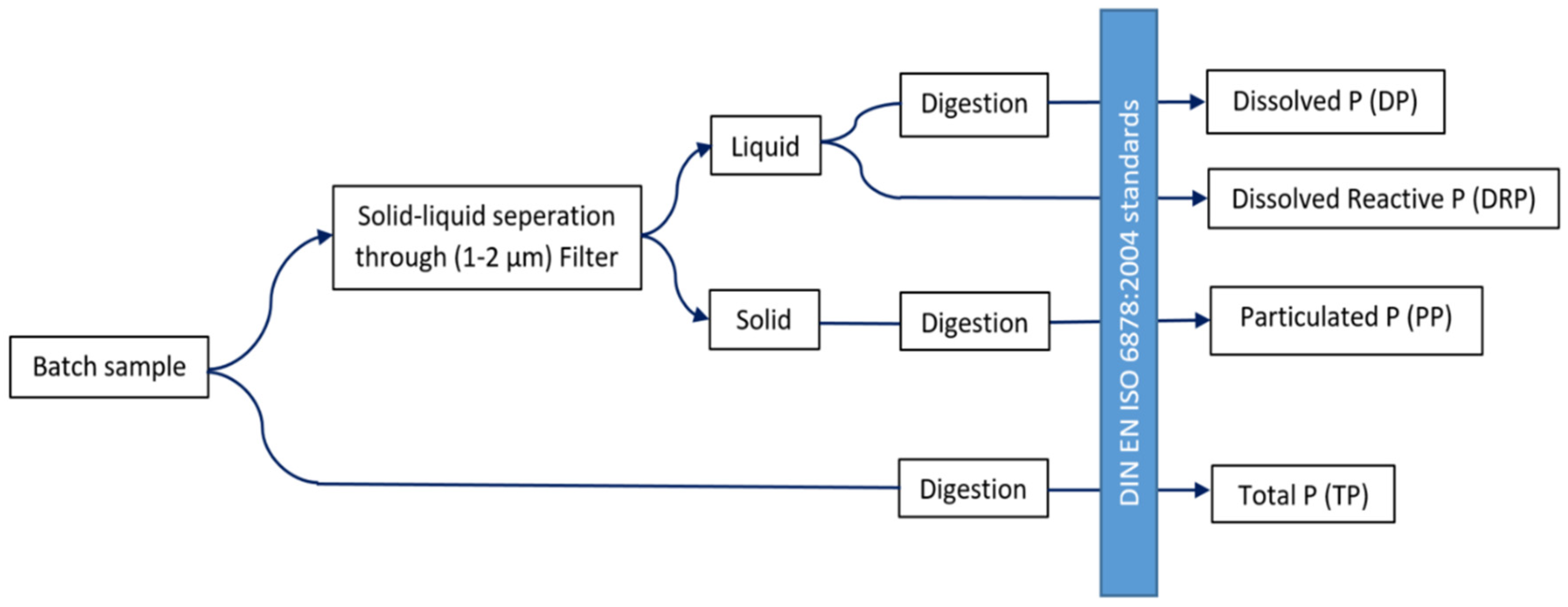
Figure 2.
Concentration of sCOD (a) and PO4-P (b) as well as pH (c) after 3 hours of H2O2 treatment at 20 °C and 60 °C.
Figure 2.
Concentration of sCOD (a) and PO4-P (b) as well as pH (c) after 3 hours of H2O2 treatment at 20 °C and 60 °C.
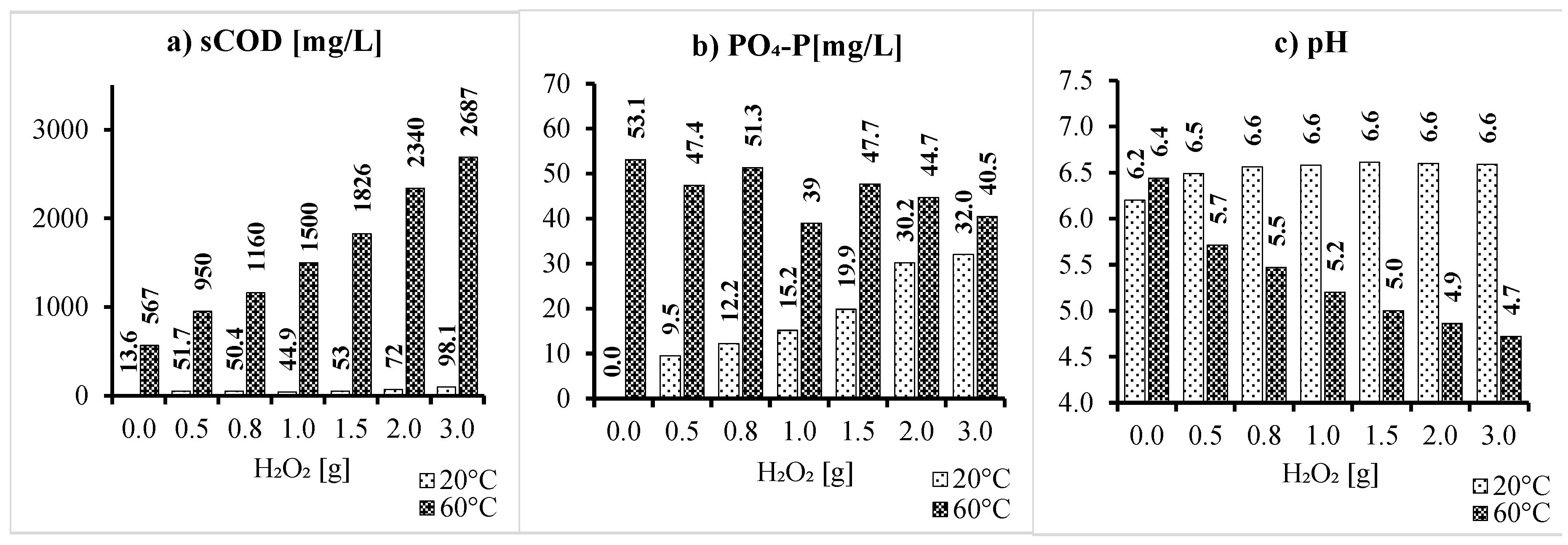
Figure 5.
NH4-N (a) and NO3-N (b) mobilisation (%) for all treatments.
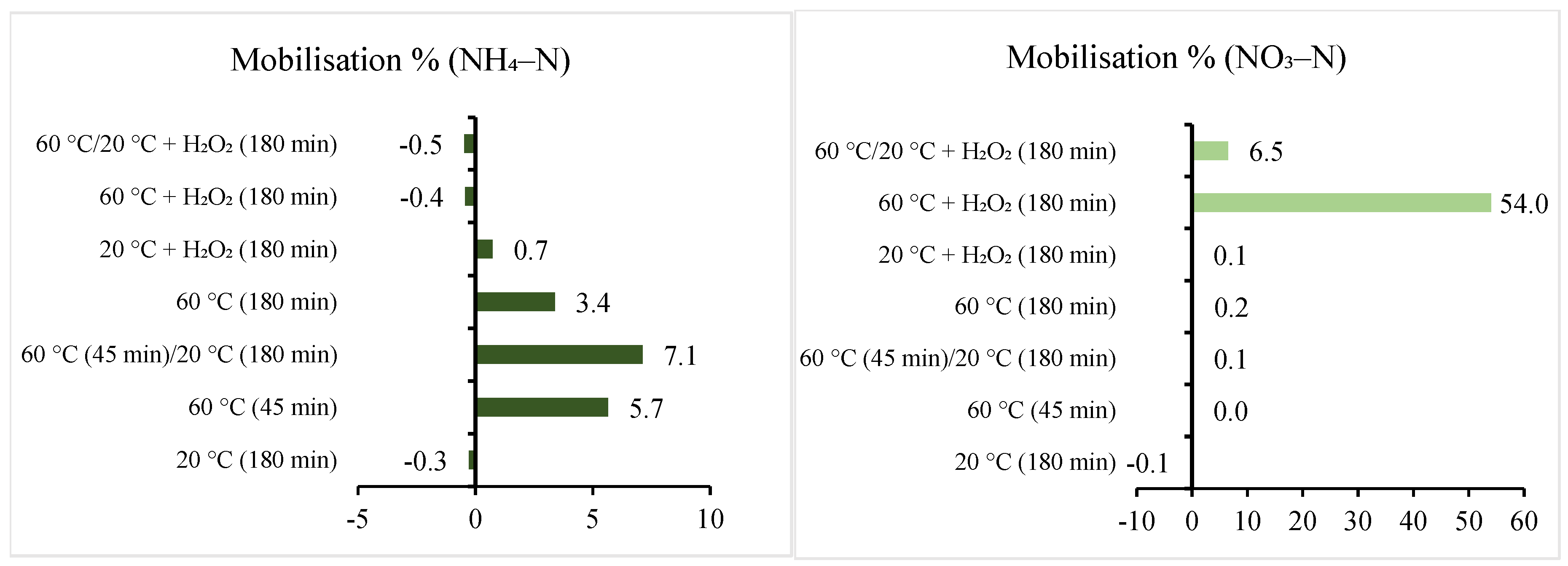
Figure 6.
Percentage of PO4-P and DP mobilization for all treatments.
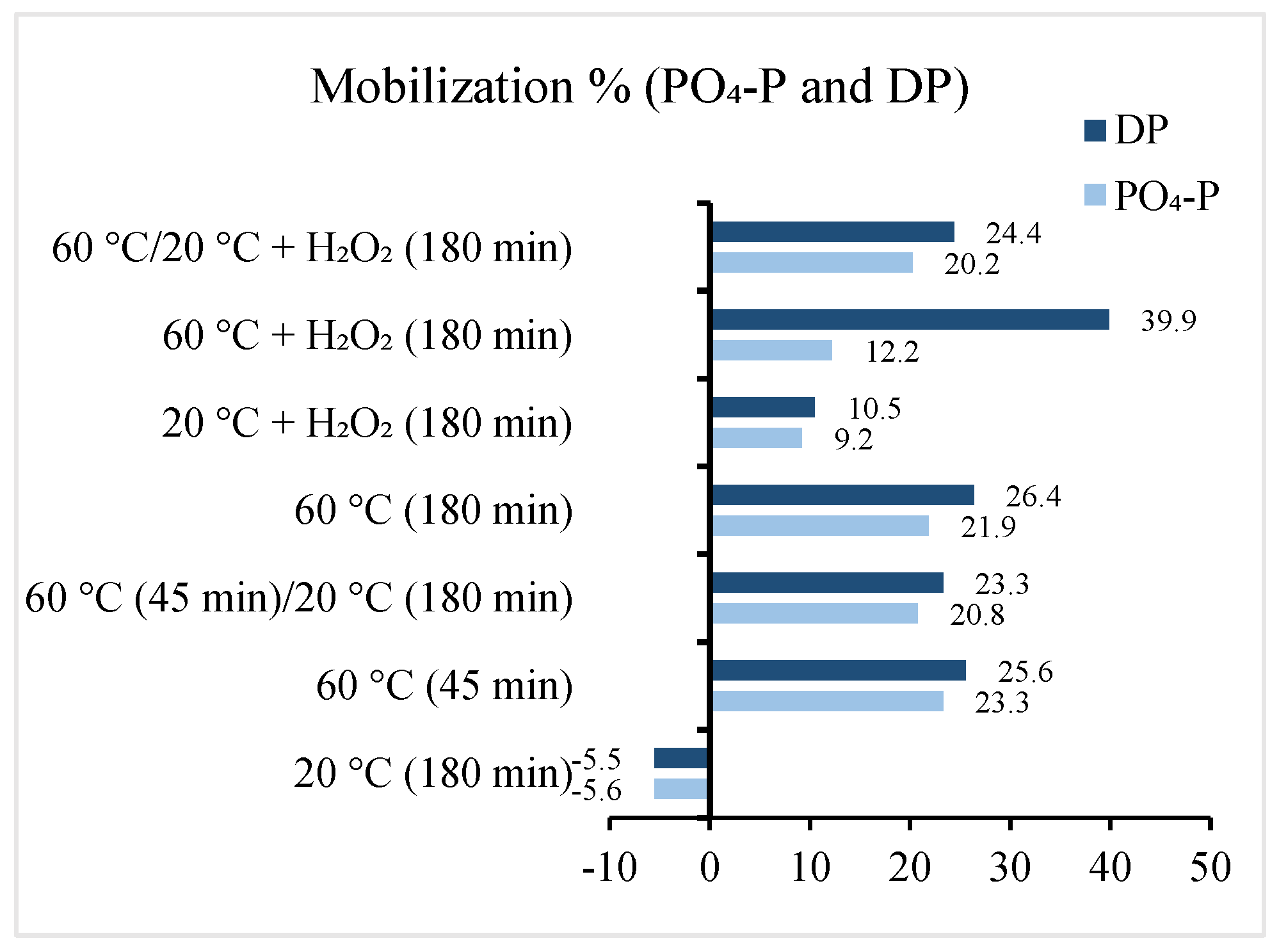
Figure 7.
Percentage of mobilized Fe3+ for all treatments.
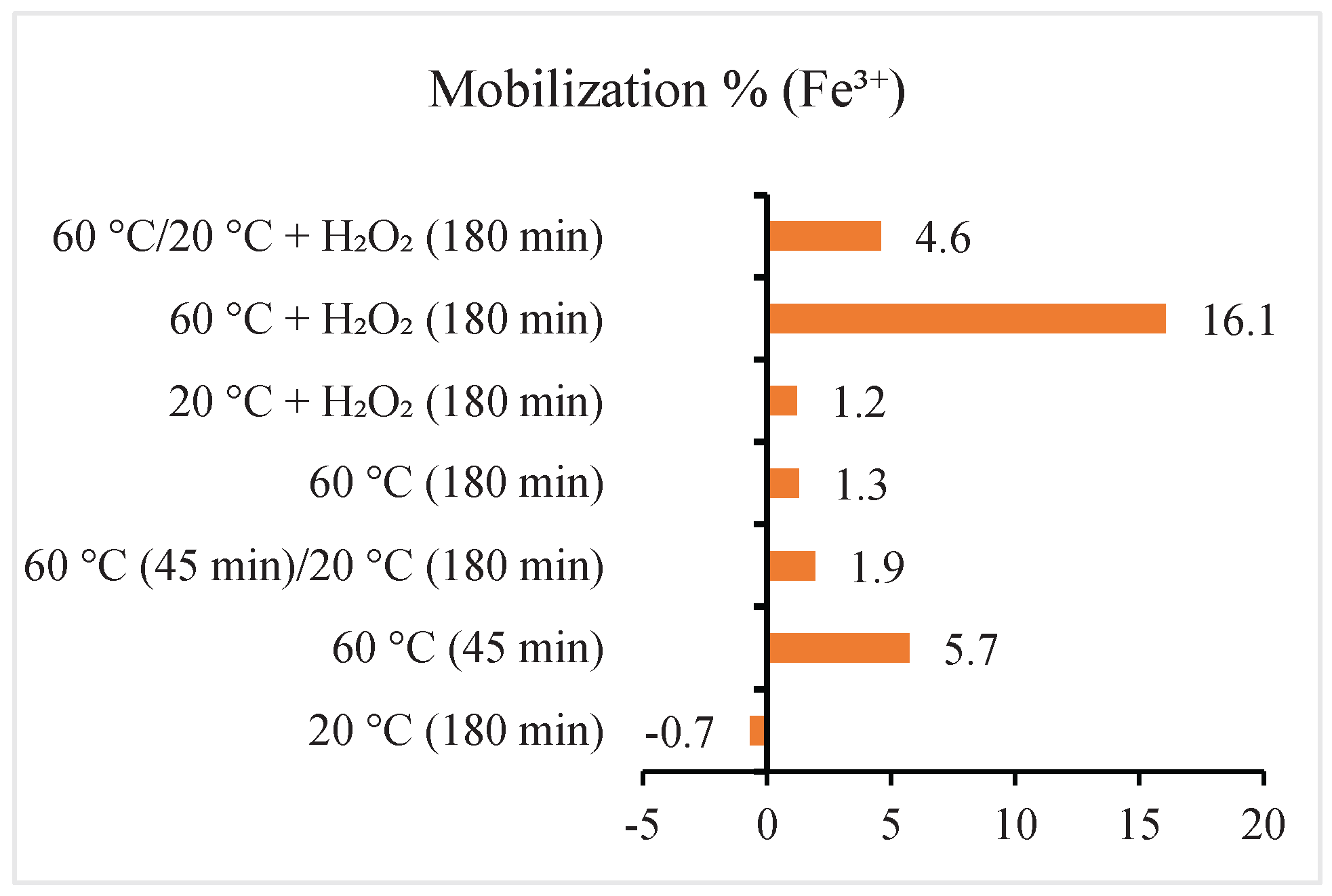
Table 2.
Experimental matrix applied in the batch tests.
| Group No. | Treatments | H2O2 dosage (g/L) |
|---|---|---|
| 1 | Heating-up (20 to 60 °C) within 45 mins | 0 |
| 2 | 3 hours at 20 °C | 0 |
| 10 | ||
| 3 | 3 hours at 60 °C |
0 |
| 10 | ||
| 4 | Thermal pretreated (No. 1), cooled down and left for 3 h at 20 °C | 0 |
| 10 |
Table 3.
Concentration of selected parameters in liquid phase for all treatments.
| Treatments | pH | sCOD | PO4-P | DP | NH4–N | ||||||
| - | SD | mg/L | SD | mg/L | SD | mg/L | SD | mg/L | SD | ||
| 1) Heating-up | Before treatment | 6.48 | 0.03 | 20 | 2 | 5.95 | 0.01 |
5.94 | 0.16 | 1.01 | 0.72 |
| After treatment | 6.05 | 0.03 |
416 | 51 | 30.90 | 0.03 |
33.3 | 0.87 | 13.3 | 9.52 | |
| 2) 3 h at 20 °C | Without H2O2 | 6.28 | 0.03 | 17 | 2 | < 0.01 | 0.00 | < 0.01 | 0.00 | 0.44 | 0.32 |
| With H2O2 | 6.40 | 0.03 | 95 | 12 | 14.67 | 0.02 | 15.93 | 0.42 | 2.41 | 1.73 | |
| 3) 3 h at 60 °C | Without H2O2 | 6.33 | 0.03 | 622 | 76 | 29.37 | 0.03 | 34.2 | 0.90 | 8.39 | 6.01 |
| With H2O2 | 4.41 | 0.02 | 1120 | 138 | 18.18 | 0.02 | 46.5 | 1.22 | 0.07 | 0.05 | |
| 4) Thermal pretreated (1) 3 h at 20 °C | Without H2O2 | 6.34 | 0.03 | 401 | 49 | 28.20 | 0.03 | 30.9 | 0.81 | 16.5 | 11.81 |
| With H2O2 | 6.14 | 0.03 | 467 | 58 | 26.44 | 0.03 | 30.68 | 0.81 | < 0.015 | 0.01 | |
| Treatments | NO3–N | Fe2+ | Fe3+ | Ca2+ | Mg2+ | ||||||
| mg/L | SD | mg/L | SD | mg/L | SD | mg/L | SD | mg/L | SD | ||
| 1) Heating-up | Before treatment | 0.23 | 0.02 | < 0.20 | 0.00 | 0.13 | 0.00 | 4.04 | 0.45 | 2.65 | 0.80 |
| After treatment | 0.30 | 0.03 | 0.20 | 0.02 | 0.71 | 0.02 | 10.90 | 1.22 | 8.48 | 2.57 | |
| 2) 3 h at 20 °C | Without H2O2 | 0.10 | 0.01 | < 0.20 | 0.00 | 0.06 | 0.00 | 5.02 | 0.56 | 1.51 | 0.46 |
| With H2O2 | 0.36 | 0.03 | 0.17 | 0.02 | 0.23 | 0.01 | 5.05 | 0.57 | 3.39 | 1.03 | |
| 3) 3 h at 60 °C | Without H2O2 | 0.64 | 0.06 | 0.20 | 0.02 | 0.26 | 0.01 | 6.23 | 0.70 | 6.68 | 2.03 |
| With H2O2 | 113.00 | 10.61 | 0.02 | 0.00 | 1.68 | 0.05 | 27.70 | 3.01 | 20.90 | 6.34 | |
| 4) Thermal pretreated (1) 3 h at 20 °C | Without H2O2 | 0.48 | 0.05 | 0.20 | 0.02 | 0.33 | 0.01 | 7.71 | 0.86 | 8.12 | 2.46 |
| With H2O2 | 13.87 | 1.30 | 0.15 | 0.01 | 0.57 | 0.02 | 8.32 | 0.93 | 11.99 | 3.64 | |
Disclaimer/Publisher’s Note: The statements, opinions and data contained in all publications are solely those of the individual author(s) and contributor(s) and not of MDPI and/or the editor(s). MDPI and/or the editor(s) disclaim responsibility for any injury to people or property resulting from any ideas, methods, instructions or products referred to in the content. |
© 2026 by the authors. Licensee MDPI, Basel, Switzerland. This article is an open access article distributed under the terms and conditions of the Creative Commons Attribution (CC BY) license (http://creativecommons.org/licenses/by/4.0/).
Copyright: This open access article is published under a Creative Commons CC BY 4.0 license, which permit the free download, distribution, and reuse, provided that the author and preprint are cited in any reuse.