

Submitted:
04 November 2026
Posted:
05 November 2026
You are already at the latest version
Abstract
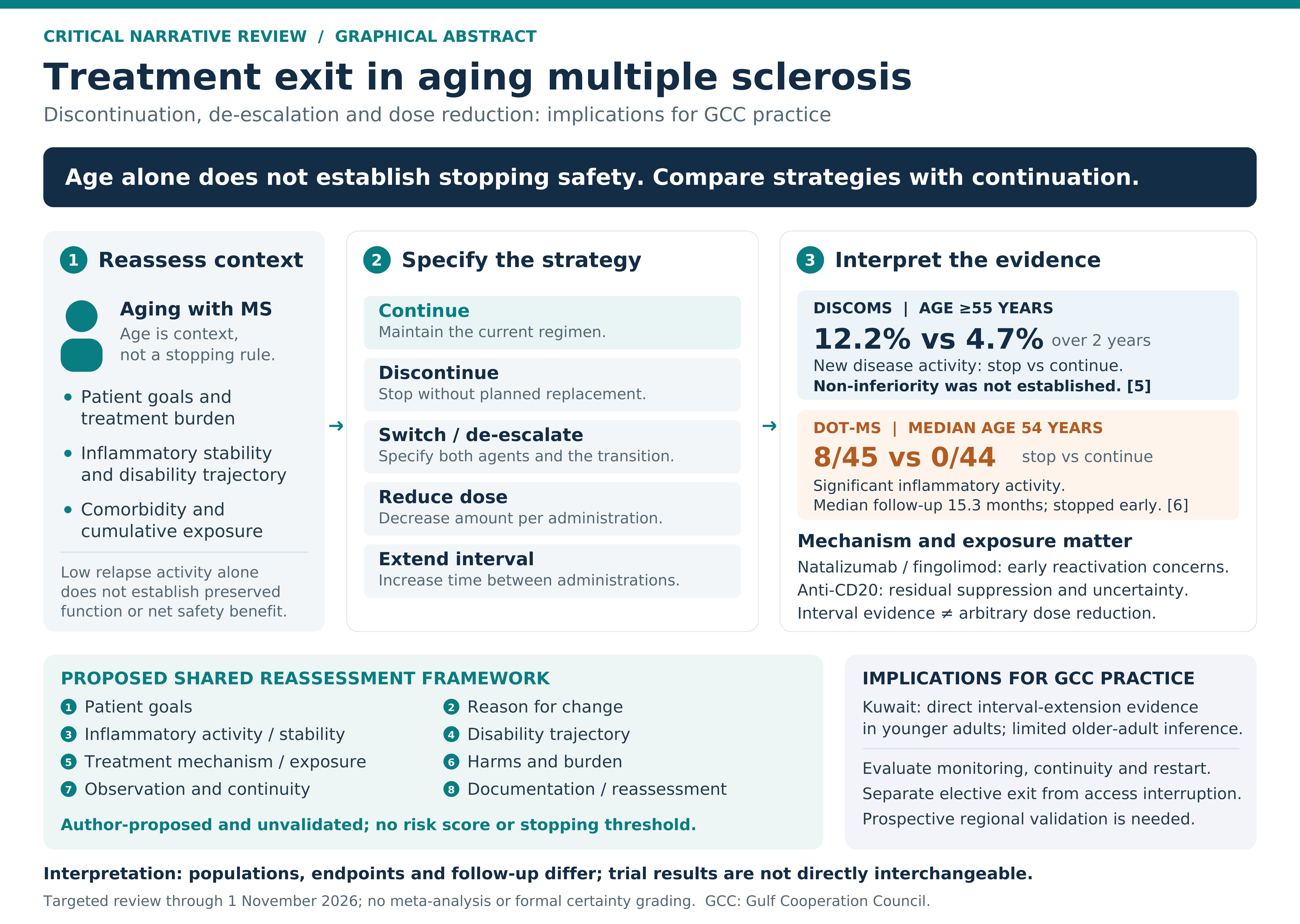
Background: Aging and prolonged disease stability prompt reassessment of multiple sclerosis disease-modifying therapy. Discontinuation, switching, dose reduction and interval extension are distinct strategies. Stability during treatment may reflect reduced inflammatory activity, continuing drug effects, or both; chronological age alone cannot establish that withdrawal will preserve control. Objective: To critically assess treatment-exit evidence, reconcile apparently conflicting findings, distinguish treatment effects from prognostic associations, and examine implications for Gulf Cooperation Council (GCC) practice. Approach: A targeted, web-assisted critical narrative review examined accessible primary studies, corrections, conference reports, trial registrations and regional documents through 1 November 2026. Comparisons considered population, mechanism, strategy, outcome, surveillance, residual exposure, restart and alignment of follow-up. No meta-analysis, independent duplicate screening or formal certainty grading was performed. Principal findings: In DISCOMS, new disease activity occurred in 12.2% of discontinuers versus 4.7% of continuers over two years: an absolute difference of 7.5 percentage points (95% confidence interval, 0.6–15.0); non-inferiority was not established. DOT-MS stopped early after significant inflammatory activity in 8/45 discontinuers versus 0/44 continuers. Differences in eligibility, MRI thresholds and follow-up prevent attribution of these findings to age alone. Selected older-adult cohorts report limited relapse activity, but disability and patient-reported outcomes remain less certain. Natalizumab and fingolimod cessation carry early reactivation concerns requiring explicit consideration of the subsequent treatment pathway. Anti-CD20 cessation studies show sustained suppression in some selected populations, although residual exposure, treatment selection and imprecision limit conclusions about durable treatment independence. The included evidence does not establish a reliable comparative reduction in serious infection following treatment exit. Lower-efficacy switching can increase recurrence, while findings for specified extended intervals cannot be generalized to arbitrary dose reductions. Kuwait supplies direct natalizumab interval-extension evidence in younger adults; other GCC cohorts mainly inform treatment context. Regional guidance offers practical criteria that require appraisal against primary evidence and local monitoring conditions. Conclusions: Treatment reassessment should compare specified alternatives with continuation, communicate relevant absolute outcomes and uncertainty, and distinguish estimated benefit–harm from regional applicability. An author-proposed framework organizes patient goals, reasons for change, inflammatory activity, disability trajectory, exposure, harms, observation and reassessment. Its accompanying minimum dataset supports prospective evaluation without assigning a risk score or universal stopping threshold. Neither the framework’s feasibility nor its clinical utility has been validated. Mechanism-specific comparative studies and coordinated GCC research should evaluate inflammatory recurrence, disability, serious infections, treatment burden and continuity of care. Such evaluation should distinguish elective reassessment from treatment interruptions caused by changing access arrangements.
Keywords:
multiple sclerosis
; aging
; treatment discontinuation
; de-escalation
; dose reduction
; extended-interval dosing
; Gulf Cooperation Council
Introduction
As people with multiple sclerosis (MS) grow older, successful disease suppression creates a difficult therapeutic question: does the present regimen remain necessary, and does its expected benefit still justify its burden? Several clinically distinct decisions follow from that question. Treatment may be continued, replaced, reduced, spaced further apart or stopped. The absence of relapses during effective disease-modifying therapy (DMT) does not reveal what would happen without it. Stability may reflect both the changing biology of MS and continuing pharmacological suppression. Reassessment therefore requires comparison of explicit alternatives, with attention to the outcomes and uncertainties that matter to the patient.
Here, “aging MS” denotes MS in later adulthood, interpreted through chronological age, disease duration, disability, comorbidity and cumulative treatment exposure. It is a clinical context, not a separate phenotype or a synonym for progressive, inactive or late-onset MS. Biological and chronological aging need not coincide.[1,2] We retain each study’s age criteria rather than impose a universal threshold; younger cohorts inform mechanisms and strategies, with their relevance to older adults identified separately.
The ECTRIMS workshop synthesis, recent narrative reviews, a systematic review and meta-analysis, and an anti-CD20-focused perspective have established treatment reassessment as an important research priority.[1,2,3,4] Their collective contribution also exposes the difficulty of synthesizing studies that differ in the treatment stopped, the reason for change and the outcome assessed. DISCOMS and DOT-MS, for example, examined stable populations but used different eligibility and inflammatory-activity thresholds.[5,6] Registry comparisons introduce additional variation in treatment selection, restart and surveillance. Interpreting these differences is essential before findings are translated into practice.
The term treatment exit is used here as an organizing concept, not as a claim that treatment must end. Discontinuation means cessation without a planned replacement DMT; de-escalation means switching to a regimen intended to reduce efficacy intensity or a specified treatment-related hazard; dose reduction changes the amount administered; interval extension changes the spacing of administrations. The latter two are forms of de-intensification, but neither is equivalent to untreated observation. A temporary interruption implies an intended restart and is distinct from discontinuation without a planned replacement. Completion of a scheduled immune-reconstitution course is also different from electively withholding a later course that would otherwise have been indicated. Table 1 defines these distinctions, and Figure 1 places them within the reason for considering a change.
This review’s contribution is to connect strategy-specific clinical evidence with the methodological conditions under which it can inform aging MS care, and then examine its applicability to GCC practice. The objectives are to evaluate discontinuation, lower-intensity switching, dose reduction and interval extension by treatment mechanism and population; explain divergent findings through outcome definitions, residual exposure, surveillance, restart and time-zero alignment; distinguish prognosis after withdrawal from the comparative effect of changing treatment; and separate direct GCC strategy evidence from contextual cohorts and guidance. We also propose an eight-component discussion framework and a supplementary minimum dataset for prospective regional evaluation. These are interpretive and research contributions, not a validated clinical score, consensus guideline or claim of established stopping safety.
Review Approach
Design and Scope
This study is a critical narrative review of existing evidence with an author-proposed interpretive framework. It is separate from the proposed EXIT-MS systematic-review protocol and does not represent completion of that protocol. It reports no new participant recruitment, individual participant analysis, prospective framework validation or formal consensus exercise.
Sources and Retrieval
Targeted web-assisted retrieval covered evidence available through 1 November 2026. Searches located PubMed-indexed records, PubMed Central articles, publisher reports, trial registrations, conference abstracts and official regional documents. Search modules addressed aging and withdrawal, mechanism-specific cessation, switching, interval and dose modification, disability, safety, prediction and GCC applicability. Citation tracing and targeted checks for corrections and newer reports supplemented these modules. Direct systematic searches of PubMed/MEDLINE, Embase, Scopus and Web of Science with exported and deduplicated records were not performed. The retained query logs are provided in Supplementary Sections S1, S7 and S8; they document actual searches rather than a screened literature universe.
Selection and Source Verification
Selection prioritized randomized comparisons and comparative observational studies, supplemented by uncontrolled cohorts addressing distinct treatment transitions or regional gaps. Reviews and guidance informed context and citation tracing; principal numerical claims were drawn from accessible primary reports. Conference results and registrations were distinguished from completed journal reports. Studies were compared within their population, mechanism, strategy and outcome rather than combined into a pooled estimate. Recruitment country, rather than author affiliation, determined whether a study contributed direct GCC evidence.
Extraction recorded study design, cohort identity, age and phenotype, treatment history, reason for change, comparator, exposure definition, time zero, outcomes, follow-up, uncertainty and major limitations. Initial numerical checks were AI-assisted and used accessible primary abstracts, full-text sections and retained registry records. Abdulla I Salem Alsharoqi subsequently performed a targeted source check of the central DISCOMS, DOT-MS, DISCOMS extension, anti-CD20 cessation and rituximab interval-extension findings, including the published correction, documented on 2 November 2026. The PCORI investigator-report PDF resolved the previously inaccessible DISCOMS treatment-composition and separate clinical, MRI and disability details. Source access, locations and remaining source-level inconsistencies are documented in Supplementary Section S8.1. Shared registries and linked publications were flagged to avoid treating potentially overlapping observations as independent confirmation. Unavailable fields were not inferred from secondary summaries. This targeted verification did not constitute independent duplicate screening or comprehensive duplicate extraction; the evidence retrieval cutoff remained 1 November 2026.
Critical Appraisal and Reporting
Qualitative appraisal examined allocation, post-randomization exclusions, treatment selection, outcome construction, precision, surveillance, restart, missing observations and applicability to older adults. No completed RoB 2, ROBINS-I or GRADE assessment is claimed. Independent duplicate human screening or extraction was not undertaken. Author validation included the targeted source check described above and review of the synthesis and its consistency; it does not denote duplicate assessment of the entire evidence base. Formal publication-bias assessment was not performed, and the direction or magnitude of selective publication was not estimated.
The reporting check used SANRA domains to examine the rationale, objectives, search description, referencing, scientific reasoning and presentation of outcomes.[13] No numerical SANRA score or independent rating was assigned. Inclusion in the evidence matrix indicates relevance to the review, not certification of study validity. Interpretation distinguishes source-reported findings from the authors’ synthesis, while unresolved fields remain explicit in the supplement.
Aging and the Treatment Benefit–Harm Balance
Age-related treatment effects depend on the outcome and population examined. Weideman and colleagues associated increasing trial-average age with reduced effects on disability progression, whereas Zhang and colleagues found no significant trial-level association between age and reductions in ARR, new T2 lesions or enhancing lesions.[14,15] The latter analysis included 26 trials, with mean ages of approximately 33–40 years for the relapse analysis, and therefore provides limited direct information on later adulthood. Different endpoints and selection for active disease help explain the apparent disagreement. Neither ecological analysis supplies an individual age at which treatment benefit disappears.
The relevant clinical assessment separates inflammatory activity from progression and from other causes of functional decline. Absence of relapses does not establish absence of progression, while progression does not automatically establish failure of anti-inflammatory treatment. A patient may accumulate disability despite prevention of attacks. Conversely, maintaining an apparently successful regimen may not address the dominant source of worsening. These possibilities require explicit discussion because a withdrawal decision framed only around relapse counts can overlook the outcome the patient most wants to preserve: mobility, cognition, independence or participation.
Safety assessment should incorporate cumulative exposure and functional vulnerability. In 2,482 rituximab-treated patients, mean age 43 years, higher cumulative dose (>4 g versus ≤2 g) and IgG <500 versus ≥700 mg/dL were independently associated with serious infection: adjusted HRs 1.56 (95% CI 1.09–2.24) and 2.98 (1.56–5.72), respectively. Advanced disability carried an adjusted HR of 5.51 (3.71–8.18); obesity and chronic obstructive pulmonary disease were associated with outpatient infections.[16] These are risk associations during treatment, not evidence that cessation reverses those risks.
Additional evidence reinforces the need to evaluate vulnerability rather than infer it from age alone. In a multicentre cohort of 556 anti-CD20-treated patients, predominantly with MS but including neuromyelitis optica spectrum disorder, age ≥50 years was associated with IgG hypogammaglobulinaemia (odds ratio 1.64, 95% CI 1.06–2.54), which was associated with severe infections (2.65, 1.15–6.12).[17] The mixed population and infection context limit direct application to elective exit in older MS. These associations support recording immunoglobulins, exposure and comorbidity; they do not demonstrate that cessation or interval extension improves overall clinical outcomes.
A Swedish nationwide cohort provides broader treatment context. Crude serious-infection rates per 1,000 person-years were 8.9 with interferon/glatiramer acetate, 11.4 with natalizumab, 14.3 with fingolimod and 19.7 with rituximab, compared with 5.2 in general-population comparators. After adjustment, rituximab retained a higher hazard than injectables (HR 1.70, 95% CI 1.11–2.61).[18] These predominantly younger treatment cohorts do not establish a causal ranking for older GCC patients or quantify the benefit of exit. Across the included exit evidence, a reliable comparative reduction in serious infection remains unestablished. Reduced infusion burden, immunoglobulin recovery and fewer serious infections should consequently be evaluated as separate outcomes.
Biological aging, immune recovery, comorbidity and frailty may ultimately improve individual assessment, but they should not be inserted into a treatment-exit score without validation. The same caution applies to malignancy, vaccine responses and health-economic claims: a plausible advantage of less immunosuppression is not an observed comparative benefit of a particular exit strategy. The studies reviewed below provide uneven information on these outcomes. Cost should include surveillance, patient travel, treatment transitions and potential disease recurrence rather than acquisition expenditure alone. Reduced treatment burden may be valuable even when measurable safety gains remain uncertain, provided this distinction is understood.
Patient priorities belong in this assessment before a preferred strategy is chosen. A person concerned about infection may accept a different residual relapse risk from someone whose employment depends on preserved hand function. Others may regard the reassurance of continued treatment as a benefit, or repeated infusions as a substantial burden. These are reasons to clarify tradeoffs, not evidence that one option is objectively safer. Continuing the existing regimen remains an active and legitimate decision when expected benefit, uncertainty and patient preference favor it.
Evidence on Discontinuation
Withdrawal After Prolonged Stability
DISCOMS randomized 259 patients aged ≥55 years without relapse for five years or new MRI activity for three years. At two years, the relapse-or-new/enlarging-T2 endpoint occurred in 16/131 discontinuers (12.2%) and 6/128 continuers (4.7%): difference 7.5 percentage points (95% CI 0.6–15.0). The upper confidence limit exceeded the prespecified eight-point margin, so non-inferiority was not established.[5] The investigator report states that approximately 73% received interferon or glatiramer acetate and identifies relapses in three discontinuers and one continuer, with new MRI lesions in 14 and five, respectively; one discontinuer had both. Confirmed disability worsening occurred in 16/130 discontinuers (12.3%) and 14/126 continuers (11.1%), a difference of 1.2 percentage points (95% CI −6.7 to 9.1).[19] Thus, the excess composite activity was predominantly radiological, while the disability estimate remained compatible with benefit or harm over this horizon.
DOT-MS randomized 89 adults stable for at least five years on first-line therapy; median age was 54 years. Significant inflammatory activity occurred in 8/45 discontinuers (17.8%) and 0/44 continuers, prompting early termination after median follow-up of 15.3 months.[6] The endpoint required relapse, ≥3 new T2 lesions or ≥2 enhancing lesions. Two of the eight affected discontinuers had a clinical relapse; recurrence was predominantly radiological. Median time to significant activity was 12 months; affected participants had median age 46 years, versus 54 among those without activity, a descriptive difference that was not statistically significant. The published statistical methods specify a 7.5-percentage-point non-inferiority margin, but the planned primary analysis was not completed. These observations demonstrate recurrence despite prolonged stability without establishing that age alone explains the difference from DISCOMS.
The DISCOMS extension included 74 selected participants who had retained their assigned strategy and remained free of the parent trial’s primary endpoint. No relapses occurred during the extension; new lesions were reported in 2/44 discontinuers and 1/30 continuers, with mean total follow-up of 40 months. Nevertheless, time from original trial entry to disease activity was shorter in discontinuers (log-rank P=0.043).[20] These findings indicate low extension-event frequency in a selected older population while retaining a between-group time-to-event difference; they do not provide independent replication of the parent trial. An Iranian randomized report enrolled 178 patients but analyzed 84 per group after post-randomization exclusions. Relapses occurred in 12 discontinuers and nine continuers (RR 1.33, 95% CI 0.60–2.98).[21] Exclusion of control participants to balance group sizes compromised the randomized comparison. Its non-significant result and reporting inconsistencies warrant limited evidentiary weight, not an equivalence claim.
Older-Adult Observational Evidence
Older-adult observational studies contribute information on outcomes under clinical selection. An Italian cohort aged ≥60 years reported no detected before–after difference in MRI activity after predominantly first-line cessation, without a matched continuation group.[22] In contrast, the abstract of a single-centre case–control study reports 56 discontinuers and 62 continuers, with median ages 58.19 and 51.63 years. Discontinuation was associated with two-year confirmed disability progression (adjusted OR 5.10; P=0.031) and PIRA (adjusted OR 5.96; P=0.036); confidence intervals were not available in the inspected abstract.[23] The age imbalance, retrospective selection and limited accessible methods constrain causal interpretation. These findings address disability rather than simply contradicting low-relapse reports.
Long-term follow-up of the Cleveland Clinic cohort included 600 people aged at least 60 years, of whom 396 discontinued DMT. Median follow-up was 10.5 years after age 60, but median observation from discontinuation to the last visit was 4.3 years. Relapse risk did not differ significantly between discontinuers and continuers (HR 1.80, 95% CI 0.51–6.39), while MRI changes were common.[24] The wide interval does not establish equivalence. The study adds useful older-adult evidence and patient-reported measures, but treatment selection, sparse relapses and changing observation over time limit causal inference. Earlier reports from this cohort should not be counted as independent replication.
A published Cemcat comparison adds relevant age-stratified evidence. In 110 discontinuation observations and 581 matched continuation observations, discontinuation was associated with inflammatory reactivation (HR 2.04, 95% CI 1.33–3.14), chiefly MRI activity. Estimates differed between patients aged ≤60 years (3.71, 1.99–6.90) and >60 years (1.35, 0.68–2.69; interaction P=0.027). The 48-week-confirmed disability-worsening HR was 1.24 (0.86–1.78).[25] Matching allowed multiple eligible baselines per patient, so the comparison count is not a count of independent unique continuers. This observational interaction supports studying age within specified transitions; it does not validate age 60 as a stopping boundary.
Prediction After Withdrawal
VIAADISC addresses prognosis after withdrawal rather than the comparative benefit of stopping. It was developed in 168 and validated in 98 patients from Austrian observational databases following interferon or glatiramer acetate cessation. Its components are age at discontinuation, MRI activity and duration of clinical stability. Five-year reactivation probabilities were approximately 7% in the lowest category, 36–38% in the intermediate category and 83–85% in the highest.[26] This separation of risk groups is clinically informative within the development context. It does not estimate what the same patients would have experienced under continuation, nor establish transportability to other mechanisms or GCC populations. External calibration and decision utility require separate evaluation.
A 2025 extension evaluated VIAADISC in 129 patients changing therapies other than interferon or glatiramer acetate; mean age was 44.3 years. Higher scores predicted reactivation, while natalizumab or fingolimod de-escalation contributed additional risk (HR 2.20, 95% CI 1.18–4.10).[27] This broadens the score’s evaluation but does not establish reliability across all mechanisms, older phenotypes or GCC populations. Small low-risk subgroups with no observed events do not define a universally safe stopping threshold. Prediction under a selected withdrawal strategy remains different from estimating benefit relative to continuation.
Withdrawal from Therapies with Early Reactivation Risk
RESTORE demonstrates the early vulnerability associated with natalizumab interruption: MRI recurrence occurred in 19/41 placebo recipients (46%) and 0/45 participants continuing natalizumab during the 24-week randomized period.[7] The comparison concerns interruption with older alternative regimens and intensive surveillance, not every contemporary switching strategy. Larger registry analyses also show an early rise in relapse rates within one to two months after fingolimod cessation.[8] Where these data concern fingolimod, they should not be generalized quantitatively to siponimod, ozanimod or ponesimod. Mechanism and the timing of replacement treatment remain integral to the exposure.
In the OFSEP comparison of inactive patients aged ≥50 years, 154 matched pairs had an overall relapse HR of 4.1 (95% CI 2.0–8.5) after high-efficacy cessation. Drug-specific HRs were 7.2 (2.1–24.5) for natalizumab, 4.5 (1.3–15.5) for fingolimod and 1.1 (0.3–4.8) for anti-CD20 therapy.[9] Estimated one-year relapse probabilities among discontinuers were 33.6%, 16.3% and 0%, respectively; natalizumab relapses clustered within zero to four months. Zero observed first-year anti-CD20 relapses does not imply zero underlying risk. Reasons for stopping varied, and 44.8% resumed treatment, making this a heterogeneous cessation-and-retreatment experience rather than sustained untreated observation.
Reactivation and rebound should also remain distinct. Reactivation describes renewed activity; rebound implies activity exceeding an appropriate pretreatment reference. Studies do not always operationalize the latter consistently. The clinically useful conclusion is that certain transitions require advance planning for loss of suppression, not that every post-cessation lesion represents rebound. A safety-driven need to stop a drug may be unavoidable, yet the subsequent treatment pathway remains part of the intervention. Evidence about untreated gaps cannot quantify the effectiveness of a carefully specified replacement strategy without additional data.
Anti-CD20 Cessation and Residual Exposure
The dedicated 2026 OFSEP anti-CD20 analysis included 224 matched pairs; its abstract reports mean age 57.7 years and median follow-up 34.8 months. Reported HRs were 0.6 (95% CI 0.3–1.3) for relapse, 0.9 (0.5–1.4) for focal inflammatory activity, 1.2 (0.9–1.7) for disability accrual and 1.0 (0.6–1.8) for serious infection.[28] Discontinuation required no infusion within 13 months; baseline was the last infusion for discontinuers and the corresponding matched time for continuers. The main intent-to-stop analysis censored discontinuers at treatment resumption. Among the 383 discontinuers before matching, treatment inefficacy, mainly progression without relapse, was the most frequently reported stopping reason (30.8%). These definitions and stopping indications require attention to early events, retreatment and selection beyond elective withdrawal after prolonged stability. Both OFSEP publications arise from the same registry; participant overlap was not quantified, so the later analysis should not be counted as independent confirmation of the earlier anti-CD20 stratum.
In Konen’s matched German cohort, 58 patients stopped ocrelizumab and 232 continued; only 22 discontinuers were older than 50. Median postdiscontinuation follow-up was 28.5 months. Stopping mainly reflected COVID-19 infection concerns (81%) or hypogammaglobulinaemia (16%). Relapses occurred in 6/58 versus 26/232 and PIRA in 11/58 versus 33/232. The Results section reports a time-dependent inflammatory-activity HR of 0.92 (95% CI 0.09–10.82), whereas the abstract gives 0.91 (0.08–10.79).[29] Methods describe a harmonized landmark after ≥12 months of event-free treatment, anchored to the last infusion for discontinuers. This is a selected stable-treatment comparison, not a randomized decision-date estimate. The uncertainty precludes a validated treatment-duration or restart threshold.
Finite-course treatment addresses a different question. Two prospective open-label ocrelizumab trials pooled against matched controls observed reactivation in 6/19 finite-course participants and 0/52 controls.[30] These patients had active relapsing disease and a short initial course, unlike older patients leaving treatment after prolonged stability. In the MSBase safety-driven transition study, ARR was 0.08 (95% CI 0.05–0.14) in switchers and 0.038 (0.02–0.07) in continuers; the first-relapse HR was 2.23 (0.68–7.28).[31] The comparison incorporates treatment switching after safety events, and the rate and time-to-event measures answer different questions. Neither report is a direct test of elective untreated cessation in an older stable population.
An uncontrolled four-centre SPMS cohort broadens phenotype coverage. Among 55 patients, mean age at anti-CD20 initiation was 53.5 years and mean post-discontinuation observation was 55.1 months. Relapses occurred in 6/55, new MRI activity in 4/35 with available scans, confirmed EDSS worsening in 31/55 and severe infections in 17/55.[32] Inclusion required at least 36 months of follow-up without subsequent DMT, preferentially retaining patients able to remain untreated. The findings illustrate the coexistence of limited focal inflammation with accumulating disability and infection burden. Without a continuation comparator, they cannot determine whether cessation caused or prevented those outcomes.
Taken together, anti-CD20 cessation studies support a hypothesis of prolonged suppression after the last administration in selected patients, while leaving the duration and clinical value of that suppression uncertain. Peripheral B-cell recovery, immunoglobulin recovery and renewed inflammatory activity are related but non-equivalent events. Follow-up should report actual measurements and their timing rather than assume a universal repopulation interval. Comparative safety assessment must retain infections occurring while biological effects persist. Durable remission without treatment and temporary carry-over suppression require longer, appropriately anchored observation to distinguish.
Disability and Patient-Reported Outcomes
Disability is a distinct endpoint, not a consequence that can be inferred directly from relapse counts. OFSEP reported an association between discontinuation and confirmed disability progression (HR 2.6, 95% CI 1.5–4.4), but mixed stopping indications, unequal observation and residual confounding complicate interpretation.[9] The dedicated anti-CD20 analysis reported a disability-accrual HR of 1.2 (0.9–1.7).[28] These estimates address different populations and exposure definitions. A patient may worsen despite suppression of relapses, while worsening after cessation does not establish that continuation would have prevented it.
Progression independent of relapse activity (PIRA) must be reported using the source’s confirmation and relapse-exclusion windows. The ocrelizumab cessation study evaluated PIRA, but its very wide confidence interval precludes reassurance or a reliable estimate of harm.[29] It would therefore be inaccurate to state that no available exit study assessed PIRA; the limitation is the scarcity and comparability of informative estimates. Progressive phenotype, absence of relapses and operationally defined PIRA should not be used interchangeably.
The Cleveland follow-up included Neuro-QoL and performance measures and reported a small worsening in fatigue scores among discontinuers over time.[24] These findings extend assessment beyond lesions and relapses without establishing a causal effect on fatigue. Future comparisons should prespecify cognition, mobility, daily function, treatment burden and quality of life alongside inflammatory activity. Competing illness, aging, missing assessments and treatment restart must remain visible when these outcomes are interpreted.
Evidence on Switching and De-Escalation
Switching preserves treatment exposure but changes both its potential benefit and its adverse-effect profile. The intended reduction may concern efficacy intensity, infection susceptibility, a specific toxicity, administration burden or another hazard. These dimensions do not form a single universal ranking. A lower-efficacy therapy can introduce a different burden, and a change made because of intolerance is not necessarily an elective aging-related strategy. The original drug, replacement drug, gap between them and indication for switching therefore belong in the definition of the intervention.
In MSBase, 876 matched pairs were compared over a median 4.8 years; median age was approximately 40 years. De-escalation was associated with first relapse (HR 2.36, 95% CI 1.79–3.11) and confirmed disability worsening (1.54, 1.02–2.34).[12] Relapse estimates differed by transition: high-to-low efficacy HR 3.68 (1.86–7.28), high-to-medium 2.54 (1.78–3.64), and medium-to-low 1.70 (0.93–3.10). The last interval includes both no difference and clinically important harm. The Danish cohort similarly describes post-switch activity but lacks an equivalent continuation group.[33] These findings favor sequence-specific interpretation; the label de-escalation does not identify a uniform intervention or preserve control by definition.
A small cohort switching from ocrelizumab to diroximel fumarate illustrates the opposite evidentiary limit. No relapses were observed in 25 selected patients during one year.[34] This supports feasibility in that setting but cannot establish comparative efficacy, especially while residual anti-CD20 effects may contribute. The absence of events in a small series is compatible with clinically relevant risks that the study could not detect. Evidence for switching should therefore be described by the actual sequence rather than generalized to a category called safer treatment.
For older patients, the unanswered question is often whether a specified switch offers a better balance than both continued therapy and monitored discontinuation. Most available studies do not compare all three alternatives. A replacement may be reasonable because it retains some protection or addresses a particular toxicity, but those are hypotheses requiring a suitable comparator. Selection of a seemingly less intensive drug is not evidence that the overall strategy is less burdensome after monitoring, adverse effects and possible re-escalation are included.
Evidence on Dose Reduction and Interval Extension
Natalizumab Interval Extension
NOVA randomized 499 stable natalizumab-treated adults aged 18–60 years to six-week or continued four-week dosing over 72 weeks. The primary new/enlarging-T2 lesion-count ratio was 4.24 (95% CI 0.86–20.85). Two participants with at least 25 lesions contributed disproportionately to the extended-interval result; an asymptomatic PML case occurred in that group.[10] These details explain the instability of the mean lesion comparison without erasing its uncertainty. NOVA informs a specified dosing interval in selected adults; it establishes neither universal equivalence nor freedom from PML.
TOUCH complements the trial with observational rare-event safety data. Of 35,521 JCV-antibody-positive eligible patients, the primary analysis included 1,988 extended-interval and 13,132 standard-interval recipients; its PML HR was 0.06 (95% CI 0.01–0.22).[35] Other analyses used different eligibility and exposure definitions. The association supports investigation of natalizumab interval extension as a risk-mitigation strategy, while nonrandomized treatment allocation limits causal certainty. Efficacy maintenance and PML reduction rely on different evidence, and neither a favorable HR nor absence of events in a small cohort guarantees individual safety.
Anti-CD20 Interval Extension
Recent rituximab studies expand the evidence for reduced dosing frequency. In a comparison of 500-mg infusions every twelve versus six months after an initial stable year, the assignment-based hazard ratio for failure of no evidence of disease activity (NEDA-3: no relapse, MRI activity or confirmed disability worsening) was 1.60 (95% CI 0.69–3.68).[11] The investigators interpreted annual dosing as effective without an observed increase in disease activity. The associated correction specifies that eligibility required no conversion to secondary progressive MS during the first 12 months; it also clarifies other explanatory wording without changing the reported numerical effect estimates.[36] The observational findings support further evaluation of interval extension, but the wide confidence interval does not exclude a clinically important increase in risk. The predominantly younger population and specific regimen limit inference for older adults and other anti-CD20 products.
A further cohort examining intervals up to eighteen to twenty-four months also reported imprecise comparative estimates.[37] It arose from the same healthcare setting, with potential patient overlap, and should not be counted as wholly independent confirmation. Evolving treatment schedules can select patients who have already remained stable long enough to receive longer intervals. Analyses must account for how patients entered an extended schedule, rather than simply comparing those who eventually received it with everyone else.
RIDOSE-MS is available here as conference abstract O131. A common first year of six-monthly treatment preceded a three-year randomized comparison of 500-mg rituximab annually (104 participants) or six-monthly (103).[38] Investigators concluded non-inferiority for inflammatory manifestations, but the accessible abstract does not report the prespecified margin or complete primary NEDA-3 analysis. Its relapse totals span all four years, including the common treatment year; age distribution is not supplied. The reported slower IgG decline is a laboratory result rather than demonstrated prevention of serious infection. The trial warrants attention, with interpretation proportionate to its conference-level reporting.
Interval extension must remain distinct from reducing the amount per infusion. The evidence summarized here is more informative about selected spacing strategies than about generalized dose reduction across agents. Pharmacodynamic similarities do not establish interchangeable regimens for rituximab, ocrelizumab and other B-cell-directed therapies. Likewise, peripheral B-cell recovery is not a self-validating threshold for retreatment. A useful dosing biomarker would need to improve prediction and decisions beyond clinical and imaging information, with assay-specific thresholds and consequences evaluated prospectively.
Dose reduction research should specify whether the intended change concerns dose per administration, cumulative exposure over a defined interval, or frequency of treatment contact. Two regimens can deliver the same annual amount while producing different peaks, troughs and periods of biological recovery. Conversely, a lower cumulative amount does not show that the minimum effective exposure has been identified. Studies need a clearly specified regimen, an adherence definition and a plan for patients whose clinical status changes. Until those features are available, the current evidence should support investigation of defined schedules rather than an assumption that any reduction is therapeutically interchangeable.
Reconciling the Evidence
Population and Outcome Determine the Question
Apparent contradictions frequently disappear when the treatment decision is specified. A trial of platform withdrawal in an older, long-stable population asks a different question from a registry study of high-efficacy switching after an adverse event. Short-course treatment in recently active disease is a further distinct scenario. Studies should be compared first within the combination of patient history, drug mechanism and reason for change. Direct evidence in older adults should remain visible, while younger-adult evidence should be used to explain mechanisms or identify hazards rather than silently determine older-adult recommendations.
Outcome construction changes both event frequency and clinical interpretation. A single asymptomatic lesion, several new lesions, a relapse and sustained disability worsening are not interchangeable. Composite endpoints improve sensitivity but may be driven by the least severe or most frequently measured component. They should therefore be disaggregated whenever possible. Conversely, the absence of a detected disability difference during limited follow-up cannot establish that inflammatory recurrence has no long-term consequence. The relevant uncertainty concerns both the importance of the observed signal and the duration needed to detect its effects.
Non-inferiority requires its own reasoning. The acceptable margin is a clinical and design judgment, not a universal boundary between safe and unsafe care. A confidence interval crossing that margin leaves non-inferiority unproven even if the observed difference appears small. A superiority analysis with P greater than 0.05 addresses a different null hypothesis and cannot replace the non-inferiority test. The review therefore emphasizes estimates, intervals, denominators and horizons rather than characterizing studies as positive or negative. Table 2 preserves these distinctions; Table 3 summarizes conclusions without assigning invented certainty grades.
Risk communication should preserve the same denominator and time horizon when alternatives are discussed. An annualized relapse rate cannot be read as the proportion of people who will relapse, and a hazard ratio cannot be converted directly into an individual probability. A small absolute difference may matter greatly to a person with limited functional reserve, while an uncertain relative estimate may be less useful than a clear account of the observed events. Where compatible absolute estimates are unavailable, the appropriate response is to explain that limitation. Illustrative probabilities should not be invented to make a shared decision appear more precise than the supporting evidence.
Time Zero and Treatment Restart
Figure 2 distinguishes the decision date, last administered dose, first omitted scheduled dose and measured biological recovery. These dates may be widely separated and need not occur in a fixed order relative to the clinical discussion. A study beginning follow-up at the last infusion includes a period during which both strategies may remain pharmacologically similar. A study beginning only after recovery selects a different population. Neither anchor is inherently wrong, but the estimand—the precise clinical comparison being estimated—must be stated.
Retrospective discontinuation definitions deserve particular attention when they require patients to remain without another dose for a specified future period. Events during that period, early restart and loss to follow-up can influence which group patients enter. Comparing such a selected group with all continuers can introduce selection or immortal-time problems unless eligibility, assignment and follow-up are aligned. A landmark analysis may address part of this problem, but then estimates outcomes among those who reach the landmark. It should not be presented as an assignment-based comparison from the initial decision.[53,54] Unequal starting points alone do not diagnose immortal-time bias; the defining feature is whether group membership depends on future survival or event-free time that is attributed or selected asymmetrically.
Restart is also clinically informative. It can reflect inflammatory recurrence, patient anxiety, changing preferences, access restoration or an unrelated medical event. Counting restart as disease reactivation combines biological and behavioral outcomes; censoring at restart can remove precisely the patients whose deterioration matters most. Conversely, continuing follow-up after restart estimates a strategy that includes rescue treatment rather than the effect of remaining untreated. These are legitimate but different questions. Reports should state the reason, timing and subsequent therapy and provide sensitivity analyses aligned with the intended decision.
Surveillance and Residual Confounding
The observed event rate depends on how often and how consistently investigators look. Less frequent MRI can make a strategy appear quieter, particularly when outcomes are radiological. Clinical visits triggered by symptoms can also differ from scheduled assessment. Missing imaging should not be recoded as absence of activity. Comparisons need information on observation intensity, scan protocols, disability assessments and loss to follow-up. These features are as important for regional applicability as the treatment label itself.
Propensity methods improve balance in recorded variables but cannot guarantee balance in unrecorded clinical judgment. Clinicians may select particularly stable patients for elective withdrawal, producing reassuring results, or stop treatment in medically vulnerable patients, producing adverse outcomes unrelated to loss of efficacy. Both directions of bias are plausible. The appropriate response is to examine indication and eligibility, not automatically distrust every observational result or accept every adjusted estimate. Overlapping registries and secondary analyses must also be identified so that repeated observations do not create a false impression of replication.
Selection into withdrawal can be examined separately from its outcomes. In a Medicare cohort of 8,694 persistent DMT users aged ≥66 years, 1,025 (11.79%) met the study’s discontinuation definition. Older age, frailty and disability were associated with lower odds of stopping.[55] This challenges the assumption that the most vulnerable patients are consistently selected for withdrawal. The study describes determinants of treatment use and does not establish the clinical effect of discontinuation. Its claims-based exposure definition should not be equated automatically with a documented shared decision.
Implications for GCC Practice
Benefit–Harm and Applicability Are Separate Judgments
A well-resourced service can reproduce intensive observation without making an ineffective strategy beneficial. Conversely, evidence of harm may be highly applicable even when it comes from another country, particularly when the mechanism and treatment transition match. The first judgment is therefore what the evidence implies about the strategy’s benefits, harms and uncertainty. The second is whether the local population and care process resemble those in which that evidence was generated. Combining these judgments into a single traffic-light recommendation risks disguising clinical uncertainty as administrative readiness.
Regional adaptation should preserve the original outcome definitions and comparator. Published study estimates do not change when transported, but their applicability and absolute consequences may differ with population characteristics, competing risks, observation and treatment delivery. Access to MRI does not make a younger natalizumab interval cohort directly informative about anti-CD20 cessation in an older progressive population; absence of a local trial does not invalidate international evidence. The appropriate approach is to state shared features, important differences and remaining uncertainties, then explain their possible consequences for treatment effects or their detection.
Direct Regional Evidence and Its Boundaries
Within the GCC, the Kuwait National Registry supplies direct evidence for a defined de-intensification strategy. Its natalizumab comparison included 202 patients receiving six-week dosing and 41 maintaining four-week dosing, with mean age 35.7 years.[39] No statistically detected group differences were reported in the assessed outcomes. This supports regional experience with interval extension, but the younger population, unequal groups and nonrandomized selection limit inference about equivalence or elective cessation in older adults.
Regional treatment cohorts provide a separate kind of evidence. A multicountry rituximab study included recruitment from Kuwait, Oman, Saudi Arabia and the UAE alongside three non-GCC countries.[40] Ocrelizumab cohorts from Kuwait and Qatar also document treatment experience.[41,42] These studies demonstrate regional clinical activity and describe treated populations; they do not estimate the effect of exiting treatment in older people. A regional author affiliation alone would not establish local patient recruitment, and aggregate MENA data cannot be relabeled as a six-country GCC result.
No dedicated comparative GCC study of elective discontinuation in an older, stable population was identified in this targeted retrieval. This is a bounded search finding, not proof that such work or clinical experience does not exist. Table 4 separates direct strategy evidence, treatment context and guidance by country. Where country-specific evidence was not retrieved, the appropriate entry is an information gap. It would be unjustified to infer that a country lacks specialist services, MRI capacity or a restart pathway simply because public outcome data were unavailable.
Guidance and Delivery Conditions
Regional guidance should be appraised against the primary evidence it applies. The UAE guideline considers cessation in RRMS above age 55 after at least five years without activity and advises baseline then annual MRI, at least twice-yearly clinical review, and restart for unambiguous relapse or MRI activity.[43] These are guidance recommendations, not results of a GCC discontinuation trial. DISCOMS required five relapse-free years but three MRI-stable years, enrolled mainly platform-treated patients and did not establish non-inferiority.[5] Its findings therefore support qualified shared discussion rather than a guaranteed safe-stopping threshold. Annual imaging from a general recommendation should not be assumed adequate for every mechanism-specific early-reactivation scenario.
The 2024 Saudi update gives a complementary position: discontinuation or de-escalation should be individualized by age, MRI activity and duration of stability, with patient discussion and contribution to the national registry.[49] It builds on earlier Saudi consensus and sits alongside MENACTRIMS guidance.[44,45] The contrast between a pragmatic eligibility-and-monitoring proposal and an individualized approach is useful for regional practice: both require an explicit treatment comparison, acknowledgment of uncertainty and a feasible reassessment process. Neither validates the framework proposed in this review.
An official Abu Dhabi announcement in 2026 describes a treatment guideline intended to support standardized pathways and align reimbursement.[46] This documents a policy initiative within that jurisdiction. It does not measure appointment availability, completion of follow-up imaging or time to obtain a replacement drug across the UAE, much less across the GCC. Likewise, a national consensus document cannot establish that every institution, payer or patient subgroup can reproduce the conditions of a research study. These distinctions are necessary to avoid turning policy language into unmeasured service performance.
Additional regional material describes continuity rather than exit effectiveness. A Saudi tertiary-centre cohort of 826 patients with relapsing-remitting MS, median age 35 years, reported 12-month persistence of 91.7% with high-efficacy and 83.4% with platform treatment.[47] Treatment persistence is influenced by efficacy, tolerability, preference and supply; it is not a surrogate for the safety of elective withdrawal. A UAE policy dialogue examined disparities in access, insurance arrangements and specialist provision.[48] This is documentary evidence of stakeholder concerns within the UAE, not a comparative outcome study or a measured assessment of all GCC services.
Population composition makes registry representativeness a practical concern. Bahrain’s official 2024 figures identify 848,934 non-Bahrainis among 1,588,670 residents (53.4%). Oman’s 2024 population report records 2,283,279 expatriates among 5,268,072 residents (43.3%, calculated from those counts).[50,51] The foundational Bahrain MS registry abstract analyzed Bahraini patients, so its population frame should not be assumed to cover all residents.[52] These examples justify recording eligibility, coverage and continuity for citizens and non-citizens in future studies. They do not demonstrate that nationality itself causes interrupted care, and the selected statistics are not presented as a harmonized six-country demographic series.
For implementation, the relevant unit is often the patient’s actual care pathway. The treating team needs to know who reviews new symptoms, who compares serial scans, whether funding and prescriptions remain continuous during a transition, and how a treatment change can be authorized if activity recurs. Documentation should identify the institution and payer arrangements rather than assume uniform access for citizens and expatriates. These are questions for local assessment; the current review does not supply country-level estimates of delay, coverage or inequity.
The same discipline applies to infection prevention, comorbidity and disability services. Regional prevalence or cultural assumptions should not stand in for patient-level evaluation. Local infection-screening procedures, vaccination access, rehabilitation needs and communication preferences should be recorded where they affect the proposed strategy. Arabic-language materials and other languages may be needed according to the individual’s preference and comprehension. Their value is an implementation hypothesis to test with patients, not a completed finding of this review.
A Proposed Discussion and Research Framework
The proposed framework in Figure 3 organizes reassessment around eight components: patient goals; reason for considering change; inflammatory activity and stability; disability trajectory; treatment mechanism and exposure; harms and burden; observation and continuity; and documentation with reassessment. It makes assumptions explicit without generating a numerical risk estimate, ranking patients or prescribing a schedule. Treatment benefit–harm and local applicability remain separate judgments. Continuation, a specified switch, dose reduction or interval extension, and discontinuation with planned observation should be compared against the same patient priorities.
The starting point is the reason for reassessment. Elective reduction after stability, a safety event, intolerability, progression, preference and an access interruption should be recorded separately, with more than one reason allowed. The next step is to describe the actual competing strategies, including the replacement agent or revised regimen where relevant. A proposal called de-escalation is too vague to evaluate until the treatment sequence and intended objective are specified. The evidence profile should then identify the closest population and contrast, relevant uncertainties and any important mismatch with the individual case.
Observation is part of the strategy. The discussion should establish clinical and imaging baselines, responsibility for review, a means of reporting symptoms and a feasible process for reconsidering treatment. The schedule should reflect mechanism-specific evidence, relevant guidance and individual circumstances. The framework itself supplies no numerical surveillance interval or restart threshold. An access-related interruption should be recorded as such, rather than retrospectively classified as an elective exit with adequate observation. Inflammatory activity and worsening disability should be documented separately, together with competing explanations for functional decline.
Contingencies should distinguish new inflammatory activity, gradual worsening, toxicity and changes in preference. Each may require a different reassessment. The framework does not assume that every new lesion mandates the same response, or that progression alone proves benefit from restarting the previous regimen. Instead, it asks whether the event changes the original benefit–harm judgment and whether the available treatment choices still match the patient’s goals. Recording the rationale also allows subsequent audit of what happened after the initial decision.
Evaluation should begin with patient, clinician and service-planner review of clarity, relevance and burden across GCC settings. Initial feasibility outcomes should include the proportion of consultations documenting all eight components, component-specific missingness, consultation duration, completion of planned follow-up and patient and clinician acceptability. An established acceptability instrument may be selected and linguistically adapted, with its measurement properties assessed in the intended setting rather than assumed. Supplementary Section S9 defines a proposed minimum dataset, variable sources and observation anchors. Subsequent comparative evaluation should test shared understanding and patient-important outcomes; estimating the effects of continuation and exit remains a separate randomized or target-trial research task.[54]
Research Priorities
Comparative Studies and the Research Pipeline
The central research priority is a mechanism-specific comparison in older patients that measures outcomes patients value, not simply a short-term absence of lesions. Randomized studies should specify the proposed exit or de-intensification strategy, comparator, acceptable loss of inflammatory control and intended safety gain. Disability, cognition, serious infections, treatment burden and patient-reported function require follow-up appropriate to their time course. A study too small to assess rare harms should state that limitation rather than infer safety from zero observed events.
Where randomization is impractical, prospective registries can define an explicit treatment decision, align eligibility and follow-up, record why each option was selected and retain information on subsequent changes. Target-trial approaches should distinguish assignment-based strategies from sustained adherence to a regimen. Repeated treatment decisions may need time-varying analyses, while loss to follow-up and restart require explicit handling. Reporting the number at risk, imaging completeness and event components would often improve interpretability more than adding a further adjusted model to an incompletely described cohort.
STOP-I-SEP (NCT03653273) evaluates withdrawal in inactive SPMS above age 50, with six-month-confirmed disability progression at 24 months as its primary outcome. The retained record, updated 30 March 2026, lists active, not recruiting; for rituximab and ocrelizumab, inclusion occurs six months after the last infusion.[56] This operational anchor is especially relevant to residual-exposure interpretation. TWINS (NCT06663189) compares withdrawal with continuation in inactive RRMS at age ≥55.[57] Its retained record, updated 3 January 2025, lists not yet recruiting. These are dated registry statements, not independent confirmation of current recruitment, and no completed outcome report from either trial contributed to this synthesis.
Biomarkers and Regional Evaluation
Biomarkers require a defined clinical task. In the DOT-MS analysis, change in serum NfL was associated with significant inflammatory activity, whereas GFAP was not discriminatory; neither supplied reliable prediction before withdrawal.[58] Detection of emerging activity, prediction of future recurrence and prediction of benefit from continuing therapy are distinct applications. A marker associated with an event may still fail to provide adequate warning or improve a treatment decision. Prospective studies should evaluate whether biomarker-guided management adds value to clinical and MRI observation, rather than adopt a data-derived cutoff as a validated restart rule.
A coordinated GCC evaluation could use the proposed minimum dataset to retain treatment sequence, reason for change, age, phenotype, stability history, exposure, clinical and imaging outcomes, safety, observation completeness and restart. Country, institution and relevant coverage arrangements should be retained without assuming homogeneous services. Data on nationality or residency should be collected only where justified for representativeness or continuity analyses, with appropriate consent, governance and missing-data categories. A feasibility phase should establish whether sites can record comparable information before developing a predictive score or testing the framework’s clinical utility.
An informative regional evaluation would also examine who enters the discussion and who is missing from follow-up. Patients with fragmented care or changing coverage may be less visible in specialty registries, yet their treatment gaps can be misclassified as elective decisions. Recording these circumstances would help distinguish biological failure of a strategy from failure to deliver its intended observation or replacement treatment. Equity assessment should therefore examine completion of the care pathway and the distribution of its burdens, without presuming the direction or magnitude of disparities. These are proposed measurements for future work, not findings established by the present evidence.
Strengths and Limitations
The review combines strategy-specific clinical interpretation with explicit consideration of study design and GCC applicability. Its strengths include separation of withdrawal from switching and dosing changes; numerical anchors for the principal comparisons; attention to disability, serious infection and patient-important outcomes; and recognition of residual exposure, restart and overlapping cohorts. The regional synthesis distinguishes direct strategy evidence from descriptive treatment experience, guidance and demographic context. Source-location records and retained queries make the basis of the narrative more transparent. The proposed framework and data dictionary turn the interpretive contribution into an evaluable research proposal without claiming a validated score or universal stopping rule.
Retrieval was nevertheless targeted, web-assisted and predominantly English-language, without an exhaustive database search, independent duplicate human screening or extraction, or formal certainty grading. Access ranged from full-text sections to primary abstracts and indexed passages, restricting appraisal of some allocation, attrition and analytic details. Search ranking, access restrictions and selective publication may have influenced selection, but their effects were not measured. Conference abstracts and registry entries provide less detail than complete reports. Shared registries limit independence, and many switching, dosing and regional cohorts are younger than the intended clinical population. Age descriptions alone do not resolve differences in disease history or treatment selection. A targeted author check verified central source comparisons, but it did not provide independent duplicate extraction or comprehensive human appraisal of every included report. The framework has not undergone patient consensus, prospective GCC feasibility testing or evaluation of clinical utility.
Conclusions
Treatment exit in aging MS is a set of mechanism-specific decisions, not an age-defined endpoint of care. Randomized evidence shows that inflammatory activity can recur despite prolonged stability; DISCOMS leaves non-inferiority unresolved, and DOT-MS demonstrates recurrence sufficient to terminate the trial early. Observational studies refine the relevant scenarios but do not remove selection, surveillance or treatment-timing uncertainty. Natalizumab and fingolimod require attention to early loss of suppression, whereas anti-CD20 cessation requires longer observation to distinguish residual effects from durable treatment independence. Defined interval-extension strategies have a different evidence base from complete withdrawal or arbitrary dose reduction. Low relapse frequency alone is insufficient to establish preserved function or a net safety benefit.
For GCC practice, a defensible decision combines the closest available comparative evidence with patient goals and the care pathway that can be delivered. Kuwait’s interval-extension experience is relevant within its population and strategy, while the broader regional priority is prospective comparative evidence in older patients. The proposed eight-component framework and minimum dataset make the rationale, exposure, uncertainty, observation and subsequent decisions explicit; continuation remains a legitimate outcome. Their value must be tested through feasibility, acceptability and patient-important outcomes rather than presumed from conceptual coherence. Coordinated GCC research should distinguish elective exit from access-related interruption and assess inflammatory recurrence, disability, serious infection and treatment burden together. The clinical objective is proportionate therapy throughout aging, with a clear basis for every change and a documented opportunity to reconsider it.
Supplementary Materials
The following supporting information can be downloaded at the website of this paper posted on Preprints.org. Supplementary Sections S1–S10 contain retained retrieval queries, extraction profiles, numerical source locations, qualitative appraisal, a glossary, trial-registration details, additional source checks, a proposed GCC minimum dataset and the matching reference list. Figures are original conceptual schematics containing no patient-level data, simulated effects or validated decision thresholds.
Author Contributions
Isa A. Alsharoqi: Conceptualization, methodology, investigation, formal analysis, writing—original draft, writing—review and editing, supervision and project administration. Abdulla I Salem Alsharoqi: Investigation, data curation, validation and writing—review and editing. Sayed Mohamed Alsaffar: Investigation, validation and writing—review and editing. Saeed A Bohlega: Conceptualization, methodology, supervision and writing—review and editing. All authors are responsible for the integrity of their contributions and for addressing questions concerning the accuracy or integrity of the work.
Funding
This research received no specific grant from any funding agency in the public, commercial or not-for-profit sectors.
Ethics approval and consent to participate
This critical narrative review draws exclusively on published literature and publicly accessible documents. It involved no recruitment of participants, direct contact with patients, collection of biological specimens or analysis of identifiable individual-level patient data. No research ethics committee approval or waiver was sought or obtained. Consent to participate was not applicable.
Consent for publication
Not applicable. The manuscript contains no identifiable personal information, individual patient images or case descriptions requiring consent for publication.
Data availability
The supplementary material provides the extraction records, source-location ledger, retained retrieval queries and supporting appraisal documentation used in this synthesis. The underlying evidence is available in the publications and documents cited in the manuscript, subject to their respective access conditions. No individual participant data were obtained or analyzed, and no new patient-level dataset was generated.
Declaration of generative artificial intelligence use
ChatGPT (OpenAI) assisted targeted literature retrieval, evidence extraction, drafting, language editing and programmatic preparation of conceptual figures. Source-access and verification limitations are described in the Review approach and supplement. No patient-level data were supplied to these tools. The authors remain responsible for the accuracy, interpretation, integrity and final approval of the manuscript.
Acknowledgments
The authors have no additional acknowledgments.
Competing interests
Isa A. Alsharoqi co-authored the cited foundational Bahrain MS registry report. The authors report no financial competing interests relevant to this manuscript and no other non-financial competing interests.
Abbreviations
AI, artificial intelligence; anti-CD20, therapy targeting the CD20 antigen on B lymphocytes; ARR, annualized relapse rate; CI, confidence interval; DMT, disease-modifying therapy; ECTRIMS, European Committee for Treatment and Research in Multiple Sclerosis; EDSS, Expanded Disability Status Scale; GCC, Gulf Cooperation Council; GFAP, glial fibrillary acidic protein; GRADE, Grading of Recommendations Assessment, Development and Evaluation; HR, hazard ratio; IgG, immunoglobulin G; JCV, John Cunningham virus; MENA, Middle East and North Africa; MENACTRIMS, Middle East North Africa Committee for Treatment and Research in Multiple Sclerosis; MRI, magnetic resonance imaging; MS, multiple sclerosis; NEDA-3, no evidence of disease activity across relapses, MRI activity and confirmed disability worsening; NfL, neurofilament light; NTZ, natalizumab; OCR, ocrelizumab; OFSEP, Observatoire français de la sclérose en plaques; OR, odds ratio; PIRA, progression independent of relapse activity; PML, progressive multifocal leukoencephalopathy; RoB 2, revised Cochrane risk-of-bias tool for randomized trials; ROBINS-I, Risk Of Bias In Non-randomized Studies–of Interventions; RR, risk ratio; RRMS, relapsing-remitting multiple sclerosis; RTX, rituximab; S1P, sphingosine-1-phosphate; SANRA, Scale for the Assessment of Narrative Review Articles; SPMS, secondary progressive multiple sclerosis; UAE, United Arab Emirates.
References
- Androdias, G.; Lünemann, J.D.; Maillart, E.; et al. De-escalating and discontinuing disease-modifying therapies in multiple sclerosis. Brain 2025, 148(5), 1459–1478. [Google Scholar] [CrossRef]
- Mrochen, A.; Meuth, S.G.; Pfeuffer, S. Should we stay or should we go? Recent insights on drug discontinuation in multiple sclerosis. Neurol. Res. Pract. 2025, 7, 25. [Google Scholar] [CrossRef]
- Shahid, S.; Hasan, A.; Iqbal, M.; et al. Discontinuation of disease-modifying therapy in stable multiple sclerosis: a systematic review and meta-analysis. Mult. Scler. Relat. Disord. 2025, 101, 106599. [Google Scholar] [CrossRef]
- Zanghì, A.; van der Walt, A.; D’Amico, E. Is it time for anti-CD20 discontinuation in multiple sclerosis? Cumulative risk or cumulative uncertainty. Front Immunol. 2026, 17, 1917676. [Google Scholar] [CrossRef]
- Corboy, J.R.; Fox, R.J.; Kister, I.; et al. Risk of new disease activity in patients with multiple sclerosis who continue or discontinue disease-modifying therapies (DISCOMS): a multicentre, randomised, single-blind, phase 4, non-inferiority trial. Lancet Neurol. 2023, 22(7), 568–577. [Google Scholar] [CrossRef]
- Coerver, E.M.E.; Fung, W.H.; de Beukelaar, J.; et al. Discontinuation of first-line disease-modifying therapy in patients with stable multiple sclerosis: the DOT-MS randomized clinical trial. JAMA Neurol. 2025, 82(2), 123–131. [Google Scholar] [CrossRef]
- Fox, R.J.; Cree, B.A.C.; De Sèze, J.; et al. MS disease activity in RESTORE: a randomized 24-week natalizumab treatment interruption study. Neurology 2014, 82(17), 1491–1498. [Google Scholar] [CrossRef]
- Roos, I.; Malpas, C.; Leray, E.; et al. Disease reactivation after cessation of disease-modifying therapy in patients with relapsing-remitting multiple sclerosis. Neurology 2022, 99(17), e1926–e1944. [Google Scholar] [CrossRef]
- Jouvenot, G.; Courbon, G.; Lefort, M.; et al. High-efficacy therapy discontinuation vs continuation in patients 50 years and older with nonactive MS. JAMA Neurol. 2024, 81(5), 490–498. [Google Scholar] [CrossRef]
- Foley, J.F.; Defer, G.; Zhovtis Ryerson, L.; et al. Comparison of switching to 6-week dosing of natalizumab versus continuing with 4-week dosing in patients with relapsing-remitting multiple sclerosis (NOVA): a randomised, controlled, open-label, phase 3b trial. Lancet Neurol. 2022, 21(7), 608–619. [Google Scholar] [CrossRef]
- Langer-Gould, A.; Li, B.H.; Smith, J.B.; et al. Comparative effectiveness of rituximab dosed every 6 and 12 months in relapsing multiple sclerosis. Neurology 2026, 106(2), e214473. [Google Scholar] [CrossRef]
- Müller, J.; Sharmin, S.; Lorscheider, J.; et al. Treatment de-escalation in relapsing-remitting multiple sclerosis: an observational study. CNS Drugs 2025, 39(4), 403–416. [Google Scholar] [CrossRef]
- Baethge, C.; Goldbeck-Wood, S.; Mertens, S. SANRA—a scale for the quality assessment of narrative review articles. Res. Integr. Peer Rev. 2019, 4, 5. [Google Scholar] [CrossRef]
- Weideman, A.M.; Tapia-Maltos, M.A.; Johnson, K.; Greenwood, M.; Bielekova, B. Meta-analysis of the age-dependent efficacy of multiple sclerosis treatments. Front Neurol. 2017, 8, 577. [Google Scholar] [CrossRef]
- Zhang, Y.; Gonzalez Caldito, N.; Shirani, A.; et al. Aging and efficacy of disease-modifying therapies in multiple sclerosis: a meta-analysis of clinical trials. Ther. Adv. Neurol. Disord. 2020, 13, 1756286420969016. [Google Scholar] [CrossRef]
- Langer-Gould, A.; Li, B.H.; Smith, J.B.; Xu, S. Multiple sclerosis, rituximab, hypogammaglobulinemia, and risk of infections. Neurol. Neuroimmunol. Neuroinflamm 2024, 11(3), e200211. [Google Scholar] [CrossRef]
- Smolik, K.; Camilli, F.; Panzera, I.; et al. Hypogammaglobulinemia and severe infections in multiple sclerosis patients on anti-CD20 agents: a multicentre study. Mult. Scler. Relat. Disord. 2025, 93, 106191. [Google Scholar] [CrossRef]
- Luna, G.; Alping, P.; Burman, J.; et al. Infection risks among patients with multiple sclerosis treated with fingolimod, natalizumab, rituximab, and injectable therapies. JAMA Neurol. 2020, 77(2), 184–191. [Google Scholar] [CrossRef]
- Corboy, J.R.; Fox, R.; Kister, I.; et al. Comparing stopping or continuing use of disease-modifying therapies in older adults with multiple sclerosis—the DISCOMS trial [Internet]; Patient-Centered Outcomes Research Institute: Washington (DC), Dec 2023; Available online: https://www.ncbi.nlm.nih.gov/books/NBK621039/. [CrossRef]
- Corboy, J.R.; Fox, R.J.; Cutter, G.; et al. DISCOntinuation of disease-modifying therapies in MS: the DISCOMS extension trial. Mult. Scler. 2025, 31(2), 159–173. [Google Scholar] [CrossRef]
- Daneshyar, S.; Ghiasian, M.; Khazaei, S.; Alborzi, K.; Ebadi, M. Disease-modifying therapies (DMTs) discontinuation in older relapsing-remitting multiple sclerosis (RRMS) patients with stable disease: two-year randomized, controlled trial. Casp. J. Intern Med. 2026, 17(3), 589–594. [Google Scholar] [CrossRef]
- Frau, J.; Schiavetti, I.; Landi, D.; et al. Treatment discontinuation in older patients with multiple sclerosis. Mult. Scler. Relat. Disord. 2025, 103, 106741. [Google Scholar] [CrossRef]
- Cabañas Engenios, G.; Mena García, N.; Garay Albízuri, P.; et al. Discontinuation of disease-modifying therapies in patients with multiple sclerosis: A retrospective case-control study. Mult. Scler. Relat. Disord. 2026, 112, 107343. [Google Scholar] [CrossRef]
- Orme, D.R.; Matesen, E.; Conway, D.; Thompson, N.; Hua, L.H. Long-term follow-up of patients with multiple sclerosis over age 60: comparing clinical and radiological outcomes in disease-modifying therapy continuers and discontinuers. Mult. Scler. J. Exp. Transl. Clin. 2026, 12(2), 20552173261448005. [Google Scholar] [CrossRef]
- Carvajal, R.; Marcialis, C.; Tur, C.; et al. Age and treatment class modify inflammatory risk after disease-modifying therapy discontinuation in older people with MS. J. Neurol. Neurosurg. Psychiatry 2026, 97(11), 992–1003. [Google Scholar] [CrossRef]
- Bsteh, G.; Hegen, H.; Riedl, K.; et al. Quantifying the risk of disease reactivation after interferon and glatiramer acetate discontinuation in multiple sclerosis: the VIAADISC score. Eur. J. Neurol. 2021, 28(5), 1609–1616. [Google Scholar] [CrossRef]
- Bsteh, G.; Introcaso, V.; Gradl, C.; et al. Risk stratification for disease reactivation after therapy de-escalation/discontinuation in relapsing multiple sclerosis by the VIAADISC score. Mult. Scler. Relat. Disord. 2025, 103, 106691. [Google Scholar] [CrossRef]
- Moukhine, A.; Rollot, F.; Casey, R.; et al. Anti-CD20 discontinuation versus continuation in people aged over 50 with non-active multiple sclerosis. Ann. Clin. Transl. Neurol. Published online. 2026. [Google Scholar] [CrossRef]
- Konen, F.F.; Axhausen, F.; Wolff, S.; et al. Discontinuation of ocrelizumab in multiple sclerosis: reoccurrence of disease activity. J. Neurol. Neurosurg. Psychiatry 2026, 97(6), 513–521. [Google Scholar] [CrossRef]
- Salazar-Camelo, A.; Vega, L.; Fadlallah, Y.; et al. Finite-course ocrelizumab in relapsing multiple sclerosis: results of two prospective open-label trials with matched controls. Mult. Scler. 2025, 31(11), 1338–1347. [Google Scholar] [CrossRef]
- Zanghì, A.; Spelman, T.; Fabis-Pedrini, M.; et al. Ocrelizumab discontinuation vs. continuation after safety events: comparative insights from MSBase. Curr. Neuropharmacol. 2026, 24(8), 1251–1262. [Google Scholar]
- Otto, F.; Kliushnikova, D.; Radlberger, R.F.; et al. Disease course after anti-CD20 discontinuation in secondary progressive multiple sclerosis—a multicenter long-term longitudinal study. Ann. Clin. Transl. Neurol. Published online. 2026. [Google Scholar] [CrossRef]
- Elberling, F.; Mahler, M.R.; Pontieri, L.; Sellebjerg, F.; Magyari, M. De-escalation of disease-modifying therapy in multiple sclerosis—a Danish nationwide cohort study. Eur. J. Neurol. 2025, 32(2), e70042. [Google Scholar] [CrossRef]
- Gudesblatt, M.; Bumstead, B.; Buhse, M.; et al. De-escalation of disease-modifying therapy for people with multiple sclerosis due to safety considerations: characterizing 1-year outcomes in 25 people who switched from ocrelizumab to diroximel fumarate. Adv. Ther. 2024, 41(8), 3059–3075. [Google Scholar] [CrossRef]
- Zhovtis Ryerson, L.; Foley, J.; Chang, I.; et al. Risk of natalizumab-associated PML in patients with MS is reduced with extended interval dosing. Neurology 2019, 93(15), e1452–e1462. [Google Scholar] [CrossRef]
- Correction: comparative effectiveness of rituximab dosed every 6 and 12 months in relapsing multiple sclerosis. Neurology 2026, 106(9), e214917. [CrossRef] [PubMed]
- Langer-Gould, A.M.; Smith, J.B.; Nielsen, A.S.; et al. De-escalating low-dose rituximab up to every 24-month infusions and the risk of disease activity in people with relapsing multiple sclerosis who were stable the first year on therapy. Mult. Scler. 2026, 32(4), 409–420. [Google Scholar] [CrossRef]
- Svenningsson, A.; Frisell, T.; Burman, J.; et al. Rituximab long-term DOSE trial in multiple sclerosis—RIDOSE-MS. A phase 3 trial investigating extended dosing regimen of rituximab in relapsing-remitting MS. ECTRIMS 2025 Late Breaking Oral Presentations. Mult. Scler. Abstract O131 within the late-breaking oral presentations collection. 2025, 31((3_) suppl, 1334–1341. [Google Scholar] [CrossRef]
- Alroughani, R.; Al-Hashel, J.; Farouk Ahmed, S. Effectiveness of 6-week dosing of natalizumab versus continued 4-week treatment for multiple sclerosis: an observational registry-based study. Mult. Scler. Relat. Disord. 2025, 94, 106297. [Google Scholar] [CrossRef]
- Ismail, G.; Zeineddine, M.; Al-Roughani, R.; et al. The real-world effectiveness and safety of off-label rituximab in a large cohort of Middle Eastern multiple sclerosis patients. Neurotherapeutics 2026, 23(2), e00861. [Google Scholar] [CrossRef]
- Alroughani, R.; AlMojel, M.; Al-Hashel, J.; Ahmed, S.F. Real world study of ocrelizumab in multiple sclerosis: Kuwait experience. Mult. Scler. Relat. Disord. 2023, 79, 104941. [Google Scholar] [CrossRef]
- Zammar, K.; Abualrob, M.A.; Yasin, R.; et al. Real-world effectiveness and safety of ocrelizumab in a gulf multiple sclerosis cohort: extension of the Q-OCRE study to 451 patients. Mult. Scler. Relat. Disord. 2026, 115, 107971. [Google Scholar] [CrossRef]
- Jacob, A.; Shatila, A.O.; Inshasi, J.; et al. Disease modifying treatment guidelines for multiple sclerosis in the United Arab Emirates. Mult. Scler. Relat. Disord. 2024, 88, 105703. [Google Scholar] [CrossRef]
- Yamout, B.; Al-Jumah, M.; Sahraian, M.A.; et al. Consensus recommendations for diagnosis and treatment of Multiple Sclerosis: 2023 revision of the MENACTRIMS guidelines. Mult. Scler. Relat. Disord. 2024, 83, 105435. [Google Scholar] [CrossRef]
- Al Malik, Y.M.; Al Thubaiti, I.A.; AlAmmari, M.A.; et al. Saudi consensus recommendations on the management of multiple sclerosis: disease-modifying therapies and management of relapses. Clin. Transl. Neurosci. 2022, 6(4), 27. [Google Scholar] [CrossRef]
- Abu Dhabi Media Office. In collaboration with National Multiple Sclerosis Society, Department of Health—Abu Dhabi publishes Multiple Sclerosis Treatment Guideline. 25 February 2026. Available online: https://www.mediaoffice.abudhabi/en/health/in-collaboration-with-national-multiple-sclerosis-society-department-of-health-abu-dhabi-publishes-multiple-sclerosis-treatment-guideline/.
- Bin Aziz, K.; Alhowaish, T.S.; Alanazi, F.; et al. Predictors of initiating high-efficacy vs. platform therapies as first-line disease-modifying treatment in multiple sclerosis. Front Neurol. 2026, 17, 1738815. [Google Scholar] [CrossRef]
- Mohammed bin Rashid School of Government. Enhancing access to multiple sclerosis disease-modifying therapies across the United Arab Emirates. In Policy Council Proceedings; Mohammed bin Rashid School of Government: Dubai, 2025; Available online: https://mbrsg.ae/documents/32309/42303/MBRSG_PC_Enhancing_Access_to_Multiple_Sclerosis_Disease.pdf/7cc95e68-d676-49ac-a35c-4c9c27bbb641.
- Althobaiti, A.H.; Abulaban, A.A.; Bunyan, R.F.; et al. Updated clinical recommendations for multiple sclerosis by Saudi neurology experts. Saudi J. Clin. Pharm. 2024, 3, 101–116. [Google Scholar] [CrossRef]
- Information; eGovernment Authority; Kingdom of Bahrain. Facts & figures: population 2024 [Internet; cited 2026 Nov 1; Bahrain National Portal; Available online: https://www.bahrain.bh/(Facts.
- National Centre for Statistics and Information; Sultanate of Oman. Main results: population, housing and establishments 2024 [Internet; cited 2026 Nov 1]. p. 10. Available online: https://www.ncsi.gov.om/Elibrary/LibraryContentDoc/bar_Main%20results%20Population%2C%20housing%20and%20establishments%202024_b3883bf4-87d0-4273-838e-3c59227b7af5.pdf.
- Alsharoqi, I.; Alsaffar, M.; Almukhtar, B.; Abdulla, F.; Aljishi, A. P056—Prevalence, demographics and clinical features of multiple sclerosis in Bahrain [conference abstract]. Mult. Scler. Relat. Disord. 2014, 3(6), 761. [Google Scholar] [CrossRef]
- Suissa, S. Immortal time bias in pharmaco-epidemiology. Am. J. Epidemiol. 2008, 167(4), 492–499. [Google Scholar] [CrossRef]
- Hernán, M.A.; Robins, J.M. Using big data to emulate a target trial when a randomized trial is not available. Am. J. Epidemiol. 2016, 183(8), 758–764. [Google Scholar] [CrossRef]
- Li, J.; Hutton, G.J.; Aparasu, R.R. Discontinuation of disease-modifying therapies in older adults with multiple sclerosis. Mult. Scler. Relat. Disord. 2026, 113, 107378. [Google Scholar] [CrossRef]
- Rennes University Hospital. Disease modifying therapies withdrawal in inactive secondary progressive multiple sclerosis patients older than 50 years (STOP-I-SEP). ClinicalTrials.gov identifier NCT03653273. 1 Nov 2026. Available online: https://clinicaltrials.gov/study/NCT03653273.
- Disease modifying therapies withdrawal in inactive relapsing-remitting multiple sclerosis patients aged 55 and over (TWINS). ClinicalTrials.gov identifier NCT06663189. 1 Nov 2026. Available online: https://clinicaltrials.gov/study/NCT06663189.
- Fung, W.H.; Wessels, M.H.J.; Coerver, E.M.E.; et al. Reliability of serum neurofilament light and glial fibrillary acidic protein for detecting disease activity upon discontinuation of first-line disease-modifying therapy in stable multiple sclerosis (DOT-MS). J. Neurol. 2025, 272(8), 530. [Google Scholar] [CrossRef]
Figure 1.
Patient context and treatment strategy Original conceptual schematic: Patient context, reasons for reassessment and treatment strategies are separate dimensions; there is no prescribed mapping between columns. Continuation remains a legitimate option. Temporary interruption and scheduled immune-reconstitution course completion are distinct from elective cessation. Study age thresholds are eligibility criteria, not biological stopping thresholds. Definitions are informed by withdrawal, switching and interval evidence.[5,6,9,10,11,12].
Figure 1.
Patient context and treatment strategy Original conceptual schematic: Patient context, reasons for reassessment and treatment strategies are separate dimensions; there is no prescribed mapping between columns. Continuation remains a legitimate option. Temporary interruption and scheduled immune-reconstitution course completion are distinct from elective cessation. Study age thresholds are eligibility criteria, not biological stopping thresholds. Definitions are informed by withdrawal, switching and interval evidence.[5,6,9,10,11,12].
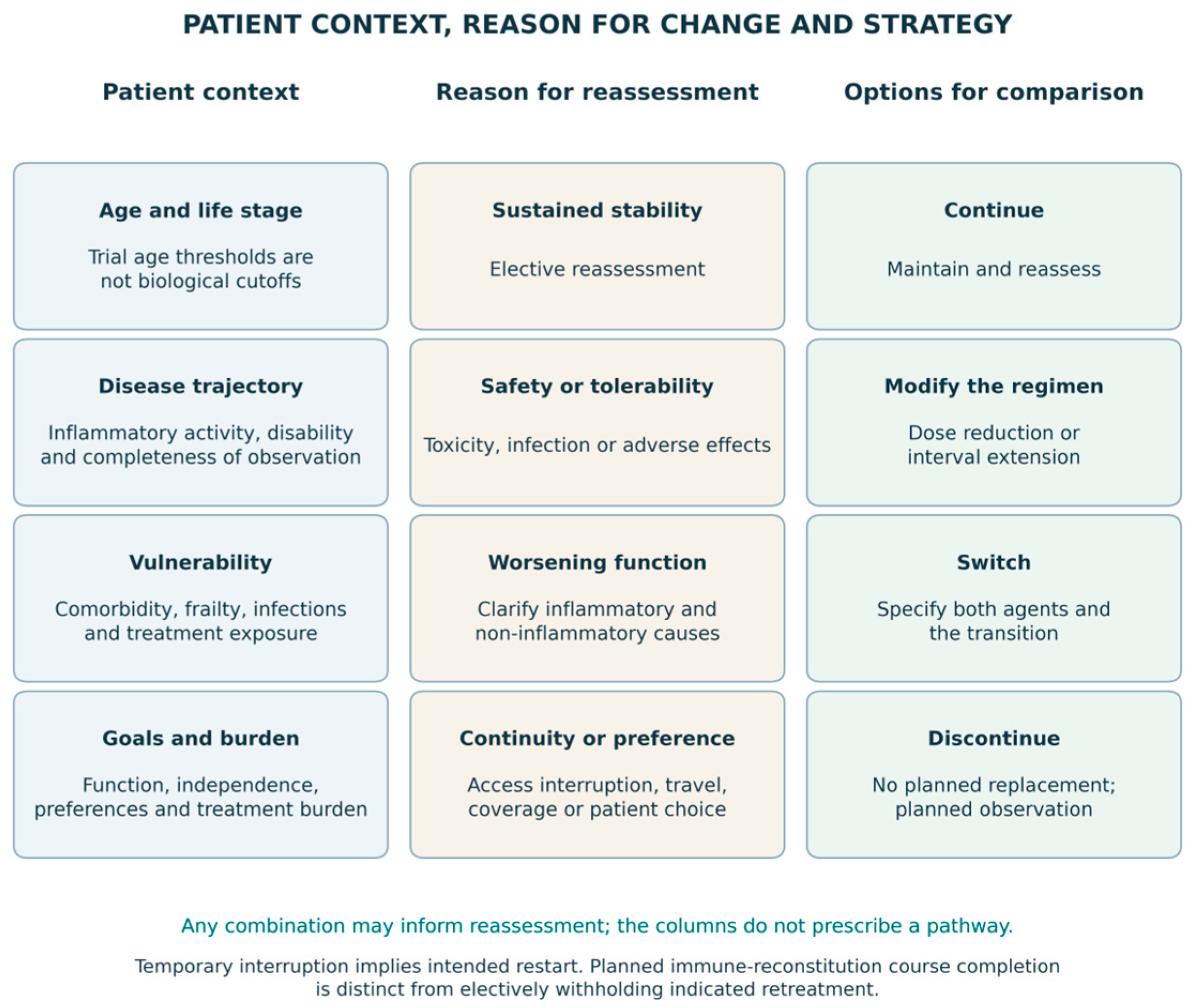
Figure 2.
Pharmacological exposure and epidemiological time zero Conceptual methodological schematic: A: The decision, last administration, first omitted scheduled dose and measured biological recovery are distinct anchors; the decision can precede or follow the last dose. B: A common time zero aligns eligibility, strategy assignment and follow-up. C: An illustrative biased construction classifies patients as discontinuers only after an event-free interval but credits that interval to them from an earlier date, while counting early events among continuers. This is one mechanism of immortal-time bias, not a diagnosis applicable to every delayed exposure definition. Observation and treatment restart must also be specified. Spacing is schematic and conveys neither duration nor risk.[53,54].
Figure 2.
Pharmacological exposure and epidemiological time zero Conceptual methodological schematic: A: The decision, last administration, first omitted scheduled dose and measured biological recovery are distinct anchors; the decision can precede or follow the last dose. B: A common time zero aligns eligibility, strategy assignment and follow-up. C: An illustrative biased construction classifies patients as discontinuers only after an event-free interval but credits that interval to them from an earlier date, while counting early events among continuers. This is one mechanism of immortal-time bias, not a diagnosis applicable to every delayed exposure definition. Observation and treatment restart must also be specified. Spacing is schematic and conveys neither duration nor risk.[53,54].
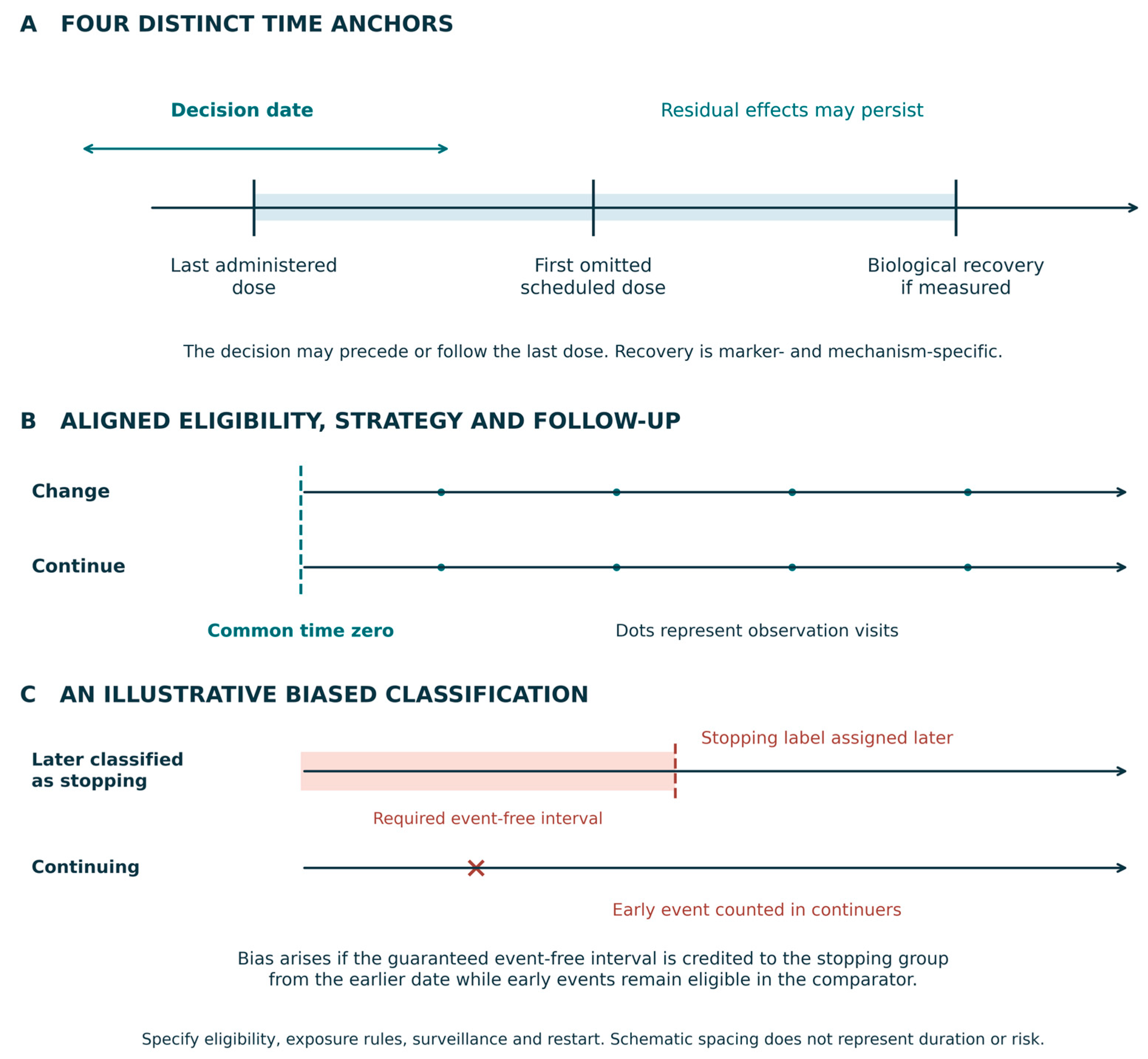
Figure 3.
Proposed GCC discussion and research framework Author-proposed and unvalidated. Eight components structure shared reassessment and prospective documentation. No score, stopping rule or treatment instruction is assigned. Treatment benefit–harm is assessed separately from local applicability. Dose reduction means reducing the amount administered; interval extension means increasing the time between administrations. The framework synthesizes the review’s interpretation and regional evidence.[39,40,41,42,43,44,45,46,47,48] Patient and clinician review, feasibility testing and evaluation of clinical utility remain future work.
Figure 3.
Proposed GCC discussion and research framework Author-proposed and unvalidated. Eight components structure shared reassessment and prospective documentation. No score, stopping rule or treatment instruction is assigned. Treatment benefit–harm is assessed separately from local applicability. Dose reduction means reducing the amount administered; interval extension means increasing the time between administrations. The framework synthesizes the review’s interpretation and regional evidence.[39,40,41,42,43,44,45,46,47,48] Patient and clinician review, feasibility testing and evaluation of clinical utility remain future work.
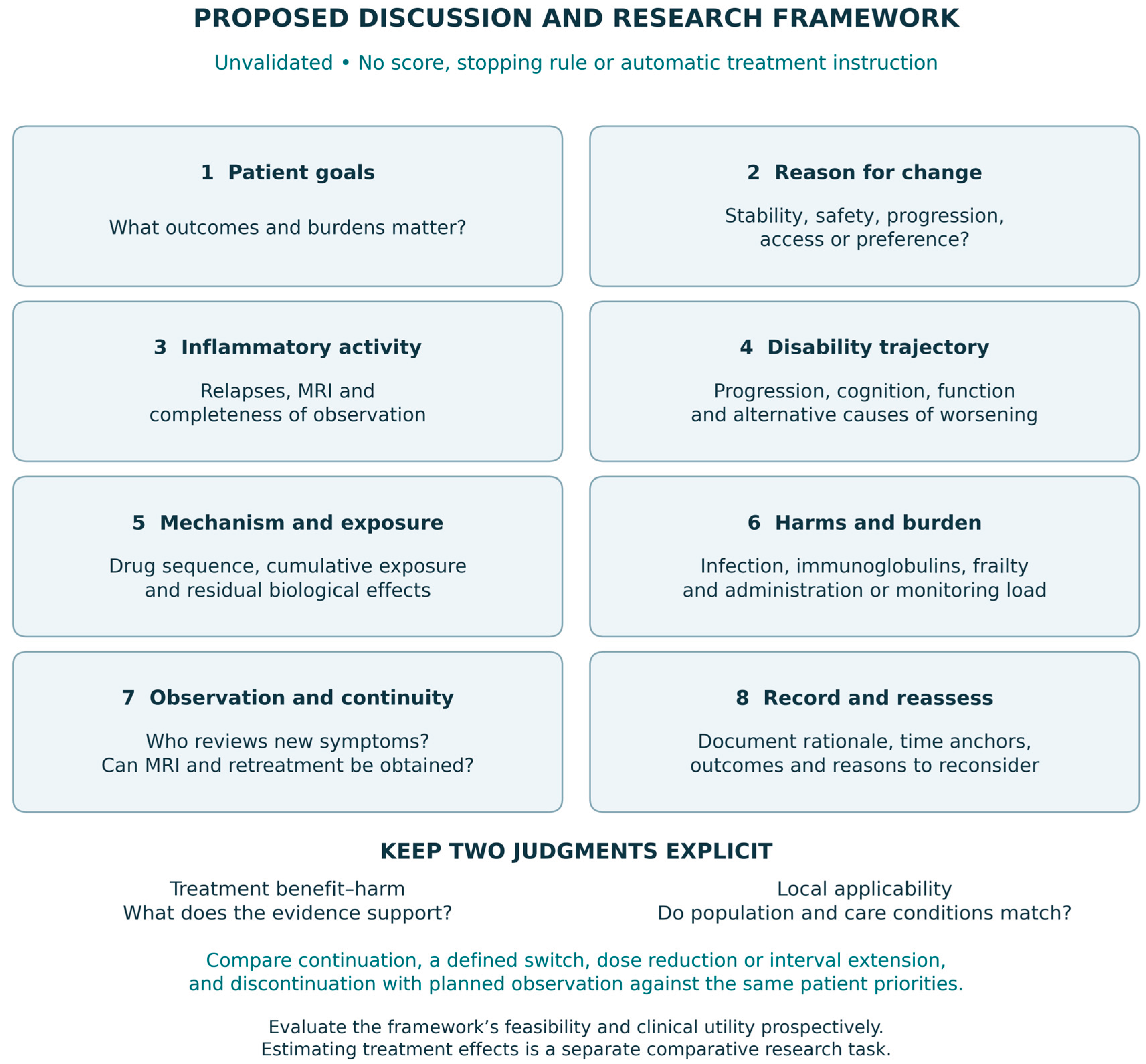

Table 1.
Treatment strategies and interpretive boundaries.
| Strategy | Operational definition | Mechanism or interpretation |
|---|---|---|
| Discontinuation | Stop without planned replacement | Residual effects may persist; natalizumab and fingolimod gaps differ from anti-CD20 cessation. |
| Temporary interruption | Pause treatment with intended restart | Specify the reason, anticipated duration and restart plan; interruption evidence does not establish long-term cessation safety. |
| Switching or de-escalation | Replace with a specified regimen intended to reduce efficacy intensity or a defined hazard | Specify both drugs, transition timing and reason. Lower efficacy is not synonymous with lower overall burden. |
| Dose reduction | Decrease the amount per administration | Distinguish from fewer administrations. Do not infer class-wide minimum effective dosing. |
| Interval extension | Increase time between administrations | Evidence concerns particular drugs and schedules; continued biological exposure is expected. |
| Planned course completion | Finish a scheduled immune-reconstitution course | Not automatically an exit event. A decision to withhold indicated retreatment is a separate contrast. |
| Continuation | Maintain the current regimen | A legitimate comparator and clinical option; continued reassessment is required. |
Notes: These operational definitions distinguish treatment decisions rather than rank preferred options. Stopping administration does not immediately end biological exposure. For any switch, specify both agents, the gap and the intended benefit. Dose reduction concerns amount per administration; interval extension concerns frequency. Temporary interruption and scheduled course completion should be recorded separately from elective cessation. Continuation is an active comparator. Definitions are informed by mechanism-specific studies.[7,8,9,10,11] DMT, disease-modifying therapy; anti-CD20, therapy targeting CD20-positive B cells.
Table 2.
Selected comparative studies and their principal limits.
| Study and strategy | Population and age | Older-adult relevance | Contrast and horizon | Principal finding | Main interpretive limit |
|---|---|---|---|---|---|
| DISCOMS [5] | 259; ≥55 y; mean 63 y | Direct | Stop vs continue; 2 y | Composite 16/131 vs 6/128; difference 7.5 points (0.6–15.0) | Non-inferiority unproven; mainly platform therapies |
| DOT-MS [6] | 89; median 54 y | Mixed age | First-line stop vs continue; median 15.3 mo | Significant activity 8/45 vs 0/44 | Early termination; stricter MRI threshold |
| Daneshyar [21] | 178 randomized; 168 analyzed; ≥55 y | Direct age eligibility | Stop vs continue; 24 mo | Relapse 12/84 vs 9/84; RR 1.33 (0.60–2.98) | Randomized report with post-randomization exclusions |
| Cleveland [24] | 600; ≥60 y | Direct | Stop vs continue; median 4.3 y after stop | Relapse HR 1.80 (0.51–6.39) | Treatment selection; sparse relapses |
| Cemcat [25] | ≥50 y; stop median 58 y; 110 vs 581 matched observations | Direct | Cessation vs continuation; median 5.1 vs 4.4 y | Inflammatory HR 2.04 (1.33–3.14) | Reusable control baselines; observational selection |
| OFSEP [9] | 154 pairs; ≥50 y; matched mean 57.7 y | Direct | High-efficacy stop vs continue; mean 2.5 y | Relapse HR 4.1 (2.0–8.5) | Mechanism and stopping-indication heterogeneity |
| OFSEP anti-CD20 [28] | 224 pairs; age ≥50 y; abstract mean 57.7 y | Direct | No infusion within 13 mo vs continue; median 34.8 mo | Relapse HR 0.6 (0.3–1.3); focal inflammatory activity HR 0.9 (0.5–1.4) | Future exposure classification; shared registry |
| Konen [29] | 58 stop, 232 continue; 22/58 discontinuers >50 y | Mixed age | OCR stop vs continue after stable treatment; median post-stop follow-up 28.5 mo | Inflammatory HR 0.92 (0.09–10.82) | Conditional population; extremely wide CI |
| Finite-course OCR [30] | 19 finite-course, 52 controls; active relapsing MS | Indirect | Short initial course vs ongoing; up to 46 mo | Reactivation 6/19 vs 0/52 | Different disease history; small nonrandomized comparison |
| MSBase switching [12] | 876 pairs; median approximately 40 y | Predominantly indirect | De-escalate vs continue; median 4.8 y | Relapse HR 2.36 (1.79–3.11) | Drug-pair and indication heterogeneity |
| NOVA [10] | 499; eligibility 18–60 y | Mixed age | NTZ 6 vs 4 weeks; 72 weeks | T2 lesion-count ratio 4.24 (0.86–20.85) | Sparse events; influential high-lesion observations |
| TOUCH [35] | Primary analysis 1,988 extended/13,132 standard; JCV-positive adults | Not older-specific | Extended vs standard NTZ intervals | Primary PML HR 0.06 (0.01–0.22) | Observational rare-event safety; definitions vary |
| RTX yearly [11,36] | 140 yearly/468 six-monthly; mean approximately 38–40 y | Predominantly indirect | 500 mg; stable first year | NEDA-3 failure HR 1.60 (0.69–3.68) | Wide CI; corrected eligibility; selection |
| RTX longer intervals [37] | 467 prolonged/585 comparison; mean 38.5 y | Predominantly indirect | Up to 18–24 vs 6–12 months | NEDA-3 failure HR 0.57 (0.21–1.57) | Possible overlap with yearly cohort |
| RIDOSE-MS [38] | 207 randomized; age not reported in inspected abstract | Undetermined | Annual vs six-monthly RTX after common year | Investigator-reported non-inferiority for inflammation | Conference abstract; primary margin/analysis incomplete |
| Kuwait NTZ [39] | 202 extended/41 standard; mean 35.7 y | Indirect for older adults | 6 vs 4 weeks after standard dosing | No statistically detected group differences | Observational; unequal arms; no equivalence margin |
Notes: Rows are grouped by strategy. “Older-adult relevance” describes population applicability, not a certainty grade; study-specific ages are retained. Parentheses after effect estimates denote 95% CIs. Counts, hazards, annualized rates and lesion-count ratios are not interchangeable. Daneshyar retains its randomized design label with post-randomization exclusions identified. Cemcat counts are matched observations with reusable continuation baselines. Konen’s HR is from the Results section; its abstract differs slightly. RIDOSE-MS remains conference evidence. Potential registry overlap limits independence. Details appear in Supplementary Sections S2, S3 and S8. HR, hazard ratio; JCV, JC virus; mo, months; NEDA-3, no evidence of disease activity across three domains; NTZ, natalizumab; OCR, ocrelizumab; PML, progressive multifocal leukoencephalopathy; RR, risk ratio; RTX, rituximab; y, years.
Table 3.
What the current evidence supports and leaves unresolved.
| Clinical scenario | Numerical anchor and horizon | Supported interpretation | Unresolved question |
|---|---|---|---|
| Stable first-line withdrawal [5,6] | DISCOMS: 12.2% vs 4.7% activity at 2 y. DOT-MS: 8/45 vs 0/44 significant activity; median 15.3 mo. | Inflammatory recurrence remains possible after prolonged stability. | Individual benefit, long-term disability and a safe stopping age. |
| NTZ or fingolimod cessation [7,8,9] | OFSEP stop groups: one-year relapse probability 33.6% NTZ; 16.3% fingolimod. RESTORE: MRI recurrence 19/41 vs 0/45 at 24 weeks. | Early reactivation and the replacement pathway matter. | Optimal transition for each older subgroup; other S1P modulators. |
| Older anti-CD20 cessation [28] | OFSEP: relapse HR 0.6 (0.3–1.3); serious infection HR 1.0 (0.6–1.8); median 34.8 mo. | Selected cohorts may retain inflammatory suppression. | Durable independence, selection effects and comparative safety benefit. |
| Lower-efficacy switching [12] | MSBase: relapse HR 2.36 (1.79–3.11); median 4.8 y. | A specified lower-efficacy transition can lose control. | Best alternative to both continuation and cessation in older patients. |
| NTZ interval extension [10,35,39] | NOVA: T2 lesion-count ratio 4.24 (0.86–20.85) at 72 weeks. TOUCH: PML HR 0.06 (0.01–0.22), primary analysis. | Efficacy and rare-event safety require separate evidence. | Equivalence, individual PML risk and older-adult generalization. |
| Anti-CD20 interval change [11,36,37,38] | Yearly RTX: NEDA-3 failure HR 1.60 (0.69–3.68). RIDOSE-MS: full primary analysis unavailable. | Defined spacing regimens warrant comparative evaluation. | Dose-per-infusion reduction, class interchangeability and net safety benefit. |
| Disability and patient-reported outcomes [24,28,29,32] | OFSEP anti-CD20 disability HR 1.2 (0.9–1.7); selected SPMS cohort: EDSS worsening 31/55 over mean 55.1 mo, without comparator. | Low relapse activity does not imply preserved function. | Comparative PIRA, cognition, quality of life and competing illness effects. |
| GCC applicability [39,40,41,42,43,44,45,46,47,48,49,50,51,52] | Kuwait interval cohort mean age 35.7 y. No older elective-exit comparative estimate identified regionally. | Regional studies and guidance inform bounded applicability. | Prospective outcomes, continuity and framework feasibility across sites. |
Notes: This is a qualitative synthesis, not formal certainty grading or a prescribing algorithm. Numerical anchors retain the source population, comparator, endpoint and horizon. They are not pooled estimates or individual risk predictions. Absolute probabilities are reported only where supported; an unavailable absolute estimate is not reconstructed from an HR. Low inflammatory activity does not establish preserved function or infection benefit. The main text and supplement provide design qualifications and source locations. CI, confidence interval; GCC, Gulf Cooperation Council; HR, hazard ratio; MRI, magnetic resonance imaging; NTZ, natalizumab; PIRA, progression independent of relapse activity; PML, progressive multifocal leukoencephalopathy.
Table 4.
GCC evidence and questions for local implementation.
| Country | Retrieved evidence | Boundary of inference | Question for local evaluation |
|---|---|---|---|
| Bahrain | Foundational citizen registry abstract [52]; official population context [50]. No exit comparison identified. | Citizen-only historical cohort is not an all-resident exit sample. | Include representativeness, reasons for change and completed follow-up. |
| Kuwait | NTZ interval comparison [39]; OCR and regional RTX cohorts [40,41]. | Direct interval evidence in younger patients; treatment cohorts do not establish exit safety. | Can comparable observation and continuity be delivered for older patients? |
| Oman | Recruitment in regional RTX cohort [40]; population report [51]. | Aggregate treatment data; no Oman-specific exit effect. | Record strategy, observation and coverage with country attribution. |
| Qatar | Q-OCRE treatment cohort [42]. | Treatment experience, not a discontinuation comparison. | Measure surveillance, transitions and restart prospectively. |
| Saudi Arabia | Saudi recommendations [45,49]; regional RTX [40]; persistence cohort [47]. | Guidance and predominantly younger treatment context. | Distinguish planned exit from interruption, intolerance and inefficacy. |
| United Arab Emirates | Guidance [43], regional RTX [40], policy announcement [46] and access dialogue [48]. | Jurisdiction-specific context; policy discussion does not measure nationwide performance. | Evaluate coverage, completed monitoring and access to retreatment. |
Notes: Country attribution follows verified recruitment or the jurisdiction addressed. Strategy comparisons, treatment cohorts, epidemiological abstracts and guidance provide different kinds of evidence. Multicountry participation does not yield a country-specific treatment effect. The Kuwait interval cohort is younger than the main older-adult withdrawal populations. “No exit comparison identified” is a bounded retrieval finding; it does not imply absent services or expertise. Questions in the final column are proposed measurements, not documented deficiencies. Demographic context informs representativeness, not biological risk or proof of care disruption. Retrieval cutoff: 1 November 2026. NTZ, natalizumab; OCR, ocrelizumab; Q-OCRE, Qatar ocrelizumab cohort; RTX, rituximab.
Disclaimer/Publisher’s Note: The statements, opinions and data contained in all publications are solely those of the individual author(s) and contributor(s) and not of MDPI and/or the editor(s). MDPI and/or the editor(s) disclaim responsibility for any injury to people or property resulting from any ideas, methods, instructions or products referred to in the content. |
© 2026 by the authors. Licensee MDPI, Basel, Switzerland. This article is an open access article distributed under the terms and conditions of the Creative Commons Attribution (CC BY) license (http://creativecommons.org/licenses/by/4.0/).
Copyright: This open access article is published under a Creative Commons CC BY 4.0 license, which permit the free download, distribution, and reuse, provided that the author and preprint are cited in any reuse.