

Submitted:
03 November 2026
Posted:
05 November 2026
You are already at the latest version
Abstract
School meals can improve child nutrition and support local food systems. This study examined the inclusion of aquatic foods in dietary guidance and school food policies in low- and middle-income countries (LMICs), and how this guidance was reflected in school menus, recipes and meals reportedly served. We systematically searched grey literature for national food-based dietary guidelines (FBDGs), school food guidance, menus and recipes across 132 LMICs. A stakeholder survey assessed reported implementation, alignment between planning and provision, and perceived barriers and enablers. FBDGs were identified for 63 countries, and 62 (98%) included aquatic foods. School food guidance was identified for 71 countries, and 53 (75%) included aquatic foods. Aquatic foods appeared in menus for 26 of 47 countries (55%), in recipe documents for 18 of 26 (69%), and in individual recipes for 101 of 1,502 (7%). Only 14 countries had accessible documents at all four stages of the policy-to-school-plate pathway, and ten included aquatic foods throughout. Survey respondents rated food safety and affordability as primary enablers and cost and inadequate funding as the main barriers to fish provision. Among 30 paired respondents, aquatic animal-source foods were reported in menus or recipes by 80% and as served by 57%, with moderate agreement (κ = 0.49). Documentation became less common downstream, and planning did not always align with provision. Translation of dietary guidance into school meal provision depends on feasible guidance, resources, governance, procurement and supply systems, food safety, infrastructure and cultural acceptability.
Keywords:
animal-source foods
; food-based dietary guidelines
; school food policy
; implementation
; small fish
; low- and middle-income countries
; nutrition
1. Introduction
School meal programs reach over 466 million children annually and support nutrition, education and local food systems (GCNF 2024b; World Food Programme (WFP) 2024). Governments increasingly seek alignment with dietary guidance, sustainability, climate resilience and local procurement (FAO 2019b; WHO 2026), but implementation depends on governance, budgets, procurement, supply chains, infrastructure, food safety and local availability and preferences (Micha et al., 2018; Cohen et al., 2021; WHO 2026).
Poor diet quality remains a major global health and nutrition challenge, characterized in many populations by inadequate intake of both high-quality protein and essential micronutrients. More than half of the world's population consumes inadequate amounts of at least one of several key micronutrients, including iron, zinc, calcium, iodine, folate, and vitamins A, B12 and C (Passarelli et al., 2024). Undernutrition also remains widespread: in 2024, an estimated 23.2% of children under five years of age—150.2 million children—were affected by stunting (UNICEF, WHO and World Bank, 2025). Inadequate dietary intake of protein and essential micronutrients, as well as long-chain omega-3 fatty acids, can constrain physical growth, development and cognitive function, particularly during periods of rapid growth, which compromises growth, learning and long-term health (Nyaradi et al., 2013). Maintaining nutritional gains from the first 1,000 days requires attention throughout childhood and adolescence—the subsequent “7,000 days” (Yakubu et al., 2026; WFP, 2024), which encompass growth, puberty, brain development and lasting dietary preferences (Hanley-Cook et al., 2024; WFP 2024). Calcium requirements increase during adolescence, while girls have high iron requirements associated with menstrual losses (Matkovic 1992; Low et al., 2016).
Aquatic animal-source foods (ASFs), including fish, shellfish, molluscs and other aquatic animals, are rich in bioavailable micronutrients (e.g., iron, zinc, vitamin B12 and iodine), long-chain omega-3 fatty acids, including docosahexaenoic acid (DHA) and eicosapentaenoic acid (EPA), and high-quality protein that support child and adolescent growth and cognitive development (UN Nutrition 2021; FAO/WHO 2024a; O’Connor et al., 2025; Consalez et al., 2022). In many low- and middle-income countries (LMICs), small fish and other locally available aquatic ASFs can be relatively affordable and nutrient-rich, particularly when they are consumed whole, including the bones and organs (Johnsson et al., 2025; Robinson et al., 2022, 2025). Seaweed and other algae provide iodine, fibre and bioactive compounds; some also contain vitamin B12, with variable bioavailability (Koseki et al., 2023). Nutrient composition varies by species and growing conditions (Park et al., 2023), and a single portion of some products may exceed the tolerable upper iodine intake level (Aakre et al., 2021), with potential adverse health effects (Blikra et al., 2024).
Fish and other aquatic food consumption among many children and adolescents remains below recommendations. In high-income countries, barriers include household dietary practices, cost, sensory preferences, perceived quality, contaminant and sustainability concerns, and limited preparation confidence (Ansai et al., 2025; Derbyshire 2019; Utri-Khodadady et al., 2024). Evidence from LMICs, largely focused on infants and young children, additionally identifies limited access, seasonal food insecurity, delayed introduction during complementary feeding, concerns about bones, caregiver beliefs, cultural norms and intra-household food allocation. These barriers can persist even in fish-producing communities (Bogard et al., 2017; Byrd et al., 2021; Thorne-Lyman et al., 2017). School meals may improve equitable access and have potential to support diet quality (Kante et al., 2026; Lehner et al., 2020).
Food-based dietary guidelines (FBDGs) provide population-level recommendations for healthy, culturally appropriate diets and can inform institutional guidance (FAO 2019b; Herforth et al., 2019). School food policies shape foods provided, sold or marketed in and around schools (FAO 2019a; WHO 2026). Nutrition guidelines and standards for school meals translate dietary objectives into menu-planning, procurement and provision guidance (FAO 2019b; WHO 2021; WHO 2026), while menus and recipes specify planned provision. Here, ‘school food’ refers to the broader policy and food environment, and ‘school meals’ to organized meal provision. Countries may have school food policies without national school meal programs, or school meal programs without comprehensive school food policies.
This study examined aquatic foods across the school food policy landscape in LMICs. We aimed to: (1) identify aquatic food references in FBDGs, school food guidance, menus and recipes; (2) map document availability and aquatic food inclusion across the policy-to-school-plate pathway; (3) assess stakeholder-reported planning, provision and implementation barriers; and (4) identify opportunities for feasible, context-appropriate inclusion of aquatic foods in school meals.
Our conceptual framework (Figure 1) traces dietary recommendations through school food guidance, menus and recipes, foods served, and children's dietary exposure, health and education outcomes. School meals can also support livelihoods and wider food system outcomes. We use aquatic foods to identify discontinuities across these stages. To our knowledge, no previous multi-country study has systematically mapped aquatic foods across these layers.
2. Methods
We included 132 LMICs based on the World Bank 2026–2027 classification, retaining Costa Rica despite its recent transition to high-income status (World Bank 2026). Document availability was assessed independently of reported school meal program status: policies may precede national programs or support subnational, community-led or future provision. Restriction to reported national programs would rely on incomplete, time-varying program-status data and exclude countries with undocumented implementation.
2.1. Document Search and Review
Inclusion criteria, sources, search period, search terms, numbers of records screened and excluded, and data extracted from each document are summarized in Table 1. Searches were conducted from 3 November 2025 to 15 March 2026, and eligible documents were included regardless of publication date. When multiple documents of the same type were identified for a country, the most recent was included.
‘School food guidance documents’ includes policies, standards and practical tools governing the nutritional quality and safety of foods provided or sold in and around schools: school meal nutrition guidelines and standards, menu-planning guides, vendor regulations, and recommended, restricted or prohibited food lists.
All available daily, weekly or monthly menu cycles were reviewed. For recipe books containing more than 30 recipes, ChatGPT 5.6 Sol Light (OpenAI; last accessed 17 September 2026) screened each recipe against predefined aquatic food inclusion and type criteria. The model was supplied with a standardized prompt and output template to record country, total recipes, recipes containing aquatic foods and aquatic food types. A researcher independently reviewed a random sample of 3 of 26 recipe documents (12%) using the same criteria; discrepancies were corrected before finalizing the dataset. Table 1 summarizes records and countries reviewed; individual recipe counts are reported in the Results.
2.2. Stakeholder Survey
The online survey was administered in English, French and Spanish using non-probability convenience and snowball sampling. Professional contacts received the link through LinkedIn and targeted distribution lists and were invited to circulate it further.
Target respondents included government officials, non-governmental and international organizations, implementers and suppliers involved in school meals. Responses could concern national, subnational, community or informal initiatives. The survey collected quantitative and qualitative information on aquatic foods in menus, recipes and meals served; barriers and enablers rated on a 4-point Likert scale from not important (1) to very important (4); and supporting documents for review (Section 2.1). Most survey questions were presented as multiple-choice items, allowing respondents to select one or more response options. Conditional branching distinguished suppliers or producers from other stakeholders. The survey was open from 3 April to 8 June 2026.
Clearance for the treatment of personal data was obtained from SIKT (Norwegian Agency for Shared Services in Education and Research) on 4 March 2026 (Notification Form 999356), and survey respondents were given comprehensive information on the use of their data and then asked to actively consent to participate in the online survey.
2.3. Analysis
Documents and survey responses were summarized descriptively. Country-level mapping and respondent-level analyses were treated separately because the convenience sample was not representative. Document discontinuity refers to reduced specificity, coverage or implementation between successive pathway stages, including absent aquatic foods or insufficient frequency or quantity relative to dietary objectives. We compared document availability and aquatic food content across stages and assessed planned versus reportedly served foods within paired survey responses. These comparisons did not establish causal mechanisms or verify national implementation. Comparable portions reported in grams were assessed against the Global Diet Quality Score (GDQS) Meal and Menu Metrics fish and seafood thresholds for children aged 5–9 and 10–14 years: >40 g indicates a high contribution to meal quality, 8–40 g medium and <8 g low (Intake 2025).
Survey questions covering the same food category at different stages of the pathway were paired a priori to compare planned and reported provision. Respondent-level agreement was assessed using Cohen's kappa: 0.01–0.20 slight, 0.21–0.40 fair, 0.4–0.60 moderate, 0.61–0.80 substantial and >0.80 almost perfect. Multiple respondents could represent one country; estimates were not nationally representative. Analyses used R 4.5.1 and RStudio 2025.09.1+401. Responses to one open-ended survey question on recommendations for improving the inclusion of aquatic foods in school meals were analyzed thematically by two reviewers. The reviewers familiarized themselves with the data and iteratively generated inductive codes, which were grouped into broader themes following Braun and Clarke’s six-phase framework (Ahmed et al., 2025; Campbell et al., 2021). Themes included policy development, procurement reform, improved infrastructure, local sourcing, food safety systems, product innovation, and capacity strengthening.
Data from the Global Survey of School Meal Programs, conducted by the Global Child Nutrition Foundation (GCNF) in 2019, 2021, and 2024, were used to contextualize findings from the document review and stakeholder survey in relation to countries reporting large-scale school meal programs (GCNF, 2024a).
3. Results
3.1. Availability of Policy and Implementation Documents
At least one relevant document type was identified for 101 of 132 countries (76%), but documentation availability declined downstream (Table 2; Supplementary Table S1). Among the 132 countries, 94 reported school meals in at least one GCNF survey (2019, 2021 or 2024), 22 never responded, and 16 reported no large-scale program at the time. Reported programs included national, sub-national, community/parent-led provision in Uganda and Tanzania and emergency provision in Yemen. Among the 31 countries without identified documents, 16 reported school meal programs, nine never submitted GCNF survey responses, and six reported no program (GCNF 2024a).
FBDGs were identified for 63 countries (48%). Of the 63 countries with FBDGs, 8% were low-income, 35% lower-middle-income and 56% upper-middle-income countries. They were most often endorsed by ministries of health (n=49), agriculture (n=5), or both (n=2). Seven national FBDGs included recommendations for school-aged children, generally within a broader category spanning children and adolescents; Bolivia and Bhutan had separate guidance documents for school-aged children or adolescents. School food guidance was identified for 71 countries (54%): 10% low-income, 39% lower-middle-income, 49% upper-middle-income, plus Costa Rica. Of 28 school nutrition guidelines and standards (NGS), issuers most often included ministries of education (n=9), health (n=6), or both ministries (n=4). Mongolia had both NGS and a practical guide. India had ministry of health-led nutrient standards and education-led food standards and food education activities.
Eighty-one menu or recipe documents represented 57 countries (43% of the 132 in our search): menus alone were identified for 31 countries, recipes alone for ten, and both document types for 16. Menus were therefore available for 47 countries and recipe documents for 26. Only 11% of countries (n=14) had accessible documentation across all stages of the pathway, including FBDGs, school food guidance, menus, and recipes. Conversely, no accessible documentation was identified for 23% of countries (n=31).
3.2. Inclusion of Aquatic Foods Across the Policy-to-School-Plate Pathway
Aquatic foods were explicitly included in 62 FBDGs (98% of identified FBDGs; 47% of all 132 countries). One FBDG was not fully accessible and could not be assessed for aquatic food inclusion. Aquatic foods were usually represented as finfish within broad animal-source or protein-rich food groups (Figure 2). Seaweed and other algae were included in only five FBDGs: the Dominican Republic, Ecuador, India, Indonesia and the Philippines. Where included, they were grouped with fish or mentioned in relation to specific nutrients, such as iodine or omega-3 fatty acids.
Among the 62 accessible FBDGs that included aquatic foods, 29 provided quantitative fish portion sizes and 11 provided semi-quantitative descriptions, such as a ‘palm-sized’ portion (Figure 3). Twelve specified a fish-specific consumption frequency. Quantitative recommendations for non-fish aquatic foods, such as molluscs or crustaceans, were not identified.
Among 71 countries with school food guidance documents, 75% (n=53), or 40% of the total 132 countries included in our review, explicitly referenced fish or other aquatic foods (only China referenced seaweed). Documents that did not mention fish were typically nutrient-based or referred only to animal-source foods more generally. Two countries (Algeria and Jordan) categorized fish along with meat, which was restricted in school canteens or subject to veterinary certification requirements. Approximately half of the school food guidance documents reviewed included serving size guidance (n=28) or frequency recommendations for aquatic foods (n=28), while only 11 provided both frequency and serving size guidance. The mean frequency recommendation and serving size recommendation range is reported in Figure 3. No quantitative recommendations for non-fish aquatic foods were included in school food guidance documents.
Aquatic foods appeared in menus and/or recipes for 32 countries (24% of 132 countries; or 56% of countries for which we found menus and/or recipes). Aquatic foods were included in both menus and recipes in 12 countries (9% of all 132 countries), in menus only in 14 (11%), and in recipes only in six (5%). Among countries with available documents, aquatic foods appeared in menus in 26 of 47 countries (55%) and in recipes in 18 of 26 countries (69%). Three countries included seaweed in recipes – Mongolia, Timor-Leste and Ukraine. Figure 3 summarizes quantifiable serving sizes from recipes and serving frequencies depicted in menus. Among 1,502 individual recipes reviewed, 7% (n=101) included at least one aquatic food, with fresh or frozen fish dominating 61% of individual recipes that included aquatic foods (n=62). Figure 4 details the inclusion of aquatic foods in individual recipes across countries where recipes were reviewed (n=26); percentages reflect the documents reviewed.
Taken together, aquatic food inclusion was 98% among accessible FBDGs and 75% among school food guidance documents. Within the operational-document stage, aquatic foods appeared in 55% of assessed menus and 69% of assessed recipe documents, and 7% of the 1,502 individual recipes reviewed. Denominators differ by stage and describe accessible evidence. Among the 14 countries where the complete policy-to-school-plate pathway could be assessed, ten countries (Belize, Mexico, Moldova, Mongolia, Paraguay, Saint Lucia, South Africa, Sri Lanka, Timor-Leste, Vietnam) demonstrated inclusion of aquatic foods across FBDGs, school food guidance, menus, and recipes. Figure 5 presents a high-level overview of the inclusion of aquatic foods across the policy-to-school-plate pathway. Supplementary table S1 provides more detail on available documents and inclusion of aquatic foods in each.
3.3. Stakeholder Survey Findings
The stakeholder survey generated 46 complete responses from 23 countries, on average two respondents per country, although representation was unequal., Most responses came from lower-middle-income countries (65%), followed by upper-middle-income countries (20%), then Costa Rica (9%) and Malawi (4%) as the only high- and low-income countries that responded to the survey. Respondents primarily represented international organizations (35%) and government institutions (24%) and reported working at national (80%), provincial or regional (41%), community (35%) or international (30%) levels (Supplementary Table S3). Three-quarters of respondents reported school nutrition guidelines or standards and 71% reported official school menus or recipe books. Out of the 23 countries represented in stakeholder survey responses, all reported school meal programs in past GCNF surveys, except for four: two countries (Iran and Fiji) have never responded to a GCNF survey, whereas the other two countries (Samoa and Solomon Islands) have responded and noted that there is no large-scale school meal program in the country (GCNF 2024a).
Paired responses were available from 30 respondents representing 16 countries. Overall agreement between foods included in official menus or recipes and foods reported as generally served was substantial across all food groups (κ = 0.71). For aquatic animal-source foods (fish and other aquatic animals), 80% reported inclusion in official menus or recipes, compared with 57% reporting that they were generally served; agreement was moderate (κ = 0.49). Seaweed and other algae appeared in menus or recipes for 20% of respondents but were reported as generally served by 7%, with slight agreement (κ = 0.17) (Supplementary Table S4). Because observations were respondent-level and multiple respondents could represent one country, these findings indicate perceived alignment rather than nationally representative implementation gaps.
Aquatic food procurement was predominantly reported from local fish markets or small-scale traders (73%). Fresh aquatic foods were the most frequently reported form in menus or recipes (79%), followed by frozen (42%), dried (38%), canned (33%) and fish powder (17%) (Supplementary Table S5). Freshwater fish, large marine fish and small fish were commonly reported; however, the questionnaire examples did not consistently distinguish small marine from small freshwater species, so these categories should be interpreted cautiously. Small fish were reported in menus or recipes by 58% of respondents and as generally served in school meals by 77%.
Respondents rated food safety and quality and affordability most highly among enabling factors (both 3.82/4). Cost and inadequate funding received the highest barrier score (3.77/4), followed by infrastructure limitations, safety concerns and unstable supply (Supplementary Table S6). Open-ended responses additionally mentioned centralized procurement, limited monitoring, weak policy prioritization, storage constraints and cultural considerations as barriers. These respondent-reported perceptions were not designed to establish regional prevalence or causal importance.
3.4. The Policy-to-Plate Pathway
Table 3 provides selected examples of aquatic food portions and frequencies in FBDGs, school food guidance, menus and recipes with stakeholder-reported provision, including countries with survey evidence of provision but incomplete upstream documentation. Further examples are available in Supplementary Table S2. Quantitative policy alignment was evident in Malaysia and South Africa, and alignment between school food guidance and menus or recipes in Moldova. Timor-Leste, Sri Lanka and Paraguay showed alignment across documented stages, although Paraguay had no survey evidence of provision. Most surveyed countries had broad protein or animal-source food categories in guidance (Bhutan, Cambodia, Costa Rica) or lacked identified upstream guidance (Lao PDR, Marshall Islands).
In several countries, recommended serving sizes in school food guidance documents exceeded the GDQS Meal and Menu Metrics threshold for a high contribution to meal quality (>40 g of fish or shellfish) (Bhutan, Costa Rica, Samoa and Timor-Leste). Timor-Leste and Sri Lanka had reported serving sizes in menus or recipes that were broadly consistent with these recommendations in their school food guidance. Sri Lanka, The Gambia and Rwanda distinguished fresh from dried fish. Because the GDQS gram thresholds do not differentiate products by moisture content, direct comparisons with nutrient-dense dried fish portions require caution. Survey-reported fish portions in Bhutan, Costa Rica, Samoa and Timor-Leste exceeded the Intake (2025) threshold for a high contribution to meal quality.
4. Discussion
Aquatic foods illustrate the challenges of translating policy into school meals, given their diversity in nutrient content, production systems and seasonal availability, combined with differing supply chain and food safety requirements. They provide protein, omega-3 fatty acids and micronutrients important for development, with contributions depending on species and product form (FAO/WHO 2024a, 2024b; O'Connor et al., 2025). Their inclusion in school meals therefore requires translating nutritional objectives into procurement and preparation practices suited to local supply and school capacity.
4.1. Integration of Aquatic Foods into School Meals: Four Pathway Profiles
Aquatic foods were widely recognized within the documents available at each stage of the policy-to-school-plate pathway, although the availability of evidence became more limited at the operational stages. The country-level findings can be interpreted through four pathway profiles.
The first comprises ten countries with aquatic foods included in FBDGs, school food guidance, menus and recipes: Belize, Mexico, Moldova, Mongolia, Paraguay, Saint Lucia, South Africa, Sri Lanka, Timor-Leste and Vietnam. This consistency across policy and operational documents does not, by itself, verify that aquatic foods were regularly served or consumed. Among countries with corresponding survey evidence, Sri Lanka and Timor-Leste provided the clearest examples of broadly consistent aquatic food quantity across guidance, operational documents and reported provision.
The second profile comprises upstream recognition with incomplete documented operationalization: aquatic foods appeared in FBDGs or school food guidance but were absent or less consistent downstream. Albania had quantitative fish recommendations in both guidance stages but none in the reviewed menu. This may reflect implementation gaps or inaccessible current, subnational or decentralized documents.
The third profile comprises downstream inclusion without accessible national policy anchoring. The Gambia, Rwanda and Ukraine had school food guidance or operational evidence without identified FBDGs; Lao PDR included aquatic foods in recipes and reported provision despite limited upstream documentation. Local availability, procurement and program decisions may support inclusion even where national recognition is weak or undocumented.
The fourth profile comprises countries where the pathway could not be adequately assessed because the available evidence was insufficient or incomplete. No relevant policy or operational documents were identified for 31 countries, while other countries lacked one or more document types needed to assess continuity across the pathway. These findings indicate gaps in document identification or public accessibility and should not be interpreted as evidence that school food policies, school meal programs or aquatic food provision were absent. This distinction is particularly important for Pacific small island states, where fish is widely regarded as central to food security and traditional diets, although its availability and consumption vary considerably within and between countries (Bell et al., 2009; Charlton et al., 2016). For Tonga and the Marshall Islands, no relevant documents were located despite GCNF data indicating the presence of school meal programs; the Marshall Islands also contributed evidence to our stakeholder survey.
Together, these profiles distinguish documented coherence, apparent gaps between policy and operational planning, downstream inclusion without clear policy anchoring, and insufficient evidence. They extend previous work on coherence between fisheries and nutrition policies (Koehn et al., 2022) by tracing aquatic foods across dietary guidance, school food policies, menus, recipes and respondent-reported provision in multiple countries. This approach highlights both limited evidence at downstream stages and imperfect alignment between documented plans and reported provision.
4.2. Implementation Depends on Systems, Not Only Guidelines
Governance and coordination across nutrition, education, procurement, fisheries and food safety systems may influence the translation of aquatic food recommendations into school meal provision, although we did not test these relationships in this study. Survey respondents identified affordability, supply reliability, food safety, and infrastructure as factors affecting inclusion, consistent with findings from a previous scoping review of aquatic foods in school meal programs in Sub-Saharan Africa (Ahern et al., 2021). Identifying affordability as an enabler and cost as a barrier (as was the case in our stakeholder survey) may reflect different comparisons and budget constraints: aquatic foods may be affordable relative to other ASFs, while purchase, processing, transport, storage and preparation costs may still exceed school meal budgets. These findings reinforce the importance of supportive procurement systems, adequate infrastructure and budgets, and institutional capacity for implementing school food policies (Micha et al., 2018; Cohen et al., 2021; WHO 2026; Hawkins 2023). Although stronger nutrition standards can improve the nutritional quality of school meals, implementation may be constrained by cost, acceptability, availability, compliance and broader contextual factors (Cohen et al., 2021; Micha et al., 2018; WHO 2021; Ralston and Newman 2015; Vieux et al., 2013). Addressing these constraints requires a coordinated approach linking school food environments, procurement, and nutrition education (FAO 2019a).
In the surveyed settings, inclusion in planning documents did not consistently correspond with reported provision (moderate agreement, κ = 0.49), suggesting that assessment of menus and recipes alone may overestimate dietary exposure. However, the non-representative respondent-level survey sample prevents country-wide inference. Procurement, seasonal availability, budgets, supplier capacity and local decisions may help explain these discrepancies, but direct observation is needed to establish actual provision and investigate its determinants. A food systems perspective could help connect dietary objectives with feasible procurement, preparation and delivery while accounting for economic, sociocultural and environmental conditions (FAO 2024; FAO and WFP 2026).
Non-fish aquatic foods were largely invisible across the policy-to-school-plate pathway. This absence matters because “aquatic foods” encompass nutritionally and culturally diverse foods beyond finfish, including shellfish and seaweed and other algae that may be locally important sources of micronutrients, livelihoods and food system diversity (Bernhardt & O’Connor, 2021). At the same time, their composition and safety cannot be generalized: for example, seaweed nutrient content varies markedly by species and product, some products may contain excessive iodine, cadmium and inorganic arsenic, and omega-3 content may be relatively low (Aakre et al., 2021; Kendel et al., 2012; Blikra et al., 2024). Their limited visibility may reflect low consumption in some settings, aggregation within broad food groups, limited evidence, or genuine policy neglect; this review cannot distinguish among these explanations. On the other hand, their inclusion may, in some cases, represent aspirational policy framing rather than foods that are routinely available in food environments or through school procurement systems. Where locally available, culturally acceptable and safe, school food guidance and procurement assessments should consider whether non-fish aquatic foods can contribute to program objectives.
4.3. Translation Is Not Necessarily Linear, with Evidence of Both Implementation Gaps and Local Adaptation
Broad food group framing may be appropriate in an FBDG but insufficient for procurement or menu design. In this review, aquatic foods were commonly visible in FBDGs and school food guidance but grouped with other foods. Generic categories such as "protein," "animal-source foods," or "meat and alternatives" may obscure their specific nutritional contributions and offer limited incentive to prioritize them over potentially cheaper protein sources (Tlusty 2021; Ximenes et al., 2026). The appropriate degree of specificity depends on the document’s purpose. Where aquatic foods support program objectives, guidance may distinguish nutritionally or operationally important forms, such as small whole fish, oily fish or dried fish, while allowing substitution according to local availability, cost and cultural preferences. The FAO and WFP methodology for holistic nutrition guidelines and standards for school meals provides a framework for balancing specificity and flexibility (FAO and WFP 2026).
Operational guidance must also account for product form. Quantified recommendations were more visible in FBDGs and school food guidance than in menus and recipes. Frequencies generally ranged from one to three fish servings per week, while fresh fish portions frequently exceeded 40 g. Quantitative alignment was clearest in few countries: Malaysia and South Africa between policy documents; Moldova between school food guidance and menus or recipes; and Sri Lanka and Timor-Leste across guidance, operational documents and reported provision. Alignment therefore concerns both frequency and portion size; inclusion at each stage does not necessarily imply consistency in the amounts recommended or served.
School food guidance from The Gambia, Rwanda and Sri Lanka included recommendations for dried fish, with smaller portions. Drying removes water and concentrates nutrients, making dried fish more nutrient-dense per unit weight than fresh fish (Robinson et al., 2025). These portions are therefore not directly comparable with fresh fish portions or the GDQS threshold without accounting for moisture content (Intake, 2025).
4.4. Aligning Aquatic Food Products, Policy Ambitions, Procurement and School Capacity
Aquatic food guidance should reflect local food environment conditions, as product forms differ in their requirements for storage, transport, preparation, food safety, affordability, and acceptability. Integration therefore requires selecting suitable aquatic food products and, where feasible, adapting procurement systems to school capacity (Andrianarimanana et al., 2024; Ahern et al., 2025; Bonis-Profumo et al., 2024; 2025). Where cold-chain infrastructure is limited, dried, canned, smoked, or powdered products may be more feasible due to longer storage life (Kaunda et al., 2025; Mahmud et al., 2019), whereas fresh fish may suit settings with established local supply and preparation capacity. Investments in infrastructure and food safety systems may also support the procurement of other local perishable products. The balance between product adaptation and system improvements depends on local feasibility, costs, and wider benefits.
Survey respondents reported fresh products more frequently in menus or recipes (79%), followed by frozen (42%), dried (38%), canned (33%) and powdered products (17%). Categories were not mutually exclusive and indicate documented inclusion rather than serving frequency. Small fish were reported as served more often than they appeared in menus or recipes (77% versus 58%), potentially indicating provision of locally available aquatic foods not reflected in planning documents. The survey was not representative and did not capture reasons for this difference.
Procurement arrangements, food safety and cultural acceptance were recurrent considerations in survey responses. Procurement models should reflect local supply structures and institutional capacity: decentralized purchasing may strengthen links with small-scale suppliers, whereas centralized purchasing may facilitate standardized monitoring and quality control (FAO and WFP 2020). For aquatic foods, assessing fisheries value chains and supplier capacity can help identify arrangements that enable small-scale fisherfolk to supply schools (Andrianarimanana et al., 2024). Neither procurement model is inherently preferable, and hybrid arrangements may be appropriate within national programs.
Food safety requirements must protect children’s health while remaining proportionate and feasible for suppliers. Product form and recipe design can influence acceptance where bones, unfamiliar species or strong flavours are concerns (Araya and Castillo-Montes 2021; Bilbao et al., 2024; Martins et al., 2021; Nakagiri et al., 2024; Thorne-Lyman et al., 2017; Gibson et al., 2020). Fish powders and adapted recipes may improve acceptability and nutritional value in some contexts (Ahern et al., 2025; Atter et al., 2024; Donadini et al., 2013; Elolu and Ongeng 2020; Latorres et al., 2016; Laureati et al., 2016). Product selection and procurement should therefore reflect local nutritional objectives, supply conditions, safety and preferences, alongside holistic food education (Vargas et al., 2025; FAO 2020).
4.5. From Policy Recognition to Implementation: Priorities for Action and Research
Priorities depend on nutritional needs, local food systems and program capacity. Where aquatic foods are feasible and relevant, operational school food guidance can specify frequency, portions or nutritional contributions while permitting locally appropriate substitutions. Such detail may be more useful in school guidance than population-facing FBDGs.
Procurement and menu planning should reflect local production, seasonality, product form, safety, storage and supplier capacity. Cold-chain investment may be appropriate in some settings; in others, quality-assured shelf-stable products may address different constraints. Local sourcing may benefit small-scale producers, but feasibility, safety and distributional effects require context-specific assessment (Bonis-Profumo et al., 2025).
Cross-sectoral coordination may support alignment between health-led FBDGs and school guidance developed by education, health, agriculture, fisheries or social protection institutions. Centralized and decentralized models distribute procurement, preparation and management responsibilities differently; local adaptation depends on administrative, procurement and monitoring capacity (FAO and WFP 2018). This study did not classify programs sufficiently to test these relationships. Research should examine governance level, legal enforceability, coordination, monitoring and procurement.
Future research should directly assess foods offered, selected and consumed and their effects on diet quality, nutrient intake and health (FAO/WHO 2024a, 2024b; O’Connor et al., 2025). Evidence is limited in LMICs (Gelli et al., 2026), whereas studies in high-income settings have examined alignment between standards, provision and consumption (Mateo Silleras et al., 2015; Borkowski et al., 2020; Sancho Uriarte et al., 2015; Gilmour and Fairchild 2025; Juniusdottir et al., 2018). Studies should measure frequency, portions, species, product form, nutritional contribution, acceptability, plate waste, consumption and cost, using standardized tools where appropriate.
4.6. Limitations
This study has several limitations. First, the availability of policy documents, menus, and recipes varied substantially across countries, limiting comparability and restricting assessment in countries where documents were unavailable. Policy documents differed considerably in structure, terminology, and specificity. Menus and recipes may exist but are unpublished, decentralized or inaccessible. Survey responses were also based on stakeholder self-report, were not nationally representative, and likely do not reflect all schools within a country. This made it difficult to establish clear traceability between national dietary recommendations and operational meal planning.
Second, the study assessed the presence of aquatic foods within documents but not the prominence, strength or enforceability of recommendations. A passing reference to fish, a quantified consumption recommendation and a mandatory standard requiring fish twice weekly were therefore all classified as inclusion, despite implying different obligations and implementation mechanisms. Operational documents also varied substantially in scope: menus ranged from single-day examples to multi-week cycles, while recipe sources ranged from individual examples to extensive recipe books. Comparable menu-day frequencies could not be calculated because the menu documents covered different time periods and levels of completeness.
Third, we examined quantitative recommendations in relation to dietary quality thresholds (Intake, 2025), but reported provision alone does not establish whether the quantity, frequency or type of aquatic food meets nutritional objectives. Analysis of program cost structures was also outside the scope, although survey respondents frequently identified affordability as a factor affecting implementation.
Fourth, discontinuities were assessed descriptively from the availability and content of successive document types and from paired respondent reports of planned and served foods. This approach could identify apparent discontinuities but could not determine why they occurred, distinguish non-implementation from inaccessible documentation, or establish causal relationships between policy and provision.
Finally, the study did not assess implementation of other food groups or categories, so we could not determine whether the gaps identified are unique to aquatic foods or reflect broader implementation challenges. Comparative research with other nutrient-dense foods could help distinguish aquatic food barriers from wider challenges in school food systems.
5. Conclusion
Aquatic foods were widely recognized in accessible dietary and school food guidance, but downstream documents and stakeholder reports showed less consistent planning and provision. The four profiles distinguish documented continuity, weak operationalization, downstream inclusion without policy anchoring, and insufficient evidence. They guide country follow-up without equating missing documents with implementation failure; identified gaps are potential, not nationally validated.
Translation from policy to school plate requires actionable guidance, adequate resources, coordinated governance and locally appropriate procurement systems. Direct assessment of foods served and consumed—including frequency, portions, waste, nutritional contribution, cost and acceptability—is needed to establish whether aquatic foods in school meals improve children's diets and nutrition.
Supplementary Materials
The following supporting information can be downloaded at the website of this paper posted on Preprints.org.
Author Contributions
Conceptualization: MA, KB, CM, ERG, MD, MK; Methodology: MA, MK; Investigation: MA, CK; Original Draft Preparation: MA, CK; Reviewing and Editing: MA, KB, CK, CM, GBP, JR, ERG, MWM, MD, AW, MK. All authors have read and agreed to the published version of the manuscript.
Funding
This research was made possible by the time and expertise provided by the authors. MWM and MK’s time was covered by funding from the GRC pilot: Small fish for food and nutrition security in Africa (smallfish4food). The views expressed in this publication are those of the author(s) and do not necessarily reflect the views or policies of the Food and Agriculture Organization of the United Nations or other organizations.
Institutional Review Board Statement
Clearance for the treatment of personal data collected in the stakeholder survey was obtained from SIKT (Norwegian Agency for Shared Services in Education and Research) on 4 March 2026 (Notification Form 999356).
Informed Consent Statement
Survey respondents were given comprehensive information on the use of their data and then asked to actively consent to participate in the online survey.
Data Availability Statement
The database created for this research is available open access here.
AI Statement
The author(s) used artificial intelligence tools to support coding for analyses conducted in R, to visualize the conceptual framework (Figure 1) and classification of aquatic foods in FBDGs (Figure 2), and to review individual recipes in recipe books from 26 countries published in various languages. The authors reviewed and finalized all content.
Acknowledgments
Survey dissemination: Global Action Network on Sustainable Food from the Oceans and Inland Waters for Food Security and Nutrition; Pacific School Food Network; World Food Program (WFP), Food and Agriculture Organization of the United Nations (FAO). Shared documents for review: Aisha Kante (Johns Hopkins University & Global Child Nutrition Foundation - GCNF - database of school menus shared); Gianna Bonis-Profumo (sharing NGS from Timor Leste), Sarah Burkhart (University of Sunshine Coast, Australia – shared Samoa NGS/info from Samoa and Tonga); Darryl Pupi (FAO Regional Office for Pacific – shared info on NGS for Samoa); Angela Capcelea (UNICEF Moldova- shared info on NGS for Moldova), (Liz Nussbaumer, Andrew Thorne-Lyman, Dave Love (John Hopkins University - colleagues for shared FBDG dataset on aquatic food quantities).
Assistance with language translation of documents
Chorouk Benkabour and Mohamed Megahed (FAO Fisheries and Aquaculture Division - Arabic translations)
Conflicts of Interest
The authors declare that the research was conducted in the absence of any commercial or financial relationships that could be construed as a potential conflict of interest.
References
- Aakre, I.; Solli, D.D.; Markhus, M.W.; Mæhre, H.K.; Dahl, L.; Henjum, S.; Alexander, J.; Korneliussen, P.A.; Madsen, L.; Kjellevold, M. Commercially available kelp and seaweed products - valuable iodine source or risk of excess intake? Food Nutr. Res. 2021, 65. [Google Scholar] [CrossRef] [PubMed] [PubMed Central]
- Ahern; Brynne, Molly; Thilsted, Shakuntala Haraksingh; Kjellevold, Marian; et al. Locally-Procured Fish Is Essential in School Feeding Programmes in Sub-Saharan Africa. Foods 2021, 10(9), 2080. [Google Scholar] [CrossRef] [PubMed]
- Ahern, Molly; Lowore, Tijoy; Andrianarimanana, Mihasina; Banda, Amenye; Toppe, Jogeir; Ng’ong’ola-Manani, Tinna. Exploring the Integration of Fish Powder in School Meal Programs in Malawi through a Food Environment Lens: Acceptability, Affordability, and Convenience. Front. Nutr. 2025, 12. [Google Scholar] [CrossRef] [PubMed]
- Ahmed, Sirwan Khalid; Mohammed, Ribwar Arsalan; Nashwan, Abdulqadir J.; et al. Using Thematic Analysis in Qualitative Research. J. Med. Surg. Public Health 2025, 6 (August), 100198. [Google Scholar] [CrossRef]
- Andrianarimanana, M.; Ahern, M.; Polo Galante, A.; Toppe, J. A toolkit for incorporating fish into the home-grown school feeding programme; FAO: Rome, 2024. [Google Scholar] [CrossRef]
- Ansai, Nicholas; Terry, Ana L.; Stierman, Bryan; Ahluwalia, Namanjeet. Seafood Consumption Among Youth and Adults: United States; 2025. [Google Scholar] [CrossRef] [PubMed]
- Araya, Mariana; Castillo-Montes, Mauricio. Aceptabilidad de los almuerzos del Programa de Alimentación Escolar y estimaciones de pérdidas económicas asociadas en la comuna de Coquimbo, Chile. Rev. chil. Nutr. 2021, 908–16. [Google Scholar]
- Atter, Amy; Ofori, Hayford; Akonor Paa, T.; Andoh-Odoom, Anthonia; Ampah, Jonathan; Owusu, Margaret; Peget, Frank; Overa, Ragnhild; Kolding, Jeppe; Pucher, Johannes; Kjellevold, Marian. Enriched local convenience foods with two different small pelagic fish species increases the nutritional value without compromising taste. Int. J. Gastron. Food Sci. 2024, 37. [Google Scholar] [CrossRef]
- Bell, J. D.; Kronen, M.; Vunisea, A.; Nash, W. J.; Keeble, G.; Demmke, A.; Pontifex, S.; Andréfouët, S. Planning the use of fish for food security in the Pacific. Mar. Policy 2009, 33(1), 64–76. [Google Scholar] [CrossRef]
- Bernhardt, Joey R.; O’Connor, Mary I. Aquatic Biodiversity Enhances Multiple Nutritional Benefits to Humans. Proc. Natl. Acad. Sci. USA 2021, 118(15), e1917487118. [Google Scholar] [CrossRef] [PubMed]
- Bilbao, Valentina; Villalobos, Constanza; Cancino, Valeria; et al. Evaluation of the Implementation and Acceptability of the New Intercultural Guidelines in Chile’s National School Feeding Program at A Rural School: A Pilot Quali-Quantitative Research. Rev. Española De Nutr. Humana Y Dietética 2024, 28(4), 318–27. [Google Scholar] [CrossRef]
- Blikra, M. J.; Aakre, I.; Rigutto-Farebrother, J. Consequences of acute and long-term excessive iodine intake: A literature review focusing on seaweed as a potential dietary iodine source. Compr. Rev. Food Sci. Food Saf. 2024, 23(6), e70037. [Google Scholar] [CrossRef] [PubMed]
- Bogard, J. R.; Marks, G. C.; Mamun, A.; Thilsted, S. H. Non-farmed fish contribute to greater micronutrient intakes than farmed fish: Results from an intra-household survey in rural Bangladesh. Public Health Nutr. 2017, 20(4), 702–711. [Google Scholar] [CrossRef] [PubMed]
- Bonis-Profumo, G.; Gomes, S.; Tilman, E.; et al. The Fish in School Meals Pilot Report. 2024. Available online: https://worldfishcenter.org/publication/fish-school-meals-pilot-report.
- Bonis-Profumo, G.; Hunnam, K.; Altarturi, H.H.; et al. Integrated Analyses for Planning the Inclusion of Fish in Timor-Leste’s School Meal Program: Proof of Concept. Program Brief No. 2025–92; WorldFish, 2025; Available online: https://hdl.handle.net/20.500.12348/6826.
- Borkowski, Sonia; Rubenstein, Wendy; Galvez, Maida; Deierlein, Andrea L. Prevalence of Meats Offered during Meals at New York City Schools. Health Behav. Policy Rev. 2020, 7(2), 146. [Google Scholar] [CrossRef]
- Byrd, Kendra A.; Thilsted, Shakuntala H.; Fiorella, Kathryn J. Fish Nutrient Composition: A Review of Global Data from Poorly Assessed Inland and Marine Species. Public Health Nutr. 2021, 24(3), 476–86. [Google Scholar] [CrossRef] [PubMed]
- Campbell, E. Orr; Durepos, P.; Nguyen, L. Reflexive Thematic Analysis for Applied Qualitative Health Research. ResearchGate. 2021. Available online: https://www.researchgate.net/publication/352791851_Reflexive_Thematic_Analysis_for_Applied_Qualitative_Health_Research.
- Charlton, K. E.; Russell, J.; Gorman, E.; Hanich, Q.; Delisle, A.; Campbell, B.; Bell, J. Fish, food security and health in Pacific Island countries and territories: A systematic literature review. BMC Public Health 2016, 16, 285. [Google Scholar] [CrossRef] [PubMed]
- Cohen, Juliana F. W.; Hecht, Amelie A.; McLoughlin, Gabriella M.; Turner, Lindsey; Schwartz, Marlene B. Universal School Meals and Associations with Student Participation, Attendance, Academic Performance, Diet Quality, Food Security, and Body Mass Index: A Systematic Review. Nutrients 2021, 13(3), 911. [Google Scholar] [CrossRef] [PubMed]
- Consalez, Fabio; Ahern, Molly; Andersen, Peter; Kjellevold, Marian. The Effect of the Meat Factor in Animal-Source Foods on Micronutrient Absorption: A Scoping Review. Adv. Nutr. 2022, 13(6), 2305–15. [Google Scholar] [CrossRef] [PubMed]
- Derbyshire, Emma. Oily Fish and Omega-3s Across the Life Stages: A Focus on Intakes and Future Directions. Front. Nutr. 2019, 6. [Google Scholar] [CrossRef] [PubMed]
- Donadini, G.; Fumi, M. d.; Porretta, S. Hedonic Response to Fish in Preschoolers. J. Sens. Stud. 2013, 28(4), 282–96. [Google Scholar] [CrossRef]
- Elolu, Samuel; Ongeng, Duncan. Community-Based Nutrition-Sensitive Approach to Address Short-Term Hunger and Undernutrition among Primary School Children in Rural Areas in a Developing Country Setting: Lessons from North and North-Eastern Uganda. BMC Nutr. 2020, 6(1), 73. [Google Scholar] [CrossRef] [PubMed]
- FAO. FAO School Food and Nutrition Framework. Rome, Italy, 2019a. Available online: https://openknowledge.fao.org/server/api/core/bitstreams/6f3162ea-1c1f-4699-a4b1-59a041e5f113/content.
- FAO. Nutrition Guidelines and Standards for School Meals: A Report from 33 Low and Middle-Income Countries. FAO. 2019b. Available online: https://openknowledge.fao.org/server/api/core/bitstreams/d3b90456-169c-4bca-a5a8-69c4fc3a4e9e/content.
- FAO. Food Systems-Based Dietary Guidelines: An Overview. FAO. 2024. Available online: https://openknowledge.fao.org/handle/20.500.14283/cc9394en.
- FAO and WFP. Home-Grown School Feeding Resource Framework; Rome, 2020; Available online: https://openknowledge.fao.org/handle/20.500.14283/ca0957en.
- FAO; and WFP. Developing Holistic Nutrition Guidelines and Standards for School Meals: A Global Methodology; FAO & WFP, 2026. [Google Scholar]
- FAO/WHO. FAO/WHO Background Document on the Risks and Benefits of Fish Consumption; Food Safety and Quality Series: Rome, Italy, 2024a; Volume No. 27. [Google Scholar] [CrossRef]
- FAO/WHO. Joint FAO/WHO Expert Consultation on the Risks and Benefits of Fish Consumption; FAO; WHO, 2024b. [Google Scholar] [CrossRef]
- Global Child Nutrition Foundation (GCNF). Global Survey of School Meal Programs data set; GCNF: Seattle, 2024a; Available online: https://gcnf.org/global-survey/.
- GCNF. School Meal Programs Around the World: Results from the 2024 Global Survey of School Meal Programs; GCNF: Seattle, 2024b; Available online: https://gcnf.org/global-reports/.
- Gelli, Aulo; Bell, Winnie; Bliznashka, Lilia; et al. School Meals in the 21st Century: Key Evidence Gaps and Future Directions; 8 January 2026; Available online: https://hdl.handle.net/10568/179539.
- Gibson, Emily; Stacey, Natasha; Sunderland, Terry C. H.; Adhuri, Dedi S. Dietary Diversity and Fish Consumption of Mothers and Their Children in Fisher Households in Komodo District, Eastern Indonesia. PLoS ONE 2020, 15(4), e0230777. [Google Scholar] [CrossRef] [PubMed]
- Gilmour, Alice; Fairchild, Ruth. Developing and Using a School Menu Healthiness Assessment Tool to Analyse School Food Provision in Wales. Public Health Nutr. 2025, 28(1), e36. [Google Scholar] [CrossRef] [PubMed]
- Hanley-Cook, Giles Tristan; Hoogerwerf, Sara; Parraguez, Juan Pablo; Gie, Simone Michelle; Holmes, Bridget Anna. Minimum Dietary Diversity for Adolescents: Multicountry Analysis to Define Food Group Thresholds Predicting Micronutrient Adequacy among Girls and Boys Aged 10–19 Years. Curr. Dev. Nutr. 2024, 8(3), 102097. [Google Scholar] [CrossRef] [PubMed]
- Hawkins, Anna. “Spatial Barriers to the Effective Delivery of School Food Policy in UK Primary Schools: Findings from an Institutional Ethnography.” People, Place and Policy. In (Issue 2); World, 2023; Volume 17. [Google Scholar] [CrossRef]
- Herforth, Anna; Arimond, Mary; Álvarez-Sánchez, Cristina; Coates, Jennifer; Christianson, Karin; Muehlhoff, Ellen. A Global Review of Food-Based Dietary Guidelines. Adv. Nutr. 2019, 10(4), 590–605. [Google Scholar] [CrossRef] [PubMed]
- Intake. Global Diet Quality Score (GDQS) Meal and Menu Toolkit. Intake – Center for Dietary Assessment at FHI 360. 2025. Available online: https://www.intake.org/sites/default/files/2025-09/GDQS%20Meal%20and%20Menu%20Metric%20Toolkit%202025%20WEB.pdf.
- Johnsson, Emma; Harris, Cristen; Drewnowski, Adam. Nutrient Density and Affordability of Aquatic Foods in the FAO uFISH Database Assessed Using Nutrient Rich Food (NRF) Indices. Front. Nutr. 2025, 12. [Google Scholar] [CrossRef] [PubMed]
- Juniusdottir, Ragnheidur; Hörnell, Agneta; Gunnarsdottir, Ingibjorg; et al. Composition of School Meals in Sweden, Finland, and Iceland: Official Guidelines and Comparison With Practice and Availability. J. Sch. Health 2018, 88(10), 744–53. [Google Scholar] [CrossRef] [PubMed]
- Kanté, A.; Gelli, A.; Bell, W.; Wineman, A. What’s on the menu? A review of school meal quality across twenty-nine countries. Public Health Nutr. 2026, 29, e108. [Google Scholar] [CrossRef] [PubMed]
- Kaunda, G.; Mwangwela, A.; Geresomo, N.; Kaunda, E.; Simfukwe, K. Proximate composition, acceptability, and shelflife of complementary foods developed from blends of staple grains maize, soybeans, and fish in Malawi. Cogent Food Agric. 2025, 11(1). [Google Scholar] [CrossRef]
- Kendel, M.; Couzinet-Mossion, A.; Viau, M.; et al. Seasonal composition of lipids, fatty acids, and sterols in the edible red alga Grateloupia turuturu. J. Appl. Phycol. 2013, 25, 425–432. [Google Scholar] [CrossRef]
- Koehn; Zachary, John; Allison, Edward H.; Villeda, Karen; et al. Fishing for Health: Do the World’s National Policies for Fisheries and Aquaculture Align with Those for Nutrition? Fish. Fish. 2022, 23(1), 125–42. [Google Scholar] [CrossRef]
- Koseki, K.; Yoshimura, R.; Ido, K.; Katsuura, K.; Bito, T.; Watanabe, F. Determination of Vitamin B12 and Folate Compounds in Commercially Available Edible Seaweed Products. Front Biosci. (Elite Ed) 2023, 15, 10. [Google Scholar] [CrossRef] [PubMed]
- Latorres, J. m.; Mitterer-Daltoé, M. l.; Queiroz, M. i. Hedonic and Word Association Techniques Confirm a Successful Way of Introducing Fish into Public School Meals. J. Sens. Stud. 2016, 31(3), 206–12. [Google Scholar] [CrossRef]
- Laureati, M.; Cattaneo, C.; Bergamaschi, V.; Proserpio, C.; Pagliarini, E. School Children Preferences for Fish Formulations: The Impact of Child and Parental Food Neophobia. J. Sens. Stud. 2016, 31(5), 408–15. [Google Scholar] [CrossRef]
- Lehner, A.; Staub, K.; Aldakak, L.; Eppenberger, P.; Rühli, F.; Martin, R. D.; Bender, N. Fish consumption is associated with school performance in children in a non-linear way: Results from the German cohort study KiGGS. Evol. Med. Public Health 2020, 2020(1), 2–11. [Google Scholar] [CrossRef] [PubMed]
- Low; Yuan, Michael Sze; Speedy, Joanna; Styles, Claire E.; De-Regil, Luz Maria; Pasricha, Sant-Rayn. Daily Iron Supplementation for Improving Anaemia, Iron Status and Health in Menstruating Women. 2016. Available online: https://www.cochranelibrary.com/cdsr/doi/10.1002/14651858.CD009747.pub2/full.
- Mahmud, N.; Al-Fuad, S.; Satya, S.; Mamun, A.; Ahmed, S.; Karim, A.; Islam, M.; Ferdaus, J.; Islam, S.; Sakib, N.; Yeasmin, J. Development and Biochemical Composition Assessment of Fish Powders from Bangladeshi Indigenous Fish Species and Shelf-Life Characteristics Evaluation During 90 Days of Room Temperature (27°C - 30°C) Storage. Food Nutr. Sci. 2019, 10, 963–984. [Google Scholar] [CrossRef]
- Martins, Margarida L.; Rodrigues, Sara SP; Cunha, Luís M.; Rocha, Ada. School Lunch Nutritional Adequacy: What Is Served, Consumed and Wasted. Public Health Nutr. 2021, 24(13), 4277–85. [Google Scholar] [CrossRef] [PubMed]
- Silleras, Mateo; de, Beatriz; Martín, María Alicia Camina; Sainz, Berta Ojeda; et al. Diseño y Aplicación de Un Cuestionario de Calidad Dietética de Los Menús Escolares. Nutr. Hosp. 2015, 31(1), 225–35. [Google Scholar] [CrossRef] [PubMed]
- Matkovic, V. Calcium and Peak Bone Mass. J. Intern. Med. 1992, 231(2), 151–60. [Google Scholar] [CrossRef] [PubMed]
- Micha, Renata; Karageorgou, Dimitra; Bakogianni, Ioanna; et al. Effectiveness of School Food Environment Policies on Children’s Dietary Behaviors: A Systematic Review and Meta-Analysis. PLoS ONE 2018, 13(3), e0194555. [Google Scholar] [CrossRef] [PubMed]
- Nakagiri, Kiyo; Sato, Yukari; Kawakami, Takayo. Factors Associated with the Leftover Rate of Side Dishes in Japanese School Lunches. PLoS ONE 2024, 19(2), e0298691. [Google Scholar] [CrossRef] [PubMed]
- Nyaradi, Anett; Li, Jianghong; Hickling, Siobhan; Foster, Jonathan; Oddy, Wendy H. The Role of Nutrition in Children’s Neurocognitive Development, from Pregnancy through Childhood. Front. Hum. Neurosci. 2013, 7 (March), 97. [Google Scholar] [CrossRef] [PubMed]
- O’Connor, Lauren E.; Spill, Maureen K.; Saha, Sanjoy; Balalian, Arin; Davis, Julie S.; MacFarlane, Amanda J. Seafood and Neurocognitive Development in Children: A Systematic Review. Adv. Nutr. 2025, 16(4), 100391. [Google Scholar] [CrossRef] [PubMed]
- Park, E.; Yu, H.; Lim, J.-H.; Choi, J. H.; Park, K.-J.; Lee, J. Seaweed metabolomics: A review on its nutrients, bioactive compounds and changes in climate change. Food Res. Int. 2023, 163, 112221. [Google Scholar] [CrossRef] [PubMed]
- Passarelli, Simone; Free, Christopher M.; Shepon, Alon; Beal, Ty; Batis, Carolina; Golden, Christopher D. Global Estimation of Dietary Micronutrient Inadequacies: A Modelling Analysis. Lancet. Glob. Health 2024, 12(10), e1590–99. [Google Scholar] [CrossRef] [PubMed]
- Ralston, Katherine; Newman, Constan. School Meals in Transition. 2015. Available online: https://ers.usda.gov/sites/default/files/_laserfiche/publications/44003/53570_eib143.pdf.
- Robinson, James P. W.; Mills, David J.; Asiedu, Godfred Ameyaw; et al. Small Pelagic Fish Supply Abundant and Affordable Micronutrients to Low- and Middle-Income Countries. Nat. Food 2022, 3(12), 1075–84. [Google Scholar] [CrossRef] [PubMed]
- Robinson, James P. W.; O’Meara, Lydia; Fiorella, Kathryn J.; et al. Dried Fish Provide Widespread Access to Critical Nutrients across Africa. Proc. Natl. Acad. Sci. 2025, 122(39), e2426844122. [Google Scholar] [CrossRef] [PubMed]
- Sancho Uriarte, Patricia; Larrea, Francisco Borja Cirarda; Alonso, Santiago Valcárcel. Características Nutricionales de Los Menús Escolares En Bizkaia (País Vasco, España) Durante El Curso 2012/2013. Nutr. Hosp. 2015, 31(3), 1309–16. [Google Scholar] [CrossRef] [PubMed]
- Thorne-Lyman, Andrew L.; Valpiani, Natalie; Akter, Rumana; et al. Fish and Meat Are Often Withheld From the Diets of Infants 6 to 12 Months in Fish-Farming Households in Rural Bangladesh. Food Nutr. Bull. 2017, 38(3), 354–68. [Google Scholar] [CrossRef] [PubMed]
- Tlusty, Michael F. Food-Based Dietary Guidelines for Seafood Do Not Translate into Increased Long-Chain Omega-3 Levels in the Diet for U.S. Consumers. Foods 2021, 10(8), 1816. [Google Scholar] [CrossRef] [PubMed]
- United Nations Children’s Fund (UNICEF); World Health Organization (WHO); World Bank Group. Levels and trends in child malnutrition: UNICEF/WHO/World Bank Group joint child malnutrition estimates: Key findings of the 2025 edition. 2025. Available online: https://data.unicef.org/wp-content/uploads/2025/07/JME-Brochure-2025.pdf?utm_source=chatgpt.com.
- UN Nutrition. The Role of Aquatic Foods in Sustainable Healthy Diets. UN Nutrition. 2021. Available online: https://www.unnutrition.org/wp-content/uploads/FINAL-UN-Nutrition-Aquatic.
- Utri-Khodadady, Zofia; Skolmowska, Dominika; Głąbska, Dominika. Determinants of Fish Intake and Complying with Fish Consumption Recommendations—A Nationwide Cross-Sectional Study among Secondary School Students in Poland. Nutrients 2024, 16(6), 853. [Google Scholar] [CrossRef] [PubMed]
- Vargas, Melissa; Sánchez, Cristina Álvarez; Tyler, Vilma; Hachem, Fatima. Putting Food at the Centre of Learning: An Evidence-Based and Practice-Informed Model of Holistic Food Education in Schools. Lancet Planet. Health 2025, 9(11). [Google Scholar] [CrossRef] [PubMed]
- Vieux, Florent; Dubois, Christophe; Allegre, Laëtitia; Mandon, Lionel; Ciantar, Laurent; Darmon, Nicole. Dietary Standards for School Catering in France: Serving Moderate Quantities to Improve Dietary Quality without Increasing the Food-Related Cost of Meals. J. Nutr. Educ. Behav. 2013, 45(6), 533–39. [Google Scholar] [CrossRef] [PubMed]
- World Bank. FY27 updated country income classification for analytical purposes. 2026. Available online: https://documents.worldbank.org/en/publication/documents-reports/documentdetail/099063026190549947.
- World Food Programme (WFP). State of School Feeding Worldwide 2024; World Food Programme (WFP), 2024; p. 258 p. [Google Scholar] [CrossRef]
- World Health Organization (WHO). Implementing School Food and Nutrition Policies: A Review of Contextual Factors. 2021. Available online: https://www.who.int/publications/i/item/9789240035072.
- World Health Organization (WHO). Policies and Interventions to Create Healthy School Food Environments: WHO Guideline; World Health Organization: Geneva, 2026; Available online: https://www.who.int/publications/i/item/9789240118324.
- Ximenes, I.R.; Pinto, A.; Simoes, NDD Faria; Bonis-Profumo, G. Menu Composition and Aquatic Food Inclusion in the School Meal Program: A Situation Analysis from Three Municipalities in Timor-Leste; Penang, Malaysia, 2026; Available online: https://www.worldfishcenter.org/publication/menu-composition-and-aquatic.
- Yakubu, S. O.; Akparibo, R.; Morgan-Fallah, C.; Ranjan, A.; Karim, Z.; Adesanmi, B.; Schultz, L.; Bundy, D. Investing in nutrition throughout the first 8000 days of life: A multisectoral approach to supporting well-being and creating future human capital. BMJ Glob. Health 2026, 11(4), e019620. [Google Scholar] [CrossRef] [PubMed]
Figure 1.
Policy-to-school-plate pathway through which aquatic food recommendations may translate into school meals and children’s diets.
Figure 1.
Policy-to-school-plate pathway through which aquatic food recommendations may translate into school meals and children’s diets.
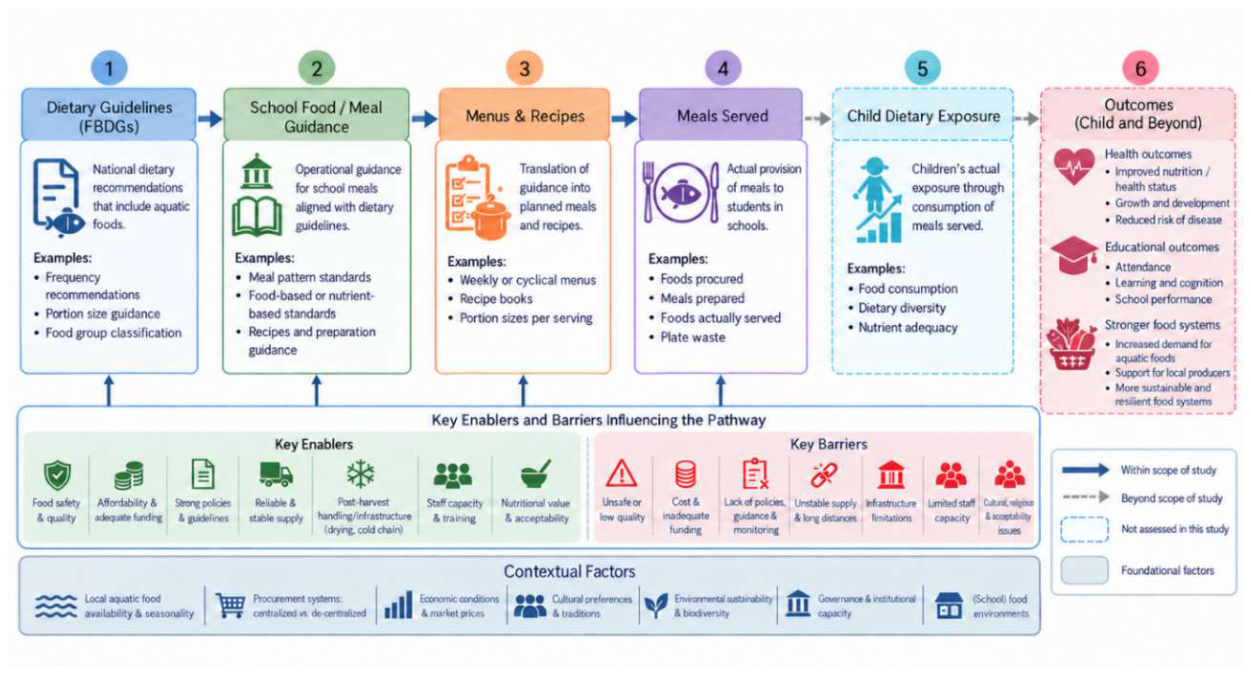
Figure 2.
Classification of aquatic foods in FBDG. Note: Based on an analysis of FBDG from 62 countries. Percentages may not sum to 100 due to rounding. ASF=animal source foods, FBDG=Food-Based Dietary Guidelines.
Figure 2.
Classification of aquatic foods in FBDG. Note: Based on an analysis of FBDG from 62 countries. Percentages may not sum to 100 due to rounding. ASF=animal source foods, FBDG=Food-Based Dietary Guidelines.
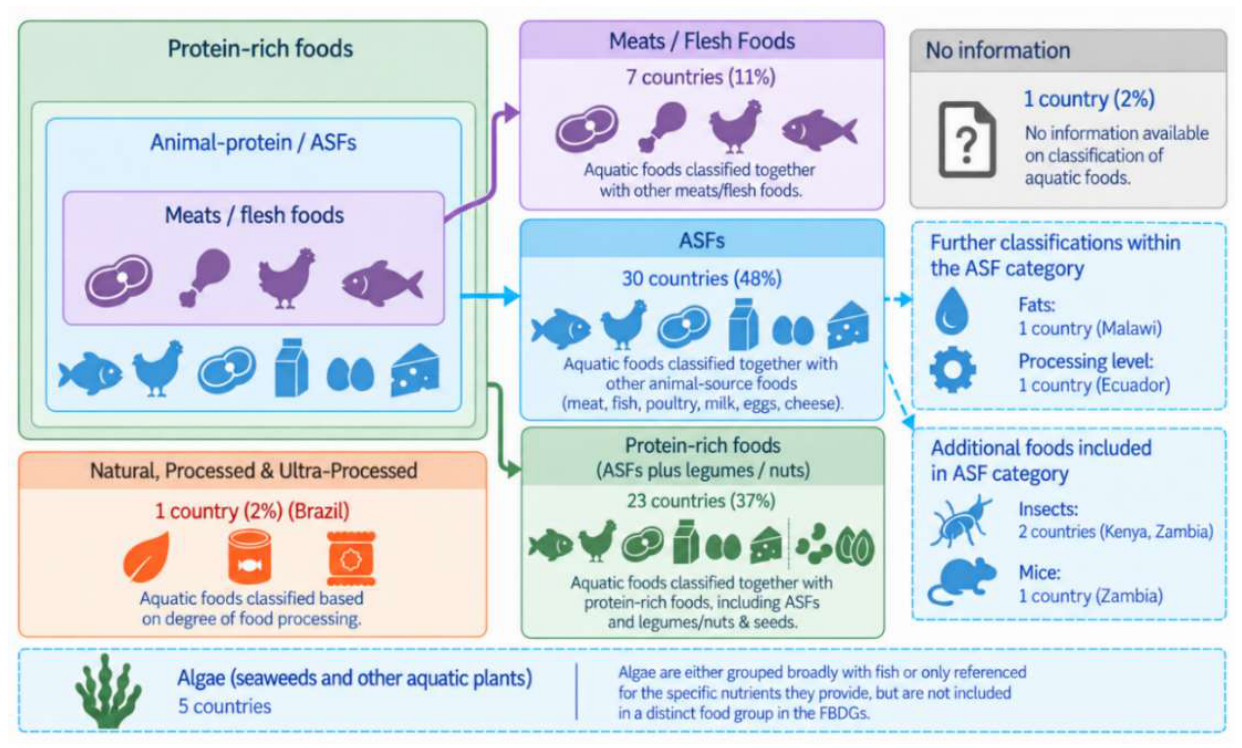
Figure 3.
Portion-size (A) and frequency recommendations (B) for aquatic foods in dietary guidelines, school food guidance and planned school meals. Note: Points show reported means; lines show observed minimum-maximum values. Open diamonds mark ranges for which no mean was reported. Additional aquatic foods identified in menus/recipes: seaweed, 15g (n=1, Mongolia), shrimp, 10g (n=1, Viet Nam). Number of documents (n) reporting a portion size or frequency recommendation. “Other” comprises cooked fish in policy/guidance documents and fish with form not specified in menus/recipes. Observed ranges are descriptive, not confidence intervals.
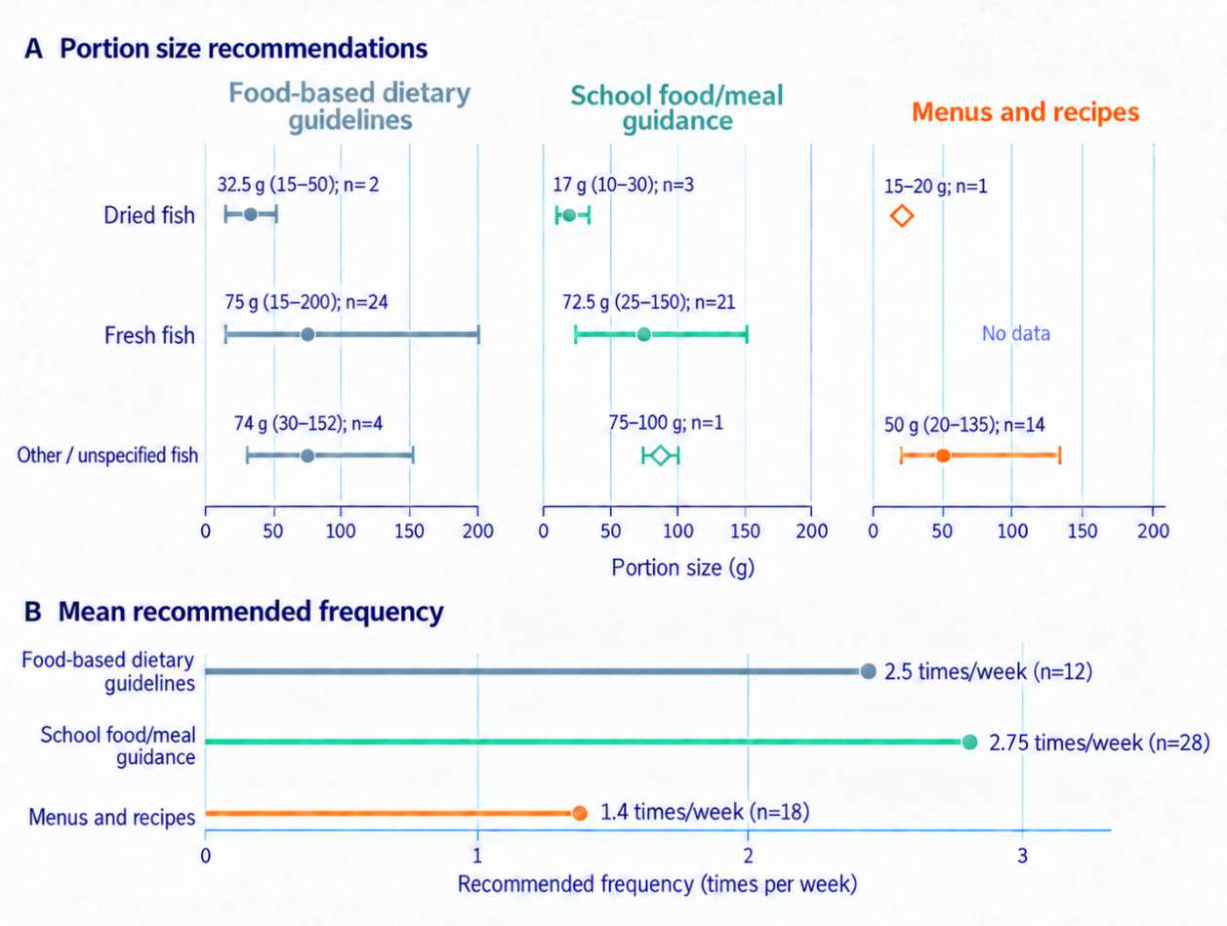
Figure 4.
Aquatic foods in reviewed school meal recipes. Panel A shows the percentage of reviewed recipes containing aquatic foods in each country. Panel B presents the distribution of the 101 recipes containing aquatic foods by aquatic food type or form. Note: Panel A labels show entries containing aquatic foods / entries reviewed; point-size represents the number reviewed. Percentages reflect the reviewed documents and are not nationally representative. Panel A includes 101 recipes which include aquatic foods, out of 1,502 recipes reviewed (6.7%).
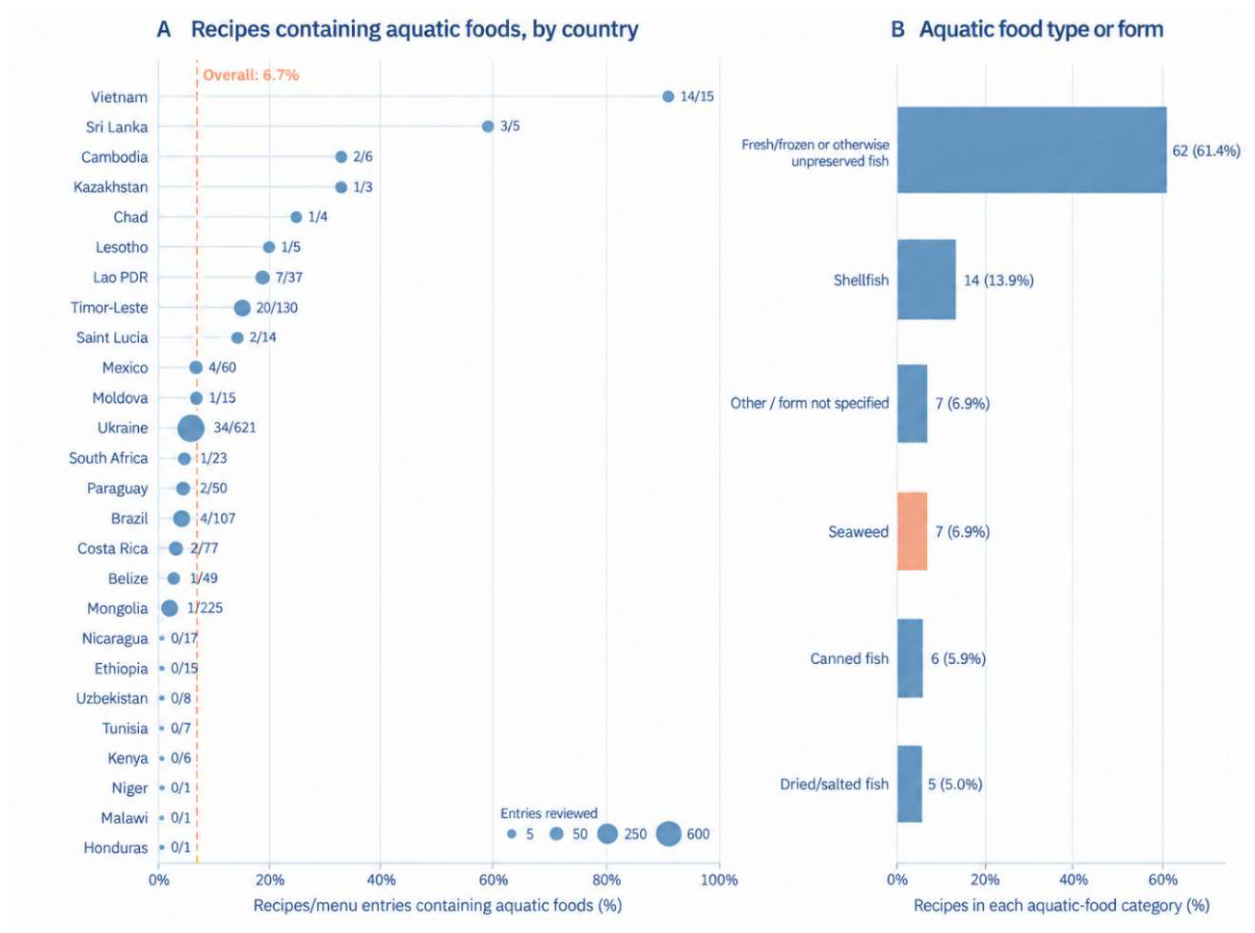
Figure 5.
Presence of aquatic foods in dietary guidance and operational documents reviewed across the 132 countries included in this review. Note: Documents include FBDG and school food/meal guidance (SMG). Insets provide further detail for small island states in the Caribbean and Pacific.
Figure 5.
Presence of aquatic foods in dietary guidance and operational documents reviewed across the 132 countries included in this review. Note: Documents include FBDG and school food/meal guidance (SMG). Insets provide further detail for small island states in the Caribbean and Pacific.
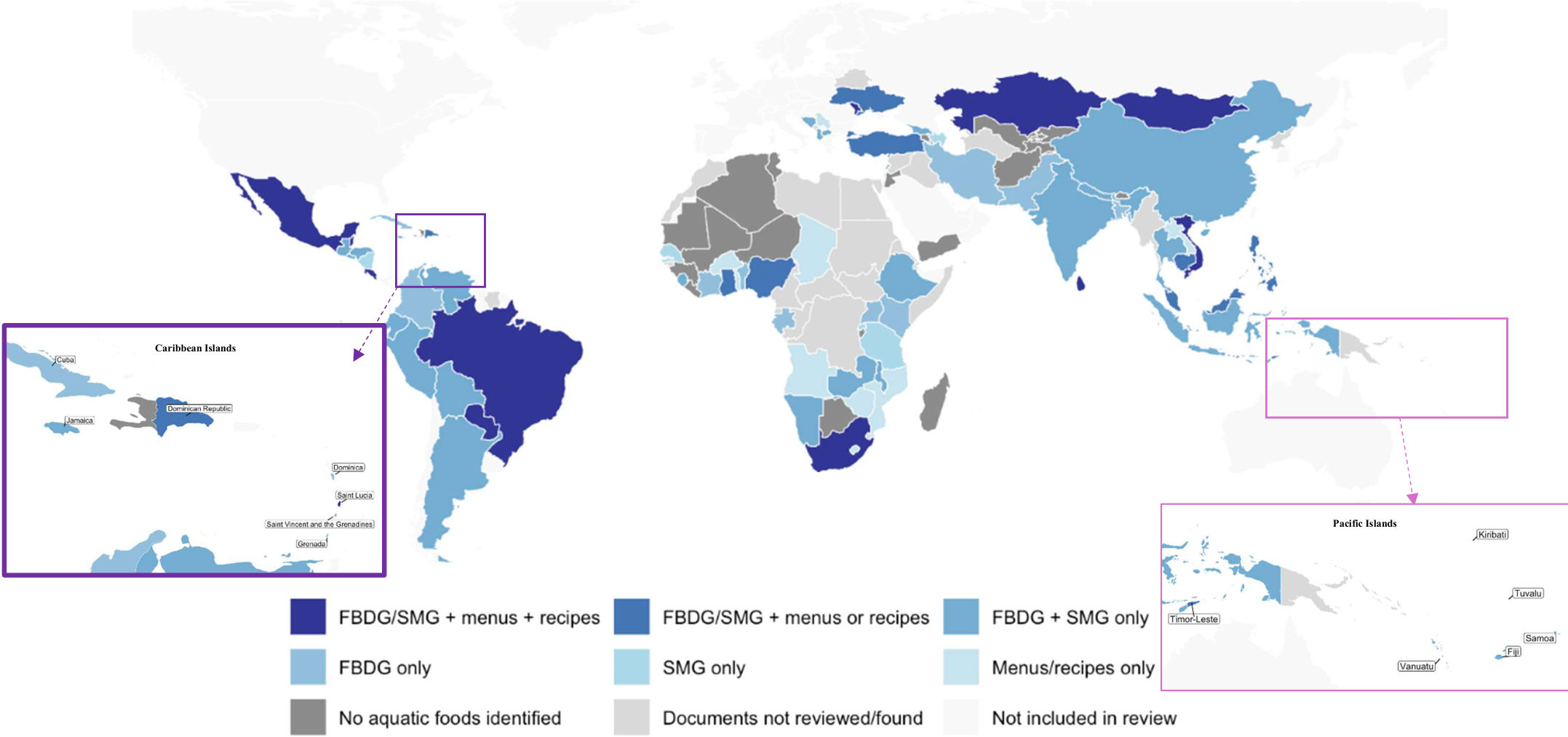

Table 1.
Summary of document review methods for FBDG, school food guidance, and school menus and recipes.
Table 1.
Summary of document review methods for FBDG, school food guidance, and school menus and recipes.
| Component | Scope / Inclusion criteria | Sources | Search Terms a | Screening & exclusions | Included Records and Number of Countries | Data extracted |
| FBDG | National FBDG from all included countries (n=132 countries) | FAO repository; Systematic search (English + national languages b); key informants | Dietary guidelines [Country]”/ food-based dietary guidelines [Country] | 66 records screened; 3 excluded Reasons: Guidelines for children under-2 years of age (n=3) |
63 records from 63 countries | Publication year; issuing institution; target population; aquatic food representation; serving sizes/frequency |
| School food guidance a | Policies, standards, tools for school food environments (Nutrition Guidelines and Standards (NGS), menu guides, vendor regulations, food lists) | FAO School Food Hub; FAO (2019b) references; Systematic search (English + national languages b); country contacts | Nutrition Guidelines for School meals /feeding in [Country]” / “Nutrition Standards for School meals/feeding in [Country]” / “Guidance on foods served in schools in [Country] | 90 records screened; 17 excluded Reasons: Incompleteness (n=4) Studies, news article or broader policy which only mentioned development of NGS (n=11) FBDG for children /adolescents, not noted as used in relation to school foods (n=2) |
73 records from 71 countries | Publication year; issuing institution; target population; aquatic food representation; serving sizes / frequency + categorization type (NGS / menu guide / regulations / food lists) |
| Menus & recipes | School meal menus and/or recipes | GCNF survey submissions; systematic search (English + national languages a), survey uploads | “Menus for School meals in [Country]” / “Recipes for School meals in [Country]” | 110 records screened; 29 excluded Reasons: General descriptions of foods without menu or recipe (n=12) Ration guidelines, food norms or standards without menu or recipe (n=11) Other non-menu / recipe documents (n=6) |
81 records from 57 countries | Menu / recipe presence; aquatic food frequency; portion size; food form |
a Searches were conducted in English and the national language(s) of each country, with the help of Google Translate to translate search terms and documents found. Due to limitations in machine translation of Arabic-language documents, translations were assisted by native Arabic-speaking FAO staff. National languages included: French, Arabic, Spanish, Portuguese, Farsi, Bahasa Indonesia, Dhivehi, Mongolian, Serbian, Nepali, Urdu, Chinese, Russian, Hindi, Swahili, Ukrainian, Moldovan, and Tetum.
Table 2.
Overview of documents reviewed.
| Type of Document |
Number of Countries (%) (N=132) |
| Food-based dietary guidelines (FBDG) | 63 (48%) |
| FBDG included aquatic foods | 62 (47% of all countries; 98% of FBDGs found) |
| School food guidance documents | 71 (54%) |
| National or sub-national Nutrition Guidelines & Standards (NGS) | 28 (21%) |
| Practical guides for school meals | 33 (25%) |
| Both NGS and practical guide | 1 (1%) |
| Regulations governing foods sold by vendors near or at schools | 1 (1%) |
| Food lists specifying recommended, restricted or prohibited foods | 2 (2%) |
| FBDG used for planning school meals (noted on FAO school food hub pages) | 4 (3%) |
| Regional guidance document for meal planning | 1 (1%) |
| Full document not accessible | 2 (2%) |
| School food guidance includes aquatic foods | 53 (40% of 132 countries in our search; 75% of those with school food guidance documents found) |
| Menus and recipes | 57 (43%) |
| Menus only | 31 (23%) |
| Recipes only | 10 (8%) |
| Both menus and recipes | 16 (12%) |
| Menus and/or recipes include aquatic foods | 32 (24% of 132 countries in our search; 56% of those with menus/recipes found) |
| Countries with all documents found | 14 (11%) |
| Countries with no documentation found | 31 (23%) |
| Countries with school meal programs reported to GCNF | 16 (12%) |
| Countries with no school meal program reported to GCNF | 6 (5%) |
| Countries with no survey data reported to GCNF in any year | 9 (7%) |
Note: Denominators include all study countries, not only those with reported national school meal programs.
Table 3.
Selected examples of alignment and discontinuity in aquatic food portion size and frequency recommendations and reported school meal provision.
Table 3.
Selected examples of alignment and discontinuity in aquatic food portion size and frequency recommendations and reported school meal provision.
| Country | Policy recommendations | Planned school meals | Reported provision (Survey) | Summary |
| Sri Lanka | 30 g fresh or 15–20 g dried fish; 2–3 times/week in school guidance | 30 g fresh or 15 g dried; 3 times/week | 30 g fresh or 20 g dried; 2–3 times/week | Broad alignment across stages |
| Timor-Leste | 45–60 g fish and other animal-source foods by age; 2 times/week | 50–60 g fish per recipe | 45–60 g fish; once/week | Portion alignment; lower reported frequency |
| Moldova | 35–70 g fish; at least once/week | ~68 g net fish; 4 days in a 10-day menu cycle | No data | Alignment between guidance and menus |
| South Africa | 80 g pilchards as an example portion; no quantitative frequency in school guidance | 40–70 g pilchards; 1–2 times/week | No data | Smaller planned portions than the guidance example |
| Bhutan | 75–100 g chicken, fish or meat; 2–3 daily servings of protein-rich foods | No aquatic foods in reviewed menu | 80 g fish; once/week | Reported provision despite omission from reviewed menu and guidelines lacking specificity |
| Cambodia | Portion size not specified, 2-3 times per week for animal source foods | 20g of fish (snakefish, trey pa) or 0.3g of fish sauce per student; frequency not specified | 15–20g; 2-4 times/week | Alignment between planned menus and reported provision |
| The Gambia | 10 g dried/salted/smoked fish; 3 times/week | Fish included 3 times/week; portion unspecified | No data | Frequency alignment; portion not documented |
| Lao PDR | No national FBDG or school food guidance identified | Fish and aquatic products included in recipes | 2 g fish; 2–4 times/week | Reported provision without identified upstream guidance |
Cell shading indicates GDQS fish/seafood portion thresholds for children aged 5–14 years (y): low, <8g | medium, 8–40g | high, >40g. Light green denotes dried-fish portions that are not directly comparable with GDQS thresholds (Intake, 2025)
Disclaimer/Publisher’s Note: The statements, opinions and data contained in all publications are solely those of the individual author(s) and contributor(s) and not of MDPI and/or the editor(s). MDPI and/or the editor(s) disclaim responsibility for any injury to people or property resulting from any ideas, methods, instructions or products referred to in the content. |
© 2026 by the authors. Licensee MDPI, Basel, Switzerland. This article is an open access article distributed under the terms and conditions of the Creative Commons Attribution (CC BY) license (http://creativecommons.org/licenses/by/4.0/).
Copyright: This open access article is published under a Creative Commons CC BY 4.0 license, which permit the free download, distribution, and reuse, provided that the author and preprint are cited in any reuse.