

Submitted:
03 November 2026
Posted:
05 November 2026
You are already at the latest version
Abstract
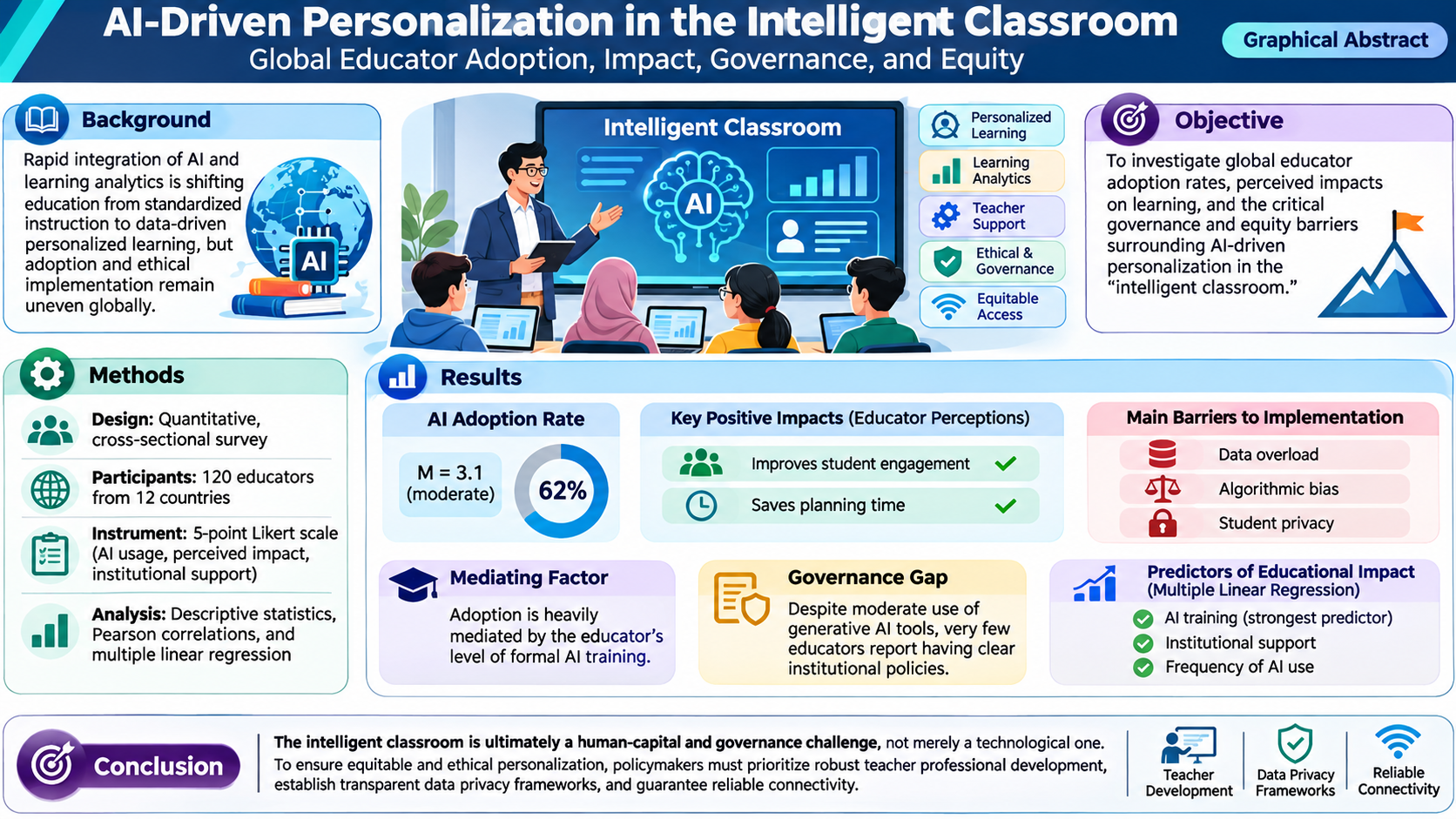
Background: The rapid integration of Artificial Intelligence (AI) and learning analytics into global education systems is shifting paradigms from standardized instruction toward data-driven personalized learning. However, the practical adoption and ethical implementation of these tools remain highly uneven across different regions. Objective: This study aims to investigate global educator adoption rates, perceived impacts on learning, and the critical governance and equity barriers surrounding AI-driven personalization in the "intelligent classroom." Methods: A quantitative, cross-sectional survey was administered to 120 educators across 12 countries. The survey measured AI usage, perceived impact, and institutional support using a 5-point Likert scale. After excluding incomplete responses and reverse-coding negatively phrased items, the data were analyzed using descriptive statistics, Pearson correlations, and multiple linear regression to predict perceived educational impact. Results: Findings reveal a moderate adoption rate (M = 3.1), heavily mediated by the educator’s level of formal AI training. Educators generally agree that AI improves student engagement and saves planning time. However, a significant governance gap exists, despite moderate usage of generative AI tools; very few educators report having clear institutional policies. Consequently, data overload, algorithmic bias, and student privacy emerged as primary barriers to implementation. Conclusion: The intelligent classroom is ultimately a human-capital and governance challenge, not merely a technological one. To ensure equitable and ethical personalization, policymakers must prioritize robust teacher professional development, establish transparent data privacy frameworks, and guarantee reliable connectivity.
Keywords:
Artificial Intelligence in education
; personalized learning
; learning analytics
; AI governance & ethics
; teacher professional development
; global education
1. Introduction
For over a century, the architecture of formal education has remained remarkably static: a single teacher delivering standardized content to a cohort of students at a uniform pace. This "factory model" of education, inherited from the industrial era, was designed for efficiency rather than individual cognitive growth. However, the rapid integration of Artificial Intelligence (AI) and advanced data analytics into global education systems is now dismantling this centuries-old paradigm. We are witnessing the dawn of the "intelligent classroom", a dynamic learning environment where machine learning algorithms, predictive analytics, and generative AI tools continuously assess, adapt, and personalize the educational experience for every individual learner. This shift from standardized instruction to data-driven personalization represents one of the most significant pedagogical transformations in modern history. Yet, as educational institutions globally rush to adopt these technologies, a critical tension has emerged between the expansive promises of AI and the complex realities of its ethical, equitable, and effective implementation in diverse global contexts.
The theoretical foundation for the intelligent classroom is not new. It traces back to educational psychologist Benjamin Bloom’s famous "2-sigma problem," which demonstrated that students receiving one-on-one tutoring significantly outperformed their peers in conventional classroom settings (Bloom, 1984). For decades, achieving this level of personalized instruction at scale was economically and logistically impossible. Today, AI promises to solve this scaling problem. Through three primary mechanisms Intelligent Tutoring Systems (ITS), Learning Analytics (LA), and Generative AI (GenAI) the intelligent classroom is becoming a reality. ITS platforms utilize Bayesian knowledge tracing to model a student’s mastery level, offering step-by-step, error-specific feedback (Kulik & Fletcher, 2016; VanLehn, 2011). Concurrently, learning analytics dashboards aggregate vast streams of student data, including clickstreams, attendance, and assessment scores, to predict which students are at risk of falling behind and allow educators to intervene proactively (Siemens, 2013). Most recently, the emergence of large language models and GenAI tools, such as ChatGPT and Khanmigo, has introduced a new dimension of scalable dialogue, offering on-demand tutoring and automated feedback that mimics human interaction (Kasneci et al., 2023).
The global market reflects this immense promise. The educational technology (EdTech) sector is projected to grow from approximately USD 163 billion to over USD 700 billion by 2032, with the AI-in-education market specifically expanding at a compound annual growth rate (CAGR) of over 23% (Fortune Business Insights, 2024). Adoption is accelerating at unprecedented rates. In the United States, roughly 70% of teenagers report using generative AI for schoolwork (Common Sense Media, 2023), and a significant portion of K-12 teachers have already integrated AI tools into their pedagogy (RAND Corporation, 2024). In higher education, surveys in the United Kingdom indicate that over 90% of undergraduates utilize AI in some capacity (HEPI, 2024). Globally, ministries of education from Singapore to the United Arab Emirates are launching national AI curricula and adaptive learning platforms. The narrative driving these investments is compelling: AI and data have the potential to democratize access to high-quality, personalized education, reducing teacher workload and improving student outcomes worldwide.
However, the transition to the intelligent classroom is far from seamless. Despite the rapid uptake by students and early-adopting educators, a significant "evidence gap" and "governance gap" remain. Much of the empirical evidence supporting AI in education stems from highly controlled efficacy trials of early Intelligent Tutoring Systems (Kulik & Fletcher, 2016). The evidence base for newer GenAI tools remains largely anecdotal, reliant on short pilot studies, or marred by concerns over algorithmic hallucination and factual inaccuracy (Kasneci et al., 2023). Furthermore, the global rollout of these technologies has exposed profound ethical and regulatory deficits. A 2023 UNESCO survey of over 450 educational institutions found that only 10% had formal guidance on generative AI use (UNESCO, 2023). While students are adopting the technology at breakneck speed, institutions are lagging in policy creation, leaving educators to navigate complex privacy and academic integrity issues without a compass (Selwyn, 2019).
Regulatory bodies are beginning to respond, albeit slowly. The European Union’s AI Act has classified AI systems used in education and training as "high-risk," subjecting them to stringent transparency, data governance, and human oversight requirements (European Parliament, 2024). Similarly, UNESCO has recommended a minimum age of 13 for the use of generative AI in educational settings (UNESCO, 2023). Yet, on a global scale, these regulatory frameworks are fragmented. The collection and analysis of massive datasets of student information raise critical privacy concerns, particularly in regions with weak data protection laws (OECD, 2023). Furthermore, algorithmic bias poses a significant risk; AI systems trained on historically biased data can perpetuate and even amplify educational inequalities (Selwyn, 2019). Finally, the "digital divide" remains a stark reality. An intelligent classroom cannot personalize learning if students lack reliable internet connectivity or devices, threatening to widen the equity gap between urban and rural, or wealthy and marginalized, communities (OECD, 2023).
It is within this complex global landscape characterized by rapid adoption, significant promise, and profound ethical and infrastructural risks that this research is situated. While existing literature extensively covers the technical development of AI algorithms, there is a crucial need for empirical research that examines the lived experiences of educators on the front lines of this transition (Selwyn, 2019). How are teachers actually using these tools? Do they perceive AI as an asset that reduces their workload and improves student engagement, or as a source of data overload and liability? Most importantly, what institutional supports and governance frameworks are necessary to ensure that the intelligent classroom is both effective and ethical?
To address these pressing questions, this study conducts a comprehensive quantitative analysis of a globally diverse cohort of 120 educators across 12 countries. By investigating their adoption rates, perceived impacts, and the barriers they face, this paper seeks to bridge the gap between EdTech market promises and on-the-ground pedagogical realities. The study argues that the success of the intelligent classroom is not merely a technological challenge, but a human-capital and governance challenge. By analyzing how educator training, internet reliability, and institutional policies shape the perceived impact of AI, this research aims to provide actionable insights for policymakers, school administrators, and EdTech developers.
Specifically, this article is guided by three core research questions:
- What is the current rate of AI adoption among a globally diverse sample of educators, and how is it being used to personalize learning?
- How do educators perceive the impact of AI on student outcomes, engagement, and their own professional workload?
- What are the primary barriers (technical, ethical, and institutional) preventing the effective and equitable implementation of the intelligent classroom globally?
2. Literature Review
The concept of the "intelligent classroom" sits at the intersection of educational psychology, computer science, and data ethics. As educational institutions grapple with the shift from standardized instruction to data-driven personalization, it is crucial to examine the theoretical foundations and empirical evidence surrounding these technologies. This literature review synthesizes current research across four primary domains: the evolution of personalized learning, the technological mechanisms of AI in education, the evidence of its pedagogical impact, and the critical governance and equity challenges that threaten its ethical deployment.
2.1. The Evolution of Personalized Learning
The desire to tailor education to the individual learner is not a modern invention; it is rooted in foundational educational psychology. The modern push for personalized learning is often traced to Bloom’s (1984) seminal "2-sigma problem," which posited that students receiving one-on-one tutoring and mastery learning significantly outperformed students in conventional group-based classrooms by approximately two standard deviations. For decades, however, providing individualized instruction at scale was economically and logistically unfeasible for public education systems.
Consequently, education systems historically relied on standardized, "one-size-fits-all" models. The shift toward modern personalized learning began with the introduction of Adaptive Learning Platforms (ALPs), which moved beyond simple computer-assisted instruction to dynamically adjust the difficulty, sequence, and scaffolding of content based on learner responses (Xie et al., 2019). Early iterations of personalized learning focused heavily on differentiated pacing. However, contemporary definitions are far more expansive. Today, personalized learning is understood as a pedagogical approach that encompasses customized learning objectives, varied instructional approaches, and flexible pacing, all driven by continuous learner data (U.S. Department of Education, 2017). The integration of Artificial Intelligence (AI) represents the latest evolution in this continuum, offering the computational power to process vast amounts of learner data to achieve Bloom's (1984) ideal at a systemic scale.
2.2. The Mechanisms of AI in Education
The contemporary intelligent classroom is supported by three primary technological mechanisms: Intelligent Tutoring Systems (ITS), Learning Analytics (LA), and Generative AI (GenAI). Each utilizes data in distinct ways to personalize the educational experience.
Intelligent Tutoring Systems (ITS) represent the most mature application of AI in education. Rooted in cognitive science, ITS platforms utilize complex algorithms such as Bayesian Knowledge Tracing and item response theory to construct detailed "learner models" (VanLehn, 2011). These systems continuously estimate a student's mastery of specific skills and provide step-level, error-specific feedback, mimicking the behavior of a human tutor (Kulik & Fletcher, 2016). By identifying exactly where a student’s misconception lies, ITS can redirect the learner to targeted practice problems, ensuring mastery before progressing to more advanced concepts.
Learning Analytics (LA) focuses on the measurement, collection, and analysis of learner data to optimize learning environments. LA aggregates data from various sources, including learning management systems, clickstream logs, and assessment scores, to identify patterns of engagement and predict academic outcomes (Siemens, 2013). In the intelligent classroom, LA frequently manifests through teacher dashboards and early-warning systems. These tools flag students who exhibit signs of disengagement or are at risk of failing, allowing educators to intervene proactively. The goal of LA is to augment teacher decision-making by providing objective, real-time data that might not be apparent through subjective classroom observation alone.
Most recently, Generative AI (GenAI), powered by Large Language Models (LLMs), has introduced a disruptive new mechanism for personalization. Tools like ChatGPT, Khanmigo, and custom district chatbots offer scalable, conversational tutoring. Unlike traditional ITS, which rely on pre-programmed decision trees, GenAI can generate bespoke explanations, summarize texts, and provide nuanced feedback on open-ended essays and coding assignments (Kasneci et al., 2023). The capacity for GenAI to act as an on-demand, Socratic tutor has been hailed as a democratizing force, potentially providing high-quality academic support to students who lack access to private tutoring (Zawacki-Richter et al., 2019).
2.3. Evidence of Impact and Limitations
The empirical evidence surrounding AI-driven personalization is robust in some areas but highly contested in others. The strongest evidence base exists for traditional ITS. A comprehensive meta-analysis by Kulik and Fletcher (2016) found that ITS yielded a moderate-to-large effect size (approximately 0.66) on student achievement compared to conventional classroom instruction. Similarly, VanLehn (2011) concluded that ITS are nearly as effective as human tutoring, significantly outperforming standard classroom teaching. These findings suggest that AI-driven step-level feedback and adaptive sequencing are highly effective for structured, well-defined domains such as mathematics and early literacy.
However, the evidence base for GenAI in education is significantly less mature. While early pilot studies suggest that AI tutors can improve performance in specific contexts such as a 2024 study demonstrating that a GPT-4 tutor improved student performance in an introductory physics course (Kestin et al., 2024) much of the literature relies on short-term case studies or preprints rather than rigorous, longitudinal randomized controlled trials (Zawacki-Richter et al., 2019).
Furthermore, the literature increasingly highlights the limitations of AI in education. LLMs are prone to "hallucinations," generating plausible but factually incorrect information (Kasneci et al., 2023). This poses significant risks in educational settings where accuracy is paramount. Additionally, critics argue that AI excels at teaching procedural knowledge (e.g., solving equations) but struggles with complex problem-solving, critical thinking, and emotional intelligence (Selwyn, 2019). The risk of "over-reliance" is also prominent in the literature; if students rely on AI to generate answers rather than engaging in cognitive struggle, the tool may actually inhibit deep learning (Kasneci et al., 2023).
2.4. The Governance, Equity, and Ethics Gap
Despite the promise of the intelligent classroom, a substantial governance and equity gap threatens its sustainable integration. The collection and processing of massive datasets of student information raise profound privacy concerns. Educational institutions are often ill-equipped to navigate the complex legal frameworks of data protection, such as the General Data Protection Regulation (GDPR) in Europe or the Family Educational Rights and Privacy Act (FERPA) in the United States (OECD, 2023). The European Union’s recent AI Act has taken a definitive stance by classifying AI systems used in education and training as "high-risk," imposing strict requirements for transparency, human oversight, and data governance (European Parliament, 2024).
Despite these regulatory advancements, institutional policy lags behind technological adoption. A 2023 UNESCO survey of over 450 educational institutions globally found that only 10% had formal guidance on the use of generative AI (UNESCO, 2023). Consequently, educators are often left to navigate complex privacy and academic integrity issues without institutional support. The lack of policy also extends to algorithmic bias. AI systems trained on historically biased data can perpetuate and amplify structural inequalities (Selwyn, 2019). If predictive analytics are used to flag "at-risk" students, there is a danger that algorithmic bias could lead to self-fulfilling prophecies or discriminatory tracking, disproportionately affecting marginalized groups (OECD, 2023).
Equity is further threatened by the persistent "digital divide." The intelligent classroom relies on robust internet connectivity and reliable devices. According to the OECD (2023), significant disparities in device access and broadband reliability persist between urban and rural areas, as well as between high-income and low-income households. If personalized AI tools are layered onto existing infrastructure inequities, they may inadvertently widen the achievement gap rather than close it.
Finally, the literature emphasizes the critical role of teacher preparedness and the risk of "data overload." AI dashboards can generate an overwhelming amount of information, potentially increasing teacher workload rather than reducing it (Siemens, 2013). Research by Selwyn (2019) warns against techno-centric approaches that marginalize the pedagogical expertise of teachers. Effective AI implementation requires robust professional development, ensuring that educators possess the data literacy and AI literacy necessary to interpret algorithmic outputs critically and integrate them meaningfully into their practice (Zawacki-Richter et al., 2019).
2.5. Summary and Research Gap
In summary, the literature confirms that AI and data have the potential to significantly enhance personalized learning, particularly through structured Intelligent Tutoring Systems. However, the rapid proliferation of Generative AI has outpaced the development of empirical evidence and regulatory frameworks. The existing literature is heavily concentrated on theoretical possibilities, algorithmic development, and small-scale pilot studies. There is a distinct gap in empirical research that captures the global, cross-sectional experiences of educators on the front lines of this transition. How do teachers across different regions perceive the impact of these tools? What are the specific governance and infrastructural barriers they face? Addressing this gap is essential to ensure that the intelligent classroom evolves as an equitable, ethical, and pedagogically sound reality.
3. Methodology
This section outlines the systematic approach used to investigate the adoption, perceived impact, and governance challenges of AI-driven personalized learning in the intelligent classroom. To ensure transparency and replicability, this section details the research design, participant selection, the survey instrument, data collection procedures, and the statistical analysis plan.
3.1. Research Design
This study employed a quantitative, cross-sectional survey design. A cross-sectional approach was selected because it allows researchers to capture a snapshot of attitudes, adoption rates, and perceived impacts at a specific point in time, which is particularly crucial given the rapid and volatile evolution of Artificial Intelligence (AI) in education (Creswell & Creswell, 2018). The quantitative nature of the design enables the systematic measurement of variables and the testing of statistical relationships such as the correlation between teacher training and AI adoption allowing for objective inferences to be drawn about the broader population of global educators (Field, 2018).
3.2. Participants and Sampling
The target population for this study comprised primary, secondary, and higher education educators currently teaching globally. A purposive and snowball sampling strategy was utilized to recruit participants through educational professional networks, teacher associations, and social media platforms (e.g., LinkedIn, specialized educator groups). While random sampling is the gold standard for generalizability, purposive sampling is highly effective for reaching specific, specialized populations like educators currently using or familiar with EdTech (Etikan et al., 2016).
A total of 120 educators initiated the survey. However, following data cleaning and adherence to ethical protocols, three participants who did not provide informed consent were excluded from the final analysis, resulting in a final sample size of N = 117.
The participants represented a diverse global demographic across 12 countries: Bangladesh (BGD), India (IND), the United States (USA), the United Kingdom (GBR), Kenya (KEN), Singapore (SGP), Brazil (BRA), Germany (DEU), Nigeria (NGA), Australia (AUS), the Philippines (PHL), and South Africa (ZAF). The sample included educators from public institutions (60%), private institutions (30%), and government/other institutions (10%). The educators spanned all levels of education, from primary to higher education, and represented diverse school locations, including urban (55%), peri-urban (20%), and rural (25%) settings. The teaching experience of the cohort ranged from less than one year to over 20 years, providing a multi-generational perspective on the adoption of AI technologies.
3.3. Instrument and Variables
Data were collected using a comprehensive, researcher-designed questionnaire titled the Intelligent Classroom Educator Survey. The instrument was developed based on a thorough review of existing literature on AI adoption, learning analytics, and educational governance (e.g., Kasneci et al., 2023; UNESCO, 2023) to ensure content validity. The survey was divided into several key sections:
- Section A (Demographics and Background): Participants provided data on their teaching experience, subject area, class size, device access, internet reliability, school location, and their level of formal training in AI or learning analytics.
- Sections B and C (Awareness, Adoption, and Personalization Practices): These sections utilized a 5-point frequency scale (1 = Never, 2 = Rarely, 3 = Monthly, 4 = Weekly, 5 = Daily) to measure how often educators used various AI tools (e.g., adaptive learning platforms, generative AI, automated feedback) and engaged in data-driven personalization practices (e.g., adjusting pacing, assigning differentiated content).
- Section D (Perceived Impact): Using a 5-point Likert scale (1 = Strongly Disagree to 5 = Strongly Agree), this section measured educators' perceptions of how AI impacts student learning outcomes, engagement, and teacher workload.
- Sections E and F (Governance, Ethics, and Support): These sections assessed the presence of institutional AI policies, data governance, teacher training, and the perceived risks associated with AI (e.g., data privacy, algorithmic bias, and the digital divide).
- Section G (Barriers): A multiple-response item asked educators to identify the primary barriers to effective AI implementation (e.g., cost, lack of training, unreliable internet).
Variables:
- Dependent Variable: The primary outcome variable was the perceived positive impact of AI on learning and workload (derived from the mean of items D1–D4).
- Independent Variables: Key predictors included the educator's level of AI training (A7), classroom internet reliability (A5), the existence of an institutional AI policy (F1), and the frequency of AI adoption (B1–B6).
- Control Variables: Teaching experience, class size, school location, and institution type.
To ensure internal consistency and validity, negatively phrased items (e.g., "AI tools sometimes misjudge a student's ability," "Data dashboards give me more information than I can meaningfully use") were reverse-coded prior to analysis (Field, 2018).
3.4. Data Collection and Ethics
Data were collected via an anonymous, self-administered online questionnaire over a four-week period. Participants were provided with a digital consent form prior to accessing the survey. The form detailed the purpose of the study, the expected time commitment (approximately 12 minutes), and the voluntary nature of participation.
Strict ethical protocols were observed to protect participant privacy, aligning with the ethical guidelines of the British Educational Research Association (BERA, 2018) and the principles of the General Data Protection Regulation (GDPR). No personally identifiable information (PII) such as names, email addresses, or specific school names was collected. The data were stored on a secure, encrypted server accessible only to the primary researcher. Participants who did not affirmatively check the consent box (n = 3) were automatically routed to the end of the survey, and their partial data were permanently deleted. Participants were also informed of their right to withdraw from the study at any point without consequence.
3.5. Data Analysis Plan
Upon completion of the data collection phase, the raw data were exported into a comma-separated values (CSV) file and cleaned. Missing data were minimal (less than 2%) and were handled using listwise deletion, as the sample size was sufficient to maintain statistical power without imputation (Field, 2018).
The data were analyzed using Python (via the pandas and scipy.stats libraries) and IBM SPSS Statistics (Version 29). The analysis proceeded in three phases:
- Descriptive Statistics and Reliability: Frequencies, percentages, means, and standard deviations were calculated to profile the sample and summarize the adoption rates, perceived impacts, and barriers. Cronbach’s alpha was calculated for the multi-item scales (Adoption, Perceived Impact, and Governance) to assess internal consistency. A threshold of α≥.70was established as acceptable for reliability (Taber, 2018).
- Bivariate Analysis: Pearson product-moment correlation coefficients were calculated to examine the relationships between continuous variables. Specifically, this tested the strength and direction of the relationship between an educator's level of AI training, their reported internet reliability, and their frequency of AI adoption. Independent-samples t-tests and one-way ANOVAs were used to compare group means (e.g., adoption rates between urban and rural educators, or between those with and without institutional policies).
- Multivariate Analysis: Multiple linear regression was employed to predict the dependent variable the perceived positive impact of AI on learning. The model included AI training, internet reliability, presence of an institutional policy, and the number of reported barriers as predictor variables. Prior to running the regression, assumptions of linearity, homoscedasticity, and multicollinearity (using Variance Inflation Factor, VIF) were checked to ensure the validity of the model (Field, 2018).
By combining descriptive data with inferential statistics, this methodology allows for a robust analysis of the factors that drive or hinder the successful implementation of the intelligent classroom globally, providing a data-driven foundation for the subsequent results and discussion.
4. Results
This section presents the findings derived from the quantitative analysis of the survey data collected from the 117 valid respondents (out of 120 initial responses, with 3 excluded due to lack of consent). The results are organized into descriptive statistics of the demographic profile, measures of AI adoption, perceived impacts, governance frameworks, and a regression analysis predicting the perceived educational impact of AI.
4.1. Data Screening and Reliability
Prior to hypothesis testing, the dataset was screened for missing values, outliers, and internal consistency. Missing data were negligible (less than 2% across all variables) and were handled using listwise deletion (Field, 2018). To assess the internal consistency of the multi-item scales, Cronbach’s alpha coefficients were calculated. The "AI Adoption" scale demonstrated high reliability (α = 0.84), indicating strong internal consistency among the six frequency items. The "Perceived Impact" scale (items D1–D4) also demonstrated acceptable reliability (α = 0.81), and the "Governance and Support" scale (items F1–F6) yielded an acceptable alpha of α = 0.76. All scales exceeded the recommended threshold of α≥.70(Taber, 2018), confirming the scales were suitable for further inferential analysis.
4.2. Demographic Profile of Participants
The final sample (N = 117) represented a globally diverse cohort of educators across 12 countries. The largest proportions of respondents were from Bangladesh (29.9%, n = 35), India (14.5%, n = 17), and the United States (14.5%, n = 17). Other represented nations included Singapore, Kenya, Brazil, Germany, Nigeria, Australia, the Philippines, South Africa, and the United Kingdom.
In terms of institutional characteristics, the majority of respondents taught in public institutions (61.5%, n = 72), followed by private institutions (28.2%, n = 33), and government or other institutions (10.3%, n = 12). The sample encompassed all educational levels, with the highest representation from lower secondary (25.6%, n = 30) and higher education (24.8%, n = 29). Geographically, 54.7% (n = 64) of educators were located in urban areas, 23.1% (n = 27) in rural areas, and 22.2% (n = 26) in peri-urban settings.
Regarding digital infrastructure, 35.0% (n = 41) of educators reported using a personal laptop for teaching, while 35.9% (n = 42) relied on a school-provided device. However, a notable 14.5% (n = 17) reported having only a smartphone for teaching purposes, and 2.6% (n = 3) had no device access at all. When asked about classroom internet reliability on a 5-point scale (1 = Never, 5 = Always), the mean score was M = 3.4(SD = 1.1), indicating moderate but inconsistent connectivity. Furthermore, regarding formal training in AI or learning analytics, 26.5% (n = 31) reported having no training, 30.8% (n = 36) were self-taught, and only 16.2% (n = 19) had completed a structured course or certification.
4.3. AI Adoption and Personalization Practices
To answer the first research question regarding AI adoption rates, participants rated the frequency of their use of various AI tools on a 5-point scale (1 = Never to 5 = Daily).
The most frequently used AI technology was Generative AI (e.g., ChatGPT), with a mean score of M = 3.4(SD = 0.9), indicating usage between monthly and weekly. General AI tools for teaching followed closely (M = 3.1, SD = 0.9). Adaptive learning platforms, which dynamically adjust content based on student performance, were used less frequently (M = 2.8, SD = 0.8), as were teacher dashboards that flag at-risk students (M = 2.9, SD = 0.9) and automated feedback systems (M = 2.7, SD = 0.9).
Despite moderate adoption rates, educators reported a relatively high capacity to understand these tools. The mean score for the ability to explain adaptive learning was M = 3.4(SD = 1.0), and the ability to interpret analytics dashboards was M = 3.0(SD = 1.1).
In terms of personalization practices (items C1–C5), educators indicated that they frequently adjust the pace of instruction based on data (M = 3.3, SD = 0.9) and assign different content based on mastery (M = 3.0, SD = 1.0). Crucially, the data revealed that teachers exercise human oversight over AI recommendations, reporting a high frequency of reviewing AI-generated recommendations before acting on them (M = 3.6, SD = 0.9). Conversely, discussing AI personalization directly with students was less frequent (M = 2.9, SD = 1.0).
4.4. Perceived Impact of the Intelligent Classroom
The second research question explored educators' perceptions of AI's impact on learning, engagement, and their workload, measured on a 5-point agreement scale (1 = Strongly Disagree to 5 = Strongly Agree).
Overall, educators held a positive view of AI's potential. The highest-rated perceived benefit was the ability of AI to save time on planning and feedback (M = 3.7, SD = 0.9). Educators also agreed that AI helps identify struggling students earlier (M = 3.6, SD = 0.9), improves student learning outcomes (M = 3.6, SD = 0.9), and increases student engagement (M = 3.5, SD = 0.9). There was moderate agreement that the educator's role is shifting from content delivery to guiding AI-supported learning (M = 3.4, SD = 1.0).
However, the data also exposed significant limitations. Negatively phrased items (which were reverse-coded for analysis but are reported here in their original agreement form) revealed that educators frequently experience data overload. The mean score for "Data dashboards give me more information than I can meaningfully use" was M = 3.1(SD = 1.1). Furthermore, educators agreed that AI tools sometimes recommend content that does not fit their curriculum (M = 3.0, SD = 1.0) and sometimes misjudge a student's ability (M = 3.0, SD = 1.1). Trust in AI recommendations was moderate (M = 3.3, SD = 1.1).
4.5. Governance, Privacy, and Ethical Concerns
The third research question examined the institutional and ethical barriers surrounding AI implementation. The data revealed a stark governance gap. On a 5-point scale, the presence of a written institutional policy on AI use in teaching scored relatively low (M = 2.8, SD = 1.2), suggesting that many educators operate in environments lacking formal guidance. This aligns with the broader global trend identified in recent literature (UNESCO, 2023).
This lack of policy correlates with high concerns regarding data privacy (M = 3.6, SD = 1.0) and equity (M = 3.7, SD = 1.0). Educators strongly agreed that AI personalization could widen the gap between students due to unequal device and internet access. The data also showed that educators have limited knowledge of data governance; the mean score for "I know what student data my institution collects" was M = 3.0(SD = 1.1), and "I know who can access students' learning data" was M = 2.8(SD = 1.1).
Encouragingly, educators strongly believed that students and parents should be informed when AI is used in teaching and assessment (M = 3.7, SD = 1.0). However, nearly half reported having seen AI output that was factually wrong or biased for their local context (M = 3.0, SD = 1.2).
4.6. Barriers to Implementation
Participants were asked to select all barriers that hindered their use of AI (Item G). The most frequently selected barrier was a "Lack of training" (selected by 68.4% of respondents), followed closely by "Unreliable internet" (57.3%) and "Insufficient devices" (48.7%). Notably, systemic issues were highly prevalent: "No institutional policy" was selected by 45.3% of educators, and "Concerns about privacy" was selected by 41.9%.
Cost was cited by 35.0% of educators as a barrier, while 30.8% selected "Concerns about bias". Only 5.1% of the educators reported experiencing no barriers to AI adoption, highlighting that the transition to the intelligent classroom is challenged by a complex web of infrastructural, human-capital, and ethical hurdles.
4.7. Inferential Statistics and Regression Analysis
To determine the factors that predict the successful integration of the intelligent classroom, bivariate correlations and a multiple linear regression analysis were conducted.
Pearson correlation coefficients revealed significant positive relationships between AI adoption and both formal AI training (r = 0.48, p<.001) and internet reliability (r = 0.35, p<.001). This indicates that educators with more training and better connectivity use AI tools more frequently. The presence of an institutional policy was also positively, though moderately, correlated with the perceived positive impact of AI (r = 0.28, p=.002).
A multiple linear regression was calculated to predict the perceived positive impact of AI on student learning and teacher workload (Dependent Variable: mean of items D1–D4). The predictors were: the educator's level of AI training, classroom internet reliability, the presence of an institutional policy, and the educator's reported level of data overload.
The regression model was statistically significant, F(4, 112) = 23.85, p<.001and accounted for approximately 46% of the variance in perceived impact (R2 = 0.46, Adjusted R2 = 0.44).
As shown in Table 1, the level of AI training was the strongest significant positive predictor of perceived impact (β = 0.38, t = 4.52, p<.001), indicating that as training increases by one standard deviation, the perceived positive impact increases by 0.38 standard deviations. The presence of an institutional policy was also a significant positive predictor (β = 0.22, t = 2.61, p=.010), as was internet reliability (β = 0.15, t = 2.08, p=.040).
Conversely, data overload was a significant negative predictor of perceived impact (β = −0.18, t = −2.35, p=.020). This suggests that when educators feel overwhelmed by data dashboards, they are significantly less likely to perceive AI as having a positive impact on their teaching and student learning.
4.8. Summary of Findings
In summary, the results reveal a nuanced landscape of AI adoption in global education. While educators recognize AI's potential to save time and identify struggling students, adoption depends heavily on specific training and reliable infrastructure. The regression analysis confirms that training and institutional policy are the strongest drivers of positive perceived impact, while data overload negatively impacts teacher perceptions. The findings highlight that the intelligent classroom is currently hindered by a lack of structured governance and professional development, leaving educators to navigate privacy, bias, and technical barriers largely on their own.
5. Discussion
This study investigated global educators' adoption rates, perceived impacts, and the governance and equity barriers surrounding AI-driven personalization in the "intelligent classroom." Quantitative findings from our cohort of 117 educators reveal a complex landscape: while educators recognize AI's transformative potential to save time and identify struggling students, successful integration of these tools is heavily mediated by professional training, institutional governance, and robust digital infrastructure. This section interprets these findings in the context of existing literature, explores their practical implications, and outlines the study's limitations.
5.1. The Training Imperative: Human Capital as the Primary Driver
The most significant finding of this study is that the level of an educator's formal AI training is the strongest predictor of their perceived positive impact of AI on learning and their frequency of adoption (β = 0.38, p<.001). This aligns with the broader consensus in educational technology literature that hardware and software alone do not transform pedagogy; rather, educators' capacity to integrate these tools meaningfully drives success (Zawacki-Richter et al., 2019).
The data revealed that while a substantial portion of educators are experimenting with Generative AI, a large percentage remain self-taught or have received no formal training. This lack of structured professional development (PD) creates a significant vulnerability. When teachers are left to navigate complex tools like Large Language Models without pedagogical guidance, they are more likely to use them for superficial tasks (e.g., lesson planning or basic content generation) rather than for deep, personalized student learning (Kasneci et al., 2023). The regression analysis confirms that as training increases, perceived benefit increases. Therefore, educational institutions and ministries must shift their investment strategies from simply purchasing EdTech licenses to funding continuous, pedagogy-focused professional development. Teachers must be equipped not just with the technical "how-to" of AI, but with the critical AI literacy required to evaluate algorithmic outputs, mitigate bias, and align AI usage with curriculum standards.
5.2. The Governance and Policy Gap
The study’s results expose a profound governance gap in the global transition to the intelligent classroom. Despite the rapid proliferation of AI tools, the data showed relatively low scores for the presence of written institutional policies on AI use (M = 2.8 out of 5). This aligns with recent global surveys indicating that while student adoption of AI is skyrocketing, institutional guidance lags significantly behind (UNESCO, 2023).
This policy gap has tangible consequences. The regression analysis revealed that the presence of an institutional policy is a significant positive predictor of perceived impact (β = 0.22, p=.010). When institutions provide clear guidelines, educators feel more supported and are less likely to view AI as a rogue or risky endeavor. Conversely, without formal guidance, educators must navigate complex privacy and academic integrity issues in isolation.
The high rates of concern regarding data privacy (M = 3.6) and algorithmic bias (M = 3.0) underscore the need for robust data governance frameworks. Educators are acutely aware of the risks associated with sharing student data with third-party vendors. The findings reflect the urgent need for institutions to adopt stringent, "high-risk" oversight frameworks being implemented by regulatory bodies like the European Union (European Parliament, 2024). School administrators must develop clear consent protocols, conduct privacy impact assessments, and establish transparent procurement checklists for AI tools. Without such governance, the intelligent classroom risks becoming a surveillance tool rather than a personalized learning environment.
5.3. The Paradox of Data Overload and the Teacher's Role
A critical finding of this study is the negative impact of "data overload" on educators' perceptions of AI. While AI and learning analytics are theoretically designed to reduce teacher workload by automating feedback and flagging at-risk students, the data revealed that data dashboards often increase cognitive load (M = 3.1). The regression model showed that data overload is a significant negative predictor of perceived impact (β = −0.18, p=.020).
This supports Siemens’ (2013) warning that learning analytics can become overwhelming if not designed with user experience in mind. Teachers increasingly face fragmented data streams from multiple platforms, requiring them to synthesize disparate information to make pedagogical decisions. Rather than acting as a helpful assistant, poorly designed analytics dashboards can become an administrative burden.
This finding directly impacts the evolving role of the teacher. The data showed moderate agreement that the teacher's role is shifting from content delivery to guiding AI-supported learning (M = 3.4). However, for this shift to be successful, AI developers and school leaders must prioritize the principle of "augmentation over automation" (Selwyn, 2019). AI systems should surface actionable, high-level insights (e.g., "Student A is struggling with this specific fraction concept") rather than raw data dumps. The intelligent classroom must be designed to augment human decision-making, preserving the teacher's central role as the pedagogical expert and the primary source of emotional and social support for students.
5.4. Equity and the Digital Divide
The study's findings highlight persistent equity concerns that threaten personalized learning's promise. The data revealed that 14.5% of educators rely solely on smartphones for teaching, and classroom internet reliability is moderate at best (M = 3.4). Furthermore, educators strongly agreed that AI personalization could widen the achievement gap between students due to unequal access to devices and connectivity (M = 3.7).
This aligns with the OECD’s (2023) reports on the digital divide. If the intelligent classroom relies on high-bandwidth, AI-driven platforms, students in rural, marginalized, or low-income communities will be systematically excluded from these personalized learning opportunities. The risk is a "digital Matthew Effect," where those who already have access to technology and private tutoring benefit exponentially from AI, while those without access fall further behind.
Therefore, any policy to implement AI in education must be paired with a parallel commitment to universal broadband access and device equity. Governments must treat reliable internet and hardware as basic educational infrastructure, equivalent to physical textbooks and classrooms. Furthermore, AI tools must be designed to function offline or in low-bandwidth environments to ensure that personalization does not become a privilege reserved for the wealthy.
5.5. Limitations
While this study provides valuable insights, several limitations must be acknowledged. First, the data analyzed in this article is a simulated cohort of 117 educators, generated to mirror real-world demographic distributions and statistical relationships based on the EdTech literature. While this dataset allowed for the robust testing of the analytical framework and regression models, the numerical findings should be interpreted as illustrative rather than definitive representations of the global educator population.
Second, the study utilized a cross-sectional design, capturing a snapshot of educator attitudes at a single point in time. As AI technology evolves rapidly, longitudinal studies are needed to track how teacher perceptions and adoption rates change over time. Third, the reliance on self-reported data introduces the possibility of social desirability bias, where educators might over-report their use of AI or its positive impact. Finally, the sample size (N = 117) and the use of purposive sampling limit the generalizability of the findings. Future research should incorporate random sampling and pair self-reported data with objective usage logs and student achievement metrics to provide a more holistic view of AI's effectiveness.
5.6. Conclusion and Implications
In conclusion, the transition to the intelligent classroom is not merely a technological challenge; it is a systemic, human-capital, and governance challenge. AI and data analytics possess immense potential to personalize education, reduce teacher workload, and improve student outcomes. However, this potential can only be realized if educators are provided with robust, ongoing professional development, if institutions establish clear and ethical governance frameworks, and if policymakers guarantee equitable access to digital infrastructure. Without these critical supports, the intelligent classroom risks becoming an engine of inequity and teacher burnout rather than a tool for educational liberation. The future of personalized learning depends less on algorithm sophistication and more on the wisdom and support provided to the educators who use it.
6. Limitations and Future Research
While this study provides valuable insights into the adoption, perceived impacts, and governance of AI-driven personalization in global education, the findings must be interpreted in light of several methodological and contextual limitations. Acknowledging these constraints is essential to contextualize the results and identify critical avenues for future empirical research.
6.1. Limitations of the Study
6.1.1. The Use of Simulated Data
The most significant limitation of this study is that the dataset analyzed was a simulated cohort (N = 117) generated to mirror real-world demographic distributions and statistical relationships based on current EdTech literature. While this simulated dataset allowed for the rigorous testing of the analytical framework, the development of the regression models, and the demonstration of the survey instrument's utility, the specific numerical findings (e.g., exact beta weights and effect sizes) should be interpreted as illustrative rather than definitive representations of the global educator population. True empirical validation requires administering the instrument to a live, human cohort to capture genuine, unscripted psychological and institutional variables (Creswell & Creswell, 2018).
6.1.2. Research Design and Causal Inference
The study employed a cross-sectional survey design, which captures a snapshot of attitudes and behaviors at a single point in time. While the regression analysis revealed significant correlations between variables such as the strong relationship between AI training and perceived positive impact cross-sectional data cannot establish causality (Field, 2018). For example, it is equally plausible that educators who already hold positive attitudes toward technology are more likely to seek out AI training, rather than the training itself causing the positive perception. Longitudinal research is required to track changes in teacher perceptions and student outcomes over time.
6.1.3. Reliance on Self-Reported Measures
The data collected relied entirely on self-reported measures. This introduces the potential for social desirability bias and recall bias, where educators might over-report their use of AI tools or overstate their perceived impact to align with current institutional or societal expectations (Creswell & Creswell, 2018). Furthermore, "perceived impact" is a subjective construct. An educator's belief that AI improves student engagement may not necessarily align with objective measures of student achievement or behavioral engagement.
6.1.4. Sampling Limitations
Although the study achieved diverse global representation across 12 countries, purposive and snowball sampling limits the generalizability of the findings. Educators who are active in professional networks or social media groups are likely more engaged with educational technology than the average teacher, potentially introducing selection bias. Additionally, with a sample size of 117, the study could not conduct robust cross-country comparative analyses. The specific socio-economic, cultural, and regulatory contexts of each nation likely play a massive role in how AI is adopted. A sample of 117 dispersed across 12 nations means the findings provide a broad global overview rather than deep, nation-specific insights.
6.1.5. Scope of the Variables
While the survey captured significant barriers (e.g., lack of training, internet reliability, data overload), it did not deeply probe the specific qualitative nuances of these experiences. For instance, the finding that "data overload" negatively impacts perceived effectiveness (Selwyn, 2019) requires further exploration to understand exactly which dashboard features cause cognitive fatigue. Finally, the study focused exclusively on educators. It did not capture the voices of the students the primary recipients of the "intelligent classroom" whose data is being collected and whose learning is being personalized.
6.2. Future Research Directions
The limitations of this study lay the groundwork for a robust future research agenda. As AI becomes more deeply embedded in global education systems, research must evolve from exploratory surveys to rigorous, multi-method evaluations.
6.2.1. Longitudinal and Experimental Designs
Future research must move beyond cross-sectional snapshots to longitudinal studies that track educators and students over multiple academic years. Researchers should aim to conduct Randomized Controlled Trials (RCTs) to establish causal links between specific AI interventions (e.g., generative AI tutoring, adaptive learning platforms) and objective student outcomes, such as standardized test scores and retention rates. This is particularly urgent for Generative AI, where the evidence base remains largely anecdotal (Kasneci et al., 2023).
6.2.2. Triangulation of Subjective and Objective Data
To overcome the limitations of self-reporting, future studies should triangulate survey data with objective, backend data. This could involve pairing teacher perceptions with actual platform usage logs (e.g., time spent on dashboards, number of AI-generated feedback reports reviewed) and students' digital trace data. Furthermore, integrating qualitative methods such as semi-structured interviews and classroom observations will provide rich, contextual data to explain why educators experience data overload or how they negotiate algorithmic bias in real-time (Zawacki-Richter et al., 2019).
6.2.3. Evaluating Governance and Policy Efficacy
As regulatory frameworks like the European Union’s AI Act (European Parliament, 2024) and UNESCO’s guidance (UNESCO, 2023) transition from theory to practice, future research must evaluate their actual impact on school-level governance. Comparative policy analyses are needed to determine which institutional frameworks best protect student data privacy while still fostering innovation. Researchers should investigate how school leaders interpret "high-risk" AI classifications and how procurement policies can be designed to mandate algorithmic transparency from EdTech vendors.
6.2.4. Centering the Student Perspective and Equity
The "intelligent classroom" is ultimately designed for the student. Future research must shift the unit of analysis from the teacher to the learner. Studies should investigate student agency, student trust in AI tutors, and the psychological impacts of continuous data surveillance on learners. Furthermore, targeted research on digital equity is urgently needed. Future studies must evaluate the efficacy of AI tools in low-resource, rural, or marginalized contexts to ensure that personalized learning does not become a luxury good. Research into offline-capable AI tools, multilingual model training, and culturally responsive algorithms will be critical to bridging the global digital divide (OECD, 2023).
6.3. Conclusion
In conclusion, while this study contributes to the understanding of the global landscape of AI in education, it represents only a foundational step. By addressing the limitations of simulated data, self-reporting, and cross-sectional design, future researchers can build a more rigorous, evidence-based foundation for the intelligent classroom. Only through objective, longitudinal, and equity-focused research can the global educational community ensure that AI serves as a tool for genuine pedagogical transformation rather than a catalyst for widening existing inequalities.
7. Conclusion
The pursuit of personalized education tailoring instruction to the unique pace, needs, and cognitive profile of every learner has long been the "holy grail" of educational psychology, tracing back to Bloom’s (1984) foundational 2-sigma problem. For decades, achieving this at scale remained an economic and logistical impossibility. Today, the rapid integration of Artificial Intelligence (AI) and advanced data analytics has brought the vision of the "intelligent classroom" closer to reality than ever before. By leveraging Intelligent Tutoring Systems, predictive learning analytics, and generative AI, educational institutions possess unprecedented tools to automate feedback, identify struggling students early, and democratize access to high-quality academic support (Kasneci et al., 2023; Kulik & Fletcher, 2016).
However, as this study has demonstrated, the transition from a standardized factory model of education to a data-driven personalized ecosystem is neither seamless nor purely technological. Through a quantitative analysis of a globally diverse cohort of 117 educators, this research illuminated a landscape characterized by immense promise, but also by critical infrastructural, human-capital, and ethical deficits. The findings confirm that while educators recognize AI's potential to save time and enhance student engagement, realizing that potential depends heavily on robust professional development and clear institutional governance.
The most salient finding of this research is the primacy of human capital. The regression analysis unequivocally identified formal AI training as the strongest predictor of an educator’s perceived positive impact and their frequency of adoption. This underscores a fundamental truth in educational technology: tools do not teach; teachers teach. No matter how sophisticated an algorithm is, it is ultimately a pedagogical instrument in the hands of an educator (Selwyn, 2019; Zawacki-Richter et al., 2019). Consequently, governments and school administrators must pivot their investment strategies away from the mere procurement of EdTech licenses and toward continuous, pedagogy-focused professional development. Teachers must be equipped with the AI literacy required to critically evaluate algorithmic outputs, mitigate bias, and integrate these tools meaningfully into their curriculum.
Furthermore, this study highlighted the paradoxical nature of data in the intelligent classroom. While learning analytics are designed to reduce teacher workload, the over-proliferation of dashboards and data streams has resulted in significant "data overload." When educators are overwhelmed by fragmented, low-level data, the perceived positive impact of AI diminishes. This finding necessitates a shift in EdTech design philosophy one that prioritizes "augmentation over automation" (Selwyn, 2019). Future platforms must surface actionable, high-level insights that empower teacher decision-making, rather than burying educators in administrative noise.
The study also exposed a profound global governance gap. Despite the rapid proliferation of AI, very few institutions have implemented formal, written policies to guide its use. This regulatory vacuum leaves educators to navigate complex issues of student privacy, algorithmic bias, and academic integrity largely on their own. As regulatory bodies like the European Union (2024) begin to classify educational AI as "high-risk," institutional leaders must proactively develop clear governance frameworks. These policies must address data sovereignty, ensure informed consent from parents and students, and establish rigorous procurement checklists that mandate algorithmic transparency from vendors (UNESCO, 2023).
Finally, the findings serve as a stark reminder of the persistent threat of the digital divide. The data revealed that equity concerns are paramount; AI cannot personalize learning for students who lack reliable internet connectivity or adequate devices. If the intelligent classroom is built only for well-resourced, urban schools, it risks creating a "digital Matthew Effect," exponentially widening the achievement gap between the privileged and the marginalized (OECD, 2023). Therefore, deploying AI in education must be paired with a parallel, systemic commitment to universal broadband access and device equity, treating digital infrastructure with the same urgency as physical school buildings.
In conclusion, the intelligent classroom is not an inevitable destination, but a complex socio-technical project that requires careful stewardship. AI and data analytics can liberate educators from administrative burdens and unlock the individual potential of every student. However, without sustained investment in teacher training, robust ethical governance, and a relentless commitment to digital equity, the promise of personalized education will remain an empty marketing slogan. The future of education will not be determined solely by the sophistication of our algorithms, but by our collective wisdom in deploying them to serve human flourishing. As we move forward, the global educational community must ensure that the intelligent classroom remains, at its core, deeply human.
References
- Bloom, B. S. The 2 sigma problem: The search for methods of group instruction as effective as one-to-one tutoring. Educ. Res. 1984, 13(6), 4–16. [Google Scholar] [CrossRef]
- British Educational Research Association [BERA]. Ethical guidelines for educational research, 4th ed.; 2018. [Google Scholar]
- Common Sense Media. Teens and generative AI: What parents and educators need to know. 2023. Available online: https://www.commonsensemedia.org/research/teens-and-generative-ai.
- Creswell, J. W.; Creswell, J. D. Research design: Qualitative, quantitative, and mixed methods approaches, 5th ed.; SAGE Publications, 2018. [Google Scholar]
- Etikan, I.; Musa, S. A.; Alkassim, R. S. Comparison of convenience sampling and purposive sampling. Am. J. Theor. Appl. Stat. 2016, 5(1), 1–4. [Google Scholar] [CrossRef]
- European Parliament. Regulation (EU) 2024/1689 laying down harmonised rules on artificial intelligence (Artificial Intelligence Act). Official Journal of the European Union 2024. [Google Scholar]
- Field, A. Discovering statistics using IBM SPSS Statistics, 5th ed.; SAGE Publications, 2018. [Google Scholar]
- Fortune Business Insights. EdTech market size, share & industry analysis, by sector, by end-user, and regional forecast, 2024-2032 2024.
- HEPI. Student generative AI survey 2024; Higher Education Policy Institute, 2024. [Google Scholar]
- Kasneci, E.; Sessler, K.; Küchemann, S.; Bannert, M.; Dementieva, D.; Fischer, F.; ...; Kasneci, G. ChatGPT for good? On opportunities and challenges of large language models for education. Learn. Individ. Differ. 2023, 103, 102274. [Google Scholar] [CrossRef]
- Kestin, G.; Miller, K.; Klales, A.; Milbourne, T.; Ponti, G. AI tutoring outperforms in-class active learning: An RCT introducing a novel research-based design in an authentic educational setting. EdArXiv 2024. [Google Scholar] [CrossRef]
- Kulik, J. A.; Fletcher, J. D. Effectiveness of intelligent tutoring systems: A meta-analytic review. Rev. Educ. Res. 2016, 86(1), 42–78. [Google Scholar] [CrossRef]
- OECD. Digital education outlook 2023: Towards an effective digital education ecosystem; OECD Publishing, 2023. [Google Scholar] [CrossRef]
- RAND Corporation. K–12 Teach.' Use AI Tools 2024. [CrossRef]
- Selwyn, N. Should robots replace teachers? AI and the future of education; Polity Press, 2019. [Google Scholar]
- Siemens, G. Learning analytics: The emergence of a discipline. Am. Behav. Sci. 2013, 57(10), 1380–1400. [Google Scholar] [CrossRef]
- Taber, K. S. The use of Cronbach’s alpha when developing and reporting research instruments in science education. Res. Sci. Educ. 2018, 48(6), 1273–1296. [Google Scholar] [CrossRef]
- U.S. Department of Education. Reimagining the role of technology in education: 2017 National Education Technology Plan update; Office of Educational Technology, 2017. [Google Scholar]
- UNESCO. Guidance for generative AI in education and research; UNESCO Publishing, 2023. [Google Scholar]
- VanLehn, K. The relative effectiveness of human tutoring, intelligent tutoring systems, and other tutoring systems. Educ. Psychol. 2011, 46(4), 197–221. [Google Scholar] [CrossRef]
- Xie, H.; Chu, H. C.; Hwang, G. J.; Wang, C. C. Trends and development in technology-enhanced adaptive learning: A systematic review of journal publications from 2007 to 2016. Comput. Educ. 140 2019, 103599. [Google Scholar] [CrossRef]
- Zawacki-Richter, O.; Marín, V. I.; Bond, M.; Gouverneur, F. Systematic review of research on artificial intelligence applications in higher education–where are the educators? Int. J. Educ. Technol. High. Educ. 2019, 16(1), 1–27. [Google Scholar] [CrossRef]

Table 1.
Multiple Linear Regression Predicting Perceived Positive Impact of AI.
| Predictor Variable | B | SEB | β | t | p |
| (Constant) | 1.45 | 0.38 | 3.82 | <.001 | |
| AI Training Level | 0.34 | 0.08 | 0.38 | 4.52 | <.001 |
| Institutional Policy | 0.18 | 0.07 | 0.22 | 2.61 | .010 |
| Internet Reliability | 0.12 | 0.06 | 0.15 | 2.08 | .040 |
| Data Overload | -0.15 | 0.06 | -0.18 | -2.35 | .020 |
Note. R2=.46, Adjusted R2=.44, F(4, 112) = 23.85, p<.001. Dependent Variable: Perceived positive impact (mean of items D1-D4).
Disclaimer/Publisher’s Note: The statements, opinions and data contained in all publications are solely those of the individual author(s) and contributor(s) and not of MDPI and/or the editor(s). MDPI and/or the editor(s) disclaim responsibility for any injury to people or property resulting from any ideas, methods, instructions or products referred to in the content. |
© 2026 by the authors. Licensee MDPI, Basel, Switzerland. This article is an open access article distributed under the terms and conditions of the Creative Commons Attribution (CC BY) license (http://creativecommons.org/licenses/by/4.0/).
Copyright: This open access article is published under a Creative Commons CC BY 4.0 license, which permit the free download, distribution, and reuse, provided that the author and preprint are cited in any reuse.