
Submitted:
03 November 2026
Posted:
05 November 2026
You are already at the latest version
Abstract
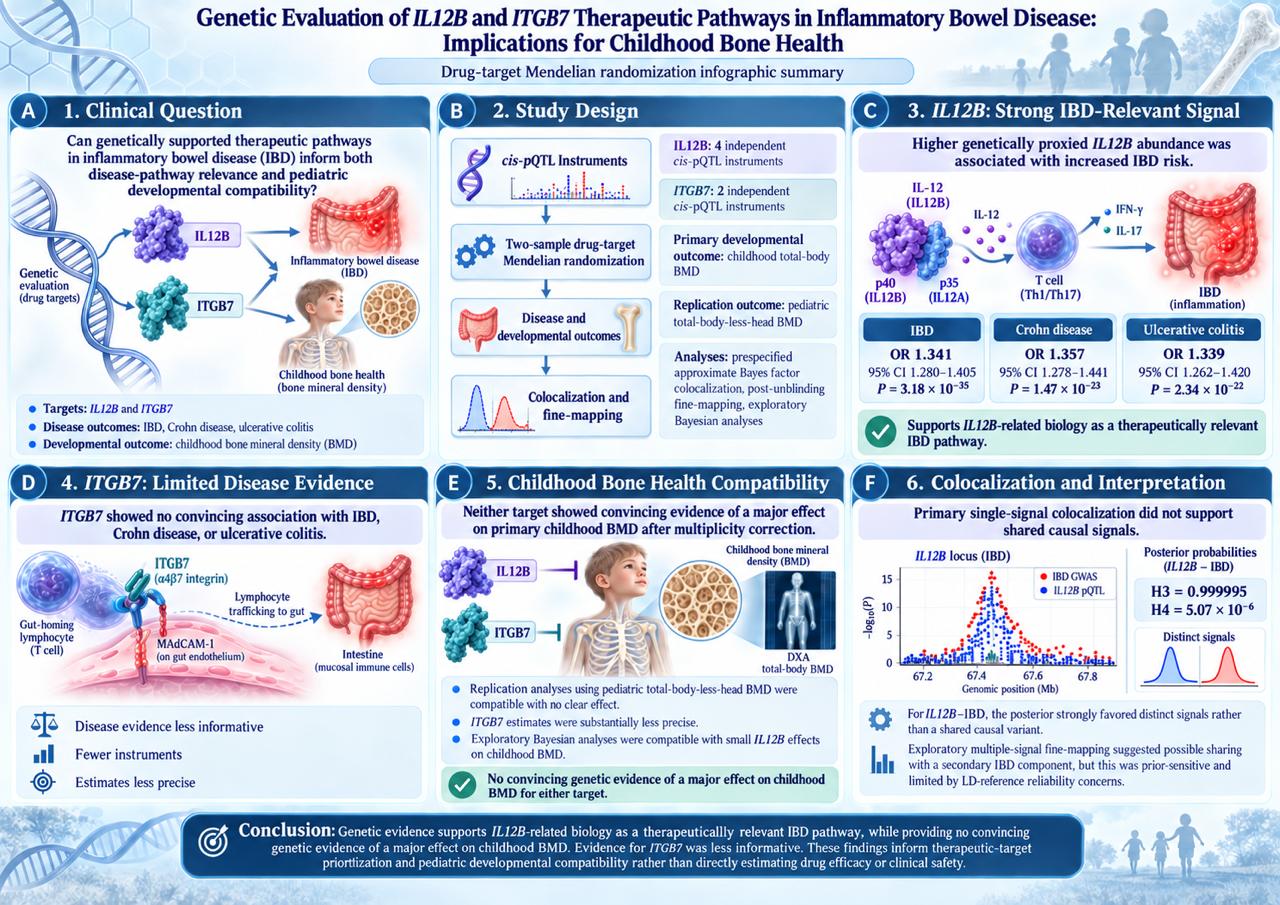
Genetic evaluation of therapeutic targets can clarify disease-pathway relevance and developmental compatibility in inflammatory bowel disease (IBD). We performed two-sample drug-target Mendelian randomization using cis-pQTL instruments for IL12B and ITGB7, evaluating IBD, Crohn disease, ulcerative colitis, and childhood total-body bone mineral density (BMD), with pediatric total-body-less-head BMD replication. Four IL12B and two ITGB7 instruments were retained. Higher genetically proxied IL12B abundance was associated with IBD (OR, 1.341; 95% CI, 1.280–1.405), Crohn disease (OR, 1.357; 95% CI, 1.278–1.441), and ulcerative colitis (OR, 1.339; 95% CI, 1.262–1.420), whereas ITGB7 showed no convincing disease association. Neither target showed convincing evidence of a major effect on childhood BMD; replication was inconclusive, with lower precision for ITGB7. Primary colocalization showed no supportive evidence of a shared causal signal; IL12B–IBD strongly favored distinct signals (H3 = 0.999995; H4 = 5.07 × 10⁻⁶). Exploratory fine-mapping suggested possible sharing with a secondary IBD component, but this finding was prior-sensitive and limited by LD-reference reliability. Bayesian analyses were compatible with small IL12B BMD effects, whereas ITGB7 remained less precise. Overall, these findings support IL12B-related pathway relevance while informing developmental compatibility rather than drug efficacy or clinical safety.
Keywords:
inflammatory bowel disease
; drug-target mendelian randomization
; therapeutic-target genetics
; IL12B
; ITGB7
; colocalization
; fine-mapping
; bone mineral density
; pediatric development
Copyright: This open access article is published under a Creative Commons CC BY 4.0 license, which permit the free download, distribution, and reuse, provided that the author and preprint are cited in any reuse.