

Submitted:
03 November 2026
Posted:
05 November 2026
You are already at the latest version
Abstract
Clinical artificial intelligence (AI) has advanced rapidly in evidence retrieval, knowledge synthesis, predictive modeling, and diagnostic classification. However, reliable machine-assisted clinical reasoning may require more than direct computational processing of symptoms, diagnostic labels, physiological measurements, or unstructured clinical text. This Perspective proposes the Clinical–AI Bridge as a clinician-led framework for organizing patient-specific physiological states before computational inference. The framework does not propose a new AI model, diagnostic algorithm, ontology, knowledge graph, or knowledge representation formalism. Rather, it addresses the prior clinical problem of how heterogeneous observations should be represented in a physiologically meaningful and clinically interpretable form. Precision otology is used as a model domain. Within this domain, the Neuro–Vascular–Mechanical–Inflammatory–Autonomic (NVMIA) framework provides a mechanistic foundation for structured mechanism representation. Patient observations are organized into mechanism units, relative NVMIA axis profiles, coupling relationships, temporal trajectories, and confidence and uncertainty markers. A worked patient example illustrates how clinical observations may be represented end-to-end as a structured physiological configuration before computational inference. The framework is positioned in relation to prior knowledge-representation and clinical-AI work while emphasizing a distinct contribution: clinical representation of an evolving patient state before formal computational representation or inference. A staged validation roadmap is proposed, beginning with representational reliability. A near-term falsifiable claim is that trained clinicians, given the same standardized patient-state snapshot, should be able to independently generate concordant NVMIA-based representations above chance agreement. Subsequent validation should assess physiological coherence, incremental clinical utility, and implementation safety. The Clinical–AI Bridge is therefore proposed as a conceptual architecture for preserving clinical meaning, uncertainty, and clinician accountability in trustworthy machine-assisted reasoning.
Keywords:
Clinical–AI Bridge
; clinical representation
; machine-assisted reasoning
; explainable artificial intelligence
; structured mechanism representation
; precision otology
; Eustachian tube dysfunction
; NVMIA framework
; knowledge representation
; clinician-led decision support
1. Introduction
Clinical artificial intelligence (AI), including foundation-model-based systems and large language models, has advanced rapidly in evidence retrieval, knowledge synthesis, predictive modeling, and diagnostic classification across multiple areas of medicine [1,2,3,4]. These developments have expanded the potential role of computational systems in supporting clinical decision-making, biomedical interpretation, and health care delivery.
Nevertheless, the translation of these capabilities into reliable clinical reasoning remains incomplete. Clinical observations—including symptoms, examination findings, physiological measurements, diagnostic codes, and patient-reported information—are often processed as descriptive inputs within data-driven systems. Although such inputs may support pattern recognition and prediction, they may not preserve the physiological organization through which clinicians interpret symptom generation, compensation, instability, treatment response, and state change [5,6,7,8].
This limitation suggests that clinically meaningful machine-assisted reasoning may require a clinically interpretable representation layer before computational encoding and inference. Rather than transferring observations directly into computational systems, clinical information may first need to be organized into structures that preserve mechanistic meaning, regulatory relationships, temporal evolution, and uncertainty. In this perspective, this missing layer is referred to as the representation gap: the gap between evidence-accessible medical knowledge and clinically interpretable representation of individualized physiological states.
The present article proposes the Clinical–AI Bridge as a representation-mediated framework for explainable machine-assisted clinical reasoning. The framework introduces structured mechanism representation as a form of clinical representation through which clinician-interpreted physiological meaning can be organized before translation into computational knowledge representation or inference. Rather than proposing a new AI model, diagnostic algorithm, or autonomous decision system, it defines a clinically interpretable architecture through which physiological meaning may be preserved before computational inference occurs.
This distinction is necessary because the concept of an intermediate representation between observation and inference has a long history in AI. Knowledge representation has been a major field of AI for decades, concerned with how knowledge should be structured so that computational systems can use it for reasoning, explanation, and problem solving [8,9]. In medicine, this tradition was developed through expert systems and diagnostic decision-support programs such as INTERNIST-I and Quick Medical Reference (QMR). INTERNIST-I was described as an experimental computer-based diagnostic consultant for general internal medicine, and QMR was developed from the INTERNIST-I knowledge base to support diagnostic assistance in internal medicine [10,11,12]. These systems demonstrated both the promise and the limitations of formalized medical knowledge representation.
The present framework does not claim to introduce a new knowledge representation formalism. Rather, it addresses a different and prior problem. Traditional medical knowledge representation primarily organizes general biomedical knowledge so that it can be encoded, searched, reasoned upon, or computationally manipulated. Clinical representation, as used here, concerns the representation of an individual patient’s evolving physiological state before translation into machine-readable form. The proposed framework therefore does not replace knowledge representation; it defines the clinically meaningful representational layer that should precede and constrain it.
The Clinical–AI Bridge should therefore be distinguished from formal computational approaches such as biomedical ontologies, knowledge graphs, neuro-symbolic architectures, qualitative or model-based reasoning systems, Bayesian networks, state-space or dynamical-system models, latent-variable models, and standardized data models or terminologies such as Systematized Nomenclature of Medicine Clinical Terms (SNOMED CT) and the Observational Medical Outcomes Partnership Common Data Model (OMOP CDM). These approaches provide important methods for structuring, reasoning over, or learning from biomedical knowledge and clinical data. By contrast, the present framework addresses the prior clinical question of how an individual patient’s physiological state should be represented in a clinician-interpretable form before formal computational representation, modeling, or inference. Its proposed contribution is therefore not a new AI formalism, but a clinically grounded representation architecture that may constrain and inform future computational implementations.
This distinction is particularly important for precision medicine. Precision medicine requires not only individualized data but also individualized clinical representation. Although traditional knowledge representation can organize general biomedical knowledge, it does not by itself determine how an individual patient’s physiological state should be represented as a clinically meaningful configuration. Clinical representation addresses this gap by organizing patient-specific mechanisms, regulatory relationships, temporal change, and uncertainty before computational encoding occurs.
Precision otology is used as a model domain for examining this representation problem. Within this domain, the Neuro–Vascular–Mechanical–Inflammatory–Autonomic (NVMIA) framework provides the mechanistic foundation for structured representation. In this sense, the Clinical–AI Bridge extends a clinician-led effort within precision otology to represent patient states as evolving physiological configurations rather than fixed diagnostic labels.
The following sections develop this argument by examining why data scale alone is insufficient, how clinical reasoning operates as structured mechanism navigation, why explainability requires structural representation, and how precision otology can serve as a model domain for the Clinical–AI Bridge.
1.1. Why Scaling Data Alone Is Not Enough
The rapid expansion of AI in medicine has substantially improved the ability of computational systems to identify statistical regularities across increasingly large and heterogeneous datasets [1,2,4]. These advances have encouraged the expectation that larger datasets and increasingly sophisticated models may progressively improve prediction, classification, and clinical decision support.
However, precision medicine requires more than improved predictive performance. The National Research Council [13] proposed that future biomedical systems should move beyond descriptive classification toward knowledge structures capable of integrating biological organization and individualized interpretation. Similarly, systems medicine frameworks emphasize that clinically meaningful understanding emerges through interactions among biological processes rather than through accumulation of isolated variables alone [14,15].
In routine clinical practice, observations are rarely interpreted independently. Symptoms, examination findings, physiological measurements, patient-reported information, and contextual factors are continuously reorganized into physiologically meaningful structures as clinicians evaluate competing explanations and revise interpretations over time [16,17,18]. More data may reveal additional associations without necessarily clarifying the mechanisms responsible for symptom generation, compensation, instability, or state transition.
This limitation is particularly relevant when routinely collected health data or administrative diagnostic codes are used as proxies for clinical states. Such data are valuable for surveillance, reimbursement, observational research, and phenotyping, but they may incompletely preserve individualized physiological organization or treatment-relevant mechanisms [19,20]. Accordingly, scaling descriptive datasets may improve association detection without resolving the representational structure required for clinically meaningful reasoning.
Recent work on foundation models has suggested that increasing model scale may improve generalization, while studies of clinical foundation models and adaptive medical AI have also highlighted limitations in evaluation, deployment stability, and clinical robustness when underlying clinical meaning is not explicitly represented [1,7,21]. Broader perspectives in AI have also argued that increasingly capable systems may require structured internal representations of environmental organization rather than reliance on statistical association alone [22].
In clinical medicine, the corresponding representational structure must preserve the physiological organization through which patient states are generated, compensated, destabilized, and transformed. The following sections develop this argument in precision otology, where dynamic otologic symptoms provide a clinically suitable model for examining representation before inference.
1.2. Clinical Reasoning as Structured Mechanism Navigation
Clinical reasoning is often described as a process of integrating observations into diagnostic decisions. However, clinicians rarely move directly from findings to conclusions. Instead, observations are interpreted through evolving explanatory structures that organize heterogeneous information into clinically meaningful patterns [16,17,18].
This process may be understood as structured mechanism navigation. Symptoms, examination findings, physiological measurements, patient-reported information, temporal patterns, and contextual factors are continuously reweighted as clinicians evaluate competing explanations, identify predominant regulatory contributions, judge plausibility, and revise working interpretations over time.
In disorders characterized by distributed physiological regulation, this reasoning process becomes especially important. Clinical meaning often depends not on isolated findings alone, but on how those findings relate to mechanisms, compensation, coupling, threshold behavior, and state transition. A symptom may therefore acquire different meaning depending on timing, associated findings, environmental triggers, response to treatment, and the patient’s evolving physiological state.
This perspective suggests that computational systems designed to support clinical reasoning may require access not only to observations, but also to the intermediate structures through which observations become clinically interpretable. The Clinical–AI Bridge framework builds on this premise by proposing that clinician-guided mechanistic interpretations should be represented explicitly before computational inference occurs.
1.3. Why Explainability Requires Structural Representation
Explainability has become an important objective in clinical AI, particularly in high-stakes settings where model outputs must be understandable, contestable, and clinically accountable [23,24,25]. Existing approaches often focus on feature attribution, visualization, attention mechanisms, or post hoc explanation of model behavior.
However, explanation and clinical interpretability are not equivalent. A computational system may generate plausible explanations or identify influential features while operating on representations that remain disconnected from physiological organization. In such cases, the explanation may describe the behavior of the model without clarifying the clinical state that the model was asked to interpret. This concern parallels broader arguments in causal reasoning, in which associative patterns alone are considered insufficient for mechanism-oriented or intervention-oriented explanation unless the underlying structure of relationships is represented [26].
This distinction is particularly important for foundation-model-based clinical AI. Large language models can encode substantial amounts of biomedical knowledge and perform competitively across selected benchmark-based medical tasks [3]. Yet encoded knowledge alone does not ensure that patient-specific observations are organized according to mechanisms, compensation, temporal evolution, or uncertainty.
Accordingly, explainable clinical reasoning may require more than transparent algorithms or fluent explanations. It may also require clinically interpretable representations that preserve physiological organization before computational inference occurs. In this perspective, structural representation is not an optional interpretive layer added after prediction, but a prerequisite for making machine-assisted reasoning clinically meaningful.
1.4. Precision Otology as a Model Domain
Precision otology provides a suitable model domain for examining clinically interpretable representation because otologic symptoms often emerge through interactions among multiple physiological processes rather than from isolated structural abnormalities. In Eustachian tube dysfunction (ETD), consensus-recognized symptoms include pressure disequilibrium–related manifestations such as aural fullness, pressure discomfort, popping, and muffled hearing [27]. Historical observations and contemporary reports further suggest that pressure-sensitive otologic presentations may include vestibulo-auditory symptoms in selected contexts [28,29,30].
This clinical variability creates a representational challenge. Patients with the same diagnostic label may differ in dominant complaint, temporal pattern, compensation status, pressure sensitivity, inflammatory threshold, sensory adaptation, autonomic state, and treatment response. Conversely, similar symptoms may arise from different regulatory configurations. Clinical interpretation therefore requires not only identification of abnormal findings but also organization of those findings into physiologically coherent structures.
Pressure regulation provides a useful conceptual reference because it represents an observable interface through which distributed physiological interactions may become clinically expressed. However, pressure-related measurements should not be treated as standalone diagnostic markers or sufficient explanations. Rather, they may function as structurally informative variables within a broader representation of patient state.
The NVMIA framework provides the mechanistic foundation for this approach. It has been proposed as a pressure-centered, hypothesis-generating architecture for organizing ETD and related barophysiologic disorders through interacting neural, vascular, mechanical, inflammatory, and autonomic domains, with middle ear pressure (MEP) positioned as a clinically measurable physiological coordinate [31]. In the present article, this architecture is extended toward structured mechanism representation for explainable machine-assisted clinical reasoning rather than restated as a pathophysiological framework.
The Clinical–AI Bridge accordingly refers to an intermediate architecture that translates clinically interpreted observations into structured mechanistic representations before computational inference. The framework is not presented as a validated diagnostic algorithm, treatment protocol, or autonomous decision system, but as a clinically interpretable foundation for future explainable machine-assisted reasoning grounded in structured mechanism representation.
2. Foundation: NVMIA as a Mechanistic Architecture
The Clinical–AI Bridge framework requires a clinically interpretable representation through which heterogeneous clinical observations can be organized before computational inference. In precision otology, the NVMIA framework is proposed as one example of such clinical representation. NVMIA organizes patient-specific physiological observations according to interacting neural, vascular, mechanical, inflammatory, and autonomic mechanisms that contribute to symptom generation, pressure regulation, compensation, and state-dependent variability [31]. It is used here not as a diagnostic checklist, disease taxonomy, computational ontology, or algorithm, but as the mechanistic basis for structured representation. Because clinical states may change through shifts in relative domain contributions, coupling relationships, compensation, and stability over time, they may be more meaningfully represented as dynamic physiological configurations than as fixed diagnostic labels. Accordingly, rather than restating the pathophysiology of NVMIA, this section specifies how the framework can support the translation of clinical observations into structured mechanism representations for explainable precision otology.
2.1. From Diagnostic Categories to Dynamic Symptom Expression
Diagnostic labels provide useful clinical shorthand, but they may conceal substantial variability in symptom expression. Patients assigned to the same diagnosis may present with different dominant complaints, temporal patterns, compensatory responses, and functional limitations depending on the underlying regulatory configuration.
This distinction is particularly important in otology. Conventionally recognized symptoms of ETD, including aural fullness, pressure discomfort, popping, and muffled hearing, may occur alongside broader pressure-sensitive vestibulo-auditory manifestations in selected contexts [27,28,30]. Within the NVMIA framework, such variability can be interpreted as dynamic expressions arising from interactions among pressure regulation, sensory integration, mucosal behavior, vascular responsiveness, mechanical boundary conditions, and autonomic adaptation [31].
The same symptom may arise from different regulatory configurations, and the same mechanism may generate different symptoms depending on timing, compensation, physiological thresholds, and cross-domain coupling. A slowly evolving or compensated pressure-related disturbance may remain clinically subtle, whereas rapid pressure asymmetry or abrupt regulatory imbalance may produce a more vertigo-dominant presentation [28,29,30,31]. Clinically meaningful representation should therefore preserve the physiological organization underlying the observed phenotype rather than reducing the patient state to a fixed diagnostic category. This provides the rationale for using NVMIA as a clinical representation framework rather than as a simple symptom classification scheme.
2.2. NVMIA Axes as Representational Dimensions
If symptom expression alone cannot adequately reflect the physiological organization of clinical states, NVMIA can function as a domain-specific clinical representation framework. Rather than serving as a disease classification system, diagnostic checklist, or predictive model, it organizes heterogeneous clinical observations into physiologically interpretable configurations. Under this view, each NVMIA domain represents a dimension of clinical organization rather than an isolated cause. Neural regulation reflects sensory integration, perceptual modulation, and adaptive processing. Vascular regulation captures perfusion-dependent variability and tissue-level resilience. Mechanical regulation represents transmission, impedance, and pressure-related boundary conditions. Inflammatory regulation modifies mucosal compliance, physiological thresholds, and susceptibility to destabilization. Autonomic regulation contributes to state dependence, adaptive variability, and context-sensitive physiological responsiveness [26].
These domains are not assumed to operate independently. Clinical states emerge through varying patterns of interaction, relative contribution, compensation, and temporal reorganization across domains. Representation therefore involves constructing a physiological configuration rather than assigning a categorical label.
From this perspective, the objective is not to determine whether a patient belongs to a specific mechanistic category. Rather, it is to characterize how the current physiological state is configured and how that configuration may influence symptom expression, compensation, and state transition over time.
This intermediate representation layer preserves clinically interpretable structure between observation and inference and provides the mechanistic foundation for the structured mechanism representation developed in Section 3.
2.3. Pressure Regulation as a Representational Anchor
Within the NVMIA architecture, pressure regulation occupies a distinctive position because MEP is clinically measurable and may reflect the effects of distributed physiological processes. MEP is positioned here not as a validated surrogate biomarker or standalone diagnostic marker, but as a clinically measurable physiological coordinate within a broader pressure-centered mechanistic architecture [31,32].
This distinction is important. Pressure-related measurements should not be interpreted as direct substitutes for disease status, nor should pressure be treated as the origin of all otologic symptoms. Rather, MEP may serve as a structurally informative variable through which interactions among ventilation, mucosal compliance, inflammatory modulation of physiological thresholds, vascular responsiveness, mechanical boundary conditions, sensory adaptation, and autonomic state become clinically accessible.
In this sense, MEP may provide a useful reference plane for structured representation. Pressure-related observations may help connect measurable findings with broader regulatory configurations, allowing heterogeneous symptoms to be interpreted within a physiologically organized state rather than as isolated complaints. Historical reports of Eustachian tube obstruction–associated vertigo [30], and case-based observations of ground-level alternobaric vertigo [29] further support the clinical relevance of pressure-sensitive vestibulo-auditory manifestations in selected contexts.
Accordingly, MEP is used in this framework not as a sufficient explanation by itself, but as a structural anchor within the NVMIA architecture. Its role is to support the clinically interpretable organization of dynamic interactions among regulatory domains before computational inference occurs.
2.4. Regulatory Configuration and State Transition
Building on this dynamic view of symptom expression, clinical states may be more meaningfully represented as regulatory configurations rather than as fixed diagnostic labels. A regulatory configuration refers to the relative organization of domain contributions, coupling relationships, compensatory processes, and physiological stability within a given patient state.
Such configurations may shift over time. Changes in inflammatory activity, autonomic state, pressure load, vascular responsiveness, sensory adaptation, mucosal compliance, or mechanical boundary conditions may alter the predominant clinical expression without necessarily changing the diagnostic label [31].
A compensated pressure-sensitive state, for example, may remain clinically subtle until regulatory instability emerges.
Within the Clinical–AI Bridge framework, regulatory configuration provides a way to represent the current patient state, whereas state transition provides a way to interpret change over time. Together, these concepts allow clinical observations to be organized as evolving physiological states rather than static collections of symptoms.
Accordingly, the NVMIA framework functions as the mechanistic foundation for structured mechanism representation, which is developed in Section 3.
3. Structured Mechanism Representation
Building on the mechanistic foundation established by NVMIA, the next challenge is not whether clinical observations can be computationally analyzed, but how their physiological meaning should be represented before computational inference occurs. Within the Clinical–AI Bridge framework, structured mechanism representation is introduced as a conceptual approach for organizing heterogeneous clinical observations into interpretable physiological configurations.
This representation is not intended to replace diagnostic reasoning. Rather, it preserves the structure through which clinicians interpret relationships among symptoms, measurements, mechanisms, compensation, temporal change, and uncertainty. In this sense, representation is treated as an active clinician-guided interpretive process rather than passive data encoding.
Structured mechanism representation organizes patient-specific physiological interpretations into a form that remains clinically interpretable while becoming more compatible with future computational modeling. It therefore serves as a bridge between clinical reasoning and computational inference without claiming to be a new knowledge representation formalism. This perspective is consistent with precision and systems medicine approaches that emphasize biological organization and individualized interpretation [8,9], and with broader arguments that intelligent systems may require structured internal representations rather than statistical associations alone [22].
The following subsections define the main components of structured mechanism representation: mechanism units, axis-based state organization, coupling relationships, temporal change, uncertainty markers, and representational output.
3.1. Mechanism Units
Individual clinical observations seldom possess mechanistic meaning in isolation. A symptom, sign, measurement, or patient-reported experience becomes clinically meaningful when interpreted in relation to other observations, contextual information, temporal behavior, and physiological plausibility. This view is consistent with clinical reasoning and systems medicine perspectives, in which meaning emerges through the structured interpretation of relationships among observations rather than from isolated variables alone [8,13,16].
Within the Clinical–AI Bridge framework, a mechanism unit refers to a basic clinically interpretable representational unit that links one or more observations to a plausible physiological interpretation. It is a representational construct rather than a discrete biological entity.
Mechanism units are not equivalent to isolated symptoms, biomarkers, diagnostic codes, or disease categories. Rather, they represent structured combinations of observations that preserve explanatory relationships. Each mechanism unit may include the observed manifestation, physiological interpretation, interpreted regulatory contributions, contextual modifiers, temporal pattern, and confidence and uncertainty markers.
For example, aural fullness should not be treated as a single mechanical phenomenon by default. Depending on the clinical context, it may reflect pressure disequilibrium, altered impedance conditions, mucosal inflammation, sensory adaptation, vascular responsiveness, autonomic modulation, or combinations of these processes. Similarly, fluctuating hearing, imbalance, pressure discomfort, or nonspecific otologic discomfort may acquire different clinical meanings depending on how they are organized within the broader regulatory state.
The function of mechanism units is therefore to preserve the interpretive step through which observations become physiologically meaningful. They provide elementary building blocks for organizing regulatory dimensions, coupling relationships, temporal change, and uncertainty-aware interpretation. In this sense, mechanism units do not fragment clinical reasoning into isolated parts; rather, they preserve the relational structure through which clinical meaning is generated.
3.2. Axis-Based State Organization
After clinical observations are organized into mechanism units, the next step is to represent how those units are clinically interpreted within a multidimensional regulatory structure. Within the Clinical–AI Bridge framework, axis-based state organization refers to the process by which mechanism units are mapped onto the NVMIA domains to generate a structured representation of the current clinical state. A mechanism unit may map to more than one regulatory axis, and the mapping may remain uncertain or context-dependent.
This process does not assign the patient to a single mechanistic category. Rather, it represents the clinically interpreted relative contributions of multiple regulatory axes within a given clinical context. A patient state may therefore be represented as a relative multidimensional profile across neural, vascular, mechanical, inflammatory, and autonomic domains. In this sense, NVMIA functions not as a disease taxonomy, but as a clinically interpretable coordinate structure for organizing physiological state information [31].
For example, a patient presenting with aural fullness, fluctuating hearing, pressure discomfort, and episodic imbalance may show a mechanically predominant, pressure-sensitive configuration. However, the clinical meaning of this configuration may differ depending on its coupling with inflammatory activity, autonomic variability, sensory adaptation, or vascular responsiveness. Axis-based state organization therefore captures the relative organization of regulatory contributions rather than establishing a fixed diagnostic conclusion.
Conceptually, this profile may be expressed as:
where N, V, M, I, and A represent clinically interpreted contributions of neural, vascular, mechanical, inflammatory, and autonomic regulation, respectively. At the present conceptual stage, these values should be understood as representational coordinates rather than validated quantitative measurements. The axes are not assumed to be independent or orthogonal, and this notation does not imply a validated scoring system.
NVMIA state = [N, V, M, I, A]
The purpose of axis-based state organization is to preserve mechanistic structure while allowing clinical observations to remain interpretable to clinicians and compatible with future computational modeling.
3.3. Mechanism Coupling
Axis-based state organization provides a structured representation of relative regulatory contributions, but clinical states rarely arise from independent domain activity alone. More often, symptom expression reflects relationships among regulatory domains, in which one domain may modify, amplify, compensate for, suppress, or destabilize the clinical effects of another.
Within the Clinical–AI Bridge framework, mechanism coupling refers to the clinician-interpreted relationships among NVMIA domains. Coupling refers not merely to the co-occurrence of regulatory contributions, but to a relationship in which one domain may modify the expression, stability, or clinical effect of another.
This distinction is important because two patients may show similar axis profiles while differing substantially in how their regulatory domains interact. For example, a mechanically predominant, pressure-sensitive state may behave differently when coupled with inflammatory mucosal change than when coupled with autonomic variability, vascular responsiveness, or sensory adaptation.
Coupling may be described by directionality, prominence, functional effect, temporality, and intervention responsiveness. These properties indicate whether a relationship is interpreted as unidirectional, bidirectional, or indeterminate; clinically prominent or secondary; compensatory, neutral, amplifying, or destabilizing; persistent or state-dependent; and responsive or nonresponsive to intervention or spontaneous state transition. Directionality describes whether the relationship is interpreted as predominantly unidirectional, bidirectional, or indeterminate. Prominence refers to the clinically interpreted importance of the relationship rather than to a validated quantitative estimate. Functional effect describes whether the coupling appears compensatory, neutral, amplifying, or destabilizing. Temporality indicates whether the relationship is persistent, episodic, transient, or state-dependent. Intervention responsiveness refers to whether the coupling pattern changes after treatment, environmental modification, or spontaneous state transition.
These coupling properties allow representation to move beyond simple axis profiles. A clinical state may therefore be characterized not only by which regulatory domains contribute, but also by how those contributions are organized relationally. This distinction is consistent with systems-level approaches to medicine, in which biological meaning emerges from interactions among regulatory components rather than from isolated abnormalities alone [14].
At the present conceptual stage, mechanism coupling should be understood as a clinician-interpreted relational structure rather than as a validated causal or computational graph. Its purpose is to preserve clinically meaningful relationships that may otherwise be lost when observations are reduced to isolated input variables.
3.4. Temporal Representation and State Evolution
Clinical states are not static entities. Symptoms, physiological responses, and regulatory interactions may evolve over time, sometimes without a change in diagnostic classification. Clinically meaningful representation should therefore preserve not only the structure of the current state, but also the direction, pace, and stability of state change. Within the Clinical–AI Bridge framework, temporal representation refers to the organization of clinical observations as evolving physiological configurations rather than as isolated time points. Interpretation includes not only which regulatory axes are currently predominant, but also how axis contributions, coupling relationships, compensation, and uncertainty change across longitudinal observations.
State evolution may reflect adaptation, compensation, destabilization, inflammatory fluctuation, autonomic shifts, changing pressure conditions, environmental influences, or responses to intervention. Conceptually, this temporal evolution may be represented as a sequence of regulatory states:
where each state reflects a reorganized configuration of interacting NVMIA domains rather than progression along a single linear scale [31].
State(t₀) → State(t₁) → State(t₂)
Transitions between states should not be assumed to be deterministic. Similar initial presentations may follow different trajectories depending on baseline physiological reserve, environmental context, and response to intervention. This view is consistent with precision medicine perspectives that emphasize individualized biological variation and longitudinal interpretation rather than static disease classification alone [8,14,15].
Accordingly, the representational target is not an isolated observation or static label, but an evolving physiological configuration that can be updated as new clinical information emerges.
3.5. Limits of Diagnosis-Centered Representation
In routine clinical care, diagnostic labels often emerge from a broader process of history taking, physical examination, physiological interpretation, differential diagnosis, clinical decision-making, and longitudinal judgment. The recorded diagnosis therefore represents a compressed clinical summary rather than the full reasoning process through which the patient state was interpreted.
This compression becomes more pronounced when clinical encounters are represented in large-scale datasets. Diagnostic codes, claims-based labels, and electronic health record phenotypes are useful for documentation, reimbursement, standardization, epidemiology, and computational scalability. However, they do not necessarily preserve the physiological reasoning, uncertainty, competing explanations, temporal behavior, compensatory responses, or mechanistic interpretation that informed the clinical encounter [19,20]. Work on computable phenotypes similarly shows that large-scale case identification depends on explicit operational definitions, standardized coding and terminology practices, and the availability and clinical context of the underlying data [33,34].
This limitation is especially relevant for machine-assisted reasoning. A diagnosis-centered representation may indicate that a condition was recognized, documented, or used to support a diagnostic or therapeutic pathway, but it may not explain how symptoms arose through interactions among mechanisms or why patients with similar diagnoses follow different clinical trajectories. As a result, heterogeneous physiological states may be compressed into the same diagnostic category.
This limitation should not be interpreted as a criticism of diagnostic systems themselves. Diagnostic categories remain essential for clinical communication, decision support, reimbursement, health-system coordination, and large-scale research. The problem is not that diagnostic labels are unnecessary, but that they are incomplete as representations of evolving physiological states.
Within the Clinical–AI Bridge framework, structured mechanism representation is proposed as a complement to diagnosis. Its purpose is to preserve mechanistic organization, uncertainty, coupling relationships, and temporal change that may otherwise be lost when clinical states are represented primarily by diagnostic labels.
3.6. Representational Output and Clinical Interpretability
The output of structured mechanism representation is not a diagnostic label, risk score, or automated treatment recommendation. Rather, it is a clinically interpretable physiological configuration in which observations are organized according to mechanistic meaning.
Such a representation may include mechanism units, relative NVMIA axis profiles, clinically prominent coupling patterns, compensatory or destabilizing features, state trajectory, and confidence and uncertainty markers. Its purpose is to preserve how observations relate to one another within an evolving physiological state.
The value of this output lies in its dual function: it should remain interpretable to clinicians while being structured for future computational use. Rather than reducing clinical observations to isolated variables or fixed diagnostic categories, it preserves their relational, temporal, and uncertainty-aware organization.
Accordingly, structured mechanism representation establishes the representational basis for the Clinical–AI Bridge, in which structured clinical meaning functions as the interface between clinical reasoning and machine-assisted inference.
4. Clinical–AI Bridge
The Clinical–AI Bridge specifies how structured mechanism representation may connect clinical reasoning with machine-assisted inference. The preceding sections positioned NVMIA as the mechanistic foundation and structured mechanism representation as the clinically interpretable organization of patient-specific physiological states. This section clarifies how such representations may become computationally accessible while remaining clinically interpretable.
The framework is based on a central premise: reliable machine-assisted clinical reasoning should not rely solely on the direct transfer of symptoms, diagnostic labels, physiological measurements, or unstructured clinical text into computational systems. Instead, clinical observations should first be organized into representations that preserve mechanistic organization, temporal evolution, and uncertainty. Computational inference can then operate on structured clinical meaning rather than on descriptive inputs alone.
This distinction is important because clinical AI systems may retrieve evidence, generate plausible explanations, identify statistical patterns, or estimate outcomes without necessarily preserving the physiological organization through which clinicians interpret patient states [5,7]. The Clinical–AI Bridge addresses this limitation by positioning structured mechanism representation between clinical interpretation and computational inference. Figure 1 summarizes the proposed framework.

Table 1.
Proposed Core Components of Structured Mechanism Representation.
| Component | Representational Function | Clinical Interpretation | Potential Computational Translation |
|---|---|---|---|
| Mechanism Unit | Defines a basic clinically interpretable unit | Links one or more observations to a plausible physiological interpretation | May support structured interpretable variables or feature sets |
| Axis-Based State Organization | Represents relative contributions across NVMIA domains | Constructs a multidimensional state profile; mapping may involve multiple axes and remain uncertain or context-dependent | May support multidimensional state representations |
| Mechanism Coupling | Represents relationships among regulatory domains | Characterizes directionality, prominence, functional effect, temporality, and intervention responsiveness | May support structured relational representations |
| Temporal Representation and State Trajectory | Represents the evolution of physiological configurations over time | Tracks transitions, compensation, destabilization, and uncertainty across longitudinal observations | May support sequential or longitudinal state representations |
| Confidence and Uncertainty Markers | Represent confidence, ambiguity, and unresolved uncertainty | Record evidence strength, interpretive confidence, and competing plausible interpretations | May support explicit uncertainty metadata or uncertainty-aware representations |
Abbreviations: NVMIA, Neuro–Vascular–Mechanical–Inflammatory–Autonomic.
4.1. Translation Pipeline
The Clinical–AI Bridge begins with the recognition that clinical observations do not become clinically meaningful merely because they are digitized. Symptoms, examination findings, physiological measurements, imaging results, treatment responses, and patient-reported experiences may all be available as data, but their clinical significance depends on how they are interpreted and organized.
The proposed pipeline proceeds through five stages. First, clinical observation gathers heterogeneous inputs, including history, symptom description, physical examination, functional testing, environmental context, treatment response, and patient-reported outcome measures (PROMs). These observations provide the initial inputs for reasoning but do not yet constitute a structured representation of physiological organization.
Second, clinician-guided mechanistic interpretation reorganizes observations into plausible hypotheses regarding predominant regulatory contributions, coupling relationships, compensatory responses, destabilizing influences, and contextual modifiers. Third, structured mechanism representation translates these interpretations into an organized form that may include mechanism units, relative NVMIA axis profiles, coupling relationships, temporal trajectories, and confidence and uncertainty markers.
Fourth, computational inference may assist by comparing configurations across patients or time points, identifying recurrent patterns, estimating plausible state transitions, detecting unexpected relationships, or suggesting alternative mechanistic configurations for clinician review. These outputs are not final decisions, but structured suggestions for clinical reassessment.
Fifth, clinical reassessment and feedback-based revision evaluates computational outputs against physiological plausibility, clinical context, patient evolution, and therapeutic response. Coherent outputs may support the current representation, whereas incomplete or implausible outputs may prompt revision of axis profiles, coupling relationships, temporal trajectories, or uncertainty markers.
Thus, the translation pipeline is not a one-way pathway from patient data to algorithmic decision. It is an iterative cycle in which clinical meaning is structured, computationally examined, and clinically reassessed.
4.2. Clinician–AI Role Delineation
A central requirement of the Clinical–AI Bridge is the clear delineation of the respective roles of clinicians and computational systems. Without such delineation, machine-assisted reasoning may be misunderstood as automated diagnosis, and structured decision support may be incorrectly interpreted as autonomous clinical authority.
Within this framework, clinicians retain responsibility for developing and revising physiological interpretations of clinical observations. This includes determining which findings are clinically relevant, judging mechanistic plausibility, integrating patient context, recognizing uncertainty, and deciding whether a representation remains appropriate as the patient state evolves. These tasks are consistent with broader accounts of clinical reasoning as an adaptive interpretive process rather than a purely linear classification task [16,17,18].
Once clinical information has been structured, computational inference may operate on the resulting representations. Its role is not to independently establish a diagnosis or determine the physiological meaning of the patient state. Rather it may compare the current state with prior states, identify similar configurations, estimate possible trajectories, detect coupling patterns that warrant further clinical review, or suggest alternative mechanistic configurations for clinician evaluation.
The Clinical–AI Bridge therefore functions as both a boundary and an interface. It allows clinician-guided interpretations to become computationally usable while preserving traceability to the clinical observations and reasoning from which they were derived. In this sense, the framework does not transfer authority from clinician to machine; it translates clinician-guided interpretations into a form that can support assistive computational analysis.
Accordingly, the Clinical–AI Bridge is best understood as a clinician-led cooperative reasoning framework. Clinical meaning remains clinician-guided, computational inference remains assistive, and clinical accountability remains with the clinician.
4.3. Conditions for Representational Reliability
For the Clinical–AI Bridge to support machine-assisted reasoning, structured mechanism representation should satisfy several conditions for representational reliability. These conditions concern the preservation of clinical meaning during the translation of clinician-guided interpretations into computationally accessible representations. They should be understood as design requirements for future development rather than as properties already validated in the present conceptual framework.
First, the representation should preserve physiological coherence. Mechanism units, relative NVMIA axis profiles, coupling relationships, and temporal trajectories should remain consistent with clinically plausible physiological organization. A representation may be computationally convenient but clinically unreliable if it disrupts the relationship between observations and their clinically interpreted physiological meaning.
Second, the representation should remain clinically interpretable and traceable. Its purpose is not to create another opaque layer between the patient and the clinician. Rather, it should be inspectable, revisable, and justifiable. Clinicians should be able to understand why a state is represented as mechanically predominant, inflammation-coupled, autonomically variable, compensated, destabilizing, or temporally evolving, and to trace these features back to the observations and interpretations from which they were derived. This requirement is aligned with the broader view that explainability in high-stakes clinical AI should support meaningful human understanding rather than merely provide post hoc explanation [23,24,25].
Third, the representation should preserve uncertainty. Clinical states are often incomplete, ambiguous, transitional, or context-dependent. A reliable representation should therefore avoid premature categorical assignment and allow uncertainty to remain visible regarding relative axis contributions, coupling directionality, temporal stability, and interpretive confidence.
Fourth, the representation should remain revisable. Patient states may change over time in relation to environmental exposure, treatment response, inflammatory activity, autonomic fluctuation, changing pressure conditions, or compensatory adaptation. A static representation may become clinically misleading if it cannot be updated as new observations emerge.
Finally, computational inference should remain bounded by and traceable to the structure of the representation. Machine-generated suggestions should be interpreted in relation to the mechanism units, relative NVMIA axis profiles, coupling relationships, temporal trajectories, and uncertainty markers from which they were derived. Computational systems may suggest alternative configurations, but such suggestions should be clearly identified when they extend beyond the represented information and should remain subject to clinician review.
In this way, representational reliability depends not only on computational performance, but also on physiological coherence, clinical interpretability, traceability, uncertainty preservation, revisability, and the structural integrity of the clinical information being processed.
4.4. Interpretability and Feedback
Within the Clinical–AI Bridge framework, interpretability is not limited to explaining computational outputs after they are generated. Rather, it should be preserved across the full reasoning pathway, from clinical observation and clinician-guided mechanistic interpretation to structured representation, computational inference, and feedback-based revision.
This distinction is important because post hoc explanations may describe why a model produced a particular output without demonstrating that the model operated on clinically meaningful representations. A system may generate plausible explanations while relying on representations that do not preserve physiological organization. Explainability alone is therefore insufficient if the underlying representation does not preserve clinical meaning [23,24,25].
The Clinical–AI Bridge addresses this issue by shifting interpretability upstream and incorporating feedback into the reasoning process. Computational outputs are returned to the clinician as structured suggestions rather than final conclusions. The clinician evaluates whether a suggested configuration is consistent with physiological plausibility, patient context, symptom evolution, treatment response, and visible uncertainty. This evaluation may support, revise, or reject the current representation.
Feedback also allows the representation to remain responsive to changing patient states. New observations, treatment responses, environmental exposures, and symptom evolution may alter relative NVMIA axis profiles, reveal previously underrecognized regulatory contributions, expose latent instability, or change the interpretation of coupling relationships and state trajectory. In each case, the representation can be revised rather than treated as a fixed input.
Accordingly, the Clinical–AI Bridge is best understood as a feedback-informed interpretability framework. Its purpose is to make clinician-guided physiological interpretations computationally accessible while preserving clinical meaning, uncertainty, clinician oversight, and revisability.
5. Worked Patient Example: End-to-End Structured Mechanism Representation
To clarify how the Clinical–AI Bridge may operate in practice, this section presents a worked patient example represented end-to-end in the proposed representation. The example is intended as a conceptual illustration rather than a validated diagnostic protocol, scoring system, or treatment recommendation. Its purpose is to demonstrate how heterogeneous clinical observations may be translated into a structured, clinically interpretable physiological configuration before computational inference.
5.1. Clinical Observation
Consider a patient presenting with persistent aural fullness, pressure discomfort, fluctuating hearing difficulty, and intermittent imbalance. Clinical assessment identifies pressure-sensitive otologic complaints, variable auditory symptoms, episodic vestibulo-auditory discomfort, and an asymmetric MEP state. Symptoms fluctuate over time in relation to pressure-related sensations and clinical context.
At this stage, the observations remain heterogeneous. They include symptoms, physiological measurements, temporal behavior, and patient-reported experiences. They are clinically relevant, but they do not yet constitute a structured representation of physiological organization.
5.2. Clinician-Guided Mechanistic Interpretation
The clinician does not treat aural fullness, fluctuating hearing, pressure discomfort, and imbalance as isolated variables. Instead, these observations are interpreted as potentially related expressions of a pressure-sensitive regulatory state.
A mechanically predominant contribution may be suspected because pressure discomfort, aural fullness, fluctuating auditory symptoms, and pressure asymmetry suggest altered pressure regulation or impedance-related boundary conditions. A neural contribution may also be considered because vestibulo-auditory symptoms require sensory integration and perceptual interpretation. Inflammatory modulation may remain possible if mucosal compliance or physiological pressure thresholds appear altered. Autonomic or vascular contributions may remain uncertain unless additional contextual or physiological evidence supports them.
Thus, the clinical interpretation does not produce a single mechanistic conclusion. It produces a structured hypothesis: the patient state may reflect a mechanically predominant, pressure-sensitive configuration with possible neural coupling, possible inflammatory modulation, and uncertain autonomic or vascular contribution.
5.3. Mechanism Units
The observations can then be organized into mechanism units, as illustrated in Table 2. A mechanism unit is not a symptom alone; it links one or more observations to a plausible physiological interpretation.
These mechanism units preserve the interpretive step through which observations become physiologically meaningful while retaining uncertainty.
5.4. NVMIA Axis Profile
The mechanism units can be organized across the NVMIA domains as a qualitative state profile, as illustrated in Table 3:
NVMIA state = [N, V, M, I, A]
This profile is not a validated score. It is a qualitative representational coordinate system that makes the clinician’s physiological interpretation explicit.
5.5. Coupling and Temporal Trajectory
The same axis profile may have different clinical meanings depending on how domains interact. In this example, mechanical–neural coupling may be suspected if pressure-related mechanical change appears to influence vestibulo-auditory perception or imbalance. Mechanical–inflammatory coupling may be considered if mucosal compliance or inflammatory threshold changes appear to modify pressure regulation. Mechanical–autonomic coupling may remain uncertain unless symptom fluctuation is reproducibly linked to stress, state-dependent variability, or autonomic context.
The patient state can also be represented longitudinally:
State(t₀): symptomatic pressure-sensitive configuration
State(t₁): reassessment after ventilation restoration, environmental change, medical treatment, or spontaneous fluctuation
State(t₂): revised state based on symptom change, pressure findings, auditory or vestibular reassessment, and treatment response
If symptoms and physiological findings improve after restoration of middle ear ventilation, the representation may shift toward a mechanically predominant, intervention-responsive configuration. If symptoms persist despite pressure normalization, the representation may shift toward stronger neural, autonomic, inflammatory, vascular, or mixed coupling hypotheses. Thus, the representation remains revisable rather than fixed.
5.6. Representational Output
The resulting structured mechanism representation may be summarized as follows:
The patient is represented as having a mechanically predominant, pressure-sensitive NVMIA configuration, with moderate neural coupling, possible inflammatory modulation, uncertain autonomic or vascular contribution, and a temporal trajectory requiring reassessment after intervention or longitudinal observation.
This output is not a diagnostic label, risk score, or automated treatment recommendation. It is a clinically interpretable physiological configuration. A computational system could later operate on this structured representation by comparing similar configurations, identifying recurrent trajectories, estimating possible state transitions, or suggesting alternative configurations for clinician review. Interpretive authority remains with the clinician, and the representation must remain revisable as new clinical information emerges.
6. Validation Roadmap
The Clinical–AI Bridge is proposed as a conceptual architecture rather than as a validated clinical decision system. Its development should therefore proceed through staged validation, moving from representational reliability and physiological coherence to incremental predictive value, clinical and intervention-response utility, and implementation safety.
The present framework does not propose a new AI model, a single validation metric, or a deployment-ready decision system. Rather, it defines a sequence of clinically grounded validation requirements that should be addressed before structured mechanism representation is deployed to support real-world machine-assisted clinical reasoning. This sequence is essential because computational performance alone cannot establish clinical meaning. A model may retrieve evidence, identify statistical patterns, estimate outcomes, or generate plausible explanations without preserving the physiological relationships through which clinicians interpret symptoms, compensation, treatment response, and state transitions [5,6,7,47].
Established clinical-AI evaluation frameworks provide essential guidance for model development, early-stage clinical evaluation, reporting, and deployment. The Clinical–AI Bridge addresses a complementary upstream question: whether a clinically meaningful physiological representation has been established before computational inference occurs [47,48]. Accordingly, validation should proceed sequentially: representation before prediction, physiological coherence before deployment, and clinician oversight throughout development, evaluation, and subsequent clinical use.
A near-term falsifiable claim of the Clinical–AI Bridge framework is that trained clinicians, when provided with the same structured patient information, should be able to independently generate concordant NVMIA-based representations at a level exceeding chance agreement. This claim can be tested by inter-rater reliability studies comparing independently assigned mechanism units, relative NVMIA axis profiles, coupling relationships, temporal trajectory judgments, and confidence and uncertainty markers. Failure to demonstrate acceptable concordance would challenge the reliability of the proposed representational structure and require revision of the framework.
6.1. Representation Validation
At this stage, validation should focus on internal consistency, clinician interpretability, traceability, inter- and intra-clinician reproducibility, uncertainty preservation, and revisability across cases and clinical settings. A near-term falsifiable claim is that trained clinicians, when provided with the same standardized clinical information representing a defined patient-state snapshot, should be able to independently generate concordant NVMIA-based representations at a level exceeding chance agreement. This claim concerns concordance for the same represented state, not invariance across different clinical time points. If the patient state changes over time, changes in the NVMIA profile may reflect state evolution rather than representational inconsistency.
This claim can be tested by asking multiple clinicians to map standardized or real-world clinical cases into mechanism units, relative NVMIA axis profiles, coupling relationships, temporal trajectories, and confidence and uncertainty markers. Clinicians with different levels of expertise and from different practice settings should be included to evaluate whether the representation remains usable beyond a single expert or institution.
Patterns of agreement and disagreement would help identify which components of the representation are stable, which require further specification, and which remain context-dependent. Disagreement should not automatically be treated as representational failure, because it may reflect genuine clinical ambiguity, insufficient information, contextual dependence, or more than one physiologically plausible interpretation. A reliable framework should preserve such uncertainty rather than force premature consensus.
Representation validation should also examine whether structured mechanism representation adds clinically meaningful information beyond diagnostic labels, unstructured symptom lists, administrative codes, or computable electronic health record phenotypes. If the reference standard used for model training or evaluation is diagnosis-centered and physiologically incomplete, machine learning may reproduce the limitations of existing diagnostic categories rather than overcome the representation gap [19,20].
6.2. Physiological Validation
After representational reliability is established, validation should examine whether structured mechanism representations remain physiologically coherent. A representation may be reproducible across clinicians but still clinically weak if it does not correspond to plausible physiological relationships, measurable clinical findings, temporal behavior, or response to intervention [47,48].
Physiological validation should therefore assess whether assigned mechanism units, relative NVMIA axis profiles, coupling relationships, and temporal trajectories are consistent with available physiological evidence. In precision otology, this may include MEP findings, tympanometric patterns, auditory or vestibular test results, symptom provocation or resolution, inflammatory context, environmental exposure, and response to pressure-regulatory or anti-inflammatory interventions [27,28,29,30,31,32]. The goal is not to prove that any single observation identifies a specific mechanism, but to determine whether the represented configuration is physiologically plausible and clinically coherent.
This stage should also evaluate whether changes in the representation correspond to meaningful state transitions. For example, if a patient initially represented as having a mechanically predominant, pressure-sensitive configuration improves after restoration of middle ear ventilation, the subsequent representation should reflect a plausible shift in pressure-related mechanical contribution, coupling relationships, symptom expression, or uncertainty [29,30,31,32]. Conversely, persistence of symptoms despite pressure normalization should prompt reassessment of neural, inflammatory, autonomic, vascular, or mixed coupling hypotheses rather than simple confirmation of the original representation.
Physiological validation should therefore test whether structured mechanism representation can preserve the relationships among clinical observations, physiological measurements, longitudinal change, and intervention response. Failure to demonstrate physiological coherence would suggest that the representation is reproducible but insufficiently grounded in the mechanisms it claims to preserve.
6.3. Incremental Predictive and Clinical Utility
After representational reliability and physiological coherence have been examined, validation should evaluate whether structured mechanism representation adds incremental value beyond diagnosis-centered or variable-centered representations. The key question is not whether computational systems can achieve high performance using conventional inputs alone, but whether adding structured mechanism representation improves clinically meaningful interpretation, prediction, or decision support [47,48].
This stage may compare models or clinical decision-support approaches that use diagnostic labels, symptom lists, physiological measurements, or electronic health record variables alone with approaches that also incorporate mechanism units, relative NVMIA axis profiles, coupling relationships, temporal trajectories, and uncertainty markers. Outcomes may include prediction of symptom persistence, treatment response, recurrence, state transition, need for reassessment, or clinically meaningful change over time.
Importantly, incremental value should not be defined only by statistical performance. Improved discrimination, calibration, or prediction may be useful, but the Clinical–AI Bridge also requires that outputs remain clinically interpretable, physiologically plausible, and traceable to the represented patient state [47,48]. A computational system that improves numerical performance while obscuring physiological meaning would not satisfy the purpose of the framework.
Clinical utility should also be evaluated prospectively. Future studies may examine whether structured mechanism representation helps clinicians recognize underrepresented mechanisms, revise premature diagnostic assumptions, identify plausible coupling relationships, or select more coherent reassessment strategies. In this stage, the framework would be considered useful only if it improves clinically meaningful reasoning or patient-state interpretation beyond what is achieved by conventional diagnosis-centered representations.
Failure to demonstrate incremental predictive or clinical utility would not necessarily invalidate the concept of clinical representation, but it would limit claims that structured mechanism representation improves machine-assisted reasoning in practice.
6.4. Implementation Safety and Feedback Monitoring
Before structured mechanism representation is used to support real-world machine-assisted reasoning, implementation safety should be evaluated. Even if a representation is reproducible, physiologically coherent, and clinically useful in controlled settings, it may still fail if implemented in ways that obscure uncertainty, encourage automation bias, reduce clinician oversight, or detach computational outputs from the clinical context in which they were generated [47,48].
Implementation validation should examine whether clinicians can construct, inspect, communicate, and revise structured mechanism representations in routine clinical workflows. Key considerations include usability, time and cognitive burden, data requirements, clinician training, documentation structure, interoperability, traceability, auditability, and the ability to revise or withdraw unreliable representations. The framework should also remain usable when clinical information is incomplete, while making uncertainty visible rather than filling informational gaps with unsupported assumptions.
As computational functions are introduced, safety monitoring should address both model drift and representational drift [21,47,48]. A system may become unreliable not only when model performance changes, but also when the meaning, use, or clinical interpretation of the representation changes over time. Monitoring should therefore examine whether structured representations remain physiologically coherent, traceable to source observations, and appropriately revised in response to patient evolution, treatment response, clinician disagreement, or new information.
Potential risks include overconfidence in structured outputs, premature or rigid mechanistic assignment, loss of visible uncertainty, confirmation bias toward an initial representation, inappropriate generalization across patient groups or clinical contexts, propagation of inaccurate representations across longitudinal records, and excessive reliance on computational suggestions. These risks should be mitigated through clinician oversight, explicit confidence and uncertainty markers, traceability to source observations, documentation of alternative interpretations, version-controlled revision, and mechanisms for correction or withdrawal of unreliable outputs.
The framework should be considered implementation-ready only if it supports clinical reasoning without replacing clinician judgment, concealing uncertainty, weakening accountability, or imposing excessive workflow burden.
7. Implications and Limitations
The Clinical–AI Bridge has several implications for precision otology, explainable clinical AI, and mechanism-based clinical reasoning. Its central contribution is not the proposal of a new computational model, diagnostic algorithm, or knowledge representation formalism. Rather, it reframes the translational challenge of clinical AI as a problem of clinical representation: how patient-specific physiological states should be organized before computational inference occurs.
This perspective suggests that future clinical AI systems may require not only larger datasets or more powerful models, but also clinically meaningful representations that preserve mechanisms, coupling relationships, temporal evolution, and uncertainty. In precision otology, NVMIA provides one domain-specific example of such representation by organizing heterogeneous symptoms, physiological measurements, and treatment responses into interpretable regulatory configurations.
Although the worked patient example intentionally uses a common presentation of ETD for conceptual clarity, the proposed representational framework is not limited to this symptom. Its potential value may become more apparent in clinically heterogeneous otologic conditions, where similar symptoms can arise from markedly different underlying physiological configurations. By preserving the mechanistic organization of patient-specific physiological states before computational inference, structured clinical representation may help distinguish clinically meaningful differences that are not adequately captured by symptom labels or diagnostic categories alone.
The framework may also support a clearer division of responsibility between clinicians and computational systems. Clinicians remain responsible for interpreting physiological meaning, judging plausibility, revising representations, and maintaining clinical accountability. Computational systems may assist by comparing structured configurations, identifying recurrent patterns, estimating possible state transitions, or suggesting alternative representations for clinician review. In this sense, the Clinical–AI Bridge is intended to support clinician-led reasoning rather than replace it.
Several limitations should be emphasized. First, the framework is conceptual and has not yet been validated as a clinical decision system. Second, NVMIA is a domain-specific mechanistic architecture derived from precision otology, and its transferability to other clinical domains remains to be tested. Third, structured mechanism representation may depend on clinician expertise, availability of physiological measurements, and the quality of longitudinal clinical information. Fourth, the proposed representation does not yet constitute a formal computational ontology, knowledge graph, Bayesian network, state-space model, or validated scoring system.
These limitations define the next stage of work. Future research should test whether clinicians can reproducibly construct NVMIA-based representations from the same patient-state snapshot, whether such representations remain physiologically coherent over time, whether they add value beyond diagnosis-centered representations, and whether they can be implemented safely without increasing cognitive burden, concealing uncertainty, or weakening clinician accountability.
8. Conclusions
The Clinical–AI Bridge is proposed as a Perspective framework for clinically interpretable machine-assisted reasoning. Its central claim is that reliable clinical AI requires not only computational inference, but also patient-specific clinical representation before inference occurs. Clinical observations, diagnostic labels, physiological measurements, and patient-reported information may be computationally accessible, but they do not automatically preserve the physiological organization through which clinicians interpret symptom generation, compensation, uncertainty, treatment response, and state change.
This article positions structured mechanism representation as a clinician-guided approach for organizing heterogeneous observations into interpretable physiological configurations. In precision otology, the NVMIA framework provides one domain-specific example of how such representation may be constructed through mechanism units, relative axis profiles, coupling relationships, temporal trajectories, and uncertainty markers. The worked patient example illustrates how this approach may represent a patient-state snapshot end-to-end before computational inference.
The framework does not propose a new AI model, diagnostic algorithm, knowledge representation formalism, ontology, knowledge graph, or autonomous decision system. Rather, it defines a clinically meaningful representation layer that may inform and constrain future computational implementations. Its value therefore depends on staged validation, including reproducibility of clinician-generated representations, physiological coherence, incremental clinical utility, and implementation safety.
The Clinical–AI Bridge should therefore be understood as a clinician-led, feedback-informed architecture for preserving clinical meaning in the AI era. Its purpose is not to replace clinical judgment, but to make clinician-guided physiological reasoning more explicit, traceable, revisable, and potentially compatible with trustworthy machine-assisted inference.
Author Contributions
The author confirms sole responsibility for the conceptualization, methodology, investigation, writing—original draft preparation, writing—review and editing, visualization, project administration, and final approval of the manuscript.
Funding
This research received no external funding.
Institutional Review Board Statement
Not applicable. This article is a conceptual perspective and did not involve new studies of humans or animals.
Informed Consent Statement
Not applicable. This article did not involve human participants or identifiable patient data.
Data Availability Statement
No new data were created or analyzed in this study. Data sharing is not applicable to this article.
Acknowledgments
During the preparation of this manuscript, the author used ChatGPT (OpenAI, GPT-5 series) for language refinement, structural editing, conceptual organization, and assistance with figure preparation. The author reviewed and edited all generated materials and takes full responsibility for the content of this publication.
Conflicts of Interest
The author declares no conflicts of interest.
Abbreviations
The following abbreviations are used in this manuscript:
| AI ETC |
Artificial intelligence Eustachian tube catheterization |
| ETD MEP |
Eustachian tube dysfunction Middle ear pressure |
| NVMIA | Neuro–Vascular–Mechanical–Inflammatory–Autonomic |
| PROMs | Patient-reported outcome measures |
References
- Moor, M.; Banerjee, O.; Abad, Z.S.H.; Krumholz, H.M.; Leskovec, J.; Topol, E.J.; Rajpurkar, P. Foundation models for generalist medical artificial intelligence. Nature 2023, 616, 259–265. [Google Scholar] [CrossRef] [PubMed]
- Rajpurkar, P.; Chen, E.; Banerjee, O.; Topol, E.J. AI in health and medicine. Nat. Med. 2022, 28, 31–38. [Google Scholar] [CrossRef] [PubMed]
- Singhal, K.; Azizi, S.; Tu, T.; Mahdavi, S.S.; Wei, J.; Chung, H.W.; Scales, N.; Tanwani, A.; Cole-Lewis, H.; Pfohl, S.; et al. Large language models encode clinical knowledge. Nature 2023, 620, 172–180. [Google Scholar] [CrossRef] [PubMed]
- Topol, E.J. High-performance medicine: The convergence of human and artificial intelligence. Nat. Med. 2019, 25, 44–56. [Google Scholar] [CrossRef] [PubMed]
- Kelly, C.J.; Karthikesalingam, A.; Suleyman, M.; Corrado, G.; King, D. Key challenges for delivering clinical impact with artificial intelligence. BMC Med. 2019, 17, 195. [Google Scholar] [CrossRef] [PubMed]
- van de Sande, D.; Chung, E.F.F.; Oosterhoff, J.; van Bommel, J.; Gommers, D.; van Genderen, M.E. To warrant clinical adoption, AI models require a multi-faceted implementation evaluation. npj Digit. Med. 2024, 7, 58. [Google Scholar] [CrossRef] [PubMed]
- Wornow, M.; Xu, Y.; Thapa, R.; Patel, B.; Steinberg, E.; Fleming, S.; Pfeffer, M.A.; Fries, J.; Shah, N.H. The shaky foundations of large language models and foundation models for electronic health records. npj Digit. Med. 2023, 6, 135. [Google Scholar] [CrossRef] [PubMed]
- Brachman, R.J.; Levesque, H.J. Knowledge Representation and Reasoning; Morgan Kaufmann: San Francisco, CA, USA, 2004. [Google Scholar]
- Davis, R.; Shrobe, H.; Szolovits, P. What is a knowledge representation? AI Mag. 1993, 14, 17–33. [Google Scholar] [CrossRef]
- Miller, R.A.; Pople, H.E., Jr.; Myers, J.D. INTERNIST-I, an experimental computer-based diagnostic consultant for general internal medicine. N. Engl. J. Med. 1982, 307, 468–476. [Google Scholar] [CrossRef] [PubMed]
- Miller, R.A.; McNeil, M.A.; Challinor, S.M.; Masarie, F.E., Jr.; Myers, J.D. The INTERNIST-1/QUICK MEDICAL REFERENCE project: Status report. West. J. Med. 1986, 145, 816–822. [Google Scholar] [PubMed]
- Miller, R.A.; Masarie, F.E., Jr. Use of the Quick Medical Reference (QMR) program as a tool for medical education. Methods Inf. Med. 1989, 28, 340–345. [Google Scholar] [CrossRef]
- National Research Council. Toward Precision Medicine: Building a Knowledge Network for Biomedical Research and a New Taxonomy of Disease; National Academies Press: Washington, DC, USA, 2011. [Google Scholar]
- Hood, L.; Flores, M. A personal view on systems medicine and the emergence of proactive P4 medicine: Predictive, preventive, personalized and participatory. N. Biotechnol. 2012, 29, 613–624. [Google Scholar] [CrossRef] [PubMed]
- Jameson, J.L.; Longo, D.L. Precision medicine—Personalized, problematic, and promising. N. Engl. J. Med. 2015, 372, 2229–2234. [Google Scholar] [CrossRef] [PubMed]
- Charlin, B.; Boshuizen, H.P.; Custers, E.J.; Feltovich, P.J. Scripts and clinical reasoning. Med. Educ. 2007, 41, 1178–1184. [Google Scholar] [CrossRef] [PubMed]
- Croskerry, P. Clinical cognition and diagnostic error: Applications of a dual process model of reasoning. Adv. Health Sci. Educ. Theory Pract. 2009, 14, 27–35. [Google Scholar] [CrossRef] [PubMed]
- Schmidt, H.G.; Mamede, S. How to improve the teaching of clinical reasoning: A narrative review and a proposal. Med. Educ. 2015, 49, 961–973. [Google Scholar] [CrossRef] [PubMed]
- Benchimol, E.I.; Smeeth, L.; Guttmann, A.; Harron, K.; Moher, D.; Petersen, I.; Sørensen, H.T.; von Elm, E.; Langan, S.M.; RECORD Working Committee. The REporting of studies Conducted using Observational Routinely-collected health Data (RECORD) statement. PLoS Med. 2015, 12, e1001885. [Google Scholar] [CrossRef] [PubMed]
- Guo, L.L.; Morse, K.E.; Aftandilian, C.; Steinberg, E.; Fries, J.; Posada, J.; Fleming, S.L.; Lemmon, J.; Jessa, K.; Shah, N.H.; et al. Characterizing the limitations of using diagnosis codes in the context of machine learning for healthcare. BMC Med. Inform. Decis. Mak. 2024, 24, 51. [Google Scholar] [CrossRef] [PubMed]
- Rosenthal, J.T.; Beecy, A.; Sabuncu, M.R. Rethinking clinical trials for medical AI with dynamic deployments of adaptive systems. npj Digit. Med. 2025, 8, 252. [Google Scholar] [CrossRef] [PubMed]
- LeCun, Y. A Path towards Autonomous Machine Intelligence, Version 0.9.2. Available online: https://openreview.net/pdf?id=BZ5a1r-kVsf (accessed on 13 July 2026).
- Holzinger, A.; Carrington, A.; Müller, H. Measuring the quality of explanations: The System Causability Scale (SCS). KI Künstl. Intell. 2020, 34, 193–198. [Google Scholar] [CrossRef] [PubMed]
- Rudin, C. Stop explaining black box machine learning models for high stakes decisions and use interpretable models instead. Nat. Mach. Intell. 2019, 1, 206–215. [Google Scholar] [CrossRef] [PubMed]
- Tjoa, E.; Guan, C. A survey on explainable artificial intelligence (XAI): Toward medical XAI. IEEE Trans. Neural Netw. Learn. Syst. 2021, 32, 4793–4813. [Google Scholar] [CrossRef] [PubMed]
- Pearl, J.; Mackenzie, D. The Book of Why: The New Science of Cause and Effect; Basic Books: New York, NY, USA, 2018. [Google Scholar]
- Schilder, A.G.M.; Bhutta, M.F.; Butler, C.C.; Holy, C.; Levine, L.H.; Kvaerner, K.J.; Norman, G.; Pennings, R.J.E.; Poe, D.S.; Silvola, J.T.; et al. Eustachian tube dysfunction: Consensus statement. Clin. Otolaryngol. 2015, 40, 407–411. [Google Scholar] [CrossRef] [PubMed]
- Bluestone, C.D.; Swarts, J.D.; Furman, J.M.; Yellon, R.F. Persistent alternobaric vertigo at ground level. Laryngoscope 2012, 122, 868–872. [Google Scholar] [CrossRef] [PubMed]
- Kim, H.-Y. Ground-level alternobaric vertigo: A contemporary perspective on Eustachian tube dysfunction and balance. In Updates in Otorhinolaryngology; Giourgos, G., Ed.; IntechOpen: London, UK, 2024. [Google Scholar] [CrossRef]
- Merica, F.W. Vertigo due to obstruction of the Eustachian tubes. JAMA 1942, 118, 1282–1284. [Google Scholar] [CrossRef]
- Kim, H.-Y. A pressure-centered mechanistic framework for precision otology: The Neuro–Vascular–Mechanical–Inflammatory–Autonomic (NVMIA) regulatory architecture. J. Pers. Med. 2026, 16, 315. [Google Scholar] [CrossRef] [PubMed]
- Kim, H.-Y. Validation of biomarkers and patient-reported outcome measures to improve the diagnosis and treatment of Eustachian tube dysfunction. Princ. Pract. Clin. Res. 2024, 10, 27–38. [Google Scholar] [CrossRef]
- Brandt, P.S.; Pacheco, J.A.; Adekkanattu, P.; Sholle, E.T.; Abedian, S.; Stone, D.J.; Knaack, D.M.; Xu, J.; Xu, Z.; Peng, Y.; et al. Design and validation of a FHIR-based EHR-driven phenotyping toolbox. J. Am. Med. Inform. Assoc. 2022, 29, 1449–1460. [Google Scholar] [CrossRef] [PubMed]
- Mo, H.; Thompson, W.K.; Rasmussen, L.V.; Pacheco, J.A.; Jiang, G.; Kiefer, R.; Zhu, Q.; Xu, J.; Montague, E.; Carrell, D.S.; et al. Desiderata for computable representations of electronic health records-driven phenotype algorithms. J. Am. Med. Inform. Assoc. 2015, 22, 1220–1230. [Google Scholar] [CrossRef] [PubMed]
- Kang, S.W.; An, M.H.; Ha, S.; Kim, M.G.; Park, T.J.; Kim, H.K.; Sheen, K.; Park, R.W.; Park, S.S. Association between gastroesophageal reflux disease and tinnitus in a nationwide population-based cohort study. Sci. Rep. 2024, 14, 30106. [Google Scholar] [CrossRef] [PubMed]
- Rim, H.S.; Lee, R.; Oh, I.H.; Yeo, S.G.; Kim, S.H. Association of tinnitus with benign paroxysmal positional vertigo. J. Clin. Med. 2025, 14, 2473. [Google Scholar] [CrossRef] [PubMed]
- Ben Slama, A.; Sahli, H.; Amri, Y.; Labidi, S. Artificial intelligence in vestibular disorder diagnosis. Bull. Electr. Eng. Inform. 2025, 14, 1901–1911. [Google Scholar] [CrossRef]
- Kabade, V.; Hooda, R.; Raj, C.; Awan, Z.; Young, A.S.; Welgampola, M.S.; Prasad, M. Machine learning techniques for differential diagnosis of vertigo and dizziness: A review. Sensors 2021, 21, 7565. [Google Scholar] [CrossRef] [PubMed]
- Callejas Pastor, C.A.; Ryu, H.T.; Joo, J.S.; Ku, Y.; Suh, M.-W. Clinical decision support for vestibular diagnosis: Large-scale machine learning with lived experience coaching. npj Digit. Med. 2025, 8, 487. [Google Scholar] [CrossRef] [PubMed]
- Jabri, S.; Carender, W.; Wiens, J.; Sienko, K.H. Automatic ML-based vestibular gait classification: Examining the effects of IMU placement and gait task selection. J. Neuroeng. Rehabil. 2022, 19, 132. [Google Scholar] [CrossRef] [PubMed]
- Reinhardt, S.; Schmidt, J.; Schneider, J.; Schulte, E.; Schüle, C.; Leuschel, M.; Schipper, J. Smartphone-based videonystagmography using artificial intelligence. Curr. Dir. Biomed. Eng. 2023, 9, 528–531. [Google Scholar] [CrossRef]
- Zhao, Y.; Tian, X.; Wu, H.; Xu, M.; Yang, R.; Xiao, J.; Zhu, Z. Machine learning-based dizziness/vertigo disease diagnosis by combining medical history and signs. J. Otolaryngol. Head Neck Surg. 2025, 54, 19160216251375034. [Google Scholar] [CrossRef] [PubMed]
- Swords, C.; Smith, M.E.; Patel, A.; Norman, G.; Llewellyn, A.; Tysome, J.R. Balloon dilatation of the Eustachian tube for obstructive Eustachian tube dysfunction in adults. Cochrane Database Syst. Rev. 2025, 2, CD013429. [Google Scholar] [CrossRef] [PubMed]
- Gey, A.; Honeder, C.; Reiber, J.; et al. Tympanoplasty with Eustachian tube balloon dilation for chronic inflammatory middle ear disease: A randomized clinical trial. JAMA Otolaryngol. Head Neck Surg. 2025, 151, 675–683. [Google Scholar] [CrossRef] [PubMed]
- Kim, H.-Y. Swallowing disorders and Eustachian tube dysfunction: A multidisciplinary perspective. In Navigating Swallowing Disorders: From Symptoms to Solutions; Gendeh, H.S., Ed.; IntechOpen: London, UK, 2024. [Google Scholar] [CrossRef]
- Kim, H.-Y. Eustachian tube dysfunction in hearing loss: Mechanistic pathways to targeted interventions. Biomedicines 2025, 13, 2686. [Google Scholar] [CrossRef] [PubMed]
- Lekadir, K.; Frangi, A.F.; Porras, A.R.; Glocker, B.; Cintas, C.; Langlotz, C.P.; Weicken, E.; Asselbergs, F.W.; Prior, F.; Collins, G.S.; et al. FUTURE-AI: International consensus guideline for trustworthy and deployable artificial intelligence in healthcare. BMJ 2025, 388, e081554. [Google Scholar] [CrossRef] [PubMed]
- Vasey, B.; Nagendran, M.; Campbell, B.; Clifton, D.A.; Collins, G.S.; Denaxas, S.; Denniston, A.K.; Faes, L.; Geerts, B.; Ibrahim, M.; et al. Reporting guideline for the early-stage clinical evaluation of decision support systems driven by artificial intelligence: DECIDE-AI. Nat. Med. 2022, 28, 924–933. [Google Scholar] [CrossRef] [PubMed]
Figure 1.
Clinical–AI Bridge framework: representation before inference toward trustworthy machine-assisted clinical reasoning. Clinical observations are interpreted by clinicians and organized into structured mechanism representation before computational inference occurs. This representation includes mechanism units, relative NVMIA axis profiles, coupling relationships, temporal trajectories, and confidence and uncertainty markers. Computational outputs return to clinical reassessment, where the representation may be supported, revised, or rejected in light of evolving evidence and patient response. The process is iterative, and interpretive authority remains with the clinician. The internal components of structured mechanism representation are summarized in Table 1. These components specify how clinician-guided interpretations are organized into forms that remain clinically interpretable while becoming potentially compatible with computational modeling.
Figure 1.
Clinical–AI Bridge framework: representation before inference toward trustworthy machine-assisted clinical reasoning. Clinical observations are interpreted by clinicians and organized into structured mechanism representation before computational inference occurs. This representation includes mechanism units, relative NVMIA axis profiles, coupling relationships, temporal trajectories, and confidence and uncertainty markers. Computational outputs return to clinical reassessment, where the representation may be supported, revised, or rejected in light of evolving evidence and patient response. The process is iterative, and interpretive authority remains with the clinician. The internal components of structured mechanism representation are summarized in Table 1. These components specify how clinician-guided interpretations are organized into forms that remain clinically interpretable while becoming potentially compatible with computational modeling.
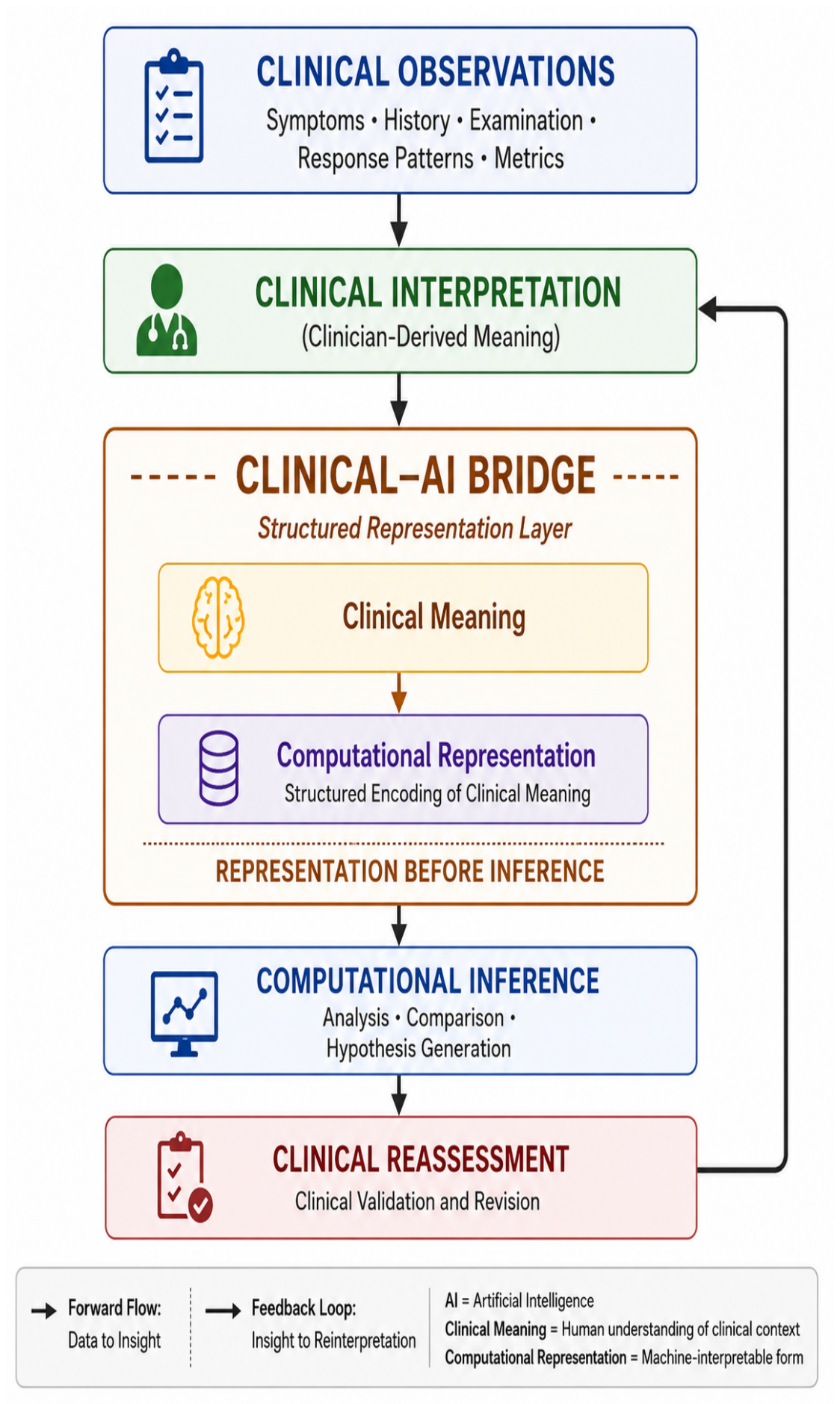
Table 2.
Exampleof mechanism units derived from heterogeneous clinical observations.
| Observation | Mechanism Unit | Clinically Interpreted Meaning |
|---|---|---|
| Aural fullness with pressure discomfort | Pressure-regulatory disturbance | Suggests mechanical or pressure-sensitive contribution |
| Fluctuating hearing difficulty | Impedance- or boundary-condition-related auditory variability | Suggests mechanically mediated auditory fluctuation |
| Intermittent imbalance | Pressure-sensitive vestibulo-auditory expression | Suggests possible mechanical–neural coupling |
| Symptom fluctuation over time | Dynamic regulatory instability | Suggests state-dependent variation rather than fixed disease expression |
| Improvement after ventilation restoration, if observed | Intervention-responsive pressure configuration | Supports pressure-regulatory interpretation without proving a single mechanism |
Table 3.
Example qualitative NVMIA axis profile for the worked patient example.
| Axis | Interpreted Contribution | Rationale |
|---|---|---|
| Neural | Moderate | Imbalance and vestibulo-auditory symptoms require sensory integration and perceptual processing |
| Vascular | Low or uncertain | No specific vascular-dominant evidence is assumed in this example |
| Mechanical | High | Aural fullness, pressure discomfort, fluctuating hearing, and pressure asymmetry suggest pressure-sensitive mechanical contribution |
| Inflammatory | Low to moderate or uncertain | Mucosal compliance or threshold modulation may contribute, but evidence may be incomplete |
| Autonomic | Uncertain | State-dependent variability may suggest autonomic influence, but this remains inferential unless supported by additional context |
Disclaimer/Publisher’s Note: The statements, opinions and data contained in all publications are solely those of the individual author(s) and contributor(s) and not of MDPI and/or the editor(s). MDPI and/or the editor(s) disclaim responsibility for any injury to people or property resulting from any ideas, methods, instructions or products referred to in the content. |
© 2026 by the authors. Licensee MDPI, Basel, Switzerland. This article is an open access article distributed under the terms and conditions of the Creative Commons Attribution (CC BY) license (http://creativecommons.org/licenses/by/4.0/).
Copyright: This open access article is published under a Creative Commons CC BY 4.0 license, which permit the free download, distribution, and reuse, provided that the author and preprint are cited in any reuse.