

Submitted:
03 November 2026
Posted:
05 November 2026
You are already at the latest version
Abstract
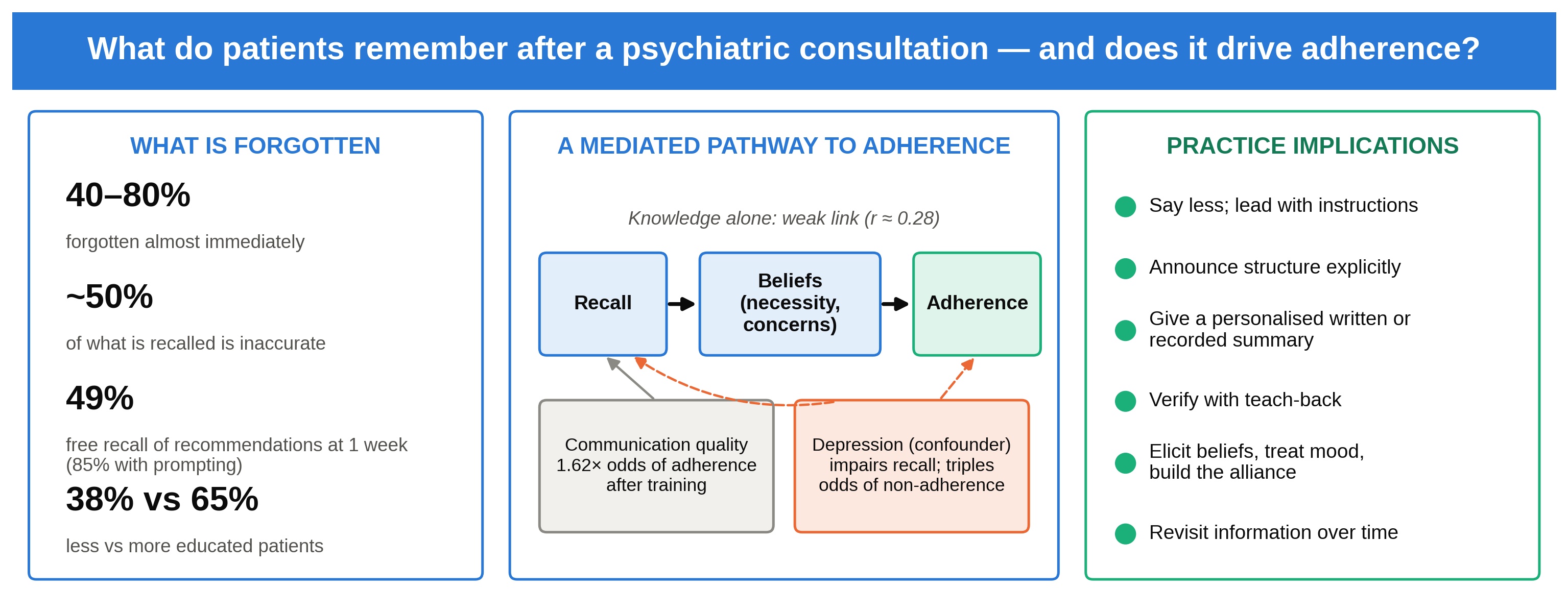
Objective: To synthesise evidence on what patients retain 24 hours and about one week after a psychiatric consultation, the determinants of that retention, whether recall influences treatment adherence, and which interventions improve recall and adherence.Methods: A narrative review, structured according to SANRA criteria, of systematic reviews, meta-analyses, randomised trials and observational studies, prioritising studies that verified recall against recorded consultation content. Evidence was organised around a causal model running from communication through encoding, retention, comprehension, beliefs and intention to adherence.Results: Across medical settings, 40–80% of consultation information is forgotten almost immediately and about half of what is recalled is inaccurate. At one week, only 49% of decisions and recommendations are freely and accurately recalled (85% with prompting), with a steep educational gradient (38% vs 65%). Direct data at 24 hours, and psychiatry-specific data at either interval, are scarce. Disorder-related deficits in effortful encoding (depression) and free recall (schizophrenia; d = 1.21 vs 0.64 for recognition) compound ordinary forgetting. Communication quality predicts adherence (19% higher risk of non-adherence with poor communicators; 1.62-fold higher odds after training; OR 5.82 for conversational repair in schizophrenia), but knowledge correlates only weakly with adherence and is outweighed by necessity–concern beliefs, insight, depression and alliance. Personalised recordings, written material, explicit structuring and teach-back reliably improve recall but improve adherence inconsistently.Conclusion: Recall is a necessary but insufficient condition for adherence in psychiatry; its link to behaviour is heavily mediated by beliefs and confounded by mood.Practice implications: Psychiatrists should engineer recall deliberately—limit and prioritise content, structure it explicitly, provide personalised written or recorded summaries and verify understanding with teach-back—while simultaneously addressing medication beliefs, mood and the therapeutic alliance.
Keywords:
patient recall
; memory
; psychiatry
; medication adherence
; physician–patient communication
; health literacy
; teach-back
1. Introduction
Every psychiatric consultation is, among other things, an act of information transfer. A diagnosis is named or withheld, a medication is started or changed, a risk is discussed and a plan is agreed. For any of this to shape what a patient does after leaving the room, it must first be encoded, retained and retrievable. Ley's cognitive model of communication places memory alongside understanding and satisfaction as a determinant of adherence [1], a framing that still organises the field [2].
The stakes are unusually high in psychiatry. Non-adherence is among the most important modifiable risk factors for relapse in psychotic disorders [3], and its prevalence across major psychiatric disorders is high enough that modest gains in the consultation process could have population-level consequences [4,5]. If a meaningful fraction of non-adherence originates in information that was never retained, recall is a tractable clinical target. If, conversely, non-adherence is driven mainly by beliefs, side-effect experience, insight and circumstance, improving recall alone will disappoint—as several knowledge-focused trials have [6].
Yet recall has been studied far less in mental health settings than in oncology, primary care and surgery, even though the disorders being treated impair the very cognitive processes on which recall depends. This review therefore addresses three linked questions: (i) what do patients remember 24 hours and one week after a psychiatric consultation; (ii) what distinguishes patients who remember from those who do not; and (iii) does recall influence adherence, and through what mechanism? We also appraise interventions that target recall and their downstream behavioural effects.
2. Methods
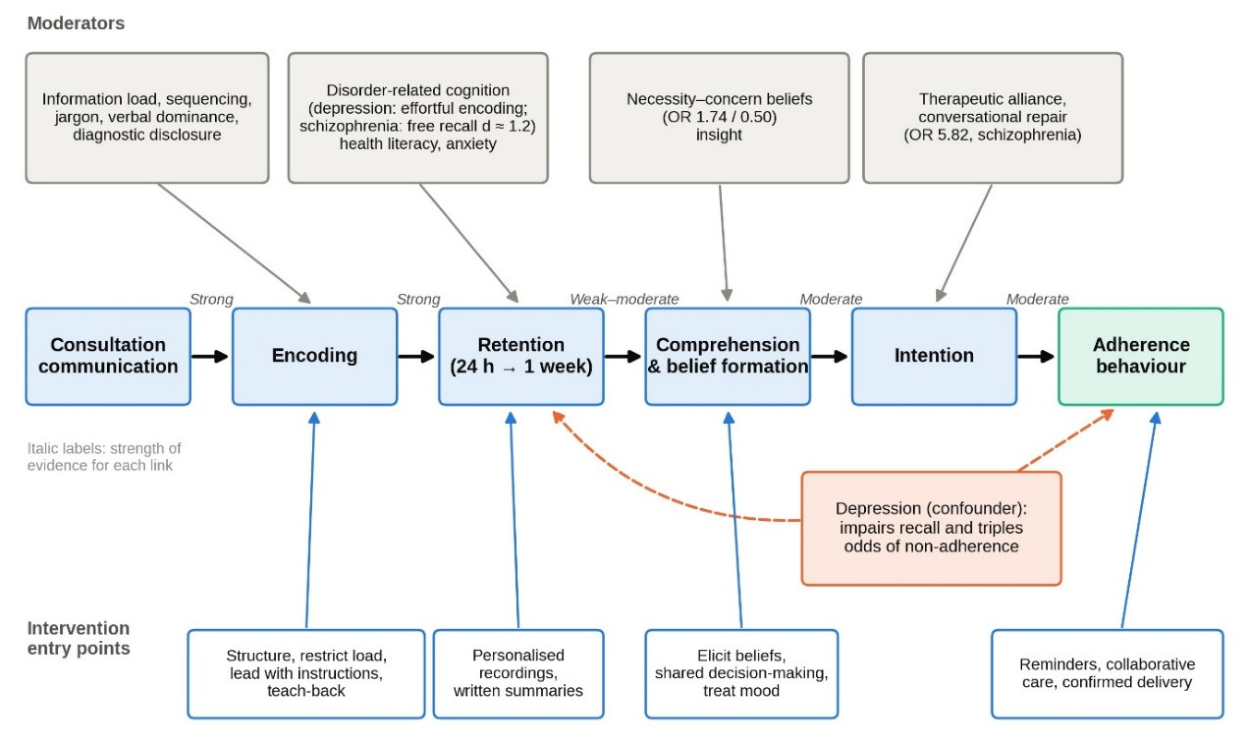
This narrative review was structured according to the Scale for the Assessment of Narrative Review Articles (SANRA) [7]. Literature was identified through searches of PubMed/MEDLINE, Scopus and Google Scholar up to November 2025, combining terms for recall and memory (e.g., “patient recall”, “memory for medical information”, “information retention”), consultation and communication, psychiatric disorders, and adherence, supplemented by backward and forward citation tracking of key systematic reviews [8,9,10]. We prioritised systematic reviews and meta-analyses, randomised controlled trials, and observational studies in which recall was scored against audio-recorded or transcribed consultation content. Foundational and highly cited studies were retained where they remain the primary source for a finding; less-cited studies were included only where they supplied evidence unavailable elsewhere, such as the only direct comparison of telephone and face-to-face recall [11] and the largest survey of recall among recipients of electroconvulsive therapy (ECT) [12]. Because few studies were conducted in psychiatric populations, evidence from other specialties was used to establish mechanisms and is explicitly identified as indirect. Evidence was organised around a causal model running from consultation communication to encoding, retention, comprehension and belief formation, intention, and adherence behaviour (Figure 1). No quantitative pooling was attempted because recall intervals, prompting procedures and adherence measures were heterogeneous.
Figure 1.
Conceptual model of the pathway from consultation communication to adherence. Solid arrows show the hypothesised causal chain, with the strength of evidence for each link in italics; grey boxes show moderators; the dashed orange arrows show depression acting as a confounder of the recall–adherence association; blue boxes show intervention entry points.
Figure 1.
Conceptual model of the pathway from consultation communication to adherence. Solid arrows show the hypothesised causal chain, with the strength of evidence for each link in italics; grey boxes show moderators; the dashed orange arrows show depression acting as a confounder of the recall–adherence association; blue boxes show intervention entry points.
3. Why Consultations are Forgotten
3.1. The Baseline Problem
The amount of information correctly recalled by patients is strikingly small: 40–80% of medical information is forgotten almost immediately, and about half of what is recalled is inaccurate [2,13]. In a rheumatology clinic, total recall was 40%, and patients misconstrued 48% of what they believed they remembered [14]. Given the limits of short-term memory, most verbally presented instruction will not be recalled even if it is initially encoded; memory improves when retrieval cues are provided, which is the mechanistic case for printed instructions available for later review [15].
3.2. Information Load, Primacy, Importance and Specificity
Recall is an inverse function of volume: the more information presented, the lower the proportion recalled, and the amount forgotten is a linear function of the amount presented [1,2]. The number of items per visit independently predicted poorer recall in ambulatory specialty care [16], and presenting multiple problems reduced recall in primary care [11]. Which content survives is shaped by primacy—material presented first is better retained [1,17]—and by perceived importance. Diagnostic statements are rated as more important than treatment statements, and recall tracks subjective importance [1,2]. The result is a clinically consequential asymmetry: instructions and advice are forgotten most, because they are perceived as less important and tend to be delivered late [1,14]. Specific, concrete advice is better recalled than general statements [1,2].
3.3. Structure, Emotion and Capacity
Because encoding is organisationally driven, supplying structure at the point of delivery improves retention. Labelled categorisation increased recall in laboratory volunteers and general practice patients [18], and dividing content into explicit chapters with headings increased recall from 5.71 to 8.12 of 28 items (p = 0.005) while improving perceived comprehensibility [19]. Emotion exerts a non-monotonic influence: anxiety and recall are related in an inverted-U fashion, and a clinician who appears worried reduces recall [2]. At least one clinic-based study nevertheless found anxious patients recalling more than relaxed ones [14], a discrepancy that plausibly reflects differences between trait anxiety, state anxiety and the arousal associated with perceived threat.Diagnostic news that is inconsistent with the patient's self-schema is harder to integrate and recall [20], and in depression task-irrelevant emotional processing consumes resources that would otherwise support effortful encoding [21]. Modality matters as well: retention rises steeply from auditory to read to interactively acquired information [13]. Lower educational attainment and health literacy further reduce the capacity available for encoding verbal instructions [13,22].
4. What Is Remembered at 24 Hours and at One Week
4.1. The 24-Hour Window
The 24-hour interval is the least studied window in this literature. Most studies assess recall within minutes or at one to two weeks, so estimates at 24 hours must be reconstructed rather than read off directly. What can be said with confidence is that the steepest losses occur earliest. Patients are frequently unable to recall what they were told within minutes of leaving the consulting room [18], and immediate assessment—asking patients to restate treatment instructions within one minute of the consultation—is feasible and informative [23]. Because forgetting curves are negatively accelerated, most of the information that will ultimately be lost has been lost well before 24 hours. What remains is likely to be dominated by content that was presented first, perceived as important and framed concretely [1,2,17].
Two features of this window matter clinically. First, distortion rivals omission: a patient at 24 hours may hold a confidently held but partly incorrect version of the consultation rather than merely an impoverished one [13,14]. Second, retention favours diagnosis over treatment [14]—precisely the wrong pattern for adherence, because patients are most likely to retain the label and least likely to retain the instruction.
4.2. The One-Week Horizon
The one-week horizon is better documented (Table 1; Figure 2). In 189 audio-recorded outpatient specialty encounters, with patients interviewed a week later, 49% of decisions and recommendations were recalled accurately without prompting, 36% only with a prompt, and 15% erroneously or not at all [16]. Patients with less than high-school education freely recalled 38% of items, compared with 65% among college graduates (p < 0.0001), and both the number of items per visit and the clinician's verbal dominance predicted poorer recall [16]. Much of what appears forgotten at one week is therefore inaccessible to free recall but recoverable with cues—an argument for written and recorded material, which functions as a retrieval cue [15].
Primary care findings are more encouraging. When recorded consultations were compared with recall about 13 days later, patients recalled most important components of both telephone and face-to-face consultations with few errors; reduced recall was associated with presenting multiple problems, brain injury and low memory score, while general practitioners rarely used recall-promoting strategies [11]. In psychologically oriented encounters, recall is poorer: insomnia patients forgot one-third of therapy instructions, with recall as low as 13% for some recommendation types, and in genetic counselling a quarter of patients remembered recommendations that had never been made [20]. Advice about health-behaviour change is particularly poorly recalled [27]. The consistent theme is that the content most relevant to behaviour is the content least likely to survive.
5. Psychiatry-Specific Determinants of Recall
5.1. Disorder-Intrinsic Cognitive Impairment
This factor most clearly distinguishes psychiatric from general medical consultations. In major depressive disorder, an effect-size analysis of 726 patients and 795 controls found the largest effects on episodic encoding and retrieval, with minimal effects on semantic and working memory [24], a pattern that persists in drug-free patients [28]. The deficit is therefore concentrated at exactly the stage on which a consultation depends: the effortful encoding of new verbal material. Depressed patients also preferentially process negative information [21,29]. When medication risks are discussed, this is close to a worst case: adverse content is preferentially encoded while the broader message is not.
In schizophrenia, deficits are larger. Verbal memory impairments are common, moderate to severe, and not simply an artefact of encoding failure [30], and working memory is affected across verbal, visuospatial and central executive components [31]. Effect sizes of d = 1.00–1.27 have been reported for immediate encoding and 30-minute recall of verbal and visual material [32]. Free recall is impaired about twice as strongly as recognition (d = 1.21 vs 0.64), and patients do not typically show rapid forgetting of material actually learned [25]; the difficulty lies in acquisition and free retrieval, with better performance under cued or recognition conditions [33]. Three consequences follow. Orally delivered information is likely to be poorly encoded irrespective of presentation quality; open questions such as “do you remember what we discussed?” understate what the patient knows; and written or recorded material that supports recognition should be disproportionately valuable [34]. Acute agitation or distress further limits recall, and the same content reviewed later, when the patient is calmer, may be better absorbed [34].
5.2. What Psychiatrists Say, and How
Recall cannot exceed what was communicated. Among 230 psychiatric inpatients, those with schizophrenia received diagnostic information less often and less comprehensively; the label was often paraphrased or withheld, and only 26% of patients with affective disorders or schizophrenia accepted a medical disease concept, whereas psychiatrists favoured a biological concept in over 90% of cases [35]. Psychiatrists vary substantially in how far they involve patients in decisions, independently of visit length [36,37], and only about half of decisions in medication check-up visits meet minimum criteria for shared decision-making [38]. Where patients are not involved, the information exchanged is thinner and less personally relevant, and personal relevance largely determines whether information is processed deeply enough to be stored [39].
5.3. Health Literacy and Companions
Lower health literacy is associated with poorer recall of verbally conveyed instructions [22]. Among 395 primary care patients, 70.7% of those with low literacy could state “take two tablets by mouth twice daily” but only 34.7% could demonstrate the number of pills to take each day; low literacy (adjusted RR 2.32) and taking five or more medications (adjusted RR 2.98) independently predicted misunderstanding [26]. Even unambiguous prescription instructions are interpreted inconsistently, with error rates of 9–64% across five instructions [40], and around one in five adults in the United States reads at or below a fifth-grade level [41]. In psychiatry, where polypharmacy and titration are common, such failures translate directly into dosing errors. Companions can increase understanding and involvement in decision-making [42], and professional guidelines recommend involving families and carers in information and consent processes where the patient agrees [43].
6. How Recall Is Measured—And Why It Changes the Answer
Apparent inconsistencies in this literature are often artefacts of measurement. Free recall yields markedly lower estimates than cued or recognition formats [44], a difference magnified in schizophrenia [25]. Permitting prompts moves one-week estimates from 49% to about 85% [16], and assessment timing ranges from one minute [23] to about two weeks [11], capturing different degrees of decay and reconstruction. Adherence measurement is equally problematic. Self-report correlates only moderately with electronic monitoring (pooled r ≈ 0.45) and produced the higher estimate in 45 of 49 discordant comparisons [45]. In one direct comparison, mean adherence was 85% by self-report but 62% by electronic monitoring [46], and across 251 comparisons, self-report overestimated median adherence by 17% [47], and interview-based self-reports do not concord with electronic measures [48]. Self-report remains the only feasible routine method that distinguishes intentional from unintentional non-adherence [49], but any recall–adherence link resting on self-report alone should be interpreted cautiously.
7. Does Recall Influence Adherence?
7.1. Communication Quality: The Strongest Evidence
Ley's model treats memory as one pillar supporting adherence [2], and poor memory for visit content has been linked to incorrect or incomplete execution of recommendations [27]. The chain from encoding to behaviour is long, however, and each link attenuates (Figure 1). The most robust quantitative evidence concerns communication quality, which partly determines what is available to be recalled. A meta-analysis of 106 correlational studies and 21 experimental interventions found a 19% higher risk of non-adherence among patients of poor communicators and 1.62-fold higher odds of adherence when physicians received communication training [50]. Condition-specific studies converge. In HIV care, each 10-point improvement in general communication was associated with 15% higher odds of a one-level improvement in adherence (OR 1.15) [51], and in primary care, higher patient-reported physician–patient concordance was associated with one-third greater medication compliance (OR 1.34, 95% CI 1.04–1.72) [52].
The psychiatric evidence is narrower but striking. In schizophrenia, patients' requests for clarification of the psychiatrist's talk, and the clarification provided, were associated with adherence six months later (OR 5.82, 95% CI 1.31–25.82) [53]. This process of conversational “repair”—resolving problems of speaking, hearing and understanding—is a mechanism for building shared understanding [54] and is the most direct psychiatric evidence that mutual comprehension, a close relative of recall, predicts adherence. A systematic review of alliance and communication in mental health care supports agreement on treatment tasks and collaborative communication styles [55], and a positive therapeutic relationship predicts improvement during pharmacotherapy [56]. Tellingly, in bipolar disorder, patients who felt helped and respected by their psychiatrists were more likely to be adherent, whereas the extent to which risks and benefits were discussed was not associated with adherence [57]. The relational dimensions of communication may therefore matter more for behaviour than the transmission of risk information—the very content that recall studies tend to measure.
7.2. Knowledge, Beliefs and Insight
Knowledge relates to adherence, but modestly. Higher disease knowledge was associated with lower odds of non-adherence in type 2 diabetes (OR 0.87) [58]; in hypertension, knowledge correlated with adherence at r = 0.28 and attitude at r = 0.41, and the full model explained only 15.8% of the variance [59]. Medication knowledge nonetheless matters as one of the more modifiable non-financial barriers [60]. Knowledge is also fragmented: among 187 cardiovascular outpatients, knowledge of the regimen and its purpose was highest, fewer knew what to do after a missed dose, and few could identify common side effects [61]. A patient may therefore “know” their medication and still not know what to do in precisely the situation in which adherence fails. Improving medication knowledge alone generally does not improve adherence, as two trials of an electronic record tool and a tailored decision aid illustrate [6].
The Necessity–Concerns Framework explains why. Stronger perceived necessity (OR 1.74) and fewer concerns (OR 0.50) predict adherence robustly across conditions and adherence measures [62], and the two belief types act independently [63,64]. Meta-analytic tests of the common-sense model confirm that necessity and concern beliefs predict adherence independently of illness perceptions [65], whereas broad illness beliefs relate only weakly to adherence, with explanatory power increasing as beliefs become more specific to the behaviour in question [66]. A consultation that transmits facts about a medication without engaging with whether the patient believes they need it, and what they fear about it, may raise knowledge scores while leaving adherence unchanged. Insight shows a moderately consistent association with adherence: nine of 15 cross-sectional studies in one systematic review found an association [67], poor insight predicts discontinuation in first-episode psychosis [68], and in a one-year European cohort insight correlated with alliance (r = 0.38–0.48) and, on path analysis, positively influenced both adherence and alliance [69]. Negative attitudes towards medication consistently predict discontinuation and are themselves most strongly predicted by insight [70], and several reviews conclude that attitudes and beliefs about medication, rather than insight per se, are the most important predictors of adherence [71].
7.3. Depression as a Confounder
Depression both impairs recall [21,24] and independently triples the odds of non-adherence to medical treatment [72]; in diabetes, its weighted correlation with non-adherence is 0.21, largest for appointment-keeping (r = 0.31) and smallest for medication-taking (r = 0.14) [73]. An observed association between poor recall and poor adherence may therefore be substantially confounded by depression severity. This does not dismiss recall as a target; rather, it predicts that recall interventions that ignore mood will underperform, and that treating depression is itself an adherence intervention—adherence interventions in depressive disorders are effective for up to six months, with the largest benefit in patients with comorbid depression and anxiety (OR 2.77) and collaborative care the most effective model (OR 1.88) [74].
7.4. Where the Chain Breaks
Non-adherence to antipsychotics is common—around 40–50% in methodologically stronger studies [75,76]—and clinicians substantially underestimate it: in one sample, 56.5% of patients reported non-adherence whereas psychiatrists judged only 6% non-adherent [77]. Three lines of evidence show that recall and knowledge are insufficient to address it. First, purely educational interventions are the weakest performers in schizophrenia. Psychoeducation without behavioural components is unlikely to improve adherence, whereas motivational interviewing, assertive community treatment, concrete problem-solving, reminders and self-monitoring are more promising, with booster sessions needed because problems recur [78]; combined educational, behavioural and affective strategies improved adherence in 8 of 12 studies [79]. Second, structured adherence therapy has not outperformed control conditions in a systematic review [80] or in a 52-week multicentre randomised trial [81], and a meta-analysis of 23 publications found no difference between intervention types (I² = 19.9%), favouring behavioural–educational combinations that are easy to implement [82]. Third, where delivery rather than knowledge is secured, outcomes change: oral and long-acting injectable antipsychotics do not differ in efficacy when oral medication is taken consistently, and the advantage of injectables lies largely in clinician-confirmed administration [83], with better adherence and lower relapse and hospitalisation rates [84,85]. Similarly, dropout from competently delivered internet interventions for anxiety and depression reaches 50% in some trials [86]: the failure is behavioural, not informational.
8. Interventions That Target Recall
Table 2 summarises the principal interventions and the evidence for their effects on recall and on adherence.
8.1. Written Information
Written information reliably improves knowledge and satisfaction. Among 719 patients interviewed one to two weeks after a prescription, leaflet recipients were better informed on every item tested except the drug name, with the greatest gain in awareness of side effects and no evidence of spurious side-effect reporting; at one year, 97% had read and 70% had kept their leaflets [87]. Written material helps patients remember what was said and reduces unnecessary requests, although much of what is available fails basic quality criteria [101], and a Cochrane review found mostly favourable effects on side-effect knowledge [88]. Evidence that written information changes adherence is thin relative to the volume of material produced [89], and written strategies help less when health literacy is limited [90]; verbal reinforcement and demonstration therefore remain necessary.
8.2. Consultation Recordings
Recording the patient's own consultation is among the most consistently effective recall interventions. Personalised recordings add value over oral information alone, whereas generic recordings do not and may even inhibit recall [9]. Across 25 studies in patients aged 50 years and over, recordings improved satisfaction, recall, fulfilment of information needs and decision-making, with only minor negative effects [91], and successful integration requires a systematic, administratively supported approach [102]. Recordings can also be shared with family members to support decision-making [90]. In psychiatry, they could help patients retain self-help strategies, medication advice and safety plans, and allow the encounter to be reviewed when the patient is calmer [34]—a rationale well matched to the recognition-sparing profile described in Section 5.1, because a recording converts a one-off, poorly encoded message into a repeatedly accessible resource.
8.3. Structure, Teach-Back, Prompt Sheets and Decision Aids
Explicit structuring improves recall and perceived comprehensibility [18,19]; simpler language, explicit categorisation, repetition and concrete rather than abstract statements are the principal levers for reducing the amount forgotten [1]. Teach-back improves knowledge and self-care across 20 studies of moderate quality, although implementation strategies are rarely reported [92]. Question prompt sheets increase the number of questions asked about tests and treatment [93], but the recall benefit depends on the clinician actively endorsing the sheet [9]; a Cochrane review of pre-consultation interventions likewise found gains in participation and information-seeking [103]. Decision aids improve participation and decision quality across 23 oncology trials [94]. In psychiatry, two cluster randomised trials of decision aids for depression and post-traumatic stress disorder found no effect on adherence but improved satisfaction and perceived involvement, whereas an online aid for young people with depression was associated with better adherence [95]. Shared decision-making is feasible in serious mental illness [104], and patients' own accounts show how often the content of such discussions is only partially registered [105]. The consistent pattern is that participatory interventions improve experience and knowledge reliably, and adherence inconsistently.
8.4. Communication Skills Training
Because recall depends on what is said and how, training clinicians is a plausible upstream intervention. An eight-hour programme changed physicians' interviewing behaviour without lengthening visits and reduced patients' emotional distress for up to six months [106], and a large-scale programme improved patient-reported communication and respect scores [107]. Training improved patients' health literacy and medication adherence in a randomised trial [97], and most studies measuring recall or disease knowledge found gains among patients of trained clinicians [96]. The meta-analytic finding of 1.62-fold higher odds of adherence after training [50] is the strongest single piece of evidence that modifying the consultation changes behaviour, and it operates through clarity, participation and relationship, of which recall is only one channel [55].
8.5. Memory Support and Reminders
Memory for therapy content is poor [20], and a structured approach to memory support—including a rating scale for clinicians' memory-supporting behaviours and free-recall assessment at repeated time points—has been developed in psychotherapy research [108]. Its organising hypothesis, that improving memory for treatment improves outcome [27], is precisely the hypothesis this review examines for the psychiatric consultation. Reminders act on the intention–behaviour gap rather than on encoding, but can compensate for content that was never retained. Text-message reminders improve appointment-keeping in mental health services [100] and are acceptable to people with psychosis without requiring smartphones [109]. In a randomised trial of 254 poorly adherent outpatients with schizophrenia, daily reminders improved Morisky–Green scores at three months, chiefly by reducing the tendency to stop medication when feeling better (45% vs 59%) [99].
8.6. Structured Consent: Electroconvulsive Therapy
ECT is the psychiatric intervention in which recall of consultation content carries the most direct ethical weight. In earlier reviews, at least half of service users felt inadequately informed, and only 7–16% were judged to have full knowledge of what the procedure involved [110]. In a survey of 858 recipients across 44 countries, 63% recalled being told that ECT can cause temporary memory problems but only 17% recalled being told about long-term memory problems [12]. Because ECT itself impairs memory, some forgetting is expected, but the proportion who feel misinformed makes it unlikely to explain all cases; repeating information before each treatment has been recommended [111], and professional guidelines specify the content to be conveyed and advise involving carers and documenting consent and its withdrawal [43]. Structured consent improved knowledge recalled before ECT, but knowledge declined after the course in both structured and control groups, and Mini-Mental State Examination scores correlated with recall (r = 0.43–0.53) [98]. Consent obtained in a single, cognitively compromised encounter is a weak foundation; recall must be re-established over the course of treatment rather than assumed at the outset.
9. Discussion
9.1. Principal Findings
Three conclusions emerge. First, the recall problem is large, early and content-selective, and psychiatric disorders worsen it by impairing encoding and free retrieval. Second, the recall–adherence pathway is real but heavily mediated and confounded: communication quality and the repair of misunderstanding predict adherence [50,53], but knowledge correlates only weakly with it [59], and necessity–concern beliefs [62], insight [67], alliance [55,56] and depression [72] each carry independent weight. Third, the interventions with the best recall evidence—written material, recordings, structure and teach-back—are not those with the best adherence evidence, which are behavioural, relational and multi-component [50,74,78,79]. Recall should therefore be pursued for its own sake, as a precondition of informed consent and shared decision-making, but should not be expected to deliver adherence alone.
9.2. Relation to Previous Reviews
Earlier systematic reviews examined recall interventions in general healthcare [8] and cancer care [9], and the effects of physicians' information-giving on patient outcomes [10], while meta-analyses quantified the communication–adherence relationship [50]. None integrated recall research with the cognitive profile of psychiatric disorders or tested the recall–adherence pathway against its mediators and confounders. The present review adds a psychiatry-specific causal framework (Figure 1), identifies the 24-hour interval as an almost entirely unmeasured window, and shows why interventions that succeed on recall endpoints frequently fail on adherence endpoints.
9.3. Limitations
Direct measurement at 24 hours is rare, and psychiatry-specific recall data at either interval are scarce, so several estimates are extrapolated from other specialties in which anxiety, cognition and consultation content differ. Heterogeneity in prompting, question format, timing and adherence measurement precluded pooling. As a narrative review, study selection was not exhaustive and is susceptible to selection bias, which we sought to mitigate by prioritising systematic reviews and objectively verified recall.
9.4. Research Agenda
Priorities are (i) prospective cohorts in general adult, first-episode psychosis and mood-disorder clinics that measure recall at fixed 24-hour and 7-day intervals against coded transcripts; (ii) designs that separate free recall, cued recall and recognition [25,44]; (iii) objective adherence measures alongside self-report [45,47]; (iv) formal mediation models adjusting for depression, beliefs, insight and alliance; (v) randomised trials of personalised consultation recordings with adherence as the primary endpoint, noting that information-giving improved behavioural outcomes in 8 of 9 studies while recall improved in only 4 of 10 [10]; and (vi) theory-based recall interventions [8], including adaptation of memory-support methods developed in psychotherapy research [108]. Standardised reporting of recall timing, prompting, question format and adherence measurement would, in turn, allow the pooling that heterogeneity currently prevents [16,82].
10. Conclusions
Patients forget most of what is said in a psychiatric consultation, and the content most likely to be lost—instructions about treatment—is the content most likely to govern behaviour. Recall is a necessary but demonstrably insufficient condition for adherence: its first link is well evidenced, its middle links are heavily mediated by beliefs and mood, and its final link remains, in psychiatric populations, substantially unmeasured.
10.1. Practice Implications
Clinicians can engineer recall by limiting information load, leading with instructions, announcing structure (“first your diagnosis, then your medication, then what to do if you feel worse”), framing advice concretely, providing a personalised written or recorded summary, verifying understanding with teach-back rather than asking “any questions?”, involving carers with the patient's consent, and revisiting key information over time. Because recall alone rarely changes behaviour, the same consultation should elicit the patient's beliefs about need and concerns, attend to mood and invest in the therapeutic alliance. Finally, diagnoses should be disclosed transparently: information withheld cannot be recalled, and diagnostic disclosure is generally reported to carry benefit without significant evidence of harm [112].
Author Contributions
Sushil Kumar Sompur Vasanthkumar: Conceptualization; Methodology; Investigation; Visualization; Writing – original draft; Writing – review & editing; Project administration.
Funding
This research did not receive any specific grant from funding agencies in the public, commercial, or not-for-profit sectors.
Data Availability Statement
No data was used for the research described in the article.
Conflicts of Interest
The author declares that he has no known competing financial interests or personal relationships that could have appeared to influence the work reported in this paper.
Ethics Approval and Consent
Not applicable. This article is a review of previously published literature and did not involve human participants, human data or animals; ethical approval and informed consent were therefore not required.
Declaration of Generative AI and AI-Assisted Technologies in the Manuscript Preparation Process
During the preparation of this work the author used Claude (Anthropic) to assist with restructuring, condensing and language editing of the manuscript and with preparing the figures. After using this tool, the author reviewed and edited the content as needed and takes full responsibility for the content of the publication.
References
- Ley, P. Memory for medical information. Br. J. Soc. Clin. Psychol. 1979, 18, 245–55. [Google Scholar] [CrossRef] [PubMed]
- Kessels, R.P.C. Patients' memory for medical information. J. R Soc. Med. 2003, 96, 219–22. [Google Scholar] [CrossRef]
- Kirson, N.Y.; Weiden, P.J.; Yermakov, S.; Huang, W.; Samuelson, T.; Offord, S.J.; et al. Efficacy and effectiveness of depot versus oral antipsychotics in schizophrenia: synthesizing results across different research designs. J. Clin. Psychiatry 2013, 74, 568–75. [Google Scholar] [CrossRef] [PubMed]
- Semahegn, A.; Torpey, K.; Manu, A.; Assefa, N.; Tesfaye, G.; Ankomah, A. Psychotropic medication non-adherence and its associated factors among patients with major psychiatric disorders: a systematic review and meta-analysis. Syst. Rev. 2020, 9, 17. [Google Scholar] [CrossRef] [PubMed]
- Nosè, M.; Barbui, C.; Tansella, M. How often do patients with psychosis fail to adhere to treatment programmes? A systematic review. Psychol. Med. 2003, 33, 1149–60. [Google Scholar] [CrossRef] [PubMed]
- Hartch, C.E.; Dietrich, M.S.; Lancaster, B.J.; Stolldorf, D.P.; Mulvaney, S.A. Effects of a medication adherence app among medically underserved adults with chronic illness: a randomized controlled trial. J. Behav. Med. 2024, 47, 389–404. [Google Scholar] [CrossRef] [PubMed]
- Baethge, C.; Goldbeck-Wood, S.; Mertens, S. SANRA—a scale for the quality assessment of narrative review articles. Res. Integr. Peer Rev. 2019, 4, 5. [Google Scholar] [CrossRef] [PubMed]
- Watson, P.W.B.; McKinstry, B. A systematic review of interventions to improve recall of medical advice in healthcare consultations. J. R Soc. Med. 2009, 102, 235–43. [Google Scholar] [CrossRef] [PubMed]
- van der Meulen, N.; Jansen, J.; van Dulmen, S.; Bensing, J.; van Weert, J. Interventions to improve recall of medical information in cancer patients: a systematic review of the literature. Psychooncology 2008, 17, 857–68. [Google Scholar] [CrossRef] [PubMed]
- Lie, H.C.; Juvet, L.K.; Street, R.L., Jr.; Gulbrandsen, P.; Mellblom, A.V.; Brembo, E.A.; et al. Effects of physicians' information giving on patient outcomes: a systematic review. J. Gen. Intern Med. 2022, 37, 651–63. [Google Scholar] [CrossRef] [PubMed]
- McKinstry, B.; Hammersley, V.; Burton, C.; Pinnock, H.; Elton, R.; Dowell, J.; et al. Comparison of the accuracy of patients' recall of the content of telephone and face-to-face consultations: an exploratory study. Postgrad. Med. J. 2011, 87, 394–9. [Google Scholar] [CrossRef] [PubMed]
- Read, J.; Harrop, C.; Morrison, L.; Hancock, S.; Johnstone, L.; Cunliffe, S. A large exploratory survey of electroconvulsive therapy recipients, family members and friends: what information do they recall being given? J. Med. Ethics 2026, 52, 77–84. [Google Scholar] [CrossRef] [PubMed]
- Timmers, T.; Janssen, L.; Pronk, Y.; van der Zwaard, B.C.; Koëter, S.; van Oostveen, D.; et al. Assessing the efficacy of an educational smartphone or tablet app with subdivided and interactive content to increase patients' medical knowledge: randomized controlled trial. JMIR Mhealth Uhealth 2018, 6, e10742. [Google Scholar] [CrossRef] [PubMed]
- Anderson, J.L.; Dodman, S.; Kopelman, M.; Fleming, A. Patient information recall in a rheumatology clinic. Rheumatol. Rehabil. 1979, 18, 18–22. [Google Scholar] [CrossRef] [PubMed]
- Sandberg, E.H.; Sharma, R.; Sandberg, W.S. Deficits in retention for verbally presented medical information. Anesthesiology 2012, 117, 772–9. [Google Scholar] [CrossRef] [PubMed]
- Laws, M.B.; Lee, Y.; Taubin, T.; Rogers, W.H.; Wilson, I.B. Factors associated with patient recall of key information in ambulatory specialty care visits: results of an innovative methodology. PLoS ONE 2018, 13, e0191940. [Google Scholar] [CrossRef] [PubMed]
- Ley, P. Primacy, rated importance, and the recall of medical statements. J. Health Soc. Behav. 1972, 13, 311–7. [Google Scholar] [CrossRef]
- Ley, P.; Bradshaw, P.W.; Eaves, D.; Walker, C.M. A method for increasing patients' recall of information presented by doctors. Psychol. Med. 1973, 3, 217–20. [Google Scholar] [CrossRef] [PubMed]
- Langewitz, W.; Ackermann, S.; Heierle, A.; Hertwig, R.; Ghanim, L.; Bingisser, R. Improving patient recall of information: harnessing the power of structure. Patient Educ. Couns. 2015, 98, 716–21. [Google Scholar] [CrossRef] [PubMed]
- Harvey, A.G.; Lee, J.; Williams, J.; Hollon, S.D.; Walker, M.P.; Thompson, M.A.; et al. Improving outcome of psychosocial treatments by enhancing memory and learning. Perspect. Psychol. Sci. 2014, 9, 161–79. [Google Scholar] [CrossRef] [PubMed]
- Gotlib, I.H.; Joormann, J. Cognition and depression: current status and future directions. Annu Rev. Clin. Psychol. 2010, 6, 285–312. [Google Scholar] [CrossRef] [PubMed]
- McCarthy, D.M.; Waite, K.R.; Curtis, L.M.; Engel, K.G.; Baker, D.W.; Wolf, M.S. What did the doctor say? Health literacy and recall of medical instructions. Med. Care 2012, 50, 277–82. [Google Scholar] [CrossRef] [PubMed]
- Selič, P.; Svab, I.; Repolusk, M.; Gucek, N.K. What factors affect patients' recall of general practitioners' advice? BMC Fam. Pract. 2011, 12, 141. [Google Scholar] [CrossRef] [PubMed]
- Zakzanis, K.K.; Leach, L.; Kaplan, E. On the nature and pattern of neurocognitive function in major depressive disorder. Neuropsychiatry Neuropsychol. Behav. Neurol. 1998, 11, 111–9. [Google Scholar] [PubMed]
- Palmer, B.W.; Dawes, S.E.; Heaton, R.K. What do we know about neuropsychological aspects of schizophrenia? Neuropsychol. Rev. 2009, 19, 365–84. [Google Scholar] [CrossRef] [PubMed]
- Davis, T.C.; Wolf, M.S.; Bass, P.F., 3rd; Thompson, J.A.; Tilson, H.H.; Neuberger, M.; et al. Literacy and misunderstanding prescription drug labels. Ann. Intern Med. 2006, 145, 887–94. [Google Scholar] [CrossRef] [PubMed]
- Lee, J.Y.; Harvey, A.G. Memory for therapy in bipolar disorder and comorbid insomnia. J. Consult Clin. Psychol. 2015, 83, 92–102. [Google Scholar] [CrossRef] [PubMed]
- Porter, R.J.; Gallagher, P.; Thompson, J.M.; Young, A.H. Neurocognitive impairment in drug-free patients with major depressive disorder. Br. J. Psychiatry 2003, 182, 214–20. [Google Scholar] [CrossRef] [PubMed]
- Price, R.B.; Duman, R. Neuroplasticity in cognitive and psychological mechanisms of depression: an integrative model. Mol. Psychiatry 2020, 25, 530–43. [Google Scholar] [CrossRef] [PubMed]
- Bowie, C.R.; Harvey, P.D. Cognitive deficits and functional outcome in schizophrenia. Neuropsychiatr. Dis. Treat. 2006, 2, 531–6. [Google Scholar] [CrossRef] [PubMed]
- Barch, D.M. The cognitive neuroscience of schizophrenia. Annu Rev. Clin. Psychol. 2005, 1, 321–53. [Google Scholar] [CrossRef] [PubMed]
- Skelley, S.L.; Goldberg, T.E.; Egan, M.F.; Weinberger, D.R.; Gold, J.M. Verbal and visual memory: characterizing the clinical and intermediate phenotype in schizophrenia. Schizophr. Res. 2008, 105, 78–85. [Google Scholar] [CrossRef] [PubMed]
- Gur, R.E.; Calkins, M.E.; Gur, R.C.; Horan, W.P.; Nuechterlein, K.H.; Seidman, L.J.; et al. The Consortium on the Genetics of Schizophrenia: neurocognitive endophenotypes. Schizophr. Bull. 2007, 33, 49–68. [Google Scholar] [CrossRef] [PubMed]
- Hewson, T.; Abraham, S.; Randles, N.; Akinola, A.; Cliff, R.; Byrne, P.; et al. The recording of mental health consultations by patients: clinical, ethical and legal considerations. BJPsych Bull. 2022, 46, 133–7. [Google Scholar] [CrossRef] [PubMed]
- Luderer, H.J.; Böcker, F.M. Clinicians' information habits, patients' knowledge of diagnoses and etiological concepts in four different clinical samples. Acta Psychiatr. Scand. 1993, 88, 266–72. [Google Scholar] [CrossRef] [PubMed]
- Goss, C.; Moretti, F.; Mazzi, M.A.; Del Piccolo, L.; Rimondini, M.; Zimmermann, C. Involving patients in decisions during psychiatric consultations. Br. J. Psychiatry 2008, 193, 416–21. [Google Scholar] [CrossRef] [PubMed]
- McCabe, R.; Khanom, H.; Bailey, P.; Priebe, S. Shared decision-making in ongoing outpatient psychiatric treatment. Patient Educ. Couns. 2013, 91, 326–8. [Google Scholar] [CrossRef] [PubMed]
- Salyers, M.P.; Matthias, M.S.; Fukui, S.; Holter, M.C.; Collins, L.; Rose, N.; et al. A coding system to measure elements of shared decision making during psychiatric visits. Psychiatr. Serv. 2012, 63, 779–84. [Google Scholar] [CrossRef] [PubMed]
- Posma, E.R.; van Weert, J.C.; Jansen, J.; Bensing, J.M. Older cancer patients' information and support needs surrounding treatment: an evaluation through the eyes of patients, relatives and professionals. BMC Nurs. 2009, 8, 1. [Google Scholar] [CrossRef] [PubMed]
- Mazzullo, J.M.; Lasagna, L.; Griner, P.F. Variations in interpretation of prescription instructions: the need for improved prescribing habits. JAMA 1974, 227, 929–31. [Google Scholar] [CrossRef]
- Doak, C.C.; Doak, L.G.; Friedell, G.H.; Meade, C.D. Improving comprehension for cancer patients with low literacy skills: strategies for clinicians. CA Cancer J. Clin. 1998, 48, 151–62. [Google Scholar] [CrossRef] [PubMed]
- Jansen, J.; van Weert, J.C.; Wijngaards-de Meij, L.; van Dulmen, S.; Heeren, T.J.; Bensing, J.M. The role of companions in aiding older cancer patients to recall medical information. Psychooncology 2010, 19, 170–9. [Google Scholar] [CrossRef] [PubMed]
- Weiss, A.; Hussain, S.; Ng, B.; Sarma, S.; Tiller, J.; Waite, S.; et al. Royal Australian and New Zealand College of Psychiatrists professional practice guidelines for the administration of electroconvulsive therapy. Aust. N Z. J. Psychiatry 2019, 53, 609–23. [Google Scholar] [CrossRef] [PubMed]
- Jansen, J.; van Weert, J.; van der Meulen, N.; van Dulmen, S.; Heeren, T.; Bensing, J. Recall in older cancer patients: measuring memory for medical information. Gerontologist 2008, 48, 149–57. [Google Scholar] [CrossRef] [PubMed]
- Stirratt, M.J.; Dunbar-Jacob, J.; Crane, H.M.; Simoni, J.M.; Czajkowski, S.; Hilliard, M.E.; et al. Self-report measures of medication adherence behavior: recommendations on optimal use. Transl. Behav. Med. 2015, 5, 470–82. [Google Scholar] [CrossRef] [PubMed]
- Wagner, G.J.; Rabkin, J.G. Measuring medication adherence: are missed doses reported more accurately than perfect adherence? AIDS Care 2000, 12, 405–8. [Google Scholar] [CrossRef] [PubMed]
- El Alili, M.; Vrijens, B.; Demonceau, J.; Evers, S.M.; Hiligsmann, M. A scoping review of studies comparing the medication event monitoring system (MEMS) with alternative methods for measuring medication adherence. Br. J. Clin. Pharmacol. 2016, 82, 268–79. [Google Scholar] [CrossRef] [PubMed]
- Garber, M.C.; Nau, D.P.; Erickson, S.R.; Aikens, J.E.; Lawrence, J.B. The concordance of self-report with other measures of medication adherence: a summary of the literature. Med. Care 2004, 42, 649–52. [Google Scholar] [CrossRef] [PubMed]
- Garfield, S.; Clifford, S.; Eliasson, L.; Barber, N.; Willson, A. Suitability of measures of self-reported medication adherence for routine clinical use: a systematic review. BMC Med. Res. Methodol. 2011, 11, 149. [Google Scholar] [CrossRef] [PubMed]
- Zolnierek, K.B.H.; DiMatteo, M.R. Physician communication and patient adherence to treatment: a meta-analysis. Med. Care 2009, 47, 826–34. [Google Scholar] [CrossRef] [PubMed]
- Schneider, J.; Kaplan, S.H.; Greenfield, S.; Li, W.; Wilson, I.B. Better physician-patient relationships are associated with higher reported adherence to antiretroviral therapy in patients with HIV infection. J. Gen. Intern Med. 2004, 19, 1096–103. [Google Scholar] [CrossRef] [PubMed]
- Kerse, N.; Buetow, S.; Mainous, A.G., 3rd; Young, G.; Coster, G.; Arroll, B. Physician-patient relationship and medication compliance: a primary care investigation. Ann. Fam. Med. 2004, 2, 455–61. [Google Scholar] [CrossRef] [PubMed]
- McCabe, R.; Healey, P.G.T.; Priebe, S.; Lavelle, M.; Dodwell, D.; Laugharne, R.; et al. Shared understanding in psychiatrist-patient communication: association with treatment adherence in schizophrenia. Patient Educ. Couns. 2013, 93, 73–9. [Google Scholar] [CrossRef] [PubMed]
- McCabe, R.; Healey, P.G.T. Miscommunication in doctor-patient communication. Top. Cogn. Sci. 2018, 10, 409–24. [Google Scholar] [CrossRef] [PubMed]
- Thompson, L.; McCabe, R. The effect of clinician-patient alliance and communication on treatment adherence in mental health care: a systematic review. BMC Psychiatry 2012, 12, 87. [Google Scholar] [CrossRef] [PubMed]
- Totura, C.M.W.; Fields, S.A.; Karver, M.S. The role of the therapeutic relationship in psychopharmacological treatment outcomes: a meta-analytic review. Psychiatr. Serv. 2018, 69, 41–7. [Google Scholar] [CrossRef] [PubMed]
- Sylvia, L.G.; Hay, A.; Ostacher, M.J.; Miklowitz, D.J.; Nierenberg, A.A.; Thase, M.E.; et al. Association between therapeutic alliance, care satisfaction, and pharmacological adherence in bipolar disorder. J. Clin. Psychopharmacol. 2013, 33, 343–50. [Google Scholar] [CrossRef] [PubMed]
- Sweileh, W.M.; Zyoud, S.H.; Abu Nab'a, R.J.; Deleq, M.I.; Enaia, M.I.; Nassar, S.M.; et al. Influence of patients' disease knowledge and beliefs about medicines on medication adherence: findings from a cross-sectional survey among patients with type 2 diabetes mellitus in Palestine. BMC Public Health 2014, 14, 94. [Google Scholar] [CrossRef] [PubMed]
- Shi, S.; Shen, Z.; Duan, Y.; Ding, S.; Zhong, Z. Association between medication literacy and medication adherence among patients with hypertension. Front Pharmacol. 2019, 10, 822. [Google Scholar] [CrossRef] [PubMed]
- Bazargan, M.; Smith, J.; Yazdanshenas, H.; Movassaghi, M.; Martins, D.; Orum, G. Non-adherence to medication regimens among older African-American adults. BMC Geriatr. 2017, 17, 163. [Google Scholar] [CrossRef] [PubMed]
- Ascione, F.J.; Kirscht, J.P.; Shimp, L.A. An assessment of different components of patient medication knowledge. Med. Care 1986, 24, 1018–28. [Google Scholar] [CrossRef] [PubMed]
- Horne, R.; Chapman, S.C.E.; Parham, R.; Freemantle, N.; Forbes, A.; Cooper, V. Understanding patients' adherence-related beliefs about medicines prescribed for long-term conditions: a meta-analytic review of the Necessity-Concerns Framework. PLoS ONE 2013, 8, e80633. [Google Scholar] [CrossRef] [PubMed]
- Stewart, S.J.F.; Moon, Z.; Horne, R. Medication nonadherence: health impact, prevalence, correlates and interventions. Psychol. Health 2023, 38, 726–65. [Google Scholar] [CrossRef] [PubMed]
- Horne, R.; Weinman, J. Self-regulation and self-management in asthma: exploring the role of illness perceptions and treatment beliefs in explaining non-adherence to preventer medication. Psychol. Health 2002, 17, 17–32. [Google Scholar] [CrossRef]
- Hagger, M.S.; Koch, S.; Chatzisarantis, N.L.D.; Orbell, S. The common sense model of self-regulation: meta-analysis and test of a process model. Psychol. Bull. 2017, 143, 1117–54. [Google Scholar] [CrossRef] [PubMed]
- Aujla, N.; Walker, M.; Sprigg, N.; Abrams, K.; Massey, A.; Vedhara, K. Can illness beliefs, from the common-sense model, prospectively predict adherence to self-management behaviours? A systematic review and meta-analysis. Psychol. Health 2016, 31, 931–58. [Google Scholar] [CrossRef] [PubMed]
- Lincoln, T.M.; Lüllmann, E.; Rief, W. Correlates and long-term consequences of poor insight in patients with schizophrenia: a systematic review. Schizophr. Bull. 2007, 33, 1324–42. [Google Scholar] [CrossRef] [PubMed]
- Lysaker, P.H.; Pattison, M.L.; Leonhardt, B.L.; Phelps, S.; Vohs, J.L. Insight in schizophrenia spectrum disorders: relationship with behavior, mood and perceived quality of life, underlying causes and emerging treatments. World Psychiatry 2018, 17, 12–23. [Google Scholar] [CrossRef] [PubMed]
- Novick, D.; Montgomery, W.; Treuer, T.; Aguado, J.; Kraemer, S.; Haro, J.M. Relationship of insight with medication adherence and the impact on outcomes in patients with schizophrenia and bipolar disorder: results from a 1-year European outpatient observational study. BMC Psychiatry 2015, 15, 189. [Google Scholar] [CrossRef] [PubMed]
- Goff, D.C.; Hill, M.; Freudenreich, O. Strategies for improving treatment adherence in schizophrenia and schizoaffective disorder. J. Clin. Psychiatry 2010, 71 Suppl 2, 20–6. [Google Scholar] [CrossRef] [PubMed]
- Yanos, P.T.; Moos, R.H. Determinants of functioning and well-being among individuals with schizophrenia: an integrated model. Clin. Psychol. Rev. 2007, 27, 58–77. [Google Scholar] [CrossRef] [PubMed]
- DiMatteo, M.R.; Lepper, H.S.; Croghan, T.W. Depression is a risk factor for noncompliance with medical treatment: meta-analysis of the effects of anxiety and depression on patient adherence. Arch. Intern Med. 2000, 160, 2101–7. [Google Scholar] [CrossRef] [PubMed]
- Gonzalez, J.S.; Peyrot, M.; McCarl, L.A.; Collins, E.M.; Serpa, L.; Mimiaga, M.J.; et al. Depression and diabetes treatment nonadherence: a meta-analysis. Diabetes Care 2008, 31, 2398–403. [Google Scholar] [CrossRef] [PubMed]
- González de León, B.; del Pino-Sedeño, T.; Serrano-Pérez, P.; Rodríguez Álvarez, C.; Bejarano-Quisoboni, D.; Trujillo-Martín, M.M. Effectiveness of interventions to improve medication adherence in adults with depressive disorders: a meta-analysis. BMC Psychiatry 2022, 22, 487. [Google Scholar] [CrossRef] [PubMed]
- El Abdellati, K.; De Picker, L.; Morrens, M. Antipsychotic treatment failure: a systematic review on risk factors and interventions for treatment adherence in psychosis. Front Neurosci. 2020, 14, 531763. [Google Scholar] [CrossRef] [PubMed]
- Velligan, D.I.; Weiden, P.J.; Sajatovic, M.; Scott, J.; Carpenter, D.; Ross, R.; et al. The expert consensus guideline series: adherence problems in patients with serious and persistent mental illness. J. Clin. Psychiatry 2009, 70 Suppl 4, 1–46. [Google Scholar] [CrossRef]
- García, S.; Martínez-Cengotitabengoa, M.; López-Zurbano, S.; Zorrilla, I.; López, P.; Vieta, E.; et al. Adherence to antipsychotic medication in bipolar disorder and schizophrenic patients: a systematic review. J. Clin. Psychopharmacol. 2016, 36, 355–71. [Google Scholar] [CrossRef] [PubMed]
- Zygmunt, A.; Olfson, M.; Boyer, C.A.; Mechanic, D. Interventions to improve medication adherence in schizophrenia. Am. J. Psychiatry 2002, 159, 1653–64. [Google Scholar] [CrossRef] [PubMed]
- Dolder, C.R.; Lacro, J.P.; Leckband, S.; Jeste, D.V. Interventions to improve antipsychotic medication adherence: review of recent literature. J. Clin. Psychopharmacol. 2003, 23, 389–99. [Google Scholar] [CrossRef] [PubMed]
- Hegedüs, A.; Kozel, B. Does adherence therapy improve medication adherence among patients with schizophrenia? A systematic review. Int. J. Ment. Health Nurs. 2014, 23, 490–7. [Google Scholar] [CrossRef] [PubMed]
- Gray, R.; Leese, M.; Bindman, J.; Becker, T.; Burti, L.; David, A.; et al. Adherence therapy for people with schizophrenia: European multicentre randomised controlled trial. Br. J. Psychiatry 2006, 189, 508–14. [Google Scholar] [CrossRef] [PubMed]
- Loots, E.; Goossens, E.; Vanwesemael, T.; Morrens, M.; Van Rompaey, B.; Dilles, T. Interventions to improve medication adherence in patients with schizophrenia or bipolar disorders: a systematic review and meta-analysis. Int. J. Environ. Res. Public Health 2021, 18, 10213. [Google Scholar] [CrossRef] [PubMed]
- Kane, J.M.; McEvoy, J.P.; Correll, C.U.; Llorca, P.M. Controversies surrounding the use of long-acting injectable antipsychotic medications for the treatment of patients with schizophrenia. CNS Drugs 2021, 35, 1189–205. [Google Scholar] [CrossRef] [PubMed]
- Kaplan, G.; Casoy, J.; Zummo, J. Impact of long-acting injectable antipsychotics on medication adherence and clinical, functional, and economic outcomes of schizophrenia. Patient Prefer Adherence 2013, 7, 1171–80. [Google Scholar] [CrossRef] [PubMed]
- Biagi, E.; Capuzzi, E.; Colmegna, F.; Mascarini, A.; Brambilla, G.; Ornaghi, A.; et al. Long-acting injectable antipsychotics in schizophrenia: literature review and practical perspective, with a focus on aripiprazole once-monthly. Adv. Ther. 2017, 34, 1036–48. [Google Scholar] [CrossRef] [PubMed]
- Christensen, H.; Griffiths, K.M.; Farrer, L. Adherence in internet interventions for anxiety and depression. J. Med. Internet Res. 2009, 11, e13. [Google Scholar] [CrossRef] [PubMed]
- Gibbs, S.; Waters, W.E.; George, C.F. The benefits of prescription information leaflets (1). Br. J. Clin. Pharmacol. 1989, 27, 723–39. [Google Scholar] [CrossRef] [PubMed]
- Nicolson, D.; Knapp, P.; Raynor, D.K.; Spoor, P. Written information about individual medicines for consumers. Cochrane Database Syst. Rev. 2009, (2), CD002104. [Google Scholar] [CrossRef] [PubMed]
- Arthur, V.A.M. Written patient information: a review of the literature. J. Adv. Nurs. 1995, 21, 1081–6. [Google Scholar] [CrossRef] [PubMed]
- Barr, P.J.; Dannenberg, M.D.; Ganoe, C.H.; Haslett, W.; Faill, R.; Hassanpour, S.; et al. Sharing annotated audio recordings of clinic visits with patients—development of the Open Recording Automated Logging System (ORALS): study protocol. JMIR Res. Protoc. 2017, 6, e121. [Google Scholar] [CrossRef] [PubMed]
- Dommershuijsen, L.J.; Dedding, C.; van Bruchem-Visser, R.L. Consultation recording: what is the added value for patients aged 50 years and over? A systematic review. Health Commun. 2021, 36, 168–78. [Google Scholar] [CrossRef] [PubMed]
- Talevski, J.; Wong Shee, A.; Rasmussen, B.; Kemp, G.; Beauchamp, A. Teach-back: a systematic review of implementation and impacts. PLoS ONE 2020, 15, e0231350. [Google Scholar] [CrossRef] [PubMed]
- Brown, R.; Butow, P.N.; Boyer, M.J.; Tattersall, M.H. Promoting patient participation in the cancer consultation: evaluation of a prompt sheet and coaching in question-asking. Br. J. Cancer 1999, 80, 242–8. [Google Scholar] [CrossRef] [PubMed]
- Stacey, D.; Samant, R.; Bennett, C. Decision making in oncology: a review of patient decision aids to support patient participation. CA Cancer J. Clin. 2008, 58, 293–304. [Google Scholar] [CrossRef] [PubMed]
- Priebe, S.; Conneely, M.; McCabe, R.; Bird, V. What can clinicians do to improve outcomes across psychiatric treatments: a conceptual review of non-specific components. Epidemiol. Psychiatr. Sci. 2019, 29, e48. [Google Scholar] [CrossRef] [PubMed]
- D'Agostino, T.A.; Atkinson, T.M.; Latella, L.E.; Rogers, M.; Morrissey, D.; DeRosa, A.P.; et al. Promoting patient participation in healthcare interactions through communication skills training: a systematic review. Patient Educ. Couns. 2017, 100, 1247–57. [Google Scholar] [CrossRef] [PubMed]
- Tavakoly Sany, S.B.; Behzhad, F.; Ferns, G.; Peyman, N. Communication skills training for physicians improves health literacy and medical outcomes among patients with hypertension: a randomized controlled trial. BMC Health Serv. Res. 2020, 20, 60. [Google Scholar] [CrossRef] [PubMed]
- Greening, J.; et al. The effect of structured consent on recall of information pre- and post-electroconvulsive therapy: a pilot study. Psychiatr. Bull. 1999, 23, 471–4. [Google Scholar] [CrossRef]
- Montes, J.M.; Gómez Beneyto, M.; Tesoro, A.; Díez, T.; Mauriño, J. Short Message Service (SMS)-based strategy to improve antipsychotic adherence in schizophrenia. Eur. Psychiatry 2011, 26 Suppl 1, 1454. [Google Scholar] [CrossRef]
- Berrouiguet, S.; Baca-García, E.; Brandt, S.; Walter, M.; Courtet, P. Fundamentals for future mobile-health (mHealth): a systematic review of mobile phone and web-based text messaging in mental health. J. Med. Internet Res. 2016, 18, e135. [Google Scholar] [CrossRef] [PubMed]
- Kenny, T.; Wilson, R.G.; Purves, I.N.; Clark, J.; Newton, L.D.; Newton, D.P.; et al. A PIL for every ill? Patient information leaflets (PILs): a review of past, present and future use. Fam. Pract. 1998, 15, 471–9. [Google Scholar] [CrossRef] [PubMed]
- Rieger, K.L.; Hack, T.F.; Beaver, K.; Schofield, P. Should consultation recording use be a practice standard? A systematic review of the effectiveness and implementation of consultation recordings. Psychooncology 2018, 27, 1121–8. [Google Scholar] [CrossRef] [PubMed]
- Kinnersley, P.; Edwards, A.; Hood, K.; Cadbury, N.; Ryan, R.; Prout, H.; et al. Interventions before consultations for helping patients address their information needs. Cochrane Database Syst. Rev. 2007, (3), CD004565. [Google Scholar] [CrossRef] [PubMed]
- Zisman-Ilani, Y.; Roth, R.M.; Mistler, L.A. Time to support extensive implementation of shared decision making in psychiatry. JAMA Psychiatry 2021, 78, 1183–4. [Google Scholar] [CrossRef] [PubMed]
- Eliacin, J.; Salyers, M.P.; Kukla, M.; Matthias, M.S. Patients' understanding of shared decision making in a mental health setting. Qual. Health Res. 2015, 25, 668–78. [Google Scholar] [CrossRef] [PubMed]
- Roter, D.L.; Hall, J.A.; Kern, D.E.; Barker, L.R.; Cole, K.A.; Roca, R.P. Improving physicians' interviewing skills and reducing patients' emotional distress: a randomized clinical trial. Arch. Intern Med. 1995, 155, 1877–84. [Google Scholar] [CrossRef]
- Boissy, A.; Windover, A.K.; Bokar, D.; Karafa, M.; Neuendorf, K.; Frankel, R.M.; et al. Communication skills training for physicians improves patient satisfaction. J. Gen. Intern Med. 2016, 31, 755–61. [Google Scholar] [CrossRef] [PubMed]
- Harvey, A.G.; Lee, J.; Smith, R.L.; Gumport, N.B.; Hollon, S.D.; Rabe-Hesketh, S.; et al. Improving outcome for mental disorders by enhancing memory for treatment. Behav. Res. Ther. 2016, 81, 35–46. [Google Scholar] [CrossRef] [PubMed]
- Firth, J.; Cotter, J.; Torous, J.; Bucci, S.; Firth, J.A.; Yung, A.R. Mobile phone ownership and endorsement of “mHealth” among people with psychosis: a meta-analysis of cross-sectional studies. Schizophr. Bull. 2016, 42, 448–55. [Google Scholar] [CrossRef] [PubMed]
- Greenhalgh, J.; Knight, C.; Hind, D.; Beverley, C.; Walters, S. Clinical and cost-effectiveness of electroconvulsive therapy for depressive illness, schizophrenia, catatonia and mania: systematic reviews and economic modelling studies. Health Technol. Assess. 2005, 9, 1–156. [Google Scholar] [CrossRef] [PubMed]
- Rose, D.S.; Wykes, T.H.; Bindman, J.P.; Fleischmann, P.S. Information, consent and perceived coercion: patients' perspectives on electroconvulsive therapy. Br. J. Psychiatry 2005, 186, 54–9. [Google Scholar] [CrossRef] [PubMed]
- Carpiniello, B.; Wasserman, D. European Psychiatric Association policy paper on ethical aspects in communication with patients and their families. Eur. Psychiatry 2020, 63, e36. [Google Scholar] [CrossRef] [PubMed]
Figure 2.
Quantitative estimates of recall and its determinants. (A) Recall of decisions and recommendations one week after 189 audio-recorded outpatient specialty visits [16]. (B) Free, accurate recall by educational attainment in the same cohort [16]. (C) Magnitude of memory deficit in schizophrenia relative to healthy controls for free recall versus recognition [25].
Figure 2.
Quantitative estimates of recall and its determinants. (A) Recall of decisions and recommendations one week after 189 audio-recorded outpatient specialty visits [16]. (B) Free, accurate recall by educational attainment in the same cohort [16]. (C) Magnitude of memory deficit in schizophrenia relative to healthy controls for free recall versus recognition [25].
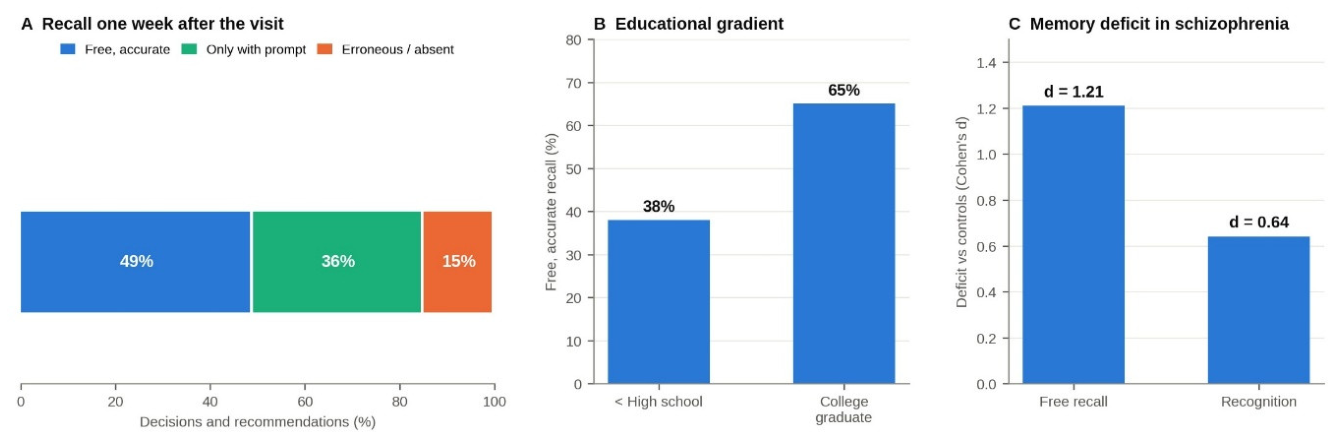

Table 1.
Key quantitative estimates of patient recall, by interval and determinant.
| Interval / domain | Finding | Setting and design | Ref. |
|---|---|---|---|
| Immediate | 40–80% of information forgotten; about half of recalled content inaccurate | Synthesis across medical settings | [2,13] |
| Immediate | Total recall 40%; 48% of “remembered” content misconstrued | Rheumatology clinic | [14] |
| Immediate | Explicit structure: 8.12 vs 5.71 of 28 items recalled (p = 0.005) | Experimental study | [19] |
| 24 hours | No direct psychiatric estimate; retained content inferred to be dominated by primacy, perceived importance and specificity | Reconstruction from forgetting-curve and serial-position evidence | [1,2,17] |
| One week | 49% recalled freely and accurately; 36% only with prompting; 15% erroneous or absent | 189 audio-recorded outpatient specialty visits | [16] |
| One week | Free, accurate recall 38% (< high school) vs 65% (college graduates), p < 0.0001 | Same cohort | [16] |
| ~13 days | Most important components recalled; poorer recall with multiple problems, brain injury, low memory score | Primary care; telephone vs face-to-face | [11] |
| Therapy follow-up | One-third of instructions forgotten; as low as 13% for some recommendation types | Insomnia therapy | [20] |
| Depression | Largest deficits in episodic encoding and retrieval; minimal in semantic and working memory | 726 patients vs 795 controls | [24] |
| Schizophrenia | Free recall d = 1.21 vs recognition d = 0.64; no accelerated forgetting of learned material | Meta-analysis of memory tests | [25] |
| Health literacy | Only 34.7% of low-literacy patients could demonstrate daily pill count; adjusted RR 2.32 for misunderstanding | 395 primary care patients | [26] |
| ECT consent | 17% recalled being told of long-term memory problems (63% of temporary problems) | Survey of 858 recipients, 44 countries | [12] |
Abbreviations: ECT, electroconvulsive therapy; RCT, randomised controlled trial; RR, relative risk; SMS, short message service.
Table 2.
Interventions targeting recall: mechanism and evidence for effects on recall and adherence.
Table 2.
Interventions targeting recall: mechanism and evidence for effects on recall and adherence.
| Intervention | Mechanism targeted | Effect on recall / knowledge | Effect on adherence |
|---|---|---|---|
| Written information (leaflets) | Retrieval cue; reduces reliance on working memory | Better informed on every item except drug name; 97% read leaflets [87]; mostly favourable for side-effect knowledge [88] | Under-researched [89]; less effective with low health literacy [90] |
| Recording of the patient's own consultation | Repeated access; supports recognition over free recall | Added value over oral information; generic recordings do not help [9]; improved recall, satisfaction and decision-making across 25 studies [91] | Proposed benefit in psychiatry [34]; reported association with adherence [90]; not tested as a primary endpoint |
| Explicit structure / categorisation | Organisation at encoding; primacy | Increased recall in laboratory and general practice [18]; 5.71 → 8.12 of 28 items [19] | Not directly tested |
| Teach-back | Verification through active reproduction | Improved knowledge and self-care across 20 studies [92] | Not directly tested |
| Clinician-endorsed question prompt sheet | Cueing of information needs; participation | More questions asked [93]; recall benefit when actively endorsed [9] | Not directly tested |
| Patient decision aids | Participation; values clarification | Higher-quality decisions across 23 RCTs [94]; improved satisfaction and involvement in psychiatry [95] | Mixed in psychiatry: no effect in two cluster RCTs [95] |
| Communication skills training | Clarity, participation, relationship | Greater recall or disease knowledge in most studies [96] | Odds of adherence 1.62 times higher [50]; improved adherence in RCT [97] |
| Structured consent (ECT) | Repeated, structured, cognition-aware information | Improved knowledge recalled pre-ECT; decline after course [98] | Not applicable |
| SMS / electronic reminders | Intention–behaviour gap (not encoding) | Not a recall intervention | Morisky–Green 1.2 vs 1.53 at 3 months (difference −0.33, 95% CI −0.62 to −0.03) [99]; improved appointment-keeping [100] |
Abbreviations: ECT, electroconvulsive therapy; RCT, randomised controlled trial; RR, relative risk; SMS, short message service.
Disclaimer/Publisher’s Note: The statements, opinions and data contained in all publications are solely those of the individual author(s) and contributor(s) and not of MDPI and/or the editor(s). MDPI and/or the editor(s) disclaim responsibility for any injury to people or property resulting from any ideas, methods, instructions or products referred to in the content. |
© 2026 by the authors. Licensee MDPI, Basel, Switzerland. This article is an open access article distributed under the terms and conditions of the Creative Commons Attribution (CC BY) license (http://creativecommons.org/licenses/by/4.0/).
Copyright: This open access article is published under a Creative Commons CC BY 4.0 license, which permit the free download, distribution, and reuse, provided that the author and preprint are cited in any reuse.