

Submitted:
03 November 2026
Posted:
05 November 2026
You are already at the latest version
Abstract
Introduction: Iron deficiency during pregnancy and early childhood may affect myelination, neurotransmission, and neural network maturation, with potential consequences for motor, cognitive, and language development. Objective: To quantitatively synthesize the effects of iron supplementation on motor, cognitive/global, and language development by integrating the original dataset with a complementary search for original studies. Methods: Systematic review with random-effects quantitative synthesis. The expanded review included 11 publications. Continuous outcomes and adjusted estimates were harmonized to log odds ratios (logOR), with positive values indicating better performance with greater iron exposure. Between-study variance was estimated by restricted maximum likelihood (REML). Ten motor, 11 cognitive/global, and 7 language effect estimates were pooled. Results: For motor development, the pooled effect was logOR 0.31 (95% CI 0.14 to 0.48; OR 1.36; p < 0.001; τ² = 0.044; I² = 69.3%). For cognitive/global development, the pooled effect was logOR 0.11 (95% CI -0.10 to 0.33; OR 1.12; p = 0.307; τ² = 0.088; I² = 74.8%). For language, the pooled effect was logOR -0.02 (95% CI -0.26 to 0.21; OR 0.98; p = 0.851; τ² = 0.048; I² = 50.7%). Conclusion: The expanded synthesis yielded a positive pooled estimate for motor development, whereas pooled cognitive/global and language estimates remained close to the null. Effect magnitude and direction varied across populations, timing and dose of supplementation, baseline iron status, and age at assessment.
Keywords:
iron
; infant
; neurocognitive development
; motor development
; language
; meta-analysis
1. Introduction
Iron deficiency remains one of the most common nutritional deficiencies in childhood and is an important public health problem because its effects may extend beyond hematological abnormalities. Iron contributes to essential processes in central nervous system maturation, including myelination, neuronal energy metabolism, neurotransmitter synthesis, and the organization of circuits involved in movement, attention, memory, and learning. During the first months of life, when the brain undergoes intense structural and functional development, insufficient availability of this micronutrient may be associated with developmental changes that cannot always be explained by hemoglobin concentration alone. Accordingly, the effects of supplementation should be assessed not only in terms of preventing or correcting anemia but also through functional and neurobehavioral outcomes (Pivina et al., 2019; Sundararajan and Rabe, 2021).
The first 24 months of life represent a particularly sensitive developmental window. During this period, infants rapidly acquire postural control, grasping, mobility, social interaction, communication, and early language, all of which depend on the integration of neurological maturation, nutritional supply, growth, and environmental stimulation. When iron stores are low, the body may prioritize hematological functions and other vital processes, reducing mineral availability to developing tissues. Thus, neurological alterations may emerge before clinically apparent anemia or persist after normalization of blood markers. This dissociation helps explain why hematological improvement is not always accompanied by measurable changes in motor, cognitive, or language scales over the same period (Pivina et al., 2019; Larson, Phiri, and Pasricha, 2017).
Neonatal iron stores depend on gestational and postnatal factors. Placental transfer occurs mainly in late pregnancy; therefore, preterm birth may interrupt an important part of this process and result in lower iron stores at birth. Preterm infants may also experience rapid postnatal growth and have specific nutritional requirements. Similarly, infants born to mothers with anemia or depleted stores may begin life in a more vulnerable condition. Early supplementation has a consistent biological rationale in these groups. Nevertheless, even among higher-risk populations, differences in gestational age, birth weight, feeding, dose, timing of initiation, and duration of supplementation may modify the observed effect (Saito-Benz, Flanagan, and Berry, 2020; Luciano et al., 2022; Xu et al., 2022).
The situation differs among healthy term infants, especially when there is no clear evidence of deficiency at baseline. In this population, the effect of additional supplementation may depend on anemia prevalence, dietary patterns, age at introduction of iron-rich foods, administered dose, and initial nutritional status. Trials in lower-risk groups have produced small or near-null estimates across developmental domains, contrasting with more favorable findings in some studies of preterm infants and children at greater risk of deficiency. This distinction reinforces the importance of accounting for baseline risk, clinical setting, and intervention timing in quantitative syntheses (Bora et al., 2021; Svensson et al., 2024; Pasricha et al., 2021).
The available literature is also heterogeneous in study design and outcomes. Randomized trials, trial follow-up studies, and observational investigations have assessed motor development, cognition, language, brain connectivity, growth, and hematological parameters at different ages using different instruments. Some evidence derives from direct infant supplementation, whereas other studies evaluated maternal supplementation during pregnancy and subsequent offspring development. Analyses from ECLIPSES indicated that cognitive findings differed by maternal iron status and administered dose, whereas other trials reported near-null results in healthy infants. These differences necessitate harmonization of effect measures before pooling (Iglesias-Vázquez et al., 2022; Iglesias-Vázquez et al., 2023; Svensson et al., 2024).
Neurodevelopment is additionally influenced by factors extending beyond nutritional status. Hematological markers can demonstrate a biological response to supplementation but do not automatically replace assessments of motor, cognitive, or language performance. Perinatal conditions, growth, feeding, maternal health, stimulation in the home, income, and psychosocial stress may contribute to different developmental trajectories. Follow-up evidence suggests that environmental factors act independently and may help explain variability among nutritional studies. Therefore, interpretation of iron-related effects requires an approach that preserves differences across domains and populations rather than indiscriminately combining measures of distinct constructs (Doom et al., 2021).
The objective of this systematic review and meta-analysis was to quantitatively synthesize the effects of iron supplementation during pregnancy or early childhood on these three domains using a random-effects model with restricted maximum likelihood (REML) estimation, while additionally describing hematological, growth, and safety outcomes.
2. Methods
2.1. Study Design and Eligibility Criteria
This systematic review and meta-analysis was structured according to the Preferred Reporting Items for Systematic Reviews and Meta-Analyses (PRISMA) recommendations. The research question was organized around population, intervention, comparator, and outcomes. Eligible populations included infants from birth to 24 months and children assessed at older ages when exposure to iron supplementation had occurred during pregnancy, the neonatal period, or early childhood. The intervention of interest was iron supplementation administered as an isolated intervention to the pregnant woman or child. Acceptable comparators included placebo, no supplementation, a different iron dose, or a distinct exposure condition permitting isolation of the iron-related contrast. The primary outcomes were motor development, cognitive or global development, and language. Hemoglobin, ferritin, growth, brain connectivity, and adverse events were considered complementary outcomes and were not included in the three primary quantitative groups.
Eligible designs comprised randomized clinical trials, secondary analyses or follow-up studies of trials, and prospective or retrospective cohort studies examining associations between iron exposure and outcomes of interest. Observational studies were retained to broaden the representation of at-risk populations and long-term follow-up. Studies were excluded if they lacked an interpretable comparator, used multi-micronutrient interventions from which the iron component could not be isolated, enrolled populations with preexisting neurological disorders or non–iron deficiency anemia that precluded iron-specific interpretation, or did not measure a neurodevelopment-related outcome. Studies whose age range, exposure, or comparator made it impossible to assess supplementation during pregnancy or early childhood were also excluded.
2.2. Search Strategy and Study Selection
The original search was conducted in PubMed/MEDLINE, EMBASE, and ScienceDirect and covered publications from 2015 to 2025. Controlled terms and keywords relating to “iron supplementation,” “infant,” “child development,” “neurodevelopment,” “motor development,” and “randomized controlled trial” were combined using Boolean operators. No language restrictions were applied.
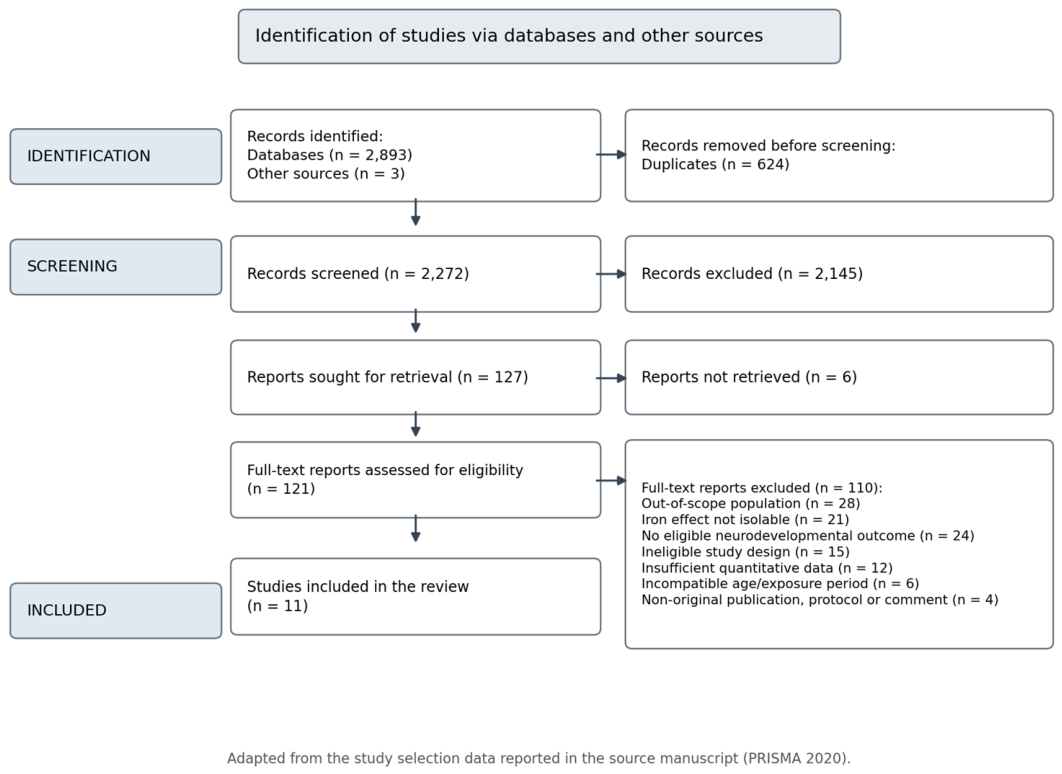
Records were organized to identify duplicates before eligibility assessment. Two reviewers independently screened titles and abstracts and subsequently evaluated the full texts of potentially eligible reports. Disagreements were resolved through discussion and reassessment of the criteria. For each publication, we checked whether exposure, comparator, and at least one primary outcome permitted direct extraction or derivation of an effect measure. The supplementary search added three original publications to the initial dataset, yielding 11 publications in the expanded review. The complete process of identification, screening, eligibility assessment, and inclusion is shown in Figure 1.
2.3. Data Extraction and Harmonization
A standardized extraction form recorded publication year, study design, sample size, clinical characteristics, gestational age when relevant, maternal condition, supplementation initiation, dose and duration, comparator, assessment instrument, age at measurement, and quantitative result. Preterm infants and infants of anemic mothers were categorized as having a higher baseline risk of deficiency, whereas healthy term infants without a clear indication of deficiency were considered lower risk. Where a publication reported different assessment times, clinically defined subgroups, or components of the same domain, each eligible estimate was retained as an effect unit. Thus, the number of pooled estimates (k) does not necessarily equal the number of independent publications.
Original effect measures were harmonized to a common log odds ratio (logOR) scale, with positive values oriented to indicate better performance associated with greater iron exposure. When means, standard deviations, and sample sizes were available, a standardized mean difference was calculated or used, with Hedges’ correction where applicable. Effects reported as Hedges’ g were converted using the approximation logOR = g × π/√3; confidence interval limits were multiplied by the same constant. Adjusted mean differences, coefficients, and other continuous measures were standardized using the dispersion statistics, sample size, standard error, confidence interval, or significance level available in the extraction table. Where only a significance threshold was recorded, such as p < 0.05 or p < 0.001, that threshold was used as a conservative approximation without assigning greater significance than documented in the source.
Before pooling, the direction of each scale was verified. Where higher values indicated poorer performance, the sign was reversed so that positive values consistently favored greater iron exposure. Dose- or ferritin-stratified findings retained their comparison labels in the forest plots. Odds ratios were obtained by exponentiating logOR, and a standardized equivalent event proportion was calculated as p_eq = OR/(1 + OR), assuming a comparator reference probability of 50%. This percentage was used solely to communicate relative magnitude and does not represent an observed crude incidence.
2.4. Statistical Analysis
Separate meta-analyses were conducted for motor development, cognitive/global development, and language. A random-effects model was used to account for differences across studies in populations, doses, timing and duration of supplementation, assessment instruments, and follow-up ages. Between-estimate variance was determined using REML. The model weight for each estimate was calculated as the inverse of total variance, 1/(v_i + τ²), where v_i is the sampling variance of the estimate and τ² is the between-study variance. Pooled effects were reported as logOR and converted to OR using exp(logOR), together with 95% confidence intervals and p values. Heterogeneity was summarized using τ², Cochran’s Q test, and I². Forest plots were constructed on the logOR scale to preserve the common metric used in the model.
The expanded synthesis included multiple estimates from some publications, covering different ages, subgroups, or components of a domain. Because the extraction table did not contain covariance matrices, within-publication correlations could not be modeled; each estimate was treated as a separate effect unit, and the potential dependence was considered when interpreting the findings. Results with insufficient information for harmonization were retained in the narrative synthesis. The estimates were recalculated in Python using numerical random-effects routines with REML. Hematological parameters, growth, brain connectivity, and safety were reported as complementary findings. Sensitivity analyses, Hartung–Knapp inference, leave-one-out analyses, and robust variance models were considered possible extensions and were not part of the primary model.
3. Results
3.1. Included Studies
A total of 2,896 records were identified: 2,893 from databases and three from other records or supplementary sources. After removal of 624 duplicates, 2,272 records underwent title and abstract screening, of which 2,145 were excluded. Next, 127 reports were sought for retrieval; six could not be obtained, leaving 121 full-text reports assessed for eligibility.
Of the full-text reports assessed, 110 were excluded: population outside the eligibility criteria (n = 28), intervention from which the iron effect could not be isolated (n = 21), no eligible neurocognitive, motor, or language outcome (n = 24), ineligible design (n = 15), insufficient quantitative data for extraction or analysis (n = 12), incompatible age group or exposure period (n = 6), and non-original publication, editorial, protocol, or commentary (n = 4). Ultimately, 11 studies were included in the expanded review. Figure 1 summarizes the selection process.
The designs included randomized trials, trial follow-ups, and observational studies. Populations ranged from preterm infants and infants at greater risk of deficiency to healthy term infants, as well as cohorts followed to school age or adolescence. Interventions included neonatal or infant supplementation, different prenatal iron doses, and comparisons with placebo, no supplementation, or an alternative dose.

Table 1.
General characteristics of the publications included in the expanded review.
| Study | Design/population | Exposure/comparator | Relevant outcomes |
|---|---|---|---|
| Bora et al., 2021 | RCT; infants at risk of early deficiency | Supplementation from the neonatal period vs no supplementation | Motor; hemoglobin/ferritin |
| Doom et al., 2021 | Longitudinal follow-up; Chile | Early iron exposure and psychosocial factors | Neurocognition in adolescence |
| Iglesias-Vázquez et al., 2022 | ECLIPSES follow-up | Prenatal doses tailored to iron status | Cognition; language; motor |
| Iglesias-Vázquez et al., 2023 | ECLIPSES follow-up | Prenatal doses stratified by maternal ferritin | IQ and cognitive/verbal domains |
| Li M. et al., 2021 | Preterm infant neuroimaging study | Daily iron supplementation | Motor; brain connectivity |
| Luciano et al., 2022 | Double-blind RCT; late-preterm infants | Iron 2 mg/kg/day vs comparator | Global/psychomotor development |
| Svensson et al., 2024 | RCT; healthy term infants | Low-dose iron vs placebo | Motor; cognition; language |
| Xu et al., 2022 | Cohort of preterm infants | Supplementation in first year of life | Motor; global development; hemoglobin; weight |
| Angulo-Barroso et al., 2016 | RCT; term infants in China | Iron from 6 weeks to 9 months vs placebo | Motor development |
| Pasricha et al., 2021 | Three-arm RCT; Bangladesh | Iron syrup or micronutrients vs placebo | Cognition; language; motor; safety |
| Li C. et al., 2015 | Prenatal RCT follow-up; China | Iron + folic acid vs folic acid | Global cognition and WISC-IV domains |
Source: Prepared by the authors based on the included studies. RCT = randomized controlled trial; WISC-IV = Wechsler Intelligence Scale for Children, Fourth Edition.
3.2. Quantitative Synthesis
Table 2.
Random-effects meta-analysis results using REML estimation.
| Outcome | k | logOR (95% CI) | OR | Equiv. incidence* | p | Heterogeneity |
|---|---|---|---|---|---|---|
| Motor development | 10 | 0.31 (0.14 to 0.48) | 1.36 | 57.6% | <0.001 | τ² = 0.044; I² = 69.3% |
| Cognitive/global | 11 | 0.11 (-0.10 to 0.33) | 1.12 | 52.8% | 0.307 | τ² = 0.088; I² = 74.8% |
| Language | 7 | -0.02 (-0.26 to 0.21) | 0.98 | 49.4% | 0.851 | τ² = 0.048; I² = 50.7% |
* Equivalent incidence is a standardized transformation of OR assuming a 50% comparator reference probability; it is not observed crude incidence. Source: Estimates included in the meta-analysis.
3.2.1. Motor Development
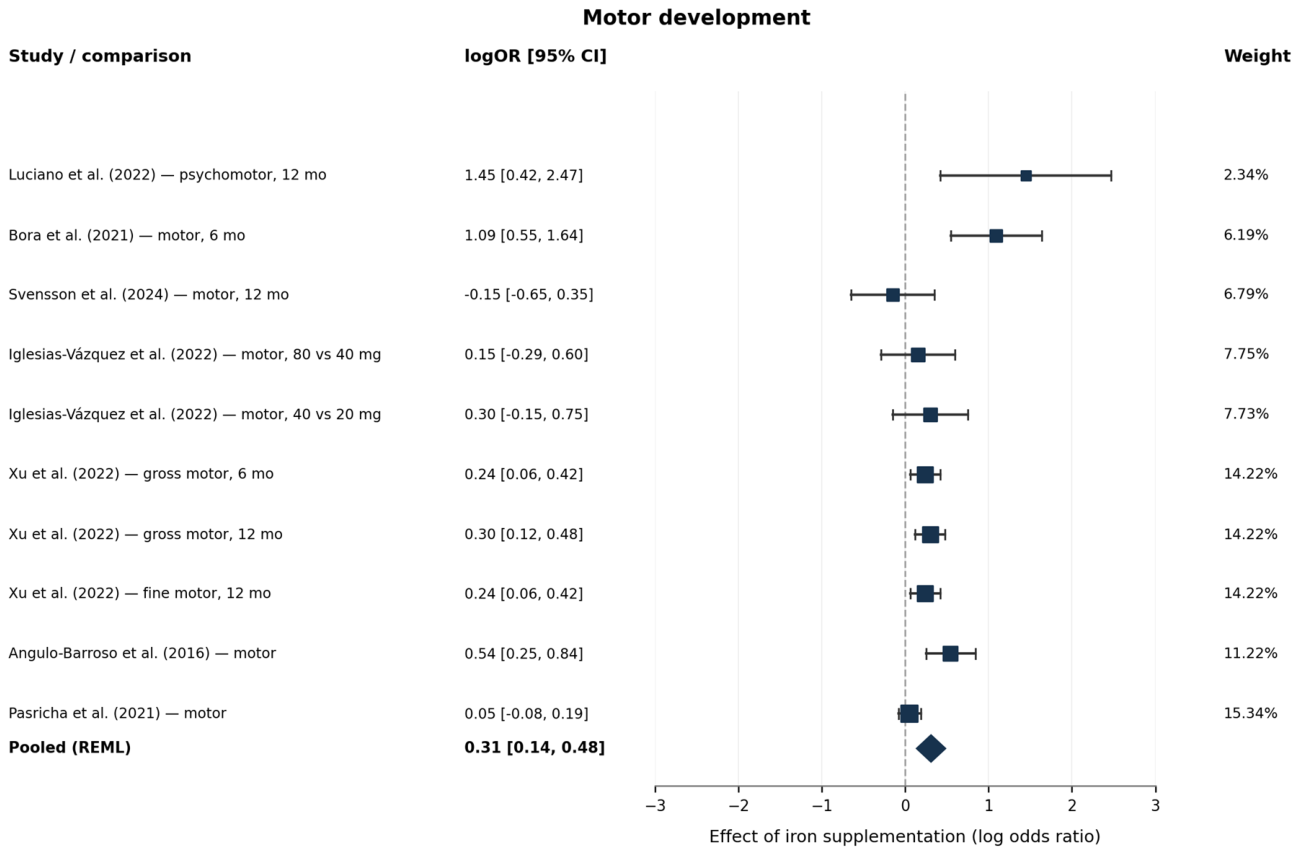
Ten estimates were pooled for motor development. The REML pooled effect was logOR 0.31 (95% CI 0.14 to 0.48), corresponding to OR 1.36 and an equivalent event proportion of 57.6%. The test of the pooled effect yielded p < 0.001. Between-estimate variance was τ² = 0.044 and I² = 69.3%. Cochran’s Q was 29.32 (df = 9; p < 0.001). The estimates included findings from Luciano et al. (2022), Bora et al. (2021), Svensson et al. (2024), Iglesias-Vázquez et al. (2022), Xu et al. (2022), Angulo-Barroso et al. (2016), and Pasricha et al. (2021).
The largest individual logORs occurred in higher-baseline-risk studies, particularly trials of late-preterm infants and infants at risk of early iron deficiency. By contrast, the trial of healthy infants by Svensson et al. and the large trial by Pasricha et al. yielded near-null estimates. Angulo-Barroso et al. reported an improvement of approximately 0.3 standard deviations in motor development with infant supplementation, contributing an intermediate positive estimate.
Figure 2.
Forest plot of the effects of iron supplementation on motor development. Effects are expressed as logOR; random-effects model with REML estimation.
Figure 2.
Forest plot of the effects of iron supplementation on motor development. Effects are expressed as logOR; random-effects model with REML estimation.
3.2.2. Cognitive/global Development
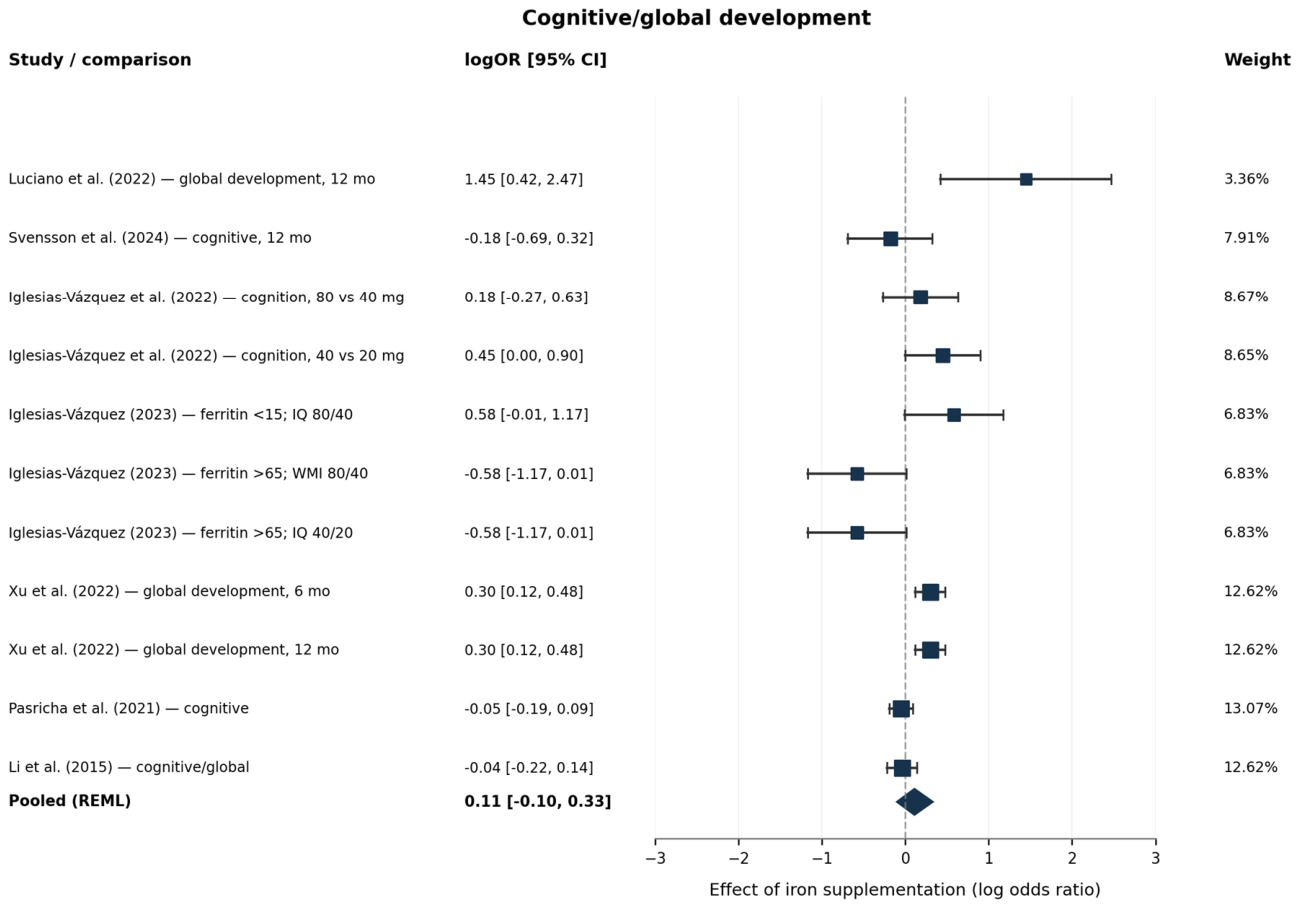
Eleven estimates were pooled for cognition or global development. The pooled effect was logOR 0.11 (95% CI -0.10 to 0.33), equivalent to OR 1.12 and an equivalent event proportion of 52.8% (p = 0.307). Heterogeneity was τ² = 0.088 and I² = 74.8%, with Q = 39.70 (df = 10; p < 0.001). The pooled-effect confidence interval included the null.
Cognitive findings differed in direction across subgroups. Iglesias-Vázquez et al. (2023) reported distinct estimates according to maternal ferritin and iron dose, whereas Xu et al. (2022) contributed positive global-development estimates. Pasricha et al. (2021) found an adjusted mean difference close to zero for cognitive scores after three months of supplementation, and Li C. et al. (2015) found no relevant differences in overall IQ or WISC-IV domains between prenatal iron plus folic acid and folic acid alone at school-age follow-up.
Figure 3.
Forest plot of the effects of iron supplementation on cognitive/global development. Effects are expressed as logOR; random-effects model with REML estimation.
Figure 3.
Forest plot of the effects of iron supplementation on cognitive/global development. Effects are expressed as logOR; random-effects model with REML estimation.
3.2.3. Language Development
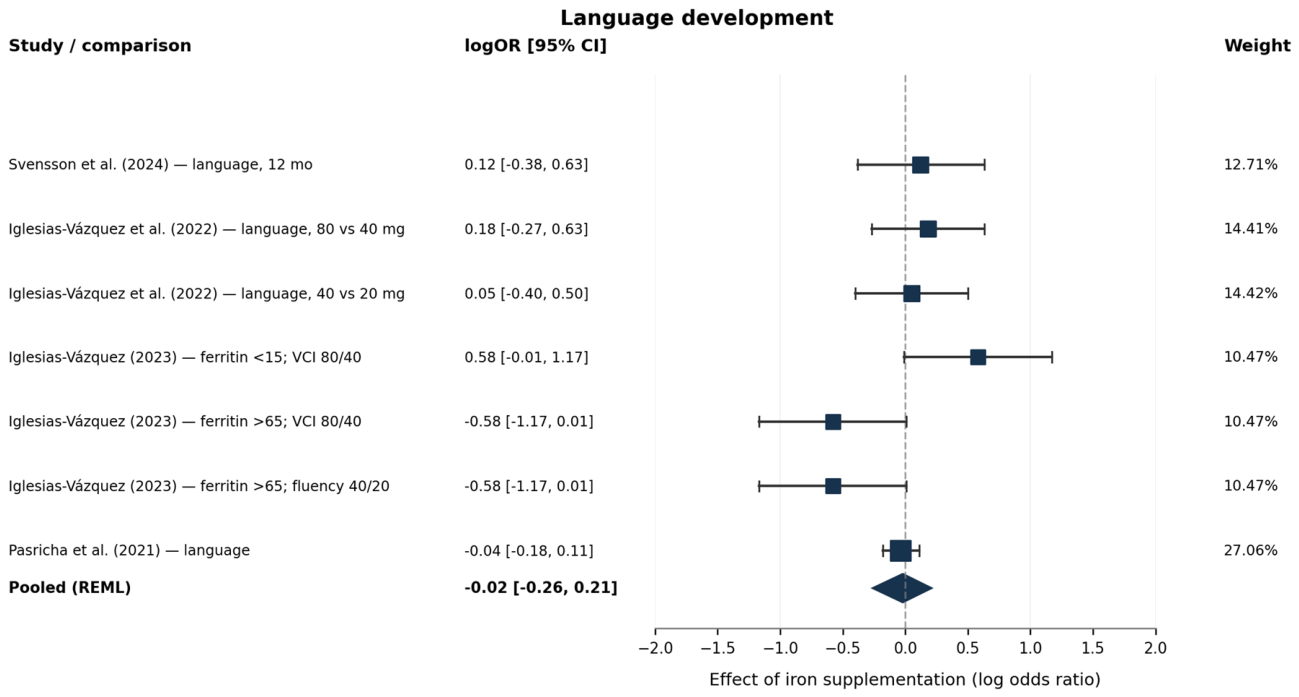
Seven estimates were pooled for language. The pooled effect was logOR -0.02 (95% CI -0.26 to 0.21), corresponding to OR 0.98 and an equivalent event proportion of 49.4% (p = 0.851). Heterogeneity was τ² = 0.048 and I² = 50.7%, with Q = 12.18 (df = 6; p = 0.058). The pooled effect remained close to zero.
Svensson et al. (2024) and Pasricha et al. (2021) provided near-null language estimates. ECLIPSES analyses yielded effects in different directions across strata defined by maternal iron status and dose, contributing to dispersion among individual estimates despite the near-null pooled effect.
Figure 4.
Forest plot of the effects of iron supplementation on language development. Effects are expressed as logOR; random-effects model with REML estimation.
Figure 4.
Forest plot of the effects of iron supplementation on language development. Effects are expressed as logOR; random-effects model with REML estimation.
3.3. Complementary Findings
Hematological outcomes indicated a biological response to supplementation in at-risk groups. Bora et al. reported improved iron markers at six months, and Xu et al. described associations between supplementation, hemoglobin, and growth measures. Luciano et al. found no relevant difference in body weight during the reported follow-up. Li M. et al. assessed brain connectivity in preterm infants, adding a mechanistic outcome to the narrative synthesis.
Regarding safety, the studies did not report a consistent pattern of serious adverse events attributable to supplementation. In the trial by Pasricha et al. (2021), interventions reduced anemia and iron deficiency in the short term while developmental outcomes remained close to those in the placebo group; serious adverse events and symptoms of infection were similar between groups.
4. Discussion
This meta-analysis brought together three central neurodevelopmental domains—motor development, cognitive/global development, and language—within a common quantitative framework and showed that the response to iron supplementation was not uniform across them. Motor development showed a positive pooled effect, with logOR 0.31 (95% CI 0.14 to 0.48), equivalent to OR 1.36, whereas pooled cognitive/global and language effects remained close to the null. At the same time, heterogeneity was considerable, with I² of 69.3% for motor development, 74.8% for cognitive/global development, and 50.7% for language.
For motor development, the pooled effect remained statistically different from the null after inclusion of the additional estimates. However, the distribution of individual results suggests that the average effect should be interpreted alongside the characteristics of the populations studied. Luciano et al. (2022) and Bora et al. (2021) assessed infants more likely to have low iron stores, including late-preterm infants and those at early risk of deficiency, and reported larger estimates. Angulo-Barroso et al. (2016) also contributed an intermediate positive estimate. In contrast, Svensson et al. (2024), studying healthy term infants, and Pasricha et al. (2021), in a large population-based trial, reported effects near zero. Thus, the pooled estimate summarizes different clinical contexts and does not necessarily represent an effect size applicable uniformly to all populations.
This variation is consistent with potential effect modification by baseline deficiency risk. Prematurity, maternal anemia, low stores at birth, rapid growth, and increased metabolic demands may make iron availability a limiting factor for neurological development. When such a limitation exists, supplementation is more likely to produce a measurable difference. In populations with adequate stores, the same additional quantity of iron may not change performance because the nutrient is not the principal limiting factor. The expanded analysis therefore retains the positive motor signal observed in the initial version, but shifts interpretation from a large, apparently homogeneous effect to a smaller average effect accompanied by substantial heterogeneity and differences related to exposure context.
A more evident effect on motor development remains biologically plausible given iron's role in myelination, neuronal energy metabolism, and neurotransmitter synthesis and function. During the first months of life, cortical and subcortical motor circuits undergo rapid maturation. The study by Li M. et al. (2021), included in the narrative synthesis, adds a mechanistic component by relating iron deficiency in preterm infants to altered connectivity among structures involved in motor control. These findings do not permit attribution of every functional difference to a single neuroanatomical pathway, but may help explain why motor outcomes exhibit a more consistent signal than language or cognition in infancy assessments.
The age at which supplementation begins may also contribute to heterogeneity. In studies with more favorable motor findings, the intervention occurred early, when limited iron stores may coincide with rapid growth and intensive brain maturation. In other studies, supplementation began later or was administered to populations without clear evidence of baseline deficiency. This review cannot establish an optimal initiation window because regimens differed in dose, duration, and exposure age. Nevertheless, the observed variation suggests that exposure timing, baseline risk, and treatment duration should be considered potential effect modifiers when interpreting the pooled result.
For cognition and global development, the pooled effect was logOR 0.11 (95% CI -0.10 to 0.33), with a confidence interval including the null. This domain also exhibited the greatest heterogeneity among the three outcomes. Such variability is consistent with the diversity of measures included: some estimates concerned global developmental scales in infancy, whereas others represented intelligence tests or specific cognitive components assessed later in childhood. Studies also differed in whether supplementation was prenatal, neonatal, or administered in infancy. Pooling these estimates on a common scale allows quantitative synthesis, but the resulting effect must be understood as an average across related, not identical, constructs.
The ECLIPSES analyses are particularly relevant in this context because they suggest that maternal iron status and dose may modify the direction of associations with cognitive outcomes. Extracted estimates varied across strata defined by maternal ferritin and supplementation dose and included both positive and negative findings. This pattern limits the utility of an interpretation based solely on the overall mean and suggests that baseline nutritional status may influence the response. Li C. et al. (2015) found no relevant difference in overall IQ at follow-up among children whose mothers received iron plus folic acid during pregnancy versus folic acid alone. Pasricha et al. (2021) likewise reported an adjusted cognitive effect close to zero over the assessment period following intervention.
Assessment timing may account for some of the divergence in cognitive findings. Tests performed in the first months of life measure abilities that are still emerging and may be less able to detect subtle differences in executive function, memory, or language. At follow-up several years later, cognitive instruments become more specific, but a longer interval between exposure and outcome increases the influence of diet, intercurrent illnesses, home stimulation, schooling, and socioeconomic conditions. Early and late assessments therefore represent different measurement windows and degrees of exposure to subsequent influences, which probably contributes to the high I² observed for cognitive/global development.
For language development, the pooled effect remained essentially null (logOR -0.02; 95% CI -0.26 to 0.21). Svensson et al. (2024) and Pasricha et al. (2021) reported estimates close to zero, while stratified ECLIPSES analyses showed differing directions by ferritin level and dose. Language may be particularly sensitive to age at assessment, caregiver–child interaction, language exposure, and opportunities for stimulation, and it also depends on the integration of several cognitive systems. Consequently, changes in iron status may not translate into measurable changes in language to the same extent or over the same timeframe as motor skills.
Another important consideration is the dissociation between hematological and neurodevelopmental responses. In the original dataset, Bora et al. reported improvements in iron markers at six months, and Xu et al. described associations between supplementation and hemoglobin. In the trial by Pasricha et al. (2021), interventions reduced anemia and iron deficiency in the short term, although developmental outcomes remained close to those in the placebo group. These findings show that correction of a hematological marker confirms a biological response to iron but does not automatically imply a measurable change in motor, cognitive, or language performance. Neurodevelopment reflects cumulative and multidimensional processes, whereas hemoglobin and ferritin may respond to supplementation over shorter periods.
Psychosocial factors must also be considered. Doom et al. (2021), included in the original dataset, assessed relationships among early iron deficiency, supplementation, psychosocial stress, and adolescent outcomes. That study indicated that psychosocial exposures play an important role in neurocognitive trajectories and may coexist with effects associated with nutritional status. This is particularly relevant to cognitive and language outcomes, which depend heavily on learning, social interaction, stimulation, and the family environment over time. Even when supplementation corrects a potentially limiting nutritional factor, other exposures can attenuate or amplify group differences and contribute to between-study variation.
Safety and complementary outcomes further contextualize the findings. Studies from the original dataset showed no consistent pattern of serious adverse events attributable to supplementation at the doses examined. Pasricha et al. (2021) likewise reported similar rates of serious adverse events and infectious symptoms across the groups considered in this review. Growth findings were less consistent: Xu et al. reported small positive associations for some measures, whereas Luciano et al. found no relevant difference in body weight. Growth and hematological response therefore provide complementary information but cannot substitute for neurodevelopmental outcomes when interpreting the intervention's effects.
Methodologically, adopting a common logOR scale made it possible to integrate results originally expressed as standardized mean differences, adjusted mean differences, and other continuous measures. This approach increased the number of available estimates and enabled comparable forest plots for the three domains. Nevertheless, harmonization requires mathematical transformations and, for some comparisons, estimates derived from incomplete extraction information. The logOR must therefore be regarded as a common analytical scale, not as evidence that all studies originally measured binary outcomes. Likewise, the “equivalent event proportion” presented in the tables is a standardized transformation of OR assuming a 50% reference probability in the comparator and does not represent incidence observed directly in study samples.
Using REML is consistent with the adopted random-effects framework because the studies differed clinically and methodologically and were not expected to estimate a single identical true effect. The observed heterogeneity reinforces this choice. However, the expanded synthesis includes multiple estimates from individual publications, such as different assessment times, domains, or strata. This increases the use of available information but creates potential statistical dependence among observations. Because covariance matrices were unavailable in the extracted data, within-publication correlation could not be directly incorporated into the model. Consequently, the number of effect estimates exceeds the number of independent publications.
A strength of this expanded review is that its quantitative synthesis extends beyond motor development to include pooled results for cognition/global development and language. Presenting the three domains separately also avoids treating motor, cognitive, and linguistic changes as one undifferentiated neurodevelopmental construct.
The main limitations relate to clinical and methodological heterogeneity, the need to transform some measures, and dependence among estimates extracted from the same publication. Included populations varied in prematurity, maternal anemia, baseline risk, diet, and socioeconomic setting; interventions differed in dose, initiation, and duration; and assessment instruments were applied at different ages. In addition, not all studies provided complete dispersion statistics for each comparison, requiring approximation in some calculations. These characteristics increase uncertainty about the exact magnitude of the effects and explain why interpretation should consider the direction and consistency of findings as well as the pooled estimate.
Finally, the current framework allows additional analyses without changing the three primary outcomes. Sensitivity analyses limited to directly reported effects could clarify the extent to which results depend on derived estimates; separate models for prenatal and infant supplementation could examine differences related to exposure timing; and baseline-risk subgroups could test more directly whether responses are larger in populations more likely to be iron deficient. Leave-one-out analyses, prediction intervals, and Hartung–Knapp inference could also be considered. If sufficient information becomes available on correlations among multiple estimates from the same study, multilevel models or robust variance approaches could explicitly account for this dependence.
5. Conclusions
In the expanded meta-analysis, iron supplementation showed a positive pooled effect on motor development (logOR 0.31; 95% CI 0.14 to 0.48), while pooled effects for cognitive/global development (logOR 0.11; 95% CI -0.10 to 0.33) and language (logOR -0.02; 95% CI -0.26 to 0.21) remained close to the null. Results varied across populations and exposure contexts, and heterogeneity was relevant in all three domains.
Author Contributions (CRediT)
Hércules Kanaan Pereira Sousa: Conceptualization, Formal Analysis, Investigation, Software, Visualization, Writing – Original Draft Preparation. Thiago de Sousa Siqueira: Conceptualization, Methodology, Project Administration, Writing – Original Draft Preparation. Ricardo Rezende de Queiroz: Resources, Validation, Data Curation, Writing – Review & Editing. Eduarda Rodrigues Belfort de Carvalho: Investigation, Data Curation, Resources, Writing – Review & Editing. Victoria Cristina Souto Costa: Investigation, Data Curation, Visualization, Writing – Review & Editing. Maria Adriely Machado de Castro Oliveira: Investigation, Data Curation, Validation, Writing – Review & Editing. Alexandre Patrício Vasconcelos: Investigation, Methodology, Data Curation, Writing – Review & Editing. Ana Júlia Hortegal Cavalcante: Investigation, Resources, Data Curation, Writing – Review & Editing. Paloma Layonara Vieira Viana: Investigation, Visualization, Data Curation, Writing – Review & Editing. José Maurício Raulino Barbosa: Supervision, Methodology, Validation, Project Administration, Writing – Review & Editing.
Data Availability
The authors declare that the research data are contained within the manuscript.
Competing Interests
The authors declare that they have no financial or personal conflicts of interest that could have improperly influenced the work reported in this manuscript.
Use of Artificial Intelligence
The source Portuguese manuscript states that no generative or AI-assisted tools were used in the original study design, analysis, literature review, or manuscript preparation. ChatGPT (OpenAI) was subsequently used to assist with translation and formatting of this English-language version. The authors are responsible for checking the translation, methodological details, and final submitted text.
References
- Andrew M. Neurodevelopmental and visual outcomes of infants at risk of neurodevelopmental disability following dietary supplementation in infancy. Doctoral thesis. University of Oxford; 2016.
- Angulo-Barroso RM et al. Iron Supplementation in Pregnancy or Infancy and Motor Development: A Randomized Controlled Trial. Pediatrics. 2016;137(4):e20153547. [CrossRef]
- Bora R et al. Effect of iron supplementation from neonatal period on the iron status of 6-month-old infants at-risk for early iron deficiency: a randomized interventional trial. The Journal of Maternal-Fetal & Neonatal Medicine. 2021;34(9):1421–1429. [CrossRef]
- Doom JR et al. Infant iron deficiency, iron supplementation, and psychosocial stress as predictors of neurocognitive development in Chilean adolescents. Nutritional Neuroscience. 2021;24(7):520–529. [CrossRef]
- Hare DJ et al. Health outcomes of iron supplementation and/or food fortification in iron-replete children aged 4–24 months: protocol for a systematic review and meta-analysis. Systematic Reviews. 2019;8(1):253. [CrossRef]
- Iglesias-Vázquez L et al. Adapting prenatal iron supplementation to maternal needs results in optimal child neurodevelopment: a follow-up of the ECLIPSES Study. BMC Pregnancy and Childbirth. 2022;22(1):710. [CrossRef]
- Iglesias-Vázquez L et al. Importance of Maternal Iron Status on the Improvement of Cognitive Function in Children After Prenatal Iron Supplementation. American Journal of Preventive Medicine. 2023;65(3):395–405. [CrossRef]
- Kuitunen I et al. The effect of intravenous iron supplementation compared to oral iron supplementation during pregnancy on neonatal outcomes—a systematic review of randomized controlled trials. European Journal of Pediatrics. 2025;184(11):684.
- Larson LM, Phiri KS, Pasricha S-R. Iron and cognitive development: what is the evidence? Annals of Nutrition and Metabolism. 2017;71(Suppl 3):25–38. [CrossRef]
- Li C et al. Prenatal Micronutrient Supplementation Is Not Associated with Intellectual Development of Young School-Aged Children. The Journal of Nutrition. 2015;145(8):1844–1849. [CrossRef]
- Li M et al. Effects of Daily Iron Supplementation on Motor Development and Brain Connectivity in Preterm Infants: A Diffusion Magnetic Resonance Study. Frontiers in Neuroscience. 2021;15:769558. [CrossRef]
- Luciano R et al. Neurological development and iron supplementation in healthy late-preterm neonates: a randomized double-blind controlled trial. European Journal of Pediatrics. 2022;181(1):295–302. [CrossRef]
- McCarthy EK, Dempsey EM, Kiely ME. Iron supplementation in preterm and low-birth-weight infants: a systematic review of intervention studies. Nutrition Reviews. 2019;77(12):865–877.
- Mutua AM et al. Effects of iron intake on neurobehavioural outcomes in African children: a systematic review and meta-analysis of randomised controlled trials. Wellcome Open Research. 2021;6:181. [CrossRef]
- Nguyen PH et al. Preconception micronutrient supplementation with iron and folic acid compared with folic acid alone affects linear growth and fine motor development at 2 years of age: a randomized controlled trial in Vietnam. The Journal of Nutrition. 2017;147(8):1593–1601.
- Pasricha S-R et al. Benefits and Risks of Iron Interventions in Infants in Rural Bangladesh. New England Journal of Medicine. 2021;385(11):982–995. [CrossRef]
- Pivina L et al. Iron deficiency, cognitive functions, and neurobehavioral disorders in children. Journal of Molecular Neuroscience. 2019;68(1):1–10. [CrossRef]
- Ruan S et al. The effect of iron supplementation in preterm infants at different gestational ages. BMC Pediatrics. 2024;24(1):530.
- Saito-Benz M, Flanagan P, Berry MJ. Management of anaemia in pre-term infants. British Journal of Haematology. 2020;188(3):354–366. [CrossRef]
- Sundararajan S, Rabe H. Prevention of iron deficiency anemia in infants and toddlers. Pediatric Research. 2021;89(1):63–73. [CrossRef]
- Svensson L et al. Effect of Low-Dose Iron Supplementation on Early Development in Breastfed Infants: A Randomized Clinical Trial. JAMA Pediatrics. 2024;178(7):649.
- Xu S et al. Iron Supplementation Is Associated with Improvement of Motor Development, Hemoglobin Level, and Weight in Preterm Infants during the First Year of Life in China. Nutrients. 2022;14(13):2624. [CrossRef]
Figure 1.
PRISMA flow diagram of study identification, screening, eligibility, and inclusion. Adapted from the study selection data reported in the source manuscript.
Figure 1.
PRISMA flow diagram of study identification, screening, eligibility, and inclusion. Adapted from the study selection data reported in the source manuscript.
Disclaimer/Publisher’s Note: The statements, opinions and data contained in all publications are solely those of the individual author(s) and contributor(s) and not of MDPI and/or the editor(s). MDPI and/or the editor(s) disclaim responsibility for any injury to people or property resulting from any ideas, methods, instructions or products referred to in the content. |
© 2026 by the authors. Licensee MDPI, Basel, Switzerland. This article is an open access article distributed under the terms and conditions of the Creative Commons Attribution (CC BY) license.
Copyright: This open access article is published under a Creative Commons CC BY 4.0 license, which permit the free download, distribution, and reuse, provided that the author and preprint are cited in any reuse.