

Submitted:
03 November 2026
Posted:
05 November 2026
You are already at the latest version
Abstract
Generative artificial intelligence (GenAI) is increasingly being integrated into educational practices, transforming how students access information, develop ideas, and carry out cognitive tasks. While GenAI offers opportunities to foster critical thinking and creativity, its use raises concerns regarding "cognitive offloading"—the delegation of reasoning processes that are fundamental to learning. This study presents a review based on 108 documents from Scopus and Web of Science, which allowed for an examination of the relationships between GenAI, critical thinking, creativity, and cognitive offloading, as well as their pedagogical and institutional implications. The evidence analyzed suggests that GenAI can improve immediate task performance, facilitate idea generation, and support content development. However, these benefits do not necessarily translate into autonomous learning or greater creative originality. Outcomes appear to depend on students' prior knowledge, their AI literacy, task design, metacognitive regulation, and the nature and timing of pedagogical support. Based on this review, an AI-Mediated Cognitive Infrastructure Framework (AMCIF) is proposed, which links GenAI usage patterns with cognitive processes, educational practices, and institutional conditions. This framework distinguishes between forms of assistance that promote cognitive engagement and those that might replace the mental activity necessary for learning, emphasizing the essential role of instructor mediation, source verification, reflective practices, and process-oriented assessment. The AMCIF provides a conceptual foundation for analyzing how to integrate GenAI into educational settings while preserving critical judgment, creativity, and the capacity for independent reasoning. The proposed relationships require rigorous empirical validation.
Keywords:
generative artificial intelligence
; cognitive offloading
; critical thinking
; creativity
; metacognition
; higher education
; human-AI collaboration
1. Introduction
Generative artificial intelligence (GenAI) is becoming increasingly embedded in educational practices, changing how students and educators access information, develop ideas, and carry out academic tasks. Yet the opportunities offered by these technologies are not equally available to all users. Access to more advanced capabilities often depends on economic resources, technological infrastructure, and institutional support. The rapid adoption of GenAI tools, offered through free and paid versions with different capabilities, has also raised questions about how these systems should be incorporated into teaching and learning. Although educators can use GenAI to develop instructional materials, design learning activities, and provide feedback, its widespread use among students presents new challenges for teaching and assessment. In particular, the development and validation of pedagogical approaches have not necessarily kept pace with technological adoption, leaving educators to determine how these tools can be used without undermining the intended learning outcomes.
The use of generative artificial intelligence (GenAI) in education remains an active and evolving area of research. Early studies have identified opportunities for personalized instruction, immediate feedback, and more flexible forms of educational support, alongside concerns about inaccurate information, algorithmic biases, and uncritical reliance on AI-generated content [1,2]. Beyond these concerns, a central question is how GenAI changes the distribution of cognitive work among students, educators, and technological systems. This question can be examined through the concept of cognitive offloading, which refers to the use of external actions or resources to reduce the internal cognitive demands of a task [3]. Cognitive offloading is not inherently detrimental. Writing, diagrams, calculators, and search engines have long allowed individuals to extend their cognitive capabilities beyond the limits of unaided mental processing. In educational settings, however, its implications depend on which cognitive operations are delegated and which remain under the learner’s control. When GenAI reduces demands that are peripheral to the learning objectives, it may free working-memory resources for activities such as comparison, interpretation, and evaluation. The situation is different when these systems perform the reasoning that students are expected to develop themselves. Under such conditions, greater efficiency in completing a task may be accompanied by less engagement in the cognitive processes required for learning. In an experimental comparison of large language models (LLMs) and conventional web search, Stadler et al. [4] found that students using an LLM experienced lower cognitive load but produced weaker reasoning and argumentation. Their findings highlight an important distinction: reducing the mental effort required to complete an academic task does not necessarily improve the quality of the cognitive processes involved in learning.
Empirical evidence suggests that improvements in AI-assisted performance do not necessarily translate into independent learning or greater creative originality. In a large-scale field experiment involving secondary school mathematics students, access to GPT-4 improved performance during practice, but students using an unrestricted interface performed worse when AI assistance was withdrawn. This effect was largely mitigated when the system provided guided hints and instructional safeguards rather than direct answers [5]. A similar tension emerges in creative tasks. Although GenAI can support idea generation and improve the novelty and usefulness of individual outputs, particularly among less creative participants, AI-assisted short stories have also been found to exhibit greater similarity, suggesting reduced diversity at the collective level [6]. Studies of visual ideation have likewise reported design fixation and reductions in dimensions of divergent thinking following exposure to AI-generated examples [7]. Research examining the adoption of text-to-image systems further indicates gains in creative productivity and value alongside declining average content novelty, although some creators achieved higher levels of originality [8]. Together, these findings suggest that the educational value of GenAI cannot be assessed solely through task performance or the quality of generated products. Critical thinking and metacognitive regulation are also important, particularly when students must determine whether to accept, question, or revise AI-generated suggestions. This requires evaluating the reliability of information, identifying underlying assumptions, considering alternative explanations, and monitoring the extent to which AI assistance influences their own reasoning. The distinction between cognitive support and cognitive substitution therefore depends not only on what GenAI produces, but also on how learners engage with and critically evaluate its contributions.
The influence of GenAI on critical thinking varies depending on students’ prior knowledge, the complexity of the task, and the conditions under which AI assistance is provided. Students with greater disciplinary expertise may be better equipped to question generated explanations and recognize inaccuracies, whereas less experienced students may struggle to identify errors in seemingly convincing responses. This raises questions about how educators should incorporate GenAI into their teaching practices—specifically, when determining which activities require independent reasoning and when technological assistance might be beneficial. Encouraging students to attempt a task before consulting GenAI, verifying information against reliable sources, or explaining and defending their conclusions can help maintain their active engagement in the learning process. Some studies suggest that students’ willingness to adopt GenAI is linked to its perceived utility and its compatibility with existing academic practices, though access remains unequal [9,10]. A further limitation is that much of this evidence stems from surveys regarding perceptions and intended use, rather than direct measurements of learning or cognitive performance. Consequently, positive perceptions of GenAI should not be taken as proof that students are developing stronger critical thinking skills, greater creativity, or more independent reasoning. Assessing these outcomes requires focusing on what students actually learn, how they utilize AI assistance, and whether they can demonstrate their knowledge without relying on it.
Despite growing interest in the use of Generative AI in education, significant gaps remain in the literature. Critical thinking, creativity, and cognitive offloading are often investigated separately, even though they may interact during AI-assisted activities. For example, generating more ideas with the help of AI does not necessarily mean that students will critically evaluate them or produce more original work. Furthermore, much of the available evidence focuses on immediate task performance, perceived utility, or intentions to adopt the technology—offering limited insight into whether learners retain the ability to reason, create, and solve problems independently once AI assistance is removed. Research on pedagogical practices and institutional governance also tends to approach these issues from disparate perspectives, with little integration regarding their cognitive implications. Examining Generative AI as part of a broader sociotechnical environment can help address these limitations by linking patterns of technology use to cognitive processes, learning outcomes, instructional mediation, assessment practices, and institutional policies.
This study presents a review that seeks to uncover the relationships between generative AI, critical thinking, human creativity, and cognitive offloading within the educational sphere. The review is guided by the following research question: under what cognitive and pedagogical conditions does generative AI foster critical thinking, creativity, and autonomous learning, and in what instances does cognitive offloading risk replacing the mental processes necessary for their development? Based on the literature reviewed, we propose the "AI-Mediated Cognitive Infrastructure Framework" (AMCIF) to examine how different patterns of generative AI usage can either promote or limit cognitive engagement. This framework integrates student characteristics, metacognitive regulation, teaching practices, and institutional conditions to explain why similar forms of AI-assisted support can lead to different educational outcomes. Special attention is given to the role of prior knowledge, source verification, instructor mediation, and process-based assessment in maintaining student involvement in reasoning and knowledge construction. The AMCIF also addresses the risks associated with an uncritical reliance on AI-generated responses and the delegation of cognitive activities that are fundamental to intended learning objectives. Rather than viewing generative AI as inherently beneficial or detrimental, this framework provides a conceptual basis for analyzing how educational practices can leverage its capabilities while preserving students’ critical judgment, creativity, and cognitive autonomy—while also highlighting gaps that require further experimental investigation.
2. Literature Review Process
This study adopts a narrative review approach with an integrative conceptual focus to examine how generative artificial intelligence (GenAI) relates to critical thinking, creativity, and cognitive offloading in education. The review integrates academic literature and institutional documents to connect cognitive and pedagogical findings with implications for educational governance. Rather than providing an exhaustive inventory of AI research in education, it aims to develop a conceptually integrated account of the conditions under which GenAI may support or displace learners’ cognitive engagement.
The review focuses on the relationships among GenAI use, higher-order thinking, metacognitive regulation, and human agency. Curricular integration, institutional governance, and evidence from Latin American higher education are considered as complementary perspectives informing the AI-Mediated Cognitive Infrastructure Framework (AMCIF).
2.1. Literature Identification and Search Strategy
Literature identification combined direct searches on academic databases and publishers’ platforms with a complementary search using the applcation named Consensus. The sources consulted were Scopus, ScienceDirect, Springer Nature, ACM Digital Library, Frontiers, Wiley, and MDPI. Consensus was used to identify potentially relevant publications addressing the central themes of the review.
The search strategy was organized around five thematic routes, represented by the following keyword combinations:
- Critical thinking and creativity: “critical thinking” AND “artificial intelligence” AND “creativity”.
- Cognitive processes: “generative AI” AND “education” AND “neurocognitive processes”.
- Policy and governance: “generative artificial intelligence” AND “education” AND (“regulatory guidelines” OR “policy” OR “governance” OR “institutional guidelines”).
- Curricular integration: “generative artificial intelligence” AND (“curriculum” OR “curricular”) AND “education”.
- Latin American higher education: (“generative artificial intelligence” OR “generative AI” OR GenAI) AND “higher education” AND “Latin America”.
2.2. Source Selection
Peer-reviewed journal articles constituted the principal academic evidence base. Conference papers were retained when they addressed relevant emerging developments in GenAI, education, cognition, or human–AI interaction. Official and institutional documents were included when they addressed educational policy, regulation, institutional guidelines, or responsible GenAI use. One working paper issued by Harvard Business School was retained for its relevance to the conceptual scope of the review.
The selection process prioritized articles published in Q1 and Q2 journals, as well as documents published mainly within the most recent five-year period. Older sources were retained only when they provided relevant conceptual, theoretical, or contextual support for the review. Publications identified through Consensus were manually reviewed to confirm their relevance to the aims of the study. Institutional documents were not included in the journal quartile analysis because quartile classifications apply to journal venues rather than to policy reports, guidelines, or institutional sources.
2.3. Methodological Limitations
As a narrative review with an integrative conceptual focus, this study involved author judgment in source selection and interpretation. Its coverage may therefore have been influenced by the publisher platforms consulted, the search terminology used, and the relevance criteria applied during screening. The complementary use of Consensus supported the identification of potentially relevant publications, but it did not establish exhaustive coverage of the literature.
The predominance of English-language and internationally indexed publications may have limited the retrieval of relevant research published in other languages or in regional academic outlets. Although the review included evidence from Latin American and Ibero-American higher education, these contributions represented a comparatively small portion of the selected sources. Therefore, the findings should not be interpreted as a comprehensive representation of educational experiences across regions, languages, or institutional contexts.
The selected documents also combined sources with different purposes and evidential characteristics, including peer-reviewed journal articles, conference papers, one working paper, and institutional documents. This heterogeneity should be considered when interpreting the synthesis. In particular, institutional recommendations, policy documents, and conceptual arguments were used to contextualize the discussion, but they were not treated as equivalent to empirical evidence of educational outcomes.
2.4. Characteristics of the Reviewed Corpus
The reviewed corpus comprised 108 documents: 86 peer-reviewed journal articles, nine conference papers, one working paper, and 12 official and institutional documents. Publication dates for the dated documents ranged from 2017 to 2026, with a concentration in 2025 and 2026. The reported proportions were approximately 45% for 2026, 36% for 2025, and 19% for 2017–2024.
For journal articles, publication venues were characterized using quartile information where available. Approximately 79% of the articles were published in Q1 journals, 13% in Q2 journals, and 7% in Q3 or Q4 journals. One article (approximately 1%) could not be assigned a journal quartile classification.
Within the academic component of the corpus, Elsevier accounted for the largest publisher share (33%), followed by Springer Nature (26%) and ACM (11%). Frontiers, MDPI, and Wiley each accounted for 10%.
The official and institutional component included policy and governance documents from organizations such as the OECD, UNESCO, Harvard University, Schola Europaea, the University of Pavia, and the Delaware Department of Education.
2.5. Development of the Conceptual Framework
The synthesis was designed to examine how patterns of GenAI use relate to critical thinking, creativity, cognitive offloading, and independent learning. Given the diversity of research designs, educational contexts, and outcome measures represented in the literature, the analysis adopted a thematic and conceptual approach rather than a statistical aggregation of effect sizes. The analytical process consisted of four stages. First, the selected sources were classified according to their research design, educational context, cognitive constructs, and reported findings. A distinction was made between empirical studies, theoretical contributions, and institutional guidelines to avoid treating different forms of evidence as equivalent.
Second, the findings were organized around recurring patterns of AI-mediated cognitive engagement—specifically, the distinction between assistance that supports students’ reasoning and assistance that replaces cognitive operations central to learning objectives. Attention was also given to mixed or inconclusive results, as well as the differences between performance on AI-assisted tasks and outcomes in independent learning. Third, the identified patterns were examined in relation to learner characteristics, metacognitive regulation, instructional design, teacher mediation, and institutional conditions. This stage sought to identify potential mediating and moderating relationships that could explain why similar forms of GenAI assistance were associated with different educational outcomes.
Finally, the resulting conceptual relationships were integrated into the AI-Mediated Cognitive Infrastructure Framework (AMCIF). The framework organizes the reviewed evidence into modes of GenAI engagement, cognitive processes, contextual conditions, and educational outcomes. The proposed relationships should be interpreted as theoretically grounded propositions derived from the literature, rather than as empirically validated causal mechanisms.
3. Synthesis of Evidence on Generative AI and Cognition
3.1. Generative AI and Critical Thinking
The integration of generative artificial intelligence (GenAI) into higher education has introduced a tension between cognitive scaffolding and cognitive offloading [11,12]. Critical thinking (CT) is conceptualized as a purposeful, self-regulated process involving analysis, evaluation, inference, and metacognition, with an emerging emphasis on source verification [13]. This section categorizes the effects of GenAI on CT as positive, negative, mixed, or inconclusive.
When GenAI is integrated through structured pedagogical designs, it can function as a “force multiplier” for critical thinking by handling lower-order tasks and enabling deeper engagement with complex problems. Randomized controlled trials (RCTs) demonstrate that ChatGPT-based facilitators, such as LearnGuide, significantly improve scores on standardized measures such as the Cornell Critical Thinking Test (; ) [14]. Similarly, concept mapping-enhanced generative AI collaborative learning has been shown to significantly outperform traditional methods in fostering CT dispositions and problem-solving skills among secondary and university students [15]. In addition, You et al. [16] employed a quasi-experimental design involving 126 graduate students. The experimental group participated in an eight-week intervention mediated by a generative conversational agent, whereas the control group received traditional lecture-based instruction. Following the intervention, participants in the experimental group generated an average of 3.8 alternative explanations when confronted with complex academic problems, compared with 2.1 explanations generated by the control group. Moreover, 72.6demonstrated the ability to systematically assess the quality of evidence and identify logical fallacies, compared with only 38.1those in the control group. Taken together, these findings suggest that the intervention fostered critical-thinking dispositions and skills through Socratic questioning, counterexample-based challenges, and guidance from multiple perspectives.
Conversely, frequent and unregulated reliance on GenAI is associated with reduced independent reasoning through cognitive offloading. Tian and Zhang [17] examined the relationship between artificial intelligence (AI) dependence and critical thinking among university students, considering cognitive fatigue as a mediating mechanism and information literacy as a moderating factor. Data were collected from 580 Chinese university students and analyzed using a moderated mediation model based on PROCESS Model 8. The results showed that AI dependence was negatively correlated with critical thinking (, ) and positively correlated with cognitive fatigue (, ). The negative correlation between AI dependence and critical thinking suggests that excessive reliance on AI systems may limit active reasoning and critical engagement. Furthermore, the positive relationship between AI dependence and cognitive fatigue may reflect the depletion of the mental resources required for complex thinking processes. Reliance on instant, polished AI answers can also foster decreased cognitive effort, characterized by a diminished inclination to initiate deliberate cognitive effort or engage in self-regulatory processes [18,19]. Approximately 75the tool may reduce their own CT skills [20]. Prolonged reliance on GenAI can lead to “cognitive debt,” whereby failure to engage in the productive struggle of knowledge construction hinders the internalization of information [21,22].
In this regard, Bastani et al. [5] conducted a randomized controlled trial to examine how the design of generative AI tutors affects the performance and learning of nearly 1,000 high school mathematics students. The study compared three groups: a control group with no access to AI, a group using GPT Base—a ChatGPT-like interface—and a group using GPT Tutor, which was designed to provide hints without directly revealing answers and incorporated teacher-provided solutions, common student errors, and feedback guidelines. During AI-assisted practice, GPT Base and GPT Tutor improved students’ scores by 48127subsequent unassisted examination, students who had used GPT Base scored 17essentially eliminated for GPT Tutor, although it did not improve unassisted examination performance relative to the control group. These findings suggest that generative AI can enhance immediate task performance, but its use without appropriate safeguards may impair short-term learning.
The impact of GenAI on CT is not uniform; it is conditional on user traits and the temporal structure of the task [23]. GenAI assistance has been shown to improve CT among experienced researchers (), who use the tool as a supplementary aid, whereas novices experience a decline () [24]. Novices often lack the subject-matter knowledge required to detect subtle hallucinations or logical inconsistencies [25]. Finally, AI access from the beginning of a task can provide a productivity boost under extreme time pressure; however, it may significantly impair critical-thinking performance when sufficient time is available for independent deliberation. Beginning tasks independently appears to preserve CT by allowing learners to develop initial schemas before seeking AI support [24].
3.2. Critical Thinking and AI Competencies
GenAI has transformed critical thinking from an internal cognitive trait into an interactive regulatory process for managing human-AI collaboration. The five core dimensions of critical-thinking engagement most strongly supported by empirical and review-based evidence are analysis, evaluation, argumentation, metacognition, and source verification.
First, analysis involves decomposing complex problems and identifying argumentative structures. Second, evaluation requires learners to judge critically the credibility, relevance, and appropriateness of AI outputs rather than accepting them as inherently reliable [26]. Third, argumentation involves using generative AI to generate counterarguments, compare alternative perspectives, and refine one’s position through dialogic engagement with AI-generated content. These processes are regulated by metacognition, which functions as a control layer through which learners determine when, how, and to what extent generative AI should be used during a task.
Cress and Kimmerle [27] contend that argumentative human–AI dialogues can facilitate knowledge transformation when appropriately designed prompts encourage the reciprocal integration of information, thereby extending the interaction beyond the mere transmission of knowledge. In addition, Li et al. [28] found, in a study involving 558 participants and discussions from Reddit, Kialo, and Debatewise, that AI-generated summaries supplemented with counterarguments were associated with the highest likelihood of opinion change. Summaries without counterarguments (, ) and the absence of AI assistance (, ) were associated with a lower likelihood of opinion change. Although changes without AI assistance occurred less frequently, they were greater in magnitude. These findings suggest that AI-generated counterarguments promote frequent but moderate reconsideration by activating reflective thinking, whereas summaries facilitate information processing without necessarily encouraging critical evaluation.
Finally, source verification involves proactively checking AI-generated claims against authoritative sources. This practice is increasingly recognized as an essential form of critical-thinking enactment because it helps learners avoid submitting inaccurate, misleading, or unsupported information [11].
Successful GenAI integration depends on several interlocking conditions [17]. In particular, the educator’s role must shift from that of an information source to that of a facilitator of critical digital literacy [29]. GenAI in education has fundamentally reconfigured the educator’s professional identity. Rather than functioning as the primary information provider, the teacher becomes an epistemic orchestrator and designer of learning experiences. These findings are consistent with a broader shift toward constructivist and human-centered pedagogical paradigms, in which educators intentionally mediate students’ engagement with AI to ensure that it supports knowledge construction and cognitive augmentation rather than serving as a substitute for independent reasoning [30,31].
To address the risks associated with cognitive offloading and diminished metacognitive engagement, educators may incorporate reflection points that require students to restate AI-generated responses in their own words [32], critically verify and compare these responses with credible sources, and maintain reflective journals documenting their patterns of AI use [33].
Assessment should therefore extend beyond final products to include evidence of the learning process [26,34]. AI-resilient assessment designs may incorporate staged submissions and oral or reflective justifications [34], while rubrics evaluate documented revision, output validation, and responsible AI use alongside technical correctness [26,35]. In addition, educators can mitigate the risk of cognitive offloading by introducing pedagogical friction, such as try-first protocols that require students to attempt parts of a task independently before consulting GenAI or requesting hints. By sustaining effortful cognitive engagement, these practices may promote deeper understanding, self-regulation, and epistemic agency, thereby positioning GenAI as a scaffold for human reasoning rather than as a substitute for it [11,33].
3.3. Generative AI and Human Creativity
The integration of GenAI into creative workflows has introduced a paradigm shift from individual authorship to human–AI co-creation [36,37]. This transformation is characterized by a complex interplay between the automated synthesis of existing knowledge and the intentionality of human judgment [38].
Evidence regarding the impact of GenAI on creativity is multidimensional and often contradictory, making it necessary to distinguish idea fluency from genuine innovation [39,40]. GenAI’s impact can be evaluated using the classical dimensions of divergent thinking: fluency, flexibility, originality, and elaboration.
Fluency and flexibility. GenAI can enhance idea fluency (the number of ideas generated) and flexibility (the variety of categories represented) [41]. It can help users overcome writer’s block and cognitive fixation by offering a broader conceptual space for exploration.
Originality. The effect on originality, understood as uniqueness, is more contested. Benchmarking tests such as the Divergent Association Task (DAT) indicate that state-of-the-art large language models, including GPT-4, can exceed the population average in semantic divergence. However, they still fall short of the most creative human participants (the top 10%), suggesting a persistent creative ceiling [39].
Elaboration. GenAI can support the detailed development and refinement of initial concepts [32], helping students integrate advanced rhetorical devices or functional details into their work [41].
GenAI accelerates idea generation, although it may encourage premature convergence, whereby users settle on early AI-generated concepts rather than engage in the iterative experimentation required for functional refinement [37]. Evidence reviewed by Ivcevic and Grandinetti [42] suggests that access to GenAI can improve the novelty and quality of individual creative outputs, particularly among individuals with lower baseline creative ability; however, it may also increase similarity across outputs, thereby reducing aggregate content diversity. Similar prompts submitted to the same GenAI tool may yield generic, repetitive, or convergent ideas, potentially reducing diversity across users’ outputs. However, this possibility should be interpreted as a perceived risk rather than as an empirically demonstrated homogenization effect, because similarity across responses was not quantitatively assessed [43].
Empirical evidence points to a tension between individual creative gains and collective diversity in GenAI-assisted production. In a randomized online experiment involving 293 writers and 600 evaluators, access to GPT-4-generated ideas increased the assessed novelty and usefulness of short stories, particularly among less inherently creative participants; however, it also made the resulting stories significantly more similar to others produced under the same experimental condition, indicating a reduction in collective novelty [6]. Similarly, a between-participants visual-ideation study involving 60 participants found that AI-generated images increased design fixation and, on average, resulted in lower fluency, variety, and originality than the unaided baseline, although the effect on originality was small [7].
Extending this short-term experimental evidence, an event-study difference-in-differences analysis of more than four million artworks produced by over 53,000 artists showed that GenAI adoption increased productivity and peer-evaluated value but was accompanied by declining average content and visual novelty over time. Nevertheless, maximum content novelty increased, suggesting that some artists were able to expand the creative frontier [8].
Taken together, these findings provide empirical context for Owen [44]’s concept of “Average Intelligence,” according to which insufficiently critical integration of AI may reinforce normative patterns and intellectual conformity. However, because Owen’s analysis of 30 undergraduate essays constitutes a bounded, perception-based case study rather than a causal test of homogenization, the available evidence supports a conditional risk of creative convergence under poorly mediated GenAI use, rather than an inevitable flattening of intellectual and artistic diversity.
A mixed-initiative approach to co-creation has recently been conceptualized as emergent creativity [45]: novel and valuable outcomes generated through dynamic collaboration that surpass the capabilities of either humans or AI alone [46]. Within this co-creative framework, two distinct strategies have been identified (see Figure 1).
Centaurs. In directed co-creation, professionals selectively delegate specific subtasks to GenAI—such as mapping the problem domain, gathering methodological information, or refining drafts-while retaining control over problem framing, contextual integration, and final judgment [47].
Cyborgs. This mode of fused co-creation involves the continuous integration of GenAI throughout the problem-solving workflow. Human and AI contributions are interwoven through iterative cycles of prompting, analysis, challenge, validation, and refinement, with the human remaining actively involved in shaping the process and selecting the final solution [47].
Successful human–AI co-creation depends heavily on human intentionality and authenticity [48]. Although generative AI can provide rapid stimuli, alternative perspectives, and novel combinations of ideas, it does not possess the moral agency, personal commitment, or existential risk-taking that characterize human creative acts [37]. GenAI may therefore be most productively positioned as a collaborative innovation partner rather than as a substitute for human creative agency. Although it can expand the space of possible ideas, human creators remain responsible for critically evaluating, selecting, refining, and contextualizing its outputs according to their intentions and domain knowledge [49,50,51,52].
4. Moderators
Divergent findings regarding the impact of generative artificial intelligence (GenAI) on critical thinking and creativity are not accidental; rather, they reflect fundamentally different pathways of engagement. AI may function either as a cognitive scaffold that supports higher-order reasoning and creative development or as a cognitive-offloading mechanism that reduces epistemic effort and may contribute to skill erosion.
AI can enhance cognitive development when it is positioned as an epistemic partner rather than as an answer-producing tool [53,54]. This positive pathway depends strongly on teacher mediation and intentional instructional design. In AI-supported learning environments, educators must move beyond the role of information providers and act as epistemic orchestrators who structure how, when, and for what purposes learners engage with AI-generated content [31]. Effective mediation involves designing tasks that target the upper levels of Bloom’s taxonomy (see Table 1), particularly analysis, evaluation, and creation, while establishing a sequence in which students initially engage with the problem independently before consulting the AI system[35]. Such designs help preserve epistemic effort andencourage learners to use AI outputs as material for questioning, comparison, and refinement rather than as ready-made solutions.
Concept mapping functions as a metacognitive and organizational scaffold that structures information-dense AI outputs and externalizes learners’ reasoning. By requiring students to identify and visualize relationships among machine-generated concepts, this tool helps ensure that knowledge construction remains an active product of learners’ own cognitive processing rather than a result of passive acceptance or automated delivery [15].
AI literacy can function as a protective cognitive buffer by enabling learners to understand, evaluate, and apply AI systems ethically and strategically. Rather than accepting generative AI outputs at face value, AI-literate users are more likely to approach these systems with reflective skepticism, using them to verify claims, explore alternative perspectives, identify possible limitations, and refine their own arguments [31]. In this sense, AI literacy operates as a cognitive filter that helps preserve epistemic agency and reduces the likelihood of uncritical reliance on AI-generated content.
The 3R Principle (Results, Responses, and Responsibility) is proposed as a framework for addressing the risk that an emerging AI-mediated cognitive infrastructure may lead to metacognitive erosion and the permanent loss of epistemic sovereignty (see Figure 2) [55,56].
4.1. Results: Verification over Epistemic Endpoints
In this framework, AI outputs are defined strictly as “results” because large language models (LLMs) operate through statistical probabilities rather than semantic understanding. Learners are encouraged to treat these outputs as raw material to be verified, interpreted, and refined rather than as finished knowledge. Accepting AI results without critical evaluation may lead to an abdication of authorship, whereby the machine preconfigures learners’ thoughts through predictive enframing [55].
4.2. Responses: Cognitive Plasticity and Epistemic Effort
The “responses” dimension focuses on learners’ neurocognitive engagement. Neurocognitive theory, specifically BCM theory, suggests that synaptic strength is activity-dependent. A passive stance characterized by uncritical reliance and extensive cognitive offloading may weaken neural pathways associated with memory and reflection.
Conversely, active co-creation, including questioning and refining AI outputs, may promote plasticity. Direct neurophysiological evidence suggests that relying exclusively on AI for complex tasks is associated with reduced neural connectivity in alpha and beta bands, a state described as cognitive debt [55].
4.3. Responsibility: Authorship and Ethical Agency
Responsibility is the uniquely human capacity to choose values and imbue AI results with moral and existential meaning, thereby transforming them into genuine responses. Although AI can optimize cost functions, only humans can determine which outcomes are preferable based on ethical and social principles. Retaining authorship involves maintaining the productive struggle of knowledge construction, which builds the underlying structures of understanding [55].
5. Conceptual Framework
This section develops the AI-Mediated Cognitive Infrastructure Framework (AMCIF), a multilayered model designed to explain the dynamic interaction between generative artificial intelligence (GenAI) and human higher-order cognition.
AMCIF conceptualizes the integration of GenAI as a conditional and dynamic process in which patterns of use shape whether the technology functions primarily as a cognitive enhancer or contributes to cognitive inhibition [5,57,58,59]. The framework links initial modes of engagement—ranging from passive answer adoption to reflective and scaffolded collaboration—to downstream outcomes in critical thinking and human creativity. It proposes metacognitive regulation, sustained epistemic engagement, and source verification as protective mechanisms, whereas cognitive offloading, epistemic laziness, and uncritical reliance constitute risk pathways that may weaken independent reasoning and creative agency [49,60,61,62,63,64].
- 1.
- GenAI as an epistemic stimulus. Generative artificial intelligence is conceptualized not as a passive instrument but as an active epistemic stimulus characterized by a fundamental duality [46]. On the one hand, its technological affordances include unprecedented operational speed, linguistic fluency, rapid idea generation, and complex pattern recognition [38]. On the other hand, these capabilities are coupled with structural constraints, most notably a propensity for hallucinations, latent algorithmic bias, and inherent opacity, often termed the “black-box” problem. This tension functions as an external stimulus complex that triggers an internal evaluation process within the learner. The resulting cognitive response requires users to navigate a jagged frontier of reliability and make critical epistemic decisions: whether to accept machine outputs at face value, question their underlying logic, verify claims against independent authoritative sources, or refine results through iterative prompting [11].
- 2.
- Modes of use. Frictionless use is characterized by uncritical acceptance and cognitive offloading, whereby essential mental operations are delegated to the system to conserve internal resources [33]. Although this mode can produce short-term productivity gains, habitual offloading may induce metacognitive laziness and cognitive inertia, reducing learners’ willingness to engage in productive struggle and creating a risk of cognitive debt. Conversely, regulated or guided engagement employs a groundwork-first approach in which AI is treated as a provisional partner rather than an authority. Try-first protocols and pedagogical friction require learners to think independently before consulting the system. This process activates metacognitive monitoring and control, shifting AI’s role from substitution to cognitive scaffolding. GenAI then assumes selected lower-order tasks, reducing extraneous cognitive load and freeing mental resources for higher-order critical thinking and creativity [32,65]. Effective integration therefore depends on teacher mediation and critical AI literacy, which transform interaction from a passive exchange into a rigorous process of source verification and evaluative judgment [29,66].
- 3.
-
Mediating cognitive processes. From a cognitive load perspective, GenAI should be understood as redistributing rather than uniformly reducing cognitive load. When operations such as initial information retrieval, the organization of dispersed material, or preliminary content generation are ancillary rather than intended learning outcomes, GenAI may offload some of their demands, allowing limited working-memory resources to be redirected toward analysis, integration, and evaluation. Although this mechanism has been conceptually proposed in previous research, cognitive load was not directly measured in that study [67]. More direct evidence comes from a randomized experiment in which students using ChatGPT for information retrieval experienced lower cognitive load than those using a conventional search engine, but produced lower-quality reasoning and argumentation [4]. Under a more structured design, a GenAI-supported progressive-prompting intervention significantly reduced extraneous cognitive load () while improving learning achievement and critical thinking () [68].Consistent with these contrasting findings, a systematic review of 39 empirical studies found heterogeneous effects: of the 16 studies that measured extraneous cognitive load separately, seven reported reductions, whereas the remainder reported null, increased, curvilinear, or non-directional effects. These outcomes depended on scaffolding, task design, learner prior knowledge, and the dosage of AI support [69]. Accordingly, GenAI is most likely to support learning when it removes peripheral processing demands while preserving source verification, elaboration, and reflection. When it replaces the reasoning or composing processes that learners are expected to develop, reduced effort may instead indicate unproductive cognitive offloading rather than more efficient learning [57].These findings suggest that the educational consequences of cognitive redistribution depend not only on how much effort is displaced, but also on which cognitive activities are preserved. When GenAI offloads peripheral operations, learners may redirect working-memory resources toward germane cognitive processing, including schema construction, deep reasoning, and the synthesis of competing perspectives [22,69]. However, when offloading extends to foundational reasoning, the same process may encourage metacognitive laziness by reducing the effortful engagement required for knowledge construction. This distinction may be particularly important across levels of prior knowledge: managed offloading may benefit learners who have already attained proficiency in a task, whereas it may hinder those who are still developing foundational schemas if it enables them to bypass the reasoning required for mastery [22].AI literacy further complicates this relationship. Greater AI literacy has been found to buffer the negative association between AI dependence and critical thinking while simultaneously intensifying cognitive fatigue under conditions of high AI dependence. This pattern may reflect the additional effort required to monitor, filter, and verify information-dense AI-generated responses [17].
- 4.
- Outcome: the critical–creative loop. The critical–creative loop characterizes human–AI collaboration as a recursive synergy in which critical thinking functions as a regulatory filter for AI-generated novelty [36]. Within this iterative loop, structured prompt training can engage learners in interpreting AI-generated feedback, evaluating outputs, and refining prompts and solutions, thereby improving the contextual relevance and practical usefulness of GenAI-assisted work [70]. Central to this outcome is cognitive sovereignty: the learner’s capacity to retain independent control over reasoning, judgment, and authorship despite the persuasive fluency of AI-generated suggestions [71,72]. Meaningful human–AI co-creation therefore requires protocols that mandate independent deliberation before AI access and the development of critical AI literacy.
6. Educational Implications
Table 2 presents five teacher-oriented mechanisms for guiding the use of generative AI in education. These mechanisms promote critical thinking, creativity, and cognitive autonomy while reducing risks such as cognitive offloading, uncritical reliance on AI outputs, and product-focused academic shortcuts.
To harness the benefits of GenAI for critical thinking (CT) and creativity while mitigating the risks of cognitive offloading, educational institutions must move beyond binary policies of prohibition or unrestricted access [35]. Instead, they must foster an environment in which AI is positioned as a mediational resource for disciplined inquiry rather than as an authoritative endpoint [54]. The educator’s role must evolve from that of a primary information provider to that of an epistemic orchestrator and designer of learning experiences [79]. Effective mediation requires moving beyond tool demonstrations toward explicit support for professional judgment regarding when and how AI use is appropriate [34].
Strategic task design can mitigate unproductive cognitive offloading and potential metacognitive laziness by preserving opportunities for learners to generate, retrieve, and articulate their own reasoning before receiving AI assistance. In a randomised experiment, GenAI support improved students’ written products without producing corresponding gains in knowledge acquisition or transfer, while their self-regulated learning patterns were consistent with increased dependence on the technology [57]. Consistent with this concern, a large-scale field experiment in secondary mathematics found that unrestricted GPT-4 access improved performance during assisted practice but reduced subsequent unaided performance by 17constrained to provide teacher-informed hints rather than direct answers largely mitigated this learning cost [5]. The rationale for requiring an initial independent attempt is also consistent with productive-failure research: a meta-analysis of 53 studies and 166 comparisons found a moderate advantage for problem solving before instruction (Hedges’ ) [80]. Moreover, a randomised study involving 94 university students found that an LLM-based Socratic conversational agent produced better academic achievement and reflective-thinking outcomes than a non-Socratic agent [81]. Taken together, these findings support designing AI-mediated tasks around independent generation, staged hints, probing questions, and opportunities for retrieval and self-explanation rather than immediate answer provision [82,83]. Nevertheless, evidence for retrieval and self-explanation derives primarily from the broader learning-sciences literature, and further research is needed to establish whether GenAI-specific forms of pedagogical friction consistently improve long-term learning across domains.
Verification routines and AI audit trails are designed to cultivate epistemic vigilance: the willingness to invest cognitive effort in interrogating machine-generated content [74]. Practices include assigning bias audits or hallucination checks in which students fact-check AI claims against vetted academic sources [75,84]. Teachers may also require “AI traces,” such as logs of prompt iterations and manual edits, to make students’ cognitive labor visible [74]. These routines support higher-order evaluative judgment and analytical reasoning. By treating GenAI as a debate partner rather than as an authority, this mechanism reduces uncritical acceptance and the illusion of mastery that arises when polished AI outputs mask underlying skill deficits.A complementary conceptual perspective comes from research on information quality assessment in data fusion systems, which examines quality criteria and their relationship with application context [85]. Extending this perspective to GenAI-supported education suggests that verification activities could explicitly consider the accuracy, completeness, and contextual relevance of generated information. This extension requires educational validation.
Reflective activities and metacognitive monitoring may mitigate cognitive dependence on GenAI by encouraging learners to evaluate AI outputs and distinguish between tasks that can be delegated and those requiring independent reasoning. Evidence suggests that metacognitive prompts and critical-thinking interventions promote reflective engagement and reduce the uncritical adoption of AI-generated content [59,61], although longitudinal evidence that these practices prevent deskilling remains limited. Teachers can encourage reflective use through journals or reflection partners that prompt students to document their learning and analyze how AI use affects skill development [86]. This mechanism supports self-regulation and metacognition as students reconcile the tool’s efficiency with their self-concept as original authors and honest learners. Reflective prompts can mitigate metacognitive laziness and encourage students to retain control over their learning, thereby preserving cognitive autonomy in an environment that may predispose users toward surface-level engagement. Such awareness is also vital for creativity because it counters the homogenization of thought that may occur when students stop brainstorming independently.
Process-based assessment shifts evaluation from final products, which AI can readily replicate, to the process of knowledge construction [87]. Teachers can implement this approach through Evidence-Centred Assessment Design (ECD), collecting multidimensional data such as conversation logs with virtual patients or clickstream data from interactive platforms. Concrete practices include viva voce examinations and in-class presentations [88]. This approach supports the synthesis of complex ideas and ensures that higher-order intellectual input is assessed [89]. By evaluating how a product was developed rather than only what was produced, educators reduce the value of using GenAI as a learning shortcut. Because GenAI complicates the attribution of conventional assessment products, assessment may need to place greater emphasis on evidence of the learning process, including oral defences, project-based work, and reflective journals. These approaches may help educators evaluate students’ genuine understanding and distinguish original academic work from AI-generated content, while potentially supporting critical thinking, creativity, and intellectual autonomy [87].
Teacher mediation can be conceptualized as epistemic orchestration: educators determine when and how GenAI is used, contextualize its outputs, and retain human judgment in consequential decisions [90,91,92]. Human-in-the-loop and emerging praxical arrangements may enable teachers to review and refine AI-generated feedback before it reaches students [93,94]. Orchestration also involves allocating routine tasks to AI while preserving mentorship, critical discussion, and context-sensitive pedagogical reasoning as human responsibilities. Teachers may additionally use flawed AI responses for structured critique to promote metacognitive monitoring and error detection [95]. This division of labor positions GenAI as a scaffold for critical inquiry rather than a substitute for professional agency and judgment. However, predefined “hallucination levels” should be regarded as an emerging design proposal rather than an empirically validated practice [96].
7. Regulatory and Institutional Governance of Generative AI in Education
| GenAI Use | Disclosure Requirement | AI Traceability | Assessment Strategy | Teacher Resp. | Student Resp. | Source / Evidence |
| Restricted | Mandatory (“AI-assisted” label) | Revision history (MS Word/Google Docs) | Discourages unsupervised assignments for grading | Must verify results; cannot use AI for grading | Prohibited from use unless authorized | [97] |
| Conditional (Instructor decides) | Mandatory for assignments/theses | Specify tool, scope, and manner of use | Authentic assessments; human-led grading | Define course-specific policies | Critical verification of AI outputs | [98] |
| Conditional / Encouraged | Mandatory transparency | Openness on when/how/why used | Not specified | Produce specific guidelines as required | Responsible, ethical, and transparent use | [99] |
| Conditional (Instructor decides) | Mandatory declaration | Declare, cite, reference, and reflect | Avoid paraphrasing tools to pass work | Provide clear rationale for AI policy | Avoid AI as substitute for original thought | [100] |
| Conditional (Category system) | Mandatory | Formal declaration in prescribed format | Review criteria to align with permitted use | Ensure equality of provision for tools | Follow assignment-specific declarations | [88] |
| Conditional (Authorized assistance) | Mandatory attribution in Conduct Codes | Revision history to analyze workflows | Use histories rather than detection tools | Define roles; monitor appropriate use | Use only for approved assignments | [101] |
| Encouraged (human-centred) | Mandatory labeling by providers | Traceability and provenance requirements | Rethink design (higher-order thinking) | Validate tools for pedagogical appropriateness | Verify AI-generated statements critically | [102] |
| Restricted (sensitive activities) | Recommended (Methods sections) | Traceability of sources and prompts | Human-only peer review restriction | Analyze limitations and provide feedback | Acknowledge others’ authorship and cite | [103] |
GenAI governance has shifted away from rigid numerical limits toward flexible, qualitative proportionality criteria [97]. The official institutional policies analyzed in the current regulatory landscape do not establish a universal numerical threshold for the proportion of student work that may involve AI. Instead, a prevalent governance model has emerged in which universities provide centralized guardrails for areas such as data protection and tool procurement while delegating decisions about instructional use to individual faculty members [104]. This distributed approach enables instructors to determine classroom AI policy in ways that align with disciplinary needs and learning outcomes [98,105]. Interactional transparency has also become a cornerstone of academic integrity [102]. Current policies increasingly require disclosure of GenAI use, often through detailed citations or an AI-assisted disclaimer. Because AI-detection tools are widely recognized by educational authorities as unreliable and prone to false positives, institutions increasingly prioritize process-oriented evaluation [101,106]. These strategies include authentic assessments, such as oral defenses and in-class demonstrations, as well as the analysis of digital revision histories to make students’ reasoning and production processes visible.
7.1. Evidence from Latin American Higher Education
Empirical research on generative artificial intelligence (GenAI) in Latin American higher education indicates rapid but uneven adoption, driven primarily by perceived usefulness and compatibility with existing academic practices. In a survey of 792 undergraduate students from Peru, Chile, Bolivia, Argentina, and Colombia, Vargas Bernuy et al. [10] found that relative advantage () and compatibility () were the strongest predictors of attitudes toward ChatGPT. Attitude, in turn, strongly predicted intention to use the technology (), explaining 60.4% of its variance. These findings indicate that adoption is largely determined by the perceived academic value of GenAI and its alignment with students’ established learning routines.
Similarly, a study involving 2,579 experienced ChatGPT users from Ecuador, Mexico, Chile, Brazil, Colombia, and Guatemala confirmed that students’ perceptions of the tool’s academic contribution were organized into communicative and analytical dimensions, including academic writing, critical thinking, and problem-solving [107]. However, because this study validated a self-report instrument rather than measuring performance, its findings should not be interpreted as evidence of actual skill development. At the institutional level, interviews with 26 stakeholders from universities in Ecuador, Chile, and Costa Rica revealed heterogeneous adoption across academic and administrative activities, but limited integration of ChatGPT into institutional decision-making and transformative policy [9].
Country-specific evidence further illustrates the coexistence of educational opportunities and substantial limitations. In Brazil, a descriptive study of 201 medical students found that 76.6% used ChatGPT to support their studies, particularly to understand complex concepts, prepare summaries, and address problem-based scenarios. Nevertheless, 75% considered its information only occasionally reliable, and faculty adoption remained limited [108].
More direct evidence comes from a quasi-experimental study conducted with 100 nursing students in Peru. Following a structured 15-session intervention, students using ChatGPT as pedagogical support demonstrated significant improvements in research skills relative to a comparison group () [109]. These results are promising, although the convenience sample, single disciplinary context, and non-randomized design restrict their generalizability.
Evidence from Colombia is more cautious: a comparison between a standard GenAI assistant and one configured to promote dialectical reflection found no statistically significant quantitative differences in critical thinking, although qualitative findings suggested that the dialectical assistant elicited deeper analytical and evaluative responses [110]. This contrast suggests that the cognitive effects of GenAI may depend less on access alone than on the pedagogical structure of the interaction.
The regional evidence also identifies risks related to reliability and academic integrity. Among 4,811 students from eight Ecuadorian universities, trust in ChatGPT-generated information was positively associated with higher self-reported plagiarism levels (, ), whereas broader knowledge of AI tools was associated with lower levels (, ) [111]. Because these associations were obtained through a cross-sectional design, they do not establish that GenAI use causes plagiarism; rather, they highlight the potentially protective role of AI literacy and critical verification practices.
Overall, the available evidence does not support a generalized claim that GenAI inherently improves higher education across Latin America. Instead, it supports a conditional interpretation: GenAI may contribute to learning when embedded in structured pedagogical interventions, but its benefits depend on instructional design, critical AI literacy, source verification, faculty mediation, and institutional governance. A regional scoping review of 31 empirical studies similarly found that research has concentrated on student use, learning support, and academic writing, while objective educational impact, assessment practices, and structural equity remain comparatively underexamined [112]. Accordingly, longitudinal, multi-institutional, and experimental studies using direct measures of learning, critical thinking, creativity, and cognitive offloading are still required.
8. Future Research Agenda
Future research should prioritize longitudinal cohort studies that follow students over multiple years. This design is crucial for determining whether immediate gains in operational efficiency lead to a systemic accumulation of “cognitive debt” or a lasting decline in independent reasoning abilities [4,62]. Furthermore, rigorous field experiments using randomized controlled trials should extend beyond immediate post-tests and include assessments at multiple time points. Such methodologies would help determine whether improvements observed in AI-mediated critical thinking and creativity persist once the technological scaffold is removed or whether they produce fragile competencies that fade in the absence of algorithmic support [5,6,57].
Future studies could complement learning outcomes and interaction logs with behavioral and neurophysiological measures. Previous work has explored classroom attention assessment using posture-based computer vision and fuzzy inference [113], while a systematic review has examined the integration of EEG signals into serious games [114]. These approaches provide methodological precedents for investigating learner engagement during GenAI-supported activities. However, their application to GenAI requires specific validation: posture and EEG measures should not be treated as direct indicators of critical thinking, creativity, or durable learning, and should be interpreted alongside independent performance assessments.
Because current models are trained on massive datasets that may reflect the dominant worldviews represented in their training data, they may reinforce particular cultural standards and limit pluralistic thinking and independent inquiry [102]. To mitigate this risk, institutions should foster human–AI synergy models designed to prevent metacognitive laziness, a state in which learners delegate reflective and critical thinking to automation [57,59]. Educational governance should position GenAI not as a substitute for human intellect but as a Socratic opponent or cognitive scaffold [54,81]. The goal is for these tools to extend intellectual capacity and facilitate the acquisition of higher-order skills while keeping cognitive autonomy and human agency at the center of the educational process [72].
The current landscape is also characterized by substantial reliance on faculty discretion in setting AI policy. Institutions often locate decisions about student AI use at the course level [104]. Although this approach preserves academic freedom, it shifts considerable interpretive and implementation responsibility to individual instructors. The result may be fragmented practice, as students navigate divergent and sometimes contradictory expectations within a single program, leading to confusion and potential inequity. Intergovernmental organizations such as UNESCO emphasize disclosure as a cornerstone of academic integrity [102]; however, mandatory requirements remain far from universal. Data indicate that only 30% of U.S. flagship universities mandate disclosure of AI use, while most treat it as an optional recommendation [104]. This gap is exacerbated by the unreliability of AI-detection tools, which frequently produce false positives and fail to distinguish legitimate support from dishonest substitution [97,106]. Emerging priorities should therefore focus on process-oriented assessment that uses revision histories and staged submissions to make student reasoning visible [88,101].
9. Conclusions and Future Work
The educational consequences of generative artificial intelligence cannot be understood solely by examining whether students perform better while using it. Across the literature reviewed, GenAI frequently improved the speed, fluency, and apparent quality of task completion. These advantages, however, did not consistently translate into durable learning or stronger performance once technological assistance was removed. The distinction between assisted performance and independent competence is therefore central to evaluating the educational value of GenAI. A polished response produced with algorithmic support may indicate effective tool use, but it does not by itself demonstrate that the learner has developed the knowledge, judgment, or reasoning required to produce an equivalent response independently.
The evidence also shows that GenAI does not exert a uniform influence on critical thinking or creativity. Its effects depend on what learners delegate, what they continue to perform themselves, and how the interaction is structured. When GenAI supports peripheral operations, offers alternative perspectives, or provides feedback that learners must evaluate, it can extend the space available for analysis and creative exploration. When it supplies conclusions before learners have constructed an initial understanding, the same technology may reduce epistemic effort and encourage the substitution of generated fluency for reasoned judgment. Cognitive offloading is therefore not inherently beneficial or harmful. Its educational significance depends on whether it releases resources for higher-order thought or displaces the cognitive activity that the task was intended to develop.
This conditional relationship constitutes the central premise of the AI-Mediated Cognitive Infrastructure Framework (AMCIF). The framework positions GenAI not as an isolated instructional tool but as part of a broader arrangement through which cognitive work is distributed among learners, educators, technological systems, assessment practices, and institutional rules. AMCIF distinguishes between frictionless use, characterized by answer adoption and extensive cognitive substitution, and regulated engagement, in which learners retain responsibility for problem framing, verification, interpretation, and final judgment. Metacognitive monitoring, prior knowledge, critical AI literacy, source verification, teacher mediation, and process-oriented assessment are proposed as mechanisms that can shift this relationship toward cognitive augmentation. In contrast, uncritical reliance and the repeated delegation of learning-relevant operations may weaken epistemic agency, even when immediate productivity increases.
These findings have direct implications for educational practice. Policies based exclusively on prohibition or unrestricted permission fail to address the different ways in which GenAI can participate in a learning task. What matters is not only whether the technology is used, but when it is introduced, what function it performs, and what evidence students provide of their own reasoning. Independent initial attempts, staged assistance, Socratic questioning, verification routines, reflective journals, prompt and revision histories, oral defenses, and process-based assessment can make learners’ intellectual contributions more visible. Within these arrangements, the teacher assumes the role of an epistemic orchestrator who decides which forms of assistance are compatible with the intended learning outcomes and which forms risk replacing them.
The review also reveals important limits in the available evidence. Much of the literature examines short interventions, self-reported perceptions, or the quality of products created while AI assistance is available. Fewer studies measure delayed retention, transfer to new problems, or performance after access to GenAI has been withdrawn. Critical thinking and creativity are also operationalized inconsistently across studies, which makes direct comparisons difficult. Moreover, evidence from Latin American higher education remains limited and is concentrated largely on adoption, perceived usefulness, academic writing, and integrity concerns. These limitations prevent strong conclusions about the long-term effects of GenAI on cognitive autonomy or the generalizability of existing findings across disciplines, educational levels, languages, and institutional contexts.
Future research should consequently move beyond comparisons between students who use GenAI and those who do not. More informative studies would compare distinct modes of use, including unrestricted answer generation, hint-based tutoring, Socratic dialogue, delayed access, groundwork-first protocols, and structured human–AI co-creation. Longitudinal and multi-institutional designs are needed to determine whether repeated reliance produces lasting changes in independent reasoning and whether pedagogical safeguards remain effective over time. Assessment should include immediate performance, delayed retention, transfer, unaided task completion, metacognitive accuracy, source verification, and the originality and diversity of creative outcomes. Research should also examine how prior knowledge, disciplinary expertise, AI literacy, socioeconomic conditions, language, and access to advanced models moderate these effects.
AMCIF itself should be treated as a framework open to empirical testing rather than as a completed account of AI-mediated cognition. Future studies could operationalize its proposed pathways and test whether metacognitive regulation mediates the relationship between patterns of GenAI use and independent performance. Experimental work could also examine whether pedagogical friction changes the amount and location of cognitive effort, and whether the critical–creative loop predicts better outcomes than linear workflows based on prompt generation and answer acceptance. Validation in Latin American institutions would be particularly valuable because it would reveal whether the framework holds in settings marked by linguistic diversity, uneven technological access, and different traditions of teaching and assessment. Ultimately, the educational value of GenAI does not reside in the amount of intellectual work it can perform on behalf of learners. It resides in the quality of the thinking that its use makes possible and in the capacity of learners to retain control over that thinking. The relevant goal is neither to preserve every traditional cognitive routine nor to delegate every operation that can be automated. It is to determine, with pedagogical and ethical judgment, which forms of assistance extend human capability without eroding the knowledge, responsibility, and agency on which meaningful education depends.
Author Contributions
Conceptualization, C.Z.H., M.A.B., E.D.G. and J.A.N.E.; methodology, C.Z.H., M.A.B. and J.A.N.E.; investigation, C.Z.H., M.A.B., L.S.G. and J.A.N.E.; formal analysis, M.A.B., D.H.P.O. and J.A.N.E.; data curation, C.Z.H. and L.S.G.; resources, L.S.G. and E.D.G.; writing—original draft preparation, C.Z.H. and M.A.B.; writing—review and editing, M.A.B., E.D.G., L.S.G., D.H.P.O. and J.A.N.E.; visualization, C.Z.H. and L.S.G.; supervision, M.A.B., D.H.P.O. and E.D.G. All authors have read and agreed to the published version of the manuscript.
Acknowledgments
Johanna Navarro gratefully acknowledges the support provided by the Facultad de Ingenierías, Arquitectura y Ciencia de la Naturaleza at Universidad Ecotec in carrying out this work.
Conflicts of Interest
The authors declare no conflict of interest.
References
- Kasneci, E.; Seßler, K.; Küchemann, S.; Bannert, M.; Dementieva, D.; Fischer, F.; Gasser, U.; Groh, G.; Günnemann, S.; Hüllermeier, E.; et al. ChatGPT for good? On opportunities and challenges of large language models for education. Learn. Individ. Differ. 2023, 103, 102274. [Google Scholar] [CrossRef]
- Tlili, A.; Shehata, B.; Adarkwah, M.A.; Bozkurt, A.; Hickey, D.T.; Huang, R.; Agyemang, B. What if the devil is my guardian angel: ChatGPT as a case study of using chatbots in education. Smart Learn. Environ. 2023, 10, 15. [Google Scholar] [CrossRef]
- Risko, E.F.; Gilbert, S.J. Cognitive Offloading. Trends Cogn. Sci. 2016, 20, 676–688. [Google Scholar] [CrossRef]
- Stadler, M.; Bannert, M.; Sailer, M. Cognitive ease at a cost: LLMs reduce mental effort but compromise depth in student scientific inquiry. Comput. Hum. Behav. 2024, 160. [Google Scholar] [CrossRef]
- Bastani, H.; Bastani, O.; Sungu, A.; Ge, H.; Kabakcı; Mariman, R. Generative AI without guardrails can harm learning: Evidence from high school mathematics. Proc. Natl. Acad. Sci. 2025, 122. [Google Scholar] [CrossRef]
- Doshi, A.R.; Hauser, O.P. Generative AI enhances individual creativity but reduces the collective diversity of novel content. Sci. Adv. 2024, 10, eadn5290. [Google Scholar] [CrossRef]
- Wadinambiarachchi, S.; Kelly, R.M.; Pareek, S.; Zhou, Q.; Velloso, E. The effects of generative AI on design fixation and divergent thinking. In Proceedings of the Proceedings of the 2024 CHI Conference on Human Factors in Computing Systems, 2024; p. 380. [Google Scholar] [CrossRef]
- Zhou, E.; Lee, D. Generative artificial intelligence, human creativity, and art. PNAS Nexus 2024, 3, pgae052. [Google Scholar] [CrossRef]
- Rivadeneira, L.; Bellido de Luna, D.; Fernandez, C. Exploring the role of ChatGPT in higher education institutions: Where does Latin America stand? Digit. Gov. Res. Pract. 2025, 6. [Google Scholar] [CrossRef]
- Vargas Bernuy, J.B.; Nolasco-Mamani, M.A.; Velásquez Rodríguez, N.C.; Gambetta Quelopana, R.L.; Martinez Valdivia, A.N.; Espinoza Vidaurre, S.M. Relative advantage and compatibility as drivers of ChatGPT adoption in Latin American higher education: A PLS-SEM study towards sustainable digital education. Sustainability 2025, 17. [Google Scholar] [CrossRef]
- Cong-Lem, N.; Thuy-Dung, N.T. Towards a framework for understanding and assessing critical thinking in generative AI-enhanced learning environments: a scoping review. Eur. J. Psychol. Educ. 2026, 41. [Google Scholar] [CrossRef]
- Izquierdo-Condoy, J.S.; Arias-Intriago, M.; Tello-De-la Torre, A.; Busch, F.; Ortiz-Prado, E. Generative Artificial Intelligence in Medical Education: Enhancing Critical Thinking or Undermining Cognitive Autonomy? In. J. Med. Internet Res. 2025, 27. [Google Scholar] [CrossRef]
- Salido, A.; Syarif, I.; Sitepu, M.S.; Suparjan; Wana, P.R.; Taufika, R.; Melisa, R. Integrating critical thinking and artificial intelligence in higher education: A bibliometric and systematic review of skills and strategies. Soc. Sci. Humanit. Open 2025, 12. [Google Scholar] [CrossRef]
- Wang, S.; Zuo, Y.; Zou, B.; Liu, G.; Zhou, J.; Zheng, Y.; Zhang, Z.; Yuan, L.; Feng, R. Enhancing self-directed learning with custom GPT AI facilitation among medical students: A randomized controlled trial. Med. Teach. 2025, 47. [Google Scholar] [CrossRef]
- Chu, S.T.; Hwang, G.J.; Tu, Y.F. Concept mapping as a critical thinking facilitator for generative AI-supported collaborative learning: Effects on diverse perceptions and cognitive levels. Think. Ski. Creat. 2026, 62. [Google Scholar] [CrossRef]
- You, L.; Hu, Y.; Li, Z.; Dai, L.; Zhao, J.; Liu, J.; Huang, W.; Wu, Z.; Li, Y.; Yan, Y. Generative Dialogue Agent Design for Research Integrity Education: Behavioral Intervention and Cognitive Training Evidence. Digit. Technol. Res. Appl. 2026, 5. [Google Scholar] [CrossRef]
- Tian, J.; Zhang, R. Learners’ AI dependence and critical thinking: The psychological mechanism of fatigue and the social buffering role of AI literacy. Acta Psychol. 2025, 260. [Google Scholar] [CrossRef]
- Noorbehbahani, F.; Oyibo, K. AI-overdependence and human cognitive decline: Hazards, evidence, and mitigation strategies. Comput. Hum. Behav. Rep. 2026, 22. [Google Scholar] [CrossRef]
- Tao, S.; Zhang, H.; Ding, L. Explainable machine learning for sustainable education: Predicting college students’ reliance on generative artificial intelligence. Acta Psychol. 2026, 265. [Google Scholar] [CrossRef]
- Malik, A.R.; Pratiwi, Y.; Andajani, K.; Numertayasa, I.W.; Suharti, S.; Darwis, A.; Marzuki. Exploring Artificial Intelligence in Academic Essay: Higher Education Student’s Perspective. Int. J. Educ. Res. Open 2023, 5. [Google Scholar] [CrossRef]
- Favero, T.G. Artificial intelligence in physiology teaching and learning. Curr. Opin. Physiol. 2026, 48. [Google Scholar] [CrossRef]
- Marshall, J. Conceptually demystifying the intersection between higher education students’ GenAI use and critical thinking. Discov. Educ. 2026, 5. [Google Scholar] [CrossRef]
- Zhi, J.; Kumar, H.; Lee, M. Investigating the Effects of LLM Use on Critical Thinking under Time Constraints: Access Timing and Time Availability. In Proceedings of the Conference on Human Factors in Computing Systems - Proceedings, 2026. [Google Scholar] [CrossRef]
- Bae, S.; Song, H.; Jeon, H.; Kim, T.; Suh, B. Supporting or Hindering? Understanding the Divergent Effects of LLM Assistance on Critical Thinking in Academic Reading. In Proceedings of the Conference on Human Factors in Computing Systems - Proceedings, 2026. [Google Scholar] [CrossRef]
- Zhai, C.; Wibowo, S.; Li, L.D. The effects of over-reliance on AI dialogue systems on students’ cognitive abilities: a systematic review. Smart Learn. Environ. 2024, 11. [Google Scholar] [CrossRef]
- Yang, Y.; Zhang, S.; Li, Y. The Influence of AI on Critical Thinking and Creativity in L2 Learning Contexts: A Social Cognitive Perspective. J. Intell. 2026, 14. [Google Scholar] [CrossRef]
- Cress, U.; Kimmerle, J. Co-constructing knowledge with generative AI tools: Reflections from a CSCL perspective. Int. J. Comput.-Support. Collab. Learn. 2023, 18. [Google Scholar] [CrossRef]
- Li, S.; Han, L.; Demartini, G. Provoking critical thinking: Using counter-arguments in online discussion summarisation. Inf. Process. Manag. 2025, 62. [Google Scholar] [CrossRef]
- Gluck, S.; Katz, L. AI in education: new tools to navigate the AI reality. Front. Educ. 2026, 11. [Google Scholar] [CrossRef]
- Abdalrahman, E.M.; Ismail, R.; Ahmed, A.S.; Ahmed, O.S.; Alhassani, F.R.; Aldhanhani, H.M. Statistical Analysis Impact of Artificial Intelligence Use on the Development of Educational Skills among University Students: An Application to Students of the University of Fujairah. J. Stat. Appl. Probab. 2026, 15. [Google Scholar] [CrossRef]
- Aliyeva, N.; Orujova, N.; Aliyeva, G.; Asgarova, G.; Oksanen, L. Integrating Artificial Intelligence in Higher Education Language Teaching: Insights from Academic Discourse. Qubahan Acad. J. 2026, 6. [Google Scholar] [CrossRef]
- Jose, B.; Cherian, J.; Verghis, A.M.; Varghise, S.M.; S, M.; Joseph, S. The Cognitive Paradox of AI in Education: Between Enhancement and Erosion. Front. Psychol. 2025, 16, 1550621. [Google Scholar] [CrossRef]
- Roy, B.K.; Jony, M.S. Generative AI and Critical Thinking in Higher Education: Students’ Narratives of Cognitive Offloading. J. Interdiscip. Stud. Educ. 2026, 15. [Google Scholar] [CrossRef]
- Kohnke, L.; Zou, D.; Lai, C.; Gu, M.M. Preparing pre-service teachers for responsible generative AI use: Curriculum implications for ethics, privacy, and AI literacy. Comput. Educ. Artif. Intell. 2026, 10. [Google Scholar] [CrossRef]
- Gruslu, V.; Jafarov, Z.; Mövsümova, A.; Namazov, A.; Mirzayev, H. Encouraging responsible GenAI use in software engineering education: A design-oriented model. J. Syst. Softw. 2026, 237. [Google Scholar] [CrossRef]
- Guo, H.; Zhou, Z.; Ma, F.; Ning, Z. Critical thinking and AI-Assisted creativity in engineering education: differences between Undergraduate, Master’s, and doctoral students. Educ. Inf. Technol. 2026, 31. [Google Scholar] [CrossRef]
- Tsakalerou, M.; Akhmadi, S.; Balgynbayeva, A.; Kumisbek, Y. AI-assisted design synthesis and human creativity in engineering education. Front. Artif. Intell. 2026, 9. [Google Scholar] [CrossRef]
- Ishag, K.I.A.; Setoutah, S.; Mahmoud, K.O.; Al-Obaidi, E.; Mohamed, E.A.S. The Impact of Generative Artificial Intelligence on Public Relations Strategies: A Shift in Practitioner Roles and the Future of Corporate Communication. Stud. Media Commun. 2026, 14. [Google Scholar] [CrossRef]
- Bellemare-Pepin, A.; Lespinasse, F.; Thölke, P.; Harel, Y.; Mathewson, K.; Olson, J.A.; Bengio, Y.; Jerbi, K. Divergent creativity in humans and large language models. Sci. Rep. 2026, 16. [Google Scholar] [CrossRef]
- OECD. Technical report, The effects of generative AI on productivity, innovation and entrepreneurship. 2025. [Google Scholar] [CrossRef]
- Guo, H.; Zhou, Z.; Ma, F. The influence of artificial intelligence generated content-based problem-solving on engineering students’ creativity: a controlled experimental study. Educ. Inf. Technol. 2025, 30. [Google Scholar] [CrossRef]
- Ivcevic, Z.; Grandinetti, M. Artificial intelligence as a tool for creativity. J. Creat. 2024, 34. [Google Scholar] [CrossRef]
- Baltà-Salvador, R.; El-Madafri, I.; Brasó-Vives, E.; Peña, M. Empowering Engineering Students Through Artificial Intelligence (AI): Blended Human–AI Creative Ideation Processes With ChatGPT. Comput. Appl. Eng. Educ. 2025, 33. [Google Scholar] [CrossRef]
- Owen, J.T. A case study: rethinking “Average Intelligence” and the artificiality of AI in academia. AI Soc. 2026, 41. [Google Scholar] [CrossRef]
- Moruzzi, C. Artificial Intelligence and Creativity. Philos. Compass 2025, 20. [Google Scholar] [CrossRef]
- Jiang, H.; Liu, Y. From metacognitive monitoring to control: How human-AI collaboration influences emergent creativity in higher education. Think. Ski. Creat. 2026, 61. [Google Scholar] [CrossRef]
- Randazzo, S.; Lifshitz, H.; Kellogg, K.C.; Dell’Acqua, F.; Mollick, E.; Candelon, F.; Lakhani, K.R. Technical report, Cyborgs, centaurs and self-automators: The three modes of human–GenAI knowledge work and their implications for skilling and the future of expertise. 2025. [Google Scholar] [CrossRef]
- Byrge, C.; Guzik, E.E.; Gilde, C. Artificial Intelligence and the creative process: Does AI-creativity extend beyond divergent thinking? J. Creat. 2025, 35. [Google Scholar] [CrossRef]
- Chen, J.; Shi, Y. Critical thinking patterns and their associations with creative performance in human–AI co-creation. J. Data Inf. Sci. 2026. [Google Scholar] [CrossRef]
- Urban, M.; Lukavský, J.; Brom, C.; Hein, V.; Svacha, F.; Děchtěrenko, F.; Urban, K. Prompting for creative problem-solving: A process-mining study. Learn. Instr. 2025, 99. [Google Scholar] [CrossRef]
- Bangerl, M.M.; Disch, L.; David, T.; Pammer-Schindler, V. CreAItive collaboration? Users’ misjudgment of AI-creativity affects their collaborative performance. In Proceedings of the Proceedings of the 2025 CHI Conference on Human Factors in Computing Systems, 2025; p. 195. [Google Scholar] [CrossRef]
- Guo, W.; Liang, Z.; Wang, C.; Li, X.; Hu, H.; Chen, S.; Yu, Q.; Zhao, Q. Student–AI collaborative creative problem-solving: The role of human agency. Comput. Educ. 2025, 239. [Google Scholar] [CrossRef]
- Pingmuang, P.; Boonchuvong, C.; Koraneekij, P. From Awareness to Application: AI-Integrated Learning Practices among Undergraduate Students. In Proceedings of the ICEEL 2025 - 2025 9th International Conference on Education and E-Learning, 2026; pp. 197–203. [Google Scholar] [CrossRef]
- Stenbom, S.; Garrison, D.R. Artificial Intelligence and Communities of Inquiry: Reimagining Educational Experiences. Int. Rev. Res. Open Distrib. Learn. 2026, 27. [Google Scholar] [CrossRef]
- Rossi, S.; Fraccaro, V.; Manzotti, R. The brain side of human-AI interactions in the long-term: the “3R principle.”. npj Artif. Intell. 2026, 2. [Google Scholar] [CrossRef]
- Westerbeek, H. How AI is rewiring the human brain: the generational transformation of cognition and knowing. AI Soc. 2026, 41. [Google Scholar] [CrossRef]
- Fan, Y.; Tang, L.; Le, H.; Shen, K.; Tan, S.; Zhao, Y.; Shen, Y.; Li, X.; Gašević, D. Beware of metacognitive laziness: Effects of generative artificial intelligence on learning motivation, processes, and performance. Br. J. Educ. Technol. 2025, 56. [Google Scholar] [CrossRef]
- Nasr, N.R.; Tu, C.H.; Werner, J.; Bauer, T.; Yen, C.J.; Sujo-Montes, L. Exploring the impact of generative AI ChatGPT on critical thinking in higher education: Passive AI-directed use or human–AI supported collaboration? Educ. Sci. 2025, 15. [Google Scholar] [CrossRef]
- Hou, C.; Zhu, G.; Liu, Y.; Sudarshan, V.; Chong, J.L.L.; Zhang, F.Y.; Tan, M.Y.H.; Ong, Y.S. The effects of critical thinking intervention on reliance behaviors, problem-solving quality, and creativity during human–generative AI collaborative learning. Comput. Educ. 2026, 247. [Google Scholar] [CrossRef]
- Lee, H.P.; Sarkar, A.; Tankelevitch, L.; Drosos, I.; Rintel, S.; Banks, R.; Wilson, N. The impact of generative AI on critical thinking: Self-reported reductions in cognitive effort and confidence effects from a survey of knowledge workers. In Proceedings of the Proceedings of the 2025 CHI Conference on Human Factors in Computing Systems, 2025; p. 1121. [Google Scholar] [CrossRef]
- Singh, A.; Guan, Z.; Rieh, S.Y. Enhancing critical thinking in generative AI search with metacognitive prompts. Proc. Proc. Assoc. Inf. Sci. Technol. 2025, Vol. 62. [Google Scholar] [CrossRef]
- Gerlich, M. AI tools in society: Impacts on cognitive offloading and the future of critical thinking. Societies 2025, 15. [Google Scholar] [CrossRef]
- Kırcaburun, K. Generative AI use and critical thinking dispositions in higher education: A cross-sample study of the sequential role of metacognitive weakness and epistemic laziness. J. Intell. 2026, 14. [Google Scholar] [CrossRef]
- Yurt, E.; Kuşci, I. Factors influencing critical thinking during AI use among university students: The mediating effects of epistemic laziness and metacognitive weakness. Curr. Psychol. 2026, 45. [Google Scholar] [CrossRef]
- Liang, W.; Li, L. Artificial Intelligence Chatbot-Empowered Critical Thinking: Voices From English Majors. J. Comput. Assist. Learn. 2026, 42. [Google Scholar] [CrossRef]
- Chan, C.K.Y.; Hu, W. Students’ voices on generative AI: perceptions, benefits, and challenges in higher education. Int. J. Educ. Technol. High. Educ. 2023, 20. [Google Scholar] [CrossRef]
- Zhao, G.; Sheng, H.; Wang, Y.; Cai, X.; Long, T. Generative Artificial Intelligence Amplifies the Role of Critical Thinking Skills and Reduces Reliance on Prior Knowledge While Promoting In-Depth Learning. Educ. Sci. 2025, 15. [Google Scholar] [CrossRef]
- Li, C.J.; Hwang, G.J.; Chang, C.Y.; Su, H.C. Generative AI-supported progressive prompting for professional training: Effects on learning achievement, critical thinking, and cognitive load. Br. J. Educ. Technol. 2025, 56. [Google Scholar] [CrossRef]
- Qian, W.; Yang, F.; Cao, Y.; Yi, L.; Gu, R.; Wang, Z. Generative AI and cognitive load in education: A systematic review of WoS/SSCI-indexed studies through the lens of cognitive load theory. Front. Psychol. 2026, 17. [Google Scholar] [CrossRef]
- Garg, A.; Nisumba Soodhani, K.; Rajendran, R. Enhancing data analysis and programming skills through structured prompt training: The impact of generative AI in engineering education. Comput. Educ. Artif. Intell. 2025, 8. [Google Scholar] [CrossRef]
- Branda, F.; Ciccozzi, M. The comfort of automation: why cognitive sovereignty matters in AI-driven life sciences. Artif. Intell. Life Sci. 2026, 9. [Google Scholar] [CrossRef]
- Nandhlal, K.; Kabanda, G. Sustaining human agency in AI-supported higher education: governance implications for sustainable cities. Front. Sustain. Cities 2026, 8. [Google Scholar] [CrossRef]
- Kestin, G.; Miller, K.; Klales, A.; Milbourne, T.; Ponti, G. AI tutoring outperforms in-class active learning: An RCT introducing a novel research-based design in an authentic educational setting. Sci. Rep. 2025, 15. [Google Scholar] [CrossRef]
- Horvath, L.; Eger, L.; Tomczyk, Ł.; Rohlíková, L.; Kincl, T.; Pospíšil, J.; Medeková, K.; Mikulcová, P.; Gasimova, J. Higher education students’ perspectives on GenAI in learning and career futures in the Visegrad countries. Comput. Educ. Open 2026, 10. [Google Scholar] [CrossRef]
- Jin, Y.; Yan, L.; Echeverria, V.; Gašević, D.; Martinez-Maldonado, R. Generative AI in higher education: A global perspective of institutional adoption policies and guidelines. Comput. Educ. Artif. Intell. 2025, 8. [Google Scholar] [CrossRef]
- Cena, E.; McParland, A.; Toivo, W.; Dalton, B.; Mundy, M.; O’Connor, P.A.; Robertson, A.E.; Swingler, M.; Wilson, P.; Duncan, C. Studying with GenAI: Student views on the opportunities and risks of GenAI in higher education. In Education and Information Technologies; 2026. [Google Scholar] [CrossRef]
- Huo, X.; Siau, K.L. Generative Artificial Intelligence in Business Higher Education: A Focus Group Study. J. Glob. Inf. Manag. 2024, 32. [Google Scholar] [CrossRef]
- Cheng, Y.; Lyons, K.; Chen, G.; Gašević, D.; Swiecki, Z. Evidence-centered assessment for writing with generative AI. In Proceedings of the Proceedings of the 14th International Conference on Learning Analytics and Knowledge; 2024; pp. 178–188. [Google Scholar] [CrossRef]
- Wei, Y.; Perkins, M. Generative AI and student collaboration: a scoping review of group work processes, outcomes, and risks. Int. J. Educ. Integr. 2026, 22. [Google Scholar] [CrossRef]
- Sinha, T.; Kapur, M. When problem solving followed by instruction works: Evidence for productive failure. Rev. Educ. Res. 2021, 91. [Google Scholar] [CrossRef]
- Xi, L.; Zhang, Y.; Wang, Q. Investigating the effects of an LLM-based Socratic conversational agent on students’ academic performance and reflective thinking in higher education. Comput. Educ. 2026, 241. [Google Scholar] [CrossRef]
- Adesope, O.O.; Trevisan, D.A.; Sundararajan, N. Rethinking the use of tests: A meta-analysis of practice testing. Rev. Educ. Res. 2017, 87. [Google Scholar] [CrossRef]
- Rittle-Johnson, B.; Loehr, A.M.; Durkin, K. Promoting self-explanation to improve mathematics learning: A meta-analysis and instructional design principles. ZDM Math. Educ. 2017, 49. [Google Scholar] [CrossRef]
- Tillmanns, T.; Salomão Filho, A.; Rudra, S.; Weber, P.; Dawitz, J.; Wiersma, E.; Dudenaite, D.; Reynolds, S. Mapping Tomorrow’s Teaching and Learning Spaces: A Systematic Review on GenAI in Higher Education. Trends High. Educ. 2025, 4. [Google Scholar] [CrossRef]
- Becerra, M.A.; Tobón, C.; Castro-Ospina, A.E.; Peluffo-Ordóñez, D.H. Information Quality Assessment for Data Fusion Systems. Data 2021, 6, 60. [Google Scholar] [CrossRef]
- OECD. Technical report, Digital Education Outlook 2026, 2026. [CrossRef]
- Pireci Sejdiu, N.; Sejdiu, S. The quiet transformation of higher education in the AI era. Open Res. Eur. 2025, 5. [Google Scholar] [CrossRef]
- Wang, H.; Dang, A.; Wu, Z.; Mac, S. Generative AI in higher education: Seeing ChatGPT through universities’ policies, resources, and guidelines. Comput. Educ. Artif. Intell. 2024, 7. [Google Scholar] [CrossRef]
- Zhou, X.; Chai, Q.; Chilukuri, B.; Quach, J.J.Y. From Experimentation to Integration: Embedding GenAI in Business Higher Education through the Lens of Constructive Alignment. J. Univ. Teach. Learn. Pract. 2026, 23. [Google Scholar] [CrossRef]
- Holstein, K.; McLaren, B.M.; Aleven, V. Co-designing a real-time classroom orchestration tool to support teacher–AI complementarity. J. Learn. Anal. 2019, 6. [Google Scholar] [CrossRef]
- Holstein, K.; Aleven, V. Designing for human–AI complementarity in K–12 education. AI Mag. 2022, 43. [Google Scholar] [CrossRef]
- Cukurova, M. A conceptual framework for teacher–AI teaming in education: Harnessing GenAI to enhance teacher agency. OECD Digit. Educ. Outlook 2026 Explor. Eff. Uses Gener. AI Educ. 2026, 130–146. [Google Scholar] [CrossRef]
- Fajardo-Ramos, D.C.; Chiappe, A.; Mella-Norambuena, J. Human-in-the-loop assessment with AI: Implications for teacher education in Ibero-American universities. Front. Educ. 2025, 10. [Google Scholar] [CrossRef]
- Kleveland, J.; Giannakos, M.; Lindvig, Y. Teacher–AI collaboration to support assessment and feedback: A case study in Norwegian secondary education. Eval. Rev. 2026, 29. [Google Scholar] [CrossRef]
- Exintaris, B.; Karunaratne, N.; Yuriev, E. Metacognition and critical thinking: Using ChatGPT-generated responses as prompts for critique in a problem-solving workshop (SMARTCHEMPer). J. Chem. Educ. 2023, 100. [Google Scholar] [CrossRef]
- OECD. Technical report, Reimagining teaching in an accelerating world; 2026. [Google Scholar] [CrossRef]
- Schola Europaea. Technical report, Legal and pedagogical guidelines for the educational use of generative artificial intelligence in the European Schools. 2025. [Google Scholar]
- University of Pavia. Technical report, Guidelines for the use of Artificial Intelligence. 2026. [Google Scholar]
- Lund University. Technical report, Policy on principles for the use of generative AI at Lund University. 2025. [Google Scholar]
- Saunders, S.; Ellison, C.; Coulby, C.; Evans, K.; Lindsay, R.; Johnston, H.; Parsons, B.; Rushton-Davis, H.; Scott-Williams, R. Univ. Guid. Use Gener. Artif. Intell. (GenAI) In Learn. Teach. Assess. 2025. [CrossRef]
- Delaware Department of Education. Technical report, Generative Artificial Intelligence in Internet Safety Policies, Acceptable Use Policies, and Codes of Conduct Guidance. 2026. [Google Scholar]
- Unesco. Guidance for generative AI in education and research. In Guidance for generative AI in education and research; Technical report; 2023. [Google Scholar] [CrossRef]
- European Commission. Technical report, Living guidelines on the responsible use of generative AI in research. 2026. [Google Scholar]
- LaFrance, J. Governing Generative Artificial Intelligence: Institutional Policies and Guidelines at America’s Flagship Universities. In Educational Policy; 2026. [Google Scholar] [CrossRef]
- Harvard University. Technical report, Generative AI Guidance – Office of Undergraduate Education; n.d. [Google Scholar]
- An, Y.; Yu, J.H.; James, S. Investigating the higher education institutions’ guidelines and policies regarding the use of generative AI in teaching, learning, research, and administration. Int. J. Educ. Technol. High. Educ. 2025, 22. [Google Scholar] [CrossRef]
- George-Reyes, C.E.; Romero, C.A.; Merida-Cordova, E.J.; Yeguas-Bolivar, E. ChatGPT and higher education in Latin America: Measuring perceived academic skills. Front. Res. Metr. Anal. 2026, 11. [Google Scholar] [CrossRef]
- Carvalho, M.R.; Greco, M.E.; de Souza, D.M. Use of ChatGPT as a study and teaching complementary tool in the medical course. Educ. E Pesqui. 2025, 51. [Google Scholar] [CrossRef]
- Ríos Gonzales, J.D.; Tomanguilla Reyna, J.; Vereau Amaya, E.A.; Vásquez Luján, I.G. Evaluation of the impact of ChatGPT on the development of research skills in higher education. Int. J. Learn. Teach. Educ. Res. 2025, 24. [Google Scholar] [CrossRef]
- Peláez, C.A.; Saavedra Munar, L.; Ospina Galíndez, J.A.; Solano, A. Do generative AI assistants enhance or hinder critical thinking skills in university students? IEEE Rev. Iberoam. De Tecnol. Del Aprendiz. 2025, 21. [Google Scholar] [CrossRef]
- Torres-Diaz, J.C.; Duart, J.; Rivera, D.; Beltran Flandoli, A. Artificial intelligence and academic integrity: Exploring plagiarism in Ecuadorian universities. Int. J. Educ. Integr. 2025, 21. [Google Scholar] [CrossRef]
- Motta-Soto, B.P.; Orbegoso-Leiva, F.C.L.; Hernández-García, E.D.; Carrillo-Atahualpa, R.L.; Mostacedo-Villca, M.; Chafloque-Capuñay, F. Adopción de inteligencia artificial generativa en educación superior latinoamericana: Revisión de alcance. Prohominum 2026, 8. [Google Scholar] [CrossRef]
- Rojas, J.; Londoño-Montoya, E.; Duque, E.; Jimenez, L.; Patiño, J.; Serna-Guarín, L.; Becerra, M.A. Valoración de los niveles de atención en procesos de aprendizaje en el aula basado en medidas morfológicas. RISTI – Revista Ibérica de Sistemas e Tecnologias de Informação 2023, 195–205. [Google Scholar]
- Patiño, J.; Vega, I.; Becerra, M.A.; Duque-Grisales, E.; Jimenez, L. Integration Between Serious Games and EEG Signals: A Systematic Review. Appl. Sci. 2025, 15, 1946. [Google Scholar] [CrossRef]
Figure 1.
Centaur and Cyborg Modes of Human-AI Collaboration in Generative AI Use.
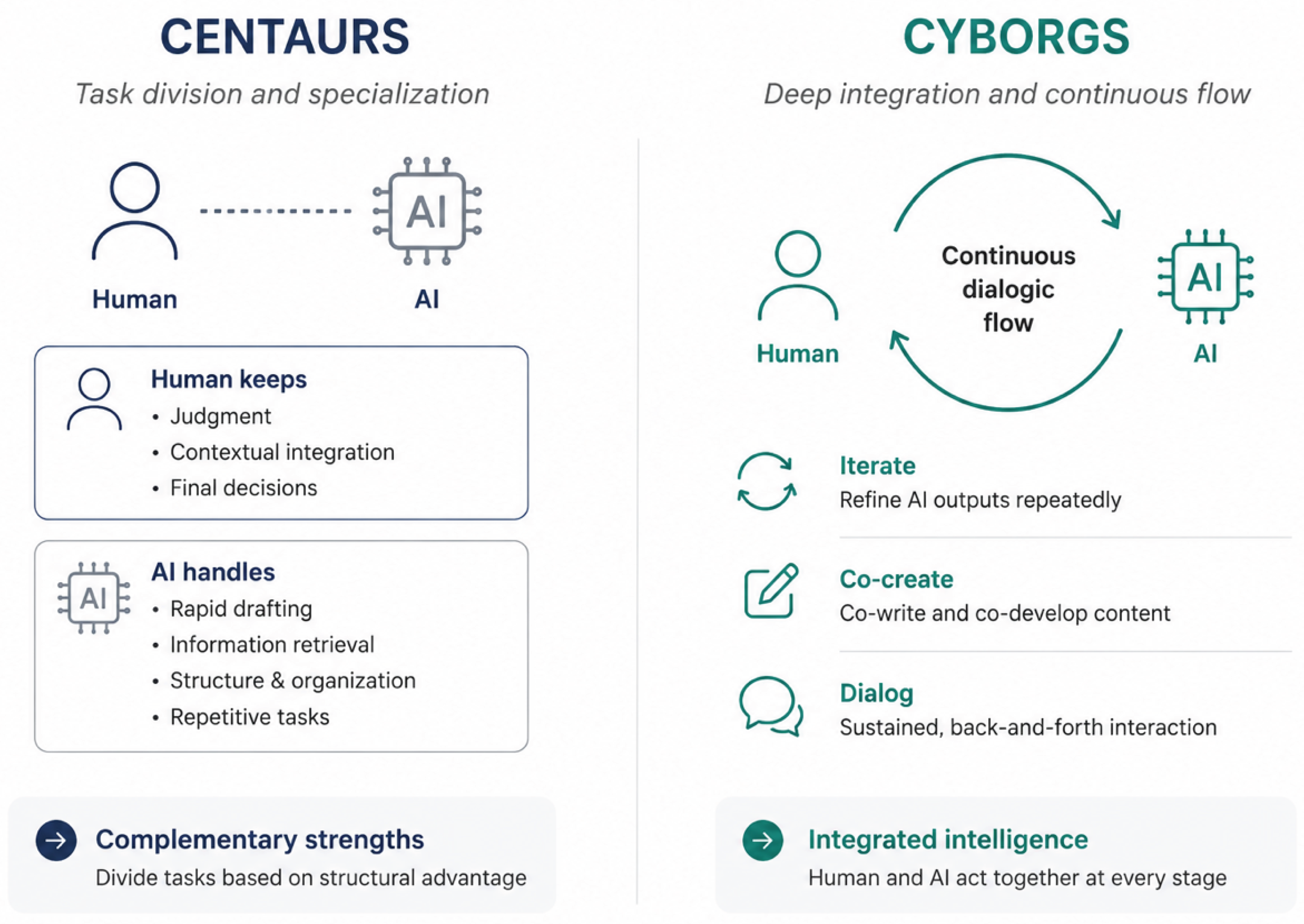
Figure 2.
The 3R Principle for Responsible Generative AI Use: Results, Responses, and Responsibility.
Figure 2.
The 3R Principle for Responsible Generative AI Use: Results, Responses, and Responsibility.
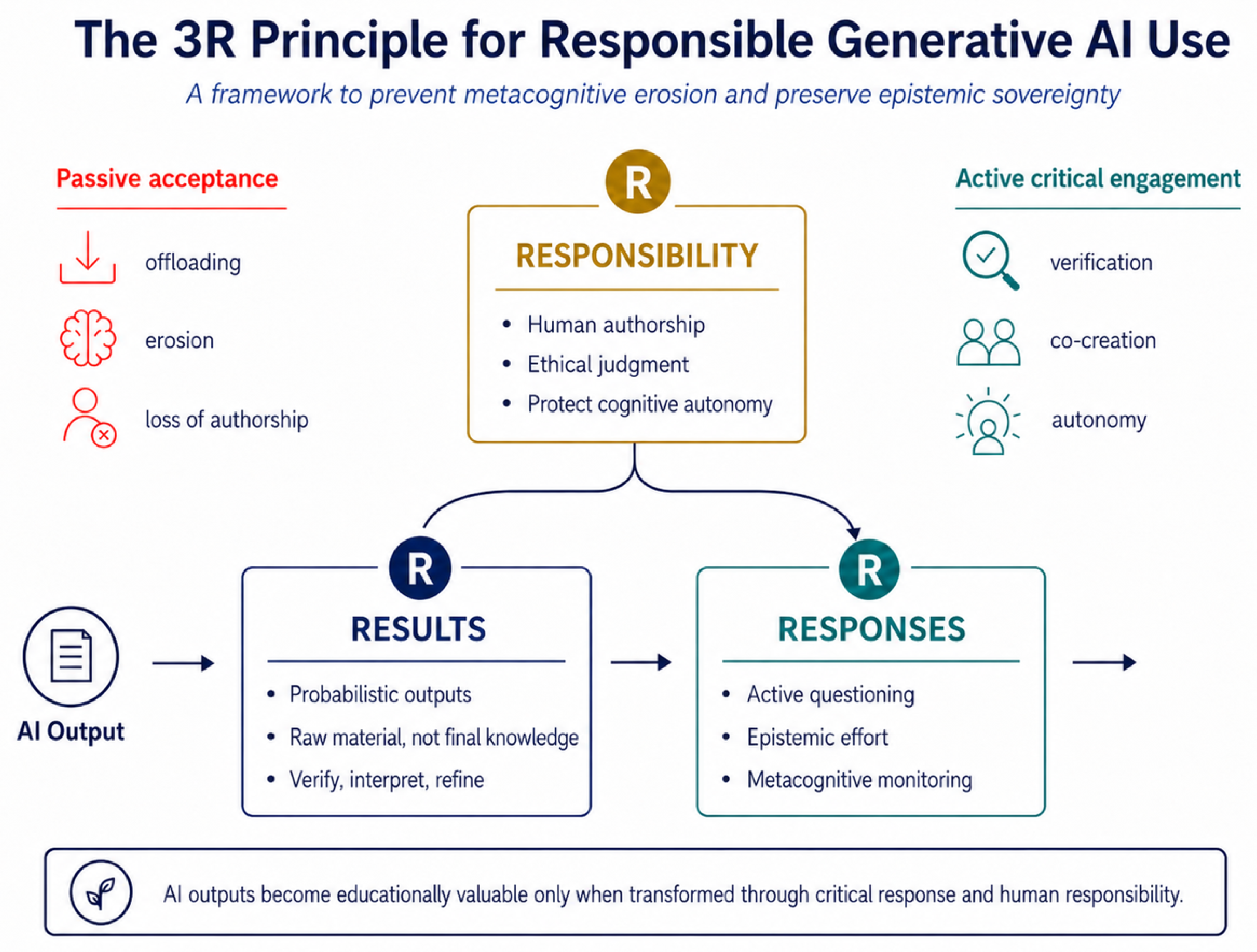

Table 1.
Generative AI Support Across Bloom’s Taxonomy Levels. Adapted from Gruslu et al. [35].
Table 1.
Generative AI Support Across Bloom’s Taxonomy Levels. Adapted from Gruslu et al. [35].
| Bloom’s taxonomy | Learning process | How GenAI can supplement learning |
|---|---|---|
| Create | Engage in both creative and cognitive processes that leverage human lived experiences, social-emotional interaction, intuition, reflection, and judgment to formulate original solutions. | Support brainstorming processes; suggest a range of alternatives; enumerate potential drawbacks and advantages; describe successful real-world cases; create a tangible deliverable based on human inputs. |
| Evaluate | Engage in metacognitive reflection; holistically appraise the ethical consequences of alternative courses of action; identify significance or situate an issue within a complete historical or disciplinary context. | Identify the advantages and disadvantages of different courses of action; develop and apply evaluation rubrics. |
| Analyze | Think critically and reason within the cognitive and affective domains; justify analysis in depth and with clarity. | Compare and contrast data; infer trends and themes in a narrowly defined context; compute; predict; interpret and relate findings to real-world problems, decisions, and choices. |
| Apply | Operate, implement, conduct, execute, experiment, and test in the real world; apply human creativity and imagination to the development of ideas and solutions. | Use a process, model, or method to solve a quantitative or qualitative inquiry; help students identify errors in the problem-solving process. |
| Understand | Contextualize answers within emotional, moral, or ethical considerations; select relevant information; explain significance. | Accurately describe a concept in different words; recognize a related example; translate it into another language. |
| Remember | Recall information in situations where technology is not readily accessible. | Retrieve information; list possible answers; define a term; construct a basic chronology or timeline. |
Table 2.
Teacher-Mediated Pedagogical Mechanisms for Critical, Creative, and Autonomous Generative AI Use
Table 2.
Teacher-Mediated Pedagogical Mechanisms for Critical, Creative, and Autonomous Generative AI Use
| Mechanism | Core teacher action | Main student cognitive process | Risk reduced | Main contribution | Key supporting studies |
|---|---|---|---|---|---|
| Strategic Task Design and Pedagogical Friction | Context engineering; specifying constraints; Socratic questioning. | Retrieval practice; self-explanation. | Metacognitive laziness | Baseline understanding for durable learning. | [5,73]. |
| Verification Routines and AI Audit Trails | Mandating AI traces (prompt logs); assigning bias audits. | Epistemic vigilance | Uncritical overreliance | Rigorous interrogation of machine authority. | [74,75]. |
| Reflective Activities and Metacognitive Monitoring | Embedding reflective prompts; careful use. | Self-regulated learning; identity negotiation. | Cognitive dependency; motivational fade. | Strategic awareness of when to delegate to AI. | [28,32,76,77]. |
| Process-Based Assessment | Implementing Evidence-Centred Design (ECD); viva voce exams. | Knowledge construction and synthesis. | Academic misconduct; product-only shortcuts. | Higher-order thinking and authentic learning. | [74,78]. |
| Teacher Mediation as Epistemic Orchestration | Praxical teaming; reviewing and refining AI feedback. | Dialogic co-construction of knowledge. | Teacher deprofessionalization; skill atrophy. | Professional agency and competence augmentation. | [34]. |
Disclaimer/Publisher’s Note: The statements, opinions and data contained in all publications are solely those of the individual author(s) and contributor(s) and not of MDPI and/or the editor(s). MDPI and/or the editor(s) disclaim responsibility for any injury to people or property resulting from any ideas, methods, instructions or products referred to in the content. |
© 2026 by the authors. Licensee MDPI, Basel, Switzerland. This article is an open access article distributed under the terms and conditions of the Creative Commons Attribution (CC BY) license (http://creativecommons.org/licenses/by/4.0/).
Copyright: This open access article is published under a Creative Commons CC BY 4.0 license, which permit the free download, distribution, and reuse, provided that the author and preprint are cited in any reuse.