

Submitted:
03 November 2026
Posted:
05 November 2026
You are already at the latest version
Abstract
Medical pluralism is a global consensus, and "using each system's strengths" is common policy and clinical language. Yet advantage itself has never been decided: every claim that a system excels in a given situation remains a historical assertion—lacking a neutral metric, falsifiable conditions, and a veto mechanism. This paper names this lacuna the decidability gap of integrative medicine. Building on the author's prior multi-track cognition / system-mapping framework [4], we propose protocol-based commensuration: paradigm incommensurability at the theoretical level is left intact, while outcomes become commensurable through measurable anchors. The decision mechanism is organized into three layers: measurement (a homeostatic anchor network with a measurable-anchor specification), computation (a bidirectional cross-validation efficacy protocol and contextual routing rules), and extension (an open access protocol admitting any qualified system). Convergent validity grounds the cross-system borrowing of anchors; three safeguards—the holistic-homeostasis veto, tiered anchor admission, and evidence weighting—constrain the mechanism itself, and every anchor entering the network carries three identity markers: veto eligibility, validity grade, and evidence weight. Three standardized theoretical demonstrations and a counter-intuitive-output check show that the mechanism yields adjudications with boundary conditions, nullification clauses, and granularity beyond experiential consensus. The framework supplies an operational basis for evidence-based evaluation, multi-system coordination, and personalized medical decision-making.
Keywords:
integrative medicine
; decidability gap
; protocol commensuration
; homeostatic anchor network
; convergent validity
; open access protocol
1. Introduction
1.1. Medical Pluralism and the "Common-Sense Trap"
Contemporary medicine hosts many coexisting systems: biomedicine built on modern life sciences; traditional Chinese medicine (TCM) organized around zang-fu viscera, meridians, qi-blood and yin-yang; India's Ayurveda and Siddha; the Arab-Islamic Unani system; the Tibetan, Mongolian and Uyghur medical traditions; and complementary systems such as homeopathy. Each possesses a complete theoretical lineage, hundreds of millions of users, and irreplaceable clinical domains. In May 2025, the 78th World Health Assembly adopted the WHO Global Strategy on Traditional Medicine 2025–2034, requiring member states to integrate traditional, complementary and integrative medicine into health systems and govern it by evidence [1]; ICD-11 for the first time included a traditional medicine chapter, laying statistical infrastructure for cross-system comparability [2]. Medical pluralism has thus moved from the margins onto the formal global health-governance agenda.
A conspicuous gap nevertheless separates practice from theory. Clinicians and patients already mix systems—acute trauma and infection are managed with biomedicine, chronic conditioning and wellness with TCM, musculoskeletal injury with TCM orthopedics—yet this division of labor has long remained at the level of experiential intuition, without testable criteria. The maxim "acute cases go to biomedicine, conditioning goes to TCM" answers none of three questions: by what objective criterion is the boundary between "acute" and "conditioning" drawn? How can one prove that a system is effective for a state, rather than that the body self-recovers or that placebo operates? On what grounds and by what procedure may a new system be admitted? We call this gap the common-sense trap: the conclusion is known to all, but the rules supporting it do not exist.
The theoretical literature on medical pluralism divides into two positions. Fusion-ism holds that systems should dialogue at the theoretical level and converge into a unified medicine; juxtaposition-ism holds that each system should retain its own integrity. The field often uses the metaphors of "smoothie" and "salad bowl": the smoothie blends ingredients indistinguishably, whereas the salad bowl lets each ingredient keep its form in one container [3]. Neither suffices: fusion purchases coherence by sacrificing a system's internal theoretical consistency, while juxtaposition stops at "each lives well" and cannot answer cross-system efficacy judgment and selection. We argue for a third path—protocol-based commensuration.
1.2. The Decidability Gap
Alongside the fact of pluralism stands a near-global consensus: each system has its strengths, and they should be used selectively and in coordination. In China, "both Chinese and Western medicine emphasized, drawing on each other's strengths" has been policy language and clinical consensus for decades; on the front line, divisions such as "acute critical care by biomedicine, functional conditioning by TCM" are near-default knowledge. Yet an unnamed problem runs through this consensus: by whom is "advantage" judged, on what basis, and how are wrong judgments corrected?
Examining existing discourse shows that every statement of the form "system S excels in domain C" has the logical structure "S has been regarded, in historical experience E, as excelling in situation C." Its subject is history, not measurement, and it lacks three elements: a neutral metric on which the comparison is conducted; falsifiability—what observation would overturn it; and veto conditions—under what circumstances it must not apply. We name this lacuna the decidability gap of integrative medicine: the direction of integration is already consensus, but the decision of integration remains at the level of experiential intuition.
1.3. Claim and Structure
This paper is a natural extension of the author's prior work. Facing Kuhn's problem of paradigm incommensurability, the author constructed a multi-track cognition / system-mapping framework, establishing four axioms—ontological unity, cognitive plurality, mapping commensurability, and generative synergy—and solved the legitimacy of cross-paradigm integration: whether different medical paradigms can dialogue equally while retaining their subjectivity intact [4]. But legitimacy is only the first half. When integration moves from principle to clinic, the practitioner's concrete question is: for this patient, this stage, this set of problems, which system should be chosen? The prior framework provides a platform for dialogue but no ruler for judgment. The present task is to move integrative medicine from "integrable" to "judgeable"—a direct response to the decidability gap.
Our core claim is this: medical pluralism needs no philosophical compromise; it needs an executable operational protocol. The protocol uses multi-dimensional homeostatic anchors as a public interface, bidirectional cross-validation as the efficacy criterion, and evidence strength as the basis of contextual routing, so that "paradigm juxtaposition" is upgraded into "protocol commensuration"—systems remain incommensurable at the theoretical level, and become commensurable at the outcome level through measurable anchors.
The remainder is organized as follows. Section 2 reviews prior work and locates the gap precisely. Section 3 rebuilds the measurement-theoretic ground for cross-system efficacy judgment, including convergent validity and three safeguards. Section 4 presents the three-layer architecture and four operational models. Section 5 tests the mechanism's generative capacity through three demonstrations and a counter-intuitive-output check. Section 6 anticipates and addresses core objections. Section 7 discusses significance and limitations. Section 8 concludes.
2. Prior Work and Positioning
Before constructing the framework, we must settle a methodological question: has the problem—"how to make evidence-based choices among medical systems for a concrete clinical situation"—already been solved? If yes, this paper is redundant; if no, the exact location of the gap must be fixed. This section reviews six classes of prior work (Section 2.1, Section 2.2, Section 2.3, Section 2.4, Section 2.5 and Section 2.6), then reviews scattered cross-system evidence (Section 2.7), and thereby fixes our academic position.
2.1. Paradigm Incommensurability and Two Positions in Integrative Medicine
Kuhn argued that different scientific traditions carry their own ontological commitments, methods and standards, and that paradigms are not fully commensurable [5]. Differences among medical systems have a paradigm-like character: TCM organizes clinical facts around signs and syndromes, biomedicine around pathological mechanisms and biomarkers, and the two do not share a single concept of "what is health" or "what is effective". Prior work has argued that cross-paradigm integration need not sacrifice either side's theoretical core; through a zero-compromise rigidity, an indirect mediating structure can be sought at a higher level [4].
In integrative-medicine practice, fusion-ism is represented by Fan Daiming's "integrative medicine"—the whole exceeds the sum of parts, and the body should be integrated organically as a whole [6]. Juxtaposition-ism is embodied in the institutional arrangement of "parallel provision, separate regulation" in most countries; its latest theoretical statement is the ideal of the equitable mosaic—the salad bowl against the smoothie, holding that each system should be evaluated equally by its own philosophy and standards [3]. We do not deny the value of these efforts; we note that neither yet supplies operational rules for how to judge cross-system efficacy or how to choose among systems—which is precisely where protocol commensuration steps in.
2.2. The Discourse Tradition of "Complementary Strengths": Consensus Without Adjudication
The ideal of each system contributing its strengths has deep policy and clinical roots in China. Since the mid-twentieth-century policy of integrating Chinese and Western medicine, "both emphasized" and "complementary strengths" have been core official and academic phrases; the 2026 National Health Work Conference further required comprehensive Sino-Western coordination in prevention, treatment, rehabilitation, innovation and workforce development [7]. In TCM oncology and perioperative rehabilitation, the "Western treatment + Chinese conditioning" model has become routine practice with a substantial evidence base.
Our stance on this tradition: its value lies in direction, its gap in adjudication. Every statement that a system excels in a domain has the structure "S has been regarded, in historical experience E, as excelling in C"—its subject is history, not measurement, and it contains no neutral metric, no falsifiability, no veto condition. In the absence of a decision mechanism, "advantage" is actually distributed by historical inertia, resource configuration and discursive power—the deep reason integration has long stayed at the experiential level.
2.3. Coordination Paradigms and Staged Integration: Operational Effort and Its Boundaries
Chinese scholarship has not stopped at ideals. Around Sino-Western collaboration rules, fairly mature operational research has formed: whole-course coordination from the Western "disease" angle, staged coordination from the TCM "syndrome" angle, and docking of symptom control with mechanistic intervention at the level of "symptom" and "target". Perioperative Enhanced Recovery After Surgery (ERAS) Sino-Western coordination has refined preoperative conditioning, intraoperative support and postoperative rehabilitation into clinical-pathway rules.
We hold that this research completes an important leap from "idea" to "rule", but two boundaries remain uncrossed. First, coverage: all rules are built within the Sino-Western dyad, not abstracted into a general protocol admitting Tibetan, Mongolian, Ayurvedic or other systems. Second, provenance: rules come from experiential induction and rest on expert consensus rather than a neutral metric—the rule contains no internal arbitration of "which dominates when", and has no external veto. Experiential induction can produce correct rules, but cannot prove them correct, nor detect error when experience fails.
2.4. Evaluation Methods Within a Single System
Over the past half-century, mature efficacy-evaluation methods have developed within a single system. The randomized controlled trial (RCT) is the gold standard of efficacy judgment; the GRADE evidence-grading system has been adapted for traditional medicine [8]; for TCM and integrative medicine, the CHIMERAS system [9] and the MESERT multi-dimensional evidence-synthesis framework [10] have been proposed; for outcome standardization, the International Consortium for Health Outcomes Measurement (ICHOM) builds comparable patient-centered standard sets across institutions [11]. Patient-reported outcomes (PROs) and TCM syndrome scores have also entered formal clinical trials.
The common feature of these methods is intra-system evaluation: they answer "is a therapy effective under its own system's criteria", not "how do the evaluation criteria of different systems confirm one another". TCM syndrome scores and Western laboratory markers may appear in the same trial, but are usually reported as two parallel sets of outcomes, without a theoretical design that brings them into a common efficacy framework.
2.5. Whole Systems Research: Methodological Legitimacy of Single-System Evaluation
The methodological lineage closest to our work is Whole Systems Research (WSR), developed internationally in complementary and alternative medicine since the early 2000s. WSR holds that when a whole medical system is studied as a complex intervention, the research design must fit the system's own theoretical framework—the requirement of model validity; applying reductionist evaluation templates outside a system's native logic produces systematic validity loss [12].
We explicitly inherit two legacies of WSR: the legitimacy claim that a system should be evaluated in its own terms, which is isomorphic with our lossless-interpretation principle; and WSR's critique of reductionist evaluation hegemony, which is our international academic warrant for paradigm neutrality. But we must also mark WSR's boundary: WSR answers "how is a single system correctly evaluated", not "how are systems compared". It gives each system a fair self-presentation but supplies no cross-system neutral metric—when clinic must choose among systems, WSR stays silent. The decidability gap exists in the international literature as well, and is equally unnamed.
2.6. Recent Meta-Frameworks of Integration: Pattern Enumeration Without Mechanism
In recent years, "medical integration needs a meta-framework" has itself become a field. Representative Chinese work by Duan Yucong's team adds an "intention" layer to the classic DIKW model to form DIKWP, and explores TCM-Western semantic integration supported by knowledge fusion [13]. Chinese "proactive health" research defines health as dynamic adaptation and self-management, proposing a dynamic health optimization system covering monitoring, assessment and intervention.
The common contribution of these works is to turn the meta-framework from aspiration into agenda. Their common limitation is that pattern enumeration has replaced mechanism construction: integration patterns are listed rather than derived; there is no neutral metric supporting comparison among patterns, no access protocol governing new entrants, and no veto mechanism preventing failed modes from persisting. The dynamic-health concept defines homeostasis, but for homeostasis to become an operational tool of cross-system judgment it must pass measurement, threshold and weighting transformations—from concept to interface, a one-step difference of a different kind. That step is precisely what this paper constructs.
2.7. Scattered Evidence of Cross-System Mutual Validation
Notably, cross-system efficacy mutual-validation has already occurred abundantly at the empirical level, though not yet been theorized. First, TCM means restoring Western biochemical markers: a network meta-analysis shows that combined Chinese-Western treatment of metabolic syndrome significantly outperforms Western treatment alone in fasting glucose, triglycerides and HDL [14]; a systematic review of Wendan Decoction for metabolic syndrome included 31 RCTs and 2,512 patients, with an overall effective rate of 91.4% versus 66.9% in controls [15]; berberine significantly lowers CRP, TNF-α and IL-6 [16]; Baduanjin exercise improves glucose, blood pressure and lipid profiles in metabolic syndrome [17]. Second, Western means restoring TCM observation systems: using TCM syndrome scores as outcome measures of Western or combined interventions has become standard design in Chinese clinical trials. Third, isomorphic evidence from other traditional systems: Ayurvedic whole-system intervention in rheumatoid arthritis lowered clinical scores and converged serum metabolomic profiles toward healthy controls, explicitly described as "promoting the body's return to homeostasis" [18].
Meanwhile, objective TCM diagnostic tools are maturing rapidly: digital acquisition of the four examinations is advancing clinically and industrially; the standardized classification of TCM syndromes has national-standard support, providing a coding basis for cross-institution comparability of syndrome anchors [19]. The once-subjective pulse and tongue have thus acquired measurable, quantifiable technical foundations—the hardware conditions for an anchor network are maturing.
2.8. Positioning: From "Claiming Matching" to "Constructing Adjudication"
Table 1 summarizes the relationship between prior work and this paper.
Our academic position can be stated in one sentence: this paper does not claim that plural systems should be used selectively—that is consensus, not contribution; it constructs the mechanism that makes "selecting" a decidable, verifiable, extendable scientific proposition. Specifically, we deliver three things: (i) a decidable definition of advantage with its measurement-theoretic basis (Section 3); (ii) an adjudication mechanism using the homeostatic anchor network as a neutral metric and three safeguards as rigid constraints (Section 4); and (iii) an open protocol admitting any qualified paradigm, with demonstrations of its executability (Section 4 and Section 5).
3. Theoretical Grounding: Rebuilding the Measurement Science of Cross-System Efficacy Judgment
This section answers one question: what scientific ground is needed to make "advantage" a decidable proposition? We locate this ground not within medical philosophy but at the intersection of measurement science and homeostasis science: the former supplies the legitimacy framework for cross-method validity testing, the latter the universal physiological metric across systems.
3.1. Homeostasis as the Cross-System Common Ontological Referent: A Chain of Evidence
We take human life homeostasis as the ultimate referent of cross-system judgment. This choice is not philosophical preference; it is supported by an increasingly dense evidence chain.
First, homeostasis science has mature tools for system-level health measurement. Since McEwen proposed the allostatic-load concept, composite load indices built from cortisol rhythms, inflammatory factors and metabolic markers have been shown to predict health outcomes across diseases and systems, functioning as a de facto universal metric of stress and adaptation [20]. Heart rate variability (HRV) is another universal anchor: biomedicine uses it to assess autonomic function, TCM uses it to corroborate pulse, and mind-body intervention research uses it as an objective effect measure—the same physiological quantity independently adopted by multiple medical traditions is the most direct evidence that homeostasis is measurable across systems [21]. Network physiology further constructs inter-organ interaction as a dynamic network, characterizing system homeostasis by network topology, providing strict mathematical language for "anchors as a network" [22].
Second, typological systems in traditional medicine show biological evidence of cross-paradigm convergence. Indian research on the three Ayurvedic constitutions (Vata/Pitta/Kapha) found that extreme constitutions significantly correlate with the expression profiles of hundreds of genes and multiple biochemical markers—traditional typology is not an untestable metaphysical label but a phenotype with reproducible biological correlates [23]. The implication is that traditional indicators can be "borrowed" by biomedical measurement—the empirical precedent for our cross-system anchor borrowing.
Third, international conceptual frameworks are converging toward homeostasis. The WHO Global Strategy 2025–2034 lists multi-system coordination on the global agenda [1]; ICD-11 includes the traditional medicine chapter [2]. Conceptual convergence means that a decision framework taking homeostasis as common ontology is not one system's self-advertisement, but the current position of global medical-concept evolution.
3.2. Convergent Validity: Measurement-Theoretic Legitimacy of Cross-System Anchor Borrowing
Our core operation—using a system A indicator to test a system B intervention—is not a new invention but a new application of a classic principle. Campbell and Fiske's 1959 multitrait-multimethod matrix holds that the strongest evidence for a construct's validity is convergent validity: when independent methods measure the same construct, results should converge; if they do, the methods share valid representations of that construct [24].
Applying this to medical judgment yields the following argument. Human homeostasis is one construct; Western laboratory markers, TCM signs, and Ayurvedic constitutional indicators are three mutually independent measurement methods of that construct (each developed in a different theoretical tradition, without a common methodological source—the independence premise required by convergent validity, and the fundamental reason anchor borrowing is not circular). Therefore: if an intervention shifts multiple independent measurement systems in the same salutary direction, the intervention's effect on the construct "human homeostasis" has gained cross-method convergent evidence—regardless of which system it comes from.
This is the full legitimacy statement of cross-system anchor borrowing. It also states its boundary: borrowing constitutes convergent evidence only when two indicator systems are mutually independent; if a "TCM indicator" is itself calibrated against Western markers, the two are not independent methods, and borrowing degenerates into self-confirmation. This boundary is enforced rigidly at the anchor-admission step.
3.3. Three Safeguards: Preventing Failure Modes of the Adjudication Mechanism
3.3.1. Safeguard 1: The Surrogate-Endpoint Trap and the Holistic-Homeostasis Veto
The first failure mode is indicator illusion—surrogate endpoints masquerading as hard outcomes. An intervention normalizes a marker while overall homeostasis does not improve or worsens. Drug development offers sobering precedents: the CETP inhibitor torcetrapib markedly raised HDL-cholesterol (a salutary marker) yet increased all-cause mortality in a large outcomes trial [25]; intensive glycemic control normalized HbA1c while mortality rose [26]. If the mechanism treats "one anchor moving in a salutary direction" as sufficient, the mechanism itself becomes a production line of indicator illusion.
Rule 1 (holistic-homeostasis veto): the salutariness of any single marker-class anchor is not sufficient for an adjudication; the conclusion must pass veto review by first-level holistic-homeostasis anchors (survival, function, quality of life—hard outcomes). The relation between holistic anchors and marker anchors is that of constitution to statute: markers may claim "effective", but homeostasis holds final veto.
3.3.2. Safeguard 2: Instrument Validity Thresholds and Tiered Anchor Admission
The second failure mode is measurement tools that are themselves invalid—the instrument-validity threshold not being enforced. Modern detection of TCM pulse and tongue illustrates this: current pulse and tongue instruments are not yet stable in inter-instrument agreement or in agreement with senior clinicians; if unvalidated instrument readings become the validation target, the entire adjudication chain rests on unstable measurement.
Rule 2 (tiered anchor admission): anchors are graded into three levels by the validity of their measuring instruments. Core-validation anchors pass inter-instrument and criterion validity, and may serve as decision basis; auxiliary-observation anchors have standardized, repeatable observation protocols but incomplete validity evidence, and serve only as corroboration; hypothetical anchors rest only on theoretical deduction and are used solely for mechanism demonstration, never for adjudication. Sign-type indicators that have not passed validity testing may never serve as core-validation anchors.
This rule applies equally to both sides: a Western marker that has not passed validity testing in the relevant context (e.g., a novel biomarker lacking outcome-association evidence) is downgraded just the same. Neutrality lies in a unified threshold, not in averaging results.
3.3.3. Safeguard 3: Asymmetric Evidence Weight and the Weighting Rule
The third failure mode is the weight illusion—giving equal voting weight to indicators of vastly different evidence strength: formally neutral, substantively awarding weak evidence excess decision influence. We must acknowledge: mainstream Western indicators usually rest on large-sample cohort validation with hard-outcome endpoints, while traditional indicators rest mainly on expert consensus and small-to-mid studies; their contributions to adjudication reliability cannot be equal.
Rule 3 (evidence weighting rule): an anchor's decision power is proportional to its association with hard outcomes; weighted scoring is used, with weights calibrated by evidence grade and itself open to revision—when a traditional indicator accumulates outcome-level evidence, its weight rises accordingly. The essence of weighting is to institutionalize the honest posture of acknowledging evidence asymmetry, while preserving the openness that "evidence growth changes adjudication". We do not claim that all systems' cognitions are equally effective; we claim that all systems' validity claims are tested on the same metric with different weights.
4. Core Framework: The Three-Layer Architecture of the Anchor-Network Operational Theory
Built on the prior-work review (Section 2) and the measurement ground (Section 3), this section constructs the ontology of the adjudication mechanism. It has three layers: measurement (what coordinate we compare on—the homeostatic anchor network and measurable-anchor specification); computation (how comparison results are produced and stated—the bidirectional cross-validation protocol and contextual routing rules); and extension (how new members enter without disturbing the coordinate—the plug-in access specification). Four operational models sit in these layers: measurable-anchor specification, bidirectional cross-validation efficacy protocol, contextual routing rules, and plug-in access specification.
4.1. Definition and Tiered Structure of Homeostatic Anchors
Cannon's concept of homeostasis shows that health in living systems appears as dynamic balance and recoverability of internal-environment parameters [27]. Building on this, we offer an operational definition: a homeostatic anchor is an indicator—or combination of indicators—used within a medical system to characterize the body's homeostatic state, and in principle objectively observable.
We organize the anchor network into four tiers. Tier 1: holistic life-homeostasis anchors (survival, function, quality of life—hard outcomes). Tier 2: system functional-hub anchors (blood pressure, glucose, inflammatory load, autonomic function; authoritative guidelines set BP reference ranges and grading [28]), including a psycho-somatic subclass (sleep, mood, stress-response flexibility)—a dimension independently emphasized in both modern psychosomatic medicine and traditional systems. Tier 3: organ–tissue anchors. Tier 4: cellular–molecular anchors. Lower-tier anchors maintain explicit causal association with higher-tier ones, ultimately all anchored at Tier 1. Parallel to the four tiers, system-specific anchors form an independent category: pulse, tongue, syndrome scores, constitutional typology, Ayurvedic Dosha states—the key carriers of cross-system mutual validation, admitted to the network on equal terms after Tier-2 grading. Network construction follows three principles: top-down (lower anchors chosen by their causal contribution to higher ones); paradigm neutrality (selection by identifiability and verifiability alone, no system a priori favored); and minimal sufficiency (fewest anchors covering the key homeostatic dimensions of the situation to be judged).
Terminology note: this version restructures the prior framework's five-tier anchor structure (with psycho-somatic as an independent tier) into a four-tier network—psycho-somatic moves from independent tier to functional-hub subclass, and system-specific anchors rise from an appendix to a parallel category. The restructure follows the minimal-sufficiency principle; the prior "top-down, causally linked" tier logic is fully preserved, and no substantive adjudication rule changes.
The key difference from earlier versions is that the three safeguards of Section 3—the holistic-homeostasis veto, tiered admission, and evidence weighting—are no longer external audit stages but intrinsic properties of the network. Every anchor born into the network carries three identity markers: whether it may be subject to Tier-1 veto, which validity grade it belongs to, and what its evidence weight is. The anchor network is not a coordinate map but a metric system with audit logic built in. This is the structural feature that distinguishes it from every "indicator set" proposal.
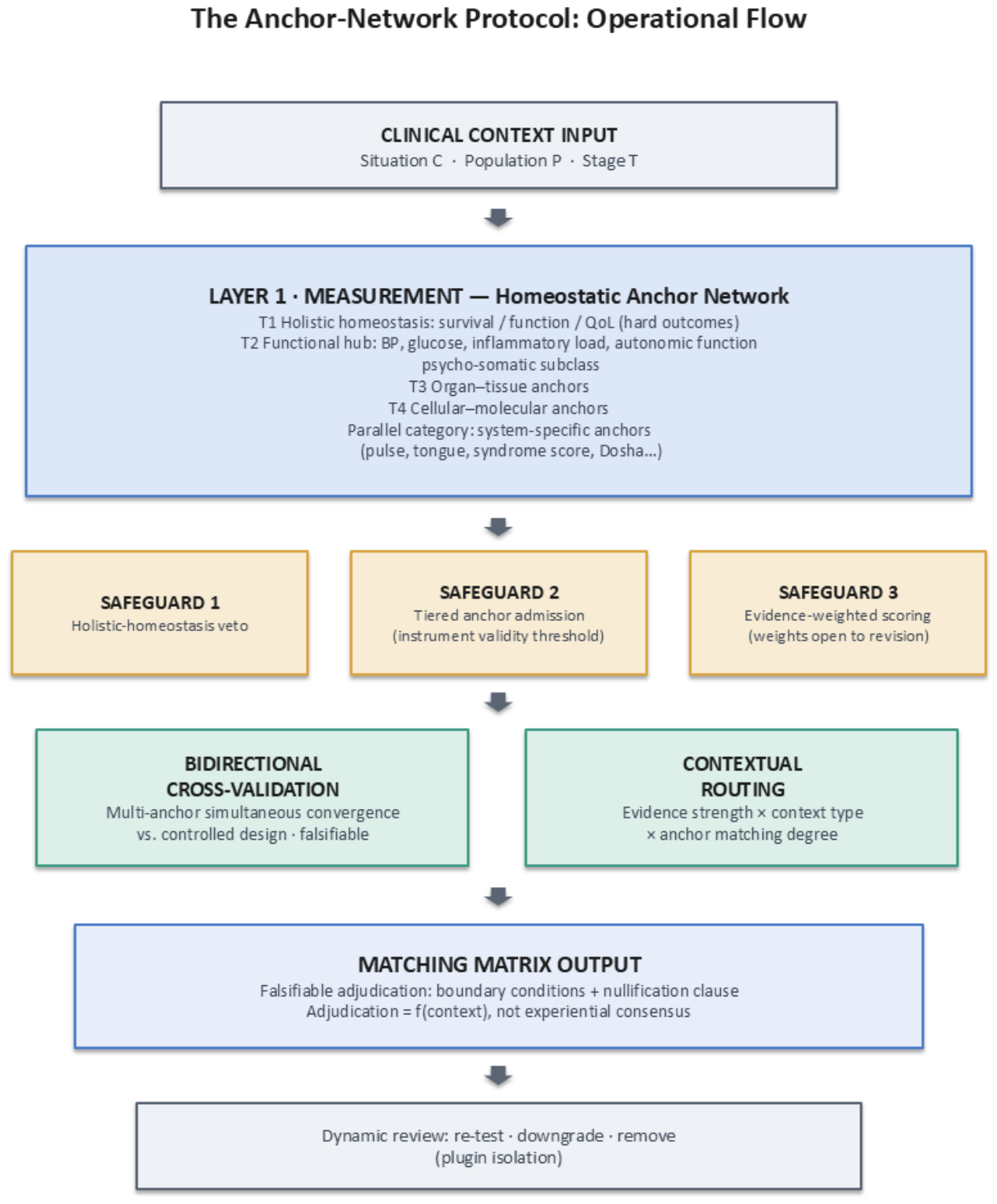
Figure 1.
Operational flow of the anchor-network protocol: clinical context input → Layer-1 homeostatic anchor network → three safeguards → Layer-2 bidirectional cross-validation and contextual routing → falsifiable matching-matrix output → dynamic review.
Figure 1.
Operational flow of the anchor-network protocol: clinical context input → Layer-1 homeostatic anchor network → three safeguards → Layer-2 bidirectional cross-validation and contextual routing → falsifiable matching-matrix output → dynamic review.
4.2. Layer 1 · Measurement: The Measurable-Anchor Specification (Model 1)
The measurable-anchor specification answers which indicators may serve as anchors, with what tools they are measured, and by what normality criterion; it is the measurement foundation of the whole protocol. Table 2 gives an example mapping of anchors to objectifying tools.
To qualify, an indicator must meet four criteria simultaneously: measurability (a repeatable objective tool exists); reliability (acceptable measurement error, inter-rater agreement); sensitivity (responsive enough to homeostatic change to show detectable pre/post-intervention difference); and cross-system compatibility (the anchor is acknowledged as clinically meaningful by at least two systems, or its system-belonging is explicitly declared in the protocol). The fourth criterion is decisive: it ensures anchors serve both intra-system judgment and cross-system mutual validation.
4.3. Layer 2 · Computation: The Bidirectional Cross-Validation Efficacy Protocol (Model 2)
The bidirectional cross-validation protocol defines "effective" as a testable proposition: under a controlled design (RCT or quasi-experimental control), after intervention, the pre-specified anchor network converges simultaneously in multiple dimensions toward its respective reference ranges, the effect is repeatable and significantly different from control; then the intervention is judged effective for that state. This definition carries two rigid requirements: simultaneous convergence of multiple anchors (to prevent surrogate-endpoint chasing from masquerading as root-cure"); and mandatory control (to exclude natural recovery, regression to the mean and placebo). Uncontrolled case observations do not constitute efficacy evidence.
A crucial distinction: in existing Sino-Western trials, Western markers and TCM syndrome scores are reported as two parallel outcome sets—parallel-outcome design; our protocol requires multi-dimensional simultaneous convergence of the anchor network as a unified sufficient criterion, closed by holistic-homeostasis veto review—joint-convergence criterion. The former is parallel recording; the latter is joint adjudication. What "bidirectional cross-validation" adds beyond existing practice is upgrading parallel outcomes into a joint efficacy rule with a veto mechanism—not merely naming existing practice.
The feasibility of protocol commensuration is preliminarily supported by existing evidence. Table 3 summarizes representative evidence by validation direction.
Every efficacy proposition under this protocol is falsifiable: if, in a conforming controlled trial, the anchor network fails to converge simultaneously, or the convergence effect is not significantly different from control, the "effective" adjudication is overturned. Protocol commensuration thus differs from untestable philosophical claims—it supplies generation rules for scientific hypotheses, not a priori conclusions.
4.4. Layer 2 · Computation: Contextual Routing Rules and the Matching Matrix (Model 3)
Contextual routing answers "which system to use for which situation". Routing judgment rests on three dimensions: evidence strength (the evidence grade and effect size of a system's intervention for the situation class); situation type (acute critical care, infection/trauma, chronic management, functional conditioning, wellness prevention); and anchor-matching degree (which system's observational advantage range contains the most situation-sensitive anchors). Their composition yields the preferred system and a confidence level.
The decidable definition of advantage: in target situation C, target population P, intervention stage T, system S's advantage over system S′ is defined as—on anchor set A, the weighted salutary effect of pathway S exceeds that of S′, the difference passes holistic-homeostasis veto review, and the adjudication is reproducible within a pre-specified follow-up window. Five elements are indispensable: situation, population, stage, anchor set, veto review. Missing any, "advantage" reverts to a historical assertion. "TCM excels at conditioning" is not an instance of this definition; "on anchor set A, in recovery stage T, for population P, after weighted scoring and veto review, pathway S outperforms S′" is.
Simplified implementation of weighting follows three steps. Step 1, anchor grading: split set A into core-validation anchors A₁ and auxiliary-observation anchors A₂ (Rule 2); A₁ enters scoring, A₂ is directional corroboration only. Step 2, weight calibration: weights within A₁ are set by evidence grade of association with hard outcomes (e.g., outcome-cohort validation > prospective studies > consensus standards), normalized. Step 3, veto review: the weighted score goes to the holistic-homeostasis mechanism—if S's high score is purchased at the cost of any hard-outcome anchor worsening, then regardless of total score, the adjudication is rewritten as "undecidable / pathway redesign needed". This implementation is deliberately simplified: precise weight calibration is an empirical task; we deliver the computational framework by which calibration results enter adjudication, not the calibration data itself—a division honestly declared in Section 7.3.
Illustrative calculation (weights and scores are hypothetical, showing the calculation only): after grading, the core-validation set is A₁ = {completion rate of chemotherapy, blood count, function score}, with weights w = (0.5, 0.3, 0.2); candidate pathways S₁ and S₂ have standardized salutary scores S₁ = (0.90, 0.80, 0.50) and S₂ = (0.60, 0.50, 0.80). Weighted scores: S₁ = 0.5×0.90 + 0.3×0.80 + 0.2×0.50 = 0.79; S₂ = 0.5×0.60 + 0.3×0.50 + 0.2×0.80 = 0.61. S₁ scores higher; if S₁'s high score is accompanied by a liver-function worsening signal (hard-outcome anchor turning adverse), veto review triggers and the adjudication is rewritten as "undecidable / pathway redesign". This also demonstrates the order: weighted scoring first, veto review second—the two steps cannot be merged.
The systematic record form of adjudications is the matching matrix. Each row is a clinical situation; the six-column structure is shown in Table 4.
Three points must be stressed. First, matrix cells are propositions to be adjudicated, not conclusions—the "dominant candidate" column lists candidates entering adjudication, their status produced by the rules, not pre-filled by experience; this is the essential difference from every "empirical division-of-labor table". Second, the matrix is locally revisable: when a cell's adjudication is overturned by new evidence, only that cell and its causally linked cells are revised, without triggering a matrix-wide credibility crisis. Third, rows are constrained by the anchor network's causal links: if an intervention on one anchor produces negative effects in other situation rows, the related rows must be jointly re-reviewed—preventing the fallacy of "locally optimal, globally self-defeating".
The procedure for producing an anchor set must be explicit, or the minimal-sufficiency principle hangs in air. We add a governance rule:
Rule 4 (anchor-set governance): for a concrete situation, the anchor set is voted item by item by a cross-system expert review group according to Model 1's four criteria; anchors in dispute default to auxiliary-observation status and may not be voted up to core-validation; the entire production and revision process is logged, auditable and reproducible. The review group must cover all participating medical systems and have no direct interest in the situation being judged.
Every adjudication must be output in falsifiable format: if, tested on anchor set A with scheme V, no weighted salutary difference Δ is observed within window τ, this adjudication is nullified and the matrix cell revised. The falsifiable format is the final boundary between adjudication mechanism and experiential consensus: consensus need never predict when it is wrong; adjudication must.
"Acute cases to biomedicine, conditioning to TCM" is experiential common sense; contextual routing is explicit rules. Three differences: boundary made explicit (what counts as acute, how strong evidence must be to switch, all defined); criterion computable (routing value composed from evidence strength, situation type and anchor matching, not intuition); result auditable (every routing decision traceable, overturnable and updatable by higher-quality evidence). Just as "the body needs balance" was common sense before homeostasis and its negative-feedback mechanism made it a measurable physiological framework [27], just as TCP/IP turned "let different machines communicate" into an interoperable explicit standard, we propose turning "division of labor by system" into a testable, updatable, extendable protocol—the boundary between common sense and science. Health IT offers a parallel precedent: the SMART platform, through standardized application programming interfaces, achieved plug-and-play substitutable applications within electronic health records [30]; cross-system protocol commensuration in medicine follows the same technical route.
4.5. Layer 3 · Extension: The Plug-In Access Specification (Model 4)
The plug-in access specification answers how a new system enters the anchor network. Any system—TCM, Ayurveda, Tibetan, Mongolian, Unani, or other traditional systems—may enter if it meets three conditions: (1) diagnostic anchors are objectifiable—the system's core state indicators can be bound to objective tools; (2) interventions are standardizable—its therapies can be normatively described and repeatably delivered; (3) effects are testable under a controlled design—the system's efficacy can be tested under controlled design. All three are indispensable: the unobjectifiable cannot enter the evidence loop, the non-standardizable cannot be reproduced, the uncontrollable cannot be adjudicated.
Open access has four steps. Step 1, admission review: the applying system passes three screens—neutral scientific demarcation (self-consistent, practically reproducible, clearly bounded), absolute safety floor (controllable risk, ethical, legal), and subjectivity integrity (possessing independent native diagnostic logic); any failed screen means rejection. Step 2, anchor audit and tool mapping: lossless interpretation of the system's native logic is performed by its own qualified practitioners—interpretation by outsiders necessarily imports outsiders' hidden paradigmatic frameworks; the system's diagnostic anchors (including system-specific ones) are identified and registered, each bound to an objectifying tool or mapped to an existing anchor category; mapping declares only "which anchors this system's intervention targets and what salutary change is expected"—it does not translate or align with other systems' concepts. Step 3, baseline evidence and mutual-validation registration: the system's existing efficacy evidence is collected, graded and weighted per Section 4.3, new anchors enter the network, and bidirectional mutual-validation accumulation begins; baseline labeling must be honest—labeling consensus-grade evidence as cohort-grade will be detected at the weighting step and rebound against the system's adjudication credit. Step 4, participation in adjudication: after entry, the system enters the matching matrix as a candidate, subject to exactly the same adjudication rules, three safeguards and falsifiable format as others—entry is not privilege; entry equals equal standing for audit. The credit mechanism is isomorphic with the adjudication mechanism: the cost of breach is executed automatically by the rules, no administrative eviction needed.
The open-architecture proposition: this framework presupposes no system and enumerates no system; any system passing admission and completing anchor mapping enters losslessly and participates in adjudication and coordination, without the framework builder pre-knowing that system. The essence is changing the relation between framework and concrete medical knowledge from containment to interface: the framework is an operating system, the systems are applications—an OS's validity does not depend on pre-knowing all applications, only on the stability of the interface.
Openness carries risk, and the protocol must carry feedback: an admitted system with new safety evidence, abusive use or failed validation triggers dynamic review; failed review means downgrade or removal; removal does not disturb the framework's adjudication relations with other systems—a plugin's failure must not force an OS restart.
Tibetan medicine illustrates this: its rLung, mkhris-ba, bad-kan tri-d theory corresponds to functional states, and may be bound to pulse-objectifying tools and metabolic/neuroendocrine markers; Tibetan compound formulas, blood-letting and medicinal baths can be standardized by normative description; clinical efficacy can be tested under controlled design. The Mongolian three-element theory and Unani humoral medicine work analogously. What this offers these systems is not "which theory explains you" but "by what interface you enter, by what criterion you are validated"—after entry, each system keeps its theoretical integrity; that is the meaning of plug-in: plug and play, mutual non-engulfment.
5. Demonstrations: Testing the Generative Capacity of the Adjudication Mechanism
This section does not test the clinical efficacy of a single intervention—that is the task of clinical trials; it tests the adjudication mechanism itself: whether it runs, whether its outputs are mere restatements of common sense, and whether it can admit systems the builder does not know. All demonstrations are standardized theoretical deductions; the intervention schemes cited are mature, publicly evidence-based methods and do not constitute empirical evidence.
5.1. Demonstration Design
Three demonstrations each test one capacity. Demonstration 1 tests experiential rewriting—taking the least disputable common-sense proposition into the mechanism and observing whether it comes back unchanged or is recast into a more testable form. Demonstration 2 tests multi-system computation—weighted adjudication with veto review among three candidate systems. Demonstration 3 tests open access—running a hypothetical system through the complete entry procedure. A counter-intuitive-output check (Section 5.5) further asks whether the mechanism can say what experiential intuition would not—our decisive evidence that decidability outperforms experiential consensus.
5.2. Demonstration 1: Soft-Tissue Injury—the Mechanistic Recasting of a Common-Sense Proposition
Experiential proposition (to be recast): "For bruises and sprains, use TCM orthopedics."
Step 1, situation delimitation: C = closed soft-tissue injury (mild–moderate); P = adults without fracture/dislocation or open injury; T = 72 h post-acute to functional recovery.
Step 2, anchor-set construction: core-validation anchors = pain VAS, joint range of motion, function recovery time, return-to-work/training time; auxiliary-observation anchors = local swelling score, allostatic-load index change.
Step 3, recast result: under C, P, T, if on the core-validation set, the TCM-orthopedic pathway's weighted salutariness exceeds routine Western treatment and passes veto review, then adjudicate TCM orthopedics as dominant and biomedicine as backup pathway for imaging exclusion and complication management; if no effect difference is observed within a 4-week window, this item is nullified.
The recast yields three increments: "use TCM" moves from a universal claim to a bounded adjudication (the occult-fracture risk, backed by Western imaging, was never stated by the experiential proposition; the mechanism forces it to be stated); "excels" moves from untestable to windowed with a nullification clause; and the adjudication carries a built-in hedging structure—dominant does not mean exit, and the matrix permits the composite output "dominant + backup", a combination intra-system rules cannot generate.
The point of this demonstration is not the conclusion—the recast adjudication likely agrees with experience—but the form: every word of the proposition the mechanism emits is testable. Common sense, processed by the mechanism, becomes a scientific proposition; that transformation itself is the mechanism's value.
5.3. Demonstration 2: Chemotherapy-Induced Myelosuppression—weighted Adjudication Among Three Systems
Setup: post-operative chemotherapy with grade III myelosuppression and grade II gastrointestinal reaction; three candidates: S₁ biomedical supportive care (neutrophil recovery, antiemetics, hepatoprotection), S₂ TCM intervention (external therapies avoiding chemotherapy-period contraindications), S₃ clinical nutrition. This upgrades the conflict-resolution case of the prior framework—not merely showing "conflict is resolvable", but demonstrating adjudicative computation among three systems.
Computation: grading—bone-marrow hematopoietic function (blood count) and chemotherapy completion rate (hard-outcome related) are core-validation anchors; nausea/vomiting frequency, intake, energy score, and inflammatory markers (CRP, TNF-α, IL-6, which have meta-analytic evidence [16] but are listed as auxiliary-observation anchors per Rule 2) are auxiliary. Weighting—completion rate, directly tied to hard outcomes, receives the highest weight; blood count next. Output—the matrix cell: in T₁ (acute myelosuppression), S₁ dominates (neutrophil recovery has outcome-level evidence on core anchors), S₂ serves as congruent reinforcement and risk-hedging pathway, S₃ is auxiliary (nutritional substrate); in T₂ (interval), the center of gravity shifts to S₂ and S₃, whose expected advantages lie on energy, appetite and allostatic-load anchors.
The practical meaning of veto review: if S₁'s neutrophil-recovery pathway is purchased at the cost of liver-function worsening (hard outcome turning adverse) in a given patient, the veto triggers, that patient's row is rewritten as "S₁ dose reduction + S₂ strengthening support", and the matrix output degrades from group-level adjudication to individual adjudication—the mechanism's acknowledgment of its own boundary is part of its scientificity.
The increment: this demonstration shows three-system weighted ranking and stage-switching—the output is a staged composite pathway table, not a static "who dominates who" label. That is exactly what clinic needs and experiential consensus has never supplied.
5.4. Demonstration 3: Accession Drill for a Hypothetical System—executability Of the Open-Architecture Proposition
Setup: imagine a "highland-ethnic medicine system H" (explicitly labeled: simulated object, not real validation), unknown to the framework builder.
Entry procedure: Step 1, admission review—H submits materials: internally self-consistent (explaining disease through natural-force balance), practically reproducible (standardized oral norms within the group), clearly bounded (referral principles for incurable conditions stated); safety screening finds one unverified mineral oral ingredient—a collision; after remediation (topical substitution), it re-passes. Step 2, anchor audit and tool mapping—performed by H's own qualified inheritors, declaring targeted anchors: body-state expressed as "cold-heat force" (mapped to auxiliary anchors: thermoregulation, subjective cold-heat score), digestive function expressed as "stomach force" (mapped to absorption anchors); oral norms transcribed into repeatable operational descriptions, satisfying standardizability. Step 3, baseline evidence and registration—H's existing evidence is labeled consensus-grade per the efficacy protocol, weights calibrated accordingly, and anchors enter the network for mutual-validation accumulation. Step 4, participation in adjudication—H enters a situation's candidate set, subject to exactly the same weighted adjudication and falsifiable format as others.
Conclusion: the whole entry process requires no builder understanding H's theoretical language; H enters the adjudication coordinate with its system integrity intact. The open-architecture proposition holds operationally—the OS indeed need not know the applications, only the interface. This is direct evidence of the executability of Section 4.5: a framework that claims plug-and-play must complete at least one full plug-unplug cycle, or the proposition is rhetoric.
5.5. Counter-Intuitive-Output Check: The Mechanism Says What Experience Would Not
Construct the following adjudication: a functional dyspepsia situation, where experiential consensus favors "TCM-led conditioning". After anchor-set construction and weighted computation, suppose (a theoretical-deduction setting) the adjudication reads: a certain biomedical pathway (e.g., standardized acid-suppression + prokinetic combined with lifestyle prescription) has, on core-validation anchors (symptom score, quality-of-life scale), an expected effect size superior to the average level of routine TCM outpatient pathway—note: not superior to TCM's best pattern differentiation.
This adjudication defies experiential intuition, but precisely demonstrates three capacities unique to the mechanism. First, the mechanism compares "pathway average level", not "system ideal level"—it forces discussion from "is TCM any good" to "TCM delivered in what organizational form", a granularity experiential debate can never reach. We must honestly acknowledge: the pathway's organizational form (outpatient vs specialty, clinician qualification, adherence management) is not an independent dimension within the anchor network; this adjudication is in substance a joint judgment of system × supply form, and the mechanism currently decomposes only the system factor—the explicit modeling of supply factors is future work. Second, this falsifiable adjudication converts directly into a hypothesis for a comparative study—the mechanism is a hypothesis generator, its added value to medical research. Third, if testing overturns the adjudication, the nullification clause triggers and the matrix cell is revised—the mechanism has pre-built an exit for its own possible errors.
Experiential consensus never says "I may be wrong"; an adjudication mechanism must. This alone constitutes decisive evidence that decidability outperforms experiential consensus—and the strongest response to the objection "isn't this already how it's done?".
5.6. Chapter Summary
Three demonstrations plus one counter-intuitive check show: the mechanism runs (Demonstration 2), its outputs are more than restatement of common sense (the form-upgrade of Demonstration 1, the granularity dive of Section 5.5), it is openly extendable (Demonstration 3), and it reserves an exit for its own errors (the counter-intuitive check). The adjudication mechanism has completed the transition from construction to executability. Remaining questions—failure scenarios, acknowledged limits, and differentiated relations to prior work—are handled in the discussion and response sections.
6. Anticipated Objections
This section addresses, in advance, the eight objections this paper is most likely to face. The posture is uniform: acknowledge the reasonable part of the objection, delimit its valid boundary, then give a mechanism-level answer.
6.1. "Complementary Strengths Is Policy Discourse—what Is New Here?"
The reasonable part: if our contribution is summarized as "match medical systems by their strengths", there is indeed nothing new—that claim is existing consensus, and we do not repeat it. Our contribution is decidability: supplying a metric, computation rules and nullification clauses for "advantage", a concept never before adjudicated. An operational criterion: delete this paper—does the testability of "which system excels in which situation" change? If not, we are redundant; if yes, we have completed the conversion from discourse to mechanism.
6.2. "Homeostatic Health Has Been Proposed—is This Old Wine in a New Bottle?"
The dynamic-health concept provides our conceptual basis, and we explicitly acknowledge it. But between concept and tool lies an engineering step: defining "health as dynamic adaptation" produces no executable adjudication. Only after homeostasis passes measurement (anchors), thresholding (graded admission), weighting (evidence weight) and vetoing (hard-outcome review) transformations does it become a cross-system adjudication interface. The distance from concept to interface is precisely this paper's core content.
6.3. "Who Guarantees the Neutrality of Anchors?"
We do not claim ontologically absolute neutrality of anchors—pure objectivity detached from cognition does not hold philosophically. What we claim is procedural neutrality: anchors derive from operational decomposition of the common ontology (the body's overall homeostasis); selection criteria are cross-paradigm identifiability and verifiability; admission enforces a unified threshold, not averaged results. What guarantees neutrality is not a guarantor but the procedure itself: an anchor from any paradigm must pass exactly the same validity tests as anchors from every other paradigm. The procedure is auditable; the guarantor is not—which is why we choose procedure over authority. Regarding anchor-set governance, the cross-system review group introduced by Rule 4 constitutes no new guarantor: it executes only Model 1's four selection criteria, under three rigid constraints (disputed items default-downgrade, no vote-based upgrading, full logging); the criteria themselves are not created by anyone, so procedural neutrality is not weakened.
6.4. "Is Cross-System Anchor Borrowing Circular?"
Circularity requires that the verifier and the thing verified be the self-confirmation of the same method. Convergent validity precisely forbids this condition: the force of borrowing comes from the mutual independence of measurement methods. Western markers testing a TCM intervention constitute evidence precisely because the two systems developed in traditions with no common methodological source; if a "TCM indicator" is itself calibrated against Western markers, then by the independence boundary, that borrowing degenerates into subjective confirmation and cannot be accepted. The mechanism has built-in structure to recognize and expel circularity. A further distinction: bidirectional cross-validation is not renaming existing dual-outcome trials—reporting two outcome sets in parallel is recording; requiring the anchor network to converge simultaneously and pass veto review is adjudication (Section 4.3); the two are explicitly cut at the protocol level.
6.5. "Relation to WSR and the Equitable Mosaic: Replacement or Complement?"
Complement, with a clear division of labor. WSR and the equitable mosaic solve "how a single system is correctly evaluated"—their paradigm-fitting and each-by-own-criteria principles are directly absorbed by our lossless interpretation. We solve "how systems are compared and chosen"—the problem domain those literatures explicitly leave open. We are building the second story on the methodological foundation they paved, a story their blueprints did not contain.
6.6. "How Does This Differ from Recent Integration Meta-Frameworks (E.g., DIKWP)?"
Three structural differences. First, derivation vs enumeration: existing frameworks list integration patterns; we supply computation rules that derive adjudication from the anchor network. Second, presence vs absence of a metric: existing frameworks provide no neutral coordinate for cross-system comparison; our anchor network plus three safeguards constitute a complete metric system. Third, presence vs absence of veto: existing frameworks do not specify when an integration conclusion must be nullified; every adjudication we issue carries its nullification clause. These differences do not negate existing frameworks—we are at a different abstraction level of the same problem domain.
6.7. "Won't Open Access Become a Channel for Pseudoscience?"
The access protocol is a gate, not a guarantee, and we do not evade that. The mechanism sets three structural lines of defense: the one-vote veto of admission review; dynamic review and removal of admitted systems; and the isolation design whereby removal does not affect the framework itself. The more fundamental defense sits at the adjudication layer: entry grants only equal standing for audit; once in the matrix, any system's advantage claim must pass exactly the same weighted adjudication and falsifiable testing as mainstream medicine—within a decidability mechanism, pseudoscience gains no immunity after entry. If a therapy cannot produce repeatable salutary evidence on any anchor, its position in the matrix is naturally emptied by the adjudication rules.
6.8. "Who Calibrates the Weights—will The Calibrator Become a New Hegemon?"
Three lines of defense. First, calibration rests on the evidence grade of association with hard outcomes—its source is public, evidence-based literature, not any individual discretion. Second, weights are openly revisable: when a traditional indicator accumulates outcome-level evidence, its weight rises automatically; calibration authority belongs to the growth of evidence, not any institution. Third, any calibration result is itself subject to the holistic-homeostasis veto. We acknowledge: precise calibration is a continuing empirical-science task; we deliver the computational framework for calibration results and the anti-hegemony structure, not the ultimate weight table—to disguise an unfinished scientific question as solved would be the real arrogance toward readers.
7. Discussion: Significance and Limitations
7.1. Theoretical Significance: From Relativistic Suspension to Decidability Construction
The hundred-year predicament of medical pluralism is its oscillation between two failed postures: suspending all comparison on the ground of incommensurability (relativism), or adjudicating everything by a single paradigm's standards (hegemonism). Our theoretical contribution is opening a third road: what is incommensurable is theoretical language; what is decidable is practical effect. Acknowledging the former while constructing the latter's metric upgrades pluralism from the diplomatic language of "peaceful coexistence" to "a game with a referee". Integrative medicine thereby gains a property it lacked: its core propositions begin to submit to Popperian test logic.
7.2. Practical Significance
First, a decision tool for tiered care and integrative clinics: the matching matrix gives auditable adjudication for "which patient enters which pathway", replacing current reliance on individual clinician prestige. Second, a hypothesis generator for Sino-Western integration research: every adjudication the mechanism emits is a ready-made research hypothesis—the adjudication mechanism is simultaneously a research-topic mechanism. Third, infrastructure for international traditional-medicine coordination: relative to the WHO pluralism agenda, scarcer than "respecting each tradition" is "a tool for choosing among traditions"; the open access protocol lets resource-constrained health systems (especially primary care and the Global South) connect indigenous systems and mainstream medicine on the same adjudication coordinate, allocating intervention resources by evidence rather than by origin.
Fourth, organizational neutrality of health systems: we supply an epistemological-methodological protocol compatible with all three organizational models the WHO describes—integration, inclusion, and parallel provision; whatever the organizational form, the anchor network can serve as the evaluation and decision basis for multi-system coordination.
The mechanism's capacity as a hypothesis generator includes producing judgments that defy experiential intuition—developed as an independent demonstration in Section 5.5. By comparing "pathway average level" rather than "system ideal level", it forces discussion from "is a system any good" to "in what organizational form is that system delivered", a granularity experiential debate can never reach.
7.3. Limitations and Future Work
We explicitly declare six limitations. First, this study is mechanism construction and theoretical deduction, without prospective clinical validation—the cell-level adjudications of the matching matrix require real-world cohort studies or pragmatic trials, our core future agenda. Second, some anchor instruments lack sufficient validity—pulse and tongue instruments are still standardizing; the Tier-2 grading design acknowledges rather than conceals this, and until instruments mature, relevant anchors participate only as auxiliary. Third, precise weight calibration depends on data accumulation—we deliver the weighting framework; the specific weight table is an open empirical question. Fourth, the protocol's requirement of controlled designs means high cost; real-world data and single-case design paths can be explored as supplements—Ayurveda has already attempted supplementing RCTs with real-world evidence [31]. Fifth, cross-cultural validation and practitioner participation across systems are preconditions for acceptance; we supply only the technical framework, and actual implementation requires multi-system negotiation on anchor selection—the protocol is a starting point for negotiation, not a substitute. Sixth, our demonstrations contain simulated deduction (Section 5.4 hypothetical system, Section 5.5 counter-intuitive setting), labeled point by point, and do not constitute empirical evidence; mistaking simulation for evidence is what we explicitly refuse. Two further protocol-level details remain to be refined: (i) the standardization of effect sizes across anchors (e.g., normalization by minimal clinically important difference or reference-range width) is a statistical detail of implementation; our demonstration uses unified-scale hypothetical values, and the specific normalization awaits empirical filling; (ii) the statistical criterion for "multi-dimensional simultaneous convergence"—the minimum proportion of converging anchors and multiple-comparison correction—is likewise pending; this protocol commits only to a falsifiable structure and presets no statistical thresholds. The six limitations point to one honesty: we have completed the engineering of "making adjudication possible"; whether the adjudication itself is correct must be answered by evidence.
Future work also includes: filling concrete anchor inventories and weights disease by disease through empirical studies; developing multilingual, multicultural versions of the protocol; interfacing with existing health-information standards (ICD-11 traditional medicine chapter [2] and GB/T 15657-2021 [19] already provide infrastructure at the coding and syndrome-classification layers, respectively); health and efficacy judgment involves value judgments, and the anchor network cannot replace clinical-ethical decision-making—it can only provide its evidence basis.
8. Conclusions
Targeting the long-existing but unnamed decidability gap of integrative medicine, this paper has completed a construction from theory to protocol. Grounded in the evidence chain of homeostasis science and the principle of convergent validity, we establish the measurement-theoretic legitimacy of cross-system efficacy judgment; using the anchor network as metric, the three safeguards (holistic-homeostasis veto, tiered anchor admission, evidence weighting) as constraints, and falsifiable formulation as output norm, we construct a decidability mechanism for advantage, systematized as the matching matrix; and using three access conditions and a four-step procedure, we construct an open architecture admitting any qualified paradigm. We organize the adjudication mechanism into three layers and deliver four executable operational models: Layer 1 measurement—the measurable-anchor specification defines what is measured; Layer 2 computation—the bidirectional cross-validation protocol defines how to judge, and contextual routing defines when to use whom; Layer 3 extension—the plug-in access specification defines who uses it. Verified evidence shows that three directions of cross-system mutual validation already exist—TCM means restoring Western indicators [14,15,16,17], Western means improving TCM syndromes [29], and Ayurvedic means converging metabolic profiles toward health [18]—and this paper supplies a unified theoretical container and operational rules for these scattered evidences. Three theoretical-deduction demonstrations and a counter-intuitive-output check show that the mechanism yields adjudications with boundary conditions, nullification clauses, and granularity beyond experiential consensus; that it can admit hypothetical systems the builder does not know; and that it has pre-built an exit for its own possible errors.
Our proposition can be condensed to one sentence: the next stage of medical pluralism is not more declarations of inclusion, but the first shared ruler. Whether the ruler measures accurately is for subsequent evidence to decide—and that is precisely what distinguishes it from every declaration.
Ethics statement
All demonstrations in this paper are standardized theoretical deductions and involved no human subjects; the intervention schemes cited are mature, publicly published, evidence-based methods; simulated content (including the hypothetical system in Demonstration 3) is labeled point by point and does not constitute empirical evidence.
Author Contributions
The author is the sole contributor and independently completed the conceptualization, framework construction, and writing of this paper, and is responsible for its authenticity and integrity.
Funding
This research received no specific grant from any funding agency in the public, commercial, or not-for-profit sectors.
Competing interests
The author operates a health-consulting enterprise; the commercial application potential of the mechanism is truthfully declared in the text; this paper makes no efficacy claim for any specific product.
References
- WHO WHO global traditional medicine strategy 2025–2034 [R/OL]; World Health Organization: Geneva, 2025; Available online: https://apps.who.int/gb/ebwha/pdf_files/WHA78/A78_4Add1-en.pdf.
- WHO ICD-11: International Classification of Diseases 11th Revision, Supplementary Chapter Traditional Medicine Conditions—Module I [R/OL]; WHO: Geneva, 2019.
- Josyula, L.K. Equitable mosaic: the ideal for medical pluralism. Philos. Ethics Humanit Med. 2025, 20, 32. [Google Scholar] [CrossRef] [PubMed]
- Yang, G. A multi-track cognition framework for global integrative medicine: breaking paradigm incommensurability through system-level mapping across medical systems [preprint]. Preprints.org 2026. [Google Scholar] [CrossRef]
- Kuhn, T.S. The structure of scientific revolutions; University of Chicago Press: Chicago, IL, 1962. [Google Scholar]
- Fan, D. Integrative medicine: a new era of medical development. Natl. Med. J. China 2016, 96(22), 1713–1718. [Google Scholar]
- Health News Daily. Better leverage the unique strengths of Sino-Western coordination—on implementing the 2026 National Health Work Conference (Part V) [N/OL]; Reprinted by National Health Commission of the PRC; 19 01 2026. [Google Scholar]
- Liu, J.P. GRADE methods in traditional medicine. Integr. Med. Res. 2022, 11(2), 100836. [Google Scholar] [CrossRef] [PubMed]
- Chung, V.C.H.; Wu, X.Y.; Ziea, E.T.C.; et al. Assessing internal validity of clinical evidence on effectiveness of Chinese and integrative medicine: CHIMERAS. Eur. J. Integr. Med. 2015, 7(4), 332–341. [Google Scholar] [CrossRef]
- Li, Q.R.; Luo, X.C.; Li, L.; et al. Toward better translation of clinical research evidence into rapid recommendations for traditional Chinese medicine interventions: a methodological framework. Integr. Med. Res. 2022, 11(3), 100841. [Google Scholar] [CrossRef] [PubMed]
- International Consortium for Health Outcomes Measurement (ICHOM) [EB/OL]. Available online: https://www.ichom.org.
- Verhoef, M.J.; Lewith, G.; Ritenbaugh, C.; et al. Complementary and alternative medicine whole systems research: beyond identification of inadequacies of the RCT. Complement Ther. Med. 2005, 13(3), 206–212. [Google Scholar] [CrossRef] [PubMed]
- Duan, Y.; Gu, H.; et al. Research on TCM–Western medicine semantic integration and proactive medicine strategy based on the DIKWP model. J. Yunnan Univ. Tradit. Chin. Med. 2025. [Google Scholar]
- Zhao, S.; Hao, R.; Zhao, J.Y.; et al. Efficacy and safety of combined Chinese and Western medicine in the treatment of metabolic syndrome: a network meta-analysis of randomized controlled trials. Heliyon 2024, 10(16), e35811. [Google Scholar] [CrossRef] [PubMed]
- Huang, Y.M.; Xu, J.H.; Ling, W.; et al. Efficacy of the Wendan decoction, a Chinese herbal formula, for metabolic syndrome. Altern. Ther. Health Med. 2015, 21(4), 54–67. [Google Scholar] [PubMed]
- Lu, Y.; et al. The effects of berberine on inflammatory markers in Chinese patients with metabolic syndrome: a meta-analysis of randomized controlled trials. Inflammopharmacology 2022, 30(3), 1063–1077. [Google Scholar] [CrossRef] [PubMed]
- Zhao, J.Y.; et al. The effectiveness of Baduanjin on metabolic syndrome: an overview of systematic reviews and meta-analyses. Adv. Chin. Med. 2024, 1(1), 66–78. [Google Scholar] [CrossRef]
- Rastogi, S.; et al. Clinical metabolomics investigation of rheumatoid arthritis patients receiving Ayurvedic whole-system intervention. J. Ayurveda Integr. Med. 2024, 15(4), 101009. [Google Scholar] [CrossRef] [PubMed]
- State Administration for Market Regulation; Standardization Administration of China. GB/T 15657-2021 [S]; Classification and codes for diseases and Chinese medicines. China Standards Press: Beijing, 2021.
- McEwen, B.S. Protective and damaging effects of stress mediators. N Engl. J. Med. 1998, 338(3), 171–179. [Google Scholar] [CrossRef] [PubMed]
- Task Force of the European Society of Cardiology; North American Society of Pacing and Electrophysiology. Heart rate variability: standards of measurement, physiological interpretation, and clinical use. Circulation 1996, 93(5), 1043–1065. [Google Scholar] [PubMed]
- Ivanov, PCh; Liu, K.K.L.; Bartsch, R.P. Network physiology: how organ systems dynamically interact. PLoS ONE 2015, 10(11), e0142143. [Google Scholar] [CrossRef] [PubMed]
- Prasher, B.; Negi, S.; Sapra, S.; et al. Whole genome expression and biochemical correlates of extreme constitutional types defined in Ayurveda. J. Transl. Med. 2008, 6, 48. [Google Scholar] [CrossRef] [PubMed]
- Campbell, D.T.; Fiske, D.W. Convergent and discriminant validation by the multitrait-multimethod matrix. Psychol. Bull. 1959, 56(2), 81–105. [Google Scholar] [CrossRef]
- Barter, P.J.; Caulfield, M.; Eriksson, M.; et al. Effects of torcetrapib in patients at high risk for coronary events. N Engl. J. Med. 2007, 357(21), 2109–2122. [Google Scholar] [CrossRef] [PubMed]
- Gerstein, H.C.; Miller, M.E.; Byington, R.P.; et al. Effects of intensive glucose lowering in type 2 diabetes. N Engl. J. Med. 2008, 358(24), 2545–2559. [Google Scholar] [CrossRef] [PubMed]
- Cannon, W.B. Organization for physiological homeostasis. Physiol. Rev. 1929, 9(3), 399–431. [Google Scholar] [CrossRef]
- National Health Commission of the; P.R.C. Chinese guidelines for hypertension prevention and management (2024 revision). Chin J Hypertens. 2024, 32(7). [Google Scholar]
- National Medical Products Administration. Technical guidelines for clinical research of new Chinese medicines based on syndrome patterns [S]; NMPA: Beijing, 2018. [Google Scholar]
- Mandl, K.D.; Mandel, J.C.; Murphy, S.N.; et al. The SMART platform: early experience enabling substitutable applications for electronic health records. J. Am. Med. Inf. Assoc. 2012, 19(4), 597–603. [Google Scholar] [CrossRef] [PubMed]
- Amritha Sindhu, D.; Bhargavi, N.; Bhatia, V.; et al. From clinical records to community care: using real-world evidence in Ayurveda. Front Med. 2026, 13, 1895750. [Google Scholar] [CrossRef] [PubMed]

Table 1.
Prior work and this paper.
| Prior work | Completed | Where it stops | What this paper adds |
|---|---|---|---|
| Fusion-ism / juxtaposition-ism | Philosophical stance on integration | Does not answer choice among systems | Cross-system adjudication mechanism |
| "Complementary strengths" discourse | Consensus on direction | Advantage not decidable, falsifiable or vetoable | Decidable definition of advantage |
| Coordination paradigms / staged integration | Sino-Western operational rules | Dyadic coverage; experiential provenance | General adjudication protocol + veto |
| Single-system evaluation (RCT/GRADE) | Intra-system efficacy methods | No cross-system commensuration or comparison | Cross-system metric + anchor borrowing |
| Whole systems research (WSR) | Paradigm-fitting single-system evaluation | No cross-system commensuration or comparison | Cross-system metric + anchor borrowing |
| Integration meta-frameworks (DIKWP) | Systematic enumeration of patterns | No metric, no access, no veto | Derivative adjudication + open access |
| Dynamic / proactive health concepts | Homeostasis as health definition | Definition level; not operationalized | Measurement-interface construction |
Table 2.
Anchor–instrument mapping examples.
| Anchor tier | Example anchors | Objectifying tool | Maturity |
|---|---|---|---|
| T1 Holistic homeostasis | Survival, function, QoL (hard outcomes) | Standardized function and QoL scales (mappable to ICHOM sets [11]) | Mature |
| T2 Functional hub | BP, glucose, lipids, inflammatory load, autonomic function; psycho-somatic state (sleep, mood, stress flexibility) | Clinical laboratory assays; heart rate variability (HRV) | Mature |
| T3 Organ–tissue | Organ function, local imaging | Medical imaging; organ function assessment | Mature / developing |
| T4 Cellular–molecular | Gene expression, metabolomic profiles, biomarkers | Gene chips; NMR metabolomics | Developing |
| System-specific | Pulse, tongue, syndrome score, constitution type, Dosha state | Pulse meters, tongue analyzers, syndrome scales | Developing |
Table 3.
Evidence spectrum of cross-system mutual validation (representative).
| Validation direction | Representative evidence | Evidence type | Source |
|---|---|---|---|
| TCM → Western markers | Combined Chinese-Western treatment improves glucose, lipids, BP in metabolic syndrome | Network meta-analysis | [14] |
| TCM formula → metabolic markers | Wendan Decoction improves glucose, BP, lipids in metabolic syndrome (31 RCTs, n=2,512) | Systematic review | [15] |
| TCM monomer → inflammatory markers | Berberine lowers CRP, TNF-α, IL-6 | Meta-analysis | [16] |
| TCM exercise → metabolic markers | Baduanjin improves glucose, BP, lipids | Overview of systematic reviews | [17] |
| Western / combined → TCM syndromes | TCM syndrome scores used as outcome measure of Western or combined intervention | Design guideline | [29] |
| Ayurveda → metabolome | Whole-system intervention converges RA patients' metabolome toward healthy controls | Prospective cohort + metabolomics | [18] |
Table 4.
The matching matrix (standardized theoretical-demonstration examples).
| Clinical situation | Dominant candidate | Anchor set | Adjudication rule | Validation criterion | Veto condition |
|---|---|---|---|---|---|
| Closed soft-tissue injury (mild–moderate), functional recovery | TCM orthopedics; biomedicine (imaging backup) | Pain VAS, joint ROM, function recovery time, return-to-work time | Weighted salutary comparison; weights by outcome evidence | 4-week window, weekly standardized assessment | Undetected occult fracture worsening function → nullified |
| Chemotherapy-induced myelosuppression (grade III), acute phase | Biomedical supportive care; TCM external therapy; nutrition | Blood count, chemo completion (core); nausea/vomiting, intake, energy (auxiliary) | Core-anchor weighted scoring; completion rate highest weight | Stage-wise assessment per chemo cycle | Hard-outcome worsening (e.g., liver function) → veto, re-review |
Disclaimer/Publisher’s Note: The statements, opinions and data contained in all publications are solely those of the individual author(s) and contributor(s) and not of MDPI and/or the editor(s). MDPI and/or the editor(s) disclaim responsibility for any injury to people or property resulting from any ideas, methods, instructions or products referred to in the content. |
© 2026 by the authors. Licensee MDPI, Basel, Switzerland. This article is an open access article distributed under the terms and conditions of the Creative Commons Attribution (CC BY) license (http://creativecommons.org/licenses/by/4.0/).
Copyright: This open access article is published under a Creative Commons CC BY 4.0 license, which permit the free download, distribution, and reuse, provided that the author and preprint are cited in any reuse.