
Submitted:
31 October 2026
Posted:
04 November 2026
You are already at the latest version
Abstract
Background: The Mano River Union (MRU) countries (Liberia, Sierra Leone, and Guinea) face persistent health-system constraints related to conflict, epidemics, underinvestment, and weak institutional capacity. Progress toward universal health coverage (UHC) requires evidence on how financing and system-strengthening strategies affect service access, equity, and resilience. This review synthesized evidence on health financing and health-system strengthening in Liberia and the wider MRU, including their implications for health outcomes, equity, and community health systems. Methods: This PRISMA 2020-compliant review was registered in PROSPERO (CRD420251243931). PubMed and African Journals Online were searched for English-language sources published from 1 January 2015 to 31 December 2025, and gray literature was sought from the World Health Organization, World Bank, UNICEF, African Development Bank, and Liberia Ministry of Health. Two reviewers independently screened records and extracted data, and primary empirical studies were appraised using the Mixed Methods Appraisal Tool 2018. Findings were integrated using narrative thematic synthesis within a health-systems framework informed by PECOS. Results: Database searches identified 1,254 records, and organizational sources identified six additional records. After 312 database duplicates were removed, 942 database records were screened; 934 were excluded, and eight reports were retrieved and assessed. All six organizational records were retrieved and assessed. No reports were excluded after full-text assessment, and all 14 reports were included, comprising six journal articles (including two reviews) and eight institutional or technical reports. Five themes emerged: chronic underfunding and low government prioritization of health; mixed, mechanism-dependent performance of financing reforms; geographic and socioeconomic disparities in maternal and child health access; central but donor-dependent community health systems; and Ebola-related disruption with uneven recovery. Governance fragmentation and donor coordination were cross-cutting concerns. Liberia's average health-budget allocation of 3.46% from 2010 to 2018 illustrates the financing gap. Conclusions: Although the evidence base is limited by heterogeneous designs, reliance on policy and technical sources, and the absence of Guinea-specific studies, evidence from the MRU indicates that underinvestment, inequity, and governance weaknesses continue to constrain health-system performance. More predictable domestic financing, equity-oriented reforms, and sustained support for integrated community health systems are priorities for advancing UHC in fragile and post-conflict settings.
Keywords:
Mano River Union
; Liberia
; health financing
; health-system strengthening
; universal health coverage
; community health workers
; health equity
; fragile and conflict-affected settings
; systematic review
1. Introduction
Universal Health Coverage (UHC) has emerged as a cornerstone of the global health agenda and is explicitly embedded within the United Nations Sustainable Development Goals (SDGs). UHC embodies the commitment of nations and international organizations to ensure that all individuals receive the health services they need without suffering financial hardship. The concept is pivotal for improving population health outcomes and is intimately tied to economic development, social stability, and inclusive growth.[1,2] Despite this global commitment, the path toward UHC remains uneven and fraught with challenges, especially in regions with histories of conflict, resource constraints, and fragile governance systems.
Significant disparities in access to and affordability of healthcare persist, both between countries and within national borders. These inequities are particularly pronounced in sub-Saharan Africa and are magnified in fragile and post-conflict settings. Achieving UHC in these contexts is complicated by underfunded health systems, inadequate infrastructure, workforce shortages, and limited administrative capacity.[3,4] Efforts to achieve UHC are further constrained by political instability, external shocks such as disease outbreaks, and fragmented governance.
Few regions illustrate these complexities more starkly than the Mano River Union (MRU), comprising Liberia, Sierra Leone, and Guinea. These countries have been profoundly shaped by decades of armed conflict, recurrent disease outbreaks, and chronic underinvestment in health.[5,6] In Liberia, two civil wars between 1989 and 2003 devastated much of the nation's health infrastructure, displaced communities, and depleted the health workforce. The 2014 to 2016 Ebola virus disease outbreak served as a tragic stress test, exposing the profound weaknesses of these health systems and reversing years of hard-won, post-conflict gains.[7,8]
Health financing is a critical determinant of health system performance. In the MRU, health financing is characterized by low government expenditure, heavy reliance on out-of-pocket payments, and significant donor dependence.[9,10] Various financing mechanisms, including community-based health insurance (CBHI), performance-based financing (PBF), and user-fee removal policies, have been introduced across the region with varying degrees of success. However, the effectiveness of these mechanisms is contingent upon the foundational strength of the health system in which they operate.[11,12]
Community health systems have emerged as a pragmatic strategy for extending essential services to underserved populations in fragile settings. Liberia's National Community Health Assistant Program, established in the aftermath of the Ebola outbreak, exemplifies efforts to institutionalize community health workers (CHWs) within the formal health system.[13,14] CHWs play a pivotal role in delivering maternal and child health services, health education, and disease surveillance, thereby contributing to improved health outcomes and enhancing system resilience.[15]
Despite increasing attention to health system strengthening in fragile settings, there remains a notable lack of comprehensive syntheses that integrate diverse evidence sources with a particular focus on the MRU. Most reviews concentrate on clinical or disease-specific interventions, with limited attention to financing or overall system performance.[4,16] This systematic review addresses this gap by synthesizing peer-reviewed literature, policy documents, and gray literature to provide a holistic understanding of health financing, disparities, and community health systems in Liberia and the broader MRU.
Specifically, the review sought to: (i) characterize the level and composition of health financing in Liberia and the wider MRU; (ii) examine how financing reforms and health system strengthening strategies have performed and under what conditions; (iii) describe geographic and socioeconomic disparities in access to essential maternal and child health services; and (iv) assess the contribution of community health systems to service coverage and resilience, including in the context of the Ebola outbreak. The findings are intended to inform policy, guide practice, and direct future research aimed at accelerating progress toward UHC in fragile, post-conflict settings.
2. Methods
2.1. Protocol and Registration
The protocol for this systematic review was developed a priori and registered with the International Prospective Register of Systematic Reviews (PROSPERO) under registration number CRD420251243931. The review was conducted and reported in accordance with the Preferred Reporting Items for Systematic Reviews and Meta-Analyses (PRISMA) 2020 statement;[17] the completed PRISMA 2020 checklist is provided as Additional file 1. The review was registered on 2 December 2025.
2.2. Study Design
This systematic review was designed to synthesize evidence on health financing, health system strengthening, and health outcomes within the MRU countries (Liberia, Sierra Leone, and Guinea), with a primary focus on the Liberian context. A mixed-evidence design was adopted so that peer-reviewed empirical research could be read alongside the policy documents and technical reports through which financing decisions in the region are typically articulated and evaluated.
2.3. Conceptual Framework
Given that this review evaluates complex health financing arrangements and systemic strengthening strategies rather than isolated clinical interventions, the traditional PICO framework was adapted into a broader health-systems conceptual structure informed by PECOS and organized around four interconnected elements: (i) Context, the fragile, post-conflict settings of the MRU; (ii) Health system inputs and financing, including health spending composition, insurance schemes, user-fee policies, and CHW programs; (iii) Interventions and policies, namely national and subnational health system strengthening strategies; and (iv) Population-level outcomes, including service coverage, utilization, financial protection, equity, and health status indicators.
2.4. Information Sources and Search Strategy
PubMed and African Journals Online (AJOL) were searched for sources published from 1 January 2015 to 31 December 2025. Scopus and Web of Science were specified in the review design but could not be searched because neither database was available through the University of Port Harcourt library subscription; this is addressed as a limitation. Searches were run from December 2025, following PROSPERO registration, and captured records published up to 31 December 2025; PubMed and AJOL were last searched on 4 September 2026. PubMed and AJOL together returned 1,254 records; the per-database split was not retained in the review documentation. Search dates for each source are reported with the full strategies in Additional file 2. Search strategies combined controlled vocabulary, where available, with keywords for the geographic setting, health financing, health-system strengthening, and relevant outcomes. The PubMed strategy was:
("Liberia"[Mesh] OR "Sierra Leone"[Mesh] OR "Guinea"[Mesh] OR "Mano River Union") AND ("Health Care Financing"[Mesh] OR "Insurance, Health"[Mesh] OR "Community Health Workers"[Mesh] OR "Health Systems Strengthening") AND ("Health Status Disparities"[Mesh] OR "Healthcare Disparities"[Mesh] OR "Maternal Health Services"[Mesh]) AND ("2015/01/01"[Date - Publication] : "2025/12/31"[Date - Publication])
The search strategy was adapted for AJOL. Organizational sources searched for policy and gray literature included the World Health Organization (WHO), World Bank, UNICEF, African Development Bank (AfDB), and Liberia Ministry of Health. Institutional and technical reports were eligible whether identified through bibliographic databases or repository searching. The full search strategies for each database and organizational repository, including the date each source was last searched, are provided in Additional file 2.
2.5. Eligibility Criteria
Sources were eligible if they reported original research, reviews, policy analyses, or institutional evidence focused on at least one MRU country and addressed health financing, health-system strengthening, health-service access, or health disparities. Regional and continental sources were eligible only when they provided disaggregated findings or direct policy relevance for Liberia, Sierra Leone, or Guinea. Conference abstracts, editorials, commentaries, sources outside the specified geographic or thematic scope, and disease-specific clinical studies without broader health-system implications were excluded. The 2015 start date was selected to capture the post-Ebola health-system recovery period.
2.6. Study Selection
All identified records were imported into reference-management software and deduplicated. Two reviewers independently screened titles and abstracts, then independently assessed potentially eligible full-text reports. Disagreements were resolved by discussion and consensus, with a third reviewer available when necessary. Selection counts are presented in the PRISMA 2020 flow diagram (Fig 1).
2.7. Data Extraction
A standardized data extraction form was developed in Microsoft Excel to systematically capture study characteristics, population demographics, financing mechanisms, and key findings. Data extraction was performed independently by two reviewers with cross-checking for accuracy.
2.8. Quality Appraisal
The methodological quality of included empirical studies was appraised using the Mixed Methods Appraisal Tool (MMAT) Version 2018.[18] The first reviewer (O.K.O.) applied the two MMAT screening questions and the five criteria for each study's design category, drawing on the published methods and results, and rated each criterion as yes, no, or can't tell. A second reviewer independently confirmed all ratings, with no change to any score. Consistent with MMAT guidance, ratings are reported for each criterion rather than as a summary score. The MMAT was applied to the four primary empirical studies (Table 1, Nos. 1, 2, 6, and 7); reviews and institutional or technical reports fall outside the scope of the MMAT and were recorded as "MMAT not applicable". Appraisal informed the weight given to each study during synthesis, with findings from criteria rated can't tell interpreted alongside the other sources contributing to the same theme (Table 3), but was not used to exclude sources, thereby preserving the limited regional evidence base. Study-level ratings are reported in Table 2.

Table 2.
Methodological quality of included primary empirical studies (MMAT 2018).
| No. | Source | MMAT 2018 category | S1 | S2 | C1 | C2 | C3 | C4 | C5 |
|---|---|---|---|---|---|---|---|---|---|
| 1 | Adebisi YA et al. (2021) | Quantitative descriptive | Y | Y | Y | Y | Y | CT | Y |
| 2 | Kentoffio K et al. (2016) | Quantitative nonrandomized | Y | Y | Y | Y | CT | Y | CT |
| 6 | Witter S et al. (2018) | Mixed methods | Y | Y | Y | Y | Y | CT | CT |
| 7 | Raven J et al. (2020) | Qualitative | Y | Y | Y | Y | Y | Y | CT |
Note: Y, yes; CT, can't tell; S1 and S2, MMAT screening questions; C1 to C5, the five criteria for the relevant design category. Ratings are reported for each criterion, consistent with MMAT guidance, rather than as a summary score. Ratings were made by the first reviewer from the published methods and independently confirmed by a second reviewer, with no change to any score. Can't tell indicates that the criterion could not be judged from the published report: nonresponse bias in a secondary expenditure database (No. 1); completeness of outcome data and delivery of the exposure (No. 2); handling of divergent quantitative and qualitative findings and adherence to the quality criteria of each component (No. 6); and coherence between data and interpretation for Liberia, where data came from managers only (No. 7). The remaining ten sources (Nos. 3 to 5 and 8 to 14) are reviews or policy and technical documents, which fall outside the scope of the MMAT. MMAT, Mixed Methods Appraisal Tool.
Table 3.
Mapping of synthesis themes to included sources.
| Theme | Contributing sources (Table 1 No.) | Principal insight |
|---|---|---|
| 1. Chronic underfunding and low prioritization of health | 1, 11, 12 | Liberia's health budget allocation averaged 3.46% (2010 to 2018) against the 15% Abuja target, constraining infrastructure, medicines, and workforce |
| 2. Mechanism-dependent performance of financing reforms | 6, 8, 9, 10 | Domestic revenue measures and fee-removal reforms succeed only with predictable funding, political commitment, and governance capacity |
| 3. Geographic and socioeconomic disparities in maternal and child health access | 2, 4, 5, 13 | Remote and poor households face transport, income, and infrastructure barriers; CHW outreach partially mitigates these gaps |
| 4. Central but donor-dependent community health systems | 3, 7, 11, 12, 13 | CHW programs extend coverage and surveillance but depend on stable financing, supervision, supply chains, and integration; reliance on development-partner funding leaves programs vulnerable |
| 5. Ebola disruption and uneven recovery | 3, 8, 12 | Post-Ebola reforms expanded community-level reach, but persistent financing, workforce, and infrastructure gaps limited consolidation of recovery |
| Cross-cutting: Governance fragmentation and donor coordination | 14 | Fragmented donor funding and weak accountability undermine system strengthening; alignment with national priorities is essential |
Note: Source numbers refer to Table 1 and include only sources cited for each theme in the Results text. CHW, community health worker.
2.9. Synthesis of Results
To address the significant heterogeneity in study designs and outcomes, a narrative thematic synthesis approach following Thomas and Harden was adopted.[19] This process involved familiarization with the data, coding of key concepts related to health financing and community health systems, development of descriptive themes, and generation of analytical themes to interpret findings within the regional context. While a meta-analysis was initially considered, it was deemed unfeasible due to the high degree of heterogeneity in populations, interventions, and outcome measures. The narrative synthesis was extended to include gray literature, providing contextual depth to complement the formal academic evidence. A formal certainty-of-evidence assessment (for example, GRADE-CERQual) was not undertaken because most contributing sources were policy or technical documents; to support transparent interpretation, Table 3 reports the sources contributing to each theme.
2.10. Ethical Considerations
Ethical approval was not required because this review analyzed published and publicly available sources. The review adhered to principles of academic integrity and transparency.
3. Results
3.1. Study Selection
Database searches identified 1,254 records, and organizational-repository searches identified six additional records. After 312 duplicates were removed from the database set, 942 database records underwent title and abstract screening. Of these, 934 were excluded, and eight reports were retrieved and assessed for eligibility. All six organizational-repository records were retrieved and assessed for eligibility. No reports were excluded after full-text assessment in either pathway. Fourteen reports were therefore included, comprising six journal articles (including two reviews) and eight institutional or technical reports. Selection counts for both pathways are presented in Figure 1.
3.2. Characteristics of Included Sources
Table 1 summarizes the 14 included sources, published from 2016 to 2025. Six focused on Liberia, two on Sierra Leone, one was a multi-country qualitative study covering Sierra Leone, Liberia, and the Democratic Republic of Congo (DRC), and five were regional or continental analyses retained because they provided disaggregated findings or direct policy relevance for MRU countries. The evidence base included database analyses, surveys, mixed-methods and qualitative studies, reviews, program evaluations, sector reviews, and policy documents. This diversity supported a broad health-systems synthesis but limited direct comparison across sources. Four sources (Nos. 1, 2, 6, and 7) were primary empirical studies eligible for MMAT appraisal, two (Nos. 3 and 8) were reviews, and eight were institutional or technical reports; study-level MMAT results are presented in Table 2.
3.3. Thematic Synthesis of Findings
Five analytical themes and one cross-cutting issue were generated from the synthesis. Table 3 maps each theme to the included sources that contribute to it.
3.3.1. Theme 1: Chronic Underfunding and Low Government Prioritization of Health
Chronic underinvestment in health was a recurring finding, particularly for Liberia. Adebisi et al. reported that the country's health-budget allocation averaged 3.46% from 2010 to 2018, well below the 15% Abuja Declaration benchmark.[20] Across the included policy and sector sources, limited public financing was linked to persistent infrastructure gaps, medicine shortages, and health-workforce constraints that reduce service availability and quality.[21,22]
3.3.2. Theme 2: Mixed, Mechanism-Dependent Performance of Financing Reforms
Liberia's National Health Sector Strategic Plan 2022 to 2026 and KOICA's 2022 evaluation emphasize expanded domestic revenue generation. Proposed measures include earmarked taxes on alcohol and tobacco, although implementation depends on political commitment, administrative feasibility, and transparent use of revenue.[23,24] Evidence from Sierra Leone's Free Health Care Initiative likewise highlights sustainability risks when reforms are not supported by predictable financing and implementation capacity.[25,26] Overall, reform performance appeared to depend not only on the financing mechanism selected but also on the reliability of funding and the institutions responsible for implementation.
3.3.3. Theme 3: Deep-Seated Geographic and Socioeconomic Disparities in Maternal and Child Health Access
The review identified pronounced geographic and socioeconomic inequities in access to essential services across MRU countries. Kentoffio et al. documented barriers faced by remote communities, including transportation difficulties, low income, and weak infrastructure.[27] These barriers disproportionately affect rural populations and poorer households. UNICEF's 2023 country report described support for community health, immunization financing, and digital registries across Liberia, but the included evidence did not quantify the extent to which these activities reduced geographic inequities.[28] Without explicit equity objectives and monitoring, financing reforms may preferentially benefit populations that already have better access.[1,2]
3.3.4. Theme 4: Central but Donor-Dependent Community Health Systems
Community health systems, particularly community health worker (CHW) programs, were consistently identified as important to service delivery and resilience in Liberia and the wider MRU. Evidence on Liberia's National Community Health Assistant Program suggests improved reach of maternal and newborn services, health education, and disease surveillance, although the strength and consistency of outcome evidence varied across sources.[13]
Despite their importance, CHW programs face continuing challenges, including irregular financing, inconsistent supervision, and supply-chain weaknesses. Evidence from Liberia and regional financing and quality-of-care sources indicates that institutionalization requires sustained political commitment, predictable remuneration, supportive supervision, reliable supplies, and stronger integration with primary healthcare systems.[13,14,21,22] Multi-country qualitative evidence from Sierra Leone, Liberia, and the DRC, in which Liberian data came from managers only, identified unfulfilled promises about allowances, supervision challenges, and scarcity of supplies as threats to CHW retention and performance.[14] UNICEF's 2023 country report documented development-partner support for community health in Liberia,[28] illustrating the extent to which community health activities have relied on external financing and remain vulnerable when such support is reduced or delayed.
3.3.5. Theme 5: Ebola Disruption and Uneven Recovery
The 2014 to 2016 Ebola outbreak was a recurring reference point in the included sources, both as a shock to service delivery and as a catalyst for reform. Ansumana et al. reported that post-Ebola health-system strengthening in Sierra Leone continued to face financing and human-resource challenges, underscoring the system's vulnerability to future epidemics.[26] In Liberia, the National Community Health Assistant Program was established in the aftermath of the outbreak as part of efforts to rebuild frontline services and community-based surveillance.[13] Recovery nonetheless appeared uneven: expanded community-level reach was reported alongside persistent workforce, medicine, and infrastructure gaps that limited the consolidation of post-Ebola investments.[22,26]
3.3.6. Cross-Cutting Issue: Governance Fragmentation and Donor Coordination
The included African Development Bank regional review identified fragmented financing, weak coordination, and accountability constraints as barriers to health-system strengthening. Better alignment of external assistance with national priorities was identified as important for reducing duplication and improving sustainability.[31]
4. Discussion
This review synthesized evidence published from 2015 to 2025 on health financing, health-system strengthening, and health outcomes in the MRU, with particular emphasis on Liberia. The findings indicate persistent underfunding, inequitable access, and governance constraints, while identifying community health systems as an important platform for extending services and supporting resilience. By considering peer-reviewed studies alongside policy and technical sources, the review connects financing arrangements with service coverage, equity, and implementation conditions across a region with a limited and heterogeneous evidence base.
4.1. Health Financing and Fiscal Space
Chronic underinvestment emerged as a central constraint across the MRU, particularly in Liberia. This finding is consistent with wider evidence that limited fiscal space and governance capacity impede health-system strengthening in low-income and fragile settings.[3,4] Adebisi et al. similarly reported low health-priority indices and budget allocations across West Africa.[20] Policy responses should focus on increasing the predictability and equity of domestic public financing, assessing the feasibility and distributional effects of earmarked health taxes, and aligning external assistance with nationally defined priorities. The Abuja Declaration benchmark remains a useful political commitment, but allocation levels should be considered alongside budget execution, purchasing arrangements, and measurable service outcomes.
4.2. Equity in Access
Equity remains a significant challenge. Remote and poor communities face persistent structural barriers to care, reflecting a pattern common across fragile contexts.[5,6] The included evidence indicates that CHW programs have extended access to maternal and child health services in remote communities, although outcome evidence was heterogeneous; the sustainability of these gains requires stable financing and stronger integration with formal health systems. Without targeted policy efforts, inequities are likely to persist or worsen.
4.3. Community Health Systems
Community health systems can extend essential services to underserved populations in fragile settings. Liberia's National Community Health Assistant Program provides a prominent example of efforts to institutionalize CHWs and expand maternal, newborn, and child health services and disease surveillance.[13]-[15] However, the reviewed evidence supports cautious interpretation of effectiveness because designs and outcomes were heterogeneous. Sustained gains are likely to require predictable remuneration and financing, competency-based training, supportive supervision, reliable supplies, referral pathways, and integration into primary healthcare governance and information systems.
4.4. Governance and Donor Coordination
Governance issues, including fragmentation, weak coordination, and limited accountability, continue to undermine system performance. Strengthening governance structures, improving donor coordination, and investing in health information systems are necessary to enhance transparency and support data-driven decision-making.[29,30,31]
4.5. Comparison with the Wider Literature
The findings of this review resonate with global literature on health financing and system strengthening in fragile settings. The importance of community health systems aligns with WHO's recommendations for primary healthcare and health system resilience.[2] The political economic challenges identified echo studies highlighting governance as a critical determinant of health system performance in fragile states.[29,30] The convergence of these MRU-specific findings with the wider literature suggests that the patterns identified here reflect shared structural features of fragile health systems, not only country-specific circumstances, and positions the MRU as an informative case for other post-conflict and post-epidemic settings.
Ebola-related disruption and uneven recovery emerged as a distinct theme in this review, and the wider literature reinforces its significance. The 2014 to 2016 Ebola outbreak demonstrated the need for health systems that can absorb shocks while maintaining essential functions. Strengthening community platforms, health information systems, workforce capacity, and accountable governance may improve preparedness and continuity of services, reinforcing the community-health and governance findings of this review.[7,8]
4.6. Strengths and Limitations
The strengths of this review include adherence to PRISMA 2020 guidelines and prospective PROSPERO registration; dual independent screening and data extraction with recourse to a third reviewer; criterion-level MMAT 2018 appraisal of every primary empirical study, reported transparently in Table 2; a health-systems conceptual framework suited to complex, system-level questions; a mixed-evidence approach integrating peer-reviewed and gray literature; and a focus on a critically under-researched region.
Several limitations affect interpretation. Only PubMed and AJOL were searched; Scopus and Web of Science were specified in the review design but were not available through the University of Port Harcourt library subscription, so relevant studies indexed only in those databases may have been missed. Publication and language bias cannot be excluded. Restriction to English-language sources may have omitted relevant francophone evidence from Guinea; no included source focused specifically on Guinea, so country-specific conclusions are not warranted. Heterogeneity in source types, designs, populations, and outcomes precluded meta-analysis and limited causal inference. Reviews and policy or technical documents contributed contextual and implementation evidence but do not provide the same evidentiary weight as primary empirical studies. Gray literature was important for policy detail but may be affected by selective reporting and generally lacks peer review. The database strategy combined financing and health-system terms with disparity and maternal-health terms, which improved specificity but may have missed studies addressing financing alone. Two included reviews may overlap with primary evidence in the region, so some findings may be represented more than once. Quality appraisal ratings were made by the first reviewer and independently confirmed by a second reviewer rather than generated by two fully independent appraisals, although every criterion-level rating is reported so that readers can examine each judgment. Reviews and institutional reports were not formally appraised, and no formal certainty-of-evidence assessment was undertaken; Table 3 is provided so that readers can judge the breadth of support for each theme.
4.7. Implications for Policy, Practice, and Research
Policy: MRU countries should prioritize increased and more equitable health financing through domestic resource mobilization, earmarked taxes, and better-aligned donor support.
Practice: Strengthening and integrating CHW programs should be central to service delivery strategies, with a specific focus on reaching marginalized and remote populations.
Research: Future studies should evaluate the long-term effectiveness of financing reforms and CHW programs, while exploring strategies to strengthen governance and resilience in fragile health systems. Studies from Guinea, including French-language sources, and evaluations that link financing mechanisms directly to service coverage and financial protection outcomes would be particularly valuable.
5. Conclusions
The available evidence suggests that underinvestment, inequitable access, and governance constraints continue to impede progress toward UHC in the MRU, particularly in Liberia. Community health systems offer an important platform for extending essential services and supporting resilience, but their effectiveness and sustainability depend on predictable financing, adequate supervision and supplies, functional referral systems, and formal integration with primary healthcare. Priorities for policy and practice include more equitable domestic resource mobilization, stronger public financial management and donor alignment, and routine monitoring of service coverage, financial protection, and distributional effects. More primary research, especially from Guinea and in French, is needed to determine which financing and system-strengthening approaches produce durable and equitable improvements.
Supplementary Materials
The supporting information can be downloaded at the website of this paper posted on Preprints.org. Additional file 1: PRISMA 2020 checklist. Completed PRISMA 2020 checklist indicating the location of each reporting item in this manuscript. Additional file 2: Search strategies and record flow. Information sources searched and not searched, with limits and the date each source was last searched; search strategies for PubMed, AJOL, and the organizational sources; and a summary of record flow.
Author Contributions
O.K.O.: Conceptualization, methodology, investigation, formal analysis, and writing (original draft). V.A.: Supervision, validation, and writing (review and editing). D.O.: Supervision, methodology, and writing (review and editing). All authors read and approved the final manuscript.
Funding
This research received no specific grant from any funding agency.
Institutional Review Board Statement
Not applicable. This review analyzed published and publicly available sources and did not involve human participants, human data, or human tissue.
Informed Consent Statement
Not applicable.
Data Availability Statement
All data supporting the findings of this review are contained in the manuscript (Table 1) and its additional files (Additional files 1 and 2). The Excel workbook containing the 14 included sources and their extracted study characteristics, together with the MMAT appraisal log, is available from the corresponding author on reasonable request.
Review Registration: This review was registered in the International Prospective Register of Systematic Reviews (PROSPERO) on 2 December 2025 (registration number CRD420251243931).
Acknowledgments
The authors thank the University of Port Harcourt School of Public Health for academic support.
Conflicts of Interest
The authors declare no competing interests.
Abbreviations
AfDB: African Development Bank; AJOL: African Journals Online; CBHI: community-based health insurance; CHW: community health worker; ECOWAS: Economic Community of West African States; GRADE-CERQual: Grading of Recommendations Assessment, Development and Evaluation, Confidence in the Evidence from Reviews of Qualitative research; KOICA: Korea International Cooperation Agency; MMAT: Mixed Methods Appraisal Tool; MRU: Mano River Union; PBF: performance-based financing; PECOS: Population, Exposure, Comparator, Outcome, Study design; PRISMA: Preferred Reporting Items for Systematic Reviews and Meta-Analyses; PROSPERO: International Prospective Register of Systematic Reviews; SDGs: Sustainable Development Goals; UHC: universal health coverage; UNICEF: United Nations Children's Fund; WHO: World Health Organization; WHO AFRO: World Health Organization Regional Office for Africa.
References
- World Bank. Universal health coverage in Africa: a framework for action; World Bank: Washington, DC, 2016. [Google Scholar]
- World Health Organization. WHO results report 2024-2025: African Region; World Health Organization: Geneva, 2025. [Google Scholar]
- McPake, B.; Witter, S.; Ensor, T.; Fustukian, S.; Newlands, D.; Martineau, T.; et al. Health financing in fragile and conflict-affected states: what do we know and what are the gaps? Health Policy Plan 2015, 30(1), 1–3. [Google Scholar]
- McIntyre, D.; Kutzin, J. Health financing country diagnostic: a foundation for national strategy development; WHO: Geneva, 2016. [Google Scholar]
- Kruk, M.E.; Freedman, L.P.; Anglin, G.A.; Waldman, R.J. Rebuilding health systems to improve health and promote statebuilding in post-conflict countries: a theoretical framework and research agenda. Soc. Sci. Med. 2010, 70(1), 89–97. [Google Scholar] [CrossRef] [PubMed]
- Spiegel, P.B.; Checchi, F.; Colombo, S.; Paik, E. Health-care needs of people affected by conflict: future trends and changing frameworks. Lancet 2010, 375(9711), 341–5. [Google Scholar] [CrossRef] [PubMed]
- Evans, D.K.; Goldstein, M.; Popova, A. Health-care worker mortality and the legacy of the Ebola epidemic. Lancet Glob. Health 2015, 3(8), e439-40. [Google Scholar] [CrossRef] [PubMed]
- Moon, S.; Sridhar, D.; Pate, M.A.; Jha, A.K.; Clinton, C.; Delaunay, S.; et al. Will Ebola change the game? Ten essential reforms before the next pandemic. Lancet 2015, 386(10009), 2204–21. [Google Scholar] [CrossRef] [PubMed]
- World Health Organization. The world health report 2010: health systems financing: the path to universal coverage; World Health Organization: Geneva, 2010. [Google Scholar]
- Ekman, B. Community-based health insurance in low-income countries: a systematic review of the evidence. Health Policy Plan. 2004, 19(5), 249–70. [Google Scholar] [CrossRef] [PubMed]
- Lagomarsino, G.; Garabrant, A.; Adyas, A.; Muga, R.; Otoo, N. Moving toward universal health coverage: health insurance reforms in nine developing countries in Africa and Asia. Lancet 2012, 380(9845), 933–43. [Google Scholar] [CrossRef] [PubMed]
- Mtei, G.; Makawia, S.; Ally, M.; Kuwawenaruwa, A.; Meheus, F.; Borghi, J. Who pays and who benefits from health care? An assessment of equity in health care financing and benefit distribution in Tanzania. Health Policy Plan. 2012, 27 (Suppl 1), i23–34. [Google Scholar] [CrossRef] [PubMed]
- Simen-Kapeu, A.; Lewycka, S.; Ibe, O.; Yeakpalah, A.; Horace, J.M.; Ehounou, G.; et al. Strengthening the community health program in Liberia: lessons learned from a health system approach. J. Glob. Health 2021, 11, 07002. [Google Scholar] [CrossRef] [PubMed]
- Raven, J.; Wurie, H.; Idriss, A.; Bah, A.J.; Baba, A.; Nallo, G.; et al. How should community health workers in fragile contexts be supported: qualitative evidence from Sierra Leone, Liberia and Democratic Republic of Congo. Hum. Resour. Health 2020, 18, 58. [Google Scholar] [CrossRef] [PubMed]
- Kruk, M.E.; Myers, M.; Varpilah, S.T.; Dahn, B.T. What is a resilient health system? Lessons from Ebola. Lancet 2015, 385(9980), 1910–2. [Google Scholar] [CrossRef] [PubMed]
- Atim, C. The contribution of mutual health organizations to financing, delivery, and access to health care; Abt Associates: Bethesda, 1998. [Google Scholar]
- Page, M.J.; McKenzie, J.E.; Bossuyt, P.M.; Boutron, I.; Hoffmann, T.C.; Mulrow, C.D.; et al. The PRISMA 2020 statement: an updated guideline for reporting systematic reviews. BMJ 2021, 372, n71. [Google Scholar] [CrossRef] [PubMed]
- Hong, Q.N.; Fàbregues, S.; Bartlett, G.; Boardman, F.; Cargo, M.; Dagenais, P.; et al. The Mixed Methods Appraisal Tool (MMAT) version 2018 for information professionals and researchers. Educ. Inf. 2018, 34(4), 285–91. [Google Scholar] [CrossRef]
- Thomas, J.; Harden, A. Methods for the thematic synthesis of qualitative research in systematic reviews. BMC Med. Res. Methodol. 2008, 8, 45. [Google Scholar] [CrossRef] [PubMed]
- Adebisi, Y.A.; Alaran, A.; Badmos, A.; Bamisaiye, A.O.; Nzeribe, E.; Etukakpan, A.U.; et al. How West African countries prioritize health. Trop. Med. Health 2021, 49, 87. [Google Scholar] [CrossRef] [PubMed]
- World Health Organization. Public financing for health in Africa: from Abuja to the SDGs; World Health Organization: Geneva, 2016. [Google Scholar]
- World Bank. Quality of care in hospitals supported by the Liberia Health Systems Strengthening Project; World Bank: Washington, DC, 2023. [Google Scholar]
- Liberia Ministry of Health. National Health Sector Strategic Plan 2022-2026: UHC roadmap; Ministry of Health: Monrovia, 2022. [Google Scholar]
- KOICA. Liberia health program evaluation: improved service delivery and health worker capacity; KOICA: Seoul, 2022. [Google Scholar]
- Witter, S.; Brikci, N.; Harris, T.; Williams, R.; Keen, S.; Mujica, A.; et al. The free healthcare initiative in Sierra Leone: evaluating a health system reform, 2010-2015. Int. J. Health Plan. Manag. 2018, 33(2), 434–48. [Google Scholar] [CrossRef] [PubMed]
- Ansumana, R.; Keitell, S.; Roberts, G.M.; Ntoumi, F.; Petersen, E.; Ippolito, G. Strengthening the health system in Sierra Leone to prevent and control future epidemics. BMJ Glob. Health 2020, 5(11), e003453. [Google Scholar]
- Kentoffio, K.; Kraemer, J.D.; Griffiths, T.; Kenny, A.; Panjabi, R.; Sechler, G.A.; et al. Charting health system reconstruction in post-war Liberia: a comparison of rural vs. remote healthcare utilization. BMC Health Serv. Res. 2016, 16, 478. [Google Scholar] [CrossRef] [PubMed]
- UNICEF. Country Office Annual Report 2023: Liberia; UNICEF: New York, 2023. [Google Scholar]
- Roberts, M.; Hsiao, W.; Berman, P.; Reich, M. Political economy of health systems: understanding health sector reform. Health Policy Plan. 2004, 19(6), 371–7. [Google Scholar]
- Savedoff, W.D.; de Ferranti, D.; Smith, A.L.; Fan, V. Governing health systems: for what and how? Center for Global Development: Washington, DC, 2012. [Google Scholar]
- African Development Bank. West Africa health sector performance and financing review; AfDB: Abidjan, 2022. [Google Scholar]
- Haddaway, N.R.; Page, M.J.; Pritchard, C.C.; McGuinness, L.A. PRISMA2020: an R package and Shiny app for producing PRISMA 2020-compliant flow diagrams. Campbell Syst. Rev. 2022, 18(2), e1230. [Google Scholar] [PubMed]
Figure 1.
PRISMA 2020 flow diagram of source selection. Of 942 database records screened, 934 were excluded and eight reports were retrieved and assessed for eligibility. Six records identified through organizational repositories were retrieved and assessed. No reports were excluded after full-text assessment; eight database-pathway reports and six organizational-pathway reports were included (14 total). Adapted from the PRISMA 2020 flow diagram and reporting guidance.[17,32].
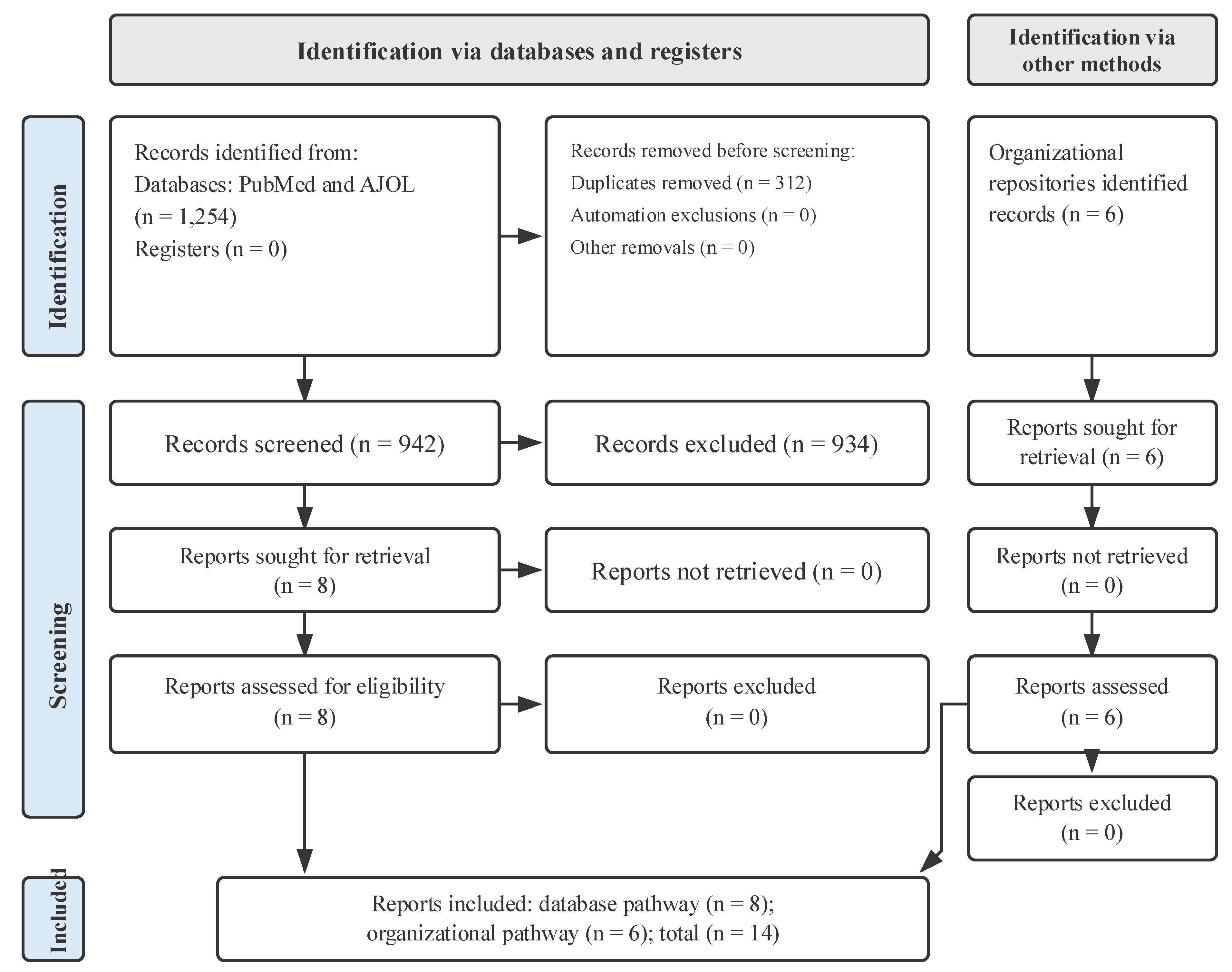
Table 1.
Characteristics of included sources (n = 14).
| No. | Citation (Author, Year) | Country/Region | Study design | Key findings |
|---|---|---|---|---|
| 1 | Adebisi YA et al. (2021) | West Africa (ECOWAS) | Database analysis | Low health priority index for Liberia; average health budget allocation 3.46% (2010 to 2018) |
| 2 | Kentoffio K et al. (2016) | Liberia | Comparative survey | Geographic and socioeconomic disparities in maternal and child health access |
| 3 | Simen-Kapeu A et al. (2021) | Liberia | Review | Importance of strengthening community health program for resilience |
| 4 | World Bank (2016) | Africa | Framework report | Coverage gaps and disparities hindering UHC |
| 5 | WHO AFRO (2025) | Africa | Progress report | Service coverage and financing disparities hinder UHC progress |
| 6 | Witter S et al. (2018) | Sierra Leone | Mixed methods | Free Health Care Initiative improved service use but faces sustainability challenges without predictable funding |
| 7 | Raven J et al. (2020) | Sierra Leone, Liberia, and DRC | Qualitative study | CHW retention and performance depend on supervision, supplies, community support, and regular remuneration; allowance delays reported in Liberia and Sierra Leone |
| 8 | Ansumana R et al. (2020) | Sierra Leone | Review | Post-Ebola health system strengthening faces financing and human resource challenges |
| 9 | Liberia Ministry of Health (2022) | Liberia | Policy document | UHC roadmap prioritizes sustainable financing and integrated community-based services |
| 10 | KOICA (2022) | Liberia | Program evaluation | Improved service delivery and health worker capacity |
| 11 | WHO (2016) | Africa | Technical report | Links financing performance to budget allocation, execution, and spending efficiency |
| 12 | World Bank (2023) | Liberia | Health sector review | Documents quality-of-care constraints, including workforce, medicine, and infrastructure gaps |
| 13 | UNICEF (2023) | Liberia | Program report | Reports support for community health, immunization financing, and national digital registries |
| 14 | African Development Bank (2022) | West Africa | Sector performance review | Reviews health sector performance and financing challenges, including Liberia |
Note: Regional reports were included only where they presented disaggregated findings or policy implications specific to Liberia, Sierra Leone, or Guinea. ECOWAS, Economic Community of West African States; KOICA, Korea International Cooperation Agency; DRC, Democratic Republic of Congo; WHO AFRO, World Health Organization Regional Office for Africa; UHC, Universal Health Coverage; CHW, community health worker.
Disclaimer/Publisher’s Note: The statements, opinions and data contained in all publications are solely those of the individual author(s) and contributor(s) and not of MDPI and/or the editor(s). MDPI and/or the editor(s) disclaim responsibility for any injury to people or property resulting from any ideas, methods, instructions or products referred to in the content. |
© 2026 by the authors. Licensee MDPI, Basel, Switzerland. This article is an open access article distributed under the terms and conditions of the Creative Commons Attribution (CC BY) license (http://creativecommons.org/licenses/by/4.0/).
Copyright: This open access article is published under a Creative Commons CC BY 4.0 license, which permit the free download, distribution, and reuse, provided that the author and preprint are cited in any reuse.