

Submitted:
02 November 2026
Posted:
04 November 2026
You are already at the latest version
Abstract
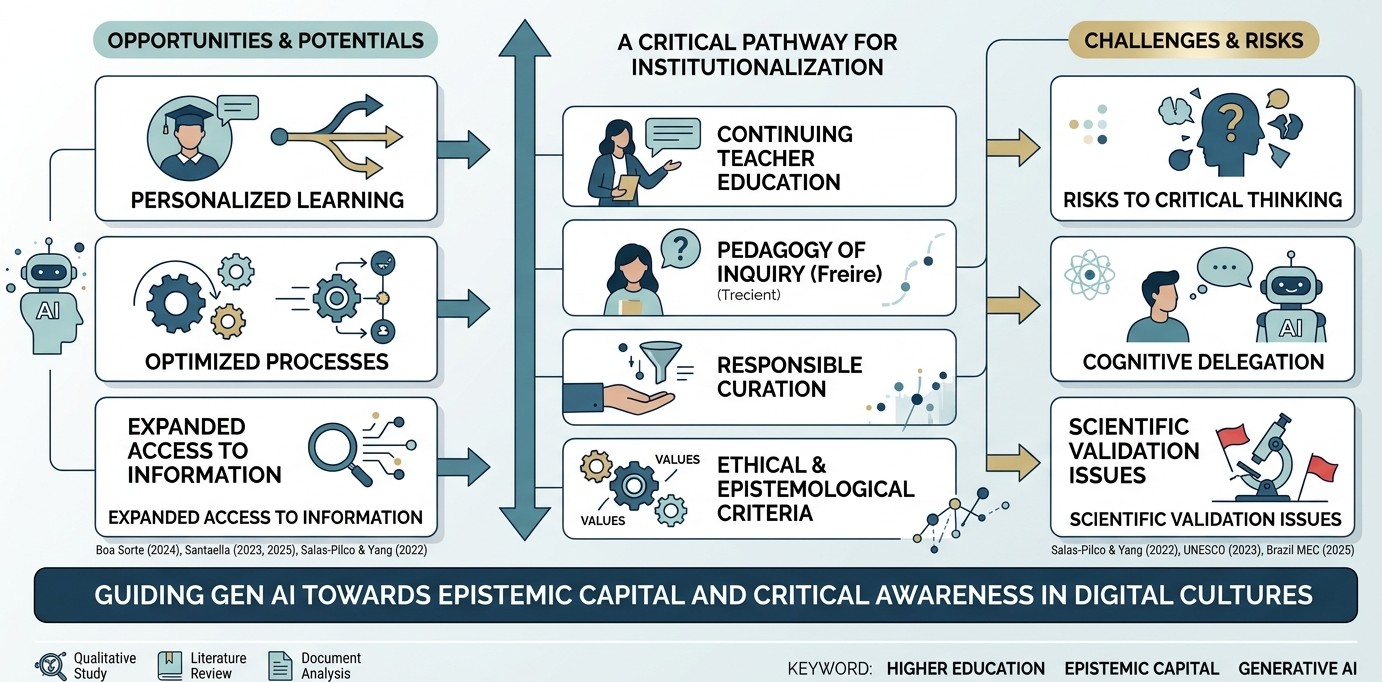
This study examines the incorporation of Generative Artificial Intelligence (Gen AI) into higher education through a critical analysis of the adoption of these resources in educational contexts, drawing on references such as Boa Sorte (2024), Santaella (2023, 2025), Salas-Pilco and Yang (2022), documents from UNESCO (2023), and a document from the Ministry of Education published in 2025 in Brazil. The overall objective is to critically analyze the impacts of GenAI on higher education, considering its potential, epistemological risks, and the ethical implications involved in its institutionalization. Methodologically, this is a qualitative study based on a literature review and document analysis. The results indicate that, although Gen AI contributes to the personalization of learning, the optimization of processes, and the expansion of access to information, its uncritical use can compromise the development of critical thinking, encourage practices of cognitive delegation, and undermine criteria for scientific validation. It is understood that Gen AI in higher education requires a critical approach, based on continuing teacher education, the Pedagogy of Inquiry advocated by Freire, responsible curation, and the explicit articulation of ethical and epistemological criteria. It is therefore argued that the use of Gen AI should be guided by the expansion of epistemic capital and critical awareness within the context of contemporary digital cultures.
Keywords:
higher education
; epistemic capital
; generative AI
Copyright: This open access article is published under a Creative Commons CC BY 4.0 license, which permit the free download, distribution, and reuse, provided that the author and preprint are cited in any reuse.