

Submitted:
03 November 2026
Posted:
04 November 2026
You are already at the latest version
Abstract
Objective: Small language models (SLMs) suitable for local deployment may enable integration of generative AI into electronic health record (EHR) systems; however, their performance in non-English pharmaceutical domains remains unclear. Methods: Fifty-two open-source SLMs (≤20B parameters) were evaluated using 283 text-based questions from the 107th Japanese National License Examination for Pharmacists. Each model was tested in three independent runs. Performance was assessed using accuracy and response consistency metrics, including the Any Correct Rate, Full Correct Rate, and Consistency Gap. Results: Three models (GPT-OSS:20b, Qwen3:14b, and Qwen3:8b) achieved high accuracy comparable to frontier LLMs, whereas medical-specialized SLMs performed poorly. Consistency Gap showed no association with parameter size but demonstrated a nonlinear relationship with accuracy. Conclusions: Selected locally deployable SLMs achieved strong performance in a Japanese pharmaceutical benchmark, supporting their potential as components of EHR-compatible decisionsupport systems, provided that their reliability is further validated in clinical contexts.
Keywords:
consistency
; generative AI
; national license examination
; pharmacist
; small language models
Introduction
Recent advances in generative AI have led to substantial performance improvements, accelerating its adoption in the medical field. While early generative AI models failed to meet passing criteria for medical licensing examinations [1,2,3,4,5], recent studies have reported that current models substantially exceed the passing criteria in examinations for multiple healthcare professions, including physicians [5,6,7,8], pharmacists [9,10,11], nurses [12,13], and radiological technologists [14]. Recent frontier generative AI models, such as ChatGPT and Gemini, exhibit strong performance, indicating the potential for high-accuracy outputs in medical domain. However, the use of these frontier models requires an online environment. In general, hospital information systems such as electronic health records (EHRs), handle sensitive information, including patients’ personal data, and are commonly operated in closed or tightly controlled network infrastructures. Consequently, the direct deployment of online generative AI services in clinical environments remains challenging.
In parallel, the development of small language models (SLMs) that can operate in local environments has accelerated in recent years. Their performance has steadily improved. As these SLMs can operate without internet access, they mitigate concerns regarding data leakage and are expected to be useful in healthcare settings. However, reports evaluating the performance of SLMs in the medical domain remain limited [15,16,17]. In particular, the performance of SLMs in non-English healthcare contexts has not been sufficiently investigated. Furthermore, existing studies have largely focused on medical domains, and evaluations in pharmacy-related fields are lacking.
The aim of this study was to evaluate the performance of small-scale language models that do not require high-end computing resources in the context of the pharmaceutical domain in Japanese. This study focuses on small language models that can be deployed locally. Because electronic health record (EHR) systems typically operate in closed or restricted network environments, locally deployable models are particularly relevant for practical implementation in hospital informatics systems.
Methods
JNLEP Dataset
This study used 283 questions from the 107th Japanese National License Examination for Pharmacists (JNLEP) held in Feb 2022. Because most SLMs do not support image inputs, 61 questions that included diagrams and one question lacking an answer, were excluded from the total 345 items in the 107th JNLEP. The questions in the 107th JNLEP are organized into the following 9 subject categories: physics, chemistry, biology, hygiene, pharmacology, pharmaceuticals, pathophysiology, regulations, and practice. All items were presented in a multiple-choice format, comprising single-answer questions (SAQs) and multiple-answer questions (MAQs) with five options each. The major passing criterion of the JNLEP is an overall accuracy rate ≥ 62.9%. Although this study uses a national licensing examination dataset, the JNLEP can be considered a proxy for knowledge-intensive clinical decision support (CDS) tasks. The examination requires the integration of multidisciplinary pharmaceutical knowledge and selection among multiple options, resembling knowledge-based decision-making in clinical settings.
Small Language Models
This study focused on SLMs with fewer than 20 billion parameters that can be operated on commonly used personal computers. The SLMs evaluated in this study were selected from freely available models distributed via the Ollama library. The 52 SLMs evaluated in this study were: gpt-oss:20b, deepseek-r1 (1.5b, 7b, 8b, 14b), gemma (2b, 7b), gemma2 (2b, 9b), gemma3 (1b, 4b, 12b), gemma4 (e2b, e4b), ministral-3 (3b, 8b, 14b), mistral:7b, mixtral:8x7b, llama2 (7b, 13b), llama3:8b, llama3.1:8b, llama3.2 (1b, 3b), qwen (1.8b, 4b, 7b, 14b), qwen2 (1.5b, 7b), qwen2.5 (1.5b, 3b, 7b, 14b), qwen3 (1.7b, 4b, 8b, 14b), qwen3.5 (2b, 9b), phi:2.7b, phi3 (3.8b, 14b), phi3.5:3.8b, phi4 (mini3.8b, 14b, reasoning14b), biomistral:7b, medllama2:7b, dolphin3:8b, meditron:7b.
GPT-OSS, Mixtral, and Qwen3 adopt Mixture-of-Experts (MoE) architectures, while all other evaluated models are based on dense transformer architectures. BioMistral, MedLlama2, Dolphin3, and Meditron are medical domain–specialized models built upon the Llama architecture.
Performance Evaluation
For each model, three independent runs were conducted for each question. From each generated output, the option number selected by the model was recorded. Each generated response was compared with the officially published correct answer [18] to determine its correctness. For each model, we evaluated the mean accuracy rate across all 283 questions as the primary performance metric. In addition, subject-wise accuracy rates were calculated for each model.
To evaluate response consistency across repeated runs, we additionally calculated the Any Correct Rate (ACR), defined as the proportion of questions answered correctly in at least one of the three runs, and the Full Correct Rate (FCR), defined as the proportion answered correctly in all three runs. The difference between ACR and FCR was defined as the Consistency Gap, representing the degree of variability in model responses across repeated inferences.
Results
Overall Accuracy
Most evaluated SLMs demonstrated low accuracy in Japanese pharmaceutical-domain tasks. Ten SLMs with fewer than 20 billion parameters were identified as meeting the passing criteria of the JNLEP (Table 1). The model with the highest accuracy was qwen3:14B, which reached 81.89%. The qwen3 family demonstrated superior accuracy relative to other families of similar parameter scales. The medical-domain specialized SLMs (medLama2:7B, dolphin3:8B, and meditron:7B) showed very low performance in the Japanese pharmaceutical-domain tasks. While intra-family comparisons showed a tendency for accuracy to improve with increasing parameter size, the overall set of models did not exhibit a clear parameter-accuracy relationship consistent with scaling laws (R = 0.584, linear regression).
Response Consistency
The mean consistency gap across all 52 SLMs was 22.43% (range, 0.35–40.28). In most models, the responses generated across the three runs differed with a certain degree of frequency. In contrast, the relationship between the consistency gap and mean accuracy demonstrated a nonlinear pattern: the consistency gap tended to increase during the lower-accuracy phase, whereas a declining trend was observed among higher-performing models, resulting in a broadly inverted U-shaped distribution (Figure 1).
The seven high-performing models (overall accuracy > 70%) exhibited low variation in their consistency gap values, all remaining below 25%. These consistency gaps were markedly lower than would be expected from their correlation with accuracy. Furthermore, the Gemma family was characterized by uniformly low consistency gaps (the mean consistency gap of 9 Gemma family models: 14.14%).
Accuracy by Subject Categories
The accuracies of each model by subject category are shown in Table 3. Based on the mean performance across the overall set of models, Chemistry (26.54%), Pharmaceuticals (32.28%), and Practice (32.78%) showed lower accuracy, whereas Biology (42.87%), Hygiene (39.32%), and Pathophysiology (39.69%) demonstrated higher accuracy. A comparison of the two top-performing models based on overall accuracy, gpt-oss:20b and qwen3:14b, revealed no substantial difference in Practice (77.04%, 78.15%), the subject area regarded as most critical for clinical application. gpt-oss:20b showed better performance in the basic science subjects of Chemistry (77.78%) and Biology (100%), whereas qwen3:14b achieved higher accuracy in Pharmacology (94.87%), Pharmaceuticals (81.11%), and Pathophysiology (91.89%).

Table 2.
Accuracy of the small language models by subject categories on 283 items from the 107th JNLEP.
Table 2.
Accuracy of the small language models by subject categories on 283 items from the 107th JNLEP.
| Model |
Physics (n=16) |
Chemistry (n=6) |
Biology (n=10) |
Hygiene (n=27) |
Pharmacology (n=39) | Pharmaceuticals (n=30) | Pathophysiology (n=37) |
Regulations (n=28) |
Practice (n=90) |
|||||||||||||||||||||||||||
|---|---|---|---|---|---|---|---|---|---|---|---|---|---|---|---|---|---|---|---|---|---|---|---|---|---|---|---|---|---|---|---|---|---|---|---|---|
| Mean | ( | CG | ) | Mean | ( | CG | ) | Mean | ( | CG | ) | Mean | ( | CG | ) | Mean | ( | CG | ) | Mean | ( | CG | ) | Mean | ( | CG | ) | Mean | ( | CG | ) | Mean | ( | CG | ) | |
| GPT-OSS:20b | 72.92 | ( | 37.50 | ) | 77.78 | ( | 33.33 | ) | 100.0 | ( | 0.00 | ) | 81.48 | ( | 7.41 | ) | 88.89 | ( | 12.82 | ) | 74.44 | ( | 23.33 | ) | 85.59 | ( | 16.22 | ) | 72.62 | ( | 25.00 | ) | 77.04 | ( | 26.67 | ) |
| Deepseek-r1:1.5b | 20.83 | ( | 50.00 | ) | 16.67 | ( | 33.33 | ) | 6.67 | ( | 20.00 | ) | 6.17 | ( | 14.81 | ) | 11.97 | ( | 33.33 | ) | 17.78 | ( | 40.00 | ) | 11.71 | ( | 29.73 | ) | 10.71 | ( | 25.00 | ) | 11.11 | ( | 30.00 | ) |
| Deepseek-r1:7b | 37.50 | ( | 31.25 | ) | 11.11 | ( | 33.33 | ) | 36.67 | ( | 60.00 | ) | 22.22 | ( | 29.63 | ) | 12.82 | ( | 33.33 | ) | 16.67 | ( | 33.33 | ) | 19.82 | ( | 32.43 | ) | 21.43 | ( | 39.29 | ) | 17.04 | ( | 37.78 | ) |
| Deepseek-r1:8b | 52.08 | ( | 18.75 | ) | 38.89 | ( | 16.67 | ) | 60.00 | ( | 30.00 | ) | 56.79 | ( | 40.74 | ) | 58.12 | ( | 46.15 | ) | 41.11 | ( | 40.00 | ) | 76.58 | ( | 27.03 | ) | 48.81 | ( | 35.71 | ) | 45.56 | ( | 44.44 | ) |
| Deepseek-r1:14b | 58.33 | ( | 37.50 | ) | 66.67 | ( | 50.00 | ) | 73.33 | ( | 20.00 | ) | 58.02 | ( | 40.74 | ) | 68.38 | ( | 46.15 | ) | 54.44 | ( | 50.00 | ) | 67.57 | ( | 27.03 | ) | 52.38 | ( | 32.14 | ) | 54.44 | ( | 44.44 | ) |
| Gemma:2b | 10.42 | ( | 12.50 | ) | 33.33 | ( | 0.00 | ) | 20.00 | ( | 0.00 | ) | 16.05 | ( | 11.11 | ) | 9.40 | ( | 11.11 | ) | 6.67 | ( | 10.00 | ) | 2.70 | ( | 0.00 | ) | 20.24 | ( | 7.14 | ) | 20.00 | ( | 11.11 | ) |
| Gemma:7b | 22.92 | ( | 25.00 | ) | 16.67 | ( | 0.00 | ) | 43.33 | ( | 10.00 | ) | 43.21 | ( | 7.41 | ) | 11.11 | ( | 2.56 | ) | 28.89 | ( | 13.33 | ) | 30.63 | ( | 10.81 | ) | 32.14 | ( | 17.86 | ) | 25.52 | ( | 10.00 | ) |
| Gemma2:2b | 31.25 | ( | 12.50 | ) | 16.67 | ( | 0.00 | ) | 33.33 | ( | 10.00 | ) | 25.93 | ( | 18.52 | ) | 11.11 | ( | 5.13 | ) | 32.22 | ( | 26.67 | ) | 25.23 | ( | 13.51 | ) | 36.90 | ( | 10.71 | ) | 22.59 | ( | 13.33 | ) |
| Gemma2:9b | 45.83 | ( | 18.75 | ) | 55.56 | ( | 16.67 | ) | 73.33 | ( | 10.00 | ) | 62.96 | ( | 7.41 | ) | 45.30 | ( | 5.13 | ) | 44.44 | ( | 53.33 | ) | 66.67 | ( | 70.27 | ) | 53.57 | ( | 14.29 | ) | 49.26 | ( | 11.11 | ) |
| Gemma3:1b | 20.83 | ( | 12.50 | ) | 22.22 | ( | 16.67 | ) | 30.00 | ( | 20.00 | ) | 30.86 | ( | 18.52 | ) | 11.11 | ( | 7.69 | ) | 15.56 | ( | 10.00 | ) | 13.51 | ( | 5.41 | ) | 14.29 | ( | 14.29 | ) | 20.74 | ( | 15.56 | ) |
| Gemma3:4b | 39.58 | ( | 12.50 | ) | 16.67 | ( | 0.00 | ) | 16.67 | ( | 10.00 | ) | 44.44 | ( | 0.00 | ) | 23.08 | ( | 0.00 | ) | 33.33 | ( | 20.00 | ) | 36.94 | ( | 8.11 | ) | 36.90 | ( | 3.57 | ) | 35.19 | ( | 12.22 | ) |
| Gemma3:12b | 50.00 | ( | 18.75 | ) | 33.33 | ( | 0.00 | ) | 80.00 | ( | 0.00 | ) | 77.78 | ( | 0.00 | ) | 67.52 | ( | 10.26 | ) | 50.00 | ( | 6.67 | ) | 73.87 | ( | 8.11 | ) | 59.52 | ( | 3.57 | ) | 54.44 | ( | 5.56 | ) |
| Gemma4:e2b | 60.14 | ( | 37.50 | ) | 22.22 | ( | 50.00 | ) | 56.67 | ( | 30.00 | ) | 62.96 | ( | 22.22 | ) | 57.27 | ( | 43.59 | ) | 41.11 | ( | 36.67 | ) | 68.47 | ( | 18.92 | ) | 51.19 | ( | 35.71 | ) | 43.70 | ( | 27.78 | ) |
| Gemma4:e4b | 70.83 | ( | 18.75 | ) | 66.67 | ( | 50.00 | ) | 76.67 | ( | 0.50 | ) | 82.72 | ( | 22.2 | ) | 84.62 | ( | 25.64 | ) | 66.67 | ( | 30.0 | ) | 88.29 | ( | 13.51 | ) | 60.71 | ( | 25.00 | ) | 69.26 | ( | 31.11 | ) |
| Mistral:7b | 22.92 | ( | 31.25 | ) | 22.22 | ( | 50.00 | ) | 16.67 | ( | 30.00 | ) | 22.22 | ( | 33.33 | ) | 20.51 | ( | 28.21 | ) | 20.00 | ( | 30.00 | ) | 19.82 | ( | 24.32 | ) | 25.00 | ( | 25.00 | ) | 15.93 | ( | 21.11 | ) |
| Ministral-3:3b | 37.50 | ( | 12.50 | ) | 27.78 | ( | 33.33 | ) | 50.00 | ( | 20.00 | ) | 39.51 | ( | 25.93 | ) | 58.12 | ( | 33.33 | ) | 35.56 | ( | 20.00 | ) | 59.46 | ( | 18.92 | ) | 48.81 | ( | 25.00 | ) | 39.63 | ( | 25.56 | ) |
| Ministral-3:8b | 64.58 | ( | 6.25 | ) | 50.00 | ( | 33.33 | ) | 90.00 | ( | 0.00 | ) | 72.84 | ( | 11.11 | ) | 78.63 | ( | 15.38 | ) | 62.22 | ( | 13.33 | ) | 77.48 | ( | 8.11 | ) | 58.33 | ( | 14.29 | ) | 62.22 | ( | 15.56 | ) |
| Ministral-3:14b | 66.67 | ( | 12.50 | ) | 61.11 | ( | 16.67 | ) | 90.00 | ( | 0.00 | ) | 88.89 | ( | 74.07 | ) | 81.20 | ( | 15.38 | ) | 71.11 | ( | 26.67 | ) | 88.29 | ( | 8.11 | ) | 76.19 | ( | 10.71 | ) | 66.67 | ( | 14.44 | ) |
| Mixtral:8x7b | 22.92 | ( | 25.00 | ) | 0.00 | ( | 0.00 | ) | 40.00 | ( | 20.00 | ) | 29.63 | ( | 29.63 | ) | 20.51 | ( | 15.38 | ) | 32.22 | ( | 30.00 | ) | 29.73 | ( | 24.32 | ) | 36.90 | ( | 32.14 | ) | 28.89 | ( | 27.78 | ) |
| Qwen:1.8b | 4.17 | ( | 6.25 | ) | 0.00 | ( | 0.00 | ) | 10.00 | ( | 20.00 | ) | 2.47 | ( | 3.70 | ) | 0.85 | ( | 2.56 | ) | 8.89 | ( | 23.33 | ) | 5.41 | ( | 13.51 | ) | 4.76 | ( | 14.29 | ) | 3.33 | ( | 10.00 | ) |
| Qwen:4b | 2.08 | ( | 6.25 | ) | 11.11 | ( | 33.33 | ) | 10.00 | ( | 20.00 | ) | 7.41 | ( | 18.52 | ) | 5.13 | ( | 5.13 | ) | 16.67 | ( | 16.67 | ) | 8.11 | ( | 18.92 | ) | 3.57 | ( | 7.14 | ) | 6.30 | ( | 12.22 | ) |
| Qwen:7 | 10.42 | ( | 25.00 | ) | 11.11 | ( | 16.67 | ) | 33.33 | ( | 30.00 | ) | 22.22 | ( | 18.52 | ) | 11.11 | ( | 17.95 | ) | 10.00 | ( | 13.33 | ) | 13.51 | ( | 16.22 | ) | 15.48 | ( | 17.86 | ) | 14.07 | ( | 18.89 | ) |
| Qwen:14b | 29.17 | ( | 25.00 | ) | 5.56 | ( | 16.67 | ) | 16.67 | ( | 20.00 | ) | 28.40 | ( | 14.81 | ) | 18.80 | ( | 25.64 | ) | 22.22 | ( | 23.33 | ) | 31.53 | ( | 21.62 | ) | 25.00 | ( | 17.86 | ) | 24.44 | ( | 22.22 | ) |
| Qwen2:1.5b | 4.17 | ( | 12.50 | ) | 0.00 | ( | 0.00 | ) | 23.33 | ( | 40.00 | ) | 11.11 | ( | 18.52 | ) | 11.11 | ( | 17.95 | ) | 8.89 | ( | 16.67 | ) | 8.11 | ( | 21.62 | ) | 17.86 | ( | 28.57 | ) | 8.52 | ( | 15.56 | ) |
| Qwen2:7b | 27.08 | ( | 25.00 | ) | 11.11 | ( | 16.67 | ) | 66.67 | ( | 50.00 | ) | 53.08 | ( | 22.22 | ) | 29.91 | ( | 23.08 | ) | 21.11 | ( | 20.00 | ) | 39.64 | ( | 24.32 | ) | 45.24 | ( | 39.29 | ) | 32.59 | ( | 28.89 | ) |
| Qwen2.5:1.5b | 12.50 | ( | 31.25 | ) | 22.22 | ( | 50.00 | ) | 16.67 | ( | 20.00 | ) | 18.52 | ( | 29.63 | ) | 15.38 | ( | 23.08 | ) | 26.67 | ( | 50.00 | ) | 11.71 | ( | 21.62 | ) | 21.43 | ( | 42.86 | ) | 16.67 | ( | 33.33 | ) |
| Qwen2.5:3b | 22.92 | ( | 25.00 | ) | 16.67 | ( | 0.00 | ) | 20.00 | ( | 30.00 | ) | 41.98 | ( | 29.63 | ) | 26.50 | ( | 33.33 | ) | 36.67 | ( | 56.67 | ) | 32.43 | ( | 32.43 | ) | 34.52 | ( | 39.29 | ) | 24.44 | ( | 33.33 | ) |
| Qwen2.5:7b | 64.58 | ( | 25.00 | ) | 22.22 | ( | 16.67 | ) | 60.00 | ( | 40.00 | ) | 58.02 | ( | 33.33 | ) | 40.17 | ( | 41.03 | ) | 40.00 | ( | 26.67 | ) | 71.17 | ( | 18.92 | ) | 51.19 | ( | 25.00 | ) | 47.41 | ( | 31.11 | ) |
| Qwen2.5:14b | 62.50 | ( | 43.75 | ) | 61.11 | ( | 16.67 | ) | 83.33 | ( | 20.00 | ) | 64.20 | ( | 18.52 | ) | 66.67 | ( | 10.26 | ) | 62.22 | ( | 30.00 | ) | 78.38 | ( | 10.81 | ) | 54.76 | ( | 17.86 | ) | 55.93 | ( | 27.78 | ) |
| Qwen3:1.7b | 56.25 | ( | 25.00 | ) | 22.22 | ( | 66.67 | ) | 50.00 | ( | 40.00 | ) | 30.86 | ( | 29.63 | ) | 41.88 | ( | 46.15 | ) | 42.22 | ( | 46.67 | ) | 46.85 | ( | 29.73 | ) | 30.95 | ( | 25.00 | ) | 37.41 | ( | 31.11 | ) |
| Qwen3:4b | 77.08 | ( | 18.75 | ) | 61.11 | ( | 33.33 | ) | 96.67 | ( | 10.00 | ) | 77.78 | ( | 18.52 | ) | 83.76 | ( | 12.82 | ) | 70.00 | ( | 13.33 | ) | 83.78 | ( | 5.40 | ) | 41.67 | ( | 14.29 | ) | 67.41 | ( | 25.56 | ) |
| Qwen3:8b | 68.75 | ( | 12.50 | ) | 66.67 | ( | 33.33 | ) | 90.00 | ( | 20.00 | ) | 82.72 | ( | 18.52 | ) | 92.31 | ( | 12.82 | ) | 68.89 | ( | 33.33 | ) | 88.29 | ( | 8.11 | ) | 63.10 | ( | 25.00 | ) | 73.70 | ( | 17.78 | ) |
| Qwen3:14b | 70.83 | ( | 31.25 | ) | 66.67 | ( | 33.33 | ) | 90.00 | ( | 0.00 | ) | 81.48 | ( | 22.22 | ) | 94.87 | ( | 12.82 | ) | 81.11 | ( | 10.00 | ) | 91.89 | ( | 5.41 | ) | 71.43 | ( | 25.00 | ) | 78.15 | ( | 23.33 | ) |
| Qwen3.5:2b | 45.83 | ( | 18.75 | ) | 11.11 | ( | 33.33 | ) | 53.33 | ( | 30.00 | ) | 27.16 | ( | 33.33 | ) | 29.91 | ( | 41.03 | ) | 23.33 | ( | 33.33 | ) | 48.65 | ( | 54.05 | ) | 26.19 | ( | 39.29 | ) | 24.07 | ( | 36.67 | ) |
| Qwen3.5:9b | 68.75 | ( | 18.75 | ) | 50.00 | ( | 33.33 | ) | 83.33 | ( | 20.00 | ) | 74.07 | ( | 33.33 | ) | 82.91 | ( | 25.64 | ) | 66.67 | ( | 43.33 | ) | 82.88 | ( | 21.62 | ) | 41.67 | ( | 35.71 | ) | 59.63 | ( | 53.33 | ) |
| Phi:2.7b | 2.08 | ( | 6.25 | ) | 0.00 | ( | 0.00 | ) | 0.00 | ( | 0.00 | ) | 0.00 | ( | 0.00 | ) | 0.00 | ( | 0.00 | ) | 0.00 | ( | 0.00 | ) | 1.80 | ( | 0.54 | ) | 2.38 | ( | 7.14 | ) | 0.37 | ( | 1.11 | ) |
| Phi3:3.8b | 12.50 | ( | 31.25 | ) | 16.67 | ( | 50.00 | ) | 23.33 | ( | 50.00 | ) | 24.69 | ( | 40.74 | ) | 9.40 | ( | 20.51 | ) | 24.44 | ( | 30.00 | ) | 26.13 | ( | 32.43 | ) | 27.38 | ( | 35.71 | ) | 15.19 | ( | 30.00 | ) |
| Phi3:14b | 43.75 | ( | 31.25 | ) | 27.78 | ( | 33.33 | ) | 40.00 | ( | 50.00 | ) | 45.68 | ( | 37.04 | ) | 41.03 | ( | 43.59 | ) | 27.78 | ( | 33.33 | ) | 45.95 | ( | 40.54 | ) | 39.29 | ( | 39.29 | ) | 31.11 | ( | 36.67 | ) |
| Phi3.5:3.8b | 18.75 | ( | 18.75 | ) | 16.67 | ( | 0.00 | ) | 20.00 | ( | 0.00 | ) | 34.57 | ( | 29.63 | ) | 30.77 | ( | 15.38 | ) | 23.33 | ( | 20.00 | ) | 23.42 | ( | 8.11 | ) | 32.14 | ( | 21.43 | ) | 28.89 | ( | 16.67 | ) |
| Phi4-mini:3.8b | 31.25 | ( | 43.75 | ) | 0.00 | ( | 0.00 | ) | 23.33 | ( | 40.00 | ) | 24.69 | ( | 25.93 | ) | 17.95 | ( | 17.95 | ) | 17.78 | ( | 33.33 | ) | 18.92 | ( | 24.32 | ) | 34.52 | ( | 32.14 | ) | 19.26 | ( | 30.00 | ) |
| Phi4:14b | 47.92 | ( | 18.75 | ) | 50.00 | ( | 33.33 | ) | 70.00 | ( | 0.00 | ) | 70.37 | ( | 37.04 | ) | 54.70 | ( | 30.77 | ) | 47.78 | ( | 26.67 | ) | 74.77 | ( | 29.73 | ) | 54.76 | ( | 28.57 | ) | 61.48 | ( | 43.33 | ) |
| Phi4-reasoning:14b | 62.50 | ( | 18.75 | ) | 77.78 | ( | 16.67 | ) | 66.67 | ( | 40.00 | ) | 71.60 | ( | 18.52 | ) | 87.18 | ( | 17.95 | ) | 64.44 | ( | 26.67 | ) | 87.39 | ( | 24.32 | ) | 61.90 | ( | 25.00 | ) | 75.56 | ( | 30.00 | ) |
| Llama2:7b | 8.33 | ( | 25.00 | ) | 11.11 | ( | 33.33 | ) | 20.00 | ( | 20.00 | ) | 11.11 | ( | 14.81 | ) | 7.69 | ( | 10.26 | ) | 16.67 | ( | 30.00 | ) | 10.81 | ( | 16.22 | ) | 2.38 | ( | 7.14 | ) | 15.19 | ( | 15.56 | ) |
| Llama2;13b | 16.67 | ( | 18.75 | ) | 5.56 | ( | 16.67 | ) | 16.67 | ( | 10.00 | ) | 24.69 | ( | 14.81 | ) | 12.82 | ( | 7.69 | ) | 24.44 | ( | 20.00 | ) | 14.41 | ( | 18.92 | ) | 10.71 | ( | 0.00 | ) | 17.04 | ( | 6.67 | ) |
| Llama3:8b | 25.00 | ( | 12.50 | ) | 16.67 | ( | 0.00 | ) | 23.33 | ( | 40.00 | ) | 40.74 | ( | 22.22 | ) | 30.77 | ( | 25.64 | ) | 23.33 | ( | 36.67 | ) | 27.03 | ( | 29.73 | ) | 26.19 | ( | 35.71 | ) | 30.37 | ( | 23.33 | ) |
| Llama3.1:8b | 27.08 | ( | 43.75 | ) | 33.33 | ( | 33.33 | ) | 33.33 | ( | 50.00 | ) | 34.57 | ( | 37.04 | ) | 26.50 | ( | 23.08 | ) | 20.00 | ( | 40.00 | ) | 32.23 | ( | 32.43 | ) | 33.33 | ( | 39.29 | ) | 24.07 | ( | 24.44 | ) |
| Llama3.2:1b | 12.50 | ( | 31.25 | ) | 0.00 | ( | 0.00 | ) | 26.67 | ( | 30.00 | ) | 12.35 | ( | 14.81 | ) | 17.95 | ( | 28.21 | ) | 11.11 | ( | 26.67 | ) | 6.31 | ( | 18.92 | ) | 17.86 | ( | 28.57 | ) | 10.74 | ( | 20.00 | ) |
| Llama3.2:3b | 22.92 | ( | 43.75 | ) | 0.00 | ( | 0.00 | ) | 36.67 | ( | 50.00 | ) | 32.10 | ( | 48.15 | ) | 22.22 | ( | 28.21 | ) | 21.11 | ( | 26.67 | ) | 23.42 | ( | 29.73 | ) | 27.38 | ( | 35.71 | ) | 24.81 | ( | 31.11 | ) |
| Biomistral:7b | 2.08 | ( | 6.25 | ) | 0.00 | ( | 0.00 | ) | 0.00 | ( | 0.00 | ) | 0.00 | ( | 0.00 | ) | 1.71 | ( | 5.13 | ) | 1.11 | ( | 3.33 | ) | 0.00 | ( | 0.00 | ) | 2.38 | ( | 7.14 | ) | 1.48 | ( | 3.33 | ) |
| MedLlama2:7b | 12.50 | ( | 12.50 | ) | 5.56 | ( | 16.67 | ) | 16.67 | ( | 10.00 | ) | 6.17 | ( | 14.81 | ) | 11.11 | ( | 20.51 | ) | 8.89 | ( | 23.33 | ) | 8.11 | ( | 16.22 | ) | 7.14 | ( | 14.29 | ) | 8.52 | ( | 14.44 | ) |
| Dolphin3:8b | 25.00 | ( | 12.50 | ) | 11.11 | ( | 16.67 | ) | 30.00 | ( | 60.00 | ) | 28.40 | ( | 14.81 | ) | 17.09 | ( | 35.90 | ) | 24.44 | ( | 33.33 | ) | 21.62 | ( | 16.22 | ) | 19.05 | ( | 17.86 | ) | 17.78 | ( | 30.00 | ) |
| Meditron:7b | 0.00 | ( | 0.00 | ) | 0.00 | ( | 0.00 | ) | 0.00 | ( | 0.00 | ) | 0.00 | ( | 0.00 | ) | 0.00 | ( | 0.00 | ) | 0.00 | ( | 0.00 | ) | 0.00 | ( | 0.00 | ) | 0.00 | ( | 0.00 | ) | 0.37 | ( | 0.01 | ) |
| Average | 34.22 | ( | 22.34 | ) | 26.54 | ( | 21.60 | ) | 42.78 | ( | 23.52 | ) | 39.32 | ( | 20.92 | ) | 34.93 | ( | 20.32 | ) | 32.28 | ( | 25.80 | ) | 39.69 | ( | 18.57 | ) | 33.55 | ( | 22.55 | ) | 32.78 | ( | 23.17 | ) |
| JNLEP: Japanese National License Examination for Pharmacist | ||||||||||||||||||||||||||||||||||||
| CG: Consistency Gap (ACR - FCR) | ||||||||||||||||||||||||||||||||||||
| FCR: Full correct rate in three runs | ||||||||||||||||||||||||||||||||||||
| ACR: At-least-once correct rate in three runs | ||||||||||||||||||||||||||||||||||||
| Bold: Best performance modes for each subject | ||||||||||||||||||||||||||||||||||||
Discussion
This study systematically evaluated the performance of 52 small language models (SLMs) on a Japanese pharmaceutical benchmark and identified several important findings. Although most SLMs did not reach the passing threshold of the Japanese National License Examination for Pharmacists (JNLEP), a subset of models with ≤20 billion parameters achieved high levels of accuracy comparable to those reported for online large language models (LLMs). In addition, response consistency differed substantially across models and was not explained by parameter size; instead, it exhibited a nonlinear relationship with overall accuracy. Notably, even among models with similar levels of accuracy, consistency profiles varied considerably, indicating that performance cannot be adequately characterized by accuracy alone. Taken together, these findings underscore the importance of evaluating both performance and reliability when considering the use of small language models in clinical settings.
Previous studies have shown that frontier LLMs can achieve high accuracy on medical and pharmacy licensing examinations across several healthcare professions and languages [1,2,3,4,5,6,7,8,9,10,11,12,13,14]. The present findings extend this literature by demonstrating that selected SLMs can also achieve high performance in a non-English pharmaceutical domain, despite their smaller scale and local deployability. This is important because most prior studies have focused on large, cloud-based models, whereas the practical use of such models in hospital information systems may be constrained by privacy, governance, and network-security requirements.
At the same time, the poor performance of several medical domain–specialized SLMs indicates that domain-specific tuning alone does not guarantee performance in all healthcare-related tasks. These models may have been optimized primarily for English biomedical corpora or physician-centered clinical tasks, which may not transfer well to Japanese pharmaceutical examinations requiring knowledge of pharmacology, pharmaceutical sciences, regulations, and clinical practice. This finding is consistent with broader concerns that LLM performance may vary substantially across languages, domains, and task formats, and that benchmark results should therefore be interpreted in relation to the specific context of intended use [15,16,17].
The results also support a broader view of model evaluation in health informatics. Accuracy remains an essential measure of task performance, but it is insufficient as a standalone criterion for assessing whether a language model is suitable for clinical or institutional use. Recent discussions of LLMs in healthcare have emphasized that implementation is challenged not only by performance limitations but also by issues such as reliability, bias, privacy, transparency, and workflow integration [19,20]. In this context, the present study contributes by showing that models with similar accuracy can exhibit markedly different levels of response consistency. This finding is particularly relevant to health informatics because AI systems embedded in clinical information environments are expected to behave predictably. For example, clinical decision support (CDS) systems are designed to provide information or recommendations at the point of care, and their usefulness depends not only on the correctness of individual outputs but also on their relevance, reliability, and fit within clinical workflows [21,22]. Therefore, evaluation frameworks for language models in healthcare should include measures that capture output stability and reproducibility, in addition to conventional accuracy-based metrics.
A key contribution of this study is the introduction and application of response consistency metrics, including the At-least-once Correct Rate (ACR), the Full Correct Rate (FCR), and the Consistency Gap. These metrics provide a structured way to distinguish between a model’s potential ability to produce a correct answer and its reliability in producing correct answers consistently. This distinction is especially important for stochastic language models, whose outputs may vary even when the same input is repeated.
In clinical informatics, such variability should not be regarded merely as a technical characteristic. If a model provides different recommendations for the same clinical scenario, this may reduce user trust, complicate workflow integration, and create uncertainty in decision-making. Recent medical LLM studies have also raised concerns about insufficient reporting of stochasticity and variability in model evaluation [23]. The Consistency Gap proposed in this study may therefore serve as a practical indicator of output stability, particularly when comparing models for potential use in decision-support or knowledge-retrieval systems.
Against this background, SLMs offer a potentially important alternative. Because they can be operated locally, they may be better suited to closed or restricted hospital networks than cloud-based frontier LLMs. This local deployability is not merely a technical convenience but an informatics-relevant property, because healthcare institutions must manage sensitive patient data under strict privacy and governance constraints. Recent work on small language models in healthcare has similarly emphasized their potential value in resource-constrained or privacy-sensitive clinical environments [15,16,17]. The present study adds empirical evidence from a Japanese pharmaceutical benchmark, suggesting that carefully selected SLMs may provide a feasible basis for local AI functions in hospital informatics systems.
The use of a national licensing examination dataset should be interpreted carefully. The JNLEP is not a direct simulation of clinical practice, and multiple-choice questions cannot fully represent real-world tasks involving longitudinal patient information, free-text documentation, laboratory trends, and multidisciplinary decision-making. However, the examination does require the integration of structured pharmaceutical knowledge across basic sciences, pharmacology, therapeutics, regulations, and practice. In this sense, it provides a useful benchmark for evaluating foundational knowledge-processing capabilities relevant to pharmacy-related decision support. Furthermore, in our previous work, we evaluated the performance of 18 online frontier LLMs on the same JNLEP task under identical experimental conditions [9]. Taken together with the present evaluation of 52 locally deployable SLMs, these studies provide large-scale benchmark evaluation results for language models in the Japanese pharmaceutical domain across a broad spectrum of model architectures and deployment settings. The present results should therefore be viewed as evidence of potential suitability rather than evidence of clinical effectiveness. Further evaluation using real clinical data, pharmacist-authored queries, EHR-derived scenarios, and human-in-the-loop assessment will be required before such models can be considered for operational deployment.
This study was limited to a single year of JNLEP, and therefore the generalizability of the findings to other examination years, datasets, or clinical scenarios remains uncertain. In addition, the use of multiple-choice examination questions does not fully capture the complexity of real-world clinical tasks, which often involve unstructured data, contextual reasoning, and dynamic decision-making processes. Response consistency may also be influenced by generation parameters such as temperature and sampling strategies, which were not systematically varied in this study. Finally, although the proposed consistency metrics provide a structured approach to evaluating output stability, their validity and applicability across different tasks, domains, and model architectures require further investigation.
Conclusions
This study demonstrates that selected small language models can achieve high performance in a non-English pharmaceutical domain while being suitable for local deployment. Importantly, the results highlight that evaluation of AI systems for clinical informatics should extend beyond accuracy to include reliability and reproducibility. The proposed consistency metrics provide a practical framework for assessing output stability and may contribute to the development of trustworthy AI systems for healthcare. These findings support the potential integration of locally deployable language models into EHR-based clinical decision support systems, provided that their performance and consistency are carefully evaluated.
Author Contributions
Hiroyasu Sato: Conceptualization, Methodology, Investigation, Writing - Original Draft, Writing - Review & Editing; Katsuhiko Ogasawara: Writing - Review & Editing, Supervision; Hidehiko Sakurai: Writing - Review & Editing, Supervision, Project administration.
Funding
This research did not receive any specific grant from funding agencies in the public, commercial, or not-for-profit sectors.
Ethical considerations
This manuscript describes only computational analyses and did not describe research involving human participants or animal models.
Consent to participate
Not applicable.
Consent for publication
Not applicable.
Declaration of conflicting interest
The authors declared no potential conflicts of interest with respect to the research, authorship, and/or publication of this article.
Data Availability Statement
The data that support the findings of this study are available from the corresponding author upon reasonable request.
References
- Gilson, A.; Safranek, C.W.; Huang, T.; et al. How does ChatGPT perform on the United States Medical Licensing Examination (USMLE)? The implications of large language models for medical education and knowledge assessment. JMIR Med. Educ. 2023, 9, e45312. [Google Scholar] [CrossRef]
- Yanagita, Y.; Yokokawa, D.; Uchida, S.; et al. Accuracy of ChatGPT on medical questions in the National Medical Licensing Examination in Japan: evaluation study. JMIR Form. Res. 2023, 7, e48023. [Google Scholar] [CrossRef]
- Sato, H.; Ogasawara, K. ChatGPT (GPT-4) passed the Japanese National License Examination for Pharmacists in 2022, answering all items including those with diagrams: a descriptive study. J. Educ. Eval. Health Prof. 2022, 21, 4. [Google Scholar] [CrossRef]
- Zong, H.; Li, J.; Wu, E.; et al. Performance of ChatGPT on Chinese National Medical Licensing Examinations: a five-year examination evaluation study for physicians, pharmacists and nurses. BMC Med. Educ. 2024, 24, 143. [Google Scholar] [CrossRef]
- Jin, H.K.; Lee, H.E.; Kim, E. Performance of ChatGPT-3.5 and GPT-4 in national licensing examinations for medicine, pharmacy, dentistry, and nursing: a systematic review and meta-analysis. BMC Med. Educ. 2024, 24, 1013. [Google Scholar] [CrossRef]
- Jung, L.B.; Gudera, J.A.; Wiegand, T.L.T.; et al. ChatGPT passes German State Examination in Medicine with picture questions omitted. Dtsch. Arztebl. Int. 2023, 120(21), 373–374. [Google Scholar] [CrossRef]
- Flores-Cohaila, J.A.; García-Vicente, A.; Vizcarra-Jiménez, S.F.; et al. Performance of ChatGPT on the Peruvian National Licensing Medical Examination: cross-sectional study. JMIR Med. Educ. 2023, 9, e48039. [Google Scholar] [CrossRef]
- Wang, H.; Wu, W.; Dou, Z.; et al. Performance and exploration of ChatGPT in medical examination, records and education in Chinese: pave the way for medical AI. Int. J. Med. Inform. 2023, 177, 105173. [Google Scholar] [CrossRef]
- Sato, H.; Ogasawara, K.; Sakurai, H. Performance Evaluation of 18 Generative AI Models (ChatGPT, Gemini, Claude, and Perplexity) in 2024 Japanese Pharmacist Licensing Examination: Comparative Study. JMIR Med. Educ. 2025, 11, e76925. [Google Scholar] [CrossRef]
- Jin, H.K.; Kim, E. Performance of GPT-3.5 and GPT-4 on the Korean Pharmacist Licensing Examination: comparison study. JMIR Med. Educ. 2023, 10, e57451. [Google Scholar] [CrossRef]
- Kunitsu, Y. The potential of GPT-4 as a support tool for pharmacists: analytical study using the Japanese National Examination for Pharmacists. JMIR Med. Educ. 2023, 9, e48452. [Google Scholar] [CrossRef]
- Wu, Z.; Gan, W.; Xue, Z.; et al. Performance of ChatGPT on Nursing Licensure Examinations in the United States and China: cross-sectional study. JMIR Med. Educ. 2024, 10, e52746. [Google Scholar] [CrossRef]
- Taira, K.; Itaya, T.; Hanada, A. Performance of the large language model ChatGPT on the National Nurse Examinations in Japan: evaluation study. JMIR Nurs. 2023, 6, e47305. [Google Scholar] [CrossRef]
- Ito, T.; Ishibashi, T.; Hayashi, T.; et al. Large Language Models for the National Radiological Technologist Licensure Examination in Japan: Cross-Sectional Comparative Benchmarking and Evaluation of Model-Generated Items Study. JMIR Med. Educ. 2025, 11, e81807. [Google Scholar] [CrossRef]
- Xu, H.A.; Pythoud, R.; Thorball, C.W.; et al. “Small” Large Language Models in the hospital: an evaluation study on real-world data in a resources-constrained setting. JMIR Prepr. 2025, 04/11/2025, 86453. [Google Scholar] [CrossRef]
- Garg, M.; Raza, S.; Rayana, S.; et al. The Rise of Small Language Models in Healthcare: A Comprehensive Survey. arXiv 2025, arXiv:2504.17119. (cs). [Google Scholar] [CrossRef]
- Ansari, M.S.; Khan, M.S.A.; Revankar, S.; et al. Lightweight Clinical Decision Support System using QLoRA-Fine-Tuned LLMs and Retrieval-Augmented Generation. arXiv 2025, arXiv:2505.03406. (cs). [Google Scholar] [CrossRef]
- The 107th Japanese National License Examination for Pharmacist [Article in Japanese]. The Ministry of Health, Labour and Welfare in Japan. Available online: https://www.mhlw.go.jp/stf/seisakunitsuite/bunya/0000198924.html (accessed on 15 December 2025).
- Dennstädt, F.; Hastings, J.; Putora, P.M.; et al. Implementing large language models in healthcare while balancing control, collaboration, costs and security. npj Digit Med. 2025, 8, 143. [Google Scholar] [CrossRef]
- Busch, F.; Hoffmann, L.; Rueger, C.; et al. Current applications and challenges in large language models for patient care. Commun. Med. 2025, 5, 26. [Google Scholar] [CrossRef]
- Sutton, R.T.; Pincock, D.; Baumgart, D.C.; et al. An overview of clinical decision support systems: benefits, risks, and strategies for success. npj Digit Med. 2020, 3, 17. [Google Scholar] [CrossRef]
- Kawamoto, K.; Houlihan, C.A.; Balas, E.A.; et al. Improving clinical practice using clinical decision support systems: a systematic review of trials to identify features critical to success. BMJ 2005, 330, 765. [Google Scholar] [CrossRef]
- Suh, C.H.; Yi, J.; Shim, W.H.; et al. Insufficient Transparency in Stochasticity Reporting in Large Language Model Studies for Medical Applications in Leading Medical Journals. Korean J. Radiol. 2024, 25, 1029–1031. [Google Scholar] [CrossRef]
Figure 1.
Correlation between consistency gap and overall accuracy for evaluated models.
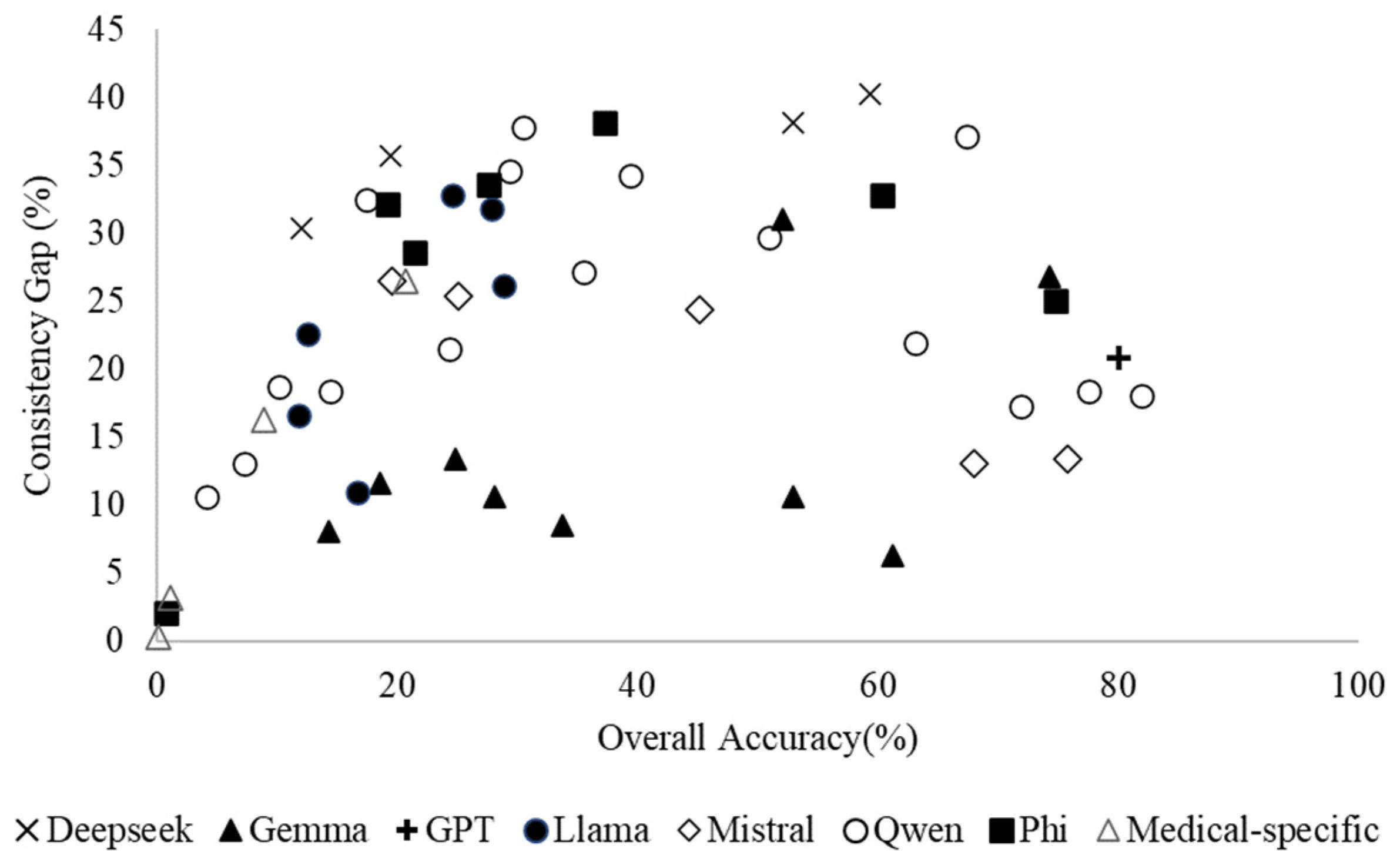
Table 1.
Overall accuracy of the small language models on 283 items from 107th JNLEP.
| Group | Model | Param | Run1 | Run2 | Run3 | Mean* | FCR* | ACR* | CG |
|---|---|---|---|---|---|---|---|---|---|
| GPT | GPT-OSS:20b | 20.9 | 78.80 | 79.86 | 81.63 | 80.09 | 69.61 | 90.46 | 20.85 |
| Deepseek | Deepseek-r1:1.5b | 1.78 | 10.95 | 12.37 | 12.72 | 12.01 | 0.35 | 30.74 | 30.39 |
| Deepseek-r1:7b | 7.62 | 21.20 | 18.37 | 18.73 | 19.43 | 3.89 | 39.58 | 35.69 | |
| Deepseek-r1:8b | 8.19 | 53.71 | 50.53 | 54.77 | 53.00 | 34.28 | 72.44 | 38.16 | |
| Deepseek-r1:14b | 14.8 | 60.07 | 56.89 | 61.13 | 59.36 | 39.58 | 79.86 | 40.28 | |
| Gemma | Gemma:2b | 2.51 | 15.19 | 14.49 | 13.07 | 14.25 | 10.60 | 18.73 | 8.13 |
| Gemma:7b | 8.54 | 28.98 | 27.56 | 27.92 | 28.15 | 23.67 | 34.28 | 10.61 | |
| Gemma2:2b | 2.61 | 24.03 | 24.38 | 26.15 | 24.85 | 18.37 | 31.80 | 13.43 | |
| Gemma2:9b | 9.24 | 53.00 | 53.71 | 52.30 | 53.00 | 48.06 | 58.66 | 10.60 | |
| Gemma3:1b | 1 | 18.37 | 17.67 | 19.79 | 18.61 | 13.43 | 25.09 | 11.66 | |
| Gemma3:4b | 4.3 | 32.86 | 34.63 | 33.92 | 33.80 | 29.68 | 38.16 | 8.48 | |
| Gemma3:12b | 12.2 | 61.84 | 60.42 | 61.48 | 61.25 | 57.95 | 64.31 | 6.36 | |
| Gemma4:e2b | 5.12 | 51.24 | 52.65 | 52.30 | 52.06 | 37.46 | 68.55 | 31.09 | |
| Gemma4:e4b | 8 | 74.91 | 74.56 | 73.5 | 74.32 | 60.42 | 87.28 | 26.86 | |
| Mistral | Mistral:7b | 7.25 | 21.55 | 18.02 | 19.08 | 19.55 | 7.42 | 33.92 | 26.50 |
| Ministral-3:3b | 3.85 | 45.94 | 47.35 | 42.40 | 45.23 | 33.92 | 58.30 | 24.38 | |
| Ministral-3:8b | 8.92 | 67.49 | 66.08 | 70.32 | 67.96 | 61.47 | 74.56 | 13.08 | |
| Ministral-3:14b | 13.9 | 76.68 | 75.62 | 74.91 | 75.74 | 68.90 | 82.33 | 13.43 | |
| Mixtral:8x7b | 14 | 27.92 | 30.39 | 27.21 | 28.51 | 16.61 | 42.05 | 25.44 | |
| Qwen | Qwen:1.8b | 1.84 | 4.95 | 4.24 | 3.18 | 4.12 | 0.00 | 10.60 | 10.60 |
| Qwen:4b | 3.95 | 8.13 | 7.42 | 6.36 | 7.30 | 1.77 | 14.84 | 13.07 | |
| Qwen:7 | 7.72 | 14.84 | 15.19 | 13.43 | 14.49 | 6.01 | 24.38 | 18.37 | |
| Qwen:14b | 14.2 | 24.73 | 20.49 | 27.92 | 24.38 | 14.13 | 35.69 | 21.56 | |
| Qwen2:1.5b | 1.54 | 12.01 | 8.48 | 9.89 | 10.13 | 2.12 | 20.85 | 18.73 | |
| Qwen2:7b | 7.62 | 35.34 | 34.28 | 37.10 | 35.57 | 23.32 | 50.53 | 27.21 | |
| Qwen2.5:1.5b | 1.54 | 17.31 | 20.85 | 14.13 | 17.43 | 3.53 | 36.04 | 32.51 | |
| Qwen2.5:3b | 3.09 | 28.62 | 28.62 | 30.74 | 29.33 | 14.13 | 48.76 | 34.63 | |
| Qwen2.5:7b | 7.62 | 49.47 | 50.18 | 53.36 | 51.00 | 37.46 | 67.14 | 29.68 | |
| Qwen2.5:14b | 14.8 | 62.90 | 62.19 | 64.31 | 63.13 | 51.94 | 73.85 | 21.91 | |
| Qwen3:1.7b | 2.03 | 39.58 | 39.93 | 39.58 | 39.46 | 23.67 | 57.95 | 34.28 | |
| Qwen3:4b | 4.02 | 71.73 | 73.14 | 71.02 | 71.96 | 62.90 | 80.21 | 17.31 | |
| Qwen3:8b | 8.19 | 75.27 | 78.45 | 79.15 | 77.62 | 67.84 | 86.22 | 18.38 | |
| Qwen3:14b | 14.8 | 82.33 | 80.21 | 83.39 | 81.98 | 72.44 | 90.46 | 18.02 | |
| Qwen3.5:2b | 2.27 | 28.27 | 30.74 | 32.51 | 30.51 | 13.07 | 50.88 | 37.81 | |
| Qwen3.5:9b | 9.65 | 67.84 | 67.14 | 67.14 | 67.37 | 48.06 | 85.16 | 37.10 | |
| Phi | Phi:2.7b | 2.78 | 1.06 | 0.35 | 0.71 | 0.71 | 0.00 | 2.12 | 2.12 |
| Phi3:3.8b | 3.82 | 18.37 | 18.37 | 20.49 | 19.20 | 4.59 | 36.75 | 32.16 | |
| Phi3:14b | 14 | 37.81 | 37.81 | 36.04 | 37.22 | 18.37 | 56.54 | 38.17 | |
| Phi3.5:3.8b | 3.82 | 25.09 | 28.27 | 29.33 | 27.56 | 12.72 | 46.29 | 33.57 | |
| Phi4-mini:3.8b | 3.82 | 21.20 | 22.61 | 20.49 | 21.44 | 8.48 | 37.10 | 28.62 | |
| Phi4:14b | 14.7 | 60.42 | 61.13 | 59.36 | 60.31 | 43.46 | 76.33 | 32.87 | |
| Phi4-reasoning:14b | 14.7 | 72.44 | 76.33 | 75.62 | 74.79 | 60.78 | 85.87 | 25.09 | |
| Llama | Llama2:7b | 6.74 | 9.54 | 10.60 | 15.19 | 11.78 | 4.24 | 20.85 | 16.61 |
| Llama2;13b | 13 | 17.31 | 15.19 | 17.67 | 16.73 | 11.66 | 22.61 | 10.95 | |
| Llama3:8b | 8.03 | 29.68 | 28.27 | 28.98 | 28.86 | 15.90 | 42.05 | 26.15 | |
| Llama3.1:8b | 8.03 | 25.09 | 28.27 | 30.39 | 27.92 | 13.07 | 44.88 | 31.81 | |
| Llama3.2:1b | 1.24 | 11.66 | 12.01 | 13.78 | 12.49 | 2.83 | 25.44 | 22.61 | |
| Llama3.2:3b | 3.21 | 24.03 | 23.67 | 26.15 | 24.62 | 9.19 | 42.05 | 32.86 | |
| Medical-specific | Biomistral:7b | 7.24 | 1.41 | 0.71 | 1.41 | 1.18 | 0.00 | 3.18 | 3.18 |
| MedLlama2:7b | 6.74 | 9.54 | 8.13 | 9.19 | 8.95 | 1.77 | 18.02 | 16.25 | |
| Dolphin3:8b | 8.03 | 21.91 | 21.55 | 18.73 | 20.73 | 8.83 | 35.34 | 26.51 | |
| Meditron:7b | 6.74 | 0.00 | 0.35 | 0.00 | 0.12 | 0.00 | 0.35 | 0.35 | |
| JNLEP: Japanese National License Examination for Pharmacist | |||||||||
| FCR: Full correct rate in three runs | |||||||||
| ACR: At-least-once correct rate in three runs | |||||||||
| CG: Consistency Gap (ACR – FCR) | |||||||||
| *Bold > Passing Criteria | |||||||||
Disclaimer/Publisher’s Note: The statements, opinions and data contained in all publications are solely those of the individual author(s) and contributor(s) and not of MDPI and/or the editor(s). MDPI and/or the editor(s) disclaim responsibility for any injury to people or property resulting from any ideas, methods, instructions or products referred to in the content. |
© 2026 by the authors. Licensee MDPI, Basel, Switzerland. This article is an open access article distributed under the terms and conditions of the Creative Commons Attribution (CC BY) license.
Copyright: This open access article is published under a Creative Commons CC BY 4.0 license, which permit the free download, distribution, and reuse, provided that the author and preprint are cited in any reuse.