

Submitted:
03 November 2026
Posted:
04 November 2026
You are already at the latest version
Abstract
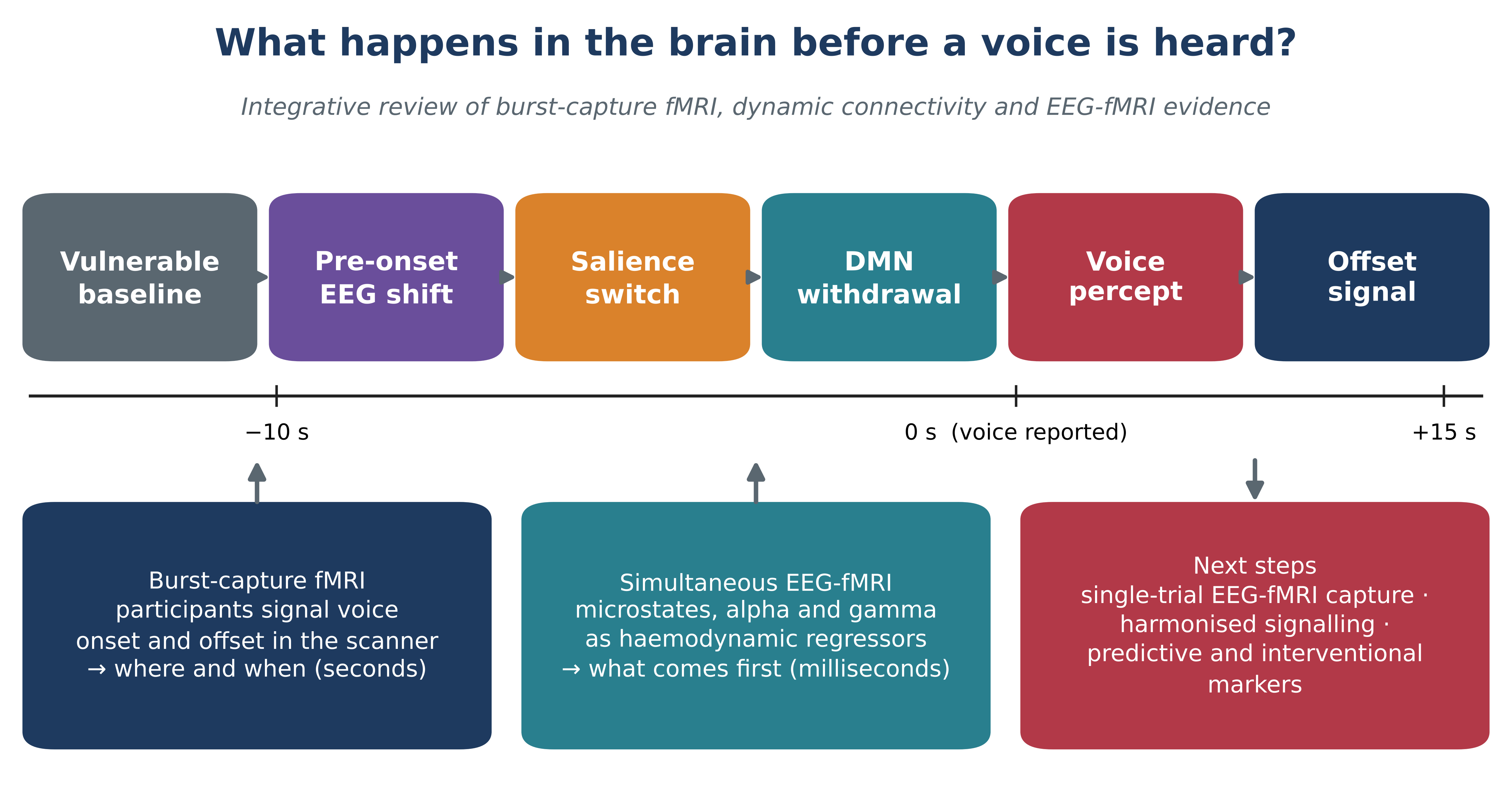
Auditory verbal hallucinations (AVH) are discrete, self-limiting perceptual events, yet their neural basis has been characterised largely through static contrasts between hallucinating and non-hallucinating periods. Whether a reproducible sequence of large-scale network transitions precedes conscious hallucination onset remains unresolved. This integrative review, built on a structured search of five databases (1995–2025), synthesises burst-capture (symptom-capture) functional magnetic resonance imaging (fMRI) studies in which participants signalled episode onset and offset during scanning, together with time-resolved connectivity, electroencephalography (EEG) and simultaneous EEG-fMRI evidence. Capture studies converge on a fronto-temporal, insular and medial temporal signature of the hallucinatory episode. Ventromedial prefrontal and paracingulate activity begins several seconds before the onset report, with a mirror-image deflection before offset, and both precede the motor response. Hallucination-prone individuals spend less time in brain states with strong default mode/task-positive anticorrelation, and salience-network-centred switching is reduced, less persistent and more variable. EEG microstate class D shortens during hallucinations, auditory-cortical alpha synchrony rises around onset, and EEG-fMRI studies show that such electrophysiological markers can be mapped onto haemodynamic networks. We integrate these findings into a testable dynamic transition model: a vulnerable baseline gives way to a less differentiated cortical state, a salience-network switch, default mode withdrawal and fronto-temporal re-synchronisation that culminate in the percept, followed by a distinct offset signal. Because no study has yet ordered these events within one dataset, adequately powered single-trial EEG-fMRI capture designs with harmonised signalling are the decisive next step toward predictive and interventional markers.
Keywords:
auditory verbal hallucinations
; symptom capture
; simultaneous EEG-fMRI
; dynamic functional connectivity
; salience network
; EEG microstates
; predictive coding
Copyright: This open access article is published under a Creative Commons CC BY 4.0 license, which permit the free download, distribution, and reuse, provided that the author and preprint are cited in any reuse.