

Submitted:
03 November 2026
Posted:
04 November 2026
You are already at the latest version
Abstract
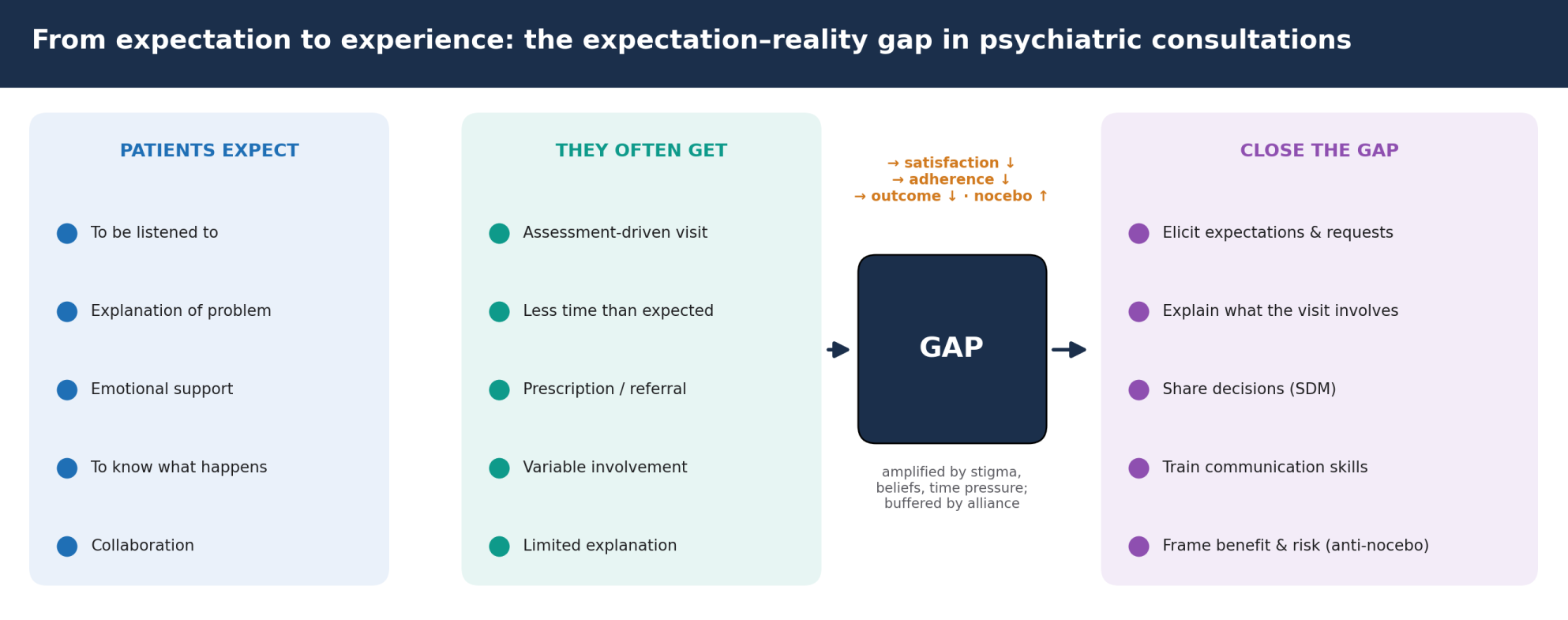
Objective: To synthesize evidence on the gap between what patients expect from psychiatric consultations and what they experience, and on its origins, consequences and remedies.Methods: A narrative review, guided by the SANRA criteria, of conceptual frameworks, empirical studies, systematic reviews and meta-analyses from psychiatry, general medicine, psychotherapy and placebo research, identified through targeted searches of PubMed/MEDLINE, Scopus and Google Scholar and by citation chaining.Results: Patients most consistently expect to be listened to, to receive emotional support and explanation, and to be told what the consultation will involve, whereas consultations are typically assessment-driven, shorter than anticipated and more often end in prescription or referral than patients expect. Stigma, delayed help-seeking, illness beliefs and time-pressured services amplify the gap, and the therapeutic alliance moderates it. Unmet expectations predict dissatisfaction and non-adherence; optimistic outcome expectations are associated with better outcomes (r = 0.18 across 12,722 patients); and expectancy mediates placebo and nocebo responses to antidepressants. Eliciting expectations, preparatory information, shared decision-making, communication-skills training and expectancy-sensitive framing of benefits and risks show promise, although trial evidence from psychiatric settings remains limited.Conclusion: The expectation–reality gap is a modifiable determinant of patient experience and outcome in psychiatry that warrants precise measurement and targeted intervention.Practice implications: Clinicians should routinely elicit patients' predicted and desired expectations, explain what the consultation involves, negotiate plans that visibly address patients' requests, and frame treatment benefits and side effects to minimize nocebo responses; services should protect time for psychosocial discussion and embed communication and shared decision-making training.
Keywords:
patient expectations
; psychiatric consultation
; patient satisfaction
; therapeutic alliance
; medication adherence
; placebo and nocebo effects
; shared decision-making
Department of Psychiatry, Venkateshwara Institute of Medical Sciences, Shri Venkateshwara University, Gajraula, Uttar Pradesh 244236, India; sushil.sompur@gmail.com; Tel.: +91-8660361438
1. Introduction
The psychiatric consultation is the gateway to mental health care, and for many patients it is an encounter freighted with apprehension, hope and uncertainty. Patients arrive not only with symptoms but with beliefs about what their problem is, what a psychiatrist does and what treatment should involve. What they experience in the consulting room frequently differs from what they anticipated, and this discrepancy—the expectation–reality gap—has consequences for satisfaction, engagement and clinical outcome.
Over five decades, research across medicine and psychiatry has shown that patient expectations are neither epiphenomenal nor cosmetic. Unmet expectations predict dissatisfaction and non-adherence [1]; fulfilled expectations predict more favorable consultation outcomes [2]; and patients’ early expectations of treatment are associated with post-treatment improvement across more than 12,000 psychotherapy patients [3]. In psychiatry the stakes are amplified: stigma discourages help-seeking in the first place [4,5], the therapeutic relationship is a recognized active ingredient of treatment [6], and believing that a treatment will work measurably alters response to it, including in antidepressant trials [7,8].
Despite this, the literature on expectations is scattered across primary care, psychotherapy, placebo science and health communication, and it has rarely been brought to bear on the psychiatric consultation as a whole. This review therefore (1) defines and classifies expectations relevant to psychiatric care; (2) contrasts what patients expect from consultations with what they receive; (3) examines the origins and amplifiers of the gap; (4) evaluates its consequences for satisfaction, adherence and outcomes, including placebo and nocebo mechanisms; and (5) appraises strategies to close it. We summarize the pathway in a conceptual model (Figure 1), tabulate the key quantitative evidence (Table 1; Figure 2) and translate it into a consultation-level toolkit for clinicians (Table 2).
2. Methods
This narrative review was designed and reported with reference to the Scale for the Assessment of Narrative Review Articles (SANRA) [9]. Targeted searches of PubMed/MEDLINE, Scopus and Google Scholar combined terms for expectations (“patient expectation,” “request,” “met expectations,” “expectancy”) with terms for the setting and outcomes (“psychiatric consultation,” “outpatient,” “satisfaction,” “therapeutic alliance,” “adherence,” “placebo,” “nocebo,” “shared decision-making,” “communication skills”). Reference lists of key reviews were hand-searched and seminal studies were retrieved by citation chaining.
Priority was given to meta-analyses, systematic reviews, landmark empirical studies and influential conceptual frameworks; English-language, peer-reviewed sources were included. Because psychiatric data are limited for several questions, evidence from primary care, pediatrics and psychotherapy was included where it illuminates mechanisms and is identified as such. Evidence was synthesized thematically along the expectation–experience–consequence pathway. Consistent with the narrative design, no formal risk-of-bias assessment or quantitative pooling was undertaken.
3. Results
3.1. Conceptual Foundations: Defining and Classifying Expectations
Conceptual imprecision has been a persistent obstacle. Kravitz’s foundational formulation defines patients’ expectations as “beliefs or attitudes that interact with perceived occurrences to produce care-related evaluations,” and distinguishes expectations that express probabilities (what patients predict will happen) from those that express values (what they desire or feel entitled to) [10]. The distinction matters clinically: a patient may predict a brief, medication-focused appointment while desiring an extended exploratory conversation, and satisfaction depends on where the experience lands relative to both.
The Health Technology Assessment review by Bowling and colleagues showed that expectations range from “ideal desires” to “predicted expectations” and apply to the structures, processes and outcomes of care; it also catalogued four major sources of expectations: perceived vulnerability to illness, previous experience of illness or services, transmitted knowledge and somatic symptoms [11]. In a qualitative study across several clinical contexts, patients framed their expectations in three consistent domains—health outcomes, individual clinicians and the health-care system [12]. Laferton and colleagues proposed an integrative model while noting that progress has been hampered by inconsistent constructs and heterogeneous assessment [13], and Kravitz concluded that expectations are “wide ranging, can be measured, and have potentially important clinical consequences” [14]. Together, these frameworks yield a workable definition: the expectation–reality gap is the discrepancy between what patients predict, desire or feel entitled to and what they perceive themselves to have received, evaluated through the filter of their values, fears and prior experience.
3.2. What Patients Expect from Psychiatric Consultations
The evidence is consistent across decades and settings, and notably different from what clinicians typically assume. In a Polish study of ambulatory psychiatric patients, expectations referred “first of all to the need to talk about the problems experienced by the patients and to receiving emotional support,” and psychiatrists who explained what would happen during the consultation were rated most positively [15]. In a questionnaire study of 57 newly referred outpatients, 77% expected to see “a doctor who dealt with mental health and emotional problems,” 72% anticipated that their problem was treatable and 72% primarily wanted a chance to talk [16]. In primary care, where expectations have been studied most intensively, the most wanted item among 504 patients was “explanation of the problem,” with less desire for tests or diagnosis [17]. In psychiatric services, most patients hold requests “which they will express when encouraged to do so”—expectations are often latent rather than absent [18].
Eisenthal and Lazare’s “customer approach” to the initial psychiatric interview formalized the elicitation of patient requests as a clinical method. Clinicians were trained to understand how patients hoped to be helped and to negotiate a plan; patients’ perception that this approach had been used correlated substantially with feeling satisfied and helped, even when they did not obtain the disposition they originally wanted [19].
3.3. What Consultations Deliver: Where the Gap Opens
The classic study by Francis, Korsch and Morris of 800 pediatric visits found 24% of parents grossly dissatisfied, 38% only moderately compliant and 11% non-compliant; unmet expectations, lack of warmth and failure to explain the diagnosis and its cause were key factors [1]. Although not psychiatric, this demonstration that the gap, rather than demographic characteristics, drives dissatisfaction shaped decades of subsequent research.
Psychiatric studies reveal the same structure. Michaels and Sevitt interviewed 30 patients before their first psychiatric consultation and found that “many patients have unrealistic expectations about various aspects of the interview, and afterwards many are dissatisfied with its outcome” [20]. Blenkiron quantified the mismatch: 61% of patients significantly underestimated appointment duration, and patients received psychotropic medication or onward referral twice as often as they expected [16]. Across samples in the Bowling program, the least-met expectations included being seen on time, choice of doctor, being treated with respect and dignity, reassurance, information about cause and management, and “an opportunity to discuss problems in life”; patients wanted “a positive interaction with their doctor—to have a conversation and be reassured—as much as to receive a cold analysis of their problem” [11], a formulation that captures the defining tension of the psychiatric consultation.
Clinicians and patients also disagree about the components of the consultation itself: “patients and their psychiatrists disagree on the key components of an outpatient consultation” [21]. Observational work in UK outpatient clinics found that psychiatrists’ involvement of patients in decisions ranged from 0 to 38 of a possible 48 on the Observing Patient Involvement scale, variation explained “more by their individual style than by socio-demographic, structural or clinical factors” [22]. When the structure of the encounter is this clinician-dependent, the size of the gap depends partly on which psychiatrist the patient happens to see.
3.4. Origins and Amplifiers of the Gap
3.4.1. Stigma and Anticipated Stigma
Stigma shapes expectations before the first appointment is booked. A systematic review of 144 studies found stigma to be “a moderately important barrier, ranking fourth out of 10 barriers,” with disclosure and confidentiality concerns most prominent [4]. Public, self and structural stigma impede care-seeking and undermine engagement [5], and internalized stigma consistently reduces help-seeking attitudes and intentions [23]. The temporal cost is large: in a US survey of almost 10,000 adults, average delays before seeking help were 8 years for mood disorders and at least 9 years for anxiety disorders, only 41% of people with a mental illness in the previous year received any treatment (12% from a psychiatrist), and “at least reasonable” care was provided in about half of specialist but only 13% of primary care cases [24]. Patients who finally reach a psychiatrist after years of shame and delay bring expectations freighted with secrecy and accumulated unmet need.
3.4.2. Health Beliefs and Illness Representations
What patients believe about their condition shapes what they expect of care. Beliefs about a purely physical cause, together with stigma, influence help-seeking, and need for care must therefore be assessed from the patient’s perspective rather than presumed [25]. The Seeking Mental Health Care model links self-efficacy, illness representations and internalized stigma to help-seeking [23]. A patient who regards depression as a social or moral problem will expect sympathy and life advice, and may experience a prescription as evidence of not having been heard.
3.4.3. System and Structural Factors
Service structures widen the gap independently of clinician skill. Consultation length does not by itself improve outcomes; rather, time allows the psychosocial management that patients value [26]. Time-pressured systems therefore systematically under-deliver what patients want most: conversation, reassurance and discussion of life problems [11]. Satisfaction with psychiatric care correlates with hospital-level staffing and resources, and reviews of inpatient satisfaction identify clear discharge planning, less coercion, better information and more staff time as drivers [27,28].
3.4.4. The Therapeutic Alliance
The gap is amplified or dampened by the therapeutic relationship, which is “not a placebo but an essential part of all clinical care” [6]. The alliance is associated with improvement in psychopharmacological treatment [29] and with adherence to antipsychotic medication in schizophrenia [30]. Expectations and alliance are entangled: optimistic outcome expectations partly exert their influence on improvement through alliance quality [31]. A weak alliance can convert small mismatches into global dissatisfaction; a strong one can absorb them.
3.5. Consequences of the Expectation–Reality Gap
3.5.1. Satisfaction
In psychiatry, satisfaction is a process variable with predictive power: more satisfied patients are more adherent and benefit more, and satisfaction measured within the first days of treatment predicts outcomes [32]. Its determinants are complex—older age predicts higher satisfaction; depressive symptoms, personality disorder and low subjective quality of life predict lower satisfaction; and coercion and a poor therapeutic relationship are strongly associated with dissatisfaction [32]. General-medicine evidence aligns: patients with more expectations met report higher satisfaction [17]; patients leaving without an unmet expectation are more satisfied and less worried about serious illness [33]; and fulfillment of expectations predicts satisfaction and adherence more strongly than overall perception of the encounter [2].
3.5.2. Adherence and Engagement
Physician communication is tightly linked to adherence: patients of physicians who communicate poorly have a 19% higher risk of non-adherence, the odds of adherence are 2.16 times greater with a good communicator, and communication training raises the odds of adherence 1.62-fold [34]. That meta-analysis, like much of the communication–adherence literature, excluded psychiatric patients; a dedicated systematic review in mental health care supports an association between the clinician–patient alliance and adherence while highlighting how thin the psychiatric evidence remains [35]. Non-adherence in psychiatry approaches 50%, and the therapeutic relationship predicts adherence to antipsychotic medication and, through it, relapse and rehospitalization [30]. Patients who expect a collaborative, listening psychiatrist and instead experience a rapid, prescriptive encounter are at high risk of disengaging.
3.5.3. Clinical Outcomes
Expectations are associated with measurable clinical change. A meta-analysis of 81 independent samples and 12,722 patients found that more optimistic early outcome expectations were associated with better post-treatment outcomes (weighted r = 0.18; d = 0.36) [3]. The alliance–outcome association is modest but robust (weighted r = 0.28 across 190 studies, accounting for 5–8% of outcome variance), comparable to the effects of many specific techniques [36]. Most studies show a correlation between effective physician–patient communication and improved health outcomes [37]; information-gathering and provision have “unequivocally positive effects” [38]; and trust in the clinician—built partly through expectation-consistent communication—is associated with health outcomes (r = 0.24, 95% CI 0.19–0.29) and self-rated health (r = 0.30) [39].
3.5.4. Expectancy Mechanisms: Placebo and Nocebo
In psychiatry, expectations are not only correlates but mechanisms of treatment response. Placebo responses in antidepressant trials are large, and “patient expectancy is a significant mediator of placebo effects in antidepressant trials” [7,8]. Trial design makes the point concretely: response rates rise from 51.7% in drug–placebo trials to 57.7% in drug–drug–placebo trials and 65.4% in drug–drug comparator trials, implicating the information conveyed at consent in shaping expectancy [40]. Among patients treated with reboxetine for major depression, 90% of those who expected the drug to be “very effective” responded, compared with 33% of those who expected it to be “somewhat effective” [41].
The same mechanism operates in the opposite direction. Nocebo effects—“adverse events produced by negative expectations”—are generated by verbal suggestion and prior unsuccessful therapy [42], account for a significant proportion of reported side effects [43], and are modulated by the patient–practitioner relationship [44]. In antidepressant trials, adverse events in placebo arms mirror the expected profile of the active drug, with higher rates in placebo arms of tricyclic than of SSRI trials [45]. Placebo and nocebo effects are “powerful and pervasive in clinical practice,” generated by treatment information, prior drug experience and the therapeutic milieu [46]. The gap therefore has a double valence: unrealistic positive expectations of a “magic pill” breed disappointment when they meet the modest effect sizes and side-effect burden of real treatments, while negative expectations, primed by stigma and bad experiences, actively generate the adverse outcomes patients fear.
3.6. Bridging the Gap: Strategies and Interventions
3.6.1. Eliciting Expectations
The first step is discovering the gap. The Calgary–Cambridge framework identifies eliciting and managing the patient’s beliefs and expectations as a key consultation task [47]. Patients express requests “when encouraged to do so” [18], and negotiating requests predicts satisfaction even when patients do not receive the disposition they wanted [19]. The gap is narrowed not necessarily by giving patients what they want, but by showing that their wants have been understood and addressed in a negotiated plan—directly relevant to psychiatric prescribing, where patients often expect dialogue rather than prescription [15].
3.6.2. Calibrating Expectations
Because part of the gap is informational, preparatory interventions are a natural remedy. A video describing the content of the consultation, the psychiatrist’s role and treatment types “increased the accuracy of patients’ expectations but had no impact on satisfaction or anxiety” [48]. The null effect on satisfaction is informative: expectations that were matched (accurate) rather than met did not raise satisfaction, suggesting that calibration without relational warmth is insufficient—consistent with Francis’s triad of unmet expectations, lack of warmth and poor explanation [1].
3.6.3. Shared Decision-Making
Shared decision-making (SDM) is the institutionalized form of expectation management in modern psychiatry, endorsed as the gold standard of patient–clinician interaction by the US National Academy of Medicine and the UK National Institute for Health and Care Excellence, and recognized as essential practice by the American Psychiatric Association [49]. SDM is acceptable to patients and providers, with encouraging evidence of effectiveness in mental health [50], and involvement in decisions honors autonomy and “is associated with greater patient satisfaction” [51]. The literature also shows the limits of aspirational frameworks: between-psychiatrist variation in involvement is large [22], and critics caution that SDM risks relabeling common sense and that preferences for involvement are heterogeneous—in one UK survey only 7% of patients said they were not involved as much as they wanted [52]. Yet even this critique concedes that communication “is at the heart of mental health care” and that improving it is “the single most important and promising route to more effective treatment” [52]. The question is not whether to manage expectations, but how precisely, measurably and respectfully to do so.
3.6.4. Communication-Skills Training
The strongest evidence for closing the gap through clinician change comes from communication-skills training, which improves adherence substantially [34]. Cochrane reviews of such training for professionals working with people with severe mental illness rest on the premise that better communication increases satisfaction and adherence [53], and simulation-based curricula in psychiatry produce measurable gains in agenda-setting, information organization and empathy [54]. Evidence that quality communication enhances satisfaction, trust and adherence [38,55] supports treating expectation management as a teachable competency rather than an innate gift.
3.6.5. Expectancy Optimization
The placebo–nocebo literature suggests that expectations should be managed as deliberately as doses. Expectancy-related interventions have been proposed “as a means of controlling placebo responses in antidepressant clinical trials and improving patient outcome in clinical treatment” [8]; reviews call for interventions that optimize positive expectations of benefit while minimizing the impact of adverse effects [45] and for harnessing placebo mechanisms while reducing nocebo-driven side-effect burden [43]. In practice this means careful framing of benefit and risk information, attention to the therapeutic milieu, and explicit discussion of what a treatment is, and is not, likely to do [42,46].
4. Discussion and Conclusion
4.1. Discussion
This review shows that the expectation–reality gap is not a peripheral nicety of service quality but a central mechanism linking the psychiatric consultation to engagement, satisfaction, adherence and treatment response (Figure 1). Three findings stand out. First, patients consistently prioritize being heard, receiving explanation and information about the consultation, whereas clinicians prioritize assessment and treatment planning—a structural mismatch that is predictable and therefore addressable [15,16,21]. Second, the gap is amplified by forces largely outside the consulting room—stigma, delayed help-seeking, illness beliefs and time-pressured services [4,11,24]. Third, in psychiatry expectations act on outcomes through two routes: relationally, via alliance and adherence [30,31], and biologically, via placebo and nocebo mechanisms [8,46].
Measurement remains the field’s weakest link. There is no well-tested questionnaire spanning structures, processes and outcomes, and because expectations are formed and modified during the visit, multiple measurement points are needed [11]. Integrated assessment grounded in a coherent model [13] and measures that sample outcomes, clinicians and the health-care system [12] are required. Psychiatry adds specific confounds: satisfaction is depressed by depressive symptomatology itself and influenced by coercion, so gap-based metrics should be adjusted for symptom level and legal status of treatment [32]. The evidence base is also lopsided: the communication–adherence literature has largely excluded psychiatric patients [35], and much expectation research comes from primary care [2,17] and pediatrics [1].
Three research priorities follow. First, psychiatric-specific, multidimensional expectation instruments should distinguish predicted from desired expectations and be administered before and after consultations. Second, the mediating pathways—through alliance [31] and through placebo and nocebo mechanisms [8,45]—should be tested in naturalistic psychiatric settings, where coercion and questions of capacity make expectation management harder and more consequential [6,32]. Third, trials should move beyond satisfaction to test whether elicitation protocols, preparatory media, SDM training and expectancy framing improve adherence and symptom outcomes, mirroring the designs that established the communication–adherence link in general medicine [34]. Digital psychiatry is a further frontier: online information is already reshaping expectations before the first consultation and flattening the hierarchical doctor–patient relationship [6]. Evidence from low- and middle-income settings, where consultations are often brief and help-seeking is shaped by distinctive explanatory models, is particularly scarce.
This review integrates conceptual, psychiatric, general-medical and placebo-science literatures into a single pathway model and derives a practical toolkit. Its limitations include the non-systematic selection of studies and the absence of formal quality appraisal or pooling; reliance on older and non-psychiatric studies for some questions; heterogeneity in how expectations and satisfaction were measured; and the predominance of evidence from high-income countries.
4.2. Conclusion
Patients come to psychiatric consultations expecting to be heard, understood, informed and helped. Consultations that honor these expectations foster satisfaction, alliance and adherence; those that do not leave patients dissatisfied, non-adherent and clinically worse off. In a specialty where stigma delays help-seeking by years [24], where the alliance carries every treatment [6] and where expectations move symptoms in both directions [8,46], managing expectations is not a soft skill but a clinical intervention in its own right. The task now is to measure the gap precisely, close it deliberately and place expectation management at the center of psychiatric practice and training.
4.3. Practice Implications
Clinicians should routinely elicit patients’ predicted and desired expectations at the start of the consultation, explain what the consultation will involve, and negotiate a plan that visibly addresses the patient’s requests even when the requested disposition cannot be provided (Table 2). Treatment discussions should frame benefits realistically and side effects in ways that inform without inducing nocebo responses, and should be followed by a brief check of what the patient understood and expects next. Services should protect consultation time for psychosocial discussion, offer preparatory information before first appointments, embed communication-skills and SDM training in psychiatric curricula, and monitor patient experience with instruments that separate expectation from satisfaction.
Funding
This research did not receive any specific grant from funding agencies in the public, commercial, or not-for-profit sectors.
Ethics statement
Not applicable. This article is a narrative review of previously published literature; it involved no human participants, patient data or animals and therefore did not require ethics committee approval or informed consent.
Data availability
Data sharing is not applicable to this article, as no new data were created or analyzed. All data discussed are available in the cited publications.
Acknowledgments
None.
Declaration of competing interest
The author declares that he has no known competing financial interests or personal relationships that could have appeared to influence the work reported in this paper.
Declaration of generative AI and AI-assisted technologies in the manuscript preparation process
During the preparation of this work the author used Claude (Anthropic) in order to assist with language editing, restructuring to the journal’s format, reference formatting and checking, and preparation of the figures and graphical abstract. After using this tool, the author reviewed and edited the content as needed and takes full responsibility for the content of the published article.
References
- Francis, V.; Korsch, B.M.; Morris, M.J. Gaps in doctor-patient communication: Patients’ response to medical advice. N Engl. J. Med. 1969, 280, 535–540. [Google Scholar] [CrossRef] [PubMed]
- Ruiz Moral, R.; Pérula de Torres, L.A.; Jaramillo-Martin, I. The effect of patients’ met expectations on consultation outcomes: A study with family medicine residents. J. Gen. Intern Med. 2007, 22, 86–91. [Google Scholar] [CrossRef] [PubMed]
- Constantino, M.J.; Vîslă, A.; Coyne, A.E.; Boswell, J.F. A meta-analysis of the association between patients’ early treatment outcome expectation and their posttreatment outcomes. Psychotherapy 2018, 55, 473–485. [Google Scholar] [CrossRef] [PubMed]
- Clement, S.; Schauman, O.; Graham, T.; Maggioni, F.; Evans-Lacko, S.; Bezborodovs, N.; et al. What is the impact of mental health-related stigma on help-seeking? A systematic review of quantitative and qualitative studies. Psychol. Med. 2015, 45, 11–27. [Google Scholar] [CrossRef] [PubMed]
- Corrigan, P.W.; Druss, B.G.; Perlick, D.A. The impact of mental illness stigma on seeking and participating in mental health care. Psychol. Sci. Public Interest 2014, 15, 37–70. [Google Scholar] [CrossRef] [PubMed]
- Bhugra, D.; Tasman, A.; Pathare, S.; Priebe, S.; Smith, S.; Torous, J.; et al. The WPA-Lancet Psychiatry Commission on the Future of Psychiatry. Lancet Psychiatry 2017, 4, 775–818. [Google Scholar] [CrossRef] [PubMed]
- Rutherford, B.R.; Roose, S.P. A model of placebo response in antidepressant clinical trials. Am. J. Psychiatry 2013, 170, 723–733. [Google Scholar] [CrossRef] [PubMed]
- Rutherford, B.R.; Wall, M.M.; Brown, P.J.; Choo, T.H.; Wager, T.D.; Peterson, B.S.; et al. Patient expectancy as a mediator of placebo effects in antidepressant clinical trials. Am. J. Psychiatry 2017, 174, 135–142. [Google Scholar] [CrossRef] [PubMed]
- Baethge, C.; Goldbeck-Wood, S.; Mertens, S. SANRA—A scale for the quality assessment of narrative review articles. Res. Integr. Peer Rev. 2019, 4, 5. [Google Scholar] [CrossRef] [PubMed]
- Kravitz, R.L. Patients’ expectations for medical care: An expanded formulation based on review of the literature. Med. Care Res. Rev. 1996, 53, 3–27. [Google Scholar] [CrossRef] [PubMed]
- Bowling, A.; Rowe, G.; Lambert, N.; Waddington, M.; Mahtani, K.R.; Kenten, C.; et al. The measurement of patients’ expectations for health care: A review and psychometric testing of a measure of patients’ expectations. Health Technol. Assess. 2012, 16(30). [Google Scholar] [CrossRef] [PubMed]
- El-Haddad, C.; Hegazi, I.; Hu, W. Understanding patient expectations of health care: A qualitative study. J. Patient Exp. 2020, 7, 1724–1731. [Google Scholar] [CrossRef] [PubMed]
- Laferton, J.A.C.; Kube, T.; Salzmann, S.; Auer, C.J.; Shedden-Mora, M.C. Patients’ expectations regarding medical treatment: A critical review of concepts and their assessment. Front Psychol. 2017, 8, 233. [Google Scholar] [CrossRef] [PubMed]
- Kravitz, R.L. Measuring patients’ expectations and requests. Ann. Intern Med. 2001, 134, 881–888. [Google Scholar] [CrossRef] [PubMed]
- Małus, A.; Galińska-Skok, B.; Konarzewska, B.; Szulc, A. How do patients perceive ambulatory psychiatric care and what are their needs? Ann. Agric. Environ. Med. 2018, 25, 90–94. [Google Scholar] [CrossRef] [PubMed]
- Blenkiron, P. Referral to a psychiatric clinic: What do patients expect? Int. J. Health Care Qual. Assur 1998, 11, 188–192. [Google Scholar] [CrossRef] [PubMed]
- Williams, S.; Weinman, J.; Dale, J.; Newman, S. Patient expectations: What do primary care patients want from the GP and how far does meeting expectations affect patient satisfaction? Fam. Pract. 1995, 12, 193–201. [Google Scholar] [CrossRef] [PubMed]
- Noble, L.M.; Douglas, B.C.; Newman, S.P. What do patients want and do we want to know? A review of patients’ requests of psychiatric services. Acta Psychiatr. Scand. 1999, 100, 321–327. [Google Scholar] [CrossRef] [PubMed]
- Eisenthal, S.; Lazare, A. Evaluation of the initial interview in a walk-in clinic: The patient’s perspective on a “customer approach”. J. Nerv. Ment. Dis. 1976, 162, 169–176. [Google Scholar] [CrossRef] [PubMed]
- Michaels, R.M.; Sevitt, M.A. The patient and the first psychiatric interview. Br. J. Psychiatry 1978, 132, 288–292. [Google Scholar] [CrossRef]
- Thomson, S.H.; Doody, G.A. Parallel paths? Patient and doctor priorities in psychiatric outpatient consultations. J. Ment. Health 2010, 19, 461–469. [Google Scholar] [CrossRef] [PubMed]
- McCabe, R. Involvement in decision making: The devil is in the detail. World Psychiatry 2017, 16, 155–156. [Google Scholar] [CrossRef] [PubMed]
- McLaren, T.; Peter, L.J.; Tomczyk, S.; Muehlan, H.; Schomerus, G.; Schmidt, S. The Seeking Mental Health Care model: Prediction of help-seeking for depressive symptoms by stigma and mental illness representations. BMC Public Health 2023, 23, 69. [Google Scholar] [CrossRef] [PubMed]
- Thornicroft, G. Stigma and discrimination limit access to mental health care. Epidemiol. Psichiatr Soc. 2008, 17, 14–19. [Google Scholar] [CrossRef] [PubMed]
- Prins, M.A.; Verhaak, P.F.M.; Bensing, J.M.; van der Meer, K. Health beliefs and perceived need for mental health care of anxiety and depression—The patients’ perspective explored. Clin. Psychol. Rev. 2008, 28, 1038–1058. [Google Scholar] [CrossRef] [PubMed]
- Lemon, T.I.; Smith, R.H. Consultation content not consultation length improves patient satisfaction. J. Fam. Med. Prim. Care 2014, 3, 333–339. [Google Scholar] [CrossRef] [PubMed]
- Jiang, F.; Rakofsky, J.J.; Zhou, H.; Hu, L.; Liu, T.; Wu, S.; et al. Satisfaction of psychiatric inpatients in China: Clinical and institutional correlates in a national sample. BMC Psychiatry 2019, 19, 19. [Google Scholar] [CrossRef] [PubMed]
- Elgendy, H.E.; Shalaby, R.; Owusu, E.; Nkire, N.; Agyapong, V.I.O.; Wei, Y. A scoping review of adult inpatient satisfaction with mental health services. Healthcare 2023, 11, 3130. [Google Scholar] [CrossRef] [PubMed]
- Totura, C.M.W.; Fields, S.A.; Karver, M.S. The role of the therapeutic relationship in psychopharmacological treatment outcomes: A meta-analytic review. Psychiatr. Serv. 2018, 69, 41–47. [Google Scholar] [CrossRef] [PubMed]
- McCabe, R.; Bullenkamp, J.; Hansson, L.; Lauber, C.; Martinez-Leal, R.; Rössler, W.; et al. The therapeutic relationship and adherence to antipsychotic medication in schizophrenia. PLoS ONE 2012, 7, e36080. [Google Scholar] [CrossRef] [PubMed]
- Constantino, M.J.; Coyne, A.E.; Goodwin, B.J.; Vîslă, A.; Flückiger, C.; Muir, H.J.; et al. Indirect effect of patient outcome expectation on improvement through alliance quality: A meta-analysis. Psychother. Res. 2021, 31, 711–725. [Google Scholar] [CrossRef] [PubMed]
- Priebe, S.; Miglietta, E. Assessment and determinants of patient satisfaction with mental health care. World Psychiatry 2019, 18, 30–31. [Google Scholar] [CrossRef] [PubMed]
- Jackson, J.L.; Kroenke, K. The effect of unmet expectations among adults presenting with physical symptoms. Ann. Intern Med. 2001, 134, 889–897. [Google Scholar] [CrossRef] [PubMed]
- Zolnierek, K.B.H.; DiMatteo, M.R. Physician communication and patient adherence to treatment: A meta-analysis. Med. Care 2009, 47, 826–834. [Google Scholar] [CrossRef] [PubMed]
- Thompson, L.; McCabe, R. The effect of clinician-patient alliance and communication on treatment adherence in mental health care: A systematic review. BMC Psychiatry 2012, 12, 87. [Google Scholar] [CrossRef] [PubMed]
- Arnow, B.A.; Steidtmann, D. Harnessing the potential of the therapeutic alliance. World Psychiatry 2014, 13, 238–240. [Google Scholar] [CrossRef] [PubMed]
- Stewart, M.A. Effective physician-patient communication and health outcomes: A review. CMAJ 1995, 152, 1423–1433. [Google Scholar] [PubMed]
- Riedl, D.; Schüßler, G. The influence of doctor-patient communication on health outcomes: A systematic review. Z. Psychosom. Med. Psychother. 2017, 63, 131–150. [Google Scholar] [CrossRef] [PubMed]
- Birkhäuer, J.; Gaab, J.; Kossowsky, J.; Hasler, S.; Krummenacher, P.; Werner, C.; et al. Trust in the health care professional and health outcome: A meta-analysis. PLoS ONE 2017, 12, e0170988. [Google Scholar] [CrossRef] [PubMed]
- Rutherford, B.R.; Wall, M.M.; Glass, A.; Stewart, J.W. The role of patient expectancy in placebo and nocebo effects in antidepressant trials. J. Clin. Psychiatry 2014, 75, 1040–1046. [Google Scholar] [CrossRef] [PubMed]
- Sinyor, M.; Schaffer, A.; Levitt, A. Why antidepressant clinical trials fail: The role of expectations. Clin. Investig. 2011, 1, 1207–1209. [Google Scholar] [CrossRef]
- Colloca, L.; Finniss, D. Nocebo effects, patient-clinician communication, and therapeutic outcomes. JAMA 2012, 307, 567–568. [Google Scholar] [CrossRef] [PubMed]
- Petrie, K.J.; Rief, W. Psychobiological mechanisms of placebo and nocebo effects: Pathways to improve treatments and reduce side effects. Annu Rev. Psychol. 2019, 70, 599–625. [Google Scholar] [CrossRef] [PubMed]
- Blasini, M.; Peiris, N.; Wright, T.; Colloca, L. The role of patient–practitioner relationships in placebo and nocebo phenomena. Int. Rev. Neurobiol. 2018, 139, 211–231. [Google Scholar] [CrossRef] [PubMed]
- Shedden Mora, M.; Nestoriuc, Y.; Rief, W. Lessons learned from placebo groups in antidepressant trials. Philos. Trans. R Soc. Lond. B Biol. Sci. 2011, 366, 1879–1888. [Google Scholar] [CrossRef] [PubMed]
- Colloca, L.; Barsky, A.J. Placebo and nocebo effects. N Engl. J. Med. 2020, 382, 554–561. [Google Scholar] [CrossRef] [PubMed]
- Main, C.J.; Buchbinder, R.; Porcheret, M.; Foster, N. Addressing patient beliefs and expectations in the consultation. Best Pract. Res. Clin. Rheumatol. 2010, 24, 219–225. [Google Scholar] [CrossRef] [PubMed]
- Douglas, B.; Noble, L.; Newman, S. Improving the accuracy of patients’ expectations of the psychiatric out-patient consultation. Psychiatr. Bull. 1999, 23, 425–427. [Google Scholar] [CrossRef]
- Zisman-Ilani, Y.; Roth, R.M.; Mistler, L.A. Time to support extensive implementation of shared decision making in psychiatry. JAMA Psychiatry 2021, 78, 1183–1184. [Google Scholar] [CrossRef] [PubMed]
- Patel, S.R.; Bakken, S.; Ruland, C. Recent advances in shared decision making for mental health. Curr. Opin. Psychiatry 2008, 21, 606–612. [Google Scholar] [CrossRef] [PubMed]
- Mundal, I.; Lara-Cabrera, M.L.; Betancort, M.; De las Cuevas, C. Exploring patterns in psychiatric outpatients’ preferences for involvement in decision-making: A latent class analysis approach. BMC Psychiatry 2021, 21, 133. [Google Scholar] [CrossRef] [PubMed]
- Priebe, S. Common sense alone is not enough. World Psychiatry 2017, 16, 157–158. [Google Scholar] [CrossRef] [PubMed]
- Papageorgiou, A.; Loke, Y.K.; Fromage, M. Communication skills training for mental health professionals working with people with severe mental illness. Cochrane Database Syst. Rev. 2017, 6, CD010006. [Google Scholar] [CrossRef] [PubMed]
- Novais, F.; Ganança, L.; Barbosa, M.; Telles-Correia, D. Communication skills in psychiatry for undergraduate students: A scoping review. Front Psychiatry 2022, 13, 972703. [Google Scholar] [CrossRef] [PubMed]
- Sharkiya, S.H. Quality communication can improve patient-centred health outcomes among older patients: A rapid review. BMC Health Serv. Res. 2023, 23, 886. [Google Scholar] [CrossRef] [PubMed]
Figure 1.
Conceptual model of the patient expectation–reality gap in psychiatric consultations. Sources and amplifiers (left) shape patients’ predicted and desired expectations; the discrepancy between expectations and the experienced consultation (the gap) produces downstream consequences (right). The therapeutic alliance moderates and mediates these effects. Five intervention points (bottom) act on expectations, on the consultation experience or on the gap itself. OR, odds ratio; SDM, shared decision-making.
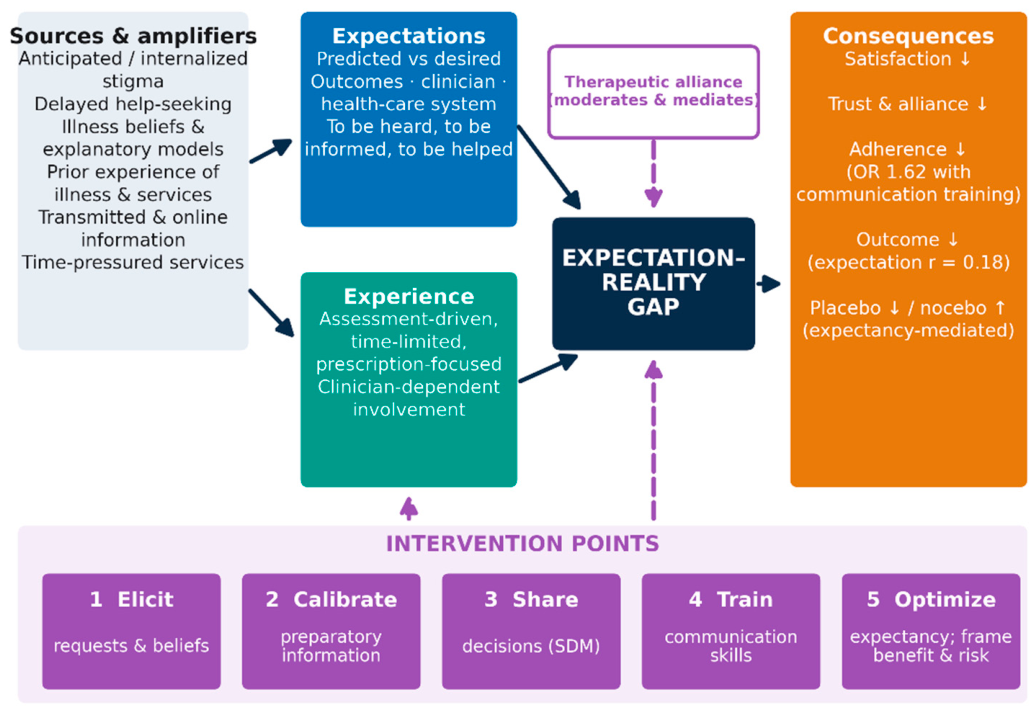
Figure 2.
Quantitative illustrations of the expectation–reality gap. (A) Expectations of 57 newly referred psychiatric outpatients [16]. (B) Pooled correlations between outcome expectation [3], trust in the clinician [39] and therapeutic alliance (meta-analysis of 190 studies, as summarized in [36]) and treatment outcomes; the error bar shows the 95% confidence interval where reported. (C) Antidepressant response rates by trial design [40] and by patients’ expectation of reboxetine efficacy [41]. (D) Proportion of people with a past-year mental disorder receiving treatment, by provider, in a US survey of almost 10,000 adults [24]. Values are as reported in the cited sources.
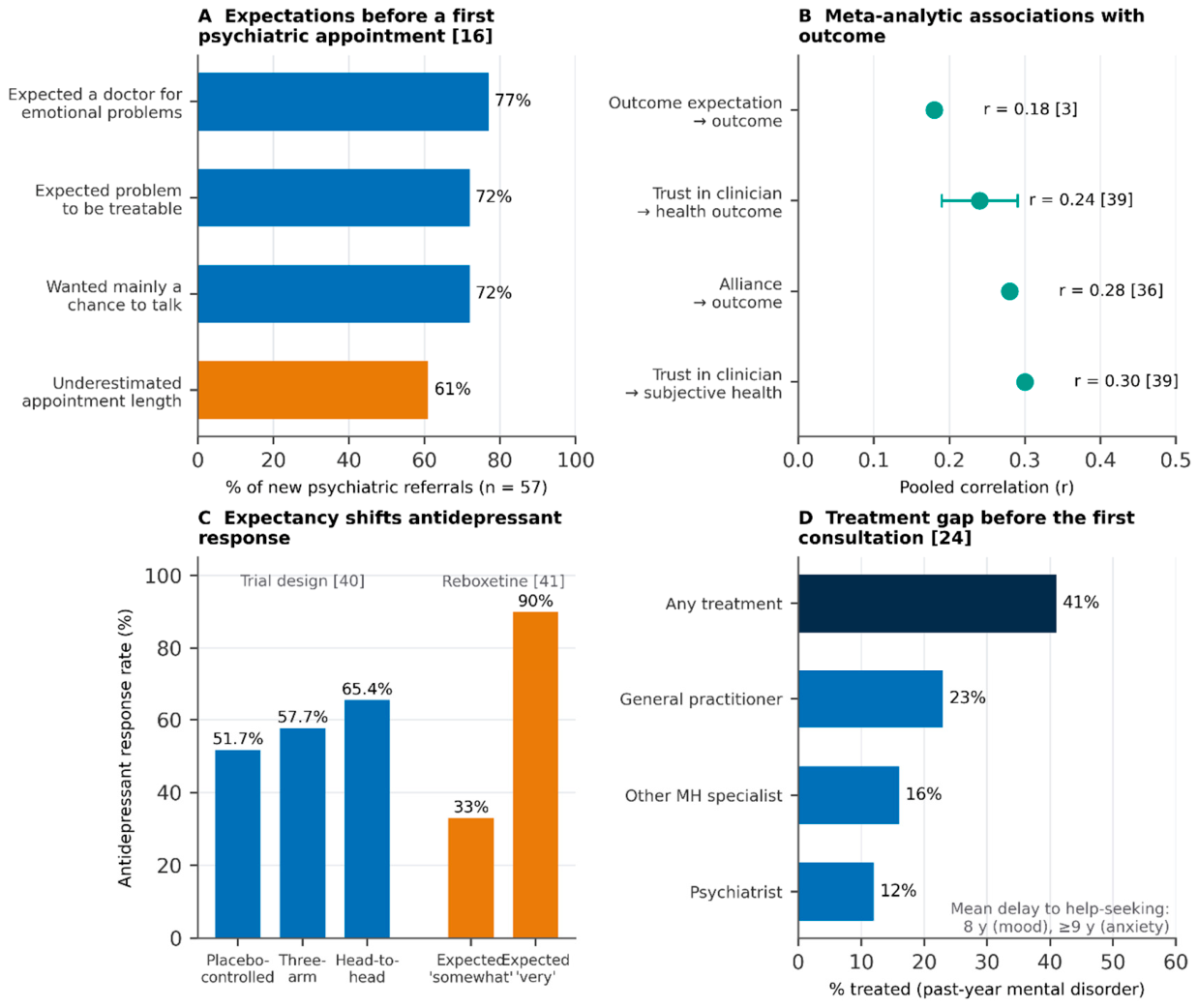

Table 1.
Key studies quantifying the patient expectation–reality gap and its consequences.
| Study | Setting and sample | Key finding | Implication for the psychiatric consultation |
|---|---|---|---|
| Francis et al., 1969 [1] | 800 pediatric outpatient visits, USA | 24% of parents grossly dissatisfied; 11% non-compliant; unmet expectations, lack of warmth and no explanation of diagnosis were key factors | The gap, not demographics, drives dissatisfaction and non-adherence |
| Michaels and Sevitt, 1978 [20] | 30 patients before and after a first psychiatric interview, UK | Many held unrealistic expectations of the interview; many were dissatisfied with its outcome | The gap is visible from the first psychiatric contact |
| Blenkiron, 1998 [16] | 57 newly referred psychiatric outpatients, UK | 72% wanted mainly a chance to talk; 61% underestimated appointment length; medication or referral occurred twice as often as expected | Mismatch is directional and predictable |
| Williams et al., 1995 [17] | 504 primary-care patients of 25 GPs, London | Explanation of the problem was the most wanted item; more expectations met predicted higher satisfaction | Explanation matters more than tests |
| Małus et al., 2018 [15] | Ambulatory psychiatric patients, Poland | Expectations centered on talking about problems and receiving emotional support; information about the consultation was valued | Relational needs dominate in psychiatry |
| Thornicroft, 2008 [24] | US survey of ~10,000 adults | Help-seeking delayed 8 years (mood) and ≥9 years (anxiety); 41% treated, 12% by a psychiatrist | Patients arrive with accumulated unmet need |
| Zolnierek and DiMatteo, 2009 [34] | Meta-analysis, physician communication and adherence | 19% higher risk of non-adherence with poor communication; communication training OR 1.62 for adherence | Communication is a modifiable adherence lever |
| McCabe et al., 2012 [30] | Patients with schizophrenia, European multicentre data | Therapeutic relationship predicted adherence to antipsychotic medication | Alliance links the consultation to relapse risk |
| Constantino et al., 2018 [3] | Meta-analysis, 81 samples, 12,722 psychotherapy patients | Optimistic early outcome expectation associated with better post-treatment outcome (r = 0.18; d = 0.36) | Expectations predict outcome |
| Rutherford et al., 2014; 2017 [8,40] | Antidepressant trials | Response 51.7% (placebo-controlled) vs 65.4% (head-to-head); expectancy mediates placebo effects | Information at consent shapes response |
| Sinyor et al., 2011 [41] | Reboxetine for major depression | 90% response if drug expected to be ‘very effective’ vs 33% if ‘somewhat effective’ | Expectancy is a mechanism, not a correlate |
| Douglas et al., 1999 [48] | Preparatory video before psychiatric outpatient consultation | Improved accuracy of expectations; no effect on satisfaction or anxiety | Calibration alone is insufficient without relational warmth |
GP, general practitioner; OR, odds ratio. Studies were selected to illustrate the quantitative evidence along the expectation–experience–consequence pathway; non-psychiatric studies are included where they establish mechanisms.
Table 2.
A consultation-level toolkit for narrowing the expectation–reality gap in psychiatric practice.
Table 2.
A consultation-level toolkit for narrowing the expectation–reality gap in psychiatric practice.
| Consultation phase | Aim | Practical actions (example wording) | Supporting evidence |
|---|---|---|---|
| Before the visit | Calibrate | Provide brief information (leaflet, video or message) on consultation length, the psychiatrist’s role and possible outcomes (talking, investigations, medication, psychological therapy, referral) | [16,48] |
| Opening | Elicit | Ask about hopes and predictions separately: “What were you hoping would happen today?” “What do you think is causing this?” “Is there anything you are worried might happen here?” | [10,18,47] |
| History and formulation | Listen and explain | Protect time for the patient’s narrative; explain the formulation in the patient’s terms; address stigma and confidentiality concerns explicitly | [4,11,15,26] |
| Decision-making | Negotiate | Present options, including non-pharmacological ones; ask how involved the patient wishes to be; explain why a requested disposition is or is not offered | [19,49,51] |
| Treatment framing | Optimize expectancy | Convey realistic hope about benefit and time course; give balanced side-effect information framed to inform without provoking nocebo responses | [8,42,43] |
| Closing | Check and align | Ask the patient to summarize the plan and what they expect to notice; agree follow-up and how to raise concerns early | [35,38] |
| Service level | Sustain | Protect consultation time; train clinicians in communication and SDM; measure expectations and satisfaction separately and adjust for symptom severity and coercion | [32,53,54] |
Actions are the author’s synthesis of the evidence reviewed and are intended as practical guidance rather than a validated protocol. SDM, shared decision-making.
Disclaimer/Publisher’s Note: The statements, opinions and data contained in all publications are solely those of the individual author(s) and contributor(s) and not of MDPI and/or the editor(s). MDPI and/or the editor(s) disclaim responsibility for any injury to people or property resulting from any ideas, methods, instructions or products referred to in the content. |
© 2026 by the author. Licensee MDPI, Basel, Switzerland. This article is an open access article distributed under the terms and conditions of the Creative Commons Attribution (CC BY) license.
Copyright: This open access article is published under a Creative Commons CC BY 4.0 license, which permit the free download, distribution, and reuse, provided that the author and preprint are cited in any reuse.