

Submitted:
30 October 2026
Posted:
04 November 2026
You are already at the latest version
Abstract
Automatic face recognition (FR) has progressed from hand-engineered subspace projections in the early 1990s to deep neural embeddings that now exceed human accuracy on standard verification benchmarks. Yet a single, biologically extreme test case exposes the limits of this progress: pairs of identical (monozygotic) twins, whose facial appearance is genetically near-indistinguishable. This survey traces five decades of FR method families—subspace and geometric methods, local texture descriptors, deep metric embeddings, margin-based angular losses, and the current era of transformers, quality-adaptive margins, and synthetic data—and then reframes that history through the lens of twin discrimination. We argue that identical twins constitute a natural stress test that isolates the ceiling of two-dimensional, appearance-based recognition: modern systems that report over 99.8% accuracy on mainstream benchmarks drop to roughly 88–92% on identical-twin verification. We organize the literature into a taxonomy along a twin-discrimination axis (appearance-only vs. multimodal/3D vs. mark-based and fine-grained methods), catalogue the specialized twin datasets that anchor this research (ND-TWINS-2009-2010, the Twins Days 3D challenge, and related multibiometric collections), and compile reported accuracies with their protocol caveats. We close with the open problems that the twin frontier makes unavoidable: fine-grained discriminative learning, multimodal and mark-based fusion, demographic fairness, presentation-attack and morphing robustness, and the regulatory pressures of the deployed 2026 landscape.
Keywords:
face recognition
; identical twins
; monozygotic twins
; biometrics
; deep metric learning
; margin-based loss
; fine-grained recognition
; facial marks
; presentation-attack detection
; face morphing
; demographic bias
1. Introduction
Face recognition is among the oldest and most intensively studied problems in computer vision, and it is now among the most widely deployed. From border control and device unlocking to forensic investigation and large-scale surveillance, systems that infer identity from a face image are embedded in the infrastructure of everyday life. The technical trajectory that made this possible is remarkable: in roughly three decades the field moved from linear subspace projections that could barely cope with lighting changes [1,2] to deep networks that match or exceed human verification accuracy on constrained benchmarks [3,4,5]; general reviews of deep learning and convolutional architectures chronicle the broader shift [6,7,8,9,10], as do face-specific reviews across pose and application [11,12,13].
This survey has two goals. The first is a consolidated, chronological account of how face recognition evolved and where it stands in 2026. The second, and the organizing thesis of the paper, is that the problem of identical twins is the most informative stress test for the current generation of systems—and that studying it reveals the ceiling of appearance-based recognition and the directions the field must take to move past it. Identical (monozygotic) twins share essentially the same genome, and their faces are, by construction, the hardest natural negative pair a recognition system can encounter. A system that reports near-perfect accuracy on standard benchmarks but cannot separate twins has not solved recognition; it has saturated an easy distribution. Recent work makes the gap concrete: methods reporting over 99.8% on mainstream benchmarks fall to roughly 88.9% on identical-twin verification [14].
Scope and Method
This is a pure literature survey; we conduct no original experiments. We assembled the corpus by systematically querying scholarly databases (OpenAlex, arXiv) across the vocabulary of both face-recognition method families and twin biometrics, followed by citation-graph expansion around the foundational twin papers. Every reference cited here was verified against a live bibliographic record (DOI resolution or arXiv identification); entries that could not be verified, along with one predatory-journal item and four retracted papers surfaced by the search, were excluded. A companion methodological note and a reference-metadata table accompany the paper. One finding of the retrieval process is itself substantive: the twins-specific face-recognition literature is comparatively thin and clusters temporally around the 2010–2018 period and a small number of datasets, a gap we return to in Section 8.
Contributions
This survey makes four contributions.
- 1.
- A consolidated chronological account of face-recognition method families from 1991 to 2026, organized into five eras with two clearly marked inflection points (the shift to deep learning around 2014 and benchmark saturation around 2019).
- 2.
- A taxonomy that reorganizes these method families along a twin-discrimination axis—appearance-only, multimodal/3D, and mark-based/fine-grained—making explicit which design choices help separate near-identical faces.
- 3.
- A catalogue of the specialized twin datasets and a compilation of reported twin verification/identification accuracies, presented with the protocol caveats that make the raw numbers non-comparable across studies.
- 4.
- An evidence-based characterization of the twin-literature gap, obtained as a by-product of a verified, reproducible corpus-construction procedure, together with the open problems it makes unavoidable.
Organization
Section 2 traces the method families in chronological order. Section 3 presents a taxonomy organized along the twin-discrimination axis. Section 4 develops the twin frontier in detail, Section 5 catalogues the datasets, and Section 6 compiles reported accuracies with protocol caveats. Section 7 covers demographic fairness, presentation attacks and morphing, and regulation. Section 8 lays out open problems, and Section 9 concludes.
2. The Evolution of Face Recognition, 1991–2026
Figure 1 summarizes the five method families that structure this section and marks the two inflection points that define the modern era: the shift to deep learning around 2014 and the saturation of standard benchmarks around 2019.
2.1. Subspace and Geometric Methods (1991–2003)
The modern era of appearance-based recognition opens with Eigenfaces, which represented faces as coordinates in a low-dimensional subspace obtained by principal component analysis of a training set of face images [1]. Eigenfaces treated recognition as a nearest-neighbour problem in this subspace and, for the first time, made automatic recognition tractable on modest hardware. Its central weakness—that the leading principal components often encode illumination rather than identity—was addressed by Fisherfaces, which used linear discriminant analysis to find projections that maximize between-class over within-class scatter, yielding markedly better robustness to lighting and expression [2]. A parallel line replaced holistic subspaces with graph-based geometry: elastic bunch graph matching represented a face as a labelled graph of Gabor-jet “fiducial” points and matched by elastic deformation, providing tolerance to pose and local distortion [15]. Subsequent refinements—two-dimensional PCA [16], Laplacianfaces from locality-preserving projections [17], Gabor-feature enhanced Fisher models [18], and, later, sparse-representation classification that recast recognition as an reconstruction problem [19]—improved accuracy but retained the essential assumption that a face is a point in a hand-designed appearance space.
2.2. Local Texture Descriptors (2004–2011)
The second family shifted from global appearance to local texture statistics. Local binary patterns (LBP) encode each pixel neighbourhood as a short binary code and summarize a face as a spatially gridded histogram of these codes, giving strong invariance to monotonic illumination change at very low computational cost [20,21]. LBP became the workhorse descriptor of the pre-deep-learning era; multi-scale and derivative variants extended it to capture higher-order texture [22,23]. The appeal of these descriptors was their engineering simplicity and speed, but they encoded only surface texture and had no mechanism to learn identity-discriminative structure from data—precisely the limitation the next family removed. The date ranges we attach to each family denote when it was the dominant research paradigm, not hard cut-offs: texture descriptors did not disappear when deep learning arrived, and multi-scale LBP-style features continued to be fused with or embedded in deep pipelines—for edge and spatial-consistency cues and for efficiency on resource-constrained hardware—well into the deep era.
2.3. Deep Metric Embeddings (2012–2016)
The decisive break came when convolutional neural networks trained on large labelled face collections replaced hand-designed features with learned representations. DeepFace aligned faces with an explicit 3D model and trained a deep CNN to classify identities, closing much of the gap to human performance on unconstrained verification [4]. DeepID showed that features learned by predicting tens of thousands of identities transferred to verification [24]. FaceNet then reframed the objective directly as metric learning: a triplet loss pulled matching pairs together and pushed mismatched pairs apart in a unit-normalized embedding, so that Euclidean distance in the learned space measured identity similarity [3]. VGGFace demonstrated that a comparatively simple deep architecture trained on a large curated dataset could reach state-of-the-art verification, and released data and models that catalysed the field [25]. Progress in this period was tightly coupled to the availability of large training sets and general advances in deep architectures and representation learning [26,27,28,29,30,31].
2.4. Margin-Based Angular Losses (2017–2020)
Once embeddings were the standard output, attention turned to the loss that shapes them. A sequence of angular-margin softmax variants reorganized the embedding space so that identities occupy well-separated angular cones. Large-margin softmax introduced the idea of an explicit decision margin in the classification layer [32]; SphereFace made the margin multiplicative on the angle and constrained features to a hypersphere [33]; CosFace applied an additive cosine margin [34]; and ArcFace applied an additive angular margin, which has a clean geometric interpretation and became the de facto standard loss for high-accuracy recognition [5]. Related work explored unified pair-similarity formulations [35] and margin-aware or fairness-oriented objectives designed to reduce error disparities [36,37,38], and specialized variants such as masked-face cosine losses [39]. A separate, orthogonal line of work targeted not the geometry of the loss but the cost of computing it: softmax-approximation and gradient-approximation schemes reduce the complexity of the classification layer and mitigate vanishing gradients when identity counts are very large [40,41]. It is this family that produced the headline “>99.8% on standard benchmarks” numbers—and, as we argue below, it is also this family whose gains largely evaporate on identical twins.
2.5. Transformers, Quality-Adaptive Margins, and Synthetic Data (2021–2026)
The current era is defined by three overlapping trends. First, vision transformers and hybrid architectures have been adapted to faces, using part-based tokens, relative positional encodings of facial keypoints, and cross-architecture distillation [42,43,44,45]. Earlier transform-domain and subspace-adaptation methods—curvelet, scattering, wavelet, and low-rank representations—bridged the descriptor and deep eras [46,47,48,49,50,51,52,53,54]. Second, the recognition of quality as a first-class variable: AdaFace makes the angular margin adaptive to image quality so that hard, low-quality samples do not dominate training [55], and ElasticFace relaxes the fixed margin into a distribution to improve generalization [56]. We group these with this era chronologically, but note that they are loss-layer innovations rather than architectural ones: both are angular-margin classification losses trained on standard CNN (ResNet) backbones and do not depend on self-attention or transformer blocks. They are contemporaneous with the transformer wave, not instances of it. Third, synthetic and generative data: generative adversarial networks [57] and, more recently, diffusion-based generators are used to synthesize training identities that sidestep the privacy and licensing problems of web-scraped face datasets such as Labeled Faces in the Wild and MS-Celeb-1M [58,59]. The through-line of this period is that raw benchmark accuracy is no longer the binding constraint; robustness, fairness, privacy, and performance on hard sub-populations—including twins—have become the frontier.
3. A Taxonomy Under the Twin-Discrimination Lens
The chronological account above organizes methods by when and how they compute features. To connect that history to the twin problem, we reorganize the same methods along a different axis: how much discriminative signal each approach can extract that is independent of the shared genetic appearance of monozygotic twins. Figure 2 presents this taxonomy. It has three columns of increasing robustness to twin confusion.
Appearance-Only (2D)
Every method family in Section 2—subspace, texture, deep embeddings, and margin losses—is, at root, a function of 2D appearance. This is precisely why they are powerful on the general population and weak on twins: they encode exactly the signal that monozygotic twins share. Empirically, holistic and deep appearance features degrade sharply when the negative pair is a twin rather than an arbitrary impostor [60,61,62]. The appearance-only column is therefore the ceiling this survey is concerned with, not a solution to the twin problem.
Multimodal and 3D
The second column recovers signal that 2D appearance discards. Three-dimensional face capture and morphable models exploit shape differences that need not covary with genetics and that help most under neutral expression [63,64,65,66], aided by 3D normal descriptors, pose/expression normalization, and detailed animatable face models [67,68,69,70,71]. This is a conditional advantage, not a uniform one: on the 3D-TEC twin challenge, geometric matching helps chiefly under neutral expression and degrades under expression-induced non-rigid deformation and sensor noise, so high-resolution 2D texture can match or exceed 3D shape for twin separation under less controlled capture [63]. Forensic odontology has even examined 3D palatal rugae in twins as a complementary trait [72]. Ocular and iris biometrics—the periocular region and, in particular, iris texture—are developmentally random rather than genetically determined, so iris texture differs even between identical twins [73,74,75,76]; the periocular and iris literatures have matured into their own surveys [77,78,79,80,81], and fingerprint sensing likewise [82]. Multibiometric fusion that combines face with fingerprint and iris substantially outperforms face alone on twins because the fused modalities are statistically independent of the shared facial genome [83,84].
Mark-Based and Fine-Grained
The third column targets the residual, identity-unique cues that survive genetic sharing. Facial marks—moles, scars, freckles, and other soft-biometric features—provide discriminative evidence that holistic representations discard, and were shown early to help distinguish twins [85,86,87]. The current generation of twin-specific deep methods makes this explicit through fine-grained attention: the 2026 AHAN model uses an asymmetric hierarchical attention mechanism to focus on the subtle local regions that differ between twins, and reports the strongest twin-verification accuracy to date [14]. Two cautions temper this result. First, attention and asymmetry cues that isolate fine local differences are inherently sensitive to head pose: the spatial correspondence such mechanisms rely on degrades under yaw, and the same viewpoint sensitivity is visible in the human-versus-machine study, where accuracy falls as the frontal-to-profile disparity grows [88]. Second, the result is a single-dataset accuracy figure obtained on a small, aging benchmark (ND-TWINS, 213 pairs), so it is a within-cohort accuracy rather than a security-threshold operating point, and generalization to unseen twin pairs and to modern capture conditions remains open. Landmark- and similarity-learning approaches specialized to twins occupy the same column [89,90,91].
4. The Identical-Twin Frontier
4.1. Why Twins are the Definitive Stress Test
Identical twins arise from a single fertilized egg and share essentially the same nuclear genome. Because 2D facial appearance is substantially heritable, monozygotic twins present the hardest natural negative pair in biometrics: two distinct identities whose faces are, to an appearance-based system, nearly the same person. This makes twins a uniquely clean diagnostic. General-population benchmarks mix easy negatives (very different-looking people) with a few hard ones; a twin protocol removes the easy negatives entirely and measures only the fine-grained discrimination that recognition ultimately requires. The pattern has been documented repeatedly: for both humans and machines, twin-impostor pairs are far harder than general-impostor pairs [88,92,93]. It is also of direct practical consequence—twins defeat face-based authentication and have been studied as a natural adversary for access control and as a vector for morphing attacks [94,95].
4.2. A Short History of Twin Biometrics
Systematic study of twin biometrics predates the deep-learning era and spans modalities. Early work established that even fingerprints of identical twins are similar but distinguishable [96], with analogous findings for palmprints [97] and ears [98]. Face-specific study accelerated around 2011 with the collection of dedicated datasets at the Twins Days Festival, which enabled the first large-scale evaluations of whether face matchers could distinguish twins [60] and the first 3D twin challenge [63]. A rich vein of work followed on the specific cues that help: facial marks [85,86], facial aging and asymmetry [99,100], expression dynamics and “talking” profiles [101], and the effect of gender and age on discriminant-analysis approaches [102,103], and the effect of gender and age on separability [104]. Early evaluations also probed whether faces alone suffice [105], and later work extended to geometric and hybrid features [106] and to non-face twin traits including fingerprints and voice [107,108,109]. Surveys consolidated this subfield [93]. Since roughly 2018 the pace has slowed and shifted toward deep methods and fusion [62,110,111,112], with the notable 2023–2026 resurgence of human-versus-machine comparison [88] and fine-grained attention [14].
4.3. What Current Systems Achieve
Figure 3 states the central empirical fact of this survey. The same class of models that reports over 99.8% on standard verification benchmarks drops to about 88.9% on identical-twin verification; the best current twin-specialized method, AHAN, recovers part of that loss to 92.3% [14]. The residual gap—roughly seven to eleven points below saturated benchmark performance—is the quantitative signature of the appearance ceiling.
Not all approaches sit at the same point. Hand-crafted feature fusion on ND-TWINS-2009-2010 reached equal error rates as low as 2.07% for natural expression and 0.0% for smiling faces under favourable, curated conditions—far better than the best prior methods evaluated under the same conditions—illustrating that under controlled capture, marks and complementary descriptors can separate twins well [113]. Similarity-learning networks trained specifically to score twin/look-alike pairs report test areas under the curve near 0.98 [114]. The apparent tension between these strong numbers and the modest 88–92% headline is explained entirely by protocol: equal error rates on curated single-condition subsets are not comparable to verification accuracy over a full, mixed-condition twin protocol. We make these protocol differences explicit in Section 6.
5. Twin Face Datasets
Research on twin face recognition is anchored by a small number of specialized collections, almost all gathered at the annual Twins Days Festival in Twinsburg, Ohio. Table 1 summarizes their specifications. Two properties of this dataset landscape are worth emphasizing. First, it is small and concentrated: a handful of collections, mostly captured between 2009 and 2011, underpin the great majority of published results, which limits statistical power and cross-study comparability. Second, the most widely used resource, ND-TWINS-2009-2010, contains 435 subjects and 213 twin pairs (predominantly monozygotic) across roughly 24,000 images captured under varied indoor/outdoor illumination, expression, and pose [60].
6. Reported Twin Accuracies and Protocol Caveats
Table 2 compiles reported twin-discrimination results across the literature. We deliberately present the metric and a protocol caveat alongside each value, because the single most common error in reading this literature is to compare numbers that were never measured under comparable conditions. Equal error rates on a curated, single-expression subset [113], a similarity-network AUC [114], an item-level human-versus-machine accuracy across viewpoints [88], and a full mixed-condition verification accuracy [14] are all legitimate measurements, but they are not interchangeable. A particular hazard is that several of these numbers are binary classification or verification accuracy figures, whereas an operational biometric system is normally characterised by its true-accept rate at a fixed, strict false-accept rate (for example, ). A headline “accuracy” does not fix an operating point, and accuracy at a balanced threshold can look strong while at a security-grade remains poor; the twin-specific numbers in Table 2 should be read with that gap in mind rather than as directly comparable operating-point results. Read with that caution, the table tells a consistent story: controlled conditions and complementary cues (marks, multiple modalities, fine-grained attention) raise twin discrimination substantially, while generic appearance-based verification under realistic conditions remains well below benchmark-saturation levels.
7. Societal Dimensions: Fairness, Attacks, and Regulation
7.1. Demographic Bias
Even setting twins aside, accuracy is not uniform across the population. The Gender Shades study showed that commercial face-analysis systems had far higher error rates on darker-skinned and female faces than on lighter-skinned and male faces [115]. The US National Institute of Standards and Technology confirmed the generality of the problem across a large number of commercial algorithms in its Face Recognition Vendor Test on demographic effects, finding systematic variation in false-match and false-non-match rates across demographic groups [116]. Subsequent work has quantified and sought to mitigate racial bias, both by constructing balanced evaluation sets such as Racial Faces in-the-Wild [117] and by surveying mitigation strategies [118], while comparative studies examine how machine bias relates to human bias [119]. The twin problem and the fairness problem are connected: both are failures of fine-grained discrimination on hard sub-populations that aggregate benchmark accuracy conceals.
7.2. Presentation Attacks, Morphing, and Deepfakes
Deployed systems face adversaries as well as hard negatives. Presentation-attack detection—distinguishing a live face from a photo, replay, or mask—remains an active area [120], as does robustness to adversarial perturbations [121] and recognition across spectral domains [122]. Face morphing, in which a single document image is engineered to match multiple identities, is a particular concern for border control; here the twin literature and the attack literature meet, because twins and look-alikes make especially effective morph pairs and raise the attack’s success probability [95]. The maturation of generative models that first entered FR as a training-data tool [57] has thus also enlarged the threat surface.
7.3. Regulation in 2026
The deployment context in 2026 is shaped by regulation as much as by algorithms. The European Union’s AI Act classifies most real-time remote biometric identification in public spaces as prohibited or high-risk, imposing documentation, accuracy, and human-oversight obligations on permitted uses; comparable sectoral rules and moratoria exist in other jurisdictions. The scientific consequence is that the field’s own quality metrics—demographic error parity, presentation-attack robustness, and performance on hard cases including twins—are increasingly the criteria on which legal deployment turns, not merely research desiderata. Documentation of the past, present, and anticipated trajectory of the field reflects this shift in emphasis [13]. Age-robust transformer recognition [123] illustrates the widening set of deployment concerns. Early content-based retrieval framed some of these questions before the deep era [124].
8. Open Problems and Research Directions
The twin frontier makes several open problems unavoidable.
- Fine-grained discriminative learning. The residual twin gap is a fine-grained recognition problem. Attention mechanisms that localize the small regions where twins differ are the most promising current direction [14], but they are trained and evaluated on very little data.
- Multimodal and mark-based fusion. The most reliable route to twin discrimination remains signal that is independent of the shared facial genome—iris, periocular texture, fingerprints, and explicit facial marks [73,83,86]. Systematic, learned fusion of these with deep face embeddings is comparatively underexplored.
- Data scarcity. The field depends on a handful of small, aging twin collections. New, larger, demographically diverse, and longitudinal twin datasets—and privacy-preserving synthetic twin data—would materially change what is testable. Predictive and augmented-feature approaches hint at what larger data could enable [125].
- Protocol standardization. As Section 6 shows, reported twin accuracies are widely incomparable. A shared twin-verification protocol, with fixed splits and reporting conventions, is overdue.
- Fairness and robustness as first-class objectives. Demographic parity, presentation-attack and morphing resistance, and twin discrimination are all facets of the same underlying demand for reliable fine-grained recognition, and are now partly codified in regulation.
9. Conclusions
Face recognition has traversed an extraordinary arc, from linear subspaces that encoded mostly lighting to deep, margin-trained embeddings that saturate mainstream benchmarks above 99.8% accuracy. That very saturation is why the field needs a harder test, and identical twins provide the hardest natural one. Viewed through the twin-discrimination lens, the method families of the past three decades sort cleanly by how much identity signal they can extract beyond shared appearance: 2D appearance methods, however sophisticated, hit a ceiling; multimodal, 3D, mark-based, and fine-grained attention methods push past it. The measured gap between benchmark and twin accuracy—roughly 99.8% down to 88.9%, recovered only partway to 92.3% by the best current twin-specialized model—is the clearest single indicator of how much of the recognition problem remains unsolved. Closing it will require the field’s current priorities: fine-grained learning, principled multimodal fusion, better and larger data, standardized protocols, and fairness and robustness treated as primary objectives. The twin frontier is where the next decade of face recognition will be decided.
References
- Turk, M.; Pentland, A. Eigenfaces for Recognition. J. Cogn. Neurosci. 1991. [Google Scholar] [CrossRef] [PubMed]
- Belhumeur, P.N.; Hespanha, J.P.; Kriegman, D. Eigenfaces vs. Fisherfaces: recognition using class specific linear projection. In IEEE Transactions on Pattern Analysis and Machine Intelligence; 1997. [Google Scholar] [CrossRef]
- Schroff, F.; Kalenichenko, D.; Philbin, J. FaceNet: A unified embedding for face recognition and clustering. 2015. [Google Scholar] [CrossRef]
- Taigman; Yang; Ranzato; et al. DeepFace: Closing the Gap to Human-Level Performance in Face Verification; 2014. [Google Scholar] [CrossRef]
- Deng, J.; Guo, J.; Yang, J.; Xue, N.; Kotsia, I.; Zafeiriou, S. ArcFace: Additive Angular Margin Loss for Deep Face Recognition. 2019. [Google Scholar] [CrossRef]
- Voulodimos, A.; Doulamis, N.; Doulamis, A.; Protopapadakis, E. Deep Learning for Computer Vision: A Brief Review. In Computational Intelligence and Neuroscience; 2018. [Google Scholar] [CrossRef] [PubMed]
- Alzubaidi, L.; Zhang, J.; Humaidi, A.J.; Al-Dujaili, A.Q.; Duan, Y.; Al-Shamma, O.; Santamaría, J.; Fadhel, M.A.; Al-Amidie, M.; Farhan, L. Review of deep learning: concepts, CNN architectures, challenges, applications, future directions. J. Big Data 2021. [Google Scholar] [CrossRef] [PubMed]
- Li, Z.; Liu, F.; Yang, W.; Peng, S.; Zhou, J. A Survey of Convolutional Neural Networks: Analysis, Applications, and Prospects. IEEE Trans. Neural Netw. Learn. Syst. 2021. [Google Scholar] [CrossRef] [PubMed]
- Sarker, I.H. Machine Learning: Algorithms, Real-World Applications and Research Directions. In SN Computer Science; 2021. [Google Scholar] [CrossRef] [PubMed]
- Weiss, K.R.; Khoshgoftaar, T.M.; Wang, D. A survey of transfer learning. J. Big Data 2016. [Google Scholar] [CrossRef]
- Zhang, X.; Gao, Y. Face recognition across pose: A review. In Pattern Recognition; 2009. [Google Scholar] [CrossRef]
- Parmar, D.N.; Mehta, B.B. Face Recognition Methods & Applications. Int. J. Comput. Technol. Appl. Jan-Feb 2013, 2014, Vol 4(1), 84–86. [Google Scholar]
- Adjabi, I.; Ouahabi, A.; Benzaoui, A.; Taleb-Ahmed, A. Past, Present, and Future of Face Recognition: A Review. Electronics 2020. [Google Scholar] [CrossRef]
- Nguyen, H.N. AHAN: Asymmetric Hierarchical Attention Network for Identical Twin Face Verification. arXiv 2026. [Google Scholar] [CrossRef]
- Wiskott, L.; Fellous, J.; Kuiger, N.; Malsburg, C.v.d. Face recognition by elastic bunch graph matching. In IEEE Transactions on Pattern Analysis and Machine Intelligence; 1997. [Google Scholar] [CrossRef]
- Yang, J.; Zhang, D.; Frangi, A.F.; Yang, J.y. Two-dimensional pca: a new approach to appearance-based face representation and recognition. IEEE Trans. Pattern Anal. Mach. Intell. 2004. [Google Scholar] [CrossRef] [PubMed]
- He, X.; Yan, S.; Hu, Y.; Niyogi, P.; Zhang, H.J. Face recognition using Laplacianfaces. IEEE Trans. Pattern Anal. Mach. Intell. 2005. [Google Scholar] [CrossRef] [PubMed]
- Liu, C.; Wechsler, H. Gabor feature based classification using the enhanced fisher linear discriminant model for face recognition. IEEE Trans. Image Process. 2002. [Google Scholar] [CrossRef] [PubMed]
- Wright, J.; Yang, A.; Ganesh, A.; Sastry, S.; Ma, Y. Robust Face Recognition via Sparse Representation. In IEEE Transactions on Pattern Analysis and Machine Intelligence; 2009. [Google Scholar] [CrossRef] [PubMed]
- Ahonen, T.; Hadid, A.; Pietikäinen, M. Face Recognition with Local Binary Patterns. In Proceedings of the Lecture notes in computer science, 2004. [Google Scholar] [CrossRef]
- Ahonen, T.; Hadid, A.; Pietikäinen, M. Face Description with Local Binary Patterns: Application to Face Recognition. In IEEE Transactions on Pattern Analysis and Machine Intelligence; 2006. [Google Scholar] [CrossRef] [PubMed]
- Chan, C.H.; Kittler, J.; Messer, K. Multi-scale Local Binary Pattern Histograms for Face Recognition. In Proceedings of the Lecture notes in computer science, 2007. [Google Scholar] [CrossRef]
- Zhang, B.; Gao, Y.; Zhao, S.; Liu, J. Local Derivative Pattern Versus Local Binary Pattern: Face Recognition With High-Order Local Pattern Descriptor. IEEE Trans. Image Process. 2009. [Google Scholar] [CrossRef] [PubMed]
- Sun; Wang; Tang. Deep Learning Face Representation from Predicting 10,000 Classes. 2014. [Google Scholar] [CrossRef]
- Parkhi; Vedaldi; Zisserman. Deep Face Recognition; 2015. [Google Scholar] [CrossRef]
- Wang, M.; Deng, W. Deep face recognition: A survey. Neurocomputing 2021, 429, 215–244. [Google Scholar] [CrossRef]
- Kaya, M.; Bilge, H. Deep Metric Learning: A Survey; Symmetry, 2019. [Google Scholar] [CrossRef]
- He, K.; Zhang, X.; Ren, S.; Sun, J. Spatial Pyramid Pooling in Deep Convolutional Networks for Visual Recognition. In Proceedings of the Lecture notes in computer science, 2014. [Google Scholar] [CrossRef]
- Zagoruyko, S.; Komodakis, N. Learning to compare image patches via convolutional neural networks. 2015. [Google Scholar] [CrossRef]
- Le-Khac, P.H.; Healy, G.; Smeaton, A.F. Contrastive Representation Learning: A Framework and Review. IEEE Access 2020. [Google Scholar] [CrossRef]
- Shafiq, M.; Gu, Z. Deep Residual Learning for Image Recognition: A Survey. Appl. Sci. 2022. [Google Scholar] [CrossRef]
- Liu, W.; Wen, Y.; Yu, Z.; Yang, M. Large-Margin Softmax Loss for Convolutional Neural Networks. In arXiv (Cornell University); 2016. [Google Scholar] [CrossRef]
- Liu; Wen; Yu; et al. SphereFace: Deep Hypersphere Embedding for Face Recognition; 2017. [Google Scholar] [CrossRef]
- Wang, H.; Wang, Y.; Zhou, Z.; Ji, X.; Gong, D.; Zhou, J.; Li, Z.; Liu, W. CosFace: Large Margin Cosine Loss for Deep Face Recognition. In arXiv (Cornell University); 2018. [Google Scholar] [CrossRef]
- Sun, Y.; Cheng, C.; Zhang, Y.; Zhang, C.; Zheng, L.; Wang, Z.; Wei, Y. Circle Loss: A Unified Perspective of Pair Similarity Optimization. arXiv 2020, arXiv:2002.10857. [Google Scholar] [CrossRef]
- Liu, B.; Deng, W.; Zhong, Y.; Wang, M.; Hu, J.; Tao, X.; Huang, Y. Fair Loss: Margin-Aware Reinforcement Learning for Deep Face Recognition. 2019. [Google Scholar] [CrossRef]
- Wang, X.; Zhang, S.; Wang, S.; Fu, T.; Shi, H.; Mei, T. Mis-Classified Vector Guided Softmax Loss for Face Recognition. In Proceedings of the Proceedings of the AAAI Conference on Artificial Intelligence, 2020. [Google Scholar] [CrossRef]
- Kim, B.; Kim, J. Adjusting Decision Boundary for Class Imbalanced Learning. IEEE Access 2020. [Google Scholar] [CrossRef]
- Deng, H.; Feng, Z.; Qian, G.; Lv, X.; Li, H.; Li, G. MFCosface: A Masked-Face Recognition Algorithm Based on Large Margin Cosine Loss. Appl. Sci. 2021. [Google Scholar] [CrossRef]
- Li, L.; Doroslovački, M.; Loew, M.H. Approximating the Gradient of Cross-Entropy Loss Function. IEEE Access 2020. [Google Scholar] [CrossRef]
- Xu, H.; Xiang, S.; Qian, D. SubFace: Learning with Softmax Approximation for Face Recognition. arXiv 2022. [Google Scholar]
- Sun, Z.; Tzimiropoulos, G. Part-based Face Recognition with Vision Transformers. arXiv 2022. [Google Scholar]
- Kim, M.; Su, Y.; Liu, F.; Jain, A.; Liu, X. KeyPoint Relative Position Encoding for Face Recognition. arXiv 2024. [Google Scholar]
- Zhao, W.; Zhu, X.; He, Z.; Zhang, X.Y.; Lei, Z. Cross Architecture Distillation for Face Recognition. arXiv 2023. [Google Scholar]
- Xu, P.; Zhu, X.; Clifton, D.A. Multimodal Learning With Transformers: A Survey. IEEE Trans. Pattern Anal. Mach. Intell. 2023. [Google Scholar] [CrossRef] [PubMed]
- Cohen, R. Face Recognition using Curvelet Transform. arXiv 2011. [Google Scholar]
- Minaee, S.; Abdolrashidi, A.; Wang, Y. Face Recognition Using Scattering Convolutional Network. arXiv 2016. [Google Scholar]
- Bhowmik, M.K.; Bhattacharjee, D.; Nasipuri, M.; Basu, D.K.; Kundu, M. Fusion of Daubechies Wavelet Coefficients for Human Face Recognition. arXiv 2010. [Google Scholar]
- Qiu, Q.; Sapiro, G.; Chen, C.H. Domain-invariant Face Recognition using Learned Low-rank Transformation. arXiv 2013. [Google Scholar]
- Duong, V.H.; Lee, Y.S.; Pham, B.T.; Mathulaprangsan, S.; Bao, P.T.; Wang, J.C. Complex Matrix Factorization for Face Recognition. arXiv 2016. [Google Scholar]
- Li, Y.; Zheng, W.; Cui, Z. Recurrent Regression for Face Recognition. arXiv 2016. [Google Scholar]
- Peng, C.; Gao, X.; Wang, N.; Li, J. Graphical Representation for Heterogeneous Face Recognition. arXiv 2015. [Google Scholar]
- Li, A.; Shan, S.; Chen, X.; Ma, B.; Yan, S.; Gao, W. Cross-pose Face Recognition by Canonical Correlation Analysis. arXiv 2015. [Google Scholar]
- Biswas, S.; Biswas, A. Face Recognition Algorithms based on Transformed Shape Features. IJCSI Int. J. Comput. Sci. Issues 2012, Vol. 9(Issue 3, No 3), pg 445–451. [Google Scholar]
- Kim; Jain; Liu. AdaFace: Quality Adaptive Margin for Face Recognition. 2022. [Google Scholar] [CrossRef]
- Boutros; Damer; Kirchbuchner; et al. ElasticFace: Elastic Margin Loss for Deep Face Recognition. 2022. [Google Scholar] [CrossRef]
- Goodfellow, I.; Pouget-Abadie, J.; Mirza, M.; Xu, B.; Warde-Farley, D.; Ozair, S.; Courville, A.; Bengio, Y. Generative Adversarial Networks. In arXiv; Cornell University, 2014. [Google Scholar] [CrossRef]
- Learned-Miller; Huang; RoyChowdhury; et al. Labeled Faces in the Wild: A Survey; 2016. [Google Scholar] [CrossRef]
- Guo; Zhang; Hu; et al. MS-Celeb-1M: A Dataset and Benchmark for Large-Scale Face Recognition; 2016. [Google Scholar] [CrossRef]
- Phillips, P.J.; Flynn, P.J.; Bowyer, K.W. Distinguishing identical twins by face recognition. 2011. [Google Scholar] [CrossRef]
- Paone, J.R.; Flynn, P.J.; Philips, P.J. Double Trouble: Differentiating Identical Twins by Face Recognition. IEEE Trans. Inf. Forensics Secur. 2014. [Google Scholar] [CrossRef]
- Sundaresan, V.; Shanthi, S. Monozygotic twin face recognition: An in-depth analysis and plausible improvements. Image Vis. Comput. 2021. [Google Scholar] [CrossRef]
- Vijayan, V.; Bowyer, K.W.; Flynn, P.J. Twins 3D face recognition challenge. 2011. [Google Scholar] [CrossRef]
- Vijayan, V.; Bowyer, K.W.; Flynn, P.J. 3D Twins and Expression Challenge. 2011. [Google Scholar] [CrossRef]
- Blanz, V.; Vetter, T. A morphable model for the synthesis of 3D faces; 1999. [Google Scholar] [CrossRef]
- Blanz, V.; Vetter, T. Face recognition based on fitting a 3D morphable model. In IEEE Transactions on Pattern Analysis and Machine Intelligence; 2003. [Google Scholar] [CrossRef]
- Li, H.; Huang, D.; Chen, L. A group of facial normal descriptors for recognizing 3D identical twins. 2012. [Google Scholar] [CrossRef]
- Zhu, X.; Lei, Z.; Yan, J.; Dong, Y.; Li, S.Z. High-fidelity Pose and Expression Normalization for face recognition in the wild. 2015. [Google Scholar] [CrossRef]
- Feng, Y.; Feng, H.; Black, M.J.; Bolkart, T. Learning an animatable detailed 3D face model from in-the-wild images. In ACM Transactions on Graphics; 2021. [Google Scholar] [CrossRef]
- Xiong, X.; Torre, F.D.l. Supervised Descent Method and Its Applications to Face Alignment. 2013. [Google Scholar] [CrossRef]
- Kim, H.; Garrido, P.; Tewari, A.; Xu, W.; Thies, J.; Nießner, M.; Pérez, P.; Richardt, C.; Zollhöfer, M.; Theobalt, C. Deep video portraits. ACM Trans. Graph. 2018. [Google Scholar] [CrossRef]
- Taneva, E.D.; Evans, C.A.; Viana, G. 3D Evaluation of Palatal Rugae in Identical Twins. In Case Reports in Dentistry; 2017. [Google Scholar] [CrossRef] [PubMed]
- Hollingsworth, K.; Bowyer, K.W.; Flynn, P.J. Similarity of iris texture between identical twins. 2010. [Google Scholar] [CrossRef]
- Park, U.; Jillela, R.; Ross, A. Periocular Biometrics in the Visible Spectrum. IEEE Trans. Inf. Forensics Secur. 2010. [Google Scholar] [CrossRef]
- Bharadwaj, S.; Bhatt, H.S.; Vatsa, M. Periocular biometrics: When iris recognition fails. 2010. [Google Scholar] [CrossRef]
- Miller, P.E.; Lyle, J.R.; Pundlik, S. Performance evaluation of local appearance based periocular recognition. 2010. [Google Scholar] [CrossRef]
- Alonso-Fernandez, F.; Bigün, J. A survey on periocular biometrics research. Pattern Recognit. Lett. 2015. [Google Scholar] [CrossRef]
- Nguyen, K.; Fookes, C.; Jillela, R.; Sridharan, S.; Ross, A. Long range iris recognition: A survey. In Pattern Recognition; 2017. [Google Scholar] [CrossRef]
- Malgheet, J.R.; Manshor, N.; Affendey, L.S. Iris Recognition Development Techniques: A Comprehensive Review. Complexity 2021. [Google Scholar] [CrossRef]
- Nguyen, K.; Proença, H.; Alonso-Fernandez, F. Deep Learning for Iris Recognition: A Survey. In ACM Computing Surveys; 2024. [Google Scholar] [CrossRef]
- Boyd, A.; Yadav, S.; Swearingen, T.; Kuehlkamp, A.; Trokielewicz, M.; Benjamin, E.; Maciejewicz, P.; Chute, D.J.; Ross, A.; Flynn, P.J.; et al. Post-Mortem Iris Recognition—A Survey and Assessment of the State of the Art. IEEE Access 2020. [Google Scholar] [CrossRef]
- Yu, Y.; Niu, Q.; Li, X.; Xue, J.; Liu, W.; Lin, D. A Review of Fingerprint Sensors: Mechanism, Characteristics, and Applications; Micromachines, 2023. [Google Scholar] [CrossRef] [PubMed]
- Sun, Z.; Paulino, A.A.; Feng, J. A study of multibiometric traits of identical twins. Proceedings of SPIE, the International Society for Optical Engineering/Proceedings of SPIE, 2010. [Google Scholar] [CrossRef]
- Behravan, H.; Faez, K. Introducing a new multimodal database from twins’ biometric traits. 2013. [Google Scholar] [CrossRef]
- Srinivas, N.; Aggarwal, G.; Flynn, P.J. Analysis of Facial Marks to Distinguish Between Identical Twins. IEEE Trans. Inf. Forensics Secur. 2012. [Google Scholar] [CrossRef]
- Klare, B.; Paulino, A.A.; Jain, A.K. Analysis of facial features in identical twins. 2011. [Google Scholar] [CrossRef]
- Nixon, M.; Correia, P.L.; Nasrollahi, K.; Moeslund, T.B.; Hadid, A.; Tistarelli, M. On soft biometrics. Pattern Recognit. Lett. 2015. [Google Scholar] [CrossRef]
- Parde, C.J.; Strehle, V.E.; Banerjee, V.; Hu, Y.; Cavazos, J.G.; Castillo, C.D.; O’Toole, A.J. Twin Identification over Viewpoint Change: A Deep Convolutional Neural Network Surpasses Humans. ACM Trans. Appl. Percept. 2023. [Google Scholar] [CrossRef] [PubMed]
- Mousavi, S.; Charmi, M.; Hassanpoor, H. A distinctive landmark-based face recognition system for identical twins by extracting novel weighted features. Comput. Electr. Eng. 2021. [Google Scholar] [CrossRef]
- Sanil, G.; Prakash, K.; Prabhu, S. Facial Similarity Measure for Recognizing Monozygotic Twins Utilizing 3D Facial Landmarks, Efficient Geodesic Distance Computation, and Machine Learning Algorithms. In IEEE Access; 2024. [Google Scholar] [CrossRef]
- McCauley, J.A. Identical Twins as a Facial Similarity Benchmark for Human Facial Recognition. 2021. [Google Scholar] [CrossRef]
- Biswas, S.; Bowyer, K.W.; Flynn, P.J. A study of face recognition of identical twins by humans. 2011. [Google Scholar] [CrossRef]
- Bowyer, K.W.; Flynn, P.J. Biometric identification of identical twins: A survey. 2016. [Google Scholar] [CrossRef]
- Gnatyuk, V.; Moskalenko, A. Mobile Twin Recognition. 2020. [Google Scholar] [CrossRef]
- Ramachandra, R.; Venkatesh, S.; Jaswal, G.; Li, G. Vulnerability of Face Morphing Attacks: A Case Study on Lookalike and Identical Twins. arXiv. 2023. Available online: http://arxiv.org/abs/2303.14004.
- Jain, A.K.; Prabhakar, S.; Pankanti, S. On the similarity of identical twin fingerprints. In Pattern Recognition; 2002. [Google Scholar] [CrossRef]
- Kong, A.W.; Zhang, D.; Lu, G. A Study of Identical Twins’ Palmprints for Personal Authentication. In Proceedings of the Lecture notes in computer science, 2005. [Google Scholar] [CrossRef]
- Nejati, H.; Zhang, L.; Sim, T. Wonder Ears: Identification of Identical Twins from Ear Images; National University of Singapore, 2012. [Google Scholar]
- Le, N.; Luu, K.; Seshadri, K. A facial aging approach to identification of identical twins. 2012. [Google Scholar] [CrossRef]
- Le, N.; Seshadri, K.; Luu, K. Facial aging and asymmetry decomposition based approaches to identification of twins. Pattern Recognit. 2015. [Google Scholar] [CrossRef]
- Zhang, L.; Ma, K.; Nejati, H. A talking profile to distinguish identical twins. In Image and Vision Computing; 2013. [Google Scholar] [CrossRef]
- Juefei-Xu, F.; Savvides, M. An Augmented Linear Discriminant Analysis Approach for Identifying Identical Twins with the Aid of Facial Asymmetry Features. 2013. [Google Scholar] [CrossRef]
- Gu, D.; Nguyen, M.; Yan, W. Cross Models for Twin Recognition. Int. J. Digit. Crime. Forensics 2016. [Google Scholar] [CrossRef]
- Mahalingam, G.; Ricanek, K. Investigating the effects of gender and age group based differences in identical twins. 2013. [Google Scholar] [CrossRef]
- Pruitt, M.T.; Grant, J.M.; Paone, J.R. Facial recognition of identical twins. 2011. [Google Scholar] [CrossRef]
- Nahar, K.M.; Abul-Huda, B.; bataineh, A.A. Twins and Similar Faces Recognition Using Geometric and Photometric Features with Transfer Learning. Int. J. Comput. Digit. Syst. 2022. [Google Scholar] [CrossRef] [PubMed]
- Mishra, K.N.; Srivastava, P.C.; Agrawal, A. Minutiae Distances and Orientation Fields Based Thumbprint Identification of Identical Twins. Int. J. Image Graph. Signal Process. 2013. [Google Scholar] [CrossRef]
- Sabatier, S.B.R.; Trester, M.R.; Dawson, J. Measurement of the impact of identical twin voices on automatic speaker recognition. Measurement 2018. [Google Scholar] [CrossRef]
- Li, J.; Zhang, L.; Guo, D. Audio-visual twins database. 2015. [Google Scholar] [CrossRef]
- Toygar, O.; Alqaralleh, E.; Afaneh, A. Symmetric ear and profile face fusion for identical twins and non-twins recognition. In Signal Image and Video Processing; 2018. [Google Scholar] [CrossRef]
- Mohammed, B.O.; Shamsuddin, S.M. Feature level Fusion for Multi-biometric with identical twins. 2018. [Google Scholar] [CrossRef]
- Mousavi, S.; Charmi, M.; Hassanpoor, H. Recognition of identical twins based on the most distinctive region of the face: Human criteria and machine processing approaches. In Multimedia Tools and Applications; 2021. [Google Scholar] [CrossRef]
- Afaneh, A.; Noroozi, F.; Toygar, O. Recognition of identical twins using fusion of various facial feature extractors. EURASIP J. Image Video Process. 2017. [Google Scholar] [CrossRef]
- Sami, S.M.; McCauley, J.; Soleymani, S.; Nasrabadi, N.; Dawson, J. Benchmarking Human Face Similarity Using Identical Twins. arXiv. 2022. Available online: http://arxiv.org/abs/2208.11822.
- Buolamwini, J.; Gebru, T. Gender Shades: Intersectional Accuracy Disparities in Commercial Gender Classification. Proceedings of Machine Learning Research (FAccT), 2018. [Google Scholar]
- Grother, P.; Ngan, M.; Hanaoka, K. Face recognition vendor test part 3. Tech. Rep. 2019. [Google Scholar] [CrossRef]
- Wang, M.; Deng, W.; Hu, J.; Tao, X.; Huang, Y. Racial Faces in-the-Wild: Reducing Racial Bias by Information Maximization Adaptation Network. In arXiv (Cornell University); 2018. [Google Scholar] [CrossRef]
- Yücer, S.; Tektas, F.; Moubayed, N.A.; Breckon, T.P. Racial Bias within Face Recognition: A Survey. In ACM Computing Surveys; 2024. [Google Scholar] [CrossRef]
- Dooley, S.; Downing, R.; Wei, G.; Shankar, N.; Thymes, B.; Thorkelsdottir, G.; Kurtz-Miott, T.; Mattson, R.; Obiwumi, O.; Cherepanova, V.; et al. Comparing Human and Machine Bias in Face Recognition. arXiv 2021. [Google Scholar]
- Ming, Z.; Visani, M.; Luqman, M.M.; Burie, J.C. A Survey On Anti-Spoofing Methods For Face Recognition with RGB Cameras of Generic Consumer Devices. arXiv 2020. [Google Scholar]
- Cao, Y.; Zhu, Y.; Wang, D.; Wen, S.; Xue, M.; Lu, J.; Ge, H. Rethinking the Threat and Accessibility of Adversarial Attacks against Face Recognition Systems. arXiv 2024. [Google Scholar]
- Anghelone, D.; Chen, C.; Ross, A.; Dantcheva, A. Beyond the Visible: A Survey on Cross-spectral Face Recognition. arXiv 2022. [Google Scholar]
- Prakash, P.; Rai, A.K. Age-Defying Face Recognition with Transformer-Enhanced Loss. arXiv 2024. [Google Scholar]
- Gupta, A.; Jain, R. Visual information retrieval. In Communications of the ACM; 1997. [Google Scholar] [CrossRef]
- Nafees, M.; Uddin, J. A Twin Prediction Method Using Facial Recognition Feature. 2018 International Conference on Computer, Communication, Chemical, Material and Electronic Engineering (IC4ME2), 2018. [Google Scholar] [CrossRef]
Figure 1.
Five decades of face-recognition method families. Alternating bands above and below the timeline mark the dominant paradigm of each period; the two diamond markers indicate the deep-learning inflection (2014) and the point at which standard verification benchmarks saturated above 99.8% accuracy (2019). Representative methods are named within each band.
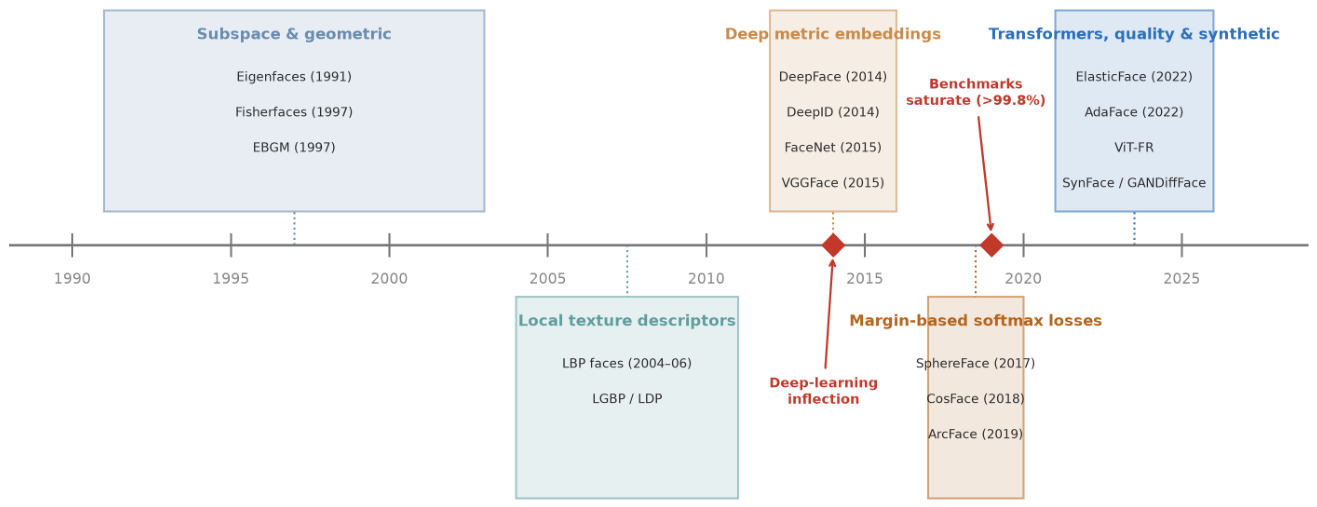
Figure 2.
A taxonomy of face-recognition methods under the twin-discrimination lens. Left: appearance-only 2D methods, from subspace projections to margin-based deep embeddings, all of which are defeated by the shared appearance of identical twins. Centre: multimodal and 3D methods, which recover discriminative signal from geometry and from independent modalities. Right: mark-based and fine-grained methods, which target the identity-unique cues (moles, scars, micro-texture, and learned fine-grained attention) that distinguish even genetically identical faces. Discriminative power with respect to twins increases left to right.
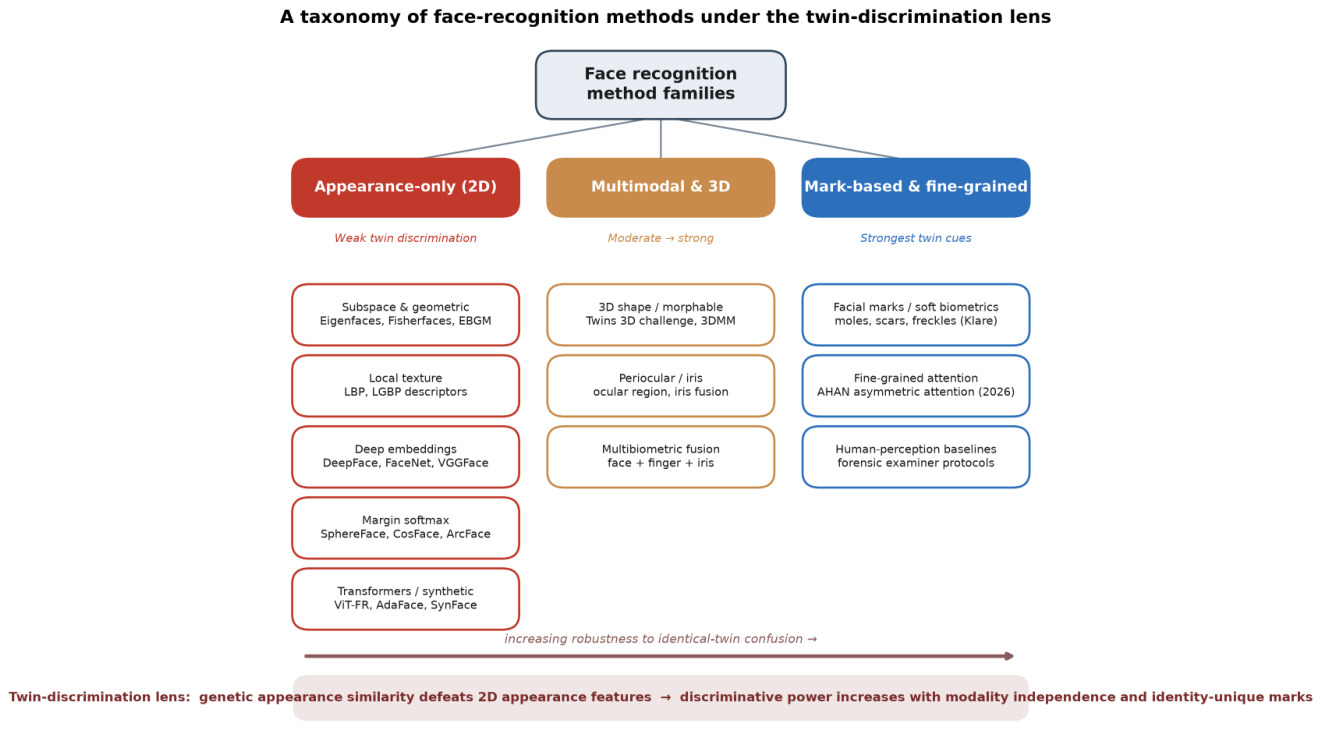
Figure 3.
The accuracy gap that motivates this survey. Modern face recognition reports over 99.8% verification accuracy on standard benchmarks (grey) but drops to 88.9% on identical twins under the prior state of the art (red); the 2026 AHAN fine-grained attention model recovers to 92.3% (blue). Values reported on the ND_TWIN dataset [14].
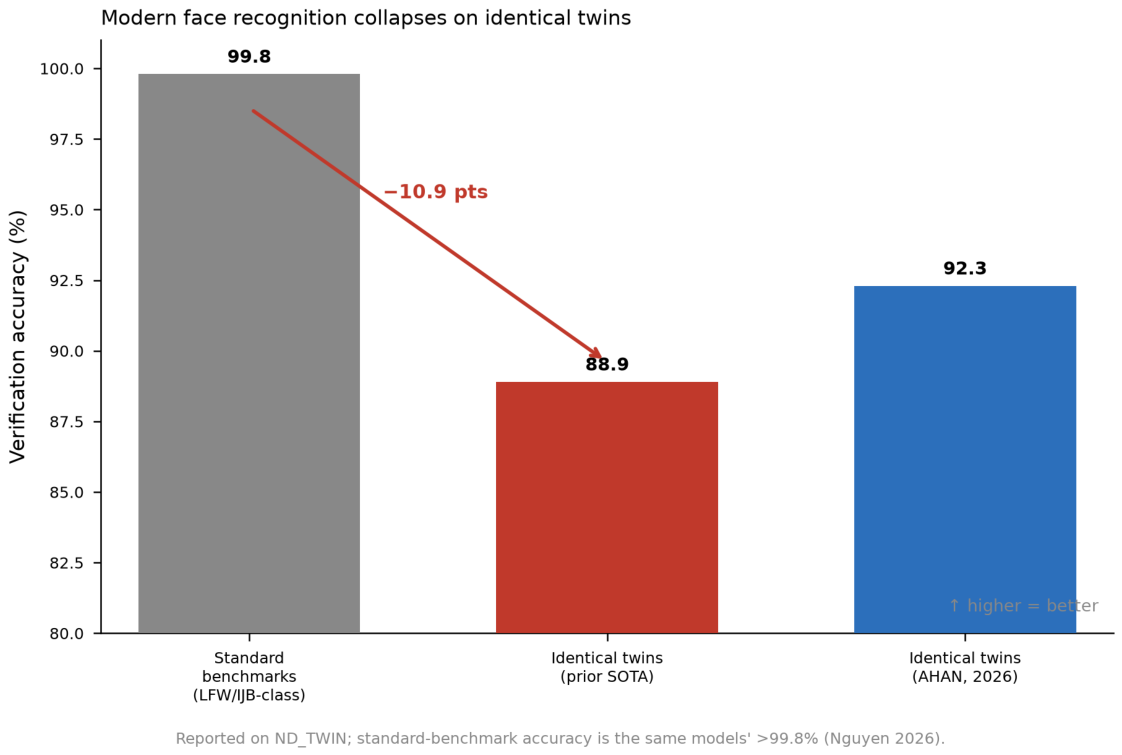

Table 1.
Specialized twin face datasets. “n.r.” marks a figure not reported in a form we could verify from the primary source. “Scale” gives the approximate image count or modality volume. Most collections derive from the Twins Days Festival; availability is typically by research license or partner access.
| Dataset | Years | Subjects | Twin pairs | Scale | Modality | Ref. |
|---|---|---|---|---|---|---|
| ND-TWINS-2009-2010 | 2009–2010 | 435 | 213 (mostly MZ) | ~24,050 2D | 2D visible | [60] |
| Twins Days 3D / 3D-TEC (IJCB-2011 challenge) | 2010 | 214 | 107 (MZ) | 3D scans + 2D, neutral & smiling | 3D + 2D visible | [63] |
| Klare facial-marks twin set | 2011 | n.r. | twin pairs (n.r.) | 2D high-res | 2D visible + facial-mark annotations | [86] |
| Multibiometric twins (SPIE-2010) | 2010 | ~132 (66 families) | ~66 | face + fingerprint + iris | Multimodal (face/finger/iris) | [83] |
| Human-perception twin study set | 2011 | n.r. | n.r. | 2D visible | 2D visible | [92] |
| Twins Days longitudinal (NIST/annual) | 1997–present | thousands cumulatively | hundreds of MZ/DZ pairs | 2D (+some 3D/multimodal) | 2D visible + selected multimodal | [60] |
Table 2.
Reported twin verification/identification results with protocol caveats. Values are not directly comparable across rows; the metric column and caveat column state why. Foundational studies (top rows) report condition-specific behaviour rather than a single headline number.
Table 2.
Reported twin verification/identification results with protocol caveats. Values are not directly comparable across rows; the metric column and caveat column state why. Foundational studies (top rows) report condition-specific behaviour rather than a single headline number.
| Study | Method | Dataset | Metric | Reported | Protocol caveat | Ref. |
|---|---|---|---|---|---|---|
| Phillips et al. 2011 | COTS + academic FR matchers | ND-TWINS-2009-2010 | Effect of conditions on twin discrimination | Same-day matching near-perfect; different-day + uncontrolled lighting/expression degrades sharply | Foundational study; pre-deep-learning matchers; exact TAR varies by matcher/condition, not a single headline number | [60] |
| Vijayan et al. 2011 | 3D face matchers (challenge) | Twins Days 3D (IJCB-2011) | Rank-1 / verification under expression | 3D helps under neutral expression; expression variation degrades twin separation | Challenge protocol; small gallery; numbers condition-specific | [63] |
| Klare et al. 2011 | Facial-mark (soft-biometric) features | Twins Days facial-mark set | Improvement from facial marks | Facial marks provide discriminative cues absent in holistic appearance | Marks are demonstrated as auxiliary cue, not a standalone accuracy figure | [86] |
| Sun et al. 2010 | Multibiometric fusion (face+finger+iris) | Twins Days multibiometric | Fusion vs. face-only | Fingerprint/iris fusion substantially outperforms face-only for twins | Multimodal capture; fingerprint/iris ~independent of genetics | [83] |
| Afaneh et al. 2017 | Feature+score+decision fusion (PCA+HOG+LBP) | ND-TWINS-2009-2010 | EER (lower is better) | 2.07% (natural expr.), 0.0% (smiling), 2.2% (controlled illum.) | Hand-crafted-feature fusion; EER on curated condition subsets, not a general-protocol number | [113] |
| Parde et al. 2023 | DCNN (Ranjan et al. 2018) vs humans | ND-TWINS pairs | Accuracy vs viewpoint disparity | DCNN at/above human accuracy in 8 of 9 conditions; twin-impostor harder than general-impostor for both | Item-level human-machine study; frontal→90° profile degrades all | [88] |
| Sami et al. 2022 | DCNN similarity network | Large twin + look-alike set | Test AUC | 0.9799 | Measures similarity-embedding quality, not twin verification TAR@FAR directly | [114] |
| Ramachandra et al. 2023 | Landmark-based morph vs FRS | 16 twin/look-alike pairs | FRS vulnerability to twin/look-alike morphs | Twin/look-alike morphs raise attack potential vs normal morphs | Small n (16 pairs); presentation-attack angle, not verification accuracy | [95] |
| Nguyen 2026 (AHAN) | Asymmetric Hierarchical Attention Network | ND_TWIN | Verification accuracy | 92.3% (AHAN); 88.9% (prior SOTA on twins) | Reports the headline standard-benchmark→twin drop (99.8%→88.9%); +3.4% over prior SOTA; single dataset | [14] |
Disclaimer/Publisher’s Note: The statements, opinions and data contained in all publications are solely those of the individual author(s) and contributor(s) and not of MDPI and/or the editor(s). MDPI and/or the editor(s) disclaim responsibility for any injury to people or property resulting from any ideas, methods, instructions or products referred to in the content. |
© 2026 by the authors. Licensee MDPI, Basel, Switzerland. This article is an open access article distributed under the terms and conditions of the Creative Commons Attribution (CC BY) license.
Copyright: This open access article is published under a Creative Commons CC BY 4.0 license, which permit the free download, distribution, and reuse, provided that the author and preprint are cited in any reuse.