

Submitted:
03 November 2026
Posted:
04 November 2026
You are already at the latest version
Abstract
Background/Objectives: Nursing leadership is a multidimensional construct that includes relational, strategic, collaborative, and organisational capabilities. However, nursing-specific measures that integrate these domains remain limited. This study evaluated the preliminary psychometric properties of the Effective Nursing Leadership Scale (ENLS), examined its association with job satisfaction, and explored its seven dimensions as nursing leadership-related competency domains. Methods: A descriptive cross-sectional survey was conducted among 885 registered nurses in Albania. Reliability, factor-retention procedures, confirmatory model comparisons, discriminant validity, common-method sensitivity analyses, Pearson correlations, and multiple linear regression were examined. Results: Of 918 questionnaires administered, 885 complete questionnaires were analysed (response rate 96.4%). The 19-item ENLS showed very high internal consistency (Cronbach’s α = .967; McDonald’s ω = .969). Parallel analysis retained two factors rather than seven, so the seven-domain structure was treated as theory-driven and evaluated by CFA. Among the tested models, the seven-correlated-factor model showed the best fit (CFI = .960, TLI = .948, RMSEA = .075, SRMR = .076), outperforming the single-factor and second-order models. HTMT values ranged from .713 to .962, indicating incomplete discriminant validity among several domains. The ENLS total score correlated modestly with job satisfaction (r = .220, p < .001). In simultaneous regression, Communication Competencies was the only clear independent positive predictor (β = .421, p < .001); the model explained 12.2% of job-satisfaction variance (R² = .122). Conclusions: The ENLS demonstrates strong reliability and a plausible multidimensional structure, but the present data do not provide definitive support for seven empirically distinct dimensions. Independent replication, refinement of closely overlapping domains, cross-cultural validation, and multi-source designs are required before high-stakes or benchmarking use.
Keywords:
Albania
; job satisfaction
; leadership
; nursing
; nursing management
; psychometrics
; nursing leadership competencies
1. Introduction
Nursing leadership is increasingly recognized as a critical component of contemporary healthcare systems because of its associations with quality of care, patient safety, organizational effectiveness, and workforce well-being [1,2]. Healthcare organizations are facing growing complexity related to population ageing, chronic disease, workforce shortages, technological transformation, and increasing expectations for high-quality, person-centred care [3]. Within this context, nurse leaders have assumed roles extending beyond traditional managerial functions to include strategic coordination, professional development, interdisciplinary collaboration, and the promotion of supportive work environments [4].
From a competency-based perspective, effective nursing leadership can be viewed as a set of observable and developable nursing competencies that integrate communication, decision-making, strategic vision, adaptability, empowerment, professional development, resource management, and interprofessional collaboration.
Contemporary nursing leadership is increasingly conceptualized as a multidimensional relational and organizational process involving communication, strategic vision, empowerment, adaptability, decision-making, and collaboration. Effective nurse leaders are expected to coordinate teams and resources while supporting professional development, evidence-based practice, shared responsibility, and organizational change [5,6].
Leadership is also closely associated with nurses’ professional well-being. Job satisfaction is an important indicator of organizational health and workforce sustainability, whereas dissatisfaction has been linked to burnout, turnover intention, absenteeism, emotional exhaustion, and poorer organizational outcomes [7,8]. Conversely, supportive and empowering leadership environments are associated with greater motivation, professional engagement, resilience, and organizational commitment [9].
Previous research has particularly emphasized transformational leadership, which promotes shared vision, autonomy, motivation, innovation, and collaboration. Such leadership has been positively associated with job satisfaction, psychological empowerment, organizational commitment, patient safety, and quality of care [10,11,12]. However, contemporary healthcare increasingly requires broader adaptive and collaborative competencies, including conflict management, systems thinking, interprofessional coordination, and responsiveness to organizational change [13,14].
The relationship between leadership and job satisfaction is influenced by contextual and organizational factors, including professional autonomy, staffing adequacy, organizational support, participation in decision-making, and opportunities for professional development [15]. These relationships may vary across healthcare systems and cultural contexts, supporting the need for context-sensitive research on nursing leadership and workforce outcomes.
Despite the growing literature, important measurement gaps remain. Many available tools assess broad leadership styles or managerial effectiveness rather than a nursing-specific combination of communication, decision-making, strategic influence, conflict management, professional development, empowerment, resource management, and interprofessional collaboration. Relatively little attention has also been given to the association between distinct nursing leadership domains and job satisfaction across different healthcare and cultural contexts. These gaps motivated the development and initial psychometric evaluation of the ENLS as a multidimensional nursing-specific measure.
The ENLS was developed as a new instrument rather than as a shortened, re-scored, or reorganised version of an existing scale. Its conceptual basis integrates transformational and relational leadership perspectives with nursing-management and interprofessional-collaboration literature. The intended contribution is therefore not to replace established leadership-style measures, but to assess a broader set of nursing-relevant behavioural domains within a single competency-oriented framework.
Accordingly, examining whether these domains form a coherent psychometric structure is also relevant to the development of nursing leadership competency frameworks for education, continuing professional development, and organisational workforce strategies.
For an international nursing policy audience, the value of a leadership measure extends beyond psychometric performance alone. A nursing-specific instrument may help organisations and professional bodies identify leadership capability gaps, evaluate development initiatives and generate comparable evidence on workforce environments. However, such use requires evidence that the construct is meaningful across health systems and cultures; therefore, the present Albanian study should be viewed as an initial validation step rather than evidence for universal application.
2. Materials and Methods
2.1. Study Design and Aims
The aim of this study was to evaluate the psychometric properties of the Effective Nursing Leadership Scale (ENLS), examine the association between nursing leadership and job satisfaction among registered nurses, and explore the ENLS dimensions as a structured set of nursing leadership competency domains.
Specifically, the study aimed to:
- assess the internal consistency and factorial structure of the ENLS;
- examine the relationships between ENLS dimensions and job satisfaction;
- identify the leadership dimensions most strongly associated with job satisfaction.
- interpret the proposed ENLS dimensions as potential nursing leadership competency domains for developmental and educational use.
It was hypothesized that the ENLS would demonstrate satisfactory reliability and construct validity and that more positive perceptions of nursing leadership would be associated with higher job satisfaction.
A descriptive, cross-sectional quantitative design was used to examine the association between nursing leadership and job satisfaction and to evaluate the psychometric properties of the Effective Nursing Leadership Scale (ENLS). The study was reported in accordance with the STROBE guidelines [16].
2.2. Sample and Setting
Participants were registered nurses practising in Albania and were recruited through an online survey distributed via digital platforms, professional nursing networks, and social media. Data collection took place between September 2025 and January 2026. Eligibility criteria were current employment as a registered nurse, at least six months of professional experience, and provision of informed consent. Formal appointment to a managerial or leadership position was not an eligibility criterion; accordingly, the ENLS was interpreted in this study as a measure of self-reported leadership-related behaviours and capabilities that may also be expressed through informal, shared, or clinical-team leadership.
A total of 918 questionnaires were administered. Of these, 885 complete questionnaires were returned and retained for analysis, corresponding to a response rate of 96.4%; 33 questionnaires (3.6%) were not included in the analytic dataset. Participation was voluntary and anonymous, and no personally identifiable information was collected.
The analytic dataset contained no item-level missing values across the 19 ENLS items and 36 job-satisfaction items for the 885 included respondents. The 33 non-analysed questionnaires were not available in the supplied analytic file; therefore, a formal Little’s MCAR test comparing retained and excluded questionnaires could not be performed. No listwise deletion was required within the final n = 885 dataset.
2.3. Data Collection and Measures
Data were collected between September 2025 and January 2026 through an anonymous online survey.
Nursing leadership was assessed using the Effective Nursing Leadership Scale (ENLS), a newly developed 19-item self-report instrument comprising seven domains: Communication Competencies, Decision-Making, Influence and Vision, Conflict Management and Adaptability, Professional Development and Resource Management, Team Empowerment, and Interprofessional Collaboration. Items are rated on a five-point Likert scale from 1 (“strongly disagree”) to 5 (“strongly agree”), with higher scores indicating more positive self-perceptions of leadership-related behaviours. Because the participants were registered nurses rather than exclusively formal nurse managers, scores were interpreted as perceived leadership-related capabilities in professional and team-based practice, not as an objective rating of formal managerial performance.
For the purposes of the present analysis, these seven ENLS domains were treated as leadership-related nursing competency domains, reflecting behavioural capabilities that may be strengthened through education, professional development, and organisational learning.
Job satisfaction was assessed using the 36-item Job Satisfaction Survey (JSS) developed by Spector [26]. The JSS assesses nine facets of job satisfaction: Pay, Promotion, Supervision, Fringe Benefits, Contingent Rewards, Operating Procedures, Coworkers, Nature of Work, and Communication. In the present study, items were administered using a five-point agreement scale (1 = strongly disagree to 5 = strongly agree), which represents a modification of the original six-point response format. Higher scores indicate greater job satisfaction after reverse coding of negatively worded items. The five-point format was used to maintain response-format consistency with the ENLS within the combined survey and to reduce respondent burden. The JSS total score was calculated as the mean of all 36 items after reverse coding, so that higher values consistently indicated greater satisfaction. Because this differs from the original six-point metric, direct comparison with studies using the original response format should be made cautiously.
For this study, the JSS was translated into Albanian using forward- and back-translation procedures supervised by experts in nursing research and research methodology to support semantic and conceptual equivalence. In accordance with the JSS scoring key, negatively worded items 2, 4, 6, 8, 10, 12, 14, 16, 18, 19, 21, 23, 24, 26, 29, 31, 32, 34, and 36 were reverse coded; because a five-point format was used, reverse scoring was performed as 6 minus the observed response. The modification of the original response format and the absence of a separate adaptation sample are acknowledged as limitations.
2.4. Ethical Considerations
The study was conducted in accordance with the Declaration of Helsinki and received ethical approval from the Ethics Committee of the Centre of Excellence for Nursing Culture and Research (CECRI), Rome, Italy (Approval No. 3.21.3, approved on 15 July 2025). Participation was voluntary and anonymous. Before accessing the questionnaire, participants received information regarding the study objectives, confidentiality, data management procedures, and their right to withdraw without consequences. Electronic informed consent was obtained from all participants before questionnaire completion.
2.5. Data Analysis
Descriptive statistics were used to summarize participants’ characteristics and study variables. Internal consistency was evaluated using Cronbach’s alpha; McDonald’s omega was additionally estimated for the ENLS total score and for domains containing at least three items. For the three two-item domains, inter-item correlations and Spearman–Brown reliability were reported because omega is not stably identified for two-indicator subscales. Sampling adequacy was assessed using the Kaiser–Meyer–Olkin (KMO) measure and Bartlett’s Test of Sphericity.
Factor retention was re-evaluated using the scree pattern and parallel analysis. Because parallel analysis did not support retention of seven exploratory factors, the seven-domain structure was treated as a theory-driven measurement model rather than as an empirically derived EFA solution. Three CFA structures were compared using covariance-based maximum-likelihood estimation: a single-factor model, a seven-correlated-factor model, and a second-order hierarchical model. Model evaluation included χ2, χ2/df, CFI, TLI, RMSEA, SRMR, AIC, and BIC. Discriminant validity was examined using latent-factor correlations and the heterotrait–monotrait ratio (HTMT). Common-method variance was screened with Harman’s single-factor test; because the first unrotated factor exceeded 50% of variance, a sensitivity model including an unmeasured common-method factor was also examined. Parallel analysis was used to identify the dominant exploratory covariance structure, whereas CFA was used to test a prespecified, theory-driven representation; therefore, better CFA fit for seven correlated domains should not be interpreted as evidence that all seven are empirically distinct.
Associations between ENLS dimensions and JSS total job satisfaction were examined using Pearson correlations and multiple linear regression. All seven ENLS domain mean scores were entered simultaneously. Collinearity was assessed using variance inflation factors (VIFs), and 95% confidence intervals were calculated for unstandardized regression coefficients. Statistical significance was set at p < .05. The principal analyses used the complete n = 885 dataset.
2.6. Validity and Reliability/Rigour
The ENLS was developed de novo from a review of the literature on nursing leadership, transformational and relational leadership, healthcare management, interprofessional collaboration, and organizational well-being. It was not adapted from, or created by re-scoring, an existing leadership instrument. The conceptual framework treated effective nursing leadership as a multidimensional set of observable behaviours spanning relational, strategic, adaptive, developmental, resource-management, and collaborative functions. Seven domains were specified a priori: Communication Competencies, Decision-Making, Influence and Vision, Conflict Management and Adaptability, Professional Development and Resource Management, Team Empowerment, and Interprofessional Collaboration. An initial item pool was then generated to represent these domains.
Content validity was evaluated by a panel of 12 experts with expertise in nursing leadership, management, education, and research. Experts rated each item for relevance, clarity, and representativeness using a four-point scale. Item-level and scale-level content validity indices (I-CVI and S-CVI/Ave) were calculated, and items with lower expert agreement were revised before psychometric testing. This expert-review phase was intended to establish content relevance and domain coverage prior to empirical evaluation; the subsequent factor analyses therefore examined whether the proposed content structure was supported by the observed data.
The psychometric evaluation included internal consistency, exploratory factor analysis, confirmatory factor analysis, second-order factor modelling, composite reliability, and average variance extracted.
This psychometric strategy was intended to determine whether the proposed competency domains were empirically distinguishable while remaining components of a broader effective nursing leadership construct.
3. Results
A total of 885 questionnaires were included in the final analysis. Participants were predominantly female (85.5%), with a mean age of 39.94 years (SD = 10.99) and mean professional experience of 14.56 years (SD = 11.59). Most participants held either a Master’s degree (49.2%) or Bachelor’s degree (47.2%), and 95.0% worked in public healthcare institutions (Table 1).
Perceived nursing leadership was generally high, with an ENLS total mean score of 4.31 (SD = 0.69). Influence and Vision showed the highest mean score, whereas Decision-Making showed the lowest. Mean job satisfaction was 3.35 (SD = 0.54) (Table 2).
Viewed as a competency profile, these scores indicate generally positive self-perceptions across the seven nursing leadership competency domains, while also identifying comparatively lower ratings for Decision-Making.
The ENLS demonstrated very high overall internal consistency (Cronbach’s α = .967; McDonald’s ω = .969). Domain Cronbach’s alpha coefficients ranged from .745 to .919. Omega estimates for domains containing at least three items were .887 for Communication Competencies, .778 for Decision-Making, .919 for Influence and Vision, and .892 for Conflict Management and Adaptability. For the two-item domains, inter-item correlations were .778, .749, and .787, corresponding to Spearman–Brown reliabilities of .875, .857, and .881, respectively. The JSS total score showed good internal consistency (α = .884).

Table 3.
Reliability analysis of the ENLS and job satisfaction scale.
| Scale/Dimension | Number of items | Cronbach’s α |
| Communication Competencies | 4 | .882 |
| Decision-Making | 3 | .745 |
| Influence and Vision | 3 | .919 |
| Conflict Management and Adaptability | 3 | .892 |
| Professional Development and Resource Management | 2 | .875 |
| Team Empowerment | 2 | .855 |
| Interprofessional Collaboration | 2 | .881 |
| Effective Nursing Leadership Scale total scale | 19 | .967 |
| Job Satisfaction Survey | 36 | .884 |
Note. α = Cronbach’s alpha.
Factorability was excellent (KMO = .975; Bartlett’s χ2(171) = 16,266.03, p < .001). However, empirical factor-retention criteria did not reproduce seven exploratory factors. The first two eigenvalues were 12.29 and 1.42, whereas the third eigenvalue was .70; parallel analysis retained two factors at the 95th-percentile criterion. The first unrotated factor accounted for 64.7% of item variance. Accordingly, the seven ENLS domains were retained as a prespecified theoretical structure for CFA rather than claimed as a seven-factor EFA solution.
Table 4.
Prespecified ENLS domains and standardized loadings from the seven-correlated-factor CFA.
| Item Code | Item Description | Factor | Standardized loading |
| ENLS1 | I communicate expectations clearly to my team | Communication Competencies | .896 |
| ENLS2 | I provide constructive feedback to team members | Communication Competencies | .819 |
| ENLS3 | I listen carefully to colleagues’ concerns | Communication Competencies | .896 |
| ENLS4 | My verbal and non-verbal communication creates an environment of trust and cooperation | Communication Competencies | .647 |
| ENLS5 | I rapidly assess situations and make informed decisions under pressure | Decision-Making | .532 |
| ENLS6 | I involve my team in decision-making when appropriate | Decision-Making | .796 |
| ENLS7 | My decisions are based on evidence and nursing best practices | Decision-Making | .846 |
| ENLS8 | I inspire and motivate my team toward common goals | Influence and Vision | .887 |
| ENLS9 | I provide a clear vision for the direction of the team’s work | Influence and Vision | .888 |
| ENLS10 | I positively influence team members to achieve organisational results | Influence and Vision | .893 |
| ENLS11 | I effectively manage conflicts within the team | Conflict Management and Adaptability | .853 |
| ENLS12 | I adapt effectively to changes in the healthcare environment | Conflict Management and Adaptability | .853 |
| ENLS13 | I promote a positive work environment by resolving tensions among colleagues | Conflict Management and Adaptability | .863 |
| ENLS14 | I encourage continuous professional development among team members | Professional Development and Resource Management | .890 |
| ENLS15 | I manage resources effectively to ensure patient care | Professional Development and Resource Management | .875 |
| ENLS16 | I encourage team-member autonomy in important decisions | Team Empowerment | .836 |
| ENLS17 | I actively support team members’ professional growth through responsibility | Team Empowerment | .897 |
| ENLS18 | I promote effective communication between nurses and other healthcare professionals | Interprofessional Collaboration | .901 |
| ENLS19 | I promote collaboration between my team and other departments to support integrated care | Interprofessional Collaboration | .874 |
Note. Standardized CFA loadings are reported for the prespecified seven-domain model. Parallel analysis supported two exploratory factors; therefore, these domain assignments should be interpreted as theory-driven and require independent replication.
The CFA model comparison favored the seven-correlated-factor structure. The single-factor model showed inadequate fit (χ2(152) = 1967.37, CFI = .888, TLI = .874, RMSEA = .116, SRMR = .061). The seven-correlated-factor model provided the best overall fit (χ2(131) = 781.20, CFI = .960, TLI = .948, RMSEA = .075, SRMR = .076; AIC = 899.20; BIC = 1181.55). The second-order model also showed comparatively acceptable incremental fit but was weaker than the correlated-factor model (χ2(145) = 942.25, CFI = .951, TLI = .942, RMSEA = .079, SRMR = .078; AIC = 1032.25; BIC = 1247.61). Thus, the hierarchical representation remains theoretically plausible, but the present dataset supports the seven correlated domains more strongly than a constrained second-order structure.
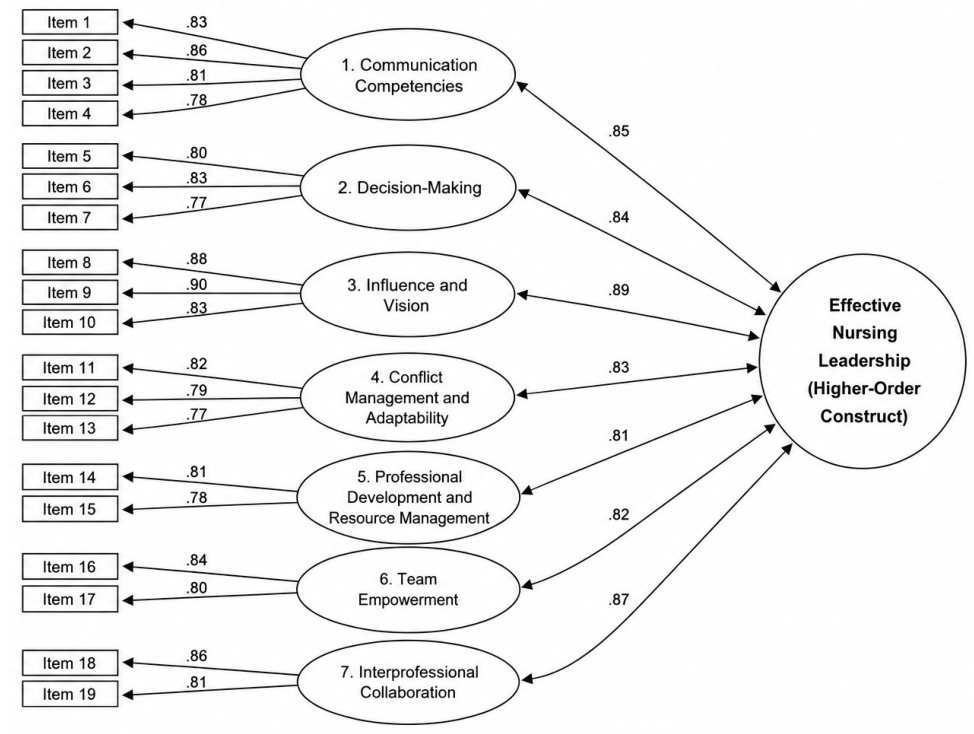
Figure 1.
Second-Order Confirmatory Factor Analysis Model of the Effective Nursing Leadership Scale (ENLS).
Figure 1.
Second-Order Confirmatory Factor Analysis Model of the Effective Nursing Leadership Scale (ENLS).
Table 5.
Comparison of confirmatory factor models for the Effective Nursing Leadership Scale (ENLS).
Table 5.
Comparison of confirmatory factor models for the Effective Nursing Leadership Scale (ENLS).
| Fit index | Single-factor | Seven correlated factors | Second-order |
| χ2 (df) | 1967.37 (152) | 781.20 (131) | 942.25 (145) |
| χ2/df | 12.94 | 5.96 | 6.50 |
| CFI | .888 | .960 | .951 |
| TLI | .874 | .948 | .942 |
| RMSEA | .116 | .075 | .079 |
| SRMR | .061 | .076 | .078 |
| AIC | 2043.37 | 899.20 | 1032.25 |
| BIC | 2225.22 | 1181.55 | 1247.61 |
Note. CFI = Comparative Fit Index; TLI = Tucker–Lewis Index; RMSEA = Root Mean Square Error of Approximation; SRMR = Standardized Root Mean Square Residual; AIC = Akaike Information Criterion; BIC = Bayesian Information Criterion. Lower AIC/BIC values indicate better comparative fit.
Composite reliability ranged from .776 to .919 and AVE from .544 to .791 across the seven domains, supporting convergent validity. Discriminant validity was less satisfactory: latent-factor correlations ranged from .645 to .964, and HTMT values ranged from .713 to .962, with several pairs exceeding the conventional .90 criterion. These findings indicate substantial overlap among several ENLS domains and support cautious interpretation of domain-level distinctions. Harman’s single-factor test showed that the first unrotated factor accounted for 64.7% of variance. In a sensitivity CFA including an orthogonal unmeasured common-method factor, fit improved (χ2(112) = 332.87, CFI = .986, TLI = .979, RMSEA = .047, SRMR = .015), suggesting that common-method variance may contribute to the observed covariance structure; this sensitivity result should not be interpreted as proof that the shared variance is exclusively methodological. The highest HTMT coefficients (up to .962) occurred within the group of conceptually adjacent relational, developmental, and team-oriented leadership domains. This pattern may reflect genuine conceptual proximity, overlapping item content, and incomplete empirical separation; therefore, good overall CFA fit does not by itself establish discriminant validity.
Table 6.
Composite reliability (CR) and average variance extracted (AVE) for the ENLS dimensions.
| ENLS dimension | CR | AVE |
| Communication Competencies | .890 | .673 |
| Decision-Making | .776 | .544 |
| Influence and Vision | .919 | .791 |
| Conflict Management and Adaptability | .892 | .733 |
| Professional Development and Resource Management | .875 | .778 |
| Team Empowerment | .858 | .751 |
| Interprofessional Collaboration | .881 | .788 |
Note. CR values greater than .70 indicate satisfactory internal consistency, while AVE values above .50 support adequate convergent validity of the latent constructs.
ENLS scores were positively but modestly associated with job satisfaction. The ENLS total score correlated with the JSS total score at r = .220 (p < .001). At domain level, correlations ranged from r = .145 to .326; Communication Competencies showed the strongest bivariate association with job satisfaction (r = .326, p < .001).
Table 7.
Pearson correlations between ENLS dimensions and job satisfaction.
| Variable | Job satisfaction, r |
| Effective Nursing Leadership Scale total score | .220 |
| Communication Competencies | .326 |
| Decision-Making | .151 |
| Influence and Vision | .167 |
| Conflict Management and Adaptability | .146 |
| Professional Development and Resource Management | .204 |
| Team Empowerment | .145 |
| Interprofessional Collaboration | .149 |
Note. All correlations were statistically significant at p < .001.
The simultaneous seven-predictor regression model was statistically significant and explained 12.2% of the variance in job satisfaction (R2 = .122; adjusted R2 = .115; n = 885). Communication Competencies was the only clear independent positive predictor (standardized β = .421, p < .001). Decision-Making showed a small negative coefficient at the conventional significance boundary (β = −.111, p = .050), while the other five domains were not statistically significant after simultaneous adjustment. VIFs ranged from 2.32 to 5.56, indicating moderate multicollinearity, particularly among the highly correlated leadership domains. The Decision-Making coefficient at p = .050 should therefore be regarded as borderline and not as unequivocal evidence of an inverse association, especially in the presence of shared variance among predictors.
Table 8.
Multiple linear regression analysis predicting job satisfaction.
| Predictor | B (SE) | 95% CI | Standardized β | p |
| Communication Competencies | .269 (.031) | .208 to .329 | .421 | < .001 |
| Decision-Making | −.075 (.038) | −.150 to .000 | −.111 | .050 |
| Influence and Vision | −.023 (.048) | −.118 to .072 | −.034 | .634 |
| Conflict Management and Adaptability | −.069 (.049) | −.166 to .028 | −.103 | .161 |
| Professional Development and Resource Management | .086 (.049) | −.011 to .182 | .130 | .082 |
| Team Empowerment | −.002 (.043) | −.087 to .083 | −.003 | .965 |
| Interprofessional Collaboration | −.017 (.042) | −.099 to .065 | −.026 | .686 |
Note. n = 885. B = unstandardized coefficient; SE = standard error; β = standardized coefficient; CI = confidence interval. VIFs were 2.32 (Communication), 3.21 (Decision-Making), 5.23 (Influence and Vision), 5.42 (Conflict Management and Adaptability), 5.56 (Professional Development and Resource Management), 4.66 (Team Empowerment), and 4.28 (Interprofessional Collaboration).
The overall regression model was statistically significant, F(7, 877) = 17.35, p < .001, with R2 = .122 and adjusted R2 = .115. The attenuation and sign changes of several domain coefficients relative to their positive bivariate correlations are consistent with shared variance and multicollinearity among ENLS domains; domain-specific regression coefficients should therefore be interpreted cautiously.
4. Discussion
The present study evaluated the psychometric properties of the ENLS and examined its association with job satisfaction among registered nurses. The reanalysis provides strong evidence for reliability but more qualified evidence for dimensional distinctiveness. The seven-correlated-factor model fit the data better than both the single-factor and second-order alternatives, yet parallel analysis favored two exploratory factors and HTMT indicated substantial overlap among several domains. The ENLS should therefore be viewed as a promising, theory-informed multidimensional measure whose domain structure requires refinement and independent replication.
Psychometric interpretation. The findings should be considered in sequence: reliability, exploratory factor retention, confirmatory model fit, and discriminant validity. These indicators address complementary questions and do not provide interchangeable evidence for seven distinct dimensions.
A major finding concerns the preliminary psychometric performance of the ENLS. The scale demonstrated very high internal consistency overall and satisfactory alpha coefficients across its seven dimensions. Although these findings support internal coherence, the total α of .967 is sufficiently high to warrant caution regarding possible item overlap. In addition, three domains contain only two items; such short factors can be statistically identifiable within a larger structural model but may provide narrower conceptual coverage and reduced stability than factors represented by three or more indicators. These domains should therefore be expanded or independently replicated before strong claims about their robustness are made. The similarly high total omega (.969) reinforces reliability but does not exclude item redundancy and should not be used as evidence of seven distinct dimensions.
Exploratory analyses did not independently reproduce the proposed seven-domain structure. Parallel analysis retained two factors, indicating that the empirical factor-retention evidence was more parsimonious than the a priori seven-domain framework. Accordingly, the seven ENLS domains were treated as theory-driven dimensions and evaluated through confirmatory model comparisons rather than presented as an empirically established seven-factor EFA solution. These results are not necessarily contradictory: the two-factor solution describes the dominant exploratory organization of covariance, while the seven-domain CFA evaluates whether a theoretically specified finer-grained representation is compatible with the data.
Confirmatory model comparison clarified the internal structure of the ENLS. A single general-factor solution was inadequate, whereas the seven-correlated-factor model showed the strongest fit of the models tested. The second-order model remained plausible but fit less well. At the same time, high latent correlations and HTMT values above .90 for several domain pairs indicate that some competencies are not sharply distinguishable empirically. This pattern is compatible with leadership functioning as an integrated capability while also cautioning against treating all seven domain scores as fully independent constructs. Accordingly, the seven-domain solution should be considered theoretically meaningful but empirically overlapping and provisional. At this stage, the seven scores are best used as developmental areas for education and professional reflection rather than as fully independent psychometric measures.
This higher-order structure also supports a competency-oriented interpretation: the seven ENLS dimensions can be understood as interrelated nursing leadership competencies that contribute jointly to an overarching leadership capability rather than as isolated skills.
Participants reported generally high perceptions of nursing leadership, particularly for Influence and Vision, Professional Development and Resource Management, and Interprofessional Collaboration. These findings may reflect the growing emphasis placed on collaborative and relational approaches within contemporary healthcare environments. Increasing organizational complexity requires nurse leaders to coordinate multidisciplinary teams, support professional development, promote shared goals, and facilitate communication across professional boundaries [22].
In contrast, job satisfaction showed more moderate levels. This finding is consistent with evidence indicating that nurses’ satisfaction is shaped by multiple organizational and professional pressures, including workload, staffing shortages, administrative demands, emotional burden, and workforce instability [23]. Leadership therefore represents only one component of a broader set of organizational conditions influencing nurses’ workplace experiences.
Leadership and job satisfaction. The following associations are interpreted separately from the measurement findings because the cross-sectional design does not establish whether leadership perceptions precede workplace satisfaction.
ENLS scores were positively associated with job satisfaction, although the bivariate associations were modest. Communication Competencies showed the strongest correlation with job satisfaction (r = .326), and in the simultaneous regression it was the only clear positive independent predictor (β = .421, p < .001). The remaining domain coefficients were attenuated after mutual adjustment, which is consistent with the substantial intercorrelations and multicollinearity among ENLS domains. These findings therefore support an association between leadership-related perceptions and job satisfaction but do not establish causal effects or independent contributions for each domain.
Although Team Empowerment is conceptually relevant to autonomy and participation, its association with job satisfaction was not independently significant after adjustment. Accordingly, the present findings do not establish a distinct contribution of this domain; its potential relevance remains a topic for future research [25].
The regression model explained 12.2% of the variance in job satisfaction, indicating that leadership is one contributor among many rather than a dominant explanation. Communication Competencies emerged as the clearest independent correlate after simultaneous adjustment. The non-significance or suppression-like behavior of several other domains is consistent with their substantial intercorrelations and moderate VIF values. Workload, pay, staffing adequacy, professional autonomy, organisational constraints, and other unmeasured conditions may explain an equal or greater proportion of variance.
Interprofessional Collaboration remains conceptually important for coordinated care, but its modest bivariate correlation with job satisfaction did not persist as an independent association in the simultaneous regression. Its practical significance should therefore be examined in studies that incorporate organisational context and team-level outcomes.
Educational and organisational implications. Given the preliminary nature of the ENLS, the most defensible application is to inform developmental discussion and future validation rather than individual-level classification or performance decisions.
The findings also support the importance of structured leadership development within nursing. Leadership competencies are often developed through clinical experience; however, contemporary healthcare environments increasingly require advanced competencies in communication, conflict management, adaptability, systems thinking, team coordination, and professional development. Structured educational and organizational interventions may therefore help strengthen leadership capacity and support workforce resilience and organizational effectiveness.
A competency-based approach may therefore enable educators and organisations to map leadership development needs across career stages, align learning outcomes with specific competency domains, and evaluate changes following targeted leadership-development interventions.
From an educational perspective, leadership development should be integrated into undergraduate, postgraduate, and continuing nursing education. Preparing nurses to participate actively in decision-making, team coordination, professional development, and organizational change may be increasingly important within healthcare systems characterized by rapid transformation and growing complexity.
Overall, the ENLS offers a potentially useful multidimensional framework for research and developmental assessment. The present reanalysis supports strong reliability and favors a seven-correlated-domain CFA over a single-factor model, but it also identifies substantial domain overlap, a two-factor parallel-analysis solution, and possible common-method effects. These findings argue for refinement, independent replication, and cross-cultural testing before the ENLS is used for benchmarking, high-stakes assessment, or workforce-policy decisions.
The policy relevance of these findings lies primarily in the potential use of structured leadership assessment to inform workforce development rather than in the promotion of a single national benchmark. Leadership expectations are shaped by governance arrangements, professional regulation, staffing models and organisational cultures. Accordingly, international application of the Effective Nursing Leadership Scale should be preceded by cross-cultural validation and measurement invariance testing, while policy use should combine scale findings with contextual workforce indicators rather than interpret leadership scores in isolation.
4.1. Implications for Nursing Practice and Management
The findings have important implications for nursing management, organizational leadership, and workforce sustainability. Effective nursing leadership should be considered a strategic organizational resource rather than solely an administrative function. The multidimensional structure of the ENLS indicates that nursing leadership encompasses communication, decision-making, strategic vision, conflict management, empowerment, professional development, and interprofessional collaboration. Healthcare organizations may therefore benefit from leadership models that integrate these competencies rather than focusing on single leadership behaviours.
The observed association between nursing leadership and job satisfaction is consistent with the possibility that supportive, empowering, and collaborative leadership practices are relevant to more positive workplace experiences; however, the present cross-sectional findings do not demonstrate such effects. In healthcare systems characterized by workforce shortages, increasing complexity, and high emotional demands, leadership approaches that promote autonomy, professional support, participation, and shared decision-making may help strengthen organizational engagement and workforce stability.
Leadership development should therefore be supported through structured educational and organizational initiatives. Nurse leaders increasingly require competencies in communication, conflict resolution, adaptability, systems thinking, team coordination, emotional intelligence, and professional development. Targeted leadership programmes may help prepare nurse leaders to manage organizational complexity, facilitate change, and support multidisciplinary teams more effectively.
In practice, competency profiles derived from the ENLS could be used developmentally to identify strengths and learning needs in communication, decision-making, strategic vision, adaptability, resource management, empowerment, and interprofessional collaboration.
Interprofessional collaboration represents another important area for nursing management. Nurse leaders occupy a key position in facilitating communication across professional boundaries, reducing organizational fragmentation, and strengthening teamwork. Leadership strategies that promote mutual respect, shared responsibility, and interdisciplinary coordination may therefore support both professional well-being and more integrated organizational functioning.
The ENLS may also have practical value for healthcare organizations and academic institutions. As a multidimensional measure of nursing leadership, it may support the identification of leadership strengths and developmental needs, organizational assessments, leadership training initiatives, and future workforce research. Its use may also contribute to evaluating leadership development interventions over time, although additional psychometric validation is required before broader application across different settings and populations.
From an educational perspective, leadership competencies should be progressively integrated across undergraduate, postgraduate, and continuing professional education. Preparing nurses for active roles in decision-making, team coordination, professional development, and organizational change may strengthen their capacity to contribute to contemporary healthcare systems.
Overall, investment in nursing leadership development may represent an important organizational strategy for strengthening professional well-being, workforce sustainability, and organizational resilience. However, because the present study was cross-sectional, these implications should be interpreted as practice-oriented considerations rather than evidence of causal effects.
4.2. Implications for Nursing Policy
At policy level, leadership development may be considered as one component of a broader nursing workforce strategy rather than as an isolated managerial activity. Professional and organisational policies can support explicit leadership competencies across career stages, access to continuing professional development, shared decision-making structures, and interprofessional governance. The present findings do not directly assess retention, turnover, absenteeism, quality-of-care outcomes, or policy interventions; therefore, policy implications should be viewed as hypothesis-generating and developmental. Workforce policies seeking to improve job satisfaction should consider leadership alongside staffing, workload, pay, professional autonomy, and organisational support. Because the study is cross-sectional and the instrument has been evaluated in one national context, the ENLS should not yet be used for international benchmarking or regulatory decisions without additional cross-cultural validation.
Accordingly, competency frameworks may guide professional development across career stages, but the ENLS should be used only for exploratory and developmental purposes until its dimensional structure and cross-cultural measurement properties have been independently confirmed.
4.3. Limitations
For clarity, the limitations concern four main areas: study design and self-report, sample representativeness, measurement structure, and the scope of the assessed outcomes.
Several limitations should be considered when interpreting the findings of this study. First, the cross-sectional design does not allow causal relationships between nursing leadership and job satisfaction to be established. Although significant associations were identified, the directionality of these relationships cannot be determined, and longitudinal studies are needed to examine their temporal stability and predictive relevance.
Second, the study relied exclusively on self-reported measures. Harman’s test indicated that the first unrotated factor accounted for 64.7% of variance, and an unmeasured-method-factor sensitivity model materially improved CFA fit. These findings suggest that common-method variance may have influenced associations, although the method factor can also absorb substantive general leadership variance. Future studies should incorporate multi-source ratings, temporal separation, or objective organisational indicators where feasible. No single diagnostic test can conclusively confirm or exclude common-method bias; the Harman and method-factor analyses are therefore interpreted as sensitivity checks rather than definitive tests.
The sampling strategy also represents a limitation. Of 918 administered questionnaires, 885 were completed and analysed, yielding a response rate of 96.4%. The final dataset contained no item-level missingness, but the 33 non-analysed questionnaires were not available for formal MCAR assessment or responder–nonresponder comparison. The predominance of public-sector participants may also limit generalisability to private organisations or other healthcare contexts.
Although the sample was large and geographically heterogeneous, the study was conducted within a specific national and cultural context. Leadership perceptions and organizational dynamics may differ across healthcare systems and professional cultures; therefore, further cross-cultural validation is required before extending the findings to other settings.
The psychometric evaluation of the ENLS should also be considered preliminary. Although the seven-correlated-factor CFA showed the best fit among the tested models, parallel analysis retained only two exploratory factors, and several latent correlations and HTMT values exceeded thresholds typically used to support discriminant validity. Three domains contain only two items; although their inter-item correlations and Spearman–Brown coefficients were strong, two-indicator factors remain less robust and may underrepresent construct breadth. Independent samples, item expansion, cross-validation, and measurement-invariance testing are needed.
Finally, the study focused primarily on leadership and job satisfaction and did not include other potentially relevant organizational and psychological variables, such as burnout, workload, staffing adequacy, resilience, organizational support, intention to leave, and work engagement. Future research should consider more comprehensive models incorporating these variables, as well as potential mediating and moderating mechanisms, to better explain the relationships among leadership, organizational climate, and professional well-being. The use of a five-point rather than the original six-point JSS response format may also affect comparability with prior studies and should be examined in future adaptation work.
Finally, the ENLS measures self-reported leadership-related perceptions rather than observed competence or objective managerial performance. The proposed competency interpretation is therefore developmental and should not be used for individual credentialing, institutional ranking, or high-stakes policy decisions without additional validation.
5. Conclusions
This study provides preliminary evidence supporting the high internal consistency and factorial plausibility of the Effective Nursing Leadership Scale (ENLS) in a large sample of registered nurses in Albania. The seven-correlated-factor CFA provided the best fit among the tested models; however, parallel analysis retained only two exploratory factors, several HTMT coefficients indicated incomplete discriminant validity, and common-method sensitivity analyses suggested that self-report method variance may have influenced the observed structure. The findings should therefore be interpreted as an initial validation step rather than definitive confirmation of seven empirically distinct dimensions.
ENLS scores were modestly and positively associated with job satisfaction (r = .220, p < .001). In the simultaneous regression, Communication Competencies was the only clear positive independent predictor (β = .421, p < .001), and the model explained 12.2% of job-satisfaction variance (R2 = .122). These findings underscore that leadership-related perceptions represent only one component within a broader set of organisational and professional determinants of job satisfaction. No causal inference can be made from these cross-sectional associations.
The ENLS may offer a useful framework for assessing nursing leadership within clinical, educational, and organizational contexts and for identifying areas for leadership development. However, additional studies are required to confirm its psychometric properties across independent samples, healthcare settings, and cultural contexts. Until independent replication and stronger evidence of discriminant validity are available, the seven domain scores should be regarded as provisional developmental areas rather than empirically independent measures.
Conceptualising the seven ENLS dimensions as nursing leadership competency domains may strengthen the instrument’s educational and workforce-development relevance by linking psychometric assessment to targeted competency development.
Overall, strengthening nursing leadership competencies may represent an important component of broader workforce strategies supporting professional well-being, organisational resilience and health-system sustainability. For policy and governance purposes, the Effective Nursing Leadership Scale may eventually provide a structured way to assess leadership development needs and evaluate organisational initiatives; however, replication, cross-cultural validation and measurement invariance testing are required before policy-level benchmarking or wider international implementation.
Author Contributions
Conceptualization, GE, AS, BD and IN; Methodology, GE, AS, BD and IN; Validation, GE, BD, GN, AB and IN; Formal Analysis, GE, AS and IN; Investigation, GE, BD, GN, SK, RV, PE, AB, SCar and SCap; Data Curation, GE, BD and GN; Writing—Original Draft Preparation, GE, AS, BD and IN; Writing—Review and Editing, GE, AS, BD, GN, SK, RV, PE, AB, SCar, SCap, GR and IN; Visualization, GE and IN; Supervision, AS, GR and IN; Project Administration, GE, BD and IN. All authors have read and agreed to the final version of the manuscript.
Funding
This research received no external funding.
Institutional Review Board Statement
The study was conducted in accordance with the Declaration of Helsinki and approved by the Ethics Committee of the Centre of Excellence for Nursing Culture and Research (CECRI), Rome, Italy (Approval No. 3.21.3; 15 July 2025).
Informed Consent Statement
Informed consent was obtained from all subjects involved in the study.
Data Availability Statement
The data that support the findings of this study are available from the corresponding author upon reasonable request. The data are not publicly available due to confidentiality and institutional restrictions.
Patient or Public Contribution
No patient or public contribution. Registered nurses participated as survey respondents but were not involved in the design, conduct, analysis, interpretation of the data, or preparation of the manuscript.
Acknowledgments
The authors would like to thank all nurses who participated in the study.
Artificial Intelligence (AI) Use Disclosure
During the preparation of this manuscript, the authors used ChatGPT (OpenAI) to support language refinement and manuscript organization. The AI tool was not used to generate or collect study data, determine research findings, or replace authors’ scientific judgement. All AI-assisted content was critically reviewed, verified, revised, and approved by the authors, who take full responsibility for the accuracy, integrity, and final content of the manuscript.
Conflicts of Interest
The authors declare no conflicts of interest.
Abbreviations
| ENLS | Effective Nursing Leadership Scale |
| JSS | Job Satisfaction Survey |
| EFA | Exploratory Factor Analysis |
| CFA | Confirmatory Factor Analysis |
| CR | Composite Reliability |
| AVE | Average Variance Extracted |
| KMO | Kaiser-Meyer-Olkin |
| CFI | Comparative Fit Index |
| TLI | Tucker-Lewis Index |
| RMSEA | Root Mean Square Error of Approximation |
| SRMR | Standardized Root Mean Square Residual |
References
- Alsadaan, N.; Salameh, B.; Reshia, F. A. A. E.; Alruwaili, R. F.; Alruwaili, M.; Ali, S. A. A.; Alruwaili, A. N.; Hefnawy, G. R.; Alshammari, M. S. S.; Alrumayh, A. G. R.; Alruwaili, A. O.; Jones, L. K. Impact of nurse leaders behaviors on nursing staff performance: A systematic review of literature. Inq. J. Health Care Organ. Provis. Financ. 2023, 60, 00469580231178528. [Google Scholar] [CrossRef] [PubMed]
- Niinihuhta, M.; Häggman-Laitila, A. A systematic review of the relationships between nurse leaders’ leadership styles and nurses’ work-related well-being. Int. J. Nurs. Pract. 2022, 28(5), e13040. [Google Scholar] [CrossRef] [PubMed]
- Khan, H. T. A.; Addo, K. M.; Findlay, H. Public health challenges and responses to the growing ageing populations. Public Health Chall. 2024, 3(3), e213. [Google Scholar] [CrossRef] [PubMed]
- Alqahtani, H. M. H.; Alharbi, A. S.; Alherz, S. S.; Alqasir, M. A. A.; Alsufayan, M. F.; Aldosari, A. O.; Alzubidi, A. H. A. Integrated leadership in health administration, nursing, and pharmacy: Exploring the impact on workforce development, organizational efficiency, and patient outcomes. Int. J. Health Sci. 2022, 6(S10), 2264–2288. [Google Scholar] [CrossRef]
- Stucky, C. H.; Wymer, J. A.; House, S. Nurse leaders: Transforming interprofessional relationships to bridge healthcare quality and safety. Nurse Lead. 2022, 20(4), 375–380. [Google Scholar] [CrossRef]
- Singh, P. K.; Singh, S.; Kumari, V.; Tiwari, M. Navigating healthcare leadership: Theories, challenges, and practical insights for the future. J. Postgrad. Med. 2024, 70(4), 232–241. [Google Scholar] [CrossRef] [PubMed]
- Gumasing, M. J. J.; Ilo, C. K. K. The impact of job satisfaction on creating a sustainable workplace: An empirical analysis of organizational commitment and lifestyle behavior. Sustainability 2023, 15(13), 10283. [Google Scholar] [CrossRef]
- Stemmer, R.; Bassi, E.; Ezra, S.; Harvey, C.; Jojo, N.; Meyer, G.; Özsaban, A.; Paterson, C.; Shifaza, F.; Turner, M. B.; Bail, K. A systematic review: Unfinished nursing care and the impact on the nurse outcomes of job satisfaction, burnout, intention-to-leave and turnover. J. Adv. Nurs. 2022, 78(8), 2290–2303. [Google Scholar] [CrossRef] [PubMed]
- Al-Dossary, R. N. Leadership style, work engagement and organizational commitment among nurses in Saudi Arabian hospitals. J. Healthc. Leadersh. 2022, 14, 71–81. [Google Scholar] [CrossRef] [PubMed]
- Lei, L. P.; Lin, K. P.; Huang, S. S.; Tung, H. H.; Tsai, J. M.; Tsay, S. L. The impact of organisational commitment and leadership style on job satisfaction of nurse practitioners in acute care practices. J. Nurs. Manag. 2022, 30(3), 651–659. [Google Scholar] [CrossRef] [PubMed]
- Ibrahim, I. A.; El-Monshed, A. H.; Altheeb, M.; El-Sehrawy, M. G. Transformational leadership, psychological empowerment, and organizational citizenship behaviors among nursing workforce: A single mediation analysis. J. Nurs. Manag. 2024, 2024(1), 9919371. [Google Scholar] [CrossRef] [PubMed]
- Notarnicola, I.; Duka, B.; Lommi, M.; Grosha, E.; De Maria, M.; Iacorossi, L.; Mastroianni, C.; Ivziku, D.; Rocco, G.; Stievano, A. Transformational leadership and its impact on job satisfaction and personal mastery for nursing leaders in healthcare organizations. Nurs. Rep. 2024, 14(4), 3561–3574. [Google Scholar] [CrossRef] [PubMed]
- Alotaibi, N. H. H.; Almutairi, A. N.; Almwallad, R. B.; Al Mutairi, H. M.; Al-Harbi, F. H. J.; Al-Harbi, A. H. J.; Alharbi, Z. A. K.; Alharbi, G. M. Evaluating communication styles and leadership for enhancing team dynamics among specialized and maternal-child nurses in multidisciplinary hospital units. J. Int. Crisis Risk Commun. Res. 2024, 7(S3), 885–891. [Google Scholar] [CrossRef]
- Bernhardt, J. M.; Samost, M. Transferable nursing skills that support nurse leader development. Nurs. Manag. 2025, 56(7), 44–50. [Google Scholar] [CrossRef] [PubMed]
- Pursio, K.; Kankkunen, P.; Mikkonen, S.; Kvist, T. Organizational characteristics of nursing practice environments related to registered nurses’ professional autonomy and job satisfaction in two Finnish Magnet-aspiring hospitals: Structural equation modeling study. BMC Nurs. 2024, 23(1), 100. [Google Scholar] [CrossRef] [PubMed]
- von Elm, E.; Altman, D. G.; Egger, M.; Pocock, S. J.; Gøtzsche, P. C.; Vandenbroucke, J. P.; STROBE Initiative. Strengthening the reporting of observational studies in epidemiology (STROBE) statement: Guidelines for reporting observational studies. BMJ 2007, 335(7624), 806–808. [Google Scholar] [CrossRef] [PubMed]
- Carlson, M. A.; Morris, S.; Day, F.; Dadich, A.; Ryan, A.; Fradgley, E. A.; Paul, C. Psychometric properties of leadership scales for health professionals: A systematic review. Implement. Sci. 2021, 16(1), 85. [Google Scholar] [CrossRef] [PubMed]
- Restivo, V.; Minutolo, G.; Battaglini, A.; Carli, A.; Capraro, M.; Gaeta, M.; Odone, A.; Trucchi, C.; Favaretti, C.; Vitale, F.; Casuccio, A. Leadership effectiveness in healthcare settings: A systematic review and meta-analysis of cross-sectional and before–after studies. Int. J. Environ. Res. Public Health 2022, 19(17), Article 10995. [Google Scholar] [CrossRef] [PubMed]
- Uhl-Bien, M.; Meyer, D.; Smith, J. Complexity leadership in the nursing context. Nurs. Adm. Q. 2020, 44(2), 109–116. [Google Scholar] [CrossRef] [PubMed]
- Cavins, B. Uncertain times: Emotional-social intelligence and relational leadership practices: A conceptual framework. Vis. Leis. Bus. 2021, 22(2), 4. [Google Scholar] [CrossRef]
- Mataboge, S. K. C. Relational leadership: A building block for ethical transformation and toxicity remedy in higher education. Soc. Sci. Educ. Res. Rev. 2025, 12(1), 330–340. [Google Scholar] [CrossRef]
- Udensi, C. G.; Vunnava, R.; Durojaye, T. J. Interdisciplinary collaboration in healthcare management: Strengthening healthcare delivery—A review. Int. J. Adv. Multidiscip. Res. Stud. 2025, 5(5), 210–216. [Google Scholar] [CrossRef]
- Alrehaili, M. M.; Alrashedi, G. S. O.; Alshammary, G. R. S.; Alshammari, N. R.; Alshammari, F. K.; Dagreri, W. A.; Hadadi, H. Y.; Alenezi, F. A. Caring under pressure: Unraveling the crisis of nursing workload and stress in modern healthcare. J. Int. Crisis Risk Commun. Res. 2024, 7(S4), 7–15. [Google Scholar] [CrossRef]
- Othman, T.; Khrais, H. The relationship between transformational leadership, job satisfaction, and organizational commitment in Jordanian nurses. Anaesth. Pain Intensive Care 2022, 26(3), 304–309. [Google Scholar] [CrossRef]
- Al Otaibi, S. M.; Amin, M.; Winterton, J.; Bolt, E. E. T.; Cafferkey, K. The role of empowering leadership and psychological empowerment on nurses’ work engagement and affective commitment. Int. J. Organ. Anal. 2023, 31(6), 2536–2560. [Google Scholar] [CrossRef]
- Spector, P. E. Measurement of human service staff satisfaction: Development of the Job Satisfaction Survey. Am. J. Community Psychol. 1985, 13, 693–713. [Google Scholar] [CrossRef] [PubMed]
Table 1.
Sociodemographic and professional characteristics of the sample.
| Variable | Category/Measure | n | % | Mean | SD |
| Questionnaires | Administered / analysed | 918 / 885 | 96.4 | — | — |
| Gender | Female | 757 | 85.5 | — | — |
| Male | 128 | 14.5 | — | — | |
| Age | Years | — | — | 39.94 | 10.99 |
| Professional experience | Years | — | — | 14.56 | 11.59 |
| Educational level | Bachelor | 418 | 47.2 | — | — |
| Master | 435 | 49.2 | — | — | |
| Secondary school | 27 | 3.1 | — | — | |
| Doctorate | 5 | 0.6 | — | — | |
| Healthcare structure | Public | 841 | 95.0 | — | — |
| Private | 44 | 5.0 | — | — |
Note. SD = standard deviation. Age and professional experience are reported as mean and standard deviation; categorical variables are reported as frequencies and percentages.
Table 2.
Descriptive statistics of the ENLS dimensions and job satisfaction.
| Scale/Dimension | Number of items | Mean | SD |
| Communication Competencies | 4 | 4.31 | 0.80 |
| Decision-Making | 3 | 4.22 | 0.76 |
| Influence and Vision | 3 | 4.39 | 0.76 |
| Conflict Management and Adaptability | 3 | 4.30 | 0.76 |
| Professional Development and Resource Management | 2 | 4.36 | 0.78 |
| Team Empowerment | 2 | 4.27 | 0.80 |
| Interprofessional Collaboration | 2 | 4.31 | 0.80 |
| Effective Nursing Leadership Scale total score | 19 | 4.31 | 0.69 |
| Job Satisfaction Survey total score | 36 | 3.35 | 0.51 |
Note. SD = standard deviation.
Disclaimer/Publisher’s Note: The statements, opinions and data contained in all publications are solely those of the individual author(s) and contributor(s) and not of MDPI and/or the editor(s). MDPI and/or the editor(s) disclaim responsibility for any injury to people or property resulting from any ideas, methods, instructions or products referred to in the content. |
© 2026 by the authors. Licensee MDPI, Basel, Switzerland. This article is an open access article distributed under the terms and conditions of the Creative Commons Attribution (CC BY) license (http://creativecommons.org/licenses/by/4.0/).
Copyright: This open access article is published under a Creative Commons CC BY 4.0 license, which permit the free download, distribution, and reuse, provided that the author and preprint are cited in any reuse.