

Submitted:
02 November 2026
Posted:
04 November 2026
You are already at the latest version
Abstract
Exposure to tear gas, a chemical agent used primarily to disperse crowds, results in acute adverse effects on health which are well-documented but may have longer-term impacts on health. This study investigated the association between tear gas exposure during protests in 2020 and male reproductive health outcomes. Data were collected through an anonymous online questionnaire in 2020–2021 from adults exposed to tear gas. Exposure was assessed using reported acute symptoms affecting the eyes, lungs, skin, and heart. A symptom-based exposure score ranging from 0–14 was categorized as low, medium, or high. Male participants reported whether they experienced erectile dysfunction, ejaculatory dysfunction, or difficulty conceiving following exposure. Logistic regression was used to estimate adjusted odds ratios (OR) and 95% confidence intervals (CI). Among 92 male respondents, approximately 46% reported at least one reproductive issue, including 28 with erectile dysfunction and 26 with ejaculatory dysfunction. High tear gas exposure was significantly associated with erectile dysfunction compared with low exposure (adjusted OR=6.57; 95% CI: 1.28–40.08). No significant association was observed for ejaculatory dysfunction (adjusted OR=1.96; 95% CI: 0.35–11.36). These findings suggest potential reproductive health effects of tear gas exposure and may help to guide public policy and education.
Keywords:
tear gas
; reproductive health
; males
; social justice
; erectile dysfunction
1. Introduction
Tear gas refers to a group of chemical compounds that, when exposed to, may cause irritation to the eyes, nose, lungs, heart, and skin [1]. The most common compounds used as tear gas are chloroacetophenone (CN), chlorobenzylidenemalononitrile (CS), and dibenz[b,f]-1,4-oxazepine (CR) [2]. Around the world, there has been increased use of tear gas, especially by law enforcement officers who rely on tear gas to disperse crowds during protests, demonstrations, or civil unrest [3]. In the US, especially in 2020 and 2021, tear gas was used at numerous protests due to racial injustice and the Black Lives Matter movement; this was what prompted this research [4]. Although there has been increased usage of this lachrymator agent, little is known about its effect on other aspects of health, such as reproductive health [3].
The most common sexual dysfunctions in men are erectile dysfunction (ED) and ejaculatory dysfunction [5]. ED refers to the inability to achieve and maintain the erection required for sexual pleasure [6]. Estimates of the prevalence of ED ranges from 3-76.5% across the globe [7], and it is estimated that by 2025, about 322 million men will have ED worldwide, significantly affecting the quality of life of men globally [8]. Although physiological and psychological factors have been linked to ED, recent studies have implicated environmental factors in the global trend of ED [9]. Like ED, the prevalence of premature ejaculation is also relatively high, affecting 30 to 50% of men in the world [10].
Although exposure to tear gas is known to result in acute health effects, only a few studies have reported its impact on longer-term health issues, such as on reproductive health. In a recent study by Torgrimson-Ojerio et al. [11], approximately 54.5% of women exposed to tear gas saw changes in their menstrual cycle, indicating that tear gas may affect female reproduction. Another study by Hassan et al. reported that women exposed to tear gas experienced certain menstrual disorders, such as early and late menstruation [12]. Exposure to tear gas may increase the risk of cardiovascular [13,14], respiratory [15], and psychological [11] conditions that are linked to the pathogenesis of ED. In addition, tear gas has been hypothesized to be an endocrine disruptor [16]; these are known to have antiandrogenic effects [17]. There are currently no studies that have investigated whether exposure to tear gas may have an adverse impact on male reproductive health; therefore, this study investigated the effects of tear gas exposure, as estimated by the number of tear gas exposure symptoms experienced, on male reproductive health outcomes, including erectile dysfunction and ejaculatory dysfunction.
2. Materials and Methods
2.1. Study Design
The Louisville tear gas study was a cross-sectional study of individuals reporting exposure to tear gas in 2020 or 2021. An online survey was conducted between March 2021 to September 2021, including subjects across the United States. The questionnaire collected data on demographics, acute tear gas effects, chronic diseases, reproductive health, and protest attendance. This study was approved by the Institutional Review Board of University of Louisville, KY (IRB 20.0802).
2.2. Data Collection
The participants were aged 18 years and older who reported being exposed to tear gas during the 2020 to 2021 protests and demonstrations held across the country. Subjects were recruited using online marketing strategies (Facebook and Twitter ads). Community recruitment among protestors or demonstrators in the Louisville area occurred through word-of-mouth, which was promoted by one of the investigators (M. Unseld) as well as several local news outlets. The questionnaire was created and maintained on Research Electronic Data Capture (REDCap), a secure, online platform for entering and storing data [18,19]. After reading a preamble introducing the purpose of the study, the participants were asked to respond to two screening questions to ensure that participants were at least 18 years of age and had been exposed to tear gas. Participants were then asked to respond to a questionnaire that included demographic information: state of residence, age, sex, race, ethnicity, education, income, occupation, and smoking behavior. Information on prior health conditions was asked via open-ended questions. The participants were asked to check whether they had any acute symptoms of tear gas exposure or any reproductive health outcomes after attending a protest; these are described further in the “Measures” section below. Each completed questionnaire was assigned a unique identifier. The study was approved by the University of Louisville Institutional Review Board.
Three hundred and one (301) questionnaires were submitted over the course of 6 months. Those below 18 years (N=5) were excluded. Because of the anonymous, online nature of the survey, when records were submitted with timestamps within one minute of one another with identical or nearly identical data, only one of the records was included in the analysis (N=62 duplicate or blank surveys). This was a quality control measure intended to eliminate serial submissions by the same participant. Participants who were female, transgender/non-binary, or other were also excluded from this analysis (N=140). Two males did not provide exposure information. Thus, ninety-two unique records of individuals who identified as male were eligible for this study (Figure 1).
2.2.1. Patient and Public Involvement
The public was involved through recruitment by word-of-mouth, originating with protestors and demonstrators in connection with M. Unseld.
2.3. Measures
The extent of tear gas exposure was estimated by the number of acute tear gas exposure symptoms, as all participants in the study reported being exposed on the questionnaire. These symptoms include eye effects (watery eyes, burning, stingy eyes, and other eye effects), lung effects (coughing, burning lungs, shortness of breath, and other lung effects), skin effects (burning sensation, blistering, and other skin effects), and heart effects (increased heart rate, irregular heart rate, chest pain, and other heart effects). The participants checked yes for each symptom they had experienced, and the number of acute tear gas exposure symptoms for each participant was summed to create a composite score, ranging from 0-14, where 0 represents not having any of the symptoms and 14 means having all the symptoms. The scores were then divided into approximate tertiles; low (0-5), medium (6-8), and high (9-14) acute symptom scores to assess severity.
The male reproductive health outcomes were assessed using the question: “What reproductive or hormonal problems have you had since you started attending protests? Check all that apply:” The response options (each were yes/no) were erectile dysfunction; ejaculatory dysfunction; trouble conceiving; and don't know/don't wish to answer, with the option to select more than one. Those who selected don’t know/don't wish to answer were excluded from the analysis. The outcomes were analyzed using three methods: 1) having at least one outcome (erectile dysfunction, ejaculatory dysfunction, or trouble conceiving) vs. none; 2) erectile dysfunction (yes or no); and 3) ejaculatory dysfunction (yes or no). Given the small sample size of men who reported trouble conceiving, this outcome was not individually analyzed.
Demographic data collected from the participants included the following: age, gender, race, ethnicity, income, education, occupation, and state. For gender, respondents were asked to select between female, male, non-binary, transgender, or other. Race was categorized as American Indian or Alaska Native, Asian, Black or African American, Native Hawaiian or Other Pacific Islander, White, and other. Ethnicity was reported as either Hispanic or Non-Hispanic. For income, participants were asked to choose between Less than $10,000, $10,000-$19,999, $20,000-$29,999, $30,000-$39,999, $40,000-$49,999, $50,000-$59,999, $60,000-$69,999 and more than $70,000. Education was reported as less than high school, high school diploma, some college, bachelor’s degree and graduate degree. All questions also had the option “don’t know/don’t wish to answer.”
2.4. Statistical Analysis
Descriptive statistics were used to compare the distributions of the variables by tear gas exposure categories. Because of the small sample sizes in some categories, race was categorized for analysis into Black, white, and other races. Education was categorized as less than or some college, and bachelor’s degree or more. Income was grouped into less than $39,999; $40,000 to $59,999; and greater than $60,0000. Categorical variables were presented using frequencies and percentages and compared using Chi-square tests or Fisher’s exact tests. Age was reported using median (IQR) and compared using the Kruskal-Wallis test because it was not normally distributed.
To investigate the association between acute tear gas symptoms and male reproductive outcomes, multivariable logistic regression was used to estimate odds ratios (ORs) and 95% confidence intervals (CI). Two models for each outcome were built to determine the association between acute tear gas exposure score and male reproductive outcomes (any male outcome/ erectile dysfunction/ejaculatory dysfunction). Model I did not adjust for covariates; Model II was adjusted for variables that were significantly associated with the tear gas exposure score or were known to be associated with male reproductive outcomes.
Additional analyses were conducted. First, multivariable logistic regression was conducted to examine the effect of specific organ-related symptoms from tear gas exposure (eye, heart, lung, skin) on the outcomes. Heart-related symptoms (increased heart rate, irregular heartbeat, chest pain, and other heart effects) were of particular interest because of the known link between cardiovascular diseases and ED [20,21]. Second, the effect of seeking medical care after exposure to tear gas on male reproductive outcomes was explored using multivariable logistic regression. We hypothesized that seeking medical care may be another indication of the intensity of exposure. All statistical analyses were performed using R software (version 4.1.0).
3. Results
The ninety-two male respondents were from various states across the United States, with the largest number from Kentucky (Figure S1), followed by California. The baseline characteristics of the participants, stratified by acute tear gas exposure scores, are reported in Table 1. There was no significant difference in the distribution of age across the three exposure groups (p-value=0.92). The participants in the high exposure score group were more likely to be Black, non-Hispanic ethnicity, and have some college or less. Seventy-five percent of the high exposure group earned between $40,000 to $59,999 per year. Approximately 52% of participants with acute tear gas exposure score of greater than 8 had erectile dysfunction, 54% had ejaculatory dysfunction, and 8% had trouble conceiving; among participants in the lowest category of exposure score, these outcomes were only experienced by 16%, 16%, and none, respectively.
Multivariable logistic regression analyses were conducted to determine the effect of tear gas exposure, as estimated by acute tear gas score, on male reproductive outcomes, including erectile dysfunction and ejaculatory dysfunction. (Table 2 and Table 3). There was a significant positive association between tear gas exposure scores and any male reproductive outcome when comparing those with high exposure scores to those with low exposure scores in the unadjusted model (OR 7.67; 95% CI 2.42-27.43) and the model adjusted for age, race, education, and income (OR 5.10; 95% CI 1.11–26.16; Table 2).
The effect of the acute tear gas exposure score on each male reproductive outcome was then examined. Compared to those with low scores, those with high scores had 6.6 times the odds of having erectile dysfunction, adjusting for age, race, education, and income (OR=6.57; 95% CI 1.28-40.08, Table 3). There was also a significant positive association between high tear gas exposure score and ejaculatory dysfunction (OR 6.38; 95% CI 1.93-24.13); however, this association was no longer statistically significant after adjusting for the covariates (OR 1.96; 95% CI 0.35-11.36, Table 3). To investigate this attenuation of the OR, each covariate was tested individually along with the exposure in additional models, and the result showed that income was most responsible for the change in the effect of acute tear gas exposure on ejaculatory dysfunction. Because of the similar unadjusted odds ratios observed for ejaculatory dysfunction and erectile dysfunction, the extent of overlap between these two outcomes was examined. Of those with erectile dysfunction, half also had ejaculatory dysfunction (Table S1).
Associations between tear gas exposure score and specific organ-related tear gas symptoms, including heart, eye, lung, and skin effects on male sexual dysfunction were individually examined (Table 4). Men who reported one or two heart effects (OR 6.89; 95% CI 1.67-37.82) and those who reported more than two heart effects after exposure to tear gas (OR 14.19; 95% CI 2.27-110.95) had higher odds of having at least one of the male reproductive outcomes compared to those without any heart effect, in the adjusted model. There was no significant association between eye or lung effects and any male reproductive outcome. However, there was a positive association between skin effects and any male reproductive outcome (OR 9.33; 95% CI 2.22-48.24).
4. Discussion
In this cross-sectional study, there was a significant association between experiencing more acute symptoms of tear gas exposure and having adverse reproductive outcomes among males who attended protests and demonstrations during 2020 and 2021. This effect was observed when the sexual dysfunctions were analyzed as a group and individually; the most consistent associations were with erectile dysfunction. Similar results were recorded when only heart-related and skin-related symptoms of tear gas exposure were investigated. The effect of tear gas on trouble conceiving was not able to be evaluated on its own, due to the small number of men who reported trouble conceiving.
This is the first study to investigate the effect of tear gas exposure on male reproductive health outcomes. Although two studies have reported changes in menstrual function among women exposed to tear gas [11,12], little is known about the impact on male sexual dysfunction. An animal study reported that CS gas metabolized into cyanide after mice were exposed to the gas [22]. The resulting cyanide formation may result in a decline in oxygen levels in different parts of the body [23], and possibly lead to ED. Another study showed that male rats exposed to high level of cyanide experienced a decline in LH and testosterone levels [24].
The occurrence of an erection involves multiple processes within the vascular, neurological, endocrine, and psychological systems [25]. When any of these systems are affected, it may lead to ED. A common condition related to vascular ED is cardiovascular disease (CVD). ED is regarded as a harbinger of CVD [20,26,27]; therefore, it is not surprising that these conditions may share similar risk factors, including environmental exposures. Some studies have reported that exposure to tear gas may result in cardiovascular conditions such as transient hypertension [2] and high blood pressure in those with pre-existing heart conditions [28]. One case report documented the onset of an acute myocardial infarction after exposure to pepper spray [29]. Our study also corroborates this evidence, demonstrating that those with more heart-related tear gas symptoms were more likely to develop ED. However, our study did not control for prior heart-related conditions due to the small sample size; the questionnaire asked whether the participant had any pre-existing heart conditions; however, only one participant responded affirmatively.
Psychological factors, such as stress, depression, and anxiety, are known predictors of ED [30,31]. Stress may increase the cortisol level in the body, causing the constriction of blood vessels and when there is an improper flow of blood to the penis, erection may be affected [32]. These psychological conditions may be related to quality of life [33], chronic health conditions [34], or environmental exposures [35]. Studies have reported a relationship between tear gas exposure and psychological disorders [11]. In the Portland-based tear gas study, approximately 72% of participants had various psychological conditions, including anxiety and depression, after exposure to tear gas [11]. Given that there is a strong link between psychological factors and ED, there is a possibility of tear gas exposure resulted in psychogenic erectile dysfunction.
Another possible biological mechanism linking tear gas exposure to ED may be the relationship between tear gas exposure and respiratory illnesses. A Turkish study reported an increased risk of chronic bronchitis, a type of chronic obstructive pulmonary disease (COPD), among subjects exposed to tear gas [15]. The progression of COPD may result in inflammatory responses of the airways, and with the involvement of phagocytes, reactive oxygen species (ROS) is increased. The heightened ROS may further induce oxidative stress causing detrimental effects such as DNA damage [36]. DNA damage may lower the levels of testosterone produced by Leydig cells, subsequently resulting in ED [37]. Also, high ROS (superoxide) may react with penile nitrous oxide (NO) and, in turn, decrease NO concentration through the induction of peroxynitrite, leading to ED [38]. NO is important in the mechanism of penile erection, as it is responsible for the relaxation of the smooth muscles that allows blood to flow to the penis [39,40]. Therefore, there is a possibility that exposure to tear gas may result in ED of respiratory-related origin.
Recent reports on the effect of tear gas on menstrual function support the claim that tear gas may be an endocrine disruptor. Torgrimson-Ojerio et al. reported that 54.5% of the 899 study participants experienced menstrual disorders after exposure to tear gas [11], and in the study by Hassan et al., approximately 55% of the women experienced early menstrual bleeding and 19% had delayed menstrual bleeding [12]. Endocrine disruptors, such as bisphenol A (BPA), tend to be anti-androgenic [41] and have been linked to ED and ejaculatory dysfunction [42,43]. A study on factory workers showed a strong relationship between BPA (median TWA8 levels of BPA in air samples =4.57mg/m3) and male sexual dysfunctions. Compared to workers not exposed to BPA, those exposed to BPA had 4.5 times the odds of having ED, after adjusting for age, education, marital status, current smoking status, presence of chronic diseases, exposure to other chemicals and occupational history (OR = 4.5, 95% CI 2.1-9.8). Similarly, there was a strong association between high levels of BPA exposure and ejaculatory dysfunction (adjusted OR = 7.1, 95% CI 2.9-17.6) [43]. The proposed mechanism in which endocrine disruptors may lead to ED is through reactive oxygen species (ROS) induction, which may lower testosterone levels, subsequently resulting in ED [37,44,45].
A strength of this study is that it addresses a novel and timely research question. Also, multiple aspects of tear gas exposure and its effects (eye, skin, lung, and heart effects) in relation to the male reproductive outcomes were assessed, permitting the examination of various definitions of exposure and outcome. Though every survey respondent reported being exposed to tear gas, those of Black race, lower income, and less than a college degree were more likely to experience acute adverse effects of tear gas, revealing racial and socioeconomic disparities in the intensity of tear gas exposure.
Limitations of this study include the use of self-reported survey data, small sample size, and lack of generalizability. All participants in this study reported being exposed to tear gas; thus, these results would not be generalizable to populations not exposed to tear gas. Although there was not a true “unexposed” group for comparison, the variation in the severity of exposure permitted the analysis of the association with subsequent reproductive outcomes. The small sample size limited the statistical power to address the individual reproductive outcomes; the effect of tear gas exposure on trouble conceiving was not assessed due to the small number of men who reported trouble conceiving. The data used for this analysis was self-reported using an online questionnaire that assessed exposure severity based on the number of symptoms potentially arising from exposure. This may be prone to information bias such as misclassification bias or reporting bias.
This was a cross-sectional study, and the temporal relationship between the exposure and outcomes cannot be definitively established. Participants were asked whether they had experienced the male reproductive outcomes “since being exposed to tear gas”, but the duration of the adverse male outcomes was not assessed; some participants might have been experiencing these outcomes before being exposed to tear gas. This would cause a bias if and only if prior reproductive health issues were associated with the exposure (e.g., if individuals experiencing erectile dysfunction before being exposed to tear gas were also more likely to report more acute symptoms of tear gas exposure).
Another limitation of this study is the potential for residual confounding. There are some potential confounders, such as pre-existing health conditions, smoking, and stress, that we were unable to include in the multivariable models.
5. Conclusion
In conclusion, this study observed an association between tear gas exposure, as measured by acute tear gas exposure symptoms, and sexual dysfunction in men. Since this is the first study that has examined the effects of these irritants on male reproductive health outcomes, further studies using a larger sample size and a more thorough examination of tear gas exposure intensity and medical history is needed to understand the association between tear gas exposure and incident ED. The nature of this research makes research opportunities difficult to predict, but timely distribution of surveys that include questions on reproductive health both before and after being exposed to tear gas will strengthen the evidence for this association. Based on these results, a recommendation will be to educate the public, including protestors, law enforcement, and passersby on the health impacts of tear gas on reproductive health and on the immediate actions they need to take when exposed. Furthermore, this research can help support policymakers in their efforts to reduce or eliminate the use of tear gas in protests and demonstrations.
Supplementary Materials
The following supporting information can be downloaded at the website of this paper posted on Preprints.org. Table S1. Cross tabulation of erectile dysfunction and ejaculatory dysfunction. Figure S1. State of residence reported by males in the Louisville Tear Gas Study (N=92).
Author Contributions
Conceptualization, D.R.O., K.C.T., and M.U.; methodology, D.R.O. and K.C.T.; data curation, D.R.O., K.C.T, M.U., and E.R.; writing—original draft preparation, D.R.O; writing—review and editing, D.R.O. and K.C.T; supervision, K.C.T., J.T.G., R.Y., N.D., T.A., C.C., T.S., A.B., A.W. All authors have read and agreed to the published version of the manuscript.
Funding
This work was supported by the National Institute of Environmental Health Sciences (NIEHS)--P30ES030283 (PI: Christopher States).
Institutional Review Board Statement
This study was approved by the Institutional Review Board of University of Louisville, KY (IRB 20.0802) and the participants gave informed consent before taking part.
Data Availability Statement
Analysis of health outcomes from the tear gas survey is still ongoing. For access to data pertinent to this analysis, please email the corresponding author (kira.taylor@louisville.edu).
Conflicts of Interest
The authors have nothing to disclose.
References
- Blain, P. G. Tear gases and irritant incapacitants. 1-chloroacetophenone, 2-chlorobenzylidene malononitrile and dibenz[b,f]-1,4-oxazepine. Toxicol. Rev. 2003, 22(2), 103–110. [Google Scholar] [CrossRef] [PubMed]
- Beswick, F. W. Chemical agents used in riot control and warfare. Hum. Toxicol. 1983, 2(2), 247–256. [Google Scholar] [CrossRef] [PubMed]
- Rothenberg, C.; Achanta, S.; Svendsen, E. R.; Jordt, S. E. Tear gas: an epidemiological and mechanistic reassessment. Ann. N Y Acad. Sci. 2016, 1378(1), 96–107. [Google Scholar] [CrossRef] [PubMed]
- Larry Buchanan, Q. B.; Patel, Jugal K. Black Lives Matter May Be the Largest Movement in U.S. History. The New York Times. 2020. Available online: https://www.nytimes.com/interactive/2020/07/03/us/george-floyd-protests-crowd-size.html.
- Anderson, D.; Laforge, J.; Ross, M. M.; Vanlangendonck, R.; Hasoon, J.; Viswanath, O.; Kaye, A. D.; Urits, I. Male Sexual Dysfunction. Health Psychol. Res. 2022, 10(3), 37533. [Google Scholar] [CrossRef] [PubMed]
- McCabe, M. P.; Sharlip, I. D.; Atalla, E.; Balon, R.; Fisher, A. D.; Laumann, E.; Lee, S. W.; Lewis, R.; Segraves, R. T. Definitions of Sexual Dysfunctions in Women and Men: A Consensus Statement From the Fourth International Consultation on Sexual Medicine 2015. J. Sex. Med. 2016, 13(2), 135–143. [Google Scholar] [CrossRef] [PubMed]
- Kessler, A.; Sollie, S.; Challacombe, B.; Briggs, K.; Van Hemelrijck, M. The global prevalence of erectile dysfunction: a review. BJU Int. 2019. [Google Scholar] [CrossRef] [PubMed]
- Ayta, I. A.; McKinlay, J. B.; Krane, R. J. The likely worldwide increase in erectile dysfunction between 1995 and 2025 and some possible policy consequences. BJU Int. 1999, 84(1), 50–56. [Google Scholar] [CrossRef] [PubMed]
- Burnett, A. L. Environmental erectile dysfunction: can the environment really be hazardous to your erectile health? J. Androl. 2008, 29(3), 229–236. [Google Scholar] [CrossRef] [PubMed]
- Gao, J.; Zhang, X.; Su, P.; Shi, K.; Tang, D.; Hao, Z.; Zhou, J.; Liang, C. Prevalence and impact of premature ejaculation in outpatients complaining of ejaculating prematurely: using the instruments of intravaginal ejaculatory latency time and patient-reported outcome measures. Int. J. Impot Res. 2014, 26(3), 94–99. [Google Scholar] [CrossRef] [PubMed]
- Torgrimson-Ojerio, B. N.; Mularski, K. S.; Peyton, M. R.; Keast, E. M.; Hassan, A.; Ivlev, I. Health issues and healthcare utilization among adults who reported exposure to tear gas during 2020 Portland (OR) protests: a cross-sectional survey. BMC Public Health 2021, 21(1), 803. [Google Scholar] [CrossRef] [PubMed]
- Hassan, A.; Ojanen-Goldsmith, A.; Hing, A. K.; Mahoney, M.; Traxler, S.; Boraas, C. M. More than tears: associations between exposure to chemical agents used by law enforcement and adverse reproductive health outcomes. Front. Epidemiol. Brief Research Report. 2023, 3. [Google Scholar] [CrossRef] [PubMed]
- Hazari, M. S.; Griggs, J.; Winsett, D. W.; Haykal-Coates, N.; Ledbetter, A.; Costa, D. L.; Farraj, A. K. A single exposure to acrolein desensitizes baroreflex responsiveness and increases cardiac arrhythmias in normotensive and hypertensive rats. Cardiovasc Toxicol. 2014, 14(1), 52–63. [Google Scholar] [CrossRef] [PubMed]
- Hazari, M. S.; Haykal-Coates, N.; Winsett, D. W.; Krantz, Q. T.; King, C.; Costa, D. L.; Farraj, A. K. TRPA1 and sympathetic activation contribute to increased risk of triggered cardiac arrhythmias in hypertensive rats exposed to diesel exhaust. Environ. Health Perspect. 2011, 119(7), 951–957. [Google Scholar] [CrossRef] [PubMed]
- Arbak, P.; Başer, I.; Kumbasar Ö, O.; Ülger, F.; Kılıçaslan, Z.; Evyapan, F. Long term effects of tear gases on respiratory system: analysis of 93 cases. ScientificWorldJournal 2014, 2014, 963638. [Google Scholar] [CrossRef] [PubMed]
- Wilson, S. The Implications of Tear Gas Use on Endocrine Function. Pitzer Sr. Theses 2021, 132. [Google Scholar]
- Ginsburg, J. Tackling environmental endocrine disrupters. Lancet 1996, 347, 1501–1502. [Google Scholar] [CrossRef] [PubMed]
- Harris, P. A.; Taylor, R.; Thielke, R.; Payne, J.; Gonzalez, N.; Conde, J. G. Research electronic data capture (REDCap)--a metadata-driven methodology and workflow process for providing translational research informatics support. J. BioMed Inf. 2009, 42(2), 377–381. [Google Scholar] [CrossRef] [PubMed]
- Harris, P. A.; Taylor, R.; Minor, B. L.; Elliott, V.; Fernandez, M.; O'Neal, L.; McLeod, L.; Delacqua, G.; Delacqua, F.; Kirby, J.; et al. The REDCap consortium: Building an international community of software platform partners. J. BioMed Inf. 2019, 95, 103208. [Google Scholar] [CrossRef] [PubMed]
- Guo, W.; Liao, C.; Zou, Y.; Li, F.; Li, T.; Zhou, Q.; Cao, Y.; Mao, X. Erectile dysfunction and risk of clinical cardiovascular events: a meta-analysis of seven cohort studies. J. Sex. Med. 2010, 7(8), 2805–2816. [Google Scholar] [CrossRef] [PubMed]
- Jackson, G. Erectile dysfunction and cardiovascular disease. Arab J. Urol. 2013, 11(3), 212–216. [Google Scholar] [CrossRef] [PubMed]
- Frankenberg, L.; Sörbo, B. Formation of cyanide from o-chlorobenzylidene malononitrile and its toxicological significance. Arch. Toxikol. 1973, 31(2), 99–108. [Google Scholar] [CrossRef] [PubMed]
- (NCEH), N. C. f. E. H. Facts About Cyanide. 2018. Available online: https://emergency.cdc.gov/agent/cyanide/basics/facts.asp#:~:text=Cyanide%20prevents%20the%20cells%20of,use%20a%20lot%20of%20oxygen. (accessed on 14 February 2023).
- Shivanoor, S. M.; David, M. Subchronic cyanide toxicity on male reproductive system of albino rat. Toxicol. Res. acccessed. 2015, 4(1), 57–64. [Google Scholar] [CrossRef]
- Dean, R. C.; Lue, T. F. Physiology of penile erection and pathophysiology of erectile dysfunction. Urol. Clin. North Am. 2005, 32((4) v), 379–395. [Google Scholar] [CrossRef] [PubMed]
- Vlachopoulos, C. V.; Terentes-Printzios, D. G.; Ioakeimidis, N. K.; Aznaouridis, K. A.; Stefanadis, C. I. Prediction of cardiovascular events and all-cause mortality with erectile dysfunction: a systematic review and meta-analysis of cohort studies. Circ. Cardiovasc Qual. Outcomes 2013, 6(1), 99–109. [Google Scholar] [CrossRef] [PubMed]
- Dong, J. Y.; Zhang, Y. H.; Qin, L. Q. Erectile dysfunction and risk of cardiovascular disease: meta-analysis of prospective cohort studies. J. Am. Coll. Cardiol. 2011, 58(13), 1378–1385. [Google Scholar] [CrossRef] [PubMed]
- Yetman, D. How Does Tear Gas Affect the Human Body? 2020. Available online: https://www.healthline.com/health/tear-gas-effects (accessed on 27 February 2023).
- Cil, H.; Atilgan, Z. A.; Islamoğlu, Y.; Tekbaş, E. O.; Dostbil, Z. Is the pepper spray a triggering factor in myocardial infarction? A case report. Eur. Rev. Med. Pharmacol. Sci. 2012, 16 Suppl 1, 73–74. [Google Scholar] [PubMed]
- Feldman, H. A.; Goldstein, I.; Hatzichristou, D. G.; Krane, R. J.; McKinlay, J. B. Impotence and its medical and psychosocial correlates: results of the Massachusetts Male Aging Study. J. Urol. 1994, 151(1), 54–61. [Google Scholar] [CrossRef] [PubMed]
- Jannini, E. A.; McCabe, M. P.; Salonia, A.; Montorsi, F.; Sachs, B. D. Organic vs. psychogenic? The Manichean diagnosis in sexual medicine. J. Sex. Med. 2010, 7(5), 1726–1733. [Google Scholar] [CrossRef] [PubMed]
- Cay, M.; Ucar, C.; Senol, D.; Cevirgen, F.; Ozbag, D.; Altay, Z.; Yildiz, S. Effect of increase in cortisol level due to stress in healthy young individuals on dynamic and static balance scores. North Clin. Istanb. 2018, 5(4), 295–301. [Google Scholar] [CrossRef] [PubMed]
- Cho, Y.; Lee, J. K.; Kim, D. H.; Park, J. H.; Choi, M.; Kim, H. J.; Nam, M. J.; Lee, K. U.; Han, K.; Park, Y. G. Factors associated with quality of life in patients with depression: A nationwide population-based study. PLoS ONE 2019, 14(7), e0219455. [Google Scholar] [CrossRef] [PubMed]
- Holt, R. I.; de Groot, M.; Golden, S. H. Diabetes and depression. Curr. Diab Rep. 2014, 14(6), 491. [Google Scholar] [CrossRef] [PubMed]
- Borroni, E.; Pesatori, A. C.; Bollati, V.; Buoli, M.; Carugno, M. Air pollution exposure and depression: A comprehensive updated systematic review and meta-analysis. Environ. Pollut. 2022, 292 Pt A, 118245. [Google Scholar] [CrossRef] [PubMed]
- Zinellu, E.; Zinellu, A.; Fois, A. G.; Pau, M. C.; Scano, V.; Piras, B.; Carru, C.; Pirina, P. Oxidative Stress Biomarkers in Chronic Obstructive Pulmonary Disease Exacerbations: A Systematic Review. Antioxidants 2021, 10(5), 710. [Google Scholar] [CrossRef] [PubMed]
- Roychoudhury, S.; Chakraborty, S.; Choudhury, A. P.; Das, A.; Jha, N. K.; Slama, P.; Nath, M.; Massanyi, P.; Ruokolainen, J.; Kesari, K. K. Environmental Factors-Induced Oxidative Stress: Hormonal and Molecular Pathway Disruptions in Hypogonadism and Erectile Dysfunction. Antioxidants 2021, 10(6). [Google Scholar] [CrossRef] [PubMed]
- Hirata, H.; Kawamoto, K.; Kikuno, N.; Kawakami, T.; Kawakami, K.; Saini, S.; Yamamura, S.; Dahiya, R. Restoring erectile function by antioxidant therapy in diabetic rats. J. Urol. 2009, 182(5), 2518–2525. [Google Scholar] [CrossRef] [PubMed]
- Lue, T. F.; Tanagho, E. A. Physiology of erection and pharmacological management of impotence. J. Urol. 1987, 137(5), 829–836. [Google Scholar] [CrossRef] [PubMed]
- Lue, T. F. Erectile dysfunction. N Engl. J. Med. 2000, 342(24), 1802–1813. [Google Scholar] [CrossRef] [PubMed]
- Xie, L. N.; Wang, X. C.; Dong, X. J.; Su, L. Q.; Zhu, H. J.; Wang, C.; Zhang, D. P.; Liu, F. Y.; Hou, S. S.; Dong, B.; et al. Concentration, spatial distribution, and health risk assessment of PFASs in serum of teenagers, tap water and soil near a Chinese fluorochemical industrial plant. Environ. Int. 2021, 146, 106166. [Google Scholar] [CrossRef] [PubMed]
- Kovanecz, I.; Gelfand, R.; Masouminia, M.; Gharib, S.; Segura, D.; Vernet, D.; Rajfer, J.; Li, D. K.; Kannan, K.; Gonzalez-Cadavid, N. F. Oral Bisphenol A (BPA) given to rats at moderate doses is associated with erectile dysfunction, cavernosal lipofibrosis and alterations of global gene transcription. Int. J. Impot Res. 2014, 26(2), 67–75. [Google Scholar] [CrossRef] [PubMed]
- Li, D.; Zhou, Z.; Qing, D.; He, Y.; Wu, T.; Miao, M.; Wang, J.; Weng, X.; Ferber, J. R.; Herrinton, L. J.; et al. Occupational exposure to bisphenol-A (BPA) and the risk of self-reported male sexual dysfunction. Hum. Reprod. 2010, 25(2), 519–527. [Google Scholar] [CrossRef] [PubMed]
- Leong, J. Y.; Blachman-Braun, R.; Patel, A. S.; Patel, P.; Ramasamy, R. Association between polychlorinated biphenyl 153 exposure and serum testosterone levels: analysis of the National Health and Nutrition Examination Survey. Transl. Androl. Urol. 2019, 8(6), 666–672. [Google Scholar] [CrossRef] [PubMed]
- Lopez-Espinosa, M. J.; Fletcher, T.; Armstrong, B.; Genser, B.; Dhatariya, K.; Mondal, D.; Ducatman, A.; Leonardi, G. Association of Perfluorooctanoic Acid (PFOA) and Perfluorooctane Sulfonate (PFOS) with age of puberty among children living near a chemical plant. Environ. Sci. Technol. 2011, 45(19), 8160–8166. [Google Scholar] [CrossRef] [PubMed]
Figure 1.
Flow diagram showing inclusion and exclusion criteria for the multivariable models used in the analysis.
Figure 1.
Flow diagram showing inclusion and exclusion criteria for the multivariable models used in the analysis.
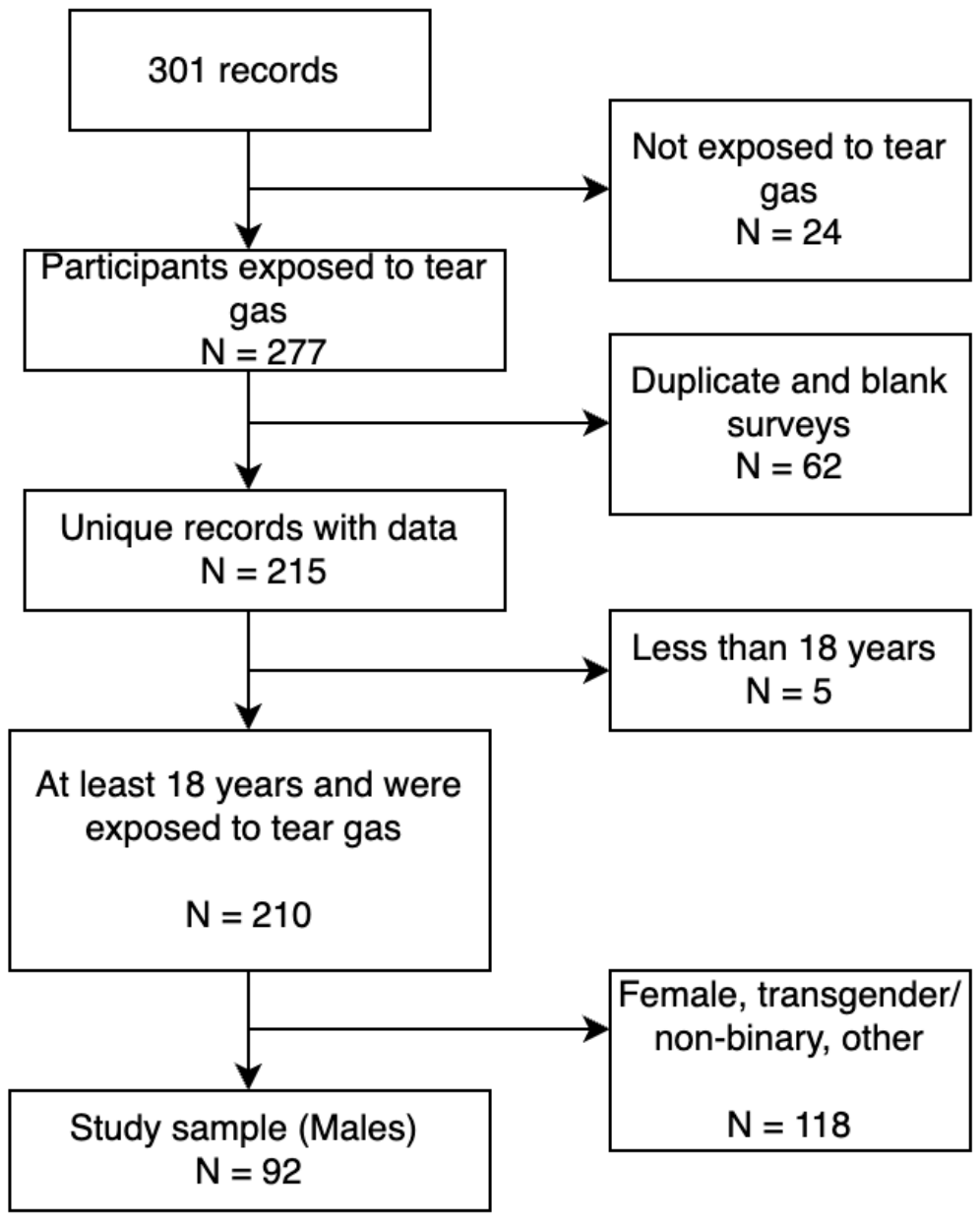

Table 1.
Participant characteristics by low, medium, and high tear gas exposure scores (N=92).
|
Low exposure score (0-5 acute symptoms) N = 32 |
Medium exposure score (6-8 acute symptoms) N = 36 |
High exposure score (9-14 acute symptoms) N = 24 |
P-value |
|
| Age | 0.916 | |||
| Median (IQR) | 35 (9.0) | 35 (8.3) | 32 (8.0) | |
| Race, n (%) | 0.001 | |||
| Black | 11 (34.4) | 9 (25.0) | 16 (66.7) | |
| Others | 1 (3.1) | 4 (11.1) | 4 (16.7) | |
| White | 20 (62.5) | 21 (58.3) | 4 (16.7) | |
| Missing | 0 (0.0) | 2 (5.6) | 0 (0.0) | |
| Ethnicity, n (%) | 0.960 | |||
| Non-Hispanic | 27 (84.4) | 31 (86.1) | 22 (91.7) | |
| Hispanic | 2 (6.2) | 3 (8.3) | 2 (8.3) | |
| Missing | 3 (9.4) | 2 (5.6) | 0 (0.0) | |
| Education, n (%) | <0.001 | |||
| Some college or less | 9 (28.1) | 18 (50.0) | 21 (87.5) | |
| Bachelor's & Graduate degree | 23 (71.9) | 18 (50.0) | 3 (12.5) | |
| Income, n (%) | <0.001 | |||
| Less than $39,999 | 7 (21.9) | 12 (33.3) | 4 (16.7) | |
| $40,000 – $59,999 | 6 (18.8) | 13 (36.1) | 18 (75.0) | |
| Greater than $60,000 | 19 (59.4) | 11 (30.6) | 1 (4.2) | |
| Missing | 0 (0.0) | 0 (0.0) | 1 (4.2) | |
| Any Male Outcome, n (%) | 0.002 | |||
| No | 23 (71.9) | 21 (58.3) | 6 (25.0) | |
| Yes | 9 (28.1) | 15 (41.7) | 18 (75.0) | |
| Erectile dysfunction, n (%) | 0.007 | |||
| No | 27 (84.4) | 26 (72.2) | 11 (45.8) | |
| Yes | 5 (15.6) | 10 (27.8) | 13 (54.2) | |
| Ejaculatory dysfunction, n (%) | 0.004 | |||
| No | 27 (84.4) | 28 (77.8) | 11 (45.8) | |
| Yes | 5 (15.6) | 8 (22.2) | 13 (54.2) | |
| Trouble conceiving, n (%) | 0.262 | |||
| No | 32 (100.0) | 35 (97.2) | 22 (91.7) | |
| Yes | 0 (0.0) | 1 (2.8) | 2 (8.3) |
Table 2.
Association between acute tear gas symptoms and any male reproductive outcome.
| Any male outcomea | Unadjusted | Adjustedb | ||||
| No | Yes | ORc | 95% CI | OR | 95% CI | |
| Acute exposure score | ||||||
| Low | 23 | 9 | 1.00 | 1.00 | ||
| Medium | 21 | 15 | 1.83 | 0.67-5.19 | 1.59 | 0.50-5.08 |
| High | 6 | 18 | 7.67 | 2.42-27.43 | 5.10 | 1.11-26.16 |
|
aMale outcomes: Erectile dysfunction, ejaculatory dysfunction and trouble conceiving. bAdjusted for age, race (Black/white/other), education (some college or less/college degree), income (>$39k/$40k-$59k/>$60k) cOR = Odds Ratio | ||||||
Table 3.
Association between acute tear gas symptoms and specific male reproductive outcomes.
| Outcome | Unadjusted | Adjusteda | ||||
| No | Yes | OR | 95% CI | OR | 95% CI | |
| Erectile dysfunction | ||||||
| Acute exposure score | ||||||
| Low | 27 | 5 | 1.00 | 1.00 | ||
| Medium | 26 | 10 | 2.08 | 0.65-7.44 | 1.95 | 0.52-8.02 |
| High | 11 | 13 | 6.38 | 1.93-24.13 | 6.57 | 1.28-40.08 |
| Ejaculatory dysfunction | ||||||
| Low | 27 | 5 | 1.00 | 1.00 | ||
| Medium | 28 | 8 | 1.54 | 0.46-5.66 | 0.93 | 0.20-4.35 |
| High | 11 | 13b | 6.38 | 1.93-24.13 | 1.96 | 0.35-11.36 |
|
aAdjusted for age, race (Black/white/other), education (some college or less/college degree), income (>$39k/$40k-$59k/>$60k) | ||||||
Table 4.
Univariate & multivariable model for each acute effects category and any male reproductive outcome.
Table 4.
Univariate & multivariable model for each acute effects category and any male reproductive outcome.
| Any male outcomes | Unadjusted | Adjusteda | ||||
| No | Yes | OR | 95% CI | OR | 95% CI | |
| Heart effects | ||||||
| No heart effect | 23 | 3 | 1.00 | 1.00 | ||
| 1 -2 heart effects | 21 | 22 | 8.03 | 2.35-37.49 | 6.89 | 1.67-37.82 |
| 3-4 heart effects | 6 | 17 | 21.72 | 5.55-118.81 | 14.19 | 2.27-110.95 |
| Eye effects | ||||||
| 0-1 eye effects | 20 | 13 | 1.00 | 1.00 | ||
| 2-3 eye effects | 30 | 29 | 1.49 | 0.63-3.59 | 1.34 | 0.47-3.85 |
| Lung effects | ||||||
| 0-1 lung effects | 18 | 8 | 1.00 | 1.00 | ||
| 2 lung effects | 7 | 14 | 4.50 | 1.36-16.31 | 2.90 | 0.73-12.17 |
| 3-4 lung effects | 25 | 20 | 1.80 | 0.66-5.18 | 0.98 | 0.26-3.59 |
| Skin effects | ||||||
| 0-1 skin effects | 45 | 20 | 1.00 | 1.00 | ||
| 2-3 skin effects | 5 | 22 | 9.90 | 3.50-33.04 | 9.33 | 2.22-48.24 |
|
aAdjusted for age, race (White/Black/other), education (some college or less/college degree), income (>$39k/$40k-$59k/>$60k) | ||||||
Disclaimer/Publisher’s Note: The statements, opinions and data contained in all publications are solely those of the individual author(s) and contributor(s) and not of MDPI and/or the editor(s). MDPI and/or the editor(s) disclaim responsibility for any injury to people or property resulting from any ideas, methods, instructions or products referred to in the content. |
© 2026 by the authors. Licensee MDPI, Basel, Switzerland. This article is an open access article distributed under the terms and conditions of the Creative Commons Attribution (CC BY) license (http://creativecommons.org/licenses/by/4.0/).
Copyright: This open access article is published under a Creative Commons CC BY 4.0 license, which permit the free download, distribution, and reuse, provided that the author and preprint are cited in any reuse.