

Submitted:
02 November 2026
Posted:
04 November 2026
You are already at the latest version
Abstract
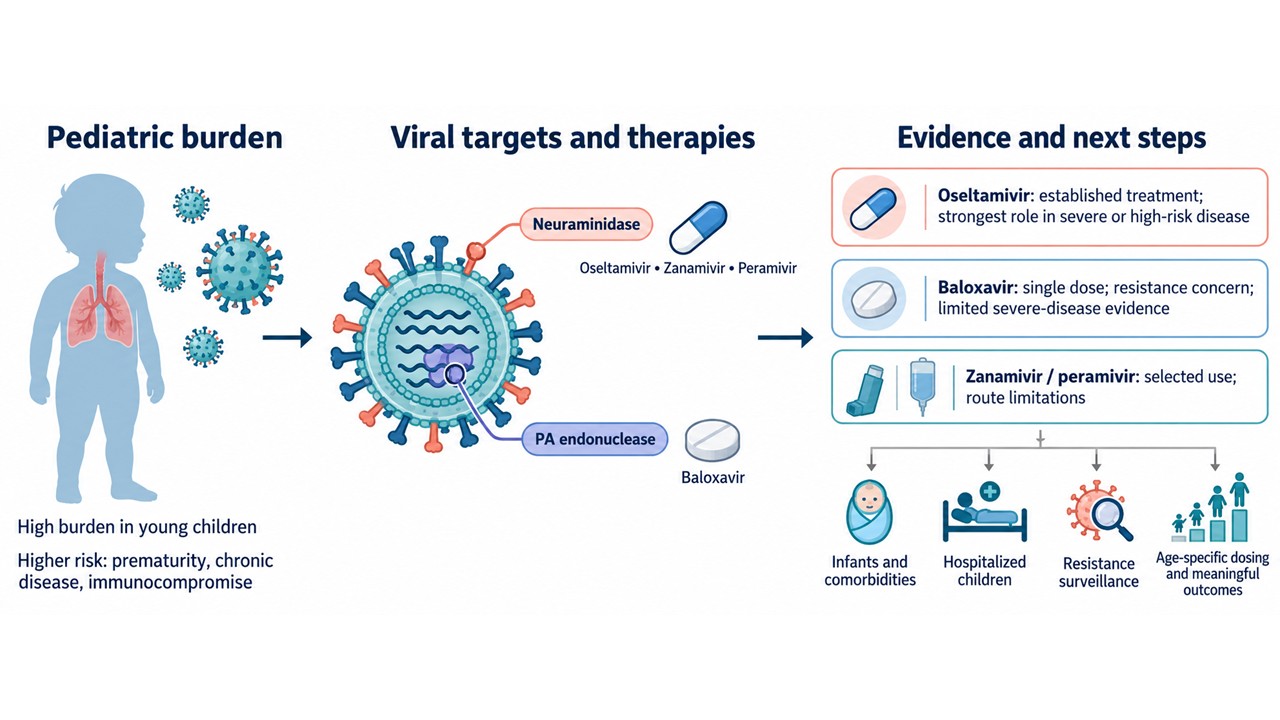
Background: Influenza causes substantial seasonal illness in children, particularly infants and young children. Children with chronic conditions, prematurity, neurologic disorders, or immunocompromise are at increased risk of complications. Although antiviral treatment complements vaccination and supportive care, pediatric evidence remains uneven: randomized trials have largely involved otherwise healthy outpatients, while evidence in hospitalized and medically complex children is mostly observational. Methods: This narrative review synthesizes evidence on the mechanisms, clinical use, and limitations of currently available influenza antivirals in children. It prioritizes pediatric trials, observational studies, and clinical guidance, with adult evidence considered where pediatric data are limited. Results: Oseltamivir remains the most widely recommended treatment, particularly for hospitalized children and those at increased risk. Its benefits in uncomplicated illness are generally modest, and vomiting is a recognized adverse effect. Zanamivir and peramivir are alternatives for selected patients, but their use is constrained by inhaled administration, airway disease, intravenous delivery, and limited evidence in severe illness. Baloxavir offers single-dose oral treatment and rapid suppression of viral replication; however, pediatric trials remain relatively small, reduced susceptibility can emerge during treatment, and evidence in severe disease is insufficient. Novel polymerase inhibitors and host-directed therapies remain investigational or have not established a clear clinical role in children. Conclusions: Future research should prioritize infants, children with comorbidities, and hospitalized patients, while addressing age-specific pharmacokinetics, antiviral resistance, and outcomes that matter to children and families.
Keywords:
influenza
; child
; antiviral agents
; oseltamivir
; baloxavir
; drug resistance
; pediatric infectious diseases
1. Introduction
Seasonal influenza is a leading cause of acute respiratory illness in childhood and contributes substantially to outpatient visits, school absence, hospital admission, and family disruption. A global modelling analysis estimated that, in 2018, children younger than 5 years experienced 109.5 million influenza episodes, 10.1 million influenza-associated acute lower respiratory infections, and approximately 870,000 related hospital admissions [1]. Earlier analyses likewise identified influenza as an important contributor to pediatric respiratory hospitalizations, with substantial variation by age and geography [2]. A systematic review of risk factors found particularly increased odds of admission in children with neurologic disorders, prematurity, sickle cell disease, immunosuppression, diabetes, and age younger than 2 years [3]. Influenza-associated mortality is concentrated in settings with limited access to healthcare, although severe and fatal illness also occurs in high-income countries [1,4].
Annual vaccination remains the principal preventive intervention. Antiviral drugs are an adjunct for treatment and, in selected circumstances, post-exposure prophylaxis. Current recommendations emphasize early treatment of children who are hospitalized, have severe, complicated, or progressive disease, or are at increased risk of complications; in these groups, treatment should not be delayed while awaiting test results [5,6,7,8]. Recommendations for otherwise healthy outpatients with uncomplicated influenza vary somewhat among jurisdictions and depend on timing, age, risk, availability, and shared decision-making. The World Health Organization (WHO) guideline also distinguishes non-severe from severe disease and grades several antiviral recommendations as conditional because certainty about the magnitude of benefit is limited [6,7].
The term “targeted therapy” in this review refers primarily to drugs acting on viral proteins or replication processes. The currently used agents target viral neuraminidase or the cap-dependent endonuclease of the polymerase complex. Other compounds in clinical development target viral polymerase functions or host pathways that influenza viruses depend on [9,10]. The challenge is to translate antiviral activity and reductions in viral load into measurable pediatric benefits, while accounting for age-dependent pharmacology, resistance, route of administration, and the distinction between uncomplicated outpatient disease and severe lower respiratory tract infection.
This narrative review summarizes the current evidence for antiviral therapies in children, highlights limitations in the evidence base, and discusses priorities for future pediatric studies. Adult trials are included when they inform mechanism or drug development, but are identified as indirect evidence and are not assumed to establish pediatric efficacy or safety.
2. Methods
2.1. Review Design and Scope
We conducted a narrative review of evidence on targeted therapies for influenza in children. The review focused on seasonal influenza A and B in patients younger than 18 years and addressed currently available antiviral drugs, therapies under investigation, efficacy and safety, antiviral resistance, and gaps in the pediatric evidence base. Prevention and supportive care were considered only where relevant to the context or interpretation of antiviral treatment.
2.2. Search Strategy and Information Sources
Focused, web-based searches were conducted on 29 October 2026. Searches targeted PubMed-indexed records and guidance published by the World Health Organization (WHO), the American Academy of Pediatrics (AAP), and the US Centers for Disease Control and Prevention (CDC). Search terms were combined using Boolean operators and included: influenza AND (child OR children OR pediatric OR paediatric); influenza AND (antiviral OR treatment OR therapy); influenza AND (oseltamivir OR zanamivir OR peramivir OR baloxavir); influenza AND (antiviral resistance OR resistance); influenza AND (severe OR hospitalized OR hospitalised) AND (child OR pediatric); influenza AND (investigational OR novel antiviral OR host-directed therapy). Searches were also directed at pediatric clinical trials, current treatment recommendations, and reports describing emerging antiviral agents or resistance. The search was limited to English-language sources.
2.3. Eligibility and Source Selection
Sources were considered relevant if they addressed influenza treatment in children or adolescents, including clinical trials, observational studies, systematic reviews, and clinical practice guidelines. We prioritized studies reporting pediatric data on clinical outcomes, virologic outcomes, safety, dosing, or resistance. Guidance documents were included to summarize current recommendations and age-specific treatment considerations.
Adult studies were considered when they provided relevant information on antiviral mechanisms or investigational approaches for which pediatric evidence was limited. These findings were treated as indirect evidence and were not assumed to establish efficacy or safety in children. Studies focused exclusively on influenza prevention, vaccine effectiveness, or non-influenza respiratory infections were outside the review’s scope unless they provided context relevant to treatment.
2.4. Data Collection and Synthesis
For each selected source, we considered the study design, population and age range, influenza type, antiviral agent, treatment timing, comparator, and reported clinical, virologic, and safety outcomes. We also noted limitations relevant to interpreting the findings in children, including small sample sizes, restricted age ranges, and limited evidence in hospitalized patients or those with severe disease.
Findings were synthesized narratively and organized by therapeutic class and clinical evidence. We distinguished evidence from pediatric studies from adult or mechanistic evidence and compared it with recommendations in current guidance documents. Because this was a narrative review based on focused searches, we did not conduct a formal systematic-review screening process, meta-analysis, or PRISMA assessment.
3. Virology and Therapeutic Targets
Influenza A and B viruses are enveloped, segmented, negative-sense RNA viruses. Their replication cycle offers several potential therapeutic targets. Hemagglutinin mediates attachment and membrane fusion; the M2 ion channel facilitates viral uncoating; the nuclear polymerase complex transcribes and replicates the viral genome; and neuraminidase cleaves sialic acid residues to release newly formed virions [9]. Influenza A polymerase “cap-snatches” short capped fragments of host RNA to prime viral messenger RNA synthesis. The PA subunit contains the cap-dependent endonuclease targeted by baloxavir, while PB2 cap binding and RNA synthesis are targets for other investigational inhibitors [9,10].
The distinction between direct-acting and host-directed treatment is clinically relevant. Direct-acting antivirals aim to inhibit viral replication with limited disruption of normal host function, although resistance can arise through viral mutation. Host-directed agents aim to modify host processes that support replication or contribute to tissue injury. Their potential advantage is a higher barrier to viral escape; their central risk is interfering with protective immune responses or causing toxicity in a developing child. At present, approved pediatric treatment is based on direct-acting antivirals, and host-directed strategies have no established routine role [10].
Older M2 ion-channel blockers, amantadine and rimantadine, were active against influenza A but not influenza B. Widespread resistance among circulating influenza A viruses led to recommendations against their routine use [11]. They are not considered current standard therapy. The modern clinical toolkit instead relies on neuraminidase inhibitors (NAIs) and baloxavir, with susceptibility patterns and regulatory indications changing over time and varying by region [5,8,12].
8. Clinical Evidence Gaps and Research Priorities
The pediatric evidence base has several recurring limitations. First, many randomized trials recruit otherwise healthy outpatients with uncomplicated influenza and exclude children with chronic disease, immunocompromise, severe illness, or recent antiviral use. Those are precisely the groups for whom clinicians most need robust outcome data. Second, trials frequently use symptom duration or viral shedding as endpoints, while families and health systems care about hospitalization, return to school, complications, antibiotic exposure, intensive care, and mortality. Serious outcomes are uncommon enough that trials need large, pragmatic, multicenter designs to detect meaningful differences.
Third, children are not a homogeneous pharmacologic group. Drug disposition, renal function, body size, immune response, and ability to use a delivery device change from infancy through adolescence. Development plans should include preterm and term infants, age-appropriate formulations, and dose selection based on pharmacokinetic and pharmacodynamic targets. Studies should also address feeding tubes, vomiting, renal impairment, obesity, and prolonged shedding in immunocompromised children. Current dose recommendations are based on available evidence and guidance, but data remain thinner in the youngest infants and in children with complex comorbidity [5,8,13].
Fourth, timing and diagnosis influence apparent treatment effectiveness. Many trials enroll within 48 hours, while high-risk patients may present later. Rapid molecular testing can help direct therapy, but empiric treatment should not be delayed in priority groups. Future trials could compare pragmatic testing-and-treatment pathways, measure time from symptom onset to first dose, and distinguish influenza A subtypes and influenza B lineages where sample size permits. Data on coinfections and bacterial complications are also needed, because an antiviral cannot replace appropriate evaluation of a child whose clinical course worsens.
Fifth, resistance surveillance must be integrated into trials and routine care. Studies should collect serial specimens from children with prolonged illness, immunocompromise, or treatment failure and report both genotypic markers and phenotypic susceptibility where feasible. Baloxavir trials should report resistance stratified by age and subtype, including the transmission and clinical consequences of selected variants. NAI resistance monitoring should remain linked to global surveillance because local prevalence may shift rapidly [8,31,36].
Finally, equity and feasibility matter. The global burden of severe influenza in young children is concentrated in low- and middle-income settings [1,2]. A single-dose agent may improve adherence but may also be more expensive or unavailable. Oral suspension stability, supply, diagnostic access, and the capacity to recognize severe illness shape whether a therapy can meaningfully reduce burden. Trials should include diverse geographic settings and report costs, access, and practical feasibility alongside efficacy.
A useful pediatric evidence program would coordinate randomized trials with prospective surveillance rather than rely on isolated small studies. Core outcome sets could include time to sustained symptom resolution, return to normal activity, complications requiring a change in care, hospitalization, and serious adverse events, alongside viral kinetics and resistance. Stratification by age, influenza type or subtype, vaccination status, baseline risk, and time to treatment would improve interpretability. For hospitalized children, pragmatic platform designs may permit comparison of standard-dose oseltamivir with clinically plausible alternatives without delaying standard care. Embedded pharmacokinetic studies can address infants and children receiving enteral feeds, while follow-up after treatment can assess prolonged shedding and emergence of resistance. Such designs would generate findings that can change practice rather than simply confirm antiviral activity.
Table 4. translates the evidence gaps into study priorities, populations, and outcomes that could make future pediatric trials more useful for clinical decisions.
9. Conclusions
Targeted antivirals have an established role in pediatric influenza, but the strength of evidence differs markedly by drug, age, and clinical setting. Oseltamivir remains the best-established option for children who are hospitalized, severely ill, or at increased risk of complications, with early treatment generally preferred. Zanamivir and peramivir are alternatives for selected circumstances but have route-specific and evidence limitations. Baloxavir adds a convenient single-dose mechanism and has supportive evidence for uncomplicated disease in eligible children, while age-related resistance concerns and limited severe-disease data require careful patient selection.
The next phase of progress will depend less on adding agents with antiviral activity alone and more on proving age-appropriate clinical benefit. Pediatric trials should enroll high-risk and hospitalized children, evaluate outcomes that matter to patients and families, characterize pharmacology and resistance, and include the settings where influenza causes the greatest burden. Until those data are available, clinical decisions should follow current local guidance, distinguish pediatric evidence from adult extrapolation, and integrate antiviral treatment with vaccination, timely diagnosis, and careful supportive care.
Author Contributions
S.E. wrote the first draft of the manuscript; M.M., G.G.A. and V.M. performed the literature review; N.P. revised the manuscript and gave a substantial scientific contribution. All authors have read and agreed to the published version of the manuscript.
Funding
This research received no external funding.
Institutional Review Board Statement
Not applicable.
Informed Consent Statement
Not applicable.
Data Availability Statement
No new data were created or analyzed in this study. Data sharing is not applicable to this article. .
Conflicts of Interest
The authors declare no conflict of interest.
References
- Wang, X.; Li, Y.; O’Brien, K.L.; Madhi, S.A.; Widdowson, M.A.; Byass, P.; et al. Global burden of respiratory infections associated with seasonal influenza in children under 5 years in 2018: a systematic review and modelling study. Lancet Glob. Health 2020, 8(4), e497–e510. [Google Scholar] [CrossRef] [PubMed]
- Lafond, K.E.; Nair, H.; Rasooly, M.H.; Valente, F.; Booy, R.; Rahman, M.; et al. Global role and burden of influenza in pediatric respiratory hospitalizations, 1982-2012: a systematic analysis. PLoS Med. 2016, 13(3), e1001977. [Google Scholar] [CrossRef] [PubMed]
- Gill, P.J.; Ashdown, H.F.; Wang, K.; Heneghan, C.; Roberts, N.W.; Harnden, A.; et al. Identification of children at risk of influenza-related complications in primary and ambulatory care: a systematic review and meta-analysis. Lancet Respir. Med. 2015, 3(2), 139–49. [Google Scholar] [CrossRef] [PubMed]
- Iuliano, A.D.; Roguski, K.M.; Chang, H.H.; Muscatello, D.J.; Palekar, R.; Tempia, S.; et al. Global Seasonal Influenza-associated Mortality Collaborator Network. Estimates of global seasonal influenza-associated respiratory mortality: a modelling study. Lancet 2018, 391(10127), 1285–300. [Google Scholar] [CrossRef] [PubMed]
- Committee on Infectious Diseases. Recommendations for prevention and control of influenza in children, 2025-2026: policy statement. Pediatrics 2025, 156(6), e2025073620. [Google Scholar] [CrossRef] [PubMed]
- World Health Organization. Clinical practice guidelines for influenza; World Health Organization: Geneva, 2024; ISBN 978-92-4-009775-9. [Google Scholar]
- Vandvik, P.O.; Agarwal, A.; Rylance, J.; Agoritsas, T.; Guyatt, G.; Leo, Y.S.; et al. Summary of WHO clinical practice guidelines for influenza. BMJ 2026, 392, e087397. [Google Scholar] [CrossRef] [PubMed]
- Uyeki, T.M.; Bernstein, H.H.; Bradley, J.S.; Englund, J.A.; File, T.M., Jr.; Fry, A.M.; et al. Clinical practice guidelines by the Infectious Diseases Society of America: 2018 update on diagnosis, treatment, chemoprophylaxis, and institutional outbreak management of seasonal influenza. Clin. Infect. Dis. 2019, 68(6), e1–e47. [Google Scholar] [CrossRef] [PubMed]
- Carter, T.; Iqbal, M. The influenza A virus replication cycle: a comprehensive review. Viruses 2024, 16(2), 316. [Google Scholar] [CrossRef] [PubMed]
- Kumari, R.; Sharma, S.D.; Kumar, A.; Ende, Z.; Mishina, M.; Wang, Y.; et al. Antiviral approaches against influenza virus. Clin. Microbiol. Rev. 2023, 36(1), e00040-22. [Google Scholar] [CrossRef] [PubMed]
- Bright, R.A.; Medina, M.J.; Xu, X.; Perez-Oronoz, G.; Wallis, T.R.; Davis, X.M.; et al. Incidence of adamantane resistance among influenza A (H3N2) viruses isolated worldwide from 1994 to 2005: a cause for concern. Lancet 2005, 366(9492), 1175–81. [Google Scholar] [CrossRef] [PubMed]
- Centers for Disease Control and Prevention. Influenza antiviral medications: summary for clinicians; CDC: Atlanta, 10 Mar 2026; Available online: https://www.cdc.gov/flu/hcp/antivirals/summary-clinicians.html (accessed on 29 October 2026).
- Kimberlin, D.W.; Acosta, E.P.; Prichard, M.N.; Sánchez, P.J.; Ampofo, K.; Lang, D.; et al. Oseltamivir pharmacokinetics, dosing, and resistance among children aged . J. Infect. Dis. 2013, 207(5), 709–20. [Google Scholar] [CrossRef] [PubMed]
- Whitley, R.J.; Hayden, F.G.; Reisinger, K.S.; Young, N.; Dutkowski, R.; Ipe, D.; et al. Oral oseltamivir treatment of influenza in children. Pediatr. Infect. Dis. J. 2001, 20(2), 127–33. [Google Scholar] [CrossRef] [PubMed]
- Heinonen, S.; Silvennoinen, H.; Lehtinen, P.; Vainionpää, R.; Vahlberg, T.; Ziegler, T.; et al. Early oseltamivir treatment of influenza in children 1-3 years of age: a randomized controlled trial. Clin. Infect. Dis. 2010, 51(8), 887–94. [Google Scholar] [CrossRef] [PubMed]
- Malosh, R.E.; Martin, E.T.; Heikkinen, T.; Brooks, W.A.; Whitley, R.J.; Monto, A.S. Efficacy and safety of oseltamivir in children: systematic review and individual patient data meta-analysis of randomized controlled trials. Clin. Infect. Dis. 2018, 66(10), 1492–500. [Google Scholar] [CrossRef] [PubMed]
- Wang, K.; Shun-Shin, M.; Gill, P.; Perera, R.; Harnden, A. Neuraminidase inhibitors for preventing and treating influenza in children (published trials only). Cochrane Database Syst. Rev. 2022, 3(3), CD002744. [Google Scholar] [CrossRef] [PubMed]
- Fry, A.M.; Goswami, D.; Nahar, K.; Sharmin, A.T.; Rahman, M.; Gubareva, L.; et al. Efficacy of oseltamivir treatment started within 5 days of symptom onset to reduce influenza illness duration and virus shedding in an urban setting in Bangladesh: a randomised placebo-controlled trial. Lancet Infect. Dis. 2014, 14(2), 109–18. [Google Scholar] [CrossRef] [PubMed]
- Campbell, A.P.; Tokars, J.I.; Reynolds, S.; Garg, S.; Kirley, P.D.; Miller, L.; et al. Influenza antiviral treatment and length of stay. Pediatrics 2021, 148(4), e2021050417. [Google Scholar] [CrossRef] [PubMed]
- Walsh, P.S.; Schnadower, D.; Zhang, Y.; Ramgopal, S.; Shah, S.S.; Wilson, P.M. Association of early oseltamivir with improved outcomes in hospitalized children with influenza, 2007-2020. JAMA Pediatr. 2022, 176(11), e223261. [Google Scholar] [CrossRef] [PubMed]
- Hedrick, J.A.; Barzilai, A.; Behre, U.; Henderson, F.W.; Hammond, J.; Reilly, L.; et al. Zanamivir for treatment of symptomatic influenza A and B infection in children five to twelve years of age: a randomized controlled trial. Pediatr. Infect. Dis. J. 2000, 19(5), 410–7. [Google Scholar] [CrossRef] [PubMed]
- Mäkelä, M.J.; Pauksens, K.; Rostila, T.; Fleming, D.M.; Man, C.Y.; Keene, O.N.; et al. Clinical efficacy and safety of the orally inhaled neuraminidase inhibitor zanamivir in the treatment of influenza: a randomized, double-blind, placebo-controlled European study. J. Infect. 2000, 40(1), 42–8. [Google Scholar] [CrossRef] [PubMed]
- US National Library of Medicine. Rapivab (peramivir) injection: prescribing information. DailyMed. Available online: https://dailymed.nlm.nih.gov/dailymed/drugInfo.cfm?setid=fe04f6cd-e71c-4bd4-abac-97720bba2a0d (accessed on 29 October 2026).
- Committee on Infectious Diseases. Recommendations for prevention and control of influenza in children, 2025-2026: technical report. Pediatrics 2025, 156(6), e2025073622. [Google Scholar] [CrossRef] [PubMed]
- US National Library of Medicine. Xofluza (baloxavir marboxil) tablets and oral suspension: prescribing information. DailyMed. 2025. Available online: https://dailymed.nlm.nih.gov/dailymed/drugInfo.cfm?setid=e49e1a61-1b7c-4be5-ac84-af6240b511e7 (accessed on 29 October 2026).
- Hayden, F.G.; Sugaya, N.; Hirotsu, N.; Lee, N.; de Jong, M.D.; Hurt, A.C.; et al. Baloxavir marboxil for uncomplicated influenza in adults and adolescents. N Engl. J. Med. 2018, 379(10), 913–23. [Google Scholar] [CrossRef] [PubMed]
- Ison, M.G.; Portsmouth, S.; Yoshida, Y.; Shishido, T.; Mitchener, M.; Tsuchiya, K.; et al. Early treatment with baloxavir marboxil in high-risk adolescent and adult outpatients with uncomplicated influenza (CAPSTONE-2): a randomised, placebo-controlled, phase 3 trial. Lancet Infect. Dis. 2020, 20(10), 1204–14. [Google Scholar] [CrossRef] [PubMed]
- Baker, J.; Block, S.L.; Matharu, B.; Macutkiewicz, L.B.; Wildum, S.; Dimonaco, S.; et al. Baloxavir marboxil single-dose treatment in influenza-infected children: a randomized, double-blind, active-controlled phase 3 safety and efficacy trial (miniSTONE-2). Pediatr. Infect. Dis. J. 2020, 39(8), 700–5. [Google Scholar] [CrossRef] [PubMed]
- Hirotsu, N.; Sakaguchi, H.; Sato, C.; Ishibashi, T.; Baba, K.; Omoto, S.; et al. Baloxavir marboxil in Japanese pediatric patients with influenza: safety and clinical and virologic outcomes. Clin. Infect. Dis. 2020, 71(4), 971–81. [Google Scholar] [CrossRef] [PubMed]
- Ikematsu, H.; Hayden, F.G.; Kawaguchi, K.; Kinoshita, M.; de Jong, M.D.; Lee, N.; et al. Baloxavir marboxil for prophylaxis against influenza in household contacts. N Engl. J. Med. 2020, 383(4), 309–20. [Google Scholar] [CrossRef] [PubMed]
- Centers for Disease Control and Prevention. Influenza antiviral drug resistance; CDC: Atlanta; Available online: https://www.cdc.gov/flu/treatment/antiviralresistance.html (accessed on 29 October 2026).
- Kiso, M.; Mitamura, K.; Sakai-Tagawa, Y.; Shiraishi, K.; Kawakami, C.; Kimura, K.; et al. Resistant influenza A viruses in children treated with oseltamivir: descriptive study. Lancet 2004, 364(9436), 759–65. [Google Scholar] [CrossRef] [PubMed]
- Stephenson, I.; Democratis, J.; Lackenby, A.; McNally, T.; Smith, J.; Pareek, M.; et al. Neuraminidase inhibitor resistance after oseltamivir treatment of acute influenza A and B in children. Clin. Infect. Dis. 2009, 48(4), 389–96. [Google Scholar] [CrossRef] [PubMed]
- Saito, R.; Sato, I.; Suzuki, Y.; Baranovich, T.; Matsuda, R.; Ishitani, N.; et al. Reduced effectiveness of oseltamivir in children infected with oseltamivir-resistant influenza A (H1N1) viruses with His275Tyr mutation. Pediatr. Infect. Dis. J. 2010, 29(10), 898–904. [Google Scholar] [CrossRef] [PubMed]
- Omoto, S.; Speranzini, V.; Hashimoto, T.; Noshi, T.; Yamaguchi, H.; Kawai, M.; et al. Characterization of influenza virus variants induced by treatment with the endonuclease inhibitor baloxavir marboxil. Sci. Rep. 2018, 8(1), 9633. [Google Scholar] [CrossRef] [PubMed]
- Imai, M.; Yamashita, M.; Sakai-Tagawa, Y.; Iwatsuki-Horimoto, K.; Kiso, M.; Murakami, J.; et al. Influenza A variants with reduced susceptibility to baloxavir isolated from Japanese patients are fit and transmit through respiratory droplets. Nat. Microbiol. 2020, 5(1), 27–33. [Google Scholar] [CrossRef] [PubMed]
- Trevejo, J.M.; Asmal, M.; Vingerhoets, J.; Polo, R.; Robertson, S.; Jiang, Y.; et al. Pimodivir treatment in adult volunteers experimentally inoculated with live influenza virus: a phase IIa, randomized, double-blind, placebo-controlled study. Antivir. Ther. 2018, 23(4), 335–44. [Google Scholar] [CrossRef] [PubMed]
- Leopold, L.; Vingerhoets, J.; Deleu, S.; Nalpas, C.; Weber, K.; van Dromme, I.; et al. Efficacy and safety of pimodivir combined with standard of care in hospitalized and nonhospitalized high-risk adolescents and adults with influenza A infection. J. Infect. Dis. 2025, 231(1), e132–e143. [Google Scholar] [CrossRef] [PubMed]
- Hayden, F.G.; Lenk, R.P.; Stonis, L.; Oldham-Creamer, C.; Kang, L.L.; Epstein, C. Favipiravir treatment of uncomplicated influenza in adults: results of two phase 3, randomized, double-blind, placebo-controlled trials. J. Infect. Dis. 2022, 226(10), 1790–9. [Google Scholar] [CrossRef] [PubMed]
- Hayden, F.G.; Whitley, R.J. Introduction and update: advances in influenza therapeutics. J. Infect. Dis. 2025, 232 (Suppl 3), S169–76. [Google Scholar] [CrossRef] [PubMed]
- Kumar, D.; Ison, M.G.; Mira, J.P.; Welte, T.; Ha, J.H.; Hui, D.S.; et al. Combining baloxavir marboxil with standard-of-care neuraminidase inhibitor in patients hospitalised with severe influenza (FLAGSTONE): a randomised, parallel-group, double-blind, placebo-controlled, superiority trial. Lancet Infect. Dis. 2022, 22(5), 718–30. [Google Scholar] [CrossRef] [PubMed]
- Lansbury, L.; Rodrigo, C.; Leonardi-Bee, J.; Nguyen-Van-Tam, J.; Lim, W.S. Corticosteroids as adjunctive therapy in the treatment of influenza: an updated Cochrane systematic review and meta-analysis. Crit. Care Med. 2020, 48(2), e98–e106. [Google Scholar] [CrossRef] [PubMed]

Table 1.
Current influenza antivirals relevant to pediatric care.
| Agent | Target and route | Pediatric role | Key limitations |
|---|---|---|---|
| Oseltamivir | Neuraminidase inhibitor; oral or enteric. | Preferred treatment for hospitalized, severe/progressive, and high-risk children; recommended from birth in US guidance when clinically indicated. [5,8,12,13] | Five-day course for uncomplicated disease; vomiting is common; dose adjustment may be needed in selected circumstances. |
| Zanamivir | Neuraminidase inhibitor; inhaled dry powder. | Option for selected uncomplicated outpatients; treatment authorization begins at age 7 years. [5,8,21] | Avoid in asthma or underlying airway disease; requires reliable inhaler technique; limited role in severe or hospitalized disease. |
| Peramivir | Neuraminidase inhibitor; intravenous. | Single-dose treatment for uncomplicated influenza from age 6 months; may be considered when enteric treatment is not feasible. [12,23,24] | Requires IV access; pediatric and severe-disease evidence is limited; no established routine advantage over oseltamivir. |
| Baloxavir | PA cap-dependent endonuclease inhibitor; oral single dose. | Treatment option from age 5 years for eligible uncomplicated cases; age indications vary by jurisdiction. [5,12,25] | Not established for severe/hospitalized pediatric influenza; reduced-susceptibility variants emerge more often in younger patients; polyvalent cations can reduce absorption. [25,28,29] |
Table 2.
Antiviral resistance pathways and pediatric implications.
| Agent or class | Resistance marker or mechanism | Pediatric evidence and significance | Clinical interpretation |
|---|---|---|---|
| Neuraminidase inhibitors | Neuraminidase substitutions can reduce susceptibility; H275Y is a recognized marker for reduced oseltamivir susceptibility in A(H1N1). [31,32,33,34] | Resistance has emerged during treatment in children; prolonged replication and immunocompromise increase concern. [32,33,34] | Prevalence varies by season and subtype. Consider specialist-guided testing for persistent viral replication or treatment failure, not symptoms alone. [12,31] |
| Baloxavir | PA substitutions at residue I38 (including I38T, I38M, and I38F) can reduce susceptibility. [25,35] | Treatment-emergent substitutions are reported more often in children than adults, particularly younger children; rebound shedding may occur. [25,28,29,35] | Clinical impact varies. Variants with reduced susceptibility have shown transmission fitness in experimental models; ongoing surveillance is warranted. [36] |
| Adamantanes | M2 ion-channel resistance became widespread among influenza A viruses. [11] | Historical example of resistance eliminating a previously active class from routine use. | Amantadine and rimantadine are not recommended for routine seasonal influenza treatment. [11,12] |
| Cross-class surveillance | Resistance is drug-, subtype-, and mutation-specific; a genotype does not always predict clinical outcome. [12,31] | Children with prolonged viral shedding may provide a setting for selection and onward transmission. | Interpret sequence results with phenotype when available, viral kinetics, clinical course, and local surveillance. |
Table 3.
Clinical evidence for antiviral treatment by pediatric setting.
| Population or setting | Evidence base | Main findings | Important limitations |
|---|---|---|---|
| Otherwise healthy outpatients | Randomized pediatric trials of oseltamivir and zanamivir; baloxavir pediatric safety trial. [14,15,16,17,18,21,28] | NAIs modestly shorten illness in laboratory-confirmed cases; oseltamivir increases vomiting. Baloxavir symptom outcomes were similar to oseltamivir in miniSTONE-2. | Trials mainly enrolled uncomplicated illness and were not powered for rare complications or superiority in children. |
| High-risk outpatients | CAPSTONE-2 enrolled high-risk adolescents and adults; pediatric data below age 12 are limited. [27] | Baloxavir improved time to symptom alleviation versus placebo in the trial population. | Adult/adolescent findings do not establish benefit in younger children, infants, or severe disease. |
| Hospitalized children | Large observational cohorts of early oseltamivir treatment. [19,20] | Early treatment was associated with shorter length of stay and selected improved outcomes. | Nonrandom treatment assignment and residual confounding limit causal conclusions. |
| Severe disease or inability to take enteral therapy | Guidelines favor oseltamivir; evidence for IV peramivir in severe pediatric disease is limited. [8,12,23,24] | Peramivir may be considered when oral or enteric oseltamivir cannot be absorbed or tolerated. | No routine alternative has established superior pediatric outcomes; baloxavir is not established for hospitalized disease. |
Table 4.
Priorities for future pediatric influenza antiviral research.
| Priority | Population | Study approach and outcomes | Why it matters |
|---|---|---|---|
| Age-specific pharmacology | Term and preterm infants, especially children younger than 2 years. | Prospective PK/PD and dose-finding studies; safety, drug exposure, formulation feasibility, and clinical response. | Infants remain underrepresented, while drug disposition and dosing needs change rapidly with age. [13] |
| High-risk children | Children with chronic, neurologic, hematologic, or immune conditions. | Pragmatic multicenter trials; complications, hospitalization, return to usual activity, and serious adverse events. | These children have high complication risk but are often excluded from registration trials. [3,5] |
| Hospitalized and severe influenza | Children with pneumonia, hypoxemia, ICU admission, or progressive disease. | Large adaptive or platform trials embedded in standard care; time to first dose, length of stay, ICU progression, and mortality. | Current inpatient evidence is largely observational and cannot fully resolve treatment effects. [19,20] |
| Resistance and prolonged shedding | Immunocompromised children and patients with persistent viral replication or treatment failure. | Serial sampling with sequencing and phenotypic susceptibility; viral rebound, shedding duration, and transmission. | Resistance can emerge during treatment and may have consequences beyond the individual patient. [31,35,36] |
| Patient-centered outcomes and access | Diverse regions, including settings with high pediatric influenza burden and limited resources. | Report symptom recovery, school/activity resumption, adverse effects, affordability, supply, diagnostics, and formulation access. | Efficacy will translate into benefit only when treatment can be delivered equitably and promptly. [1,2] |
Disclaimer/Publisher’s Note: The statements, opinions and data contained in all publications are solely those of the individual author(s) and contributor(s) and not of MDPI and/or the editor(s). MDPI and/or the editor(s) disclaim responsibility for any injury to people or property resulting from any ideas, methods, instructions or products referred to in the content. |
© 2026 by the authors. Licensee MDPI, Basel, Switzerland. This article is an open access article distributed under the terms and conditions of the Creative Commons Attribution (CC BY) license (http://creativecommons.org/licenses/by/4.0/).
Copyright: This open access article is published under a Creative Commons CC BY 4.0 license, which permit the free download, distribution, and reuse, provided that the author and preprint are cited in any reuse.