

Submitted:
03 November 2026
Posted:
04 November 2026
You are already at the latest version
Abstract
Can every set of diameter one in four dimensions be split into at most five parts of smaller diameter? Three parts suffice in the plane and four in three-dimensional space. In four dimensions five parts are sometimes necessary. We prove that six always suffice, improving the previous upper bound of seven. For small circumradius we use six cones. For large circumradius five balls meet every diametral pair of a compact set. At intermediate radii we bound the diameter of each part by the diameter of a rational polytope.
Keywords:
Borsuk’s problem
; diameter
; circumradius
; geometric partitions
1. Introduction
Can every set of diameter one in be split into at most parts of smaller diameter? Borsuk [2] asked this question in 1933. The vertices of a unit equilateral triangle need three parts, since any two are a unit apart. For the same reason, the vertices of a regular n-simplex need parts.
Write for the least number of parts that always suffices. Borsuk proved . Perkal [8] announced in 1947, and Eggleston [3] published a proof in 1955. In 1993, Kahn and Kalai [5] disproved the conjecture in high dimensions. Four is the first dimension in which the question remains open.
Lassak’s 1982 bound gives [6]. In May 2026, Tolmachev and Voronov [9], Theorem 2 reduced this to eight. In October 2026, Arman, Bondarenko, Prymak and Radchenko [1], Theorem 1 covered every set of diameter one in with seven balls of diameter less than . We prove the following bound.
Theorem 1.
Every bounded subset of of positive diameter admits a partition into at most six sets of strictly smaller diameter. In particular, .
By scaling and taking closures it suffices to partition a compact set K of diameter one. Centre its smallest enclosing ball at zero and write r for its squared radius. There are affinely independent contacts and weights with , , and [1] [Lemma 2]. Thus
Put and . Let be the open ball of radius t about c.
2. Large Circumradius
Proposition 1.
Suppose . There are five contacts such that
contains no pair at distance one.
Proof.
Let , , and . The inequalities and give
The scalar products have weighted mean zero. For we have . Averaging this inequality gives
Suppose now that satisfy . Put , and . Then and . Adding (2) for x and y gives
For a lower bound, let . The Gram matrix of gives
Write . Since ,
Subtract from this lower bound and use with . The difference is at least
Since , we have , so the coefficient of is nonnegative.
It remains to show . Completing the square gives
where and . On we have , and , so . Substitution gives . Thus , contradicting the upper bound for .
A nonempty F is compact and contains no unit pair, so . Assigning each point of to the first ball containing it gives five parts of diameter at most . □
3. Small Circumradius
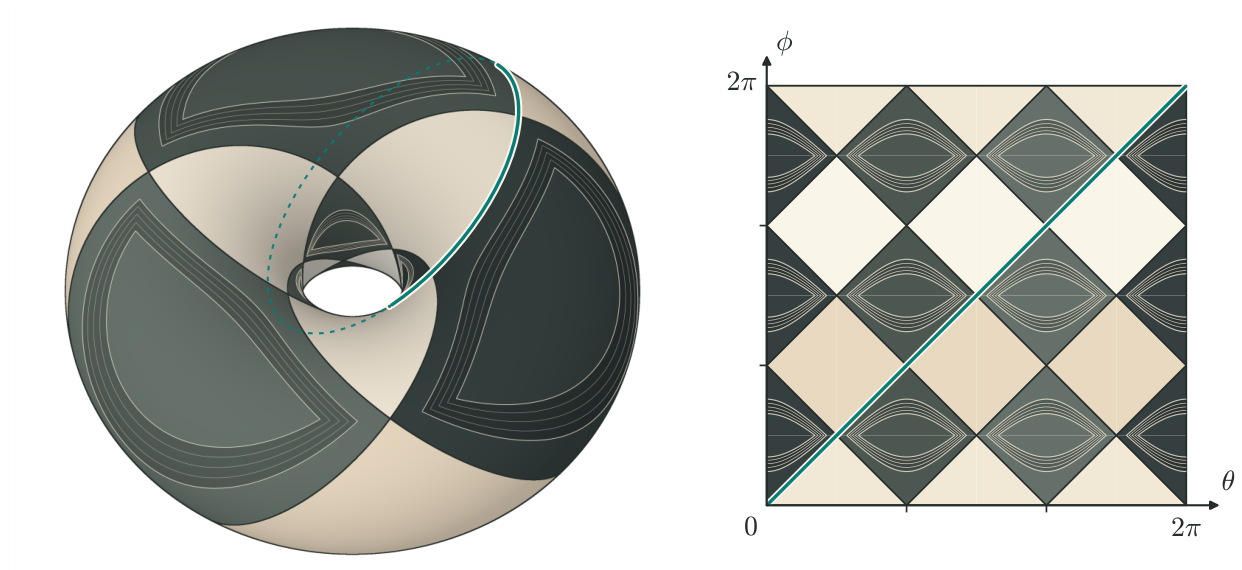
Let be the unit vectors at angles in the two coordinate planes of . The six cones on which the respective are maximal are congruent. On the Clifford torus in Figure 1 the two planar components are , with respective angles . Their maximal scalar products are and , where .
Proposition 2.
A ball of radius R in has a partition into at most six sets of squared diameter at most . This bound is less than one for .
Proof.
In the cone for every ray has a representative , where
Indeed, the inequalities force on every nonzero ray and give this section at .
Fix and put , , . For fixed and the smaller cosine is
If , the sign of is the sign of . This is nonpositive since and . By symmetry we can increase the smaller coordinate to the larger, then increase both to , without increasing f. The resulting cosine is
At a minimum with z interior to T, differentiation gives , whence . Then and the cosine is . Otherwise symmetry puts on an edge. Writing gives . By Cauchy–Schwarz,
This gives the same lower bound. Consequently two points in one cone of the ball are at squared distance at most . Assign ties to the least index. Since , at the bound is less than . □
The rays through and attain the angular bound, so the constant is sharp for this partition.
4. Intermediate Circumradius
Suppose . Since , (1) gives at least three contacts. Take successive facets nearest the circumcentre of the current simplex until a triangle remains. By [1] [Lemma 3 and Proposition 4], the triangle is acute, and its squared circumradius and the distance h of its plane from zero satisfy
Indeed, passing from a k-simplex to its nearest facet retains at least of its squared circumradius. The factor is the product when both steps are needed. For the selected contacts , we have
4.1. Contact Triangles
Order the angles and write , . The longest side is at most one, and . Thus
Following [1] [Lemma 10], for put
Each interpolation covers its closed interval. Put . After an orthogonal change of coordinates the contacts are
The side lengths are times the sines of , and the plane has distance h from zero. Write for (3) in these coordinates. Rotating the last two axes carries and its partition to congruent sets.
Lemma 1.
Suppose the selected triangle has . For every q such that and , we have
Proof.
With three or four initial contacts we would have . Hence the triangle is a nearest facet of a tetrahedron whose squared circumradius S satisfies . Every facet of this tetrahedron is at distance at least from its circumcentre.
Translate that centre to zero. Write for the vertices, for the outward unit facet normals, for the corresponding distances, and for the barycentric weights of zero. The facet opposite gives
Thus , and summing over the other three weights gives . These two bounds imply
For we have , so . In particular the longest side of the triangle satisfies
Rearrangement gives (4). The argument allows ties between nearest facets. □
4.2. Polyhedral Partitions
On a closed dyadic box , let , , have rational coefficients. Assign to the least j maximizing . For every n, (3) gives
For rational n, a rational upper bound on any right side throughout Q gives a halfspace containing every , . Intersect finitely many such halfspaces with and the five halfspaces . The resulting rational polytope contains the jth region. Its diameter is the largest distance between its vertices, since a difference of convex combinations of vertices is a convex combination of their pairwise differences.
Proposition 3.
The cube admits a finite cover by closed dyadic boxes. On each box, either six affine functions partition every into sets of squared diameter at most , or no u represents a triangle selected by successive nearest facets.
Proof.
The supplementary table boxes.tsv lists the four intervals defining each box. For each of the 1512 partition entries it gives a bound and the source of the six affine functions and their supporting halfspaces. To bound (5) on a box we use rational intervals, rounding square roots outwards. For and the planar contribution to is times
The endpoints and any interior maximum give an upper bound C for this factor. It remains to bound . When , use for and for , then maximize in h. Otherwise use separate bounds for and h.
Cutting by the halfspaces gives the vertices of . Put . Since , a common squared-diameter bound is
Here range over the vertices of the same . For a partition obtained by from one with bound , take . For each retained normal n, the support bounds satisfy , so . Also , giving .
The box gives the largest . Its reference partition and dilation give
Subdivide each of the ten slabs perpendicular to the -axis at the box endpoints in each coordinate. A closed cell lies in precisely when for all i. For each interval I below, P counts cells in partition boxes and E counts the remaining cells. The last column is over the partition entries in those slabs.
| I for | All cells | P | E | |
| 0 | ||||
| 12 | ||||
| 265 | 265 | 0 | 86 |
The twelve remaining cells lie in the union of nine boxes on each of which . On each box a rational q satisfies the hypotheses of Lemma 1, but the upper bound for is strictly below the right side of (4). Hence these boxes contain no selected triangle. The last column gives throughout the partition boxes. □
Proof of Theorem 1.
Propositions 1 and 2 give six parts when or . Otherwise select a contact triangle. Its parameter u lies in a partition box by Proposition 3. The six regions of restrict to K by (3). Restricting to the original set and rescaling proves the upper bound. The regular four-simplex gives the lower bound. □
5. Concluding Remarks
If , four is the least dimension in which Borsuk’s conjecture fails.
Can a compact set of diameter one on a sphere of radius in require six parts of smaller diameter?
Such a set would give for every by the construction of Hinrichs and Richter [4] Lemma 9, also used for the nine-dimensional example in [7], Corollary 7.1. Suppose K is such a set and centre its sphere at zero. To adjoin in one more dimension, where . This point is at distance one from every point of , so it requires a new part. The enlarged set lies on the sphere with centre and radius . Iterating would leave as precisely the dimensions in which parts always suffice.
Disclosure of AI use
OpenAI’s Astra assisted with exploring proofs, preparing the Lean formalisation, and in the article preparation process. The author takes full responsibility for the article.
Data Availability Statement
The data and scripts for Proposition 3 are available at doi:10.5281/zenodo.23909607.
Conflicts of Interest
The author declares no conflicts of interest.
References
- Arman, A.; Bondarenko, A.; Prymak, A.; Radchenko, D. Borsuk number in four dimensions is at most seven. 2026. Available online: https://arxiv.org/abs/2610.39078v1.
- Borsuk, K. Drei Sätze über die n-dimensionale euklidische Sphäre. Fund. Math. 1933, 20, 177–190. [Google Scholar] [CrossRef]
- Eggleston, H. G. Covering a three-dimensional set with sets of smaller diameter. J. Lond. Math. Soc. 1955, 30, 11–24. [Google Scholar] [CrossRef]
- Hinrichs, A.; Richter, C. New sets with large Borsuk numbers. Discret. Math. 2003, 270, 137–147. [Google Scholar] [CrossRef]
- Kahn, J.; Kalai, G. A counterexample to Borsuk’s conjecture. Bull. Amer. Math. Soc. (N.S.) 1993, 29, 60–62. [Google Scholar] [CrossRef]
- Lassak, M. An estimate concerning Borsuk partition problem. Bull. Acad. Pol. Sci. Sér. Sci. Math. 1982, 30, 449–451. [Google Scholar]
- OpenAI. A nine-dimensional counterexample to Borsuk’s covering assertion. 2026. Available online: https://github.com/openai/math/blob/main/preprints/A-nine-dimensional-counterexample-to-Borsuks-covering-assertion-September-23-2026/paper.pdf.
- Perkal, J. Sur la subdivision des ensembles en parties de diamètre inférieur, announcement in the Wrocław proceedings. Colloq. Math. 1947, 1, 45. [Google Scholar] [CrossRef]
- Tolmachev, A.; Voronov, V. Reducing the upper bound for the Borsuk number in R4 to 8. 2026. Available online: https://arxiv.org/abs/2605.19068v1.
Figure 1.
Stereographic projection of the Clifford torus (left) and its angle square (right). The boundaries project to six Villarceau circles. The turquoise diagonal traces one such circle, dashed where hidden. In the dark regions . The fine contours mark , .
Figure 1.
Stereographic projection of the Clifford torus (left) and its angle square (right). The boundaries project to six Villarceau circles. The turquoise diagonal traces one such circle, dashed where hidden. In the dark regions . The fine contours mark , .
Disclaimer/Publisher’s Note: The statements, opinions and data contained in all publications are solely those of the individual author(s) and contributor(s) and not of MDPI and/or the editor(s). MDPI and/or the editor(s) disclaim responsibility for any injury to people or property resulting from any ideas, methods, instructions or products referred to in the content. |
© 2026 by the authors. Licensee MDPI, Basel, Switzerland. This article is an open access article distributed under the terms and conditions of the Creative Commons Attribution (CC BY) license (http://creativecommons.org/licenses/by/4.0/).
Copyright: This open access article is published under a Creative Commons CC BY 4.0 license, which permit the free download, distribution, and reuse, provided that the author and preprint are cited in any reuse.