
Submitted:
02 November 2026
Posted:
04 November 2026
You are already at the latest version
Abstract
Background: Older adults with chronic obstructive pulmonary disease (COPD) and multiple cardiometabolic disorders may exhibit overlapping inflammatory and vascular abnormalities. Evidence regarding intravenous oxyhydrogen nanobubble (NB-HHO) formulations remains limited. Case presentation: A 78-year-old man with COPD, coronary artery disease, hypertension, type 2 diabetes mellitus, and ankylosing spondylitis received 15 adjunctive NB-HHO infusion sessions between 6 October and 19 November 2025, using the documented stepwise dose-titration protocol. Clinical observations: From baseline to the end of the treatment period, C-reactive protein changed from 5.2 to 2.2 mg/L, blood pressure from 172/97 to 146/71 mmHg, estimated glomerular filtration rate from 80 to 89 mL/min/1.73 m², total cholesterol from 333 to 297 mg/dL, LDL cholesterol from 201 to 170 mg/dL, and COPD Assessment Test score from 23 to 20. The patient also reported less productive cough and greater energy. Conclusion: These temporal changes are descriptive and hypothesis-generating. A single uncontrolled case with concurrent clinical management and incomplete formulation and safety information cannot establish efficacy, causality, or long-term safety.
Keywords:
geriatric multimorbidity
; COPD
; inflammaging
; oxyhydrogen nanobubbles
; molecular hydrogen
; systemic inflammation
1. Introduction
Population aging has become a major challenge for healthcare systems worldwide, particularly because of the increasing prevalence of multimorbidity among older adults. Multimorbidity, defined as the coexistence of two or more chronic conditions, is associated with greater clinical complexity, functional deterioration, increased healthcare utilization, and reduced quality of life [1,4]. Chronic obstructive pulmonary disease (COPD) is relevant in this context because it frequently coexists with cardiovascular, metabolic, and musculoskeletal disorders, including coronary artery disease (CAD), hypertension, diabetes mellitus, and dyslipidemia [2,3,5]. These conditions may interact through overlapping pathophysiological pathways and complicate treatment decisions. Accordingly, managing older patients with COPD and multimorbidity requires an integrated approach that considers both individual conditions and their shared clinical burden [1,4,5].
One process increasingly recognized in age-related multimorbidity is inflammaging, a persistent state of low-grade systemic inflammation associated with aging [6]. It involves inflammatory activation, altered immune regulation, and oxidative stress that may contribute to cellular dysfunction [6,7]. In patients with COPD and cardiovascular comorbidities, chronic inflammation may coexist with increased reactive oxygen species (ROS), endothelial dysfunction, altered nitric oxide (NO) bioavailability, and mitochondrial disturbances [8,9]. Circulating C-reactive protein (CRP) is a clinically accessible, although nonspecific, marker of systemic inflammation. These overlapping mechanisms provide a rationale for exploring adjunctive approaches relevant to inflammatory and oxidative processes without presuming clinical benefit.
Molecular hydrogen (H₂) has received attention for possible antioxidant and inflammation-modulating properties. Experimental studies have described effects on selected oxidative injury pathways and proposed involvement of endogenous stress-response systems, including Nrf2-related signaling [10,11,14,21]. Studies involving hydrogen-rich water and inhaled hydrogen have explored metabolic, cardiovascular, and respiratory outcomes [12,13,15]. Nonetheless, clinical evidence varies substantially by condition, route, formulation, and measured outcome; efficacy and optimal use in geriatric multimorbidity have not been established. In particular, observations from oral or inhaled H₂ cannot automatically be transferred to an intravenous nanobubble preparation.
Nanobubble technologies are being investigated as potential gas-delivery platforms whose behavior depends on formulation-specific particle characteristics, stability, and composition [25]. Experimental work has described oxygen-containing nanobubbles in models of hypoxia and mitochondrial dysfunction, but does not establish their behavior after intravenous administration in humans [25]. An exploratory case series involving three patients with chronic kidney disease reported clinical observations after intravenous oxyhydrogen nanobubble treatment [27]. However, its small sample and different patient population limit generalizability, and evidence in older patients with concurrent respiratory, cardiovascular, and metabolic conditions remains scarce.
Against this background, this report describes the clinical course of a 78-year-old man with COPD, CAD, hypertension, type 2 diabetes mellitus, and ankylosing spondylitis who received adjunctive intravenous NB-HHO therapy over six weeks. It summarizes changes in inflammatory, hemodynamic, renal, lipid, and respiratory symptom measures before and after the treatment period. The intention is to document preliminary observations and formulate questions for future research, not to establish a causal treatment effect or safety profile from a single uncontrolled case.
2. Case Presentation
2.1. Patient Information and Medical History
A 78-year-old male patient presented with a persistent productive cough and thick white sputum. He had smoked approximately 20 cigarettes daily for 50 years and stopped smoking 10 years before presentation. The documented medical history included COPD, coronary artery disease, hypertension, type 2 diabetes mellitus, and ankylosing spondylitis. Two coronary stents had been placed in 2011.
His documented medication history included a combination of amlodipine and valsartan and antiplatelet therapy with clopidogrel (Plavix), with a history of inconsistent adherence. Additional history included nocturia for approximately 40 years, occurring five or six times nightly, and transurethral resection of the prostate (TURP) in 2022.
Over the preceding year, his weight declined from 64 to 46 kg, and a reduction in reported height from 170 to 163 cm was recorded. Visible muscle mass loss and diminished subcutaneous fat were observed. These findings suggested possible sarcopenia, but no formal assessment of muscle mass or strength was available to establish the diagnosis.
2.2. Clinical Findings and Baseline Assessment
Physical examination showed a mildly barrel-shaped chest, decreased vesicular breath sounds in both lung fields, and a prolonged expiratory phase, consistent with the patient's known COPD. Systolic blood pressure had reportedly fluctuated around 150–170 mmHg. Immediately before the initial infusion on 6 October 2025, blood pressure was 172/97 mmHg.
Baseline CRP was 5.2 mg/L, estimated glomerular filtration rate (eGFR) was 80 mL/min/1.73 m², total cholesterol was 333 mg/dL, and low-density lipoprotein cholesterol (LDL-C) was 201 mg/dL. These measurements were considered alongside the existing cardiovascular and metabolic comorbidities. The baseline COPD Assessment Test (CAT) score was 23.
2.3. Clinical Timeline
The patient received 15 adjunctive intravenous oxyhydrogen nanobubble sessions between 6 October and 19 November 2025, approximately three sessions per week. Doses were titrated through initiation, escalation with respiratory interventions, and maintenance with protocol modification. ECG and laboratory evaluations were incorporated at designated sessions. The protocol documented during routine care is summarized below.
2.4. Therapeutic Intervention
Initiation phase (sessions 1–4). The initial regimen included IfaMg 250 cc, NO 2.5 mL, and HHO 5 mL. The HHO volume was gradually increased to 15 mL during the first four sessions. ECG monitoring was included, and a complete laboratory evaluation was performed at session 4.
Dose-escalation and adjunctive phase (sessions 5–10). HHO was increased in increments of 5 mL per session, from 20 to 45 mL. The source protocol describes escalation after confirmation of an absence of a reported “healing crisis”; the term was not operationally defined in the available documentation. Respiratory cleansing therapy was provided during each session of this phase as directed by the physician. At session 7, chest tapping was added to assist sputum mobilization. ECG and laboratory assessments were repeated at session 10.
Maintenance and modification phase (sessions 11–15). The HHO volume was maintained at 50 mL. On 7 November 2025 (session 12), the regimen was modified to IfaMg 300 cc plus NO 2.5 mL. The course ended on 19 November 2025, with ECG and laboratory reassessment at session 15.
The intervention is reported using the recorded preparation names and volumes; the available case documentation does not specify gas concentrations, nanobubble particle-size distribution, infusion rates, or other physicochemical parameters required to define delivered gas exposure.
2.5. Clinical and Laboratory Outcomes
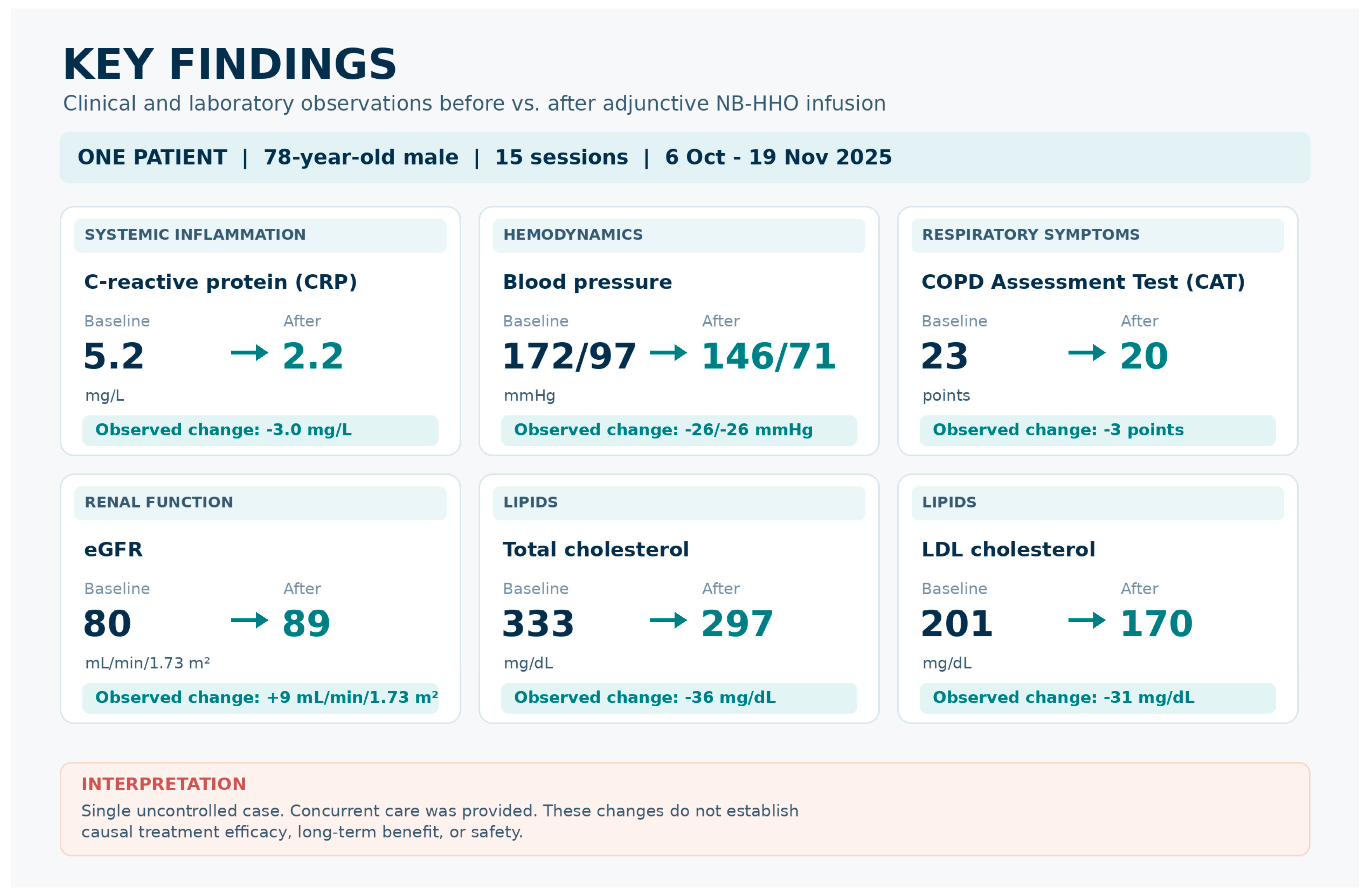
After 15 sessions, blood pressure was 146/71 mmHg compared with 172/97 mmHg at baseline. CRP decreased from 5.2 to 2.2 mg/L, while eGFR was 89 mL/min/1.73 m² compared with 80 mL/min/1.73 m² at baseline. Total cholesterol changed from 333 to 297 mg/dL, and LDL-C from 201 to 170 mg/dL; both remained elevated for a patient with established coronary disease. The CAT score was 20 at the end of treatment compared with 23 at baseline. The patient also reported reduced productive cough and increased physical energy.
These values represent observations at two time points rather than proof that the intervention produced the changes. Table 1 presents the measurements without causal attribution.
Figure 1.
Observed changes in clinical and laboratory measures from baseline to completion of 15 adjunctive sessions. These descriptive measurements do not establish causality, efficacy, or long-term safety.
Figure 1.
Observed changes in clinical and laboratory measures from baseline to completion of 15 adjunctive sessions. These descriptive measurements do not establish causality, efficacy, or long-term safety.
2.6. Safety Monitoring and Follow-Up
ECG and laboratory monitoring were documented at designated sessions, including laboratory assessments at sessions 4, 10, and 15. Detailed ECG findings, systematically collected adverse-event outcomes, and longer-term observations after the fifteenth session were not provided in the available case description. Therefore, safety and tolerability cannot be determined from these records. The reported symptom changes and biochemical measurements describe the end of the six-week observation period only.
3. Discussion
3.1. Clinical Observations in Geriatric Multimorbidity
This report documents temporal changes in selected clinical and laboratory measures during 15 sessions of adjunctive intravenous NB-HHO treatment in a 78-year-old man with COPD and several cardiovascular, metabolic, and musculoskeletal conditions. CRP, blood pressure, total cholesterol, LDL-C, and CAT score were lower at the end of the observation period; eGFR was numerically higher, and the patient reported less cough and greater vitality. These observations are of clinical interest but cannot establish a treatment effect because the case involved one patient, multiple concurrent clinical measures, and no comparator.
Inflammaging and oxidative stress may contribute to interconnected respiratory and cardiometabolic disease processes in older adults [6,7]. Clustering of COPD comorbidities has been associated with systemic inflammation, and endothelial dysfunction is relevant to both COPD and cardiovascular disease [8,9]. This provides a biological context for investigating redox-related interventions, while the same multimorbidity makes the interpretation of individual outcomes especially difficult.
3.2. Systemic Inflammation and Proposed Hydrogen-Related Mechanisms
CRP decreased from 5.2 to 2.2 mg/L. The direction of this change is consistent with a lower inflammatory marker level at the final assessment; however, CRP is nonspecific and responsive to infection, disease activity, medication exposure, and normal biological fluctuation. Gough et al. [31] documented substantial within-person variation in CRP and high-sensitivity CRP, reinforcing the limitations of drawing strong conclusions from only two measurements.
Molecular hydrogen has been studied as a potential modulator of oxidative injury. Ohsawa et al. [21] reported protection against selected oxidative insults in experimental systems, while subsequent studies have proposed changes in endogenous antioxidant responses, including Keap1–Nrf2 signaling and mitochondrial processes [11,14,23]. These mechanisms are not established for the intravenous preparation used here. The patient did not undergo direct measurement of cytokines, redox biomarkers, Nrf2 signaling, or mitochondrial activity. Thus, although a reduction in CRP is biologically compatible with hypotheses derived from hydrogen research, it does not demonstrate an anti-inflammatory mechanism or treatment-specific benefit.
3.3. Hemodynamic Findings and Renal Function
Blood pressure changed from 172/97 to 146/71 mmHg during the observation period. This numerical reduction is noteworthy in a patient with coronary artery disease, hypertension, and diabetes, but the final systolic value remained elevated and the data cannot demonstrate sustained blood pressure control. Physiological NO signaling is involved in vascular tone and renal perfusion [17]; however, the proposed contributions of H₂, O₂, and NO within the administered formulation were not directly measured. The previous exploratory intravenous oxyhydrogen nanobubble case series in three patients with chronic kidney disease [27] provides contextual human experience but does not validate an effect in this patient or establish a generalizable protocol.
The eGFR changed from 80 to 89 mL/min/1.73 m². In a person with marked weight loss and reduced muscle mass, interpretation of creatinine-based kidney function estimates requires caution. The KDIGO 2024 executive summary [30] identifies circumstances in which non-GFR determinants, including muscle mass, may affect creatinine estimates and additional testing may be helpful. Because the estimating method and other relevant measurements were not fully documented, the reported eGFR increase cannot be taken as confirmation of renal recovery.
A further limitation is the patient's documented history of inconsistent adherence to antihypertensive medication. Without a complete record of medication use and clinical management throughout the six-week interval, the observed blood pressure and renal measurements cannot be attributed specifically to NB-HHO.
3.4. Lipid Changes and Cardiometabolic Interpretation
Total cholesterol decreased from 333 to 297 mg/dL, and LDL-C from 201 to 170 mg/dL. Although these changes were directionally favorable, the values remained above desirable levels for a patient with established coronary artery disease. Studies of orally administered hydrogen-rich water have reported changes in selected lipid-related outcomes among individuals with metabolic disorders [18,19]. These observations offer a relevant research context, but route, dose, delivery kinetics, and population differences prevent direct extrapolation to intravenous NB-HHO.
The case documentation does not allow the effects of dietary intake, lipid-lowering treatment, adherence, or metabolic variability to be distinguished. Mechanisms described in experimental studies, such as altered lipid oxidation or hepatic regulation, were not directly assessed in this patient. The lipid findings should therefore remain descriptive and do not support replacement of established cardiovascular prevention strategies.
3.5. Respiratory Symptoms and Patient-Reported Function
The CAT score decreased from 23 to 20, accompanied by self-reported improvement in productive cough and energy. Kon et al. [29] identified approximately two points as an estimate of the minimally important change for CAT; the three-point reduction here may therefore represent a meaningful change in reported symptom burden. Nevertheless, it cannot independently identify the cause of that change.
Zheng et al. [28] reported symptom benefits from inhaled hydrogen/oxygen compared with oxygen alone in a randomized trial involving acute exacerbation of COPD. That study differs substantially from the present case, which involved an intravenous formulation and a patient described as having stable COPD. In addition, respiratory cleansing was provided at sessions 5–10 and chest tapping at session 7. These concomitant approaches could have influenced cough, sputum clearance, and patient-reported symptom scores. No comparative spirometry or objective exercise-capacity assessment was available.
Mitochondrial dysfunction is relevant to lung inflammaging and COPD [22], but this patient's mitochondrial function, muscular performance, and body composition were not objectively reassessed. Improved vitality should be treated as a subjective observation rather than evidence of restored mitochondrial activity or reversal of possible sarcopenia.
3.6. Nanobubble Delivery and Translational Considerations
Nanobubbles are being investigated as gas-containing dispersions with possible biomedical applications, particularly in experimental oxygen-delivery systems [25]. Their physical and biological properties depend on formulation characteristics such as gas composition, concentration, particle-size distribution, and stability. Findings from experimental oxygen nanobubbles do not directly establish vascular delivery, microcirculatory improvement, or tissue oxygenation after intravenous infusion in humans.
In the present protocol, HHO and accompanying IfaMg and NO components were recorded by volume. Without additional physicochemical or pharmacological characterization, the actual exposure to individual gases cannot be determined. Therefore, proposed synergistic effects of H₂, O₂, and NO, endothelial restoration, or improved mitochondrial bioenergetics are biologically motivated hypotheses rather than mechanisms demonstrated by the data.
3.7. Strengths, Limitations, and Implications
A useful feature of this report is the documented sequence of 15 treatment sessions, including dose titration and selected clinical assessments, together with paired inflammatory, hemodynamic, kidney-function, lipid, and symptom measures. It therefore adds a detailed individual observation to a small and emerging literature on intravenous oxyhydrogen nanobubble administration.
Several limitations substantially restrict interpretation. First, a single uncontrolled case is susceptible to confounding, regression toward the mean, and ordinary fluctuations in chronic disease. Second, detailed changes in standard medications, adherence, diet, and other supportive care were not available. Third, blood pressure and laboratory measures were compared mainly at baseline and the end of therapy; objective pulmonary and mechanistic markers were limited. Fourth, the marked loss of body mass complicates eGFR interpretation. Fifth, formulation-specific gas exposure and nanobubble characterization were not sufficiently described to support reproducibility. Finally, detailed ECG findings, systematic adverse-event surveillance, and long-term follow-up were not provided, precluding conclusions about safety or durability.
The findings should consequently be used to define questions for further research rather than to endorse routine clinical use. Future investigations should first address formulation standardization and prospective safety assessment, followed by controlled studies capable of separating the effects of the intervention from established medical treatment and natural variation.
4. Conclusions
This single-patient report documents temporal decreases in CRP, blood pressure, total cholesterol, LDL-C, and COPD symptom burden, together with a numerically higher eGFR and subjective symptom improvement during six weeks of adjunctive intravenous oxyhydrogen nanobubble treatment. Because of the uncontrolled design, concurrent clinical care, incomplete intervention characterization, and limited safety and follow-up information, these observations cannot establish causality, efficacy, renal recovery, or long-term safety. Standardized formulation research and controlled prospective studies are required before clinical value can be assessed.
Author Contributions
Conceptualization, R.T.R., O.I., and S.; clinical methodology and case documentation, O.I. and S.; data collection and verification, R.T.R., O.I., and S.; literature review, R.T.R. and O.I.; writing—original draft preparation, R.T.R.; writing—review and editing, R.T.R., O.I., and S.; visualization, R.T.R.; supervision, O.I. and S. All authors are expected to review and approve the final version of the manuscript and accept responsibility for their respective contributions.
Institutional Review Board Statement
This retrospective case report was prepared in accordance with the ethical principles outlined in the Declaration of Helsinki. The clinical information was derived from records generated during routine patient care, without introducing additional diagnostic or therapeutic procedures specifically for research reporting.
Data Availability Statement
The clinical and laboratory data underlying the findings of this case report are included in the manuscript. Additional patient-specific medical records are not publicly accessible to ensure the protection of personal health information and patient confidentiality. Supplementary de-identified data may be made available upon reasonable request, subject to institutional policies and applicable data protection regulations.
Acknowledgments
he authors express their appreciation to the Indonesian Molecular Innovation Foundation (IMI), Malang, Indonesia, for its institutional affiliation and support. The authors also extend their gratitude to the medical professionals and clinical staff who contributed to patient assessment, clinical monitoring, and documentation throughout the reported case.
Conflicts of Interest
The authors declare no financial or non-financial conflicts of interest that could have influenced the preparation, interpretation, or reporting of this manuscript.
Abbreviations
| CAD | Coronary Artery Disease |
| CAT | COPD Assessment Test |
| COPD | Chronic Obstructive Pulmonary Disease |
| CRP | C-Reactive Protein |
| ECG | Electrocardiography |
| eGFR | Estimated Glomerular Filtration Rate |
| H₂ | Molecular Hydrogen |
| HHO | Hydrogen–Oxygen Preparation (as named in the clinical record) |
| IfaMg | Infusion Component Recorded as “IfaMg”; composition not specified |
| LDL-C | Low-Density Lipoprotein Cholesterol |
| NB-HHO | Oxyhydrogen Nanobubble |
| NO | Nitric Oxide |
| Nrf2 | Nuclear Factor Erythroid 2-Related Factor 2 |
| ROS | Reactive Oxygen Species |
| TURP | Transurethral Resection of the Prostate |
References
- Orlowski, A.; Ettinger, J.; Bottle, A.; et al. Modifiable risk factors that may be addressed in routine care to prevent progression to and extension of multimorbidity in people with COPD: a systematic literature review. BMJ Open Respir. Res. 2024, 11(1), e002272. [Google Scholar] [CrossRef]
- Alter, P.; et al. Disease progression and age as factors underlying multimorbidity in patients with COPD: results from COSYCONET. Int. J. Chron. Obstruct Pulmon Dis. 2022, 17, 1703–1713. [Google Scholar] [CrossRef]
- Cui, J.; et al. Prevalence, patterns and prognosis of multimorbidity among middle-aged and elderly inpatients with chronic obstructive pulmonary disease. Zhonghua Yu Fang Yi Xue Za Zhi 2023, 57(5), 701–709. [Google Scholar]
- Wu, J.; et al. Healthcare for older adults with multimorbidity: a scoping review of reviews. Clin. Interv. Aging 2023, 18, 1723–1735. [Google Scholar] [CrossRef]
- Mariniello, D.F.; et al. Comorbidities in COPD: current and future treatment challenges. J. Clin. Med. 2024, 13(3), 743. [Google Scholar] [CrossRef]
- Franceschi, C.; Campisi, J. Chronic inflammation (inflammaging) and its potential contribution to age-associated diseases. J. Gerontol. A Biol. Sci. Med. Sci. 2014, 69 (Suppl 1), S4–S9. [Google Scholar] [CrossRef] [PubMed]
- Tan, B.L.; et al. Antioxidant and oxidative stress: a mutual interplay in age-related diseases. Front Pharmacol. 2018, 9, 1162. [Google Scholar] [CrossRef]
- Vanfleteren, L.E.G.W.; et al. Clusters of comorbidities based on validated objective measurements and systemic inflammation in patients with chronic obstructive pulmonary disease. Am. J. Respir. Crit. Care Med. 2013, 187(7), 728–735. [Google Scholar] [CrossRef]
- Marcuccio, G.; et al. Endothelial dysfunction in chronic obstructive pulmonary disease: an update on mechanisms, assessment tools and treatment strategies. Front Med. 2025, 12, 1550716. [Google Scholar] [CrossRef]
- Ohta, S. Molecular hydrogen as a novel antioxidant: overview of the advantages of hydrogen-mediated anti-oxidant effects. Med. Gas. Res. 2021, 11(1), 1–8. [Google Scholar]
- Ishibashi, T. Therapeutic efficacy of molecular hydrogen: a new mechanistic insight. Curr. Pharm. Des. 2019, 25(9), 946–955. [Google Scholar] [CrossRef]
- LeBaron, T.W.; et al. A new approach for the prevention and treatment of cardiovascular disorders: molecular hydrogen significantly reduces the effects of oxidative stress. Molecules 2019, 24(11), 2076. [Google Scholar] [CrossRef]
- Nakao, A.; et al. Effectiveness of hydrogen-rich water on antioxidant status of subjects with potential metabolic syndrome: an open-label pilot study. J. Clin. Biochem Nutr. 2010, 46(2), 140–149. [Google Scholar] [CrossRef]
- Chen, H.; et al. Molecular hydrogen protects mice against polymicrobial sepsis by ameliorating endothelial dysfunction via an Nrf2/HO-1 signaling pathway. Int. Immunopharmacol. 2015, 28(1), 643–654. [Google Scholar] [CrossRef]
- Johnsen, H.M.; et al. Molecular hydrogen therapy—a review on clinical studies and outcomes. Molecules 2023, 28(23), 7785. [Google Scholar] [CrossRef]
- Qiu, P.; et al. Recent advances in studies of molecular hydrogen against sepsis. Int. J. Biol. Sci. 2019, 15(6), 1261–1275. [Google Scholar] [CrossRef]
- Ahmad, A.; et al. Role of nitric oxide in the cardiovascular and renal systems. Int. J. Mol. Sci. 2018, 19(9), 2605. [Google Scholar] [CrossRef]
- Song, G.; et al. Hydrogen-rich water decreases serum LDL-cholesterol levels and improves HDL function in patients with potential metabolic syndrome. J. Lipid Res. 2013, 54(7), 1884–1893. [Google Scholar] [CrossRef]
- Jamialahmadi, H.; et al. The effects of hydrogen-rich water on blood lipid profiles in metabolic disorders clinical trials: a systematic review and meta-analysis. Int. J. Endocrinol. Metab. 2024, 22(3), e148600. [Google Scholar] [CrossRef]
- Liu, B.; et al. Hydrogen inhalation alleviates nonalcoholic fatty liver disease in metabolic syndrome rats. Mol. Med. Rep. 2020, 22, 2860–2868. [Google Scholar] [CrossRef]
- Ohsawa, I.; et al. Hydrogen acts as a therapeutic antioxidant by selectively reducing cytotoxic oxygen radicals. Nat. Med. 2007, 13, 688–694. [Google Scholar] [CrossRef]
- Lerner, C.A.; et al. Mitochondrial redox system, dynamics, and dysfunction in lung inflammaging and COPD. Int. J. Biochem Cell Biol. 2016, 81 Pt B, 294–306. [Google Scholar] [CrossRef]
- Cheng, D.; et al. Hydrogen: a rising star in gas medicine as a mitochondria-targeting nutrient via activating Keap1-Nrf2 antioxidant system. Antioxidants 2023, 12(12), 2062. [Google Scholar] [CrossRef]
- Dimsdale, J.E. Psychological stress and cardiovascular disease. J. Am. Coll. Cardiol. 2008, 51(13), 1237–1246. [Google Scholar] [CrossRef]
- Viafara Garcia, S.M.; Khan, M.S.; Haidar, Z.S.; Acevedo Cox, J.P. NanoBubble-mediated oxygenation: elucidating the underlying molecular mechanisms in hypoxia and mitochondrial-related pathologies. Nanomaterials 2023, 13(23), 3060. [Google Scholar] [CrossRef]
- Suliman, H.B.; Piantadosi, C.A. Mitochondrial quality control as a therapeutic target. Pharmacol. Rev. 2016, 68(1), 20–48. [Google Scholar] [CrossRef]
- Indrajani, O.; Hernowo, A.T.; Ekasari, C.P.; Yudhanata, R.; Sumitro, S.B. The effect of intravenous oxyhydrogen nanobubble on chronic kidney disease: case series. Clin. Ther. 2025, 47(9), e13–e17. [Google Scholar] [CrossRef]
- Zheng, Z.G.; Sun, W.Z.; Hu, J.Y.; et al. Hydrogen/oxygen therapy for the treatment of an acute exacerbation of chronic obstructive pulmonary disease: results of a multicenter, randomized, double-blind, parallel-group controlled trial. Respir. Res. 2021, 22, 149. [Google Scholar] [CrossRef]
- Kon, S.S.C.; Canavan, J.L.; Jones, S.E.; et al. Minimum clinically important difference for the COPD Assessment Test: a prospective analysis. Lancet Respir. Med. 2014, 2(3), 195–203. [Google Scholar] [CrossRef]
- Levin, A.; Ahmed, S.B.; Carrero, J.J.; et al. Executive summary of the KDIGO 2024 Clinical Practice Guideline for the Evaluation and Management of Chronic Kidney Disease: known knowns and known unknowns. Kidney Int. 2024, 105(4), 684–701. [Google Scholar] [CrossRef] [PubMed]
- Gough, A.; Sitch, A.; Ferris, E.; Marshall, T. Within-subject variation of C-reactive protein and high-sensitivity C-reactive protein: a systematic review and meta-analysis. PLoS ONE 2024, 19(11), e0304961. [Google Scholar] [CrossRef]

Table 1.
Clinical and laboratory measurements at baseline and after 15 adjunctive NB-HHO sessions.
| Parameter | Baseline | After 15 sessions |
| Blood pressure (mmHg) | 172/97 | 146/71 |
| CRP (mg/L) | 5.2 | 2.2 |
| eGFR (mL/min/1.73 m²) | 80 | 89 |
| Total cholesterol (mg/dL) | 333 | 297 |
| LDL-C (mg/dL) | 201 | 170 |
| CAT score (points) | 23 | 20 |
Abbreviations: CRP, C-reactive protein; eGFR, estimated glomerular filtration rate; LDL-C, low-density lipoprotein cholesterol; CAT, COPD Assessment Test.
Disclaimer/Publisher’s Note: The statements, opinions and data contained in all publications are solely those of the individual author(s) and contributor(s) and not of MDPI and/or the editor(s). MDPI and/or the editor(s) disclaim responsibility for any injury to people or property resulting from any ideas, methods, instructions or products referred to in the content. |
© 2026 by the authors. Licensee MDPI, Basel, Switzerland. This article is an open access article distributed under the terms and conditions of the Creative Commons Attribution (CC BY) license (http://creativecommons.org/licenses/by/4.0/).
Copyright: This open access article is published under a Creative Commons CC BY 4.0 license, which permit the free download, distribution, and reuse, provided that the author and preprint are cited in any reuse.