

Submitted:
03 November 2026
Posted:
04 November 2026
You are already at the latest version
Abstract
Introduction: Institutional inclusion does not necessarily produce meaningful economic participation. Across the supplied literature, women, youth and persons with disabilities encounter policy implementation gaps, administrative burdens, discriminatory norms, financial exclusion, digital access constraints and weak transitions from education or training into work and enterprise. This review examined how institutional barriers and opportunities influence the economic participation of women, youth and persons with disabilities within inclusive development and socio-economic governance contexts.Methods: The researcher-selected databases and information sources were Google Scholar. The eligibility protocol restricted publication years to 2016–2026. The exact calendar date of search execution was not recorded in the verified identification provenance; this is distinct from the publication-year eligibility range. A systematic review searched Google Scholar for English-language peer-reviewed studies published from 2016 to 2026 using a predefined Boolean strategy.Results: Seven codes clustered into four categories and produced five analytical themes. Formal inclusion frequently failed during implementation; administrative design converted nominal access into practical exclusion; norms, discrimination and accessibility barriers patterned participation; finance and digitalisation operated as conditional opportunities; and capability-building was most promising when embedded in coordinated, locally responsive support systems. Evidence was broad on barriers but uneven on youth-specific lived experience, intersectionality, implementation fidelity and long-term livelihood outcomes. Bibliometric evidence mapped prominence and relationships but did not establish quality or causal strength.Discussion/Conclusion: Economic participation is shaped less by the existence of inclusive policies than by their enforcement, accessibility, institutional coordination and fit with local capabilities. Inclusive development therefore requires integrated governance, simplified procedures, accessible finance and technology, capability development and sustained multi-stakeholder support.
Keywords:
economic participation
; financial inclusion
; inclusive development
; institutional barriers
; persons with disabilities
1. Introduction
Inclusive development presumes that economic opportunity should be accessible to groups historically excluded from employment, entrepreneurship, finance, labour-market integration and sustainable livelihoods. The supplied literature, however, presents inclusion as an institutional process rather than a policy label. Studies of women’s entrepreneurship and labour-market participation associate economic opportunity with finance, education, technology, social norms and institutional support, while disability-focused research describes the continuing distance between formal rights and practical access (Syeda, 2026; Rietveld & Patel, 2022; Adhikari & Pradhananga, 2024). Evidence concerning youth similarly links participation to financial literacy, social investment, school-to-work transitions and access to suitable economic infrastructure (Ecchia et al., 2019; Rudevska & Ukhanova, 2026).
The supplied evidence indicates that institutional barriers operate through several connected mechanisms. Policies may be inadequately enforced, underfunded or poorly localized; administrative procedures may require documentation, verification or collateral that excluded groups cannot readily provide; organizations may reproduce gendered, ableist or productivity-based assumptions; and financial and digital systems may remain inaccessible despite apparent expansion. Conversely, self-help groups, cooperatives, social enterprises, mentoring, disability organizations, digital platforms, education and public–private partnerships can expand participation when they are coordinated and responsive to context (Nurfaisah & Pertiwi, 2025; Odaya, 2024; Muuo et al., 2025).
Important uncertainties remain. The evidence base combines qualitative, mixed-methods, quantitative, review, conceptual and policy materials, making direct comparison difficult. Youth-specific lived experience is comparatively thin, long-term outcomes are rarely demonstrated, and apparent contradictions may reflect differences between perceived access and actual use rather than genuinely opposing effects. The evidence also remains insufficiently integrated across women, youth and persons with disabilities, particularly where gender, disability, age, poverty and rurality intersect. A systematic review was therefore needed to synthesise institutional mechanisms across populations and contexts, distinguish barriers from conditional opportunities, and identify implications for research, policy and practice.
2. Research Objectives
RO1: To examine how institutional barriers (such as policy frameworks, regulatory systems, organizational structures, and socio-cultural norms) influence economic participation (including employment, entrepreneurship, labor market integration, financial inclusion, and livelihood sustainability) and inclusive development among women, youth, and persons with disabilities within inclusive development frameworks and socio-economic governance environments.
RO2: To examine the contextual, institutional and practice-related factors that shape the adoption and effective use of Institutional barriers and opportunities (such as policy frameworks, regulatory systems, organizational structures, and socio-cultural norms) within Inclusive development frameworks and socio-economic governance environments.
RO3: To identify gaps in the available evidence and derive implications for future research, policy and practice relevant to Advancing Inclusive Development: An Exploration of Institutional Barriers and Opportunities for the Economic Participation of Women, Youth and Persons with Disabilities..
3. Research Methods
3.1. Review Design
The selected review type was a Systematic Review. Evidence synthesis was understood as the systematic integration of findings from existing research to answer a defined question. This design was appropriate because the project sought to identify recurring institutional mechanisms across heterogeneous evidence concerning employment, entrepreneurship, labour-market integration, financial inclusion and livelihood sustainability. The review was reported through PRISMA-oriented selection documentation, while CASP was used for study-level methodological appraisal and thematic synthesis was used for analysis. PRISMA concerns transparent reporting, SALSA distinguishes searching, appraisal, synthesis and analysis, CASP provides design-sensitive critical appraisal, and COSTAQDA supported traceability from extracted findings to synthesised themes (Grant & Booth, 2009; Page et al., 2021; Costa & Costa, 2024).
3.2. Search Strategy and Information Sources
The researcher-selected databases and information sources were Google Scholar. The eligibility protocol restricted publication years to 2016–2026. The exact calendar date of search execution was not recorded in the verified identification provenance; this is distinct from the publication-year eligibility range.
Full Boolean search string (exactly as recorded)
(“Target Populations” OR women OR female OR youth OR “young adults” OR “persons with disabilities” OR disabled OR “marginalized populations” OR “vulnerable groups”) AND (“Institutional Barriers and Opportunities” OR “institutional barriers” OR “structural constraints” OR “policy opportunities” OR “regulatory frameworks” OR “institutional factors” OR “systemic barriers” OR “institutional mechanisms” OR “legal frameworks”) AND (“Economic Participation” OR “economic participation” OR “economic empowerment” OR employment OR entrepreneurship OR “financial inclusion” OR “labor market participation” OR “livelihood generation” OR “economic inclusion”) NOT (“child labor”)
3.3. Inclusion and Exclusion Criteria
Inclusion
- Studies focusing on women, youth, and/or persons with disabilities as target populations or key analytical subgroups.
- Studies examining institutional barriers or opportunities, such as regulatory frameworks, formal or informal institutional practices, policy environments, or structural conditions.
- Studies measuring or addressing outcomes related to economic participation, including employment, entrepreneurship, labor market integration, financial inclusion, or economic empowerment.
- Studies conducted within the context of inclusive development initiatives or socio-economic systems.
- Studies published between 2016 and 2026.
- Studies published in the English language.
- Studies published as peer-reviewed journal articles.
Exclusion
- Studies that do not focus on or disaggregate findings for women, youth, or persons with disabilities.
- Studies that do not examine institutional factors, focusing solely on individual-level psychological or biological traits.
- Studies that do not evaluate outcomes related to economic participation (e.g., focusing exclusively on general health or non-economic social outcomes).
- Studies conducted outside the context of inclusive development initiatives or socio-economic systems.
- Studies published prior to 2016 or after 2026.
- Studies published in languages other than English.
- Non-peer-reviewed literature, including gray literature, book chapters, conference abstracts, editorials, and dissertations.
3.4. Screening and Study Selection
The PRISMA selection counts are persisted, but the decision rule used during title/abstract screening is not available in the verified audit payload. COSTAQDA therefore reports the recorded workflow counts without reconstructing an unverified screening procedure.
The persisted PRISMA workflow records 148 identified records, 4 duplicates, 144 records screened, 143 reports sought for retrieval, 1 records excluded at the title/abstract stage, 92 full texts assessed, 0 full-text exclusions and 92 included records. These counts describe study selection and are not substantive review findings.
Figure 1.
PRISMA 2020 Flow Diagram—Identification, Screening, Eligibility and Included. Source: COSTAQDA PRISMA Workflow, navigation item 8: PRISMA Flow Diagram; four-stage structure showing Identification, Screening, Eligibility (including CASP critical appraisal) and Included; adapted from PRISMA 2020 (Page et al., 2021).
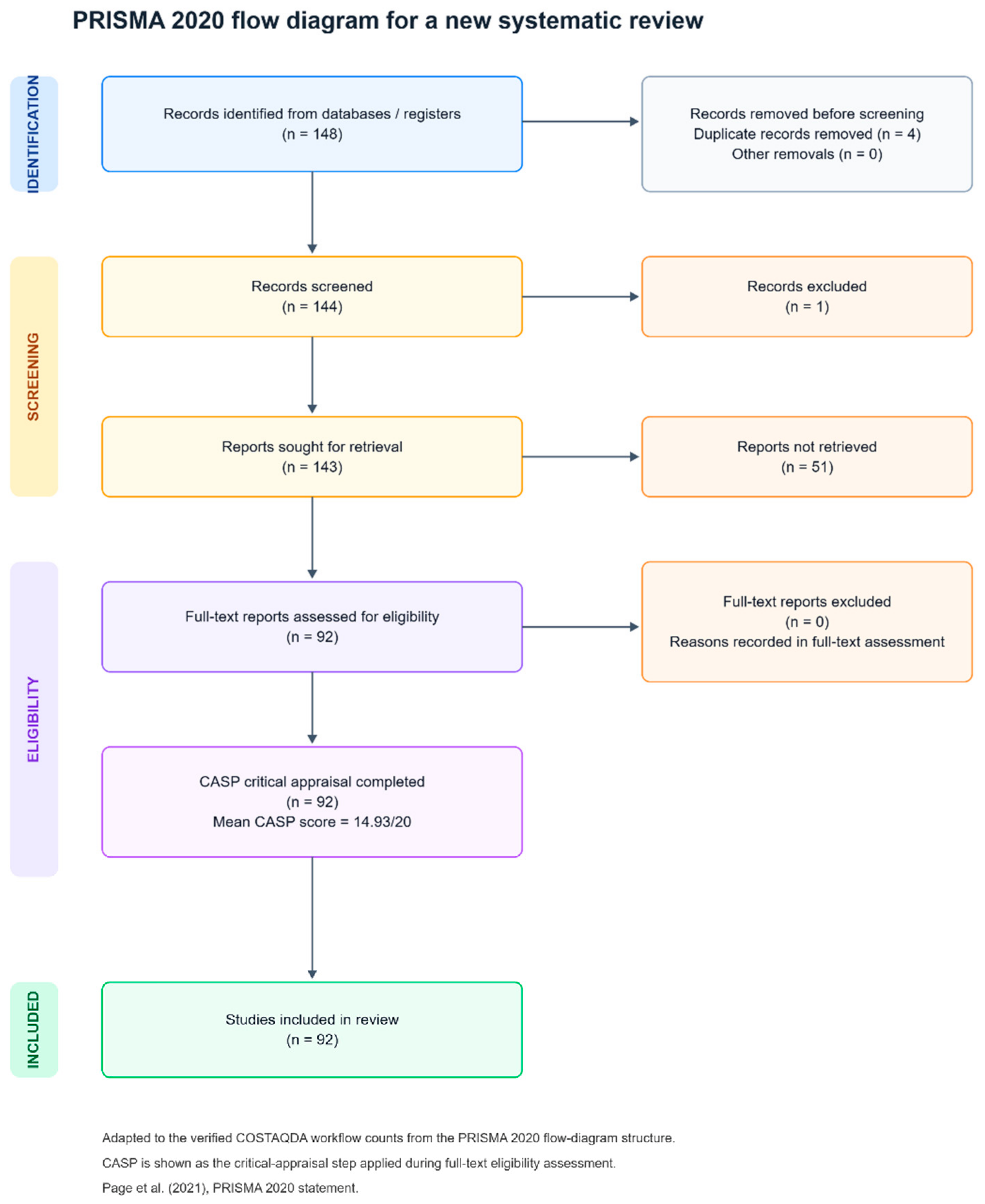
The PRISMA figure should be read as a transparent account of record movement through identification, deduplication, screening, retrieval, full-text assessment and inclusion. Its supplied values are 148 identified, 4 duplicates, 144 screened, 143 sought for retrieval, 1 title or abstract exclusion, 92 full texts assessed, 0 full-text exclusions and 92 included. The figure documents workflow rather than the strength, direction or importance of substantive evidence. Because the verified audit does not preserve the title and abstract decision rule, the figure cannot independently demonstrate the full reproducibility of screening decisions.
3.5. Critical Appraisal
CASP was used in the PRISMA full-text workspace, and 92 of 92 currently included studies had completed appraisals. The Critical Appraisal Skills Programme provides structured questions for examining methodological validity, the credibility of findings and their relevance; the supplied workspace identifies CASP but does not verify that every included study was assessed with the qualitative checklist. Accordingly, the appraisal is reported as CASP rather than as a single design-specific instrument across the heterogeneous evidence base.
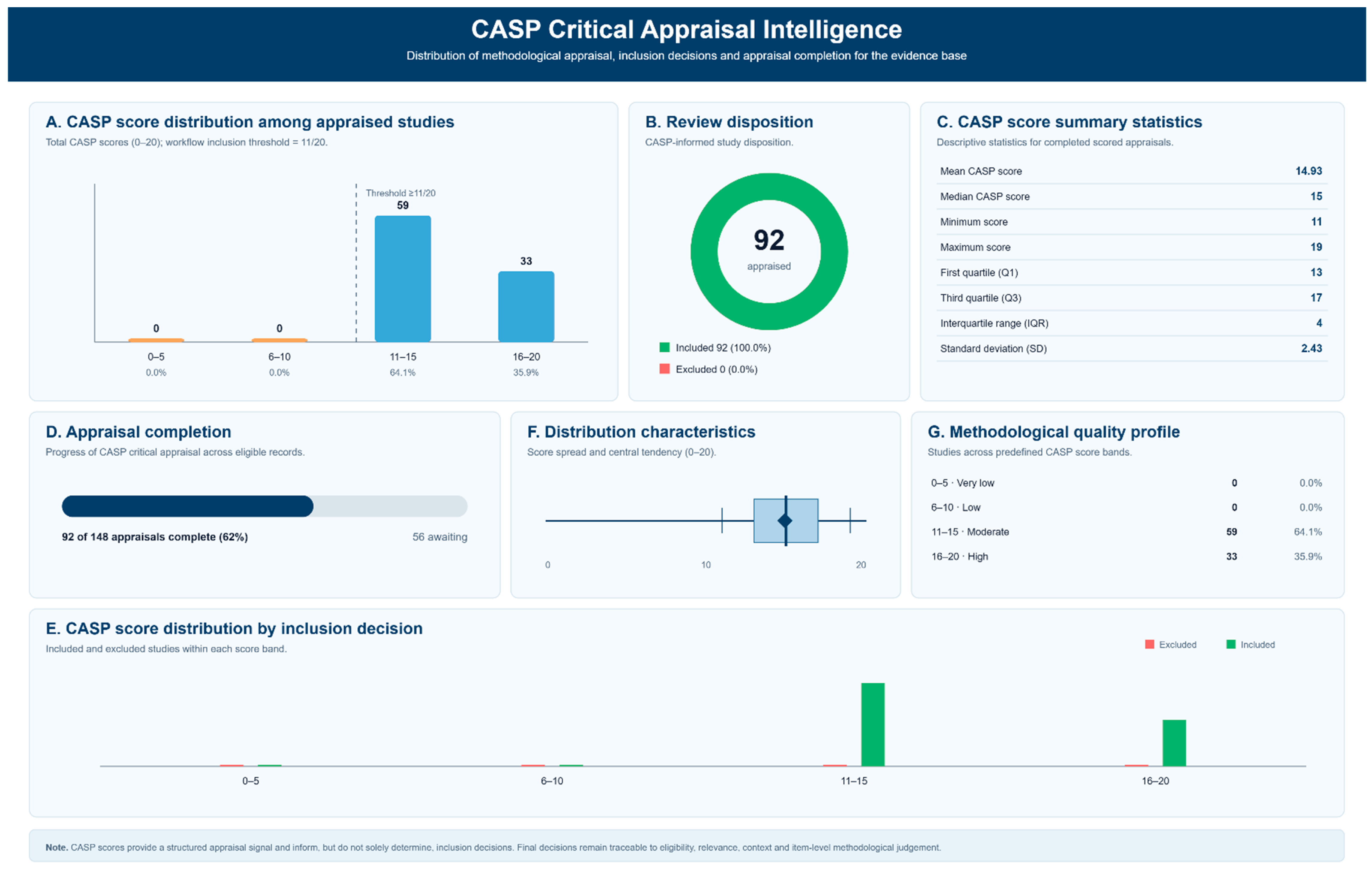
The recorded mean CASP score was 14.93, but this value was not treated as a definitive quality ranking. The workspace contains study-level scores ranging from 11 to 19 among the displayed records, with study-linked limitations recorded for methodological concerns. For example, concerns were recorded for the disability financial-inclusion study by Arora and Gupta (2026), the Nigeria disability financial-inclusion study by Ofuani-Sokolo and Monye (2024), the procurement study by Odaya (2024), and the educational inequalities study by Sandeep and Sukhwinder (2023). These concerns constrain confidence in interpreting reported associations and implementation claims.
The appraisal record also shows that many assessments were completed conservatively when the configured appraisal service was unavailable. Unsupported criteria were recorded as Can’t tell and required researcher verification. This distinction is important: missing reporting was not treated as demonstrated methodological failure, while recorded concerns were not erased by the presence of a numerical score. Such an approach is consistent with guidance that CASP should support reasoned methodological interpretation rather than uncritical checklist arithmetic (Long et al., 2020; Noyes et al., 2018).
Methodological heterogeneity further limits cross-study inference. The evidence includes qualitative interviews, case studies, surveys, regression analyses, reviews, policy analyses and conceptual materials. Qualitative studies such as Muuo et al.(2025)., Trezzini et al.(2022). and Menyana (2026) provide direct or interpretive accounts of institutional experience, whereas quantitative studies such as Rietveld and Patel (2022), Karthik et al.(2025). and Rudevska and Ukhanova (2026) estimate associations using different constructs and populations. These designs answer related but not identical questions and should not be combined as though they provide equivalent evidence.
CASP appraisal therefore informed interpretation rather than determining final inclusion or assigning formal confidence to each analytical theme. The traceable association between study-linked extracts, findings, codes and themes was supported by COSTAQDA, but traceability does not eliminate limitations in the underlying studies (Costa & Costa, 2024). No verified finding-level GRADE-CERQual assessment was supplied, so no CERQual confidence rating is claimed (Lewin et al., 2018).
The CASP figure represents completed study-level appraisals, with 92 of 92 included studies appraised and a recorded mean score of 14.93. It is useful for showing appraisal coverage and variation in recorded scores, but it should not be interpreted as a validated total-quality metric. The displayed study-linked scores range from 11 to 19, while recorded concerns include uncertainty and methodological limitations across different designs. A mean cannot show which domains were problematic, whether limitations affected particular findings, or how design differences shaped appraisal. The figure therefore supports a cautious methodological overview rather than a hierarchy of study credibility (Long et al., 2020; Noyes et al., 2018).
Figure 2.
CASP Critical Appraisal Intelligence—PRISMA Workflow, Step 6: Full-Text Screening. Source: COSTAQDA PRISMA Workflow, navigation item 6: Full-Text Screening (CASP critical appraisal outputs). The Word figure is generated from the same deterministic COSTAQDA CASP visual.
Figure 2.
CASP Critical Appraisal Intelligence—PRISMA Workflow, Step 6: Full-Text Screening. Source: COSTAQDA PRISMA Workflow, navigation item 6: Full-Text Screening (CASP critical appraisal outputs). The Word figure is generated from the same deterministic COSTAQDA CASP visual.
3.6. Data Extraction
Data extraction was not recorded as a separate procedural narrative. Nevertheless, the verified synthesis workspace demonstrates that finding-level extraction occurred: 557 extracted findings contributed by 72 studies were retained with finding IDs and study IDs. The available evidence fields include study bibliographic information, abstracts, appraisal records and extracted finding text. Because a formal extraction form, extractor number, duplicate checking procedure and field-level verification process were not supplied, the completeness and reproducibility of extraction remain uncertain.
3.7. Data Synthesis and Analysis
Qualitative evidence synthesis was conducted on 557 extracted findings contributed by 72 studies. The COSTAQDA synthesis engine applied thematic synthesis, moving from traceable finding-level evidence to 7 initial codes, 4 categories, 1 descriptive themes and 5 analytical themes.
Theme development was constrained to the extracted finding-level evidence supplied by eligible studies. Each synthesised theme retained supporting study IDs and finding IDs, while contradictory evidence was preserved where identified. Titles, abstracts and bibliographic prominence were not treated as substitutes for extracted qualitative findings.
Recorded synthesis limitations included: The supplied extracts combine qualitative, mixed-methods, quantitative, review, conceptual, and policy materials; therefore, the synthesis should not be interpreted as based exclusively on qualitative participant accounts.; Many extracts are partial, truncated, or methodological and some contain recommendations rather than observed implementation outcomes.; Evidence is geographically diverse and context-dependent, limiting direct transferability across countries, sectors, and institutional systems.; Youth-specific evidence is comparatively thin, particularly regarding direct lived experiences of institutional barriers and opportunities.; The extracts provide limited longitudinal evidence on whether institutional interventions produce sustained employment, enterprise growth, or livelihood security.; Several apparent contradictions reflect differences in measurement or context, such as perceived access versus actual use, rather than directly comparable opposing findings..
3.8. Bibliometric Intelligence and Confidence in the Evidence Base
Bibliometric intelligence provides a structural view of the evidence base that complements PRISMA selection, critical appraisal and qualitative synthesis. The following analyses examine citation relationships, scholarly influence, evidence connectivity and knowledge development within the included corpus. They provide contextual evidence about the intellectual structure and provenance of the literature and are not substitutes for methodological quality appraisal.
3.8.1. Local Citation Network
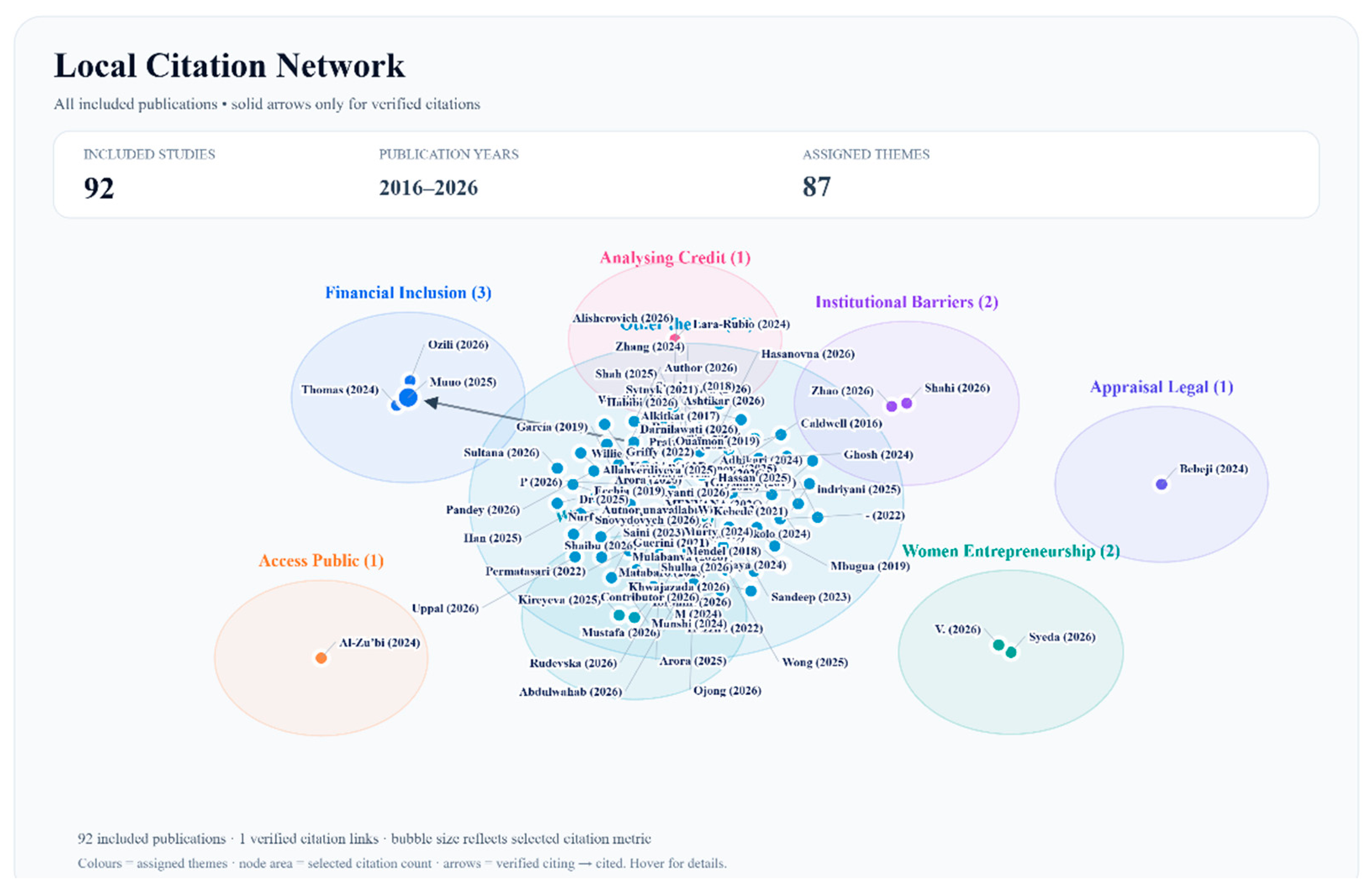
The Local Citation Network maps citation relationships within the included evidence base. It shows how studies are connected within the review corpus and supports examination of intellectual connectedness, centrality, bridging and isolation. These citation relationships describe the structure of the literature and do not, by themselves, establish methodological quality or validity.
Figure 3.
Local Citation Network—Bibliometric Intelligence, Step 12. Source: COSTAQDA PRISMA Workflow, navigation item 12: Bibliometric Intelligence—Local Citation Network.
Figure 3.
Local Citation Network—Bibliometric Intelligence, Step 12. Source: COSTAQDA PRISMA Workflow, navigation item 12: Bibliometric Intelligence—Local Citation Network.
3.8.2. Influence Pyramid
The Influence Pyramid represents the distribution of scholarly influence within the included evidence base. It helps identify how bibliometric prominence is distributed across the reviewed studies. Influence is interpreted separately from methodological quality, which is assessed through critical appraisal.
Figure 4.
Influence Pyramid—Bibliometric Intelligence, Step 12. Source: COSTAQDA PRISMA Workflow, navigation item 12: Bibliometric Intelligence—Influence Pyramid.
Figure 4.
Influence Pyramid—Bibliometric Intelligence, Step 12. Source: COSTAQDA PRISMA Workflow, navigation item 12: Bibliometric Intelligence—Influence Pyramid.
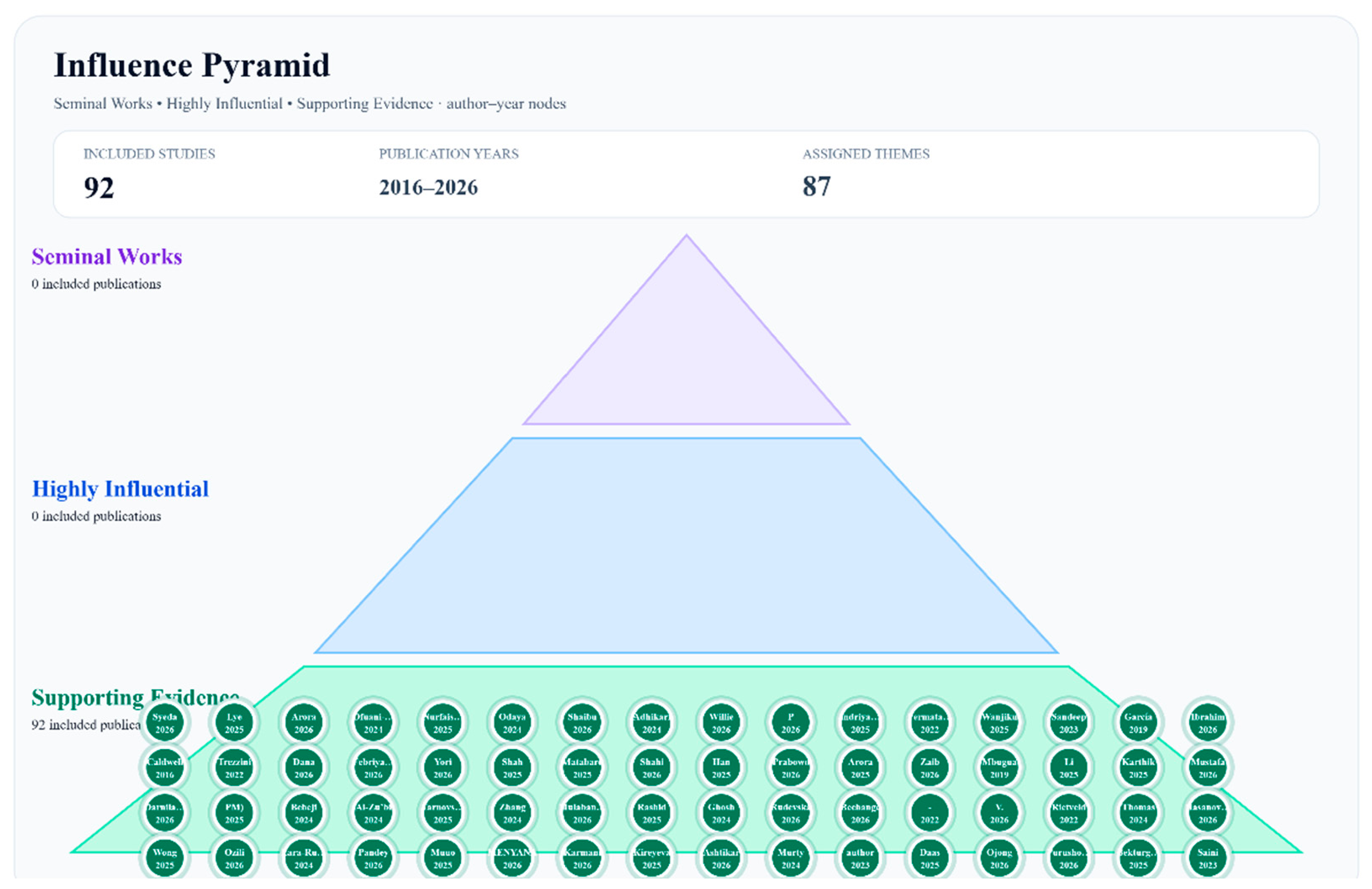
The Influence Pyramid is appropriate as a descriptive bibliometric prominence map because the project supplies OpenAlex-derived publication-level metadata for 92 included studies, including global citations, local citations and an influenceScore. The unit of analysis is the included study or publication, and the denominator is the 92-study included set. The recorded data identify three works as seminal, six as influential and a larger set as supporting, while node-level influenceScore values are predominantly 0 and one displayed study has a value of 1. These patterns suggest that bibliometric prominence is concentrated in a small portion of the mapped evidence set, but they do not demonstrate methodological quality, causal importance, consensus or substantive effectiveness.
Interpretation is constrained because the influenceScore formula, citation coverage, field normalization and comparability rules were not supplied. The OpenAlex metadata report 283 global citations, 1 local citation, 1 link and 1 cluster, but the citation denominator and procedures behind the prominence labels cannot be independently established from the supplied record. The pyramid therefore contextualizes visibility within the project corpus rather than weighting findings in the thematic synthesis. Bibliometric analysis should be designed and interpreted separately from evidence appraisal and qualitative synthesis (Donthu et al., 2021; Zupic & Čater, 2015).
3.8.3. Evidence Strength
The Evidence Strength analysis examines the structure and strength of relationships within the evidence ecosystem assembled for the review. It complements, but does not replace, CASP methodological appraisal and must not be interpreted as a direct estimate of causal effect.
Figure 5.
Evidence Strength Network—Bibliometric Intelligence, Step 12. Source: COSTAQDA PRISMA Workflow, navigation item 12: Bibliometric Intelligence—Evidence Strength Network.
Figure 5.
Evidence Strength Network—Bibliometric Intelligence, Step 12. Source: COSTAQDA PRISMA Workflow, navigation item 12: Bibliometric Intelligence—Evidence Strength Network.
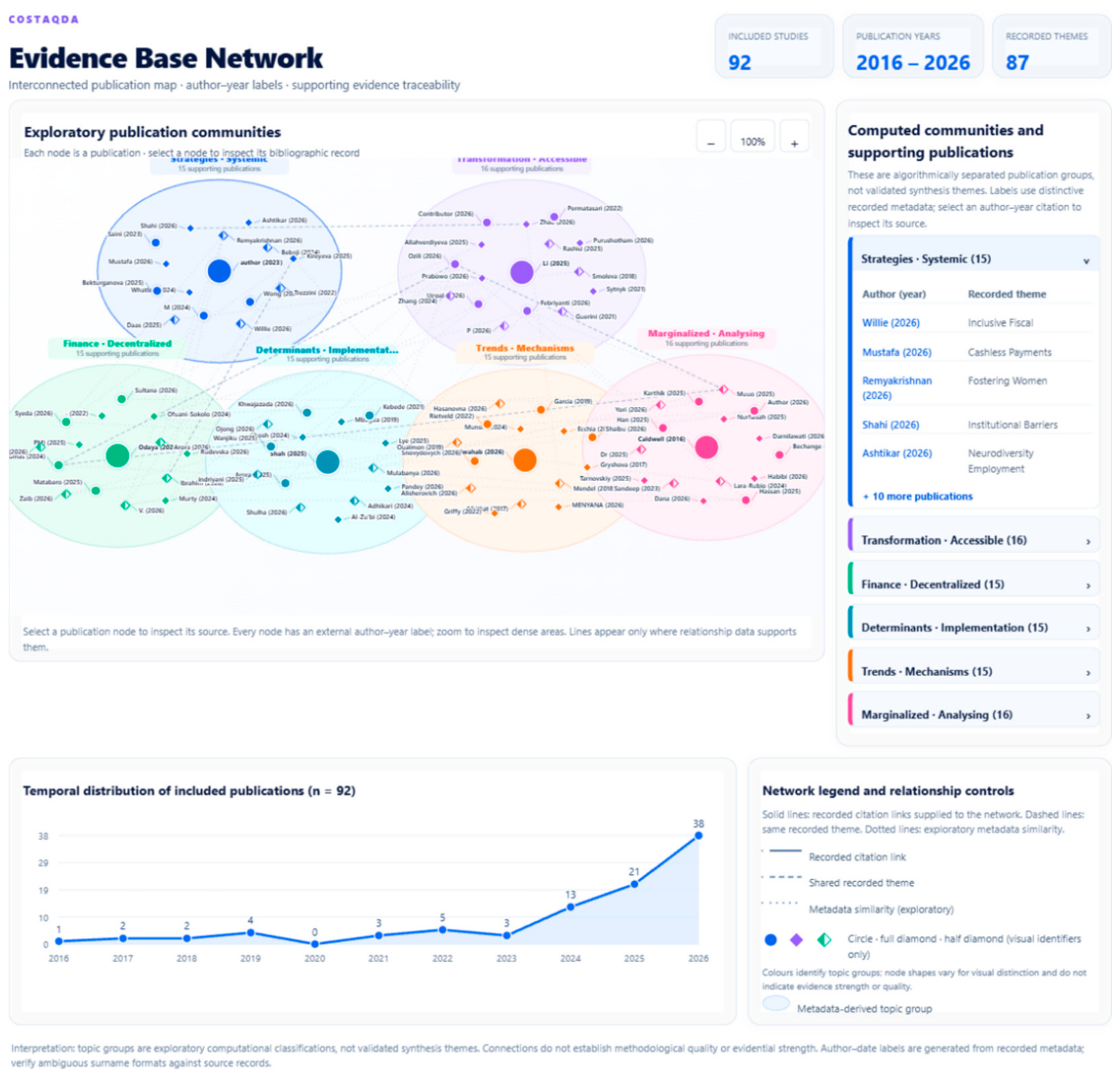
The Evidence Strength Network is appropriate for displaying the structure of recorded relationships within the evidence ecosystem, not for estimating confidence in findings. The supplied network contains one direct edge between the studies by Bechange et al.(2026). and Muuo et al.(2025).; its weight is null. The edge therefore indicates a recorded direct relationship between those nodes, while the absence of a supplied weight prevents interpretation of relationship strength. The network does not establish independent corroboration, study quality, causal strength or an observed effect.
The network metadata include 92 included-study nodes and one thematic cluster in the OpenAlex intelligence record, while the figure availability confirms an Evidence Strength Network is available for rendering. However, the underlying edge semantics beyond the supplied relation type, the method used to generate the relationship and the basis for any strength representation are not fully documented. The network must therefore remain a contextual map of evidence relationships and cannot replace CASP appraisal or a finding-level confidence assessment (Aria & Cuccurullo, 2017; van Eck & Waltman, 2010).
3.8.4. Knowledge Evolution
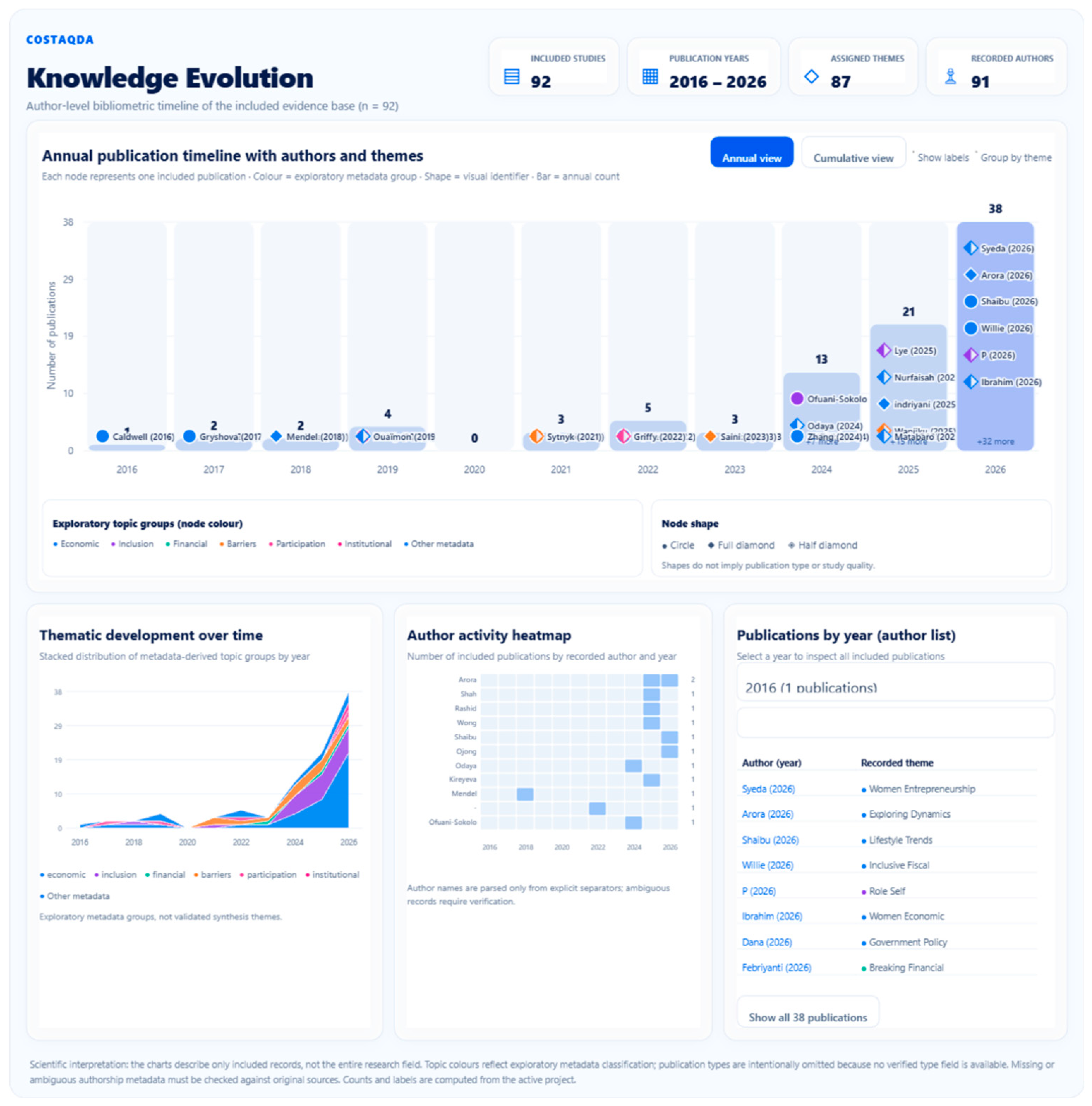
Knowledge Evolution examines the temporal and intellectual development of the included evidence base. It traces how research contributions develop over time and, where supported by the Step 12 data, how later studies extend, connect, challenge or consolidate earlier contributions.
Figure 6.
Knowledge Evolution—Bibliometric Intelligence, Step 12. Source: COSTAQDA PRISMA Workflow, navigation item 12: Bibliometric Intelligence—Knowledge Evolution.
Figure 6.
Knowledge Evolution—Bibliometric Intelligence, Step 12. Source: COSTAQDA PRISMA Workflow, navigation item 12: Bibliometric Intelligence—Knowledge Evolution.
3.8.5. Integrated Confidence in the Synthesised Evidence
A separate finding-level confidence method was not recorded. CASP was used for methodological appraisal at study level, but no CERQual assessment or other verified confidence assessment was supplied. Bibliometric outputs were treated as contextual evidence maps, not as components of a validated confidence score. Trustworthiness was therefore considered through convergence and divergence across studies, study-design limitations, contextual transferability, the transparency of selection and synthesis, and the preservation of contradictory evidence rather than through a formal confidence rating (Lewin et al., 2018).
4. Findings
4.1. Search and Selection Results
The recorded selection process yielded 92 included studies from 148 identified records after 4 duplicates were removed. Of 144 screened records, 143 reports were sought for retrieval, 1 was excluded at title or abstract stage, 92 full texts were assessed and none were excluded at full text. These figures establish the documented workflow but are not substantive findings. The decision rule for title and abstract screening was not preserved in the verified audit, limiting reproducibility of that stage (Page et al., 2021).
4.2. Characteristics of Included Studies
The included evidence was geographically and methodologically diverse, covering women, youth, persons with disabilities and intersecting or adjacent vulnerable populations across employment, entrepreneurship, financial inclusion, education, digital participation, procurement and livelihood contexts. The synthesis input comprised 72 studies and 557 extracted findings, whereas the final selection workspace recorded 92 included studies. This difference indicates that not every included study contributed findings to the verified thematic synthesis. The supplied studies included qualitative accounts from disability and institutional contexts, quantitative analyses of financial inclusion and labour participation, reviews, policy analyses and conceptual contributions (Muuo et al., 2025; Adhikari & Pradhananga, 2024; Rietveld & Patel, 2022; Lye et al., 2025).
4.3. Methodological Strengths and Limitations of Included Studies
Methodological strengths included the use of an explicit search string, predefined eligibility criteria, persisted PRISMA counts, completed CASP appraisals for all 92 included studies, finding-level traceability and a synthesis that preserved contradictory evidence. Limitations included heterogeneous study designs, partial or truncated extracts, unclear extraction procedures, study-level appraisal uncertainty, limited longitudinal evidence and context-dependent transferability. Some included records also appear to be reviews, conceptual papers, policy analyses or materials whose peer-review status or publication type is not fully clarified by the supplied metadata, which constrains interpretation of the evidence base.
4.4. Thematic Synthesis
Methodological basis: The thematic synthesis approach follows Thomas and Harden (2008), https://doi.org/10.1186/1471-2288-8-45. The study-specific findings and support counts below derive from the included evidence, not from this methodological citation.
Thematic synthesis is a systematic qualitative evidence-synthesis method used to integrate findings across multiple studies while retaining a transparent connection to the underlying evidence. (Thomas & Harden, 2008) The process moves iteratively from extracted study findings to coding, the grouping of related codes into descriptive categories or themes, and the development of higher-order analytical themes that answer the review question and research objectives. Its purpose is not merely to count how often an idea appears, but to identify patterned meaning across studies, examine convergence and divergence, preserve contextual differences, and develop an auditable interpretation that remains traceable to the contributing evidence.
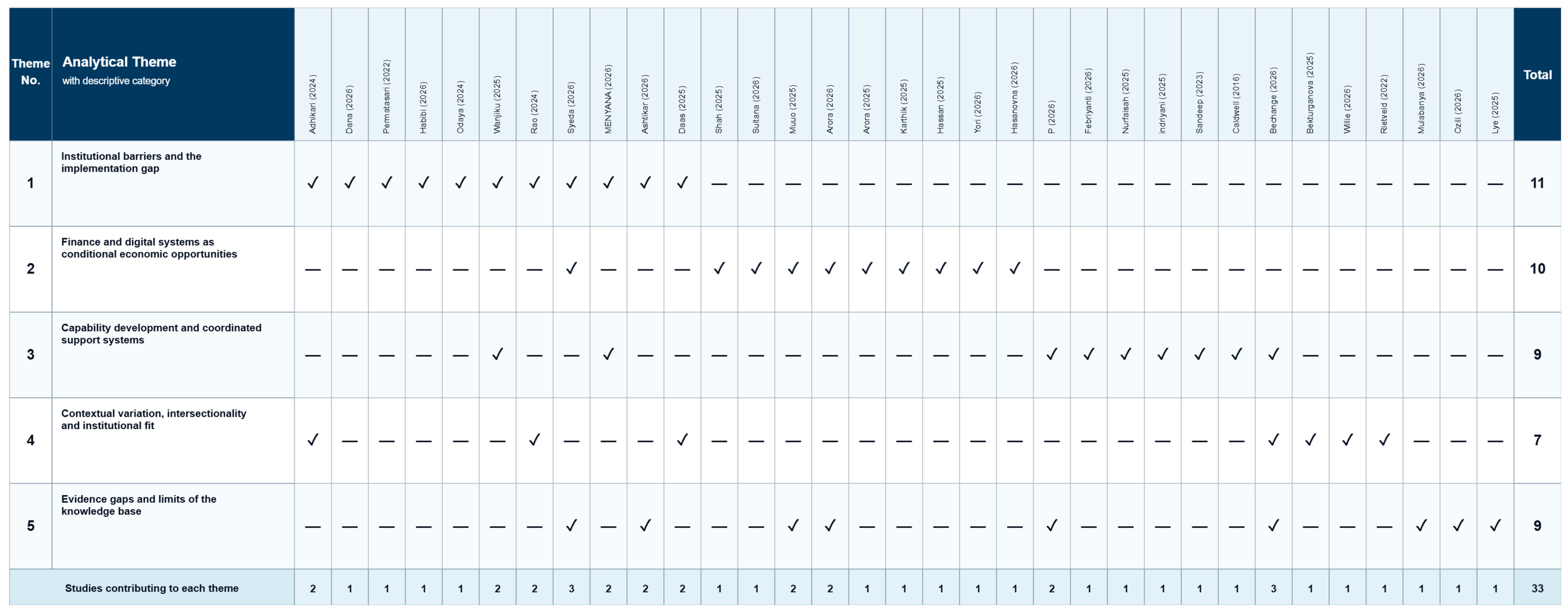
In this review, thematic synthesis was applied to the verified extracted findings retained in the active COSTAQDA project. Findings were compared across eligible studies, coded and grouped according to conceptual similarity, and then developed into 5 analytical themes represented across 33 evidence-contributing studies. The active synthesis retained 46 verified theme-to-study support assignments, allowing the analytical interpretation to remain traceable to the underlying studies rather than being reconstructed from titles or bibliographic prominence. The resulting analytical themes include “Institutional barriers and the implementation gap”, “Finance and digital systems as conditional economic opportunities”, “Capability development and coordinated support systems”, “Contextual variation, intersectionality and institutional fit”, with the widest cross-study support recorded for “Institutional barriers and the implementation gap” (11 contributing studies). Table 1 therefore operationalises the synthesis as an auditable evidence map linking each analytical theme to the studies that supplied verified supporting findings.
Table 1 presents the thematic synthesis matrix linking the verified analytical themes only to studies with verified extracted evidence supporting at least one of the themes displayed in the matrix. Any study with no verified supporting contribution to any displayed theme is excluded, even if it was included elsewhere in the systematic review or qualitative evidence base. Rows represent analytical themes and columns represent theme-contributing studies. A check mark (✓) indicates that at least one verified extracted finding from that study was assigned to the theme; an em dash (—) indicates that the study contributed evidence to the synthesis overall but no supporting extracted finding from that study was assigned to that particular theme. The absence of a supporting assignment must not be interpreted as contradictory evidence. The totals report the number of evidence-contributing studies providing verified support to each theme. The matrix therefore functions as an audit trail between thematic interpretation and the underlying finding-level evidence rather than as a measure of methodological quality or effect size.
The most widely supported analytical theme was “Institutional barriers and the implementation gap”, with verified support from 11 of 33 studies. The least widely distributed theme was “Contextual variation, intersectionality and institutional fit”, with verified support from 7 of 33 studies. Differences in the number of supporting studies indicate the distribution of traceable thematic evidence across the included literature, not the relative importance or quality of a theme. Themes supported by fewer studies may still be analytically important when the underlying findings are conceptually rich, contextually distinctive or directly relevant to the review question. Conversely, wider study support indicates cross-study recurrence but does not by itself establish stronger methodological quality. The thematic patterns shown in Table 1 should therefore be interpreted alongside critical appraisal, contextual variation, contradictory findings where verified, and the detailed theme-led discussion that follows.
4.5. RO1: Institutional Barriers and the Implementation Gap
Across disability, policy and service-system contexts, formal inclusion frequently failed at implementation. Legal rights, disability policies, employment reservations, concessions and economic-empowerment programmes were described as opportunities in principle but as weak or uneven in practice when enforcement, localization, coordination, funding or administrative capacity were inadequate. Evidence from Nepal, Zimbabwe, Indonesia and West Lombok converged on the distinction between policy existence and accessible institutional experience (Adhikari & Pradhananga, 2024; Dana, 2026; Permatasari et al., 2022; Habibi et al., 2026).
Administrative design converted nominal access into practical exclusion. Complex paperwork, slow processing, verification requirements, collateral, weak information flows and limited follow-up constrained access to finance, procurement, legal recognition and employment. The Kenya procurement evidence described limited compliance with reserved procurement schemes and insufficient operational capacity, while rural and tribal finance evidence emphasized documentation burdens and institutional distance (Odaya, 2024; Wanjiku et al., 2025; Murty & Rao, 2024).
Socio-cultural and organizational norms operated alongside formal institutions. Gendered care expectations, patriarchal assumptions, disability stigma, employer concerns about productivity, inaccessible workplaces and standardized performance expectations restricted employment, leadership, entrepreneurship and education. These barriers were especially consequential where gender, disability, rurality, poverty or age intersected (Caldwell et al., 2016; Adhikari & Pradhananga, 2024; Daas, 2025; Ashtikar & Manoharan, 2026).
4.6. RO1: Finance and Digital Systems as Conditional Economic Opportunities
Finance, fintech, mobile banking, e-commerce and digital work were repeatedly identified as potential routes to market reach, formal financial engagement, self-employment, resilience and economic empowerment. Evidence from women’s entrepreneurship, mobile banking, disability finance and digital marketing suggests that digital systems can reduce geographic constraints and expand access when users possess the skills, infrastructure and trust required to use them effectively (Syeda, 2026; Shah, 2025; Sultana, 2026; Muuo et al., 2025).
The opportunity was conditional rather than universal. Financial literacy, affordability, accessibility, consumer protection, connectivity, security, trust and suitable products mediated the relationship between nominal access and effective use. Studies of persons with disabilities and tribal women reported gaps in formal credit, banking use, digital payment use and technology support, while other evidence reported relatively high perceived access or financial literacy. This divergence appears to reflect differences between perceived access, actual use, measurement and context rather than a simple contradiction (Arora & Gupta, 2026; Arora, 2025; Karthik et al., 2025; Hassan & Ahsan, 2025).
The evidence also showed that expanded finance may reproduce inequality when infrastructure, literacy and institutional safeguards are weak. Digitalization was described as capable of broadening participation but also of reinforcing existing exclusion without targeted support. Accordingly, financial and digital systems should be interpreted as institutional infrastructures whose benefits depend on regulation, capability and accessibility rather than as inherently inclusive technologies (Ghosh & Basu, 2024; Yori et al., 2026; Hasanovna, 2026).
4.7. RO2: Capability Development and Coordinated Support Systems
Capability-building was most consistently described as effective when embedded in broader support systems. Education, vocational training, financial literacy, mentoring, self-help groups, cooperatives, social enterprises, disability organizations and public–private partnerships could improve skills, confidence, information, social capital and access to opportunities (Jebaraj & Edhayavarman, 2026; Febriyanti et al., 2026; Nurfaisah & Pertiwi, 2025).
The evidence did not support isolated interventions as sufficient. Weak post-training support, poor school-to-work transitions, obsolete vocational facilities, limited follow-up and fragmented institutional responsibilities reduced the likelihood that capability development would translate into sustained employment or enterprise growth. Studies of disability employment, education and procurement emphasized the importance of continuity, coordination and locally responsive delivery (Indriyani & Qohar, 2025; Sandeep & Sukhwinder, 2023; Wanjiku et al., 2025).
Collective support also operated as a mechanism for constrained agency. Youth and persons with disabilities used entrepreneurial clusters, mutual support and social enterprises to develop agency and social recognition, but this agency remained fragile where financing, infrastructure and social acceptance were weak (Menyana, 2026; Caldwell et al., 2016; Bechange et al., 2026).
4.8. RO2: Contextual Variation, Intersectionality and Institutional Fit
Context shaped both barriers and opportunities. Rurality, local infrastructure, institutional trust, sectoral rules, conflict, gender norms, disability accessibility and the organization of public services altered how policies and programmes were experienced. Evidence from India, Kenya, Indonesia, Nepal, Palestine, Kazakhstan and Sub-Saharan Africa cautioned against assuming that a policy or technology would operate similarly across settings (Murty & Rao, 2024; Adhikari & Pradhananga, 2024; Daas, 2025; Bekturganova & Kurmasheva, 2025).
The studies also suggested that groups cannot be treated as internally homogeneous. Women with disabilities, rural women, youth with disabilities, low-income users and people with different impairments may face overlapping but non-identical institutional constraints. However, direct intersectional analysis was limited, and the supplied evidence was stronger for persons with disabilities and women than for youth as a distinct population (Bechange et al., 2026; Willie et al., 2026; Rietveld & Patel, 2022).
4.9. RO3: Evidence Gaps and Limits of the Knowledge Base
The synthesis identified a broad literature on institutional barriers but a thinner evidence base on direct lived experience, long-term outcomes and youth-specific participation. Several included materials were reviews, conceptual papers, policy analyses or predominantly quantitative studies, and many extracted passages were partial or methodological. Evidence on implementation fidelity, sustained employment, enterprise growth, livelihood security and intersectional outcomes was limited (Lye et al., 2025; Ozili, 2026; Bechange et al., 2026).
Apparent contradictions were often measurement or context differences rather than direct oppositions. For example, relatively high perceived financial access could coexist with low formal credit use, mixed technology experiences and continuing institutional exclusion. The evidence therefore supports a research agenda that distinguishes availability, accessibility, use, quality, outcomes and sustainability rather than treating financial inclusion or policy adoption as single indicators (Arora & Gupta, 2026; Muuo et al., 2025; Kebede et al., 2021).
5. Discussion
The review answers the central question by showing that institutional barriers and opportunities influence economic participation through implementation, accessibility, norms, capabilities and coordination. RO1 is addressed by the recurring finding that formal inclusion frequently fails at the point of delivery. Policy frameworks, reserved opportunities, financial services and digital platforms may exist, yet paperwork, weak enforcement, inaccessible infrastructure, discriminatory organizational practices and inadequate information prevent meaningful use (Adhikari & Pradhananga, 2024; Odaya, 2024; Muuo et al., 2025).
RO2 is addressed by the finding that adoption and effective use depend on contextual institutional fit. Local governance capacity, rurality, infrastructure, trust, gender norms, disability accessibility, organizational incentives and support continuity condition outcomes. The same intervention may therefore operate as an opportunity in one setting and as a source of exclusion in another. This helps explain why the evidence converges on the value of digital finance, self-help groups, training and social entrepreneurship while also reporting limited uptake, unequal use and fragile outcomes (Jebaraj & Edhayavarman, 2026; Karthik et al., 2025; Bechange et al., 2026).
The divergence concerning finance and digitalization is analytically important rather than merely problematic. Some studies report increased access, literacy or empowerment, whereas others identify low formal-credit use, insecure digital transactions, inaccessible services and mixed technology experiences. These differences reflect variation in constructs, populations and contexts, including the distinction between perceived access and actual use. They caution against interpreting digital or financial expansion as inherently inclusive and support a layered understanding of inclusion that includes availability, accessibility, capability, trust, use and sustained economic outcomes (Arora & Gupta, 2026; Ghosh & Basu, 2024; Hassan & Ahsan, 2025).
RO3 is addressed by identifying gaps in youth-specific lived experience, intersectional analysis, longitudinal evidence and implementation evaluation. The review contributes by connecting these gaps to the institutional ecosystem: future research should not only count policies, accounts, programmes or participants but should examine how institutional mechanisms operate across time and place. However, the heterogeneity of the included evidence and the absence of a recorded finding-level confidence method mean that the conclusions should be treated as analytically supported and context-sensitive rather than as formally graded causal claims.
6. Conclusion
Institutional barriers and opportunities influence economic participation through the combined effects of policy implementation, administrative design, social and organizational norms, financial and digital infrastructure, capability development and collective support. Formal inclusion alone is insufficient. Economic participation becomes more plausible when institutions enforce rights, simplify procedures, provide accessible and suitable finance and technology, address discrimination, connect education to work and coordinate sustained local support. The evidence base is broad in identifying barriers but less developed in demonstrating long-term outcomes, youth-specific lived experience and intersectional implementation effects. These conclusions directly address RO1, RO2 and RO3 while remaining appropriately cautious because no formal finding-level confidence assessment was supplied.
7. Recommendations
Practice recommendations should focus on integrated delivery rather than isolated interventions. Organizations and service providers should simplify application and verification procedures, provide accessible information and reasonable accommodations, strengthen staff capability, and connect finance, digital access, mentoring, skills development and follow-up support. Programmes should be designed with women, youth and persons with disabilities as differentiated groups rather than as a single vulnerable category (Muuo et al., 2025; Wanjiku et al., 2025).
Policy recommendations should prioritize enforceable implementation frameworks, dedicated resources, inter-agency coordination, accessible procurement and finance, disability-responsive and gender-responsive regulation, digital infrastructure, consumer protection and local monitoring. Policies should measure not only programme availability or account ownership but also effective use, accessibility, institutional trust, employment quality, enterprise sustainability and livelihood security (Dana, 2026; Willie et al., 2026; Ozili, 2026).
Future research should conduct longitudinal and mixed-method evaluations of institutional interventions; strengthen direct qualitative research with youth and intersecting populations; compare perceived access with actual service use; examine implementation fidelity and administrative burden; test locally adapted models across rural and urban settings; and develop transparent measures of sustained economic participation. Finding-level confidence assessment should be incorporated in future syntheses where appropriate.
Funding
No funding sought for this research output.
Competing interests
There are no competing interests.
AI-assisted technology and COSTAQDA declaration
COSTAQDA was used as an AI-assisted evidence-synthesis and manuscript-development environment. AI-assisted functions supported the organisation, synthesis and presentation of verified project evidence and manuscript preparation within the documented COSTAQDA workflow. AI did not replace researcher responsibility for study selection, eligibility decisions, critical appraisal, verification of extracted evidence, interpretation of findings or final scholarly judgement. The human authors reviewed and approved the final manuscript and remain responsible for its accuracy, integrity, interpretations, citations and conclusions.
Appendix A. Article-Level CASP Scores
The article-level CASP scores are retained as an audit appendix. The main report presents the CASP Critical Appraisal Intelligence dashboard.
Study 1: Women Entrepreneurship, Economic Participation, and Business Sustainability in Bangladesh—19/20
Study 2: A systematic literature review of fintech, financial inclusion and vulnerable groups—19/20
Study 3: Exploring the Dynamics of Financial Inclusion in Enhancing Economic Empowerment among the Physically Disabled: An Empirical Investigation—17/20
Study 4: Engendering financial inclusion for persons with disabilities in Nigeria—14/20
Study 5: Empowering Marginalized Communities through Social Entrepreneurship: A Pathway to Inclusive Economic Development—19/20
Study 6: Inclusivity in Procurement and Supply Chain Management: A Catalyst for Economic Development—14/20
Study 7: Lifestyle Trends and Economic Participation in Developing Economies: Evidence from Nigeria—15/20
Study 8: Socio-Cultural Barriers for People with Disabilities in the Public Employment Sector of Nepal—18/20
Study 9: Towards Inclusive Fiscal Policy: A Disability-Responsive Taxation Framework for Equity and Economic Empowerment—15/20
Study 10: A study on the role of self-help groups in promoting financial inclusion among underserved communities in Pollachi Taluk—15/20
Study 11: Implementation of The Rights of People with Disabilities in Obtaining Employment for Graduates of Private Special Schools in Ciamis Regency—18/20
Study 12: Disabilities concessions in Indonesia: fundamental problems and solutions—15/20
Study 13: Optimising the Access to Public Procurement Opportunities programme in Kenya: role of the programme management office in overcoming institutional barriers—15/20
Study 14: Educational Inequalities and Economic Participation in Haryana: A Study of Barriers, Outcomes, and Policy Interventions—14/20
Study 15: The uniqueness of entrepreneurship of persons with disabilities in Spain—15/20
Study 16: Women’s Economic Empowerment in Malaysia’s Entrepreneurial Sector: Analysis of Economic Participation, Education, Health, and Political Empowerment using the Malaysia Gender Gap Index—17/20
Study 17: Social Entrepreneurs with Disabilities: Exploring Motivational and Attitudinal Factors—15/20
Study 18: Coping strategies of disabled people facing barriers to their participation in education, vocational training and employment—18/20
Study 19: Government Policy Initiatives and the Economic Rights of Persons with Disabilities in Zimbabwe’s Second Republic—19/20
Study 20: Breaking Financial Barriers: Empowering Persons With Disabilities Through Inclusive Investment Education—15/20
Study 21: Digital Divide and Economic Participation in Nigeria: Challenges in Relation to Sustainable Development Goals and Building a Resilient National Economy—14/20
Study 22: HOW DOES MOBILE BANKING CONTRIBUTE TO FINANCIAL INCLUSION IN EMERGING ECONOMIES?—14/20
Study 23: Dialectics of Economic Inclusion and Global Openness in the Democratic Republic of Congo—16/20
Study 24: Institutional Barriers, Economic Capabilities, and Women’s Market Participation in India: Legal and Policy Implications for Entrepreneurship and Markets—13/20
Study 25: Blockchain for inclusion: challenges and pathways to digital entrepreneurship among persons with disabilities in China—13/20
Study 26: BAZNAS Strategy to Increase the Participation of Persons With Disabilities in the Labor Market—18/20
Study 27: Assessing financial capability among people with disabilities in India: applying Sherraden’s framework—15/20
Study 28: Digital finance, fintech, and income inequality: Opportunities and risks for financial inclusion in Pakistan—18/20
Study 29: Determinants of Loan Repayment of Government Funding to Vulnerable Groups; A Case of Biashara Fund in Kiambu County, Kenya—18/20
Study 30: The Positive Impact of Digital Financial Inclusion on Household Consumption—13/20
Study 31: Education, Digital Literacy, and Financial Inclusion among Tribal Women in India: A Pathway to Economic Empowerment—11/20
Study 32: HOW CASHLESS PAYMENTS SUPPORT SUSTAINABLE FINANCIAL INCLUSION—15/20
Study 33: An Integrative Model of Financial Inclusion and Digital Literacy in Promoting Sustainable Economic Growth—17/20
Study 34: “More Than a Day’s Work?” Rethinking Indonesia’s Cash-for-Work for Economic Empowerment—14/20
Study 35: AN APPRAISAL OF THE LEGAL FRAMEWORK FOR PROMOTING FINANCIAL INCLUSION OF WOMEN IN NIGERIA—15/20
Study 36: Access to Public Employment for Persons with Disabilities in Jordan: Legal Framework, Policy, and Barriers—15/20
Study 37: The Role of State Policy in Supporting an Inclusive Economy—11/20
Study 38: Is the Metaverse Accessible? An Expert Opinion—16/20
Study 39: Examining The Financial Inclusion Of Persons With Disabilities In Zambia: A Case Of Selected Districts In Eastern Province—19/20
Study 40: Barriers to Digital Entrepreneurship among Persons with Disabilities: A Systematic Review—18/20
Study 41: The Impact of Fintech and Digital Financial Services on Financial Inclusion in India—16/20
Study 42: Financial Literacy as a Driver of Financial Inclusion and Economic Empowerment: Empirical Evidence from Ukrainian Youth—16/20
Study 43: Disability, entrepreneurship, and inclusive finance: reimagining livelihood pathways for young people in Sub-Saharan Africa—15/20
Study 44: Decentralized Finance: A Potential Paradigm Shift for Financial Inclusion and Economic Empowerment—12/20
Study 45: Women Entrepreneurship and Digital Finance in Karnataka: A Study on Financial Inclusion and Economic Empowerment—14/20
Study 46: Gender inequality and the entrepreneurial gender gap: Evidence from 97 countries (2006–2017)—15/20
Study 47: Financial Inclusion And Its Effect On Financial Efficiency And Economic Empowerment—With Reference To Migrant Labourers In Kerala—13/20
Study 48: PROSPECTS FOR POVERTY REDUCTION IN THE DIGITAL ECONOMY—12/20
Study 49: How Systemic Barriers Can Impact Health Inequities When Facing Climate Change Stressors: A Scoping Review of Global Differences—17/20
Study 50: Financial inclusion of persons with disabilities: role of diversity, equity, inclusion and access (DEIA)—14/20
Study 51: Analysing credit risk in persons with disabilities as an instrument of financial inclusion—12/20
Study 52: Assessing the Key Determinants of Financial Inclusion: A Comprehensive Analysis of Socioeconomic and Institutional Factors on Economic Growth—15/20
Study 53: Financial inclusion for persons with disabilities: Experiences of providers and users of financial products and services in Kenya.—19/20
Study 54: Social Entrepreneurship as a Space for Empowerment and Agency Among Youth With Disabilities in Cameroon: A Capability-Oriented Qualitative Study—19/20
Study 55: Economic Inclusion of Persons with Disabilities from the Perspective of Fiqh Muamalah: An Analysis of Maqashid Hifzh al-Mal in the Development of Agribusiness MSMEs—17/20
Study 56: Women’s Economic Empowerment in Kazakhstan: Institutional Trust, Economic Participation, and Sociocultural Barriers—12/20
Study 57: Neurodiversity, employment frameworks, and social participation: examining workplace inclusion and systemic barriers—19/20
Study 58: Exploring Financial Inclusion and Institutional Barriers for Tribal Farmers in Southern Odisha—17/20
Study 59: Sustainable Rural Wastewater Management in the People’s Republic of China: Institutional, Regulatory, and Financial Frameworks and Stakeholder Participation—11/20
Study 60: Barriers and Opportunities: Disability and Labor Market Inclusion in Palestine—11/20
Study 61: Transforming Female Education in Sub-Saharan Africa: Addressing Socio-Cultural, Economic, Institutional and Instructional Barriers to Access and Inclusion—17/20
Study 62: The Political Economy of Inclusion: How Institutional Barriers Deflect the Benefits of Economic Expansion in India—13/20
Study 63: Structural Barriers and Opportunities for Financial Inclusion of Women in Kazakhstan—16/20
Study 64: EMPLOYMENT MATTERS: SALIENT BARRIERS TO WOMEN’S LABOR FORCE PARTICIPATION IN INDIA—12/20
Study 65: Creating inclusive early childhood services for children with disabilities: institutional, social, and economic barriers to access and participation in West Lombok, Indonesia—18/20
Study 66: CHANGE MANAGEMENT IN INSTITUTIONAL PROJECTS: BARRIERS AND SUCCESS FACTORS—12/20
Study 67: SOCIAL INVESTMENT AND YOUTH LABOR MARKET PARTICIPATION—15/20
Study 68: Fostering Women Empowerment: Empirical Evidences on Financial Inclusion and Grassroots Economic Participation in Kerala—12/20
Study 69: Institutional Strategies For Addressing Barriers to Women’s Participation in Agricultural Cooperatives—19/20
Study 70: Barriers to labor market inclusion viewed by socially vulnerable populations (evidence from Northwestern Federal District)—13/20
Study 71: Borders or Barriers? Assessing Geographic, Economic, and Institutional Factors Related to Study Abroad Access and Participation at Four-Year Colleges and Universities—17/20
Study 72: Public governance in education: institutional mechanisms for interaction with the labor market—12/20
Study 73: Trends in Egyptian Female Participation in Labor Force—12/20
Study 74: BARRIERS, PARTICIPATION PATTERNS, AND INSTITUTIONAL ENABLERS OF STUDENT SOCIETIES IN SOUTH PUNJAB: A MIXED-METHODS ANALYSIS OF YOUTH LEADERSHIP DEVELOPMENT CHALLENGES—13/20
Study 75: Digital Economic Transformation, Employment Dynamics, and Gender Inclusion: Empirical Analysis of Wage Labor Participation Across Networked Economies—15/20
Study 76: Foreign bank presence, institutional quality, and financial inclusion: Evidence from Africa—12/20
Study 77: Can you jump this high? Quantifying barriers to market participation—12/20
Study 78: REGULATORY MECHANISMS AND INSTITUTIONAL FRAMEWORKS FOR CENTRAL BANK DIGITAL CURRENCY PAYMENT SYSTEMS—12/20
Study 79: Institutional Regulatory Mechanisms of Russian Labor Market in Economic Integration Conditions—14/20
Study 80: Integrating Entrepreneurship Education Practices through Regulatory and Institutional Frameworks for Sustainable Economic Development—15/20
Study 81: Women’s participation in the labor market and Economic Development: Evidence from ECCAS and ECOWAS Countries—14/20
Study 82: Health System Sustainability and Labor Market Participation in an Aging Workforce—11/20
Study 83: Institutional barriers in Chinese-Russian trade cooperation and their political-economic logic—12/20
Study 84: Labor market policy in the presence of a participation externality—13/20
Study 85: INSTITUTIONAL REGULATORS OF SOCIAL AND ECONOMIC PROVISION OF DISABLED PERSONS IN THE MARKET OF MEDICAL SERVICES OF UKRAINE—13/20
Study 86: Youth Financial Inclusion, Labor Force Participation and Economic Growth: A Comparative Study of India and the United States—16/20
Study 87: TRANSFORMATION INFLUENCE OF INSTITUTIONAL BARRIERS ON THE GROWTH OF THE NATIONAL ECONOMY OF UKRAINE—13/20
Study 88: Bridging the Implementation Gap: Institutional Logics and Employee Awareness in Afghanistan’s Financial Inclusion Agenda—14/20
Study 89: Digital Marketing Skills and Women’s Economic Empowerment in Bangladesh: Employment, Barriers, and Global Digital Participation—15/20
Study 90: Financial Education and Economic Empowerment in Urban Bangladesh: Overcoming Barriers to Inclusion—19/20
Study 91: Social Status, Economic Development and Female Labor Force (Non) Participation—17/20
Study 92: Impact of Digital Financial Services on Financial Inclusion, Economic Empowerment, and Social Development among Marginalized Populations in Punjab—11/20
References
- Adhikari, S. R., & Pradhananga, N(2024). Socio-Cultural Barriers for People with Disabilities in the Public Employment Sector of Nepal. GS WOW Wisdom of Worthy Research Journal. [CrossRef]
- Arora, H., & Gupta, S(2026). Exploring the Dynamics of Financial Inclusion in Enhancing Economic Empowerment among the Physically Disabled: An Empirical Investigation. International Journal of Engineering and Management Research. [CrossRef]
- Arora, H(2025). Assessing financial capability among people with disabilities in India: applying Sherraden’s framework. Strategic Blueprint for Viksit Bharat 2047. [CrossRef]
- Ashtikar, S. P., & Manoharan, G(2026). Neurodiversity, employment frameworks, and social participation: examining workplace inclusion and systemic barriers. Neurodivergences. [CrossRef]
- Bechange, S., Jolley, E., Muuo, S. W., Pente, V., & Schmidt, E(2026). Disability, entrepreneurship, and inclusive finance: reimagining livelihood pathways for young people in Sub-Saharan Africa. Development in Practice. [CrossRef]
- Caldwell, K., Harris, S. P., & Renko, M(2016). Social Entrepreneurs with Disabilities: Exploring Motivational and Attitudinal Factors. Canadian Journal of Disability Studies. [CrossRef]
- Costa, K., & Costa, A. P(2024). Qualitative evidence synthesis using COSTAQDA. In J. Ribeiro, C. Brandão, M. Ntsobi, J. Kasperiuniene, & A. P. Costa (Eds.), Computer supported qualitative research (Lecture Notes in Networks and Systems, Vol. 1061). Springer. [CrossRef]
- Dana, T(2026). Government Policy Initiatives and the Economic Rights of Persons with Disabilities in Zimbabwe’s Second Republic. International Journal of Research and Innovation in Social Science. [CrossRef]
- Ecchia, G., Gagliardi, F., & Giannetti, C(2019). Social investment and youth labor market participation. Contemporary Economic Policy. [CrossRef]
- Ghosh, D. S. B. A(2024). The Impact of Fintech and Digital Financial Services on Financial Inclusion in India. Library Progress (International).
- Grant, M. J., & Booth, A(2009). A typology of reviews: An analysis of 14 review types and associated methodologies. Health Information and Libraries Journal, 26(2), 91–108. [CrossRef]
- Hassan, M. S., & Ahsan, W. B(2025). Financial Education and Economic Empowerment in Urban Bangladesh: Overcoming Barriers to Inclusion. Userhub Journal. [CrossRef]
- Habibi, M. M., Jaelani, A. K., & Rachmayani, I(2026). Creating inclusive early childhood services for children with disabilities: institutional, social, and economic barriers to access and participation in West Lombok, Indonesia. Interpersona An International Journal on Personal Relationships. [CrossRef]
- Jebaraj, P. A. J. M. P., & Edhayavarman, C. E(2026). A study on the role of self-help groups in promoting financial inclusion among underserved communities in Pollachi Taluk. Journal of Management Research and Analysis. [CrossRef]
- Karthik, S., Babu, J., & Thomas, B(2025). Education, Digital Literacy, and Financial Inclusion among Tribal Women in India: A Pathway to Economic Empowerment. International Journal of Research Publication and Reviews. [CrossRef]
- Kebede, J., Selvanathan, S., & Naranpanawa, A(2021). Foreign bank presence, institutional quality, and financial inclusion: Evidence from Africa. Economic Modelling. [CrossRef]
- Lewin, S., Booth, A., Glenton, C., et al.(2018). Applying GRADE-CERQual to qualitative evidence synthesis findings: Introduction to the series. Implementation Science, 13(Suppl 1), Article 2. [CrossRef]
- Lye, C., Ying, T. L., Ng, T. H., & Ahmad-Nazmi, A. N(2025). A systematic literature review of fintech, financial inclusion and vulnerable groups. Discover Sustainability. [CrossRef]
- Long, H. A., French, D. P., & Brooks, J. M(2020). Optimising the value of the critical appraisal skills programme (CASP) tool for quality appraisal in qualitative evidence synthesis. Research Methods in Medicine & Health Sciences, 1(1), 31–42. [CrossRef]
- Menyana, E. Y., & Menyana, E. Y(2026). Social Entrepreneurship as a Space for Empowerment and Agency Among Youth With Disabilities in Cameroon: A Capability-Oriented Qualitative Study. International Journal of Research and Innovation in Social Science. [CrossRef]
- Muuo, S. W., Virendrakumar, B., Okello, G. R., Chege, M., Angwenyi, V., Gichohi, K., Kibet, H., Nduta, S., Bechange, S., Schmidt, E., Brown, S., & Jolley, E(2025). Financial inclusion for persons with disabilities: Experiences of providers and users of financial products and services in Kenya. PLoS ONE. [CrossRef]
- Noyes, J., Booth, A., Flemming, K., Garside, R., Harden, A., Lewin, S., Pantoja, T., Hannes, K., Cargo, M., & Thomas, J(2018). Cochrane Qualitative and Implementation Methods Group guidance series—paper 3: Methods for assessing methodological limitations, data extraction and synthesis, and confidence in synthesized qualitative findings. Journal of Clinical Epidemiology, 97, 49–58. [CrossRef]
- Nurfaisah, & Pertiwi, H(2025). Empowering Marginalized Communities through Social Entrepreneurship: A Pathway to Inclusive Economic Development. Journal of Indonesian Scholars for Social Research. [CrossRef]
- Odaya, A(2024). Inclusivity in Procurement and Supply Chain Management: A Catalyst for Economic Development. International Journal of Supply Chain and Logistics. [CrossRef]
- Ozili, P. K(2026). Financial inclusion of persons with disabilities: role of diversity, equity, inclusion and access (DEIA). Economic Analysis Letters. [CrossRef]
- Page, M. J., et al.(2021). The PRISMA 2020 statement: An updated guideline for reporting systematic reviews. BMJ, 372, n71. [CrossRef]
- Rietveld, C. A., & Patel, P. C(2022). Gender inequality and the entrepreneurial gender gap: Evidence from 97 countries (2006–2017). Journal of Evolutionary Economics. [CrossRef]
- Rudevska, V. I., & Ukhanova, K(2026). Financial Literacy as a Driver of Financial Inclusion and Economic Empowerment: Empirical Evidence from Ukrainian Youth. International Journal of Economics Finance and Management Sciences. [CrossRef]
- Sandeep, & Sukhwinder, S(2023). Educational Inequalities and Economic Participation in Haryana: A Study of Barriers, Outcomes, and Policy Interventions. Zenodo. [CrossRef]
- Shah, A(2025). How does mobile banking contribute to financial inclusion in emerging economies? EPH-International Journal of Business & Management Science. [CrossRef]
- Sultana, T(2026). Digital Marketing Skills and Women’s Economic Empowerment in Bangladesh: Employment, Barriers, and Global Digital Participation. American Journal of Business and Management Innovation. [CrossRef]
- Syeda, F. M(2026). Women Entrepreneurship, Economic Participation, and Business Sustainability in Bangladesh. Journal of Contemporary Business and Innovation. [CrossRef]
- Trezzini, B., Schüpbach, S., Schuller, V., & Bickenbach, J(2022). Coping strategies of disabled people facing barriers to their participation in education, vocational training and employment. Alter. [CrossRef]
- Wanjiku, M. N., Ibrahim, M., Fomina, Y. A., & Kovalenko, E. A(2025). Optimising the Access to Public Procurement Opportunities programme in Kenya: role of the programme management office in overcoming institutional barriers. Journal of Project Management. [CrossRef]
- Willie, M. M., Jikwana, S., Mnyaka, O. R., Chitha, W. W., & Dyantyi, K(2026). Towards Inclusive Fiscal Policy: A Disability-Responsive Taxation Framework for Equity and Economic Empowerment. International Journal of Environmental Research and Public Health. [CrossRef]
- Yori, S. T., Angyu, Y., & Vokpuize, M. E(2026). Digital Divide and Economic Participation in Nigeria: Challenges in Relation to Sustainable Development Goals and Building a Resilient National Economy. TARABA International Journal of Social Sciences Research.
- Zupic, I., & Čater, T(2015). Bibliometric methods in management and organization. Organizational Research Methods, 18(3), 429–472. [CrossRef]
- Syeda, F. M(2026). Women Entrepreneurship, Economic Participation, and Business Sustainability in Bangladesh. Journal of contemporary business and innovation. [CrossRef]
- Sandeep, & Sukhwinder, S(2023). Educational Inequalities and Economic Participation in Haryana: A Study of Barriers, Outcomes, and Policy Interventions. Zenodo (CERN European Organization for Nuclear Research). [CrossRef]
- Yori, S. T., Angyu, Y., & Vokpuize, M. E(2026). Digital Divide and Economic Participation in Nigeria: Challenges in Relation to Sustainable Development Goals and Building a Resilient National Economy. TARABA INTERNATIONAL JOURNAL OF SOCIAL SCIENCES RESEARCH.
- Shah, A(2025). HOW DOES MOBILE BANKING CONTRIBUTE TO FINANCIAL INCLUSION IN EMERGING ECONOMIES?. EPH-International Journal of Business & Management Science. [CrossRef]
- Muuo, S. W., Virendrakumar, B., Okello, G. R., Chege, M., Angwenyi, V., Gichohi, K., Kibet, H., Nduta, S., Bechange, S., Schmidt, E., Brown, S., & Jolley, E(2025). Financial inclusion for persons with disabilities: Experiences of providers and users of financial products and services in Kenya.. PLoS ONE. [CrossRef]
- Ecchia, G., Gagliardi, F., & Giannetti, C(2019). SOCIAL INVESTMENT AND YOUTH LABOR MARKET PARTICIPATION. Contemporary Economic Policy. [CrossRef]
- Donthu, N., Kumar, S., Mukherjee, D., Pandey, N., & Lim, W. M(2021). How to conduct a bibliometric analysis: An overview and guidelines. Journal of Business Research, 133, 285–296. [CrossRef]
- Aria, M., & Cuccurullo, C(2017). bibliometrix: An R-tool for comprehensive science mapping analysis. Journal of Informetrics, 11(4), 959–975. [CrossRef]
- van Eck, N. J., & Waltman, L(2010). Software survey: VOSviewer, a computer program for bibliometric mapping. Scientometrics, 84, 523–538. [CrossRef]
- Thomas, J., & Harden, A. (2008). Methods for the thematic synthesis of qualitative research in systematic reviews. BMC Medical Research Methodology, 8, Article 45. [CrossRef]
- Mfolo, L., & Costa, K. (2024). Qualitative Evidence Synthesis Using COSTAQDA.

Table 1.
Thematic Synthesis Matrix. Table 1 legend: Only studies contributing verified extracted qualitative evidence are displayed. ✓ = verified extracted evidence from the study supports the theme; —= the study contributed to the synthesis but no supporting extracted finding from that study was assigned to this theme. An em dash does not indicate contradictory evidence.
Disclaimer/Publisher’s Note: The statements, opinions and data contained in all publications are solely those of the individual author(s) and contributor(s) and not of MDPI and/or the editor(s). MDPI and/or the editor(s) disclaim responsibility for any injury to people or property resulting from any ideas, methods, instructions or products referred to in the content. |
© 2026 by the authors. Licensee MDPI, Basel, Switzerland. This article is an open access article distributed under the terms and conditions of the Creative Commons Attribution (CC BY) license (http://creativecommons.org/licenses/by/4.0/).
Copyright: This open access article is published under a Creative Commons CC BY 4.0 license, which permit the free download, distribution, and reuse, provided that the author and preprint are cited in any reuse.