

Submitted:
02 November 2026
Posted:
04 November 2026
You are already at the latest version
Abstract
Background. This preconception cohort study examined associations between active smoking, secondhand smoke (SHS) exposure, and miscarriage among women seeking fertility care.
Methods. Women attending a fertility clinic in Louisville, Kentucky were recruited and prospectively followed from 2016-2019. Preconception tobacco smoke exposures were reported and verified with urinary cotinine. Multivariable logistic regression was used to estimate adjusted odds ratios (aORs) and 95% confidence intervals (CIs). Models were adjusted for age, body mass index, method of conception, menstrual cycle regularity, marital status, race and male factor infertility.
Results. Of 76 women with known pregnancy outcomes, 14 were active smokers, 18 were nonsmokers with high SHS exposure and 44 were nonsmokers with low SHS exposure. Active smoking (aOR: 4.69; 95% CI: 1.03, 26.6) and spousal smoking (aOR: 6.60; 95% CI: 1.32, 51.5) were associated with increased odds of miscarriage. Among nonsmokers only, women with high SHS exposure had higher odds of miscarriage (aOR: 4.59; 95% CI: 1.16, 21.3) than women with low SHS exposure, and a significant trend was observed between urinary cotinine and odds of miscarriage (P = 0.04). These findings suggest that preconception smoking and high levels of SHS exposure may increase the risk of miscarriage among women seeking fertility care.
Keywords:
spontaneous abortion
; environmental tobacco smoke
; infertility
; smoking
; miscarriage
; secondhand smoke
; preconception smoking
; fertility treatment
; cotinine
1. Introduction
Early pregnancy loss is an important public health issue, and can be a traumatic experience with adverse physical and mental health outcomes [1,2]. Miscarriage (spontaneous abortion) is defined as the loss of an intrauterine pregnancy prior to 20 weeks’ gestation, without the use of elective medical or surgical means to terminate the pregnancy [1]. Approximately 26% of all pregnancies and 10% of all clinically recognizable pregnancies result in miscarriage [3]. Risk factors known to be associated with miscarriage include maternal age, prior pregnancy loss, certain medical conditions, specific medication use, lifestyle factors and environmental exposures such as tobacco smoke [1].
Tobacco smoke exposure is one of the leading preventable causes of mortality and morbidity in the United States. Mainstream smoke is defined as the smoke that is inhaled then exhaled by a smoker, while sidestream smoke is the smoke emitted into the surrounding environment directly from the burning end of the cigarette, pipe, or cigar [4]. Sidestream smoke produced from the lower temperature burning end of the cigarette results from incomplete combustion and contains higher concentrations of harmful and carcinogenic chemicals compared to mainstream smoke [4]. Secondhand smoke (SHS) is a mixture of two forms of smoke from burning tobacco: the exhaled mainstream smoke and sidestream smoke [4].
Tobacco smoke exposure may be associated with pregnancy outcomes such as miscarriage. The 2020 U.S. Surgeon General report stated there was suggestive but insufficient evidence to infer an association between maternal smoking and miscarriage [5]. However, several studies have shown that maternal smoking affects early pregnancy loss for both spontaneous [6,7,8,9,10] and medically assisted reproduction (MAR) [11,12,13,14,15,16]. Studies have proposed that tobacco smoke affects gametogenesis, which can increase the risk of aneuploidies within embryos, and impairs folliculogenesis by lowering ovarian reserve through impaired follicle growth or development of oocytes [17,18]. Other theorized mechanisms include meiosis impairment, DNA damage, high levels of oxidative stress, and activation of cell death pathways [19,20,21,22].
Several studies have examined the association between SHS exposure and miscarriage. However, most used cross-sectional or retrospective study designs that are more susceptible to bias; relied on self-reported exposures; and/or lacked adjustment of important confounders, and have produced inconsistent results [10,23,24,25,26,27,28,29,30]. In addition, women experiencing subfertility or infertility may be more susceptible to the harmful effects of either firsthand or SHS exposure [31]. This prospective study examines the effects of preconception active smoking and SHS on miscarriage among women seeking fertility care.
2. Materials and Methods
2.1. Study Design and Setting
The data used in this study came from the Louisville Tobacco Smoke Exposure, Genetic Susceptibility and Infertility (LOUSSI) study, a prospective study of tobacco smoke exposure, and MAR outcomes [32]. The inclusion criteria for enrollment into the LOUSSI study were English-speaking women aged 21 years and older seeking fertility care or counseling at the University of Louisville’s Reproductive Endocrinology and Infertility clinic. A total of 223 women were consented and prospectively followed between November 2016 and May 2018.
2.2. Ethical Approval
The University of Louisville Institutional Review Board approved this study (IRB #16.0063). Informed consent was obtained from women who agreed to participate.
2.3. Assessment of Tobacco Smoke Exposure
Current, active smoking was measured and verified using a supplemental smoking questionnaire (SSQ) and urinary cotinine levels at the time of enrollment. Cotinine is a metabolite of nicotine and is the preferred biomarker for tobacco exposure [33]. Its half-life ranges from 15 to 20 hours and depends on the type of specimen from which it is being measured. In urine, the half-life is approximately 16 hours [33]. Cotinine ELISA kits (Calbiotech, Spring Valley, CA) were used to measure the participant’s cotinine level to differentiate tobacco smoke exposure in the past 24 to 72 hours. Urinary cotinine levels greater than or equal to 100 ng/mL were defined as active exposure, less than 100 ng/mL and greater than 0 ng/mL were passive exposure and levels equal to 0 ng/mL as having no exposure. Cotinine was assayed in triplicate or duplicate samples; if replicates were discordant by more than 10%, the assay was repeated for that sample.
Using the SSQ, a participant was defined as a current, active smoker when the participant self-reported as a current smoker or reported quitting smoking less than 1 month prior to enrollment. Because all self-reported current smokers except for one had cotinine levels >100 ng/mL, any participant with a urinary cotinine level of 100 ng/mL or greater was also defined as a current active smoker, regardless of self-reported smoking status.
Recent SHS exposure was assessed for all women using cotinine measurements. For nonsmokers, cotinine values were categorized into three groups to assess SHS. Participants with cotinine values of 0 ng/mL were placed in an unexposed group (referent), values greater than 0 ng/mL but less than 4.0 ng/mL were considered to have low exposure; and cotinine values greater than or equal to 4.0 ng/mL but less than or equal to 25 ng/mL were considered to have high SHS. No cotinine-verified nonsmoking participants had urinary cotinine levels above 25 ng/mL.
A score was created to measure SHS in the past year by combining two questions on the SSQ: “How often were you exposed to secondhand tobacco smoke in your home in the past year?” and “How often were you exposed to secondhand tobacco smoke in other places such as work, restaurants, friends and family’s homes in the past year?” The responses to each question were given a numerical value as follows: never (1), rarely (2), often (3) and every day (4) and summed. The combined score for adult SHS exposure in the past year variable ranged from 2 to 8 and was dichotomized into low and high SHS, with high having a score of at least 4. Childhood SHS exposure was measured by asking “How often were you exposed to secondhand smoke while growing up in your home? The score was dichotomized into low and high childhood SHS exposure. Spousal smoking was collected in the SSQ by asking “What is the relationship with any smokers living in your home?” Participants chose from either spouse, partner or other. The variable was then dichotomized to either yes or no to spousal smoking.
2.4. Assessment of Pregnancy Outcomes
Participants were followed through medical records or by email, phone, or mailing address to determine whether they conceived, including the method (naturally or with MAR) and the corresponding pregnancy outcome. For this study, the first pregnancy outcome after enrollment was used in the analyses. Possible pregnancy outcomes included live birth, miscarriage, ectopic pregnancy, molar pregnancy and stillbirth or fetal death.
2.5. Statistical Analysis
Descriptive statistics were used to examine the distributions and frequencies of relevant factors according to smoking exposure status. Covariates included variables that have been shown in the literature to be associated with pregnancy outcomes and were available in the medical records. To create a parsimonious model, only covariates that were modestly associated with the exposure (P<0.20) from univariate analyses were initially included in the final multivariable logistic regression. Marital status, menstrual cycle regularity, male factor infertility, and method of conception (MAR vs. natural conception) were also included as dichotomous variables. MAR was used to define any and all technologies to treat different types of infertility diagnoses; which included ovulation induction (OI), ovulation induction with intrauterine insemination (IUI), and artificial reproductive technology (ART), specifically in-vitro fertilization/fresh embryo transfer, and in vitro fertilization/frozen embryo transfer. The pregnancy outcomes were either a live birth or miscarriage. All models were evaluated for multicollinearity using variance inflation factors.
Multivariable logistic regression models were used to examine the effect of tobacco smoke exposures on probability of miscarriage. The first model compared current, active smokers to nonsmokers (reference group). The second model was restricted to nonsmokers, and urinary cotinine categorized in three groups (high vs. low vs. no) was used to assess recent SHS exposure. A test for trend was undertaken by modeling this 3-level variable ordinally. The third model was also among nonsmokers and examined SHS in the past year using the SSQ by comparing high SHS to low SHS. The relationship between spousal smoking and childhood SHS exposure (high vs low) was also examined on miscarriage. Adjusted odds ratios and 95% CIs were calculated and adjusted for the potential confounders. A sensitivity analysis was also conducted, restricting to those women whose self-reported smoking status was concordant with their cotinine levels (N=71). All statistical analyses were performed using R Studio version 1.2.5 (Boston, MA, USA).
3. Results
3.1. Samples Description
Among the 223 women enrolled and prospectively followed, 83 (37.2%) conceived after enrollment (Figure 1). Seven women were lost to follow-up after conception and were excluded. Pregnancy outcomes were documented for 76 women and were included in the final analyses. Overall, there were 43 (56.6%) live births and 33 (43.4%) miscarriages. Forty-three (56.6%) of the 76 women conceived using MAR treatment. Among the 76 women, 14 (18.4 %) were defined as current, active smokers; 18 (23.7%) were nonsmokers with high SHS; and 44 (57.9%) were nonsmokers with low SHS. Cotinine levels were correlated with self-reported SHS (r = 0.39, p < 0.001). Five women had urinary cotinine levels that were discordant with their self-reported current smoking status. They had urinary cotinine level of 100 ng/mL or greater and were categorized as current smokers.
Table 1 compares nonsmokers with low SHS exposure in the previous year (n=44), as determined by the SSQ, to nonsmokers with high SHS exposure (n=18) and then to current smokers (n=14). Urinary cotinine levels, regular menstrual cycles, marriage, African American race, MAR cycles, male factor infertility and miscarriage were associated with tobacco smoke exposure.
3.2. Associations with Miscarriage
In general, tobacco smoke exposure (both active smoking and SHS) was associated with an increase in the odds of miscarriage (Table 2). Current, active smoking was associated with a large increase in the odds of miscarriage (aOR: 4.69; 95% CI: 1.03, 26.6) compared to nonsmokers. These estimates were adjusted for method of conception, age, BMI, marital status, menstrual cycle regularity, race and male factor infertility; and produced a significant trend when modeled ordinally (p trend = 0.01).
Among nonsmokers, high SHS in the previous year was associated with a significant increase in the odds of miscarriage (aOR: 4.59; 95% CI: 1.16, 21.3) compared to low SHS in the past year, as measured by the SSQ. In addition, nonsmokers with high levels (aOR: 6.08; 95% CI: 1.20, 38.1) and low levels (aOR: 1.78; 95% CI: 0.40, 8.33) of urinary cotinine showed an increased odds of miscarriage compared to unexposed nonsmokers. The test for trend revealed a significant dose-response (p trend = 0.04) for urinary cotinine on miscarriage.
4. Discussion
In this cohort study of women seeking fertility care, large effect sizes were observed between preconception tobacco smoke exposures and miscarriage. Notably, high SHS exposure was associated with a 3- to 5-fold increased odds of miscarriage among nonsmokers, using either self-reported exposure in the past year, or urinary cotinine as a biomarker for current exposure assessment. Among verified nonsmokers, there was a significant dose-response effect for preconception urinary cotinine. Current smokers had substantially higher odds of miscarriage compared with nonsmokers.
Past studies observed smaller effect sizes for active preconception smoking, ranging from 1.16 to 2.00 [6,7,8,9,10,11]. However, the majority of these studies are cross sectional, case-control or retrospective in design, which increases their susceptibility to biases resulting from confounding and misclassification error. A case-control study by Ness and colleagues was one of the few studies to use urinary cotinine to verify smoking status [7]. Results showed that heavy smoking was independently associated with an 80% increased risk in miscarriage (aOR: 1.8 (95%CI: 1.3, 2.6)) [7]. Only one of these studies found that preconception smoking was significantly associated with miscarriage (aOR: 1.64; 95% CI: 1.07, 2.50) [9]. The large point estimates observed in our study were surprising in the context of prior research, but confidence intervals were wide; therefore, our results could be considered consistent with previous research which indicated approximately a two-fold increase in miscarriage among smokers. Alternatively, prior studies may have been biased towards the null. For example, other study designs may miss early pregnancy losses; perhaps smoking has a large effect on early losses, but a smaller effect on later miscarriages. For studies that use self-reported smoking status only, misclassification narrows the gap between the exposed and unexposed groups, thereby attenuating the apparent association.
Three meta-analyses found weak and insignificant associations for maternal exposure to SHS and miscarriage [15,34,35]. A few individual studies reported no association between SHS during pregnancy and miscarriage [27,28,29]. However, several studies examining maternal exposure to SHS and miscarriage identified statistically significant associations and effect sizes ranging from 1.17 to 2.50 [10,23,24,25,26,30]. A recent population-based case-control study in China examined the association of co-exposure to passive smoking and vitamin D deficiency during pregnancy with the risk of miscarriage. They found an increased risk of miscarriage (aOR: 1.73 (95%CI: 1.11, 2.69)) among those exposed to passive smoking but without vitamin D deficiency, and even higher risk (aOR: 2.50 (95%CI: 1.63, 3.84)) among those with both passive smoking and vitamin D deficiency compared to women without passive smoking nor vitamin D deficiency [30]. Ahlborg and Bodin used a prospective cohort study to examine the effect of passive smoke exposure during pregnancy on pregnancy outcomes, and found an increased risk of first-trimester intrauterine deaths for passively exposed women at work (aRR:2.16; 95% CI:1.23, 3.81) [24]. However, the majority of studies that investigated SHS during pregnancy used weaker designs and relied on self-reported exposure data, which may have biased their results towards the null.
In our study, we observed a larger effect size for SHS than prior studies. We may have been better able to detect the effects of SHS because of the sensitive measures of SHS from both urinary cotinine and a questionnaire, and the ability to detect very early pregnancy losses, because of the clinical setting. The rate of miscarriage was higher than expected, at 43%. This is likely because we included biochemical pregnancy losses, which may reflect an adverse effect of smoking on the endometrium that was not captured in other studies. However, information was not collected to separate early from late miscarriage, which may have provided insight into mechanisms.
Several mechanisms by which tobacco smoke exposure may affect the risk of miscarriage have been hypothesized. These include DNA damage to the gametes, apoptosis, impairment of tissue development, or disruptions within cell division and other processes [2,36]. Cadmium and nicotine directly constrict blood flow to the uterus, which may impair development of the placenta, consequently resulting in early pregnancy loss [19]. A combination of these is also plausible and similar mechanisms have been theorized for women who use MAR [37]. A detailed exploration of tobacco smoke exposures during different critical periods of development will be important in elucidating potential biological mechanisms and to infer causality.
Preconception tobacco smoke exposure captures a critical exposure period. It may be that through proximal effects on the uterine environment or through DNA damage to the maturing oocytes, preconception smoking is more likely to cause early pregnancy losses (loss of ‘biochemical pregnancies’), as opposed to later, clinical pregnancy losses. Fetuses which survive through the most critical and sensitive periods of gestation may be more ‘robust’ and less sensitive to the harmful effects of environmental exposures.
This study has several strengths. Firstly, the prospective cohort design allowed for assessment of preconception tobacco smoke exposures in a clinical population, and the temporality criterion for inferring causality. Secondly, there was a high retention rate of 90.7%, so there was likely little to no bias as a result of loss to follow-up of certain groups. A third important strength of the study is the use of an objective biomarker to verify current tobacco smoke exposure. Sensitivity analyses retained significant estimates after excluding women whose self-reported smoking status was not verified by their urinary cotinine levels. Lastly, to the best of our knowledge, this is one of the studies to explore preconception tobacco smoke exposures and miscarriage in a clinical population with natural and assisted conception, examining both active smoking and SHS exposures.
There are a few limitations to acknowledge. The results of this clinical study may not be generalizable to women without fertility issues, as they may have significantly different characteristics compared to women seeking fertility care. Second, small sample sizes within sub-groups affected the precision of the estimates, resulting in wide confidence intervals. Because only 33 miscarriages occurred, the estimates should be interpreted cautiously and require replication in larger prospective cohorts. Given that smoking was measured at one point in this study, preconceptionally, it is not clear whether the effect of preconception smoking on miscarriage is truly a lasting result of smoking prior to pregnancy, or if the effect is seen because the women kept smoking (or continued to be exposed to high levels of SHS) during pregnancy. The point estimates for associations between SHS and miscarriage were larger in this study compared to past studies. This may reflect residual confounding from unmeasured variables. High SHS may reflect other adverse environmental exposures, or unhealthy social or behavioral exposures. Paternal smoking was not adjusted for in this study because paternal smoking is a major source of SHS, and it would not be appropriate to adjust for an important source of the exposure. As a result, it is possible that the observed SHS effect is a combination of direct maternal exposure to SHS and an indirect effect of paternal smoking on sperm quality or quantity.
These findings support incorporating tobacco smoke exposure screening into fertility evaluations. Counseling should address both active smoking and secondhand smoke exposure, particularly from household members and partners. Reducing preconception tobacco exposure may represent a modifiable target for improving reproductive outcomes among women seeking fertility care.
5. Conclusions
Adverse pregnancy outcomes such as miscarriage remain an important public health problem. There are several studies supporting the association of active smoking on lowered fecundability and increased risk of adverse pregnancy outcomes. However, according to the latest U.S. Surgeon General’s report, the literature is still insufficient with regard to SHS. This study showed clinically meaningful associations for preconception active smoking and SHS, including a significant dose-response effect for urinary cotinine on miscarriage among nonsmokers. These findings support efforts to reduce active smoking and secondhand smoke exposure among women planning pregnancy.
Author Contributions
Conceptualization, T.A. and K.C.T.; methodology, T.A. and K.C.T.; formal analysis, T.A.; data curation, T.A., I.O., S.T., E.R, and L.A.W.; writing—original draft preparation, T.A.; writing—review and editing, T.A., I.O., S.T., E.R., L.A.W., K.P., H.R., R.C.P., J.C., M.L.M., A.G. and K.C.T.; visualization, T.A.; supervision, K.C.T. All authors have read and agreed to the published version of the manuscript.
Funding
This work was supported by the Eunice Kennedy Shriver National Institute of Child Health and Human Development; grant number- 1R15HD087911-01, and KCT is supported by the University of Louisville (UofL) Center for Integrative Environmental Health Sciences (CIEHS) P30 ES030283.
Institutional Review Board Statement
The study was conducted in accordance with the Declaration of Helsinki and approved by the University of Louisville Institutional Review Board (IRB #16.0063).
Informed Consent Statement
Informed consent was obtained from all subjects involved in the study.
Data Availability Statement
The datasets used and/or analyzed during the current study are available from the corresponding author on reasonable request.
Acknowledgments
We greatly appreciate all the study participants, research team members, as well as Dr. Henry Bohler and the University of Louisville Reproductive Endocrinology and Infertility Clinic for their contribution to the LOUSSI study. We also would like to acknowledge the funding source: granting institution- Eunice Kennedy Shriver National Institute of Child Health and Human Development; grant number 1R15HD087911-01.
Conflicts of Interest
The authors declared no potential conflicts of interest with respect to the research, authorship, and/or publication of this article.
References
- Griebel, C.P.; Halvorsen, J.; Golemon, T.B.; Day, A.A. Management of spontaneous abortion. Am. Fam. Physician 2005, 72(7), 1243–1250. [Google Scholar] [PubMed]
- Pinar, M.H.; Gibbins, K.; He, M.; Kostadinov, S.; Silver, R. Early Pregnancy Losses: Review of Nomenclature, Histopathology, and Possible Etiologies. Fetal Pediatr. Pathol. 2018, 37(3), 191–209. [Google Scholar] [CrossRef] [PubMed]
- Wilcox, A.J.; Weinberg, C.R.; O’Connor, J.F.; Baird, D.D.; Schlatterer, J.P.; Canfield, R.E.; Armstrong, E.G.; Nisula, B.C. Incidence of early loss of pregnancy. N. Engl. J. Med. 1988, 319(4), 189–194. [Google Scholar] [CrossRef] [PubMed]
- Neal, M.S.; Hughes, E.G.; Holloway, A.C.; Foster, W.G. Sidestream smoking is equally as damaging as mainstream smoking on IVF outcomes. Hum. Reprod. 2005, 20(9), 2531–2535. [Google Scholar] [CrossRef] [PubMed]
- U.S. Department of Health and Human Services. Smoking Cessation. A Report of the Surgeon General; U.S. Department of Health and Human Services, Centers for Disease Control and Prevention, National Center for Chronic Disease Prevention and Health Promotion, Office on Smoking and Health: Atlanta, GA, 2020. [Google Scholar]
- Armstrong, B.G.; McDonald, A.D.; Sloan, M. Cigarette, alcohol, and coffee consumption and spontaneous abortion. Am. J. Public Health 1992, 82(1), 85–87. [Google Scholar] [CrossRef] [PubMed]
- Ness, R.B.; Grisso, J.A.; Hirschinger, N.; Markovic, N.; Shaw, L.M.; Day, N.L.; Kline, J. Cocaine and tobacco use and the risk of spontaneous abortion. N. Engl. J. Med. 1999, 340(5), 333–339. [Google Scholar] [CrossRef] [PubMed]
- Mishra, G.D.; Dobson, A.J.; Schofield, M.J. Cigarette smoking, menstrual symptoms and miscarriage among young women. Aust. N. Z. J. Public Health 2000, 24(4), 413–420. [Google Scholar] [CrossRef] [PubMed]
- Nielsen, A.; Hannibal, C.G.; Lindekilde, B.E.; Tolstrup, J.; Frederiksen, K.; Munk, C.; Bergholt, T.; Buss, L.; Ottesen, B.; Grønbaek, M.; et al. Maternal smoking predicts the risk of spontaneous abortion. Acta Obstet. Et. Gynecol. Scand. 2006, 85(9), 1057–1065. [Google Scholar] [CrossRef] [PubMed]
- Hyland, A.; Piazza, K.M.; Hovey, K.M.; Ockene, J.K.; Andrews, C.A.; Rivard, C.; Wactawski-Wende, J. Associations of lifetime active and passive smoking with spontaneous abortion, stillbirth and tubal ectopic pregnancy: a cross-sectional analysis of historical data from the Women’s Health Initiative. Tob. control. 2015, 24(4), 328–335. [Google Scholar] [CrossRef] [PubMed]
- Winter, E.; Wang, J.; Davies, M.J.; Norman, R. Early pregnancy loss following assisted reproductive technology treatment. Hum. Reprod. 2002, 17(12), 3220–3223. [Google Scholar] [CrossRef] [PubMed]
- Lintsen, A.M.E.; Pasker-de Jong, P.C.M.; de Boer, E.J.; Burger, C.W.; Jansen, C.A.M.; Braat, D.D.M.; van Leeuwen, F.E. Effects of subfertility cause, smoking and body weight on the success rate of IVF. Hum. Reprod. 2005, 20(7), 1867–1875. [Google Scholar] [CrossRef] [PubMed]
- Rockhill, K.; Tong, V.T.; Boulet, S.L.; Zhang, Y.; Jamieson, D.J.; Kissin, D.M. Smoking and Clinical Outcomes of Assisted Reproductive Technologies. J. Women’s Health 2019, 28(3), 314–322. [Google Scholar] [CrossRef] [PubMed]
- Waylen, A.L.; Metwally, M.; Jones, G.L.; Wilkinson, A.J.; Ledger, W.L. Effects of cigarette smoking upon clinical outcomes of assisted reproduction: a meta-analysis. Hum. Reprod. Update 2009, 15(1), 31–44. [Google Scholar] [CrossRef] [PubMed]
- Pineles, B.L.; Park, E.; Samet, J.M. Systematic review and meta-analysis of miscarriage and maternal exposure to tobacco smoke during pregnancy. Am. J. Epidemiol. 2014, 179(7), 807–823. [Google Scholar] [CrossRef] [PubMed]
- Budani, M.C.; Fensore, S.; Di Marzio, M.; Tiboni, G.M. Cigarette smoking impairs clinical outcomes of assisted reproductive technologies: A meta-analysis of the literature. Reprod. Toxicol. (Elmsford, N.Y.) . 2018, 80, 49–59. [Google Scholar] [CrossRef] [PubMed]
- Budani, M.C.; Tiboni, G.M. Ovotoxicity of cigarette smoke: A systematic review of the literature. Reprod. Toxicol. (Elmsford, N.Y.) . 2017, 72, 164–181. [Google Scholar] [CrossRef] [PubMed]
- Shiverick, K.T.; Salafia, C. Cigarette smoking and pregnancy I: ovarian, uterine and placental effects. Placenta 1999, 20(4), 265–272. [Google Scholar] [CrossRef] [PubMed]
- Dechanet, C.; Anahory, T.; Mathieu Daude, J.C.; Quantin, X.; Reyftmann, L.; Hamamah, S.; Hedon, B.; Dechaud, H. Effects of cigarette smoking on reproduction. Human reproduction update. 2011, 17(1), 76–95. [Google Scholar] [CrossRef] [PubMed]
- Agarwal, A.; Aponte-Mellado, A.; Premkumar, B.J.; Shaman, A.; Gupta, S. The effects of oxidative stress on female reproduction: a review. Reprod. Biol. Endocrinol. RB&E 2012, 10, 49. [Google Scholar] [CrossRef] [PubMed]
- Zenzes, M.T. Smoking and reproduction: gene damage to human gametes and embryos. Hum. Reprod. Update 2000, 6(2), 122–131. [Google Scholar] [CrossRef] [PubMed]
- Das, S.; Chattopadhyay, R.; Ghosh, S.; Ghosh, S.; Goswami, S.K.; Chakravarty, B.N.; Chaudhury, K. Reactive oxygen species level in follicular fluid--embryo quality marker in IVF? Hum. Reprod. 2006, 21(9), 2403–2407. [Google Scholar] [CrossRef] [PubMed]
- Benedict, M.D.; Missmer, S.A.; Vahratian, A.; Berry, K.F.; Vitonis, A.F.; Cramer, D.W.; Meeker, J.D. Secondhand tobacco smoke exposure is associated with increased risk of failed implantation and reduced IVF success. Hum. Reprod. 2011, 26(9), 2525–2531. [Google Scholar] [CrossRef] [PubMed]
- Ahlborg, G.J.; Bodin, L. Tobacco smoke exposure and pregnancy outcome among working women. A prospective study at prenatal care centers in Orebro County, Sweden. Am. J. Epidemiol. 1991, 133(4), 338–347. [Google Scholar] [CrossRef] [PubMed]
- Windham, G.C.; Swan, S.H.; Fenster, L. Parental cigarette smoking and the risk of spontaneous abortion. Am. J. Epidemiol. 1992, 135(12), 1394–1403. [Google Scholar] [CrossRef] [PubMed]
- George, L.; Granath, F.; Johansson, A.L.V.; Anneren, G.; Cnattingius, S. Environmental tobacco smoke and risk of spontaneous abortion. Epidemiology . 2006, 17(5), 500–505. [Google Scholar] [CrossRef] [PubMed]
- Windham, G.C.; Von Behren, J.; Waller, K.; Fenster, L. Exposure to environmental and mainstream tobacco smoke and risk of spontaneous abortion. Am. J. Epidemiol. 1999, 149(3), 243–247. [Google Scholar] [CrossRef] [PubMed]
- Meeker, J.D.; Missmer, S.A.; Vitonis, A.F.; Cramer, D.W.; Hauser, R. Risk of spontaneous abortion in women with childhood exposure to parental cigarette smoke. Am. J. Epidemiol. 2007, 166(5), 571–575. [Google Scholar] [CrossRef] [PubMed]
- Meeker, J.D.; Missmer, S.A.; Cramer, D.W.; Hauser, R. Maternal exposure to second-hand tobacco smoke and pregnancy outcome among couples undergoing assisted reproduction. Hum. Reprod. 2007, 22(2), 337–345. [Google Scholar] [CrossRef] [PubMed]
- Lin, S.; Li, J.; Zhang, Y.; Song, X.; Chen, G.; Pei, L. Maternal Passive Smoking, Vitamin D Deficiency and Risk of Spontaneous Abortion. Nutrients 2022, 14(18), 3674. [Google Scholar] [CrossRef] [PubMed]
- Sarokhani, M.; Veisani, Y.; Mohamadi, A.; Delpisheh, A.; Sayehmiri, K.; Direkvand-Moghadam, A.; Aryanpur, M. Association between cigarette smoking behavior and infertility in women: a case-control study. Biomed. Res. Ther. 2017, 4(10), 1705. [Google Scholar] [CrossRef]
- Oladipupo, I.; Ali, T.; Hein, D.W.; Pagidas, K.; Bohler, H.; Doll, M.A.; Mann, M.L.; Gentry, A.; Chiang, J.L.; Pierson, R.C.; et al. Association between cigarette smoking and ovarian reserve among women seeking fertility care. PLoS ONE 2022, 17(12), e0278998. [Google Scholar] [CrossRef] [PubMed]
- Benowitz, N.L. Cotinine as a biomarker of environmental tobacco smoke exposure. Epidemiol. Rev. 1996, 18(2), 188–204. [Google Scholar] [CrossRef] [PubMed]
- Salmasi, G.; Grady, R.; Jones, J.; McDonald, S.D.; Knowledge Synthesis Group. Environmental tobacco smoke exposure and perinatal outcomes: a systematic review and meta-analyses. Acta Obstet. Et. Gynecol. Scand. 2010, 89(4), 423–441. [Google Scholar] [CrossRef] [PubMed]
- Leonardi-Bee, J.; Britton, J.; Venn, A. Secondhand smoke and adverse fetal outcomes in nonsmoking pregnant women: a meta-analysis. Pediatrics 2011, 127(4), 734–741. [Google Scholar] [CrossRef] [PubMed]
- Agenor, A.; Bhattacharya, S. Infertility and miscarriage: common pathways in manifestation and management. Women’s Health 2015, 11(4), 527–541. [Google Scholar] [CrossRef] [PubMed]
- Zenzes, M.T.; Reed, T.E.; Wang, P.; Klein, J. Cotinine, a major metabolite of nicotine, is detectable in follicular fluids of passive smokers in in vitro fertilization therapy. Fertil. Steril. 1996, 66(4), 614–619. [Google Scholar] [CrossRef] [PubMed]
Figure 1.
Study flow diagram showing follow-up and pregnancy outcomes among participants. Among 223 women enrolled and prospectively followed, 83 conceived after enrollment. Seven women were lost to follow-up after conception and had unknown pregnancy outcomes. Pregnancy outcomes were available for 76 women, including 33 natural conceptions and 43 medically assisted conceptions. Among natural conceptions, there were 20 live births and 13 miscarriages. Among medically assisted conceptions, there were 23 live births and 20 miscarriages.
Figure 1.
Study flow diagram showing follow-up and pregnancy outcomes among participants. Among 223 women enrolled and prospectively followed, 83 conceived after enrollment. Seven women were lost to follow-up after conception and had unknown pregnancy outcomes. Pregnancy outcomes were available for 76 women, including 33 natural conceptions and 43 medically assisted conceptions. Among natural conceptions, there were 20 live births and 13 miscarriages. Among medically assisted conceptions, there were 23 live births and 20 miscarriages.
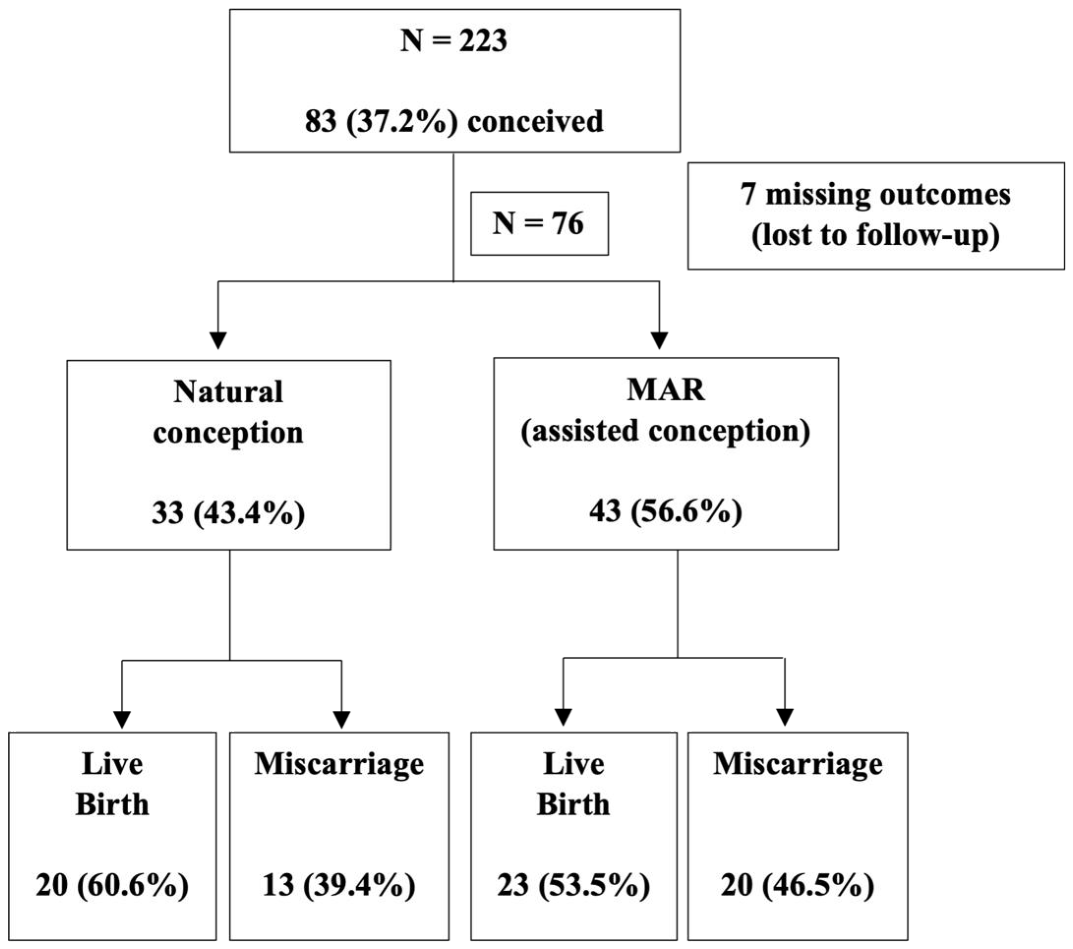

Table 1.
Characteristics of women who conceived in the LOUSSI study (N=76).
| Nonsmokers with low SHS a N=44 |
Nonsmokers with high SHS a N=18 |
Current smokers a N=14 |
p | |
|---|---|---|---|---|
| Cotinine (ng/mL), median (Q1-Q3) | 0.0(0.0-0.9) | 2.5(0.0-8.0) | 100(100-100) | <0.001 |
| Cotinine categories, n(%) | <0.001 | |||
| 0 ng/mL | 27(62.8) | 5(29.4) | 0(0.0) | |
| >0 and ≤25 ng/mL | 16(37.2) | 12(70.6) | 0(0.0) | |
| ≥100 ng/mL | 0(0.0) | 0(0.0) | 14(100.0) | |
| Missing | 1 | 1 | 0 | |
| Age (years), mean ± SD | 31.7 ± 5.4 | 30.8 ± 5.6 | 31.7 ± 6.1 | 0.837 |
| BMI (kg/m2), mean ± SD | 29.0 ±7.3 | 28.1 ± 7.2 | 30.6 ± 6.3 | 0.355 |
| Gravidity, n(%) | 0.589 | |||
| 0 | 22(50.0) | 7(38.9) | 4(28.6) | |
| 1 | 8(18.2) | 5(27.8) | 3(21.4) | |
| ≥2 | 14(31.8) | 6(33.3) | 7(50.0) | |
| Regular cycles, n(%) | 0.028 | |||
| No | 17(38.6) | 12(66.7) | 3(21.4) | |
| Yes | 27(61.4) | 6(33.3) | 11(78.6) | |
| Average cycle length (days), median (Q1-Q3) | 29.0(28.0-30.0) | 28.0(26.0-30.0) | 29.0(28.0-29.3) |
0.887 |
|
Age at menarche (years), median (Q1-Q3) |
13.0(11.8-14.0) | 12.0(12.0-13.0) | 12.5(12.0-13.0) |
0.764 |
| History of STI, n(%) | 0.379 | |||
| No | 29(67.4) | 9(50.0) | 7(53.8) | |
| Yes | 14(32.6) | 9(50.0) | 6(46.2) | |
| Missing | 1 | 1 | ||
| Married, n(%) | <0.001 | |||
| No | 6(13.6) | 7(38.9) | 10(71.4) | |
| Yes | 38(86.4) | 11(61.1) | 4(28.6) | |
| Routine exercise, n(%) | 0.865 | |||
| No | 17(39.5) | 8(47.1) | 6(42.9) | |
| Yes | 26(60.5) | 9(52.9) | 8(57.1) | |
| Missing | 1 | 1 | ||
| Alcohol use, n(%) | 0.585 | |||
| No | 24(54.5) | 11(61.1) | 6(42.9) | |
| Yes | 20(45.5) | 7(38.9) | 8(57.1) | |
| Caffeine use, n(%) | 0.668 | |||
| No | 7(15.9) | 3(17.6) | 1(7.1) | |
| Yes | 37(84.1) | 14(82.4) | 13(92.9) | |
| Missing | 1 | |||
| Race, n(%) | 0.004 | |||
| White | 29(65.9) | 11(61.1) | 5(35.8) | |
| African American or Black | 4(9.1) | 4(22.2) | 8(57.1) | |
| Other | 11(25.0) | 3(16.7) | 1(7.1) | |
| Length of infertility, (years) median (Q1-Q3) | 1.2(0.7-3.0) | 1.0(0.8-2.5) | 2.3(1.4-6.5) | 0.058 |
| Spousal smoking, n(%) | <0.001 | |||
| No | 42(95.5) | 11(64.7) | 8(57.1) | |
| Yes | 2(4.6) | 6(35.3) | 6(42.9) | |
| Missing | 1 | |||
| Male factor infertility, n(%) | 0.053 | |||
| No | 33(75.0) | 18(100.0) | 10(71.4) | |
| Yes | 11(25.0) | 0(0.0) | 4(28.6) | |
| MAR treatment cycles, n(%) | 0.195 | |||
| 0 | 10(22.7) | 8(44.4) | 8(57.1) | |
| 1 | 20(45.5) | 4(22.2) | 3(21.4) | |
| 2 or more | 14(31.8) | 6(33.4) | 3(21.5) | |
| Pregnancy outcome, n(%) | 0.011 | |||
| Live birth | 31(70.4) | 8(44.4) | 4(28.6) | |
| Miscarriage | 13(29.6) | 10(55.6) | 10(71.4) |
a Percentages may not total 100 due to rounding. BMI – Body mass index, MAR – Medically assisted reproduction
Table 2.
Multivariable logistic regression models of preconception smoking exposures and miscarriage among women seeking fertility care (N=76).
Table 2.
Multivariable logistic regression models of preconception smoking exposures and miscarriage among women seeking fertility care (N=76).
| N Pregnancies (miscarriage events) | Odds Ratioa (95%CI) | |
|---|---|---|
| Active smoking | ||
| Nonsmoker | 62 (23) | 1.00 |
| Current smokers | 14 (10) | 4.69 (1.03, 26.6) |
| SHS in the previous year b | ||
| Low (SHS score ≤3) | 44 (13) | 1.00 |
| High (SHS score ≥ 4) | 18 (10) | 4.59 (1.16, 21.3) |
| Cotinine ng/mL b | ||
| Unexposed (0 ng/mL) | 32 (9) | 1.00 |
| Low exposure (>0 and ≤4 ng/mL) | 16 (7) | 1.78 (0.40, 8.33) |
| High exposure (>4 and ≤25 ng/mL) | 12 (7) | 6.08 (1.22, 38.1)c |
| Childhood SHS exposure | ||
| Low (SHS score ≤2) | 48 (21) | 1.00 |
| High (SHS score ≥ 3) | 28 (12) | 0.59 (0.19, 1.73) |
| Paternal/Spouse Smoking | ||
| No | 66 (25) | 1.00 |
| Yes | 10 (8) | 6.60 (1.32, 51.5) |
a Adjusted for method of conception, age, BMI, menstrual cycle regularity, marital status, race and male factor infertility. b Among non-smokers only. c P trend = 0.04 SHS – secondhand smoke exposure. The sensitivity analysis retained similar and significant estimates after excluding the 5 women who had discordant self-reported smoking status and urinary cotinine levels.
Disclaimer/Publisher’s Note: The statements, opinions and data contained in all publications are solely those of the individual author(s) and contributor(s) and not of MDPI and/or the editor(s). MDPI and/or the editor(s) disclaim responsibility for any injury to people or property resulting from any ideas, methods, instructions or products referred to in the content. |
© 2026 by the authors. Licensee MDPI, Basel, Switzerland. This article is an open access article distributed under the terms and conditions of the Creative Commons Attribution (CC BY) license (http://creativecommons.org/licenses/by/4.0/).
Copyright: This open access article is published under a Creative Commons CC BY 4.0 license, which permit the free download, distribution, and reuse, provided that the author and preprint are cited in any reuse.