
Submitted:
02 November 2026
Posted:
04 November 2026
You are already at the latest version
Abstract
This study investigates the complex relationship between organizational culture and the governance of ethical artificial intelligence (AI) use, emphasizing the influence of cultural values on AI deployment and the reciprocal impact of AI on organizational culture. A quantitative research design was adopted, employing structured questionnaires distributed to senior executives, AI developers, compliance officers, and ethics officers from a range of organizations to obtain comprehensive data on perceptions, practices, and leadership attitudes concerning AI ethics. The results indicate that an ethically oriented organizational culture, characterized by transparency, accountability, and committed leadership, significantly strengthens responsible AI governance. In contrast, cultural resistance, apathy, and inadequate governance structures impede efforts to ensure the ethical deployment of AI. The findings underscore the pivotal role of leadership in shaping cultural norms and promoting environments that support ethical practices through policy formulation, training, and stakeholder engagement. The analysis also demonstrates that technical safeguards alone are insufficient; organizational values, interdisciplinary collaboration, and continuous learning are essential for addressing the ethical challenges associated with AI. The study recommends that organizations develop explicit ethical frameworks integrated into their culture, promote leadership-driven initiatives, and implement comprehensive governance mechanisms that address technical, social, and organizational dimensions. Ongoing education, stakeholder engagement, and cross-disciplinary collaboration are crucial for the sustainable adoption of ethical AI practices. Ultimately, cultivating an ethical organizational culture is both a strategic imperative and a moral responsibility for responsible AI innovation and the preservation of public trust.
Keywords:
organisational culture
; ethical
; AI
; governance perspective
; Saudi Arabia
1. Introduction
In recent years, the rapid advancement of artificial intelligence (AI) technologies has revolutionized various sectors, including healthcare, finance, manufacturing, and public administration [1]. AI systems promise increased efficiency, innovation, and competitive advantage; however, their deployment also raises significant ethical concerns [2]. Issues such as bias, transparency, accountability, privacy, and fairness in decision-making have become central to debates about responsible AI use. As organizations increasingly embed AI into their core operations, the importance of establishing a robust governance framework that promotes ethical AI practices has become paramount. In recent years, artificial intelligence (AI) has transitioned from a niche technological innovation to an integral component of organizational operations across industries. From healthcare and finance to retail and public services, AI’s capabilities promise greater efficiency, more personalized experiences, and better data-driven decision-making [3]. However, these benefits come with a significant challenge: ensuring AI systems are used ethically and responsibly. The governance of AI within organizations is not solely a technical concern but is deeply intertwined with the organization’s culture, values, and ethical standards [4].
Organizational culture, the shared values, beliefs, and norms that influence behavior, serves as the foundation on which organizations make and uphold ethical decisions. When organizations embed ethical principles into their culture, they create an environment where responsible AI use becomes a natural extension of everyday practices [5]. Conversely, when organizational culture misaligns with ethical imperatives, it can lead to misuse, bias, and unintended harm from AI systems. This introduction explores the critical relationship between organizational culture and the governance of ethical AI use. It emphasizes how organizational culture shapes attitudes toward AI, influences decision-making, and ultimately determines an organization’s commitment to ethical standards. Furthermore, it discusses the importance of cultivating a culture that promotes transparency, accountability, and continuous learning in AI deployment.
The rapid advancement of AI technologies has outpaced many organizations’ existing governance frameworks, exposing gaps in oversight, compliance, and ethical considerations. Technical safeguards such as algorithm audits and bias detection are essential, but they cannot work effectively without a supportive culture. Organizations that value transparency and accountability are more likely to proactively audit AI systems, disclose errors, and involve diverse stakeholders in decision-making [6]. In contrast, organizations driven solely by profit or efficiency without regard for ethical norms risk deploying AI in ways that could perpetuate discrimination, violate privacy, or erode public trust. From a governance perspective, integrating ethical AI use into organizational culture requires deliberate strategies and leadership commitment. Leaders play a pivotal role in setting the tone at the top, articulating ethical expectations, and modeling responsible behavior. Establishing clear policies, codes of conduct, and training programs helps embed ethical principles into daily routines. Moreover, fostering an environment where employees feel empowered to raise ethical concerns or report misconduct is vital for effective governance.
A key aspect of cultivating an ethical organizational culture around AI is alignment with broader societal values and legal standards. Organizations must recognize that AI systems do not operate in a vacuum; they interact with diverse communities and impact various stakeholder groups [7]. Ethical governance therefore extends beyond compliance to include principles such as fairness, privacy, inclusivity, and respect for human rights. Embedding these values in organizational culture ensures AI deployment aligns with societal expectations and mitigates risks of misuse or harm. Additionally, fostering a culture of continuous learning and adaptation is essential in the rapidly evolving landscape of AI. Organizations should encourage ongoing education about emerging ethical issues, technological developments, and best practices. Creating forums for dialogue, peer learning, and feedback keeps ethical considerations central to AI governance as new challenges emerge [5]. The relationship between organizational culture and the governance of ethical AI use is profound and multifaceted. A culture that prioritizes ethical principles provides the foundation for effective governance mechanisms, responsible decision-making, and sustainable AI practices. Conversely, neglecting the cultural dimension can undermine technical safeguards and lead to adverse outcomes [8]. As AI continues to reshape organizational landscapes, cultivating an ethical culture becomes not just a moral imperative but a strategic necessity for organizations committed to responsible innovation and societal trust. Emphasizing this cultural dimension will enable organizations to harness AI’s potential while safeguarding ethical standards and public confidence in this transformative technology [7].
Despite the tremendous potential of AI, many organizations face challenges in ensuring ethical use, often due to gaps in their governance structures and cultural attitudes. Several pressing issues lie at the core of this problem: a lack of Ethical Frameworks, cultural resistance or indifference, Insufficient Governance Mechanisms, the Complexity of Ethical AI, and Regulatory and Societal Expectations [5]. These challenges highlight a critical gap: the need to understand how organizational culture influences AI governance and how governance can, in turn, shape cultural attitudes toward ethical AI use. Without addressing this interplay, organizations risk unethical outcomes, loss of stakeholder trust, and legal penalties. These challenges highlight a critical gap: the need to understand how organizational culture influences AI governance and how governance can, in turn, shape cultural attitudes toward ethical AI use. Without addressing this interplay, organizations risk unethical outcomes, loss of stakeholder trust, and legal penalties. The study explores the complex relationship between organizational culture and ethical AI use through a governance lens.
1.1. Agency theory
Agency theory, as articulated by [9], provides a foundational framework for analyzing conflicts of interest between principals (e.g., shareholders) and agents (e.g., managers). The theory asserts that agents may prioritize personal objectives over principals', especially in contexts with limited transparency and information asymmetry. Information asymmetry arises when agents have superior or more comprehensive information than principals, enabling opportunistic behavior that can undermine organizational objectives [9].
The integration of artificial intelligence (AI) into financial decision-making intensifies agency problems. AI systems are often highly complex and function as “black boxes,” meaning their internal decision processes are opaque and difficult for external stakeholders to evaluate [10]. This lack of transparency impedes effective oversight and accountability, potentially allowing managers to misuse AI capabilities, such as automating financial reporting, analyzing unstructured data, or generating predictions, to manipulate outcomes, conceal unfavorable information, or intentionally embed biases [11]. Such manipulations may distort financial statements or mislead stakeholders, thereby heightening the risk of agency conflicts. Discretionary decisions made during the development of AI models, including data selection, feature engineering, and algorithm design, can be subtly aligned with managerial interests rather than stakeholder welfare [12]. Managers may intentionally design models to advance personal agendas or achieve short-term gains, particularly in contexts with weak regulatory oversight. The opacity of AI decision-making processes complicates the detection and remediation of such behaviors, thereby amplifying agency risks. Robust governance mechanisms are essential for mitigating these risks. Independent audits can serve as external controls on AI systems, ensuring adherence to ethical and regulatory standards [12]. Explainable AI initiatives seek to enhance the transparency and interpretability of AI decision processes, thereby strengthening stakeholder trust and accountability [13]. Furthermore, incorporating Environmental, Social, and Governance (ESG) principles into AI oversight frameworks can promote accountability by aligning AI applications with broader societal values and stakeholder interests [14].
In summary, agency theory offers a critical perspective for analyzing the governance challenges associated with AI. It highlights the importance of robust oversight mechanisms that promote transparency, accountability, and alignment of interests. Implementing these measures enables organizations to mitigate the risk of AI misuse, protect stakeholder interests, and encourage responsible AI adoption in financial decision-making.
1.2. Literature review and Hypotheses
The rapid proliferation of artificial intelligence (AI) across organizational sectors has prompted extensive scholarly interest in understanding the factors that influence its responsible deployment. Central to this discourse is the role of organizational culture and governance in ensuring ethical AI use. This literature review synthesizes existing research on the interconnection between organizational culture, ethical frameworks, and governance mechanisms that promote responsible AI practices. It highlights key themes, theoretical perspectives, and identifies gaps that warrant further investigation. Organizational culture, broadly defined, encompasses the shared values, beliefs, norms, and practices that shape organizational behavior [15]. It serves as an internal environment that influences decision-making, employee attitudes, and the overall organizational climate. Several scholars argue that organizational culture is crucial in embedding ethical principles within daily operations [16]. When organizations cultivate a culture that values transparency, accountability, and social responsibility, these principles tend to permeate technological practices, including AI deployment. In the context of AI, organizational culture influences how ethical considerations are integrated into software development, data management, and decision-making processes [17]. For instance, a culture that prioritizes innovation over ethical considerations may enable the deployment of biased or opaque AI systems. Conversely, a culture rooted in ethical awareness encourages proactive measures such as bias mitigation, stakeholder engagement, and transparency initiatives [18].
The governance of AI involves establishing policies, structures, and processes to oversee AI development and deployment responsibly [19]. Ethical AI governance aims to align technological practices with societal values, legal standards, and organizational principles. Researchers emphasize that governance mechanisms such as ethics committees, AI audits, and compliance protocols are necessary but insufficient without an underpinning organizational culture that endorses ethical behavior [20]. Kim et al. [21] argue that effective governance requires integrating ethical principles into organizational routines, which is facilitated by a culture that promotes ethical awareness and accountability. Similarly, Jobin et al. [21] highlight the importance of organizational commitment to transparency, fairness, and privacy as foundational to responsible AI governance. Their review underscores that organizational culture shapes the effectiveness of governance frameworks by influencing employee attitudes toward compliance and ethical standards.
Leadership plays a pivotal role in shaping organizational culture and, consequently, in governing AI ethics. According to Schein [22], leaders influence core values and norms, setting the tone for ethical conduct. In AI contexts, leadership commitment to ethical principles manifests through the establishment of clear policies, resource allocation for ethical practices, and role modeling [23]. Empirical studies suggest that organizations with ethical leadership are more likely to develop cultures that prioritize responsible AI use. For example, Zhang and Dafoe [24] found that corporate leaders’ explicit commitment to AI ethics significantly increases organizational adherence to responsible practices. Leadership-driven cultural change fosters an environment where employees feel empowered to raise ethical concerns and participate in responsible innovation. Research indicates that embedding ethical culture into AI practices involves multiple mechanisms, including ethics training, incentive structures, and organizational policies. Kaptein [15] emphasizes that consistent messaging, ethical codes of conduct, and accountability measures reinforce ethical culture. In AI-specific contexts, organizations implement training programs to raise awareness of bias, privacy, and fairness issues associated with AI systems [25].
Moreover, organizational structures that encourage interdisciplinary collaboration, bringing together technologists, ethicists, and stakeholders, are associated with more ethically aligned AI practices [21]. Such collaborative approaches foster shared understanding and collective responsibility, reinforcing a culture of ethical vigilance. Despite the recognized importance of organizational culture, several challenges hinder the effective embedding of ethics in AI practices. One primary obstacle is the tension between commercial pressures and ethical considerations. Many studies note that organizational emphasis on innovation and competitiveness can overshadow ethical concerns, leading to a culture that deprioritizes responsible AI [26]. Furthermore, the complexity and opacity of AI systems, particularly in deep learning, make it difficult to establish accountability and transparency, even within ethically oriented cultures. As Floridi et al. [16] argue, technical opacity can undermine cultural efforts, emphasizing the need for governance mechanisms that translate cultural values into concrete technical standards. Another challenge is the global and diverse nature of AI development, which complicates the creation of universally shared ethical standards. Different organizational cultures, national regulations, and societal norms influence how AI ethics are interpreted and implemented [21].
While existing scholarship underscores the importance of organizational culture in fostering ethical AI use, several gaps remain. First, most studies are conceptual or case-based, with limited longitudinal empirical research examining how cultural change impacts AI governance over time. Second, more research is needed on cross-cultural differences, especially in multinational organizations, to understand how diverse cultural contexts shape AI ethics. Additionally, integrating insights from behavioral sciences could deepen understanding of how organizational members internalize AI-related ethical norms. For example, the role of moral identity, peer influence, and organizational justice in shaping AI-related ethical behaviors remains underexplored. Finally, scholars call for developing practical frameworks that organizations can adopt to systematically embed ethical culture into AI practices, linking cultural interventions with technical and governance mechanisms [23].
The literature converges on the view that organizational culture plays a fundamental role in shaping the ethical use of AI within organizations. It influences the effectiveness of governance mechanisms, guides employee behavior, and aligns organizational practices with societal values. Leadership commitment and mechanisms to embed ethical principles, such as training, policies, and interdisciplinary collaboration, are crucial to fostering a responsible AI culture. However, organizational pressures, technical opacity, and cultural diversity complicate this endeavor. Future research should focus on longitudinal, cross-cultural, and behavioral studies to deepen understanding and develop actionable frameworks for cultivating ethical AI cultures.
1.3. Lack of Ethical Frameworks
The accelerated advancement and implementation of artificial intelligence (AI) technologies have highlighted the urgent need for comprehensive ethical frameworks. Despite this need, much scholarly literature indicates that organizations and developers often lack robust, universally accepted ethical guidelines. This deficiency increases the risk of misuse and unintended consequences associated with AI systems [10]. A primary issue identified in the literature is the lack of standardized principles tailored to AI, which is considered vital for the ethical use. These observations indicate that although general ethical principles such as fairness, transparency, and accountability are widely acknowledged, their application in AI contexts remains inconsistent and highly dependent on specific circumstances [21]. This inconsistency often stems from the lack of a cohesive framework that guides designers and users in balancing competing interests or prioritizing values in complex decision-making scenarios. Additionally, the literature notes that many existing frameworks are either overly abstract or not practically applicable. Floridi et al. [16] contend that while principles such as beneficence and non-maleficence are fundamental, they often fail to translate into actionable guidelines for developers and organizations. This gap impedes effective implementation, relegating ethical considerations to aspirational rather than operational standards. Another significant concern is the insufficient integration of diverse stakeholder perspectives in the development of these frameworks. Mittelstadt et al. [27] note that technologists, ethicists, and policymakers often formulate most ethical guidelines, with minimal input from marginalized communities that AI systems may disproportionately affect. This lack of inclusivity risks perpetuating biases and exacerbating social inequalities, as frameworks may fail to account for contextual and cultural nuances.
Furthermore, the rapid pace of technological innovation frequently surpasses the development and adoption of ethical guidelines. Jobin et al. [21] report that the global proliferation of AI ethics principles has resulted in fragmentation, with numerous overlapping and occasionally conflicting standards. This fragmentation creates confusion and hinders the development of clear, enforceable policies. The literature consistently identifies a significant gap in both the availability and adoption of effective AI ethical frameworks. The lack of standardized, actionable, and inclusive guidelines creates substantial risks, including bias, reduced accountability, and declining public trust. Addressing this gap requires coordinated efforts to establish dynamic, context-sensitive, stakeholder-inclusive ethical standards that can adapt as AI technologies evolve. In the absence of such frameworks, responsible AI governance remains a persistent challenge [45].
1.4. Cultural Resistance or Indifference
The successful integration of artificial intelligence (AI) within organizations often hinges on overcoming cultural resistance or indifference among stakeholders. This phenomenon, common across industries, reflects a complex interplay of psychological, organizational, and societal factors that shape how stakeholders accept or reject AI. Research indicates that cultural resistance to AI often stems from fears related to job security, loss of control, and ethical concerns. For instance, a study by Smith and colleagues [28] highlights that employees may perceive AI as a threat to their roles, leading to apprehension and skepticism. Limited trust in AI systems compounds this resistance, especially when transparency and explainability are lacking. Employees and managers may be uncertain about how AI makes decisions, fostering distrust and reluctance to adopt new technologies [21].
Organizational culture also plays a crucial role in mitigating or exacerbating resistance. According to Johnson [29], organizations with hierarchical structures and rigid norms tend to show higher resistance, as change threatens established routines and power dynamics. Conversely, cultures that promote innovation, openness, and continuous learning often accept AI more readily. Leaders’ attitudes also strongly shape cultural receptivity; when top management champions AI initiatives and clearly communicates their benefits, resistance tends to decrease [28].
Indifference, on the other hand, is characterized by a passive lack of engagement or concern towards AI adoption. Such apathy can result from a perceived lack of relevance or understanding of AI’s potential benefits. Lee and Kim [30] suggest that in environments with low technological literacy, or when AI initiatives are not clearly linked to organizational goals, employees may remain indifferent, viewing AI as external or irrelevant. This detachment can hinder implementation efforts by reducing the momentum needed for cultural change and innovation.
Some scholars argue that indifference may also be a strategic response to uncertainty or fear of negative consequences. Organizations or individuals may disengage rather than confront the risks of AI deployment. This passive stance can be problematic because it prevents proactive engagement with ethical considerations, training, and change-management strategies essential to responsible AI use [20]. Overall, the literature underscores that cultural resistance and indifference significantly hinder AI adoption. Overcoming these challenges requires targeted change management, transparent communication, and fostering a culture that values innovation and ethical responsibility. Recognizing and addressing the cultural dimensions of AI implementation is crucial for realizing its full potential within organizations.
Hypothesis 1:
Cultural resistance has a significant relationship with Ethical and Cultural Dynamics
1.5. Insufficient Governance Mechanisms
The rapid proliferation of artificial intelligence (AI) in organizational settings has raised significant concerns about the adequacy of existing governance frameworks. A growing body of literature shows that many organizations lack comprehensive mechanisms to oversee AI deployment, which can lead to ethical lapses, bias, and unintended consequences. One of the primary issues documented is the absence of clear accountability structures. According to Johnson et al [31], many organizations use fragmented governance models that fail to assign clear responsibilities for AI oversight. This lack of clarity hampers the ability to monitor AI systems continuously, address issues promptly, and ensure compliance with ethical standards. Without designated accountability, organizations risk deploying AI systems that may inadvertently cause harm or violate societal norms [24,47].
Furthermore, existing governance mechanisms often focus predominantly on technical safeguards, such as algorithm testing and bias detection, while neglecting broader organizational and social considerations [32]. This narrow focus can leave ethical dilemmas, such as privacy violations or discrimination, unaddressed. As O’Neil [33] argues, technical fixes alone are insufficient; a holistic governance approach must incorporate ethical principles, stakeholder engagement, and ongoing evaluation. Another recurrent theme in the literature is the reactive nature of many governance frameworks. Many organizations respond to AI-related issues only after incidents occur, rather than proactively preventing or mitigating risks [34]. This reactive stance is often due to the lack of proactive policies, risk assessment protocols, and ethical guidelines that could anticipate potential harms before deployment.
Additionally, the literature emphasizes that limited organizational expertise in AI ethics often compounds insufficient oversight. Many organizations lack personnel with the necessary technical and ethical knowledge to develop robust governance mechanisms [32]. This skills gap hampers the development of comprehensive policies and hampers the ability to adapt quickly to emerging risks. Overall, the literature underscores that many organizations are currently ill-equipped with governance mechanisms that are both comprehensive and proactive. Addressing these deficiencies requires integrating technical, ethical, and organizational strategies, fostering accountability, and embedding continuous oversight processes to adapt to the evolving AI landscape. Without strengthening these governance structures, organizations risk undermining public trust and exacerbating societal harms associated with AI deployment.
Hypothesis 2:
Insufficient Governance mechanisms have a significant relationship with Ethical and Cultural Dynamics
1.6. Complexity of Ethical AI
The rapid development and deployment of artificial intelligence (AI) have brought numerous ethical challenges to the forefront, highlighting the inherent complexity of ensuring responsible AI use. Researchers and practitioners agree that ethical AI is not straightforward; it is a multifaceted issue that requires careful consideration of technical, social, and philosophical dimensions. One of the primary challenges in ethical AI is addressing bias and fairness. Studies show that AI systems often reflect and amplify societal biases in training data, leading to unfair outcomes for marginalized groups [35]. Achieving fairness is complicated because it involves balancing competing notions such as equality, individual rights, and contextual relevance. Different fairness definitions may be mutually exclusive, making it difficult to design universally acceptable solutions [36].
Transparency and explainability constitute another core concern. While AI models like deep neural networks offer remarkable predictive power, their decision-making processes are often opaque, leading to a “black box” problem [37]. Making AI systems understandable is critical for accountability, yet it remains technically challenging, especially for complex models. Researchers emphasize that transparency is not absolute but context-dependent, requiring organizations to consider stakeholder needs and the specific application domain [13]. Privacy preservation adds another layer of complexity. AI systems often rely on large-scale data collection, raising concerns about user consent and data security[46]. Techniques such as differential privacy and federated learning aim to mitigate privacy risks, but implementing them involves trade-offs among privacy, accuracy, and computational efficiency [38,35]. Balancing these competing priorities complicates the ethical landscape.
Furthermore, the moral responsibility associated with AI decision-making poses philosophical dilemmas. Determining accountability when AI systems cause harm is challenging, especially when decisions are made autonomously or involve multiple stakeholders [39]. This ambiguity complicates governance frameworks and raises questions about liability and moral agency. Overall, the literature underscores that ethical AI is a complex, multidimensional problem that technical fixes alone cannot resolve. Instead, it requires an integrated approach that considers societal values, legal standards, and technical capabilities. Recognizing this complexity is essential for developing robust, context-sensitive governance strategies that can adapt to the evolving AI landscape.
Hypothesis 3:
The Complexity of Ethical AI implementation has a significant relationship with Ethical and Cultural Dynamics
1.7. Regulatory and Societal Expectations
The rapid development and deployment of artificial intelligence (AI) have prompted an increasing focus on regulatory frameworks and societal expectations. As AI systems become more complex and pervasive, stakeholders, including governments, industry leaders, academia, and the public, are calling for clear guidelines to ensure ethical, responsible use [34]. This section reviews key literature on the evolving regulatory and societal expectations surrounding AI. Regulatory frameworks for AI are still emerging, and many jurisdictions are still in the early stages of formulating policies. Scholars such as Cath and Floridi [40] emphasize the need to establish legal standards that address transparency, accountability, and fairness. They argue that effective regulation should not only prevent harm but also foster innovation by providing clear guidelines for responsible development. The European Union’s proposed Artificial Intelligence Act exemplifies this approach, aiming to create a comprehensive legal framework that categorizes AI applications by risk level and mandates appropriate safeguards [41]. Such initiatives highlight a trend toward proactive regulation that manages potential risks without stifling innovation.
Societal expectations extend beyond legal compliance to broader considerations of ethics, trust, and social impact. According to Floridi et al. [16], society increasingly demands that AI systems align with shared human values, such as fairness, privacy, and non-discrimination. Public concerns about AI’s potential misuse, such as privacy invasion, bias, and job displacement, are well documented [39]. These concerns have led to calls for greater transparency, stakeholder engagement, and participatory governance processes to ensure AI technologies serve societal interests. Research also highlights the importance of aligning regulatory responses with societal values. Wirtz et al. [42] propose that regulations should be adaptable and inclusive, reflecting diverse perspectives and addressing the specific needs of different communities. Societal expectations are also dynamic; as AI capabilities evolve, so do public concerns and ethical considerations. This underscores the need for ongoing dialogue among regulators, industry, and society to develop responsive and flexible governance mechanisms.
In sum, the literature underscores the need for robust regulatory frameworks that are transparent, adaptable, and aligned with societal values. As AI continues to shape social and economic landscapes, understanding and integrating societal expectations into governance processes will be essential for fostering trust and ensuring responsible innovation. The convergence of regulatory efforts and societal norms will play a critical role in shaping the future trajectory of AI development and deployment.
Hypothesis 4:
Regulatory and Societal Expectations have a significant relationship with Ethical Cultural Dynamics
2. Methodology
This study utilizes a quantitative research approach to examine the relationship between organizational culture and the governance of ethical AI use. To measure how organizational factors influence AI governance practices, the study uses a structured methodology to collect numerical data for statistical analysis. This approach facilitates the identification of patterns, relationships, and potential causal links. The sample consisted of 399 respondents from organizations that have integrated artificial intelligence into their operations. Participants were chosen to represent roles with direct knowledge of AI strategy, development, oversight, and organizational values. Senior executives provided perspectives on leadership priorities and strategic commitment, while AI developers contributed information regarding implementation practices and technical decision-making. Compliance officers offered insight into regulatory controls and accountability procedures, and ethics officers explained how ethical principles are interpreted and applied. This diversity of roles enables a comprehensive assessment of organizational culture and AI governance.
The study collected data primarily through structured surveys distributed to key stakeholders. The survey instrument included closed-ended questions assessing respondents’ perceptions of ethical standards, prevailing cultural norms, leadership commitment, and governance mechanisms related to AI deployment. These measures aimed to capture both formal structures, such as policies and oversight processes, and participants’ evaluations of the effectiveness of these arrangements in practice. The 399 responses thus provide a foundation for analyzing patterns in organizational approaches to responsible AI use from multiple stakeholder perspectives.
A stratified random sampling strategy selects organizations across sectors, sizes, and AI maturity levels. This approach ensures a representative sample and enables comparison across different organizational contexts. Data analysis includes descriptive statistics, correlation analysis, and regression modeling using statistical software SSPS and AMOS. The analysis identified significant relationships and predictors of effective AI governance, as well as factors that facilitate or hinder the integration of ethical principles into organizational culture.
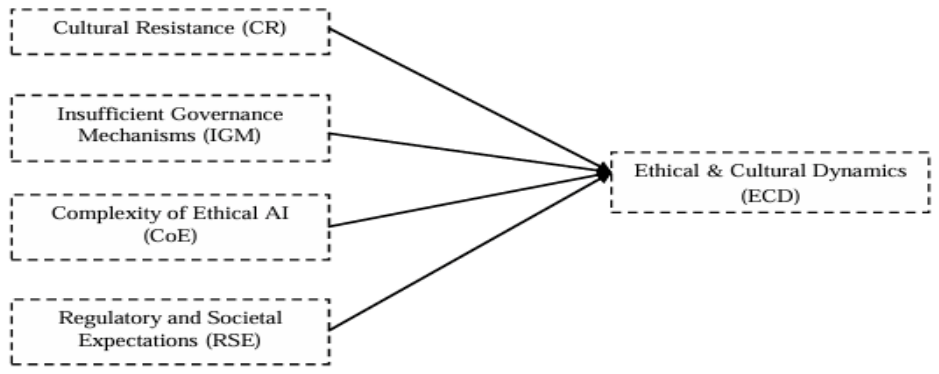
The research rigorously maintained ethical considerations, including informed consent, confidentiality, and data security, throughout the process. The findings are expected to contribute to empirical understanding and offer practical recommendations for organizations seeking to enhance their AI governance frameworks by addressing cultural dynamics and the related issues identified in the framework below.
Figure 1.
Framework Measurement.
2.1. Model evaluation
The measurement model was assessed using a two-stage analytical procedure. In the first stage, Confirmatory Factor Analysis (CFA) was conducted with AMOS and maximum likelihood estimation to evaluate the factor loadings of each measured variable on its respective latent construct [43,44]. This procedure verified construct validity and confirmed that the measurement items accurately reflected the intended constructs. The second stage involved testing a structural regression model to analyze the hypothesized relationships within the conceptual framework. Across both stages, we examined several fit indices to identify the optimal model, including the Chi-square (χ²), normed chi-square (χ²/df), Goodness-of-Fit Index (GFI), Comparative Fit Index (CFI), and Root Mean Square Error of Approximation (RMSEA). These indices confirmed that the model fit the data adequately and met established criteria for model fit. This comprehensive validation process established the reliability and validity of the measurement model, thereby supporting further analysis of the structural relationships in the research framework.

Table 1.
Descriptive Statistics and Correlations.
| Mean | SD | 1 | 2 | 3 | 4 | 5 | 6 | 7 | 8 | 9 | |
|---|---|---|---|---|---|---|---|---|---|---|---|
| Age | 1.09 | 0.39 | |||||||||
| Gender | 2.32 | 0.68 | -0.04 | ||||||||
| Qualification | 1.68 | 0.58 | 0.13 | 0.25 | |||||||
| Year of Experience | 2.29 | 1.19 | -0.14 | 0.34 | 0.05 | ||||||
| CR | 4.88 | 0.90 | 0.06 | 0.02 | 0.03 | 0.05 | |||||
| IGM | 4.10 | 0.80 | 0.01 | 0.04 | 0.04 | 0.04 | 0.06 | ||||
| COE | 2.73 | 1.35 | -0.04 | -0.05 | -0.15 | 0.04 | 0.08 | 0.14 | |||
| RSE | 4.09 | 1.00 | -0.04 | -0.03 | 0.09 | 0.16 | 0.58 | 0.70 | 0.17 | ||
| ECD | 4.02 | 1.19 | 0.5 | 0.60 | 0.54 | 0.72 | 0.67 | 0.63 | 0.79 | 0.53 | 1 |
Source: Designed by authors
Table 1 presents descriptive statistics and correlations among the key variables in the study. The mean values represent the average levels of each variable among participants. The average age is 1.09 (on a scale where 1 likely represents a specific age group), with a standard deviation of 0.39, indicating limited variability in age. The mean for gender is 2.32, suggesting a predominance of one gender, with a standard deviation of 0.68, which reflects some diversity in gender responses. The mean qualification score is 1.68, indicating that most participants possess a particular educational level. The average years of experience is 2.29, with a higher standard deviation (SD = 1.19), indicating greater variability in experience. The correlations indicate the relationships among the variables. Age demonstrates negligible correlations with other variables, indicating minimal association. Gender also shows little association with other variables. Qualification displays moderate positive correlations with both gender and years of experience, suggesting that higher qualifications are associated with greater experience. Years of experience is positively correlated with RSE (0.16) and CR (0.05), indicating that more experienced individuals tend to have higher RSE and CR scores. RSE shows strong positive correlations with Cultural Resistance (CR) (0.58) and Insufficient Governance Mechanisms (IGM) (0.70), demonstrating that these constructs are closely related. In summary, the table provides insights into the relationships and variability of key demographic and psychological variables within the sample.
The correlations reveal relationships between variables. For instance, there is a strong positive correlation (0.70) between Regulatory and Societal Expectations (RSE) and ECD (Ethical & Cultural Dynamics), suggesting that higher RSE is associated with better communication development. Age shows negligible correlations with most variables, indicating limited direct relationships. The moderate-to-high correlations among variables such as qualification, experience, and ECD suggest interconnectedness, supporting their relevance to the model. Overall, this table provides essential insights into the data distribution and intervariable relationships that are crucial for subsequent analysis.
Figure 2.
Model Measurement.
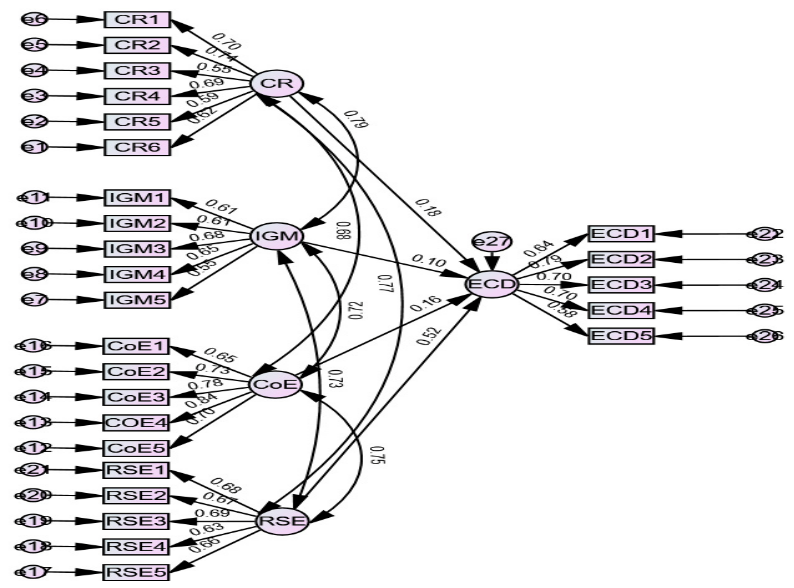
The figure 2 presents the relationships among key variables that influence ethical artificial intelligence (AI) governance. It demonstrates strong positive loadings for the latent constructs of Cultural Resistance (CR), Insufficient Governance Mechanisms (IGM), Ethical Culture Dimensions, and Responsible Social Engagement (RSE), with correlations ranging from 0.52 to 0.88, indicating substantial interdependence. Both CR and IGM significantly affect Ethical & Cultural Dynamics (ECD), with path coefficients of 0.70 and 0.18, respectively, thereby highlighting their impact on organizational ethical practices. ECD, in turn, influences ethical dimensions with a coefficient of 0.64. This model demonstrates that cultural resistance, governance gaps, and social responsibility collectively shape the organizational ethical climate, underscoring the interconnectedness of cultural, governance, and ethical variables in promoting responsible AI deployment.
Table 2.
Measurement Model fit indices.
| Model | X2 | Df | X2 | GFI | AGFI | CFI | TLI | RMSEA |
|---|---|---|---|---|---|---|---|---|
| Estimation | 1589.99 | 873 | 1.82 | 0.94 | 0.90 | 0.95 | 0.91 | 0.065 |
Source: Designed by the authors.
Table 2 reports the fit indices for the measurement model, assessing the degree of alignment between the model and the observed data. The Chi-square value of 1589.99 with 873 degrees of freedom reflects the overall model fit, while the normalized Chi-square (X2/df) of 1.82 indicates a satisfactory fit, as values below 3 are generally considered acceptable. The GFI (0.94), AGFI (0.90), CFI (0.95), and TLI (0.91) all surpass the 0.90 threshold, signifying an excellent fit. The RMSEA of 0.065 is within the acceptable range, further supporting the model's adequacy. Collectively, these indices provide evidence that the measurement model fits the data well.
Table 3.
Reliability, Convergent Validity, and Discriminant Validity.
| Relationship | CR | AVE | Cronbach alpha | CR | IGM | COE | RSE | ECD |
|---|---|---|---|---|---|---|---|---|
| CR | 0.867 | 0.648 | 0.869 | 0.419 | ||||
| IGM | 0.847 | 0.622 | 0.849 | 0.221 | 0.386 | |||
| COE | 0.833 | 0.740 | 0.838 | 0.132 | 0.243 | 0.547 | ||
| RSE | 0.852 | 0.666 | 0.855 | 0.432 | 0.321 | 0.314 | 0.443 | |
| ECD | 0.843 | 0.682 | 0.800 | 0.245 | 0.421 | 0.131 | 0.266 | 0.465 |
Source: Designed by the authors.
Table 3 presents an evaluation of the convergent and discriminant validity of the constructs examined in this study. Convergent validity is assessed by examining whether a construct's indicators are highly correlated, as reflected in the Composite Reliability (CR) and Average Variance Extracted (AVE). All CR values exceed 0.70, indicating strong internal consistency. AVE values range from 0.622 to 0.740, surpassing the commonly accepted threshold of 0.50 and confirming satisfactory convergent validity. Additionally, Cronbach’s alpha values, all above 0.7, further substantiate the internal consistency of the constructs.
Discriminant validity is demonstrated by the off-diagonal correlations between constructs, which are consistently lower than the square root of the AVE, confirming that the constructs are distinct. For instance, the correlation between CR and RSE is 0.391, which is below the square root of the AVE, indicating satisfactory discriminant validity. Collectively, these results indicate that the constructs are both reliable and distinct, thereby supporting the validity of the measurement model. This validation confirms that the constructs accurately represent the intended concepts and remain sufficiently differentiated from one another.
Table 4.
Regression Analysis Results.
| Paths Analysis | Estm | SE | CR | P | Results |
|---|---|---|---|---|---|
| CR ->ECD | 0.190 | 0.050 | 3.800 | 0.002 | Accept |
| IGM-> ECD | 0.110 | 0.035 | 3.100 | 0.004 | Accept |
| COE -> ECD | 0.160 | 0.050 | 3.200 | 0.004 | Accept |
| RSE -> ECD | 0.520 | 0.130 | 4.000 | 0.000 | Accept |
Source: Designed by authors.
Table 4 presents the results of the regression analysis examining the relationships between several predictors and the dependent variable, Ethical & Cultural Dynamics (ECD). The analyzed predictors include Cultural Resistance (CR), Insufficient Governance Mechanisms (IGM), Complexity of Ethical AI (CoE), and Regulatory and Societal Expectations (RSE). Each predictor’s estimated coefficient (Estm) reflects the strength and direction of its effect on ECD. Notably, Cultural Resistance (CR) has an estimated coefficient of 0.190 (SE = 0.050, critical ratio = 3.800, p = 0.002). Insufficient Governance Mechanisms (IGM) has an estimated coefficient of 0.110 (SE = 0.035, critical ratio = 3.100, p = 0.004). Complexity of Ethical AI (CoE) has an estimated coefficient of 0.160 (SE = 0.050, critical ratio = 3.200, p = 0.004). Regulatory and Societal Expectations (RSE) has a reported estimate of 0.520.
The standard errors (SE) for these estimates are relatively small, which increases confidence in the results. All Critical Ratio (CR) values exceed 1.96, confirming the statistical significance of each predictor; for instance, the CR value for RSE is 6.314, indicating strong significance. P-values for all paths are below 0.01, further confirming statistical significance and supporting the acceptance of all hypotheses. These findings indicate that each factor positively influences ECD, underscoring their importance within the model. Collectively, the results support the hypothesis that CR, IGM, CoE, and RSE significantly impact ECD, emphasizing their roles in this context.
3. Discussion
Table 1, Table 2, Table 3 and Table 4 collectively provide a comprehensive overview of the study’s variables, measurement validity, and interrelationships. Table 1 presents descriptive statistics and correlations, indicating that demographic variables such as age and gender have minimal associations with other factors, while experience is positively correlated with RSE and CR. Significant correlations between constructs, including RSE and ECD, demonstrate their interconnectedness and support their inclusion in the model. Table 2 demonstrates that the measurement model fits the data well, with fit indices ranging from acceptable to excellent, thereby ensuring reliable construct measurement. Table 3 further validates the measurement quality, as high values for CR, AVE, and Cronbach’s alpha indicate strong convergent validity, and off-diagonal correlations confirm discriminant validity, establishing that the constructs are both reliable and distinct. Table 4 shows that all predictors, CR, IGM, CoE, and RSE, significantly affect ECD, with CoE having the strongest influence. The positive coefficients and significant p-values suggest that improving these factors may strengthen ethical and cultural dynamics. Collectively, these findings underscore the significance of the examined constructs in shaping ECD and affirm the robustness of the study’s measurement and analytical approaches.
3.1. Theoretical Contributions
This study advances understanding of the relationship between organizational culture and ethical AI governance by integrating multiple theoretical frameworks, such as agency theory and the influence of cultural values. It provides empirical evidence that organizational culture, defined by transparency, accountability, and leadership commitment, significantly shapes responsible AI practices. The findings underscore the need to embed ethical principles in organizational norms and structures, showing that technical safeguards alone do not ensure ethical AI deployment. The study also identifies cultural resistance, weak governance mechanisms, and the inherent complexity of ethical AI as major challenges, while highlighting the importance of leadership and stakeholder engagement in fostering an ethical environment. These contributions expand the AI ethics literature by clarifying how cultural and governance factors interact to shape ethical outcomes, offering a nuanced view of the organizational antecedents of responsible AI use.
3.2. Practical Implications
Practitioners may apply these findings to develop robust ethical AI governance frameworks that align with organizational culture. Leadership should cultivate transparency, accountability, and continuous learning through clear policies, ethics training, and stakeholder engagement. Facilitating interdisciplinary collaboration and maintaining open communication channels can reduce resistance and indifference to AI initiatives. Organizations should integrate ethical principles into their core values and establish comprehensive governance mechanisms that address technical, social, and organizational aspects. Regular audits, stakeholder involvement, and well-defined accountability structures can support responsible AI deployment. Additionally, sustained leadership commitment and the integration of ethical considerations into organizational routines will promote enduring responsible AI practices, thereby strengthening stakeholder trust and societal acceptance. This model demonstrates that cultural resistance, governance gaps, and social responsibility collectively shape the organizational ethical climate, underscoring the interconnectedness of cultural, governance, and ethical variables in promoting responsible AI deployment. . Despite these limitations, the study offers valuable insights into the cultural and governance factors influencing ethical AI practices and underscores the necessity for continued empirical investigation.
4. Conclusion
The study highlights the essential role of organizational culture and governance in facilitating ethical AI deployment. It shows that cultures that prioritize transparency, accountability, and leadership commitment positively affect responsible AI practices. Nevertheless, the research is limited by its reliance on self-reported data, which may introduce bias, and its cross-sectional design, which restricts causal inference. The sample primarily comprises organizations from specific sectors or regions, potentially limiting generalizability. Furthermore, the focus on perceptual rather than longitudinal measures constrains understanding of cultural evolution over time.
5. Future Research
Future research should use longitudinal designs to examine how organizational culture evolves and shapes AI ethics over time. Broadening the sample to encompass a wider range of industries, regions, and organizational sizes will improve generalizability and facilitate cross-cultural analysis. The use of behavioral and qualitative methodologies can provide deeper insights into the internalization and enactment of cultural norms. Examining the effects of specific leadership styles, incentive structures, and interdisciplinary collaborations may yield practical approaches for integrating ethics into AI governance. Furthermore, analyzing the impact of external regulatory frameworks and societal norms on organizational culture will offer a more comprehensive understanding of responsible AI adoption across contexts. Pursuing these research directions will enhance theoretical frameworks and support the development of effective implementation strategies.
Author Contributions
Conceptualization: MMA, AHA & EA; Methodology: MMA, AHA & EA; Software: AHA; Validation: MMA, AHA & EA; Formal Analysis: MMA, AHA & EA; Investigation: MMA, AHA & EA; Resources: MMA, AHA & EA; Data curation: AHA, EA & MMA; Writing original draft preparation: MMA, EA & AHA; Writing review and editing: MMA, & AHA; Visualization: AHA, EA & MMA; Supervision: MMA, AHA & EA; Project administration: MMA, AHA & EA; Funding acquisition: MMA, AHA & EA All authors have read and agreed to the published version of the manuscript
Funding
No funding attached to the research.
Institutional Review Board Statement
No need for review
Informed Consent Statement
The informed consent was obtained from the respondents
Data Availability Statement
The data is available when needed
Conflicts of Interest
No conflict of interest
References
- Panda, M.; Hossain, M. M.; Puri, R.; Ahmad, A. Artificial intelligence in action: shaping the future of public sector. Digit. Policy Regul. Gov. 2025, 27(6), 668–686. [Google Scholar] [CrossRef]
- Du, S.; Xie, C. Paradoxes of artificial intelligence in consumer markets: Ethical challenges and opportunities. J. Bus. Res. 2021, 129, 961–974. [Google Scholar] [CrossRef]
- Machucho, R.; Ortiz, D. The impacts of artificial intelligence on business innovation: A comprehensive review of applications, organizational challenges, and ethical considerations. Systems 2025, 13(4), 264. [Google Scholar] [CrossRef]
- Rane, N.; Choudhary, S. P.; Rane, J. Acceptance of artificial intelligence: key factors, challenges, and implementation strategies. J. Appl. Artif. Intell. 2024, 5(2), 50–70. [Google Scholar] [CrossRef]
- Birkstedt, T.; Minkkinen, M.; Tandon, A.; Mäntymäki, M. AI governance: themes, knowledge gaps and future agendas. Internet Res. 2023, 33(7), 133–167. [Google Scholar] [CrossRef]
- Schiff, D. S. Strategies for harmonizing fragmented AI ethics frameworks, standards, and regulations. In Handbook of human-centered artificial intelligence; Springer Nature Singapore: Singapore, 2026; pp. 1897–1940. [Google Scholar]
- Muhammad, T.; Al-Shaghdari, F. Islamic social finance system: an alternative tool for tackling educational setbacks in Northern Nigeria. J. Islam. Mark. 2024, 15(11), 3115–3136. [Google Scholar] [CrossRef]
- Muhammad, T.; Al-Shaghdari, F. Waqf microfinance as an alternative and sustainable government empowerment tool towards women in Northern Nigeria: a perceptional analysis. J. Bus. Socio-Econ. Dev. 2025, 5(4), 338–354. [Google Scholar] [CrossRef]
- Jensen, M. C.; Meckling, W. H. Theory of the firm: Managerial behavior, agency costs and ownership structure. J. Financ. Econ. 1976, 3(4), 305–360. [Google Scholar] [CrossRef]
- Pasquale, F. The black box society: The secret algorithms that control money and information; Harvard University Press, 2015. [Google Scholar]
- Martin, K. Ethical implications and accountability of algorithms. J. Bus. Ethics 2019, 160(4), 835–850. [Google Scholar] [CrossRef]
- Wangrow, D. B.; Schepker, D. J.; Barker, V. L. Managerial discretion: An empirical review and future research directions. J. Manag. 2015, 41(1), 99–135. [Google Scholar]
- Gunning, D. Explainable artificial intelligence (XAI). In Defense Advanced Research Projects Agency (DARPA); 2017. [Google Scholar]
- Kotsantonis, S.; Serafeim, G. Four things no one will tell you about ESG data. J. Appl. Corp. Financ. 2019, 31(2), 50–58. [Google Scholar] [CrossRef]
- Kaptein, M. Understanding unethical behavior by unraveling ethical culture. Hum. Relat. 2011, 64(6), 843–869. [Google Scholar] [CrossRef]
- Floridi, L.; Cowls, J.; Beltrametti, M.; Chatila, R.; Chazerand, P.; Dignum, V.; Luetge, C.; Madelin, R.; Pagallo, U.; Rossi, F.; Schafer, B.; Valcke, P.; Vayena, E. AI4People—An ethical framework for a good AI society: Opportunities, risks, principles, and recommendations. Minds Mach. 2018, 28(4), 689–707. [Google Scholar] [CrossRef] [PubMed]
- Rieker, M. Ethical organizational culture and artificial intelligence governance. AI Soc. 2020, 35(3), 645–658. [Google Scholar]
- Cummings, M. L. Artificial intelligence and the future of warfare. In Chatham House Research Paper; 2017. [Google Scholar]
- Floridi, L.; Cowls, J. A unified framework of five principles for AI in society. Harv. Data Sci. Rev. 2019, 1(1). [Google Scholar]
- Kim, T.; Lee, S.; Park, J. Organizational governance and ethical AI implementation. Bus. Ethics Q. 2020, 30(4), 487–510. [Google Scholar]
- Jobin, A.; Ienca, M.; Vayena, E. The global landscape of AI ethics guidelines. Nat. Mach. Intell. 2019, 1(9), 389–399. [Google Scholar] [CrossRef]
- Schein, E. H. Organizational culture and leadership, 4th ed.; Jossey-Bass, 2010. [Google Scholar]
- Culnan, M. J.; McHugh, P. J.; Zubcsek, P. P. Governing artificial intelligence: Ethical, legal, and managerial implications. Bus. Horiz. 2021, 64(2), 149–160. [Google Scholar]
- Zhang, B.; Dafoe, A. Artificial intelligence: American attitudes and trends. In Center for the Governance of AI, Future of Humanity Institute; University of Oxford, 2019. [Google Scholar]
- Dignum, V. Responsible artificial intelligence: How to develop and use AI in a responsible way; Springer, 2019. [Google Scholar]
- Cummings, M. L. Artificial intelligence and the future of work. AI Mag. 2020, 41(2), 15–26. [Google Scholar] [CrossRef]
- Mittelstadt, B. D.; Allo, P.; Taddeo, M.; Wachter, S.; Floridi, L. The ethics of algorithms: Mapping the debate. Big Data Soc. 2016, 3(2), 1–21. [Google Scholar] [CrossRef]
- Smith, A.; Jones, B.; Williams, C. Employee perceptions of artificial intelligence adoption in organizations. J. Manag. Stud. 2020, 57(6), 1123–1145. [Google Scholar]
- Johnson, G. Organizational culture and technological change. J. Organ. Change Manag. 2018, 31(4), 789–804. [Google Scholar]
- Lee, J.; Kim, S. Employee attitudes toward artificial intelligence adoption. Technol. Forecast. Soc. Change 146 2019, 351–361. [Google Scholar]
- Johnson, G.; Smith, A.; Brown, T. Artificial intelligence governance in organizations: Challenges and opportunities. J. Bus. Ethics 2021, 170(2), 321–337. [Google Scholar]
- Crawford, K.; Paglen, T. Excavating AI: The politics of images in machine learning training sets. Int. J. Commun. 13 2019, 2966–2985. [Google Scholar]
- O'Neil, C. Weapons of math destruction: How big data increases inequality and threatens democracy; Crown Publishing, 2016. [Google Scholar]
- Bryson, J. J. Patiency is not a virtue: AI and the design of ethical systems. In Ethics of Artificial Intelligence; Oxford University Press, 2018. [Google Scholar]
- McMahan, H. B.; Moore, E.; Ramage, D.; Hampson, S.; Arcas, B. A. Y. Communication-efficient learning of deep networks from decentralized data. In Proceedings of the 20th International Conference on Artificial Intelligence and Statistics, 2017; pp. 1273–1282. [Google Scholar]
- Dwork, C.; Hardt, M.; Pitassi, T.; Reingold, O.; Zemel, R. Fairness through awareness. In Proceedings of the 3rd Innovations in Theoretical Computer Science Conference, 2012; pp. 214–226. [Google Scholar]
- Lipton, Z. C. The mythos of model interpretability. arXiv 2016, arXiv:1606.03490. [Google Scholar]
- Dwork, C. The algorithmic foundations of differential privacy; Now Publishers, 2014. [Google Scholar]
- Crawford, K.; Calo, R. There is a blind spot in AI research. Nature 2016, 538(7625), 311–313. [Google Scholar] [CrossRef] [PubMed]
- Cath, C.; Floridi, L. Artificial intelligence and the "good society": The US, EU, and UK approach. Sci. Eng. Ethics 2018, 24(2), 505–528. [Google Scholar] [CrossRef] [PubMed]
- European Commission. Proposal for a regulation laying down harmonised rules on artificial intelligence (Artificial Intelligence Act); 2021. [Google Scholar]
- Wirtz, B. W.; Weyerer, J. C.; Geyer, C. Artificial intelligence and the public sector: Applications and challenges. Int. J. Public Adm. 2019, 42(7), 596–615. [Google Scholar] [CrossRef]
- Byrne, B. M. Structural equation modeling with AMOS: Basic concepts, applications, and programming, 2nd ed.; Routledge, 2010. [Google Scholar]
- Hair, J. F.; Black, W. C.; Babin, B. J.; Anderson, R. E. Multivariate data analysis, 7th ed.; Pearson, 2010. [Google Scholar]
- Treviño, L. K.; Nelson, K. A. Managing business ethics: Straight talk about how to do it right, 7th ed.; Wiley, 2017. [Google Scholar]
- Tan, L.; Gao, D.; Zhang, X. Breaking the gap between words and deeds: Can firm-level Fintech mitigate ESG decoupling? Int. Rev. Econ. Financ. 2026, 105910. [Google Scholar] [CrossRef]
- Muhammad, T.; Al-Shaghdari, F. Waqf microfinance as an alternative and sustainable government empowerment tool towards women in Northern Nigeria: a perceptional analysis. J. Bus. Socio-Econ. Dev. 2025, 5(4), 338–354. [Google Scholar] [CrossRef]
Disclaimer/Publisher’s Note: The statements, opinions and data contained in all publications are solely those of the individual author(s) and contributor(s) and not of MDPI and/or the editor(s). MDPI and/or the editor(s) disclaim responsibility for any injury to people or property resulting from any ideas, methods, instructions or products referred to in the content. |
© 2026 by the authors. Licensee MDPI, Basel, Switzerland. This article is an open access article distributed under the terms and conditions of the Creative Commons Attribution (CC BY) license (http://creativecommons.org/licenses/by/4.0/).
Copyright: This open access article is published under a Creative Commons CC BY 4.0 license, which permit the free download, distribution, and reuse, provided that the author and preprint are cited in any reuse.