

Submitted:
02 November 2026
Posted:
04 November 2026
You are already at the latest version
Abstract
Introduction: Political contestation and coalition instability have become important features of South African municipal governance. The supplied evidence links unstable political arrangements with leadership turnover, delayed budgets, interrupted services and weakened long-term planning, while also indicating that coalition government is not uniformly harmful. Local economic development (LED) is additionally shaped by institutional capacity, policy coherence, stakeholder participation, resources and accountability. Methods: The researcher-selected databases and information sources were Google Scholar, ERIC. The eligibility protocol restricted publication years to 2017–2026. The exact calendar date of search execution was not recorded in the verified identification provenance; this is distinct from the publication-year eligibility range. A systematic review was conducted using Google Scholar and ERIC for English-language peer-reviewed studies published from 2017 to 2026. The recorded search strategy combined municipal governance, political contestation and LED concepts. Results: The synthesis found that coalition instability can redirect municipal attention from LED and service delivery toward political survival, but effects vary with coalition cohesion and institutional arrangements. LED performance was constrained by unclear mandates, weak skills, insufficient finance, limited coordination and inadequate monitoring. Political economy dynamics shaped whose interests were represented, with eThekwini-specific evidence indicating preferential treatment of formal businesses over street traders. Durable trajectories required political accommodation to be institutionalised through shared priorities, coherent planning, accountability and participation. Discussion/Conclusion: Political contestation influences LED through its interaction with administrative capacity, institutional rules and distributive power rather than through a simple coalition-versus-performance relationship. The evidence does not permit a firm prediction of eThekwini's post-2026 trajectory because direct evidence on its coalition dynamics and LED implementation remains limited.
Keywords:
coalition stability
; eThekwini
; local economic development
; municipal governance
; political contestation
1. Introduction
South African municipalities are expected to combine democratic representation, service delivery, institutional accountability and local economic development (LED). The supplied literature presents LED as a participatory and institutionally mediated process involving municipalities, businesses, communities and other public actors. Yet implementation remains uneven. Studies identify unclear LED mandates, limited municipal capacity, weak coordination, insufficient funding and inconsistent stakeholder engagement as recurring constraints (Hlongwane, 2018; Khenisa, 2020; Mashiteng, 2017; Shava, 2024). These concerns are especially significant in metropolitan municipalities, where political bargaining, resource allocation and economic planning intersect.
Coalition governance has intensified the political dimension of municipal administration. South African coalition-focused studies associate unstable arrangements with leadership turnover, motions of no confidence, delayed budgets, disrupted services, weakened oversight and shortened planning horizons (Maenetja & Malatji, 2024; Malinga et al., 2026; Selelo & Lebotsa, 2024). However, the evidence is not uniformly negative. Comparative observations indicate greater stability and policy consistency in Cape Town than in Johannesburg, Tshwane and Ekurhuleni, while other analysis argues that it is premature to conclude that coalitions have failed because their effects depend on political cohesion, transparency and institutional design (Maenetja & Malatji, 2024; Malinga et al., 2026).
The political economy of LED also concerns distribution. Municipal decisions determine whose knowledge, economic activity and claims receive recognition in planning, public space, procurement, infrastructure and development programmes. The eThekwini-specific evidence reports that formal businesses and shop owners receive preferential treatment in municipal decision-making, while street traders are insufficiently included despite their contribution to household income generation (Jiyane, 2017). Related evidence identifies political exclusion of youth, limited community access to Social Labour Plans and responsibility shifting among government actors (Khenisa, 2020; Tsomo & Gotyi, 2026). Conversely, research on eThekwini's electoral systems suggests that constituency representation may strengthen direct accountability and that combining proportional and constituency systems may balance representation and participation (Tshishonga, 2025).
What remains insufficiently understood is how political contestation and coalition dynamics specifically shape LED trajectories in eThekwini, particularly in the post-2026 local government environment. The supplied evidence contains limited direct analysis of eThekwini coalition governance, lacks consistent longitudinal comparisons between coalition and non-coalition municipalities, and largely supports associations rather than causal conclusions. A systematic review was therefore needed to integrate evidence across municipal governance, coalition politics, institutional capacity, participation and LED while preserving contextual differences and contradictions.
2. Research Objectives
RO1: To examine how Political contestation, political economy dynamics, and coalition governance instability within municipal management influences Local economic development trajectories, municipal governance performance, and institutional policy implementation among Municipal governance institutions, local administrative bodies, and metropolitan municipalities in South Africa, with specific reference to eThekwini Metropolitan Municipality within Post-2026 local government environment and institutional governance framework in South Africa, focusing on eThekwini Metropolitan Municipality.
RO2: To identify the principal opportunities, benefits and enabling conditions associated with Political contestation, political economy dynamics, and coalition governance instability within municipal management in relation to Local economic development trajectories, municipal governance performance, and institutional policy implementation.
RO3: To analyse the challenges, risks, ethical considerations and implementation barriers associated with Political contestation, political economy dynamics, and coalition governance instability within municipal management for Municipal governance institutions, local administrative bodies, and metropolitan municipalities in South Africa, with specific reference to eThekwini Metropolitan Municipality.
RO4: To examine the contextual, institutional and practice-related factors that shape the adoption and effective use of Political contestation, political economy dynamics, and coalition governance instability within municipal management within Post-2026 local government environment and institutional governance framework in South Africa, focusing on eThekwini Metropolitan Municipality.
RO5: To identify gaps in the available evidence and derive implications for future research, policy and practice relevant to The Political Economy of Municipal Governance: Political Contestation, Coalition Stability and the Future of Local Economic Development in Post-2026 South Africa An Institutional Case Study of eThekwini Metropolitan Municipality.
3. Research Methods
3.1. Review Design
The selected review type was Systematic Review. This design was appropriate because the question required a transparent search, explicit eligibility criteria, study-level appraisal and structured synthesis across heterogeneous empirical, conceptual, qualitative and quantitative evidence. Review reporting was distinguished from review conduct: PRISMA was used to report selection, CASP was used for methodological appraisal, and thematic synthesis was used to integrate extracted findings. SALSA concepts provide a useful distinction between searching, appraisal, synthesis and analysis (Grant & Booth, 2009; Page et al., 2021).
3.2. Search Strategy and Information Sources
The researcher-selected databases and information sources were Google Scholar, ERIC. The eligibility protocol restricted publication years to 2017–2026. The exact calendar date of search execution was not recorded in the verified identification provenance; this is distinct from the publication-year eligibility range.
3.3. Inclusion and Exclusion Criteria
Inclusion
- Studies examining municipal governance structures, metropolitan councils, or local government administration in South Africa, with relevance to eThekwini Metropolitan Municipality or comparable metros.
- Studies analysing political contestation, coalition governance, inter-party power dynamics, or institutional stability within local political economy frameworks.
- Studies focusing on local economic development (LED) outcomes, municipal economic strategies, service infrastructure planning, or governance performance.
- Studies utilizing qualitative, quantitative, mixed-methods, or institutional case-study designs.
- Peer-reviewed journal articles published between 2017 and 2026.
- Articles published in English.
Exclusion
- Studies focusing exclusively on national or provincial governance without application to municipal levels or local political economies.
- Studies investigating technical municipal operations (e.g., routine engineering or pure auditing) that omit political economy, coalition, or contestation analyses.
- Studies focusing strictly on voter turnouts or campaign advertising without assessing local governance outcomes or economic development.
- Non-peer-reviewed publications, including editorials, opinion pieces, conference abstracts, commentary, and policy blogs.
- Studies published prior to 2017 or in languages other than English.
3.4. Screening and Study Selection
The PRISMA selection counts are persisted, but the decision rule used during title/abstract screening is not available in the verified audit payload. COSTAQDA therefore reports the recorded workflow counts without reconstructing an unverified screening procedure.
The persisted PRISMA workflow records 199 identified records, 0 duplicates, 109 records screened, 108 reports sought for retrieval, 1 records excluded at the title/abstract stage, 84 full texts assessed, 0 full-text exclusions and 84 included records. These counts describe study selection and are not substantive review findings.
Figure 1.
PRISMA 2020 Flow Diagram — Identification, Screening, Eligibility and Included. Source: COSTAQDA PRISMA Workflow, navigation item 8: PRISMA Flow Diagram; four-stage structure showing Identification, Screening, Eligibility (including CASP critical appraisal) and Included; adapted from PRISMA 2020 (Page et al., 2021).
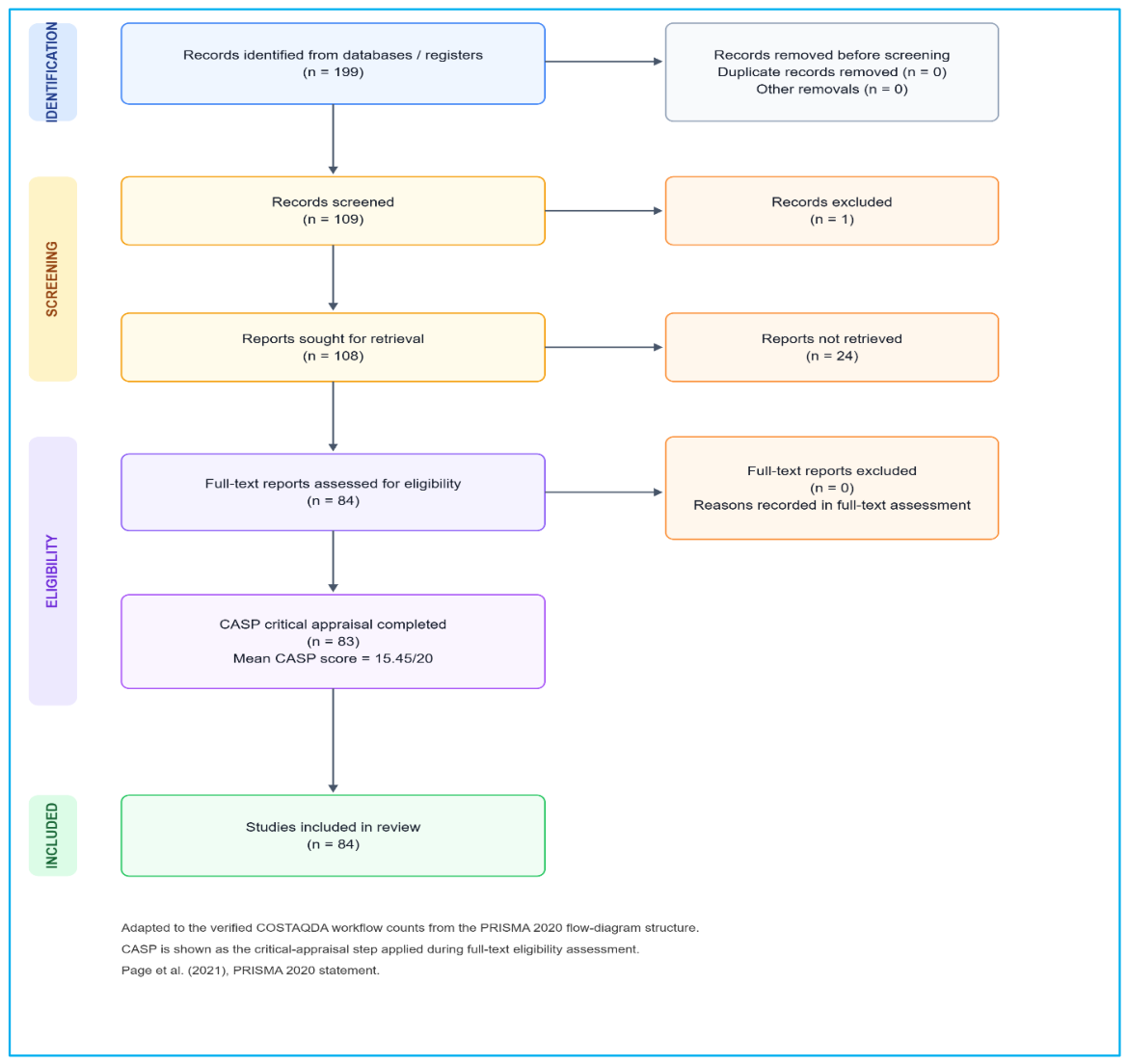
The frontend renders the actual PRISMA figure from the persisted workflow. The figure is appropriate for documenting study identification and selection, and the recorded pathway contains 199 identified records, 0 duplicates, 109 screened records, 108 reports sought, 1 title/abstract exclusion, 84 full texts assessed, 0 full-text exclusions and 84 included records (Page et al., 2021). The identification discrepancy described above remains unverified and should be displayed or annotated rather than silently reconciled.
3.5. Critical Appraisal
Critical Appraisal Skills Programme (CASP) was used in the PRISMA full-text workspace. CASP provides structured study-design-specific questions concerning methodological validity, findings and relevance; it was used here as methodological appraisal rather than as a definitive overall quality score. Eighty-three of the 84 currently included studies had completed appraisals, with one study remaining unapprised. The recorded mean score was 15.45, but this mean is not interpreted as a validated measure of evidence certainty.
The appraisal record shows study-level variation. The supplied scores ranged from 11 to 19 among the displayed completed appraisals, and study records frequently contain criterion-level methodological concerns such as casp-2, casp-4, casp-6, casp-7 and casp-8. These concerns indicate that reporting or methodological limitations were recorded, but the workspace does not provide complete criterion-level rationales for every study. Consequently, the review can identify uneven appraisal profiles but cannot reconstruct a fully domain-specific comparative assessment for all 84 studies.
The appraisal process also encountered technical limitations. Many appraisal decisions state that an external configured service was unavailable and that COSTAQDA completed a conservative text-evidence appraisal, marking unsupported criteria as Can't tell for researcher verification. This supports traceability of the appraisal record but does not remove uncertainty about the underlying methodological judgments. Appraisal results should therefore inform interpretation without being converted into an unquestioned numerical hierarchy (Long et al., 2020; Costa & Costa, 2024).
Study-specific concerns constrain the synthesis. The coalition evidence includes a conceptual analysis and studies with recorded concerns relating to methodological clarity, while several LED studies are theoretical, documentary or repository-based rather than longitudinal evaluations. The evidence from Malinga et al(2026). supports an association between coalition instability and implementation disruption, but its appraisal limitations mean that the finding should not be treated as a causal estimate. Similarly, Ngatiane (2017), Mashiteng (2017), Hlongwane (2018), Shava (2024) and Modise (2025) support institutional-capacity interpretations, but their findings do not establish that coalition politics alone produced LED outcomes.
The completed CASP appraisals strengthen transparency by linking appraisal records to study identifiers, while the absence of a recorded finding-level confidence method limits conclusions about confidence in individual synthesised findings. No GRADE-CERQual assessment was recorded. Thus, trustworthiness was considered through convergence and divergence across studies, appraisal limitations, directness to eThekwini and the distinction between association and causation rather than through a formal confidence rating (Noyes et al., 2018; Lewin et al., 2018).
Figure 2.
CASP Critical Appraisal Intelligence — PRISMA Workflow, Step 6: Full-Text Screening, Source: COSTAQDA PRISMA Workflow, navigation item 6: Full-Text Screening (CASP critical appraisal outputs). The Word figure is generated from the same deterministic COSTAQDA CASP visual.
Figure 2.
CASP Critical Appraisal Intelligence — PRISMA Workflow, Step 6: Full-Text Screening, Source: COSTAQDA PRISMA Workflow, navigation item 6: Full-Text Screening (CASP critical appraisal outputs). The Word figure is generated from the same deterministic COSTAQDA CASP visual.
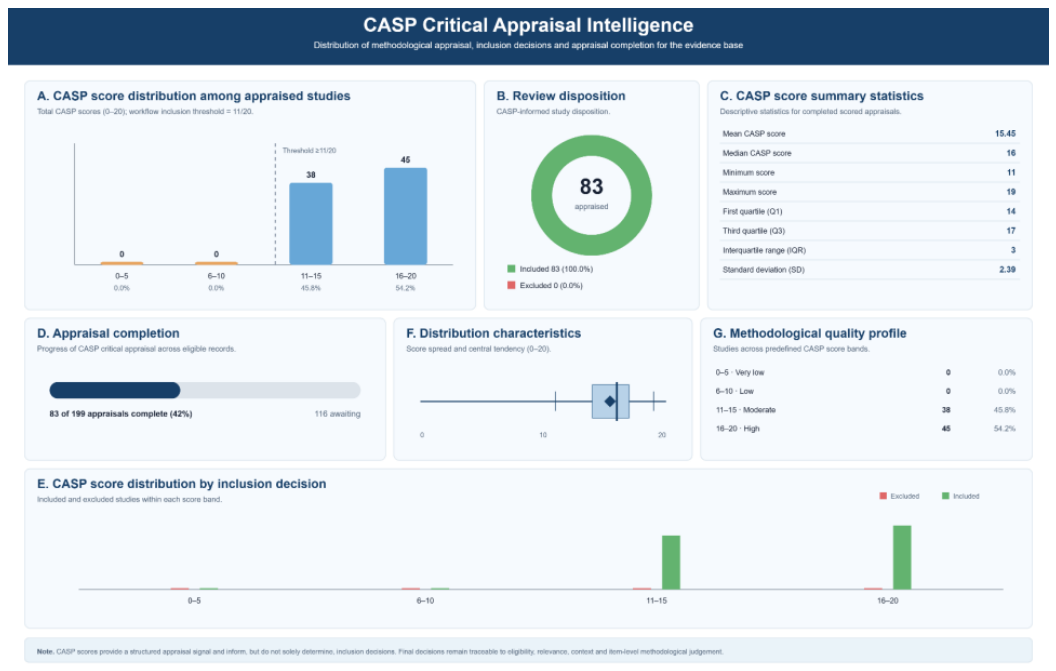
The frontend renders the CASP figure from the live appraisal workspace. Its appropriate interpretation is study-level methodological appraisal, not a measure of causal strength, evidence certainty or substantive effect. The figure records 83 completed appraisals among 84 included studies and a mean score of 15.45, but the mean should not replace examination of study-linked judgments.
The displayed appraisal pattern suggests that methodological limitations were not uniformly distributed. For example, the study-level records associate concerns with reporting, design or interpretive criteria across coalition, LED, infrastructure, participation and governance studies. However, the workspace does not provide complete criterion-level rationales for all records, so the figure cannot support precise claims about which domains were most problematic across the entire corpus.
The figure also reflects the conservative text-evidence procedure used when the configured appraisal service was unavailable. Unsupported criteria were recorded as Can't tell and flagged for researcher verification. This is preferable to presenting unresolved studies as fully appraised, but it means that numerical comparisons should be treated cautiously. CASP scores and bibliometric prominence are not substitutes for a finding-level confidence assessment (Long et al., 2020).
Overall, the CASP figure supports cautious interpretation of the synthesis. The recurring themes are supported by studies with both stronger and weaker methodological records, and the direct eThekwini evidence is limited. The figure therefore reinforces the need to frame the conclusions as conditional and context-sensitive rather than as a formal confidence grade.
3.6. Data Extraction
A formal data-extraction procedure was not recorded. Nevertheless, the verified synthesis workspace demonstrates that finding-level extraction occurred: 523 extracted findings from 69 studies were available for thematic synthesis, with finding IDs and study IDs retained. Extracted metadata also included study titles, authors, years, publication venues, abstracts, appraisal records and substantive finding text. Incomplete fragments, tables, references and metadata were not used as substantive evidence.
3.7. Data Synthesis and Analysis
Qualitative evidence synthesis was conducted on 523 extracted findings contributed by 69 studies. The COSTAQDA synthesis engine applied thematic synthesis, moving from traceable finding-level evidence to 6 initial codes, 4 categories, 0 descriptive themes and 4 analytical themes.
Theme development was constrained to the extracted finding-level evidence supplied by eligible studies. Each synthesised theme retained supporting study IDs and finding IDs, while contradictory evidence was preserved where identified. Titles, abstracts and bibliographic prominence were not treated as substitutes for extracted qualitative findings.
Recorded synthesis limitations included: The supplied findings contain limited direct evidence on eThekwini's coalition dynamics, LED implementation and post-2026 trajectory. The eThekwini-specific evidence focuses mainly on informal-sector participation and electoral accountability rather than coalition governance.; Several included findings are conceptual, theoretical, descriptive, quantitative or drawn from outside South Africa. They provide contextual support but cannot establish causal effects in eThekwini or South African municipalities generally.; Some extracted items are incomplete text fragments, tables, references or metadata. These were not used as substantive evidence.; The findings do not provide a consistent longitudinal comparison of coalition and non-coalition municipalities, so claims about coalition effects should remain conditional.; The evidence supports associations between instability, institutional weakness and implementation problems, but does not permit a firm causal conclusion that political contestation alone determines LED outcomes..
3.8. Bibliometric Intelligence and Confidence in the Evidence Base
Bibliometric intelligence provides a structural view of the evidence base that complements PRISMA selection, critical appraisal and qualitative synthesis. The following analyses examine citation relationships, scholarly influence, evidence connectivity and knowledge development within the included corpus. They provide contextual evidence about the intellectual structure and provenance of the literature and are not substitutes for methodological quality appraisal.
3.8.1. Local Citation Network
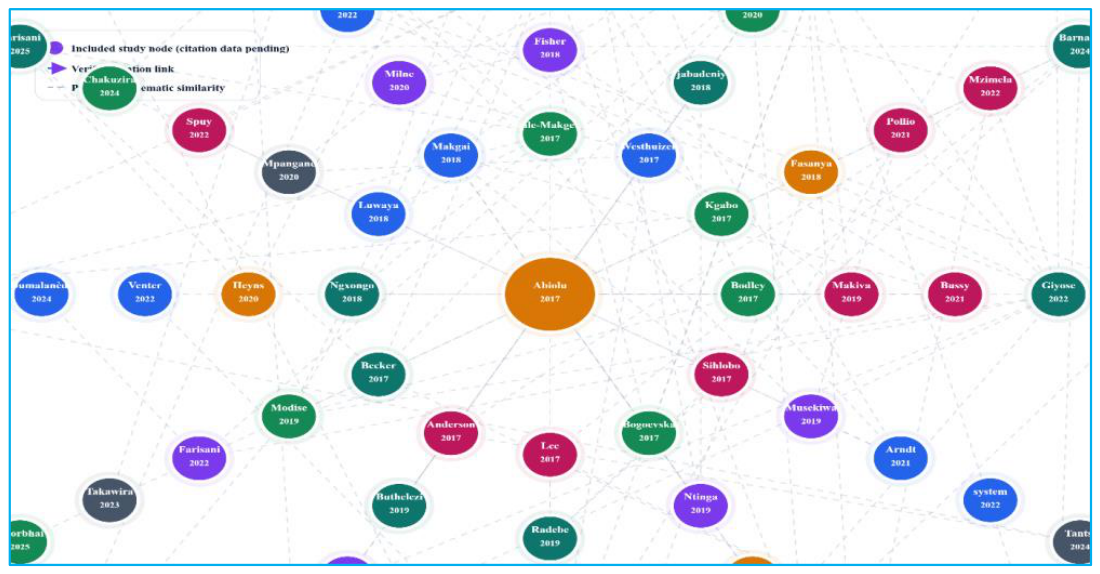
The Local Citation Network maps citation relationships within the included evidence base. It shows how studies are connected within the review corpus and supports examination of intellectual connectedness, centrality, bridging and isolation. These citation relationships describe the structure of the literature and do not, by themselves, establish methodological quality or validity.
Figure 3.
Local Citation Network. Source: COSTAQDA PRISMA Workflow.
3.8.2. Influence Pyramid
The Influence Pyramid represents the distribution of scholarly influence within the included evidence base. It helps identify how bibliometric prominence is distributed across the reviewed studies. Influence is interpreted separately from methodological quality, which is assessed through critical appraisal.
Figure 4.
Influence Pyramid Source: COSTAQDA PRISMA Workflow.
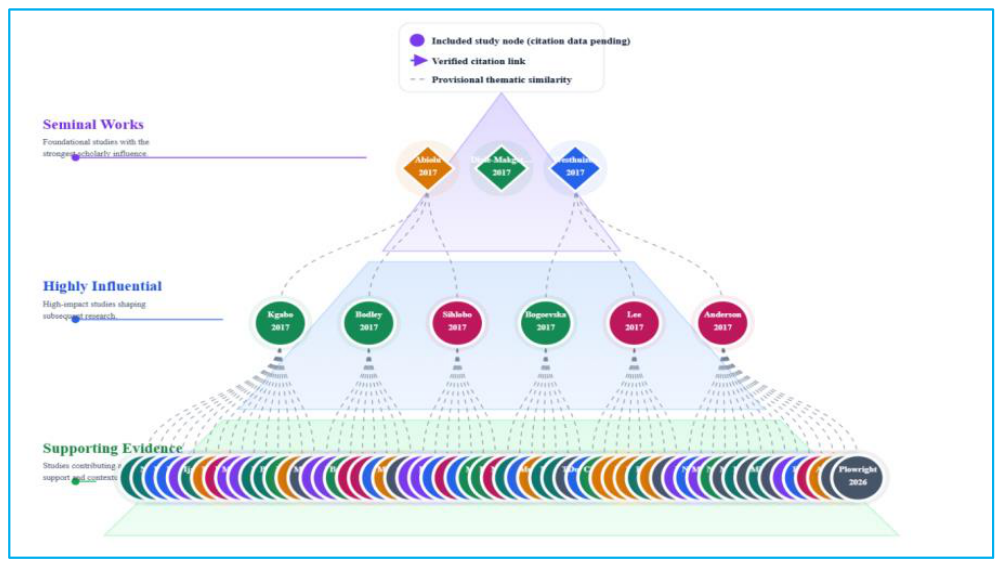
An Influence Pyramid was marked as available for frontend rendering, but the verified bibliometric intelligence contains no source, metric, nodes, edges, values or interpretation. A defensible bibliometric interpretation cannot therefore be produced. In particular, no influence Score formula or citation coverage is supplied, so construction and comparability cannot be independently established. The figure must not be interpreted as evidence of citation impact, quality, causality, consensus or methodological strength (Donthu et al., 2021; Zupic & Čater, 2015).
3.8.3. Evidence Strength
The Evidence Strength analysis examines the structure and strength of relationships within the evidence ecosystem assembled for the review. It complements, but does not replace, CASP methodological appraisal and must not be interpreted as a direct estimate of causal effect.
Figure 5.
Evidence Strength Network Source: COSTAQDA PRISMA Workflow.
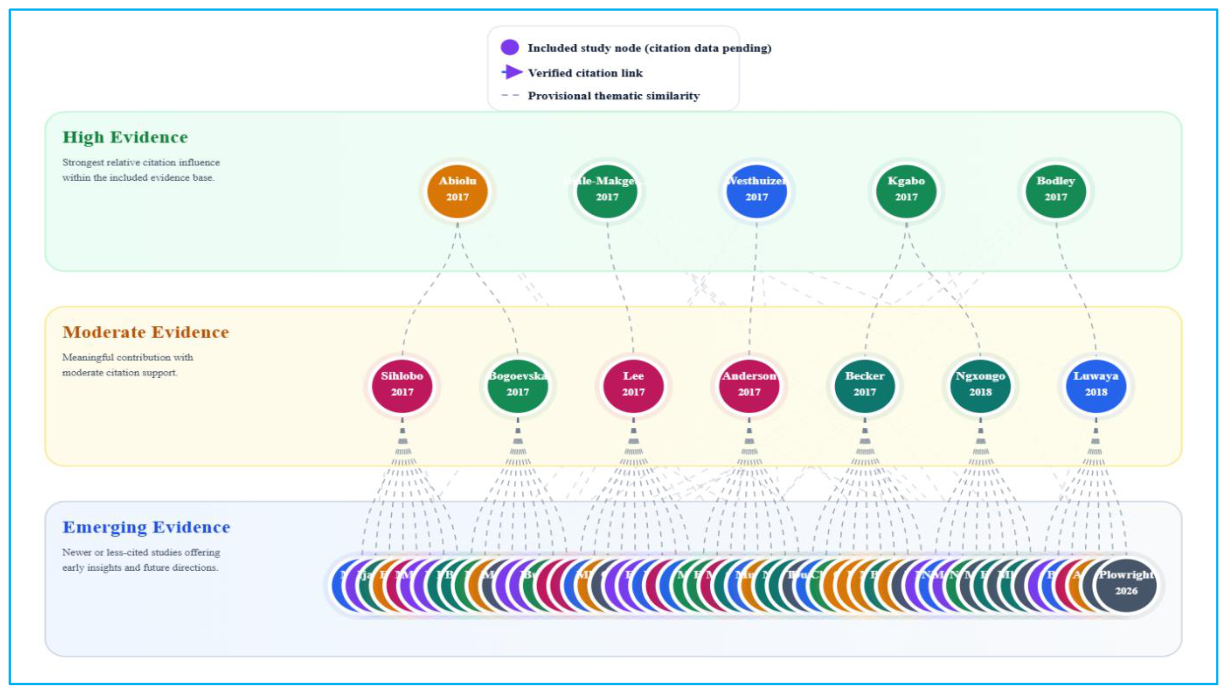
An Evidence Strength Network was also marked as available for frontend rendering, but no verified nodes, edges, relation types, weights or node metadata were supplied. A defensible interpretation cannot therefore be produced. Network structure cannot be used to infer independent corroboration, study quality, causal strength, confidence or an observed effect. The network must not replace CASP appraisal or finding-level confidence assessment (Donthu et al., 2021; Zupic & Čater, 2015).
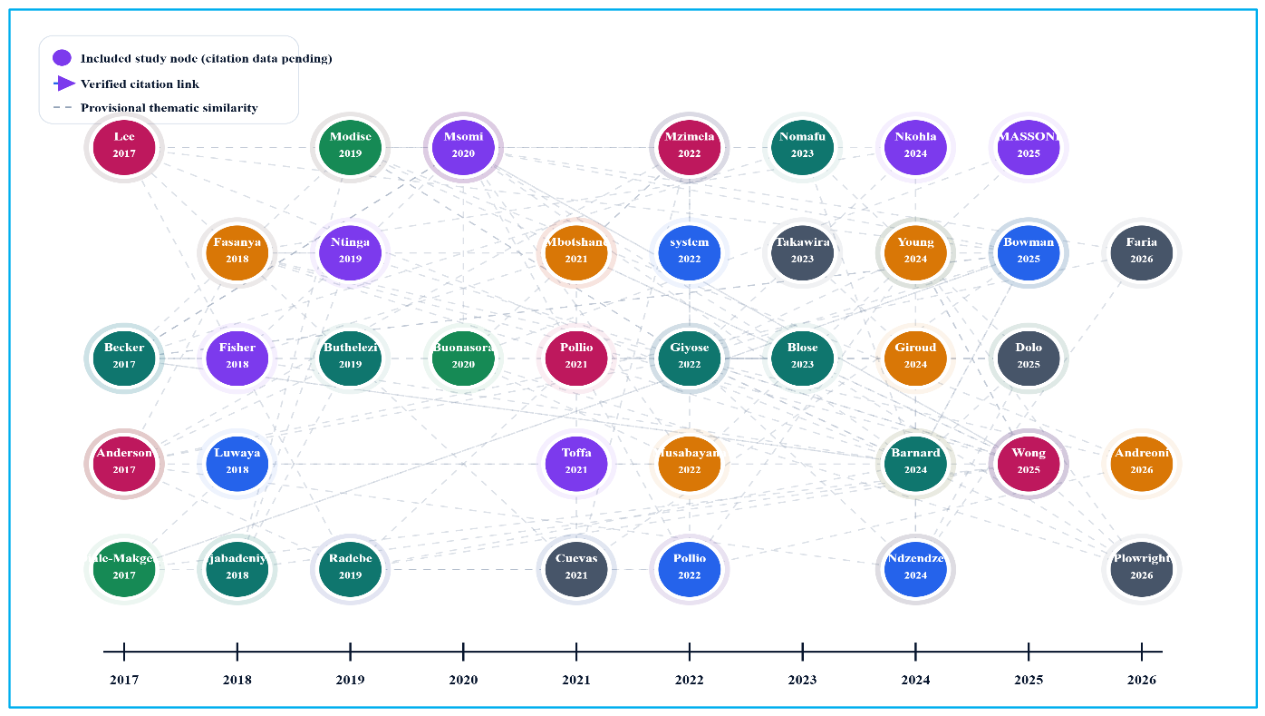
3.8.4. Knowledge Evolution
Knowledge Evolution examines the temporal and intellectual development of the included evidence base. It traces how research contributions develop over time and, where supported by the Step 12 data, how later studies extend, connect, challenge or consolidate earlier contributions.
3.8.5. Integrated Confidence in the Synthesised Evidence
A separate finding-level confidence method was not recorded, and no CERQual assessment was conducted. The review therefore does not assign formal confidence ratings. Trustworthiness was considered through study-level CASP appraisal, directness to the review question, convergence and divergence across extracted findings, preservation of contradictory evidence and explicit attention to contextual and methodological limitations. Bibliometric outputs, where available in principle, would have been contextual evidence maps rather than components of a validated confidence score.
Figure 6.
Knowledge Evolution Source: COSTAQDA PRISMA Workflow.
4. Findings
4.1. Search and Selection Results
The recorded workflow identified 199 records and included 84 studies after screening and full-text assessment. Because the identification count is inconsistent with the recorded screened count, the selection figures cannot be treated as fully reconciled. The counts describe the review process and do not constitute evidence about municipal governance or LED.
4.2. Characteristics of Included Studies
The included corpus was heterogeneous. It contained South African studies on coalition governance, LED planning, municipal capacity, participation, accountability, informal economies, Social Labour Plans and eThekwini electoral systems, alongside comparative and international studies addressing institutional efficiency, infrastructure, decentralisation, local political economy, participation and local development. The verified thematic synthesis used 69 studies and 523 extracted findings, while the final selection workflow recorded 84 included records. This difference reflects the synthesis input rather than a new eligibility decision.
Direct eThekwini evidence was limited. Jiyane (2017) addressed informal-sector participation and reported exclusionary decision-making affecting street traders, while Tshishonga (2025) addressed electoral systems and accountability. These studies do not directly establish how a post-2026 coalition would affect eThekwini's LED implementation. The strongest coalition evidence concerned other South African metropolitan contexts, particularly Johannesburg, Tshwane, Ekurhuleni and Cape Town (Maenetja & Malatji, 2024; Malinga et al., 2026).
4.3. Methodological Strengths and Limitations of Included Studies
The synthesis was strengthened by retaining study and finding identifiers, preserving contradictory evidence and excluding incomplete fragments from substantive interpretation. It also combined South African municipal studies with comparative evidence that illuminated institutional capacity, participation, infrastructure and coalition arrangements. However, methodological heterogeneity was substantial, including conceptual papers, theoretical reviews, documentary analyses, repository studies, quantitative studies and studies outside South Africa. The absence of a recorded extraction protocol and finding-level confidence assessment limits reproducibility and formal certainty.
The CASP workspace provides completed appraisals for 83 of 84 included studies, but many records contain criterion-level concerns and conservative appraisals generated when the configured external service was unavailable. The recorded mean score of 15.45 is therefore descriptive only. It should not be treated as an overall quality score or used to rank substantive findings.
4.4. Thematic Synthesis
Methodological basis: The thematic synthesis approach follows Thomas and Harden (2008), https://doi.org/10.1186/1471-2288-8-45. The study-specific findings and support counts below derive from the included evidence, not from this methodological citation.
Thematic synthesis is a systematic qualitative evidence-synthesis method used to integrate findings across multiple studies while retaining a transparent connection to the underlying evidence. (Barnett-Page & Thomas, 2009) The process moves iteratively from extracted study findings to coding, the grouping of related codes into descriptive categories or themes, and the development of higher-order analytical themes that answer the review question and research objectives. Its purpose is not merely to count how often an idea appears, but to identify patterned meaning across studies, examine convergence and divergence, preserve contextual differences, and develop an auditable interpretation that remains traceable to the contributing evidence.
In this review, thematic synthesis was applied to the verified extracted findings retained in the active COSTAQDA project. Findings were compared across eligible studies, coded and grouped according to conceptual similarity, and then developed into 6 analytical themes represented across 15 evidence-contributing studies. The active synthesis retained 27 verified theme-to-study support assignments, allowing the analytical interpretation to remain traceable to the underlying studies rather than being reconstructed from titles or bibliographic prominence. The resulting analytical themes include “Coalition instability, institutional performance and LED trajectories”, “Institutional weakness as a parallel determinant of LED implementation”, “Opportunities through enterprise support, infrastructure and participation”, “Risks, ethical concerns and distributive contestation”, with the widest cross-study support recorded for “Institutional weakness as a parallel determinant of LED implementation” (6 contributing studies). Table 1 therefore operationalises the synthesis as an auditable evidence map linking each analytical theme to the studies that supplied verified supporting findings.
Table 1 presents the thematic synthesis matrix linking the verified analytical themes only to studies with verified extracted evidence supporting at least one of the themes displayed in the matrix. Any study with no verified supporting contribution to any displayed theme is excluded, even if it was included elsewhere in the systematic review or qualitative evidence base. Rows represent analytical themes and columns represent theme-contributing studies. A check mark (✓) indicates that at least one verified extracted finding from that study was assigned to the theme; an em dash (—) indicates that the study contributed evidence to the synthesis overall but no supporting extracted finding from that study was assigned to that particular theme. The absence of a supporting assignment must not be interpreted as contradictory evidence. The totals report the number of evidence-contributing studies providing verified support to each theme. The matrix therefore functions as an audit trail between thematic interpretation and the underlying finding-level evidence rather than as a measure of methodological quality or effect size.
The most widely supported analytical theme was "Institutional weakness as a parallel determinant of LED implementation", with verified support from 6 of 15 studies. The least widely distributed theme was "Coalition instability, institutional performance and LED trajectories", with verified support from 2 of 15 studies. Differences in the number of supporting studies indicate the distribution of traceable thematic evidence across the included literature, not the relative importance or quality of a theme. Themes supported by fewer studies may still be analytically important when the underlying findings are conceptually rich, contextually distinctive or directly relevant to the review question. Conversely, wider study support indicates cross-study recurrence but does not by itself establish stronger methodological quality. The thematic patterns shown in Table 1 should therefore be interpreted alongside critical appraisal, contextual variation, contradictory findings where verified, and the detailed theme-led discussion that follows.
4.5. RO1: Coalition Instability, Institutional Performance and LED Trajectories
Across the coalition-focused evidence, leadership turnover, political bargaining, motions of no confidence and inter-party conflict were associated with delayed budgets, interrupted services, weakened oversight and reduced long-term planning. Malinga et al(2026). describe coalition instability as shifting municipal attention from service-delivery targets toward internal political negotiations, while Maenetja and Malatji (2024) connect coalition conflict with service-delivery backlogs and protests. These findings support RO1 by showing how political contestation can affect institutional implementation conditions, although they do not establish a direct causal effect on eThekwini's LED trajectory.
The evidence also indicates that coalition government itself is not deterministically harmful. Cape Town was described as having greater coalition stability and policy consistency than Johannesburg, Tshwane and Ekurhuleni, while Maenetja and Malatji (2024) argue that it is premature to conclude that coalitions have failed. The relevant distinction is therefore between coalition presence and coalition quality: cohesion, shared priorities and institutionalised agreements appear to condition whether political contestation disrupts or supports municipal performance.
4.6. RO1: Institutional Weakness as a Parallel Determinant of LED Implementation
The synthesis found that LED implementation problems cannot be reduced to coalition instability. South African studies reported a lack of common understanding of LED, inadequately defined legislative mandates, insufficient skills, weak intergovernmental relations, limited finance, low leadership prioritisation and inadequate monitoring (Hlongwane, 2018; Khenisa, 2020; Mashiteng, 2017; Shava, 2024). Ngatiane (2017) similarly identified inconsistent practitioner understanding and weak or uneven business-support functions in metropolitan LED practice.
Institutional arrangements shaped whether formal plans translated into implementation. Modise (2025) found that LED units were affected by hierarchical positioning, insufficient budgets, conflicting priorities and limited interdepartmental coordination, although district forums and monitoring tools offered enabling conditions. The convergence across these studies indicates that political stability is necessary but insufficient: durable LED requires administrative capability, resources, coherent mandates and coordination.
4.7. RO2: Opportunities Through Enterprise Support, Infrastructure and Participation
The evidence identified opportunities for LED through enterprise development, market research, infrastructure, informal-economy support, incubation, procurement and partnerships. Ngatiane (2017) described business-development services, market research and deal negotiation as municipal opportunities, while Mahlangu (2024) identified the informal economy as a source of employment, income and locally responsive production when supported by electricity, water, sanitation, finance and legal recognition. Related evidence connects LED opportunities to infrastructure, business support, cooperative arrangements and public–private or stakeholder partnerships (Kapesa & Mokone, 2026; Motsepe et al., 2026).
Participation was an enabling condition rather than an incidental consultation activity. Jiyane (2017) shows that exclusion of street traders limits the inclusiveness of eThekwini's policy process, whereas Tshishonga (2025) indicates that constituency-based representation may strengthen direct accountability. Evidence from Modise (2025) and Maphela and Adanlawo (2025) further emphasises district coordination, community engagement and integrated development planning. These opportunities are therefore conditional on inclusive representation, institutional coordination and transparent allocation of resources.
4.8. RO3: Risks, Ethical Concerns and Distributive Contestation
The political economy evidence indicates that contestation concerns distribution as well as office-holding. In eThekwini, formal businesses and shop owners were reported to receive preferential treatment over street traders, despite the latter's contribution to household income (Jiyane, 2017). Khenisa (2020) reported limited community access to Social Labour Plans, weak cooperative governance and responsibility shifting among public actors. Tsomo and Gotyi (2026) identified perceived political exclusion of youth and weak monitoring as barriers to meaningful LED participation.
These findings raise ethical concerns concerning voice, procedural fairness, public-space allocation, access to information and the distribution of municipal economic benefits. They also qualify any claim that coalition governance automatically broadens representation. Coalition bargaining may create opportunities for accountability, but it may also intensify distributive competition where institutional safeguards are weak (Maenetja & Malatji, 2024; Malinga et al., 2026).
4.9. RO4: Institutionalising Coalition Continuity for the Post-2026 Environment
The synthesis identified shared planning, policy consistency, monitoring, accountability, cross-departmental coordination and stakeholder participation as conditions for more durable municipal development trajectories. Modise (2025) described district forums and monitoring tools as mechanisms that can support coordination, while Shava (2024) emphasised regular monitoring and evaluation. Mabizela and Malinga (2025) linked accountability to the relationship between Integrated Development Plans, budgets and implementation plans.
The evidence also suggests that coalition arrangements require explicit political accommodation. Maenetja and Malatji (2024) identify social compact, cohesion and transparency as relevant to coalition durability, while Malinga et al(2026). show how unstable leadership and bargaining can interrupt implementation. The post-2026 environment should therefore not be treated as predictable from existing coalition experience: the supplied evidence does not directly establish eThekwini's future coalition configuration or its effect on LED.
4.10. RO5: Evidence Gaps and Limits of Inference
The principal evidence gap is the limited direct examination of eThekwini coalition dynamics, LED implementation and post-2026 trajectories. The eThekwini studies focus mainly on informal-sector participation and electoral accountability rather than on coalition stability, budget continuity or LED outcomes (Jiyane, 2017; Tshishonga, 2025). The broader coalition evidence is concentrated in other municipalities, while several included studies are conceptual, theoretical, descriptive, quantitative or drawn from outside South Africa.
The evidence does not provide a consistent longitudinal comparison of coalition and non-coalition municipalities. It supports associations between instability, institutional weakness and implementation problems, but it does not permit the firm causal conclusion that political contestation alone determines LED outcomes. These gaps directly support RO5 by indicating the need for municipality-specific, longitudinal and mixed-method research.
5. Discussion
The findings answer RO1 by showing that political contestation and coalition instability can affect LED through leadership turnover, disrupted planning, delayed budgets, weak oversight and administrative inconsistency. This interpretation is consistent with the coalition-focused South African studies, but the divergence between relatively stable and unstable coalition contexts prevents a general claim that coalition government is inherently damaging (Maenetja & Malatji, 2024; Malinga et al., 2026). The review therefore supports an institutional rather than a deterministic interpretation.
The answer to RO2 is similarly conditional. Enterprise support, infrastructure, market information, informal-economy recognition, incubation, stakeholder forums and integrated planning provide opportunities for LED (Mahlangu, 2024; Ngatiane, 2017; Modise, 2025). However, these mechanisms require finance, skills, coordination and accountability. The existence of a programme or formal plan should not be equated with an achieved economic effect, particularly where studies report weak implementation or lack of longitudinal outcome measurement (Khenisa, 2020; Shava, 2024).
For RO3, the synthesis demonstrates that political economy dynamics have distributive consequences. The eThekwini evidence is especially important because it identifies unequal recognition of formal businesses and street traders rather than merely describing political instability in the abstract (Jiyane, 2017). The Social Labour Plan evidence adds concerns about access to information, community voice and responsibility shifting (Khenisa, 2020). These findings mean that governance performance should be judged not only by continuity of administration but also by whose claims are incorporated into LED decisions.
For RO4, the review indicates that institutionalisation is the central practical issue. Shared coalition priorities, coherent planning, cross-departmental coordination, monitoring and accountability may protect LED from short-term political bargaining. This interpretation is supported by evidence concerning IDPs, municipal accountability and district coordination (Mabizela & Malinga, 2025; Modise, 2025). Nevertheless, the evidence does not establish whether these mechanisms would operate in eThekwini after 2026, so recommendations should be treated as evidence-informed conditions rather than predictions.
RO5 is addressed by identifying the limited direct evidence on eThekwini coalition governance and the absence of consistent longitudinal comparisons. The synthesis contributes an explanatory framework but not a causal estimate or forecast. Methodological heterogeneity, incomplete extraction documentation, one incomplete CASP appraisal and the absence of a finding-level confidence method further limit certainty. The conclusions are therefore most defensible as conditional propositions grounded in convergent themes and bounded by contextual variation.
6. Conclusion
Political contestation and coalition dynamics shape municipal LED primarily through their interaction with institutional capacity, planning continuity, accountability and distributive participation. Coalition instability can redirect municipal attention toward political survival and interrupt budgets, services and long-term programmes, but coalition government is not uniformly harmful. More durable LED trajectories require political accommodation to be embedded in shared priorities, coherent IDPs and budgets, monitoring, accountability, coordination and inclusive participation.
The review addressed RO1–RO4 by identifying these political, institutional, distributive and contextual mechanisms, and addressed RO5 by demonstrating that direct evidence on eThekwini's coalition dynamics, LED implementation and post-2026 trajectory remains insufficient. The available evidence therefore does not justify a firm prediction about eThekwini. It supports a conditional conclusion: eThekwini's future LED trajectory will depend less on coalition status alone than on whether political contestation is institutionally managed and whether municipal development processes represent affected economic groups.
7. Recommendations
Practice: Municipal administrations and coalition partners should formalise shared LED priorities within IDPs, budgets and implementation plans; maintain cross-departmental coordination; establish regular monitoring and reporting; and include informal traders, youth, community organisations, businesses and other affected stakeholders in consequential planning and resource-allocation processes (Jiyane, 2017; Modise, 2025; Tsomo & Gotyi, 2026).
Policy: South African local-government policy should strengthen the institutional conditions for coalition continuity, including transparent coalition agreements, accountability mechanisms, coherent planning responsibilities, clarified LED mandates and support for municipal skills and intergovernmental coordination. These recommendations derive from recurring evidence on instability, unclear mandates, weak capacity and responsibility shifting (Hlongwane, 2018; Khenisa, 2020; Maenetja & Malatji, 2024; Malinga et al., 2026).
Future research: Researchers should conduct longitudinal mixed-method studies comparing coalition and non-coalition municipalities, with eThekwini as a direct case. Studies should link political events to budgets, IDP changes, LED implementation, participation and economic outcomes; distinguish formal plans from implemented programmes; and include finding-level confidence assessment. Research should also examine how street traders, youth and other marginalised groups experience coalition-era decision-making (Jiyane, 2017; Tshishonga, 2025; Tsomo & Gotyi, 2026).
Competing interests
No competing interest.
AI-assisted technology and COSTAQDA declaration
COSTAQDA was used as an AI-assisted evidence-synthesis and manuscript-development environment. AI-assisted functions supported the organisation, synthesis and presentation of verified project evidence and manuscript preparation within the documented COSTAQDA workflow. AI did not replace researcher responsibility for study selection, eligibility decisions, critical appraisal, verification of extracted evidence, interpretation of findings or final scholarly judgement. The human authors reviewed and approved the final manuscript and remain responsible for its accuracy, integrity, interpretations, citations and conclusions.
Funding
No funding sought.
References
- Adhikari, S. R.; Sharma, D. L.; Rodriguez, P. J. M. P.; Paudel, T. R. Local Government Performance in Federal Nepal: A Systematic Review of Theory, Practice, Challenges, and Future Directions. NPRC J. Multidiscip. Res. 2026. [Google Scholar] [CrossRef]
- Costa, K.; Costa, A. P. Qualitative evidence synthesis using COSTAQDA. In Computer supported qualitative research (Lecture Notes in Networks and Systems; Ribeiro, J., Brandão, C., Ntsobi, M., Kasperiuniene, J., Costa, A. P., Eds.; Springer, 2024; Vol. 1061. [Google Scholar] [CrossRef]
- Costa, K.; Mfolo, L. Qualitative evidence synthesis using the COSTAQDA online software [Preprint; Research Square, 2024. [Google Scholar] [CrossRef] [PubMed]
- Grant, M. J.; Booth, A. A typology of reviews: An analysis of 14 review types and associated methodologies. Health Inf. Libr. J. 2009, 26(2), 91–108. [Google Scholar] [CrossRef] [PubMed]
- Hlongwane, S. S. N. Local economic development planning in local government: Evidence from Vulamehlo local municipality. In ResearchSpace; University of KwaZulu-Natal, 2018. [Google Scholar]
- Jiyane, A. F. C. The informal sector and public participation in policy formulation in the informal economy: A case study of eThekwini metropolitan municipality. In ResearchSpace; University of KwaZulu-Natal, 2017. [Google Scholar]
- Khenisa, A. B. The Impact of Local Economic Development (LED) on Poverty Alleviation in South Africa: A Theoretical View. J. Poverty Invest. Dev. 2020. [Google Scholar] [CrossRef]
- Long, H. A.; French, D. P.; Brooks, J. M. Optimising the value of the critical appraisal skills programme (CASP) tool for quality appraisal in qualitative evidence synthesis. Res. Methods Med. Health Sci. 2020, 1(1), 31–42. [Google Scholar] [CrossRef]
- Mabizela, H. N.; Malinga, N. S. Strengthening accountability and consequence management in South African local government for improved service delivery. Int. J. Bus. Ecosyst. Strategy 2025, 7(5). [Google Scholar] [CrossRef]
- Maenetja, R. E.; Malatji, T. L. The epoch of coalition government in South Africa: An indepth analysis on good governance and service delivery in South African local government. Int. J. Educ. Rev. Law Soc. Sci. 2024, 4(2). [Google Scholar] [CrossRef]
- Malinga, N. S.; Ragolane, M.; Mabizela, H. N. Post-2021 Coalition Arrangement and the Governance of Service Delivery in South African Local Government. Pak. J. Life Soc. Sci. 2026. [Google Scholar] [CrossRef]
- Mahlangu, P. B. The role of the informal economy on local economic development in South Africa. J. Public Adm. Financ. Law 2024. [Google Scholar] [CrossRef]
- Mashiteng, M. M. G. Assessing the capacity of Mbombela Local Municipality to drive local economic development initiatives. In ResearchSpace; University of KwaZulu-Natal, 2017. [Google Scholar]
- Modise, K. C. A critical assessment of how local municipalities implement local economic development: Case studies of Bergrivier and Cape Agulhas local municipalities; Open University of Cape Town, 2025. [Google Scholar]
- Noyes, J.; Booth, A.; Flemming, K.; Garside, R.; Harden, A.; Lewin, S.; Pantoja, T.; Hannes, K.; Cargo, M.; Thomas, J. Cochrane Qualitative and Implementation Methods Group guidance series—paper 3: Methods for assessing methodological limitations, data extraction and synthesis, and confidence in synthesized qualitative findings. J. Clin. Epidemiol. 2018, 97, 49–58. [Google Scholar] [CrossRef] [PubMed]
- Ngatiane, M. Local economic development: A study of Nelson Mandela Bay and Buffalo City Metropolitan Municipalities. In Nelson Mandela University Research Repository; 2017. [Google Scholar]
- Page, M. J. The PRISMA 2020 statement: An updated guideline for reporting systematic reviews. BMJ 2021, 372, n71. [Google Scholar] [CrossRef] [PubMed]
- Shava, E. Inclusive local economic development for effective service delivery in high-risk municipalities. USV Ann. Econ. Public Adm. 2024. [Google Scholar] [CrossRef]
- Tshishonga, N. S. Municipal election systems and their implications for ethical and accountable democratic governance at eThekwini Municipality. J. Local Gov. Res. Innov. 2025. [Google Scholar] [CrossRef]
- Tsomo, Z.; Gotyi, Z. G. Youth participation in local economic development: Evidence from the Amathole District Municipality. J. Local Gov. Res. Innov. 2026. [Google Scholar] [CrossRef]
- Ngatiane, M. Local economic development: a study of Nelson Mandela Bay and Buffalo City Metropolitan Municipalities. In Nelson Mandela University Research Repository; 2017. [Google Scholar]
- Malinga, N. S.; Ragolane, M.; Mabizela, H. N. Post-2021 Coalition Arrangement and the Governance of Service Delivery in South African Local Government. Pak. J. Life Soc. Sci. (PJLSS) 2026. [Google Scholar] [CrossRef]
- Hlongwane, S. S. N. Local economic development planning in local government: evidence from Vulamehlo local municipality. In ResearchSpace; University of KwaZulu-Natal, 2018. [Google Scholar]
- Mashiteng, M. M. G. Assessing the capacity of Mbombela Local Municipality to drive local economic development initiatives. In ResearchSpace; University of KwaZulu-Natal, 2017. [Google Scholar]
- Shava, E. INCLUSIVE LOCAL ECONOMIC DEVELOPMENT FOR EFFECTIVE SERVICE DELIVERY IN HIGH-RISK MUNICIPALITIES. USV Ann. Econ. Public Adm. 2024. [Google Scholar] [CrossRef]
- Adhikari, S. R.; Sharma, D. L.; Rodriguez, P. J. M. P.; Paudel, T. R. Local Government Performance in Federal Nepal: A Systematic Review of Theory, Practice, Challenges, and Future Directions. NPRC J. Multidiscip. Res. 2026. [Google Scholar] [CrossRef]
- Modise, K. C. A critical assessment of how local municipalities implement local economic development: case studies of Bergrivier and Cape Agulhas local municipalities; Open University of Cape Town (University of Cape Town), 2025. [Google Scholar]
- Khenisa, A. B. The Impact of Social Labour Plans (SLPs) on the Advancement of Local Economic Development: A Case Study of South Africa. In Public Policy and Administration Research; 2020. [Google Scholar] [CrossRef]
- Mabizela, H. N.; Malinga, N. S. Strengthening accountability and consequence management in South African local government for improved service delivery. Int. J. Bus. Ecosyst. Strategy 2025, 2687–2293. [Google Scholar] [CrossRef]
- Maenetja, R. E.; Malatji, T. THE EPOCH OF COALITION GOVERNMENT IN SOUTH AFRICA: AN INDEPTH ANALYSIS ON GOOD GOVERNANCE AND SERVIEC DELIVERY IN SOUTH AFRICAN LOCAL GOVERNMENT. Int. J. Educ. Rev. Law Soc. Sci. (IJERLAS) 2024. [Google Scholar] [CrossRef]
- Jiyane, A. F. C. The informal sector and public participation in policy formulation in the informal economy: a case study of eThekwini metropolitan municipality. In ResearchSpace; University of KwaZulu-Natal, 2017. [Google Scholar]
- Lewin, S.; Booth, A.; Glenton, C. Applying GRADE-CERQual to qualitative evidence synthesis findings: Introduction to the series. Implement. Sci. 2018, 13 (Suppl 1), 2. [Google Scholar] [CrossRef] [PubMed]
- Donthu, N.; Kumar, S.; Mukherjee, D.; Pandey, N.; Lim, W. M. How to conduct a bibliometric analysis: An overview and guidelines. J. Bus. Res. 2021, 133, 285–296. [Google Scholar] [CrossRef]
- Zupic, I.; Čater, T. Bibliometric methods in management and organization. Organ. Res. Methods 2015, 18(3), 429–472. [Google Scholar] [CrossRef]
- Barnett-Page, E.; Thomas, J. Methods for the synthesis of qualitative research: A critical review. BMC Med. Res. Methodol. 2009, 9, 59. [Google Scholar] [CrossRef] [PubMed]

Table 1.
Thematic Synthesis Matrix.
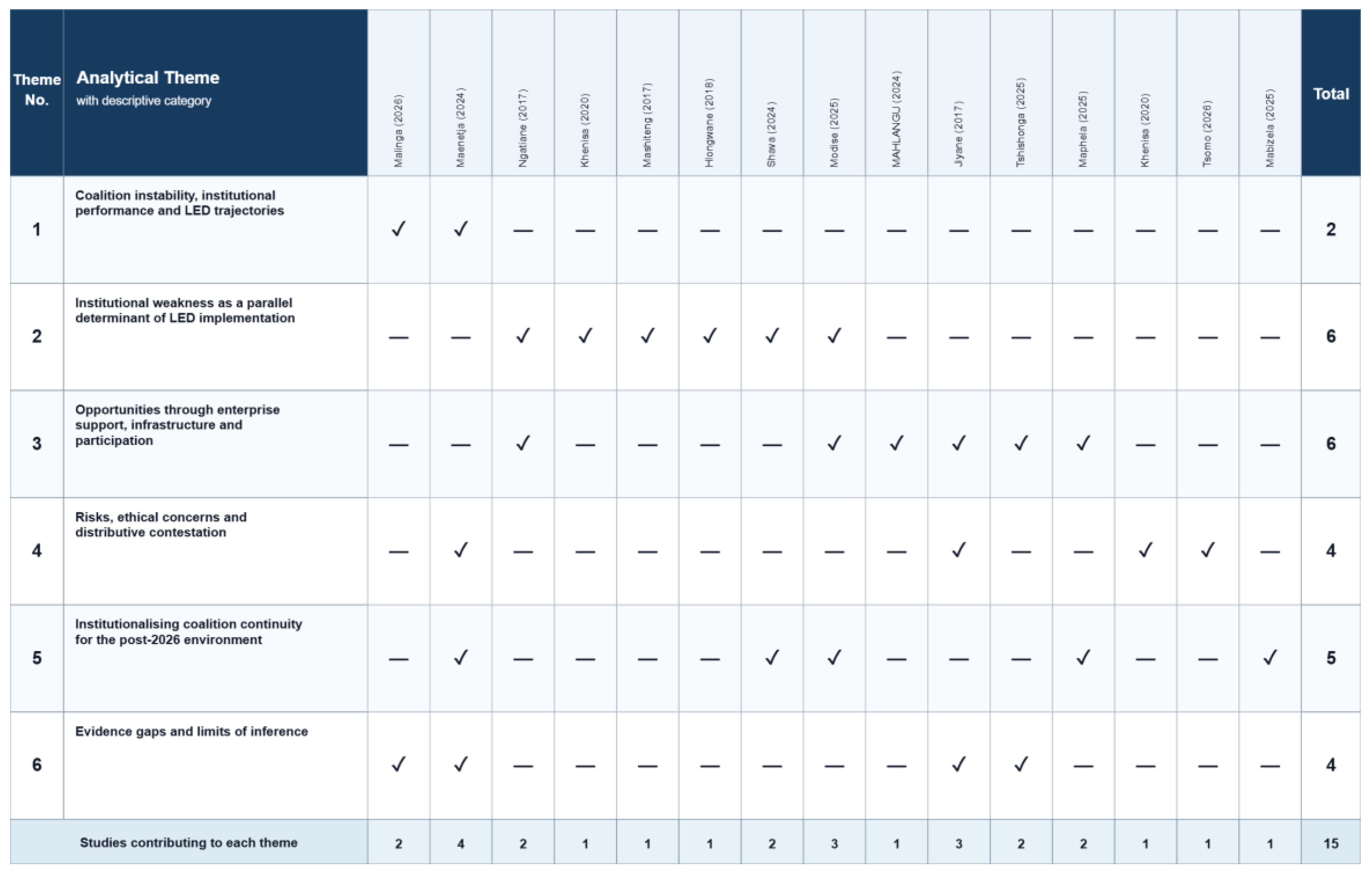 |
Table 1 legend: Only studies contributing verified extracted qualitative evidence are displayed. ✓ = verified extracted evidence from the study supports the theme; — = the study contributed to the synthesis but no supporting extracted finding from that study was assigned to this theme. An em dash does not indicate contradictory evidence.
Disclaimer/Publisher’s Note: The statements, opinions and data contained in all publications are solely those of the individual author(s) and contributor(s) and not of MDPI and/or the editor(s). MDPI and/or the editor(s) disclaim responsibility for any injury to people or property resulting from any ideas, methods, instructions or products referred to in the content. |
© 2026 by the authors. Licensee MDPI, Basel, Switzerland. This article is an open access article distributed under the terms and conditions of the Creative Commons Attribution (CC BY) license (http://creativecommons.org/licenses/by/4.0/).
Copyright: This open access article is published under a Creative Commons CC BY 4.0 license, which permit the free download, distribution, and reuse, provided that the author and preprint are cited in any reuse.