

Submitted:
02 November 2026
Posted:
04 November 2026
You are already at the latest version
Abstract
Recovery-oriented addiction treatment has developed from mutual-aid movements and therapeutic communities into increasingly professionalised, data-informed, and socially integrated systems of care. Yet its relationship to planetary health has received limited attention. This article examines the historical foundations and current challenges of recovery-oriented addiction treatment and interprets recovery as a process shaped not only by individual change or clinical intervention, but also by the social, cultural, economic, institutional, relational, and ecological conditions in which people and communities live and flourish. Using a historiographic and historical-analytical qualitative approach, the article traces the transition from peer-led recovery models to professional therapeutic communities and contemporary outcome-oriented frameworks. The analysis shows that recovery capital, social participation, housing, employment, community relationships, equity, service integration, and intersectoral collaboration are central links between recovery-oriented care and planetary health. At the same time, the field remains limited by conceptual ambiguity, heterogeneous interventions, unequal access to recovery resources, fragmented services, and methodological difficulties in evaluating dynamic and context-dependent trajectories. The article argues that a Science of Recovery should be understood as an emerging, transdisciplinary, and systems-oriented field. Its consolidation requires stronger methodological standards and a planetary health perspective capable of connecting individual recovery with healthier, more inclusive, equitable, resilient, and ecologically sustainable communities.
Keywords:
recovery-oriented addiction treatment
; science of recovery
; planetary health
; recovery capital
; social determinants of health
; therapeutic communities
; health equity
; community resilience
; systems thinking
1. Introduction: Addiction Recovery as a Planetary Health Challenge
Planetary health provides a framework for understanding human health and well-being as outcomes of interconnected social, economic, political, institutional, and ecological systems. Rather than locating health exclusively within individuals or healthcare services, this perspective emphasizes the conditions that enable populations to live healthy and dignified lives, the unequal distribution of resources and opportunities, and the interdependence between human flourishing and the systems that sustain it [1]. From this standpoint, substance use disorders and their treatment should not be understood solely as clinical problems. They must also be considered in relation to the social environments, institutional arrangements, community resources, and structural inequalities that shape vulnerability, access to care, and opportunities for sustained recovery [2,3].
Substance-related harms are experienced unevenly across populations and communities. Poverty, insecure housing, unemployment, social exclusion, violence, stigma, and limited access to healthcare can increase vulnerability while simultaneously restricting the resources required to initiate and maintain recovery [2,3,4]. These conditions are not simply individual risk factors; they are embedded in broader systems of social organization and resource distribution [2,3,4]. Consequently, the effectiveness of addiction treatment cannot be assessed exclusively through abstinence, symptom reduction, or the completion of a therapeutic programme [2,3,4]. It also requires consideration of whether individuals can regain social participation, establish supportive relationships, access stable living conditions, and develop sustainable pathways towards health and well-being [2,3,4,5]. A planetary health perspective therefore invites a broader question: how can recovery-oriented systems contribute to healthier, more equitable, and more resilient communities? [1]
Recovery-oriented addiction treatment offers a particularly relevant perspective from which to address this question because its historical development has progressively expanded the focus of intervention from substance use itself to the person, their relationships, and their social environment [3,6]. Historically, addiction treatment has been shaped by competing interpretations of substance use as a moral failure, a medical condition, or a social problem requiring collective and institutional responses [2,3]. Recovery-oriented programmes emerged through diverse traditions, including mutual-aid movements, peer support, therapeutic communities, and psychosocial rehabilitation. Although these traditions differed in their ideological foundations and organizational structures, many placed social relationships, shared experience, participation, and changes in everyday living conditions at the centre of recovery [2,3,4,5,6].
This historical trajectory is relevant to planetary health because it raises a fundamental question about the location of responsibility for recovery [2,3,4,5,6,7]. If recovery is understood exclusively as an individual achievement, the influence of housing systems, labour markets, public policies, community resources, and institutional inequalities may remain insufficiently recognized [8]. Conversely, if recovery is understood as a process emerging through interactions between individuals and their environments, the analysis must consider how these environments enable or constrain opportunities for change [2,3,4,5,6,7]. This does not mean that individual agency, clinical intervention, or personal responsibility are unimportant. Rather, it recognizes that the capacity to exercise agency depends partly on the availability of social, material, and institutional resources. Recovery is therefore both a personal process and a socially situated trajectory whose possibilities are shaped by conditions extending beyond the treatment setting [2,3,4,5,6,7,8].
The concept of recovery capital is particularly useful for examining these interdependencies [9]. Recovery capital refers to the personal, social, and community resources that individuals can mobilize to initiate and sustain recovery from substance-related problems [9,10,11]. These resources may include psychological strengths, supportive relationships, social networks, employment opportunities, housing, community participation, and access to appropriate services [9,10,11]. However, recovery capital should not be interpreted exclusively as a set of attributes possessed by individuals. Its availability is also influenced by social structures, institutional practices, public policies, and the distribution of resources across communities. The same individual capacities may generate different outcomes depending on whether people have access to safe housing, stable income, supportive relationships, and responsive services. From a planetary health perspective, recovery capital is therefore relational and context-dependent: it reflects not only what individuals can mobilize, but also what their social and institutional environments make available [1,9,10,11].
This interpretation also highlights the relationship between recovery and health equity. Recovery-oriented programmes cannot be assumed to produce equivalent opportunities for everyone when populations differ in their exposure to adversity and their access to protective resources. Gender, age, cultural background, migration-related exclusion, histories of trauma, co-occurring mental health conditions, and socioeconomic disadvantage may shape both treatment experiences and recovery trajectories. Moreover, programmes developed around relatively homogeneous populations may not adequately respond to people with complex psychosocial needs. Unequal access to recovery resources can consequently reproduce existing inequalities, even when interventions are designed to promote health and social inclusion. A planetary health approach requires attention not only to whether recovery programmes improve outcomes, but also to who benefits, who remains excluded, and which structural barriers continue to restrict participation and well-being.
The historical evolution of recovery-oriented treatment provides an opportunity to examine how these issues have been addressed, neglected, or transformed over time. Early mutual-aid movements established forms of collective identification and reciprocal support that were often situated outside formal healthcare institutions. Therapeutic communities subsequently developed more structured environments in which participation, social learning, interpersonal relationships, and shared responsibility became central elements of treatment [3,10,11,12]. From the 1990s onwards, professionalization and the development of more systematic evaluation frameworks strengthened efforts to assess programme effectiveness and treatment outcomes [2,4,19,20,21]. More recent recovery research has incorporated concepts such as recovery capital, quality of life, social integration, and personal recovery, broadening the range of outcomes considered relevant to addiction treatment [6,7,8,9].
These transformations should not be interpreted as a straightforward progression from informal practices to scientifically superior models. Instead, they reflect changing understandings of legitimate knowledge, therapeutic authority, social participation, and the criteria by which recovery is evaluated. The increasing use of standardized indicators and evidence-informed interventions has created opportunities to improve transparency, accountability, and the evaluation of outcomes. Nevertheless, it also raises questions about whether measurement frameworks adequately capture the contextual conditions that influence recovery. Indicators focused on individual functioning may fail to distinguish between a lack of personal resources and a lack of opportunities to access them. Similarly, programme evaluations may underestimate the importance of intersectoral coordination when housing, employment, mental health, and social support services operate independently. These limitations are relevant to planetary health because they concern the capacity of health and social systems to respond collectively to interconnected needs.
The relationship between recovery-oriented treatment and planetary health should nevertheless be established with conceptual precision. The present article does not assume that addiction recovery programmes directly improve ecological sustainability or that environmental outcomes can be inferred from existing recovery research. Rather, it examines the contribution that a systems-oriented understanding of recovery can make to the analysis of population health, social equity, and community resilience. The ecological dimension of planetary health provides a broader context for considering the conditions of human flourishing, while the immediate analytical focus of this article remains on the social, relational, institutional, and material environments in which recovery takes place. This distinction is important to avoid reducing planetary health to a synonym for holistic healthcare or extending its claims beyond the evidence available.
Within this framework, the central problem is how recovery-oriented systems can be understood and evaluated as part of the wider social infrastructure supporting health and well-being. This requires moving beyond the question of whether the so-called Science of Recovery has achieved sufficient conceptual and methodological consolidation to ask how the historical development of recovery models can inform more equitable and integrated approaches to addiction care. Three interconnected dimensions are particularly important: the changing role of communities and social relationships in recovery; the distribution of the resources required to sustain recovery across different populations; and the capacity of institutions and services to coordinate their responses to complex and context-dependent needs.
Accordingly, this article examines the historical evolution of recovery-oriented addiction programmes, from mutual-aid movements and the emergence of therapeutic communities to contemporary evidence-informed and outcome-oriented approaches, through a planetary health perspective. It has three objectives: (1) to analyze how successive recovery models have conceptualized the relationship between individual change, community participation, and the wider conditions of social life; (2) to examine how the development of recovery capital and outcome evaluation frameworks can illuminate inequalities in the resources and opportunities available for recovery; and (3) to identify the conceptual, methodological, and institutional challenges that must be addressed if recovery-oriented systems are to contribute to more equitable, coordinated, and resilient public health responses.
By bringing these historical and conceptual dimensions together, this article argues that the social value of recovery-oriented treatment cannot be assessed exclusively through clinical outcomes or the scientific standardization of interventions. Its wider significance also depends on how programmes recognize structural disadvantage, mobilize community resources, and connect healthcare with the social conditions required for sustained recovery. A planetary health perspective thus provides an analytical framework for examining recovery as a process situated within interconnected systems, while identifying the limits of current knowledge and the need for future research that explicitly investigates the relationships between recovery outcomes, social equity, institutional coordination, community resilience, and environmental conditions.
2. Materials and Methods
2.1. Study Design and Analytical Framework
This study adopts a qualitative historical-analytical design combining historiographical inquiry, critical literature review, and thematic analysis to examine the evolution of recovery-oriented addiction treatment and its implications for planetary health. Rather than providing an exhaustive chronology of recovery programmes or assessing the effectiveness of a specific intervention, the study examines how the concepts, practices, and institutional arrangements associated with recovery have developed over time, and how these developments reflect changing understandings of health, social participation, and the conditions required for individual and collective well-being.
The methodological approach is based on the interpretation of primary and secondary sources concerning the origins, transformation, and institutionalization of recovery-oriented treatment. Historiographical analysis is used to identify significant historical transitions and changes in the ways recovery has been conceptualized and legitimized, while thematic analysis supports the identification of recurring issues across different periods [14,15,16,17]. This combination makes it possible to examine not only the emergence of increasingly professionalized and evidence-informed approaches, but also the social and institutional assumptions underlying their development.
Planetary health provides the overarching analytical perspective. It is understood here as a framework for examining the interdependence between human health and the broader social, institutional, economic, and environmental conditions in which people live [13]. Its application to addiction recovery does not imply that recovery programmes are necessarily environmental interventions or that their ecological effects can be established through historical analysis. Instead, this perspective directs attention to the wider conditions that enable or constrain recovery, including access to housing, employment, social support, community participation, and coordinated health and social services. These dimensions are considered relevant to understanding how recovery-oriented systems may contribute to health equity and collective well-being.
2.2. Historical Scope and Organization of the Material
The analysis is organized around three broad historical periods identified in the manuscript. The first concerns the origins of recovery as a social movement, with particular attention to mutual-aid practices, experiential knowledge, and the role of collective identification in supporting recovery. The second examines the development and professionalization of therapeutic communities, focusing on their organizational principles, community-based practices, and approaches to social rehabilitation. The third addresses the emergence of data-driven recovery programmes and the contemporary formulation of the Science of Recovery, characterized by the growing importance of formal evaluation, outcome measurement, recovery capital, and evidence-informed practice.
These periods are used as analytical categories rather than as strictly bounded or mutually exclusive chronological stages. The purpose is to identify changes in the sources of legitimacy, the organization of care, and the understanding of recovery, while recognizing that earlier practices and contemporary approaches coexist and may influence one another.
The materials considered include primary and secondary sources relevant to the historical development of recovery-oriented treatment, together with literature addressing addiction, mental health, therapeutic communities, recovery capital, social rehabilitation, and the evaluation of recovery programmes. The review is historiographical and interpretative rather than systematic. Accordingly, its purpose is to develop a critical synthesis of historically significant developments and conceptual debates, rather than to estimate intervention effects or establish the exhaustive coverage of all available publications.
2.3. Analytical Procedure
The analysis proceeded through three interrelated stages.
First, the sources were examined comparatively to identify the principal historical developments in recovery-oriented treatment and the changing assumptions underpinning its organization. Particular attention was paid to the relationship between individual change, collective support, professional expertise, institutional recognition, and scientific evaluation.
Second, the material was organized thematically using a combination of deductive and inductive analysis. The deductive component was guided by concepts relevant to the study, including recovery capital, social reintegration, community participation, programme effectiveness, psychosocial support, and evidence-informed care [6,7,8,14,15,16,17]. The inductive component allowed additional issues and tensions to be identified through the interpretation of the material, particularly those concerning the relationship between lived experience and standardized measurement, the heterogeneity of recovery pathways, and the potential limitations of approaches that prioritize individual outcomes without adequately considering social context.
Third, the identified historical developments and themes were interpreted through the planetary health framework. Three interconnected analytical dimensions informed this interpretation:
Social and community conditions: the role of mutual aid, social relationships, community participation, and supportive environments in shaping recovery opportunities.
Equity and the distribution of resources: the extent to which recovery-oriented approaches recognize differences in access to material resources, social support, housing, employment, and health and social services.
Institutional organization and interdependence: the relationship between treatment programmes, health and social care systems, public policies, and the wider conditions that may facilitate or constrain continuity of care and social inclusion.
These dimensions were used to interpret the historical material rather than as variables in an empirical measurement model. Recovery capital was particularly relevant because it connects individual resources with interpersonal relationships and broader community conditions [6,7,8]. From this perspective, recovery cannot be understood exclusively as an individual clinical outcome: its possibilities are also shaped by the availability and distribution of resources across social and institutional environments.
2.4. Critical Interpretation and Methodological Limitations
The final stage involved a critical synthesis of the historical and thematic findings to examine the extent to which recovery-oriented treatment can be understood as an emerging scientific field and how its conceptual development relates to wider public health concerns. The analysis considered both the contributions of professionalization and evidence-informed practice and the challenges associated with standardization, contextual diversity, and the recognition of different recovery trajectories.
The planetary health perspective was applied as an interpretative framework to situate these developments within the interdependence of health, social conditions, institutions, and environments. This approach supports a critical examination of whether recovery systems adequately recognize the structural conditions that influence access to care and opportunities for sustained recovery. It also provides a basis for identifying questions concerning equity, cross-sectoral coordination, and community well-being that require further empirical investigation.

Table 1.
Analytical categories and research questions.
| Analytical Categories | Guiding Question | Historical Manifestations |
| Legitimate source of therapeutic knowledge | What counts as valid knowledge about recovery? | Experiential testimony (mutual aid), Clinical expertise (professional TCs), Empirical indicators (recovery science) |
| Organization of authority and decision-making | Who can define, treat, and evaluate recovery? | Peers and sponsors, Professionals and institutions, Measurement systems and funding bodies |
| Construction of the person in recovery | How is the recovering subject represented? | Member with lived experience, User/patient in treatment, Measurable trajectory and risk profile |
| Mechanisms of legitimacy | What allows programmes to claim effectiveness? | Collective recognition and belonging, Professional regulation and safety, Evidence, outcomes, and institutional sustainability |
3. Measurable Recovery: Data, Evidence, and the Standardization of Care
Viewed through planetary health, the history of recovery-oriented treatment is also a history of changing assumptions about the systems that sustain human wellbeing. Mutual-aid movements foregrounded belonging and reciprocal support; therapeutic communities institutionalised collective participation and social learning; and contemporary recovery science has increasingly sought to measure recovery capital, quality of life, social integration, and service outcomes. These stages should not be interpreted as a simple movement toward individual scientific control. They also reveal a gradual widening of the object of care—from the substance and the symptom, to the person, the person’s relationships, the community, and the institutional conditions that make recovery possible. This widening is consistent with planetary health’s emphasis on interconnected systems, equity, and the conditions for human and collective flourishing. Recovery-oriented addiction treatment did not emerge as a fully formed scientific model, but as the outcome of successive historical transformations in how addiction, treatment, and social reintegration were understood. The field developed through the interaction of mutual-aid traditions, therapeutic community practice, psychiatric reform, and later efforts to evaluate treatment through evidence-based and outcome-oriented frameworks. Rather than following a linear progression from informal support to scientific maturity, recovery-oriented treatment evolved through a series of epistemological and institutional reconfigurations in which experiential knowledge, professional authority, and scientific legitimacy were repeatedly renegotiated. From the 1990s onwards and into the early twenty-first century, a significant transformation distinguished contemporary therapeutic communities from their twentieth-century predecessors. This transformation involved not only increased professionalization but also the operationalization of the therapeutic community as a structured recovery method. During this period, various models that supported recovery—such as the C.H.I.M.E. model [19], empowerment-based approaches, and life skills development models—were integrated into the therapeutic community framework. The synthesis of these approaches into a coherent method enabled systematic evaluation, measurement, and review of interventions implemented within therapeutic community settings. This methodological integration made it possible to identify best practices for supporting individuals with substance use disorders and improving both quality of life and recovery outcomes. A key milestone in the recognition of therapeutic communities and recovery-based models as scientifically grounded approaches occurred at the European Federation of Therapeutic Communities (EFTC) conference held in Oxford in 2011. Prior to this event, several attempts had already been made to apply scientific methodologies, including experimental and quasi-experimental designs, within therapeutic community settings [2,3,4]. However, ethical constraints—such as the infeasibility of random sampling—often limited the use of classical clinical trials. The 2011 Oxford conference marked the beginning of a strategic alliance between the European Monitoring Centre for Drugs and Drug Addiction (EMCDDA) and the European Federation of Therapeutic Communities. This collaboration generated a sustained research agenda led by prominent scholars including David Best (then at the University of Derby, now at Queen’s University Belfast), Teodora Groshkova (EMCDDA), Peter R. Davies (University of Stirling), and Wouter Vanderplasschen and Erik Broekaert (Ghent University) [3,4,5]. This body of work has produced a substantial number of scientific publications examining the effectiveness [4,20,21], efficiency, visibility, social impact, and recovery outcomes associated with therapeutic communities and recovery-oriented models [19,20,21]. Although not primarily based on randomized controlled trials [22], these studies employed rigorous experimental and quasi-experimental designs, providing empirical evidence that recovery-based models can significantly improve quality of life and recovery trajectories among individuals with substance use disorders and other addictive behaviors [2,3,11,21,22,23,24]. The emergence of “Science of Recovery” represented a decisive step in the institutionalization of the field, translating historically dispersed experiences into the language of outcomes, indicators, and recovery capital. This shift did not mean abandoning the human and relational dimensions of recovery, but rather making them visible and measurable within more rigorous evaluation frameworks. As a result, variables such as quality of life, social integration, daily functioning, support networks, and personal resources began to occupy a central place in programme assessment. This change also responded to a policy and care-based need: to show that recovery programmes generate not only abstinence, but also broader benefits in terms of public health, reintegration, and reduced social harm. From this perspective, the consolidation of recovery research can be interpreted as a strategy of scientific legitimation, but also as an expansion of the object of study, moving beyond the substance or the symptom to focus on the person’s life trajectory [2,3,11,20,23,25,26]. During the twenty-first century, research and projects have been developed aimed at showing the relevance of recovery using the scientific method [2,3,11,20,23,25,26]. Most of these studies considered global interventions to be valid for all populations, without considering individual situations, substance differences, and special needs [26]. The evolution of recovery-based programs from traditional therapeutic communities [3,26,28] to current comprehensive programs has been heterogeneous in models, techniques, and perspectives [24,25,26]. The use of validated good practices, such as the HERMESS recovery model [29], or the Recovery Capital Assessment (ARC) through the “Life in Recovery” questionnaire [7,11,24,30] can help improve the relevance and suitability of Recovery-based programs as health and social responses to problems with addictive behaviors [21,25]. Identifying the strengths and barriers of such treatments may also be appropriate for identifying individuals and groups most likely to be successful in recovery programs [26,29].
The person in recovery now appears as: a source of data, a unit of analysis, a carrier of resources, a risk profile, a measurable trajectory, and a recipient of differentiated interventions. Recovery capital, quality-of-life scales, and social integration indicators do not merely describe recovery, they constitute a new way of seeing and governing it [9]. Programmes no longer legitimize themselves solely through tradition, testimony, or communal plausibility. They must also demonstrate: effectiveness, efficiency, social impact, quality, transferability, and institutional sustainability. But evidence is not neutral. It defines which outcomes are visible, which trajectories are considered successful, and which forms of recovery can be recognized by institutions. The importance of this shift lies not only in the availability of better evidence, but also in the broader legitimacy it conferred on recovery-oriented care. By demonstrating that recovery could be studied, monitored, and improved through systematic methods, these programmes strengthened the position of recovery within addiction policy and practice. At the same time, they raised new questions about how to preserve individual variation, contextual sensitivity, and the human complexity of recovery within increasingly standardized systems of care (see Table 2). Taken together, these developments raise a number of unresolved conceptual, methodological, and organizational issues that currently limit the consolidation of a Science of Recovery.
The principal contribution of a planetary health framing is to prevent the standardisation of recovery from becoming detached from the conditions in which recovery is lived. Recovery capital is unevenly distributed: secure housing, meaningful employment, safe communities, supportive relationships, accessible services, and freedom from stigma are not equally available to all people. Measurement systems that treat these resources as individual attributes may obscure the policies and institutions that produce their unequal distribution. A planetary health approach therefore asks not only whether a programme changes individual outcomes, but also whether it strengthens social connection, reduces exclusion, improves institutional coordination, supports community resilience, and contributes to more equitable conditions of wellbeing [30,31].
4. Discussion
4.1. Current Challenges for the Science of Recovery
Despite important progress in the professionalization and evaluation of recovery-oriented care, the Science of Recovery remains an emerging field rather than a fully consolidated paradigm. Its principal challenge lies in the tension between conceptual breadth and operational precision: recovery is widely used as an organizing idea, yet it continues to encompass different meanings across clinical, social, and policy contexts. This variability makes comparison across studies difficult and weakens the possibility of building cumulative evidence from heterogeneous programme models [2,3,11,20,21,24,26]. The challenges facing the Science of Recovery are also planetary health challenges because they concern the organisation and distribution of the conditions that enable people and communities to flourish. Conceptual ambiguity, fragmented services, unequal access to recovery capital, and the overgeneralisation of evidence are not merely technical limitations. They can reproduce inequities when programmes are designed around the needs of relatively well-resourced groups and then applied to people facing poverty, unstable housing, gender-based violence, racism, migration-related exclusion, trauma, or co-occurring mental health conditions. A mature recovery science must therefore examine both individual outcomes and the systems that generate vulnerability or support recovery.
A first challenge is the absence of a stable and universally accepted operational definition of recovery. Some approaches prioritize abstinence and symptom reduction, whereas others emphasize personal agency, social functioning, quality of life, or recovery capital. Although this pluralism reflects the complexity of addiction recovery, it also creates problems for measurement, programme design, and the interpretation of outcomes across different settings and populations [2,3,11,20,21,23,25].
A second challenge concerns methodology. Much of the evidence base in this area relies on quasi-experimental, observational, and programme-based designs rather than randomized controlled trials, in part because of ethical, practical, and contextual limits in real-world treatment settings [23]. This does not invalidate the field, but it requires stronger attention to transparency, comparative logic, and long-term follow-up. If recovery science is to advance, it must develop evaluative strategies that are rigorous without being disconnected from the realities of service delivery. At the methodological level, the Science of Recovery faces the challenge of building credibility on a foundation largely composed of quasi-experimental designs, observational studies, and programme evaluations. In many real-world contexts, randomized controlled trials are ethically and practically constrained: random allocation may imply delaying or denying access to needed services, treatment settings are highly dynamic, and participants often move across programmes in ways that are incompatible with strict experimental control.
A third issue is the heterogeneity of the populations and needs addressed by recovery-oriented programmes [2,3,11,21,22,23,24,25,26]. Treatments designed around a generic recovery pathway may not adequately respond to differences in gender, age, severity of dependence, psychiatric comorbidity, trauma history, or social exclusion. This raises an important equity issue: a field that aims to promote recovery for all cannot rely on models that are only suitable for relatively homogeneous or highly resourced groups. Measurement remains another major bottleneck. Indicators such as social reintegration, recovery capital, and quality of life are useful, but they are not yet embedded in a sufficiently standardized framework for routine comparison across countries, services, and cultural contexts. In addition, many instruments capture outcomes at a single point in time and therefore miss the dynamic, non-linear nature of recovery trajectories. Stronger longitudinal designs and more coherent indicator systems are needed to understand change as a process rather than a final state.
There is also a service-level challenge. Recovery-oriented programmes often depend on coordination between health systems, community resources, peer support, and social services, yet these components are frequently fragmented in practice. As a result, implementation quality can vary widely even when programmes share the same label. The field therefore needs not only better theories of recovery, but also better governance, financing, and intersectoral coordination to sustain effective care [2,3,11,21,22,23,24,25,26].
A further challenge for the Science of Recovery concerns population heterogeneity. Many recovery-oriented models have been developed and evaluated with relatively homogeneous samples, often adult men with substance use disorders and relatively stable social conditions, and are implicitly presented as universally applicable. However, there is growing evidence that these models do not necessarily fit the needs and trajectories of women, young people, and individuals with complex psychosocial needs, including co-occurring mental disorders, histories of trauma, or chronic social exclusion. In this sense, the next stage for the Science of Recovery is not simply to produce more studies, but to improve the conceptual coherence, methodological robustness, and practical transferability of existing knowledge. A mature research agenda should prioritize shared definitions, longer follow-up, comparable metrics, and evaluation designs that capture both outcomes and context. Just as importantly, it should preserve the human and relational dimensions of recovery while subjecting programmes to the standards of accountability required by contemporary health policy. If recovery is to function as a credible scientific and policy framework, it must recognize that pathways, resources, and barriers differ markedly across these groups, and that interventions designed for one profile cannot be uncritically generalized to others. This has direct implications for how programmes are designed, implemented, and evaluated, as well as for how recovery outcomes are interpreted across diverse populations [2,3,11,21,22,23,24,25,26].
4.2. Research, Policy, and Practice Agenda
The last step for the Science of Recovery is to move from broad recognition of recovery-oriented care to a more coherent and comparable research agenda. This requires clearer operational definitions, shared outcome frameworks, and study designs that can capture both change over time and variation across settings. Without this, the field risks accumulating isolated findings rather than building cumulative knowledge.
When applied to the field of recovery, the scientific method should encompass a threefold approach [2,3,11,21,22,23,24,25,26]. First, research must support and value individual narratives, this includes taking into account religious and spiritual experiences that are meaningful to the person but might otherwise go unnoticed [5,30]. Second, the strategies and tools employed must be sensitive to potential experiences of traumatic events, so-called creative techniques are recommended here. Finally, research should aim for a collective impact in its results, involving as many stakeholders as possible. For the past decade, the field of addiction recovery has strived to demonstrate its efficacy, efficiency, and relevance by applying data-driven models [2,3] to determine what works, what does not, and what can be improved in addiction recovery treatments [11,22,23,24,25]. Particularly since 2012, various studies have been conducted (such as those led by Groshkova, Best, White, Vanderplasschen, Vandevelde, Yates, and Broekaert) that examined whether recovery was merely a local issue for specific populations or if one could speak of a “Science of Recovery,” as suggested by Grushkova, Best, and White [11,24]. A fundamental concept justifying the existence of this Science of Recovery is “social capital” [10,27,32]-defined as the set of personal and social networks, along with the trust and reciprocity derived from those networks [27,28,32]. Best (2012) identifies three interconnected elements central to this concept of recovery social capital: contagion (influence within the social context), connections (for building community), and homophily (the tendency to associate with people who resemble us) [10,33].Taking this concept of recovery social capital as a reference, the term “Recovery Capital” (RECCAP) is coined, it is defined as the breadth and depth of internal and external resources that can be utilized to initiate and sustain recovery from drug-related problems [30,32,33] that is, the personal, social, and community resources available to an individual to achieve abstinence.
In the field of recovery-oriented addiction treatment, the evidence base is dominated by quasi-experimental designs, observational studies, and programme evaluations rather than classical randomized controlled trials. This predominance is not simply a methodological weakness, but reflects structural and ethical constraints in real-world treatment settings, including the impossibility of randomly denying access to care, the instability of service provision, and the need to preserve user choice and continuity of support. Future research should therefore move beyond generic models and systematically examine how recovery processes and programme effectiveness vary across key subgroups, particularly women, adolescents and young adults, and people with complex psychosocial needs. This requires sampling strategies that ensure adequate representation, subgroup analyses, and designs that are sensitive to gender, life stage, cultural background, and comorbidity.In the development of lifestyle maintenance and quality-of-life improvement programs, Recovery Science contributes to creating initiatives that provide ongoing support to individuals in recovery. This may include group therapies, long-term counseling, and strategies to prevent and manage relapse [22,23,24]. From a recovery perspective, social engagement activities are crucial, as they foster a positive identity and a sense of self-efficacy, physical health and well-being, positive social networks, social learning and modeling, as well as a sense of hope and a positive outlook on the future [10,28,32]. In this way, recovery efforts help develop strategies for the successful reintegration of individuals into society, thereby reducing stigma, improving quality of life, and promoting full social integration [10,18,23,27,29,33]. Furthermore, regarding the cost-effectiveness of addiction recovery programs [33], numerous evaluations conducted since the beginning of the 21st century have found that the benefit-cost ratio consistently exceeds one, this indicates that the benefits yielded by these programs outweigh the required investments [19,23,28,29,33]. Nevertheless, given the multifactorial nature of the problem and the associated interventions, further research into these types of assessments is warranted, particularly regarding specific groups (such as adolescents or women with addiction issues) [19,28]. In the study validating the “Life in Recovery” questionnaire [32,33] for other European contexts—a project coordinated by Sheffield Hallam University (UK) and led by David Best—statistically significant differences were found regarding indicators such as having untreated emotional problems, frequent visits to hospital emergency departments, and the frequency of healthcare service use versus self-care behaviors (check-ups and medical reviews), outcomes in these areas were better among participants in recovery programs. In general, what is observed is a lack of alignment between programs and the specific needs of each subgroup [1], as well as a need for interventions that involve the community and foster civic participation. Coordination among entities and the use of intervention networks must also be promoted [1,9] (see Figure 1), alongside continuous evaluations to identify program shortcomings and facilitate adaptation to the needs of service users [12].
Based on these aspects and profiles, a series of practical proposals has emerged from the field of Recovery Science [18]. First, continuous follow-up and monitoring of programs are necessary to verify their alignment with user profiles and needs (data-driven evaluations) [1]. Additionally, such monitoring will make it possible to identify best practices and establish mechanisms for transferring them so they can be implemented in other locations [1,2,20,21]. It is also advisable to move beyond the biomedical and individual-intervention perspective, incorporating social support into programs and adapting them to the various user sociodemographic factors, to improve their efficacy and suitability. This includes less traditional interventions, such as the multi-family approach, which keeps the affected individual at the center while also fostering recovery within a social space for the family—practices seen, for instance, in groups for people with mental health issues [22,23]. In this regard, further research is needed to profile individuals with addiction issues in order to move beyond the prevailing public perception (typified by the image of the intravenous heroin user), which does not align with current realities [17,18]. Community participation is crucial to recovery and to the promotion of public health. Recovery Science can help design initiatives that foster collaboration among governments, non-profit organizations, and civil society to address addiction at the local level [26]. Examples such as the Triple R project [18,23] demonstrate the viability of this perspective.
A second priority is the development of stronger methodological standards for recovery research. Because randomized controlled trials are often difficult to implement in this field, quasi-experimental and observational designs should be supported by rigorous transparency, appropriate comparison groups, and clearly stated inclusion criteria. The use of qualitative approaches should also remain central, since lived experience, treatment pathways, and contextual barriers are essential for understanding how recovery actually unfolds. From a research perspective, priority should be given to longitudinal studies, mixed-methods designs, and comparative evaluations that reflect the complexity of real-world treatment contexts. Future studies should examine not only abstinence and relapse, but also recovery capital, social reintegration, mental health, employment, family functioning, and overall quality of life. It is also important to improve the comparability of instruments and indicators across countries and service models so that findings can be interpreted within a broader scientific framework. Finally, it is worth emphasizing the importance of incorporating knowledge gained from research on the interaction between various psychosocial factors associated with addiction into the design of interventions. With this knowledge, it will be possible to design and implement more effective programs—adopting a more holistic approach—that encompass social support, workforce integration, a gender perspective, self-esteem, and other psychosocial elements, thereby restoring individuals’ capabilities and their sense of self-worth [37]. Furthermore, the comprehensive approach taken in this field helps address not only the symptoms of addiction but also the underlying factors and social barriers that can hinder recovery [34].
A planetary health policy agenda would treat recovery-oriented care as part of the infrastructure of healthy and resilient communities [9,30,31]. This requires policies that connect addiction services with housing, income protection, education, employment, mental health care, family support, transport, community development, and, where relevant, access to safe and restorative natural environments. The aim is not to expand the remit of addiction services without resources, but to establish coordinated systems in which responsibility for recovery is shared across sectors [9,13,30,31,38]. Such systems should be assessed according to whether they reduce inequities, preserve continuity of care, strengthen social participation, and improve the capacity of communities to respond to disruption. In policy terms, recovery-oriented care should be recognized as part of a wider public health and social inclusion strategy rather than as a narrow treatment modality. This implies coordinated action between health services, social services, housing, employment support, and community organizations [37,38,39]. Policies should also support service continuity, since recovery is often interrupted by instability in housing, income, mental health care, or family support [37,38,39]. For example, the implications in political proposals such as “Healthy minds, stronger Europe”(a policy initiative and brief launched on October 10, 2025, by the Foundation for European Progressive Studies (FEPS) alongside the Progressive Analytical Centre and the Institute for Rational Addiction Policy, addressing mental health struggles in Europe through systemic & gender-responsive solutions) is absolutely necessary for the involvement of Recovery-based policy making. From a service and policy perspective, this implies that recovery-oriented systems of care must incorporate gender-responsive, youth-specific, and complexity-informed approaches, rather than relying on one-size-fits-all programmes. Otherwise, the promise of recovery risks being realized only for those populations for whom existing models were originally designed. For practice, the most relevant implication is that programmes should be both standardized enough to be evaluated and flexible enough to respond to local needs. Recovery services are most effective when they preserve peer support, participation, and relational engagement while also incorporating professional supervision, quality assurance, and structured assessment. This balance is especially important in populations with complex needs, where a one-size-fits-all model is unlikely to produce equitable outcomes [37,38,39].
Overall, the research, policy, and practice agenda should aim to strengthen recovery-oriented systems of care through shared definitions, better evidence, and more integrated service delivery. The goal is not to reduce recovery to a single metric, but to build a field that can demonstrate effectiveness while remaining sensitive to the diversity of recovery pathways. In this way, the Science of Recovery can develop as a credible, usable, and socially relevant framework for addiction treatment and long-term support [37,38,39].
Limitations
Several limitations should be acknowledged. First, the historiographical and interpretative design does not constitute a systematic review and therefore cannot establish that all relevant publications or recovery models have been included. Second, the historical analysis can identify conceptual developments and plausible relationships between recovery practices and their social contexts, but it cannot demonstrate causal effects on health equity, community resilience, or environmental sustainability. Third, planetary health is used primarily to broaden the social and institutional interpretation of recovery; the study does not directly assess ecological indicators or the environmental footprint of treatment programmes. These boundaries are important to distinguish the contribution of the present analysis from hypotheses that require future empirical research.
5. Conclusions
The present study examines a fundamental tension within contemporary addiction care: the transition of recovery from an experientially rooted practice into a formalized, measurable scientific domain. By articulating a critical historical reconstruction alongside an analysis of empirical limitations, this work contributes to ongoing discourses regarding the conceptual precision, clinical implementation, and institutional evaluation of recovery-oriented systems.
The evolution of Recovery oriented programmes has been nonlinear, from a most phenomenological perspective to an evidence based and data driven method [5]. In recent decades, recovery models have incorporated pharmacotherapy strategies, human rights perspectives, and attention to psychiatric comorbidities, acknowledging the diversity of recovery pathways beyond strict abstinence. Today, therapeutic communities and recovery-oriented programs tend to combine scientific evidence, social support, and the active participation of service users, consolidating a more humanized, flexible, and socially inclusive approach aimed at sustainable recovery [5,25]. A planetary health perspective extends this conclusion in two ways. First, it locates recovery within the conditions that shape human and collective flourishing: secure housing, meaningful participation, social connection, equity, responsive institutions, and supportive communities. Second, it makes clear that recovery-oriented systems can themselves contribute to healthier and more resilient communities when they reduce stigma, strengthen social ties, connect people to resources, and coordinate action across sectors. The Science of Recovery should therefore develop not as a narrowly technical catalogue of interventions, but as a transdisciplinary field concerned with how individuals, communities, institutions, and environments interact over time. Its scientific credibility will depend on rigorous and transparent evaluation; its social value will depend on whether it helps create conditions in which diverse recovery pathways are possible and equitably supported [9,13,30,31,38].
Author Contributions
Conceptualization, AJMF., methodology, AJMF., validation, AJMF., investigation, AJMF., writing—original draft preparation, review and editing AJMF, visualization, AJMF; project administration, AJMF. All authors have read and agreed to the published version of the manuscript.
Funding
This research received no external funding.
Data Availability Statement
No new data were created.
Ethical approval and informed consent
This article does not contain any studies with human participants performed by any of the authors.
Conflicts of Interest
The author declare no conflicts of interest.
References
- Whitmee, S.; Haines, A.; Beyrer, C.; et al. Safeguarding human health in the Anthropocene epoch: Report of The Rockefeller Foundation–Lancet Commission on planetary health. Lancet 2015, 386, 1973–2028. [Google Scholar] [CrossRef] [PubMed]
- Ramos, J.P.; Vieira, M.; de Carvalho, C.M.; Gonçalves, F.; Barbosa, P.; Aguiar, A.; Pinto, M. Socioenvironmental Factors in Recovery of People with Substance Use Disorders: A Comprehensive Scoping Review. Contemp. Drug Probl. 2026, 53, 537–566. [Google Scholar] [CrossRef]
- Best, D. (2012). Addiction Recovery: A movement for personal change and social growth in the UK. Pavilion: Brighton.
- Best, D.; Bliuc, A.M.; Iqbal, M.; Upton, K.; Hodgkins, S. Social Mapping identity change in online networks of addiction recovery. Addict. Res. Theory 2017, 26, 163–173. [Google Scholar] [CrossRef]
- Best, D.; Vanderplasschen, W.; Nisic, M. Measuring capital in active addiction and recovery: The development of the strengths and barriers recovery scale (SABRS). Subst. Abus. Treat. Prev. Policy 2020, 15. [Google Scholar] [CrossRef]
- Yates, R. Tackling addiction: Pathways to recovery; Jessica Kingsley Pub.: London, 2010. [Google Scholar]
- Best, D.; Albertson, K.; Irving, J.; Lightowlers, C.; Mama-Rudd, A.; Chaggar, A. (2015). The UK Life in Recovery Survey 2015: The first national UK survey of addiction recovery experiences. Sheffield: Helena Kennedy Centre for International Justice, Sheffield Hallam University.
- Molina-Fernández, A. (2023). La recuperación de adicciones en Europa: Teoría, modelo y métodos. De la dependencia de las sustancias a la recuperación de las personas. Editorial Aula Magna, McGraw-Hill Interamericana de España S.L. ISBN: 9788419786173, ISBN eBook: 9788419786555.
- White, W.; Cloud, W. Recovery capital: A primer for addictions professionals. Counsellor 2008, 9, 22–27. [Google Scholar]
- Best, D.; Vanderplasschen, W.; Nisic, M. Measuring capital in active addiction and recovery: The development of the strengths and barriers recovery scale (SABRS). Subst. Abus. Treat. Prev. Policy 2020, 15. [Google Scholar] [CrossRef] [PubMed]
- Grushkova, T.; Best, D.; White, W. The Assessment of Recovery Capital: Properties and psychometrics of a measure of addiction recovery strengths. Drug Alcohol Rev. 2012, 32, 187–194. [Google Scholar] [CrossRef] [PubMed]
- Kelly, J.F.; Stauffer, W. Utility or futility? Toward an operational definition of addiction ‘recovery’. Addict. Res. Theory 2025, 1–8. [Google Scholar] [CrossRef] [PubMed]
- Vanderplasschen, W.; Vandevelde, S.; Broekaert, E. (2014) Therapeutic Communities for Addictions in Europe. Available Evidence, Current Practices and Future Challenges for Recovery Oriented Treatment in Therapeutic Communities for Drug Addicts (EMCDDA Insights Publication). European Monitoring Centre for Drugs and Drug Addiction (EMCDDA): Lisbon, Portugal.
- De Leon, G. (2010). Therapeutic communities in the new millennium. In D. Brizer & R. Castaneda (Eds.), Clinical Addiction Psychiatry (pp. 61–71). Cambridge: Cambridge University Press.
- Vanderplasschen, W.; Colpaert, K.; Autrique, M.; Rapp, R.C.; Pearce, S.; Broekaert, E.; Vandevelde, S. Therapeutic communities for addictions: A review of their effectiveness from a recovery-oriented perspective. Sci. World J. 2013, 427817. [Google Scholar] [CrossRef] [PubMed]
- White, W.L. (2026). Post Traumatic Growth and Flourishing in Addiction Recovery: A Critical Review and Commentary. Chestnut Health Systems / Lighthouse Institute, Recovery Research Institute.
- White, W. (2012). Recovery / remission from substance use disorders: An analysis of reported outcomes in 415 scientific reports, 1868-2011. Philadelphia: Philadelphia Department of Behavioural Health and Intellectual Disability Services and the Great Lakes Addiction Technology Transfer Center.
- De Leon, G. Therapeutic community treatment in correctional settings: Toward a recovery-oriented integrated system (ROIS). Offender Subst. Abus. Rep. 2007, 7, 81–96. [Google Scholar]
- Kelly, J.F.; Humphreys, K.; Ferri, M. Alcoholics Anonymous and other 12-step programs for alcohol use disorder. Cochrane Database Syst. Rev. 2020, 2020, CD012880. [Google Scholar] [CrossRef] [PubMed]
- Flick, U. An Introduction to Qualitative Research; SAGE Publications: New York, 2018. [Google Scholar]
- Moradiellos, E. (2001). Las caras de Clío: Una Introducción a la Historia. Madrid: Siglo XXI de España.
- Strauss, A. Qualitative Analysis for Social Scientists; University of Cambridge Press: Cambridge, 1987. [Google Scholar]
- Tong, A.; Sainsbury, P.; Craig, J. Consolidated criteria for reporting qualitative research (COREQ): A 32-item checklist for interviews and focus groups. Int. J. Qual. Health Care 2007, 19, 349–357. [Google Scholar] [CrossRef] [PubMed]
- Leamy, M.; Bird, V.; Le Boutillier, C.; Williams, J.; Slade, M. Conceptual Framework for Personal Recovery in Mental Health: Systematic Review and Narrative Synthesis. Br. J. Psychiatry 2011, 199, 445–452. [Google Scholar] [CrossRef] [PubMed]
- European Monitoring Center of Drug Dependance and Addiction/EMCDDA. (2014). Therapeutic communities for treating addictions in Europe: Evidence, current practices and future challenges. Lisbon: EMCDDA.
- European Monitoring Center of Drug Dependance and Addiction/EMCDDA. (2017). Answers health and social problems related to Drugs: A Guide European. Luxembourg: Publications Office of the European Union European.
- Molina Fernández, A.; Saiz Galdós, J.; Cuenca Montesino, M.L.; Gil Rodríguez, F.; Mena García, B.; Rodríguez Hansen, G. Los programas de recuperación en la intervención de los trastornos por abusos de sustancias: Buenas prácticas europeas. Rev. Española Drogodepend. 2022, 47, 33–46. [Google Scholar] [CrossRef]
- Autrique, M.; Pearce, S.; Vanderplasschen, W. The impact of a randomised trial on TC environments. Int. J. Ther. Communities 2015, 36, 137–144. [Google Scholar] [CrossRef]
- Grushkova, T.; Best, D. The evolution of a UK evidence-base for substance misuse recovery. J. Groups Addict. Recovery 2011, 6, 20–37. [Google Scholar] [CrossRef]
- Molina Fernández, A.J.; Arribas Tiemblo, I.M.; Gómez-Salgado, J.; Mena García, B.; Ayllón Alonso, E.; Saiz Galdós, J. (2026). La ciencia de la recuperación de adicciones con sustancia: Aplicaciones en Salud Pública. Rev. Esp. Salud Pública 100: 13 de marzo e202603016.
- De Leon, G.; Unterrainer, H.F. The Therapeutic Community: A Unique Social Psychological Approach to the Treatment of Addictions and Related Disorders. Front. Psychiatry 2020, 11, 786. [Google Scholar] [CrossRef] [PubMed]
- De Leon, G. The therapeutic community: Theory, model, and method; Springer Publishing Company, 2000. [Google Scholar] [CrossRef]
- Barzanti, M.; Blixt, C.; Carrena, S.; DiRenzo, M.; Franzen, A.; Molina, A. (2017b) Triple R Manual on rehabilitation and recovery of drug users. Rimini: EU/San Stepfather. BMJ (2019);364:l460.
- Myers, S.; Masztalerz, O.; Ahdoot, S.; et al. Connecting planetary boundaries and planetary health: A resilient and stable Earth system is crucial for human health. Lancet 2025, 406, 315–319. [Google Scholar] [CrossRef] [PubMed]
- Granfield, R.; Cloud, W. Social context and natural recovery: The role of social capital in the resolution of drug-associated problems. Subst. Use Misuse 2001, 36, 1543–1570. [Google Scholar] [CrossRef] [PubMed]
- Clark, C. The Battles Over Addiction Treatment. Am. Hist. Rev. 2025, 130, 1123–1133. [Google Scholar] [CrossRef]
- Martinelli, T.F.; van de Mheen, D.; Best, D.; Vanderplasschen, W.; Nagelhout, G.E. Are members of mutual aid groups better equipped for addiction recovery? European cross-sectional study into recovery capital, social networks and commitment to sobriety. Drugs Educ. Prev. Policy 2021, 28, 389–398. [Google Scholar] [CrossRef]
- Molina, A.; Saiz, J.; Gil, F.; Cuenca, M.L.; Goldsby, T. Psychosocial Intervention in European Addictive Behaviour Recovery Programmes: A Qualitative Study. Healthcare 2020, 8, 268. [Google Scholar] [CrossRef] [PubMed]
- Hibbert, L.; Best, D. Assessing recovery and functioning in former problem drinkers at different stages of their recovery journey. Drug Alcohol Rev. 2011, 30, 12–20. [Google Scholar] [CrossRef] [PubMed]
Figure 1.
Addictive behaviours treatment network (Molina et al., 2020).
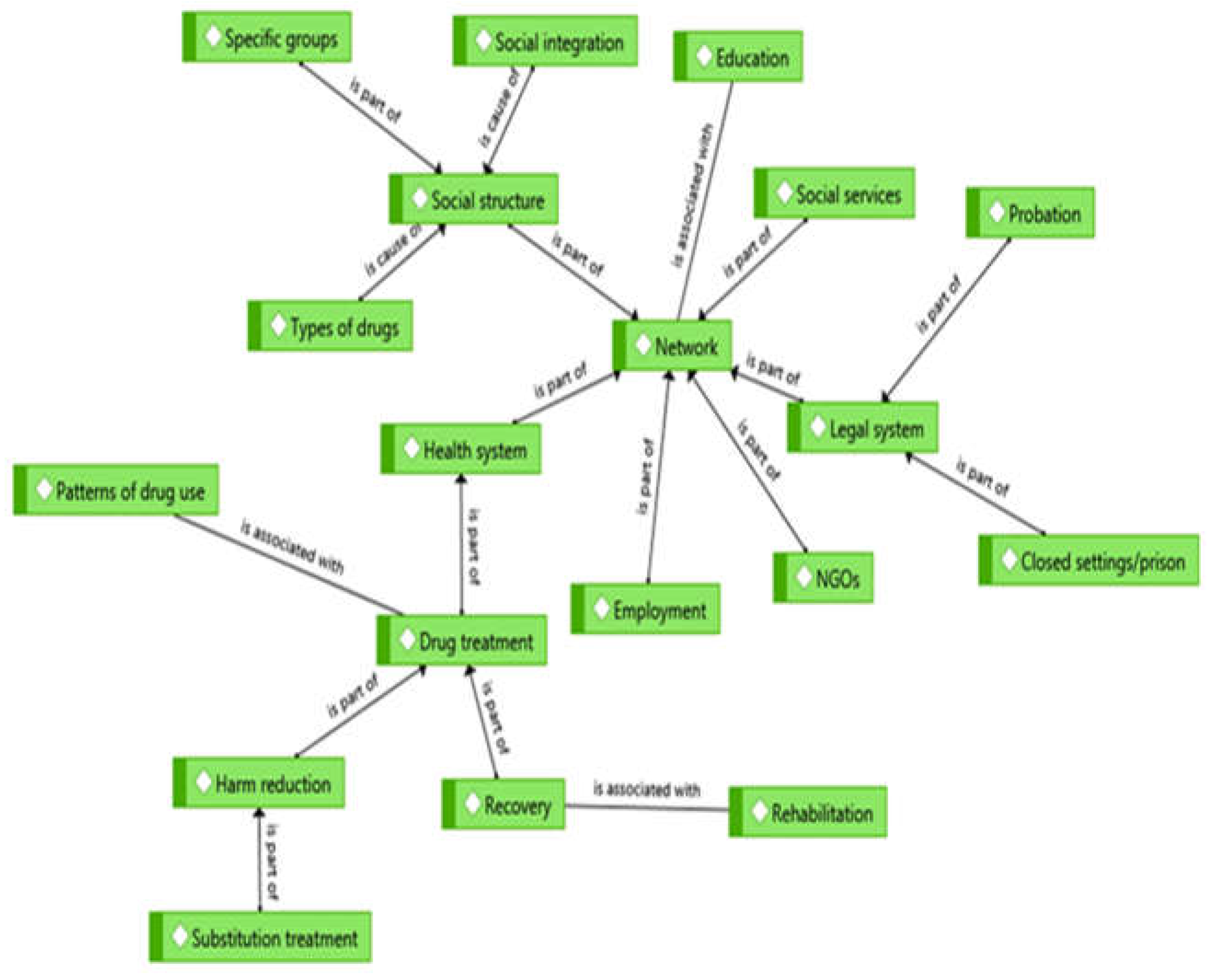
Table 2.
Conceptual Dimensions Framework.
| Dimension | Mutual Aid (1930s-1960s) | Therapeutic Communities (1950s-1990s) | Recovery Science (1990s-present) |
| Primary source of authority | Lived experience and peer recognition | Community governance and professional expertise | Evidence, indicators, and institutional validation |
| Form of knowledge | Testimony, narrative, and spiritual work | Communal observation, confrontation, and clinical protocols | Quantitative measures, scales, and recovery capital |
| Subject of treatment | Member with shared struggle | Resident/user in communal transformation | Measurable trajectory and risk/benefit profile |
| Institutional relationship | Fellowship outside formal institutions | Semi-autonomous communities with varying professionalization | Integration with health systems, policy, and funding structures |
| Principal risk | Spiritual universalism and cultural limitations | Authoritarianism, coercion, or bureaucratization | Standardization and exclusion of non-measurable pathways |
Disclaimer/Publisher’s Note: The statements, opinions and data contained in all publications are solely those of the individual author(s) and contributor(s) and not of MDPI and/or the editor(s). MDPI and/or the editor(s) disclaim responsibility for any injury to people or property resulting from any ideas, methods, instructions or products referred to in the content. |
© 2026 by the authors. Licensee MDPI, Basel, Switzerland. This article is an open access article distributed under the terms and conditions of the Creative Commons Attribution (CC BY) license (http://creativecommons.org/licenses/by/4.0/).
Copyright: This open access article is published under a Creative Commons CC BY 4.0 license, which permit the free download, distribution, and reuse, provided that the author and preprint are cited in any reuse.