

Submitted:
02 November 2026
Posted:
03 November 2026
You are already at the latest version
Abstract
Coronary artery fistulas (CAFs) are a rare, typically congenital coronary anomaly. They may cause myocardial ischemia through a coronary steal phenomenon. Acquired CAFs are exceptionally uncommon and are usually due to an intervention or trauma. We re-port the case of a 79-year-old man with history of clear cell renal cell carcinoma previ-ously treated with right nephrectomy in 2015. Seven years later, he underwent percu-taneous coronary intervention of severe LAD stenosis following out-of-hospital cardi-ac arrest. During follow-up, progressive exertional dyspnea and inducible lateral is-chemia led to repeated coronary angiography 15 months later revealing fistulous communications from the circumflex and right coronary arteries draining into a left pulmonary mass. Right-heart catheterization showed a small left-to-right shunt at rest (Qp/Qs 1.3). Thoracic computed tomography and biopsy confirmed a large pulmonary metastasis from clear cell renal cell carcinoma, suggesting that the fistulas developed as part of tumor angiogenesis. Transcatheter coil embolization would have been a strategy to reduce tumor perfusion and the coronary steal; however, we just limited our treatment to the tyrosine kinase inhibitor Axitinib due to the metastatic disease. This case describes a rare mechanism of acquired CAF formation in metastatic renal cell carcinoma.
Keywords:
coronary
; fistula
; coronary artery fistulas -CAFs
; angiography
1. Introduction
Coronary artery fistulas (CAF) are abnormal precapillary communication of a coronary artery or one of its branches into a cardiac cavity or other low-pressure vascular structure [1]. The formation of a CAF is the result of communication between a coronary artery, a cardiac chamber, a large vessel, or any other vascular structure [1]. Usually, coronary fistulas are asymptomatic and diagnosed incidentally [1]. CAF in pediatric populations are mostly congenital, whereas coronary–pulmonary fistulas in adults are often acquired [1]. Acquired CAF are usually due to heart surgery, percutaneous interventions, trauma or rarely vasculitis [2]. In older patients, they can manifest with exertional dyspnea, exertional angina, arrhythmia, endocarditis, and/or stroke [1].
In cases where CAFs result in the formation of significant shunts, treatment by surgical ligation is regarded as the gold standard [3]. For smaller fistulas, a transcatheter approach is a valuable alternative option [3].
As acquired coronary artery fistulae are rare, we describe a documented case.
2. Materials and Methods
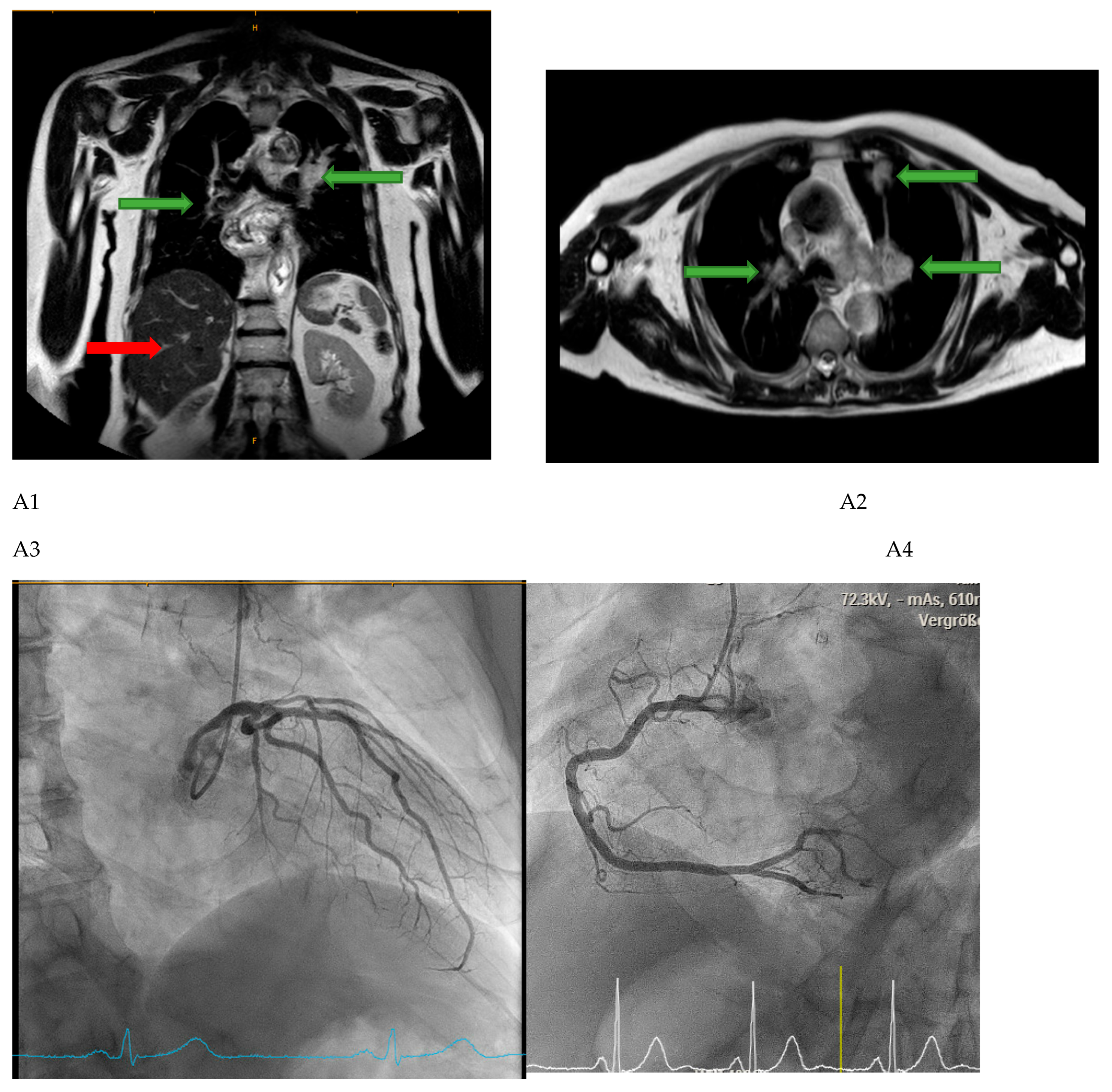
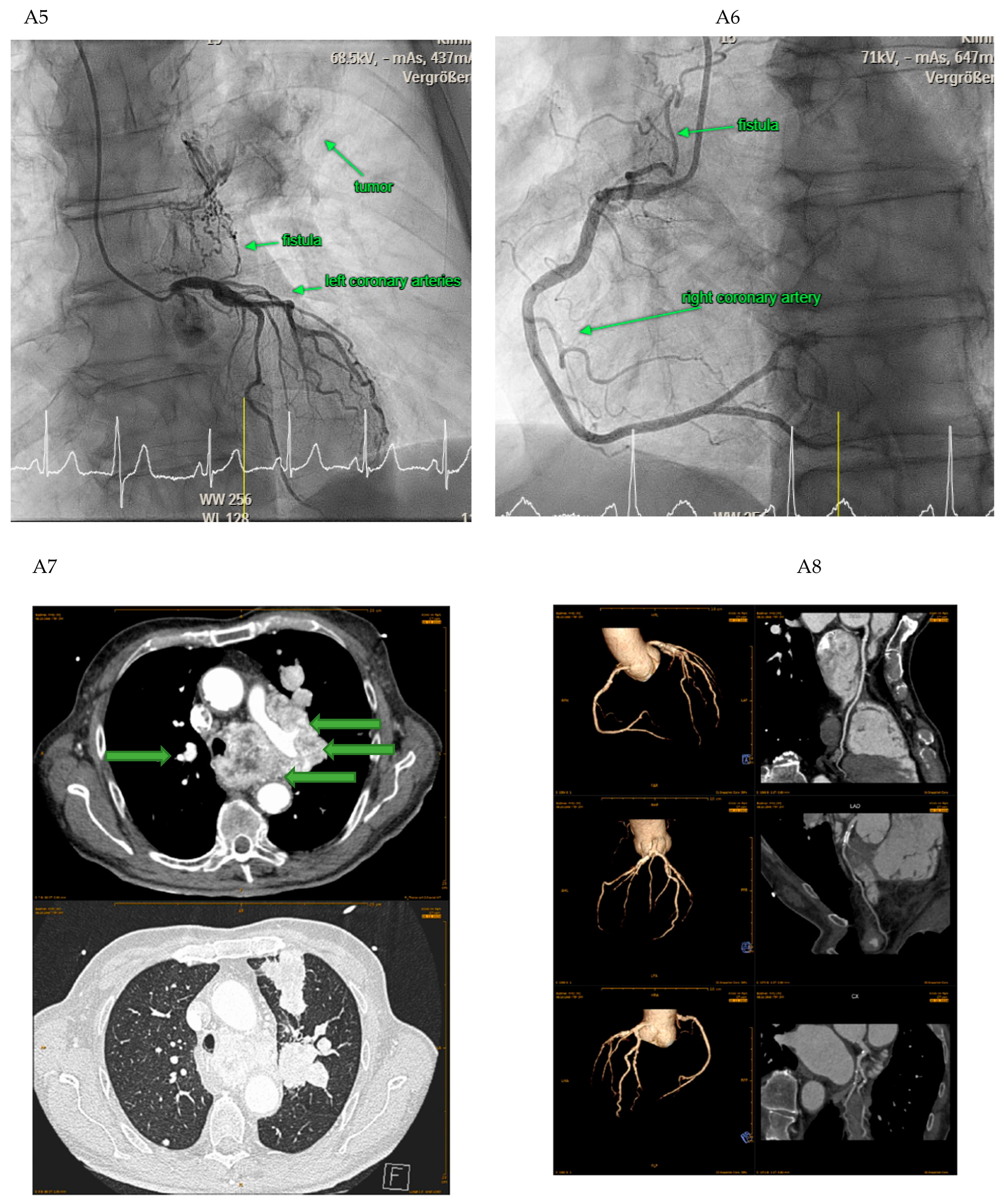
A 79-year-old male with a medical history of type 2 diabetes mellitus (on oral hypoglycaemic treatment) and dyslipidaemia underwent right kidney removal in 2015 for clear cell renal cell carcinoma (ccRCC). His medical history also includes a previous out-of-hospital cardiac arrest, which resulted in a primary percutaneous coronary intervention (PCI) with drug-eluting stent (DES) implantation to the proximal left anterior descending (LAD) artery in April 2022. At the initial outpatient clinical follow-up after the primary PCI in July 2022, a cardiac MRI was conducted. This revealed the presence of a confined antero-apical subendocardial scar, with no evidence of residual stress-induced ischemia. As an incidental finding, enlarged mediastinal lymph nodes and multifocal lung lesions on both sides were identified. Subsequent investigation was conducted using a combination of angiography and CT scanning, which revealed multiple rounded lesions of unclear nature in both lungs, in addition to enlarged mediastinal and hilar lymph nodes. No clear evidence of a primary tumour was found neither in the chest nor in the abdomen. The patient declined further investigations, namely a PET-CT and a bronchoscopy. At the subsequent cardiology follow-up at the end of 2023, coronary ischemia was found on stress echocardiography, and the patient underwent repeat coronary angiography again in February 2024. The angiogram revealed a patent stent in the proximal left anterior descending (LAD) artery. Over time, the patient began to experience coughing. By late 2024, in the presence of worsening cough, new onset of dyspnea on exertion and evidence of lateral ischaemia on stress echocardiography, a repeated coronary angiogram was performed. While the coronary anatomy remained stable, newly developed CAF were incidentally detected from the circumflex and right coronary arteries draining into the left lung. Retrospective analysis of the early 2024 coronary angiogram revealed the presence of CAFs, though they were only minimally visible. The CAF were not present in 2022, however, A subsequent left-right cardiac catheterization revealed a small left to right shunt at rest (Qp/Qs 1.3). A CT-guided biopsy of the mass was performed and confirmed the histological diagnosis of a large ccRCC metastasis. Consequently, the decision was made to initiate a first non-invasive treatment using the tyrosine kinase inhibitor therapy Axitinib. The CAFs were determined to be part of the angiogenic tumoral development. There are no standard guidelines for the treatment of these CAFs [4]. The indications for fistula closure are usually based on clinical symptoms, such as heart failure, myocardial ischemia, aneurysmal dilatation, or high-flow shunting. In this patient, the treatment of the tumor could potentially involve coiling of the fistulas, which may offer a dual benefit by reducing tumor growth and mitigating the "steal phenomenon" under exertion, thereby alleviating ischemic effects on the coronary arteries [5]. In our case, the chemotherapy treatment the patient underwent led make it possible to avoid any invasive treatment. Presently, the patient remains clinically stable without any repeat cardiac intervention.
3. Discussion
This case report shows an example of an acquired CAF, a rare coronary anomaly, affecting 0.1% to 0.2% of the population. Normally CAF involve an abnormal communication between one or more coronary arteries with either one of the cardiac chambers (CAF) or the great vessels adjacent to the heart (coronary artery or arteriovenous fistulae) without an interposed capillary bed [6]. Symptoms of breathlessness and congestive cardiac failure occur when there is a large left-to-right shunt and they can result, as our case has shown, with dyspnea on exertion due to myocardial ischemia as consequence of coronary artery “steal” phenomenon [7]. Complications of these fistulas can induce not only myocardial ischemia, but also thrombosis, heart failure, atrial fibrillation and other arrhythmias, rupture of the fistulous aneurysm, endocarditis and endarteritis [7].
Acquired CAFs in adults [8] can originate by different mechanisms
Although percutaneous strategy is preferred to open surgery because of its reduced cost, reduced morbidity, faster recovery [11] and better cosmetic outcome, there are no standard guidelines for the treatment of CAFs, neither in congenital forms nor in acquired ones. The indications for fistula closure are mainly based on clinical symptoms or high-flow shunting [3]. In severe cases, spontaneous rupture of coronary-to-pulmonary artery fistulas can lead to hemopericardium and cardiac tamponade [12]. Current therapeutic options include percutaneous embolization and surgical ligation and the updated 2018 American College of Cardiology/American Heart Association guidelines emphasized the importance of a heart team approach and an individualized approach to evaluate the appropriateness and feasibility of CAF closure at centers with expertise in both percutaneous and surgical closure techniques [11,13,14]. Transcatheter CAF closure, if feasible, is associated with a favorable acute procedural success and complication rate [13] and it has become an acceptable alternative to the standard surgical treatment [7]. Relevant to say, the success of transcatheter procedures success and its risk for complication are highly dependent on CAF anatomy and closure technique [13]. Above all, they have certain limitations, including the possibility of distal emboli, which can lead to ischemic ECG changes and heart attacks [6]. Coiling of tumoral CAFs in inoperable or high-risk patients could potentially provide significant prognostic and symptomatic benefits, as shown by several studies with an improvement in symptoms at clinical follow-ups [13,14,15]. In our patient, no invasive treatment was performed as cancer treatment was more urgent and he remained clinically stable since.
Funding
This research received no external funding.
Informed Consent Statement
Written informed consent has been obtained from the patient to publish this case-report-paper.
Conflicts of Interest
The authors declare no conflicts of interest.
Abbreviations
The following abbreviations are used in this manuscript:
| CAFs | Coronary artery fistulas |
Appendix A
AA1. A2. Chest/Thoracic-MRI. Green arrows: confined antero-apical subendocardial scar and incidental finding of enlarged mediastinal lymph nodes and multifocal lung lesions on both sides. Red arrow: area of removed kidney.
AA3. A4.A5.A6. Angiography: findings of newly developed coronary artery fistulas (CAFs) incidentally detected from the RCX and RCA draining into the left lung.
A7.A8. CT scanning: multiple rounded lesions of unclear nature in both lungs, in addition to enlarged mediastinal and hilar lymph nodes
References
- Case Report: Coronaro-bronchial fistula vascularizing a squamous cell lung cancer. Ntshaykolo C, Fave T, Benic C, Boizet A, Geier M, Nicol PP, Descourt R.Front Cardiovasc Med. 2023 Nov 8;10:1279611. eCollection 2023. [CrossRef] [PubMed]
- Vavuranakis M, Bush CA, Boudoulus H. Coronary artery fistula in adults: incidence, angiographic characteristics, natural history. Cathet Cardiovasc Diagn 1995;35:116-20. [CrossRef] [PubMed]
- Coronary Artery Fistulas: Indications, Techniques, Outcomes, and Complications of Transcatheter Fistula Closure. J Am Coll Cardiol Intv. 2021 Jul, 14 (13) 1393–1406.
- ESC 2020 Guidelines for the management of adult congenital heart disease, section 4.17.1.3.
- Coronary Artery Fistula: A Diagnostic Dilemma. Interv Cardiol. 2023 Nov 23:18:e25. [CrossRef]
- Coronary Artery Fistulae in Adult: Two Decades of Experience in Clinical Presentation, Angiographic Feature, and Management. Int J Angiol. 2021 Nov 10;30(4):277–284. [CrossRef]
- Catheter closure of coronary artery fistulas J Interv Cardiol. 2001 Jun;14(3):299-307. [CrossRef]
- Case Report: Coronaro-bronchial fistula vascularizing a squamous cell lung cancer. Front Cardiovasc Med. 2023 Nov 8;10:1279611. [CrossRef]
- A Rare Case of Left Atrial Myxoma Vascularity Causing Acquired Coronary Cameral Fistula: Role of Transesophageal Echocardiography. Heart Views. 2018 Jan-Mar;19(1):12–15. [CrossRef]
- Coronary Artery Fistulas: Unmasking Acquired Origins in the Setting of Chronic Coronary Artery Disease. Arnav Kumar Singla, MD; Cody Uhlich, MD; Namrata Kadambi, MD; Shannon Li, MD; Stuart Chen, MD; Fareed Moses Collado, MD. October 2025 • Cath Lab Digest. www.cathlabdigest.com.
- Stout KK, Daniels CJ, Aboulhosn JA, et al. 2018 AHA/ACC guideline for the management of adults with congenital heart disease: executive summary: a report of the American College of Cardiology/ American Heart Association Task Force on Clinical Practice Guidelines. J Am Coll Cardiol 2019;73:1494–563.
- Bauer HH, Allmendinger PD, Flaherty J, et al. Congenital coronary arteriovenous fistula: spontaneous rupture and cardiac tamponade. Ann Thorac Surg 1996;62:1521-3. [CrossRef] [PubMed]
- Transcatheter closure of coronary artery fistula: A 21-year experience. Catheter Cardiovasc Interv. 2020 Aug;96(2):311-319. [CrossRef]
- Shakeel A. Qureshi; Michael Tynan (2001). Catheter Closure of Coronary Artery Fistulas. 14(3), 299–308. [CrossRef]
- Shah AH, Osten M, Benson L, et al. Long-term outcomes of percutaneous closure of coronary artery fistulae in the adult: a single-center experience. Catheter Cardiovasc Interv 2020;95:939–48. [CrossRef] [PubMed]
Disclaimer/Publisher’s Note: The statements, opinions and data contained in all publications are solely those of the individual author(s) and contributor(s) and not of MDPI and/or the editor(s). MDPI and/or the editor(s) disclaim responsibility for any injury to people or property resulting from any ideas, methods, instructions or products referred to in the content. |
© 2026 by the authors. Licensee MDPI, Basel, Switzerland. This article is an open access article distributed under the terms and conditions of the Creative Commons Attribution (CC BY) license (http://creativecommons.org/licenses/by/4.0/).
Copyright: This open access article is published under a Creative Commons CC BY 4.0 license, which permit the free download, distribution, and reuse, provided that the author and preprint are cited in any reuse.