

Submitted:
01 November 2026
Posted:
03 November 2026
You are already at the latest version
Abstract
Singapore has built Southeast Asia’s clearest compliance market for international carbon credits, yet eligible nature-based supply has barely formed. Projects cannot be financed until host countries authorise exports, and buyers will not contract until credits are eligible; as of November 2025, no credits had been purchased under Singapore’s International Carbon Credits framework. This paper proposes a demand-anchored structure to break that deadlock. A price band anchored to Singapore’s carbon tax gives buyers and sellers a public ceiling; a Compliance Step-Up Offtake lets buyers contract now at a voluntary price that steps up when credits become eligible; and a Regenerative Demand Note, backed by multilateral first-loss capital, turns signed demand into upfront restoration finance. Corridor sites, or regenerative nodes, pair mangroves and other nature assets with Singapore’s energy, food and water imports, with community trusts as contract parties. Scenario modelling sizes Singapore’s compliance-anchored demand at 3.2–3.8 MtCO2e a year to 2030, worth about S$110–170 million a year, and about 37 Mt over 2026–2035 in the base case. A review of precedent market structures finds that none yet combines a compliance price anchor, a route to authorisation, finance before eligibility and communities as contract parties. The paper proposes a council of the parties to steward shared rules, shows how a shared ledger and insurers can extend the market, and sets out twenty-one hypotheses and a research agenda for validation.
Keywords:
arbon markets
; carbon trading
; carbon offsets
; net zero
; carbon tax
; Article 6
; blue carbon
; nature-based solutions
; forward offtake
; demand-anchored bankability
; impact measurement
; ecosystem mutuality
Purpose, Desired Outcomes and Significance
Purpose. This paper proposes a practical contract and financing structure that lets Singapore-based buyers commit today to high-integrity, nature-based carbon from Southeast Asian corridors, before every policy gate has been passed. It is written to be tested by practitioners, not only read. Its aim is to move readers from reading to taking part: to validate the design with me, to help form a council of the parties—working name the Regenerative Corridors and Carbon Trade Council (RCCTC)—and to make the commitments that let a first corridor demonstrate ecosystem mutuality in practice (Section 10.7).
Desired outcomes.
- Validated design. Buyers, bankers, regulators and lawyers confirm, reject or refine the twenty-one hypotheses in Section 12, so the next draft reflects how the market actually works.
- A founding coalition. A community trust, a host-state body, an anchor buyer and a catalytic funder, with ADB as the lead target, sign a non-binding founding memorandum for the first corridor by early 2027, establishing a council of the parties (working name: the Regenerative Corridors and Carbon Trade Council, RCCTC).
- A first signed offtake. At least one Compliance Step-Up Offtake within a tax-anchored price band, which makes the first Regenerative Demand Note bankable.
- Policy traction. Evidence of committed demand that helps prioritise Implementation Agreements, eligibility lists and authorisations for nature-based credits, including blue carbon.
- A replicable template. Agreements and governance that a second corridor can adopt without starting again.
Significance.
- • It addresses a binding constraint. The policy pathway exists, but eligible supply has barely formed, because host authorisation and the lack of pre-eligibility contracts bind together. The paper targets the contract gap and shows how committed demand helps unlock authorisation.
- • It turns policy into a price reference. Linking the price band to Singapore’s carbon tax gives buyers and sellers a public ceiling, resolving the price-range problem that stalls forward deals.
- • It puts communities first by design. Consent is a condition precedent, and community trusts are contract counterparties rather than beneficiaries, which addresses the legitimacy risk that has stalled projects in the region.
- • It widens the value base. Pairing nature with Singapore’s energy, food and water imports gives corridors more than one source of revenue and more than one constituency of support.
- • It is timed to the market. Singapore’s tax is rising, the 2030 vintage window is closing, and aviation, SBTi and trade rules are adding demand. Structures agreed in 2027 can deliver within that window; later ones may not.
1. Introduction: The Deployment Gap
Southeast Asia holds some of the world’s most carbon-dense coastal ecosystems, and Singapore has built the region’s most developed carbon-market rulebook. The two have not yet met. Capital has been announced, buyers have been regulated into the market, and exchanges have been built, yet very few nature-based projects in the region are being financed into existence.
In earlier work I called this a deployment gap: capital that is announced without contracted demand does not deploy (Ooi, 2026a; 2026b). Investors need contracted revenue before they fund restoration. Buyers need a price and an eligible product before they contract. Projects need investment before they can produce either. Each party waits for another to move first.
Three features make the gap acute in 2026:
- Compliance demand has arrived before compliance supply. Singapore’s carbon tax now allows eligible international credits, and its Government is tendering for Article 6 credits. But the list of eligible host countries and methodologies is still short, and no credits had been purchased under the framework by November 2025 (MSE, 2025). Aviation, corporate net-zero standards and EU trade rules are now adding demand from outside Singapore, all waiting on the same host-country authorisations.
- Price discovery is weak. Voluntary nature-based prices vary widely, while eligible compliance credits trade in a thin market. Neither gives a basis for a ten-year restoration contract.
- Rights and legitimacy are not optional. In Sarawak and elsewhere, carbon projects have faced pushback over native customary rights and benefit-sharing. A financing model that does not put communities first will not survive scrutiny.
This paper asks a practical question: what contract and financing structure would let a Singapore-based buyer sign today for nature-based credits that will become compliance-eligible later, at a price both sides can accept, in a way that communities, regulators and investors would all endorse?
1.1. Market Structures to Date, and the Gap They Leave
The carbon market has matured unevenly. Integrity standards, buyer coalitions, demand aggregators, credit-repaid funds, exchanges and insurance now exist, but each solves one part of the bankability problem, mostly for voluntary buyers and mostly outside Southeast Asia. Five structures show what has been proved and what remains open.

Table 1.
Market structures to date: what each has proved and what it leaves open.
| Structure | Example | What it has proved | What it leaves open for Southeast Asian corridors |
|---|---|---|---|
| Buyer coalitions and advance market commitments | Frontier: US$1.8 billion of carbon removal by 2040, run by a Stripe-owned public-benefit company; Symbiosis Coalition: Google, Meta, Microsoft and Salesforce, up to 20 Mt of nature-based removals by 2030 (Frontier, n.d.; Eco-Intelligent, 2026) | Pooled, credible forward demand lets suppliers raise capital against offtakes | Voluntary and US-led; no compliance price anchor; Symbiosis’s mangrove criteria were still being developed in 2026 |
| Demand aggregators working with governments | LEAF Coalition, coordinated by the non-profit Emergent: companies and donor governments buy jurisdictional forest credits; Nepal signed a deal worth up to US$55 million in January 2026 (UN-REDD Programme, n.d.; Kathmandu Post, 2026) | A neutral intermediary, standard contracts and readiness support can bring governments to market | Works with national and state governments on avoided deforestation; communities are beneficiaries rather than contract parties; not built around Singapore’s Article 6 channel |
| Funds repaid in credits | Livelihoods Carbon Funds: four funds since 2011, with investors including Danone, Hermès, SAP, Schneider Electric and Mars (Livelihoods Funds, n.d.) | Corporate buyers will finance 10–20-year projects, including mangroves, upfront and take repayment in credits | A closed European investor club; voluntary claims; no link to a tax-based price or to authorisation |
| Integrity standard-setters | Integrity Council for the Voluntary Carbon Market (ICVCM), funded by philanthropy, with funders holding no rights over its decisions (ICVCM, n.d.) | Independent rule-setting, kept separate from those who transact, builds trust | Sets quality, not price, finance or delivery |
| Exchanges and risk transfer | Climate Impact X and Abaxx in Singapore; delivery and political-risk insurers such as Kita, CFC and Oka (Abaxx, 2025; Quantum, n.d.; Reinsurance News, n.d.) | Standard contracts, physical delivery and insurance for non-delivery and authorisation risk are available | Liquidity needs a steady flow of eligible supply, which has not yet formed |
The gap. No existing structure links four things in one governed arrangement: a compliance price anchor (Singapore’s carbon tax), a route to authorisation (Article 6 Implementation Agreements), finance before eligibility (forward offtakes backed by first-loss capital), and communities as contract parties. Each precedent proves one of these can work; none combines them for Southeast Asian corridors. This paper proposes that combination.
Three lessons carry over. First, every precedent launched with an anchor sponsor—Stripe, the large technology buyers, donor governments, Danone—so the model’s first need is sponsorship of its coordinating body, before any credit is traded. Second, the precedents keep three pools of money apart: funding for the coordinating body, purchases by buyers, and capital for projects. Third, rule-setting earns trust only when it is independent of those who transact, which shapes the council proposed in Section 10.7.
1.2. Approach and Method
The paper is a design-oriented working paper: it diagnoses a market failure, proposes contract and governance instruments to address it, and sets out testable hypotheses for validating them.
- Evidence base. A desk review of primary sources—legislation, ministerial and parliamentary replies, regulator guidance, intergovernmental agreements and official datasets—supplemented by reputable market, legal and news sources, accessed between September and 1 November 2026. All sources are listed in the appendix, and the verification status of key figures is set out in the Data notes.
- Quantitative analysis. Scenario models of the carbon-tax path, the value of contracting early and Singapore’s compliance demand to 2035 (Section 2.7, Section 2.8, Section 2.9 and Section 2.10). Assumptions are stated alongside each result, so every figure can be reproduced; the results are the author’s illustrative calculations, not forecasts.
- Design. The instruments in Section 4, Section 5 and Section 6 and the activation model in Section 10 build on precedents reviewed in Section 1.1 and on the author’s earlier work on demand-anchored bankability and the Ecosystem Economics of Mutuality (Ooi, 2026a; 2026b).
- Validation. Twenty-one hypotheses (Section 12) state what must hold for the design to work and who is best placed to test each one. The paper has not yet been tested empirically; Section 13.2 sets out its limitations.
1.3. Contributions of This Paper
This paper makes four contributions. First, it extends demand-anchored bankability (Ooi, 2026a) from a general theory to a compliance setting, showing how a carbon tax can anchor forward prices for credits that are not yet eligible. Second, it designs three instruments—the tax-anchored price band, the Compliance Step-Up Offtake and the Regenerative Demand Note—that allocate policy, price and delivery risk to the parties best placed to bear them. Third, it provides a reproducible demand forecast for Singapore’s compliance market to 2035. Fourth, it turns ecosystem mutuality into governance that can be observed and measured—interlocking commitments, community trusts as contract parties and a yearly mutuality ledger—and states twenty-one falsifiable hypotheses for its validation.
Building on that review, the paper first sizes Singapore’s demand and the drivers widening it (Section 2), explains why eligible supply is missing (Section 3), proposes a price band and an offtake contract that resolve the price problem (Section 4 and Section 5), and sets out a corridor architecture to finance them (Section 6). It then maps the model to the four value pools (Section 7), regional corridors (Section 8), an implementation pathway (Section 9), an activation model built on mutuality agreements and the RCCTC (Section 10) and the risks (Section 11). Section 12 lists the hypotheses still to be validated, and Section 13 concludes with the findings and an agenda for future research.
2. Singapore’s Compliance Anchor
Singapore is the clearest market in Southeast Asia where a defined, priced and rising compliance demand for international nature-based credits exists today. It comes from two sources, the carbon tax and the Government’s own Article 6 purchases, with a third, voluntary source growing fast. Section 2.6 sets out further drivers from outside Singapore.
2.1. The Carbon Tax and the ICC Framework
The carbon tax applies to facilities emitting at least 25,000 tCO2e a year, around 50 facilities in manufacturing, power, waste and water that together account for about 70% of national emissions. The rate was S$5/t from 2019 to 2023, S$25/t in 2024–25 and S$45/t from 2026, with a view to S$50–80/t by 2030 (NCCS, n.d.-a; NEA, n.d.). Since 2024 these facilities may offset up to 5% of taxable emissions with eligible international carbon credits (ICCs) (MSE, 2026).
Figure 1.
Singapore’s carbon tax schedule and eligible-credit prices. Sources: NEA carbon tax schedule; S&P Global ICC assessments, January–March 2026.
Figure 1.
Singapore’s carbon tax schedule and eligible-credit prices. Sources: NEA carbon tax schedule; S&P Global ICC assessments, January–March 2026.
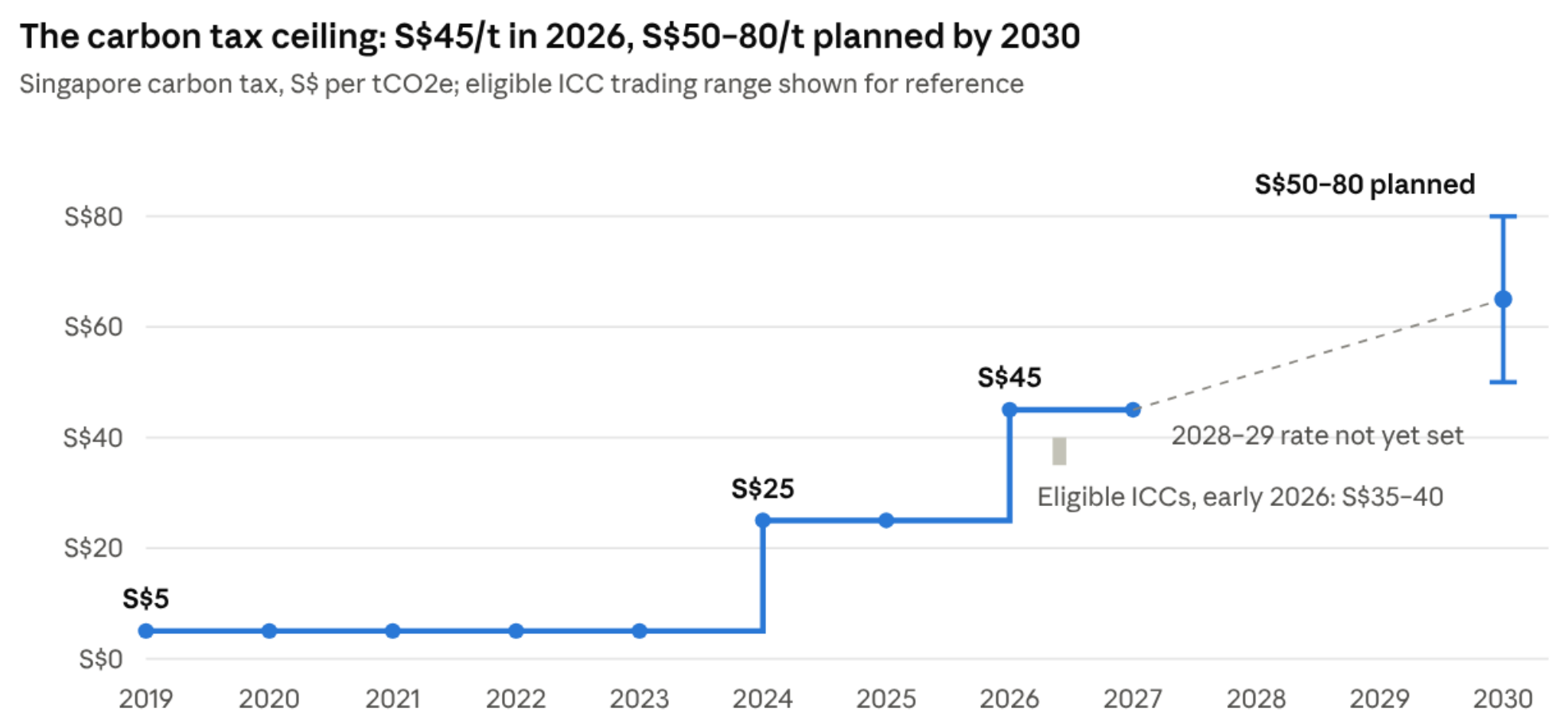
The tax gives every tax-liable buyer the same public reference point: an eligible tonne is worth up to the tax it avoids. Early-2026 assessments put eligible ICCs at S$35–40/t, with three-year forwards at S$43.50 (S&P Global, 2026c)—just below the tax, as theory predicts.
To be eligible, credits must come from a host country with an Implementation Agreement with Singapore, use a listed methodology, be authorised for corresponding adjustment, meet seven integrity principles, and represent reductions or removals from 2021–2030 (MSE, n.d.-a).
2.2. Demand Sizing
Table 2.
Singapore’s compliance-anchored demand to 2030.
| Demand stream | Basis | Estimate, MtCO2e a year to 2030 | Confidence |
|---|---|---|---|
| Carbon-tax ICC surrenders | Taxable emissions of about 26 Mt, implied by 2024 tax revenue of S$658.8 million at S$25/t (NTU, 2026), × 5% cap; covered emissions are higher (national emissions 58.6 Mt in 2022 (NEA, 2024) × about 70% covered), but transition allowances reduce taxable emissions | Up to 1.3; 0.7–1.3 at 50–100% uptake | Medium: allowances may change as the tax rises |
| Government NDC purchases | Singapore’s earlier estimate of about 2.51 Mt a year over this decade (EDB, 2025b); 2.175 Mt contracted in 2025 (EDB, 2025a); tender for at least 12 Mt opened September 2026 (Quantum, 2026) | About 2.5 | Medium–high |
| Compliance-anchored total | 3.2–3.8 | ||
| Voluntary: data centres and hyperscalers | Data centres use about 7% of electricity, expected to nearly double by 2030 on a business-as-usual path, to about 11–12% (NUS, 2024; PMCE, n.d.; Sustainability SG, 2026); 1.4 GW operating plus at least 300 MW planned (EDB, 2024) | 0.3–0.7 if operators neutralise 10–20% of a footprint of about 1.6 Mt in 2024 and 2.9–3.5 Mt by 2030 (illustrative) | Low |
At S$35–45/t, the compliance-anchored total is worth about S$110–170 million a year. A single corridor supplying 0.1–0.2 Mt a year would need only about 3–6% of it.
How the estimate is built.
Table 3.
How the demand estimate is built.
| Quantity | Formula | Result to 2030 |
|---|---|---|
| Corporate demand | Taxable emissions × 5% cap × share of the cap used = 26 Mt × 5% × 50–100% | 0.7–1.3 Mt a year |
| Government demand | Reported Government estimate | About 2.5 Mt a year |
| Compliance-anchored demand | Corporate + Government | 3.2–3.8 Mt a year |
| Value | Demand × eligible-credit price (S$35–45/t) | About S$110–170 million a year |
Method note: the data-centre footprint uses national electricity consumption of 57.6 TWh in 2024 (EMA, 2026), growing 2–4% a year to about 65–73 TWh in 2030, and the 2024 grid emission factor of 0.402 kgCO2/kWh (NCCS, n.d.-b, from EMA’s Singapore Energy Statistics), held constant. Electricity imports would lower the factor and the footprint.
2.3. Growth to 2035
Demand rises in both price and volume after 2027. The tax is planned to reach S$50–80/t by 2030, and Singapore’s 2035 target of 45–50 MtCO2e, against about 60 Mt in 2030, widens the Government’s gap after 2030 (IETA, 2025). The corporate channel is capped at 5% unless policy changes, so most volume growth will come through government procurement.
2.4. AI Data Centres: Voluntary but Decisive
Data centres emit through electricity, so they pay the carbon tax indirectly through power prices and cannot surrender ICCs themselves. Their demand is voluntary, driven by hyperscalers’ net-zero and carbon-removal commitments. These are the buyers most willing to pay for high-integrity removals with verified co-benefits, and the most likely anchors for multi-year offtake.
2.5. Buyers Already Manage Several Instruments
Many Singapore buyers already handle more than one carbon instrument. Ship operators surrender EU allowances for voyages under the EU Emissions Trading System. Airlines must collect Singapore’s sustainable aviation fuel levy on tickets sold from 1 October 2026, for flights departing from 1 January 2027 (Milelion, 2026). Nature-based ICCs will join a portfolio that treasury, trading and legal teams already manage. The question is not whether buyers can handle a new instrument, but whether one will be offered on contract terms they can approve.
2.6. Market Accelerators Beyond the Carbon Tax
Four drivers outside Singapore’s carbon tax are widening the buyer base and extending demand into the 2030s. All of them run into the same bottleneck the tax does: host-country authorisation.
Table 4.
Market accelerators beyond the carbon tax.
| Driver | Status, November 2026 | Effect on demand | Finding for the corridor model |
|---|---|---|---|
| Aviation: CORSIA Phase 1 | ICAO estimates Phase 1 demand at 100–150 MtCO2 and IATA at 200–250 million units, against about 41 million eligible units issued and labelled, and about 72 million covered by 42 letters of authorisation; units must be cancelled by 31 January 2028 (EDF, 2026; IATA, 2026) | The largest compliance shortage in the market | New corridors are too late for Phase 1 but well placed for later phases; airlines and traders become buyers of authorised credits |
| Corporate net zero: SBTi Standard V2.0 | Finalised June 2026; large companies in high-income countries must support removals of at least 1% of ongoing emissions from 2035, with a long-lived component; usable from February 2027 (ESG Dive, 2026) | A structural removal requirement for thousands of companies | Forward removal offtake becomes rational now; mangrove restoration counts as a nature-based removal but does not satisfy the long-lived component alone |
| Trade: EU carbon border adjustment (CBAM) | Definitive phase from 2026; Malaysia’s steel sector faces an estimated US$237 million bill for 2026 with no deduction, because it lacks a qualifying domestic carbon price (CBAM Guide, 2026) | A fiscal reason for exporting countries to price carbon at home | Accelerates Malaysia’s carbon pricing and Article 6 readiness, which shortens the Sarawak corridor’s path |
| Traceability and disclosure: EU deforestation rules, ISSB, TNFD | EU deforestation rules apply from 30 December 2026 for large operators and 30 June 2027 for micro and small ones, subject to a simplification review (EY, 2026); ISSB-aligned climate reporting mandatory for Singapore-listed companies | Buyers pay for verified landscape and supply-chain data, not only carbon | The corridor’s monitoring and shared record can be sold as traceability and nature data before the first credit is issued |
Two further drivers sit on the watch list. Shipping’s IMO Net-Zero Framework, with penalty units of US$100 and US$380 and a fund estimated at US$10–15 billion a year, faces an adoption vote in December 2026 (Carbon Brief, n.d.). AI-assisted satellite monitoring is cutting the per-tonne cost of verification, which matters most for small farms and coastal projects.
Findings.
- Demand becomes multi-buyer and long-dated. Singapore’s tax anchors 2026–2030; aviation, SBTi removal requirements and trade-driven carbon pricing extend demand into the 2030s.
- Authorisation, not price, is the binding constraint across schemes. CORSIA units traded at about US$9–16/t in mid-2026 despite a projected shortage of roughly 60 to 210 million units on ICAO and IATA estimates, with only about 41 million eligible units issued and labelled (Green Fuel Journal, n.d., citing OPIS and Argus). Supply that clears authorisation is scarce; price follows once enforcement bites. The corridor’s value lies in clearing gates, not in betting on price.
- Data revenue can precede carbon revenue. Traceability and nature-disclosure services give corridors income in the years before first issuance.
2.7. The Carbon Cost Trajectory and Margin Exposure
Singapore’s carbon tax has compounded at double-digit rates, and its cost now reaches every electricity user. But the 5% offset allowance limits what credits can save directly, so the business case for offtake rests on price certainty and claims rather than on tax savings alone.
Table 5.
Growth of Singapore’s carbon tax rate.
| Period | Tax rate (S$/tCO2e) | Compound annual growth |
|---|---|---|
| 2019–2026 | 5 → 45 | About 37% a year |
| 2024–2030 | 25 → 50–80 | About 12–21% a year |
| 2026–2030 | 45 → 50–80 | About 3–15% a year; double-digit only if the 2030 rate reaches about S$66 or more |
Rates fromNCCS (n.d.-a); growth rates calculated by the author.
Who feels it, and how.
Table 6.
Carbon-cost exposure by type of business.
| Business | Exposure at S$45/t (2026) | Exposure at S$80/t (2030, upper path) | Can it use credits against the tax? |
|---|---|---|---|
| Taxed facility emitting 100,000 tCO2e | S$4.5 million a year before transition allowances | S$8.0 million a year | Yes, for up to 5% of taxable emissions |
| Data centre drawing 100 MW at 85% load (about 745 GWh a year) | About S$13.5 million a year through electricity prices | About S$24.0 million a year | No; its cost arrives as a pass-through in power prices |
| Manufacturer using 5 GWh a year | About S$90,500 a year | About S$161,000 a year | No |
Electricity pass-through uses EMA’s 2024 grid emission factor of 0.402 kgCO2/kWh, about 1.8 ¢/kWh at S$45 and 3.2 ¢/kWh at S$80 (Gigawatt Solutions, 2026), assuming full pass-through. At the Q3 2026 tariff of about 31.9 ¢/kWh (Sunollo, 2026), the carbon component is roughly 6% of the bill at S$45 and about 10% at S$80 if other costs held steady. Transition allowances reduce taxed facilities’ bills; tax revenue of about S$660 million a year in 2024 and 2025 points to substantial allowances (NTU, 2026).
Findings.
- For taxed facilities, an index-linked price saves little; a fixed forward price is a real hedge. If an eligible credit costs 80–90% of the tax, the 5% allowance saves a 100,000-tonne facility only about S$22,500–45,000 a year at S$45. A forward fixed at about S$45 while the tax rises to S$80 would save about S$175,000 a year on the same 5,000 tonnes. The compounding tax therefore makes fixed-price forwards worth far more to buyers than tax-tracking prices.
- For Scope 2 users, the tax justifies decarbonisation first, and credits second. Data centres and manufacturers cannot offset a passed-through tax with credits. Their rising carbon costs drive efficiency, power purchase agreements and imported low-carbon power; credits serve their voluntary, SBTi and customer claims.
- For regional Scope 3 suppliers, the pressure comes through customers and trade rules. Suppliers to Singapore-headquartered and multinational buyers face SBTi-driven supplier targets and, for exporters to Europe, CBAM—which credits a domestic carbon price paid, not offsets. Credits and traceable nature data support their customer claims rather than reducing these costs directly.
The compounding tax is therefore a strong reason to act, but the model should sell offtake on price certainty, supply security and credible claims, not on margin recovery through offsets.
2.8. The Value of Contracting Early
Contracting early pays when policy tightens: the earlier a buyer locks in price and volume, the more the compounding tax and tightening removal supply work in its favour. Two buyer groups gain most, for different reasons.
Tax-liable buyers: a forward is a bet on the tax path. The model compares a facility emitting 100,000 tCO2e that buys its full 5% allowance (5,000 t a year) forward at a fixed S$44—close to the three-year forward assessed in early 2026—with buying each year on the spot market at 85% of the prevailing tax.
Figure 2.
Fixed forward versus annual spot purchase for a 100,000-tonne taxed facility. Source: author’s scenario model; tax paths from NCCS; forward price near S&P Global’s three-year assessment.
Figure 2.
Fixed forward versus annual spot purchase for a 100,000-tonne taxed facility. Source: author’s scenario model; tax paths from NCCS; forward price near S&P Global’s three-year assessment.
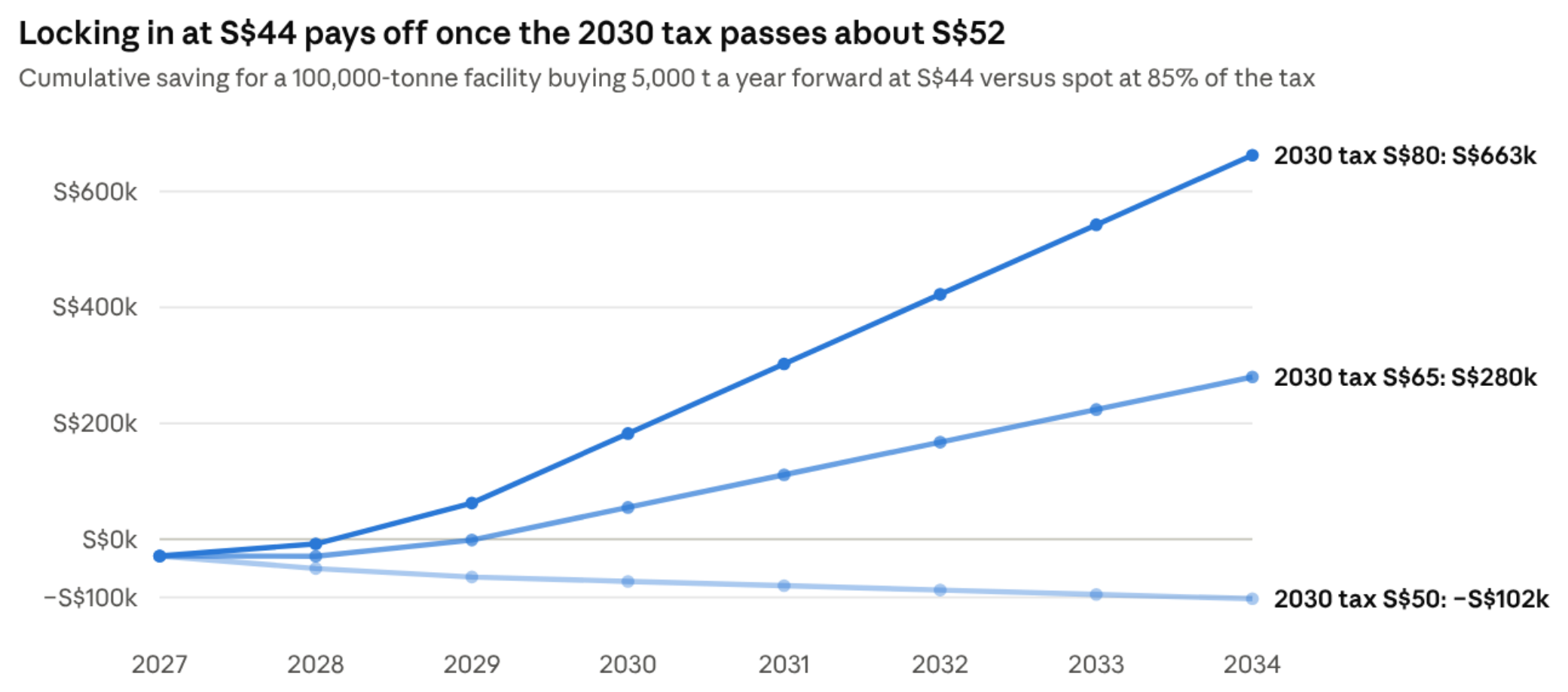
Break-even comes when the 2030 tax exceeds about S$52. Over 2027–2034, the fixed forward saves about S$280,000 if the tax reaches S$65 and about S$663,000 if it reaches S$80, but costs about S$102,500 if it stops at S$50 (net present values at a 6% discount rate: about S$195,000, S$475,000 and −S$85,000). The asymmetry favours early contracting whenever buyers judge the upper half of the S$50–80 range more likely, and the Step-Up Offtake’s voluntary-tier floor limits the downside.
The calculation, in one line. For each year from 2027 to 2034:
Saving in year t = (spot price in year t—forward price) × 5,000 tspot price in year t = 85% × carbon tax in year t; forward price = S$44
The forward pays off when the spot price, averaged over the contract, rises above S$44—which happens when the 2030 tax exceeds about S$52.
SBTi-committed companies: securing removal supply before 2035. SBTi V2.0 requires large companies in high-income countries to support removals equal to at least 1% of ongoing emissions from 2035. A company with 1 MtCO2e of value-chain emissions would need at least 10,000 t of removals a year. If nature-based removal prices rise from about US$25/t today by 5–10% a year (an illustrative assumption, not a forecast), they would reach about US$39–59/t by 2035; securing 10,000 t a year at today’s prices would avoid roughly US$140,000–340,000 a year. MSCI projects the removal-credit market at US$4–11 billion by 2030 (MSCI, n.d.), and Section 2.6 shows how quickly authorised supply runs short.
Who the urgent buyers are.
Table 7.
Buyer segments with rising urgency to contract.
| Segment | Why urgency is rising | Size signal |
|---|---|---|
| Singapore tax-liable facilities (power, refining, petrochemicals, semiconductors, waste and water) | Compounding tax; a forward hedge worth up to about S$660,000 per 100,000-tonne facility over 2027–2034 on the upper path | About 50 facilities, about 70% of national emissions (NCCS, n.d.-a) |
| Hyperscalers and data-centre operators | Rising electricity carbon costs; removal commitments; Symbiosis-style buying | Symbiosis members alone pledged up to 20 million tonnes of nature-based removals by 2030 |
| Airlines and aviation traders | CORSIA shortage with a January 2028 deadline, then later phases | 100–250 million units needed for Phase 1 (Section 2.6) |
| SBTi-validated companies in Asia, including suppliers to multinationals | 1% removal requirement from 2035; supplier targets passed down value chains | Nearly 9,800 validated companies worldwide by end-2025, Asia about 36% and growing 53% in a year (SBTi, 2026; CarbonCredits.com, 2026b) |
| Exporters facing CBAM and deforestation rules | Trade costs and traceability requirements | Malaysian steel’s estimated US$237 million CBAM bill for 2026 |
Estimating removal demand. A simple rule converts commitments into tonnes: annual removal demand from 2035 is about 1% of the value-chain emissions of in-scope companies. Every 10 MtCO2e of covered value-chain emissions creates about 0.1 Mt a year of removal demand, the size of one mature corridor. Country-level counts of SBTi companies in Singapore and Southeast Asia were not published in the sources reviewed; building that list, with emissions, is a priority for the Buyers’ Compact pipeline.
Scenario figures are the author’s illustrative calculations. They depend on the stated assumptions and are not price forecasts.
2.9. Disclosure Rules Versus Offset Rules Across Asia-Pacific
Two kinds of rule drive demand, and they are often confused. Disclosure rules require listed companies to report emissions, including Scope 3 for the largest; they create pressure but do not let credits reduce reported emissions. Offset rules in carbon taxes and trading schemes let credits count against an obligation, usually within a cap and often only for domestic credits. In Singapore, the carbon tax applies to about 50 facilities’ direct emissions, not to listed companies’ Scope 2 or 3, while SGX listing creates a disclosure duty.
Table 8.
Mandatory Scope 3 disclosure and compliance offset routes across Asia-Pacific.
| Market | Mandatory Scope 3 disclosure | Compliance offset route for corridor credits |
|---|---|---|
| Singapore | All listed companies report Scope 1 and 2 from FY2025; only the 30 STI constituents must report Scope 3, from FY2026; Scope 3 voluntary for other listed companies; large non-listed companies deferred to FY2030 (Allen & Gledhill, 2025) | Yes: carbon tax (up to 5%) and Government purchases, from Implementation Agreement countries |
| China | More than 450 large listed companies (SSE 180, SZSE 100, STAR 50, dual-listed) report from FY2025, including Scope 3 (ESG Today, 2024) | No: the national scheme uses domestic credits |
| Hong Kong | Scope 1 and 2 mandatory for all issuers from 2025; Scope 3 mandatory for LargeCap issuers from FY2026; comply-or-explain for other Main Board issuers (Slaughter and May, 2026) | No compliance scheme; voluntary demand only |
| Australia | Group 1 from 2025, Group 2 from July 2026, Group 3 from July 2027, including large unlisted entities; Scope 3 from each group’s second reporting year (HWL Ebsworth, n.d.) | Not today: Safeguard uses Australian units only |
| Japan | Prime Market companies with market value of ¥3 trillion or more apply SSBJ standards from fiscal years ending March 2027; ¥500 billion and above by 2029 (GRC Report, n.d.) | Yes, through the JCM with partner countries (not yet Malaysia) |
| Malaysia | Bursa companies with market value of RM2 billion or more from 2025; Scope 3 for the largest by 2027 and other large listed companies by 2028 (Eco-Business, n.d.-a) | Not yet: carbon tax under review |
| South Korea | Proposed from 2028 (2027 data) for KOSPI companies with assets above KRW 30 trillion; Scope 3 three years later (ESG Today, n.d.) | Limited: some international offsets once converted |
Findings.
- On mandatory Scope 3 breadth, China and Australia are ahead of Singapore, and Hong Kong is level. China covers more than 450 large listed companies from FY2025; Australia phases in thousands of large listed and unlisted entities from 2025; Hong Kong mandates Scope 3 for LargeCap issuers from FY2026, as Singapore does for its 30 STI constituents. Japan, Malaysia and Korea follow from 2027–2028.
- Disclosure creates pressure, not offset rights. Reported Scope 1–3 emissions are gross. Under ISSB-based standards, companies disclose any planned use of carbon credits towards their targets separately; credits support net-zero and SBTi claims, not a lower reported footprint.
- Compliance demand for corridor credits is concentrated in Singapore and Japan. China and Australia have large disclosure pools but domestic-only compliance schemes. Their companies are voluntary and SBTi buyers, not compliance buyers.
Implication for targeting. The Buyers’ Compact should not wait on Singapore’s 30 STI companies alone. Priority buyers are Singapore’s taxed facilities and Government; Japanese companies using the JCM; and Scope 3-reporting, SBTi-committed groups across Singapore, Hong Kong, Japan, Australia, China and Malaysia that need credible removals and supplier engagement in Southeast Asia.
2.10. Demand Forecast to 2035
In the base case, Singapore’s compliance-anchored demand grows from about 2.6 Mt in 2026 to 4.4 Mt a year after 2030—about 37 Mt and S$1.9 billion over 2026–2035. Voluntary, SBTi and aviation demand come on top and are sized separately.
Table 9.
Demand forecast assumptions and results, 2026–2035.
| Assumption | Low | Base | High |
|---|---|---|---|
| Taxable emissions (implied by 2024 revenue) | 26 Mt | 26 Mt | 26 Mt |
| Share of the 5% ICC allowance used, 2026 → 2030 onward | 5% → 40% | 10% → 70% | 20% → 100% |
| Government purchases, to 2030 / after 2030 | 2.0 / 2.5 Mt | 2.5 / 3.5 Mt | 2.5 / 5.0 Mt |
| Carbon tax in 2030 (flat afterwards) | S$50 | S$65 | S$80 |
| Credit price | 85% of the tax | 85% of the tax | 85% of the tax |
| Total demand, 2026–2035 | about 27 Mt | about 37 Mt | about 48 Mt |
| Value, 2026–2035 | about S$1.1 billion | about S$1.9 billion | about S$3.0 billion |
Demand in year t = 26 Mt × 5% × share of cap used in year t + Government purchases in year tValue in year t = Demand in year t × 85% × carbon tax in year t.
Figure 3.
Singapore’s compliance-anchored demand to 2035, base case with low–high range. Source: author’s scenario model; assumptions in the table below.
Figure 3.
Singapore’s compliance-anchored demand to 2035, base case with low–high range. Source: author’s scenario model; assumptions in the table below.
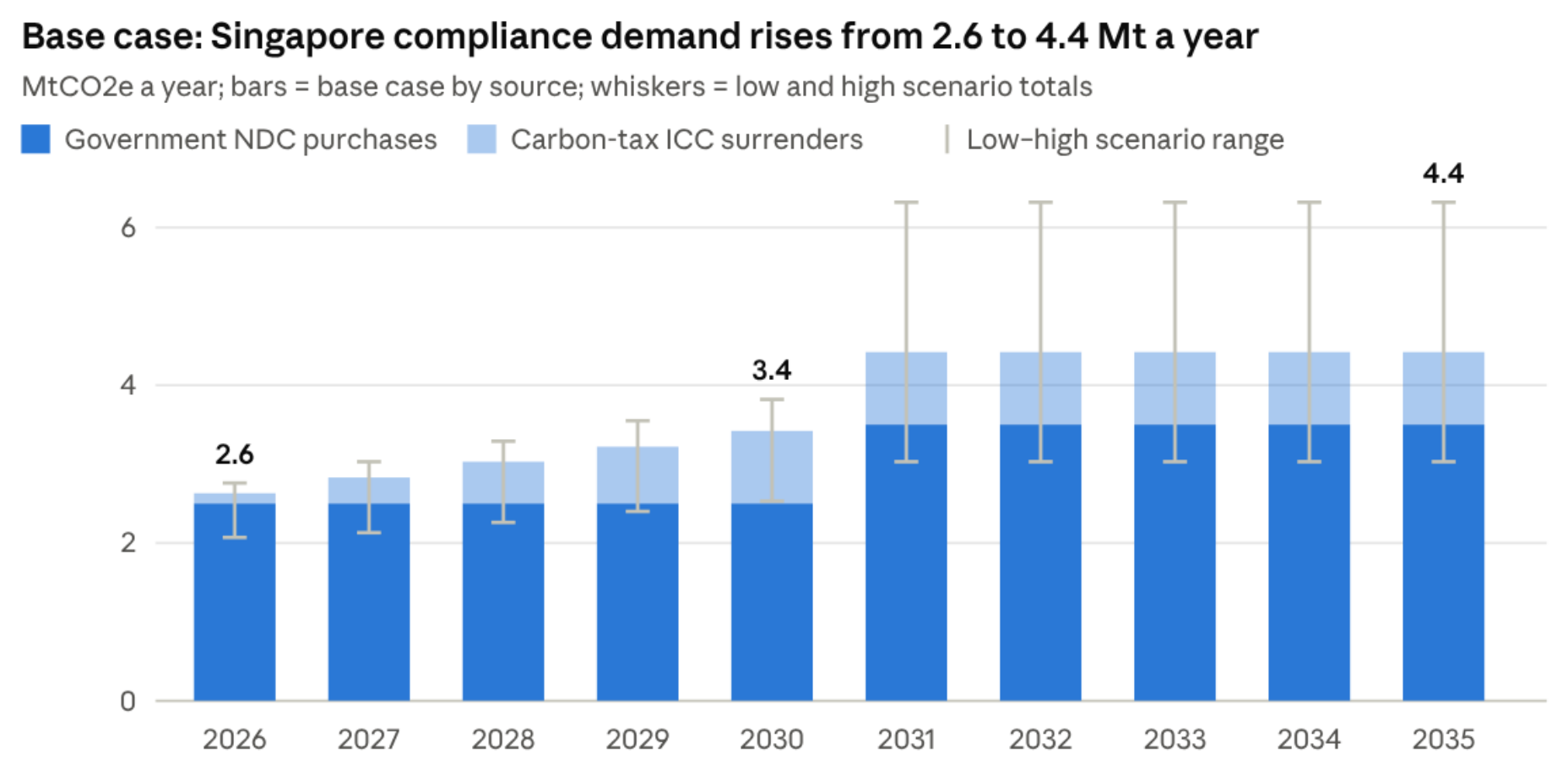
The compounding tax bill behind the demand. On about 26 Mt of taxable emissions, the annual tax bill rises from about S$1.2 billion at S$45 to S$1.3–2.1 billion by 2030, depending on the rate, before any change in allowances. The 5% allowance caps corporate credit demand at about 1.3 Mt a year, so most growth after 2030 comes through Government procurement—the step-up in that line reflects the gap between Singapore’s 2030 level of about 60 Mt and its 2035 target of 45–50 Mt.
Demand beyond Singapore’s compliance market.
Table 10.
Demand beyond Singapore’s compliance market.
| Segment | Sizing rule | Status |
|---|---|---|
| SBTi removal requirement | About 1% of in-scope companies’ value-chain emissions from 2035; every 10 Mt of covered emissions creates about 0.1 Mt a year | Company-level list for Asia to be built |
| Japan, through the JCM | Up to 10% of GX-ETS obligations from J-Credits and JCM credits | Partner countries only; not yet Malaysia |
| Aviation (CORSIA) | 100–250 million units needed globally for Phase 1 | Later phases are the corridor opportunity |
| Scope 3 reporters and voluntary buyers | Driven by disclosure and claims, not obligations | Largest pools in China, Australia, Japan and Hong Kong (Section 2.9) |
Scenario figures are the author’s illustrative calculations and depend on the stated assumptions; they are not forecasts by any agency. Government volumes after 2030 are assumptions pending Singapore’s next NDC procurement plans.
3. Why Eligible Nature-Based Supply Is Missing
Eligible supply is held back by five sequential gates. A project must pass all five before a Singapore buyer can surrender its credits, and no single party controls them all.
Table 11.
The five gates to eligible nature-based supply.
| # | Gate | Controlled by | Status in 2026 |
|---|---|---|---|
| 1 | Host country signs an Implementation Agreement with Singapore | Both governments | In force with Bhutan, Chile, Ghana, Mongolia, Peru, Rwanda and Thailand; also signed with Paraguay, Papua New Guinea, Vietnam (approved by Vietnam in August 2026), the Philippines (April 2026) and Lao PDR (September 2026); Malaysia, Indonesia and Cambodia at MOU stage (Government of Singapore, n.d.-a) |
| 2 | Methodology appears on that country’s eligibility list | Both governments | Lists published for Ghana, Bhutan, Peru, Rwanda and Thailand; a Lao PDR list of 58 methodologies was reported in October 2026 (CarbonCredits.com, 2026c; Government of Singapore, n.d.-b); Thailand’s includes VM0033 tidal wetland and seagrass restoration (Government of Singapore, 2025) |
| 3 | Host country authorises credits for corresponding adjustment | Host government | Processes still being set up in most countries |
| 4 | Project is licensed, validated and verified | Sub-national regulator, standard, verifier | Typically two to four years for restoration projects (author’s estimate) |
| 5 | Credits issued from 2021–2030 vintages | Registry | The 2030 vintage limit compresses the window for new projects |
3.1. Sarawak: Supply Without a Pathway Yet
Sarawak has mangrove assets, its own forest carbon law and active projects. The Sarawak Timber Industry Development Corporation and a private partner signed in November 2024 to restore and conserve 10,000 ha of mangroves at Tanjung Manis (Bernama, 2024). A carbon stock assessment of the Rajang mangroves has been submitted, with the state seeking investors once licensed (DayakDaily, n.d.). By October 2026, three forest carbon licences covering 56,806 ha had been issued, none reported as mangrove (The Star, 2026b).
What is missing is the route to Singapore: Malaysia remains at the MOU stage. Malaysia’s National Carbon Market Policy, launched in April 2026, sets out Article 6 authorisation pathways. Sabah and Sarawak keep their own carbon ordinances and registries, with federal harmonisation through a special committee agreed with Sarawak (The Edge, 2026). In September 2026 the federal ministry said it would manage carbon exports through eligibility whitelists and dynamic sales limits to protect Malaysia’s own NDC (Bernama, 2026). Meanwhile, Japanese interest is moving through a different route. Sumitomo has proposed a phased entry in Sarawak, from CSR programmes to voluntary credits and, in future, credits under Japan’s Joint Crediting Mechanism (Borneo Post, 2026). Malaysia is not yet among the mechanism’s 32 partner countries (Offset8 Capital, n.d.).
3.2. The Philippines: A Pathway Without Supply Yet
The Philippines signed an Implementation Agreement with Singapore on 30 April 2026, under which Singapore tax-liable companies may use authorised credits for up to 5% of taxable emissions (Rajah & Tann, 2026). Authorisation processes and an eligibility list are still to come. In October 2026 an executive order directed the Department of Environment and Natural Resources to develop the national rules for domestic and international carbon markets, possibly by early 2027 (Eco-Business, 2026); the department is already the designated authority for the Paris Agreement Crediting Mechanism (UNEP CCC, n.d.). The legal route exists; the bankable projects do not yet.
3.3. Rights and Legitimacy
Nature-based supply also depends on social licence. In Sarawak, forest carbon projects have faced pushback over native customary rights (NCR), community understanding and uneven benefits; the state takes a minimum 5% of carbon revenue (Eco-Business, n.d.-b). Credits from contested land carry reputational risk that compliance buyers will not accept. Free, prior and informed consent and a transparent benefit-sharing formula are therefore preconditions for supply, not add-ons.
3.4. Why This Matters for Finance
Each gate is a source of delay, and delay is what makes forward contracts hard to price. A buyer asked to commit today to credits that may pass all five gates in three years faces two unknowns: whether they will be eligible, and what they will be worth. The next two sections address both.
4. Solving the Price-Range Problem: A Tax-Anchored Price Band
The price-range problem disappears if buyers and sellers agree a band rather than a price. Singapore’s carbon tax supplies the ceiling that voluntary markets lack.
4.1. Why Voluntary Prices Cannot Anchor a Contract
Voluntary nature-based credits trade across a wide range, depending on project type, vintage and quality labels. Blue carbon has cleared at a premium in Singapore-based auctions, for example about US$28/t for Pakistan’s Delta Blue mangrove project in 2022 (Quantum, 2022). Forward contracts are typically priced 15–30% below expected spot (Regreener, 2026). CORSIA units traded at about US$9–16/t in mid-2026 despite a large projected shortage, a sign that buyers are waiting on authorisations and national enforcement rather than pricing the gap (Section 2.6). None of these gives a ten-year contract a defensible reference, so negotiations stall on the number.
4.2. The Three Edges of the Band
- Ceiling. For a tax-liable buyer, an eligible credit is worth no more than the tax it avoids. The ceiling is the prevailing tax rate less a discount that makes switching worthwhile. It rises automatically as the tax rises.
- Floor. The floor is the project’s delivery cost plus a fair return, including Sarawak’s minimum 5% state share or its equivalent elsewhere. It is guaranteed by first-loss capital, which is what makes the offtake bankable. Precedent: the LEAF Coalition effectively set a US$10 floor for jurisdictional REDD+ (EDF, n.d.).
- Settlement. Each delivery settles at a reference index plus an agreed quality premium, held between floor and ceiling. The index can be eligible-ICC price assessments or the clearing price of an annual portfolio auction.
Figure 4.
The tax-anchored price band (illustrative; no market data).
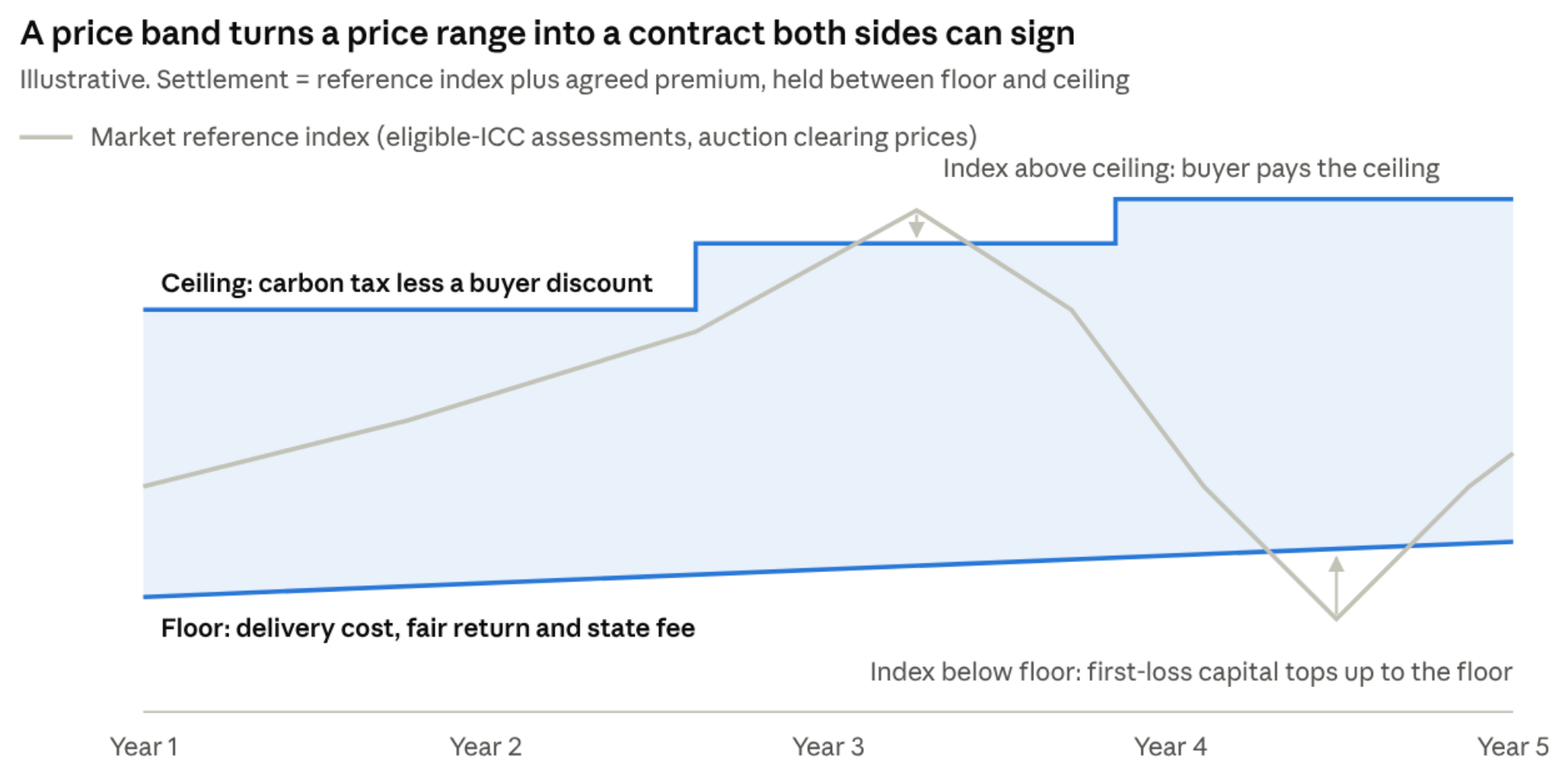
When the market index rises above the ceiling, the buyer pays only the ceiling. When it falls below the floor, the first-loss tranche tops the payment up to the floor. Between the two, buyer and seller share market movements.
The band as a formula.
Ceiling = carbon tax × (1—switching discount)
Floor = delivery cost + fair return (+ host-state share)
Settlement price = the lower of the Ceiling and the higher of
(Floor) and (Index + quality premium)
Illustration only: with a tax of S$45 and a 10% switching discount, the ceiling is S$40.50. If the floor is S$25 and the index is S$30 with a S$5 premium, the delivery settles at S$35. If the index falls to S$18, the price would be S$23, so first-loss capital pays the S$2 gap up to the S$25 floor. If the index rises to S$40, the buyer pays the S$40.50 ceiling at most.
4.3. Resetting the Band by Auction
A fixed band would drift away from the market. The model therefore holds back 20–30% of each year’s issuance for a portfolio auction. Singapore-based platforms have run such auctions before: Climate Impact X sold a curated portfolio of 170,000 nature-based credits from eight projects at US$8/t to 19 buyers in 2021 (DBS, 2021). The clearing price resets next year’s settlement index, keeping the band honest.
4.4. A Forward Curve, in Time
A futures market would give the band a public forward curve. Abaxx Exchange, licensed by MAS as a Recognised Market Operator and Approved Clearing House, already lists physically settled CORSIA and jurisdictional REDD+ futures (MarketsWiki, n.d.), with Climate Impact X approved as a delivery custodian (Abaxx, 2026). A contract on Singapore-eligible nature-based credits does not yet exist. It becomes realistic once corridors deliver eligible volume.
4.5. Competition-Law Design
Buyers agreeing a common price could raise competition-law concerns. The band avoids this by having prices set through an independent RFP and auction, not agreed among buyers, with competition advice taken before the RFP is issued.
5. The Compliance Step-Up Offtake
The Compliance Step-Up Offtake lets a buyer contract today for credits whose eligibility is still pending, without paying a compliance price for a credit that may never qualify. It converts policy uncertainty from a reason to wait into a priced option.
Figure 5.
The Compliance Step-Up Offtake: contract flow.
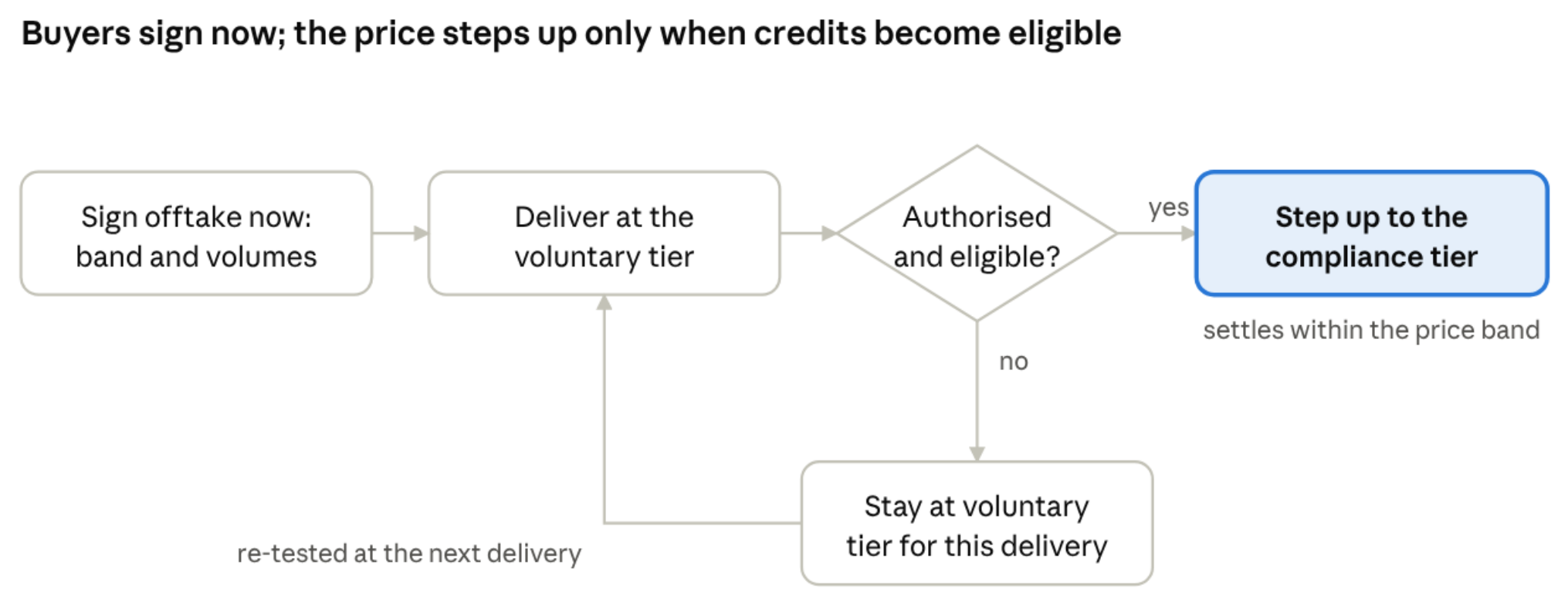
Each delivery is tested against the eligibility conditions in Section 3, or the scheme-specific triggers in the term sheet below. If they are met, that delivery settles at the compliance tier within the price band. If not, it settles at the voluntary tier and the buyer keeps the credits for voluntary claims. The test repeats at every delivery, so the contract steps up as soon as policy catches up.
5.1. Why Both Sides Sign
- • Buyer: secures supply ahead of competitors, pays a voluntary price until credits qualify, and has a ceiling linked to the tax it would otherwise pay.
- • Project: gains a signed multi-year offtake with a floor, which is what lenders and investors need to fund restoration upfront.
- • Policy-makers: see committed demand for credits from prospective partner countries, which can help prioritise Implementation Agreements and eligibility lists.
5.2. Indicative Term Sheet
Table 12.
Indicative term sheet for the Compliance Step-Up Offtake.
| Term | Indicative design |
|---|---|
| Volume | Annual tonnes over 5–10 years, with a tolerance band for issuance variance |
| Voluntary tier | Reference index plus quality premium, not below the floor |
| Compliance tier | Reference index plus premium, capped at the tax-linked ceiling; or, at the buyer’s option, a fixed forward price, which hedges against a rising tax (Section 2.7) |
| Step-up trigger | Implementation Agreement in force, methodology on the eligibility list, authorisation for corresponding adjustment, and vintage within 2021–2030; for aviation buyers, CORSIA eligibility with a letter of authorisation; for corporate buyers, recognition as a removal under SBTi V2.0 |
| Testing | At each delivery; no retrospective repricing |
| Long-stop date | If the trigger is not met by an agreed date, the buyer may reduce volumes or exit, with notice |
| Payment | Into escrow; released on delivery, including the community benefit share |
| Quality | ICVCM Core Carbon Principles label or equivalent; conservative baselines; buffer pool for reversals |
| Community terms | Free, prior and informed consent as a condition precedent; published benefit-sharing formula |
| Assignment | Buyer may assign or on-sell credits it cannot use, subject to know-your-customer checks |
5.3. A Buyer’s Option, Priced
In economic terms, the buyer holds an option on eligibility. The voluntary tier is the premium; the step-up is the exercise. Pricing the gap between tiers, and agreeing who bears the policy risk, is the single most important negotiation in the contract and a key question for validation (Section 12).
6. The Corridor Architecture
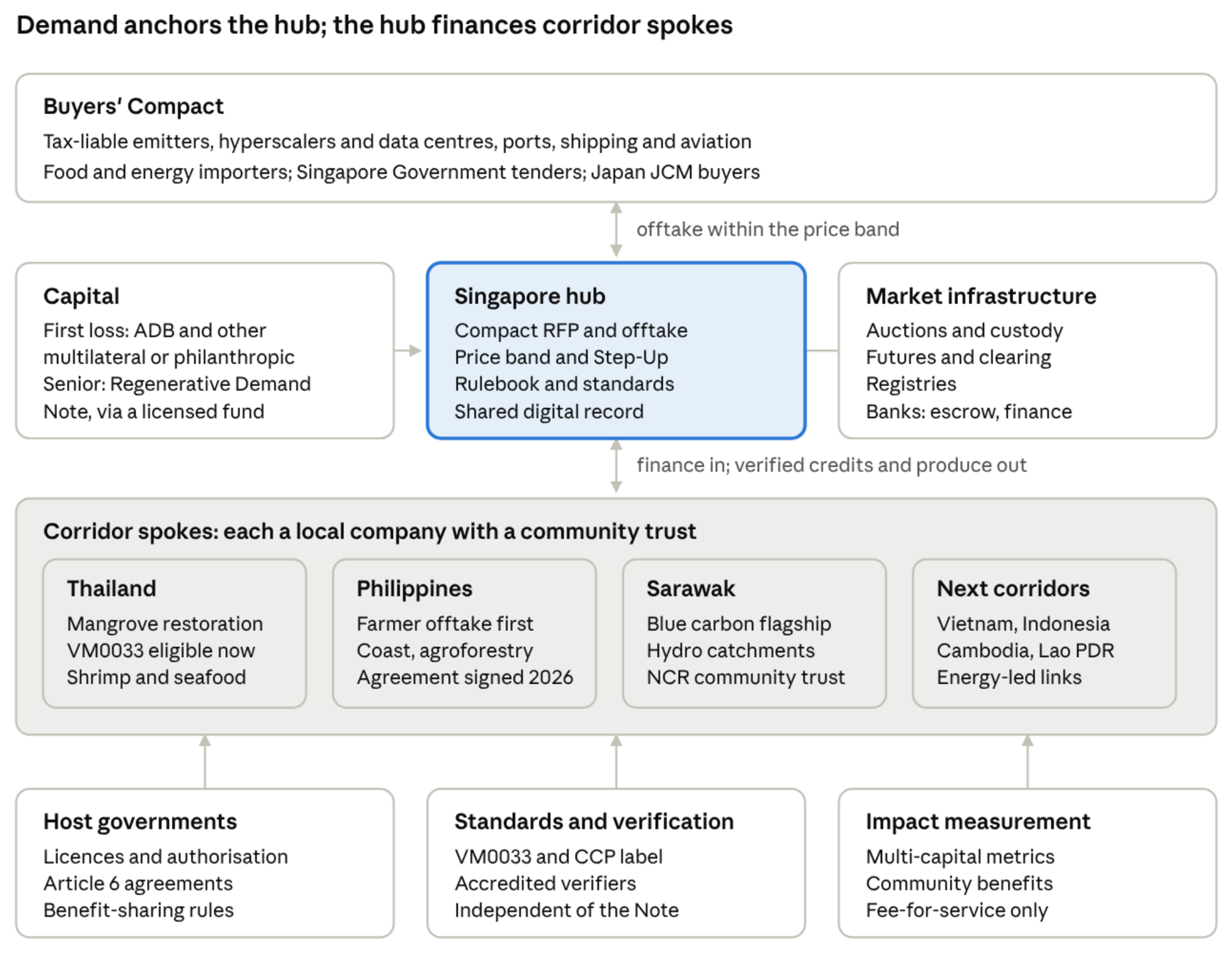
A Singapore hub aggregates demand and capital; corridor spokes in host countries hold land relationships, licences and delivery. Each layer is held by a different party, so no single actor controls both the price and the proof.
The paper calls each corridor site a regenerative node: a place where a community, a nature-based carbon asset and one of Singapore’s import needs—energy, food or water—converge under one set of contracts. The hub links the nodes to buyers and capital; the nodes deliver.
Figure 6.
Corridor architecture: hub, regenerative nodes and enablers.
6.1. Four Building Blocks
- Buyers’ Compact. A club of 5–8 anchor buyers runs one competitive RFP, modelled on Frontier (2022) and the Symbiosis Coalition (n.d.; see Section 1.1), whose members have pledged to contract up to 20 million tonnes of nature-based removals by 2030. Each buyer signs its own Compliance Step-Up Offtake within the agreed price band.
- Regenerative Demand Note. Signed offtake is the cash flow behind a note that funds restoration upfront and is repaid from deliveries (Ooi, 2026b). It is offered only to accredited and institutional investors through a licensed fund manager.
- First-loss tranche. Multilateral or philanthropic capital, with ADB as the natural lead for an ASEAN Article 6 corridor, guarantees the price floor and absorbs early losses. It earns leverage and a replicable template, not control.
- Annual portfolio auction. 20–30% of each year’s issuance is auctioned through an established Singapore platform to reset the price index.
6.2. Governance Principles
The architecture follows the governance principles of a Founding Compact the author proposes for regenerative corridors (a working name), drawn from Ooi (2026a):
- • One seat, one layer. No party occupies two adjacent layers, such as both rule-setting and verification.
- • Verification independence. Measurement and verification parties hold no equity in, and no revenue linked to, the Note.
- • Community counterparty standing. The community trust is a contract counterparty, not a beneficiary, and its consent is a condition precedent to offtake and finance.
- • Mutual ownership. Ownership of the hub platform is for its founding members to decide; the principle is that it should be mutually held, so that a stewardship platform does not reproduce extractive ownership one layer up.
6.3. The Shared Record, and Tokenisation Later
The hub keeps one permissioned record of offtakes, deliveries, community benefit payments and retirements. Once the instruments and their regulation are settled, units of the Note or the credits can move to a tokenised register under MAS-aligned frameworks such as Project Guardian. Tokenisation is a distribution efficiency, not a substitute for licensing. The same record, combined with AI-assisted satellite monitoring under human oversight, can serve supply-chain traceability and nature disclosure for palm oil, rubber, timber and food buyers. That revenue arrives before the first credit.
6.4. An Impact Ledger Linked to Exchanges
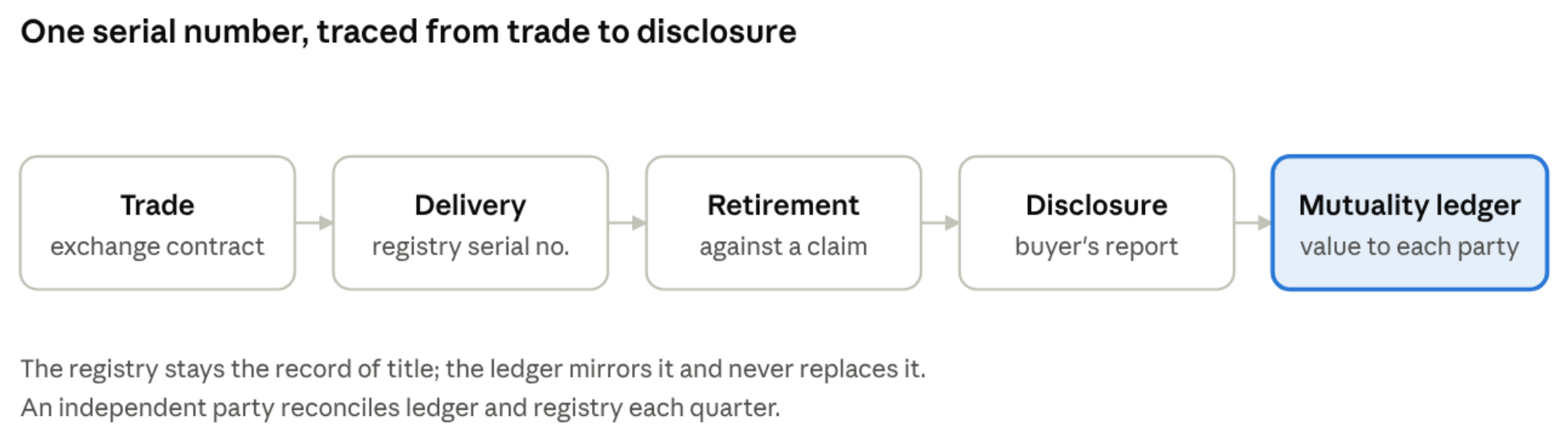
The disclosure rules in Section 2.9 leave every listed buyer with the same recurring question: which credits were bought, delivered and retired, against which emissions, and under which rules. The hub’s record can answer it if each retirement carries the registry serial number, the buyer’s claim type (a carbon-tax offset, a Scope 3 contribution or a voluntary claim), the corresponding-adjustment status and the corridor’s co-benefit data. Impact-reporting platforms that listed companies already use could take this feed, so a buyer’s sustainability report shows retired units next to the emissions they relate to, not as an unlinked offset figure. Where credits trade on an exchange such as Abaxx, the serial numbers delivered under each contract can be written to the same record, so trade, delivery, retirement and disclosure form one traceable chain.
Four safeguards keep the ledger credible:
- The registry stays the record of title. The ledger mirrors registry data and never replaces it, so no unit can be counted twice.
- Independent reconciliation. Retirement data comes from registries and verifiers, not from the hub’s own statements, and an independent party reconciles the two each quarter.
- Open, non-exclusive reporting. Any reporting platform is chosen on open terms, and buyers can export their data to the auditor of their choice.
- Accurate claim labels. Labels follow ISSB requirements and Singapore’s ICC rules, keeping compliance offsets separate from voluntary contributions.
Figure 7.
How one credit is traced through the ledger.
6.5. Insurance and a Carbon Delivery Annuity
Insurers already sell the building blocks. Specialists such as Kita, CFC, Oka and Howden offer cover for non-delivery, for political risks including Article 6 authorisation and corresponding adjustments, and for fraud and negligence, in some cases with large insurers such as Tokio Marine as partners (Howden Group, n.d.; Quantum, n.d.; Reinsurance News, n.d.). Insurers can therefore join the model in two ways:
- As investors. Their long-dated balance sheets suit the Regenerative Demand Note’s contracted, floor-protected cash flows once the Note carries a rating or a guarantee.
- As issuers of a carbon delivery annuity. A buyer—a carbon-tax payer, or an airline facing later CORSIA phases—pays a premium, upfront or yearly. In return, the insurer guarantees delivery of a fixed number of eligible credits each year for 10–15 years, or a cash payment at a reference price if credits fail. The insurer sources from Compliance Step-Up Offtakes across several corridors and hedges price risk with exchange-traded carbon futures, such as the physically delivered contracts Abaxx already lists (Abaxx, 2025; Quantum, 2025).
Figure 8.
A carbon delivery annuity: illustrative structure, feasible from about 2029.
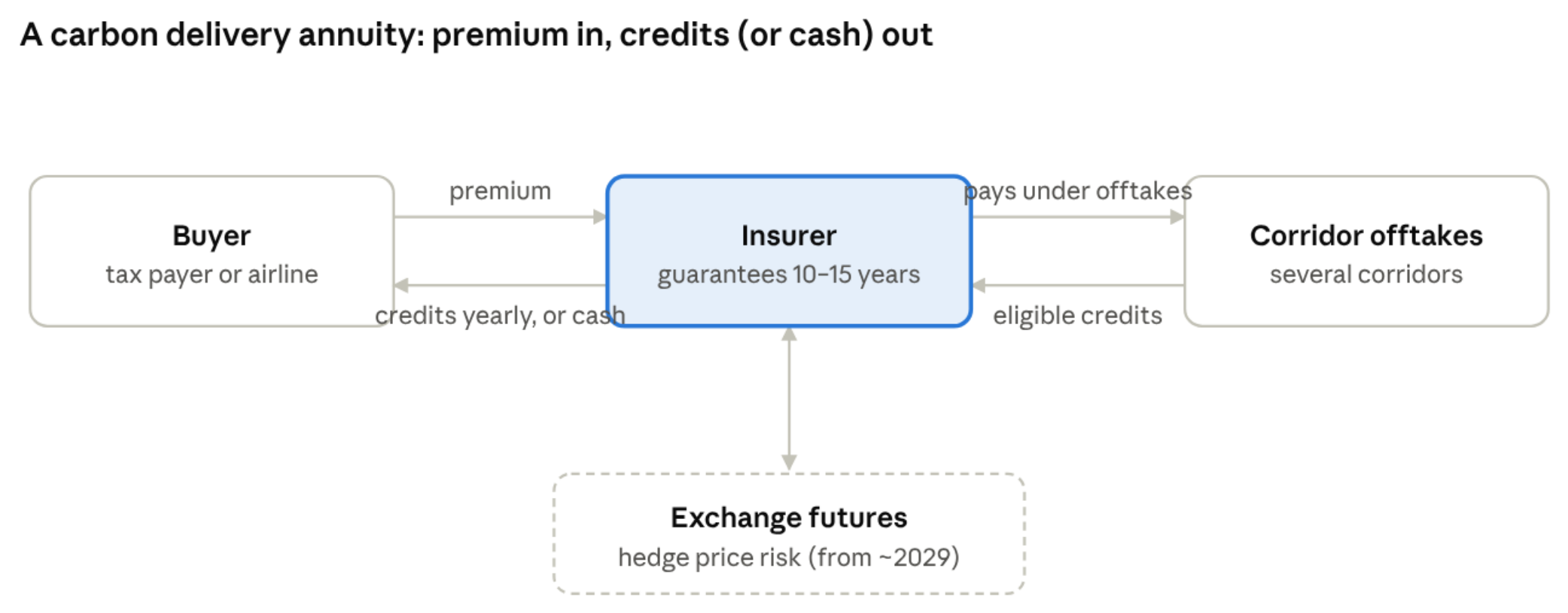
Is it feasible? Not yet as a full product. Three preconditions come first: a liquid reference contract for Article 6-eligible nature credits to hedge against; several years of corridor delivery data to price volume risk; and clarity on whether Singapore treats the annuity as insurance, a derivative or a capital-markets product. A realistic sequence is delivery insurance on the first corridor offtakes (2027), insurers investing in the Note (2028), and a pilot annuity with one insurer and one anchor buyer once a reference contract exists (2029 onwards). Hypothesis H21 tests insurers’ appetite.
7. Mapping to the Four Value Pools
The corridor model creates work, and value, in all four pools that Singapore’s sustainability practitioners are organising around. Each pool has a different lead profession and a different first deliverable.
Table 13.
The corridor model across four value pools.
| Value pool | What the model needs | Who leads | First deliverable |
|---|---|---|---|
| Sustainable finance | Regenerative Demand Note; first-loss tranche; pre-purchase finance against offtake; escrow; transition-linked lending to buyers | Banks, fund managers, multilateral lenders | Term sheet for the Note with a first-loss tranche |
| Infrastructure and projects | Restoration and silvofishery projects; community trusts; monitoring and verification; links to energy, food and water imports | Project developers, engineers, scientists, communities | Site verification and a carbon stock assessment for the first corridor |
| Carbon markets | Price band; Compliance Step-Up Offtake; portfolio auction; futures and clearing over time; CORSIA and SBTi removal demand | Buyers, traders, exchanges, registries | Buyers’ Compact RFP |
| Sustainability reporting and compliance | ICC eligibility; corresponding adjustments; ISSB and TNFD disclosure of nature-related claims; CBAM and deforestation-rule traceability; securities and competition law; land and consent law | Lawyers, auditors, regulators, reporting specialists | Legal opinions on the Note, the Compact and land tenure |
7.1. Where the Pools Depend on Each Other
- Finance depends on carbon markets. The Note cannot be priced without a signed offtake and a band.
- Carbon markets depend on compliance. The step-up exists only because eligibility rules are public and testable.
- Compliance depends on projects. Authorisation and verification require licensed, well-run projects with community consent.
- Projects depend on finance. Restoration needs upfront capital that only signed demand unlocks.
The loop explains why no single profession can close the deployment gap alone, and why forums that bring the four pools together matter.
8. Regional Corridors: Energy, Food and Water
The strongest corridors pair a nature-based carbon asset with something Singapore already imports: power, food or water. Pairing gives each corridor two revenue lines, deeper political support on both sides, and buyers who already have a commercial relationship with the host country.
8.1. What Singapore Needs from the Region
- Energy. Singapore aims to import 6 GW of low-carbon electricity by 2035 (TaiyangNews, 2024). The Energy Market Authority has granted conditional licences or approvals for projects in Indonesia, Vietnam, Cambodia, Australia and Sarawak, and a Lao hydropower trial runs through Thailand and Malaysia (EMA, 2023; Water Power, n.d.).
- Food. Singapore imports seafood from about 90 countries and keeps diversifying sources (MSE, n.d.-b). Mangroves are nurseries for the fish, crab and shrimp in that supply chain.
- Water. Under the 1962 Water Agreement, Singapore may draw up to 250 million gallons a day from the Johor River until 2061 (MFA, n.d.). Catchment and coastal ecosystems protect that supply.
8.2. Corridor Map
Table 14.
Corridor map.
| Corridor | Singapore need it serves | Nature and carbon asset | Route into Singapore compliance | Role in the portfolio |
|---|---|---|---|---|
| Thailand | Food: shrimp, rice, seafood | Mangrove restoration | Implementation Agreement in force; VM0033 already on the eligibility list | Fastest compliance-ready blue carbon corridor; proof of the model |
| Philippines | Food: farmer supply chains | Mangroves, agroforestry, farm practice | Implementation Agreement signed April 2026; eligibility list pending | Small starter: farmer offtake first, credits later |
| Vietnam | Energy: 1.2 GW offshore wind import approval; food: Mekong shrimp and rice | Mangrove–shrimp silvofishery (proven at scale in Ca Mau); rice methane | Implementation Agreement signed September 2025; approved by Vietnam August 2026 | Food-and-energy corridor |
| Malaysia: Sarawak | Energy: 1 GW hydropower import approval, targeted around 2035 | Blue carbon; forest and catchment protection | MOU only; National Carbon Market Policy sets export limits; Malaysia not yet a JCM partner | Flagship corridor; slower to compliance |
| Malaysia: Johor | Water: Johor River supply; food | Catchment and coastal protection | MOU only | Water-security co-benefits; long-term |
| Indonesia: Riau Islands | Energy: 2 GW conditional licences plus 1.4 GW conditional approvals for solar and storage | Extensive mangroves | MOU on carbon credits signed July 2026 (The Star, 2026a); working towards an Implementation Agreement | Energy-led corridor; carbon later |
| Cambodia | Energy: 1 GW import approval | Coastal and forest ecosystems | MOU | Energy-led; watch |
| Lao PDR | Energy: up to 100 MW hydropower trial | Forest and catchment protection | Implementation Agreement signed September 2026; 58-methodology eligibility list reported | Catchment stewardship for hydropower; watch |
8.3. Three Nexus Models
- Food–carbon (silvofishery). Farmers raise shrimp, crab or snails inside standing mangroves, under a rule that keeps most of the forest cover. Selva Shrimp in Ca Mau, Vietnam, reached more than 2,500 farmers on 10,000 ha by 2016, with most farms keeping at least 50% mangrove cover (Global Seafood Alliance, n.d.). Singapore seafood buyers pay for verified supply; carbon follows from the mangroves retained and restored.
- Energy–water–carbon (catchment stewardship). Hydropower depends on healthy catchments; forest loss can increase sedimentation, which shortens reservoir life and reduces output. Hydropower exporters to Singapore, in Sarawak and Lao PDR, have a direct interest in paying for catchment protection, which can also generate credits and protect water supply.
- Energy–coast (social licence). Solar and cable projects landing in coastal areas need community support. Mangrove restoration near landing sites and transmission routes can be built into a project’s community commitments and financed alongside it.
8.4. Who Else Consumes the Credits
Singapore is the anchor, but corridor credits can serve several compliance and voluntary markets. Each credit can be used only once, so corridors should plan for a mix of buyers.
Table 15.
Markets that could use corridor credits.
| Market | Scheme | Can it use corridor credits? |
|---|---|---|
| Singapore | Carbon tax (5% offset) and Government NDC purchases | Yes, from countries with Implementation Agreements |
| Japan | GX-ETS, mandatory from FY2026 for companies over 100,000 t; up to 10% of obligations from J-Credits and JCM credits; price corridor ¥1,700–4,300/t (S&P Global, 2026b) | Yes, through the Joint Crediting Mechanism: 32 partners as of July 2026, including Thailand, Vietnam, the Philippines, Indonesia, Cambodia and Lao PDR, but not Malaysia (Offset8 Capital, n.d.) |
| Host countries | Their own NDCs and emerging carbon taxes or trading schemes | Credits exported with corresponding adjustments no longer count at home, so hosts will cap authorised exports |
| Malaysia | National Carbon Market Policy (April 2026) lays the base for a carbon tax or trading scheme; the carbon tax on iron, steel and energy is under review (The Edge, 2026; Cobler, n.d.) | Domestic use likely; rules undefined |
| Australia | Safeguard Mechanism; ACCUs and SMCs only (S&P Global, 2026a) | Not today; international units to be considered in the 2026–27 review (Carbon Pulse, n.d.) |
| South Korea | K-ETS accepts some international offsets once converted; Article 6 rules pending (ICAP, n.d.) | Possibly, later |
| Voluntary buyers | Hyperscalers, shipping, aviation and consumer brands | Yes; they pay most for removals with verified co-benefits |
Three further buyer groups follow from Section 2.6:
- Airlines and aviation traders need CORSIA-eligible units with letters of authorisation; Singapore-based traders can aggregate them.
- Companies under SBTi V2.0 need removals equal to at least 1% of ongoing emissions from 2035, so forward removal contracts become part of target planning from 2027.
- Exporters facing CBAM and deforestation rules need traceable, lower-emission supply chains and verified landscape data.
8.5. Sequencing the Corridors
Thailand offers the fastest compliance-ready route for mangrove credits and is the natural first proof point. The Philippines offers a quick farmer-led start. Sarawak is the flagship but will take longer to reach Singapore compliance, so it should begin with community, catchment and food value that pays from day one. Vietnam, Indonesia, Cambodia and Lao PDR follow, led by their energy links to Singapore.
9. Implementation Pathway
The market is ready now; the compliance route for some corridors and the tokenised layer are two to four years early. The pathway lets revenue-earning work carry the model while policy matures, and spends on each phase only after the previous gate is met.
Figure 9.
Implementation pathway: four phases, three gates.
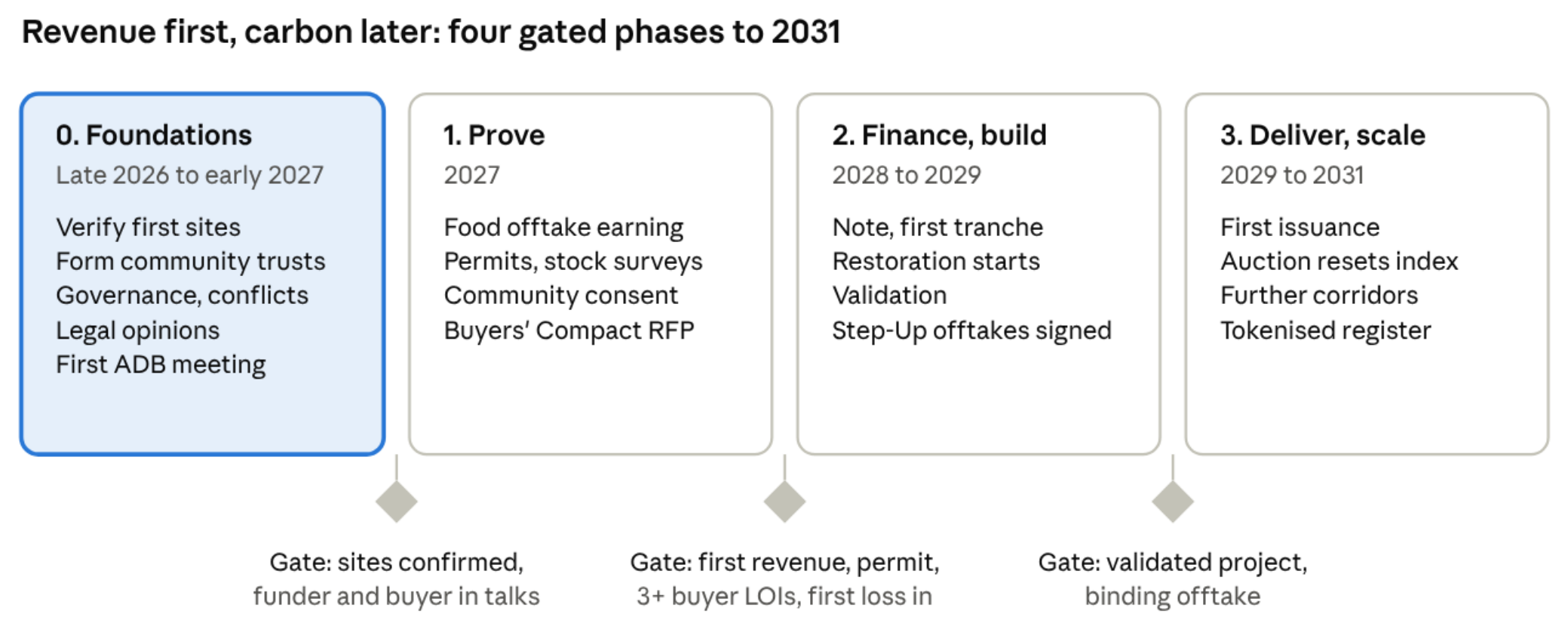
If there is neither catalytic capital nor a buyer letter of intent by the end of 2027, the vehicle pauses rather than funding the wait from its founders’ resources.
9.1. Agencies
Table 16.
Agencies and first asks.
| Jurisdiction | Agency | Role | First ask |
|---|---|---|---|
| Multilateral | ADB (lead); IFC; World Bank | First-loss capital and technical assistance for ASEAN Article 6 and nature finance | Creation-phase funding; first-loss tranche |
| Singapore | MTI / NCCS | Article 6 agreements; Government credit tenders | Pipeline of eligible partner countries and methodologies; tender pathway |
| Singapore | NEA | Carbon tax and ICC surrender | Treatment of Step-Up contracts at surrender |
| Singapore | MAS | Funds, securities and tokenisation (Project Guardian) | Informal view on the Note and fund structure |
| Singapore | EDB; Enterprise Singapore; SFA; EMA | Hub development; food security; electricity imports | Buyer introductions; links with food and energy importers |
| Host countries | Article 6 authorities, such as Malaysia’s Ministry of Natural Resources and Environmental Sustainability and the Philippines’ Department of Environment and Natural Resources; forestry and land agencies; state development corporations and banks | Authorisation, licensing, tenure, co-investment | Authorisation pathway and licence for the first sites |
9.2. Banks
Table 17.
Roles for banks by phase.
| Role | What the bank does | Phase |
|---|---|---|
| Introducer and adviser | Introduces corporate clients as anchor buyers; tests the Note’s design | 0–1 |
| Community banking | Local and rural banks handle farmer and community payments | 1–2 |
| Arranger and placement agent | Structures and places the Note with accredited and institutional investors | 2 |
| Pre-purchase finance | Lends against signed offtake, repaid from deliveries | 2 |
| Escrow and payment agent | Holds buyer payments; releases on delivery, including community shares | 2 |
| Clearing and hedging | Gives buyers access to carbon futures to hedge tax exposure | 3 |
| Custody | Holds and transfers credits for clients | 3 |
Banks lend only once three things exist: a verified site, signed offtake and a first-loss layer. Before then, their most useful role is introducing anchor buyers and stress-testing the instruments.
10. Activation Through Mutuality Agreements
The corridor activates when each actor signs an agreement under which it contributes something it holds and receives something it needs. Mutuality here has a precise meaning: every agreement states what each party gives and gets across the five capitals of the Ecosystem Economics of Mutuality (EEoM)—financial, social, human, natural and trust capital—so that no party gives without a defined return.
10.1. Engagement Principles
- Demand-anchored before supply-gathered. Capital is raised against signed demand, not announced ahead of it.
- Consent before capital. Community stewardship agreements are signed before any offtake or note.
- Non-binding first, binding at gates. A founding memorandum gathers commitment; binding agreements follow each gate in Section 9.
- One seat, one layer. Each actor holds one role; verification and measurement stay independent of the money.
- Two-way value, stated in writing. Each agreement lists contributions and returns, so trust capital is built by design rather than assumed.
10.2. Three Tiers of Agreement
Table 18.
Three tiers of agreement.
| Tier | Instrument | Parties | Binding? | Phase |
|---|---|---|---|---|
| 1 | Founding memorandum | Hub, a community trust, a host-state body, one anchor buyer, one catalytic funder | No | 0 |
| 2 | Bilateral mutuality agreements: community stewardship and benefit-sharing; Compliance Step-Up Offtake; first-loss and technical assistance; note subscription; developer and operator; verification and measurement services (fee-only); market services; government letters of support | Each pair of parties | Yes | 1–2 |
| 3 | RCCTC rulebook membership, with surplus shared by patronage; widens as further corridors join | All members | Yes | 3 |
10.3. Who Contributes What, and What Is in It for Them
Table 19.
What each actor contributes and receives.
| Actor | Role | Contributes (investment or effort) | Receives (what is in it for them) | Agreement | Engage in phase |
|---|---|---|---|---|---|
| Community trusts (NCR communities, farmer cooperatives) | Land stewards; contract counterparty | Land access through stewardship, never sale; consent; labour; local knowledge; community monitoring | A year-one stewardship payment, then a published share of revenue; food and livelihood income; recognition of tenure; skills; a vote on land and benefit decisions | Community stewardship and benefit-sharing | 0 |
| Host governments (state and federal) | Licensing, authorisation, harmonisation | Licences; authorisation for corresponding adjustment; data; policy alignment | An agreed share of reductions retained for their NDC; state revenue share; technical assistance for registries and monitoring; investment and jobs; food, energy and water security | Letter of support; MOU; licence | 0–1 |
| Singapore agencies | Policy anchor, tender buyer, regulator | Eligibility pathways; procurement; regulatory clarity; hub support | Eligible supply for the NDC and the carbon tax; strengthened hub status; import security | Policy engagement; tender participation | 0–1 |
| ADB and other multilaterals | Catalytic first-loss and technical assistance | First-loss tranche; grants for site verification, consent processes and the rulebook | A replicable Article 6 template; development outcomes; private capital mobilised per dollar | First-loss and technical assistance | 0–1 |
| Tax-liable anchor buyers | Compliance demand | Forward offtake within the band; optional prepayment | Secured eligible supply; a tax-linked ceiling; co-benefits for disclosure | Compliance Step-Up Offtake | 1 |
| Data centres and hyperscalers | Voluntary removal buyers | Premium offtake for removals and co-benefits | High-integrity removals in the region; nature disclosures; reputation | Offtake at the voluntary tier | 1 |
| Food, energy and water importers | Nexus buyers | Supply offtake; co-benefit payments; community investment around their projects | Supply security; verified sustainable sourcing; social licence for their projects | Supply and co-benefit agreement | 1 |
| Banks | Arranger, lender, escrow agent | Structuring; pre-purchase finance; escrow; client introductions | Fees; a new asset class; a transition-finance pipeline; solutions for clients | Mandate; facility; escrow | 1–2 |
| Senior investors (family offices, institutions) | Note subscribers | Upfront capital for restoration | Contracted, floor-protected returns with delivery risk covered by buffers, insurance and cross-corridor substitution; multi-capital impact reporting | Note subscription through a licensed fund | 2 |
| Project developers and operators | Delivery | Project design; restoration; aquaculture operations; monitoring | Development fees; operating margins; long-term contracts | Developer and operator | 1 |
| Science, standards and verifiers | Integrity | Methodology; validation; verification | Fees; research data; independence preserved | Service agreement, fee-only | 1–2 |
| Impact measurement | Multi-capital reporting | Measurement of social, human, natural and trust outcomes | Fee-for-service; no equity or note-linked economics | Measurement services | 1–3 |
| Market infrastructure | Price discovery, custody, clearing | Auctions; custody; futures design | Volume; new contracts; fees | Market services | 2–3 |
| Legal and professional advisers | Structuring and compliance | Opinions; drafting; independent counsel to community trusts | Fees; precedent-setting mandates | Engagement letters | 0–2 |
| The hub (operator to be agreed by founding members) | Convenor, operator and council secretariat | RFP; the shared record; secretariat support for the RCCTC’s rulebook and standards | Disclosed, capped membership and structuring fees; the mission | Rulebook | 0–3 |
10.4. Milestones to 2031
Figure 10.
Activation timeline: proposed milestones (external dates are targets, not commitments).
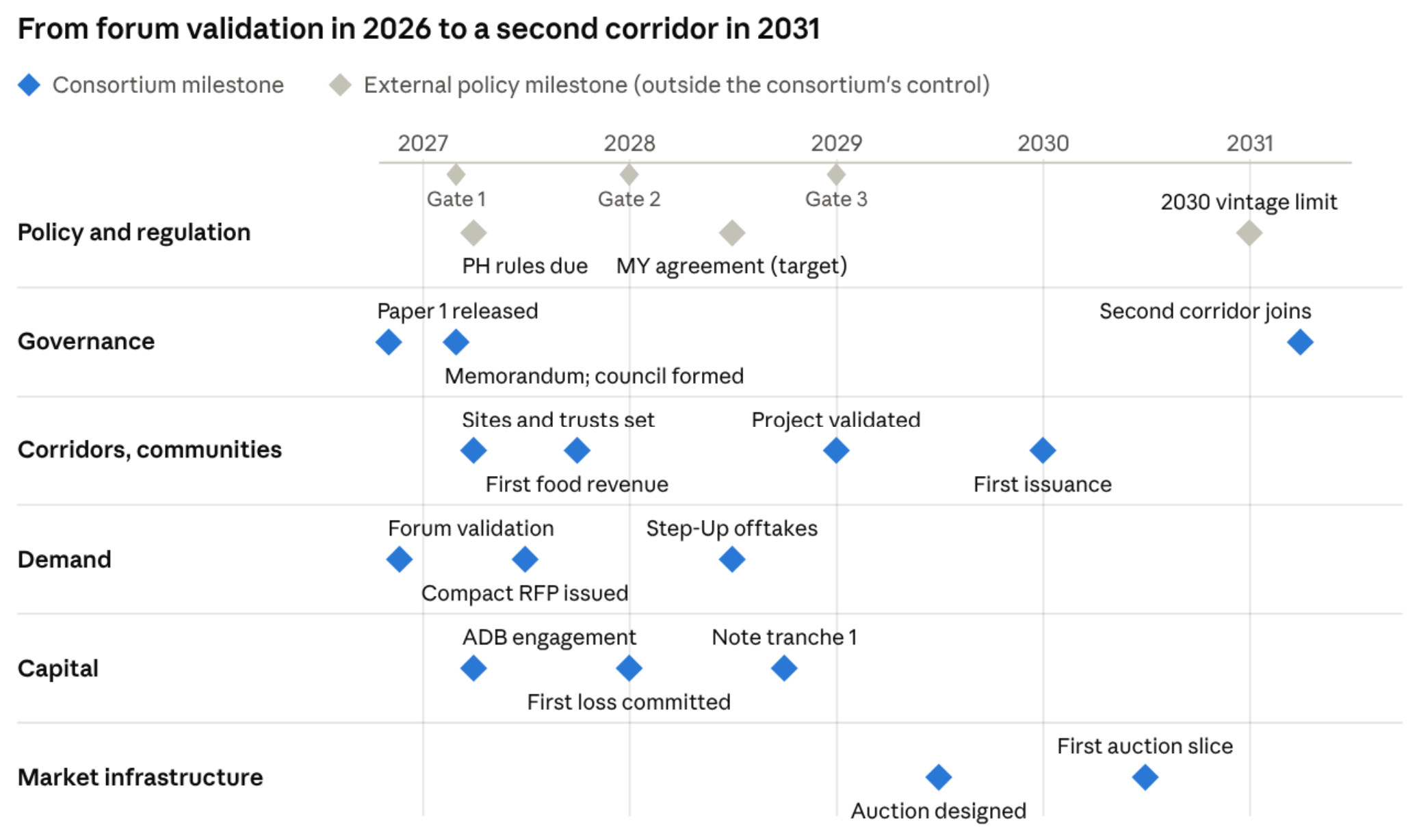
Consortium milestones are proposals; external milestones are targets that depend on governments. The three gates on the axis are those in Section 9: each must be met before the next phase’s spending begins.
10.5. Order of Engagement
- Community trusts and the host state, together, because consent and licensing gate everything else.
- Singapore policy agencies and ADB, to confirm the eligibility pathway and fund the creation phase.
- Anchor buyers, validated at practitioner forums and then invited to the Compact RFP.
- Banks and senior investors, once buyer letters of intent and first-loss commitments exist.
- Market infrastructure, to design the auction slice and, later, a reference contract.
- A second corridor, which joins the RCCTC under the same rulebook.
10.6. Stress-Testing the Value Exchange
Read from each actor’s side, the exchange is sound for most participants. Four gaps—delivery risk, host-country cost, community timing and sponsor credibility—need closing before the founding memorandum is signed.
Table 20.
Stress test of the value exchange, by actor.
| Actor | Verdict | Likely objection | Design response |
|---|---|---|---|
| Community trusts | Needs strengthening | Consent and land access are given years before credit revenue arrives | A year-one stewardship payment, independent of issuance; capacity funding; a stated right to withdraw consent |
| Host governments | Weakest link | Every tonne authorised for export is lost to the host’s own NDC; Malaysia already caps exports | An agreed share retained for the host NDC; technical assistance for registries and monitoring; investment and jobs, not only revenue |
| Singapore agencies | Sound | The model must not imply eligibility before it is granted | Ask for clarity and engagement, not endorsement |
| ADB and multilaterals | Sound for technical assistance; early for first-loss | A pre-revenue vehicle without a track record | Technical assistance first; first-loss at Gate 2, alongside an experienced fund manager or developer |
| Tax-liable buyers | Mostly sound | Why commit now rather than buy later on the spot market? | Show the value of locking in supply: three-year forwards already near S$43.50, scarce eligible supply, a prepayment discount, volume flexibility and a long-stop exit |
| Data centres and hyperscalers | Plausible, competitive | Nature-based removals carry reversal risk | Design to Symbiosis-grade criteria and buffers; lead with verified co-benefits |
| Food, energy and water importers | Unproven | Co-benefit payments are discretionary | Treat as upside, not core revenue (H12) |
| Airlines | Sound for later phases | Will credits be CORSIA-eligible with letters of authorisation? | Design projects to qualify for later CORSIA phases from the start |
| Banks | Sound at scale | Small tickets and high compliance costs | Pool corridors into one larger transaction; use banks first for buyer introductions |
| Senior investors | Gap: delivery risk | The floor covers price, not credits that never arrive | A delivery-risk stack (below); stated target return, tenor and exit route |
| Developers and operators | Sound | The ceiling caps upside | Upfront finance and a guaranteed floor are worth more than spot upside |
| Research institutions and verifiers | Sound | What beyond fees? | Data-sharing agreements and publication rights |
| Exchanges and market infrastructure | Sound as partnership | Too little early volume for a liquid contract | Start with auctions and research; commit Compact volume to a reference contract later |
| The hub | Must be stated | How the hub funds itself, and whether it sits on both sides | A disclosed, capped transaction and structuring fee; the conflicts policy in Section 6.2 |
Four design responses.
- A delivery-risk stack. Contract forward less than expected issuance; hold a standard-compliant buffer pool; insure against natural catastrophe where cover exists; diversify across corridors; and give the hub step-in rights to substitute credits from another corridor. The price floor covers price risk; this stack covers volume risk.
- A host-country share. Each letter of support agrees the split between credits authorised for export and reductions retained for the host’s NDC, alongside technical assistance for registries and monitoring.
- A year-one community floor. Community trusts receive a fixed stewardship payment from creation-phase funding from the first year, before any credit is issued, then a published share of revenue.
- A credible sponsor bench. An experienced fund manager or project developer joins the hub’s partners before first-loss capital is sought, and the ask to ADB is staged: technical assistance now, first-loss at Gate 2.
These responses close the gaps without changing the thesis: demand is still contracted first, communities are still counterparties, and each layer still has one holder.
10.7. An Invitation: How Actors Can Work on This Problem Together
This paper is an invitation as well as an argument. Writing as a researcher, as founder of Mangrove Mutuals and as a regenerative steward, I offer each actor a staged way in, so that commitment grows with evidence rather than ahead of it.
Table 21.
A staged way in: from validation to contract.
| Step | What the actor does | Form | Timing |
|---|---|---|---|
| 1. Validate | Tests the hypotheses in Section 12 in a structured conversation and shares constraints and data | Conversation; no commitment | From 20 November 2026 |
| 2. Signal | States interest in a role—buyer, funder, host, community, insurer or service provider—and the conditions attached | Letter of interest | December 2026—January 2027 |
| 3. Co-design | Joins an RCCTC working group: price band and offtake; Note and first loss; community trust and consent; or ledger and disclosure | Terms of reference; confidentiality agreement | First quarter of 2027 |
| 4. Commit | Signs the multi-party founding memorandum for the first corridor and becomes a founding member of the RCCTC | Non-binding memorandum | Early 2027 (target) |
| 5. Contract | Signs the bilateral mutuality agreement for its role as each gate in Section 9 clears | Binding agreements | 2027–2030 |
One memorandum, not many MOUs. Separate bilateral MOUs record interest but not interdependence. A single multi-party memorandum links each commitment to the others: a buyer’s letter of intent unlocks first-loss capital, first-loss capital strengthens the host’s case for authorisation, and authorisation makes the offtake eligible. The memorandum establishes that alliance as a council of the parties—working name the Regenerative Corridors and Carbon Trade Council (RCCTC): a voluntary, non-exclusive council of the signatories, not a joint venture or a fund.
Figure 11.
Interlocking commitments under one founding memorandum.
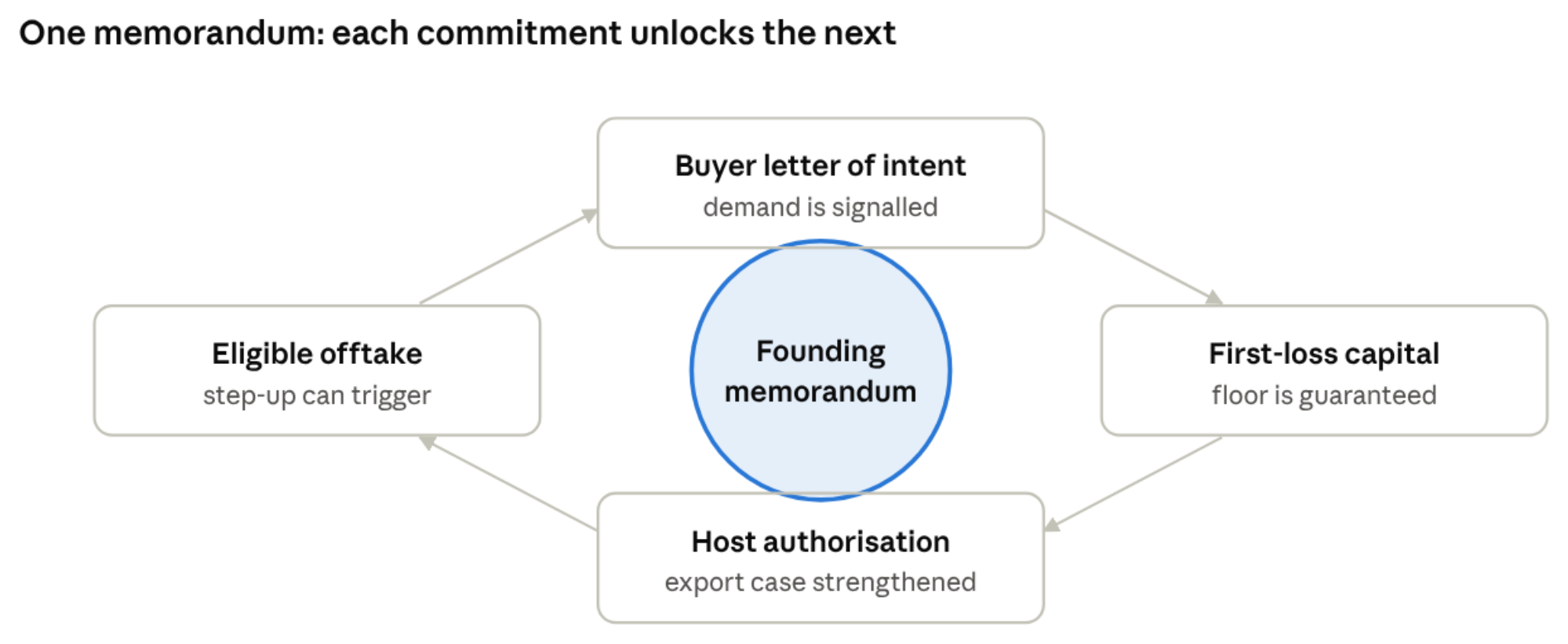
The council’s remit. The RCCTC sets and stewards the corridors’ shared rules: the mutuality charter, the formula and auction method behind the price band, community representation, integrity and claims standards, and the yearly mutuality ledger. Its members include community trusts, host-state bodies, buyers, funders, insurers and service providers, with guaranteed seats for community trusts. It does not trade credits, agree prices among members or make investment decisions: trading takes place on registries and exchanges, and investment decisions sit with the Regenerative Demand Note and its funders. Who hosts the council’s secretariat and who operates the hub are for the founding members to decide. Mangrove Mutuals would take on either role only if funded to do so, and would declare any commercial interest.
Demonstrating mutuality in practice. Five features make mutuality visible rather than asserted:
- Reciprocity in writing. Every agreement states what each party gives and gets across the five capitals.
- Interlocking conditions. Commitments trigger one another, so no party carries the first move alone.
- The community at the table. The community trust signs the founding memorandum as a party, not as a beneficiary.
- A mutuality ledger. The shared record (Section 6.3 and Section 6.4) reports each year the value delivered to each party—payments to communities, credits to buyers, returns to funders and retained reductions for hosts—so mutuality is measured, not claimed.
- Fair review and exit. The RCCTC reviews the balance of value every year, and any party can leave at a gate on agreed terms.
Guardrails. Participation is non-binding until step 5. Nothing in the process is an offer of securities (Section 11). Buyers do not agree prices among themselves outside the competition safeguards in Section 4.5. At the ESG conference on 20 November 2026 my role is limited to listening; follow-up conversations take place afterwards, in my capacity as founder of Mangrove Mutuals.
11. Risks, Safeguards and Legal Considerations
The largest risks are timing and legitimacy, not price. Each has a structural safeguard built into the model.
Table 22.
Risks and safeguards.
| Risk | Why it matters | Safeguard |
|---|---|---|
| Implementation Agreement or eligibility delayed past 2030 | Credits stay voluntary; the compliance upside disappears | Step-Up keeps a voluntary floor; multi-market buyers including Japan’s JCM; start with corridors already eligible, such as Thailand |
| Host authorisation capped | Hosts need some reductions for their own NDCs | Agree authorised volumes early; mix of compliance and voluntary buyers |
| Federal–state misalignment | In Malaysia, federal authorisation and export limits must align with Sarawak’s own carbon ordinance and registry | Engage both levels together from the start, including the federal–Sarawak harmonisation committee |
| Community rights and consent | NCR and land disputes have stalled projects | Community trust as counterparty; consent as a condition precedent; published benefit-sharing; grievance channel |
| Permanence (sea-level rise, storms, land-use change) | Reversals cancel credits and trust | Buffer pool, conservative baselines, insurance where available |
| Vintage window | Only 2021–2030 credits qualify today | Sites that can issue early; staged deliveries; track post-2030 rules |
| Thin futures liquidity | A nature-based contract may not trade | Use auctions first; treat futures as a later reference |
| Concentration of roles | One party controlling rules, money and proof undermines credibility | One seat, one layer; independent verification; conflicts policy and recusal |
11.1. Legal Questions for Practitioners
- The Regenerative Demand Note is likely a capital markets product under the Securities and Futures Act, so its offer falls under Part 13 prospectus requirements unless an exemption applies, such as offers limited to institutional or accredited investors. A tokenised version is subject to the same regime, and platforms, custodians and advisers may need licences (Baker McKenzie, 2025). Offering through a licensed fund manager is the conservative route.
- Section 34 of the Competition Act prohibits anti-competitive agreements. CCCS’s 2024 Guidance Note on environmental sustainability collaborations treats collaborations that do not affect price, output or quality as typically not harmful, allows a net-economic-benefit exclusion, and offers a streamlined notification route (CCCS, 2024). A buyers’ club should therefore let an independent RFP and auction set prices, keep each buyer’s offtake bilateral, and consider notifying CCCS.
- Platform licensing. A hub that matches buyers and sellers of credits should not hold itself out as an exchange without a licence. Established market operators can provide trading, auction and clearing.
- Digital units of the Note or of credits should follow MAS-aligned frameworks; tokenisation does not avoid licensing.
- Land and consent. Sarawak’s Forests (Forest Carbon Activity) Rules 2022 exclude land under native customary rights from carbon activities unless written consent is given, require study-permit applicants to describe how consent will be obtained and benefits shared with native communities, and require licence holders to report annually on consent (InforMEA, n.d.). The community trust should have independent legal advice.
- Corresponding adjustments. Contracts should state who bears the risk if an authorisation is withdrawn or an adjustment is not applied.
- Buyers’ disclosures under ISSB and TNFD should distinguish compliance offsets from voluntary contributions and nature co-benefits.
Policy dependence is a further risk: international schemes can stall, as the delayed IMO vote shows. Corridors should serve several schemes and buyer groups rather than depend on one.
These points were checked against published legislation and regulator guidance as of November 2026. They are framed for discussion, are not legal advice, and are pending review by a practising lawyer.
12. Validation Agenda
The paper rests on twenty-one hypotheses. Practitioners across sustainable finance, infrastructure, carbon markets and reporting are well placed to confirm or reject them, starting at the ESG conference on 20 November 2026 and continuing in follow-up conversations. Insights will inform the next draft without attribution unless permission is given.
Table 23.
Hypotheses H1–H12.
| # | Hypothesis | Why it matters | Signal to listen for | Best placed to validate | Status |
|---|---|---|---|---|---|
| H1 | Buyers will sign forward offtake before eligibility if a step-up structure exists | The whole model starts with a signature | Whether buyers already sign pre-eligibility forwards; what blocks internal approval | Carbon asset managers; trading-house counsel | To test |
| H2 | A ceiling linked to the carbon tax makes multi-year contracts easier to approve | Solves the price-range problem | How buyers benchmark price today; whether the tax is their reference | Compliance buyers; treasury and trading desks | To test |
| H3 | Eligible supply, not demand, is the binding constraint in Singapore | Determines where effort goes | Views on the ICC shortage and the project pipeline | Carbon markets educators and analysts | To test |
| H4 | Buyers expect a discount below the tax of a known size to switch to ICCs | Sets the ceiling | Any discount or premium figures mentioned | Compliance buyers; brokers | To test |
| H5 | Nature-based ICCs sit in the same portfolio as aviation fuel attributes and EU shipping allowances | Defines who buys and how | Which desks manage EAs and EUAs; how decisions are made across instruments | Aviation and shipping buyers; trading houses | To test |
| H6 | A blue carbon premium holds if credits carry CCP labels, corresponding adjustments and verified co-benefits | Sets the floor and quality bar | Quality labels buyers require; attitudes to blue carbon | Asset managers; buyers | To test |
| H7 | Banks will lend against step-up offtake if a first-loss layer guarantees the floor | Makes the Note bankable | Conditions banks attach to pre-purchase finance | Bankers; multilateral lenders | To test |
| H8 | The step-up trigger and authorisation risk can be drafted into standard offtake terms | Makes the contract enforceable | References to IETA or other template agreements; how authorisation risk is allocated today | Commodities and carbon lawyers | To test |
| H9 | More Implementation Agreements and eligible methodologies, including blue carbon, are coming | Opens new corridors | Signals on Malaysia, Indonesia and blue carbon methodologies | Regulators; policy advisers | To test |
| H10 | Data centres and hyperscalers will pay for nature-based removals with co-benefits | Largest voluntary anchor | Tech-sector procurement criteria | Technology buyers; asset managers | To test |
| H11 | A buyers’ club priced through an independent RFP and auction raises no competition concern | Protects the Compact | Experience of buyer coalitions in Singapore | Competition and commodities lawyers | To test |
| H12 | Energy and food importers will pay for nexus co-benefits in their supply corridors | Adds revenue beyond carbon | Interest in insetting and supply-chain nature claims | Energy, food and logistics companies | To test |
Hypotheses added from the market accelerators (Section 2.6):
Table 24.
Hypotheses H13–H16, from the market accelerators.
| # | Hypothesis | Why it matters | Signal to listen for | Best placed to validate | Status |
|---|---|---|---|---|---|
| H13 | Airlines and aviation traders will contract forward for later CORSIA phases from authorised corridors | Adds a large compliance buyer group | How buyers plan beyond Phase 1; views on letters of authorisation | Aviation fuel and carbon buyers; trading houses | To test |
| H14 | SBTi V2.0 makes companies sign removal offtakes well before 2035 | Extends demand into the 2030s | Whether companies are budgeting removals now; nature-based versus long-lived mix | Corporate buyers; asset managers | To test |
| H15 | CBAM will push Malaysia to price carbon sooner | Shortens the Sarawak corridor’s path | Malaysian policy signals; exporters’ responses | Regulators; trade and commodities lawyers | To test |
| H16 | Buyers will pay for traceability and nature data before credits exist | Gives corridors early revenue | Demand for deforestation-rule and TNFD data services | Commodity buyers; reporting specialists | To test |
Hypotheses added from the value-exchange stress test (Section 10.6):
Table 25.
Hypotheses H17–H21, from the value-exchange stress test and insurance.
| # | Hypothesis | Why it matters | Signal to listen for | Best placed to validate | Status |
|---|---|---|---|---|---|
| H17 | Investors will accept nature-based delivery risk if a buffer, insurance and cross-corridor substitution stack is in place | Makes the Note investable | How investors price non-delivery today | Investors; insurers; asset managers | To test |
| H18 | Host governments will authorise exports if an agreed share is retained for their NDC | Unlocks authorisation | Signals on export caps and retained shares | Regulators; policy advisers | To test |
| H19 | A year-one community payment can be funded from creation-phase grants | Aligns consent with early benefit | Funders’ appetite for upfront community payments | Multilateral and philanthropic funders | To test |
| H20 | First-loss providers require an experienced fund manager or developer alongside a new hub | Sets the sponsor bench | Conditions funders attach to first-loss | Multilateral lenders; fund managers | To test |
| H21 | Insurers will underwrite multi-year carbon delivery annuities once a reference contract and corridor delivery data exist | Opens a long-dated buyer and investor class | Whether insurers would price a 10–15 year delivery guarantee, and on what data | Insurers; brokers; exchanges | To test |
12.1. Questions for Practitioners
- “What would make a Singapore buyer sign forward offtake today for credits that are not yet eligible, but are likely to become so?”
- “Would a price band linked to the carbon tax make multi-year contracts easier to approve internally?”
- “How do buyers decide between voluntary credits, aviation attributes, EU allowances and eligible international credits—one desk or several?”
12.2. Recording the Results
Record each signal against its hypothesis, set the status, and revise Section 2.6, Section 2.10, Section 4, Section 5 and Section 6, Section 10.6 and Section 10.7 where a hypothesis is rejected or only partly confirmed.
13. Conclusions and Future Research
Singapore has built the policy foundations of compliance demand: a rising carbon tax, a credible eligibility framework, a growing network of Article 6 agreements and Government procurement at scale. What is still missing is eligible supply, held back by host authorisation and by the lack of contracts that let projects be financed before every gate is passed.
This paper proposes that contract and the structure around it. A price band anchored to the carbon tax resolves the price-range problem. A Compliance Step-Up Offtake lets buyers commit before eligibility without overpaying. A Regenerative Demand Note, backed by multilateral first-loss capital, turns signed demand into upfront restoration finance. Corridors that pair nature with Singapore’s energy, food and water imports give each project more than one source of value and more than one constituency of support. A council of the parties, the RCCTC, keeps the rules independent of those who transact, and a shared ledger shows what each party gives and receives.
Five findings carry forward:
- Compliance demand is real and growing. Singapore’s carbon tax and Government purchases anchor 3.2–3.8 MtCO2e a year to 2030, and about 37 Mt over 2026–2035 in the base case.
- Authorisation, not price, is the binding constraint. The value of a corridor lies in clearing the five gates, not in betting on price.
- Price certainty, not margin recovery, sells offtake. The 5% offset cap limits tax savings; a fixed-price forward hedges a rising tax.
- No existing structure combines the four missing pieces. A compliance price anchor, a route to authorisation, finance before eligibility and communities as contract parties have each been proved, but not together.
- Mutuality can be designed and measured. Interlocking commitments, community trusts as signatories and a yearly mutuality ledger turn a principle into evidence.
None of this requires new policy, and the accelerators in Section 2.6 strengthen the case each year. What it does require is for buyers, bankers, lawyers, regulators and communities to agree a common structure, which is why the hypotheses in Section 12 matter more than any figure in this paper. The deployment gap closes when demand is contracted first, and the region’s coastal and catchment ecosystems are the most direct place to prove it. I offer this design not as a finished answer but as a structure to be argued with, tested and improved by the people who would have to sign it.
Readers who see a role for themselves—as a buyer, funder, host, community partner, insurer or service provider—are invited to start at step 1 of Section 10.7: a conversation to test the design, with no commitment attached.
13.1. Future Research and Development
This paper is a design to be tested, not a finished model. The 20 November validation and the first corridor’s data will answer some questions; others need dedicated research. Eight streams are proposed, each tied to the hypotheses in Section 12.
Table 26.
Future research streams.
| Research stream | Core question | Method | Hypotheses |
|---|---|---|---|
| 1. Pricing the step-up | What is the fair price gap between the voluntary and compliance tiers, and who should bear policy risk? | Real-options valuation of the buyer’s eligibility option; buyer interviews and term-sheet testing | H1, H2, H4, H8 |
| 2. Demand mapping | Which companies in Asia will need removals and compliance credits, in what volumes and when? | Company-level dataset of SBTi-committed, Scope 3-reporting and tax-liable buyers; scenario updates to Section 2.10 | H3, H10, H13, H14 |
| 3. Host-country economics | What share of reductions must hosts retain for their own targets before they will authorise exports? | Comparative policy analysis of Implementation Agreements and export limits; interviews with host authorities | H9, H15, H18 |
| 4. Mutuality metrics | How should value to communities, hosts, buyers and funders be measured across the five capitals? | Indicator design for the mutuality ledger; community co-design; pilot measurement in the first corridor | H19 |
| 5. Permanence and delivery risk | How large must buffers and insurance be for mangrove and blue carbon under sea-level rise and storms? | Remote-sensing and field data; actuarial modelling with insurers | H6, H17, H21 |
| 6. Market infrastructure | What reference contract, ledger standard and registry links would let Article 6 nature credits trade and be traced? | Contract design with exchanges; ledger–registry interoperability pilot | H5, H16, H21 |
| 7. Legal architecture | How should the Note, the step-up offtake, the annuity and the council be characterised under securities, insurance and competition law? | Legal opinions; regulatory consultation; comparative review of buyer coalitions | H7, H8, H11 |
| 8. Nexus value | Will energy, food and water importers pay for co-benefits in their supply corridors? | Willingness-to-pay studies with importers; case studies of silvofishery and catchment stewardship | H12, H16 |
How the research will proceed. Each stream combines practitioner validation, published data and, once a first corridor exists, field evidence. Findings will be recorded against the hypotheses, and the design revised where they are rejected or only partly confirmed. Research institutions, standard-setters and practitioners are invited to co-author streams that match their expertise, with data-sharing and publication rights agreed in advance.
The Regenerative Convergence Series. This is Paper 1. Two further papers are planned and two more proposed, in the order the evidence allows. Legal questions (stream 7) are addressed inside each paper, with legal co-authors, rather than in a paper of their own.
Table 27.
Proposed papers in the Regenerative Convergence Series.
| Paper | Working title | Streams | Why at this point | Target |
|---|---|---|---|---|
| 2 (planned) | Pricing the Step-Up: what Singapore buyers will commit to before eligibility | 1, 2 | Turns the 20 November validation into a reference term sheet and a buyer dataset; multi-year offtakes are growing, but most companies with 2030 targets have yet to buy removals (Carbon Direct, 2026) | First half of 2027 |
| 3 (planned) | Mutuality in Practice: community trusts, benefit-sharing and the mutuality ledger | 4, 8 | Benefit-sharing is now being written into law across the region—Indonesia’s 2026 farm carbon rules require written benefit-sharing and consent but set no share, and a climate justice law is in draft (CarbonCredits.com, 2026a; Carbon Pulse, 2026)—yet no common metric exists | Second half of 2027 |
| 4 (proposed) | What Host Countries Need to Say Yes: the economics of authorisation | 3 | Malaysia’s and the Philippines’ rules are still being written, and the Paris Agreement Crediting Mechanism issued its first credits in 2026 (S&P Global, 2026d); the evidence will be stronger in 2028 | 2028 |
| 5 (proposed) | Insuring and Trading Nature: risk transfer and market infrastructure for Article 6 credits | 5, 6 | Needs delivery data and insurer and exchange partners; the first mangrove protocol to carry the ICVCM label (Isometric, 2026) makes a reference product possible | 2028–2029 |
Scope and order will follow what the validation shows.
13.2. Limitations
- Untested design. The instruments are proposals. None has yet been tested with buyers, funders or host governments, and the twenty-one hypotheses remain open.
- Scenario dependence. Demand and value figures depend on stated assumptions, above all the carbon-tax path and Government purchases after 2030, which have not been announced.
- Source limits. Several figures rest on secondary sources or reported estimates where the original government document could not be retrieved; each is flagged in the Data notes.
- Fast-moving policy. Article 6 agreements, eligibility lists and national carbon-market rules are changing quickly. Facts are stated as of 1 November 2026.
- Legal analysis. Section 11 frames legal questions for discussion. It is not legal advice and has not yet been reviewed by a practising lawyer.
- Scope. The analysis centres on Singapore as the compliance anchor; other compliance markets, and the host-country perspective, are treated more briefly and are the subject of proposed further work.
- Author position. I founded a vehicle that may apply parts of the model. I disclose this below, and the design keeps rule-setting independent of any operator (Section 6.2 and Section 10.7).
Data Notes and Open Items
Figures were checked against primary or reputable secondary sources as of 1 November 2026. The remaining open items are below:
Table 28.
Data notes and open items.
| Item | Status | Next step |
|---|---|---|
| Government need of about 2.51 MtCO2e a year of international credits | Confirmed as reported: EDB, republishing The Straits Times (21 October 2025), states that Singapore “had earlier estimated” using eligible credits for about 2.51 Mt a year this decade; the original government document was not located | Resolved: cited as a reported estimate (EDB, republishing The Straits Times) |
| National electricity consumption and grid emission factor | Confirmed: grid emission factor of 0.402 kgCO2/kWh in 2024 (NCCS, from EMA); electricity consumption of 57,639.7 GWh in 2024 (EMA dataset on data.gov.sg) | Resolved |
| Data centres’ 7% share of electricity and 12% by 2030 | Confirmed in substance: about 7% today and expected to nearly double by 2030 on a business-as-usual path (NUS College of Design and Engineering, April 2024); PMCE attributes a 12% projection to MTI and Sustainability SG gives about 11%; MTI’s own reply (MTI, 2025) could not be retrieved | Resolved: shown as 11–12% and cited to NUS, PMCE and Sustainability SG, with MTI’s written reply listed as the attributed source |
| Legal questions in Section 11 | Checked against the Securities and Futures Act, CCCS guidance and Sarawak’s forest carbon rules | Review by a practising lawyer before circulation |
| ICC purchases under the framework (supply fact in the abstract) | Confirmed: MSE’s written parliamentary reply of 5 November 2025 states that neither the Government nor carbon tax-liable companies had purchased credits under the ICC framework; no later official figure was found by 1 November 2026 | Update if MSE or NEA publishes newer figures |
Resolved since the previous draft: CORSIA supply and demand figures now cite IATA (September 2026) and ICAO via EDF (July 2026); the EU deforestation rules’ application dates are confirmed (30 December 2026 and 30 June 2027), subject to the Commission’s simplification review.
Supplementary Materials
The following supporting information can be downloaded at the website of this paper posted on Preprints.org.
Funding
This research received no external funding.
Data Availability
All figures are drawn from the public sources listed in the appendix. Scenario assumptions are stated in Section 2.7, Section 2.8, Section 2.9 and Section 2.10, and the scenario calculations are available from the author on request.
Ethics Statement
This is a conceptual and design study based on published sources. It involved no human participants or personal data, and no ethics approval was required. Practitioner validation conversations proposed in Section 12 will be conducted with informed consent and without attribution unless permission is given.
Competing Interests
The author is the founder of Mangrove Mutuals, a regenerative capital vehicle in formation that may apply parts of the model described here if funded to do so, and the founder of Antioch Streams. She is a member of the Law Society of Singapore’s ESG Workgroup. The views in this paper are her own and do not represent the Law Society of Singapore, its ESG Workgroup or any conference organiser or speaker. She holds investment and advisory interests in an impact-reporting platform of the kind described in Section 6.4, and would recuse herself from any selection of such a platform. She writes as a researcher and founder, and holds no ownership interest in any hub, council or instrument proposed here. Nothing in this paper is legal, financial or investment advice.
Generative-AI Assistance
The author used Claude (Anthropic), an AI assistant, for source checking and verification, data calculations, research support, and drafting and language editing under the author’s direction. The research questions, arguments, design choices and conclusions are the author’s own. The author reviewed and verified all content and takes full responsibility for it.
All sources were accessed between September and 1 November 2026. References follow APA (7th edition) author–date style. Organisational authors are listed under the short name used in the text, with the full name in brackets; “n.d.” marks sources that show no publication date. The verification status of key figures is set out in the Data notes above.
References
- Abaxx. Abaxx announces first carbon futures delivery on Abaxx Exchange . Barchart. May 2025. Available online: https://www.barchart.com/story/news/32257789/abaxx-announces-first-carbon-futures-delivery-on-abaxx-exchange.
- Abaxx. Climate Impact X completes first multi-party carbon futures delivery as eligible custodian for Abaxx Exchange . July 2026. Available online: https://abaxx.exchange/newsroom/press-releases/climate-impact-x-completes-first-multi-party-carbon-futures-delivery-as-eligible-custodian-for-abaxx-exchange.
- Allen; Gledhill. ACRA and SGX RegCo extend timelines for most climate reporting requirements . September 2025. Available online: https://www.allenandgledhill.com/sg/publication/articles/31136/acra-and-sgx-regco-extend-timelines-for-most-climate-reporting-requirements.
- McKenzie, Baker. Singapore: MAS publishes Guide on Tokenisation . November 2025. Available online: https://www.bakermckenzie.com/en/insight/publications/alerts/2025/11/singapore-mas-publishes-guide-on-tokenisation.
- Bernama. STIDC and partner to restore and conserve 10,000 ha of mangroves at Tanjung Manis . November 2024. Available online: https://bernama.com/misc/rss/news.php?id=2362807.
- Bernama. Malaysia sets carbon export safeguards . September 2026. Available online: https://www.bernama.com/en/general/news.php?id=2611262.
- Borneo Post. Sumitomo eyes environmental collaboration, carbon development framework in Sarawak . 12 May 2026. Available online: https://www.theborneopost.com/2026/05/12/sumitomo-eyes-environmental-collaboration-carbon-development-framework-in-sarawak/.
- Carbon Brief. Q&A: How countries got the global net-zero shipping deal back on track . n.d. Available online: https://www.carbonbrief.org/qa-how-countries-got-the-global-net-zero-shipping-deal-back-on-track.
- Carbon Direct. 2026 state of the voluntary carbon market [Report release]. Business Wire. 10 February 2026. Available online: https://www.businesswire.com/news/home/20260210293819/en/Carbon-Direct-Releases-2026-State-of-the-Voluntary-Carbon-Market-Report.
- Carbon Pulse. Australia to consider international units in the Safeguard Mechanism . n.d. Available online: https://carbon-pulse.com/?p=202435.
- Carbon Pulse. Indonesia drafts climate justice law to share carbon trading gains with local communities . 8 June 2026. Available online: https://carbon-pulse.com/519365/.
- CarbonCredits.com. Indonesia sets new rules for farm carbon credits and farmer benefits . 16 October 2026a. Available online: https://carboncredits.com/?p=48611.
- CarbonCredits.com. SBTi hits 10,000 companies with validated targets in 2026: Asia fuels the net-zero momentum . April 2026b. Available online: https://carboncredits.com/sbti-hits-10000-companies-with-validated-targets-in-2026-asia-fuels-the-net-zero-momentum/.
- CarbonCredits.com. Singapore and Laos publish eligibility list of 58 Article 6 carbon credit methodologies . October 2026c. Available online: https://carboncredits.com/singapore-laos-58-article-6-carbon-credit-methodologies/.
- CBAM Guide. Malaysia’s US$237m CBAM steel bill . 6 August 2026. Available online: https://cbamguide.com/news/2026-08-06-malaysia-237m-cbam-steel-bill/.
- CCCS (Competition and Consumer Commission of Singapore). CCCS issues guidance note for environmental sustainability collaborations . March 2024. Available online: https://www.ccs.gov.sg/media-and-events/newsroom/announcements-and-media-releases/cccs-issues-guidance-note-for-environmental-sustainability-collaborations/.
- Cobler. Carbon tax in Malaysia . n.d. Available online: https://cobler.io/blog/carbon-tax-malaysia.
- DayakDaily. Sarawak eyes Rajang mangroves as carbon credit hub with koyong farming potential . n.d. Available online: https://dayakdaily.com/sarawak-eyes-rajang-mangroves-as-carbon-credit-hub-with-koyong-farming-potential/.
- DBS. CIX completes first-of-its-kind portfolio auction of voluntary nature-based carbon credits with leading global companies . 2021. Available online: https://www.dbs.com/newsroom/CIX_completes_first_of_its_kind_portfolio_auction_of_voluntary_nature_based_carbon_credits_with_leading_global_companies_ID.
- Eco-Business. Malaysian companies must report Scope 3 emissions starting 2027 . n.d.-a. Available online: https://eco-business.com/news/malaysian-companies-must-report-scope-3-emissions-starting-2027/.
- Eco-Business. Sarawak forest carbon projects face pushback over Indigenous land rights . n.d.-b. Available online: https://www.eco-business.com/news/sarawak-forest-carbon-projects-face-pushback-over-indigenous-land-rights/.
- Eco-Business. Philippine president orders creation of carbon market framework . October 2026. Available online: https://www.eco-business.com/news/philippine-president-orders-creation-of-carbon-market-framework/.
- Eco-Intelligent. The Symbiosis Coalition is ready to buy nature-based carbon removals at scale . 20 January 2026. Available online: https://eco-intelligent.com/2026/01/20/symbiosis-coalition-nbs/.
- EDB (Economic Development Board). Singapore to expand data centre capacity by at least one-third, pushes for green energy use . 2024. Available online: https://www.edb.gov.sg/en/business-insights/insights/singapore-to-expand-data-centre-capacity-by-at-least-one-third-pushes-for-green-energy-use.html.
- EDB (Economic Development Board). Singapore to buy S$76.4 million worth of nature-based carbon credits from projects in Ghana, Peru and Paraguay . September 2025a. Available online: https://www.edb.gov.sg/en/business-insights/insights/singapore-to-buy-s76-4-million-worth-of-nature-based-carbon-credits-from-projects-in-ghana-peru-and-paraguay.html.
- EDB (Economic Development Board). What is the significance of Singapore’s carbon trading pacts on firms and the economy? . 21 October 2025b. Available online: https://www.edb.gov.sg/en/news-and-insights/what-is-the-significance-of-singapores-carbon-trading-pacts-on-firms-and-the-economy.
- EDF (Environmental Defense Fund). Navigating jurisdictional REDD+: A pricing guide for tropical forest nations . n.d. Available online: https://www.edf.org/navigating-jurisdictional-redd-pricing-guide-tropical-forest-nations.
- EDF (Environmental Defense Fund). CORSIA at a crossroads: The next year will determine its course . 27 July 2026. Available online: https://blogs.edf.org/energyexchange/2026/07/27/corsia-at-a-crossroads-the-next-year-will-determine-its-course/.
- EMA (Energy Market Authority). EMA grants conditional approval of electricity imports from Vietnam [Media release]. 24 October 2023. Available online: https://www.ema.gov.sg/content/dam/corporate/news/media-releases/2023/20231024-EMA-Media-Release-EMA-Grants-Conditional-Approval-of-Electricity-Imports-from%20Vietnam.pdf.coredownload.pdf.
- EMA (Energy Market Authority). Electricity generation and consumption, annual [Data set]. data.gov.sg. 2026. Available online: https://data.gov.sg/datasets/d_3745e3aa98ff3c4bcfcb8e1f6dffef42/view.
- Dive, ESG. SBTi finalizes long-awaited update to its corporate net-zero standard . June 2026. Available online: https://www.esgdive.com/news/sbti-finalizes-long-awaited-update-to-its-corporate-net-zero-standard/822824/.
- ESG Today. Korea plans mandatory sustainability reporting beginning in 2028 . n.d. Available online: https://www.esgtoday.com/korea-plans-mandatory-sustainability-reporting-beginning-in-2028/.
- ESG Today. China stock exchanges announce mandatory sustainability reporting requirements for listed companies . 2024. Available online: https://www.esgtoday.com/china-stock-exchanges-announce-mandatory-sustainability-reporting-requirements-for-listed-companies/.
- EY. EU Deforestation Regulation application postponed to 30 December 2026 . 2026. Available online: https://taxnews.ey.com/news/2026-0237-eu-deforestation-regulation-application-postponed-to-30-december-2026.
- Frontier. An advance market commitment to buy $1.8B of permanent carbon removal by 2040 . n.d. Available online: https://frontierclimate.com/.
- Frontier. Stripe, Alphabet, Shopify, Meta, and McKinsey launch advance market commitment to buy $1B of carbon removal by 2030 . 2022. Available online: https://frontierclimate.com/writing/launch.
- Gigawatt Solutions. Singapore carbon tax and your business electricity bill . June 2026. Available online: https://gigawattsolutions.com/blog-carbon-tax.html.
- Global Seafood Alliance. From forest to plate: A shrimp redefining farmed . n.d. Available online: https://www.globalseafood.org/advocate/from-forest-to-plate-a-shrimp-redefining-farmed/.
- Government of Singapore. Our Article 6 cooperation. Carbon Markets Cooperation. n.d.-a. Available online: https://www.carbonmarkets-cooperation.gov.sg/our-art6-cooperation/.
- Government of Singapore. Overall eligibility list. Carbon Markets Cooperation. n.d.-b. Available online: https://www.carbonmarkets-cooperation.gov.sg/environmental-integrity/overall-eligibility-list/.
- Government of Singapore. Singapore and Thailand publish list of eligible programmes and methodologies under bilateral Implementation Agreement . November 2025. Available online: https://isomer-user-content.by.gov.sg/166/9fb22f00-56a9-4f58-b3d9-4398f478b966/SINGAPORE%20AND%20THAILAND%20PUBLISH%20LIST%20OF%20ELIGIBLE%20PROGRAMMES%20AND%20METHODOLOGIES%20UNDER%20BILATERAL%20IMP.pdf.
- GRC Report. Japan maps out sustainability reporting shift with gradual move to mandatory disclosure assurance . n.d. Available online: https://www.grcreport.com/post/japan-maps-out-sustainability-reporting-shift-with-gradual-move-to-mandatory-disclosure-assurance.
- Green Fuel Journal. CORSIA-eligible emissions units 2026–2028 . n.d. Available online: https://www.greenfueljournal.com/post/corsia-eligible-emissions-units-2026-2028.
- Howden Group. Submission to the Article 6.4 Supervisory Body on reversal risk . UNFCCC. n.d. Available online: https://www.unfccc.int/sites/default/files/resource/SBM018_CFI_reversal_HowdenGroupHldgsInsurance_joint.pdf.
- Ebsworth, HWL. ESG update: Australia’s implementation timeline for climate reporting . n.d. Available online: https://hwlebsworth.com.au/esg-update-australias-implementation-timeline-for-climate-reporting/.
- IATA (International Air Transport Association). CORSIA EEU supply is growing, but not fast enough . September 2026. Available online: https://www.iata.org/en/iata-repository/publications/economic-reports/corsia-eeu-supply-is-growing-but-not-fast-enough/.
- ICAP (International Carbon Action Partnership). South Korea approves initial wave of near-term ETS reforms . n.d. Available online: https://icapcarbonaction.com/en/news/south-korea-approves-initial-wave-near-term-ets-reforms.
- ICVCM (Integrity Council for the Voluntary Carbon Market). Our funders . n.d. Available online: https://icvcm.org/about-us/corporate-governance-operations/funders-integrity-council-for-voluntary-carbon-market/.
- IETA (International Emissions Trading Association). Singapore carbon tax at a glance . Business brief. 2025. Available online: https://www.ieta.org/uploads/wp-content/Resources/Busines-briefs/2025/IETA_Business_Brief-Singapore-final.pdf.
- InforMEA. Forests (Forest Carbon Activity) Rules 2022 (Sarawak) . n.d. Available online: https://www.informea.org/en/content/legislation/forests-forest-carbon-activity-rules-2022.
- Isometric. ICVCM approves Isometric’s mangrove restoration protocol . 11 May 2026. Available online: https://isometric.com/writing-articles/icvcm-approves-isometrics-mangrove-restoration-protocol.
- Post, Kathmandu. Nepal signs LEAF Coalition deal that could bring up to $55 million in climate finance . 24 January 2026. Available online: https://kathmandupost.com/national/2026/01/24/nepal-signs-leaf-coalition-deal-that-could-bring-up-to-55-million-in-climate-finance.
- Livelihoods Funds. The Livelihoods Carbon Funds . n.d. Available online: https://livelihoods.eu/lcf/.
- MarketsWiki Abaxx Exchange. n.d. Available online: https://www.marketswiki.com/wiki/Abaxx_Exchange.
- MFA. Water agreements . Ministry of Foreign Affairs: Singapore, n.d. Available online: https://www.mfa.gov.sg/about-mfa/key-issues/water-agreements/.
- Milelion. Confirmed: Singapore to start collecting green fuel levy from October 2026 . 4 September 2026. Available online: https://milelion.com/2026/09/04/confirmed-singapore-to-start-collecting-green-fuel-levy-from-october-2026/.
- MSCI. Frozen carbon credit market may thaw as 2030 gets closer . n.d. Available online: https://www.msci.com/research-and-insights/blog-post/frozen-carbon-credit-market-may-thaw-as-2030-gets-closer.
- MSE (Ministry of Sustainability and the Environment). Eligibility criteria for international carbon credits . n.d.-a. Available online: https://www.mse.gov.sg/latest-news/eligibility-criteria-for-internationalcarboncredits/.
- MSE (Ministry of Sustainability and the Environment). Written reply to parliamentary question on seafood availability and development of aquaculture in Singapore . n.d.-b. Available online: https://www.mse.gov.sg/latest-news/written-reply-to-pq-on-seafood-availability-and-development-of-aquaculture-in-singapore/.
- MSE (Ministry of Sustainability and the Environment). Written reply to parliamentary question on carbon offset credits . 5 November 2025. Available online: https://www.mse.gov.sg/latest-news/written-reply-to-parliamentary-question-on-carbon-offset-credits-nov-2025/.
- MSE (Ministry of Sustainability and the Environment). Written reply to parliamentary question on international carbon credits limit . 26 February 2026. Available online: https://www.mse.gov.sg/latest-news/written-reply-to-parliamentary-question-on-international-carbon-credits-limit/.
- MTI (Ministry of Trade and Industry). Written reply to parliamentary question on electricity consumption when data centres’ capacities rise by a third and impact on Singapore’s greenhouse emissions . January 2025. Available online: https://www.mti.gov.sg/newsroom/written-reply-to-pq-on-electricity-consumption-when-data-centres--capacities-rise-by-a-third-and-impact-on-singapore-s-greenhouse-emissions/.
- NCCS (National Climate Change Secretariat). Carbon tax . n.d.-a. Available online: https://www.nccs.gov.sg/singapores-climate-action/mitigation-efforts/carbontax/.
- NCCS (National Climate Change Secretariat). Power . n.d.-b. Available online: https://www.nccs.gov.sg/singapores-climate-action/mitigation-efforts/power/.
- NEA (National Environment Agency). Carbon tax . n.d. Available online: https://www.nea.gov.sg/our-services/climate-change-energy-efficiency/climate-change/carbon-tax.
- NEA (National Environment Agency). Singapore’s first biennial transparency report . 2024. Available online: https://www.nea.gov.sg/docs/default-source/cmd-documents/ghg-documents/singapore%27s-first-biennial-transparency-report-2024.pdf.
- NTU. Singapore’s 2025 carbon tax revenue holds steady; experts say continued use of tax discounts likely . Nanyang Business School, March 2026. Available online: https://www.ntu.edu.sg/business/news-events/news/story-detail/singapore-s-2025-carbon-tax-revenue-holds-steady-experts-say-continued-use-of-tax-discounts-likely.
- NUS. Taking a byte out of data centre emissions . College of Design and Engineering, 5 April 2024. Available online: https://cde.nus.edu.sg/taking-a-byte-out-of-data-centre-emissions/.
- Capital, Offset8. Joint Crediting Mechanism (JCM) . n.d. Available online: https://offset8capital.com/articles/joint-crediting-mechanism-jcm/.
- Ooi, R. W. G. Closing the regenerative deployment gap: Demand-anchored bankability for emerging regenerative capital markets [Working paper]. SSRN. 2026a. Available online: https://ssrn.com/abstract=7090738. [CrossRef]
- Ooi, R. W. G. The Regenerative Demand Note: A demand-anchored asset class for closing the deployment gap in ASEAN’s regenerative transition; Working paper; 2026b. [Google Scholar]
- PMCE. What Singapore’s data-centre boom means for your electricity bill . n.d. Available online: https://pmce.sg/blogs/data-centres-singapore-electricity-prices/.
- Quantum. Analysis: Insurance products address Article 6 risks, market need . n.d. Available online: https://qcintel.com/carbon/article/analysis-insurance-products-address-article-6-risks-market-need-30398.html.
- Quantum. Delta Blue project credits auctioned at $27.80/mt . Quantum Commodity Intelligence, 2022. Available online: https://www.qcintel.com/carbon/article/delta-blue-project-credits-auctioned-at-27-80-mt-9570.html.
- Quantum. Singapore exchange Abaxx starts trading with carbon, LNG futures . 2025. Available online: https://qcintel.com/carbon/article/singapore-exchange-abaxx-starts-trading-with-carbon-lng-futures-26345.html.
- Quantum (Quantum Commodity Intelligence). Singapore tenders for at least 12m tCO2e of Article 6 credits . September 2026. Available online: https://www.qcintel.com/carbon/article/singapore-tenders-for-at-least-12m-tco2e-of-article-6-credits-72456.html.
- Rajah; Tann. Singapore and Philippines sign Implementation Agreement on carbon credits collaboration under Article 6 of the Paris Agreement . 2026. Available online: https://www.rajahtannasia.com/viewpoints/singapore-and-philippines-sign-implementation-agreement-on-carbon-credits-collaboration-under-article-6-of-the-paris-agreement/.
- Regreener. Spot vs forward vs offtake: Carbon credit pricing in 2026 . 2026. Available online: https://www.regreener.earth/blog/spot-vs-forward-vs-offtake-carbon-credit-pricing-in-2026.
- Reinsurance News. TMK partners with Kita to provide political risk insurance for carbon credit projects . n.d. Available online: https://www.reinsurancene.ws/tmk-partners-with-kita-to-provide-political-risk-insurance-for-carbon-credit-projects/.
- SBTi (Science Based Targets initiative). Corporate climate target-setting up 40% in 2025, with Asia emerging as a centre of gravity . April 2026. Available online: https://sciencebasedtargets.org/news/corporate-climate-target-setting-up-40-in-2025-with-asia-emerging-as-a-centre-of-gravity.
- Slaughter; May. ESG in APAC 2026: Hong Kong . 2026. Available online: https://www.slaughterandmay.com/services/practices/environmental-social-and-governance/esg-in-apac-2026/hong-kong/.
- S; P Global (S; P Global Commodity Insights. ACCU demand seen outpacing supply by 2030 . 27 February 2026a. Available online: https://www.spglobal.com/energy/en/news-research/latest-news/energy-transition/022726-accu-demand-seen-outpacing-supply-by-2030-2026-issuances-up-to-26-mil-cer.
- S; P Global. Japan’s GX-ETS mandatory phase begins; demand muted as companies await allocation clarity . S&P Global Commodity Insights, 8 April 2026b. Available online: https://www.spglobal.com/energy/en/news-research/latest-news/energy-transition/040826-japans-gx-ets-mandatory-phase-begins-demand-muted-as-companies-await-allocation-clarity.
- S; P Global. Singapore carbon credit buying to grow as 2026 tax hike looms: Participants . S&P Global Commodity Insights, 6 March 2026c. Available online: https://www.spglobal.com/energy/en/news-research/latest-news/energy-transition/030626-singapore-carbon-credit-buying-to-grow-as-2026-tax-hike-looms-participants.
- S; P Global. UN greenlights first credits under Article 6.4 from Myanmar cookstove project . S&P Global Commodity Insights, 26 February 2026d. Available online: https://www.spglobal.com/energy/en/news-research/latest-news/energy-transition/022626-un-greenlights-first-credits-under-article-64-from-myanmar-cookstove-project.
- Sunollo. Singapore electricity price tracker, Q3 2026 . 2026. Available online: https://www.sunollo.com/blog/singapore-electricity-price-tracker.
- Sustainability, SG. Singapore’s data centres vs net zero goals . 19 June 2026. Available online: https://sustainabilitysg.substack.com/p/singapores-data-centres-vs-net-zero.
- Symbiosis Coalition. Symbiosis Coalition . n.d. Available online: https://www.symbiosiscoalition.org/.
- TaiyangNews. Singapore raises low-carbon electricity import goal to 6 GW . 2024. Available online: https://taiyangnews.info/markets/singapore-raises-low-carbon-electricity-import-goal-to-6-gw.
- The Edge (The Edge Malaysia). Malaysia launches National Carbon Market Policy . April 2026. Available online: https://theedgemalaysia.com/node/800680.
- The Star. Indonesia, Singapore sign carbon credits pact to deepen green cooperation . 7 July 2026a. Available online: https://www.thestar.com.my/aseanplus/aseanplus-news/2026/07/07/indonesia-singapore-sign-carbon-credits-pact-to-deepen-green-cooperation.
- The Star. Three licences issued to carbon credit trading firms to date, Sarawak assembly told . 15 October 2026b. Available online: https://www.thestar.com.my/news/nation/2026/10/15/three-licences-issued-to-carbon-credit-trading-firms-to-date-sarawak-assembly-told.
- UNEP CCC. Article 6 pipeline: Philippines . UNEP Copenhagen Climate Centre, n.d. Available online: https://article6pipeline.unepccc.org/global-data/countries/philippines.
- UN-REDD Programme. Introduction: Emergent and LEAF Coalition and their safeguards approach . n.d. Available online: https://www.un-redd.org/post/introduction-emergent-and-leaf-coalition-and-their-safeguards-approach.
- Water Power (Water Power; Dam Construction). Sembcorp granted conditional approval to import hydropower from Sarawak . n.d. Available online: https://www.waterpowermagazine.com/news/sembcorp-granted-conditional-approval-to-import-hydropower-from-sarawak/.
Short Biography of Authors
Dr Rachel Ooi Wei Gee is a practitioner-scholar and the founder of Antioch Streams and Mangrove Mutuals, working on regenerative capital and systems in Southeast Asia. She is a former Adjunct Associate Professor at Nanyang Business School Graduate Studies, NTU, and Affiliate Faculty at SMU Executive Development. A former Accenture partner with nearly 30 years of leadership across Fortune 500 companies, she holds three earned doctorates (DBA, APsyD and ThD) and an honorary DSc, is an ICF Master Certified Coach, and has published more than 30 works, about half of them peer-reviewed. Her research on demand-anchored bankability and the Ecosystem Economics of Mutuality underpins this paper, which she offers as a researcher and regenerative steward contributing perspective on a shared problem.
Disclaimer/Publisher’s Note: The statements, opinions and data contained in all publications are solely those of the individual author(s) and contributor(s) and not of MDPI and/or the editor(s). MDPI and/or the editor(s) disclaim responsibility for any injury to people or property resulting from any ideas, methods, instructions or products referred to in the content. |
© 2026 by the authors. Licensee MDPI, Basel, Switzerland. This article is an open access article distributed under the terms and conditions of the Creative Commons Attribution (CC BY) license (http://creativecommons.org/licenses/by/4.0/).
Copyright: This open access article is published under a Creative Commons CC BY 4.0 license, which permit the free download, distribution, and reuse, provided that the author and preprint are cited in any reuse.