

Submitted:
02 November 2026
Posted:
03 November 2026
You are already at the latest version
Abstract
Multimodal models increasingly reason over what they perceive, act in digital and physical environments, and retrieve content across modalities. This survey reviews recent advances in the three families of models behind these abilities: multimodal reasoning models, which reach answers through chains of thought trained with reinforcement learning; multimodal agentic systems, which run such models in a loop of perception, reasoning and action with tools, graphical interfaces, robots and search engines; and multimodal embedding models, which map images, text, audio, video and documents into a shared space for retrieval and memory. We present them in one mathematical framework in which every model composes modality encoders, a connector and a foundation-model backbone ending in a generative or an embedding head. Within it we trace reasoning from attention-based visual question answering to group-relative policy optimization and ``thinking with images''; agents from tool-augmented programs to GUI, embodied and search agents trained with verifiable rewards; and embeddings from canonical correlation analysis and contrastive encoders (CLIP, SigLIP) to instruction-following universal embedders. More than 350 works are organized along five taxonomies, and we summarize benchmarks and reported results and close with open problems, including the perception bottleneck, faithful reasoning, agent safety, efficiency and evaluation.
Keywords:
multimodal reasoning
; multimodal agents
; GUI agents
; multimodal embeddings
; multimodal large language models
; foundation models
; reinforcement learning
; chain-of-thought
; contrastive learning
; retrieval
1. Introduction
Multimodal models must answer questions about what they perceive, act on it, and find related content across modalities. This survey covers the three families of models that now provide these abilities, all built on multimodal foundation models pretrained on broad data [1]:
- Multimodal reasoning models generate an answer y from a multimodal context through intermediate steps r, so that .
- Multimodal agentic systems place such a model in a loop with an environment (tools, web pages and graphical interfaces, robots or search engines), choosing actions from observations to accomplish a goal.
- Multimodal embedding models map each modality m into a shared space, , so that is large exactly when and correspond; they power retrieval and serve as memory for reasoners and agents.
The three families share encoders, connectors and backbones, and all can be written as compositions of the same components (Figure 2).
Figure 1 places the main milestones in four overlapping phases. Until about 2018, models learned shared embedding spaces with canonical correlation analysis and ranking losses [2,3,4,5] and answered visual questions with attention and modular networks [6,7,8,9]. From 2019 to 2021, fusion encoders were pretrained on image-text pairs [10,11,12,13]. From 2021, web-scale foundation models appeared: contrastive dual encoders [14,15,16] and generative models that connect visual encoders to large language models (LLMs) [17,18,19,20,21]. Since 2024, reasoning models trained with reinforcement learning (RL) produce long chains of thought [22,23,24,25] and interleave visual operations with text [26,27,28]; agents act in graphical interfaces and the physical world [29,30,31,32]; and MLLMs serve as instruction-following universal embedders [33,34,35,36].
Existing surveys (Table 1) cover multimodal representation learning [37,38], vision-language pretraining [39,40,41], multimodal Transformers [42], MLLMs [43,44] or multimodal chain-of-thought and reasoning [45,46,47], but none treats reasoning, agents and embeddings together in common notation. Our contributions are:
- a unified formalism in which reasoning, agentic and embedding models are compositions of the same components, and five complementary taxonomies ();
- a review of the multimodal foundation models they build on (Section 4), of reasoning from attention-based VQA to RL with verifiable rewards and thinking with images (Section 5), of tool, GUI, embodied and search agents (Section 6), and of embedding models from canonical correlation to MLLM-based universal embedders (Section 7);
We started from the most highly cited papers on these topics and the works they build on [48,49,50,51,52,53,54,55,56,57,58,59], followed backward and forward citations, and emphasized work from 2023 to 2026, citing preprints in published form where possible. Vision and language receive most attention; audio, video and 3D appear where they illustrate general principles.
2. Preliminaries and a Unified Formulation
2.1. Notation
Scalars are italic (), vectors bold lower case (), matrices bold upper case () and sets calligraphic (); Table 2 lists the symbols.
2.2. Transformers and Attention
Nearly all models reviewed here are Transformers [48]. For a query sequence and a context , attention is
Self-attention uses ; cross-attention draws and from different modalities and underlies multimodal fusion. A Vision Transformer (ViT) [50] splits an image into patches, embeds each linearly and applies self-attention, yielding . Since attention ignores order, positions are encoded with learned vectors or rotary embeddings (RoPE) [60], which rotate a query at position m and a key at position n so that depends only on .
2.3. Two Learning Problems
Foundation models are adapted to two problems.
[Definition 1 (multimodal embedding)] Given pairs , learn encoders with whose score ranks matched pairs above mismatched ones. Retrieval over a pool returns ; zero-shot classification with prompts for classes predicts
[Definition 2 (multimodal reasoning and agentic behavior)] Given a multimodal context and a query q, produce an answer y through a latent chain r:
In the agentic form, the model emits thoughts and actions (tool calls such as cropping, zooming, code execution or search), receives observations , and maximizes the expected return of a trajectory : .
2.4. A Unified Anatomy
In the common structure of Figure 2, modality encoders produce token features , a connector maps them to the width d of a backbone , and the backbone mixes all modalities, forming the foundation model (Section 4). An embedding head outputs a unit vector , a generative head a next-token distribution. A dual encoder has no backbone; a fusion encoder adds cross-modal attention and a matching head; an MLLM pairs an LLM backbone with a generative head. A reasoning model adds explicit thoughts, and an agent wraps the generative head in a loop of actions and observations, increasingly trained with reinforcement learning. An MLLM embedder pools a hidden state as an embedding, so one backbone serves both problems.
2.5. Objectives at a Glance
tab:objectives lists the recurring objectives. Contrastive losses shape embedding spaces, matching and masked losses train fusion encoders, the autoregressive loss trains generative models, and preference and policy objectives align reasoning models and agents. With N candidates, InfoNCE bounds the mutual information of paired views, [55,61], motivating large batches.
3. Taxonomies
No single criterion organizes the field: CLIP and LLaVA share an encoder yet differ in almost all else. We therefore place each model in the product of five axes Table 4, Figure 3 and Figure 4.
3.0.0.3. Axis A: architecture.
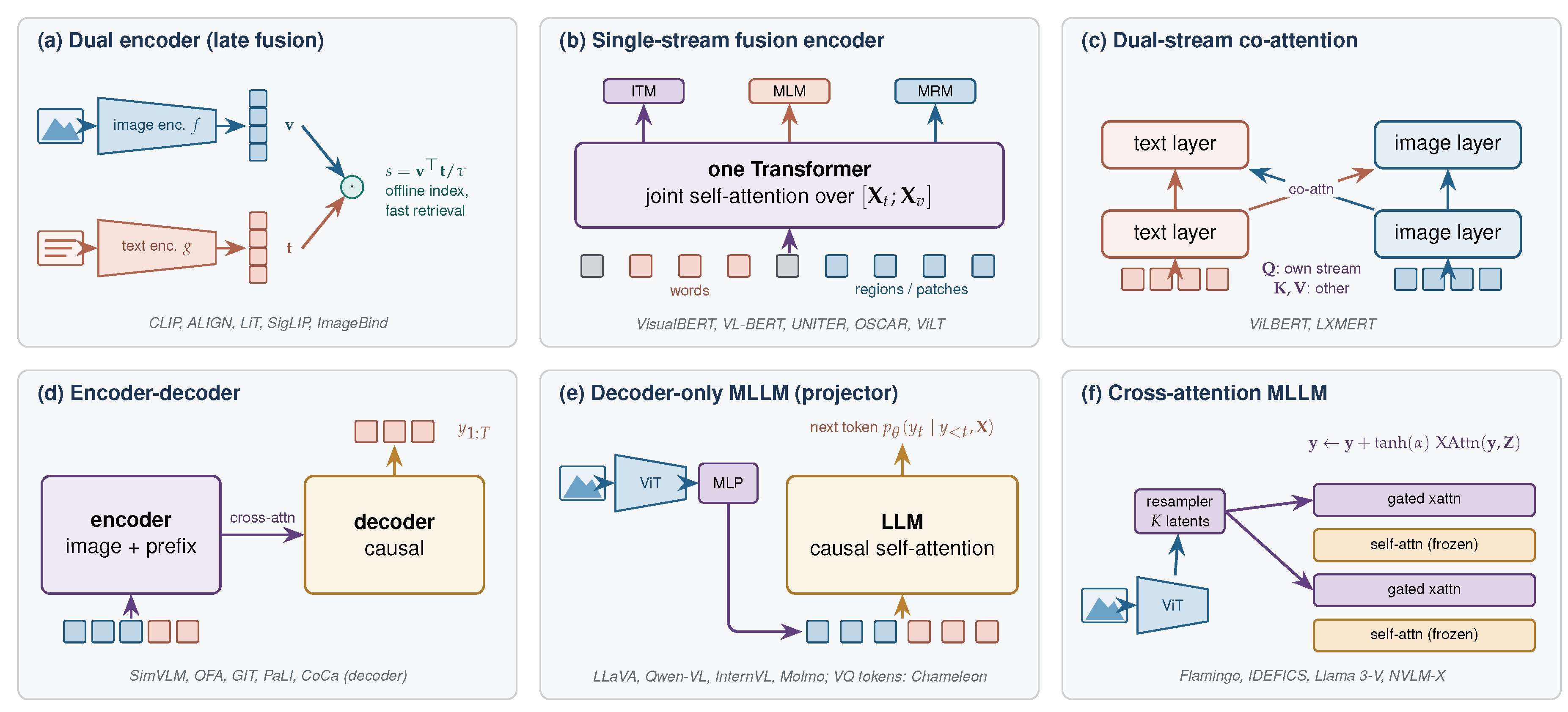
(i) Dual encoders interact only through a similarity score [14,15]. (ii) Fusion encoders use one stream over both modalities [12,65,136] or two streams coupled by co-attention [10,11]. (iii) Encoder-decoders decode text [62,206,207]. The generative models of Section 4 are (iv) decoder-only and (v) cross-attention MLLMs, which feed visual tokens to a causal LLM [19,189,192] or inject them through interleaved layers [17,208], and (vi) unified any-to-any models [63,197,201].
3.0.0.4. Axis B: fusion depth.
Let be the first layer where modalities interact. Late fusion (, ) allows offline indexing and sublinear nearest-neighbor search; token-level late interaction scores per-token vectors with a sum of maxima (Section 7.5); intermediate, bottleneck (K learned queries) and early () fusion mix modalities ever deeper. Deeper fusion is more expressive, but scoring a pool grows from for a dual encoder to for a cross-encoder.
3.0.0.5. Axis C: learning objective.
3.0.0.6. Axis D: supervision source.
3.0.0.7. Axis E: reasoning and agency paradigm.
Reasoning has grown steadily more explicit. (i) Implicit reasoning inside attention layers [7,76]; (ii) modular and neuro-symbolic programs [8,77]; (iii) prompted chain-of-thought [78,94]; (iv) tool-augmented program synthesis [79,118]; (v) learned long chains [80,100]; (vi) RL-trained thinking with verifiable rewards [24,25,109]; (vii) thinking with images, where intermediate states are visual [27,28,113]. Tool-augmented, GUI and web, embodied and search agents extend these paradigms from answering to acting (Section 6).
Figure 4.
Architecture families (axis A). (a) Dual encoder. (b) Single-stream and (c) dual-stream fusion. (d) Encoder-decoder. (e) Decoder-only MLLM. (f) Cross-attention MLLM with a frozen LLM.
Figure 4.
Architecture families (axis A). (a) Dual encoder. (b) Single-stream and (c) dual-stream fusion. (d) Encoder-decoder. (e) Decoder-only MLLM. (f) Cross-attention MLLM with a frozen LLM.
4. Multimodal Foundation Models
Multimodal reasoning models, agents and embedding models Sections 5-7 are rarely trained from scratch. They are built on a shared backbone of foundation models: networks trained once on broad data at scale and then adapted to many downstream tasks [1]. Capabilities such as zero-shot recognition and in-context learning emerge with scale, and the strengths and flaws of these few models propagate to everything built on them. This section reviews their three families Figure 5 and Table 5, foundation encoders, generative multimodal LLMs (MLLMs) and native any-to-any models, and the scaling laws that guide them.
4.1. Pretraining and Adaptation
A foundation model minimizes a generic objective from Table 3 on broad data, . Adaptation to a task k spans orders of magnitude in cost: zero-shot prompting casts the task as similarity (Equation (2)) or generation; linear probing trains a head on frozen features; fine-tuning updates all weights, or only a low-rank update per matrix in LoRA [211],
and instruction tuning and preference or reinforcement learning adapt one model to many tasks expressed in language. Embedding models mostly use the first three routes, reasoning models and agents the last two.
4.2. Foundation Encoders
CLIP showed that language supervision yields features that transfer zero-shot to dozens of tasks [14], but one global caption per image leaves contrastive encoders weak at attribute binding and fine spatial detail (Section 7.6). Self-supervised encoders learn from images alone by self-distillation or masked reconstruction [172,173,175], with DINOv3 scaling to 7B parameters while keeping dense features stable [176]. Generative encoders that predict captions, or pixels and text, match or exceed contrastive ones as MLLM vision towers [146,177], and Perception Encoder finds strong dense features in the intermediate layers of a contrastive encoder [145].
The encoder bounds what an MLLM can perceive: image pairs that CLIP cannot distinguish also defeat MLLMs built on it, and adding self-supervised DINOv2 features helps [196,213]. Encoders have also been scaled directly [180,192,214], since larger vision Transformers transfer better [215]. Finally, promptable segmenters predict masks from points, boxes or text [178], track them in video [179] and segment every instance of a named concept [212]; reasoning models and agents call them as tools (Section 6).
4.3. Scaling Laws
Scaling laws predict the pretraining loss from parameters N and tokens D. In the Chinchilla form [181],
minimizing L under compute C gives and , so parameters and tokens should grow roughly in proportion, unlike earlier estimates that favored larger models [216]. Multimodal laws also ask whether modalities help each other: in mixed-modal generative models, competition at small scale can give way to synergy [182]; contrastive zero-shot error follows a power law in compute with a dataset-dependent exponent [151]; and native early fusion scales at least as well as late fusion, more cheaply, and gains from mixture-of-experts layers [183].
4.4. Generative Multimodal LLMs
Generative MLLMs, the most widely used foundation models, connect a pretrained encoder to a pretrained LLM and model the response autoregressively:
where embeds the text. Training usually proceeds from alignment on caption pairs (often only trainable), to visual instruction tuning, to preference or reinforcement learning (Section 5). Frozen [184] first conditioned a frozen LM on visual prefix tokens, and Flamingo [17] scaled this to interleaved web data.
4.4.1. Connectors
The connector trades visual detail against sequence length (Figure 6). Projectors keep every patch token, through a linear layer [19] or a two-layer MLP, , giving 576 tokens for a 336-pixel ViT-L/14 [187]. Query bottlenecks fix the budget: learned queries cross-attend to image features, , in the Q-Former of BLIP-2 [18] and its variants [185,186], and 256 queries in Qwen-VL [189], at the risk of losing detail for OCR and counting. Gated cross-attention leaves the sequence textual, inserting layers between frozen LM layers,
with gates initialized at in Flamingo; Llama 3 adds similar adapters [208]. Visual experts give image tokens their own weights in every layer [194]. NVLM compares decoder-only, cross-attention and hybrid designs [217], and Idefics2 finds cross-attention preferable with frozen backbones but the fully autoregressive design better once they are trained [218].
4.4.2. Resolution, Token Budget and Data
Text-rich images need high resolution, yet tokens grow quadratically with it. Tiling at the encoder’s native resolution plus a thumbnail [219,220] with pixel shuffle, , costs 256 tokens per 448-pixel tile; native-resolution encoders with multimodal RoPE over time, height and width [190,191] avoid tiling; and pruning or merging tokens cuts inference cost [221,222].
Data has moved from quantity to quality: GPT-4-generated instructions [19] and formatted academic VQA [187] give strong baselines, dense captions help more than extra noisy pairs [73,195], and Cambrian-1 aggregates four encoders [196]. New modalities are serialized as tokens: coordinates for grounding [224,225,226], pooled frames for video [227,228,229], sensor states or text-coded actions for embodiment [125,126], and domain data for medicine [230], building on earlier generalists [206,207,231,232,233].
4.5. Native and Unified Any-to-Any Models
Encoder-plus-LLM pipelines cannot produce images. Native models treat every modality as tokens in one sequence: early-fusion models quantize each patch feature to its nearest code, , under one autoregressive loss [63,197]; Transfusion keeps patches continuous with [199]; Show-o uses discrete diffusion for images [200]; Janus decouples understanding and generation encoders [198]; and others add audio, video and actions [201,202]. With Section 4.3, they suggest that foundation models will be multimodal from the first training step.
4.6. Frontier Systems
At the frontier the three families have merged. Proprietary models made multimodality a default [20,21,203,204,205,234,235], and open-weight families include Qwen-VL [111,189,190,191], InternVL [192,193,220,236,237], LLaVA-OneVision [188], DeepSeek-VL [223,238], Kimi-VL [109], MiMo-VL [239] and GLM-4.5V [110]. Recent Qwen-VL, InternVL, Kimi-VL, MiMo-VL and GLM releases, like the proprietary Seed1.5-VL [240], offer “thinking” modes and serve as starting points for the reasoning models, agents and embedders that follow (Table 6).
- Foundation encoders, MLLMs and native models are the shared backbone of multimodal reasoning, agentic and embedding systems.
- The encoder bounds perception; self-supervised features reduce blind spots.
- Most MLLMs follow Equation (6); data quality matters as much as LLM size.
- Scaling laws favor native multimodal pretraining at scale.
5. Multimodal Reasoning Models
5.1. What Counts as Multimodal Reasoning
A model reasons when its answer depends on intermediate computation that combines several pieces of evidence: counting and comparing objects, relating them in space and time, reading text in images, applying knowledge or planning actions. In Equation (3) this computation is the chain r: hidden activations in classical models, an explicit program in modular models, and, in current models built on the foundation models of Section 4, a sequence of tokens, tool calls and sometimes images. fig:reasoning shows six paradigms that appeared roughly in this order but coexist today; Table 7 lists representative methods.
5.2. Implicit Reasoning in Fusion and Attention Networks
Early VQA models [6,241] predicted over a fixed answer set , so reasoning lived inside the fusion function . Bilinear fusion was factorized with count sketches [83], a low-rank Hadamard product [84], a Tucker decomposition [85] or a three-way outer product [242]. Attention made the computation selective [7,76,81,82,86], and relational or iterative modules added structure: Relation Networks sum over object pairs [87], FiLM modulates features as [88], and MAC and the Neural State Machine iterate over a memory or a scene graph [89,90]. CLEVR [9] and GQA [243] diagnosed these compositional skills, but the computation stayed hidden.
5.3. Modular and Neuro-Symbolic Reasoning
Modular methods make the computation an explicit program of modules such as find, relate and count [8]. End-to-end module networks learn the layout with policy gradients, [91], the estimator behind modern RL fine-tuning (Section 5.6); programs were executed neurally [92] or symbolically on a scene table [77], with concepts learned from question-answer pairs alone [93]. These systems were brittle on real images, but the idea returned once LLMs could write programs (Section 6).
5.4. Generative MLLMs and Prompted Chain-of-Thought
Large generative models turned reasoning into text generation, first by linking models through language [98,99] or in-context examples [17,184]. ScienceQA [94] (21,208 questions) showed that generating lectures and explanations as a chain of thought helps both few-shot GPT-3 and fine-tuned models. Multimodal-CoT [78] separates rationale generation, , from answer inference, , gating image-attended features into the text stream, . Later chains are anchored in visual structure: sub-questions delegated to a visual model [95], generated scene graphs [96], re-encoded regions [97] or numbered marks [244]. Sampling several chains and voting [245],
is a simple form of test-time scaling carried over from text [58,246]. Prompted CoT helps on mathematics and science but little on perception-heavy questions, because the chain is only as good as the first look at the image.
5.5. Learning to Reason: Long Chains, Search and Preferences
Training can then improve the chains themselves.
5.5.0.1. Supervised reasoning traces.
Traces are synthesized for mathematics [102,247] and general questions. LLaVA-CoT [100] answers in four stages (summary, caption, reasoning, conclusion) with stage-level beam search, Insight-V [101] separates reasoning and summary agents, and Mulberry [80] builds reflective traces with collective Monte Carlo tree search. Imitation alone does not teach the model to tell good chains from bad.
5.5.0.2. Preference optimization.
5.5.0.3. Verifiers and test-time scaling.
5.6. Reinforcement Learning with Verifiable Rewards
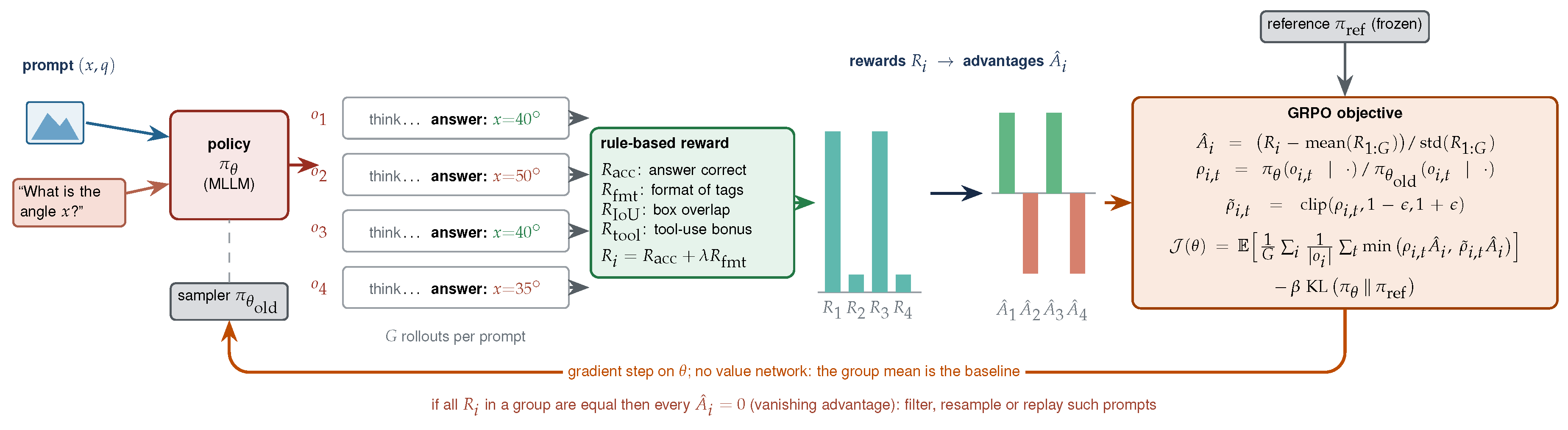
Imitation and preferences are bounded by the available chains. OpenAI o1 [22,251] and DeepSeek-R1 [23] removed this limit: RL with rule-checkable rewards yields long chains with self-verification and backtracking, a recipe multimodal models apply to an MLLM backbone (Section 4). DeepSeek-R1 uses group relative policy optimization (GRPO) [252], a PPO variant [253] without a value network: for a prompt x, it samples G responses from , scores them with rewards and maximizes
where the group mean replaces a learned baseline and the KL term is estimated per token with . fig:grpo and 1 summarize the procedure for MLLMs.
5.6.0.4. Multimodal rewards.
5.6.0.5. Recipes.
Long multimodal chains are scarce, so recipes bootstrap from text reasoning models. Vision-R1 [24] and R1-OneVision [105] convert images into text from which a text reasoning model writes cold-start chains, Vision-R1 then running GRPO with a progressively relaxed length limit; LMM-R1 [106] applies text-only RL first, and Skywork R1V [254] attaches a text reasoner to vision through a lightweight adapter. To keep RL productive, MM-Eureka [25] scales rule-based RL and reports a visual “aha moment” of spontaneous re-checking, and VL-Rethinker [108] counters vanishing advantages with selective replay and forced rethinking. Data and sampling matter as much as the objective: ThinkLite-VL keeps hard but solvable samples [255], NoisyRollout mixes rollouts on clean and distorted images [256], Perception-R1 targets grounding and counting [257], Keye-VL learns when to think at all [258], and OpenVLThinker alternates SFT and RL rounds [259]. Open recipes release full SFT and RL data [260,261,262]. Large-scale systems combine long-chain supervised warm-up with RL: Kimi k1.5, Kimi-VL-Thinking and Kimi K2.5 [109,263,264], GLM-4.1V/4.5V with curriculum sampling [110], Seed1.5-VL [240], MiMo-VL with mixed on-policy RL [239], QVQ [265], InternVL3.5 with cascade RL (offline MPO, then online policy optimization) [237], and Qwen3-VL and Qwen3.5 [111,266].
5.6.0.6. Making RL look at the image (2026).
Outcome rewards do not force a model to use the image, since language priors can suffice. Recent work ties the signal to visual evidence by weighting token advantages by image dependence [267], crediting atomic visual facts with rubric rewards [268], replaying visually grounded failure states [269], or keeping only prompts unsolvable without the image [270]; perception-centric PRMs do so at test time [271,272].
5.6.0.7. Failure modes.
(i) Vanishing advantages: if all G rewards of a group are equal, every , so recipes filter prompts by pass rate, resample or replay. (ii) Reward hacking: format rewards, loose matching and IoU (via box sizes) can be gamed. (iii) Overthinking: chains grow during training, raising cost and, on perception-heavy questions, hallucination (Section 5.8). Later variants change clipping, averaging (per token or per sequence) and prompt sampling but keep the group-relative baseline of Equation (10).
| Algorithm 1:GRPO fine-tuning of an MLLM with verifiable rewards |
|
Figure 8.
GRPO for multimodal reasoning. Programs score G rollouts per prompt; group-standardized rewards give advantages; a clipped surrogate with a KL penalty updates the policy. Groups with identical rewards carry no signal.
Figure 8.
GRPO for multimodal reasoning. Programs score G rollouts per prompt; group-standardized rewards give advantages; a clipped surrogate with a KL penalty updates the policy. Groups with identical rewards carry no signal.
5.7. Thinking with Images
Text-only chains look at the image once and then reason in language; thinking-with-images models make visual states part of the chain (Figure 7f). With history , thought , action (crop a box , zoom, draw, run code) and observation , the context grows as
so later steps can re-perceive details at higher resolution. Acting on an environment and observing the result makes this loop a step toward agentic behavior (Section 6). Early systems differ in the visual action: guided search for small objects [112], cropping and re-encoding [97], drawing auxiliary lines and plots through code [28], or generating images as thoughts with a unified model [113]. The model must also learn when and where to act: OpenAI’s o3 and o4-mini crop, zoom and rotate within their reasoning [26,273]; DeepEyes [27] learns grounded zoom-in with end-to-end RL, rewarding tool use only when it contributes to a correct answer, and Chain-of-Focus, OpenThinkIMG and V-Thinker likewise train adaptive zooming and tool calls [274,275,276]. Because explicit visual steps cost encoder passes, a second line removes them: Mirage and latent visual reasoning keep intermediate states as compact latent tokens [277,278], though these can ignore edits to the evidence they should encode [279]; self-distillation internalizes zooming so no tool is needed at inference [280]; and programs can render intermediate images [281]. See Su et al. [47] for a survey. As the loop reuses the encoder and connector (Figure 2) at every step, efficient re-encoding matters as much as the policy.
5.8. Hallucination and Faithfulness
All these paradigms fail when the model describes absent content. Captioning first quantified such hallucination with CHAIR [282],
POPE [283] polls “Is there a 〈object〉 in the image?” with random, popular and adversarial negatives, and HallusionBench [284] separates language-prior hallucination from visual illusion. At decoding time, visual contrastive decoding [285] contrasts logits for the clean image v and a distorted image ,
restricted to plausible tokens, and OPERA penalizes over-trust in summary tokens during beam search [286]. Woodpecker corrects outputs post hoc [287], and preference training aligns models during training [69,74]. Long chains can worsen this: reasoning models attend less to the image as chains lengthen, and hallucinate more on perception questions [288]. Faithfulness of the chain to the evidence, not only answer correctness, thus remains open (Section 9).
- Reasoning moved from implicit fusion, through explicit programs, to token chains trained with verifiable rewards.
- GRPO-style RL (Equation (9)) dominates; it depends on reward design, prompt difficulty and a good supervised warm-up.
- Perception remains the bottleneck: thinking with images and grounded steps help, while longer chains can amplify hallucination.
6. Multimodal Agentic Systems
A reasoning model answers a question; an agent pursues a goal by acting. A multimodal agent wraps the generative head of a foundation model in a loop of perception, reasoning and action (Figure 9). At step t it holds a history of the task q, past thoughts, actions and observations, samples a thought and an action, and receives a new observation from the environment:
where is the hidden state of the environment. Training maximizes the expected return of trajectories (Definition 2). Thinking with images (Equation (11)) is the special case in which the environment is the image itself and the actions are crops and sketches. Agents differ mainly in their environment and action space, which Table 8 uses to organize the field.
6.1. Tool-Augmented and Programmatic Agents
The first multimodal agents compensated for a weak first look by calling specialists. Visual ChatGPT [114] and MM-REACT [115] route requests to vision experts in the ReAct style of interleaved thoughts and actions [291]; HuggingGPT [116] plans, selects models, executes and summarizes; and Chameleon composes heterogeneous tools into plans [117]. VisProg [118] and ViperGPT [79] write the plan as a program over a visual API,
which revives module networks (Section 5) and is interpretable and training-free, but bounded by the quality of the tools. LLaVA-Plus learns when to call tools from instruction data [119], a step from prompted to trained tool use.
6.2. Web, GUI and Computer-Use Agents
Graphical interfaces turn every application into an environment whose actions are clicks and keystrokes. Mind2Web collected over 2,000 open-ended tasks on 137 real websites [120], and SeeAct showed that GPT-4V can plan such tasks but struggles to ground its intent in the right element [29]. Grounding, the map from an instruction to screen coordinates, has therefore become the central skill: Set-of-Mark prompting overlays numbered marks that the model can name [244], CogAgent adds a high-resolution branch for small interface elements [121], and SeeClick pretrains on GUI grounding and introduces the ScreenSpot benchmark [122]. Interactive environments measure end-to-end success: WebArena (812 tasks) and VisualWebArena (910 visually grounded tasks) host realistic websites [123,289], OSWorld runs 369 tasks in real operating systems, where humans completed about 72% but the best model at release only about 12% [30], and AndroidWorld covers 116 tasks on mobile apps [290]. Recent agents are trained end to end. UI-TARS perceives raw screenshots only, uses a unified action space and deliberate reasoning, and improves with reflective traces collected online [31]. UI-R1 applies rule-based RL (Section 5.6) to action prediction with a reward that checks the action type and whether the predicted point falls inside the target box [124],
which transfers the verifiable-reward recipe of reasoning models to agents.
6.3. Embodied Agents and Vision-Language-Action Models
Robots extend the action space to motor commands. PaLM-E injects continuous sensor states into an LLM for embodied planning [125]. RT-2 fine-tunes a vision-language model to emit robot actions as text tokens, each action dimension discretized into 256 bins, so that web-scale knowledge transfers to manipulation [126]. OpenVLA releases a 7B open vision-language-action model trained on about a million real robot episodes [32], and replaces discrete tokens with a flow-matching action expert that outputs chunks of continuous, high-frequency actions [127]. These models are evaluated by task success on physical robots, which makes evaluation slow and hard to compare across laboratories.
6.4. Search, Retrieval and Memory Agents
Many questions require knowledge that is not in the image or the weights. Multimodal retrieval-augmented generation retrieves image and text evidence with an embedding model and conditions generation on it [128,129,292], and visual document retrieval makes whole page collections searchable [36]. Agents go further by deciding what to search for and when. MMSearch evaluates MLLMs as multimodal search engines [130], and MMSearch-R1 trains an MLLM with RL to call image and text search only when needed, rewarding correct answers and penalizing unnecessary searches [131]. GAIA tests general assistants that combine browsing, tools and multimodal understanding [132], and frontier models now interleave visual reasoning with tool calls inside one chain [26,264]. Over long tasks the same embedding index also serves as episodic memory, which links agents to the embedding models of Section 7.
6.5. Training Multimodal Agents
Agent training follows the same progression as reasoning: prompting a strong MLLM, supervised fine-tuning on recorded trajectories, and reinforcement learning in the environment. Multi-turn RL extends GRPO (1) by sampling whole trajectories and masking tool and environment tokens in the loss, as in DeepEyes [27] and UI-R1 [124]. The main difficulties are long horizons with sparse rewards, credit assignment across many steps, the cost and non-determinism of real environments, and safety: an agent that clicks or moves can cause harm that a wrong answer cannot (Section 9).
- Multimodal agents run an MLLM policy in a loop of perception, reasoning and action (Equation (14)); they differ mainly in environment and action space.
- Grounding intent in pixels is the key skill of GUI agents, and verifiable rewards on actions (Equation (16)) carry the RL recipe of reasoning models over to agents.
- Embeddings give agents retrieval and memory, and safety and evaluation in real environments remain open.
7. Multimodal Embedding Models
Multimodal reasoning models (Section 5) and agents (Section 6) rely on embeddings for retrieval and memory. This section traces how such spaces are built, from classical methods to universal embedders read out from the MLLMs of Section 4.
7.1. Classical Shared Spaces
7.1.0.8. Canonical correlation.
Given centered paired views and with covariances and cross-covariance , canonical correlation analysis (CCA) [2,133] finds projections that maximize the correlation , a generalized eigenproblem whose leading eigenvectors span a shared subspace. Kernel and deep CCA [3,133] make the maps nonlinear; early deep models learned joint representations with autoencoders and deep Boltzmann machines [293,294], and tensor fusion modeled multiplicative interactions through outer products [242].
Ranking-based visual-semantic embeddings.
Ranking losses then placed matched pairs above mismatched ones by a margin . DeViSE [4] projected CNN features into a word-embedding space and recognized unseen classes; Kiros et al. [134] paired a CNN with a recurrent sentence encoder, and Karpathy and Fei-Fei [295] aligned regions with words through , an early form of late interaction. VSE++ [5] showed that a hinge loss on the hardest in-batch negative, in both retrieval directions, matters most, and SCAN [135] attended from each word to detected regions before scoring. Captioning [296,297] and region features [7,298] supplied the visual tokens for fusion encoders.
7.2. Fusion Encoders and Vision-Language Pretraining
Fusion encoders replace a similarity score with cross-modal attention, feeding region or patch features and word embeddings into Transformers pretrained on COCO, Visual Genome and Conceptual Captions [70,209,210]. Single-stream models [12,13,136,137] self-attend over , whereas dual-stream models [10,11] exchange information by co-attention; both use masked language modeling, masked region modeling and image-text matching (Table 3). UNITER adds word-region alignment by optimal transport and OSCAR uses object tags as anchors; VinVL improves region features [138], ViLT replaces the detector with a linear patch embedding for a large speed-up [65], and METER compares these design choices [299].
7.2.0.10. Align before fuse, bootstrap and mixture of experts.
Web-scale fusion pretraining faces unaligned features, noisy captions and no offline indexing. ALBEF [66] aligns unimodal embeddings contrastively before fusing them and distills from a momentum teacher; BLIP [147] unifies understanding and generation and bootstraps its data with a captioner and a filter. VLMo and BEiT-3 [67,139] share self-attention across modalities but route each token to a modality-specific feed-forward expert, so one network serves as a dual or a fusion encoder. FLAVA [148] combines unimodal and multimodal objectives, and SimVLM [62] uses a single prefix language-modeling loss. Grounded pretraining recasts detection as phrase grounding: following MDETR [300], GLIP scores regions against words through [301], and Grounding DINO extends this to open-set detection [302].
7.3. Contrastive Dual Encoders at Scale
7.3.0.11. CLIP and ALIGN.
CLIP [14] trains an image and a text encoder on 400M web pairs with the symmetric InfoNCE loss over the batch logits (Figure 10a),
with a learnable temperature; any label set then becomes a classifier through Equation (2), usually with prompt ensembles. ALIGN [15] matched CLIP with 1.8B noisier pairs, and Florence and BASIC [140,142] scaled data, model and batch further. FILIP [64] scores pairs by token-wise maximum similarity, and LiT [141] tunes only the text tower against a frozen image tower. These dual encoders became the vision towers of the MLLMs in Section 4.
7.3.0.12. Sigmoid loss.
The softmax in Equation (17) couples all pairs of a batch and requires gathering embeddings across devices. SigLIP [16] instead treats every pair as an independent binary classification,
with a learnable scale t and a bias b initialized to to offset the negatives (Figure 10b). It works with small batches and, with a locked image tower, reaches 84.5% ImageNet zero-shot accuracy on four TPU chips in two days.
7.3.0.13. Generative and contrastive hybrids.
Since a contrastive loss supervises one global similarity per pair, later encoders add generative, self-supervised or fine-grained terms. CoCa [68] attaches a captioning decoder to a contrastive dual encoder,
and reaches 86.3% ImageNet zero-shot accuracy. FLIP [303] masks most image patches for speed, and EVA-CLIP [143,214] initializes from masked-image-modeling models. SigLIP 2 [144] adds captioning-based localization, self-distillation and masked prediction and supports many languages and native aspect ratios; TULIP [304] adds intra-modal contrastive and reconstruction terms, and FG-CLIP [305] trains with long captions, region boxes and fine-grained hard negatives. Perception Encoder [145] finds that the best general features often lie in intermediate layers and aligns them to the output. Non-contrastive pretraining has also returned: AIMv2 [146] autoregressively generates patches and text, a ViT can be pretrained with a language-modeling loss alone [306], and JEPA-style cross-modal prediction needs no negatives [307].
7.3.0.14. Data is a design variable.
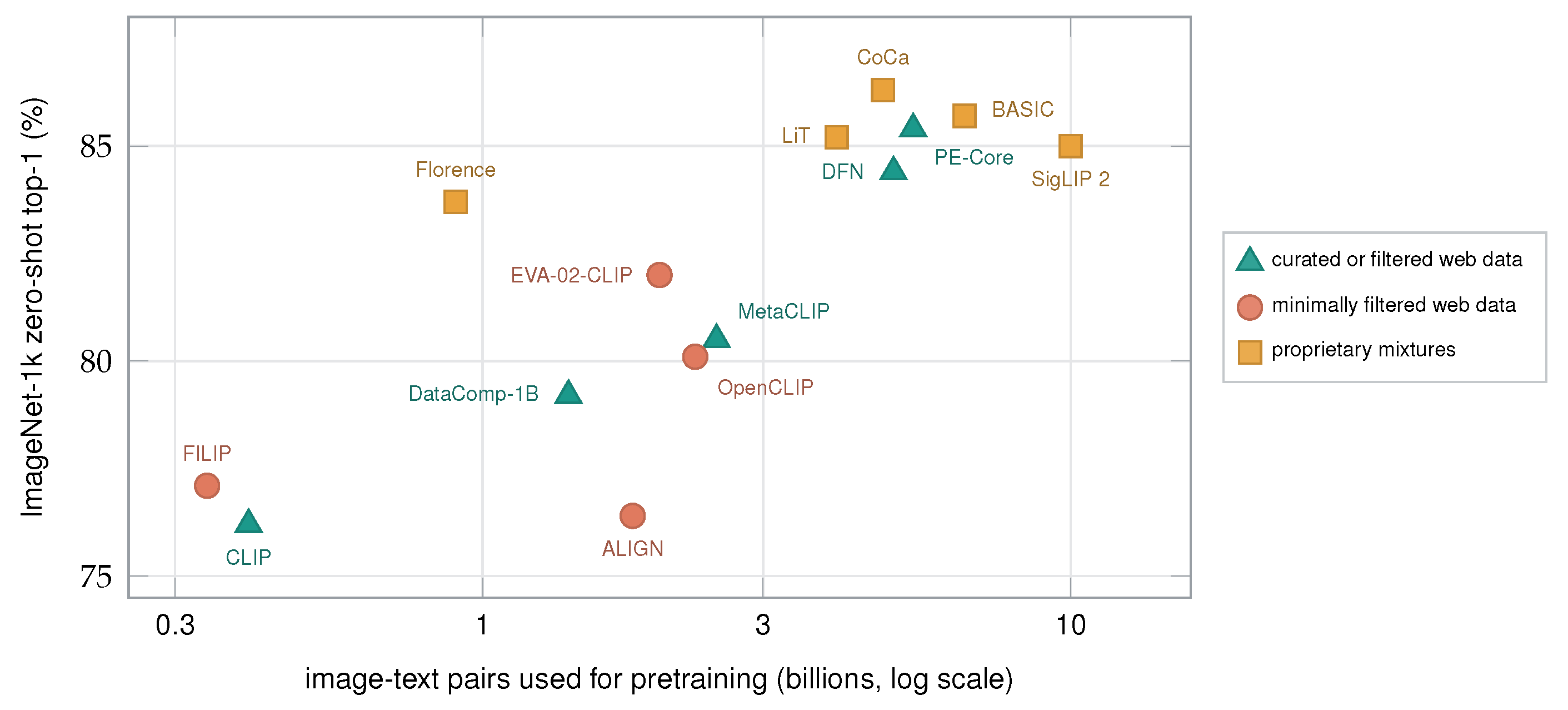
Public web-scale pairs, first in LAION-5B [71], made training data an object of study. OpenCLIP fitted power laws between error and compute with dataset-dependent exponents [151], and DataComp [72] fixed the recipe and turned filtering into the benchmark. MetaCLIP [149] reconstructed CLIP’s curation by matching captions to 500k metadata entries and capping pairs per entry, which flattens the long tail, whereas DFN [150] keeps pairs scored highly by a small filtering network. Curated sets of 1.4B to 5.4B pairs match or exceed larger raw collections ().
Adapting and reusing embeddings.
Prompt learning replaces hand-written prompts by learnable context vectors, , optionally conditioned on the image [309,310]; adapters add a residual module or a training-free few-shot cache [311,312], and WiSE-FT [313] interpolates zero-shot and fine-tuned weights to keep robustness under distribution shift. The text tower classifies regions or pixels in open-vocabulary detection and segmentation [314,315,316], CLIP embeddings condition text-to-image models [317,318], and domain variants such as BiomedCLIP [319] retrain on specialized pairs.
Figure 11.
Reported ImageNet-1k zero-shot accuracy against the number of pretraining pairs. Curation (MetaCLIP, DFN, PE) lets 1B to 5B pairs match larger raw collections; encoder size, resolution and compute differ between points.
Figure 11.
Reported ImageNet-1k zero-shot accuracy against the number of pretraining pairs. Curation (MetaCLIP, DFN, PE) lets 1B to 5B pairs match larger raw collections; encoder size, resolution and compute differ between points.
7.4. Binding More Modalities
Beyond image and text, paired data are scarce, so extending the space needs indirect supervision. ImageBind [152] uses images as a hub, training an InfoNCE loss only on (image, M) pairs for each other modality M, and obtains emergent alignment between pairs never seen together, such as audio and text. LanguageBind [153] uses language as the hub, and VATT [154] trains a modality-agnostic Transformer on video, audio and text. Most work aligns one additional modality with text or images, often from CLIP: audio [155,156,320], video [158,159,321,322,323,324] and 3D point clouds [157,325]. The Perceiver [326,327] cross-attends a small latent array to an input of length n at cost , and data2vec [328] regresses a teacher’s averaged top-layer features from masked inputs with one recipe for speech, vision and text.
7.5. Universal Embeddings from (Multimodal) LLMs
Dual encoders have four limits: short text context (77 tokens in CLIP, effectively about 20 [329]), no instructions, no interleaved inputs, and weak compositionality (Section 7.6). Text retrieval met similar limits with dense retrievers [330], late interaction [168] and LLM-based embedders evaluated on MTEB [331,332]. Universal multimodal embedders follow the same path with MLLM backbones (Figure 12d). For an instruction and an input x of any modality composition, the embedding is the normalized last hidden state of the final token,
trained with in-batch and mined hard negatives .
E5-V [33] showed that a generative backbone becomes an embedder cheaply: prompting an MLLM to summarize the input “in one word” maps text and images to comparable states, and training on text pairs alone transfers to images. VLM2Vec [34] introduced MMEB, 36 datasets in four meta-tasks (classification, VQA, retrieval, grounding), and trained with large batches (62.9 with a LLaVA-1.6 backbone). Most follow-up work improves the negatives in Equation (20): MM-Embed [160] counters a bias toward the query’s modality with modality-aware mining, B3 [164] builds batches rich in hard negatives through community detection, and LLaVE [162] up-weights negatives by their similarity, . Others improve the data or the teacher: GME [35] uses synthetic fused-modal data on Qwen2-VL, mmE5 [163] synthesizes multilingual data, and UniME [161] distills from a strong text embedder. VLM2Vec-V2 [165] extends training and evaluation to video and visual documents. Related lines cover instruction-guided retrieval (UniIR and M-BEIR [171]), visualized text embeddings [333], open-ended retrieval instructions [334] and composed image retrieval [335,336].
7.5.0.16. Scaling, distillation and omni-modality (2025 and 2026).
MMEB-V2 has 78 image, video and visual-document tasks [165], and MMEB-V3 adds text, audio and agentic tasks [337]. Strong recent embedders distill from larger models. Qwen3-VL-Embedding [167] combines staged contrastive pretraining with distillation from a cross-encoder reranker and supports Matryoshka dimensions, and UniME-V2 [338] uses an MLLM judge for negative mining and soft labels. MetaEmbed [339] learns a few meta tokens whose nested multi-vector outputs can be truncated at test time to trade cost for accuracy. At the time of writing, embedders trained at industrial scale on recent Qwen backbones lead MMEB-V2 at about 80 points [340,341,342]. Omni-modal embedders extend the space to audio, video and PDFs [343,344,345,346,347]; jina-embeddings-v5-omni trains only the connectors between frozen towers, so existing text embeddings remain valid [348].
7.5.0.17. Reasoning before embedding.
A recent line uses the generative head to make implicit query intent explicit before encoding. Think-Then-Embed [349] embeds the query together with a reasoning trace , , and UME-R1 [166] learns generative and discriminative embeddings with supervised fine-tuning and RL. Because traces add inference cost, MMEmb-R1 [350] learns with RL when to reason, and DME [341] reasons latently during training only. Reasoning can also follow a first retrieval, deciding whether to rerank or re-retrieve [351]. These models make the convergence of embedding and reasoning in Figure 2 concrete.
7.5.0.18. Visual documents and late interaction.
ColPali [36] embeds each page image as the multi-vector output of a vision-language model and scores it with the ColBERT [168] sum of maxima,
which removes the OCR pipeline and reaches nDCG@5 81.3 on ViDoRe versus 67.0 for the best text pipeline. DSE [169] embeds screenshots as single vectors, and jina-embeddings-v4 [170] produces both outputs from one backbone. ViDoRe V2 makes queries harder, and ViDoRe V3 evaluates full retrieval-augmented generation pipelines over about 26k pages in six languages [352,353]. LamRA uses one large multimodal model as retriever and reranker [354], and retrieval feeds generation in multimodal retrieval-augmented models [128,129,292], the pattern that agents extend to long-term memory (Section 6). fig:retrieval contrasts the scoring paradigms and Table 10 summarizes the main embedders.
7.6. Geometry, Compositionality and Limits
Alignment and uniformity.
7.6.0.20. The modality gap.
Image and text embeddings of CLIP-like models occupy separate cones on the sphere, so is far from zero [356]; the gap arises at random initialization, survives low-temperature contrastive training, and shifting along changes zero-shot accuracy and fairness (Figure 13a). The platonic representation hypothesis [357] reports that vision and language models grow more alike with scale, measured by mutual k-nearest-neighbor alignment (Figure 13c).
7.6.0.21. Compositionality.
Contrastive models often act as bags of words. ARO [358] probes relations, attributes and word order with over 50k cases and shows that composition-aware hard negatives (NegCLIP) help. Winoground [359] pairs two images with two captions that use the same words in different orders; a model earns the group score only if it matches both captions to the correct images and both images to the correct captions. Humans reach 85.5, while the models evaluated at release scored below chance. SugarCrepe [360] generates fluent hard negatives to remove the text-only shortcuts of earlier benchmarks.
7.6.0.22. From embedding blind spots to reasoning failures.
Tong et al. [213] call a pair of images CLIP-blind when CLIP embeds them almost identically while a self-supervised encoder separates them,
and build MMVP from 150 such pairs. MLLMs with CLIP-family encoders fail many of its questions, which links embedding geometry to the reasoning failures discussed in Section 5.
- Embedding models evolved from CCA and ranking losses through fusion pretraining and web-scale contrastive learning to MLLM backbones read out as vectors.
- Data curation and the loss (softmax versus sigmoid) matter as much as scale; curated 1B to 5B pair datasets match larger raw ones (Table 9).
- Dual encoders are efficient but compositionally weak and blind to fine visual differences, and these blind spots propagate into the MLLMs built on them.
- Instruction-aware MLLM embedders and late interaction unify retrieval over images, text, documents and video, serving as the retrieval and memory layer of reasoning models and agents; the best MMEB-V2 scores rose from about 58 to about 81 between mid-2025 and late 2026, and reasoning before embedding is emerging.
8. Benchmarks, Metrics and Reported Results
8.1. Metrics
8.1.0.23. Retrieval.
Recall@K is for queries with relevant candidate ; graded relevance is scored with
with IDCG the ideal ranking’s score; MMEB uses precision@1 over task-specific candidates [34].
8.1.0.24. Answers.
VQA accuracy credits a short answer by agreement with ten annotators, averaged over annotator subsets [6],
8.2. Benchmarks
For both embedding and reasoning (Table 11), evaluation has moved toward harder, more diagnostic tasks. Embedding evaluation went from COCO and Flickr30K retrieval [70,363] and ImageNet zero-shot classification to compositional probes [358,359,360] and multi-task suites [34,36,171]. Reasoning benchmarks went from natural-image and knowledge-based VQA [6,241,243,364,365] to diagnostic [9,366,367], text-rich [368,369,370], mathematical [371,372,373] and expert-level questions [374,375,376]. Holistic suites [361,377,378,379] and perception probes [213,380] complete the picture. To ensure the image is needed, MMStar keeps only questions unanswerable without it [379], and MMMU-Pro embeds the question in the image [375].
8.3. Reported Results
tab:results and Figure 14 collect vendor-reported scores on the two most cited reasoning benchmarks, MMMU (validation) and MathVista (testmini). Three trends stand out. First, MMMU scores rose from 36.4% (LLaVA-1.5-13B) and 56.8% (GPT-4V) in late 2023 to above 80% for reasoning models in 2025 and 85.0% for an open-weight model in early 2026, inside the human-expert band (76.2% to 88.6%) [374]. Second, thinking models drive most recent gains on mathematics: MathVista accuracy rose from 49.9% (GPT-4V) to about 90%, far above the 60.3% human baseline [371]. Third, open-weight models trail the best proprietary systems by only a few points.
Differing pipelines, prompts, answer extraction and contamination make these numbers not strictly comparable. Both benchmarks also near saturation: since late 2025, frontier vendors increasingly report MMMU-Pro, chart reasoning (CharXiv [383]) and agentic benchmarks instead (Gemini 3 Pro reports 81.0 on MMMU-Pro [235]). BLINK, MMVP, vision-only MMMU-Pro and HLE remain far from saturated [213,375,376,380].

Table 12.
Vendor-reported results on MMMU (val) and MathVista (testmini), in percent. “Thinking”: reasons at length before answering. n/r: not reported. †From a model card, a reproduced vendor chart or a source not labeling the split.
Table 12.
Vendor-reported results on MMMU (val) and MathVista (testmini), in percent. “Thinking”: reasons at length before answering. n/r: not reported. †From a model card, a reproduced vendor chart or a source not labeling the split.
| Model | Release | Type | MMMU | MathVista |
|---|---|---|---|---|
| LLaVA-1.5-13B [187] | Oct 2023 | open | 36.4 | 27.6† |
| GPT-4V [20] | Sep 2023 | proprietary | 56.8 | 49.9 |
| Gemini 1.0 Ultra [21] | Dec 2023 | proprietary | 59.4 | 53.0 |
| GPT-4o [203] | May 2024 | proprietary | 69.1 | 63.8 |
| Claude 3.5 Sonnet [384] | Jun 2024 | proprietary | 68.3 | 67.7 |
| Qwen2-VL-72B [190] | Aug 2024 | open | 64.5 | 70.5 |
| o1 [251] | Sep 2024 | proprietary, thinking | 78.2 | 73.9 |
| InternVL2.5-78B [236] | Dec 2024 | open | 70.1 | 72.3 |
| QVQ-72B-Preview [265] | Dec 2024 | open, thinking | 70.3 | 71.4 |
| Qwen2.5-VL-72B [191] | Jan 2025 | open | 70.2 | 74.8 |
| Gemini 2.5 Pro [204] | Mar 2025 | proprietary, thinking | 82.0 | n/r |
| Kimi-VL-A3B-Thinking [109] | Apr 2025 | open, thinking | 61.7 | 71.3 |
| InternVL3-78B [193] | Apr 2025 | open | 72.2 | 79.0 |
| Llama 4 Maverick [385] | Apr 2025 | open | 73.4 | 73.7† |
| o3 [273] | Apr 2025 | proprietary, thinking | 82.9 | 86.8† |
| Seed1.5-VL (thinking) [240] | May 2025 | proprietary, thinking | 77.9 | 85.6 |
| MiMo-VL-7B-RL [239] | Jun 2025 | open, thinking | 66.7 | 81.5 |
| Keye-VL-8B (thinking) [258] | Jul 2025 | open, thinking | 71.4 | 80.7 |
| GPT-5 [205] | Aug 2025 | proprietary, thinking | 84.2 | n/r |
| GLM-4.5V (thinking) [110] | Aug 2025 | open, thinking | 75.4 | 84.6† |
| InternVL3.5-241B-A28B [237] | Aug 2025 | open | 77.7 | 82.7 |
| Qwen3-VL-235B-A22B-Thinking [111] | Sep 2025 | open, thinking | 80.6 | 85.8 |
| Kimi K2.5 [264] | Feb 2026 | open, thinking | n/r | 90.1† |
| Qwen3.5-397B-A17B [266] | Feb 2026 | open, thinking | 85.0 | 90.3 |
| Human experts, worst / median / best [374] | 76.2 / 82.6 / 88.6 | |||
| Human (MathVista) [371] | 60.3 |
[unbreakable]
- Evaluation has shifted toward compositional, mathematical, expert and perception suites.
- From late 2023 to early 2026, the best MMMU and MathVista scores rose by over 25 and 35 points, largely through thinking models, and near saturation; perception probes remain hard.
- Scores depend on prompts and evaluation code, so cross-paper comparisons need care.
9. Open Problems and Future Directions
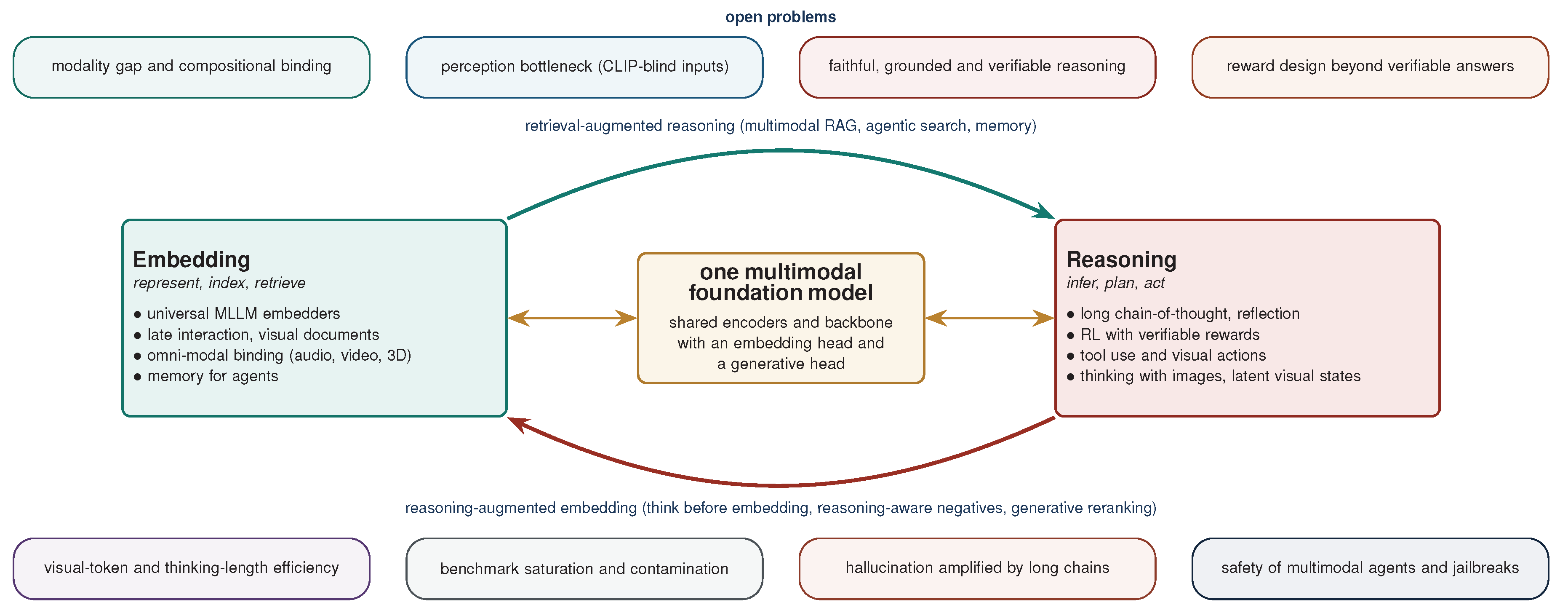
fig:roadmap summarizes open problems as reasoning, agentic and embedding models converge.
Figure 15.
Embedding and reasoning converge on a shared foundation model: retrieval supplies evidence and memory to reasoning and agents, and reasoning improves embeddings and rerankers. Tags mark open problems.
Figure 15.
Embedding and reasoning converge on a shared foundation model: retrieval supplies evidence and memory to reasoning and agents, and reasoning improves embeddings and rerankers. Tags mark open problems.
1. Modality gap and compositional binding.
Contrastive spaces separate modalities into cones (Section 7.6) and bind attributes poorly. Hard negatives [358], dense token-level objectives [64,144] and MLLM embedders [34] help, but no theory says when a shared space supports compositional queries. Can uniformity and alignment (Equation (22)) be complemented by a compositionality objective?
2. The perception bottleneck.
RL improves reasoning far more than perception: CLIP-blind inputs (Equation (23)) defeat CLIP and MLLMs built on it [213], and perception benchmarks lag reasoning ones [380]. Remedies include dense and self-supervised encoders [145,146], re-perception during reasoning (Section 5.7), and rewards that require visual evidence [267,270].
3. Faithful, grounded and verifiable reasoning.
4. Rewards beyond verifiable answers.
5. Unifying reasoning, agency and embedding.
One foundation model can already generate, act and embed (Figure 2); a natural goal is to unify these roles. Thinking before embedding helps complex queries [349,350] but adds latency, which latent or training-only reasoning can amortize [341]. Retrieval in turn serves agents as long-term memory. Open questions are whether one set of weights can lead at both generation and embedding, and how to train retrieval, reasoning and action end to end, extending multimodal RAG [128,292].
6. Efficiency.
High resolution, video, long chains and agent trajectories multiply tokens. Pruning and merging reduce visual tokens [221,222], mixture-of-experts backbones cut per-token compute [109,223], and adaptive thinking length [258] and internalized visual operations [280] make reasoning cheaper. Late-interaction retrievers store one vector per token, inflating indexes [36].
7. Evaluation.
Headline benchmarks saturate within two or three years (Figure 14), suffer contamination and are sensitive to prompts and answer extraction. Vision-indispensable questions [379], vision-only formats [375], process-level evaluation and live benchmarks are needed, as are retrieval suites covering video, documents and interleaved content [165].
8. Agent safety and reliability.
As multimodal agents act in GUIs, on the web and in the physical world [29,30,125,126], errors become actions and the attack surface grows: instructions hidden in images or web pages, visual jailbreaks and unsafe actions call for evaluations and defenses covering all modalities. Audio, video, 3D and scientific or medical data also remain less mature than vision-language [230,319].
10. Conclusions
Multimodal reasoning models, agentic systems and embedding models now share the same foundation: encoders, a connector and a backbone with a generative or an embedding head. We traced reasoning from fusion networks and neural modules to chains of thought trained with verifiable rewards and interleaved with visual operations; agents from tool-calling programs to GUI, embodied and search agents trained end to end; and embeddings from canonical correlation to contrastive encoders and instruction-aware MLLM embedders. Five taxonomies (architecture, fusion depth, objective, supervision, and reasoning and agency paradigm) locate any of these models.
Four lessons stand out. Reinforcement learning with verifiable rewards has become the main way to elicit reasoning, and the same recipe now trains agents. The perception of the foundation model sets a ceiling for everything built on it, so the blind spots of an encoder become the errors of reasoners and agents. Retrieval and embeddings are becoming the memory of agents rather than a separate application. And perception, faithfulness, safety, efficiency and evaluation, rather than reasoning alone, now limit progress. The next generation of systems is likely to be a single natively multimodal model that perceives, retrieves, reasons and acts, and the tools reviewed here (contrastive objectives, attention-based fusion and policy optimization) are the language in which it will be described.
Author Contributions
Conceptualization, M.A.B.; methodology, M.A.B.; investigation, M.A.B., M.E. and A.H.; visualization, M.A.B.; writing (original draft preparation), M.A.B.; writing (review and editing), M.A.B., M.E. and A.H. All authors have read and agreed to the published version of the manuscript.
Funding
This research received no external funding.
Institutional Review Board Statement
Not applicable.
Informed Consent Statement
Not applicable.
Data Availability Statement
No new data were created or analyzed in this study. Data sharing is not applicable to this article.
Conflicts of Interest
The authors declare no conflicts of interest.
Abbreviations
The following abbreviations are used in this manuscript:
| CCA | Canonical correlation analysis |
| CLIP | Contrastive language-image pretraining |
| CoT | Chain of thought |
| DPO | Direct preference optimization |
| GRPO | Group relative policy optimization |
| GUI | Graphical user interface |
| ITM | Image-text matching |
| KL | Kullback-Leibler (divergence) |
| LLM | Large language model |
| LoRA | Low-rank adaptation |
| MLLM | Multimodal large language model |
| MLM | Masked language modeling |
| MMEB | Massive multimodal embedding benchmark |
| MoE | Mixture of experts |
| OCR | Optical character recognition |
| PPO | Proximal policy optimization |
| PRM | Process reward model |
| RAG | Retrieval-augmented generation |
| RL | Reinforcement learning |
| RLVR | Reinforcement learning with verifiable rewards |
| SFT | Supervised fine-tuning |
| ViT | Vision Transformer |
| VLA | Vision-language-action (model) |
| VLM | Vision-language model |
| VQA | Visual question answering |
References
- Bommasani, R.; Hudson, D.A.; Adeli, E.; Altman, R.; Arora, S.; von Arx, S.; Bernstein, M.S.; Bohg, J.; Bosselut, A.; Brunskill, E.; et al. On the Opportunities and Risks of Foundation Models. arXiv 2021, arXiv:2108.07258. [Google Scholar]
- Hotelling, H. Relations Between Two Sets of Variates. Biometrika 1936, 28, 321–377. [Google Scholar] [CrossRef]
- Andrew, G.; Arora, R.; Bilmes, J.; Livescu, K. Deep Canonical Correlation Analysis. In Proceedings of the International Conference on Machine Learning (ICML), 2013. [Google Scholar]
- Frome, A.; Corrado, G.S.; Shlens, J.; Bengio, S.; Dean, J.; Ranzato, M.; Mikolov, T. DeViSE: A Deep Visual-Semantic Embedding Model. In Proceedings of the Advances in Neural Information Processing Systems (NeurIPS), 2013. [Google Scholar]
- Faghri, F.; Fleet, D.J.; Kiros, J.R.; Fidler, S. VSE++: Improving Visual-Semantic Embeddings with Hard Negatives. In Proceedings of the British Machine Vision Conference (BMVC), 2018. [Google Scholar]
- Antol, S.; Agrawal, A.; Lu, J.; Mitchell, M.; Batra, D.; Zitnick, C.L.; Parikh, D. VQA: Visual Question Answering. In Proceedings of the IEEE International Conference on Computer Vision (ICCV), 2015. [Google Scholar]
- Anderson, P.; He, X.; Buehler, C.; Teney, D.; Johnson, M.; Gould, S.; Zhang, L. Bottom-Up and Top-Down Attention for Image Captioning and Visual Question Answering. In Proceedings of the IEEE Conference on Computer Vision and Pattern Recognition (CVPR), 2018. [Google Scholar]
- Andreas, J.; Rohrbach, M.; Darrell, T.; Klein, D. Neural Module Networks. In Proceedings of the IEEE Conference on Computer Vision and Pattern Recognition (CVPR), 2016. [Google Scholar]
- Johnson, J.; Hariharan, B.; van der Maaten, L.; Fei-Fei, L.; Zitnick, C.L.; Girshick, R. CLEVR: A Diagnostic Dataset for Compositional Language and Elementary Visual Reasoning. In Proceedings of the IEEE Conference on Computer Vision and Pattern Recognition (CVPR), 2017. [Google Scholar]
- Lu, J.; Batra, D.; Parikh, D.; Lee, S. ViLBERT: Pretraining Task-Agnostic Visiolinguistic Representations for Vision-and-Language Tasks. In Proceedings of the Advances in Neural Information Processing Systems (NeurIPS), 2019. [Google Scholar]
- Tan, H.; Bansal, M. LXMERT: Learning Cross-Modality Encoder Representations from Transformers. In Proceedings of the Conference on Empirical Methods in Natural Language Processing (EMNLP-IJCNLP), 2019. [Google Scholar]
- Chen, Y.C.; Li, L.; Yu, L.; El Kholy, A.; Ahmed, F.; Gan, Z.; Cheng, Y.; Liu, J. UNITER: UNiversal Image-TExt Representation Learning. In Proceedings of the European Conference on Computer Vision (ECCV), 2020. [Google Scholar]
- Li, X.; Yin, X.; Li, C.; Zhang, P.; Hu, X.; Zhang, L.; Wang, L.; Hu, H.; Dong, L.; Wei, F.; et al. Oscar: Object-Semantics Aligned Pre-training for Vision-Language Tasks. In Proceedings of the European Conference on Computer Vision (ECCV), 2020. [Google Scholar]
- Radford, A.; Kim, J.W.; Hallacy, C.; Ramesh, A.; Goh, G.; Agarwal, S.; Sastry, G.; Askell, A.; Mishkin, P.; Clark, J.; et al. Learning Transferable Visual Models From Natural Language Supervision. In Proceedings of the International Conference on Machine Learning (ICML), 2021. [Google Scholar]
- Jia, C.; Yang, Y.; Xia, Y.; Chen, Y.T.; Parekh, Z.; Pham, H.; Le, Q.V.; Sung, Y.H.; Li, Z.; Duerig, T. Scaling Up Visual and Vision-Language Representation Learning With Noisy Text Supervision. In Proceedings of the International Conference on Machine Learning (ICML), 2021. [Google Scholar]
- Zhai, X.; Mustafa, B.; Kolesnikov, A.; Beyer, L. Sigmoid Loss for Language Image Pre-Training. In Proceedings of the IEEE/CVF International Conference on Computer Vision (ICCV), 2023. [Google Scholar]
- Alayrac, J.B.; Donahue, J.; Luc, P.; Miech, A.; Barr, I.; Hasson, Y.; Lenc, K.; Mensch, A.; Millican, K.; Reynolds, M.; et al. Flamingo: a Visual Language Model for Few-Shot Learning. In Proceedings of the Advances in Neural Information Processing Systems (NeurIPS), 2022. [Google Scholar]
- Li, J.; Li, D.; Savarese, S.; Hoi, S. BLIP-2: Bootstrapping Language-Image Pre-training with Frozen Image Encoders and Large Language Models. In Proceedings of the International Conference on Machine Learning (ICML), 2023. [Google Scholar]
- Liu, H.; Li, C.; Wu, Q.; Lee, Y.J. Visual Instruction Tuning. In Proceedings of the Advances in Neural Information Processing Systems (NeurIPS), 2023. [Google Scholar]
- OpenAI. GPT-4V(ision) System Card. Technical report. 2023. [Google Scholar]
- Gemini Team; Anil, R.; Borgeaud, S.; Alayrac, J.B.; Yu, J.; et al. Gemini: A Family of Highly Capable Multimodal Models. arXiv 2023, arXiv:2312.11805. [Google Scholar]
- OpenAI. OpenAI o1 System Card. arXiv 2024, arXiv:2412.16720. [Google Scholar]
- Guo, D.; Yang, D.; Zhang, H.; Song, J.; Wang, P.; Zhu, Q.; et al. DeepSeek-R1 Incentivizes Reasoning in LLMs through Reinforcement Learning. Nature 2025, 645, 633–638. [Google Scholar] [CrossRef] [PubMed]
- Huang, W.; Jia, B.; Zhai, Z.; Cao, S.; Ye, Z.; Zhao, F.; Xu, Z.; Tang, X.; Hu, Y.; Lin, S. Vision-R1: Incentivizing Reasoning Capability in Multimodal Large Language Models. In Proceedings of the International Conference on Learning Representations (ICLR), 2026. [Google Scholar]
- Meng, F.; Du, L.; Liu, Z.; Zhou, Z.; Lu, Q.; Fu, D.; Han, T.; Shi, B.; Wang, W.; He, J.; et al. MM-Eureka: Exploring the Frontiers of Multimodal Reasoning with Rule-based Reinforcement Learning. arXiv 2025, arXiv:2503.07365. [Google Scholar]
- OpenAI. Thinking with Images. OpenAI Blog (introducing o3 and o4-mini) 2025. [Google Scholar] [CrossRef]
- Zheng, Z.; Yang, M.; Hong, J.; Zhao, C.; Xu, G.; Yang, L.; Shen, C.; Yu, X. DeepEyes: Incentivizing “Thinking with Images” via Reinforcement Learning. In Proceedings of the International Conference on Learning Representations (ICLR), 2026. [Google Scholar]
- Hu, Y.; Shi, W.; Fu, X.; Roth, D.; Ostendorf, M.; Zettlemoyer, L.; Smith, N.A.; Krishna, R. Visual Sketchpad: Sketching as a Visual Chain of Thought for Multimodal Language Models. In Proceedings of the Advances in Neural Information Processing Systems (NeurIPS), 2024. [Google Scholar]
- Zheng, B.; Gou, B.; Kil, J.; Sun, H.; Su, Y. GPT-4V(ision) is a Generalist Web Agent, if Grounded. In Proceedings of the International Conference on Machine Learning (ICML), 2024. [Google Scholar]
- Xie, T.; Zhang, D.; Chen, J.; Li, X.; Zhao, S.; Cao, R.; Hua, T.J.; Cheng, Z.; Shin, D.; Lei, F.; et al. OSWorld: Benchmarking Multimodal Agents for Open-Ended Tasks in Real Computer Environments. In Proceedings of the NeurIPS Datasets and Benchmarks Track, 2024. [Google Scholar]
- Qin, Y.; Ye, Y.; Fang, J.; Wang, H.; Liang, S.; Tian, S.; Zhang, J.; Li, J.; Li, Y.; Huang, S.; et al. UI-TARS: Pioneering Automated GUI Interaction with Native Agents. arXiv 2025, arXiv:2501.12326. [Google Scholar]
- Kim, M.J.; Pertsch, K.; Karamcheti, S.; Xiao, T.; Balakrishna, A.; Nair, S.; Rafailov, R.; Foster, E.; Lam, G.; Sanketi, P.; et al. OpenVLA: An Open-Source Vision-Language-Action Model. In Proceedings of the Conference on Robot Learning (CoRL), 2024. [Google Scholar]
- Jiang, T.; Song, M.; Zhang, Z.; Huang, H.; Deng, W.; Sun, F.; Zhang, Q.; Wang, D.; Zhuang, F. E5-V: Universal Embeddings with Multimodal Large Language Models. arXiv 2024, arXiv:2407.12580. [Google Scholar]
- Jiang, Z.; Meng, R.; Yang, X.; Yavuz, S.; Zhou, Y.; Chen, W. VLM2Vec: Training Vision-Language Models for Massive Multimodal Embedding Tasks. In Proceedings of the International Conference on Learning Representations (ICLR), 2025. [Google Scholar]
- Zhang, X.; Zhang, Y.; Xie, W.; Li, M.; Dai, Z.; Long, D.; Xie, P.; Zhang, M.; Li, W.; Zhang, M. Bridging Modalities: Improving Universal Multimodal Retrieval by Multimodal Large Language Models. In Proceedings of the IEEE/CVF Conference on Computer Vision and Pattern Recognition (CVPR), 2025; pp. 9274–9285. [Google Scholar]
- Faysse, M.; Sibille, H.; Wu, T.; Omrani, B.; Viaud, G.; Hudelot, C.; Colombo, P. ColPali: Efficient Document Retrieval with Vision Language Models. In Proceedings of the International Conference on Learning Representations (ICLR), 2025. [Google Scholar]
- Baltrušaitis, T.; Ahuja, C.; Morency, L.P. Multimodal Machine Learning: A Survey and Taxonomy. IEEE Trans. Pattern Anal. Mach. Intell. 2019, 41, 423–443. [Google Scholar] [CrossRef] [PubMed]
- Liang, P.P.; Zadeh, A.; Morency, L.P. Foundations and Trends in Multimodal Machine Learning: Principles, Challenges, and Open Questions. ACM Comput. Surv. 2024, 56. [Google Scholar] [CrossRef]
- Gan, Z.; Li, L.; Li, C.; Wang, L.; Liu, Z.; Gao, J. Vision-Language Pre-training: Basics, Recent Advances, and Future Trends. Found. Trends Comput. Graph. Vis. 2022, 14, 163–352. [Google Scholar] [CrossRef]
- Zhang, J.; Huang, J.; Jin, S.; Lu, S. Vision-Language Models for Vision Tasks: A Survey. IEEE Trans. Pattern Anal. Mach. Intell. 2024, 46, 5625–5644. [Google Scholar] [CrossRef] [PubMed]
- Bordes, F.; Pang, R.Y.; Ajay, A.; Li, A.C.; Bardes, A.; Petryk, S.; et al. An Introduction to Vision-Language Modeling. arXiv 2024, arXiv:2405.17247. [Google Scholar]
- Xu, P.; Zhu, X.; Clifton, D.A. Multimodal Learning with Transformers: A Survey. IEEE Trans. Pattern Anal. Mach. Intell. 2023, 45, 12113–12132. [Google Scholar] [CrossRef] [PubMed]
- Yin, S.; Fu, C.; Zhao, S.; Li, K.; Sun, X.; Xu, T.; Chen, E. A Survey on Multimodal Large Language Models. Natl. Sci. Rev. 2024, 11. [Google Scholar] [CrossRef] [PubMed]
- Li, C.; Gan, Z.; Yang, Z.; Yang, J.; Li, L.; Wang, L.; Gao, J. Multimodal Foundation Models: From Specialists to General-Purpose Assistants. Found. Trends Comput. Graph. Vis. 2024, 16, 1–214. [Google Scholar] [CrossRef]
- Wang, Y.; Wu, S.; Zhang, Y.; Yan, S.; Liu, Z.; Luo, J.; Fei, H. Multimodal Chain-of-Thought Reasoning: A Comprehensive Survey. arXiv 2025, arXiv:2503.12605. [Google Scholar]
- Li, Y.; Liu, Z.; Li, Z.; Zhang, X.; Xu, Z.; Chen, X.; et al. Perception, Reason, Think, and Plan: A Survey on Large Multimodal Reasoning Models. arXiv 2025, arXiv:2505.04921. [Google Scholar]
- Su, Z.; Xia, P.; Guo, H.; Liu, Z.; Ma, Y.; Qu, X.; Liu, J.; Li, Y.; Zeng, K.; Yang, Z.; et al. Thinking with Images for Multimodal Reasoning: Foundations, Methods, and Future Frontiers. arXiv 2025, arXiv:2506.23918. [Google Scholar]
- Vaswani, A.; Shazeer, N.; Parmar, N.; Uszkoreit, J.; Jones, L.; Gomez, A.N.; Kaiser; Polosukhin, I. Attention Is All You Need. In Proceedings of the Advances in Neural Information Processing Systems (NeurIPS), 2017. [Google Scholar]
- He, K.; Zhang, X.; Ren, S.; Sun, J. Deep Residual Learning for Image Recognition. In Proceedings of the IEEE Conference on Computer Vision and Pattern Recognition (CVPR), 2016. [Google Scholar]
- Dosovitskiy, A.; Beyer, L.; Kolesnikov, A.; Weissenborn, D.; Zhai, X.; Unterthiner, T.; Dehghani, M.; Minderer, M.; Heigold, G.; Gelly, S.; et al. An Image is Worth 16x16 Words: Transformers for Image Recognition at Scale. In Proceedings of the International Conference on Learning Representations (ICLR), 2021. [Google Scholar]
- Devlin, J.; Chang, M.W.; Lee, K.; Toutanova, K. BERT: Pre-training of Deep Bidirectional Transformers for Language Understanding. In Proceedings of the Proceedings of NAACL-HLT, 2019. [Google Scholar]
- Brown, T.B.; Mann, B.; Ryder, N.; Subbiah, M.; Kaplan, J.; Dhariwal, P.; et al. Language Models are Few-Shot Learners. In Proceedings of the Advances in Neural Information Processing Systems (NeurIPS), 2020. [Google Scholar]
- Ouyang, L.; Wu, J.; Jiang, X.; Almeida, D.; Wainwright, C.L.; Mishkin, P.; et al. Training Language Models to Follow Instructions with Human Feedback. In Proceedings of the Advances in Neural Information Processing Systems (NeurIPS), 2022. [Google Scholar]
- OpenAI. GPT-4 Technical Report. arXiv 2023, arXiv:2303.08774. [Google Scholar]
- van den Oord, A.; Li, Y.; Vinyals, O. Representation Learning with Contrastive Predictive Coding. arXiv 2018, arXiv:1807.03748. [Google Scholar]
- Chen, T.; Kornblith, S.; Norouzi, M.; Hinton, G. A Simple Framework for Contrastive Learning of Visual Representations. In Proceedings of the International Conference on Machine Learning (ICML), 2020. [Google Scholar]
- He, K.; Fan, H.; Wu, Y.; Xie, S.; Girshick, R. Momentum Contrast for Unsupervised Visual Representation Learning. In Proceedings of the IEEE/CVF Conference on Computer Vision and Pattern Recognition (CVPR), 2020. [Google Scholar]
- Wei, J.; Wang, X.; Schuurmans, D.; Bosma, M.; Ichter, B.; Xia, F.; Chi, E.; Le, Q.V.; Zhou, D. Chain-of-Thought Prompting Elicits Reasoning in Large Language Models. In Proceedings of the Advances in Neural Information Processing Systems (NeurIPS), 2022. [Google Scholar]
- Rafailov, R.; Sharma, A.; Mitchell, E.; Ermon, S.; Manning, C.D.; Finn, C. Direct Preference Optimization: Your Language Model is Secretly a Reward Model. In Proceedings of the Advances in Neural Information Processing Systems (NeurIPS), 2023. [Google Scholar]
- Su, J.; Ahmed, M.; Lu, Y.; Pan, S.; Bo, W.; Liu, Y. RoFormer: Enhanced Transformer with Rotary Position Embedding. Neurocomputing 2024, 568, 127063. [Google Scholar] [CrossRef]
- Poole, B.; Ozair, S.; van den Oord, A.; Alemi, A.A.; Tucker, G. On Variational Bounds of Mutual Information. In Proceedings of the International Conference on Machine Learning (ICML), 2019. [Google Scholar]
- Wang, Z.; Yu, J.; Yu, A.W.; Dai, Z.; Tsvetkov, Y.; Cao, Y. SimVLM: Simple Visual Language Model Pretraining with Weak Supervision. In Proceedings of the International Conference on Learning Representations (ICLR), 2022. [Google Scholar]
- Chameleon Team. Chameleon: Mixed-Modal Early-Fusion Foundation Models. arXiv 2024, arXiv:2405.09818. [Google Scholar]
- Yao, L.; Huang, R.; Hou, L.; Lu, G.; Niu, M.; Xu, H.; Liang, X.; Li, Z.; Jiang, X.; Xu, C. FILIP: Fine-grained Interactive Language-Image Pre-Training. In Proceedings of the International Conference on Learning Representations (ICLR), 2022. [Google Scholar]
- Kim, W.; Son, B.; Kim, I. ViLT: Vision-and-Language Transformer Without Convolution or Region Supervision. In Proceedings of the International Conference on Machine Learning (ICML), 2021. [Google Scholar]
- Li, J.; Selvaraju, R.R.; Gotmare, A.D.; Joty, S.; Xiong, C.; Hoi, S.C.H. Align before Fuse: Vision and Language Representation Learning with Momentum Distillation. In Proceedings of the Advances in Neural Information Processing Systems (NeurIPS), 2021. [Google Scholar]
- Wang, W.; Bao, H.; Dong, L.; Bjorck, J.; Peng, Z.; Liu, Q.; Aggarwal, K.; Mohammed, O.K.; Singhal, S.; Som, S.; et al. Image as a Foreign Language: BEiT Pretraining for Vision and Vision-Language Tasks. In Proceedings of the IEEE/CVF Conference on Computer Vision and Pattern Recognition (CVPR), 2023. [Google Scholar]
- Yu, J.; Wang, Z.; Vasudevan, V.; Yeung, L.; Seyedhosseini, M.; Wu, Y. CoCa: Contrastive Captioners are Image-Text Foundation Models. Transactions on Machine Learning Research, 2022. [Google Scholar]
- Yu, T.; Yao, Y.; Zhang, H.; He, T.; Han, Y.; Cui, G.; Hu, J.; Liu, Z.; Zheng, H.T.; Sun, M.; et al. RLHF-V: Towards Trustworthy MLLMs via Behavior Alignment from Fine-grained Correctional Human Feedback. In Proceedings of the IEEE/CVF Conference on Computer Vision and Pattern Recognition (CVPR), 2024. [Google Scholar]
- Lin, T.Y.; Maire, M.; Belongie, S.; Hays, J.; Perona, P.; Ramanan, D.; Dollár, P.; Zitnick, C.L. Microsoft COCO: Common Objects in Context. In Proceedings of the European Conference on Computer Vision (ECCV), 2014. [Google Scholar]
- Schuhmann, C.; Beaumont, R.; Vencu, R.; Gordon, C.; Wightman, R.; Cherti, M.; Coombes, T.; Katta, A.; Mullis, C.; Wortsman, M.; et al. LAION-5B: An Open Large-Scale Dataset for Training Next Generation Image-Text Models. In Proceedings of the NeurIPS Datasets and Benchmarks Track, 2022. [Google Scholar]
- Gadre, S.Y.; Ilharco, G.; Fang, A.; Hayase, J.; Smyrnis, G.; Nguyen, T.; Marten, R.; Wortsman, M.; et al. DataComp: In Search of the Next Generation of Multimodal Datasets. In Proceedings of the NeurIPS Datasets and Benchmarks Track, 2023. [Google Scholar]
- Chen, L.; Li, J.; Dong, X.; Zhang, P.; He, C.; Wang, J.; Zhao, F.; Lin, D. ShareGPT4V: Improving Large Multi-Modal Models with Better Captions. In Proceedings of the European Conference on Computer Vision (ECCV), 2024. [Google Scholar]
- Sun, Z.; Shen, S.; Cao, S.; Liu, H.; Li, C.; Shen, Y.; Gan, C.; Gui, L.Y.; Wang, Y.X.; Yang, Y.; et al. Aligning Large Multimodal Models with Factually Augmented RLHF. In Proceedings of the Findings of the Association for Computational Linguistics (ACL), 2024. [Google Scholar]
- Liu, Z.; Sun, Z.; Zang, Y.; Dong, X.; Cao, Y.; Duan, H.; Lin, D.; Wang, J. Visual-RFT: Visual Reinforcement Fine-Tuning. In Proceedings of the IEEE/CVF International Conference on Computer Vision (ICCV), 2025. [Google Scholar]
- Yu, Z.; Yu, J.; Cui, Y.; Tao, D.; Tian, Q. Deep Modular Co-Attention Networks for Visual Question Answering. In Proceedings of the IEEE/CVF Conference on Computer Vision and Pattern Recognition (CVPR), 2019. [Google Scholar]
- Yi, K.; Wu, J.; Gan, C.; Torralba, A.; Kohli, P.; Tenenbaum, J.B. Neural-Symbolic VQA: Disentangling Reasoning from Vision and Language Understanding. In Proceedings of the Advances in Neural Information Processing Systems (NeurIPS), 2018. [Google Scholar]
- Zhang, Z.; Zhang, A.; Li, M.; Zhao, H.; Karypis, G.; Smola, A. Multimodal Chain-of-Thought Reasoning in Language Models. Transactions on Machine Learning Research, 2024. [Google Scholar]
- Surís, D.; Menon, S.; Vondrick, C. ViperGPT: Visual Inference via Python Execution for Reasoning. In Proceedings of the IEEE/CVF International Conference on Computer Vision (ICCV), 2023. [Google Scholar]
- Yao, H.; Huang, J.; Wu, W.; Zhang, J.; Wang, Y.; Liu, S.; Wang, Y.; Song, Y.; Feng, H.; Shen, L.; et al. Mulberry: Empowering MLLM with o1-like Reasoning and Reflection via Collective Monte Carlo Tree Search. In Proceedings of the Advances in Neural Information Processing Systems (NeurIPS), 2025. [Google Scholar]
- Yang, Z.; He, X.; Gao, J.; Deng, L.; Smola, A. Stacked Attention Networks for Image Question Answering. In Proceedings of the IEEE Conference on Computer Vision and Pattern Recognition (CVPR), 2016. [Google Scholar]
- Lu, J.; Yang, J.; Batra, D.; Parikh, D. Hierarchical Question-Image Co-Attention for Visual Question Answering. In Proceedings of the Advances in Neural Information Processing Systems (NeurIPS), 2016. [Google Scholar]
- Fukui, A.; Park, D.H.; Yang, D.; Rohrbach, A.; Darrell, T.; Rohrbach, M. Multimodal Compact Bilinear Pooling for Visual Question Answering and Visual Grounding. In Proceedings of the Conference on Empirical Methods in Natural Language Processing (EMNLP), 2016. [Google Scholar]
- Kim, J.H.; On, K.W.; Lim, W.; Kim, J.; Ha, J.W.; Zhang, B.T. Hadamard Product for Low-rank Bilinear Pooling. In Proceedings of the International Conference on Learning Representations (ICLR), 2017. [Google Scholar]
- Ben-younes, H.; Cadene, R.; Cord, M.; Thome, N. MUTAN: Multimodal Tucker Fusion for Visual Question Answering. In Proceedings of the IEEE International Conference on Computer Vision (ICCV), 2017. [Google Scholar]
- Kim, J.H.; Jun, J.; Zhang, B.T. Bilinear Attention Networks. In Proceedings of the Advances in Neural Information Processing Systems (NeurIPS), 2018. [Google Scholar]
- Santoro, A.; Raposo, D.; Barrett, D.G.T.; Malinowski, M.; Pascanu, R.; Battaglia, P.; Lillicrap, T. A Simple Neural Network Module for Relational Reasoning. In Proceedings of the Advances in Neural Information Processing Systems (NeurIPS), 2017. [Google Scholar]
- Perez, E.; Strub, F.; de Vries, H.; Dumoulin, V.; Courville, A. FiLM: Visual Reasoning with a General Conditioning Layer. In Proceedings of the AAAI Conference on Artificial Intelligence, 2018. [Google Scholar]
- Hudson, D.A.; Manning, C.D. Compositional Attention Networks for Machine Reasoning. In Proceedings of the International Conference on Learning Representations (ICLR), 2018. [Google Scholar]
- Hudson, D.A.; Manning, C.D. Learning by Abstraction: The Neural State Machine. In Proceedings of the Advances in Neural Information Processing Systems (NeurIPS), 2019. [Google Scholar]
- Hu, R.; Andreas, J.; Rohrbach, M.; Darrell, T.; Saenko, K. Learning to Reason: End-to-End Module Networks for Visual Question Answering. In Proceedings of the IEEE International Conference on Computer Vision (ICCV), 2017. [Google Scholar]
- Johnson, J.; Hariharan, B.; van der Maaten, L.; Hoffman, J.; Fei-Fei, L.; Zitnick, C.L.; Girshick, R. Inferring and Executing Programs for Visual Reasoning. In Proceedings of the IEEE International Conference on Computer Vision (ICCV), 2017. [Google Scholar]
- Mao, J.; Gan, C.; Kohli, P.; Tenenbaum, J.B.; Wu, J. The Neuro-Symbolic Concept Learner: Interpreting Scenes, Words, and Sentences From Natural Supervision. In Proceedings of the International Conference on Learning Representations (ICLR), 2019. [Google Scholar]
- Lu, P.; Mishra, S.; Xia, T.; Qiu, L.; Chang, K.W.; Zhu, S.C.; Tafjord, O.; Clark, P.; Kalyan, A. Learn to Explain: Multimodal Reasoning via Thought Chains for Science Question Answering. In Proceedings of the Advances in Neural Information Processing Systems (NeurIPS), 2022. [Google Scholar]
- Zheng, G.; Yang, B.; Tang, J.; Zhou, H.Y.; Yang, S. DDCoT: Duty-Distinct Chain-of-Thought Prompting for Multimodal Reasoning in Language Models. In Proceedings of the Advances in Neural Information Processing Systems (NeurIPS), 2023. [Google Scholar]
- Mitra, C.; Huang, B.; Darrell, T.; Herzig, R. Compositional Chain-of-Thought Prompting for Large Multimodal Models. In Proceedings of the IEEE/CVF Conference on Computer Vision and Pattern Recognition (CVPR), 2024. [Google Scholar]
- Shao, H.; Qian, S.; Xiao, H.; Song, G.; Zong, Z.; Wang, L.; Liu, Y.; Li, H. Visual CoT: Advancing Multi-Modal Language Models with a Comprehensive Dataset and Benchmark for Chain-of-Thought Reasoning. In Proceedings of the NeurIPS Datasets and Benchmarks Track, 2024. [Google Scholar]
- Yang, Z.; Gan, Z.; Wang, J.; Hu, X.; Lu, Y.; Liu, Z.; Wang, L. An Empirical Study of GPT-3 for Few-Shot Knowledge-Based VQA. In Proceedings of the AAAI Conference on Artificial Intelligence, 2022. [Google Scholar]
- Zeng, A.; Attarian, M.; Ichter, B.; Choromanski, K.; Wong, A.; Welker, S.; Tombari, F.; Purohit, A.; Ryoo, M.; Sindhwani, V.; et al. Socratic Models: Composing Zero-Shot Multimodal Reasoning with Language. In Proceedings of the International Conference on Learning Representations (ICLR), 2023. [Google Scholar]
- Xu, G.; Jin, P.; Wu, Z.; Li, H.; Song, Y.; Sun, L.; Yuan, L. LLaVA-CoT: Let Vision Language Models Reason Step-by-Step. In Proceedings of the IEEE/CVF International Conference on Computer Vision (ICCV), 2025. [Google Scholar]
- Dong, Y.; Liu, Z.; Sun, H.L.; Yang, J.; Hu, W.; Rao, Y.; Liu, Z. Insight-V: Exploring Long-Chain Visual Reasoning with Multimodal Large Language Models. In Proceedings of the IEEE/CVF Conference on Computer Vision and Pattern Recognition (CVPR), 2025. [Google Scholar]
- Shi, W.; Hu, Z.; Bin, Y.; Liu, J.; Yang, Y.; Ng, S.K.; Bing, L.; Lee, R.K.W. Math-LLaVA: Bootstrapping Mathematical Reasoning for Multimodal Large Language Models. In Proceedings of the Findings of the Association for Computational Linguistics: EMNLP, 2024. [Google Scholar]
- Wang, W.; Chen, Z.; Wang, W.; Cao, Y.; Liu, Y.; Gao, Z.; Zhu, J.; Zhu, X.; Lu, L.; Qiao, Y.; et al. Enhancing the Reasoning Ability of Multimodal Large Language Models via Mixed Preference Optimization. arXiv 2024, arXiv:2411.10442. [Google Scholar]
- Wang, W.; Gao, Z.; Chen, L.; Chen, Z.; Zhu, J.; Zhao, X.; Liu, Y.; Cao, Y.; Ye, S.; Zhu, X.; et al. VisualPRM400K: An Effective Dataset for Training Multimodal Process Reward Models. In Proceedings of the International Conference on Learning Representations (ICLR), 2026. [Google Scholar]
- Yang, Y.; He, X.; Pan, H.; Jiang, X.; Deng, Y.; Yang, X.; Lu, H.; Yin, D.; Rao, F.; Zhu, M.; et al. R1-Onevision: Advancing Generalized Multimodal Reasoning through Cross-Modal Formalization. In Proceedings of the IEEE/CVF International Conference on Computer Vision (ICCV), 2025. [Google Scholar]
- Peng, Y.; Zhang, G.; Zhang, M.; You, Z.; Liu, J.; Zhu, Q.; Yang, K.; Xu, X.; Geng, X.; Yang, X. LMM-R1: Empowering 3B LMMs with Strong Reasoning Abilities Through Two-Stage Rule-Based RL. arXiv 2025, arXiv:2503.07536. [Google Scholar]
- Shen, H.; Liu, P.; Li, J.; Fang, C.; Ma, Y.; Liao, J.; Shen, Q.; Zhang, Z.; Zhao, K.; Zhang, Q.; et al. VLM-R1: A Stable and Generalizable R1-style Large Vision-Language Model. arXiv 2025, arXiv:2504.07615. [Google Scholar]
- Wang, H.; Qu, C.; Huang, Z.; Chu, W.; Lin, F.; Chen, W. VL-Rethinker: Incentivizing Self-Reflection of Vision-Language Models with Reinforcement Learning. In Proceedings of the Advances in Neural Information Processing Systems (NeurIPS), 2025. [Google Scholar]
- Kimi Team; Du, A.; Yin, B.; Xing, B.; Qu, B.; et al. Kimi-VL Technical Report. arXiv 2025, arXiv:2504.07491. [Google Scholar]
- V Team; Hong, W.; Yu, W.; Gu, X.; Wang, G.; Gan, G.; et al. GLM-4.5V and GLM-4.1V-Thinking: Towards Versatile Multimodal Reasoning with Scalable Reinforcement Learning. arXiv 2025, arXiv:2507.01006. [Google Scholar]
- Bai, S.; et al. Qwen3-VL Technical Report. arXiv 2025, arXiv:2511.21631. [Google Scholar]
- Wu, P.; Xie, S. V*: Guided Visual Search as a Core Mechanism in Multimodal LLMs. In Proceedings of the IEEE/CVF Conference on Computer Vision and Pattern Recognition (CVPR), 2024. [Google Scholar]
- Li, C.; Wu, W.; Zhang, H.; Xia, Y.; Mao, S.; Dong, L.; Vulić, I.; Wei, F. Imagine while Reasoning in Space: Multimodal Visualization-of-Thought. In Proceedings of the International Conference on Machine Learning (ICML), 2025. [Google Scholar]
- Wu, C.; Yin, S.; Qi, W.; Wang, X.; Tang, Z.; Duan, N. Visual ChatGPT: Talking, Drawing and Editing with Visual Foundation Models. arXiv 2023, arXiv:2303.04671. [Google Scholar]
- Yang, Z.; Li, L.; Wang, J.; Lin, K.; Azarnasab, E.; Ahmed, F.; Liu, Z.; Liu, C.; Zeng, M.; Wang, L. MM-REACT: Prompting ChatGPT for Multimodal Reasoning and Action. arXiv 2023, arXiv:2303.11381. [Google Scholar]
- Shen, Y.; Song, K.; Tan, X.; Li, D.; Lu, W.; Zhuang, Y. HuggingGPT: Solving AI Tasks with ChatGPT and its Friends in Hugging Face. In Proceedings of the Advances in Neural Information Processing Systems (NeurIPS), 2023. [Google Scholar]
- Lu, P.; Peng, B.; Cheng, H.; Galley, M.; Chang, K.W.; Wu, Y.N.; Zhu, S.C.; Gao, J. Chameleon: Plug-and-Play Compositional Reasoning with Large Language Models. In Proceedings of the Advances in Neural Information Processing Systems (NeurIPS), 2023. [Google Scholar]
- Gupta, T.; Kembhavi, A. Visual Programming: Compositional Visual Reasoning Without Training. In Proceedings of the IEEE/CVF Conference on Computer Vision and Pattern Recognition (CVPR), 2023. [Google Scholar]
- Liu, S.; Cheng, H.; Liu, H.; Zhang, H.; Li, F.; Ren, T.; Zou, X.; Yang, J.; Su, H.; Zhu, J.; et al. LLaVA-Plus: Learning to Use Tools for Creating Multimodal Agents. In Proceedings of the European Conference on Computer Vision (ECCV), 2024. [Google Scholar]
- Deng, X.; Gu, Y.; Zheng, B.; Chen, S.; Stevens, S.; Wang, B.; Sun, H.; Su, Y. Mind2Web: Towards a Generalist Agent for the Web. In Proceedings of the Advances in Neural Information Processing Systems (NeurIPS), 2023. [Google Scholar]
- Hong, W.; Wang, W.; Lv, Q.; Xu, J.; Yu, W.; Ji, J.; Wang, Y.; Wang, Z.; Dong, Y.; Ding, M.; et al. CogAgent: A Visual Language Model for GUI Agents. In Proceedings of the IEEE/CVF Conference on Computer Vision and Pattern Recognition (CVPR), 2024. [Google Scholar]
- Cheng, K.; Sun, Q.; Chu, Y.; Xu, F.; Li, Y.; Zhang, J.; Wu, Z. SeeClick: Harnessing GUI Grounding for Advanced Visual GUI Agents. In Proceedings of the Annual Meeting of the Association for Computational Linguistics (ACL), 2024. [Google Scholar]
- Zhou, S.; Xu, F.F.; Zhu, H.; Zhou, X.; Lo, R.; Sridhar, A.; Cheng, X.; Ou, T.; Bisk, Y.; Fried, D.; et al. WebArena: A Realistic Web Environment for Building Autonomous Agents. In Proceedings of the International Conference on Learning Representations (ICLR), 2024. [Google Scholar]
- Lu, Z.; Chai, Y.; Guo, Y.; Yin, X.; Liu, L.; Wang, H.; Xiao, H.; Ren, S.; Xiong, G.; Li, H. UI-R1: Enhancing Efficient Action Prediction of GUI Agents by Reinforcement Learning. arXiv 2025, arXiv:2503.21620. [Google Scholar]
- Driess, D.; Xia, F.; Sajjadi, M.S.M.; Lynch, C.; Chowdhery, A.; Ichter, B.; Wahid, A.; Tompson, J.; Vuong, Q.; Yu, T.; et al. PaLM-E: An Embodied Multimodal Language Model. In Proceedings of the International Conference on Machine Learning (ICML), 2023. [Google Scholar]
- Zitkovich, B.; Yu, T.; Xu, S.; Xu, P.; Xiao, T.; Xia, F.; Wu, J.; Wohlhart, P.; Welker, S.; Wahid, A.; et al. RT-2: Vision-Language-Action Models Transfer Web Knowledge to Robotic Control. In Proceedings of the Conference on Robot Learning (CoRL), 2023. [Google Scholar]
- Black, K.; Brown, N.; Driess, D.; Esmail, A.; Equi, M.; Finn, C.; Fusai, N.; Groom, L.; Hausman, K.; Ichter, B.; et al. π0: A Vision-Language-Action Flow Model for General Robot Control. arXiv 2024, arXiv:2410.24164. [Google Scholar]
- Chen, W.; Hu, H.; Chen, X.; Verga, P.; Cohen, W.W. MuRAG: Multimodal Retrieval-Augmented Generator for Open Question Answering over Images and Text. In Proceedings of the Conference on Empirical Methods in Natural Language Processing (EMNLP), 2022. [Google Scholar]
- Yasunaga, M.; Aghajanyan, A.; Shi, W.; James, R.; Leskovec, J.; Liang, P.; Lewis, M.; Zettlemoyer, L.; Yih, W.t. Retrieval-Augmented Multimodal Language Modeling. In Proceedings of the International Conference on Machine Learning (ICML), 2023. [Google Scholar]
- Jiang, D.; Zhang, R.; Guo, Z.; Wu, Y.; Lei, J.; Qiu, P.; Lu, P.; Chen, Z.; Song, G.; Gao, P.; et al. MMSearch: Unveiling the Potential of Large Models as Multi-modal Search Engines. In Proceedings of the International Conference on Learning Representations (ICLR), 2025. [Google Scholar]
- Wu, J.; Deng, Z.; Li, W.; Liu, Y.; You, B.; Li, B.; Ma, Z.; Liu, Z. MMSearch-R1: Incentivizing LMMs to Search. In Proceedings of the Annual Meeting of the Association for Computational Linguistics (ACL), 2026. [Google Scholar]
- Mialon, G.; Fourrier, C.; Swift, C.; Wolf, T.; LeCun, Y.; Scialom, T. GAIA: A Benchmark for General AI Assistants. In Proceedings of the International Conference on Learning Representations (ICLR), 2024. [Google Scholar]
- Hardoon, D.R.; Szedmak, S.; Shawe-Taylor, J. Canonical Correlation Analysis: An Overview with Application to Learning Methods. Neural Comput. 2004, 16, 2639–2664. [Google Scholar] [CrossRef] [PubMed]
- Kiros, R.; Salakhutdinov, R.; Zemel, R.S. Unifying Visual-Semantic Embeddings with Multimodal Neural Language Models. arXiv 2014, arXiv:1411.2539. [Google Scholar]
- Lee, K.H.; Chen, X.; Hua, G.; Hu, H.; He, X. Stacked Cross Attention for Image-Text Matching. In Proceedings of the European Conference on Computer Vision (ECCV), 2018. [Google Scholar]
- Li, L.H.; Yatskar, M.; Yin, D.; Hsieh, C.J.; Chang, K.W. VisualBERT: A Simple and Performant Baseline for Vision and Language. arXiv 2019, arXiv:1908.03557. [Google Scholar]
- Su, W.; Zhu, X.; Cao, Y.; Li, B.; Lu, L.; Wei, F.; Dai, J. VL-BERT: Pre-training of Generic Visual-Linguistic Representations. In Proceedings of the International Conference on Learning Representations (ICLR), 2020. [Google Scholar]
- Zhang, P.; Li, X.; Hu, X.; Yang, J.; Zhang, L.; Wang, L.; Choi, Y.; Gao, J. VinVL: Revisiting Visual Representations in Vision-Language Models. In Proceedings of the IEEE/CVF Conference on Computer Vision and Pattern Recognition (CVPR), 2021. [Google Scholar]
- Bao, H.; Wang, W.; Dong, L.; Liu, Q.; Mohammed, O.K.; Aggarwal, K.; Som, S.; Piao, S.; Wei, F. VLMo: Unified Vision-Language Pre-Training with Mixture-of-Modality-Experts. In Proceedings of the Advances in Neural Information Processing Systems (NeurIPS), 2022. [Google Scholar]
- Yuan, L.; Chen, D.; Chen, Y.L.; Codella, N.; Dai, X.; Gao, J.; Hu, H.; Huang, X.; Li, B.; Li, C.; et al. Florence: A New Foundation Model for Computer Vision. arXiv 2021, arXiv:2111.11432. [Google Scholar]
- Zhai, X.; Wang, X.; Mustafa, B.; Steiner, A.; Keysers, D.; Kolesnikov, A.; Beyer, L. LiT: Zero-Shot Transfer with Locked-image text Tuning. In Proceedings of the IEEE/CVF Conference on Computer Vision and Pattern Recognition (CVPR), 2022. [Google Scholar]
- Pham, H.; Dai, Z.; Ghiasi, G.; Kawaguchi, K.; Liu, H.; Yu, A.W.; Yu, J.; Chen, Y.T.; Luong, M.T.; Wu, Y.; et al. Combined Scaling for Zero-Shot Transfer Learning. Neurocomputing 2023, 555, 126658. [Google Scholar] [CrossRef]
- Sun, Q.; Fang, Y.; Wu, L.; Wang, X.; Cao, Y. EVA-CLIP: Improved Training Techniques for CLIP at Scale. arXiv 2023, arXiv:2303.15389. [Google Scholar]
- Tschannen, M.; Gritsenko, A.; Wang, X.; Naeem, M.F.; Alabdulmohsin, I.; Parthasarathy, N.; Evans, T.; Beyer, L.; Xia, Y.; Mustafa, B.; et al. SigLIP 2: Multilingual Vision-Language Encoders with Improved Semantic Understanding, Localization, and Dense Features. arXiv 2025, arXiv:2502.14786. [Google Scholar]
- Bolya, D.; Huang, P.Y.; Sun, P.; Cho, J.H.; Madotto, A.; Wei, C.; Ma, T.; Zhi, J.; Rajasegaran, J.; Rasheed, H.; et al. Perception Encoder: The Best Visual Embeddings Are Not at the Output of the Network. In Proceedings of the Advances in Neural Information Processing Systems (NeurIPS), 2025. [Google Scholar]
- Fini, E.; Shukor, M.; Li, X.; Dufter, P.; Klein, M.; Haldimann, D.; Aitharaju, S.; da Costa, V.G.T.; Béthune, L.; Gan, Z.; et al. Multimodal Autoregressive Pre-training of Large Vision Encoders. In Proceedings of the IEEE/CVF Conference on Computer Vision and Pattern Recognition (CVPR), 2025. [Google Scholar]
- Li, J.; Li, D.; Xiong, C.; Hoi, S. BLIP: Bootstrapping Language-Image Pre-training for Unified Vision-Language Understanding and Generation. In Proceedings of the International Conference on Machine Learning (ICML), 2022. [Google Scholar]
- Singh, A.; Hu, R.; Goswami, V.; Couairon, G.; Galuba, W.; Rohrbach, M.; Kiela, D. FLAVA: A Foundational Language and Vision Alignment Model. In Proceedings of the IEEE/CVF Conference on Computer Vision and Pattern Recognition (CVPR), 2022. [Google Scholar]
- Xu, H.; Xie, S.; Tan, X.E.; Huang, P.Y.; Howes, R.; Sharma, V.; Li, S.W.; Ghosh, G.; Zettlemoyer, L.; Feichtenhofer, C. Demystifying CLIP Data. In Proceedings of the International Conference on Learning Representations (ICLR), 2024. [Google Scholar]
- Fang, A.; Jose, A.M.; Jain, A.; Schmidt, L.; Toshev, A.; Shankar, V. Data Filtering Networks. In Proceedings of the International Conference on Learning Representations (ICLR), 2024. [Google Scholar]
- Cherti, M.; Beaumont, R.; Wightman, R.; Wortsman, M.; Ilharco, G.; Gordon, C.; Schuhmann, C.; Schmidt, L.; Jitsev, J. Reproducible Scaling Laws for Contrastive Language-Image Learning. In Proceedings of the IEEE/CVF Conference on Computer Vision and Pattern Recognition (CVPR), 2023. [Google Scholar]
- Girdhar, R.; El-Nouby, A.; Liu, Z.; Singh, M.; Alwala, K.V.; Joulin, A.; Misra, I. ImageBind: One Embedding Space To Bind Them All. In Proceedings of the IEEE/CVF Conference on Computer Vision and Pattern Recognition (CVPR), 2023. [Google Scholar]
- Zhu, B.; Lin, B.; Ning, M.; Yan, Y.; Cui, J.; Wang, H.; Pang, Y.; Jiang, W.; Zhang, J.; Li, Z.; et al. LanguageBind: Extending Video-Language Pretraining to N-modality by Language-based Semantic Alignment. In Proceedings of the International Conference on Learning Representations (ICLR), 2024. [Google Scholar]
- Akbari, H.; Yuan, L.; Qian, R.; Chuang, W.H.; Chang, S.F.; Cui, Y.; Gong, B. VATT: Transformers for Multimodal Self-Supervised Learning from Raw Video, Audio and Text. In Proceedings of the Advances in Neural Information Processing Systems (NeurIPS), 2021. [Google Scholar]
- Elizalde, B.; Deshmukh, S.; Al Ismail, M.; Wang, H. CLAP: Learning Audio Concepts from Natural Language Supervision. In Proceedings of the IEEE International Conference on Acoustics, Speech and Signal Processing (ICASSP), 2023. [Google Scholar]
- Guzhov, A.; Raue, F.; Hees, J.; Dengel, A. AudioCLIP: Extending CLIP to Image, Text and Audio. In Proceedings of the IEEE International Conference on Acoustics, Speech and Signal Processing (ICASSP), 2022. [Google Scholar]
- Xue, L.; Gao, M.; Xing, C.; Martín-Martín, R.; Wu, J.; Xiong, C.; Xu, R.; Niebles, J.C.; Savarese, S. ULIP: Learning a Unified Representation of Language, Images, and Point Clouds for 3D Understanding. In Proceedings of the IEEE/CVF Conference on Computer Vision and Pattern Recognition (CVPR), 2023. [Google Scholar]
- Xu, H.; Ghosh, G.; Huang, P.Y.; Okhonko, D.; Aghajanyan, A.; Metze, F.; Zettlemoyer, L.; Feichtenhofer, C. VideoCLIP: Contrastive Pre-training for Zero-shot Video-Text Understanding. In Proceedings of the Conference on Empirical Methods in Natural Language Processing (EMNLP), 2021. [Google Scholar]
- Luo, H.; Ji, L.; Zhong, M.; Chen, Y.; Lei, W.; Duan, N.; Li, T. CLIP4Clip: An Empirical Study of CLIP for End to End Video Clip Retrieval and Captioning. Neurocomputing 2022, 508, 293–304. [Google Scholar] [CrossRef]
- Lin, S.C.; Lee, C.; Shoeybi, M.; Lin, J.; Catanzaro, B.; Ping, W. MM-Embed: Universal Multimodal Retrieval with Multimodal LLMs. In Proceedings of the International Conference on Learning Representations (ICLR), 2025. [Google Scholar]
- Gu, T.; Yang, K.; Feng, Z.; Wang, X.; Zhang, Y.; Long, D.; Chen, Y.; Cai, W.; Deng, J. Breaking the Modality Barrier: Universal Embedding Learning with Multimodal LLMs. In Proceedings of the ACM International Conference on Multimedia (ACM MM), 2025; pp. 2860–2869. [Google Scholar]
- Lan, Z.; Niu, L.; Meng, F.; Zhou, J.; Su, J. LLaVE: Large Language and Vision Embedding Models with Hardness-Weighted Contrastive Learning. In Proceedings of the Findings of the Association for Computational Linguistics: EMNLP, 2025; pp. 13721–13735. [Google Scholar]
- Chen, H.; Wang, L.; Yang, N.; Zhu, Y.; Zhao, Z.; Wei, F.; Dou, Z. mmE5: Improving Multimodal Multilingual Embeddings via High-quality Synthetic Data. In Proceedings of the Findings of the Association for Computational Linguistics: ACL, 2025; pp. 8254–8275. [Google Scholar]
- Thirukovalluru, R.; Meng, R.; Liu, Y.; K, K.; Su, M.; Nie, P.; Yavuz, S.; Zhou, Y.; Chen, W.; Dhingra, B. Breaking the Batch Barrier (B3) of Contrastive Learning via Smart Batch Mining. In Proceedings of the Advances in Neural Information Processing Systems (NeurIPS), 2025. [Google Scholar]
- Meng, R.; Jiang, Z.; Liu, Y.; Su, M.; Yang, X.; Fu, Y.; Qin, C.; Thirukovalluru, R.; Zhang, X.; Chen, Z.; et al. VLM2Vec-V2: Advancing Multimodal Embedding for Videos, Images, and Visual Documents. Transactions on Machine Learning Research, 2026. [Google Scholar]
- Lan, Z.; Niu, L.; Meng, F.; Zhou, J.; Su, J. UME-R1: Exploring Reasoning-Driven Generative Multimodal Embeddings. In Proceedings of the International Conference on Learning Representations (ICLR), 2026. [Google Scholar]
- Li, M.; Zhang, Y.; Long, D.; Chen, K.; Song, S.; Bai, S.; Yang, Z.; Xie, P.; Yang, A.; Liu, D.; et al. Qwen3-VL-Embedding and Qwen3-VL-Reranker: A Unified Framework for State-of-the-Art Multimodal Retrieval and Ranking. arXiv 2026, arXiv:2601.04720. [Google Scholar]
- Khattab, O.; Zaharia, M. ColBERT: Efficient and Effective Passage Search via Contextualized Late Interaction over BERT. In Proceedings of the ACM SIGIR Conference on Research and Development in Information Retrieval, 2020. [Google Scholar]
- Ma, X.; Lin, S.C.; Li, M.; Chen, W.; Lin, J. Unifying Multimodal Retrieval via Document Screenshot Embedding. In Proceedings of the Conference on Empirical Methods in Natural Language Processing (EMNLP), 2024. [Google Scholar]
- Günther, M.; Sturua, S.; Akram, M.K.; Mohr, I.; Ungureanu, A.; Wang, B.; Eslami, S.; Martens, S.; Werk, M.; Wang, N.; et al. jina-embeddings-v4: Universal Embeddings for Multimodal Multilingual Retrieval. In Proceedings of the Proceedings of the 5th Workshop on Multilingual Representation Learning (MRL), 2025; pp. 531–550. [Google Scholar]
- Wei, C.; Chen, Y.; Chen, H.; Hu, H.; Zhang, G.; Fu, J.; Ritter, A.; Chen, W. UniIR: Training and Benchmarking Universal Multimodal Information Retrievers. In Proceedings of the European Conference on Computer Vision (ECCV), 2024. [Google Scholar]
- Caron, M.; Touvron, H.; Misra, I.; Jégou, H.; Mairal, J.; Bojanowski, P.; Joulin, A. Emerging Properties in Self-Supervised Vision Transformers. In Proceedings of the IEEE/CVF International Conference on Computer Vision (ICCV), 2021; pp. 9650–9660. [Google Scholar]
- He, K.; Chen, X.; Xie, S.; Li, Y.; Dollár, P.; Girshick, R. Masked Autoencoders Are Scalable Vision Learners. In Proceedings of the IEEE/CVF Conference on Computer Vision and Pattern Recognition (CVPR), 2022; pp. 16000–16009. [Google Scholar]
- Fang, Y.; Wang, W.; Xie, B.; Sun, Q.; Wu, L.; Wang, X.; Huang, T.; Wang, X.; Cao, Y. EVA: Exploring the Limits of Masked Visual Representation Learning at Scale. In Proceedings of the IEEE/CVF Conference on Computer Vision and Pattern Recognition (CVPR), 2023; pp. 19358–19369. [Google Scholar]
- Oquab, M.; Darcet, T.; Moutakanni, T.; Vo, H.; Szafraniec, M.; Khalidov, V.; Fernandez, P.; Haziza, D.; Massa, F.; El-Nouby, A.; et al. DINOv2: Learning Robust Visual Features without Supervision. Transactions on Machine Learning Research, 2024. [Google Scholar]
- Siméoni, O.; Vo, H.V.; Seitzer, M.; Baldassarre, F.; Oquab, M.; Jose, C.; Khalidov, V.; Szafraniec, M.; Yi, S.; Ramamonjisoa, M.; et al. DINOv3. arXiv 2025, arXiv:2508.10104. [Google Scholar]
- Tschannen, M.; Kumar, M.; Steiner, A.; Zhai, X.; Houlsby, N.; Beyer, L. Image Captioners Are Scalable Vision Learners Too. In Proceedings of the Advances in Neural Information Processing Systems (NeurIPS), 2023. [Google Scholar]
- Kirillov, A.; Mintun, E.; Ravi, N.; Mao, H.; Rolland, C.; Gustafson, L.; Xiao, T.; Whitehead, S.; Berg, A.C.; Lo, W.Y.; et al. Segment Anything. In Proceedings of the IEEE/CVF International Conference on Computer Vision (ICCV), 2023; pp. 4015–4026. [Google Scholar]
- Ravi, N.; Gabeur, V.; Hu, Y.T.; Hu, R.; Ryali, C.; Ma, T.; Khedr, H.; Rädle, R.; Rolland, C.; Gustafson, L.; et al. SAM 2: Segment Anything in Images and Videos. In Proceedings of the International Conference on Learning Representations (ICLR), 2025. [Google Scholar]
- Dehghani, M.; Djolonga, J.; Mustafa, B.; Padlewski, P.; Heek, J.; Gilmer, J.; Steiner, A.; Caron, M.; Geirhos, R.; Alabdulmohsin, I.; et al. Scaling Vision Transformers to 22 Billion Parameters. In Proceedings of the International Conference on Machine Learning (ICML), 2023. [Google Scholar]
- Hoffmann, J.; Borgeaud, S.; Mensch, A.; Buchatskaya, E.; Cai, T.; Rutherford, E.; de Las Casas, D.; Hendricks, L.A.; Welbl, J.; Clark, A.; et al. Training Compute-Optimal Large Language Models. In Proceedings of the Advances in Neural Information Processing Systems (NeurIPS), 2022. [Google Scholar]
- Aghajanyan, A.; Yu, L.; Conneau, A.; Hsu, W.N.; Hambardzumyan, K.; Zhang, S.; Roller, S.; Goyal, N.; Levy, O.; Zettlemoyer, L. Scaling Laws for Generative Mixed-Modal Language Models. In Proceedings of the International Conference on Machine Learning (ICML), 2023. [Google Scholar]
- Shukor, M.; Fini, E.; da Costa, V.G.T.; Cord, M.; Susskind, J.; El-Nouby, A. Scaling Laws for Native Multimodal Models. In Proceedings of the IEEE/CVF International Conference on Computer Vision (ICCV), 2025. [Google Scholar]
- Tsimpoukelli, M.; Menick, J.; Cabi, S.; Eslami, S.M.A.; Vinyals, O.; Hill, F. Multimodal Few-Shot Learning with Frozen Language Models. In Proceedings of the Advances in Neural Information Processing Systems (NeurIPS), 2021. [Google Scholar]
- Zhu, D.; Chen, J.; Shen, X.; Li, X.; Elhoseiny, M. MiniGPT-4: Enhancing Vision-Language Understanding with Advanced Large Language Models. In Proceedings of the International Conference on Learning Representations (ICLR), 2024. [Google Scholar]
- Dai, W.; Li, J.; Li, D.; Tiong, A.M.H.; Zhao, J.; Wang, W.; Li, B.; Fung, P.; Hoi, S. InstructBLIP: Towards General-purpose Vision-Language Models with Instruction Tuning. In Proceedings of the Advances in Neural Information Processing Systems (NeurIPS), 2023. [Google Scholar]
- Liu, H.; Li, C.; Li, Y.; Lee, Y.J. Improved Baselines with Visual Instruction Tuning. In Proceedings of the IEEE/CVF Conference on Computer Vision and Pattern Recognition (CVPR), 2024. [Google Scholar]
- Li, B.; Zhang, Y.; Guo, D.; Zhang, R.; Li, F.; Zhang, H.; Zhang, K.; Zhang, P.; Li, Y.; Liu, Z.; et al. LLaVA-OneVision: Easy Visual Task Transfer. Transactions on Machine Learning Research, 2025. [Google Scholar]
- Bai, J.; Bai, S.; Yang, S.; Wang, S.; Tan, S.; Wang, P.; Lin, J.; Zhou, C.; Zhou, J. Qwen-VL: A Versatile Vision-Language Model for Understanding, Localization, Text Reading, and Beyond. arXiv 2023, arXiv:2308.12966. [Google Scholar]
- Wang, P.; Bai, S.; Tan, S.; Wang, S.; Fan, Z.; Bai, J.; Chen, K.; Liu, X.; Wang, J.; Ge, W.; et al. Qwen2-VL: Enhancing Vision-Language Model’s Perception of the World at Any Resolution. arXiv 2024, arXiv:2409.12191. [Google Scholar]
- Bai, S.; Chen, K.; Liu, X.; Wang, J.; Ge, W.; Song, S.; Dang, K.; Wang, P.; Wang, S.; Tang, J.; et al. Qwen2.5-VL Technical Report. arXiv 2025, arXiv:2502.13923. [Google Scholar]
- Chen, Z.; Wu, J.; Wang, W.; Su, W.; Chen, G.; Xing, S.; Zhong, M.; Zhang, Q.; Zhu, X.; Lu, L.; et al. InternVL: Scaling up Vision Foundation Models and Aligning for Generic Visual-Linguistic Tasks. In Proceedings of the IEEE/CVF Conference on Computer Vision and Pattern Recognition (CVPR), 2024. [Google Scholar]
- Zhu, J.; Wang, W.; Chen, Z.; Liu, Z.; Ye, S.; Gu, L.; Tian, H.; Duan, Y.; Su, W.; Shao, J.; et al. InternVL3: Exploring Advanced Training and Test-Time Recipes for Open-Source Multimodal Models. arXiv 2025, arXiv:2504.10479. [Google Scholar]
- Wang, W.; Lv, Q.; Yu, W.; Hong, W.; Qi, J.; Wang, Y.; Ji, J.; Yang, Z.; Zhao, L.; Song, X.; et al. CogVLM: Visual Expert for Pretrained Language Models. In Proceedings of the Advances in Neural Information Processing Systems (NeurIPS), 2024. [Google Scholar]
- Deitke, M.; Clark, C.; Lee, S.; Tripathi, R.; Yang, Y.; Park, J.S.; Salehi, M.; Muennighoff, N.; Lo, K.; Soldaini, L.; et al. Molmo and PixMo: Open Weights and Open Data for State-of-the-Art Vision-Language Models. In Proceedings of the IEEE/CVF Conference on Computer Vision and Pattern Recognition (CVPR), 2025; pp. 91–104. [Google Scholar]
- Tong, S.; Brown, E.; Wu, P.; Woo, S.; Middepogu, M.; Akula, S.C.; Yang, J.; Yang, S.; Iyer, A.; Pan, X.; et al. Cambrian-1: A Fully Open, Vision-Centric Exploration of Multimodal LLMs. In Proceedings of the Advances in Neural Information Processing Systems (NeurIPS), 2024. [Google Scholar]
- Wang, X.; Cui, Y.; Wang, J.; Zhang, F.; Wang, Y.; Zhang, X.; Luo, Z.; Sun, Q.; Li, Z.; Wang, Y.; et al. Multimodal Learning with Next-Token Prediction for Large Multimodal Models. Nature 2026, 650, 327–333. [Google Scholar] [CrossRef] [PubMed]
- Wu, C.; Chen, X.; Wu, Z.; Ma, Y.; Liu, X.; Pan, Z.; Liu, W.; Xie, Z.; Yu, X.; Ruan, C.; et al. Janus: Decoupling Visual Encoding for Unified Multimodal Understanding and Generation. In Proceedings of the IEEE/CVF Conference on Computer Vision and Pattern Recognition (CVPR), 2025; pp. 12966–12977. [Google Scholar]
- Zhou, C.; Yu, L.; Babu, A.; Tirumala, K.; Yasunaga, M.; Shamis, L.; Kahn, J.; Ma, X.; Zettlemoyer, L.; Levy, O. Transfusion: Predict the Next Token and Diffuse Images with One Multi-Modal Model. In Proceedings of the International Conference on Learning Representations (ICLR), 2025. [Google Scholar]
- Xie, J.; Mao, W.; Bai, Z.; Zhang, D.J.; Wang, W.; Lin, K.Q.; Gu, Y.; Chen, Z.; Yang, Z.; Shou, M.Z. Show-o: One Single Transformer to Unify Multimodal Understanding and Generation. In Proceedings of the International Conference on Learning Representations (ICLR), 2025. [Google Scholar]
- Lu, J.; Clark, C.; Lee, S.; Zhang, Z.; Khosla, S.; Marten, R.; Hoiem, D.; Kembhavi, A. Unified-IO 2: Scaling Autoregressive Multimodal Models with Vision, Language, Audio, and Action. In Proceedings of the IEEE/CVF Conference on Computer Vision and Pattern Recognition (CVPR), 2024. [Google Scholar]
- Wu, S.; Fei, H.; Qu, L.; Ji, W.; Chua, T.S. NExT-GPT: Any-to-Any Multimodal LLM. In Proceedings of the International Conference on Machine Learning (ICML), 2024. [Google Scholar]
- Hurst, A.; Lerer, A.; Goucher, A.P.; et al. GPT-4o System Card. arXiv 2024, arXiv:2410.21276. [Google Scholar]
- Comanici, G.; et al. Gemini 2.5: Pushing the Frontier with Advanced Reasoning, Multimodality, Long Context, and Next Generation Agentic Capabilities. arXiv 2025, arXiv:2507.06261. [Google Scholar]
- OpenAI. OpenAI GPT-5 System Card. arXiv 2025, arXiv:2601.03267. [Google Scholar]
- Wang, P.; Yang, A.; Men, R.; Lin, J.; Bai, S.; Li, Z.; Ma, J.; Zhou, C.; Zhou, J.; Yang, H. OFA: Unifying Architectures, Tasks, and Modalities Through a Simple Sequence-to-Sequence Learning Framework. In Proceedings of the International Conference on Machine Learning (ICML), 2022. [Google Scholar]
- Chen, X.; Wang, X.; Changpinyo, S.; Piergiovanni, A.J.; Padlewski, P.; Salz, D.; Goodman, S.; Grycner, A.; Mustafa, B.; Beyer, L.; et al. PaLI: A Jointly-Scaled Multilingual Language-Image Model. In Proceedings of the International Conference on Learning Representations (ICLR), 2023. [Google Scholar]
- Grattafiori, A.; Dubey, A.; Jauhri, A.; Pandey, A.; Kadian, A.; et al. The Llama 3 Herd of Models. arXiv 2024, arXiv:2407.21783. [Google Scholar]
- Krishna, R.; Zhu, Y.; Groth, O.; Johnson, J.; Hata, K.; Kravitz, J.; Chen, S.; Kalantidis, Y.; Li, L.J.; Shamma, D.A.; et al. Visual Genome: Connecting Language and Vision Using Crowdsourced Dense Image Annotations. Int. J. Comput. Vis. 2017, 123, 32–73. [Google Scholar] [CrossRef]
- Sharma, P.; Ding, N.; Goodman, S.; Soricut, R. Conceptual Captions: A Cleaned, Hypernymed, Image Alt-text Dataset For Automatic Image Captioning. In Proceedings of the Annual Meeting of the Association for Computational Linguistics (ACL), 2018. [Google Scholar]
- Hu, E.J.; Shen, Y.; Wallis, P.; Allen-Zhu, Z.; Li, Y.; Wang, S.; Wang, L.; Chen, W. LoRA: Low-Rank Adaptation of Large Language Models. In Proceedings of the International Conference on Learning Representations (ICLR), 2022. [Google Scholar]
- Carion, N.; et al. SAM 3: Segment Anything with Concepts. In Proceedings of the International Conference on Learning Representations (ICLR), 2026. [Google Scholar]
- Tong, S.; Liu, Z.; Zhai, Y.; Ma, Y.; LeCun, Y.; Xie, S. Eyes Wide Shut? Exploring the Visual Shortcomings of Multimodal LLMs. In Proceedings of the IEEE/CVF Conference on Computer Vision and Pattern Recognition (CVPR), 2024. [Google Scholar]
- Sun, Q.; Wang, J.; Yu, Q.; Cui, Y.; Zhang, F.; Zhang, X.; Wang, X. EVA-CLIP-18B: Scaling CLIP to 18 Billion Parameters. arXiv 2024, arXiv:2402.04252. [Google Scholar]
- Zhai, X.; Kolesnikov, A.; Houlsby, N.; Beyer, L. Scaling Vision Transformers. In Proceedings of the IEEE/CVF Conference on Computer Vision and Pattern Recognition (CVPR), 2022; pp. 12104–12113. [Google Scholar]
- Kaplan, J.; McCandlish, S.; Henighan, T.; Brown, T.B.; Chess, B.; Child, R.; Gray, S.; Radford, A.; Wu, J.; Amodei, D. Scaling Laws for Neural Language Models. arXiv 2020, arXiv:2001.08361. [Google Scholar]
- Dai, W.; Lee, N.; Wang, B.; Yang, Z.; Liu, Z.; Barker, J.; Rintamaki, T.; Shoeybi, M.; Catanzaro, B.; Ping, W. NVLM: Open Frontier-Class Multimodal LLMs. arXiv 2024, arXiv:2409.11402. [Google Scholar]
- Laurencon, H.; Tronchon, L.; Cord, M.; Sanh, V. What Matters When Building Vision-Language Models? In Proceedings of the Advances in Neural Information Processing Systems (NeurIPS), 2024. [Google Scholar]
- Liu, H.; Li, C.; Li, Y.; Li, B.; Zhang, Y.; Shen, S.; Lee, Y.J. LLaVA-NeXT: Improved Reasoning, OCR, and World Knowledge. Blog Post. 2024. [Google Scholar]
- Chen, Z.; Wang, W.; Tian, H.; Ye, S.; Gao, Z.; Cui, E.; Tong, W.; Hu, K.; Luo, J.; Ma, Z.; et al. How Far Are We to GPT-4V? Closing the Gap to Commercial Multimodal Models with Open-Source Suites. Sci. China Inf. Sci. 2024, 67, 220101. [Google Scholar] [CrossRef]
- Chen, L.; Zhao, H.; Liu, T.; Bai, S.; Lin, J.; Zhou, C.; Chang, B. An Image is Worth 1/2 Tokens After Layer 2: Plug-and-Play Inference Acceleration for Large Vision-Language Models. In Proceedings of the European Conference on Computer Vision (ECCV), 2024. [Google Scholar]
- Bolya, D.; Fu, C.Y.; Dai, X.; Zhang, P.; Feichtenhofer, C.; Hoffman, J. Token Merging: Your ViT But Faster. In Proceedings of the International Conference on Learning Representations (ICLR), 2023. [Google Scholar]
- Wu, Z.; Chen, X.; Pan, Z.; Liu, X.; Liu, W.; Dai, D.; Gao, H.; Ma, Y.; Wu, C.; Wang, B.; et al. DeepSeek-VL2: Mixture-of-Experts Vision-Language Models for Advanced Multimodal Understanding. arXiv 2024, arXiv:2412.10302. [Google Scholar]
- Chen, K.; Zhang, Z.; Zeng, W.; Zhang, R.; Zhu, F.; Zhao, R. Shikra: Unleashing Multimodal LLM’s Referential Dialogue Magic. arXiv 2023, arXiv:2306.15195. [Google Scholar]
- Peng, Z.; Wang, W.; Dong, L.; Hao, Y.; Huang, S.; Ma, S.; Ye, Q.; Wei, F. Grounding Multimodal Large Language Models to the World. In Proceedings of the International Conference on Learning Representations (ICLR), 2024. [Google Scholar]
- You, H.; Zhang, H.; Gan, Z.; Du, X.; Zhang, B.; Wang, Z.; Cao, L.; Chang, S.F.; Yang, Y. Ferret: Refer and Ground Anything Anywhere at Any Granularity. In Proceedings of the International Conference on Learning Representations (ICLR), 2024. [Google Scholar]
- Zhang, H.; Li, X.; Bing, L. Video-LLaMA: An Instruction-tuned Audio-Visual Language Model for Video Understanding. In Proceedings of the Conference on Empirical Methods in Natural Language Processing (EMNLP): System Demonstrations, 2023. [Google Scholar]
- Maaz, M.; Rasheed, H.; Khan, S.; Khan, F.S. Video-ChatGPT: Towards Detailed Video Understanding via Large Vision and Language Models. In Proceedings of the Annual Meeting of the Association for Computational Linguistics (ACL), 2024. [Google Scholar]
- Lin, B.; Ye, Y.; Zhu, B.; Cui, J.; Ning, M.; Jin, P.; Yuan, L. Video-LLaVA: Learning United Visual Representation by Alignment Before Projection. In Proceedings of the Conference on Empirical Methods in Natural Language Processing (EMNLP), 2024. [Google Scholar]
- Li, C.; Wong, C.; Zhang, S.; Usuyama, N.; Liu, H.; Yang, J.; Naumann, T.; Poon, H.; Gao, J. LLaVA-Med: Training a Large Language-and-Vision Assistant for Biomedicine in One Day. In Proceedings of the NeurIPS Datasets and Benchmarks Track, 2023. [Google Scholar]
- Huang, S.; Dong, L.; Wang, W.; Hao, Y.; Singhal, S.; Ma, S.; Lv, T.; Cui, L.; Mohammed, O.K.; Patra, B.; et al. Language Is Not All You Need: Aligning Perception with Language Models. In Proceedings of the Advances in Neural Information Processing Systems (NeurIPS), 2023. [Google Scholar]
- Wang, J.; Yang, Z.; Hu, X.; Li, L.; Lin, K.; Gan, Z.; Liu, Z.; Liu, C.; Wang, L. GIT: A Generative Image-to-text Transformer for Vision and Language. Transactions on Machine Learning Research, 2022. [Google Scholar]
- Ye, Q.; Xu, H.; Xu, G.; Ye, J.; Yan, M.; Zhou, Y.; Wang, J.; Hu, A.; Shi, P.; Shi, Y.; et al. mPLUG-Owl: Modularization Empowers Large Language Models with Multimodality. arXiv 2023, arXiv:2304.14178. [Google Scholar]
- Gemini Team. Gemini 1.5: Unlocking Multimodal Understanding across Millions of Tokens of Context. arXiv 2024, arXiv:2403.05530. [Google Scholar]
- Google DeepMind. Gemini 3 Pro: Model Card and Evaluation Methodology. Tech. Doc. 2025. [Google Scholar] [CrossRef]
- Chen, Z.; Wang, W.; Cao, Y.; Liu, Y.; Gao, Z.; Cui, E.; Zhu, J.; Ye, S.; Tian, H.; Liu, Z.; et al. Expanding Performance Boundaries of Open-Source Multimodal Models with Model, Data, and Test-Time Scaling. arXiv 2024, arXiv:2412.05271. [Google Scholar]
- Wang, W.; et al. InternVL3.5: Advancing Open-Source Multimodal Models in Versatility, Reasoning, and Efficiency. arXiv 2025, arXiv:2508.18265. [Google Scholar]
- Lu, H.; Liu, W.; Zhang, B.; Wang, B.; Dong, K.; Liu, B.; Sun, J.; Ren, T.; Li, Z.; Yang, H.; et al. DeepSeek-VL: Towards Real-World Vision-Language Understanding. arXiv 2024, arXiv:2403.05525. [Google Scholar]
- Xiaomi LLM-Core Team. MiMo-VL Technical Report. arXiv 2025, arXiv:2506.03569. [Google Scholar]
- Guo, D.; Wu, F.; Zhu, F.; Leng, F.; Shi, G.; et al. Seed1.5-VL Technical Report. arXiv 2025, arXiv:2505.07062. [Google Scholar]
- Goyal, Y.; Khot, T.; Summers-Stay, D.; Batra, D.; Parikh, D. Making the V in VQA Matter: Elevating the Role of Image Understanding in Visual Question Answering. In Proceedings of the IEEE Conference on Computer Vision and Pattern Recognition (CVPR), 2017. [Google Scholar]
- Zadeh, A.; Chen, M.; Poria, S.; Cambria, E.; Morency, L.P. Tensor Fusion Network for Multimodal Sentiment Analysis. In Proceedings of the Conference on Empirical Methods in Natural Language Processing (EMNLP), 2017. [Google Scholar]
- Hudson, D.A.; Manning, C.D. GQA: A New Dataset for Real-World Visual Reasoning and Compositional Question Answering. In Proceedings of the IEEE/CVF Conference on Computer Vision and Pattern Recognition (CVPR), 2019. [Google Scholar]
- Yang, J.; Zhang, H.; Li, F.; Zou, X.; Li, C.; Gao, J. Set-of-Mark Prompting Unleashes Extraordinary Visual Grounding in GPT-4V. arXiv 2023, arXiv:2310.11441. [Google Scholar]
- Wang, X.; Wei, J.; Schuurmans, D.; Le, Q.V.; Chi, E.H.; Narang, S.; Chowdhery, A.; Zhou, D. Self-Consistency Improves Chain of Thought Reasoning in Language Models. In Proceedings of the International Conference on Learning Representations (ICLR), 2023. [Google Scholar]
- Kojima, T.; Gu, S.S.; Reid, M.; Matsuo, Y.; Iwasawa, Y. Large Language Models are Zero-Shot Reasoners. In Proceedings of the Advances in Neural Information Processing Systems (NeurIPS), 2022. [Google Scholar]
- Gao, J.; Pi, R.; Zhang, J.; Ye, J.; Zhong, W.; Wang, Y.; Hong, L.; Han, J.; Xu, H.; Li, Z.; et al. G-LLaVA: Solving Geometric Problem with Multi-Modal Large Language Model. In Proceedings of the International Conference on Learning Representations (ICLR), 2025. [Google Scholar]
- Lightman, H.; Kosaraju, V.; Burda, Y.; Edwards, H.; Baker, B.; Lee, T.; Leike, J.; Schulman, J.; Sutskever, I.; Cobbe, K. Let’s Verify Step by Step. In Proceedings of the International Conference on Learning Representations (ICLR), 2024. [Google Scholar]
- Zhou, Y.; Wen, P.; Chen, J.; Yin, B.; Zhu, H.; Ji, J.; Dai, J.; Chan, C.M.; Han, S. What, Whether and How? Unveiling Process Reward Models for Thinking with Images Reasoning. arXiv 2026, arXiv:2602.08346. [Google Scholar]
- Yao, S.; Yu, D.; Zhao, J.; Shafran, I.; Griffiths, T.L.; Cao, Y.; Narasimhan, K. Tree of Thoughts: Deliberate Problem Solving with Large Language Models. In Proceedings of the Advances in Neural Information Processing Systems (NeurIPS), 2023. [Google Scholar]
- OpenAI. Learning to Reason with LLMs. OpenAI Blog 2024. [Google Scholar] [CrossRef]
- Shao, Z.; Wang, P.; Zhu, Q.; Xu, R.; Song, J.; Bi, X.; Zhang, H.; Zhang, M.; Li, Y.K.; Wu, Y.; et al. DeepSeekMath: Pushing the Limits of Mathematical Reasoning in Open Language Models. arXiv 2024, arXiv:2402.03300. [Google Scholar]
- Schulman, J.; Wolski, F.; Dhariwal, P.; Radford, A.; Klimov, O. Proximal Policy Optimization Algorithms. arXiv 2017, arXiv:1707.06347. [Google Scholar]
- Peng, Y.; et al. Skywork R1V: Pioneering Multimodal Reasoning with Chain-of-Thought. arXiv 2025, arXiv:2504.05599. [Google Scholar]
- Wang, X.; et al. SoTA with Less: MCTS-Guided Sample Selection for Data-Efficient Visual Reasoning Self-Improvement. arXiv 2025, arXiv:2504.07934. [Google Scholar]
- Liu, X.; et al. NoisyRollout: Reinforcing Visual Reasoning with Data Augmentation. arXiv 2025, arXiv:2504.13055. [Google Scholar]
- Yu, E.; et al. Perception-R1: Pioneering Perception Policy with Reinforcement Learning. arXiv 2025, arXiv:2504.07954. [Google Scholar]
- Kwai Keye Team. Kwai Keye-VL Technical Report. arXiv 2025, arXiv:2507.01949. [Google Scholar]
- Deng, Y.; et al. OpenVLThinker: Complex Vision-Language Reasoning via Iterative SFT-RL Cycles. arXiv 2025, arXiv:2503.17352. [Google Scholar]
- Zhang, K.; Wu, K.; Yang, Z.; Li, B.; Hu, K.; Wang, B.; Li, X.; Bing, L. OpenMMReasoner: Pushing the Frontiers in Multimodal Reasoning with an Open and General Recipe. In Proceedings of the IEEE/CVF Conference on Computer Vision and Pattern Recognition (CVPR), 2026; pp. 19276–19286. [Google Scholar]
- Lin, H.; Liu, Z.; Zhu, Y.; Qin, C.; Lin, J.; Shang, X.; He, C.; Zhang, W.; Wu, L. MMFineReason: Closing the Multimodal Reasoning Gap via Open Data-Centric Methods. arXiv 2026, arXiv:2601.21821. [Google Scholar]
- Lin, J.; Lin, H.; Yuan, Y.; Wu, X.; Cao, J.; Liang, L.; Cao, Y.; Zhu, Y.; Zhang, W.; Wu, L. MMVistaReason: Toward Open-Data and Post-Training Recipes for Multimodal Reasoning. arXiv 2026, arXiv:2610.01352. [Google Scholar]
- Kimi Team; Du, A.; Gao, B.; Xing, B.; Jiang, C.; et al. Kimi k1.5: Scaling Reinforcement Learning with LLMs. arXiv 2025, arXiv:2501.12599. [Google Scholar]
- Kimi Team. Kimi K2.5: Visual Agentic Intelligence. arXiv 2026, arXiv:2602.02276. [Google Scholar]
- Qwen Team. QVQ: To See the World with Wisdom. Blog Post. 2024. [Google Scholar]
- Qwen Team. Qwen3.5: Towards Native Multimodal Agents. Blog Post. 2026. [Google Scholar] [CrossRef]
- Zhang, Z.; Liao, L. Reinforcing Multimodal Reasoning via Token-Level Perception-Grounded Advantage Estimation. arXiv 2026, arXiv:2609.39168. [Google Scholar]
- Tian, S.; Li, M.; Dong, Y.; Ding, H.; Yao, J.; Diao, H.; Yang, J.; Zhu, H.; Liu, Z. V-Rubrics: Visual Faithfulness via Rubric-Based Reinforcement Learning. arXiv 2026, arXiv:2608.25580. [Google Scholar]
- Tang, L.; Yin, F.; Durrett, G. Visually Grounded Self-Reflection for Vision-Language Models via Reinforcement Learning. arXiv 2026, arXiv:2607.02490. [Google Scholar]
- Ye, H.; Jiang, X.; Chen, Q.; Wang, B.; Zhang, T.; Chen, S.; Wu, T.; Zheng, Z.; Chen, Y. Same Reward, Different Skills: When Multimodal RL Learns to Look. arXiv 2026, arXiv:2610.01908. [Google Scholar]
- Min, Y.; Zhou, K.; Li, Y.; Wu, Y.; Peng, H.; Du, Y.; Zhao, W.X.; Yang, M.; Wen, J.R. Improving Vision-language Models with Perception-centric Process Reward Models. arXiv 2026, arXiv:2604.24583. [Google Scholar]
- Ong, B.; Pala, T.D.; Toh, V.; Tjhi, W.C.; Poria, S. Training Vision-Language Process Reward Models for Test-Time Scaling in Multimodal Reasoning: Key Insights and Lessons Learned. arXiv 2025, arXiv:2509.23250. [Google Scholar]
- OpenAI. Introducing OpenAI o3 and o4-mini. OpenAI Blog 2025. [Google Scholar]
- Zhang, X.; Gao, Z.; Zhang, B.; Li, P.; Zhang, X.; Liu, Y.; Yuan, T.; Wu, Y.; Jia, Y.; Zhu, S.C.; et al. Adaptive Chain-of-Focus Reasoning via Dynamic Visual Search and Zooming for Efficient VLMs. arXiv 2025, arXiv:2505.15436. [Google Scholar]
- Su, Z.; et al. OpenThinkIMG: Learning to Think with Images via Visual Tool Reinforcement Learning. arXiv 2025, arXiv:2505.08617. [Google Scholar]
- Qiao, R.; Tan, Q.; Yang, M.; Dong, G.; Yang, P.; Lang, S.; Wan, E.; Wang, X.; Xu, Y.; Yang, L.; et al. V-Thinker: Interactive Thinking with Images. arXiv 2025, arXiv:2511.04460. [Google Scholar]
- Yang, Z.; Yu, X.; Chen, D.; Shen, M.; Gan, C. Machine Mental Imagery: Empower Multimodal Reasoning with Latent Visual Tokens. In Proceedings of the IEEE/CVF Conference on Computer Vision and Pattern Recognition (CVPR), 2026; pp. 33510–33520. [Google Scholar]
- Li, B.; Sun, X.; Liu, J.; Wang, Z.; Wu, J.; Yu, X.; Barsoum, E.; Chen, M.; Liu, Z. Latent Visual Reasoning. In Proceedings of the International Conference on Learning Representations (ICLR), 2026. [Google Scholar]
- Xiao, X.; Zhao, T.; Kim, Y.; Li, Z.; Xu, L.; Wu, J.; Zhang, Z.; Xu, X.; Chen, X.; Tejani, F.; et al. Rethinking Latent Visual Reasoning: Grounding Latent Reasoning in Visual Evidence. arXiv 2026, arXiv:2609.34563. [Google Scholar]
- Cai, Y.; Liu, J.; Liu, Y.; Deng, H.; Yao, L.; Zheng, Y.; Ouyang, K.; Li, Z.; Wang, Z.; Sun, X.; et al. Thinking Without Images: Internalizing Visual Manipulation with On-Policy Self-Distillation. arXiv 2026, arXiv:2606.08719. [Google Scholar]
- Chen, S.; Zhong, D.; Ma, Z.; Liu, J.; Yang, Z.; Zhang, H.; Lu, L.; Chai, J.; Gan, C. Multimodal Thinking with Renderable Programs. arXiv 2026, arXiv:2609.30130. [Google Scholar]
- Rohrbach, A.; Hendricks, L.A.; Burns, K.; Darrell, T.; Saenko, K. Object Hallucination in Image Captioning. In Proceedings of the Conference on Empirical Methods in Natural Language Processing (EMNLP), 2018. [Google Scholar]
- Li, Y.; Du, Y.; Zhou, K.; Wang, J.; Zhao, W.X.; Wen, J.R. Evaluating Object Hallucination in Large Vision-Language Models. In Proceedings of the Conference on Empirical Methods in Natural Language Processing (EMNLP), 2023. [Google Scholar]
- Guan, T.; Liu, F.; Wu, X.; Xian, R.; Li, Z.; Liu, X.; Wang, X.; Chen, L.; Huang, F.; Yacoob, Y.; et al. HallusionBench: An Advanced Diagnostic Suite for Entangled Language Hallucination and Visual Illusion in Large Vision-Language Models. In Proceedings of the IEEE/CVF Conference on Computer Vision and Pattern Recognition (CVPR), 2024. [Google Scholar]
- Leng, S.; Zhang, H.; Chen, G.; Li, X.; Lu, S.; Miao, C.; Bing, L. Mitigating Object Hallucinations in Large Vision-Language Models through Visual Contrastive Decoding. In Proceedings of the IEEE/CVF Conference on Computer Vision and Pattern Recognition (CVPR), 2024. [Google Scholar]
- Huang, Q.; Dong, X.; Zhang, P.; Wang, B.; He, C.; Wang, J.; Lin, D.; Zhang, W.; Yu, N. OPERA: Alleviating Hallucination in Multi-Modal Large Language Models via Over-Trust Penalty and Retrospection-Allocation. In Proceedings of the IEEE/CVF Conference on Computer Vision and Pattern Recognition (CVPR), 2024. [Google Scholar]
- Yin, S.; Fu, C.; Zhao, S.; Xu, T.; Wang, H.; Sui, D.; Shen, Y.; Li, K.; Sun, X.; Chen, E. Woodpecker: Hallucination Correction for Multimodal Large Language Models. Sci. China Inf. Sci. 2024, 67, 220105. [Google Scholar] [CrossRef]
- Xu, Z.; Liu, C.; Wei, Q.; Wu, J.; Zou, J.; Wang, X.E.; Zhou, Y.; Liu, S. More Thinking, Less Seeing? Assessing Amplified Hallucination in Multimodal Reasoning Models. In Proceedings of the Advances in Neural Information Processing Systems (NeurIPS), 2025. [Google Scholar]
- Koh, J.Y.; Lo, R.; Jang, L.; Duvvur, V.; Lim, M.C.; Huang, P.Y.; Neubig, G.; Zhou, S.; Salakhutdinov, R.; Fried, D. VisualWebArena: Evaluating Multimodal Agents on Realistic Visual Web Tasks. In Proceedings of the Annual Meeting of the Association for Computational Linguistics (ACL), 2024. [Google Scholar]
- Rawles, C.; Clinckemaillie, S.; Chang, Y.; Waltz, J.; Lau, G.; Fair, M.; Li, A.; Bishop, W.; Li, W.; Campbell-Ajala, F.; et al. AndroidWorld: A Dynamic Benchmarking Environment for Autonomous Agents. In Proceedings of the International Conference on Learning Representations (ICLR), 2025. [Google Scholar]
- Yao, S.; Zhao, J.; Yu, D.; Du, N.; Shafran, I.; Narasimhan, K.; Cao, Y. ReAct: Synergizing Reasoning and Acting in Language Models. In Proceedings of the International Conference on Learning Representations (ICLR), 2023. [Google Scholar]
- Lewis, P.; Perez, E.; Piktus, A.; Petroni, F.; Karpukhin, V.; Goyal, N.; Küttler, H.; Lewis, M.; Yih, W.t.; Rocktäschel, T.; et al. Retrieval-Augmented Generation for Knowledge-Intensive NLP Tasks. In Proceedings of the Advances in Neural Information Processing Systems (NeurIPS), 2020. [Google Scholar]
- Ngiam, J.; Khosla, A.; Kim, M.; Nam, J.; Lee, H.; Ng, A.Y. Multimodal Deep Learning. In Proceedings of the International Conference on Machine Learning (ICML), 2011. [Google Scholar]
- Srivastava, N.; Salakhutdinov, R. Multimodal Learning with Deep Boltzmann Machines. In Proceedings of the Advances in Neural Information Processing Systems (NeurIPS), 2012. [Google Scholar]
- Karpathy, A.; Fei-Fei, L. Deep Visual-Semantic Alignments for Generating Image Descriptions. In Proceedings of the IEEE Conference on Computer Vision and Pattern Recognition (CVPR), 2015. [Google Scholar]
- Vinyals, O.; Toshev, A.; Bengio, S.; Erhan, D. Show and Tell: A Neural Image Caption Generator. In Proceedings of the IEEE Conference on Computer Vision and Pattern Recognition (CVPR), 2015. [Google Scholar]
- Xu, K.; Ba, J.; Kiros, R.; Cho, K.; Courville, A.; Salakhutdinov, R.; Zemel, R.; Bengio, Y. Show, Attend and Tell: Neural Image Caption Generation with Visual Attention. In Proceedings of the International Conference on Machine Learning (ICML), 2015. [Google Scholar]
- Ren, S.; He, K.; Girshick, R.; Sun, J. Faster R-CNN: Towards Real-Time Object Detection with Region Proposal Networks. In Proceedings of the Advances in Neural Information Processing Systems (NeurIPS), 2015. [Google Scholar]
- Dou, Z.Y.; Xu, Y.; Gan, Z.; Wang, J.; Wang, S.; Wang, L.; Zhu, C.; Zhang, P.; Yuan, L.; Peng, N.; et al. An Empirical Study of Training End-to-End Vision-and-Language Transformers. In Proceedings of the IEEE/CVF Conference on Computer Vision and Pattern Recognition (CVPR), 2022. [Google Scholar]
- Kamath, A.; Singh, M.; LeCun, Y.; Synnaeve, G.; Misra, I.; Carion, N. MDETR: Modulated Detection for End-to-End Multi-Modal Understanding. In Proceedings of the IEEE/CVF International Conference on Computer Vision (ICCV), 2021. [Google Scholar]
- Li, L.H.; Zhang, P.; Zhang, H.; Yang, J.; Li, C.; Zhong, Y.; Wang, L.; Yuan, L.; Zhang, L.; Hwang, J.N.; et al. Grounded Language-Image Pre-training. In Proceedings of the IEEE/CVF Conference on Computer Vision and Pattern Recognition (CVPR), 2022. [Google Scholar]
- Liu, S.; Zeng, Z.; Ren, T.; Li, F.; Zhang, H.; Yang, J.; Jiang, Q.; Li, C.; Yang, J.; Su, H.; et al. Grounding DINO: Marrying DINO with Grounded Pre-Training for Open-Set Object Detection. In Proceedings of the European Conference on Computer Vision (ECCV), 2024. [Google Scholar]
- Li, Y.; Fan, H.; Hu, R.; Feichtenhofer, C.; He, K. Scaling Language-Image Pre-training via Masking. In Proceedings of the IEEE/CVF Conference on Computer Vision and Pattern Recognition (CVPR), 2023. [Google Scholar]
- Tang, Z.; Lian, L.; Eisape, S.; Wang, X.; Herzig, R.; Yala, A.; Suhr, A.; Darrell, T.; Chan, D.M. TULIP: Towards Unified Language-Image Pretraining. arXiv 2025, arXiv:2503.15485. [Google Scholar]
- Xie, C.; Wang, B.; Kong, F.; Li, J.; Liang, D.; Zhang, G.; Leng, D.; Yin, Y. FG-CLIP: Fine-Grained Visual and Textual Alignment. In Proceedings of the International Conference on Machine Learning (ICML), 2025; pp. 68777–68793. [Google Scholar]
- Fang, Y.; Lan, M.; Huang, Z.; Lei, W.; Zhao, Y.; Zhong, Y.; Yu, Y.; She, Q.; Zhao, Y.; Wei, Y. Let ViT Speak: Generative Language-Image Pre-training. arXiv 2026, arXiv:2605.00809. [Google Scholar]
- Kuhn, L.; Serra, G.; Balestriero, R.; Buettner, F. LeVLJEPA: End-to-End Vision-Language Pretraining Without Negatives. arXiv 2026, arXiv:2607.00784. [Google Scholar]
- Chuang, Y.S.; et al. MetaCLIP 2: A Worldwide Scaling Recipe. arXiv 2025, arXiv:2507.22062. [Google Scholar]
- Zhou, K.; Yang, J.; Loy, C.C.; Liu, Z. Learning to Prompt for Vision-Language Models. Int. J. Comput. Vis. 2022, 130, 2337–2348. [Google Scholar] [CrossRef]
- Zhou, K.; Yang, J.; Loy, C.C.; Liu, Z. Conditional Prompt Learning for Vision-Language Models. In Proceedings of the IEEE/CVF Conference on Computer Vision and Pattern Recognition (CVPR), 2022. [Google Scholar]
- Gao, P.; Geng, S.; Zhang, R.; Ma, T.; Fang, R.; Zhang, Y.; Li, H.; Qiao, Y. CLIP-Adapter: Better Vision-Language Models with Feature Adapters. Int. J. Comput. Vis. 2024, 132, 581–595. [Google Scholar] [CrossRef]
- Zhang, R.; Zhang, W.; Fang, R.; Gao, P.; Li, K.; Dai, J.; Qiao, Y.; Li, H. Tip-Adapter: Training-free Adaption of CLIP for Few-shot Classification. In Proceedings of the European Conference on Computer Vision (ECCV), 2022. [Google Scholar]
- Wortsman, M.; Ilharco, G.; Kim, J.W.; Li, M.; Kornblith, S.; Roelofs, R.; Lopes, R.G.; Hajishirzi, H.; Farhadi, A.; Namkoong, H.; et al. Robust Fine-Tuning of Zero-Shot Models. In Proceedings of the IEEE/CVF Conference on Computer Vision and Pattern Recognition (CVPR), 2022. [Google Scholar]
- Gu, X.; Lin, T.Y.; Kuo, W.; Cui, Y. Open-vocabulary Object Detection via Vision and Language Knowledge Distillation. In Proceedings of the International Conference on Learning Representations (ICLR), 2022. [Google Scholar]
- Minderer, M.; Gritsenko, A.; Stone, A.; Neumann, M.; Weissenborn, D.; Dosovitskiy, A.; Mahendran, A.; Arnab, A.; Dehghani, M.; Shen, Z.; et al. Simple Open-Vocabulary Object Detection. In Proceedings of the European Conference on Computer Vision (ECCV), 2022. [Google Scholar]
- Li, B.; Weinberger, K.Q.; Belongie, S.; Koltun, V.; Ranftl, R. Language-driven Semantic Segmentation. In Proceedings of the International Conference on Learning Representations (ICLR), 2022. [Google Scholar]
- Ramesh, A.; Dhariwal, P.; Nichol, A.; Chu, C.; Chen, M. Hierarchical Text-Conditional Image Generation with CLIP Latents. arXiv 2022, arXiv:2204.06125. [Google Scholar]
- Rombach, R.; Blattmann, A.; Lorenz, D.; Esser, P.; Ommer, B. High-Resolution Image Synthesis with Latent Diffusion Models. In Proceedings of the IEEE/CVF Conference on Computer Vision and Pattern Recognition (CVPR), 2022. [Google Scholar]
- Zhang, S.; Xu, Y.; Usuyama, N.; Xu, H.; Bagga, J.; Tinn, R.; Preston, S.; Rao, R.; Wei, M.; Valluri, N.; et al. A Multimodal Biomedical Foundation Model Trained from Fifteen Million Image-Text Pairs. NEJM AI 2025, 2. [Google Scholar] [CrossRef] [PubMed]
- Wu, Y.; Chen, K.; Zhang, T.; Hui, Y.; Berg-Kirkpatrick, T.; Dubnov, S. Large-Scale Contrastive Language-Audio Pretraining with Feature Fusion and Keyword-to-Caption Augmentation. In Proceedings of the IEEE International Conference on Acoustics, Speech and Signal Processing (ICASSP), 2023. [Google Scholar]
- Sun, C.; Myers, A.; Vondrick, C.; Murphy, K.; Schmid, C. VideoBERT: A Joint Model for Video and Language Representation Learning. In Proceedings of the IEEE/CVF International Conference on Computer Vision (ICCV), 2019. [Google Scholar]
- Miech, A.; Zhukov, D.; Alayrac, J.B.; Tapaswi, M.; Laptev, I.; Sivic, J. HowTo100M: Learning a Text-Video Embedding by Watching Hundred Million Narrated Video Clips. In Proceedings of the IEEE/CVF International Conference on Computer Vision (ICCV), 2019. [Google Scholar]
- Bain, M.; Nagrani, A.; Varol, G.; Zisserman, A. Frozen in Time: A Joint Video and Image Encoder for End-to-End Retrieval. In Proceedings of the IEEE/CVF International Conference on Computer Vision (ICCV), 2021. [Google Scholar]
- Wang, Y.; Li, K.; Li, Y.; He, Y.; Huang, B.; Zhao, Z.; Zhang, H.; Xu, J.; Liu, Y.; Wang, Z.; et al. InternVideo: General Video Foundation Models via Generative and Discriminative Learning. arXiv 2022, arXiv:2212.03191. [Google Scholar]
- Zhang, R.; Guo, Z.; Zhang, W.; Li, K.; Miao, X.; Cui, B.; Qiao, Y.; Gao, P.; Li, H. PointCLIP: Point Cloud Understanding by CLIP. In Proceedings of the IEEE/CVF Conference on Computer Vision and Pattern Recognition (CVPR), 2022. [Google Scholar]
- Jaegle, A.; Gimeno, F.; Brock, A.; Vinyals, O.; Zisserman, A.; Carreira, J. Perceiver: General Perception with Iterative Attention. In Proceedings of the International Conference on Machine Learning (ICML), 2021. [Google Scholar]
- Jaegle, A.; Borgeaud, S.; Alayrac, J.B.; Doersch, C.; Ionescu, C.; Ding, D.; Koppula, S.; Zoran, D.; Brock, A.; Shelhamer, E.; et al. Perceiver IO: A General Architecture for Structured Inputs & Outputs. In Proceedings of the International Conference on Learning Representations (ICLR), 2022. [Google Scholar]
- Baevski, A.; Hsu, W.N.; Xu, Q.; Babu, A.; Gu, J.; Auli, M. data2vec: A General Framework for Self-supervised Learning in Speech, Vision and Language. In Proceedings of the International Conference on Machine Learning (ICML), 2022. [Google Scholar]
- Zhang, B.; Zhang, P.; Dong, X.; Zang, Y.; Wang, J. Long-CLIP: Unlocking the Long-Text Capability of CLIP. In Proceedings of the European Conference on Computer Vision (ECCV), 2024. [Google Scholar]
- Karpukhin, V.; Oğuz, B.; Min, S.; Lewis, P.; Wu, L.; Edunov, S.; Chen, D.; Yih, W.t. Dense Passage Retrieval for Open-Domain Question Answering. In Proceedings of the Conference on Empirical Methods in Natural Language Processing (EMNLP), 2020. [Google Scholar]
- BehnamGhader, P.; Adlakha, V.; Mosbach, M.; Bahdanau, D.; Chapados, N.; Reddy, S. LLM2Vec: Large Language Models Are Secretly Powerful Text Encoders. In Proceedings of the Conference on Language Modeling (COLM), 2024. [Google Scholar]
- Muennighoff, N.; Tazi, N.; Magne, L.; Reimers, N. MTEB: Massive Text Embedding Benchmark. In Proceedings of the Conference of the European Chapter of the Association for Computational Linguistics (EACL), 2023. [Google Scholar]
- Zhou, J.; Liu, Z.; Xiao, S.; Zhao, B.; Xiong, Y. VISTA: Visualized Text Embedding For Universal Multi-Modal Retrieval. In Proceedings of the Annual Meeting of the Association for Computational Linguistics (ACL), 2024. [Google Scholar]
- Zhang, K.; Luan, Y.; Hu, H.; Lee, K.; Qiao, S.; Chen, W.; Su, Y.; Chang, M.W. MagicLens: Self-Supervised Image Retrieval with Open-Ended Instructions. In Proceedings of the International Conference on Machine Learning (ICML), 2024. [Google Scholar]
- Liu, Z.; Rodriguez-Opazo, C.; Teney, D.; Gould, S. Image Retrieval on Real-life Images with Pre-trained Vision-and-Language Models. In Proceedings of the IEEE/CVF International Conference on Computer Vision (ICCV), 2021. [Google Scholar]
- Saito, K.; Sohn, K.; Zhang, X.; Li, C.L.; Lee, C.Y.; Saenko, K.; Pfister, T. Pic2Word: Mapping Pictures to Words for Zero-shot Composed Image Retrieval. In Proceedings of the IEEE/CVF Conference on Computer Vision and Pattern Recognition (CVPR), 2023. [Google Scholar]
- Huang, H.; Lu, X.; Su, M.; Zhang, X.; Jiang, Z.; Nie, P.; Zou, K.; Pfister, T.; Chen, W.; Zhang, W.; et al. MMEB-V3: Measuring the Performance Gaps of Omni-Modality Embedding Models. In Proceedings of the Conference on Language Modeling (COLM), 2026. [Google Scholar]
- Gu, T.; Yang, K.; Zhang, K.; An, X.; Feng, Z.; Zhang, Y.; Cai, W.; Deng, J.; Bing, L. UniME-V2: MLLM-as-a-Judge for Universal Multimodal Embedding Learning. Proc. AAAI Conf. Artif. Intell. 2026, Vol. 40, 21378–21386. [Google Scholar] [CrossRef]
- Xiao, Z.; Ma, Q.; Gu, M.; Chen, C.c.J.; Chen, X.; Ordonez, V.; Mohan, V. MetaEmbed: Scaling Multimodal Retrieval at Test-Time with Flexible Late Interaction. In Proceedings of the International Conference on Learning Representations (ICLR), 2026. [Google Scholar]
- Zhou, J.; Mei, K.; Li, L.; Wang, T.; Rao, F.; Lyu, J. WeMM-Embedding: WeChat Multi-Modal Embedding Technical Report. arXiv 2026, arXiv:2608.24053. [Google Scholar]
- Chen, H.; Li, C.; Wang, Z.; Liu, Y.; Wang, Y.; Jiang, S.; Dou, Z. Douyin Multimodal Embedding Model Technical Report. arXiv 2026, arXiv:2608.02148. [Google Scholar]
- Embedding Team. Ovis-Embedding: Pushing the Frontiers of Universal Omni-Modal Embeddings. arXiv 2026, arXiv:2609.25165. [Google Scholar]
- Xu, M.; Moreira, G.; Liu, B.; Zhou, W.; Ak, R.; Oldridge, E.; Babakhin, Y.; Osmulski, R.; Schifferer, B. Omni-Embed-Nemotron: A Unified Multimodal Retrieval Model for Text, Image, Audio, and Video. arXiv 2025, arXiv:2510.03458. [Google Scholar]
- Xiao, C.; Chan, H.P.; Zhang, H.; Xu, W.; Aljunied, M.; Rong, Y. Scaling Language-Centric Omnimodal Representation Learning. In Proceedings of the Advances in Neural Information Processing Systems (NeurIPS), 2025. [Google Scholar]
- Chen, H.; Gao, S.; Timofte, R.; Sakai, T.; Dou, Z. e5-omni: Explicit Cross-modal Alignment for Omni-modal Embeddings. arXiv 2026, arXiv:2601.03666. [Google Scholar]
- Shanbhogue, M.; Li, Z.; Zhang, S.; Hernández Ábrego, G.; Huang, S.C.; Jain, A.; Salz, D.; Goenka, S.; Hegde, C.; Ma, J.; et al. Gemini Embedding 2: A Native Multimodal Embedding Model from Gemini. arXiv 2026, arXiv:2605.27295. [Google Scholar]
- Schechter Vera, H.; Dua, S.; Andonov, J.; Smoot, S.; Russo, S.; Llanos, I.; Matveev, M.; Yoo, J.H.; Black, K.; Huang, S.C.; et al. EmbeddingGemma 2: Unified and Efficient Multimodal Representations. arXiv 2026, arXiv:2610.37364. [Google Scholar]
- Honicke, F.; Gunther, M.; Koukounas, A.; Akram, M.K.; Sturua, S.; Xiao, H. jina-embeddings-v5-omni: Geometry-preserving Embeddings via Locked Aligned Towers. arXiv 2026, arXiv:2605.08384. [Google Scholar]
- Cui, X.; Cheng, J.; Chen, H.Y.; Shukla, S.N.; Awasthi, A.; Pan, X.; Ahuja, C.; Mishra, S.K.; Tian, T.; Guo, Q.; et al. Think Then Embed: Generative Context Improves Multimodal Embedding. In Proceedings of the International Conference on Learning Representations (ICLR), 2026. [Google Scholar]
- Wang, Y.; Yang, D.; Yu, H.; Bian, W.; Long, J.; Liang, X.; Feng, C.; Li, H. MMEmb-R1: Reasoning-Enhanced Multimodal Embedding with Pair-Aware Selection and Adaptive Control. arXiv 2026, arXiv:2604.06156. [Google Scholar]
- Sun, Z.; Wang, J.; Yang, K.; Gu, T.; Feng, Z.; Lu, Z. Learning from Failures: Retrieval-Centric CoT via Hard Negatives for Unified Multimodal Retrieval. arXiv 2026, arXiv:2608.06060. [Google Scholar]
- Macé, Q.; Loison, A.; Faysse, M. ViDoRe Benchmark V2: Raising the Bar for Visual Retrieval. arXiv 2025, arXiv:2505.17166. [Google Scholar]
- Loison, A.; Macé, Q.; Edy, A.; Xing, V.; Balough, T.; Moreira, G.; Liu, B.; Faysse, M.; Hudelot, C.; Viaud, G. ViDoRe V3: A Comprehensive Evaluation of Retrieval Augmented Generation in Complex Real-World Scenarios. arXiv 2026, arXiv:2601.08620. [Google Scholar]
- Liu, Y.; Zhang, Y.; Cai, J.; Jiang, X.; Hu, Y.; Yao, J.; Wang, Y.; Xie, W. LamRA: Large Multimodal Model as Your Advanced Retrieval Assistant. In Proceedings of the IEEE/CVF Conference on Computer Vision and Pattern Recognition (CVPR), 2025; pp. 4015–4025. [Google Scholar]
- Wang, T.; Isola, P. Understanding Contrastive Representation Learning through Alignment and Uniformity on the Hypersphere. In Proceedings of the International Conference on Machine Learning (ICML), 2020. [Google Scholar]
- Liang, W.; Zhang, Y.; Kwon, Y.; Yeung, S.; Zou, J. Mind the Gap: Understanding the Modality Gap in Multi-modal Contrastive Representation Learning. In Proceedings of the Advances in Neural Information Processing Systems (NeurIPS), 2022. [Google Scholar]
- Huh, M.; Cheung, B.; Wang, T.; Isola, P. Position: The Platonic Representation Hypothesis. In Proceedings of the International Conference on Machine Learning (ICML), 2024. [Google Scholar]
- Yuksekgonul, M.; Bianchi, F.; Kalluri, P.; Jurafsky, D.; Zou, J. When and Why Vision-Language Models Behave like Bags-Of-Words, and What to Do About It? In Proceedings of the International Conference on Learning Representations (ICLR), 2023. [Google Scholar]
- Thrush, T.; Jiang, R.; Bartolo, M.; Singh, A.; Williams, A.; Kiela, D.; Ross, C. Winoground: Probing Vision and Language Models for Visio-Linguistic Compositionality. In Proceedings of the IEEE/CVF Conference on Computer Vision and Pattern Recognition (CVPR), 2022. [Google Scholar]
- Hsieh, C.Y.; Zhang, J.; Ma, Z.; Kembhavi, A.; Krishna, R. SugarCrepe: Fixing Hackable Benchmarks for Vision-Language Compositionality. In Proceedings of the NeurIPS Datasets and Benchmarks Track, 2023. [Google Scholar]
- Liu, Y.; Duan, H.; Zhang, Y.; Li, B.; Zhang, S.; Zhao, W.; Yuan, Y.; Wang, J.; He, C.; Liu, Z.; et al. MMBench: Is Your Multi-modal Model an All-around Player? In Proceedings of the European Conference on Computer Vision (ECCV), 2024. [Google Scholar]
- Yu, W.; Yang, Z.; Li, L.; Wang, J.; Lin, K.; Liu, Z.; Wang, X.; Wang, L. MM-Vet: Evaluating Large Multimodal Models for Integrated Capabilities. In Proceedings of the International Conference on Machine Learning (ICML), 2024. [Google Scholar]
- Young, P.; Lai, A.; Hodosh, M.; Hockenmaier, J. From Image Descriptions to Visual Denotations: New Similarity Metrics for Semantic Inference over Event Descriptions. Trans. Assoc. Comput. Linguist. 2014, 2, 67–78. [Google Scholar] [CrossRef]
- Marino, K.; Rastegari, M.; Farhadi, A.; Mottaghi, R. OK-VQA: A Visual Question Answering Benchmark Requiring External Knowledge. In Proceedings of the IEEE/CVF Conference on Computer Vision and Pattern Recognition (CVPR), 2019. [Google Scholar]
- Schwenk, D.; Khandelwal, A.; Clark, C.; Marino, K.; Mottaghi, R. A-OKVQA: A Benchmark for Visual Question Answering using World Knowledge. In Proceedings of the European Conference on Computer Vision (ECCV), 2022. [Google Scholar]
- Suhr, A.; Zhou, S.; Zhang, A.; Zhang, I.; Bai, H.; Artzi, Y. A Corpus for Reasoning about Natural Language Grounded in Photographs. In Proceedings of the Annual Meeting of the Association for Computational Linguistics (ACL), 2019. [Google Scholar]
- Zellers, R.; Bisk, Y.; Farhadi, A.; Choi, Y. From Recognition to Cognition: Visual Commonsense Reasoning. In Proceedings of the IEEE/CVF Conference on Computer Vision and Pattern Recognition (CVPR), 2019. [Google Scholar]
- Singh, A.; Natarajan, V.; Shah, M.; Jiang, Y.; Chen, X.; Batra, D.; Parikh, D.; Rohrbach, M. Towards VQA Models That Can Read. In Proceedings of the IEEE/CVF Conference on Computer Vision and Pattern Recognition (CVPR), 2019. [Google Scholar]
- Mathew, M.; Karatzas, D.; Jawahar, C.V. DocVQA: A Dataset for VQA on Document Images. In Proceedings of the IEEE/CVF Winter Conference on Applications of Computer Vision (WACV), 2021. [Google Scholar]
- Masry, A.; Long, D.X.; Tan, J.Q.; Joty, S.; Hoque, E. ChartQA: A Benchmark for Question Answering about Charts with Visual and Logical Reasoning. In Proceedings of the Findings of the Association for Computational Linguistics (ACL), 2022. [Google Scholar]
- Lu, P.; Bansal, H.; Xia, T.; Liu, J.; Li, C.; Hajishirzi, H.; Cheng, H.; Chang, K.W.; Galley, M.; Gao, J. MathVista: Evaluating Mathematical Reasoning of Foundation Models in Visual Contexts. In Proceedings of the International Conference on Learning Representations (ICLR), 2024. [Google Scholar]
- Zhang, R.; Jiang, D.; Zhang, Y.; Lin, H.; Guo, Z.; Qiu, P.; Zhou, A.; Lu, P.; Chang, K.W.; Qiao, Y.; et al. MathVerse: Does Your Multi-modal LLM Truly See the Diagrams in Visual Math Problems? In Proceedings of the European Conference on Computer Vision (ECCV), 2024. [Google Scholar]
- Wang, K.; Pan, J.; Shi, W.; Lu, Z.; Ren, H.; Zhou, A.; Zhan, M.; Li, H. Measuring Multimodal Mathematical Reasoning with MATH-Vision Dataset. In Proceedings of the NeurIPS Datasets and Benchmarks Track, 2024. [Google Scholar]
- Yue, X.; Ni, Y.; Zhang, K.; Zheng, T.; Liu, R.; Zhang, G.; Stevens, S.; Jiang, D.; Ren, W.; Sun, Y.; et al. MMMU: A Massive Multi-discipline Multimodal Understanding and Reasoning Benchmark for Expert AGI. In Proceedings of the IEEE/CVF Conference on Computer Vision and Pattern Recognition (CVPR), 2024. [Google Scholar]
- Yue, X.; Zheng, T.; Ni, Y.; Wang, Y.; Zhang, K.; Tong, S.; Sun, Y.; Yu, B.; Zhang, G.; Sun, H.; et al. MMMU-Pro: A More Robust Multi-discipline Multimodal Understanding Benchmark. In Proceedings of the Annual Meeting of the Association for Computational Linguistics (ACL), 2025. [Google Scholar]
- Center for AI Safety; Scale AI and HLE Contributors Consortium. A Benchmark of Expert-Level Academic Questions to Assess AI Capabilities. Nature 2026, 649, 1139–1146. [Google Scholar] [CrossRef] [PubMed]
- Fu, C.; Chen, P.; Shen, Y.; Qin, Y.; Zhang, M.; Lin, X.; Yang, J.; Zheng, X.; Li, K.; Sun, X.; et al. MME: A Comprehensive Evaluation Benchmark for Multimodal Large Language Models. In Proceedings of the NeurIPS Datasets and Benchmarks Track, 2025. [Google Scholar]
- Li, B.; Ge, Y.; Ge, Y.; Wang, G.; Wang, R.; Zhang, R.; Shan, Y. SEED-Bench: Benchmarking Multimodal Large Language Models. In Proceedings of the IEEE/CVF Conference on Computer Vision and Pattern Recognition (CVPR), 2024. [Google Scholar]
- Chen, L.; Li, J.; Dong, X.; Zhang, P.; Zang, Y.; Chen, Z.; Duan, H.; Wang, J.; Qiao, Y.; Lin, D.; et al. Are We on the Right Way for Evaluating Large Vision-Language Models? In Proceedings of the Advances in Neural Information Processing Systems (NeurIPS), 2024. [Google Scholar]
- Fu, X.; Hu, Y.; Li, B.; Feng, Y.; Wang, H.; Lin, X.; Roth, D.; Smith, N.A.; Ma, W.C.; Krishna, R. BLINK: Multimodal Large Language Models Can See but Not Perceive. In Proceedings of the European Conference on Computer Vision (ECCV), 2024. [Google Scholar]
- Fu, C.; Dai, Y.; Luo, Y.; Li, L.; Ren, S.; Zhang, R.; Wang, Z.; Zhou, C.; Shen, Y.; Zhang, M.; et al. Video-MME: The First-Ever Comprehensive Evaluation Benchmark of Multi-modal LLMs in Video Analysis. In Proceedings of the IEEE/CVF Conference on Computer Vision and Pattern Recognition (CVPR), 2025. [Google Scholar]
- Mangalam, K.; Akshulakov, R.; Malik, J. EgoSchema: A Diagnostic Benchmark for Very Long-form Video Language Understanding. In Proceedings of the NeurIPS Datasets and Benchmarks Track, 2023. [Google Scholar]
- Wang, Z.; Xia, M.; He, L.; Chen, H.; Liu, Y.; Zhu, R.; Liang, K.; Wu, X.; Liu, H.; Malladi, S.; et al. CharXiv: Charting Gaps in Realistic Chart Understanding in Multimodal LLMs. In Proceedings of the NeurIPS Datasets and Benchmarks Track, 2024. [Google Scholar]
- Anthropic. Claude 3.5 Sonnet Model Card Addendum. Technical report. 2024. [Google Scholar]
- Meta, A.I. The Llama 4 Herd: The Beginning of a New Era of Natively Multimodal AI Innovation. Blog post, 2025. [Google Scholar]
Figure 1.
Milestones in multimodal embedding (top lane), multimodal foundation models (middle lane) and multimodal reasoning and agents (bottom lane). The time axis is piecewise linear and stretched after 2021 to accommodate the density of recent work; each dot marks the first public release.
Figure 1.
Milestones in multimodal embedding (top lane), multimodal foundation models (middle lane) and multimodal reasoning and agents (bottom lane). The time axis is piecewise linear and stretched after 2021 to accommodate the density of recent work; each dot marks the first public release.
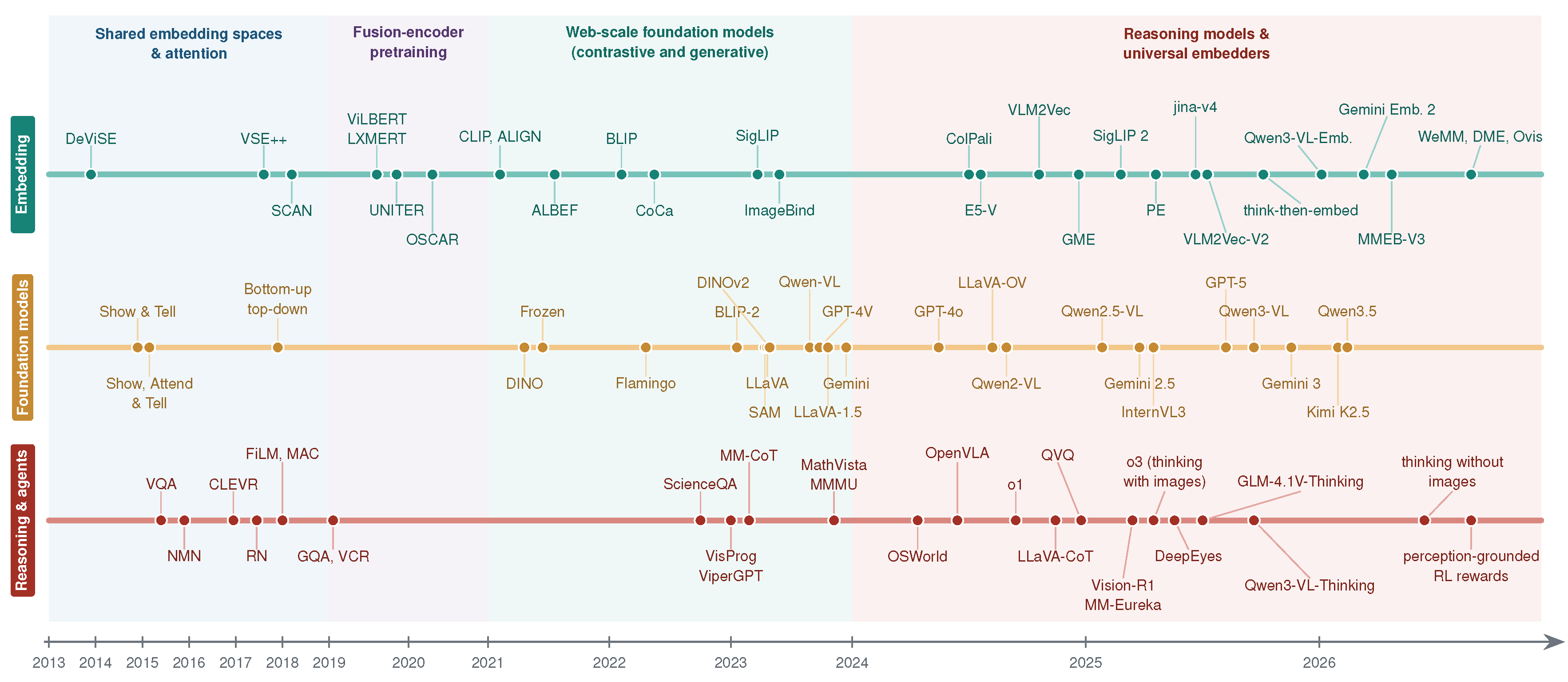
Figure 2.
A unified anatomy of multimodal reasoning, agentic and embedding models. Encoders , connector and backbone form the foundation model; an embedding head returns a unit vector for search, while a generative head produces answers, rationales and actions, possibly inside a reasoning or agent loop. The legend traces each model family.
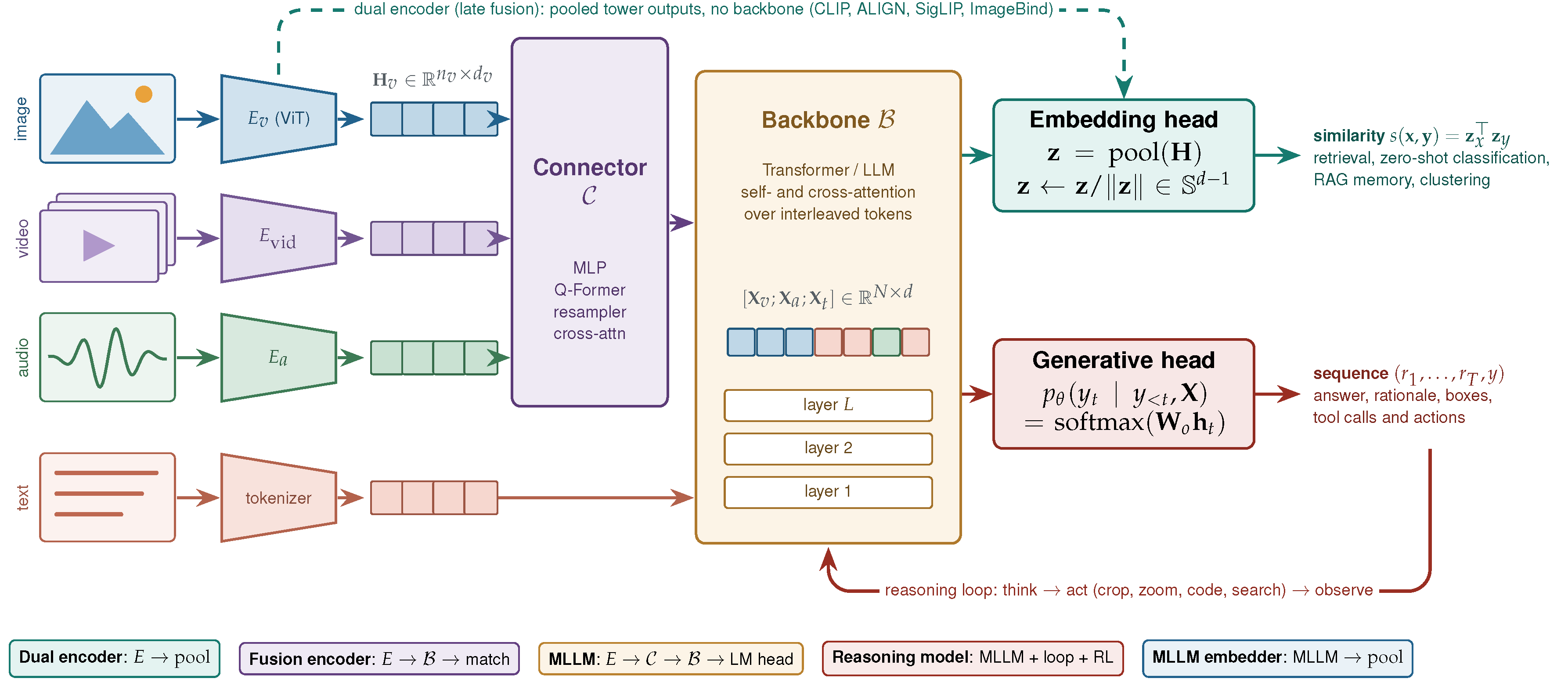
Figure 3.
Taxonomy of multimodal reasoning, agentic and embedding models and their foundation backbones, with representative works. Categories overlap: CoCa is both a dual encoder and a captioner, and Kimi-VL-Thinking both an MLLM and an RL-trained reasoner.
Figure 3.
Taxonomy of multimodal reasoning, agentic and embedding models and their foundation backbones, with representative works. Categories overlap: CoCa is both a dual encoder and a captioner, and Kimi-VL-Thinking both an MLLM and an RL-trained reasoner.
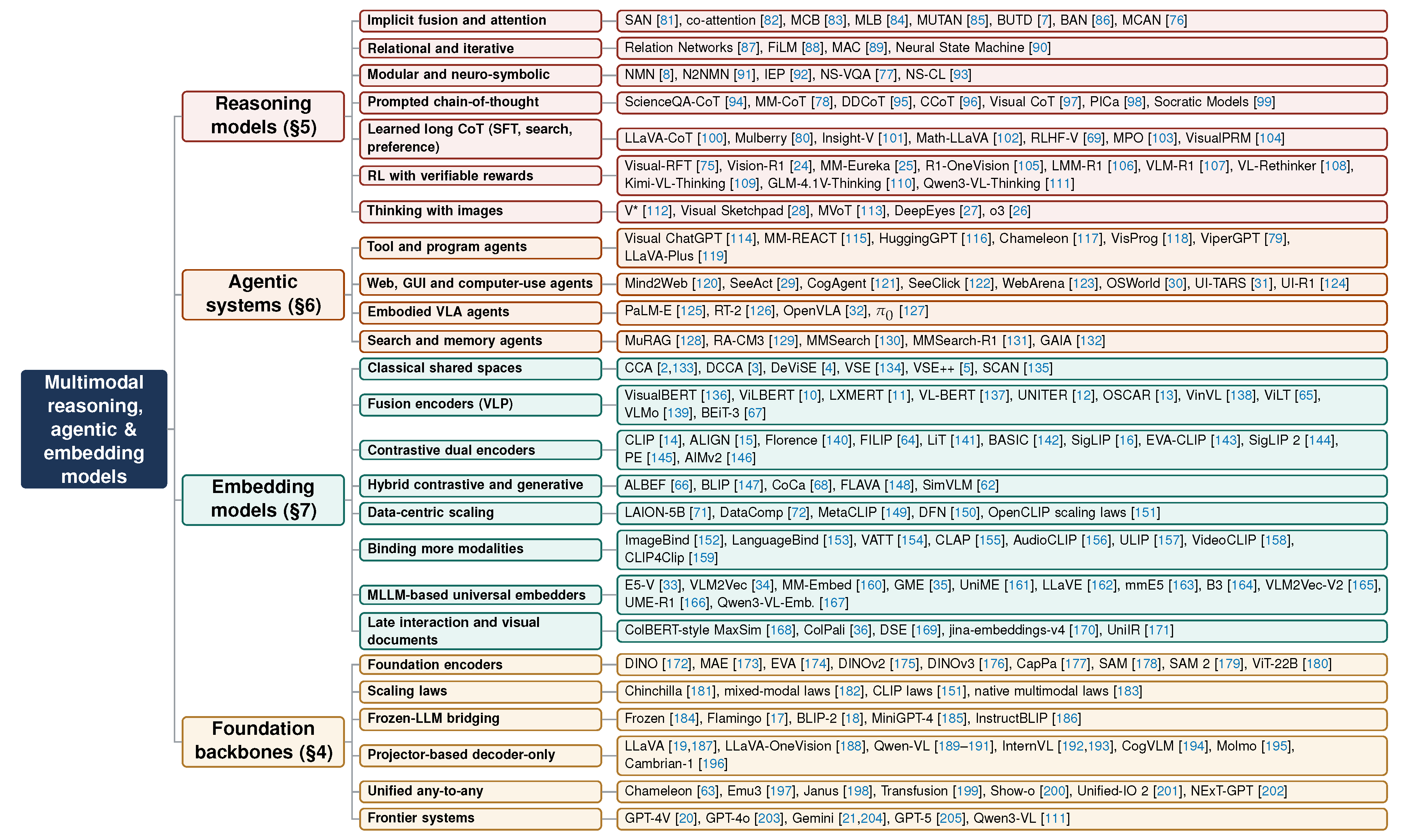
Figure 5.
Three families of multimodal foundation models. (a) Foundation encoders map an input to features or a unit vector. (b) Generative MLLMs connect an encoder to an LLM through a connector . (c) Native any-to-any models tokenize every modality for one Transformer. The bottom band lists adaptation techniques Sections 5-7.
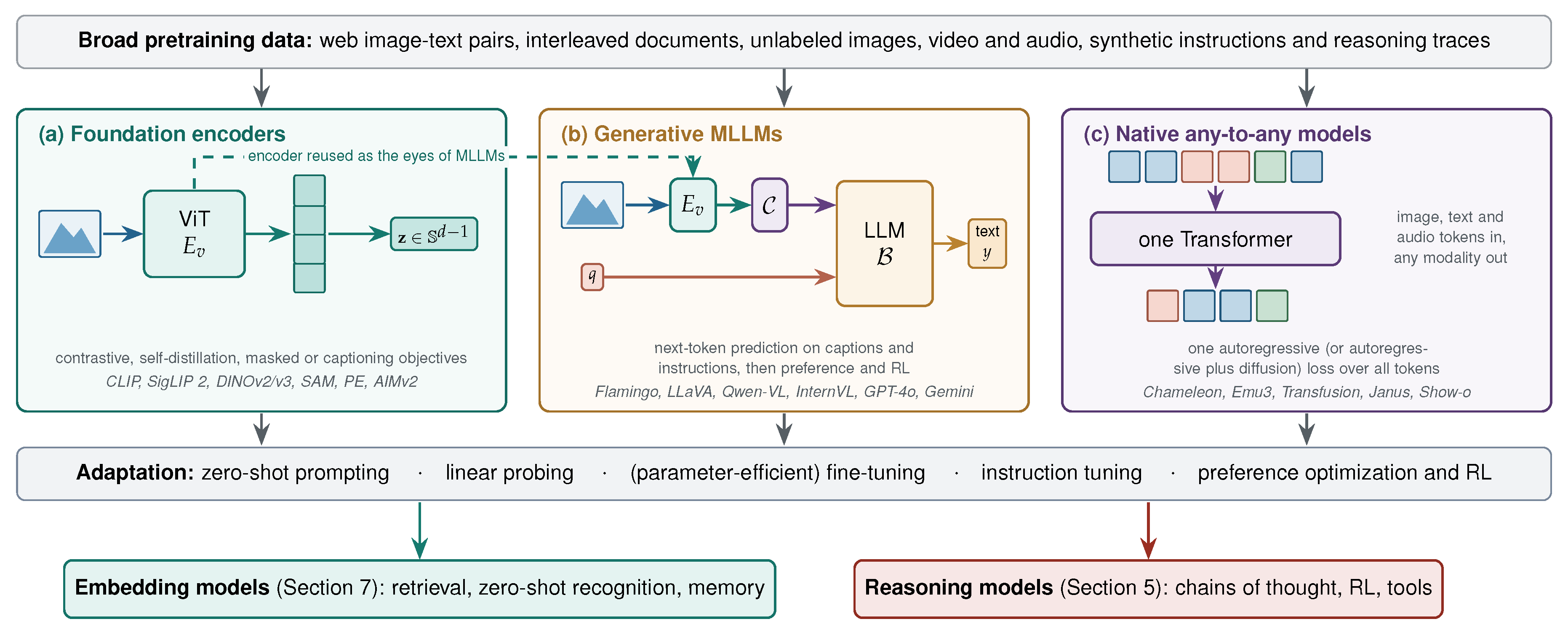
Figure 6.
Connector designs. (a) An MLP projector keeps all n tokens. (b) Learned queries compress them to K. (c) Dynamic tiling raises resolution, and pixel shuffle trades tokens for channels. (d) Modality-specific weights fuse vision in every LLM layer.
Figure 6.
Connector designs. (a) An MLP projector keeps all n tokens. (b) Learned queries compress them to K. (c) Dynamic tiling raises resolution, and pixel shuffle trades tokens for channels. (d) Modality-specific weights fuse vision in every LLM layer.
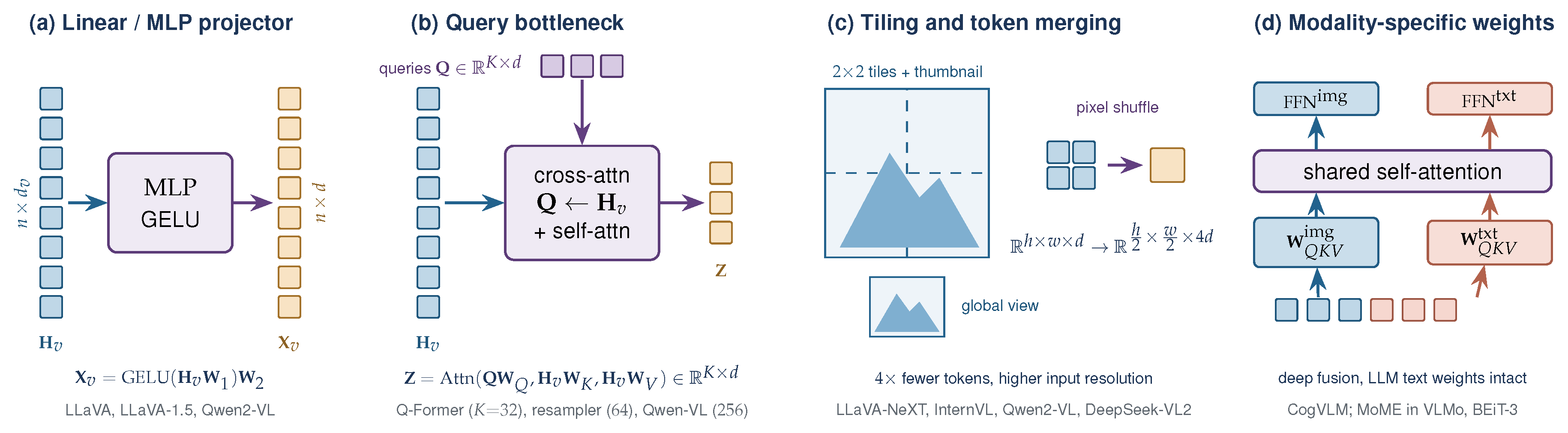
Figure 7.
Six paradigms of multimodal reasoning: (a) fusion networks classify over fixed answers; (b) modular methods execute a parsed program; (c) prompted chain-of-thought writes a rationale first; (d) an LLM calls visual tools or writes code; (e) RL with verifiable rewards trains long, self-correcting chains; (f) thinking with images interleaves visual operations with thoughts.
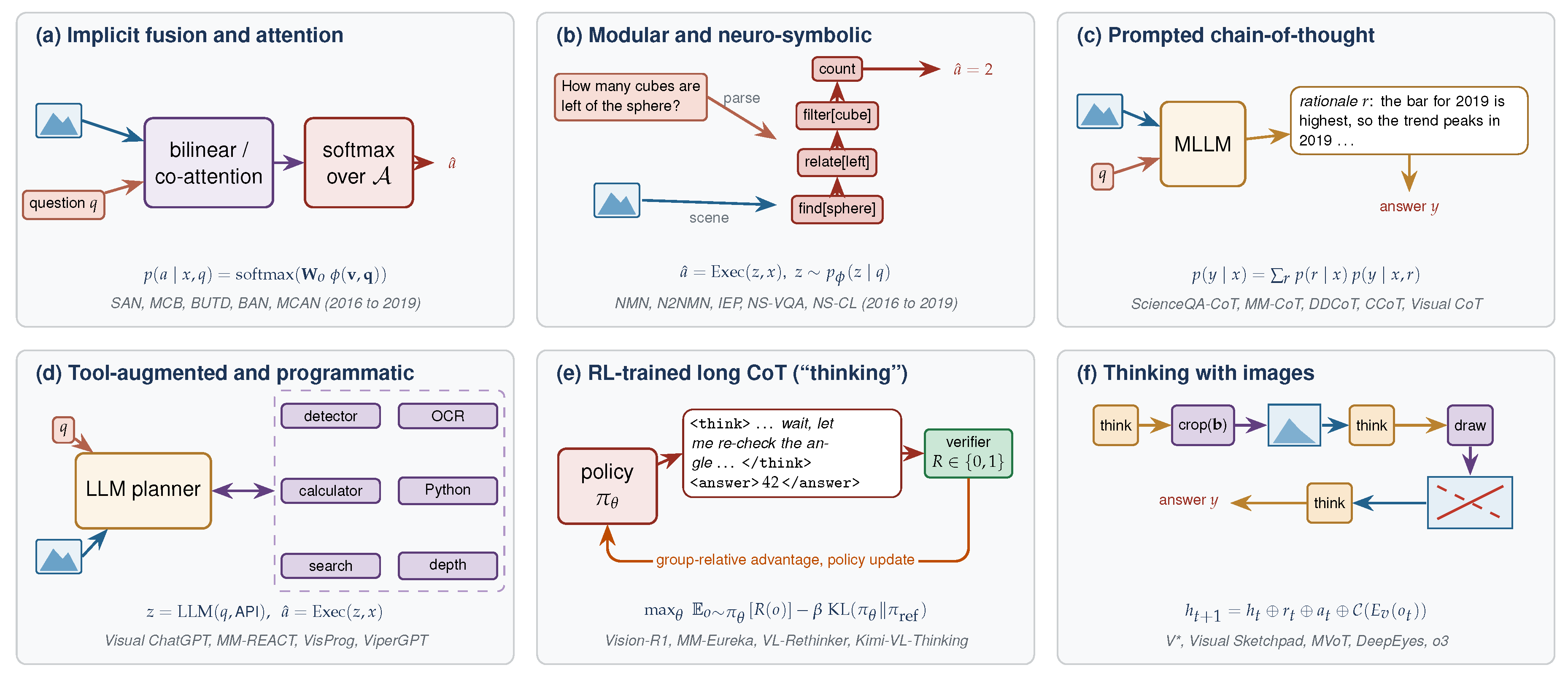
Figure 9.
The perception, reasoning and action loop of a multimodal agent. An MLLM policy perceives an observation, writes a thought and emits an action (a click, an API call, code, a motor command or a search query); the environment returns the next observation. An embedding index serves as long-term memory, and task outcomes provide rewards for supervised and reinforcement learning.
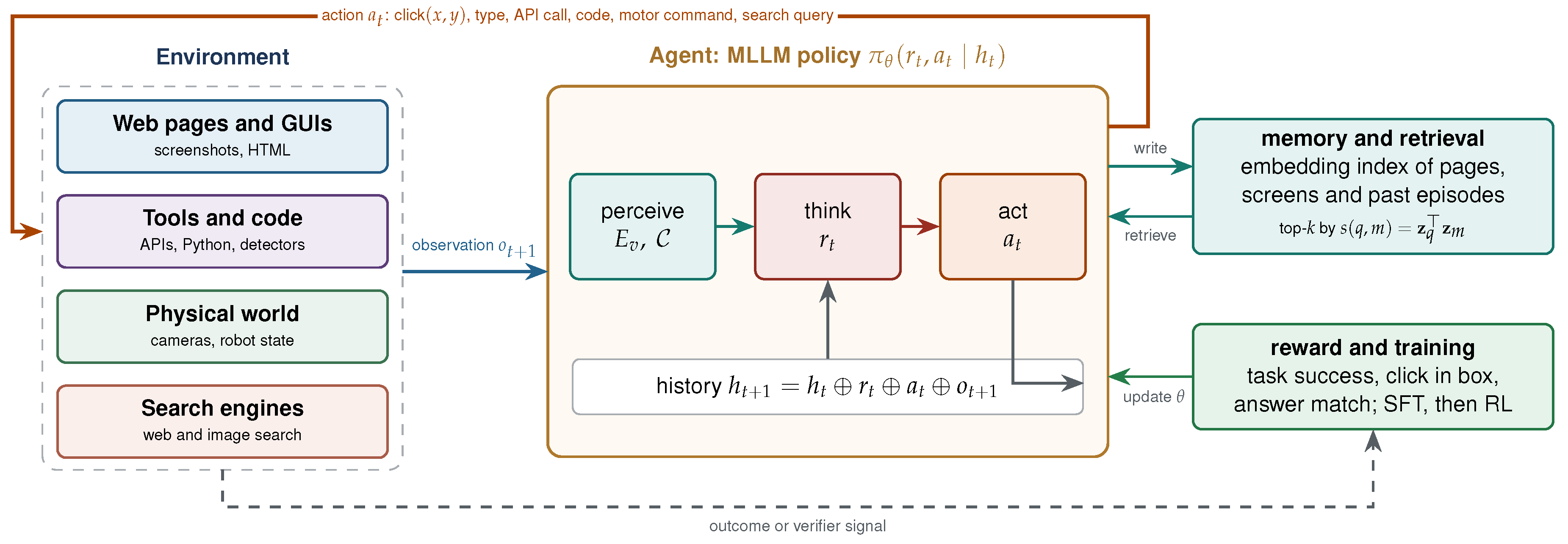
Figure 10.
Contrastive objectives. (a) InfoNCE normalizes each row and column of the batch similarity matrix, whose diagonal holds the positives. (b) The sigmoid loss treats each entry as an independent binary problem. (c) Compositional hard negatives fall inside the margin and dominate the gradient of ranking losses.
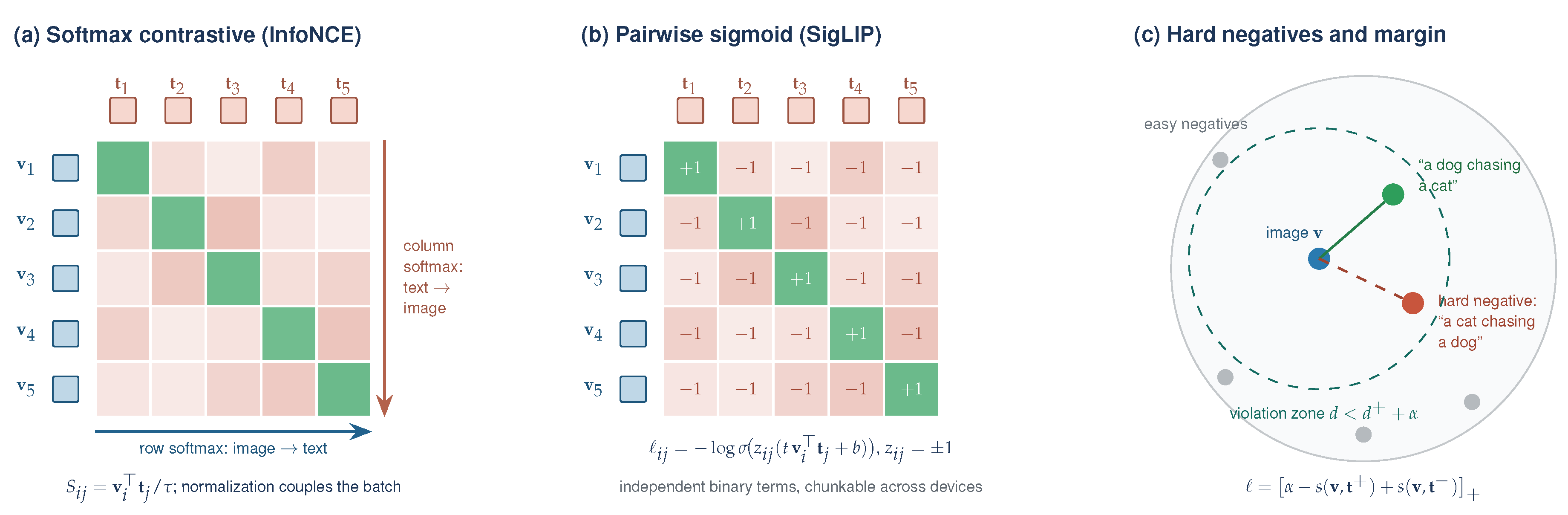
Figure 12.
Scoring paradigms for multimodal retrieval. (a) Single-vector bi-encoders permit offline indexing; (b) late interaction sums per-token maxima over multi-vector outputs; (c) cross-encoders attend jointly and serve as rerankers; (d) MLLM embedders read the final hidden state after an instruction and an interleaved input.
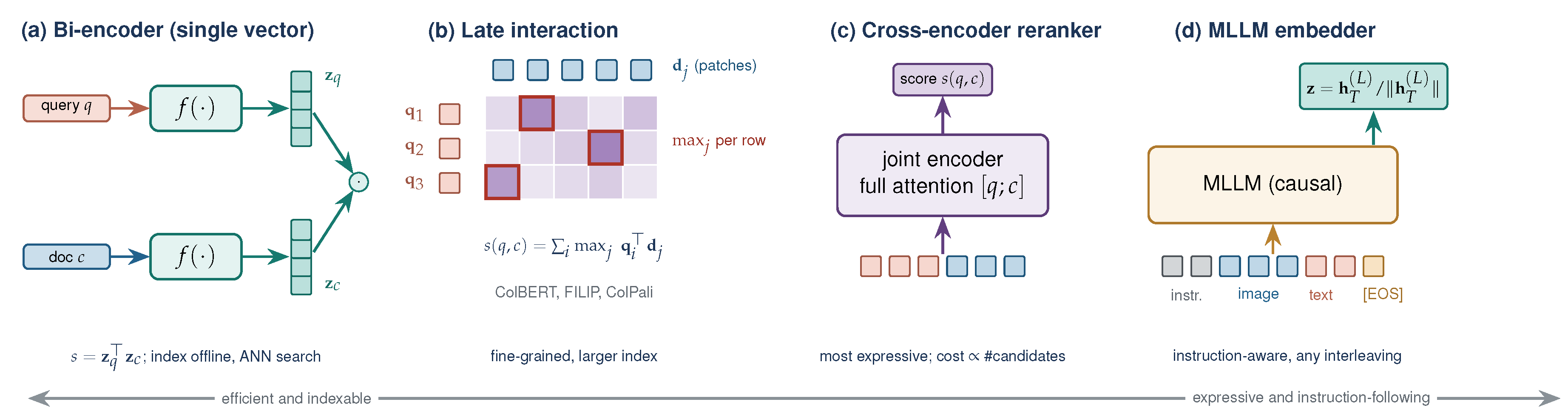
Figure 13.
Geometry of multimodal embedding spaces. (a) The modality gap separates image and text cones, although matched pairs (dotted) remain relatively close. (b) Alignment pulls positives together; uniformity spreads all embeddings. (c) Independently trained vision and language representations converge with scale.
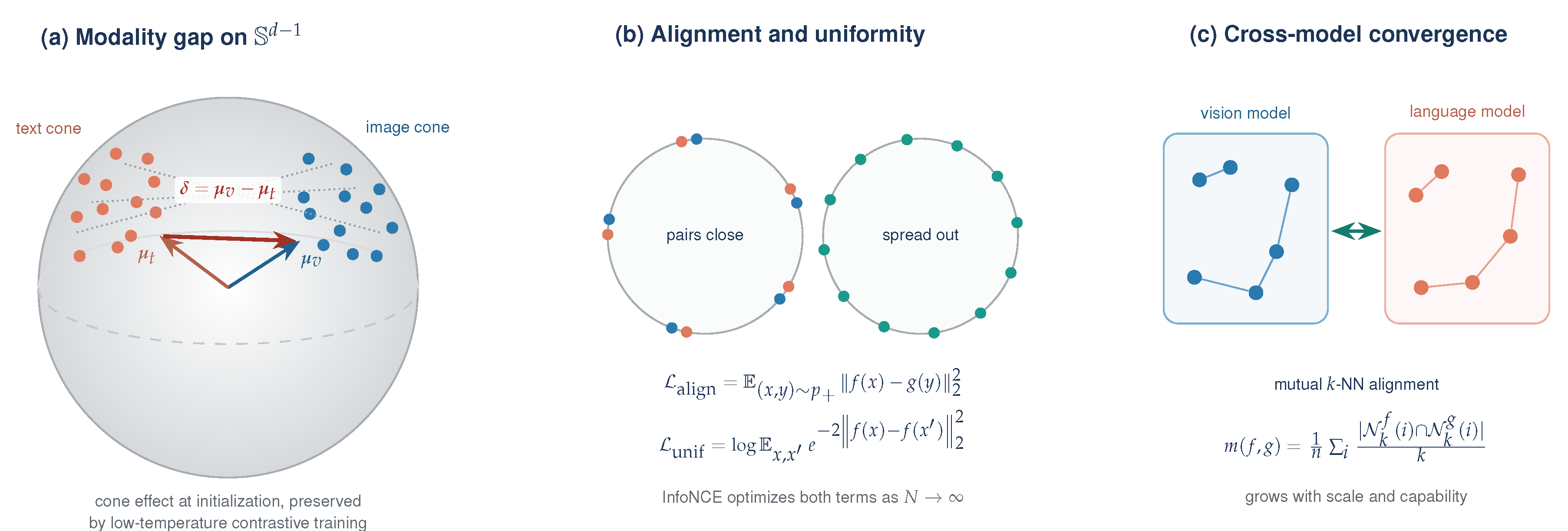
Figure 14.
Vendor-reported accuracy over release date on (a) MMMU (val) and (b) MathVista (testmini), with human references; thinking models are diamonds.
Figure 14.
Vendor-reported accuracy over release date on (a) MMMU (val) and (b) MathVista (testmini), with human references; thinking models are diamonds.
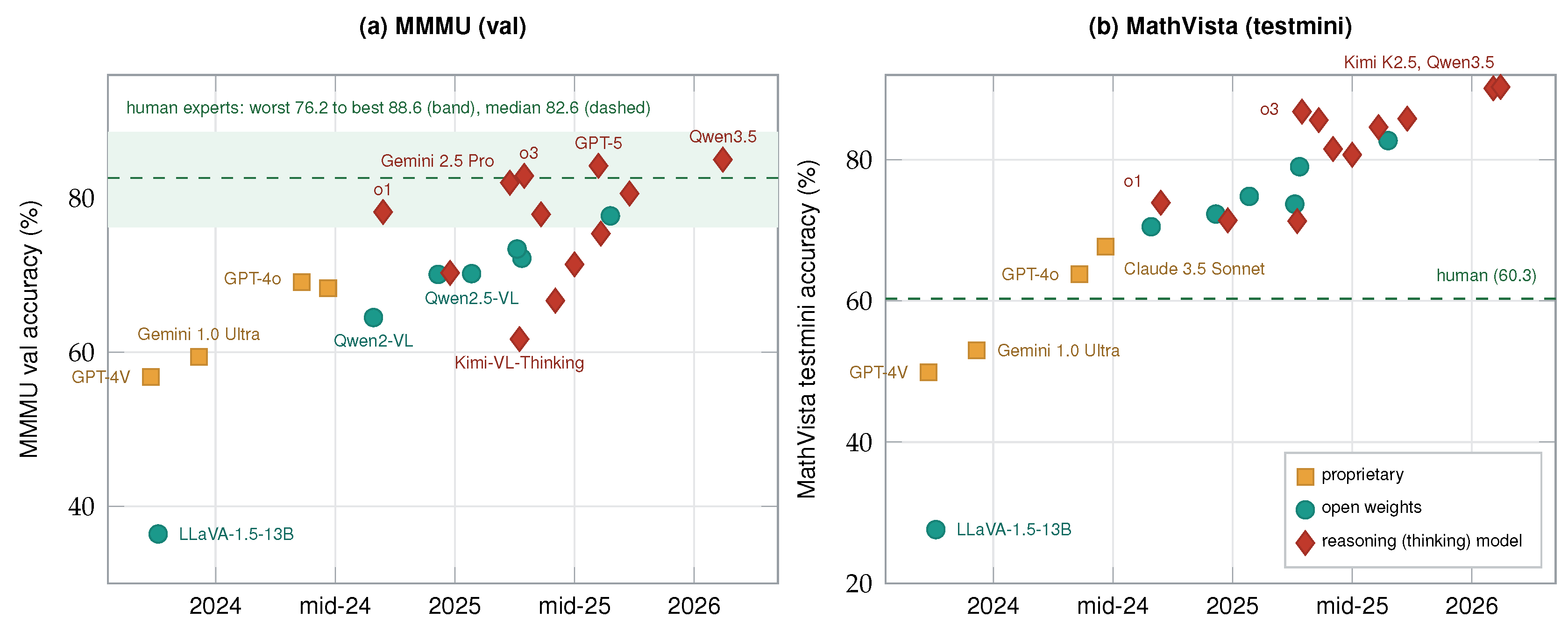
Table 1.
Positioning relative to representative surveys (coarse assessment). ✓: central topic, ○ partial coverage, ✗: not covered (often because the topic post-dates the survey).
Table 1.
Positioning relative to representative surveys (coarse assessment). ✓: central topic, ○ partial coverage, ✗: not covered (often because the topic post-dates the survey).
| Survey | Year | Primary focus | RL-trained reasoning |
Multimodal agents |
Contrastive and universal embeddings |
|---|---|---|---|---|---|
| Baltrušaitis et al. [37] | 2019 | taxonomy of multimodal ML | ✗ | ✗ | ○ |
| Gan et al. [39] | 2022 | vision-language pretraining | ✗ | ✗ | ✓ |
| Xu et al. [42] | 2023 | multimodal Transformers | ✗ | ✗ | ○ |
| Zhang et al. [40] | 2024 | VLMs for vision tasks | ✗ | ✗ | ✓ |
| Liang et al. [38] | 2024 | principles of multimodal ML | ✗ | ✗ | ○ |
| Yin et al. [43] | 2024 | multimodal LLMs | ✗ | ○ | ✗ |
| Li et al. [44] | 2024 | foundation models | ✗ | ○ | ✓ |
| Bordes et al. [41] | 2024 | tutorial on VLMs | ✗ | ✗ | ✓ |
| Wang et al. [45] | 2025 | multimodal chain-of-thought | ○ | ○ | ✗ |
| Li et al. [46] | 2025 | large multimodal reasoning models | ✓ | ○ | ✗ |
| This survey | 2026 | reasoning, agents and embeddings, unified math | ✓ | ✓ | ✓ |
Table 2.
Notation.
| Symbol | Meaning | Symbol | Meaning |
|---|---|---|---|
| input of modality m (v vision, t text, a audio) | query, key and value matrices | ||
| encoder; | learnable weight matrix | ||
| connector (projector, queries, cross-attention) | query and retrieval candidate | ||
| backbone Transformer or LLM with L layers | reasoning chain (rationale) | ||
| normalized image and text embeddings | y | answer or output sequence | |
| batch logits, | policy (MLLM), frozen reference | ||
| temperature | reward and advantage of rollout i | ||
| N | batch size | G | rollouts per prompt (group size) |
| hidden state of token t at layer ℓ | action (tool call), observation |
Table 3.
Core objectives in the shared notation ( is the logistic function, a set of masked positions, preferred and rejected responses).
Table 3.
Core objectives in the shared notation ( is the logistic function, a set of masked positions, preferred and rejected responses).
| Objective | Formula | Representative use |
|---|---|---|
| InfoNCE (contrastive) | CLIP, ALIGN, ImageBind | |
| Sigmoid (pairwise) | , , | SigLIP, SigLIP 2 |
| Triplet / hinge | DeViSE, VSE++ | |
| Image-text matching | UNITER, ALBEF, BLIP | |
| Masked modeling | ViLBERT, UNITER, BEiT-3 | |
| Autoregressive LM | SimVLM, CoCa, LLaVA | |
| Preference (DPO) | RLHF-V, MPO | |
| Policy optimization | (PPO, GRPO) | Vision-R1, MM-Eureka |
Table 4.
Design matrix: five complementary axes for classifying multimodal reasoning, agentic and embedding models.
Table 4.
Design matrix: five complementary axes for classifying multimodal reasoning, agentic and embedding models.
| Axis | Categories | Representative works |
|---|---|---|
| A. Architecture | dual encoder; single-stream fusion; dual-stream fusion; encoder-decoder; decoder-only MLLM; cross-attention MLLM; unified any-to-any | CLIP [14]; UNITER [12]; ViLBERT [10]; SimVLM [62]; LLaVA [19]; Flamingo [17]; Chameleon [63] |
| B. Fusion depth | late (score); token-level late interaction; intermediate (cross-attention); bottleneck (learned queries); early (shared tokens) | ALIGN [15]; FILIP [64], ColPali [36]; LXMERT [11]; BLIP-2 [18]; ViLT [65] |
| C. Objective | contrastive; sigmoid; matching; masked; generative; distillation; preference; RL | CLIP; SigLIP [16]; ALBEF [66]; BEiT-3 [67]; CoCa [68]; RLHF-V [69]; Vision-R1 [24] |
| D. Supervision | annotated; web alt-text; curated web; synthetic; preference; verifiable reward | COCO [70]; LAION-5B [71]; DataComp [72]; ShareGPT4V [73]; LLaVA-RLHF [74]; Visual-RFT [75] |
| E. Reasoning and agency | implicit; modular; prompted CoT; tool-augmented; learned long CoT; RL thinking; thinking with images; agentic | MCAN [76]; NS-VQA [77]; MM-CoT [78]; ViperGPT [79]; Mulberry [80]; MM-Eureka [25]; DeepEyes [27]; UI-TARS [31]; OpenVLA [32] |
Table 5.
Families of multimodal foundation models, their pretraining objectives and their role in this review.
Table 5.
Families of multimodal foundation models, their pretraining objectives and their role in this review.
| Family | Pretraining objective | Output | Representative models | Role |
|---|---|---|---|---|
| Contrastive encoders | InfoNCE or sigmoid loss on image-text pairs | unit vector, patch features | CLIP [14], ALIGN [15], SigLIP 2 [144], EVA-CLIP [143], PE [145] | embedding; eyes of MLLMs |
| Self-supervised encoders | self-distillation, masked image modeling | patch features | DINO [172], MAE [173], EVA [174], DINOv2 [175], DINOv3 [176] | dense perception; complementary eyes |
| Generative encoders | captioning or autoregressive pixel and text prediction | patch features | CapPa [177], AIMv2 [146] | eyes of MLLMs |
| Promptable segmenters | supervised masks from a data engine | masks, tracks | SAM [178], SAM 2 [179], SAM 3 [212] | grounding tools |
| Generative MLLMs | next-token prediction given visual tokens | text | Flamingo [17], BLIP-2 [18], LLaVA [19], Qwen-VL [189], InternVL [192] | reasoning; MLLM embedders |
| Native any-to-any | one loss over interleaved tokens of all modalities | any modality | Chameleon [63], Emu3 [197], Transfusion [199], Janus [198] | unified understanding and generation |
Table 6.
Representative MLLM architectures (year of first public release; visual tokens per image at the default resolution; “dynamic” means the count grows with input resolution).
Table 6.
Representative MLLM architectures (year of first public release; visual tokens per image at the default resolution; “dynamic” means the count grows with input resolution).
| Model | Year | Vision encoder | Connector | LLM | Tokens | Distinctive idea |
|---|---|---|---|---|---|---|
| Flamingo [17] | 2022 | NFNet-F6 | resampler + gated xattn | Chinchilla (70B) | 64 | interleaved few-shot learning |
| BLIP-2 [18] | 2023 | EVA ViT-g/14 | Q-Former | OPT, Flan-T5 | 32 | frozen encoder and LLM |
| LLaVA [19] | 2023 | CLIP ViT-L/14 | linear | Vicuna (13B) | 256 | GPT-4-generated instructions |
| InstructBLIP [186] | 2023 | EVA ViT-g/14 | instruction-aware Q-Former | Vicuna, Flan-T5 | 32 | instruction-conditioned queries |
| Qwen-VL [189] | 2023 | ViT-bigG | cross-attn (256 queries) | Qwen (7B) | 256 | grounding and text reading |
| LLaVA-1.5 [187] | 2023 | CLIP ViT-L/14 (336) | 2-layer MLP | Vicuna (7B, 13B) | 576 | simple, data-efficient recipe |
| CogVLM [194] | 2023 | EVA2-CLIP-E | MLP + visual expert | Vicuna (7B) | about 1.2k | deep fusion inside the LLM |
| InternVL 1.5 [220] | 2024 | InternViT-6B | MLP + pixel shuffle | InternLM2 (20B) | 256 per tile | dynamic high resolution |
| Qwen2-VL [190] | 2024 | ViT (675M) | MLP, merge | Qwen2 (up to 72B) | dynamic | native resolution, M-RoPE |
| Llama 3-V [208] | 2024 | ViT-H/14 | cross-attention layers | Llama 3 | n/a | adapters on a frozen LLM |
| Cambrian-1 [196] | 2024 | 4 encoders | spatial aggregator | Llama 3, Vicuna, Yi | 576 | vision-centric design study |
| Molmo [195] | 2024 | CLIP ViT-L/14 | MLP with pooling | OLMo, Qwen2 | multi-crop | open dense-caption and pointing data |
| LLaVA-OV [188] | 2024 | SigLIP So400m | 2-layer MLP | Qwen2 | dynamic | image, multi-image and video transfer |
| DeepSeek-VL2 [223] | 2024 | SigLIP So400m | MLP, dynamic tiling | DeepSeekMoE | dynamic | mixture-of-experts LLM |
| Chameleon [63] | 2024 | VQ tokenizer | none (early fusion) | from scratch (7B, 34B) | 1024 | mixed-modal generation |
| Qwen2.5-VL [191] | 2025 | ViT, window attention | MLP | Qwen2.5 | dynamic | absolute time encoding, agents |
| InternVL3 [193] | 2025 | InternViT | MLP + pixel shuffle | Qwen2.5, InternLM3 | 256 per tile | native multimodal pretraining |
| Kimi-VL [109] | 2025 | MoonViT | MLP | MoE (2.8B active) | dynamic | long context, thinking variant |
Table 7.
Representative multimodal reasoning methods by paradigm (year of first public release). SFT: supervised fine-tuning; RL: reinforcement learning.
Table 7.
Representative multimodal reasoning methods by paradigm (year of first public release). SFT: supervised fine-tuning; RL: reinforcement learning.
| Method | Year | Paradigm | Training signal | Key idea |
|---|---|---|---|---|
| MCAN [76] | 2019 | implicit fusion | answer classification | stacked self- and guided attention |
| NS-VQA [77] | 2018 | neuro-symbolic | programs, supervised parsing | symbolic execution on a scene table |
| MM-CoT [78] | 2023 | prompted / tuned CoT | rationales (SFT) | two stages: rationale, then answer |
| VisProg [118] | 2022 | programmatic | none (in-context) | LLM-written modular programs |
| ViperGPT [79] | 2023 | programmatic | none (in-context) | Python over a vision API |
| Visual CoT [97] | 2024 | grounded CoT | boxes + rationales (SFT) | predict, crop and re-encode a region |
| Visual Sketchpad [28] | 2024 | thinking with images | none (prompting) | draw with code as a visual chain |
| LLaVA-CoT [100] | 2024 | learned long CoT | structured traces (SFT) | four stages; stage-level beam search |
| Mulberry [80] | 2024 | learned long CoT | search-derived traces | collective Monte Carlo tree search |
| VisualPRM [104] | 2025 | verifier | step labels | process reward model for best-of-N |
| Visual-RFT [75] | 2025 | RL | IoU and class rewards | verifiable rewards for perception |
| Vision-R1 [24] | 2025 | SFT + RL | answer and format rewards | cold start from bridged text chains |
| MM-Eureka [25] | 2025 | RL | rule-based rewards | large-scale rule-based RL |
| VL-Rethinker [108] | 2025 | RL | rule-based rewards | selective replay, forced rethinking |
| Kimi-VL-Thinking [109] | 2025 | SFT + RL | long-CoT data, rewards | MoE with 2.8B active parameters |
| GLM-4.1V-Thinking [110] | 2025 | SFT + RL | curriculum-sampled RL | scalable multi-domain RL |
| DeepEyes [27] | 2025 | thinking with images | RL with tool rewards | learned zoom-in grounding |
| MVoT [113] | 2025 | thinking with images | interleaved supervision | generated images as thoughts |
Table 8.
Families of multimodal agents by environment and action space, with representative systems and benchmarks.
Table 8.
Families of multimodal agents by environment and action space, with representative systems and benchmarks.
| Family | Observation | Action space | Representative systems | Benchmarks |
|---|---|---|---|---|
| Tool and program agents | image, text, tool outputs | API calls, generated code | Visual ChatGPT [114], MM-REACT [115], HuggingGPT [116], VisProg [118], ViperGPT [79], LLaVA-Plus [119] | GAIA [132] |
| Web and GUI agents | screenshots, HTML or accessibility tree | click, type, scroll | SeeAct [29], CogAgent [121], SeeClick [122], UI-TARS [31], UI-R1 [124] | Mind2Web [120], WebArena [123], VisualWebArena [289], OSWorld [30], AndroidWorld [290] |
| Embodied (vision-language-action) agents | camera images, robot state | discretized or continuous robot actions | PaLM-E [125], RT-2 [126], OpenVLA [32], [127] | real-robot task success |
| Search and memory agents | images, retrieved pages | search queries, retrieval | MuRAG [128], RA-CM3 [129], MMSearch-R1 [131] | MMSearch [130] |
| Visual-action reasoners | image and its crops | crop, zoom, draw, run code | Visual Sketchpad [28], o3 [26], DeepEyes [27] | high-resolution VQA (Section 5.7) |
Table 9.
Contrastive and hybrid dual encoders (year of first release). IN-ZS: reported ImageNet-1k zero-shot top-1 accuracy of the best configuration (%). Data: unique pretraining image-text pairs.
Table 9.
Contrastive and hybrid dual encoders (year of first release). IN-ZS: reported ImageNet-1k zero-shot top-1 accuracy of the best configuration (%). Data: unique pretraining image-text pairs.
| Model | Year | Image encoder | Objective | Data | IN-ZS |
|---|---|---|---|---|---|
| CLIP [14] | 2021 | ViT-L/14 (336 px) | InfoNCE | 400M (WIT) | 76.2 |
| ALIGN [15] | 2021 | EfficientNet-L2 | InfoNCE | 1.8B noisy alt-text | 76.4 |
| Florence [140] | 2021 | CoSwin-H | unified contrastive | 900M | 83.7 |
| FILIP [64] | 2021 | ViT-L/14 | token-wise contrastive | 340M | 77.1 |
| LiT [141] | 2021 | ViT-g/14 (locked) | InfoNCE, locked image tower | about 4B | 85.2 |
| CoCa [68] | 2022 | ViT (1B) | contrastive + captioning | JFT-3B + ALIGN | 86.3 |
| BASIC [142] | 2021 | CoAtNet-7 | InfoNCE, very large batch | 6.6B | 85.7 |
| OpenCLIP [151] | 2022 | ViT-bigG/14 | InfoNCE | LAION-2B | 80.1 |
| EVA-02-CLIP [143] | 2023 | EVA-02-E/14+ | InfoNCE, MIM initialization | Merged-2B | 82.0 |
| SigLIP [16] | 2023 | So400m/14 (384 px) | sigmoid | WebLI | 83.2 |
| DataComp [72] | 2023 | ViT-L/14 | InfoNCE | 1.4B filtered | 79.2 |
| MetaCLIP [149] | 2023 | ViT-H/14 | InfoNCE | 2.5B curated | 80.5 |
| DFN [150] | 2023 | ViT-H/14 (378 px) | InfoNCE | 5B filtered | 84.4 |
| EVA-CLIP-18B [214] | 2024 | EVA (18B) | InfoNCE | LAION + COYO | 83.8 |
| SigLIP 2 [144] | 2025 | ViT-g/16 (384 px) | sigmoid + decoder + self-distill. | WebLI (10B images) | 85.0 |
| TULIP [304] | 2025 | ViT-G/16 (384 px) | sigmoid + intra-modal terms | SigLIP init. | 85.3 |
| PE-Core [145] | 2025 | ViT-G/14 (448 px) | InfoNCE + alignment tuning | 5.4B curated | 85.4 |
| MetaCLIP 2 [308] | 2025 | ViT-H/14 | InfoNCE, multilingual | worldwide curated | 81.3 |
Table 10.
MLLM-based and instruction-aware multimodal embedders (year of first release). V1: overall MMEB score (36 tasks); V2: overall MMEB-V2 score (78 tasks), as reported for the size in parentheses; “z”: zero-shot; n/r: not reported.
Table 10.
MLLM-based and instruction-aware multimodal embedders (year of first release). V1: overall MMEB score (36 tasks); V2: overall MMEB-V2 score (78 tasks), as reported for the size in parentheses; “z”: zero-shot; n/r: not reported.
| Model | Year | Backbone | Output | Key idea | V1 | V2 |
|---|---|---|---|---|---|---|
| UniIR [171] | 2023 | CLIP, BLIP | single vector | instruction-tuned retrieval over 8 tasks (M-BEIR) | n/r | n/r |
| MagicLens [334] | 2024 | CLIP, CoCa | single vector | self-supervised triplets with open-ended instructions | n/r | n/r |
| VISTA [333] | 2024 | ViT + BGE | single vector | image tokens fed into a text embedder | n/r | n/r |
| E5-V [33] | 2024 | LLaVA-NeXT (8B) | last token | one-word prompt; text-only training | 13.3 z | n/r |
| DSE [169] | 2024 | Phi-3-Vision | last token | document screenshots as single vectors | n/r | n/r |
| ColPali [36] | 2024 | PaliGemma (3B) | multi-vector | late interaction over page patches; ViDoRe nDCG@5 81.3 | n/r | n/r |
| VLM2Vec [34] | 2024 | LLaVA-1.6 / Qwen2-VL (7B) | last token | MMEB benchmark; large-batch contrastive training | 62.9 / 65.8 | n/r |
| MM-Embed [160] | 2024 | LLaVA-NeXT | last token | modality-aware hard negatives; M-BEIR R@5 52.7 | n/r | n/r |
| GME [35] | 2024 | Qwen2-VL (7B) | last token | fused-modal synthetic training data | n/r | 57.8 |
| UniME [161] | 2025 | LLaVA-1.6 (7B) | last token | distillation from a text embedder; hard negatives | 66.6 | n/r |
| LLaVE [162] | 2025 | LLaVA-OV (7B) | last token | hardness-weighted contrastive loss | 70.3 | n/r |
| mmE5 [163] | 2025 | Llama-3.2-Vision (11B) | last token | synthetic multilingual multimodal data | 69.8 | n/r |
| B3 [164] | 2025 | Qwen2-VL (7B) | last token | batches mined for hard negatives | 72.0 | n/r |
| jina-v4 [170] | 2025 | Qwen2.5-VL (3B) | single + multi | task-specific LoRA adapters; text, images, documents | n/r | n/r |
| VLM2Vec-V2 [165] | 2025 | Qwen2-VL (2B) | last token | images, videos and visual documents; MMEB-V2 | n/r | 58.0 |
| MetaEmbed [339] | 2025 | Qwen2.5-VL (32B) | meta tokens | test-time scalable multi-vector retrieval | 78.7 | n/r |
| UniME-V2 [338] | 2025 | LLaVA-OV (7B) | last token | MLLM judge for negatives and soft labels | 71.2 | n/r |
| TTE [349] | 2025 | Qwen2-VL (7B) | last token | embeds the query with a generated reasoning trace | n/r | 71.5 |
| UME-R1 [166] | 2025 | Qwen2-VL (7B) | generative | reasoning-driven embeddings trained with SFT and RL | n/r | 64.5 |
| Qwen3-VL-Emb. [167] | 2026 | Qwen3-VL (8B) | last token | reranker distillation; Matryoshka dimensions | n/r | 77.8 |
| MMEmb-R1 [350] | 2026 | Qwen3-VL (4B) | last token | pair-aware reasoning; RL decides when to reason | n/r | 71.2 |
| DME [341] | 2026 | Qwen3.5-based (9B) | last token | training-only latent reasoning | n/r | 78.4 |
| WeMM-Emb. [340] | 2026 | Qwen3.5 (9B) | last token | relevance refinement, cross-scale distillation | n/r | 80.6 |
| Ovis-Emb. [342] | 2026 | Qwen3.5 (9B) | last token | omni initialization, focal loss, similarity distillation | n/r | 81.1 |
Table 11.
Representative embedding (top) and reasoning (bottom) benchmarks with year of first release; sizes as originally reported (∼: approximately).
Table 11.
Representative embedding (top) and reasoning (bottom) benchmarks with year of first release; sizes as originally reported (∼: approximately).
| Benchmark | Year | Size | Focus | Metric |
|---|---|---|---|---|
| COCO / Flickr30K [70,363] | 2014 | 5k / 1k test images | image-text retrieval | Recall@K |
| Winoground [359] | 2022 | 400 examples | visio-linguistic compositionality | group score |
| ARO [358] | 2022 | more than 50k cases | relations, attributes, word order | accuracy |
| SugarCrepe [360] | 2023 | 7,512 examples | compositional hard negatives | accuracy |
| M-BEIR [171] | 2023 | 10 datasets, 5.6M pool | instructed universal retrieval | Recall@K |
| MMEB [34] | 2024 | 36 datasets, 4 meta-tasks | universal embeddings | precision@1 |
| ViDoRe [36] | 2024 | 10 page-retrieval tasks | visual document retrieval | nDCG@5 |
| MMEB-V2 [165] | 2025 | 78 tasks | image, video, visual documents | mean score |
| ViDoRe V3 [353] | 2026 | ∼26k pages, 3,099 queries | multilingual document RAG | retrieval, QA |
| MMEB-V3 [337] | 2026 | 190 tasks | omni-modal, audio, agentic tasks | mean score |
| MMVP [213] | 2024 | 150 pairs, 300 questions | CLIP-blind visual patterns | accuracy |
| VQA v2 [241] | 2016 | ∼1.1M questions | balanced open-ended VQA | VQA accuracy |
| CLEVR [9] | 2016 | 100k images, ∼1M questions | compositional diagnostics | accuracy |
| GQA [243] | 2019 | 22M questions, 113k images | scene-graph-based reasoning | accuracy |
| NLVR2 [366] | 2018 | 107,292 examples | reasoning over image pairs | accuracy |
| VCR [367] | 2018 | 290k questions | commonsense with rationales | Q→AR acc. |
| OK-VQA / A-OKVQA [364,365] | 2019 | 14,055 / ∼25k questions | outside knowledge | VQA accuracy |
| TextVQA / DocVQA / ChartQA [368,369,370] | 2019 | 45k / 50k / 33k questions | text in images, documents, charts | accuracy, ANLS |
| ScienceQA [94] | 2022 | 21,208 questions | science with lectures, explanations | accuracy |
| MathVista [371] | 2023 | 6,141 examples | mathematics in visual contexts | accuracy |
| MathVerse [372] | 2024 | 2,612 problems, 15k samples | reliance on diagrams | accuracy |
| MATH-Vision [373] | 2024 | 3,040 problems | competition mathematics | accuracy |
| MMMU [374] | 2023 | 11.5k questions, 30 subjects | college-level multidiscipline | accuracy |
| MMMU-Pro [375] | 2024 | 3,460 questions | robust MMMU, vision-only input | accuracy |
| MME [377] | 2023 | 14 subtasks | perception and cognition, yes/no | score |
| MMBench [361] | 2023 | ∼3k questions, 20 abilities | holistic, circular evaluation | accuracy |
| SEED-Bench [378] | 2023 | 19k questions | image and video understanding | accuracy |
| MM-Vet [362] | 2023 | 218 questions | integrated capabilities | LLM judge |
| MMStar [379] | 2024 | 1,500 samples | vision-indispensable questions | accuracy |
| HallusionBench [284] | 2023 | 1,129 questions | language hallucination, illusion | accuracy |
| POPE [283] | 2023 | 3k questions per setting | object hallucination | accuracy, F1 |
| BLINK [380] | 2024 | 3,807 questions, 14 tasks | core visual perception | accuracy |
| Video-MME [381] | 2024 | 900 videos, 2,700 QA pairs | video understanding | accuracy |
| EgoSchema [382] | 2023 | over 5,000 questions | long egocentric video | accuracy |
| HLE [376] | 2025 | 2,500 questions, 14% multimodal | frontier expert knowledge | accuracy |
Disclaimer/Publisher’s Note: The statements, opinions and data contained in all publications are solely those of the individual author(s) and contributor(s) and not of MDPI and/or the editor(s). MDPI and/or the editor(s) disclaim responsibility for any injury to people or property resulting from any ideas, methods, instructions or products referred to in the content. |
© 2026 by the authors. Licensee MDPI, Basel, Switzerland. This article is an open access article distributed under the terms and conditions of the Creative Commons Attribution (CC BY) license (http://creativecommons.org/licenses/by/4.0/).
Copyright: This open access article is published under a Creative Commons CC BY 4.0 license, which permit the free download, distribution, and reuse, provided that the author and preprint are cited in any reuse.