

Submitted:
31 October 2026
Posted:
03 November 2026
You are already at the latest version
Abstract
In airport clearance airspace, illegally flown unmanned aerial vehicles and birds in long-range imagery occupy extremely small pixel proportions, suffer from texture scarcity, and are readily overwhelmed by background clutter; consequently, generic detectors struggle to achieve accurate detection. To this end, this paper proposes a multi-dimensional attention collaborative optimization method that improves small-object detection performance across three complementary dimensions, feature enhancement, convolution decoupling, and loss reweighting. Initially, a multi-semantic self-attention module is developed, which employs multi-scale depthwise separable convolutions and group normalization to extract multi-semantic spatial features while guiding channel attention learning, thereby enhancing small-object response intensity. Subsequently, a receptive-field decoupled attention module is introduced, which decouples positions within the receptive field of standard convolution and independently assigns attention weights, thereby breaking the parameter-sharing limitation of convolution kernels and improving boundary regression sensitivity. Finally, a unified intersection-over-union loss is proposed, which adjusts the focus on predicted boxes of different qualities through dynamic scaling and annealing strategies, thereby strengthening the fine-grained refinement of high-quality boxes. Furthermore, the effectiveness of these three components is validated on four datasets: TIB, UB-SOD, Drone, and Flying. Notably, on TIB, the proposed method achieves 87.4% mAP50 and 38.9% mAP50-95, improving the baseline by 4.7% and 3.2%, respectively; moreover, it exhibits significant advantages over other methods.
Keywords:
airport clearance airspace
; small object detection
; UAVs
; attention mechanism
; loss function
1. Introduction
Airport clearance airspace security constitutes one of the most risk-sensitive links in the civil aviation transportation system. Birds and UAVs, as two principal hazard sources threatening airport clearance airspace, must be effectively detected and identified, as this directly bears on aircraft takeoff and landing safety and airport operational order. In recent years, with the rapid development of the low-altitude economy and the growing frequency of non-cooperative UAV activities, the risk of aerial intrusion into airport clearance airspace has risen markedly. Statistics indicate that bird strikes and UAV interference have become significant contributors to flight delays, flight returns, and even safety accidents. Against this backdrop, developing an efficient and accurate object detection system for clearance airspace has become an urgent requirement for establishing airport intelligent perception and security defense systems.
With respect to technical perspective, current object detection in airport clearance airspace relies primarily on multi-source means such as radar, electro-optical (EO) systems, radio reconnaissance, and acoustic sensing. Among these, EO detection plays an irreplaceable role in short-range object recognition and classification, owing to its high spatial resolution, visual confirmation capability, and low-cost deployment advantages. Nevertheless, EO image-based object detection faces extremely stringent challenges: birds and UAVs at long range often occupy only tens or even a few pixels, with highly limited texture details, thus constituting a typical extremely small object detection problem. Meanwhile, the background complexity of clearance airspace scenarios is exceptionally high—runway lights, building edges, and cloud textures may strongly interfere with objects, rendering weak small-object features highly susceptible to being overwhelmed. Even more challengingly, although birds and UAVs differ markedly in morphology, both degrade into blurred bright spots under low-resolution imaging conditions, leading to a sharp decline in inter-class separability. Collectively, these factors cause generic object detectors to suffer from severe missed detection and false detection in airport clearance airspace scenarios.
With respect to perspective of feature extraction and representation learning, existing methods exhibit three systematic deficiencies in addressing the above challenges. First, feature coordination across multiple semantic levels is insufficient. In deep features, small objects suffer severe loss of spatial structure due to downsampling; in shallow features, spatial details are preserved but semantic discriminability is lacking. Most existing attention mechanisms model only a single semantic level or a single dimension, making it difficult to achieve deep synergy between spatial structure and channel semantics; consequently, feature representations of bird and UAV objects become blurred and inconsistent. Second, the parameter-sharing mechanism of convolution kernels limits fine-grained enhancement of weak features. Standard convolution shares weights within a sliding window, so discriminative features in small-object regions are readily diluted by background textures. Although deformable and dilated convolutions enlarge the receptive field, they do not fundamentally achieve position-wise decoupling of object and background within the window, and weak signals in small-object regions remain difficult to strengthen independently. Third, the allocation of loss weights in the boundary regression stage lacks adaptation to the localization demands of small objects. Commonly used IoU-based losses adopt a relatively uniform weighting strategy for high-quality and low-quality boxes, whereas objects with extremely small pixel proportions are highly sensitive to localization deviations; a slight shift can cause IoU to plummet, and a fixed weighting strategy can hardly guide the model toward smooth optimization in the high-precision localization stage.
To address the above issues, this paper proposes a small-object detection algorithm for airport clearance airspace based on multi-dimensional attention mechanisms. In the feature extraction stage, a Multi-Semantic Self-Attention (MSSA) module uses multi-semantic spatial structures to guide channel self-attention learning, thereby enhancing the feature discriminability of small objects under complex clearance backgrounds and alleviating semantic discrepancies among multi-scale features. In the feature enhancement stage, a Receptive Field Decoupled Attention (RFDA) module independently assigns attention weights to different positions within the receptive-field sliding window, achieving fine-grained decoupling between objects and background and suppressing interference from runway lights and ground background on tiny objects. In the loss optimization stage, a Unified-IoU (UIoU) loss dynamically adjusts the loss weights of predicted boxes with different qualities without modifying geometric measurement rules, and introduces a cosine annealing strategy and an inverse focal mechanism to achieve a smooth transition from rapid convergence to high-precision localization. MSSA and RFDA enhance the distinguishability of small objects in the feature extraction stage, while UIoU optimizes the boundary learning process in the loss function stage, thereby systematically alleviating the core difficulties of weak features, susceptibility to being overwhelmed, and localization difficulty in small-object detection within clearance airspace.
The main contributions of this paper are summarized as follows:
1. We propose a Multi-Semantic Self-Attention module. By guiding channel self-attention learning with multi-semantic spatial structures, this module achieves deep synergy between spatial and channel dimensions, thereby enhancing the capture of weak features of small objects such as birds and UAVs across different semantic levels. Moreover, it alleviates semantic discrepancies among multi-scale features and improves feature discriminability for small objects in complex clearance scenarios.
2. Furthermore, we develop a Receptive Field Decoupled Attention module. Through the unfold operation, this module decomposes the input feature map into spatial features of multiple sliding windows, employs a dual-branch aggregation module to generate position-specific attention weights, and leverages parallel depthwise separable convolution branches to enhance local structural representation. Consequently, RFDA effectively overcomes the limitation of parameter sharing in standard convolution, suppresses background interference, and markedly improves the capture of weak features of small objects.
3. In addition, we introduce a Unified-IoU loss. This loss indirectly adjusts the loss weights of boxes with varying qualities by dynamically scaling the sizes of predicted boxes and ground-truth (GT) boxes. Furthermore, it incorporates a cosine annealing strategy and an inverse focal mechanism, enabling a smooth transition from rapid convergence to high-precision localization and providing a more rational optimization pathway for boundary regression of extremely small objects.
4. Finally, the effectiveness of the proposed method is validated on datasets related to airport clearance airspace. Specifically, MSSA, RFDA, and UIoU are integrated into a unified detection framework, and ablation and comparative experiments are conducted on the TIB, Drone, and Flying datasets, as well as on UB-SOD data for airport clearance scenarios. The results demonstrate that the three modules complement each other in the two stages of feature extraction and loss optimization, thereby significantly improving the detection accuracy and localization quality for small objects such as birds and UAVs.
The remainder of this paper is organized as follows. Section 2 reviews related work and research progress on small object detection and attention mechanisms. Section 3 details the proposed MSSA, RFDA, and UIoU. Section 4 presents the experimental setup, ablation studies, and comparative results. Section 5 concludes this paper and outlines future work.
2. Related Work
2.1. Small Object Detection
Small object detection aims to accurately identify objects that are tiny in size and scarce in features, constituting a highly challenging task in computer vision [1]. In remote sensing image analysis, objects typically occupy only a few pixels due to long imaging distances and diverse viewpoints, rendering their detection even more difficult. Early studies relied primarily on handcrafted features, such as Histogram of Oriented Gradients (HOG) [2] and Deformable Part Models (DPM) [3]; however, these methods exhibit limited generalization capability under complex backgrounds. With the advancement of deep learning, methods based on convolutional neural networks (CNNs) have achieved remarkable progress. For instance, STDnet proposed by Bosquet et al [4]. extracts high-resolution feature maps through an early visual attention mechanism, effectively improving the localization accuracy of small objects. For small objects in UAV imagery, GCL-YOLO proposed by Cao et al [5]. adopts GhostConv to construct a lightweight backbone and optimizes the feature pyramid structure and loss function, thereby improving detection accuracy while maintaining real-time performance. Similarly, Multi-YOLOv8 proposed by Sun et al [6]. effectively enhances the detection capability for infrared dim and small objects by fusing multi-frame motion information with background suppression information.
To address scale diversity and complex background interference in remote sensing images, researchers have explored various improvement strategies. Multi-scale feature fusion has proven to be an effective means; for example, the Feature Pyramid Network (FPN) [7] and its variants integrate feature information across scales through top-down and bottom-up pathways. On this basis, to better preserve fine details of small objects, several studies have introduced high-resolution feature representations. FENet proposed by Zhang et al [8]. enhances the feature representation capability for small objects by constructing high-resolution modules and a feature pyramid, combined with multi-granularity deformable convolutions. DsP-YOLO designed by Zhang et al [9]. is a lightweight detail-sensitive PAN structure (DsPAN) that strengthens local details and positional information by embedding feature transformation modules into the low-level pathway.
In recent years, Transformers have demonstrated considerable potential in object detection owing to their powerful global modeling capability. Miri Rekavandi et al [10]. systematically summarized the application of Transformers in small object detection. Some studies have attempted to combine Transformers with CNNs to balance local feature extraction and global context modeling. For example, an improved YOLOv8 model proposed by Ni et al [11]. enhances the model’s understanding of objects in UAV imagery through a parallel multi-scale feature extraction module and a scale-compensated feature pyramid network. To accommodate the arbitrary orientations of objects in remote sensing images, MiM-ISTD proposed by Li et al [12]. designs a “Mamba-in-Mamba” structure that leverages state space models to efficiently capture local and global information, improving detection accuracy while maintaining high efficiency. Furthermore, to address the low signal-to-clutter ratio and susceptibility to background overwhelming of dim and small objects in infrared images, the IWS method proposed by Zhang et al [13]. exploits object sparsity via structural tensors and suppresses clutter by incorporating contrast characteristics, achieving robust detection. IRGraphSeg proposed by Jia et al [14]. uniformly represents structural and textural information of images using graph neural networks, effectively extracting long-range dependencies through graph representation evolution blocks and feature fusion.
Small object detection based on standard convolution operations suffers from inherent deficiencies. Standard convolution extracts features through a sliding window with shared parameters, effectively reducing model parameters and computational complexity. Nevertheless, for small object detection, this sharing mechanism introduces fundamental drawbacks. Small objects occupy only an extremely small number of pixels and exhibit highly non-uniform spatial distributions. Small objects at different positions may possess entirely distinct local contexts, edge orientations, and background contrasts; however, a shared convolution kernel cannot adaptively capture such position-dependent discriminative information. More critically, within the same receptive-field window, the core pixels and background pixels of a small object contribute differently to classification, whereas standard convolution treats all pixels equally, causing small-object signals to be averaged out by the background.
2.2. Attention Mechanisms
Attention mechanisms, by simulating the human visual system, guide networks to focus on critical parts of input information and have become an important means of improving deep learning model performance [15]. Their core idea is to adaptively compute weights and recalibrate features. Squeeze-and-Excitation Networks [16] represent a classic channel attention mechanism, which explicitly models inter-channel dependencies through squeeze and excitation operations, enabling the network to focus on more informative feature channels. Subsequently, various attention mechanisms have been proposed to capture feature importance from different dimensions. The Convolutional Block Attention Module (CBAM) [17] further introduces spatial attention, refining features in both channel and spatial dimensions in a sequential manner. To reduce computational complexity, the Efficient Channel Attention (ECA) module [18] adopts one-dimensional convolution instead of fully connected layers, thereby improving efficiency while maintaining performance. The self-attention mechanism in Transformers breaks through the local receptive field limitation of CNNs, enabling the capture of long-range dependencies. Vision Transformer (ViT) [19] was the first to apply a pure Transformer architecture to image classification, whose core multi-head self-attention mechanism allows the model to jointly learn information from multiple representation subspaces. Building upon Transformers, task-specific improvements have continually emerged [20] [21].
The design and application of attention mechanisms have continuously advanced toward greater refinement and diversity. In form, they can be categorized into soft attention and hard attention [22]; the former aggregates all features through weighted averaging, whereas the latter focuses on key regions via stochastic sampling. According to the form of input features, attention can be divided into item-wise attention and position-wise attention [23]. At the input representation level, variants such as co-attention [24], self-attention [25], and hierarchical attention [26] have further emerged. Moreover, with respect to output representation, architectures such as multi-head attention [27] and multi-dimensional attention [28] have also been developed to learn richer feature information. These diverse attention mechanisms provide flexible and powerful tools for addressing various challenges in complex visual tasks.
Existing spatial attention mechanisms learn an attention map of the same size as the input and weight each spatial position, thereby alleviating, to a certain extent, the discrepancies among different positions. However, when convolution kernels with k>1 are adopted, attention weights remain shared within the receptive-field window, and overlapping regions exist between adjacent windows, within which pixels are repeatedly weighted by identical attention weights. This implies that, for small object detection, existing methods are unable to distinguish the importance of different positions within the same receptive-field window.
2.3. Loss Function
Bounding box regression (BBR) is a critical step that determines localization accuracy in object detection, and the design of its loss function directly affects model convergence speed and final performance. The IoU loss directly regresses LIOU=1-IOU, thereby achieving favorable scale invariance [29]. Nevertheless, when predicted boxes and ground-truth (GT) boxes do not overlap, the IoU loss remains constant at 1 with a zero gradient, failing to provide an effective optimization direction. To address this issue, Rezatofighi et al [30]. proposed the generalized IoU (GIoU) loss, which introduces a penalty term into the smallest enclosing box, enabling the model to learn gradients that drive predicted boxes toward GT boxes even in the absence of overlap. However, GIoU degenerates to the IoU loss in the containment case and converges slowly. Zheng et al [31]. further analyzed the geometric factors of IoU-based losses and proposed distance IoU (DIoU) and complete IoU (CIoU). DIoU introduces a normalized center distance as a penalty term and directly minimizes the Euclidean distance between box centers, markedly improving convergence speed. CIoU, in contrast, adds an aspect ratio consistency measure on the basis of DIoU, enabling the regression process to simultaneously consider three geometric factors: overlap area, center distance, and aspect ratio. However, the gradients of the aspect ratio term in CIoU have opposite signs, potentially leading to unreasonable optimization directions. SIoU proposed by Gevorgyan [32] introduces an angle cost; by guiding predicted boxes to rapidly drift toward the nearest coordinate axis, it further reduces the degrees of freedom in regression and accelerates convergence.
The above methods are dedicated to designing more refined geometric penalty terms, yet ignore the differences in contributions of predicted boxes of varying qualities during training. Zhang et al [33]. observed that low-quality samples, such as occluded and blurred small objects, generate excessively large harmful gradients that impair localization performance. To this end, they proposed the EIoU loss, which decomposes the aspect ratio term in CIoU into independent width and height differences, and, inspired by Focal Loss, proposed Focal-EIoU, which reduces the weights of low-quality samples through a static non-monotonic focusing mechanism. Tong et al [34]. pointed out that the focusing mechanism of Focal-EIoU is static and fails to fully exploit the potential of non-monotonic focusing. They proposed Wise-IoU (WIoU), which employs the outlier degree to dynamically evaluate anchor box quality and designs a dynamic non-monotonic focusing mechanism, enabling the model to focus on ordinary-quality anchor boxes while weakening the influence of extreme high- and low-quality samples.
Although the above methods have achieved notable progress, they still have limitations in small object detection. One hand, the design of geometric penalty terms tends to amplify noise in blurred small-object scenarios. On the other hand, existing focusing mechanisms mostly adopt static or monotonic strategies, making it difficult to achieve a smooth transition from rapid convergence to high-precision localization. Furthermore, existing methods generally decouple classification confidence from localization loss, neglecting their positive correlation, high-confidence predicted boxes often possess higher IoU and thus deserve greater optimization attention.
To address the above issues, we propose the UIoU loss. Unlike conventional methods that modify geometric measurement rules, UIoU indirectly adjusts the loss weights of boxes of different qualities by dynamically scaling the sizes of predicted and GT boxes. Specifically, we design a cosine annealing strategy based on bounding-box attention, such that the scaling factor smoothly transitions from greater than 1 to less than 1 as training proceeds; this suppresses gradient interference from low-quality boxes in the early training stage to achieve rapid convergence, while amplifying the losses of high-quality boxes in the later training stage to strengthen precise localization. Meanwhile, we propose an inverse focal mechanism (Focal-inv), which uses classification confidence as a weighting factor, enabling the model to focus on optimizing small-object predicted boxes that already possess relatively high confidence, thereby further refining boundaries. UIoU complements the MSSA and RFDA proposed in this paper: the former two enhance the distinguishability of small objects in the feature extraction stage, whereas the latter optimizes the boundary learning process in the loss function stage, jointly improving the detection accuracy for small objects in airport scenarios.
3. Proposed Method
In this section, we introduce the motivation and overview of our Multi-dimensional attention algorithm for small object detection in airport obstacle limitation airspace, and provide the details of the proposed network by several aspects. First, MSSA enhances the response intensity of small objects in feature maps along the spatial dimension and increases the probability of generating high-quality predicted boxes. Second, RFDA fundamentally overcomes the limitation imposed by convolution kernel parameter sharing on small-object feature extraction, thereby improving the sensitivity of the regression branch to boundary variations of small objects. Third, UIoU strengthens the localization of high-quality boxes in the later training stage, ensuring that the model learns more precise boundary regression from features enhanced by MSSA and RFDA.
3.1. Multi-Semantic Self-Attention Module
We propose a plug-and-play MSSA module. This module guides channel self-attention learning through multi-semantic spatial structures, thereby enhancing the feature discriminability of small objects in complex scenarios while alleviating semantic discrepancies among multi-scale features and achieving deep synergy between spatial and channel dimensions. The overall architecture is illustrated in Figure 2. Specifically, this structure operates from two aspects. At the spatial level, it leverages multi-semantic spatial structures to capture weak features of small objects at different semantic levels. At the channel level, it employs channel self-attention to enhance the global consistency of small-object features and avoid information loss caused by semantic ambiguity. Through the above operations, the proposed module effectively addresses the core challenges confronting small object detection—namely, the extremely small pixel proportions occupied by objects, limited texture details, and susceptibility to background interference—which lead to blurred feature representations and render small objects prone to being overwhelmed by large-scale objects or noise.
Figure 1.
Schematic illustration of the Multi-Semantic Self-Attention architecture.
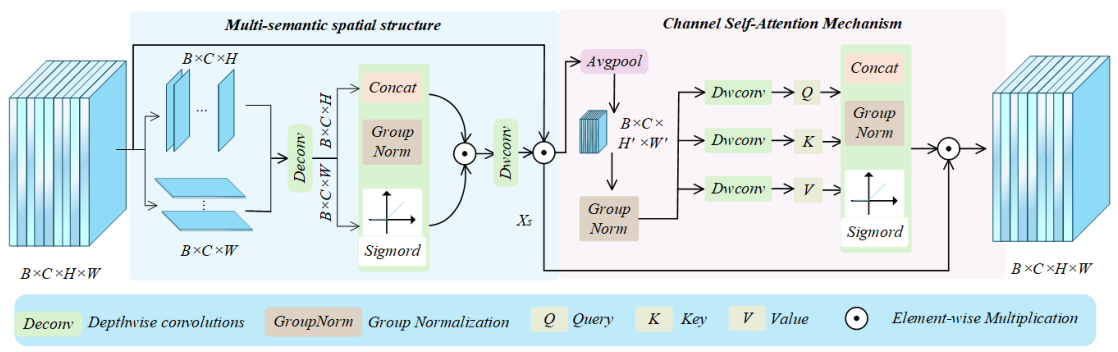
Multi-Semantic Spatial Structure. Given an input feature map , MSSA initially decouples it along the height and width dimensions and, through global average pooling, respectively creates two unidirectional 1D sequence structures, . Such a decoupling operation preserves spatial structural information, thereby laying the foundation for subsequent multi-semantic extraction.
In particular, to capture the spatial distributions of small objects at different scales, we partition each sequence feature set into K independent sub-features, and , where the channel number of each sub-feature C/K is given by:
Subsequently, we apply depthwise separable 1D convolutions with kernel sizes of 3, 5, 7, 9 to these K sub-features. This multi-scale design enables the module to simultaneously capture local details and contextual associations of small objects, effectively improving its responsiveness to weak signals from small objects. Meanwhile, we employ a lightweight shared convolution for cross-dimensional alignment, thereby enhancing feature consistency between the H and W dimensions and preventing the spatial structure fragmentation of small objects caused by dimensional decoupling:
Upon completing multi-semantic spatial feature extraction, we concatenate all sub-features along the channel dimension and normalize them using Group Normalization. By independently normalizing each sub-feature, Group Normalization effectively preserves the semantic independence among sub-features, thereby preventing background or other objects from interfering with small-object features. Subsequently, an initial spatial attention map is generated via the Sigmoid function.
To further enhance fine-grained perception of small-object regions, we apply a 3×3 depthwise separable convolution to the spatial attention map output by Sigmoid. This operation, while introducing minimal computational cost, locally smooths and sharpens the attention distribution, thereby strengthening spatial consistency and preventing activation fragmentation or diffusion into background regions caused by pixel sparsity in small-object areas. Finally, the convolution-refined spatial attention map is element-wise multiplied with the original input X to obtain the spatially modulated feature :
The aforementioned spatial modulation process, through multi-semantic guidance and local attention refinement, enhances the spatial response intensity and consistency for small-object regions.
Channel Self-Attention Structure. Subsequently, to further improve the feature discriminability of small objects, MSSA performs channel-wise self-attention computation on to model inter-channel dependencies. Small objects typically lack rich texture information, and their recognition relies more heavily on cross-channel feature synergy. To this end, we first progressively compress by reducing the resolution from to via average pooling, yielding . This operation significantly reduces computational cost while preserving key spatial details; particularly for small objects, retaining their core response regions is more important than maintaining global resolution:
Subsequently, we adopt an input-aware single-head self-attention mechanism to compute attention along the channel dimension. Here, , the query, key, and value are generated via linear projection,
and the attention weights are computed as follows:
This channel-wise self-attention effectively captures the synergistic activation patterns of small objects across different channels. Through the self-attention mechanism, these dispersed cues can be aggregated into a stronger comprehensive representation, while alleviating the semantic discrepancies introduced by multi-scale convolution and preventing semantic misalignment of small objects across features at different scales. Ultimately, global average pooling is performed on feature , after which a Sigmoid function is employed to generate channel attention weights; these weights are subsequently element-wise multiplied with the original input , thereby yielding the final output of MSSA:
The entire MSSA module deeply integrates multi-semantic spatial guidance with channel self-attention in a serial manner. The former captures spatial features of small objects at different semantic levels through multi-scale structures and provides precise spatial priors for the latter; the latter enhances the cross-channel consistency of small-object features via channel-wise self-attention, effectively mitigating feature blurring caused by multi-scale semantic discrepancies, thereby significantly improving the detection and segmentation performance of small objects in complex scenarios.
3.2. Receptive Field Decoupled Attention
To address the issue that standard convolution kernels share parameters within a sliding window, which causes weak features of small objects to be readily overwhelmed by background, this paper proposes a RFDA module. This module aims to independently assign attention weights to different positions within each receptive-field window, thereby achieving fine-grained decoupling between objects and background. The overall architecture is illustrated in Figure 2. Specifically, an unfold operation is first employed to decompose the input feature map into spatial features of multiple sliding windows. Subsequently, a dual-branch aggregation module utilizes average pooling and max pooling to extract global and local information of the windows, respectively, and thereby generates position-specific attention weights. Meanwhile, parallel feature transformation branches enhance local structural representation through depthwise separable convolutions. Finally, the attention weights are element-wise multiplied with the enhanced features, thereby achieving independent weighting of each position within the window. Through this process, RFDA effectively overcomes the limitation of parameter sharing in convolution kernels and significantly improves the capture of weak discriminative features in small-object regions.
Figure 2.
Architecture of the Receptive Field Decoupled Attention module.
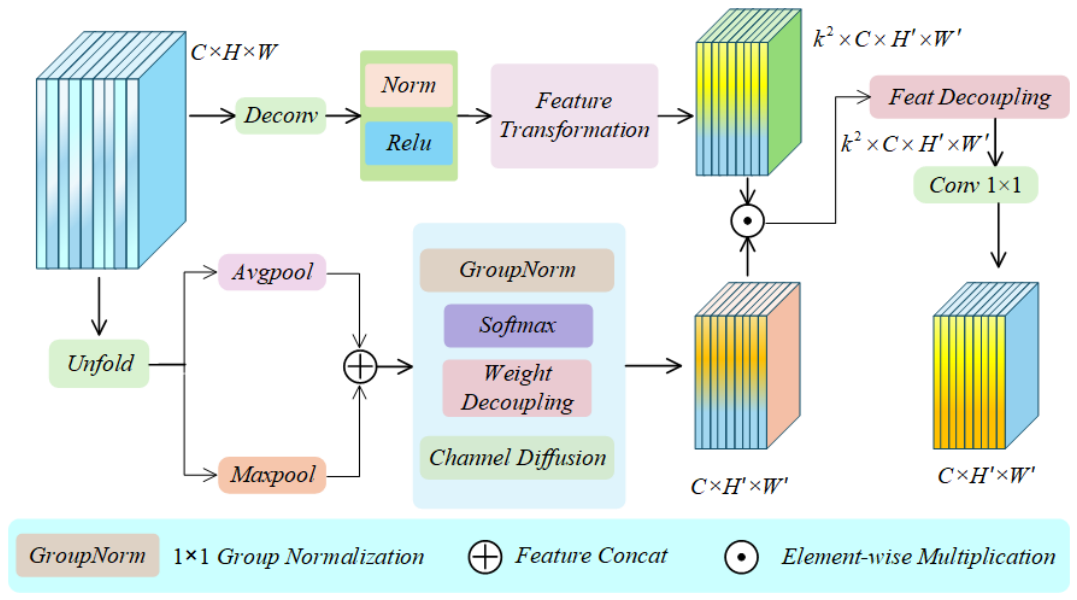
Receptive-Field Spatial Feature. To achieve independent attention for each position within the receptive field, we first convert the input feature map into receptive-field spatial features via an Unfold operation, thereby constituting the RFDA. Specifically, given an input , a kernel size , and a stride s, the Unfold operation unfolds the pixel values within each receptive-field window of size into a vector and stacks them along the spatial dimension. The resulting tensor has a shape of . Formally, for the window corresponding to output position , the pixel values it contains are:
These values are sequentially flattened and stored along the channel dimension of the output tensor. Notably, this operation introduces no learnable parameters, and when the stride is set to , the sliding windows are completely non-overlapping. Figure 3 illustrates in detail an example of extracting 2×2 receptive-field spatial features using Unfold.
Dual-Branch Aggregation Module. To more comprehensively capture the feature distribution of small objects within receptive-field windows, we design a dual-branch aggregation module to generate decoupled attention weights. One branch employs average pooling to aggregate global contextual information of the window, thereby reflecting the overall response intensity of the region where small objects reside; the other branch adopts max pooling to capture local salient peaks within the window, which is particularly critical for the weak yet prominent edge or point features of small objects. Subsequently, the features from the two branches are concatenated along the channel dimension to form a richer window-level description.
We denote the receptive-field spatial features obtained via Unfold as . The objective of RFDA is to learn an attention map , where represents the independent weight of the i-th position within the sliding window. Specifically, for each window position , we compute the average-pooled feature and the max-pooled feature, respectively:
The average-pooled and max-pooled features are concatenated along the channel dimension, thereby yielding a joint descriptor for each sliding window:
At this stage, has a shape of . Subsequently, a lightweight grouped convolutional network with 1×1 convolutions is employed—comprising groups, 2 input channels, and output channels—to model the interrelationships among different positions within each sliding window. Each group independently learns importance weights for the corresponding positions, with no parameter sharing across groups.
Softmax is then applied along the k2 dimension, such that the attention weights within each sliding window sum to 1, thereby preserving the relative scale of features.
Feature Transformation Branch. In parallel with the dual-branch aggregation branch, we design a feature transformation branch, which aims to perform depthwise separable convolution on the original input feature map to extract local structural patterns within the receptive field and enhance feature representation capability. This branch does not participate in attention weight generation; rather, it provides richer feature representations for subsequent weighted fusion.
Specifically, given an input feature map , we first apply a depthwise separable convolution with a kernel size of and a stride consistent with that of the Unfold operation. The separable Depthwise convolution decomposes the standard convolution into Depthwise and pointwise convolution operations, significantly reducing the number of parameters and computational cost while maintaining a comparable receptive field. This operation is capable of capturing spatial local patterns within each channel, such as discriminative features of small objects, including edges, corners, or textures.
Subsequently, we normalize the convolution results to accelerate convergence and stabilize training. A ReLU activation function is then employed to introduce nonlinearity and enhance feature discriminability. The resulting feature map is denoted as , whose shape is identical to that of the receptive-field spatial feature , i.e., . Formally, it is expressed as:
where denotes the depthwise separable convolution. This branch introduces no additional attention parameters and improves feature quality solely through convolution and activation functions, thereby providing more robust features for subsequent fusion.
Upon obtaining the decoupled attention weights and the transformed features , we fuse them to derive redefined output decoupled attention weights. Given that the channel dimension of is , whereas that of is , we expand by a factor of C along the channel dimension, rendering its dimension . The expanded attention weights are then element-wise multiplied with , thereby achieving independent weighting for each position within every receptive-field window.
Here, ⊗ denotes the element-wise multiplication after expansion. This operation enables weak signals of small objects within a window to receive significantly higher weights, while background regions are suppressed, consequently accomplishing object-background decoupling at the feature level.
Following the above decoupled weighting, the channel dimension of remains . To restore it to the output format of standard convolution and feed it into subsequent network layers, we employ a 1×1 convolution to map the number of channels to the target output channels . This 1×1 convolution linearly recombines the decoupled features, fuses information from different sliding window positions, and ultimately yields the final output feature map.
Through the above operations, RFDA not only fundamentally resolves the parameter-sharing issue of convolution kernels but also, via dual-branch pooling and depthwise separable feature transformation, significantly enhances the feature capture capability for small-object regions.
3.3. Unified-IoU Loss
We propose the Unified-IoU (UIoU) loss. Rather than modifying geometric measurement rules, this method indirectly adjusts the loss weights of boxes of different qualities by dynamically scaling the sizes of predicted boxes and ground-truth (GT) boxes. Furthermore, it incorporates a cosine annealing strategy and an inverse focal mechanism, thereby achieving a smooth transition from rapid convergence to high-precision localization.
Specifically, instead of directly multiplying the losses of predicted boxes of different qualities by coefficients, we proportionally scale both the predicted box P and the GT box G, thereby altering their IoU values and indirectly adjusting the loss values. Let , and the scaling factor . The scaled and maintain their center points unchanged, while their widths and heights are enlarged by a factor of r:
The scaled IoU is computed as:
The basic regression loss is defined as:
For a fixed pair of a predicted box and a GT box, when , , and the larger the original IoU, the more pronounced the decrease. In this case, the loss of high-quality predicted boxes increases significantly, which is equivalent to assigning them higher weights, whereas the loss of low-quality boxes remains essentially unchanged. Consequently, the shrinking operation can guide the model to focus on high-quality boxes. When , , and the smaller the original IoU, the more pronounced the increase; thus, the loss of low-quality boxes decreases substantially and their weights are weakened, while the relative weight improvement of high-quality boxes is comparatively modest. Therefore, the enlarging operation can guide the model to focus on low-quality boxes and accelerate early-stage convergence. This is because the shrinking operation causes the relative overlap area of two boxes that originally overlapped considerably to decrease more rapidly, whereas boxes that originally do not overlap remain non-overlapping after shrinking; hence, the rate of IoU change is positively correlated with the original IoU.
From the perspective of gradient modulation, differentiating the UIoU loss with respect to the predicted-box parameters yields a gradient whose magnitude is proportional to . The scaling operation indirectly influences the gradient contributions of boxes of different qualities by altering the local curvature of ; specifically, the gradients of high-quality boxes are amplified after shrinking, whereas those of low-quality boxes are suppressed after enlarging.
To dynamically adjust the model’s attention to predicted boxes of different qualities during training, we design a cosine annealing strategy based on bounding-box attention. The scaling factor is defined to vary with the training epoch t as follows:
where T denotes the total number of training epochs,,.
During the initial training stage, where , the contribution of low-quality boxes to the gradient is suppressed, thereby preventing interference from anomalous gradients and enabling the model to rapidly converge to a reasonable initial solution. By contrast, in the later training stage, where , the losses of high-quality boxes are amplified, and the loss function exhibits stronger convexity in the vicinity of the optimal solution, which facilitates high-precision localization of small objects and enables the model to smoothly transition from “rapid localization” to “precise localization.”
The original Focal Loss [35] excessively focuses on “hard examples” (low-confidence samples), which may trap the model in ambiguous regions caused by overlap or occlusion, consequently degrading detection accuracy at high IoU thresholds. To this end, we propose an inverse focal mechanism (Focal-inv): it increases the weights of easy-to-detect samples (high-confidence ones), thereby directing the model’s attention to predicted boxes that already perform well and further refining their boundaries. The weighting factor is defined as:
where denotes the classification confidence of the predicted box, and is an adjustable hyperparameter that is initially set to 2 in this paper. Accordingly, this factor increases with confidence, thereby enabling high-confidence small-object predicted boxes to obtain greater gradient contributions. The total UIoU loss is defined as:
The gradient with respect to the predicted-box parameter is computed as follows:
The first term constitutes the dominant term, whereas the second term serves as a coupling term between confidence and localization. For low-quality predicted boxes, conf is typically small and approaches 0, so the dominant term is suppressed; although in the second term may be relatively large, is close to 1 and is generally small, resulting in limited overall contribution. Consequently, the gradients of low-quality boxes are effectively suppressed, while those of high-quality boxes are amplified, enabling the model to concentrate on optimizing boxes that already possess a certain degree of localization accuracy.
4. Experiments
4.1. Datasets
To validate the effectiveness of the proposed method, experiments are conducted on multiple datasets: 1) the TIB dataset for UAV objects over urban areas; 2) the UB-SOD dataset for object detection in airport clearance airspace, which contains two object categories, namely UAVs and birds, yet encompasses a wide variety of UAV and bird species; 3) the Drone dataset for detecting UAV, aircraft, and helicopter objects; and 4) the Flying dataset, which contains more than 40 categories of aircraft and UAV objects. The datasets employed in this paper are predominantly composed of small objects. The data splits of these datasets are described below.
4.1.1. TIB Dataset
The TIB dataset comprises 2,850 images and 2,850 objects. The size-based criterion adopted in Table 1 is defined as the ratio of the ground-truth bounding box size to the image size. According to this criterion, small objects account for 93.65% of all objects, with 2,669 such objects, as presented in Table 1.
Specifically, as presented in Table 2, under the relative-pixel criterion, the TIB dataset contains 1,501 extremely small objects, which account for 56.15% of the total number of small objects. The remaining objects are categorized into small, medium-sized, and large objects: there are 165 medium-sized objects, accounting for 5.93%, and 12 large objects, accounting for 0.42%.
4.1.2. UB-SOD Dataset
The UB-SOD dataset comprises 6,500 images and 14,979 objects. Under the relative-pixel criterion, small objects account for 86.28% of all objects, totaling 12,924 instances, as presented in Table 3. Specifically, the dataset contains two categories of no-fly-zone intrusion objects frequently encountered in airport airspace, namely UAVs and birds. Among these, there are 9,990 extremely small objects, accounting for 66.7%, as presented in Table 4 and Table 5.
4.1.3. Drone Dataset
The Drone dataset contains a total of 11,998 images and 9,975 objects. Under the relative-pixel criterion, small objects account for 3.72% of all objects, with 371 such instances, as presented in Table 6. It should be noted that, in this publicly available dataset, objects in certain images remain unannotated, consequently rendering the number of objects smaller than that of images.
4.1.4. FlyingDataset
The Flying dataset comprises 18,830 images spanning 40 categories, with a total of 24,769 objects. Under the relative-pixel criterion, small objects account for 17.36% of all objects, totaling 4,299 instances, as presented in Table 7.
To validate the effectiveness of the proposed method, experiments are conducted on the aforementioned four datasets, aiming to demonstrate its promising performance in small object detection.
4.2. Evaluation Metrics
In this paper, three evaluation metrics are primarily adopted: mAP50, mAP50-95, and FPS, which respectively denote mean average precision, mean average precision across different IoU thresholds, and frames per second. Specifically, mAP50 and mAP50-95 serve as detection accuracy metrics, with higher values indicating superior detection accuracy; by contrast, FPS functions as a speed metric, representing the number of images the model can process per second, where higher values correspond to faster detection. Given the core requirement for accuracy in small object detection within airport scenarios, this paper places particular emphasis on improving mAP50-95, so as to validate the optimization effect of the proposed algorithm on small-object localization accuracy.
4.3. Ablation Study
The proposed method is developed by improving upon the YOLOv12 model. To validate the three innovations introduced in this paper, we conduct ablation experiments on four datasets, thereby demonstrating that the proposed method yields substantial improvements across various types of small objects. Specifically, the ablation experiment on the TIB dataset is first performed, and the corresponding results are presented in Table 8.
As presented in Table 8, with respect to mAP50, the three proposed innovations yield improvements of 1.3%, 1.2%, and 1.1% over YOLOv12, respectively. Similarly, for mAP50-95, consistent improvements are also achieved, amounting to 0.4%, 0.7%, and 1.0%, respectively. From the data in the fifth and sixth rows, it is evident that the two models can mutually reinforce each other, thereby attaining superior detection performance. Naturally, the combination of the three innovations delivers the best detection performance, with mAP50 and mAP50-95 reaching 87.4% and 38.9%, respectively, representing improvements of 4.7% and 3.2% over the baseline model. Although the detection speed is slightly lower than that of YOLOv12, at 87.5 FPS, it still satisfies the requirements for real-time detection and thus does not compromise the overall performance of the model.
Ablation experiments are further conducted on the UB-SOD dataset, with the corresponding results presented in Table 9.
As presented in Table 9, for mAP50, the three proposed innovations improve YOLOv12 by 0.5%, 1.1%, and 0.4%, respectively. Likewise, consistent improvements are also achieved for mAP50-95, amounting to 0.7%, 0.8%, and 0.4%, respectively. As can be observed from the data in the fifth and sixth rows, the two models can complement each other, further enhancing detection performance. On the UB-SOD dataset, the proposed method achieves the best detection performance, with mAP50 and mAP50-95 reaching 81.4% and 41.3%, respectively, surpassing the baseline model by 2.7% and 1.2%. The detection speed is 69.5 FPS, which satisfies the requirement for real-time detection.
Ablation experiments are further conducted on the Drone dataset, with the corresponding results presented in Table 10.
As presented in Table 10, the proposed method achieves detection performance as high as 98.1% mAP50 and 78.0% mAP50-95 on the Drone dataset. Regarding mAP50, the three proposed innovations improve YOLOv12 by 0.3%, 0.2%, or remain on par with it; likewise, they also exhibit favorable performance on mAP50-95. Furthermore, on the Drone dataset, under the synergistic positive effect of multiple modules, the model’s feature acquisition capability is further enhanced, and the proposed method attains the best detection performance. The detection speed is 55.0 FPS, which satisfies the requirement for real-time detection.
Ablation experiments are further conducted on the Flying dataset, with the corresponding results presented in Table 11.
As presented in Table 11, consistent with the detection trends observed on the other three datasets, the proposed method exhibits a pronounced performance advantage over the baseline model YOLOv12, achieving 65.6% mAP50 and 55.6% mAP50-95, which correspond to improvements of 5.9% and 5.0%, respectively. Meanwhile, each individual module also yields positive effects, with mAP50 improving by 1.0%, 0.3%, and 1.2%, and mAP50-95 improving by 1.1%, 1.3%, and 2.0%, respectively. Nevertheless, the detection speed is suboptimal, amounting to only half that of the original model.
4.4. Performance Comparison with Existing Approaches
Moreover, to demonstrate the superiority of the proposed method, we compare it with other recently developed methods on the TIB dataset, thereby verifying its practical applicability. The comparison results are presented in Table 12. Notably, for those methods that do not report the mAP50-95 metric, the corresponding results are adopted from references [36] and [37]. As can be observed, the proposed method still exhibits a pronounced advantage over existing mainstream methods.
To more intuitively examine the detection performance of the proposed method on small objects, we select several representative images for visualization, thereby demonstrating its effectiveness. The detection results are presented in Figure 4. As can be observed from Figure 4, the proposed method achieves superior detection performance for objects with complex backgrounds, extremely small sizes, and blurred edges. Although YOLO26 can also correctly detect objects, the predicted boxes generated by the proposed method align more closely with the true extent of the objects and yield higher prediction confidence. For instance, in the third column, the ground-truth boxes do not tightly enclose the objects during annotation; nevertheless, the proposed method can rectify the positions of the predicted boxes, thereby yielding improved detection results.
To validate the effectiveness of the proposed method for illegally flown UAVs and bird objects in airport clearance airspace, we present the detection results on the UB-SOD airport dataset, as illustrated in Figure 5. The first and third rows correspond to the original images to be detected, whereas the second and fourth rows present the corresponding detection results. The UAV objects and bird objects in the figure are all small or extremely small objects. Moreover, under conditions of blurred and complex backgrounds, the proposed method still achieves favorable detection performance. Even when dense bird flocks are present in the images, the proposed method maintains robust performance, further verifying its applicability.
5. Conclusions
In this paper, to address the challenges of small pixel proportions, scarce textures, and strong background interference in the detection of illegally flown UAVs and small bird objects within airport clearance airspace, we propose a multi-dimensional attention collaborative optimization method. This method optimizes detection from three aspects: feature enhancement, convolution decoupling, and loss reweighting. Specifically, MSSA guides channel attention learning through multi-semantic spatial features, thereby enhancing the response intensity of small objects. RFDA decouples positions within the receptive field of standard convolution and independently assigns attention weights, thereby breaking through the parameter-sharing limitation and enhancing boundary regression sensitivity. UIoU adjusts the attention to predicted boxes of different qualities via dynamic scaling and an annealing strategy, thereby strengthening the fine refinement of high-quality boxes. Ablation experiments validate the complementarity of the three modules across the feature extraction and loss optimization stages, demonstrating the effectiveness and robustness of this collaborative framework in densely populated small-object scenarios. Experiments on four datasets—TIB, UB-SOD, Drone, and Flying—demonstrate that the proposed method achieves significant performance improvements in small object detection tasks within airport clearance airspace.
Future work will proceed along two directions. The first involves exploring the deployment efficiency of MSSA and RFDA in lightweight networks to satisfy the engineering requirements of real-time detection in airport clearance airspace. The second focuses on extending the method to infrared and visible-light multimodal fusion scenarios to further enhance detection robustness under complex meteorological conditions.
Author Contributions
Conceptualization, S.L. and G.G.; methodology, S.L.; software, S.M.; validation, S.L., and G.G.; formal analysis, S.M. and X.J.; investigation, G.Z. and H.Z.; resources, Y.X.; data curation, S.M. and X.J.; writing—original draft preparation, S.L.; writing—review and editing, S.M.; visualization, S.L.; supervision, G.G.; project administration, S.L.; funding acquisition, S.L. All authors have read and agreed to the published version of the manuscript.
Funding
This work was supported by the National Natural Science Foundation of China under Grant 62301623, the Natural Science Youth Foundation of Zhongyuan University of Technology under Grant K2025YB003, Henan Provincial Science and Technology R&D Plan Joint Fund under Grant 5321260028, and Henan Provincial Science and Technology Research Project under Grant 262102210132.
Informed Consent Statement
Informed consent was obtained from all subjects involved in the study.
Data Availability Statement
The data supporting the findings of this study are available from the cor responding author upon reasonable request, subject to applicable ethical and institutional restrictions.
Acknowledgments
We would like to express our sincere gratitude to our colleagues who provided constructive suggestions and valuable feedback during this study. Their insightful comments and thoughtful discussions greatly helped us improve the research design and refine the manuscript.
Conflicts of Interest
The authors declare no conflicts of interest.
Abbreviations
The following abbreviations are used in this manuscript:
| UAV | Unmanned Aerial Vehicle |
| EO | Electro-Optical |
| MSSA | Multi-Semantic Self-Attention |
| RFDA | Receptive Field Decoupled Attention |
| UIoU | Unified-IoU |
| GT | Ground-Truth |
| FPN | Feature Pyramid Network |
| DIoU | Distance IoU |
| CIoU | Complete IoU |
References
- Wang X, Wang A, Yi J, et al. Small object detection based on deep learning for remote sensing: A comprehensive review. Remote Sensing 2023, 15(13), 3265. [CrossRef]
- Dalal N, Triggs B. Histograms of oriented gradients for human detection//2005 IEEE computer society conference on computer vision and pattern recognition (CVPR’05). IEEE, 2005, 1: 886-893.
- Felzenszwalb P F, Girshick R B, McAllester D, et al. Object detection with discriminatively trained part-based models. IEEE transactions on pattern analysis and machine intelligence 2009, 32(9), 1627-1645. [CrossRef] [PubMed]
- Bosquet B, Mucientes M, Brea V M. STDnet: Exploiting high resolution feature maps for small object detection. Engineering Applications of Artificial Intelligence 2020, 91, 103615. [CrossRef]
- Cao J, Bao W, Shang H, et al. GCL-YOLO: A GhostConv-based lightweight yolo network for UAV small object detection. Remote Sensing 2023, 15(20), 4932. [CrossRef]
- Sun S, Mo B, Xu J, et al. Multi-YOLOv8: An infrared moving small object detection model based on YOLOv8 for air vehicle. Neurocomputing 2024, 588, 127685. [CrossRef]
- Lin T Y, Dollár P, Girshick R, et al. Feature pyramid networks for object detection//2017 IEEE conference on computer vision and pattern recognition (CVPR). IEEE, 2017: 936-944.
- Zhang H, Li M, Miao D, et al. Construction of a feature enhancement network for small object detection. Pattern Recognition 2023, 143, 109801. [CrossRef]
- Zhang Y, Zhang H, Huang Q, et al. DsP-YOLO: An anchor-free network with DsPAN for small object detection of multiscale defects. Expert Systems with Applications 2024, 241, 122669. [CrossRef]
- Miri Rekavandi A, Rashidi S, Boussaid F, et al. Transformers in small object detection: A benchmark and survey of state-of-the-art. ACM Computing Surveys 2025, 58(3), 1-33. [CrossRef]
- Ni J, Zhu S, Tang G, et al. A small-object detection model based on improved YOLOv8s for UAV image scenarios. Remote Sensing 2024, 16(13), 2465. [CrossRef]
- Chen T, Ye Z, Tan Z, et al. MiM-ISTD: Mamba-in-mamba for efficient infrared small-target detection. IEEE Transactions on Geoscience and Remote Sensing 2024, 62, 1-13. [CrossRef]
- Zhang Y, Li Z, Siddique A, et al. Infrared small target detection based on interpretation weighted sparse method. IEEE Transactions on Geoscience and Remote Sensing 2025, 63, 1-15. [CrossRef]
- Jia G, Cheng Y, Chen T. IRGraphSeg: Infrared small target detection based on hierarchical GNN. IEEE Geoscience and Remote Sensing Letters 2024, 21, 1-5. [CrossRef]
- Niu Z, Zhong G, Yu H. A review on the attention mechanism of deep learning. Neurocomputing 2021, 452, 48-62. [CrossRef]
- Hu J, Shen L, Sun G. Squeeze-and-excitation networks. Proceedings of the IEEE conference on computer vision and pattern recognition. 2018: 7132-7141.
- Woo S, Park J, Lee J Y, et al. Cbam: Convolutional block attention module. European conference on computer vision. Cham: Springer International Publishing, 2018: 3-19.
- Wang Q, Wu B, Zhu P, et al. ECA-Net: Efficient channel attention for deep convolutional neural networks//2020 IEEE/CVF conference on computer vision and pattern recognition (CVPR). IEEE, 2020: 11531-11539.
- Dosovitskiy A. An image is worth 16x16 words: Transformers for image recognition at scale. arXiv preprint arXiv 2020, 2010, 11929.
- Wu F, Sun Y, Wang P, et al. Enhanced u-net for lesion segmentation in whole-slide images: Integrating attention mechanisms and multi-scale feature extraction. Ain Shams Engineering Journal 2025, 16(12), 103748. [CrossRef]
- Qureshi S A, Sadiq T, Usman A, et al. SAlexNet: Superimposed AlexNet using residual attention mechanism for accurate and efficient automatic primary brain tumor detection and classification. Results in Engineering 2025, 25, 104025. [CrossRef]
- Xu K, Ba J, Kiros R, et al. Show, attend and tell: Neural image caption generation with visual attention[C]//International conference on machine learning. PMLR, 2015: 2048-2057.
- Mnih V, Heess N, Graves A, et al. Recurrent models of visual attention. Advances in neural information processing systems 2014, 27.
- Lu J, Yang J, Batra D, et al. Hierarchical question-image co-attention for visual question answering. Advances in neural information processing systems 2016, 29.
- Lin Z, Feng M, Santos C N, et al. A structured self-attentive sentence embedding. arXiv preprint arXiv 2017, 1703, 03130.
- Yang Z, Yang D, Dyer C, et al. Hierarchical attention networks for document classification//Proceedings of the 2016 conference of the North American chapter of the association for computational linguistics: Human language technologies. 2016: 1480-1489.
- Vaswani A, Shazeer N, Parmar N, et al. Attention is all you need. Advances in neural information processing systems 2017, 30.
- Shen T, Zhou T, Long G, et al. Disan: Directional self-attention network for rnn/cnn-free language understanding//Proceedings of the AAAI conference on artificial intelligence. 2018, 32(1).
- Yu J, Jiang Y, Wang Z, et al. UnitBox: An advanced object detection network//Proceedings of the 24th ACM International Conference on Multimedia. 2016: 516-520.
- Rezatofighi H, Tsoi N, Gwak J Y, et al. Generalized intersection over union: A metric and a loss for bounding box regression[C]//Proceedings of the IEEE/CVF Conference on Computer Vision and Pattern Recognition. 2019: 658-666.
- Zheng Z, Wang P, Liu W, et al. Distance-IoU loss: Faster and better learning for bounding box regression//Proceedings of the AAAI Conference on Artificial Intelligence. 2020, 34(07): 12993-13000. [CrossRef]
- Gevorgyan Z. SIoU loss: More powerful learning for bounding box regression. arXiv preprint arXiv 2022, 2205, 12740.
- Zhang Y F, Ren W, Zhang Z, et al. Focal and efficient IOU loss for accurate bounding box regression. Neurocomputing 2022, 506, 146-157. [CrossRef]
- Tong Z, Chen Y, Xu Z, et al. Wise-IoU: Bounding box regression loss with dynamic focusing mechanism. arXiv preprint arXiv 2023, 2301, 10051.
- Lin T Y, Goyal P, Girshick R, et al. Focal loss for dense object detection. IEEE Transactions on Pattern Analysis and Machine Intelligence 2020, 42(2), 318-327. [CrossRef] [PubMed]
- Sun H, Yang J, Shen J, et al. TIB-Net: Drone detection network with tiny iterative backbone. IEEE Access 2020, 8, 130697-130707. [CrossRef]
- Zhou X, Yang G, Chen Y, et al. VDTNet: A high-performance visual network for detecting and tracking of intruding drones. IEEE Transactions on Intelligent Transportation Systems 2024, 25(8), 9828-9839. [CrossRef]
- Jocher, G., Chaurasia, A., Qiu, J., & Others. (2023). Ultralytics YOLOv8: Real-time object detection and segmentation. Ultralytics, Tech. Rep. YOLOv8-V1.0.
- Wang A, Chen H, Liu L, et al. Yolov10: Real-time end-to-end object detection. Advances in neural information processing systems 2024, 37, 107984-108011. [CrossRef]
- Khanam R, Hussain M. Yolov11: An overview of the key architectural enhancements. arXiv preprint arXiv 2024, 2410, 17725.
- Tian Y, Ye Q, Doermann D. Yolov12: Attention-centric real-time object detectors (2025). arXiv preprint arXiv 2026, 2502, 12524.
- Jocher G, Qiu J, Liu M, et al. Ultralytics YOLO26: Unified real-time end-to-end vision models. arXiv preprint arXiv 2026, 2606, 03748.
Figure 3.
Procedure of extracting spatial features via Unfold.
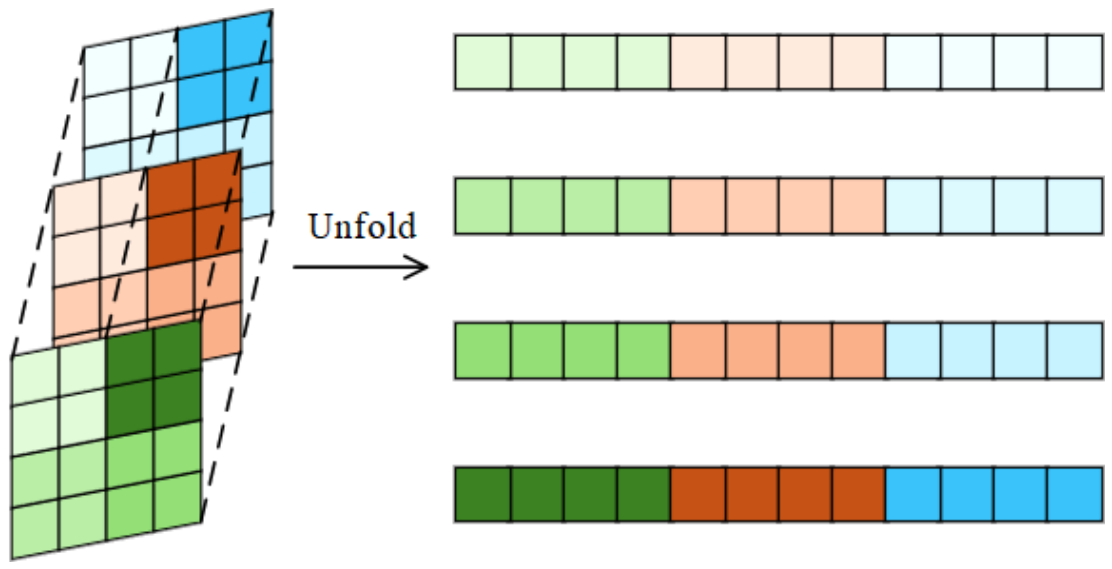
Figure 4.
Comparison of detection results between the proposed method and other methods on the TIB dataset.
Figure 4.
Comparison of detection results between the proposed method and other methods on the TIB dataset.
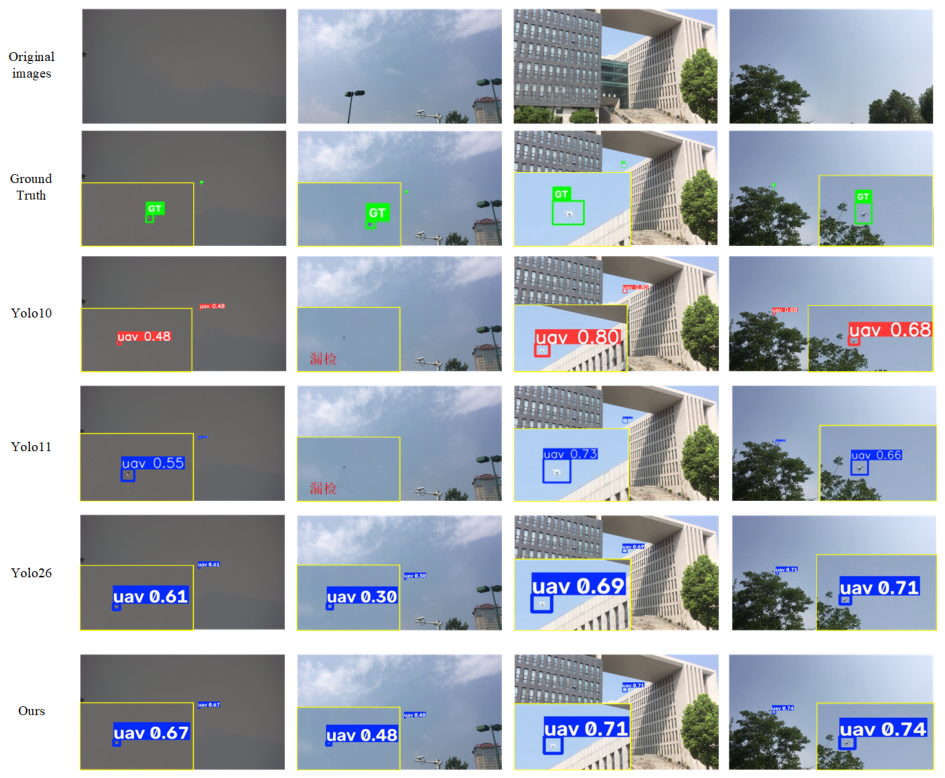
Figure 5.
Detection results of the proposed method on the UB-SOD dataset.
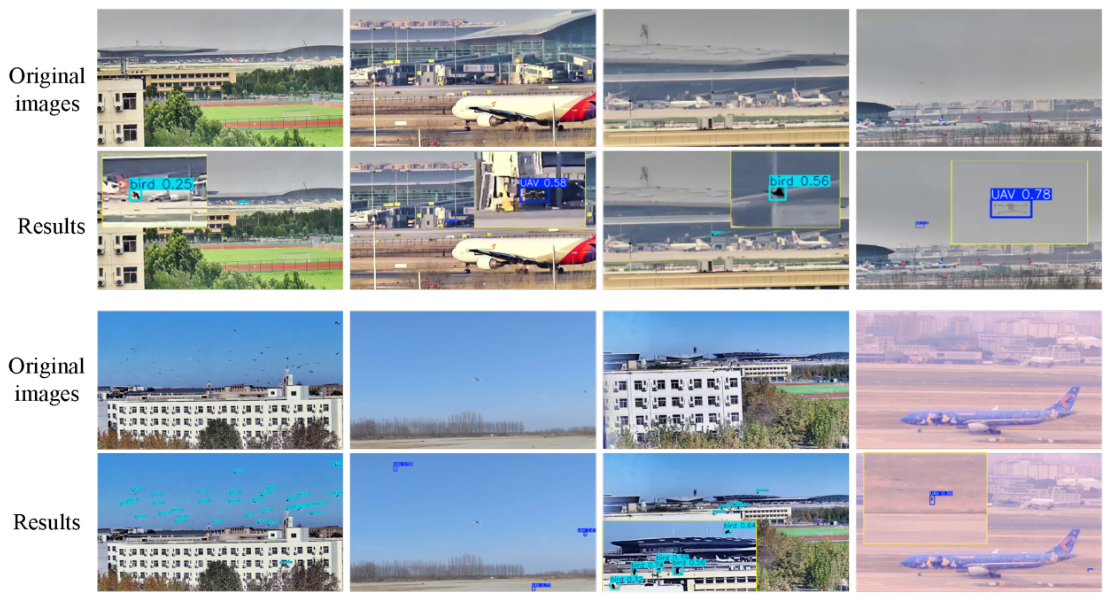

Table 1.
Distribution of target sizes in the TIB dataset.
| Dataset | Criterion(%) | Object number | Proportion (%) | Scope of application |
|---|---|---|---|---|
| TIB | 2673 | 93.79 | Small | |
| 165 | 5.79 | Middle | ||
| 12 | 0.42 | Large |
Table 2.
Distribution of uavs pixels in the TIB dataset.
| Category | Absolute pixels | Relative pixels(%) |
Object number | Proportion (%) | Cumulative proportion(%) |
Scope of application |
|---|---|---|---|---|---|---|
| UAV | 49 | 1.72 | 1.72 | Tiny | ||
| 1091 | 38.28 | 40.00 | ||||
| 361 | 12.67 | 52.67 | ||||
| 591 | 20.74 | 73.40 | Small | |||
| 581 | 20.39 | 93.79 | ||||
| 165 | 5.79 | 99.58 | Middle | |||
| 12 | 0.42 | 100.00 | Large | |||
| 0 | 0.00 | 100.00 |
Table 3.
Distribution of target sizes in the UB-SOD dataset.
| Dataset | Criterion(%) | Object number | Proportion (%) | Scope of application |
|---|---|---|---|---|
| UB-SOD | 12924 | 86.28 | Small | |
| 1635 | 10.92 | Middle | ||
| 420 | 2.80 | Large |
Table 4.
Distribution of UAVs pixels in the UB-SOD dataset.
| Category | Absolute pixels | Relative pixels(%) |
Object number | Proportion (%) | Cumulative proportion(%) |
Scope of application |
|---|---|---|---|---|---|---|
| UAV | 278 | 3.96 | 3.96 | Tiny | ||
| 867 | 12.34 | 16.30 | ||||
| 1208 | 17.20 | 33.49 | ||||
| 2049 | 29.17 | 62.66 | Small | |||
| 651 | 9.27 | 71.93 | ||||
| 1564 | 22.26 | 94.19 | Middle | |||
| 406 | 5.78 | 99.97 | Large | |||
| 2 | 0.03 | 100.00 |
Table 5.
Distribution of birds pixels in the UB-SOD dataset.
| Category | Absolute pixels | Relative pixels(%) |
Object number | Proportion (%) | Cumulative proportion(%) |
Scope of application |
|---|---|---|---|---|---|---|
| Bird | 217 | 2.73 | 2.73 | Tiny | ||
| 4859 | 61.09 | 63.82 | ||||
| 2561 | 32.20 | 96.01 | ||||
| 173 | 2.18 | 98.19 | Small | |||
| 61 | 0.77 | 98.96 | ||||
| 71 | 0.89 | 99.85 | Middle | |||
| 12 | 0.15 | 100.00 | Large | |||
| 0 | 0.00 | 100.00 |
Table 6.
Distribution of uavs pixels in the Drone dataset.
| Dataset | Criterion(%) | Object number | Proportion (%) | Scope of application |
|---|---|---|---|---|
| Drone | 371 | 3.72 | Small | |
| 5961 | 59.76 | Middle | ||
| 3643 | 36.52 | Large |
Table 7.
Distribution of target sizes in the Flying dataset.
| Dataset | Criterion(%) | Object number | Proportion (%) | Scope of application |
|---|---|---|---|---|
| Flying | 4299 | 17.36 | Small | |
| 4421 | 17.85 | Middle | ||
| 16049 | 64.79 | Large |
Table 8.
Ablation experiments on the TIB dataset.
| Improve | MSSA | RFDA | UIOU | mAP50 | mAP50-95 | FPS | |
|---|---|---|---|---|---|---|---|
| 1 | YOLOv12 | 82.7 | 35.7 | 131.5 | |||
| 2 | ✔ | 84.0 | 36.1 | 73.5 | |||
| 3 | ✔ | 83.9 | 36.4 | 84.5 | |||
| 4 | ✔ | 83.8 | 36.7 | 166.0 | |||
| 5 | ✔ | ✔ | 85.7 | 37.4 | 89.5 | ||
| 6 | ✔ | ✔ | 85.2 | 37.0 | 83.5 | ||
| 7 | ✔ | ✔ | ✔ | 87.4 | 38.9 | 87.5 |
Table 9.
Ablation experiments on the UB-SOD dataset.
| Improve | MSSA | RFDA | UIOU | mAP50 | mAP50-95 | FPS | |
|---|---|---|---|---|---|---|---|
| 1 | YOLOv12 | 78.7 | 40.1 | 73.5 | |||
| 2 | ✔ | 79.2 | 40.8 | 85.0 | |||
| 3 | ✔ | 79.8 | 40.9 | 83.5 | |||
| 4 | ✔ | 79.1 | 40.5 | 73.5 | |||
| 5 | ✔ | ✔ | 80.7 | 41.2 | 89.5 | ||
| 6 | ✔ | ✔ | 80.7 | 41.0 | 83.5 | ||
| 7 | ✔ | ✔ | ✔ | 81.4 | 41.3 | 69.5 |
Table 10.
Ablation experiments on the Drone dataset.
| Improve | MSSA | RFDA | UIOU | mAP50 | mAP50-95 | FPS | |
|---|---|---|---|---|---|---|---|
| 1 | YOLOv12 | 97.6 | 78.0 | 96.0 | |||
| 2 | ✔ | 97.9 | 78.1 | 53.0 | |||
| 3 | ✔ | 97.8 | 78.0 | 23.0 | |||
| 4 | ✔ | 97.6 | 78.2 | 96.0 | |||
| 5 | ✔ | ✔ | 98.0 | 77.2 | 55.0 | ||
| 6 | ✔ | ✔ | 97.8 | 77.8 | 47.0 | ||
| 7 | ✔ | ✔ | ✔ | 98.1 | 78.0 | 55.0 |
Table 11.
Ablation experiments on the Flying dataset.
| Improve | MSSA | RFDA | UIOU | mAP50 | mAP50-95 | FPS | |
|---|---|---|---|---|---|---|---|
| 1 | YOLOv12 | 59.7 | 50.6 | 121.5 | |||
| 2 | ✔ | 60.7 | 51.7 | 56.5 | |||
| 3 | ✔ | 60.0 | 51.9 | 58.5 | |||
| 4 | ✔ | 62.9 | 52.6 | 112 | |||
| 5 | ✔ | ✔ | 63.5 | 53.2 | 67.5 | ||
| 6 | ✔ | ✔ | 64.7 | 54.2 | 59.0 | ||
| 7 | ✔ | ✔ | ✔ | 65.6 | 55.6 | 67.5 |
Table 12.
Distribution of target sizes in the UB-SOD dataset.
| Methods | mAP50 | mAP50-95 | FPS |
|---|---|---|---|
| Faster Rcnn-MobileNet | 67.5 | \ | 8.0 |
| Casacade Rcnn-MobileNet | 78.0 | \ | 6.1 |
| EXTD-MobileFaceNet | 85.1 | \ | 3.6 |
| Yolov2 | 67.1 | \ | 33.2 |
| Yolov3 | 84.9 | \ | 15.2 |
| Yolov4 | 86.0 | \ | 52.6 |
| Yolov4s-Tiny | 26.7 | \ | 45.5 |
| Yolov5 | 86.2 | 38.7 | 128.2 |
| Yolov6n | 86.5 | \ | 76.9 |
| Yolov7-Tiny | 85.8 | \ | 125.0 |
| Yolov8 [38] | 80.3 | 31.7 | 135.2 |
| Yolov10 [39] | 72.6 | 29.3 | 78.2 |
| Yolov11 [40] | 79.7 | 31.2 | 90.9 |
| Yolov12 [41] | 82.7 | 35.7 | 65.8 |
| Yolo26 [42] | 83.2 | 34.6 | 82.0 |
| Ours | 87.4 | 38.9 | 87.5 |
Disclaimer/Publisher’s Note: The statements, opinions and data contained in all publications are solely those of the individual author(s) and contributor(s) and not of MDPI and/or the editor(s). MDPI and/or the editor(s) disclaim responsibility for any injury to people or property resulting from any ideas, methods, instructions or products referred to in the content. |
© 2026 by the authors. Licensee MDPI, Basel, Switzerland. This article is an open access article distributed under the terms and conditions of the Creative Commons Attribution (CC BY) license (http://creativecommons.org/licenses/by/4.0/).
Copyright: This open access article is published under a Creative Commons CC BY 4.0 license, which permit the free download, distribution, and reuse, provided that the author and preprint are cited in any reuse.