
Submitted:
30 October 2026
Posted:
03 November 2026
You are already at the latest version
Abstract
Circular RNAs (circRNAs) were, until a decade ago, a by-product of transcriptome profiling. They are now drug candidates. A covalently closed backbone removes the termini that exonucleases and cap-dependent decay require, and lipid nanoparticles (LNPs) turn that molecular property into a pharmacological one by carrying the RNA into the cytoplasm of a chosen cell. Between 2021 and 2026 the field moved from reporter-gene proof of concept to nine first-in-human programmes, five of which encode a CD19 chimeric antigen receptor and one of which has completed. We argue that the central question is no longer whether circRNA can be made and delivered, but which of its claimed advantages survive in vivo, and at what cost in manufacturing complexity. We examine performance determinants at three coupled levels, the molecule, the particle and the biological context, and set out the manufacturing, analytical and regulatory problems that will decide whether circularity becomes a general platform property or a niche solution.
Keywords:
LNP
; circular RNA
; in vivo CAR T
1. Introduction
Messenger RNA (mRNA) therapeutics rest on a bargain: a transient, non-integrating template is delivered to the cytoplasm, translated, and degraded. The bargain has proved commercially decisive for prophylaxis 1 and is now being tested in oncology, protein replacement and in vivo genome editing 2. It has also exposed the costs of transience. Antigen or protein levels peak within hours to days, dose is driven by the need to compensate for rapid decay, and repeated administration is required for chronic indications. Each of these costs is a property of the molecule as much as of the disease.
Circular RNAs (circRNAs) offer a different bargain. A circRNA is a single-stranded RNA whose 5′ and 3′ ends are joined by a covalent phosphodiester bond, generated in cells by back-splicing and in the test tube by ribozyme-mediated, enzymatic or chemical ligation 3. The closed backbone removes the substrates that exoribonucleases and decapping machinery require, and it permits translation without a cap, from an internal ribosome entry site (IRES) or a structured 5′ untranslated region (UTR). Both features were known before circRNAs were considered as medicines. What changed is delivery: once lipid nanoparticles (LNPs) had been reduced to a reproducible, scalable and clinically validated carrier for RNA 4, the relevant question became whether a closed RNA, packaged in the same kind of particle, produces a meaningfully different pharmacological profile 5. The translational logic was first articulated for vaccines 6, which remains the application in which the case is strongest.
The resulting literature is large, fast-moving and uneven. It contains genuinely surprising results, such as the several-hundred-fold improvement in protein output obtained by optimizing five sequence elements in a synthetic circle 7, and claims that have not aged well, most notably the assumption that circularization renders an RNA biologically inert. Between 2024 and 2026, work on circRNA turnover, export, immune sensing and clearance has shown that cells catabolize circles through defined pathways 8–11, and that circles can be immunogenic in their own right 12,13. Reviews of the field have tended either to catalogue chemistry or to survey disease applications. We take a different organizing principle.
We treat a circRNA medicine as the product of three coupled design layers: the molecule (UTR and IRES architecture, circle length, coding sequence, nucleotide modification, purification), the particle (ionizable lipid, helper lipid, sterol, polyethylene glycol (PEG)–lipid, apparent pKa, targeting strategy) and the biological context (target cell, tissue, immune status and dosing regimen). Performance is rarely limited within a layer; it is limited at the interfaces. A circle optimized for translation in a reporter assay can be a poor vaccine antigen if the formulation delivers it to the wrong lymph node compartment; a particle optimized for hepatic delivery is the wrong starting point for a T cell programme. Our aim is to make those interfaces explicit, and to separate what has been demonstrated from what has been assumed. We focus on literature published between 2021 and 2026, cite clinical registry entries where human data do not yet exist, and deliberately devote more space to the unglamorous problems of analytics, purity and redosing than to the catalogue of published disease models, because those are the problems on which the platform will succeed or fail.
2. The Molecule: What Circularity Does and Does Not Provide
2.1. Making Circles at Scale
In cells, circRNA biogenesis is a spliceosome-mediated reaction in which a downstream 5′ splice site is joined to an upstream 3′ splice site, and the efficiency of that reaction is governed by intronic complementarity, RNA-binding proteins and transcription kinetics 3. Manufacturing does not reproduce this machinery. The dominant approach remains the permuted group I intron of the cyanobacterium Anabaena (now Nostoc), in which the intron is split and permuted so that self-splicing releases a circle and leaves a short exon scar. Alternatives have multiplied since 2024. Group I and group II introns can both be used to circularize arbitrary cargo in vitro, with different sequence constraints and different residual scars 14. Split intron–exon architectures separate the elements that drive circularization from the cargo itself, which simplifies re-engineering when the payload changes 15. Enzymatic ligation with T4 RNA ligase, the fourth of the routes drawn in Figure 1b, joins the two ends of a linear precursor without a ribozyme, but its yield falls sharply as length increases. Chemical circularization of in vitro transcribed RNA, the fifth route, avoids proteinaceous enzymes entirely and allows the circularization chemistry to be studied independently of ribozyme behaviour 16. Most recently, a scarless in vitro transcription route has been reported in which the circularization element is removed from the final product, removing the foreign sequence that would otherwise be translated or sensed 17. (Figure 1)
The choice among these routes is not academic. It determines three product attributes that regulators will scrutinize: the fraction of the preparation that is covalently closed, the nature of the linear and nicked species that accompany it, and the double-stranded RNA (dsRNA) content generated by T7 polymerase during transcription. It also determines yield. Circularization is a first-order intramolecular reaction and is therefore favoured at low RNA concentration, whereas the competing intermolecular ligation that generates concatemers is second-order and takes over as concentration rises; hydrolysis is a first-order loss that dominates when the RNA is too dilute. The usable window between the two failure modes is narrow, and a process that works at bench scale does not necessarily scale linearly. We return to these constraints in Section 6.
2.2. Stability: A Real but Conditional Advantage
The claim that circRNAs are stable is empirically grounded and frequently overstated. Resistance to 5′→3′ exoribonucleases is a direct consequence of topology and is readily demonstrated in serum and in cell culture. But exonucleases are not the only degradation route. The RNA exosome-associated exonuclease DIS3 degrades circRNAs in human cells, and depletion of DIS3 selectively stabilizes a subset of circles 8. A distinct ribonuclease, ribonuclease κ, limits the age-associated accumulation of circRNAs in mammalian tissue, linking circle turnover to organismal ageing 9. Circles can also be recognized by the nonsense-mediated decay machinery when their architecture places a premature termination codon in a sensitive context 18. And a substantial fraction of the extracellular fate of an RNA is not enzymatic at all: cell-free circRNAs are taken up and cleared by macrophages through defined scavenger pathways 10.
The practical implication is that “stable” is not a property of a molecule in isolation but of a molecule in a compartment. Inside a post-mitotic cell that lacks an active DIS3 pathway, a well-designed circle may persist for days; in plasma, or in a tissue rich in macrophages, its residence time may be governed by clearance rather than by nuclease resistance. Reported half-lives should therefore always be read together with the matrix in which they were measured. This distinction matters for trial design: a durability claim derived from a secreted reporter in mouse serum is a claim about clearance and expression, not about the intrinsic stability of the circle.
2.3. Translation: The Current Bottleneck
Because a circle has no cap, initiation depends on recruiting ribosomes through RNA structure. Four solutions have converged. The first is IRES engineering: viral IRES elements, and structured elements identified by systematic screening, support cap-independent initiation at useful efficiencies, and short structured motifs in the 5′ UTR can drive extensive translation of otherwise poorly translated circles 19. The second is comprehensive sequence design. Systematic optimization of vector topology, 5′ and 3′ UTRs, IRES choice and synthetic aptamers that recruit initiation factors improved protein yield by several hundred-fold, produced higher translation than mRNA in vitro and more durable translation in vivo, and generalized across transgenes 7. The third is topological: adding a cap-like structure to the circle itself, or appending multiple cap analogues, converts a cap-independent problem into a partly cap-dependent one and augments translation 20. A fourth route is chemical: N6-methyladenosine (m6A) installed within the circle recruits reader proteins that in turn recruit eIF3 and so restore cap-independent initiation without an IRES, and the same modification changes how the circle is handled by innate sensors 7. (Figure 2)
Two further designs change the economics rather than the efficiency of a single molecule. Rolling-circle translation exploits the absence of a stop codon at the end of the circle: a ribosome that completes one lap can reinitiate on the same molecule, so a single circle yields many copies of protein. Efficient synthesis routes for rolling-circle templates have been reported 21, and the approach has been combined with nucleoside modification and a cap-independent translation enhancer to produce modified circles that translate processively 17. This matters because the linear comparator is itself moving: branched and chemically modified poly(A) tails increase the translation capacity of mRNA 22, and the frameshifting liability of m1Ψ has been defined at codon resolution 23. Any claim that circles out-perform mRNA is therefore a claim about a particular pair of designs, not about the two platforms. In parallel, minimizing circle length while retaining antigen or peptide cargo has proved unexpectedly powerful: small antigen-encoding circles elicited up to tenfold more antigen-specific T cells than large circles or mRNAs, and accounted for 30–75% of peripheral CD8+ T cells over six months in mice 24.
2.4. Immunogenicity: Less Is Not None
The early expectation that circles would be immunologically silent followed from the absence of a 5′ triphosphate and of double-stranded structure. It was too simple. Synthetic circRNAs can activate protein kinase R (PKR), and the magnitude of that activation depends on the presence of short double-stranded regions and on the purification history of the preparation; engineered circles selected for minimal immunogenicity can themselves act as potent PKR inhibitors 12. Innate sensing of circRNA preparations is also driven by by-products: dsRNA formed during transcription, residual linear RNA and residual protein. Purification therefore changes immunogenicity as much as sequence does, an observation with direct consequences for manufacturing (Section 6). Sensing is not confined to PKR: RIG-I and MDA5 respond to short double-stranded regions bearing 5′-triphosphate or diphosphate ends, TLR3 responds to dsRNA within the endosome, and m6A within the circle alters both its translation and its recognition by innate sensors 27.
Immunogenicity is context-dependent in a second sense. In a vaccine, innate activation in the draining lymph node is desirable, and circRNA-LNP vaccines exploit it: intramuscular administration produces substantial accumulation in draining lymph nodes and dendritic cell maturation, and elicits T helper 1-biased responses 25. In replacement therapy, the same activation is a liability that erodes the dose advantage of a long-lived template. The most instructive recent result is that this trade-off can be modulated chemically: nucleoside-modified circles show reduced pro-inflammatory cytokine induction while retaining translation, and in a mouse model of type 2 diabetes a modified circle encoding a GLP-1 peptide lowered blood glucose with efficacy comparable to a marketed GLP-1 receptor agonist 17. The same study used modified circles encoding an autoantigen peptide to induce immune tolerance in experimental autoimmune encephalomyelitis, which is the clearest available demonstration that the immunological sign of a circRNA can be engineered in either direction.
A methodological caveat bears on all of these claims, and it is rarely stated. The comparison on which the field’s central immunogenicity claim rests most often sets an unmodified circle against a nucleoside-modified mRNA, so topology and modification state are confounded: a circle wins that comparison whether the advantage comes from closure or from the absence of m1Ψ. The point is not hypothetical. When circles are themselves made with complete nucleoside modification, pro-inflammatory cytokine induction falls further than it does for the unmodified circle 17, which implies that modification, and not circularity, is doing much of the work, and that a nucleoside-modified circle and a nucleoside-modified mRNA may be closer in innate profile than the platform comparison suggests. A clean test needs four arms, modified and unmodified circles against modified and unmodified linear RNA of matched sequence, and it has not been reported. Until it is, immunogenicity claims should name the comparator, in the same way that durability claims are now expected to name the matrix.
A separate line of evidence complicates the picture from the opposite side. Tumour cells produce circRNAs that are translated into cryptic peptides which are presented on MHC class I and elicit anti-tumour immunity 13. Circles are therefore not intrinsically non-immunogenic; they are immunogenic when their sequence, reading frame or modification state permits antigen presentation. For therapeutic design, this argues for explicit control of the immunopeptidome of a circRNA construct rather than reliance on the assumption that circularity confers silence. Box 1 collects the claims made in Section 2 and Section 3 that most need this qualification.
|
Box 1 Seven claims that need qualification Circular RNAs are not degraded. They are resistant to exonucleases, but DIS3, ribonuclease κ and nonsense-mediated decay act on them, and macrophages clear cell-free circles. Half-lives should be reported with the matrix and cell type in which they were measured. Circular RNAs are non-immunogenic. They are less immunogenic than unmodified linear RNA, but they activate PKR, they can present cryptic peptides, and the innate response to a preparation is dominated by dsRNA and linear impurities. Circular RNA is less immunogenic than mRNA. The comparisons on which this rests usually set an unmodified circle against a nucleoside-modified mRNA, so modification state and topology are confounded. Where circles have themselves been modified, pro-inflammatory induction falls further, which suggests that modification rather than circularity may be doing much of the work. A circle gives longer expression than an mRNA. This has been shown repeatedly for unmodified circles against unmodified or m1Ψ mRNA in mice. It has not been shown against a fully optimized mRNA in a human tissue, and the comparison depends on the design of both molecules. Circularity improves translation. Circularity permits cap-independent translation; it does not by itself increase it. The largest gains reported come from UTR, IRES and topology engineering, which are transferable to linear RNA as well. Any cargo can be circularized. Yield falls with length, and long circles are harder to purify to a defined circular fraction. Whether a 6-kb circle can be manufactured at commercial scale with an acceptable purity profile is not established. LNP formulation can be transferred from mRNA. Encapsulation, potency and analytics all depend on cargo topology and on the impurity profile, and no systematic head-to-head lipid screen has been published for circular cargo. |
2.5. Circularity Is Not the Only Route to a Longer-Acting RNA
The case for circles is usually argued against mRNA, and in isolation that is the wrong comparison. A third format pursues the same objective, more protein per microgram for longer, with different trade-offs, and a programme that adopts circularity without pricing them in may be solving the wrong problem 1,2.
Self-amplifying RNA (saRNA) carries its own replicase and amplifies the delivered template in the cytoplasm, so the dose-limiting quantity is the number of replicon molecules rather than the number of transcripts 1. Dose sparing of one to two orders of magnitude relative to conventional mRNA has been reported preclinically and is now being tested clinically, at the cost of a much larger genome, typically 9-10 kb, innate sensing of the replication intermediate, and a narrower manufacturing window. Trans-amplifying designs split the replicase from the payload and recover some of that flexibility. Set against a circle, saRNA wins on amplification and loses on size, on the immunogenicity of the replication intermediate and on the analytical simplicity of a single chemically defined species. A circle wins on size and on the possibility of a fully characterized product, and loses on the absence of amplification. The point is not that one is better. It is that “circular versus linear” is a two-way comparison inside a three-way choice, and that the advantage distinctive to circularity, a small, chemically defined, thermostable RNA that cannot be degraded from its ends, is not the advantage usually claimed for it.
3. The Particle: Designing a Lipid Nanoparticle for a Different Cargo
3.1. Architecture and the Ionizable Lipid
A clinically used LNP has four components: an ionizable amino lipid, a helper phospholipid, cholesterol and a PEG-lipid. The ionizable lipid is the functional core. It is neutral at plasma pH and protonated in the acidifying endosome, where it binds the phosphate backbone, destabilizes the endosomal membrane and releases cargo into the cytosol. Its apparent pKa, typically between 6.2 and 6.8, is among the most predictive physicochemical parameters for potency within a lipid class, although its predictive power falls when chemistries are compared across classes. The combinatorial libraries that produced the current generation of lipids were built around it 26. The chemistry has since moved from empiricism to design: biodegradable ester and disulfide linkers reduce accumulation and toxicity, tail branching and unsaturation tune membrane disruption, and the head group controls protonation behaviour 27. (Figure 3)
For circRNA, the relevant question is whether this parameter set transfers. We are not aware of a published systematic comparison of ionizable lipid libraries screened against circular versus linear cargo of matched length and sequence, which is a conspicuous gap given how much formulation work the field now performs. The published record consists of case studies in which a formulation optimized for mRNA was adapted to circRNA with design-of-experiments approaches, and these do show that formulation parameters matter independently of cargo sequence: an optimized circRNA-LNP accumulated in draining lymph nodes and matured dendritic cells more effectively than a comparator mRNA-LNP, and produced a 3.8-fold higher antigen-specific IgG titre 25.
3.2. What Changes When the Cargo Is Circular
Four cargo properties differ from mRNA and each has a formulation consequence. First, length: therapeutic circles range from a few hundred nucleotides for peptide or aptamer payloads to several kilobases for multimeric antigens or editing proteins, and the preparations reported so far show a narrower size distribution than mRNA, which is consistent with every molecule being the product of a single circularization event on a defined template but has not been shown systematically. Second, topology: a circle is generally assumed to be entropically constrained and physically more compact than a linear RNA of the same length, although direct structural measurements are few, and if so it would change the packing behaviour of the lipid bilayer around it and probably the number of RNA molecules per particle. Third, the absence of a poly(A) tail removes the option of oligo(dT) affinity purification and removes a major handle for characterizing integrity. Fourth, the impurity profile differs: residual intron, linear precursor, nicked circles and dsRNA replace the double-stranded by-products and abortive transcripts that dominate mRNA manufacturing.
These differences generate design rules that are, at present, hypotheses rather than established practice. We consider three worth testing explicitly. (i) Because circles are compact, the lipid-to-RNA mass ratio that maximizes encapsulation may differ from the mRNA optimum; encapsulation assays based on fluorescent dyes that intercalate nucleic acid report total RNA, not intact circles, and will therefore overestimate the active fraction of a partially degraded preparation. (ii) Because circles cannot be capped, the innate response to the particle is the dominant early signal in vivo, and the choice of ionizable lipid therefore contributes to immunogenicity more directly than it does for a nucleoside-modified mRNA. (iii) Because rolling-circle designs produce sustained translation from few molecules, the relevant dose metric is the number of intact circles delivered per cell rather than the mass of RNA administered, which argues for potency assays that quantify intact circles rather than total RNA.
3.3. Tropism: From Default Liver Delivery to Programmed Targeting
Systemically administered LNPs accumulate predominantly in the liver, a consequence of apolipoprotein adsorption and of the fenestrated hepatic endothelium. This default is convenient for hepatocyte targets and for secreted proteins, and it is the basis of the approved small interfering RNA (siRNA) products. The approved mRNA-LNP products, by contrast, are given intramuscularly1 and act through local expression and draining-lymph-node targeting rather than through hepatocyte uptake. It is a poor match for most circRNA indications, which are concentrated in lymph nodes, tumours, T cells, muscle, lung and the central nervous system. Three strategies have been used to move beyond the default: passive targeting through particle size and charge, active targeting with antibodies or ligands, and endogenous targeting in which the protein corona is engineered by adding a fifth anionic or cationic component 28.
The circRNA literature has begun to exploit all three. Intramuscular administration with a draining-lymph-node-tropic formulation is the basis of the vaccine programmes 25. Tumour-tailored ionizable lipids that preferentially transfect the tumour microenvironment have been used to deliver circRNA encoding interleukin-12 29. Intranasal administration of circRNA-LNP reaches the brain and has been tested in experimental ischaemic stroke 30. Most consequentially for the clinical pipeline, conjugating LNPs to an anti-CD5 antibody redirects them to T cells in vivo and generates functional chimeric antigen receptor (CAR) T cells without ex vivo manufacture 31; the same logic underlies the first circRNA-encoded in vivo CAR-T programme now in phase 1 (Section 5).
3.4. Reactogenicity, Redosing and the Immunology of the Particle
LNP reactogenicity has three sources: innate sensing of the RNA, complement activation by the particle surface, and pre-existing or treatment-induced anti-PEG antibodies. The third has become clinically visible now that large populations have received repeated doses of PEGylated LNPs, and anti-PEG antibodies are associated with altered pharmacokinetics and hypersensitivity in some settings 32. For circRNA, two of these are more tractable than for mRNA and one is not. The RNA-linked component is partly addressable through purification and nucleoside modification. The particle-linked component is not: complement activation and anti-PEG responses are properties of the formulation and are largely cargo-independent.
Redosing is the least discussed and most consequential problem. Chronic indications such as peptide hormone replacement, enzyme replacement or autoimmune disease require repeated administration, and repeated administration of an LNP delivering a foreign coding sequence will generate antibody responses against the expressed protein, against the particle and possibly against RNA-associated motifs. The clinical precedent is instructive in both directions: siRNA-LNPs have been dosed every three weeks for years without loss of effect64, whereas repeated dosing of mRNA vaccines has been associated with reactogenicity that limits dose escalation. Whether a circRNA, whose own immunogenicity may be lower than that of unmodified mRNA, can be redosed more freely is an open and testable question, and it is the question on which the commercial case for chronic circRNA therapy depends.
4. What the Preclinical Evidence Shows
The evidence is best read application by application, because each application asks a different question of the molecule and the quality of the available comparison differs sharply between them. Table 1 sets out what the principal comparisons establish and, in its last column, what they cannot.
4.1. Prophylactic Vaccines
Vaccination is where circRNA has the strongest preclinical case, because the two properties that are hardest to engineer for replacement therapy, transient innate activation and high antigen output over a limited period, are advantageous. The foundational demonstration encoded a trimeric receptor-binding domain (RBD) of SARS-CoV-2 spike and produced higher and more durable antigen levels than a 1-methylpseudouridine (m1Ψ)-modified mRNA vaccine, a higher proportion of neutralizing antibodies, a T helper 1-skewed response and protection in mice and rhesus macaques; a Delta-encoding circle also protected against Omicron and worked as a booster 33. Independent confirmation with a separately optimized LNP formulation reported strong dendritic cell maturation, a 3.8-fold higher antigen-specific IgG titre than an mRNA-LNP comparator and durable transgene expression 25. Potent T cell responses have been reported for a distinct circular vaccine design 34, and the adjuvant effect of a chemokine encoded in the same particle has been used to broaden responses 35.
Three further results define the boundaries of the platform. A single-dose circRNA vaccine against Zika virus encoding a dimeric envelope domain III–Fc fusion together with non-structural protein 1 protected mice without the dengue antibody-dependent enhancement that constrains flavivirus vaccine development, which is a disease-specific argument that no mRNA formulation can claim 36. A circRNA vaccine against monkeypox virus protected against vaccinia challenge 37. And thermostability, the most commercially consequential property, has been addressed directly: lyophilized circRNA vaccines retained lymph-node-targeting delivery and immunogenicity after storage, a result that matters more for global access than for wealthy markets 38.
4.2. Oncology
In oncology, circRNA is being developed along two lines. The first is therapeutic vaccination. Antigen-encoding circles drive immunity in poorly immunogenic models 39, and small circles encoding tumour-associated antigens, neoantigens or oncoviral antigens elicited CD8+ and CD4+ T cell responses in aged as well as young mice, and inhibited tumours resistant to immune checkpoint blockade when combined with checkpoint inhibition 24. A neoantigen circle vaccine has been tested in a hepatocellular carcinoma model 40. The immunological rationale is reinforced by the observation that endogenous tumour circles encode cryptic peptides that are presented and recognized 13: the same phenomenon that makes circles immunogenic also makes them a delivery format for epitopes that linear designs may not present efficiently 41.
The second line is in situ expression of immunomodulators. Intratumoural delivery of circles encoding cytokines modulates the tumour microenvironment 42, and tumour-tailored ionizable lipids delivering interleukin-12 circRNA combine cargo and particle design in a single step 29. A third, more speculative application uses circles to encode CARs: an engineered circle encoding a DLL3-targeted CAR has been evaluated in small-cell lung cancer models 43, and is the conceptual precursor of the in vivo CAR-T trial described below 44.
4.3. Protein and Peptide Replacement, and Metabolic Disease
Replacement therapy is where the case for circularity is most intuitive and least proven. Sustained expression from a single dose has been demonstrated for vascular endothelial growth factor A delivered as circRNA, with long-term in situ protein expression 45, and circRNA-based protein replacement alleviated osteoarthritis in male mice 46. In a metabolic application, an antioxidant malic-acid-derived LNP delivering secretory uricase circRNA addressed both the cargo and the oxidative environment of the target tissue 47. The most clinically oriented result is the peptide replacement study discussed in Section 2.4, in which a nucleoside-modified circle encoding a GLP-1 peptide produced glycaemic control comparable to a marketed GLP-1 receptor agonist in obese mice 17; a related exenatide-encoding circRNA-LNP has since entered a first-in-human study (Section 5).
The unresolved issue for this class is dose and duration in humans. Mouse models of replacement therapy are typically short, use supraphysiological doses and measure a secreted reporter. The quantities of protein required for a metabolic or enzymatic effect in a 70-kg patient are one to three orders of magnitude above those needed for a vaccine antigen, and the dose-limiting toxicity of LNPs is largely particle-related. Whether circularity reduces the required dose enough to change the therapeutic index is the central question, and it will not be answered by rodent data.
4.4. Genome Editing, Editing Templates and RNA-Modulating Circles
A fourth application exploits properties of circles that have nothing to do with translation. As a template for prime editing, a circle offers a defined 3′ terminus and resistance to exonucleases; circular RNA templates improved prime editing when combined with Cas12a 48 and in a split prime editor architecture with an untethered reverse transcriptase 49. Engineered circular ADAR-recruiting RNAs increased the efficiency and fidelity of adenosine-to-inosine editing 50. Synthetic circular switches and circuits that control protein expression in mammalian cells extend the logic of RNA devices to a topology in which the device cannot be degraded from its ends 51.
The most striking use of circles as drugs rather than templates is as PKR antagonists. Short double-stranded circles bind and inhibit PKR, and this property has been converted into a therapeutic strategy in psoriasis 52 and, with adeno-associated virus delivery, in Alzheimer disease models, where a single administration produced benefits sustained for at least six months 53. An in vitro transcribed circle targeting cardiolipin on the mitochondrial inner membrane extends the concept to subcellular targeting 54. These programmes are notable because they do not require LNP delivery at all, which is itself an argument that the value of circularity is molecular and not merely pharmaceutical.
5. First-in-Human Testing
5.1. What Is Actually Being Tested
As of 21 October 2026, and to our knowledge, nine programmes are in first-in-human testing (Table 2). We searched ClinicalTrials.gov on that date with the terms “circular RNA” and “circRNA” across title, description and intervention fields, and counted a programme when the investigational product itself is a circular RNA. We therefore excluded studies in which circular RNA is only a biomarker, studies in which a linear mRNA encodes a circular RNA-derived antigen, and studies in which a circular RNA is loaded into cells ex vivo rather than administered as the drug, and we counted a single programme where one product has more than one registration. Two caveats bound the list. ChiCTR and the China Drug Trials platform index investigator-initiated studies that do not appear on ClinicalTrials.gov and would be expected to add programmes, and several further programmes are described only in company communications. The list should be read as a lower bound. To our knowledge no study has published a peer-reviewed efficacy or safety read-out, and one, HM2002, is recorded as complete. Each programme is worth examining individually, because together they reveal what the field believes its most defensible applications to be.
Figure 4.
Five years from mechanism to first-in-human testing, 2021-2026. Upper lane: preclinical reports that changed the field’s assumptions, positioned by year of publication. Lower lane: the nine programmes in first-in-human testing, with registry identifiers. The bracket marks the interval between the first protective animal data and the first registration. Most preclinical milestones are less than two years old at the time of writing, which is why the clinical lane contains registry entries but no peer-reviewed read-outs.
Figure 4.
Five years from mechanism to first-in-human testing, 2021-2026. Upper lane: preclinical reports that changed the field’s assumptions, positioned by year of publication. Lower lane: the nine programmes in first-in-human testing, with registry identifiers. The bracket marks the interval between the first protective animal data and the first registration. Most preclinical milestones are less than two years old at the time of writing, which is why the clinical lane contains registry entries but no peer-reviewed read-outs.
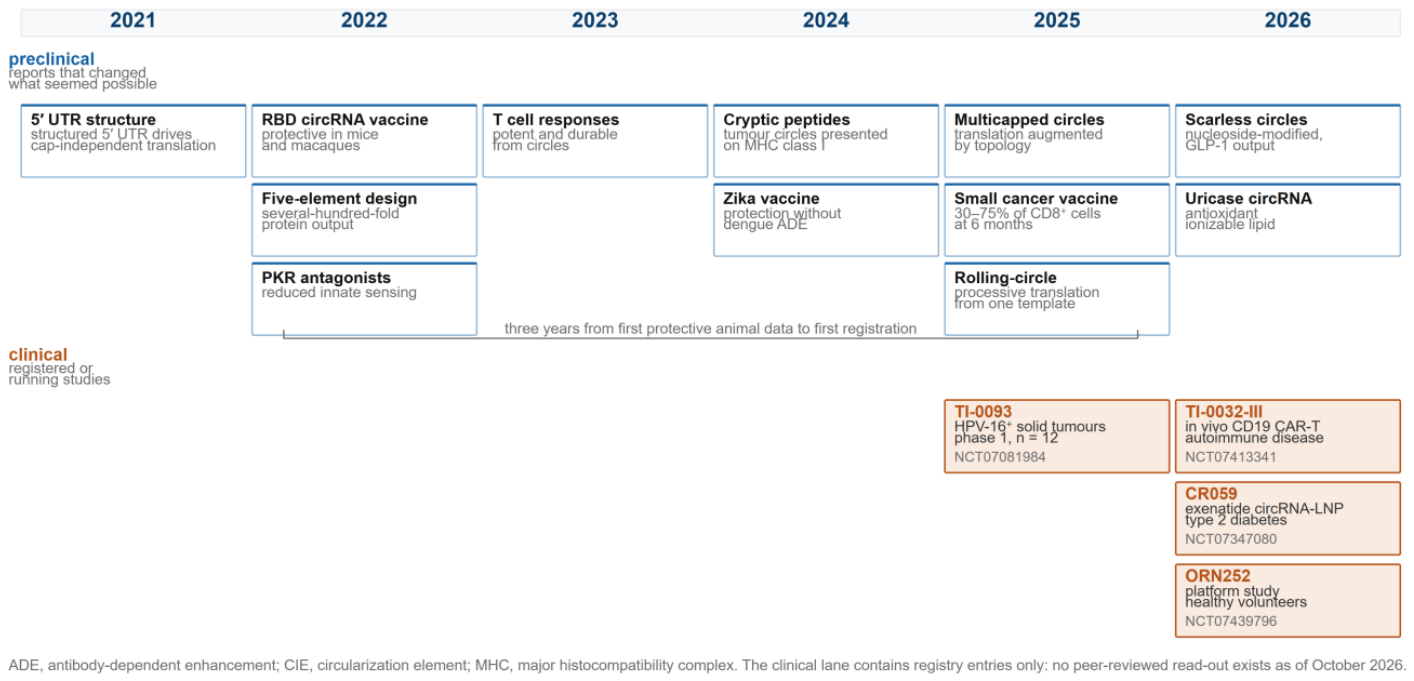
The first to start, and so far the only one to finish, is almost invisible in the peer-reviewed literature. HM2002 is a circular RNA encoding vascular endothelial growth factor, developed by CirCode Biotherapeutics and sponsored at a Shanghai centre, and given by multiple-point epicardial injection during coronary artery bypass grafting in patients with ischaemic heart failure: three participants, a single 5 mg dose, sentinel dosing with a 14-day observation interval before the remaining participants, and safety, tolerability and exploratory efficacy as objectives 55. It began in September 2024 and completed in May 2025, and the same product has since received investigational new drug clearance in both China and the United States. The design is deliberately minimal, and its significance is out of proportion to its size: it establishes that a manufactured circle can be released for human use, that an epicardial route is tolerated in a population already undergoing cardiac surgery, and that a regulatory pathway for a circular RNA drug substance exists in practice and not only on paper. Its results have been described only in sponsor communications, which report that all participants completed dosing without drug-related adverse events and with improvements in cardiac function. That a study of this importance has no peer-reviewed report is itself an observation about how this field communicates.
The second, RXRG001, tests a local rather than a systemic route: administration into the ducts of the parotid glands in radiation-induced xerostomia and hyposalivation, in a two-part design with single and multiple ascending dose cohorts followed by a randomised, placebo-controlled expansion, and an estimated enrolment of 42 56. It began in March 2025 and is recruiting. Two features are informative. The indication is chosen so that a local pharmacological effect, saliva flow, can be measured without a systemic exposure requirement, which removes the tropism problem that constrains every intravenous programme. And the product is dosed repeatedly from the outset, so the study will generate the first human data on whether a circRNA can be redosed into a tissue.
TI-0093 was the third to start and is the only therapeutic vaccine in the set: an open-label dose-escalation study in recurrent or metastatic HPV-16-positive solid tumours, with an estimated enrolment of 12 participants, designed to define safety, tolerability, the maximum tolerated dose and the recommended phase 2 dose 57. The choice of indication is deliberate: HPV-16-driven cancers express two foreign oncoproteins, so the antigen is non-self, the population is small, and the endpoint, antigen-specific T cell response, is measurable early. The study began in November 2025, and its estimated primary completion date of September 2026 has passed without a public read-out.
The first of the CD19 CAR programmes to start was RXIM002, an investigator-initiated study at a single centre in Shanghai in relapsed or refractory B cell-mediated autoimmune disease, with an estimated enrolment of 27 58. It began in December 2025 and is recruiting, and the same product has since been registered in a second indication, immune thrombocytopenia (NCT07765966), which is not tabulated separately. The same institution accounts for two of the other eight entries, HM2002 above and the lymphoma study below, which makes it the largest single source of clinical experience with the format, an unusual concentration for a platform that is otherwise distributed across companies and countries, and one that will make the first read-outs difficult to attribute to any single design choice.
CR059 is the only programme in the intravenous set that encodes neither an antigen nor a receptor: an exenatide-encoding circRNA-LNP evaluated in a single-ascending-dose study in Chinese participants with type 2 diabetes, with dose cohorts of 4, 8 and 12 μg/kg and an estimated enrolment of 9 59. It began in January 2026, and its estimated primary completion date of August 2026 has passed. The design is explicitly a pharmacology study: it asks whether a circRNA can produce a sustained peptide exposure profile in humans, not whether it improves glycaemic control. For a platform whose commercial case rests on chronic replacement this is the trial that matters most, and the one least able to answer the question, because a single dose cannot demonstrate durability.
TI-0032-III is the most technically ambitious of the autoimmune programmes. It is an LNP targeted to T cells and carrying a circRNA encoding a CD19 CAR, administered to patients with relapsed or refractory B cell-mediated autoimmune disease including systemic lupus erythematosus, Sjögren syndrome, systemic sclerosis, inflammatory myopathy and ANCA-associated vasculitis 60. It converts an ex vivo cell therapy into an off-the-shelf injection and depends on three separate technologies working together: T cell tropism, circRNA translation in primary human T cells and CAR signalling. Success would be a genuine category change. The study opened in January 2026 at a single centre in Shanghai, plans to enrol 12 participants, and has an estimated primary completion date of May 2027.
SYNCAR-100 is the first circular RNA programme in a haematological malignancy and the most aggressively dosed: a CD19 CAR encoded in a circRNA-LNP and given intravenously once weekly for four doses in relapsed or refractory B cell acute lymphoblastic leukaemia, with an estimated enrolment of 16 61. It began in February 2026. Four sequential weekly doses are the most direct test of redosing in the set: if anti-particle or anti-cargo immunity limits repeat administration, a schedule of this kind will expose it sooner than a single-dose design will.
ORN252 is the first of the nine to be run outside China and the only one dosed in healthy volunteers: an LNP carrying a circRNA encoding an anti-CD19 CAR, evaluated in a phase 1 single-ascending-dose study in Australia with an estimated enrolment of 20 62. It began in March 2026. A first-in-human study in healthy volunteers rather than in patients implies that the sponsor expects a pharmacodynamic signal that does not require disease, and for a CD19 CAR the only such signal is depletion of circulating B cells; the study therefore tests mechanism rather than efficacy, which is an unusual and informative choice for a platform entering the clinic.
The most recent entry is also the largest: a phase 1 dose-escalation study of an in vivo circular RNA CAR-T in relapsed or refractory B cell lymphoma, with four dose levels and an estimated enrolment of 30, sponsored by the same Shanghai centre in collaboration with a commercial partner 63. It began in May 2026. Its protocol is unusual in specifying pre-existing and treatment-induced antibodies against PEG, the CAR and the targeting domain as secondary endpoints, which means that the redosing question raised in Section 3.4 will be measured rather than inferred.
Three observations follow from the list as a whole. First, the field has already voted: five of the nine programmes encode a CD19 CAR, from four sponsors and two jurisdictions, and that convergence is stronger evidence of where value is expected to lie than any individual trial. Second, the routes have diversified faster than the molecules. Epicardial, intraductal, intramuscular and intravenous administration all appear, which suggests that delivery is being solved case by case rather than by a generalizable particle. Third, and least comfortably, three of the nine studies come from one institution; a platform whose clinical experience is that concentrated has a thinner evidence base than the number of registrations implies.
5.2. What the mRNA-LNP Precedents Do and Do Not De-Risk
circRNA does not need to establish the safety of LNPs, the feasibility of RNA manufacturing at scale or the regulatory route for an RNA therapeutic; the licensed mRNA vaccines, the approved siRNA products and the clinical-stage editing programmes have done that 1,2,64. Three precedents are directly informative. First, individualised neoantigen therapy with mRNA-4157 plus pembrolizumab in resected high-risk melanoma met its prespecified primary end point, with a hazard ratio for recurrence of 0.561 (95% confidence interval 0.309-1.017; one-sided P = 0.0266; two-sided P = 0.053), establishing that repeated intramuscular mRNA-LNP dosing is feasible in an adjuvant setting 65; the confidence interval crosses unity, so the result is best read as evidence of feasibility rather than of benefit. Second, in vivo gene editing with an LNP-delivered CRISPR-Cas9 system achieved dose-dependent reductions in plasma kallikrein of up to 95% after a single infusion in patients with hereditary angioedema, with infusion-related reactions and fatigue as the principal adverse events and no dose-limiting toxicity 66; a subsequent phase 2 study extended the observation 67. Third, base editing of PCSK9 in non-human primates established durable lowering of a circulating protein after a single LNP dose, the closest analogue to the durability claim that circRNA makes 68.
What these precedents do not de-risk is equally important. None of them establishes that a closed RNA is processed differently in human cells, that anti-circRNA immunity will be negligible, or that a circle will produce longer expression than an optimized nucleoside-modified mRNA in a human tissue. They also do not settle the analytical question: no pharmacopoeial or International Council for Harmonisation guidance specific to circular RNA exists, so each sponsor must negotiate its own specification.
5.3. The Read-Outs That Will Decide the Field
Four read-outs from these studies will be decisive, and the first is already informative by its absence: the only completed study in Table 2 finished in May 2025 and has published nothing, which sets a low expectation for rapid disclosure from the rest. The first read-out proper is the shape of the exposure–response curve: whether a circRNA produces a flat, sustained profile at a dose that is tolerated, or whether it behaves like a slowly decaying mRNA. The second is the innate immune signature in humans, including interferon-stimulated gene induction and reactogenicity, which will test the claim that circles are less inflammatory than unmodified linear RNA. The third is the anti-drug antibody response, both to the expressed protein and to the particle, because it determines whether chronic dosing is possible; the lymphoma protocol that specifies anti-PEG, anti-CAR and anti-target titres as endpoints is the first study designed to answer it. The fourth is the relationship between circular purity and clinical performance: if, for example, a preparation that is 85% circular behaves identically to one that is 95% circular, specifications can be set pragmatically; if not, purification becomes the rate-limiting cost of the platform.
6. Manufacturing, Analytics and Regulation
6.1. Drug Substance
A circRNA drug substance is produced by in vitro transcription of a linear template, circularization, purification and formulation. Each step has a characteristic failure mode. Transcription generates double-stranded RNA and abortive products, and T7 polymerase can generate high-molecular-weight by-products that are difficult to remove and are immunostimulatory at the concentrations concerned 12. Circularization competes with intermolecular ligation and hydrolysis and is sensitive to RNA concentration, magnesium and temperature. Purification must remove linear precursor, nicked circles, residual intron and protein, and it is here that the difference between a research-grade and a clinical-grade preparation is largest. Ribonuclease R digestion depletes linear RNA, and nicked circles, being linearized by the nick, are largely removed with it, although short 3′ overhangs at a nick can confer partial resistance in some sequence contexts, which makes the assay less quantitative than it appears; high-performance liquid chromatography separates by size and topology but with yield losses; oligo(dT) selection is unavailable because circles have no poly(A) tail. The result is a product with a circular-purity specification that is method-dependent and therefore difficult to compare across sponsors.
The economics of this sequence are governed by two variables that are rarely reported together: the circularization yield as a function of length, and the loss incurred in purifying to a defined circular fraction. A 1-kb circle and a 5-kb circle made by the same chemistry are not the same process, because yield falls steeply with length, and a programme that is viable at peptide scale may therefore not be viable at multimeric-antigen scale. Two consequences follow that the field has not yet confronted in public. First, the cost of goods for a chronic indication should be quoted per intact circle rather than per milligram of RNA, because a preparation that is 70% circular contains 30% of material that is paid for and then excluded from the dose calculation. Second, because circularization and purification losses compound, a process change that raises circular fraction by a few percentage points can be worth more commercially than a comparable gain in potency. Neither figure is reported in the preclinical literature, which is one reason comparisons between programmes are so difficult.
6.2. Critical Quality Attributes and Potency
The attribute set that matters is becoming clear even though agreed limits are not: circular fraction and the identity of linear impurities; dsRNA content; residual intron, scar or ligation junction sequence; 5′-end heterogeneity; aggregation; encapsulation efficiency measured for intact cargo rather than total RNA; particle size and polydispersity; and the lipid composition, including the fraction of PEG–lipid retained after purification. Potency is the hardest. A cell-based translation assay is the obvious approach, but it is sensitive to cell type, transfection efficiency and the translated sequence, and it does not necessarily predict in vivo performance. The field would benefit from a reference material and a consensus reporter construct, in the way that the mRNA field converged on standardized luciferase and fluorescent-protein reporters.
Analytics for circRNA have improved substantially. Long-read nanopore sequencing permits full-length profiling of circles and resolution of internal structure 69,70, and dedicated computational tools now handle terabyte-scale datasets 71. These methods are appropriate for characterization and for troubleshooting, but they are not yet routine release assays. Bridging the gap between research-grade characterization and validated release testing is a regulatory problem as much as a technical one.
Two structural problems sit underneath this list of attributes. The first is that circular fraction is operationally defined: different combinations of nuclease digestion, chromatography and long-read sequencing give different denominators, so two sponsors can report the same specification and mean different things. A certified reference material, consisting of a characterized circle together with a characterized nicked and linear mixture, would make the specifications commensurable, and it is the single most useful piece of shared infrastructure the field could build. The second is that potency and purity are not independent: if the assay reports total RNA, a preparation that is half degraded can score as well as an intact one, and the specification then rewards mass rather than activity. Both problems are solvable with existing methods and neither requires a new technology.
6.3. Drug Product and the Cold Chain
Formulation follows the mRNA-LNP playbook: microfluidic mixing of an aqueous RNA phase with an ethanolic lipid phase, solvent exchange, concentration and filtration. Two features are circRNA-specific. First, because circles are compact, the same lipid mass produces particles with different internal RNA density, and the relationship between lipid-to-RNA ratio and potency must be re-established rather than transferred. Second, stability. The claim that circles are more thermostable than linear RNA has been tested at the product level only rarely, but the available evidence is encouraging: lyophilized circRNA vaccines retained lymph-node targeting and immunogenicity after storage 38. If that result generalizes, it removes one of the principal logistical disadvantages of RNA medicines, and it is a stronger commercial differentiator than most of the molecular claims discussed above.
6.4. The Nonclinical Safety Package
The regulatory route discussed below presupposes a safety package, and no circular RNA programme has yet published one in full. Its shape is borrowed from mRNA-LNP and siRNA-LNP experience, and three elements require circRNA-specific work. The first is repeat-dose toxicology. Particle-related toxicity, complement activation, hepatotoxicity at high dose and accumulation of ionizable lipid in liver and spleen, is a property of the formulation and transfers from the mRNA experience; what does not transfer is the dosing regimen, because the indications that motivate circularity are chronic, and no chronic repeat-dose toxicology in a non-rodent species has been reported for a circular RNA.
The second is distribution. A circle that resists exonuclease attack may persist in tissue in a form that a linear transcript does not, and the safety question is not whether the circle is present but whether it is translated, or sensed, in the wrong place for longer than intended. Tissue-level measurement of intact circle, total RNA and protein, which we call for in Section 7, is a safety assay as much as an efficacy one. The third is immunotoxicity. Anti-PEG antibodies, complement and the sequence-dependent innate response described in Section 2.4 are all measurable, but no agreed panel exists, so the assays a sponsor validates will differ between programmes in the same way that circular-purity methods do.
6.5. Regulatory Pathway
No jurisdiction has issued guidance specific to circular RNA. Sponsors therefore file under existing RNA therapeutic frameworks, which were written with linear mRNA and siRNA in mind. Three issues arise repeatedly. The definition of the active substance: whether the linear precursor is an impurity, a process intermediate or a specified degradant determines how much of it is permitted. The potency assay: a bioassay is expected, but the relationship between in vitro potency and clinical effect is unproven for this class. And long-term expression: a circle that resists degradation raises a question that linear RNA does not, namely whether unintended translation from an open reading frame, or accumulation in a non-target tissue, could produce delayed effects. The first clinical datasets will do more to resolve these questions than any amount of preclinical argument.
Comparability is the problem that arrives later, and sponsors are least prepared for it. A process change after a pivotal study, a new template, a different circularization chemistry or a change of lipid supplier, alters the impurity profile in ways that the current attribute set does not resolve into a single number, and there is no agreed bridging strategy for circular RNA of the kind that exists, for example, for a change of cell substrate in the manufacture of a monoclonal antibody. Sponsors should define the relationship between circular fraction, dsRNA content and clinical read-out early, because that relationship is what a comparability exercise will be argued against. The programmes now in phase 1 are generating the first dataset on which such arguments can be built.
|
Box 2 A design checklist for a circRNA-LNP programme Indication fit. Does the therapeutic window require sustained rather than peak exposure? If peak exposure is what matters, an optimized mRNA is likely to be simpler and cheaper. Payload length. Peptides, aptamers and small antigens below about 1 kb are the format in which circles currently perform best; multimeric antigens and editing proteins push yield and purity requirements. Translation architecture. Choose between a strong IRES, a structured 5′ UTR, a cap-independent translation enhancer, and a rolling-circle design; test at least two, because relative ranking is sequence-dependent. Particle. Screen ionizable lipids against circular cargo rather than assuming transfer from mRNA; measure encapsulation of intact circles; specify apparent pKa and the fraction of PEG–lipid retained. Route and target cell. Default liver delivery is rarely the right answer; consider lymph node, tumour, T cell and intranasal routes explicitly. Redosing plan. Assume that anti-cargo and anti-particle immunity will develop; build a dose-sparing or serotype-switching strategy into the preclinical package. Analytical control. Define circular fraction, dsRNA, linear and nicked species, and a potency assay before process lock, not after. Comparator and benchmark. Decide at the outset whether the relevant comparator is an unmodified mRNA, a nucleoside-modified mRNA, a self-amplifying RNA or a protein. The answer determines which experiments are worth doing and which claims the resulting package will support. |
7. Outlook
The circRNA field has passed through the phase in which the interesting question was whether the molecule could be made, and it now faces the questions that decide whether a platform survives contact with clinical development. We see five, in descending order of how much they constrain the field today (Table 3); Box 2 turns the same list into a design checklist for a programme.
Translation efficiency per molecule remains the binding constraint for all non-vaccine applications. The gains from sequence and topology engineering have been large, but they were measured largely in immortalized cells with reporter constructs. A standardized benchmark, in which a fixed panel of circles and a fixed panel of optimized mRNAs encoding the same protein are compared in primary human cells and in at least two animal species, would do more for the field than another disease model. Without it, the claim that circles out-translate mRNA will remain contestable.
Durability in humans is the second. The preclinical record consistently shows longer expression from circles than from unmodified mRNA, but the mechanism is a mixture of nuclease resistance, slower clearance and continued translation, and the three are rarely separated experimentally. Tissue-level pharmacokinetics, distinguishing intact circle, total RNA and protein, is needed. The base-editing precedent, in which a single LNP dose produced durable pharmacodynamic effect through a different mechanism 68, shows that durability can be achieved without circularity, which means that circularity must demonstrate an advantage over that route and not only over mRNA.
Redosing and anti-drug immunity is the third, and it is the one most likely to be underestimated. Every chronic indication in the current pipeline, peptide replacement, enzyme replacement and in vivo CAR-T for autoimmune disease, requires either repeated dosing or durable expression from a single dose. The first is limited by immunity to the particle and the expressed protein; the second by the fraction of target cells that a single dose reaches. Neither has been characterized in humans for circular cargo.
Manufacturing and analytical control is the fourth. Circular purity is currently a sponsor-defined specification measured by sponsor-specific methods, which makes cross-programme comparison impossible and gives regulators no basis for a class-wide standard. Reference materials, a consensus potency assay and public data on the relationship between circular fraction and clinical performance would lower the cost of entry for everyone, including the academic groups that generate most of the mechanistic insight.
Target cell access is the fifth. The liver-default behaviour of systemic LNPs is incompatible with most of the indications for which circRNA has a mechanistic rationale, and the targeting strategies that work in mice, antibody conjugation, SORT-style charge modulation and intranasal administration, have not been shown to translate reliably. The five CD19 CAR programmes in Table 2 58,60–63 are the most informative test of whether programmed tropism is a solved problem or an aspiration, and they are the first studies in which a liver-default particle is being asked to reach a cell type that constitutes a small fraction of circulating cells. Their concentration in a small number of sponsors means that the answer will arrive as a handful of correlated data points rather than as independent replication.
One determinant of the platform’s shape is commercial rather than scientific, and it is largely absent from the primary literature. The circularization chemistries, the permuted intron–exon architecture and several of the translation-enhancing elements described in Section 2 are covered by patents held by the sponsors listed in Table 2, and we make no assessment of their scope or validity. What matters for the argument here is structural. A field in which the enabling chemistry is concentrated among a small number of holders will differentiate by licence and by manufacturing competence at least as much as by design. Academic groups, which generate most of the mechanistic insight reviewed above, are the parties least able to obtain freedom to operate on terms a commercial programme would need; if circularity becomes a general platform property, that will be visible first as a change in who is able to run a clinical programme, and only later as a change in the molecules.
Underlying all five is a strategic question that the field has not answered explicitly: is circularity a platform property or a niche solution? Our reading of the evidence is that it is currently a niche solution with one clearly established advantage and several plausible ones. The established advantage is thermostability at the product level and nuclease resistance at the molecular level, both of which matter most for vaccines in settings where cold chains are unreliable. The plausible advantages, longer expression, lower immunogenicity and higher peptide output per molecule, are real in specific systems and unproven in humans. The most likely outcome, in our view, is differentiation by indication rather than replacement of mRNA: circles for vaccines and peptide replacement where duration and stability dominate, mRNA where peak antigen expression and manufacturing simplicity dominate, and both inside the same particle technology. The next three years of clinical data will convert that judgement into either a forecast or an obituary, and the nine studies now in the clinic, one of them already complete, are the instruments that will make the measurement.
Author Contributions
Hongxian Chen: Writing-review & editing, Yunwang Zhao: Writing-original draft, Shiyi Zhou: Visualization, Lei He and Chenlin Xiu: Methodology, Formal analysis, Baihai Huang: Conceptualization. Xiongxiong Lu: Writing-review & editing, Writing-original draft, Methodology, Conceptualization.
Acknowledgments
This work was supported in part by the National Natural Science Foundation of China (81560346).
Conflicts of Interest
The authors declare no competing interests.
References
- Pardi, N.; Krammer, F. mRNA vaccines for infectious diseases - advances, challenges and opportunities. Nat. Rev. Drug Discov. 2024, 23, 838–861. [Google Scholar] [CrossRef] [PubMed]
- Barbier, A.J.; Jiang, A.Y.; Zhang, P.; et al. The clinical progress of mRNA vaccines and immunotherapies. Nat. Biotechnol. 2022, 40, 840–854. [Google Scholar] [CrossRef] [PubMed]
- Liu, C.X.; Chen, L.L. Circular RNAs: Characterization, cellular roles, and applications. Cell 2022, 185, 2016–2034. [Google Scholar] [CrossRef] [PubMed]
- Hou, X.; Zaks, T.; Langer, R.; et al. Lipid nanoparticles for mRNA delivery. Nat. Rev. Mater. 2021, 6, 1078–1094. [Google Scholar] [CrossRef] [PubMed]
- O’Leary, E.; Jiang, Y.; Kristensen, L.S.; et al. The therapeutic potential of circular RNAs. Nat. Rev. Genet. 2025, 26, 230–244. [Google Scholar] [CrossRef] [PubMed]
- Niu, D.; Wu, Y.; Lian, J. Circular RNA vaccine in disease prevention and treatment. Signal Transduct. Target. Ther. 2023, 8, 341. [Google Scholar] [CrossRef] [PubMed]
- Chen, R.; Wang, S.K.; Belk, J.A.; et al. Engineering circular RNA for enhanced protein production. Nat. Biotechnol. 2023, 41, 262–272. [Google Scholar] [CrossRef] [PubMed]
- Tao, X.; Zhai, S.N.; Liu, C.X.; et al. Degradation of circular RNA by the ribonuclease DIS3. Mol. Cell 2025, 85, 1674–1685.e8. [Google Scholar] [CrossRef] [PubMed]
- Kim, S.S.; Ham, S.; Boo, S.H.; et al. Ribonuclease κ promotes longevity by preventing age-associated accumulation of circular RNA in stress granules. Mol. Cell 2026, 86, 885–900.e14. [Google Scholar] [CrossRef] [PubMed]
- Amaya, L.; Abe, B.; Liu, J.; et al. Pathways for macrophage uptake of cell-free circular RNAs. Mol. Cell 2024, 84, 2104–2118.e6. [Google Scholar] [CrossRef] [PubMed]
- Ngo, L.H.; Bert, A.G.; Dredge, B.K.; et al. Nuclear export of circular RNA. Nature 2024, 627, 212–220. [Google Scholar] [CrossRef] [PubMed]
- Liu, C.X.; Guo, S.K.; Nan, F.; et al. RNA circles with minimized immunogenicity as potent PKR inhibitors. Mol. Cell 2022, 82, 420–434.e6. [Google Scholar] [CrossRef] [PubMed]
- Huang, D.; Zhu, X.; Ye, S.; et al. Tumour circular RNAs elicit anti-tumour immunity by encoding cryptic peptides. Nature 2024, 625, 593–602. [Google Scholar] [CrossRef] [PubMed]
- Shen, Y.; Li, B.; Dong, L.; et al. Self-splicing RNA circularization facilitated by intact group I and II introns. Nat. Commun. 2025, 16, 7376. [Google Scholar] [CrossRef] [PubMed]
- Wang, L.; Zhai, Q.; Dong, C.; et al. Split intron-exon system for circular RNA synthesis. Nat. Commun. 2026, 17, 9163. [Google Scholar] [CrossRef] [PubMed]
- Wasinska-Kalwa, M.; Mamot, A.; Czubak, K.; et al. Chemical circularization of in vitro transcribed RNA for exploring circular mRNA design. Nat. Commun. 2025, 16, 6455. [Google Scholar] [CrossRef] [PubMed]
- Wang, X.; Pan, Q.; Yin, J.; et al. Engineered circular RNA compatible with complete nucleoside modification and rolling circle translation through a Cap-independent translation enhancer. Nat. Biomed. Eng. 2026. [Google Scholar] [CrossRef] [PubMed]
- Boo, S.H.; Shin, M.K.; Hwang, H.J.; et al. Circular RNAs trigger nonsense-mediated mRNA decay. Mol. Cell 2024, 84, 4862–4877.e7. [Google Scholar] [CrossRef] [PubMed]
- Chen, C.K.; Cheng, R.; Demeter, J.; et al. Structured elements drive extensive circular RNA translation. Mol. Cell 2021, 81, 4300–4318.e13. [Google Scholar] [CrossRef] [PubMed]
- Chen, H.; Liu, D.; Aditham, A.; et al. Chemical and topological design of multicapped mRNA and capped circular RNA to augment translation. Nat. Biotechnol. 2025, 43, 1128–1143. [Google Scholar] [CrossRef] [PubMed]
- Du, Y.; Zuber, P.K.; Xiao, H.; et al. Efficient circular RNA synthesis for potent rolling circle translation. Nat. Biomed. Eng. 2025, 9, 1062–1074. [Google Scholar] [CrossRef] [PubMed]
- Chen, H.; Liu, D.; Guo, J.; et al. Branched chemically modified poly(A) tails enhance the translation capacity of mRNA. Nat. Biotechnol. 2025, 43, 194–203. [Google Scholar] [CrossRef] [PubMed]
- Mulroney, T.E.; Pöyry, T.; Yam-Puc, J.C.; et al. N1-methylpseudouridylation of mRNA causes +1 ribosomal frameshifting. Nature 2024, 625, 189–194. [Google Scholar] [CrossRef] [PubMed]
- Zhang, Y.; Liu, X.; Shen, T.; et al. Small circular RNAs as vaccines for cancer immunotherapy. Nat. Biomed. Eng. 2025, 9, 249–267. [Google Scholar] [CrossRef] [PubMed]
- Swingle, K.L.; Hamilton, A.G.; Han, X.; et al. Circular RNA lipid nanoparticle vaccine against SARS-CoV-2. Proc. Natl. Acad. Sci. USA 2025, 122, e2505718122. [Google Scholar] [CrossRef] [PubMed]
- Han, X.; Zhang, H.; Butowska, K.; et al. An ionizable lipid toolbox for RNA delivery. Nat. Commun. 2021, 12, 7233. [Google Scholar] [CrossRef] [PubMed]
- Wang, S.; Weissman, D.; Dong, Y. RNA chemistry and therapeutics. Nat. Rev. Drug Discov. 2025, 24, 828–851. [Google Scholar] [CrossRef] [PubMed]
- Dilliard, S.A.; Siegwart, D.J. Passive, active and endogenous organ-targeted lipid and polymer nanoparticles for delivery of genetic drugs. Nat. Rev. Mater. 2023, 8, 282–300. [Google Scholar] [CrossRef] [PubMed]
- Xu, S.; Xu, Y.; Solek, N.C.; et al. Tumor-Tailored Ionizable Lipid Nanoparticles Facilitate IL-12 Circular RNA Delivery for Enhanced Lung Cancer Immunotherapy. Adv. Mater. 2024, 36, e2400307. [Google Scholar] [CrossRef] [PubMed]
- Jia, Y.; Xu, L.; Leng, S.; et al. Nose-to-Brain Delivery of Circular RNA SCMH1-Loaded Lipid Nanoparticles for Ischemic Stroke Therapy. Adv. Mater. 2025, 37, e2500598. [Google Scholar] [CrossRef] [PubMed]
- Rurik, J.G.; Tombácz, I.; Yadegari, A.; et al. CAR T cells produced in vivo to treat cardiac injury. Science 2022, 375, 91–96. [Google Scholar] [CrossRef] [PubMed]
- Mihindukulasooriya, S.P.; Wang, Z.; Li, S.; et al. Anti-PEG antibodies in nanomedicine: Mechanisms, risks, and opportunities. Adv. Drug Deliv. Rev. 2026, 236, 115925. [Google Scholar] [CrossRef] [PubMed]
- Qu, L.; Yi, Z.; Shen, Y.; et al. Circular RNA vaccines against SARS-CoV-2 and emerging variants. Cell 2022, 185, 1728–1744.e16. [Google Scholar] [CrossRef] [PubMed]
- Amaya, L.; Grigoryan, L.; Li, Z.; et al. Circular RNA vaccine induces potent T cell responses. Proc. Natl. Acad. Sci. USA 2023, 120, e2302191120. [Google Scholar] [CrossRef] [PubMed]
- Wan, J.; Wang, C.; Wang, Z.; et al. CXCL13 promotes broad immune responses induced by circular RNA vaccines. Proc. Natl. Acad. Sci. USA 2024, 121, e2406434121. [Google Scholar] [CrossRef] [PubMed]
- Liu, X.; Li, Z.; Li, X.; et al. A single-dose circular RNA vaccine prevents Zika virus infection without enhancing dengue severity in mice. Nat. Commun. 2024, 15, 8932. [Google Scholar] [CrossRef] [PubMed]
- Zhou, J.; Ye, T.; Yang, Y.; et al. Circular RNA vaccines against monkeypox virus provide potent protection against vaccinia virus infection in mice. Mol. Ther. 2024, 32, 1779–1789. [Google Scholar] [CrossRef] [PubMed]
- Wan, J.; Wang, Z.; Wang, L.; et al. Circular RNA vaccines with long-term lymph node-targeting delivery stability after lyophilization induce potent and persistent immune responses. mBio 2024, 15, e0177523. [Google Scholar] [CrossRef] [PubMed]
- Li, H.; Peng, K.; Yang, K.; et al. Circular RNA cancer vaccines drive immunity in hard-to-treat malignancies. Theranostics 2022, 12, 6422–6436. [Google Scholar] [CrossRef] [PubMed]
- Wang, F.; Cai, G.; Wang, Y.; et al. Circular RNA-based neoantigen vaccine for hepatocellular carcinoma immunotherapy. MedComm 2024, 5, e667. [Google Scholar] [CrossRef] [PubMed]
- Gong, Z.; Hu, W.; Zhou, C.; et al. Recent advances and perspectives on the development of circular RNA cancer vaccines. npj Vaccines 2025, 10, 41. [Google Scholar] [CrossRef] [PubMed]
- Yang, J.; Zhu, J.; Sun, J.; et al. Intratumoral delivered novel circular mRNA encoding cytokines for immune modulation and cancer therapy. Mol. Ther. Nucleic Acids 2022, 30, 184–197. [Google Scholar] [CrossRef] [PubMed]
- Cai, J.; Liu, Z.; Chen, S.; et al. Engineered circular RNA-based DLL3-targeted CAR-T therapy for small cell lung cancer. Exp. Hematol. Oncol. 2025, 14, 35. [Google Scholar] [CrossRef] [PubMed]
- Yang, Y.M.; Bao, B.; Cao, Y.H.; et al. In vivo CAR-cell therapy: current challenges and emerging therapeutic advances. Mol. Biomed. 2026, 7, 54. [Google Scholar] [CrossRef] [PubMed]
- Liu, J.; Zhang, Y.; Liu, C.; et al. A single dose of VEGF-A circular RNA sustains in situ long-term expression of protein to accelerate diabetic wound healing. J. Control. Release 2024, 373, 319–335. [Google Scholar] [CrossRef] [PubMed]
- Suo, J.; Li, L.; Tan, W.; et al. Circular RNA-based protein replacement therapy mitigates osteoarthritis in male mice. Nat. Commun. 2025, 16, 8480. [Google Scholar] [CrossRef] [PubMed]
- Du, K.; Guo, Y.; Zhou, J.; et al. Antioxidant malic-acid-derived lipid nanoparticles delivering secretory uricase circRNA for hyperuricemia and complication management in mice. Nat. Commun. 2026, 17, 8997. [Google Scholar] [CrossRef] [PubMed]
- Liang, R.; He, Z.; Zhao, K.T.; et al. Prime editing using CRISPR-Cas12a and circular RNAs in human cells. Nat. Biotechnol. 2024, 42, 1867–1875. [Google Scholar] [CrossRef] [PubMed]
- Liu, B.; Dong, X.; Cheng, H.; et al. A split prime editor with untethered reverse transcriptase and circular RNA template. Nat. Biotechnol. 2022, 40, 1388–1393. [Google Scholar] [CrossRef] [PubMed]
- Yi, Z.; Qu, L.; Tang, H.; et al. Engineered circular ADAR-recruiting RNAs increase the efficiency and fidelity of RNA editing in vitro and in vivo. Nat. Biotechnol. 2022, 40, 946–955. [Google Scholar] [CrossRef] [PubMed]
- Kameda, S.; Ohno, H.; Saito, H. Synthetic circular RNA switches and circuits that control protein expression in mammalian cells. Nucleic Acids Res. 2023, 51, e24. [Google Scholar] [CrossRef] [PubMed]
- Guo, S.K.; Liu, C.X.; Xu, Y.F.; et al. Therapeutic application of circular RNA aptamers in a mouse model of psoriasis. Nat. Biotechnol. 2025, 43, 236–246. [Google Scholar] [CrossRef] [PubMed]
- Feng, X.; Jiang, B.W.; Zhai, S.N.; et al. Circular RNA aptamers targeting neuroinflammation ameliorate Alzheimer disease phenotypes in mouse models. Nat. Biotechnol. 2026, 44, 454–463. [Google Scholar] [CrossRef] [PubMed]
- Feng, Z.; Zhang, X.; Zhou, J.; et al. An in vitro-transcribed circular RNA targets the mitochondrial inner membrane cardiolipin to ablate EIF4G2+/PTBP1+ pan-adenocarcinoma. Nat. Cancer 2024, 5, 30–46. [Google Scholar] [CrossRef] [PubMed]
- Ruijin Hospital. First-in-Human Pilot Study of Epicardial Circular RNA-HM2002 Injection in CABG for Ischemic Heart Failure. ClinicalTrials.gov. 2024. Available online: https://clinicaltrials.gov/study/NCT06621576.
- RiboX Therapeutics Ltd. Study of Circular RNA Treatment in Patients With Radiation Induced Xerostomia-1. ClinicalTrials.gov. 2025. Available online: https://clinicaltrials.gov/study/NCT06714253.
- Therorna. A Phase I Clinical Study to Evaluate the Safety, Tolerability, Efficacy and Immunogenicity of TI-0093 Injection in Patients With Recurrent/Metastatic HPV-16 Positive Solid Tumors. ClinicalTrials.gov. 2025. Available online: https://clinicaltrials.gov/study/NCT07081984.
- Ruijin Hospital. Safety and Efficacy Study of RXIM002 in Severe, Relapsed or Refractory Autoimmune Diseases. ClinicalTrials.gov. 2025. Available online: https://clinicaltrials.gov/study/NCT07322718.
- The First Affiliated Hospital of Henan University of Science and Technology. A Single-Center, Open-Label, Single Ascending Dose Study to Evaluate the Safety, Tolerability, Pharmacokinetics and Pharmacodynamics of Exenatide Circular RNA-Lipid Nanoparticle Injection (CR059) in Chinese Subjects With Type 2 Diabetes Mellitus. ClinicalTrials.gov. 2026. Available online: https://clinicaltrials.gov/study/NCT07347080.
- Therorna. A Clinical Study on the Safety and Efficacy of in Vivo CAR-T Cell Therapy (TI-0032-III Injection) for the Treatment of Relapsed and Refractory Autoimmune Diseases. ClinicalTrials.gov. 2026. Available online: https://clinicaltrials.gov/study/NCT07413341.
- Zhejiang University. Clinical Study of SYNCAR-100 in the Treatment of Relapsed/Refractory Acute B-Lymphoblastic Leukemia. ClinicalTrials.gov. 2026. Available online: https://clinicaltrials.gov/study/NCT07429461.
- Therapeutics, Orna. A Phase 1 Study to Investigate the Safety, Tolerability, Pharmacokinetics, and Pharmacodynamics of ORN252 in Healthy Participants. ClinicalTrials.gov. 2026. Available online: https://clinicaltrials.gov/study/NCT07439796.
- Ruijin Hospital. Exploration of Circular RNA in B-cell Hematologic Malignancies. ClinicalTrials.gov. 2026. Available online: https://clinicaltrials.gov/study/NCT07774572.
- Saw, P.E.; Song, E. Advancements in clinical RNA therapeutics: Present developments and prospective outlooks. Cell Rep. Med. 2024, 5, 101555. [Google Scholar] [CrossRef] [PubMed]
- Weber, J.S.; Carlino, M.S.; Khattak, A.; et al. Individualised neoantigen therapy mRNA-4157 (V940) plus pembrolizumab versus pembrolizumab monotherapy in resected melanoma (KEYNOTE-942): a randomised, phase 2b study. Lancet 2024, 403, 632–644. [Google Scholar] [CrossRef] [PubMed]
- Longhurst, H.J.; Lindsay, K.; Petersen, R.S.; et al. CRISPR-Cas9 In Vivo Gene Editing of KLKB1 for Hereditary Angioedema. N. Engl. J. Med. 2024, 390, 432–441. [Google Scholar] [CrossRef] [PubMed]
- Cohn, D.M.; Gurugama, P.; Magerl, M.; et al. CRISPR-Based Therapy for Hereditary Angioedema. N. Engl. J. Med. 2025, 392, 458–467. [Google Scholar] [CrossRef] [PubMed]
- Musunuru, K.; Chadwick, A.C.; Mizoguchi, T.; et al. In vivo CRISPR base editing of PCSK9 durably lowers cholesterol in primates. Nature 2021, 593, 429–434. [Google Scholar] [CrossRef] [PubMed]
- Zhang, J.; Hou, L.; Zuo, Z.; et al. Comprehensive profiling of circular RNAs with nanopore sequencing and CIRI-long. Nat. Biotechnol. 2021, 39, 836–845. [Google Scholar] [CrossRef] [PubMed]
- Hou, L.; Zhang, J.; Zhao, F. Full-length circular RNA profiling by nanopore sequencing with CIRI-long. Nat. Protoc. 2023, 18, 1795–1813. [Google Scholar] [CrossRef] [PubMed]
- Zheng, X.; Zhang, J.; Song, L.; et al. Detecting and quantifying circular RNAs in terabyte-scale RNA-seq datasets with CIRI3. Nat. Biotechnol. 2026, 44, 1463–1469. [Google Scholar] [CrossRef] [PubMed]
Figure 1.
Two routes to a closed RNA. (a) Cellular back-splicing joins a downstream 5′ splice site to an upstream 3′ splice site; intronic inverted repeats and RNA-binding proteins bring the two sites together. The product is a circle carrying the exon 3–exon 1 junction, with no cap and no poly(A) tail, together with a linear exon–intron species that is degraded. (b) Six manufacturing routes, each drawn as the molecular species at the circularization step, with the liability characteristic of that route given beneath. (c) The three product attributes that differ between routes, and that set both the yield and the analytical control strategy.
Figure 1.
Two routes to a closed RNA. (a) Cellular back-splicing joins a downstream 5′ splice site to an upstream 3′ splice site; intronic inverted repeats and RNA-binding proteins bring the two sites together. The product is a circle carrying the exon 3–exon 1 junction, with no cap and no poly(A) tail, together with a linear exon–intron species that is degraded. (b) Six manufacturing routes, each drawn as the molecular species at the circularization step, with the liability characteristic of that route given beneath. (c) The three product attributes that differ between routes, and that set both the yield and the analytical control strategy.
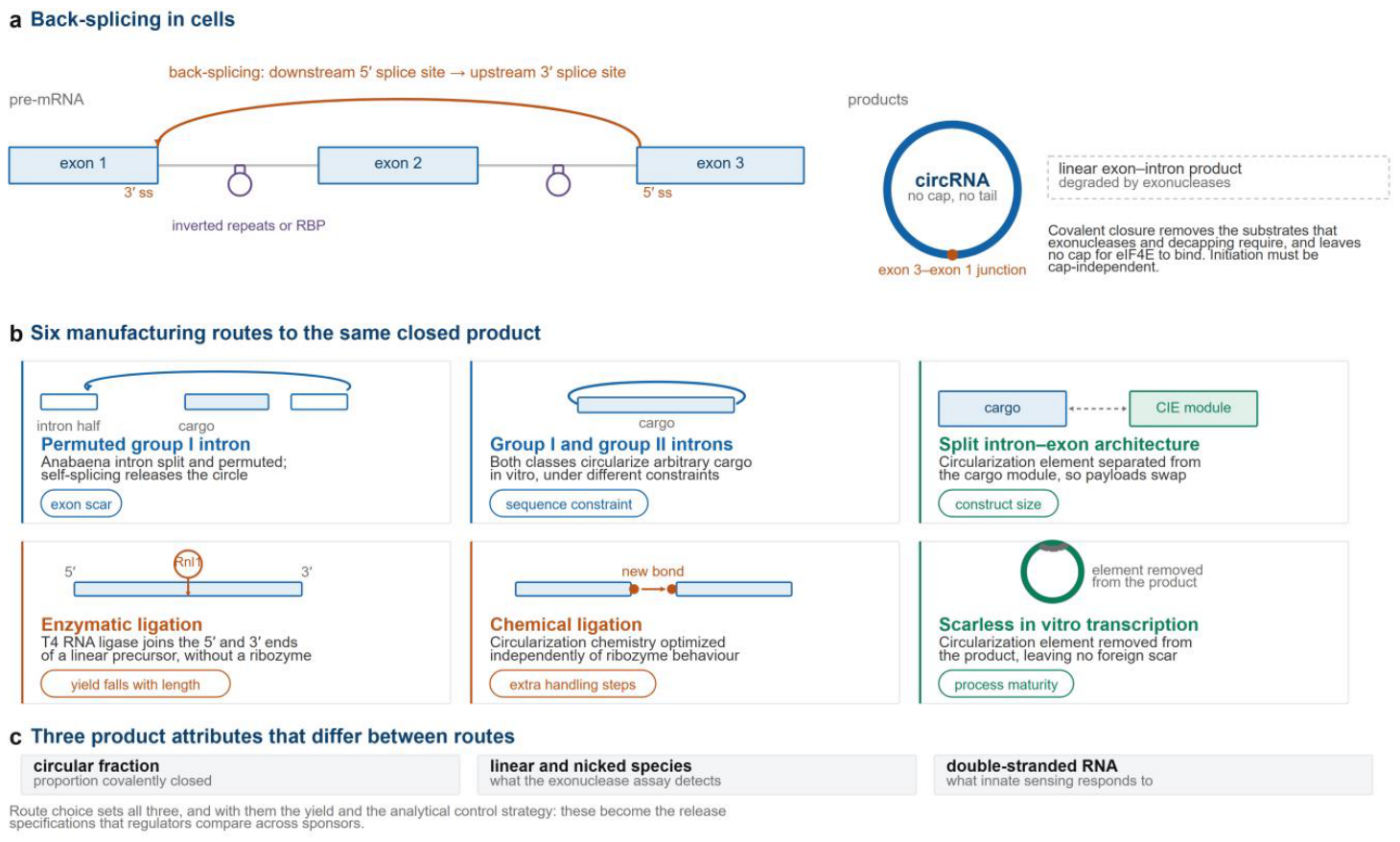
Figure 2.
Sequence, topology and turnover determinants of circRNA translation. (a) Architecture of an expression circle: the 5′ UTR and IRES, the coding sequence, the 3′ UTR and the circularization element, which is absent from scarless products; the junction is a canonical 3′–5′ phosphodiester bond in scarless products and contains a non-canonical 2′-5′ linkage where a scar is retained. (b) Closure removes the substrates that decapping and the two exonucleases require, so circles are instead turned over endonucleolytically. (c) Four routes to a translating ribosome: IRES-mediated recruitment of 40S, m6A-dependent initiation through reader proteins and eIF3, CITE or aptamer recruitment, and rolling-circle translation in the absence of a stop codon at the junction. (d) Reported effects of the principal engineering strategies; the magnitudes are not directly comparable across studies, because cargo, cell type, comparator and read-out differ.
Figure 2.
Sequence, topology and turnover determinants of circRNA translation. (a) Architecture of an expression circle: the 5′ UTR and IRES, the coding sequence, the 3′ UTR and the circularization element, which is absent from scarless products; the junction is a canonical 3′–5′ phosphodiester bond in scarless products and contains a non-canonical 2′-5′ linkage where a scar is retained. (b) Closure removes the substrates that decapping and the two exonucleases require, so circles are instead turned over endonucleolytically. (c) Four routes to a translating ribosome: IRES-mediated recruitment of 40S, m6A-dependent initiation through reader proteins and eIF3, CITE or aptamer recruitment, and rolling-circle translation in the absence of a stop codon at the junction. (d) Reported effects of the principal engineering strategies; the magnitudes are not directly comparable across studies, because cargo, cell type, comparator and read-out differ.
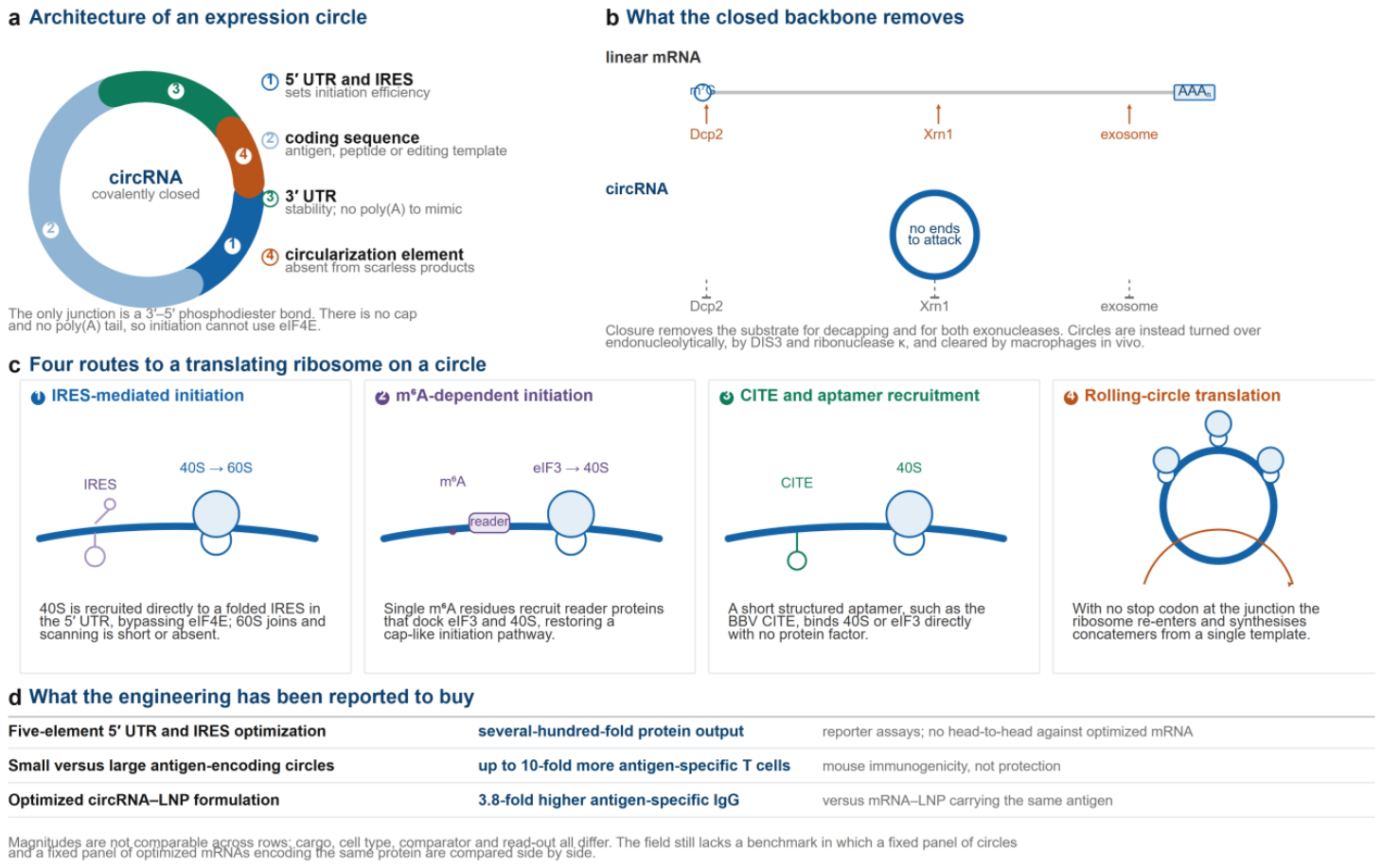
Figure 3.
Anatomy, itinerary and competing fates of a circRNA-LNP. (a) Four-component particle in which the ionizable lipid, helper lipid, cholesterol and PEG-lipid form the shell around a compacted circRNA core; the four are not interchangeable with their mRNA counterparts. (b) Uptake, endosomal acidification with protonation of the ionizable lipid, membrane disruption and cytosolic release. (c) Five fates compete for the delivered molecule, four of them after release into the cytosol and one, lysosomal routing, before it. Only the first produces protein; the other four are measured by different assays, in different compartments and at different times.
Figure 3.
Anatomy, itinerary and competing fates of a circRNA-LNP. (a) Four-component particle in which the ionizable lipid, helper lipid, cholesterol and PEG-lipid form the shell around a compacted circRNA core; the four are not interchangeable with their mRNA counterparts. (b) Uptake, endosomal acidification with protonation of the ionizable lipid, membrane disruption and cytosolic release. (c) Five fates compete for the delivered molecule, four of them after release into the cytosol and one, lysosomal routing, before it. Only the first produces protein; the other four are measured by different assays, in different compartments and at different times.
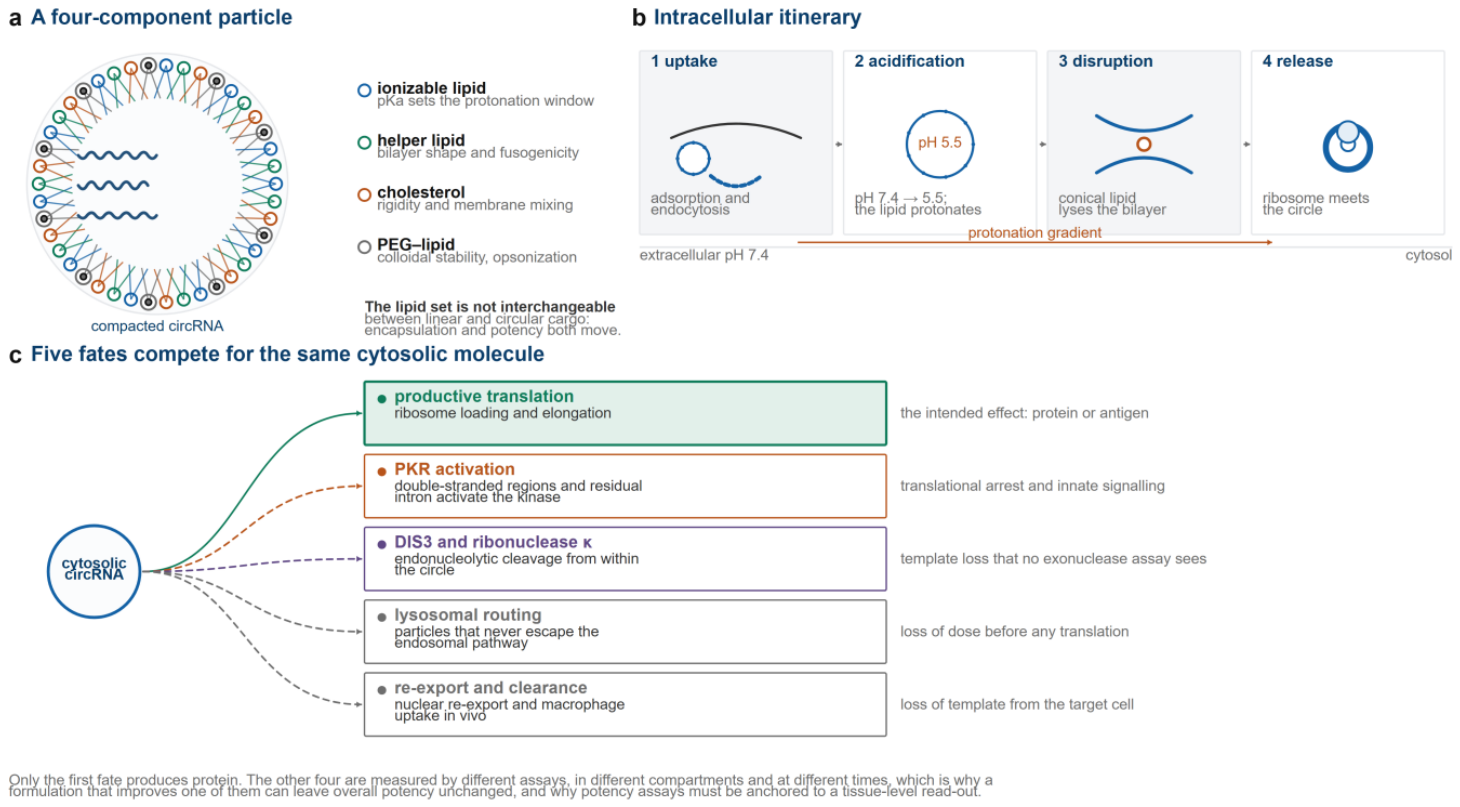

Table 1.
What the principal preclinical comparisons do and do not establish.
| Study | Cargo and architecture | Delivery and model | Principal read-out | Comparator | What the comparison does not establish |
| Chen et al. 2023 (ref. 7) | Five-element design: vector topology, 5′ and 3′ UTRs, IRES and aptamer | Transfection; immortalized cells and mice | Protein output several-hundred-fold above the starting construct; more durable translation than mRNA in mice | Unoptimized linear RNA | No head-to-head against an optimized mRNA in primary human cells |
| Chen et al. 2021 (ref. 19) | Short structured 5′ UTR elements driving cap-independent initiation | Transfection; cell lines | Extensive translation from structured elements without an IRES | IRES-containing circles | Reporter output only; in vivo performance not reported |
| Qu et al. 2022 (ref. 33) | Receptor-binding-domain circle, permuted intron–exon | LNP, intramuscular; mice and rhesus macaques | Neutralizing titre and T helper 1 bias; protection against Delta, cross-protection against Omicron, booster activity | m1Ψ-modified mRNA vaccine | No toxicology; no basis for human dose selection |
| Amaya et al. 2023 (ref. 34) | Antigen-encoding circle | LNP; mice | Potent antigen-specific T cell responses | Unmodified linear RNA | T cell read-out only; no protection data and no dose-ranging |
| Swingle et al. 2025 (ref. 25) | circRNA–LNP optimized by design of experiments | LNP; mice | 3.8-fold higher antigen-specific IgG; greater draining-lymph-node accumulation and dendritic cell maturation | mRNA–LNP | One lipid set, not a library screen; no dose-ranging |
| Zhang et al. 2025 (ref. 24) | Small antigen-encoding circles of about 1 kb | LNP; mice | Up to tenfold more antigen-specific T cells than large circles or mRNA; 30–75% of peripheral CD8+ cells for six months | Large circles and mRNA | Immunogenicity only; protection not shown |
| Liu et al. 2024 (ref. 36) | Dimeric envelope domain III–Fc fusion plus non-structural protein 1, single dose | LNP; mice | Protection without dengue antibody-dependent enhancement | Conventional vaccine controls | Mouse only; enhancement assessed in a single model |
| Zhou et al. 2024 (ref. 37) | Monkeypox antigen-encoding circle | LNP; mice | Protection against vaccinia challenge | Unvaccinated controls | Surrogate challenge model; no non-human primate data |
| Wan et al. 2024 (ref. 38) | Lyophilized circRNA vaccine | LNP; mice | Retained lymph-node targeting and immunogenicity after storage | Liquid formulation | Short follow-up; no real-time stability data at 2–8 °C |
| Wang et al. 2026 (ref. 17) | Nucleoside-modified circle encoding a GLP-1 peptide; autoantigen-encoding circle | LNP; mouse models of type 2 diabetes and experimental autoimmune encephalomyelitis | Glucose lowering comparable to a marketed GLP-1 receptor agonist; antigen-specific tolerance | Marketed peptide agonist | Single dose in mice; no primate pharmacokinetics |
Table 2.
Registered first-in-human studies of circular RNA therapeutics.
| Programme | Sponsor | Modality | Indication | Phase / design | Status | Start |
| HM2002 | Ruijin Hospital | Circular RNA; multiple-point epicardial injection during coronary artery bypass grafting | Ischaemic heart failure | Early phase 1, single 5 mg dose, sentinel dosing; n = 3 | Completed May 2025; no read-out published | Sep 2024 |
| RXRG001 | RiboX Therapeutics | Circular RNA; intraductal administration to the parotid glands | Radiation-induced xerostomia | Phase 1/2; single and multiple ascending dose, then randomised placebo-controlled; n = 42 | Recruiting | Mar 2025 |
| TI-0093 | Therorna | Circular RNA therapeutic vaccine | Recurrent or metastatic HPV-16-positive solid tumours | Phase 1, open-label dose escalation; n = 12 | Recruiting; estimated primary completion Sep 2026 (elapsed) | Nov 2025 |
| RXIM002 | Ruijin Hospital | LNP carrying circRNA encoding a CD19 CAR (in vivo CAR-T) | Relapsed or refractory B cell-mediated autoimmune disease | Early phase 1, open-label; n = 27 | Recruiting | Dec 2025 |
| CR059 | Investigator-initiated (Henan University of Science and Technology) | Exenatide-encoding circRNA-LNP | Type 2 diabetes mellitus | Early phase 1, single ascending dose; 4, 8 and 12 μg/kg; n = 9 | Recruiting; estimated primary completion Aug 2026 (elapsed) | Jan 2026 |
| TI-0032-III | Therorna | T cell-targeted LNP carrying circRNA encoding a CD19 CAR | Relapsed or refractory B cell-mediated autoimmune disease | Phase 1, open-label dose escalation; n = 12 | Recruiting; estimated primary completion May 2027 | Jan 2026 |
| SYNCAR-100 | Zhejiang University / Bisheng (Beijing) Biotechnology | LNP carrying circRNA encoding a CD19 CAR (in vivo CAR-T) | Relapsed or refractory CD19-positive B cell acute lymphoblastic leukaemia | Early phase 1, dose escalation, four weekly doses; n = 16 | Recruiting; estimated primary completion Dec 2027 | Feb 2026 |
| ORN252 | Orna Therapeutics | LNP carrying circRNA encoding an anti-CD19 CAR | Healthy volunteers (B cell depletion as the pharmacodynamic read-out) | Phase 1, single ascending dose; n = 20 | Recruiting (Australia); estimated primary completion Dec 2026 | Mar 2026 |
| RX-ONC-CS101 | Ruijin Hospital / RiboX Therapeutics | LNP carrying circRNA encoding a CD19 CAR (in vivo CAR-T) | Relapsed or refractory B cell lymphoma | Phase 1, dose escalation, four dose levels; n = 30 | Recruiting; estimated primary completion Mar 2027 | May 2026 |
Source: ClinicalTrials.gov records NCT06621576, NCT06714253, NCT07081984, NCT07322718, NCT07347080, NCT07413341, NCT07429461, NCT07439796 and NCT07774572, retrieved on 21 October 2026. A tenth registration, NCT07765966, extends RXIM002 to immune thrombocytopenia and is not tabulated separately. To our knowledge no peer-reviewed efficacy or safety read-out from any of these programmes had been published at the time of writing; one (HM2002) is recorded as complete and has been described in sponsor communications only. CAR, chimeric antigen receptor; LNP, lipid nanoparticle; PD, pharmacodynamics; PK, pharmacokinetics; B-ALL, B cell acute lymphoblastic leukaemia. Dates are as posted in the registry. Estimated primary completion dates have already elapsed for TI-0093 and CR059. Registry entries are sponsor-supplied and can change without notice, which is why no efficacy claim is made here.
Table 3.
Bottlenecks, the measurement that would resolve them, and the available lever. For each of the five constraints discussed in this section, the table gives the current state of evidence, the measurement that would resolve it, the design or process lever most likely to shift it, and whether the required study is feasible with existing methods.
Table 3.
Bottlenecks, the measurement that would resolve them, and the available lever. For each of the five constraints discussed in this section, the table gives the current state of evidence, the measurement that would resolve it, the design or process lever most likely to shift it, and whether the required study is feasible with existing methods.
| Constraint | State of the evidence | Measurement that would resolve it | Lever available today | Feasible with current methods |
| Translation per molecule | Strong in immortalized cells and reporter constructs | Side-by-side panel of circles and optimized mRNAs in primary human cells | UTR and IRES design; rolling-circle topology | Yes |
| Durability in humans | Rodent plasma reporter only | Tissue-level pharmacokinetics: intact circle, total RNA and protein | Nucleoside modification; particle choice | Partly |
| Redosing and anti-drug immunity | Not characterized for circular cargo | Anti-cargo and anti-particle titres after repeat dosing | Purification stringency; dose sparing | Yes |
| Circular purity and analytical control | Sponsor-defined specifications | Certified reference material and a consensus potency assay | Process lock before pivotal studies | No |
| Target cell access | Liver by default; mouse-only targeting data | Biodistribution of intact circle in non-human primates | Antibody conjugation; charge modulation | Partly |
Rows are ordered by how much each constraint binds the field today. The last column is a judgement: yes means the required study could be designed with existing methods, partly means that it needs methods that exist but have not yet been applied to circular cargo, and no means that no consensus method exists.
Disclaimer/Publisher’s Note: The statements, opinions and data contained in all publications are solely those of the individual author(s) and contributor(s) and not of MDPI and/or the editor(s). MDPI and/or the editor(s) disclaim responsibility for any injury to people or property resulting from any ideas, methods, instructions or products referred to in the content. |
© 2026 by the authors. Licensee MDPI, Basel, Switzerland. This article is an open access article distributed under the terms and conditions of the Creative Commons Attribution (CC BY) license (http://creativecommons.org/licenses/by/4.0/).
Copyright: This open access article is published under a Creative Commons CC BY 4.0 license, which permit the free download, distribution, and reuse, provided that the author and preprint are cited in any reuse.