

Submitted:
29 October 2026
Posted:
03 November 2026
You are already at the latest version
Abstract
Smart-city ledgers must keep alerts and model provenance verifiable for decades, yet Hyperledger Fabric’s identities use the elliptic-curve digital signature algorithm (ECDSA) by default, which quantum computers could forge. On a post-quantum fork of Fabric 3.1.4, we issued every identity ML-DSA-44, -65 or -87 (FIPS 204) or hybrid ECDSA/ML-DSA-44 certificates and ran an alert-anchoring workload ten times at 10–100 clients. A transaction grows from 5.5 kB to 32.8, 44.2 and 59.5 kB; about 72% of it is four PEM-encoded certificates, and 22% is signatures. At 20 clients throughput falls from 170 to 134, 101 and 79 transactions per second. Ten ML-DSA-87 transactions exceed the test network’s 512 KB block-size preference; raising it to 1 MB doubled throughput at 10 clients and cut 99th-percentile latency from 2.08 s to 0.16 s. Rebuilt block files suggest that binary (DER) identities would save about 20% of a post-quantum transaction, and identity references about 73%. Client connections already negotiate hybrid X25519MLKEM768 key exchange, but peers and the orderer still authenticate with ECDSA keys. At 10 alerts per second, ledger growth per peer rises from 1.9 TB to 10.6–19.0 TB per year: the cost lies mainly in how Fabric stores identities.
Keywords:
smart city
; post-quantum cryptography
; ML-DSA
; Hyperledger Fabric
; permissioned blockchain
; digital identity
; ledger storage
; measurement study
1. Introduction
City services increasingly keep their audit trails on permissioned ledgers, because a ledger shared by several agencies records who did what without trusting a single operator [1,2]. Public-sector uses range from government lotteries [3] to the anchoring of security alerts and machine-learning model provenance in our earlier smart-city architecture [4]. What such a ledger certifies is only as durable as the signatures in it: a ledger written today must still prove, years from now, that an alert was raised by a given district and endorsed by given peers.
On Hyperledger Fabric [5] every one of those proofs rests on elliptic-curve signatures, by default ECDSA (elliptic-curve digital signature algorithm). The client signs each transaction, each endorsing peer signs its response, the ordering service signs each block, and every signer’s X.509 certificate is embedded beside its signature. A cryptographically relevant quantum computer running Shor’s algorithm [6] would recover ECDSA private keys from public keys, and on a ledger those public keys are published in every transaction. For a 256-bit curve this needs a few thousand logical qubits [7], or about 13 million physical qubits to finish within a day with a surface code at a physical error rate of 10−3 and a 1 µs code cycle [8]. Our analysis of Bitcoin shows that point estimates of quantum break time understate the resulting theft risk [9]. Perimeter defences do not help here: a firewall decides which packets reach a network, not whether a signature already on the ledger can be forged later.
Post-quantum cryptography replaces these algorithms with ones that run on classical computers [10], and the US National Institute of Standards and Technology (NIST) has standardised them. ML-DSA, the module-lattice-based digital signature algorithm, is the general-purpose signature [11], ML-KEM the module-lattice-based key-encapsulation mechanism [12] and SLH-DSA the stateless hash-based digital signature algorithm [13]. A draft transition plan proposes deprecating the quantum-vulnerable algorithms at 112-bit security strength after 2030 and disallowing ECDSA, RSA and elliptic-curve Diffie–Hellman (ECDH) at every strength after 2035 [14]. A city that deploys a ledger now therefore deploys one that must migrate within its own service life, and records that must stay verifiable beyond the arrival of a quantum computer have to be protected before it arrives [15].
The cost of that migration on a permissioned ledger has not been measured where it matters. ML-DSA-44 public keys and signatures are 1312 and 2420 bytes, against 64 bytes each for ECDSA P-256. PQFabric replaced Fabric 1.4 signatures with hybrid post-quantum ones and reported certificate sizes, throughput and block latency, but kept clients classical and did not attribute ledger bytes [16]. TrustMesh signs application documents with ML-DSA-65 while every Fabric identity and signature stays ECDSA [17]. No study has issued post-quantum identities to every role of a current Fabric network and measured, byte by byte, where the ledger grows.
This paper measures that cost on the alert-anchoring workload of our earlier architecture, whose baseline with Fabric’s default ECDSA identities was 146 transactions per second and about 6 kB of ledger per anchored alert, with X.509 certificates making up 71% of each transaction in the block file [4]. Its contributions are as follows:
1. A complete post-quantum identity deployment on Fabric: a two-organisation network in which the certificate authorities, peers, orderer, administrators and clients all hold ML-DSA-44, ML-DSA-65 or ML-DSA-87 certificates, or hybrid certificates, issued with a post-quantum fork of Fabric and Fabric CA, together with the client-side signing changes this requires, and a check that client connections to every peer and the orderer over transport layer security (TLS) already use hybrid post-quantum key exchange.
2. A byte-level account of the ledger: a block-file decoder attributes the bytes of each committed transaction to certificates, signatures, payload and metadata for each security level, alongside ledger sizes and throughput from repeated runs on a fresh network per run.
3. The finding that the identities embedded in each transaction, not the transaction signatures, dominate the cost: about 72% of a post-quantum transaction is the four certificates embedded in it, stored as Base64 text in the privacy-enhanced mail (PEM) format, so a transaction grows 6.0- to 10.9-fold while the three signatures make up about 22%, and that ten ML-DSA-87 transactions exceed the 512 KB block-size preference of the Fabric test network.
4. Two remedies, one measured and one estimated: raising the orderer’s preferred block size restores full ML-DSA-87 blocks and doubles throughput at low load, and block files rebuilt with compact identity encodings estimate that Fabric would save about 20% of a post-quantum transaction by storing identities in binary Distinguished Encoding Rules (DER) form and about 73% by referring to them.
5. City-scale implications: storage per peer per year at three alert rates and its cloud cost, throughput headroom, and how the overhead shrinks with more application data per transaction.
Section 2 describes the threat and Fabric’s signature layers, Section 3 reviews related work, Section 4 the testbed and measurement protocol, Section 5 the results, and Section 6 their implications, before Section 7 concludes. Section 6.2 turns the measurements into figures a city can plan with: storage per peer and how it scales across the network, the security level to fix before storage is procured, and the retention that sets how many years are kept.
2. Background and Threat Model
2.1. Where Fabric Signs
A Fabric transaction carries three kinds of signature, and each travels with the signer’s certificate (Figure 1). The client signs the transaction envelope; its identity, a SerializedIdentity that holds the membership service provider (MSP) identifier and the certificate, sits in the signature header of the payload and again in the header of each chaincode action. Each endorsing peer signs its proposal response, and the endorsement carries that peer’s SerializedIdentity. The ordering service signs every block, and that signature with the orderer’s identity sits in the block metadata [5]. Under the default majority policy of a two-organisation channel, a committed transaction therefore holds four certificates and three signatures, plus a share of one block signature.
The MSP validates each identity against the channel’s root certificates, and the blockchain crypto service provider (BCCSP) signs and verifies. TLS between nodes and clients uses separate certificates that do not enter the ledger.
2.2. The Post-Quantum Standards
ML-DSA is the module-lattice signature of Federal Information Processing Standard (FIPS) 204 at three security levels [11], derived from CRYSTALS-Dilithium [18]. Its keys and signatures are tens of times larger than those of ECDSA (Table 1), while signing and verification remain fast.
A pure ML-DSA certificate carries the algorithm identifiers of RFC 9881 [19]; the certificates in this study use its object identifiers 2.16.840.1.101.3.4.3.17, .18 and .19 for ML-DSA-44, -65 and -87. Two certificate forms ease a gradual migration. A hybrid certificate keeps a classical subject key and adds an ML-DSA key and the issuer’s ML-DSA signature in the alternative-key extensions of ITU-T X.509 [20]; classical verifiers ignore the extensions. A composite certificate instead holds one key that combines ML-DSA with a classical algorithm, so that a forgery must break both [21]. ML-KEM replaces key exchange, and hybrid TLS 1.3 groups such as X25519MLKEM768 combine it with X25519 [22].
2.3. Threat Model
We add to the adversaries of our earlier architecture [4] a quantum-capable adversary A4 with two capabilities:
- Retroactive forgery (ledger). A4 recovers a private key from any ECDSA public key published on the ledger and signs alerts, endorsements or blocks in that identity’s name. Because certificates are embedded in every transaction, every signer’s public key is exposed from its first transaction, and a forged history cannot be told from a genuine one by signature checks alone.
- Harvest now, decrypt later (transport). A4 records TLS traffic today, for example model updates between district gateways and the aggregator, and decrypts it once ECDH falls.
A4 does not break hash functions, so block hash chaining still detects in-place modification of stored blocks. Our architecture’s edge intrusion detector and its screening rule for federated model updates use no public-key cryptography and need no change; this paper concerns the ledger layer, where A4 forges, and checks the key exchange of the transport layer, where A4 harvests. We make no claim about unknown attacks on ML-DSA itself: we measure the cost of migrating to the NIST standards, which is the decision a city faces.
3. Related Work
Surveys of post-quantum blockchains name the size of keys and signatures as a main obstacle [23], and studies that measure post-quantum signatures on blockchains report data size, not computation, as the dominant cost [24,25]; none attributes that size to the parts of a Fabric transaction when every Fabric identity is post-quantum.
3.1. Post-Quantum Permissioned Ledgers
PQFabric replaced the peer, orderer and endorser signatures of Fabric 1.4 with hybrid signatures that concatenate ECDSA with Falcon, Dilithium or qTesla, with certificates that carry the post-quantum key in an extension [16]. Certificates grew from 818 bytes to between 2988 (Falcon-512) and 7830 bytes (Dilithium-4), and throughput fell from 2084 to between 1788 and 1268 transactions per second for Falcon and Dilithium, measured with one endorser and 100-transaction blocks. Clients stayed classical, and bytes per transaction were not reported. TrustMesh signs application documents with ML-DSA-65 through a microservice on Fabric 2.5 and stores the signature and key in world state; its reproducibility package states that Fabric’s MSP, BCCSP, TLS, endorsement, validation and block signatures are unchanged [17]. The package reports no significant throughput difference from a Fabric-only ECDSA baseline without application-level signing in its document-creation and signing workloads (30 runs per condition in these two workloads and 5 in the others), as expected when the ledger’s own identities do not change. A fork of Fabric adds pure, hybrid and composite ML-DSA identities to the MSP of the Fabric 3 line, with a matching fork of Fabric CA, but publishes no measurements [26]. On Substrate, a system-level study reports transaction (extrinsic) size as the largest cost of ML-DSA [24]. On LACChain, a network built on Hyperledger Besu, Falcon-512 signatures and post-quantum TLS between nodes were deployed and evaluated, including the cost of on-chain verification, but ledger growth was not measured [27].
3.2. Post-Quantum Signatures on Public Blockchains
ML-DSA, Dilithium, Falcon, MAYO, SPHINCS+ (SLH-DSA) and CROSS were compared on signing and verification time and, in simulated Bitcoin and Ethereum networks, on block-verification time, leaving data size to future work [28]. A single-node prototype measured serialised 1000-transaction blocks of about 5.09 MB with ML-DSA-44 and 2.50 MB with Falcon-512 [25]. Santos et al. design a new chain around algorithm agility rather than migrating an existing one [29]. These studies concern open networks where block space is priced; a permissioned city ledger pays instead in storage and in throughput.
3.3. Post-Quantum Protection in Smart-City and Internet of Things (IoT) Systems
An early framework proposed a post-quantum blockchain for smart cities without experiments [30]. In federated learning, PQS-BFL signs model-update hashes with ML-DSA-65 on an Ethereum (Ganache) testbed but has no Byzantine defence and does not measure the ledger [31]; Byzantine-robust aggregation with Kyber (the basis of ML-KEM) and homomorphic encryption is reported to need about 18% more computation than non-secure federated learning but keeps no ledger [32]; and zero-knowledge federated learning with ML-KEM takes about twenty times the per-round time of standard federated learning [33]. On microcontrollers, ML-KEM-512 key exchange took 35.7 ms on an RP2040, about 17 times faster than ECDH P-256 [34], and post-quantum TLS 1.3 consumed in some cases no more energy than classical TLS [35]. Newer transports such as QUIC, which uses the TLS 1.3 handshake and has been studied for IoT traffic [36], can use the same hybrid key exchange.
3.4. Long-Lived Evidence
For regulated audit evidence, hybrid signing, re-signing of legacy records and anchoring Merkle roots under a post-quantum signature have been proposed but not measured on a blockchain [37].
3.5. Position of This Work
Table 2 places this work against the closest studies.
Compared with these studies, this work differs in three ways. It measures post-quantum identities in every MSP role, clients included, at all three ML-DSA levels and in hybrid form, and repeats every condition ten times, each run on a newly created network. It attributes every byte of a committed transaction to its parts, which shows where the ledger grows and which change of encoding would reduce it most. And it identifies an interaction between the larger transactions and the orderer’s block-size limit that, of the levels studied, appears only at the highest security level, and measures two orderer settings that remove or bound it.
4. Materials and Methods
All conditions run on one machine, one Fabric build and one workload, and differ only in the keys the certificate authorities issue. ECDSA is re-measured on the same build rather than taken from our earlier Fabric 2.5.9 results, because the platform version alone changes throughput.
4.1. Testbed
The peer, orderer and certificate authority (CA) images are built from the forks, and every network runs in an isolated Docker Compose project so that no volume of an earlier network is reused.
4.2. Conditions
Table 4 lists the five conditions.
The certificate authorities are configured with the matching key request, and every enrolment of an MSP identity requests the same algorithm. TLS enrolments keep ECDSA keys, as in the unmodified enrolment script: we apply the key request to MSP enrolments only. Under hybrid signatures the fork signs and verifies with the ML-DSA alternative key. Composite ML-DSA, also supported by the fork, is not measured because the client library cannot yet sign with it.
4.3. Client-Side Signing
The fork signs the whole message with ML-DSA in pure mode with an empty context, whereas ECDSA signs a SHA-256 digest. The benchmark client therefore configures the gateway to pass the message unhashed and signs it with the ML-DSA private key through Node.js crypto; for ECDSA it keeps the library’s default signer. A hybrid identity’s key store holds both keys, and the client signs with the ML-DSA one.
4.4. Workload and Protocol
The workload is the AnchorAlert transaction of our earlier architecture: each call stores an alert identifier, district, model identifier, SHA-256 evidence hash and timestamp, and returns the stored record [4]. One run of one condition proceeds as follows:
1. Tear down any previous network, configure the certificate authorities and the channel for the condition, and bring up a new network.
2. Deploy CityAnchor, wait until both chaincode services report ready, and submit one AnchorAlert through the peer command-line interface (CLI).
3. Submit 2000 AnchorAlert transactions at concurrency 20, then 2000 at concurrency 50, as in our earlier protocol; the ledger then holds 4001 alerts, and its size is recorded.
4. Submit 2000 transactions at concurrency 10 and 2000 at concurrency 100.
5. Record the ledger size and, for the first successful run of each condition, copy and decode the block files.
Each repetition runs every condition once in a newly randomised order, with a 20 s pause between runs, so that drift of the host over the night does not favour any condition. Ten repetitions were completed. Container central processing unit (CPU), memory and network counters are sampled about every 4 s during each benchmark.
4.5. Metrics
- Throughput: committed transactions divided by the wall-clock time of the benchmark.
- Latency: time from submission to commit status for each transaction, reported as mean, median, 95th and 99th percentile.
- Ledger size: bytes of the peer’s ledger directory after 4001 alerts, and of the block files alone.
- Byte composition: the decoder parses every block-file record and its protobuf fields and assigns each byte to one of twelve categories: block header, block metadata, envelope signature, payload header (client identity), action header (client identity again), proposal payload (the alert), proposal hash, read/write set, response and events, endorser identities, endorser signatures and configuration envelopes; the remainder is framing. On ECDSA it closely reproduces the block-file size per transaction of our earlier analysis (5467 against 5480 bytes, within 0.3% [4]). The driver decodes the first two block files of the first run of each condition. For ECDSA the first file holds the whole ledger; for the post-quantum conditions the two files hold the 20-client benchmark and part or all of the 50-client one (about one eighth of it with ML-DSA-87, about half with ML-DSA-65, nearly all with Hybrid-44, and all of it with ML-DSA-44, whose files also hold the first 80 transactions at 10 clients).
- Units: kB, MB and TB are decimal (103, 106 and 1012 bytes). The orderer’s PreferredMaxBytes follows Fabric’s binary units (512 KB = 524,288 bytes; 1 MB = 1,048,576 bytes), as does the 32 KB window of DEFLATE (Section 4.6); GiB is 230 bytes.
For each metric we report the mean over repetitions with a 95% confidence interval from the t distribution; changes relative to ECDSA are ratios of the means. Differences between orderer settings (Section 4.6) are tested with two-sided Welch’s t-tests, without correction for multiple comparisons. Yearly ledger growth is the ledger size per alert multiplied by the alert rate and by a year of 365.25 days (31,557,600 s).
4.6. Block-Cutting, Identity-Encoding and TLS Experiments
Two further drivers, with the same network set-up and certificate authorities, ran three further experiments.
- Identity encoding. Each condition was run once with the default block cutting: the set-up transactions, the CLI invoke and 2000 alerts at 20 clients. Its block files were then rebuilt with the id_bytes of every SerializedIdentity, in the transactions and in the block metadata, replaced by the DER encoding of the same certificate, or by a 32-byte SHA-256 digest of it, as if identities already known to the channel were referred to instead of embedded. Every enclosing protobuf message and length prefix is re-encoded; rebuilding with the certificates unchanged reproduces the file byte for byte. The rebuilt files are counterfactual (their signatures would not verify) and estimate what a change of encoding could save. The stored files were also compressed with gzip at level 6 (DEFLATE [38]), xz at preset 6 and zstd at level 3 [39]. Bytes per transaction leave out the configuration-only blocks.
- Block cutting. ML-DSA-87, whose ten-transaction blocks exceed 512 KB, and ML-DSA-44, whose blocks do not, were each run with three orderer settings: the default (PreferredMaxBytes 512 KB, BatchTimeout 2 s), larger blocks (1 MB, 2 s) and a shorter timeout (512 KB, 500 ms), with MaxMessageCount kept at 10. Each setting was repeated ten times in a newly randomised order per repetition, with the CLI invoke and 2000 transactions at 20, 50 and 10 clients. The setting was written to the channel configuration before the network started and read back from the channel’s genesis block. The ledger height was read before and after every benchmark, and every block of the ledger was scanned, so that the transactions per block of each benchmark are counted directly.
- TLS key exchange. For each condition the network was brought up again, and peer0.org1, peer0.org2, the orderer and the org1 CA were probed with 50 full TLS handshakes per setting from a Go 1.27 client, the TLS stack of the Fabric nodes, and from the Node.js client stack of the benchmark, with the default key exchange, X25519 only and X25519MLKEM768 only. The Go probe reports the negotiated group; for the Node.js probe, which does not report hybrid groups, it is inferred from the bytes the server sends, since an X25519MLKEM768 share carries a 1088-byte ML-KEM ciphertext more than an X25519 one. Both probes record the bytes on the wire and the handshake time; the build information of the binaries in the images and the TLS certificates were recorded as well.
4.7. Reproducibility
The three driver scripts, the benchmark client, the decoder, the block-file rebuild tool, the TLS probes, the figure scripts, the script for the city scenarios of Section 6 and the per-run logs are in the public repository [40], together with the fork branches used and the instructions to rebuild them.
5. Results
Ten repetitions of every condition completed in 2 h 40 min (50 runs, 200 benchmarks). The block-cutting and identity-encoding experiments of Section 4.6 completed in 3 h 18 min (65 runs, 185 benchmarks), with every genesis block holding the intended orderer setting and no benchmark excluded, and the TLS probes in 4 min (120 series of 50 handshakes, all completed). Throughput and latency are means over repetitions with 95% confidence intervals; byte counts come from the block files described with each table.
5.1. Feasibility
In every run of every condition the network created and joined the channel with post-quantum identities in all MSP roles, deployed CityAnchor and passed the CLI invoke. Of the 200 benchmarks, 199 committed all 2000 transactions. In one (ML-DSA-65, repetition 9, 20 clients) one client worker stopped after the gateway reported that no combination of peers could satisfy the endorsement policy, and 1955 transactions committed; the next three benchmarks of that run completed normally. We exclude that benchmark from the means; including it would change the ML-DSA-65 throughput at 20 clients from 101.1 ± 8.9 to 100.8 ± 7.9 transactions per second and its mean latency from 179.3 ± 15.9 to 178.9 ± 14.0 ms, and the loss against ECDSA from 40.5% to 40.7%. The hybrid identities carried an ECDSA subject key and an ML-DSA-44 alternative key, and every client and peer signature under them was ML-DSA-44, as the V3_0_HYBRID capability requires.
5.2. Throughput and Latency
Every post-quantum condition is slower than ECDSA at every concurrency, and the gap widens with the security level (Table 5 and Table 6, Figure 2; per-benchmark values in Table S2). At 20 clients ML-DSA-44 commits 21% fewer transactions per second than ECDSA, ML-DSA-65 40% fewer and ML-DSA-87 54% fewer; at 100 clients the losses are 28%, 41% and 51%. The hybrid identities commit 5% to 12% fewer transactions per second than pure ML-DSA-44, with overlapping confidence intervals. Paired by repetition, they were slower in 9 of 10 runs at 10 and at 50 clients, 7 at 20 and 6 at 100, consistent with their higher CPU time per transaction (7.7 against 7.2 ms at the gateway peer and 2.6 against 2.3 ms at the orderer, Section 5.5) and their 3.6% larger transactions (Section 5.3); we did not profile which step adds it. ECDSA has the widest absolute confidence intervals of throughput; its repetition 3 was the slowest at 10, 20 and 50 clients. Runs of one condition can fall into two clusters: at 20 clients ML-DSA-44 gave 109 to 128 transactions per second in five runs and 148 to 157 in the other five. Similar clusters appear in other conditions (Hybrid-44 at 20 clients, 105 to 116 and 134 to 151), so we attribute the spread to the host rather than to the conditions; the randomised run order spreads it across all of them. Across ECDSA, ML-DSA-44 and Hybrid-44, 11 of the 14 runs in the slower clusters (for ECDSA, 120 to 164 against 183 to 187 transactions per second) fell in repetitions 1 to 4, between 01:45 and 02:50 that night, whereas ML-DSA-65 and ML-DSA-87 showed no clear pattern (Figure S1); we did not log host temperature or processor frequency, so the cause remains open.
ML-DSA-87 at 10 clients is the exception to the smooth trend: throughput collapses to 41 transactions per second and the 99th-percentile latency rises to about 2.08 s, just above the orderer’s 2 s batch timeout. Section 5.3 and Section 5.6 show the cause: ten ML-DSA-87 transactions exceed the test network’s PreferredMaxBytes of 512 KB, so blocks are cut before they reach the configured 10 transactions.
5.3. Where the Ledger Bytes Go
The application data is identical across conditions, so the whole increase is cryptographic (all decoder categories in Table S3; Table 7, Figure 3). In every post-quantum condition the identity fields, that is, the four embedded certificates with the headers that carry them, take 71% to 73% of a transaction and the three signatures 21% to 23%; with ECDSA the shares are 75% and 4%. The four PEM certificates alone are 71% to 72% of a transaction in every condition, consistent with the 71% reported for ECDSA in [4]. Each certificate is stored as PEM text in the SerializedIdentity, which costs 36% to 37% more than its DER encoding in the post-quantum conditions (44% for the smaller ECDSA certificate): the client’s ML-DSA-44 certificate of 4279 bytes occupies 5852, its ML-DSA-65 certificate of 5808 bytes occupies 7919, and its ML-DSA-87 certificate of 7766 bytes occupies 10,572 bytes per copy. The hybrid certificate (4492 bytes in DER) adds an ECDSA key and signature to the ML-DSA-44 material, so a hybrid transaction is 3.6% larger than a pure ML-DSA-44 one, while its signatures are identical.
The last row of Table 7 points to the cause of the ML-DSA-87 latency, which Section 5.6 confirms. Ten transactions of 59.5 kB exceed the 512 KB PreferredMaxBytes, so the orderer cannot fill a block with ten; the decoded ML-DSA-87 blocks, mostly from the 20-client benchmark, hold 8.5 transactions on average. PreferredMaxBytes applies to the envelopes of a batch, about 57 kB each with ML-DSA-87; the stored block adds its metadata and framing, so a stored nine-transaction block can exceed 512 KB (up to 531,846 bytes in the block-cutting runs, Table S4). With only ten clients, each waiting for its previous commit, transactions left over from a cut block can then wait for the 2 s batch timeout, which matches the 2.08 s 99th percentile. The block metadata grows from 1156 bytes per block with ECDSA to 8357, 11,302 and 15,246 bytes with ML-DSA-44, -65 and -87: one orderer certificate in PEM plus one signature per block.
5.4. Ledger Growth
Table 8 gives the peer’s ledger size after 4001 alerts and its projection to one year at 10 alerts per second.
The ledger directory grows by a smaller factor than the block files alone, because the state database and indexes do not depend on the identity scheme. The size was almost identical between runs of a condition (standard deviation below 0.03% of the mean).
5.5. Resource Use
The gateway peer (peer0.org1) is the busiest container in every condition (Table S5). Its CPU use rises from 62% with ECDSA to 106–115% with post-quantum identities at 50 clients (100% is one logical processor), and its CPU time per committed transaction doubles to triples. The orderer’s CPU time per transaction rises by a similar factor while staying smaller. The chaincode containers change little (1.3 to 1.9 ms per transaction), because the chaincode itself neither signs nor verifies.
5.6. Retuned Block Cutting
Under the default setting every ML-DSA-87 block of the benchmarks held fewer than ten transactions (8.4 to 8.8 on average, Table 9): none reached MaxMessageCount, 91% to 97% held nine transactions, the most whose envelopes fit in 512 KB, and the rest were cut by the batch timeout. Raising PreferredMaxBytes to 1 MB restored ten-transaction blocks (9.95 to 10.00 on average) of up to 589 kB. At 10 clients throughput doubled from 40.9 to 82.9 transactions per second and the 99th-percentile latency fell from 2076 to 161 ms (Figure 4; p < 0.001 for both). At 20 clients throughput rose by 13% (p = 0.005); at 50 clients, where blocks fill quickly, it did not change significantly (p = 0.17). Shortening the batch timeout to 500 ms instead bounded the wait, so the 99th percentile at 10 clients fell to 578 ms, but blocks became smaller still (7.6 to 8.3 transactions); this setting gave the highest throughput at 20 and 50 clients, 24% and 8% above the default (p < 0.001). ML-DSA-44, whose blocks already held ten transactions, showed no significant change in throughput or latency under either setting (p > 0.1 at every concurrency). The default setting reproduced the main runs for ML-DSA-87: 40.9 against 41.2 transactions per second and 2076 against 2077 ms at 10 clients. For ML-DSA-44 it gave 117, 150 and 157 transactions per second at 10, 20 and 50 clients against 117, 134 and 157 in the main runs; at 20 clients the confidence intervals (150.3 ± 3.5 and 134.3 ± 13.4) barely overlap (Table 5 and Table S4), and all ten block-cutting runs under the default setting (145 to 156) are close to the faster five main runs (148 to 157), none to the slower five; under the 1 MB setting two runs fell to 106 and 116 (Section 5.2).
5.7. Compact Identity Encoding
Table 10 (and Figure S2) gives the block-file bytes per transaction of the five conditions as stored and as rebuilt. Storing identities as DER would save 19.5% to 19.9% of a post-quantum transaction and 22.3% of an ECDSA one, consistent with the 36% to 37% that PEM adds to each post-quantum certificate (Section 5.3). Referring to identities by a 32-byte digest would save 72.9% to 73.8%: an ML-DSA-44 transaction would shrink from 32.7 kB to 8.9 kB, 1.6 times the stored ECDSA transaction instead of 6.0 times, and a hybrid transaction to the same 8.9 kB, because its larger certificate is no longer carried; what remains is mostly the three signatures. Compressing the stored files with zstd removed 74.7% to 77.0% of every post-quantum transaction, about as much as referring to identities, because the four certificates repeat in every transaction; xz came within one percentage point of zstd. gzip, whose DEFLATE format limits back-references to 32 KB [38], removed 69.6% of an ML-DSA-44 transaction (32.7 kB) but only 43.4% of a hybrid one (33.9 kB) and 28.7% to 30.0% of the larger ML-DSA-65 and -87 transactions, consistent with the certificates of one transaction falling out of reach of the next.
5.8. Transport Layer
With default settings every endpoint, in every condition and from both clients, negotiated TLS 1.3 with the hybrid X25519MLKEM768 group, and every endpoint also completed the handshake when the client offered X25519MLKEM768 as its only group. The peer, orderer and CA binaries in the images were built with Go 1.27.0 without overriding its default TLS settings. Against X25519 alone, the hybrid exchange added 1086 to 1090 bytes from the server and 1232 to 1234 bytes from the client, and 0.1 to 0.7 ms (median 0.3 ms) to a handshake over the loopback interface, once per connection rather than per transaction (Table S6). Authentication is a different matter. The TLS certificates of the peers and the orderer keep ECDSA keys, so these nodes still prove their identity with ECDSA signatures, but in the post-quantum conditions an ML-DSA or hybrid TLS certificate authority signs them, and a peer’s TLS certificate grows from 729 bytes to 3083 to 5290 bytes. The CA server’s own TLS certificate carries an ML-DSA key in the pure ML-DSA conditions, so that endpoint authenticates with ML-DSA. Both clients verified every certificate chain presented.
6. Discussion
6.1. Identity Encoding Is the Lever
The sizes of keys and signatures follow from FIPS 204; what the standard does not predict is how Fabric multiplies them. Four certificates embedded in every transaction, stored as PEM, outweigh the signatures more than three to one; a block-size preference that suits ECDSA becomes a latency trap at ML-DSA-87; and a general-purpose compressor with a 32 KB window loses much of its effect once transactions outgrow it, and most of it at ML-DSA-65 and -87.
Four certificates per transaction, stored as PEM, make up about 72% of every post-quantum transaction; encoding them as DER would remove about 27% of each certificate’s footprint. Most of what remains is the ML-DSA public key and the CA’s ML-DSA signature (3732 of the 4279 DER bytes of the ML-DSA-44 client certificate), which only referring to an identity already known to the channel would remove. The transaction signatures, fixed by the standard, are the smaller part. The same holds for block metadata, which repeats the orderer’s PEM certificate in every block. The rebuilt block files estimate the saving (Section 5.7): DER alone would remove about 20% of a post-quantum transaction, whereas referring to identities would remove about 73% and bring ML-DSA-44 to 1.6 times the stored size of ECDSA. Referring requires Fabric to resolve identities from the channel configuration or a registry during validation, which the platform does not do today, so this saving is an estimate rather than a measured property of a running system. Adopting it would need a new channel capability, a way to resolve every historical reference when a node validates or rebuilds the ledger, and handling of certificate renewal and revocation, while blocks written before the change would keep their embedded certificates. Compression at the storage layer recovers a similar share without changing Fabric, provided its window spans several transactions: zstd and xz did; gzip did only for ML-DSA-44, whose transactions just fit its 32 KB window. The compression savings were measured on whole block files; a storage layer that compresses smaller units, or that must keep blocks quickly readable for validation and recovery, may save less, so they are a best case for these compressors and settings.
6.2. What It Means for a City
Table 11 scales the measured ledger growth per alert (Table 8) to three alert rates: 1 alert per second, for example a single district; the 10 alerts per second of our earlier cost model [4]; and 100 alerts per second, for example a city-wide deployment. At 10 alerts per second ledger growth per peer rises from 1.9 TB to 10.6, 14.1 and 19.0 TB per year with ML-DSA-44, -65 and -87. At the cloud block-storage price of USD 0.08 per GiB-month (Amazon Elastic Block Store gp3, US East (N. Virginia)) [41], each year of ledger then adds about USD 790 to 1410 to the monthly storage bill of every peer, against USD 140 with ECDSA, and the bill grows by that amount every year the ledger is kept. The price covers only the provisioned capacity of the volume, without snapshots, replication to other zones or charges for input/output operations per second (IOPS) and throughput above the baseline, so these costs are a lower bound. The measured throughput of the post-quantum conditions, 41 to 157 transactions per second across conditions and loads (Table 5), and about 83 or more for ML-DSA-87 once block cutting is retuned (Section 5.6), stays well above 10 alerts per second. At 100 alerts per second the highest mean throughputs we measured on one host, all at 50 clients, 157 to 170 transactions per second for ML-DSA-44, 130 for ML-DSA-65 and 104 to 115 for ML-DSA-87 under the default and the best orderer settings (Table 5, Table 9 and Table S4; Figure 4), leave a margin of about 30% at ML-DSA-65 and little at ML-DSA-87, so a city-wide ledger may need more capable or separate hosts as well as about 106 to 190 TB per peer per year. At the 10 alerts per second of our earlier model, storage rather than throughput is the binding cost on this host, so retention policy matters more after the migration. Because block files make up 98% of the post-quantum ledger directory (measured on the ledgers of Section 4.6), the savings of Section 5.7 carry over almost fully. Applying the savings of Table 10 to the block-file share and leaving the rest of the directory unchanged, with identity references an ML-DSA-44 ledger would grow by an estimated 3.0 TB per year at 10 alerts per second instead of 10.6 TB, and with zstd-compressed storage by about 2.7 TB at best (Section 6.1).
For an architecture like ours [4], in which district edge detectors anchor alerts and federated-learning rounds anchor model provenance, three planning consequences follow. Every agency that holds a peer must budget the per-peer figures of Table 11, and the orderers store the same blocks, so network-wide storage grows with the number of nodes. The security level should be fixed before storage is procured, since ML-DSA-87 needs 1.8 times the storage of ML-DSA-44 (19.0 against 10.6 TB per peer per year at 10 alerts per second). And how long alerts must stay verifiable becomes a policy decision: the ledger holds identifiers and evidence hashes rather than the evidence itself, so retention sets how many years are kept; since Fabric peers cannot yet prune committed blocks, limiting it needs archiving or a new channel, while the identity encoding and the security level set the cost of each year.
6.3. More Application Data
The alert of our workload is small: proposal arguments, read/write set and response, with the proposal hash, together carry 940 bytes of application data per transaction (Table 7). The identities, signatures and block metadata of a transaction do not depend on that data, so a transaction with more application data is the fixed cryptographic part of Table 7 plus the data. Table 12 extrapolates on that basis, neglecting the slightly larger share of block metadata when fewer transactions fit in a block. The relative cost is highest for the small records that our architecture anchors [4], such as alerts, evidence hashes and model digests: with 10 kB of application data an ML-DSA-44 transaction costs 2.9 times an ECDSA one instead of 6.0 times, and identities are still 56% of it; only at 50 kB does the ratio fall to 1.5. Identity encoding therefore remains the main lever on the post-quantum overhead across the range of Table 12. In our chaincode each record is passed as arguments, written to the state and returned, so it appears about three times in a transaction, and 10 kB of application data corresponds to a record of roughly 3.3 kB.
6.4. Choosing a Security Level and a Migration Path
Each step up in security level costs about 11 to 15 kB more per transaction and a further 17% to 25% of throughput between consecutive levels at 20 to 100 clients, with ML-DSA-87 also crossing the 512 KB block-size preference. ML-DSA-44 (NIST category 2) is therefore the economical choice for a city ledger unless a higher category is mandated. Hybrid certificates add only 3.6% to the transaction bytes of ML-DSA-44 and cost 5% to 12% of its throughput, while letting classical verifiers keep reading the certificates during the transition.
6.5. Block Cutting Must Be Retuned
The orderer’s PreferredMaxBytes of 512 KB, the value of the test network and of our earlier protocol, holds about 99 ECDSA transactions (envelopes of about 5.3 kB) but fewer than ten ML-DSA-87 transactions. With ML-DSA-87 it therefore binds before MaxMessageCount, and at low concurrency the transactions left over from a cut block wait for the batch timeout. Section 5.6 measured both remedies. Raising PreferredMaxBytes to 1 MB, enough for ten ML-DSA-87 transactions, removed the wait: at 10 clients the 99th-percentile latency fell from 2.08 s to 0.16 s, close to the 157 ms of ML-DSA-65 under the default setting (Table 6), and throughput doubled. Shortening the batch timeout only bounded the wait, at 578 ms, and made blocks smaller, although it raised throughput at 20 and 50 clients. A migration should scale PreferredMaxBytes with the transaction size of the chosen security level; a shorter timeout can complement it at higher load but does not remove the wait on its own. Block size was already a known lever of Fabric performance: on an earlier release, larger blocks raised latency at low load and lowered it above saturation [42]; post-quantum transactions add a byte limit to that trade-off. For ML-DSA-44, whose ten-transaction blocks fit in 512 KB, no significant difference was detected under either change.
6.6. The History Already Written
A migration protects new transactions only; alerts signed with ECDSA before it remain forgeable once ECDSA falls. Block hash chaining still detects modification of stored blocks, but third-party verification of the old history would need it re-anchored under a post-quantum signature, as proposed for audit evidence [37]; we leave that measurement to future work.
6.7. The Transport Layer
The Go TLS stack of the fork and OpenSSL 3.5 of the client negotiate the hybrid X25519MLKEM768 group by default (Go since version 1.24) [43,44], and Section 5.8 confirms that they do so on every endpoint we probed, both peers, the orderer and the org1 CA, from both client stacks. Connections between nodes were not observed directly, but every node runs the same Go 1.27 build with default settings and should negotiate the same group. Harvest-now-decrypt-later is therefore already addressed for client connections to the Fabric nodes, and very likely for connections between nodes, without configuration and for about 2.3 kB and 0.3 ms per handshake; other city links, such as the model updates of Section 2.3, must be checked separately. What remains classical is the authentication of peers and orderer, whose TLS keys are ECDSA. Forging it needs an active adversary with a working quantum computer at connection time, so it becomes a risk only once such a computer exists, whereas recorded traffic is at risk already; issuing ML-DSA TLS keys, as the fork’s CA already does for its own TLS certificate, would close it, at a cost the CA endpoint shows: with ML-DSA-44, -65 and -87 TLS keys it sends 8040, 10,458 and 13,734 bytes in a handshake to the Go client, against 2094 bytes with ECDSA (Table S6). Earlier TLS 1.3 measurements found Dilithium authentication practical despite larger handshakes [45], and found packet loss to hurt handshakes that span many packets most [46].
6.8. Limitations
All containers run on one host in WSL 2, with one peer per organisation and one Raft orderer; the fork is young and may still change; composite ML-DSA is not measured for lack of client support; and the main runs keep the block-cutting parameters of our earlier protocol, which Section 5.6 varies for ML-DSA-87 and ML-DSA-44 only. The benchmark client shares the host with the nodes, whose containers together used up to about 2.8 of the 8 logical processors at 50 clients (Table S5), and the containers communicate over a Docker bridge without bandwidth or latency limits, so transactions six to eleven times larger would weigh more on a real network; with a single orderer, block replication between orderers is not exercised, and since orderers also store every block, network-wide storage exceeds the per-peer figures. Throughput on a laptop is not that of a data centre, where a re-architected Fabric (FastFabric) reached about 20,000 transactions per second [47]; the ratios between conditions on the same host, with randomised run order, are what we interpret, and the absolute throughputs of Section 6.2 are those of this host. The byte-level results that carry our main conclusions (the size of each transaction, the share of the embedded certificates and the number of ML-DSA-87 transactions that fit under a given PreferredMaxBytes) follow from the encoding of the transactions and do not depend on the host; per-peer ledger growth follows from them, and network-wide storage from them and the number of nodes. A multi-host deployment with network delay is the next step to confirm the throughput and latency ratios. The byte composition comes from the first two block files of the first run of each condition (for the post-quantum conditions, the 20-client benchmark and part or all of the 50-client one), which the near-identical ledger sizes across runs support; the blocks of the 10- and 100-client benchmarks were not decoded, apart from the first 80 ML-DSA-44 transactions at 10 clients. The DER and reference sizes come from rebuilt block files, not from a Fabric that stores identities that way, and from one ledger per condition. TLS handshakes were timed over the loopback interface and exclude network latency. The storage costs of Table 11 use one public cloud price and scale the ledger of 4001 alerts linearly, and Table 12 extrapolates from the measured composition rather than measuring larger records.
7. Conclusions
Post-quantum identities for every role of a Hyperledger Fabric network are feasible today with a fork of Fabric 3. With ML-DSA at NIST categories 2, 3 and 5, a transaction grows 6.0-, 8.1- and 10.9-fold and throughput at 20 clients falls by 21%, 40% and 54%. About 72% of every post-quantum transaction is the four certificates Fabric embeds in it as PEM text, against about 22% for the signatures, and the test network’s block-size preference becomes a latency trap at the highest level. Scaling the preferred block size with the transaction size removes that trap: at 1 MB, ML-DSA-87 throughput at 10 clients doubled and its 99th-percentile latency fell from 2.08 s to 0.16 s. By our estimate from rebuilt block files, referring to identities instead of embedding them would remove about 73% of every post-quantum transaction. Compressing whole stored block files with zstd or xz removed about as much (a best case for a compressing storage layer), whereas gzip, whose 32 KB window is shorter than a hybrid, ML-DSA-65 or ML-DSA-87 transaction, saved far less for them. Cities planning a ledger today should budget for 10.6 to 19.0 TB per peer per year at 10 alerts per second, at least USD 790 to 1410 of cloud storage per peer per month for each year kept, scale block cutting with the security level, and press for identity references or compressed storage before the transition deadlines arrive. Client connections to every peer and the orderer already use hybrid post-quantum key exchange by default, while the TLS keys of peers and orderer remain ECDSA. The transaction sizes, their composition and the storage figures do not depend on the host, whereas the throughput and latency figures were measured on one host and are meaningful as comparisons between conditions.
Supplementary Materials
The following supporting information can be downloaded at: https://www.mdpi.com/xxx/s1, Table S1: Software, commits and images; Table S2: Throughput and latency of every benchmark of the repeated runs; Table S3: Block-file bytes per transaction in all decoder categories; Table S4: Block-cutting experiment for ML-DSA-87 and ML-DSA-44; Table S5: Container CPU and memory at 50 clients; Table S6: TLS key exchange, handshake bytes and certificates per condition, endpoint and client; Figure S1: Committed transactions per second at 20 clients of every run of the repeated runs against the time its benchmark finished; Figure S2: Block-file bytes per committed transaction as stored (PEM), as rebuilt with identities stored as DER or as 32-byte references, and after gzip -6 or zstd -3 compression of the stored file.
Author Contributions
Conceptualization, T.C. and S.P.; methodology, T.C. and S.P.; formal analysis, T.C. and S.P.; software, T.C. and S.P.; validation, T.C. and S.P.; writing—original draft preparation, T.C. and S.P.; writing—review and editing, T.C. and S.P.; visualization, T.C. and S.P.; supervision, T.C. and S.P.; project administration, T.C. and S.P. All authors have read and agreed to the published version of the manuscript.
Funding
This research project was financially supported by Mahasarakham University.
Institutional Review Board Statement
Not applicable.
Informed Consent Statement
Not applicable.
Data Availability Statement
The scripts, benchmark client, block-file decoder and rebuild tool, TLS probes, figure scripts, fork branches and per-run results are openly available at https://github.com/thawatchai2799/PQC_SmartCitySecurity (accessed on 22 October 2026). The results reported here correspond to the tagged release v1.1.
Acknowledgments
During the preparation of this work the authors used Claude Opus 5.5 (Anthropic) to assist with mathematical verification, software implementation, numerical computation, literature search, and drafting of the manuscript text, and used GPT-6 Luna (OpenAI) to identify errors and inconsistencies in the manuscript text. The research questions, all modelling decisions, the empirical data collection, verification of the results against the primary literature, and the final scientific judgements are the authors’ own. The authors reviewed and edited all content produced with these tools and take full responsibility for the content of the publication.
Conflicts of Interest
The authors declare no conflict of interest.
Abbreviations
The following abbreviations are used in this manuscript
BCCSP, blockchain crypto service provider; CA, certificate authority; CLI, command-line interface; CPU, central processing unit; DER, Distinguished Encoding Rules; ECDH, elliptic-curve Diffie–Hellman; ECDSA, elliptic-curve digital signature algorithm; FIPS, Federal Information Processing Standard; IoT, Internet of Things; IOPS, input/output operations per second; ML-DSA, module-lattice-based digital signature algorithm; ML-KEM, module-lattice-based key-encapsulation mechanism; MSP, membership service provider; NIST, National Institute of Standards and Technology; PEM, privacy-enhanced mail (Base64 text encoding); RSA, Rivest–Shamir–Adleman; SHA-256, Secure Hash Algorithm with a 256-bit digest; SLH-DSA, stateless hash-based digital signature algorithm; TLS, transport layer security; WSL, Windows Subsystem for Linux.
References
- Xie, J.; Tang, H.; Huang, T.; Yu, F.R.; Xie, R.; Liu, J.; Liu, Y. A Survey of Blockchain Technology Applied to Smart Cities: Research Issues and Challenges. IEEE Commun. Surv. Tutor. 2019, 21, 2794–2830. [Google Scholar] [CrossRef]
- Bhushan, B.; Khamparia, A.; Sagayam, K.M.; Sharma, S.K.; Ahad, M.A.; Debnath, N.C. Blockchain for Smart Cities: A Review of Architectures, Integration Trends and Future Research Directions. Sustain. Cities Soc. 2020, 61, 102360. [Google Scholar] [CrossRef]
- Saichua, P.; Khunthi, S.; Chomsiri, T. Design of Blockchain Lottery for Thai Government. In Proceedings of the Joint International Conference on Digital Arts, Media and Technology with ECTI Northern Section Conference on Electrical, Electronics, Computer and Telecommunications Engineering (ECTI DAMT-NCON), Nan, Thailand, 30 January–2 February 2019; pp. 9–12. [Google Scholar]
- Chomsiri, T.; Phunsa, S. A Multi-Layer Security Architecture for Smart-City IoT with Measured Limits: Edge Intrusion Detection, Screened Federated Learning and Ledger-Anchored Model Provenance. Smart Cities 2026, 9, 171. [Google Scholar] [CrossRef]
- Androulaki, E.; Barger, A.; Bortnikov, V.; Cachin, C.; Christidis, K.; De Caro, A.; Enyeart, D.; Ferris, C.; Laventman, G.; Manevich, Y.; et al. Hyperledger Fabric: A Distributed Operating System for Permissioned Blockchains. In Proceedings of the Thirteenth EuroSys Conference (EuroSys ‘18), Porto, Portugal, 23–26 April 2018; ACM: New York, NY, USA, 2018; 30, pp. 1–15. [Google Scholar] [CrossRef]
- Shor, P.W. Polynomial-Time Algorithms for Prime Factorization and Discrete Logarithms on a Quantum Computer. SIAM J. Comput. 1997, 26, 1484–1509. [Google Scholar] [CrossRef]
- Roetteler, M.; Naehrig, M.; Svore, K.M.; Lauter, K. Quantum Resource Estimates for Computing Elliptic Curve Discrete Logarithms. In Advances in Cryptology – ASIACRYPT 2017; Lecture Notes in Computer Science; Takagi, T., Peyrin, T., Eds.; Springer: Cham, Switzerland, 2017; Volume 10625, pp. 241–270. [Google Scholar] [CrossRef]
- Webber, M.; Elfving, V.; Weidt, S.; Hensinger, W.K. The Impact of Hardware Specifications on Reaching Quantum Advantage in the Fault Tolerant Regime. AVS Quantum Sci. 2022, 4, 013801. [Google Scholar] [CrossRef]
- Phunsa, S.; Chomsiri, T. Point Estimates Understate Quantum Theft Risk in Bitcoin: A Distributional Race Model for Commit–Delay–Reveal. J. Cybersecur. Priv. 2026, 6, 162. [Google Scholar] [CrossRef]
- Bernstein, D.J.; Lange, T. Post-Quantum Cryptography. Nature 2017, 549, 188–194. [Google Scholar] [CrossRef] [PubMed]
- National Institute of Standards and Technology. Module-Lattice-Based Digital Signature Standard; FIPS 204. NIST: Gaithersburg, MD, USA, 2024. [Google Scholar] [CrossRef]
- National Institute of Standards and Technology. Module-Lattice-Based Key-Encapsulation Mechanism Standard; FIPS 203; NIST: Gaithersburg, MD, USA, 2024. [Google Scholar] [CrossRef]
- National Institute of Standards and Technology. Stateless Hash-Based Digital Signature Standard; FIPS 205. NIST: Gaithersburg, MD, USA, 2024. [Google Scholar] [CrossRef]
- Moody, D.; Perlner, R.; Regenscheid, A.; Robinson, A.; Cooper, D. Transition to Post-Quantum Cryptography Standards; NIST IR 8547 (Initial Public Draft); National Institute of Standards and Technology: Gaithersburg, MD, USA, 2024. [Google Scholar] [CrossRef]
- Mosca, M. Cybersecurity in an Era with Quantum Computers: Will We Be Ready? IEEE Secur. Priv. 2018, 16, 38–41. [Google Scholar] [CrossRef]
- Holcomb, A.; Pereira, G.C.C.F.; Das, B.; Mosca, M. PQFabric: A Permissioned Blockchain Secure from Both Classical and Quantum Attacks. In Proceedings of the 2021 IEEE International Conference on Blockchain and Cryptocurrency (ICBC), Sydney, Australia, 3–6 May 2021; IEEE: Piscataway, NJ, USA, 2021; pp. 1–9. [Google Scholar] [CrossRef]
- Lechhab Ouadrassi, N.; Boukhryss, M.S.; Azmani, A.; Jebari Hassani, K. TrustMesh PQC Reproducibility Package: Hybrid ML-DSA-65/ECDSA Signatures on Hyperledger Fabric, v1 [Software]; Zenodo, 2026. [Google Scholar] [CrossRef]
- Ducas, L.; Kiltz, E.; Lepoint, T.; Lyubashevsky, V.; Schwabe, P.; Seiler, G.; Stehlé, D. CRYSTALS-Dilithium: A Lattice-Based Digital Signature Scheme. IACR Trans. Cryptogr. Hardw. Embed. Syst. 2018, 2018, 238–268. [Google Scholar] [CrossRef]
- Massimo, J.; Kampanakis, P.; Turner, S.; Westerbaan, B.E. RFC 9881; Internet X.509 Public Key Infrastructure—Algorithm Identifiers for the Module-Lattice-Based Digital Signature Algorithm (ML-DSA). IETF, October 2025. [CrossRef]
- International Telecommunication Union. Information Technology—Open Systems Interconnection—The Directory: Public-Key and Attribute Certificate Frameworks; ITU: Geneva, Switzerland, 2019; Available online: https://www.itu.int/rec/T-REC-X.509-201910-I (accessed on 22 October 2026).
- Ounsworth, M.; Gray, J.; Pala, M.; Klaußner, J.; Fluhrer, S. Composite Module-Lattice-Based Digital Signature Algorithm (ML-DSA) for Use in X.509 Public Key Infrastructure; IETF, 21 April 2026; Available online: https://datatracker.ietf.org/doc/draft-ietf-lamps-pq-composite-sigs/ (accessed on 22 October 2026).
- Kwiatkowski, K.; Kampanakis, P.; Westerbaan, B.E.; Stebila, D. Post-Quantum Traditional (PQ/T) Hybrid Key Agreement Mechanisms for TLS 1.3; RFC 10024; IETF, August 2026. [Google Scholar] [CrossRef]
- Fernández-Caramés, T.M.; Fraga-Lamas, P. Towards Post-Quantum Blockchain: A Review on Blockchain Cryptography Resistant to Quantum Computing Attacks. IEEE Access 2020, 8, 21091–21116. [Google Scholar] [CrossRef]
- Saviozzi, B.; Singh, R.; Lele, A.; Tewari, H. Building Quantum-Resilient Blockchains with ML-DSA Digital Signature Integration. In Proceedings of the 62nd Meeting of the Asia Pacific Advanced Network Conference (APAN62), Auckland, New Zealand, 10–14 August 2026; Available online: https://research-portal.uws.ac.uk/en/publications/building-quantum-resilient-blockchains-with-ml-dsa-digital-signat/ (accessed on 22 October 2026).
- Jain, T. Performance Analysis of Quantum-Secure Digital Signature Algorithms in Blockchain. arXiv 2026, arXiv:2601.17785. [Google Scholar]
- ufrn-itau-crypto-quantum. fabric. (Fork of Hyperledger Fabric with Post-Quantum ML-DSA Identities), Commit e13a86c; GitHub, 2026. Available online: https://github.com/ufrn-itau-crypto-quantum/fabric (accessed on 22 October 2026).
- Allende, M.; López León, D.; Cerón, S.; Pareja, A.; Pacheco, E.; Leal, A.; Da Silva, M.; Pardo, A.; Jones, D.; Worrall, D.J.; et al. Quantum-Resistance in Blockchain Networks. Sci. Rep. 2023, 13, 5664. [Google Scholar] [CrossRef] [PubMed]
- Schemitt, A.G.; da Silva, H.F.; Lunardi, R.C.; Kreutz, D.; Mansilha, R.B.; Zorzo, A.F. Assessing the Impact of Post-Quantum Digital Signature Algorithms on Blockchains. In Proceedings of the 2025 IEEE 24th International Conference on Trust, Security and Privacy in Computing and Communications (TrustCom), Guiyang, China, 14–17 November 2025; IEEE: Piscataway, NJ, USA; 2025, pp. 2373–2380. [Google Scholar] [CrossRef]
- Santos, M.B.; Ferrin, D.; Kahat, R.; Lodder, M. Post-Quantum Blockchains with Agility in Mind. Cryptology ePrint Archive. 2026, Paper 2026/609. Available online: https://eprint.iacr.org/2026/609 (accessed on 22 October 2026).
- El Azzaoui, A.; Park, J.H. Post-Quantum Blockchain for a Scalable Smart City. J. Internet Technol. 2020, 21, 1171–1178. [Google Scholar] [CrossRef]
- Commey, D.; Crosby, G.V. PQS-BFL: A Post-Quantum Secure Blockchain-Based Federated Learning Framework. arXiv 2025, arXiv:2505.01866. [Google Scholar]
- Rahmati, M.; Rahmati, N. Byzantine-Robust Federated Learning Framework with Post-Quantum Secure Aggregation for Real-Time Threat Intelligence Sharing in Critical IoT Infrastructure. arXiv 2026, arXiv:2601.01053. [Google Scholar]
- Lansiaux, E. Zero-Knowledge Federated Learning with Lattice-Based Hybrid Encryption for Quantum-Resilient Medical AI. arXiv 2026, arXiv:2603.03398. [Google Scholar]
- Chhetri, R.; Dhakal, S.; Gautam, A. Benchmarking NIST-Standardised ML-KEM and ML-DSA on ARM Cortex-M0+: Latency, Rejection-Sampling Variance, and Memory on the RP2040. arXiv 2026, arXiv:2603.19340. [Google Scholar]
- Tasopoulos, G.; Dimopoulos, C.; Fournaris, A.P.; Zhao, R.K.; Sakzad, A.; Steinfeld, R. Energy Consumption Evaluation of Post-Quantum TLS 1.3 for Resource-Constrained Embedded Devices. In Proceedings of the 20th ACM International Conference on Computing Frontiers (CF ‘23), Bologna, Italy, 9 May 2023; ACM: New York, NY, USA, 2023; pp. 366–374. [Google Scholar] [CrossRef]
- Utta, P.; Saibut, B.; Chomsiri, T. Enhancing Security of QUIC Protocol and IoT. In Proceedings of the Joint International Conference on Digital Arts, Media and Technology with ECTI Northern Section Conference on Electrical, Electronics, Computer and Telecommunication Engineering (ECTI DAMT & NCON), Chiang Mai, Thailand, 4–7 February 2026; pp. 546–551. [Google Scholar]
- Kao, L. Post-Quantum-Resilient Audit Evidence for Long-Lived Regulated Systems: Security Models, Migration Patterns, and Case Study. arXiv 2025, arXiv:2512.00110. [Google Scholar]
- Deutsch, P. DEFLATE Compressed Data Format Specification Version 1.3; IETF, 1951. [Google Scholar] [CrossRef]
- Collet, Y.; Kucherawy, M. Zstandard Compression and the ‘application/zstd’ Media Type. RFC 8878; IETF, February 2021. [CrossRef]
- Chomsiri, T.; Phunsa, S. PQC_SmartCitySecurity: Scripts, Benchmark Client, Block-File Decoder and Results. Release v1.1; GitHub. 2026. Available online: https://github.com/thawatchai2799/PQC_SmartCitySecurity (accessed on 22 October 2026).
- Amazon Web Services. Comparing Amazon EBS Volume Types gp2 and gp3. Amazon EMR Management Guide. Available online: https://docs.aws.amazon.com/us_en/emr/latest/ManagementGuide/emr-plan-storage-compare-volume-types.html (accessed on 22 October 2026).
- Thakkar, P.; Nathan, S.; Viswanathan, B. Performance Benchmarking and Optimizing Hyperledger Fabric Blockchain Platform. In Proceedings of the 2018 IEEE 26th International Symposium on Modeling, Analysis, and Simulation of Computer and Telecommunication Systems (MASCOTS), Milwaukee, WI, USA, 25–28 September 2018; IEEE: Piscataway, NJ, USA, 2018; pp. 264–276. [Google Scholar] [CrossRef]
- The Go Authors. Go 1.24 Release Notes. Available online: https://go.dev/doc/go1.24 (accessed on 22 October 2026).
- OpenSSL Project. OpenSSL 3.5 Series Release Notes. Available online: https://openssl-library.org/news/openssl-3.5-notes (accessed on 22 October 2026).
- Sikeridis, D.; Kampanakis, P.; Devetsikiotis, M. Post-Quantum Authentication in TLS 1.3: A Performance Study. In Proceedings of the Network and Distributed System Security Symposium (NDSS 2020), San Diego, CA, USA, 23–26 February 2020. [Google Scholar] [CrossRef]
- Paquin, C.; Stebila, D.; Tamvada, G. Benchmarking Post-Quantum Cryptography in TLS. In Post-Quantum Cryptography (PQCrypto 2020); Lecture Notes in Computer Science; Ding, J., Tillich, J.-P., Eds.; Springer: Cham, Switzerland, 2020; Volume 12100, pp. 72–91. [Google Scholar] [CrossRef]
- Gorenflo, C.; Lee, S.; Golab, L.; Keshav, S. FastFabric: Scaling Hyperledger Fabric to 20 000 Transactions per Second. Int. J. Netw. Manag. 2020, 30, e2099. [Google Scholar] [CrossRef]
Figure 1.
Anatomy of one committed transaction in the peer block file, with the bytes per transaction of each part for ECDSA and ML-DSA-44 identities (box colours: pink, identity fields; orange, signatures; green, block metadata; blue, application data; bold red values, cryptographic parts). Values from the decoded block files of the first run of the ECDSA and ML-DSA-44 conditions (Section 5.3); the totals also include 76 and 172 bytes of block header, configuration and framing, not drawn (rows rounded individually).
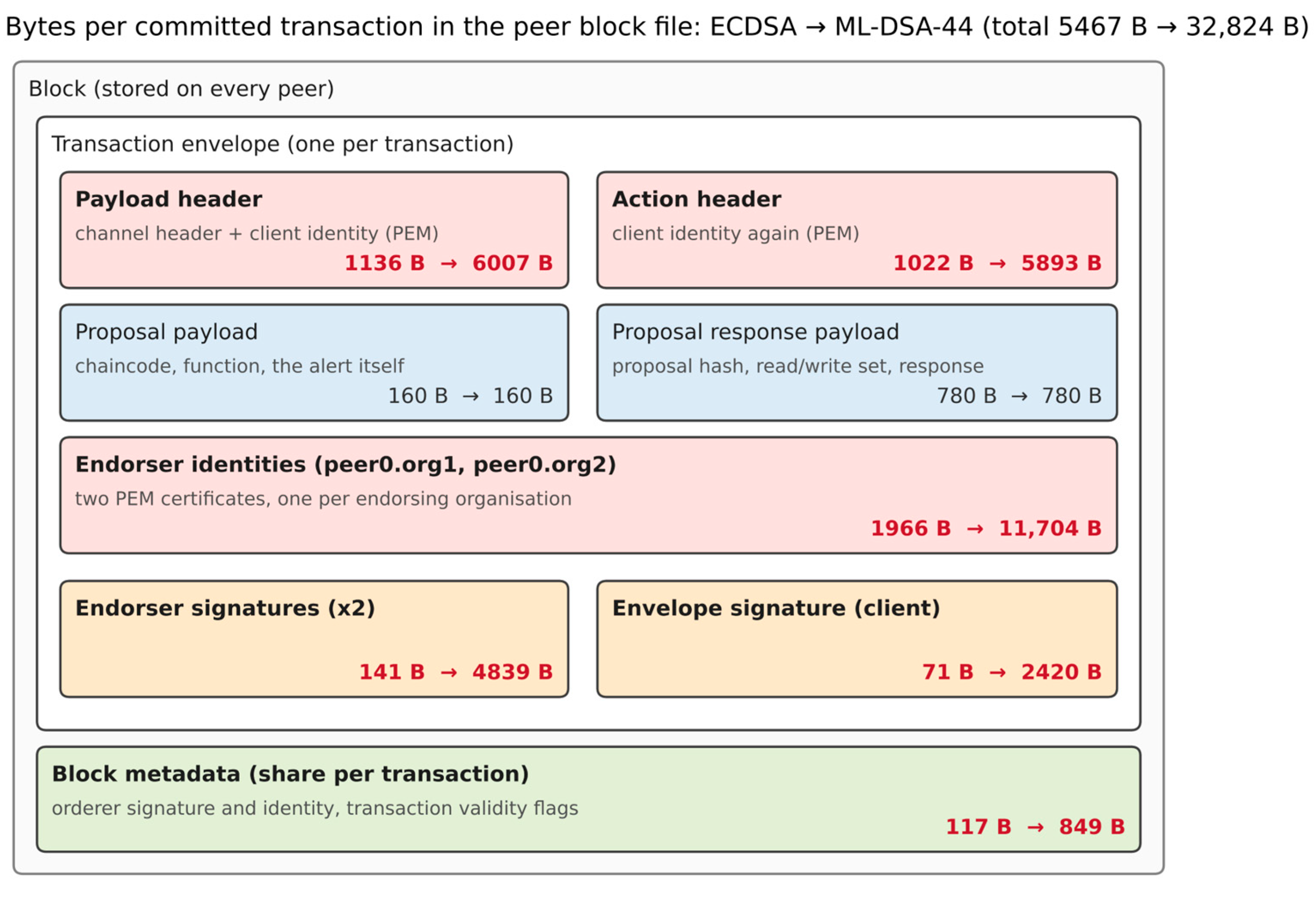
Figure 2.
(a) Committed transactions per second and (b) mean latency against the number of concurrent clients (logarithmic client axis); means over ten repetitions (nine for ML-DSA-65 at 20 clients) with 95% confidence intervals, as in Table 5 and Table 6.
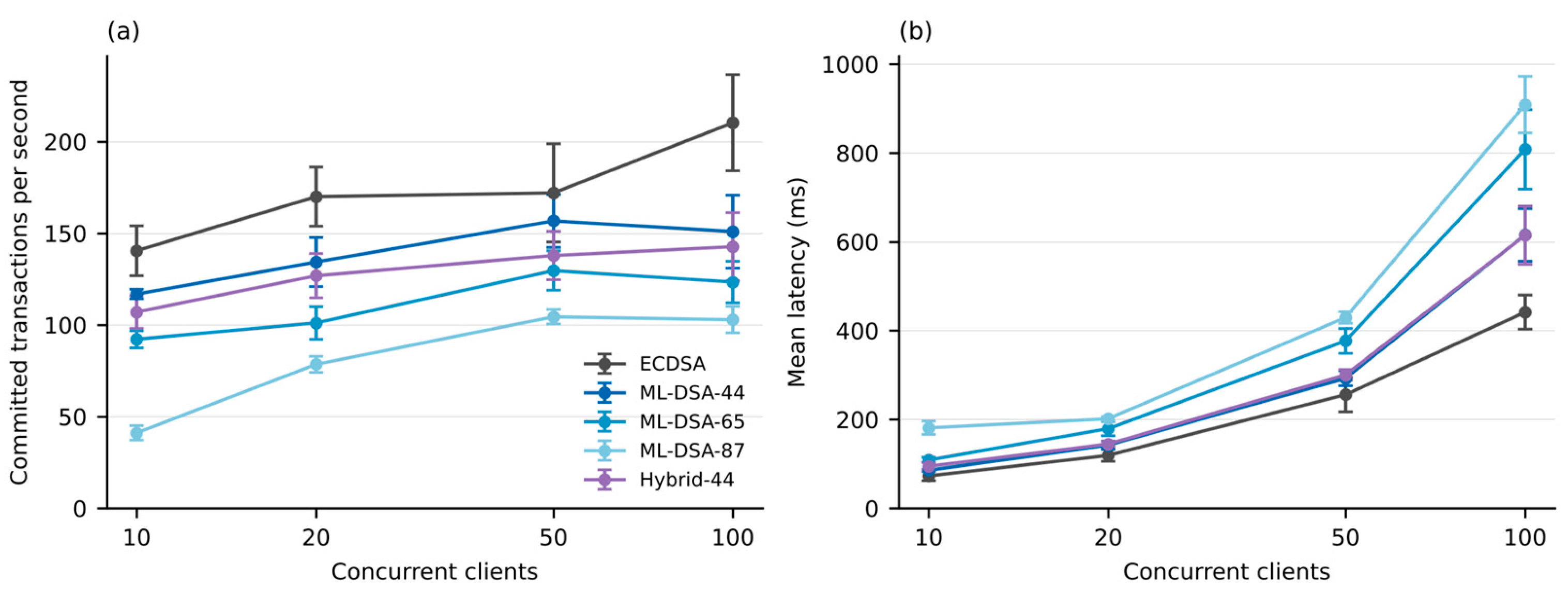
Figure 3.
Block-file bytes per committed transaction, grouped into identity fields (certificates with the headers that carry them), signatures, block metadata, application data, and block header, configuration and framing; the percentages are shares of the total (same block files as Table 7).
Figure 3.
Block-file bytes per committed transaction, grouped into identity fields (certificates with the headers that carry them), signatures, block metadata, application data, and block header, configuration and framing; the percentages are shares of the total (same block files as Table 7).
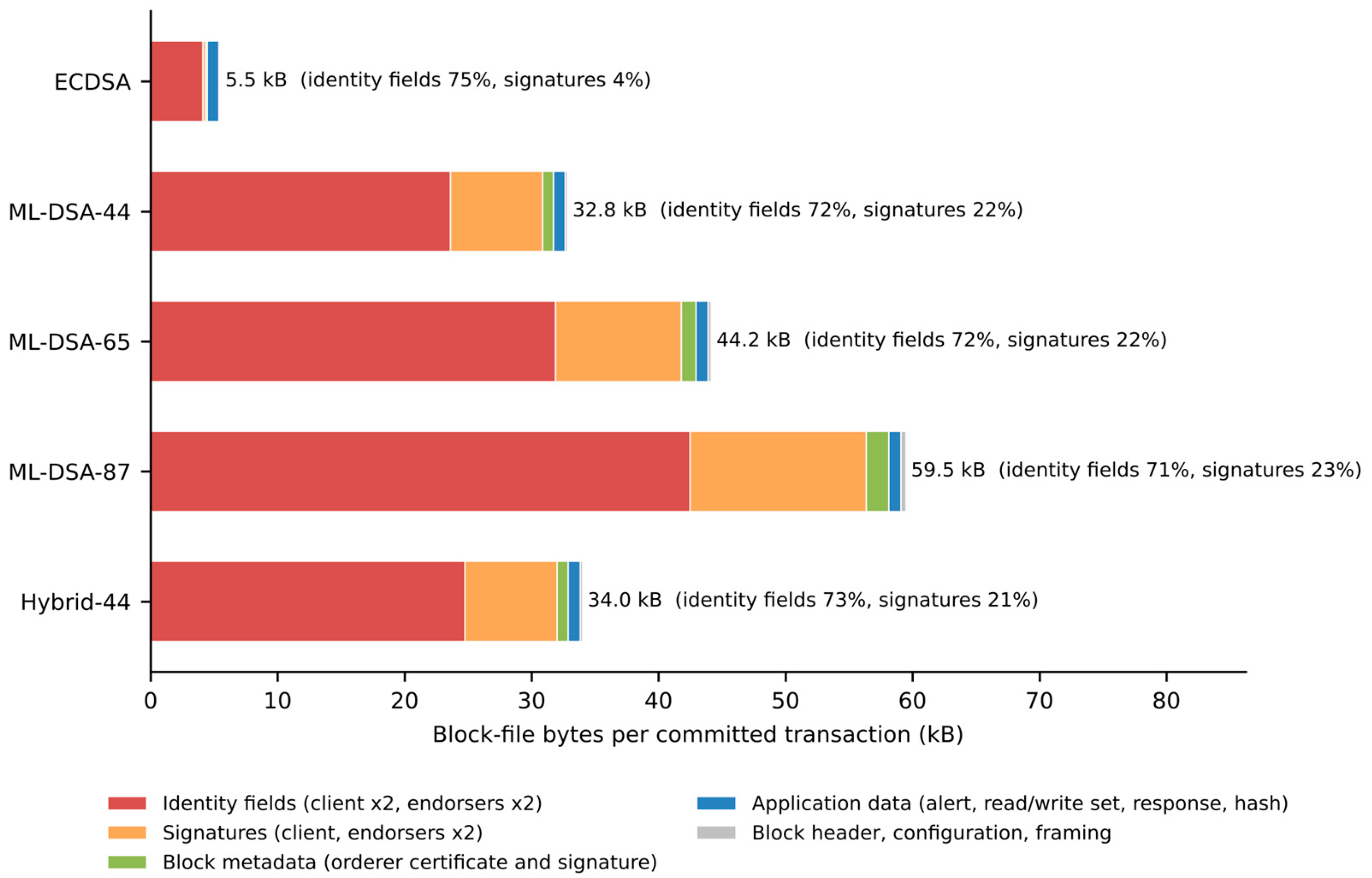
Figure 4.
Committed transactions per second (a,c) and the mean of the per-benchmark 99th-percentile latencies (ms, printed above the bars) on a logarithmic scale (b,d) for ML-DSA-87 (a,b) and ML-DSA-44 (c,d) under three orderer settings (PreferredMaxBytes, BatchTimeout); means over ten repetitions with 95% confidence intervals.
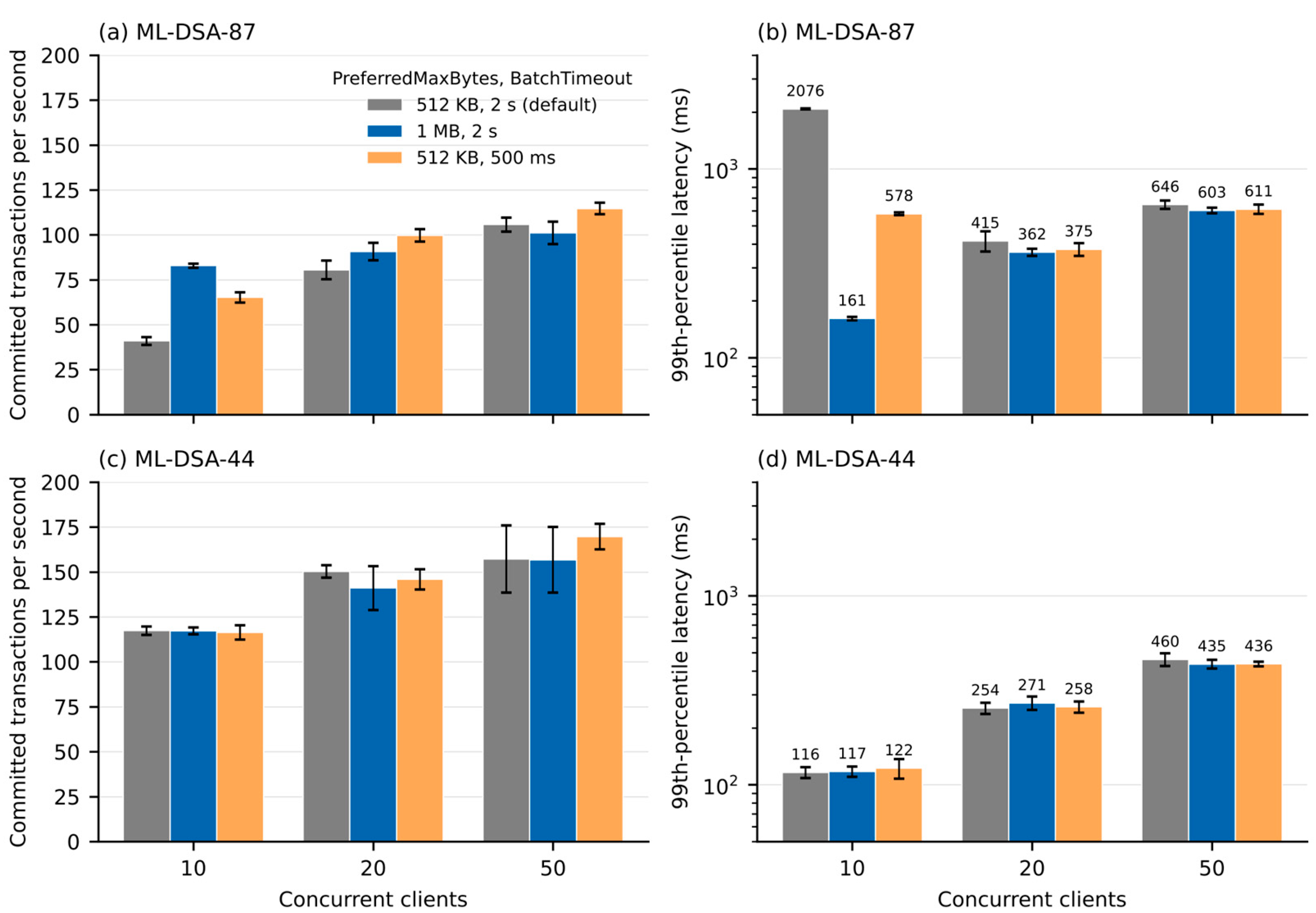

Table 1.
Public-key and signature sizes of the signature schemes measured.
| Scheme | NIST security category | Public key (bytes) | Signature (bytes) |
| ECDSA P-256 (baseline) | none (quantum-vulnerable) | 64 | 64 (70–72 DER-encoded) |
| ML-DSA-44 | 2 | 1312 | 2420 |
| ML-DSA-65 | 3 | 1952 | 3309 |
| ML-DSA-87 | 5 | 2592 | 4627 |
Table 2.
Closest studies of post-quantum identities on Hyperledger Fabric.
| Work | Platform | Post-quantum identities | Clients post-quantum | Bytes per transaction attributed | Repeated runs |
| PQFabric [16] | Fabric 1.4 | peer, orderer, endorser (hybrid) | no | no | not reported |
| TrustMesh [17] | Fabric 2.5 | none (application level) | no | no | yes (5–30 per condition) |
| Fabric fork [26] | Fabric 3.1 | all MSP roles | n/a (code only) | no | no measurements |
| This work | Fabric 3.1.4 fork | all MSP roles; ML-DSA-44/65/87 and hybrid | yes | yes (12 categories) | yes (10 per condition) |
Table 3.
Testbed.
| Component | Version or setting |
| Host | Intel Core i5-11300H laptop processor (4 cores, 3.1 GHz base); all 8 logical processors and 7 GB of memory available to the Windows Subsystem for Linux (WSL 2); Windows 11 with Ubuntu 24.04 in WSL 2; Docker Engine 29.5.3 |
| Fabric peer and orderer | Post-quantum fork of Fabric 3.1.4 (commit e13a86c) [26], built with Go 1.27.0 (crypto/mldsa) and the matching fork of fabric-lib-go (branch composite-mldsa, commit f420eda) |
| Fabric CA | Matching fork, version 1.5.21 (branch certificate-chain, commit 60fa88a) |
| Network | fabric-samples test network with Fabric CA: two organisations with one peer each, one Raft orderer, three certificate authorities |
| Channel | Capability V3_0 (MSP v3); V3_0_HYBRID for the hybrid condition |
| Block cutting | BatchTimeout 2 s, MaxMessageCount 10, PreferredMaxBytes 512 KB, as in [4]; varied in Section 4.6 |
| Endorsement | Default majority policy: both organisations endorse |
| Chaincode | CityAnchor (JavaScript, fabric-contract-api 2.5), run as an external chaincode service |
| Client | Node.js 24.16.0 with OpenSSL 3.5.6; @hyperledger/fabric-gateway 1.12.0 |
Table 4.
Conditions. All MSP identities of a condition use the same scheme.
| Condition | MSP certificates (CA, peers, orderer, administrators, clients) | TLS certificates | Channel capability |
| ECDSA | ECDSA P-256 | ECDSA key, ECDSA-signed | V3_0 |
| ML-DSA-44 | ML-DSA-44 | ECDSA key, ML-DSA-44-signed a | V3_0 |
| ML-DSA-65 | ML-DSA-65 | ECDSA key, ML-DSA-65-signed a | V3_0 |
| ML-DSA-87 | ML-DSA-87 | ECDSA key, ML-DSA-87-signed a | V3_0 |
| Hybrid-44 | ECDSA subject key with ML-DSA-44 alternative key and signature | ECDSA key, hybrid CA | V3_0_HYBRID |
a Peers and orderer; the CA server’s own TLS certificate holds an ML-DSA key of the same level (Section 5.8).
Table 5.
Committed transactions per second (mean ± 95% confidence interval over ten repetitions; the values of every benchmark are given in Table S2).
Table 5.
Committed transactions per second (mean ± 95% confidence interval over ten repetitions; the values of every benchmark are given in Table S2).
| Condition | 10 clients | 20 clients | 50 clients | 100 clients |
| ECDSA | 140.5 ± 13.6 | 170.0 ± 16.2 | 172.0 ± 26.8 | 210.3 ± 26.3 |
| ML-DSA-44 | 116.8 ± 2.6 | 134.3 ± 13.4 | 156.7 ± 14.5 | 150.9 ± 19.9 |
| ML-DSA-65 | 92.2 ± 4.6 | 101.1 ± 8.9 a | 129.7 ± 10.8 | 123.4 ± 11.3 |
| ML-DSA-87 | 41.2 ± 4.0 | 78.5 ± 4.3 | 104.5 ± 4.0 | 102.9 ± 7.3 |
| Hybrid-44 | 107.0 ± 8.9 | 126.9 ± 12.1 | 137.9 ± 13.1 | 142.7 ± 18.5 |
a Nine repetitions; one benchmark lost a client worker (Section 5.1).
Table 6.
Latency from submission to commit status (ms): mean ± 95% confidence interval over ten repetitions, and in parentheses the mean of the per-benchmark 99th percentiles.
Table 6.
Latency from submission to commit status (ms): mean ± 95% confidence interval over ten repetitions, and in parentheses the mean of the per-benchmark 99th percentiles.
| Condition | 10 clients | 20 clients | 50 clients | 100 clients |
| ECDSA | 72.7 ± 10.4 (120) | 119.3 ± 13.8 (256) | 255.8 ± 38.7 (460) | 441.6 ± 38.4 (726) |
| ML-DSA-44 | 85.6 ± 2.0 (120) | 142.0 ± 9.0 (299) | 292.8 ± 17.0 (473) | 615.5 ± 59.5 (984) |
| ML-DSA-65 | 108.9 ± 6.0 (157) | 179.3 ± 15.9 (358) a | 377.0 ± 28.0 (584) | 808.0 ± 89.6 (1189) |
| ML-DSA-87 | 181.2 ± 15.2 (2077) | 201.7 ± 4.5 (407) | 429.6 ± 13.1 (639) | 908.6 ± 63.7 (1308) |
| Hybrid-44 | 94.7 ± 9.2 (150) | 144.5 ± 5.9 (287) | 300.2 ± 12.1 (503) | 614.7 ± 65.5 (975) |
a Nine repetitions; one benchmark lost a client worker (Section 5.1).
Table 7.
Block-file bytes per committed transaction by category (first two block files of the first run of each condition, one for ECDSA: 8004, 4084, 3024, 2252 and 3934 transactions). Transactions per block count all decoded blocks, including the three configuration blocks. Rows may not sum to the totals because of rounding. Table S3 gives all decoder categories.
| Category | ECDSA | ML-DSA-44 | ML-DSA-65 | ML-DSA-87 | Hybrid-44 |
| Client identity, payload header | 1136 | 6007 | 8074 | 10,727 | 6295 |
| Client identity, action header | 1022 | 5893 | 7960 | 10,613 | 6181 |
| Endorser identities (2) | 1966 | 11,704 | 15,845 | 21,143 | 12,281 |
| Endorser signatures (2) | 141 | 4839 | 6616 | 9250 | 4839 |
| Envelope signature | 71 | 2420 | 3309 | 4627 | 2420 |
| Block metadata (share) | 117 | 849 | 1159 | 1794 | 879 |
| Alert, read/write set, response, hash | 940 | 940 | 939 | 940 | 940 |
| Header, configuration, framing | 76 | 172 | 251 | 390 | 180 |
| Total | 5467 | 32,824 | 44,152 | 59,483 | 34,015 |
| Ratio to ECDSA | 1.0 | 6.0 | 8.1 | 10.9 | 6.2 |
| Transactions per block | 9.92 | 9.84 | 9.75 | 8.50 | 9.84 |
Table 8.
Peer ledger size after 4001 alerts (mean over runs) and projected growth per peer at 10 alerts per second.
Table 8.
Peer ledger size after 4001 alerts (mean over runs) and projected growth per peer at 10 alerts per second.
| Condition | Ledger after 4001 alerts (MB) | Ratio to ECDSA | Per peer per year (TB) |
| ECDSA | 24.25 | 1.00 | 1.91 |
| ML-DSA-44 | 134.08 | 5.53 | 10.58 |
| ML-DSA-65 | 179.37 a | 7.40 | 14.15 |
| ML-DSA-87 | 240.50 | 9.92 | 18.97 |
| Hybrid-44 | 138.84 | 5.73 | 10.95 |
a Nine runs; the run whose 20-client benchmark lost a client worker holds fewer alerts and is excluded.
Table 9.
ML-DSA-87 under three orderer settings (PreferredMaxBytes, BatchTimeout): committed transactions per second, latency and transactions per block of each benchmark’s own blocks (mean ± 95% confidence interval over ten repetitions). ML-DSA-44 and further columns are given in Table S4.
Table 9.
ML-DSA-87 under three orderer settings (PreferredMaxBytes, BatchTimeout): committed transactions per second, latency and transactions per block of each benchmark’s own blocks (mean ± 95% confidence interval over ten repetitions). ML-DSA-44 and further columns are given in Table S4.
| Setting | Clients | Transactions per second | Mean latency (ms) | 99th percentile (ms) | Transactions per block |
| 512 KB, 2 s (default) | 10 | 40.9 ± 2.2 | 177.6 ± 12.7 | 2076 ± 14 | 8.43 ± 0.04 |
| 1 MB, 2 s | 10 | 82.9 ± 1.1 | 120.6 ± 1.6 | 161 ± 3 | 10.00 ± 0.00 |
| 512 KB, 500 ms | 10 | 65.2 ± 2.9 | 136.8 ± 3.3 | 578 ± 10 | 7.61 ± 0.03 |
| 512 KB, 2 s (default) | 20 | 80.6 ± 5.2 | 195.2 ± 5.8 | 415 ± 51 | 8.73 ± 0.04 |
| 1 MB, 2 s | 20 | 90.7 ± 4.9 | 191.2 ± 3.5 | 362 ± 16 | 9.95 ± 0.02 |
| 512 KB, 500 ms | 20 | 99.8 ± 3.5 | 186.1 ± 2.2 | 375 ± 29 | 8.16 ± 0.03 |
| 512 KB, 2 s (default) | 50 | 105.7 ± 3.8 | 422.4 ± 6.9 | 646 ± 33 | 8.84 ± 0.03 |
| 1 MB, 2 s | 50 | 101.0 ± 6.2 | 420.5 ± 5.8 | 603 ± 21 | 9.96 ± 0.02 |
| 512 KB, 500 ms | 50 | 114.6 ± 3.2 | 421.6 ± 11.2 | 611 ± 35 | 8.34 ± 0.03 |
Table 10.
Block-file bytes per transaction as stored (PEM), as rebuilt with identities stored as DER or as 32-byte references, and after compressing the stored file (saving in parentheses). One ledger per condition with the set-up transactions, the CLI invoke and 2000 alerts at 20 clients; configuration-only blocks are left out, so the stored values differ slightly from Table 7. The xz -6 results are in the CSV file accompanying Figure S2.
| Condition | Stored (PEM) | DER | 32-byte reference | gzip -6 | zstd -3 |
| ECDSA | 5464 | 4246 (−22%) | 1577 (−71%) | 553 (−90%) | 456 (−92%) |
| ML-DSA-44 | 32,732 | 26,289 (−20%) | 8869 (−73%) | 9962 (−70%) | 7815 (−76%) |
| ML-DSA-65 | 43,971 | 35,314 (−20%) | 11,624 (−74%) | 30,795 (−30%) | 10,601 (−76%) |
| ML-DSA-87 | 59,155 | 47,612 (−20%) | 15,781 (−73%) | 42,187 (−29%) | 14,943 (−75%) |
| Hybrid-44 | 33,907 | 27,159 (−20%) | 8869 (−74%) | 19,200 (−43%) | 7809 (−77%) |
Table 11.
Ledger growth per peer at three alert rates and the monthly cloud block-storage cost that each year of ledger adds at 10 alerts per second (USD 0.08 per GiB-month [41]), from the measured ledger size per alert of Table 8 (provisioned capacity only; a year of 365.25 days; 1 TB = 1012 bytes; 1 GiB = 230 bytes).
| Condition | Ledger per alert (kB) | TB per year, 1 alert/s | TB per year, 10 alerts/s | TB per year, 100 alerts/s | USD per month per year of ledger, 10 alerts/s |
| ECDSA | 6.1 | 0.19 | 1.91 | 19.1 | 142 |
| ML-DSA-44 | 33.5 | 1.06 | 10.58 | 105.8 | 788 |
| ML-DSA-65 | 44.8 | 1.41 | 14.15 | 141.5 | 1054 |
| ML-DSA-87 | 60.1 | 1.90 | 18.97 | 189.7 | 1413 |
| Hybrid-44 | 34.7 | 1.10 | 10.95 | 109.5 | 816 |
Table 12.
Block-file bytes per transaction extrapolated to more application data: the fixed cryptographic part of Table 7 plus the application data; the first row is measured.
Table 12.
Block-file bytes per transaction extrapolated to more application data: the fixed cryptographic part of Table 7 plus the application data; the first row is measured.
| Application data per transaction (kB) | ECDSA (kB) | ML-DSA-44 (kB, ratio to ECDSA) | ML-DSA-87 (kB, ratio to ECDSA) | Identity fields in ML-DSA-44 (%) |
| 0.94 (measured) | 5.5 | 32.8 (6.0) | 59.5 (10.9) | 72 |
| 2 | 6.5 | 33.9 (5.2) | 60.5 (9.3) | 70 |
| 5 | 9.5 | 36.9 (3.9) | 63.5 (6.7) | 64 |
| 10 | 14.5 | 41.9 (2.9) | 68.5 (4.7) | 56 |
| 50 | 54.5 | 81.9 (1.5) | 108.5 (2.0) | 29 |
Disclaimer/Publisher’s Note: The statements, opinions and data contained in all publications are solely those of the individual author(s) and contributor(s) and not of MDPI and/or the editor(s). MDPI and/or the editor(s) disclaim responsibility for any injury to people or property resulting from any ideas, methods, instructions or products referred to in the content. |
© 2026 by the authors. Licensee MDPI, Basel, Switzerland. This article is an open access article distributed under the terms and conditions of the Creative Commons Attribution (CC BY) license (http://creativecommons.org/licenses/by/4.0/).
Copyright: This open access article is published under a Creative Commons CC BY 4.0 license, which permit the free download, distribution, and reuse, provided that the author and preprint are cited in any reuse.