

Submitted:
30 October 2026
Posted:
02 November 2026
You are already at the latest version
Abstract
Introduction: Township economies are shaped by interactions among state authorities, informal traders, community organisations and other local economic actors. The supplied literature links informal economic activity to livelihood support, institutional exclusion, community governance and contested implementation, but provides limited direct evidence about South African township resource control.Methods: The researcher-selected databases and information sources were Google Scholar and ERIC. The eligibility protocol restricted publication years to 2018–2026. The exact calendar date of search execution was not recorded in the verified identification provenance; this is distinct from the publication-year eligibility range. A systematic review was undertaken using Google Scholar and ERIC, with eligibility restricted to English-language publications from 2018–2026. The exact Boolean strategy, inclusion and exclusion criteria, PRISMA workflow, CASP appraisal and COSTAQDA-supported thematic synthesis were documented.Results: The evidence presents informal activity as economically valuable while reflecting restricted access to formal finance, infrastructure, predictable pricing and administrative procedures. Governance responses tend toward managed inclusion through simplified documentation, designated trading spaces and combined formal–informal arrangements. Community governance appears more accountable when supported by rights documents, constitutions, revenue procedures, financial rules and defined roles, but formal recognition does not ensure implementation or participation. These conclusions are primarily transferable observations because the extracted evidence contains very limited direct evidence from South African townships.Discussion/Conclusion: State and informal governance mechanisms appear capable of structuring access to resources, but the review cannot establish how they redistribute control within South African township economies. Stronger township-specific empirical research is required before definitive policy or causal conclusions can be drawn.
Keywords:
informal economic governance
; resource control
; South African townships
; state power
; systematic review
1. Introduction
Township economies are arenas in which livelihood strategies, public regulation, community authority and struggles over space and resources intersect. The review question addressed the relationship between state power deployment and informal economic governance mechanisms among local economic actors, informal traders, community governance structures and state authorities in South African townships. This question is important because control over trading spaces, administrative access, local revenues and economic opportunities may be exercised through both formal state instruments and informal institutional arrangements.
The supplied literature indicates that informal economies can provide important livelihood benefits while operating under conditions of institutional exclusion. Bagaria (2026), for example, reports that informal trade income supported children's education for many surveyed traders, while also identifying limited access to formal credit, price instability, inadequate storage and competition as significant challenges. Other supplied studies describe community-based governance as dependent on codified rights, constitutions, procedures for revenue distribution, financial-management rules and defined organisational roles (Child, 2019). These studies suggest that governance is not simply a choice between state regulation and informal autonomy; rather, access and control may be produced through their interaction.
The literature also identifies a persistent implementation problem. Olaniyan (2023) reports that formal policy and legal commitments to community engagement may not be matched by practical action, contributing to dissatisfaction with local government. Comparable supplied studies examine state power, informal authority, local development and resource governance in settings outside South African townships, including India, Nepal, Nigeria, Mongolia, Tanzania, Sudan and other contexts. Their relevance is therefore transferable rather than directly demonstrative. The supplied synthesis found no direct empirical account of contestation between South African state authorities and township economic actors over particular resources, spaces, licences or revenues.
The review was consequently needed to consolidate the available evidence while maintaining a clear distinction between direct township evidence and cautious governance analogies. It also sought to identify whether the evidence supports claims about opportunities, risks, institutional conditions and future research needs. Because the evidence base contains substantial contextual heterogeneity, appraisal and synthesis were treated as interpretive processes rather than as grounds for assuming that findings from non-township settings apply automatically to South Africa.
2. Research Objectives
RO1: To examine how State Power dynamics and informal economic governance mechanisms influences control, distribution, and contestation of local economic resources and market governance dynamics among township economies, local informal economic actors, and township business communities within South African townships.
RO2: To identify the principal opportunities, benefits and enabling conditions associated with State power dynamics and informal economic governance mechanisms in relation to Control, distribution, and contestation of local economic resources and market governance dynamics.
RO3: To analyse the challenges, risks, ethical considerations and implementation barriers associated with State power dynamics and informal economic governance mechanisms for Township economies, local informal economic actors, and township business communities.
RO4: To examine the contextual, institutional and practice-related factors that shape the adoption and effective use of State power dynamics and informal economic governance mechanisms within South African townships.
RO5: To identify gaps in the available evidence and derive implications for future research, policy and practice .
3. Research Methods
3.1. Review Design
The selected review type was Systematic Review. PRISMA was used as the reporting framework for selection transparency, while CASP was used for study-level methodological appraisal. COSTAQDA supported traceability from extracted findings to codes, categories and themes; it did not replace the review design, PRISMA reporting or critical appraisal (Costa & Costa, 2024; Costa & Mfolo, 2024; Page et al., 2021).
3.2. Search Strategy and Information Sources
The researcher-selected databases and information sources were Google Scholar, ERIC. The eligibility protocol restricted publication years to 2018–2026. The exact calendar date of search execution was not recorded in the verified identification provenance; this is distinct from the publication-year eligibility range.
3.3. Inclusion and Exclusion Criteria
Inclusion
- Studies focusing on local economic actors, informal traders, community governance structures, or state authorities in South African township economies.
- Studies examining the deployment of state power or mechanisms of informal economic governance.
- Studies investigating the dynamics of control, allocation, contestation, or governance of local economic resources.
- Studies specifically conducted within the context of South African townships.
- Studies published between 2018 and 2026.
- Studies published in the English language.
- Studies published as peer-reviewed journal articles.
Exclusion
- Studies that do not involve local economic actors, informal traders, community governance structures, or state authorities within township settings.
- Studies that do not address state power deployment or informal economic governance mechanisms.
- Studies that do not analyze dynamics of control, allocation, contestation, or governance of local economic resources.
- Studies conducted outside the context of South African township economies (e.g., formal urban business districts, non-township rural settings, or international contexts).
- Studies published prior to 2018 or after 2026.
- Studies published in languages other than English.
- Non-peer-reviewed publications, including book chapters, dissertations, conference proceedings, working papers, policy briefs, and editorials.
3.4. Screening and Study Selection
The PRISMA selection counts have persisted, but the decision rule used during title/abstract screening is not available in the verified audit payload. COSTAQDA therefore reports the recorded workflow counts without reconstructing an unverified screening procedure.
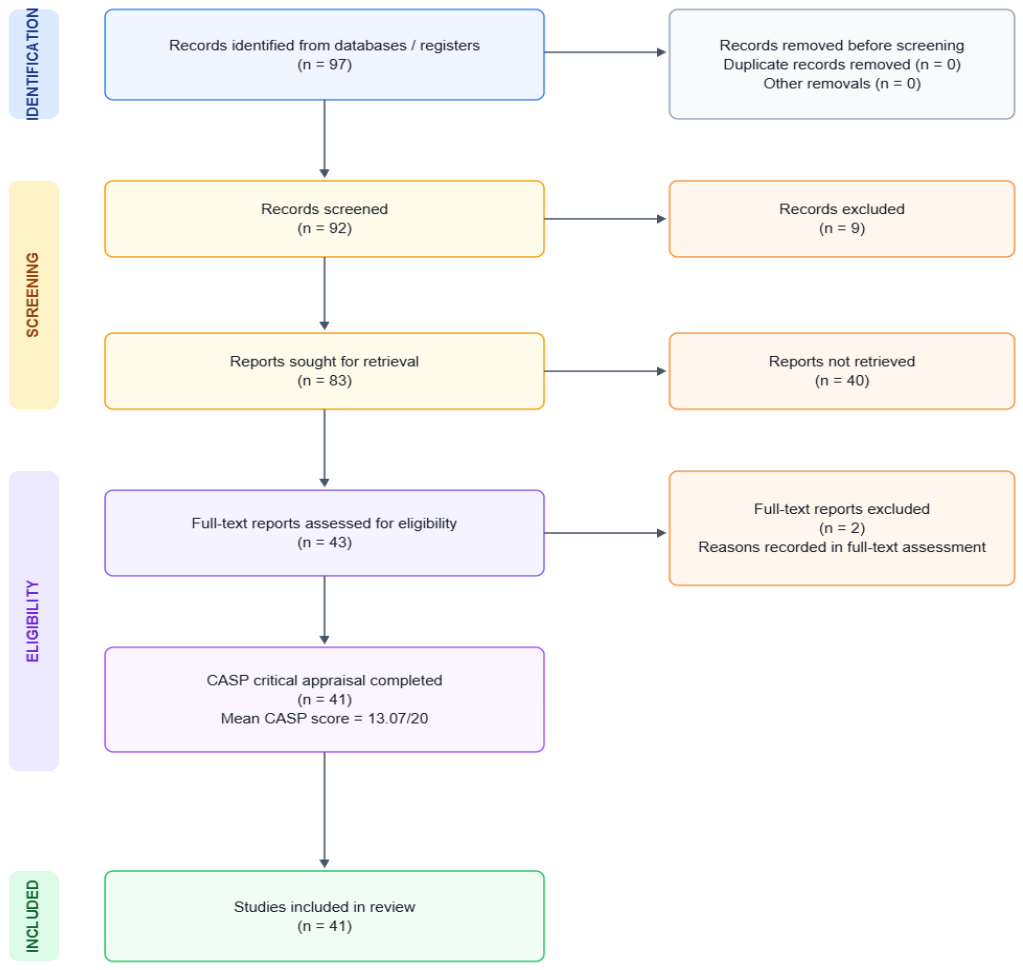
The persisted PRISMA workflow records 97 identified records, 0 duplicates, 92 records screened, 83 reports sought for retrieval, 9 records excluded at the title/abstract stage, 43 full texts assessed, 2 full-text exclusions and 41 included records. These counts describe study selection and are not substantive review findings.
Figure 1.
PRISMA 2020 Flow Diagram — Identification, Screening, Eligibility and Included. Source: COSTAQDA PRISMA Workflow, navigation item 8: PRISMA Flow Diagram; four-stage structure showing Identification, Screening, Eligibility (including CASP critical appraisal) and Included; adapted from PRISMA 2020 (Page et al., 2021).
3.5. Critical Appraisal
CASP was used in the PRISMA full-text workspace, and all 41 currently included studies had completed CASP appraisals. CASP provides structured questions for examining methodological validity, findings and relevance, but checklist responses should not be converted into an unquestioned total-quality score (Long et al., 2020). The recorded mean score was 13.07, with study-level scores in the supplied appraisal record ranging from 11 to 19. These values describe the recorded appraisal output, not a validated measure of evidential truth or confidence.
The appraisal record is methodologically unusual because the configured appraisal service was unavailable and COSTAQDA completed conservative text-evidence appraisals. Unsupported criteria were recorded as Can't tell and require researcher verification. This means that a missing judgment may represent incomplete reporting or unavailable supporting text rather than a demonstrated methodological weakness. The record also contains study-linked appraisal limitations, but no complete criterion-level rationales for all studies. The appraisal therefore supports caution about reporting and methodological uncertainty rather than a definitive ranking of studies.
The appraisal pattern is heterogeneous. The supplied study-linked records identify concerns across several CASP criteria for many studies, while the South Africa-related record by Hewitt and Botha (2026) has one recorded concern and the Ibadan study by Olaniyan (2023) has three. The Raxaul–Birgunj study by Bagaria (2026), which supplies most of the extracted findings, has five recorded concerns. These observations constrain interpretation of its findings, particularly because the thematic synthesis relies heavily on one non-South African border-trade study.
The appraisal also reveals a mismatch between the review question and much of the included material. Many records concern book chapters, international governance, macroeconomic policy or non-township settings, while the review protocol specified peer-reviewed journal articles focused on South African townships. Because the supplied project record nevertheless identifies 41 included records, this report does not reclassify or remove them retrospectively. Instead, contextual mismatch is treated as a limitation on applicability and transferability. Methodological appraisal and contextual relevance were therefore considered separately, consistent with guidance that appraisal should inform, rather than mechanically determine, synthesis judgments (Noyes et al., 2018).
No finding-level confidence method was recorded, and no GRADE-CERQual assessment was conducted. The synthesis conclusions should consequently be understood as traceable thematic interpretations rather than formal confidence ratings. The available CASP information supports a cautious account of methodological limitations, while the absence of direct South African township findings remains the more important constraint on substantive conclusions (Lewin et al., 2018). COSTAQDA's traceability between findings, codes and themes strengthens auditability, but it cannot resolve weaknesses in the underlying evidence base (Costa & Costa, 2024).
Figure 2.
CASP Critical Appraisal Intelligence — PRISMA Workflow, Step 6: Full-Text Screening. Source: COSTAQDA PRISMA Workflow, navigation item 6: Full-Text Screening (CASP critical appraisal outputs). The Word figure is generated from the same deterministic COSTAQDA CASP visual.
Figure 2.
CASP Critical Appraisal Intelligence — PRISMA Workflow, Step 6: Full-Text Screening. Source: COSTAQDA PRISMA Workflow, navigation item 6: Full-Text Screening (CASP critical appraisal outputs). The Word figure is generated from the same deterministic COSTAQDA CASP visual.
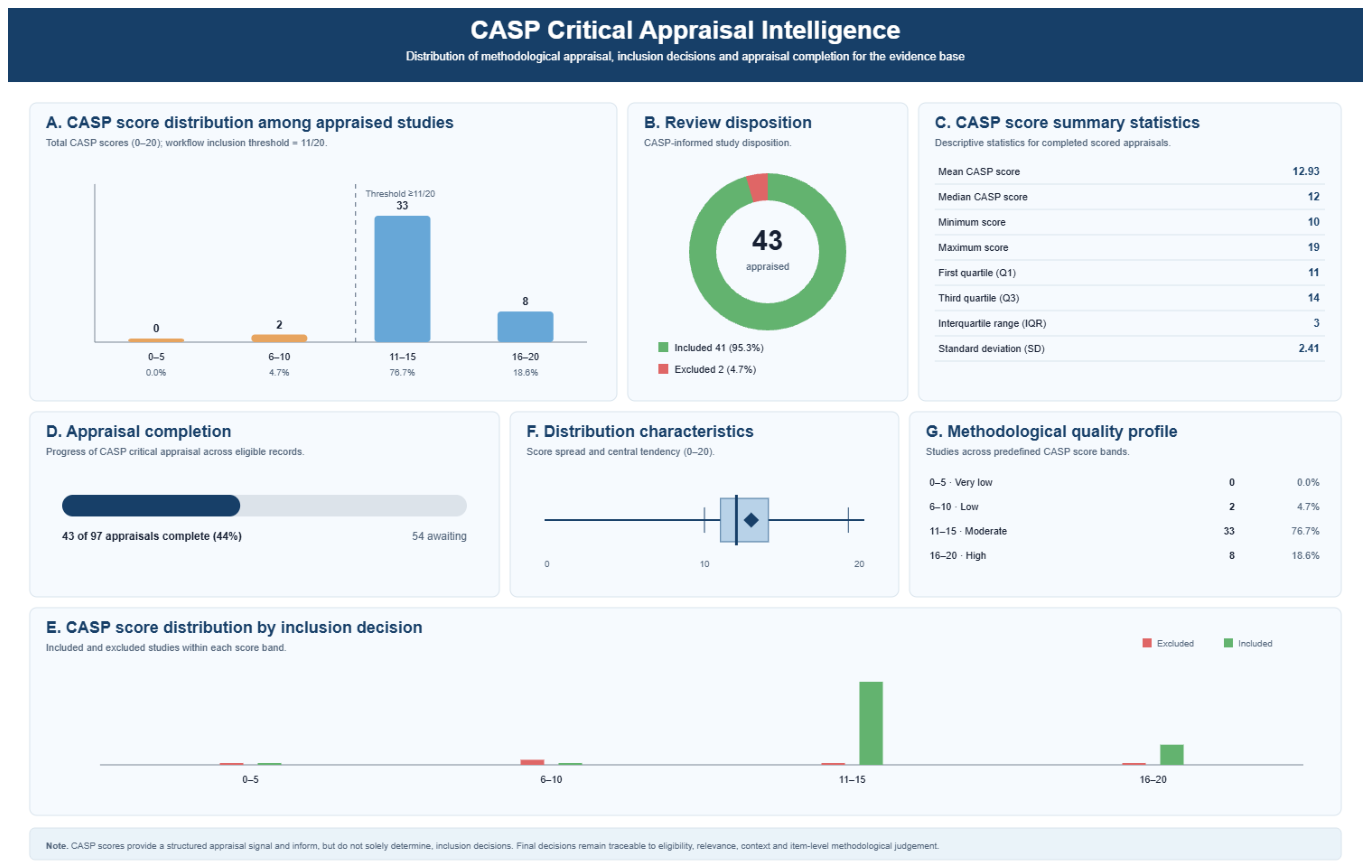
The CASP figure summarises 41 completed study-level appraisals, with a recorded mean score of 13.07 and supplied scores ranging from 11 to 19. It is appropriate as a descriptive display of the appraisal workspace, but the mean should not be interpreted as a validated overall quality score. The study-linked records show recurring methodological concerns and several Can't tell judgments, partly because the configured appraisal service was unavailable and the system used conservative text-evidence appraisal. The figure therefore supports a narrative of heterogeneous reporting and methodological uncertainty rather than a binary distinction between strong and weak evidence (Long et al., 2020; Noyes et al., 2018).
3.6. Data Extraction
Data extraction was not recorded as a separate procedural narrative. Nevertheless, the verified synthesis workspace contains 137 finding-level records contributed by 16 studies, with study identifiers retained and linked to six codes, two categories and three recorded thematic outputs. The extraction record is therefore sufficient to describe the material used in synthesis, but insufficient to reconstruct the full extraction form, extraction fields, duplicate-checking process or verification procedures.
3.7. Data Synthesis and Analysis
Qualitative evidence synthesis was conducted on 137 extracted findings contributed by 16 studies. The COSTAQDA synthesis engine applied thematic synthesis, moving from traceable finding-level evidence to 6 initial codes, 2 categories, 1 descriptive themes and 2 analytical themes.
Theme development was constrained to the extracted finding-level evidence supplied by eligible studies. Each synthesised theme retained supporting study IDs and finding IDs, while contradictory evidence was preserved where identified. Titles, abstracts and bibliographic prominence were not treated as substitutes for extracted qualitative findings.
Recorded synthesis limitations included: The supplied findings provide very limited direct evidence about South African townships and do not directly represent the specified groups of South African informal traders, township businesses, community governance structures, or state authorities.; Several findings come from India-Nepal border trade, Nigeria, or broader community-based natural-resource governance rather than South African township economies; their use here is therefore limited to cautious, transferable governance observations.; Many supplied records contain bibliographic material, methodological fragments, website text, or article-title material rather than substantive findings and were not used to generate themes.; No supplied finding directly documents contestation between South African state authorities and township economic actors over particular resources, spaces, licences, revenues, or market-control arrangements.; The extracted material contains no clear contradictory empirical findings on the effects of state power or informal governance mechanisms in South African townships.; The evidence is insufficient to assess differential effects by gender, age, migrant status, trader scale, location, municipality, or type of township economic resource..
3.8. Bibliometric Intelligence and Confidence in the Evidence Base
Bibliometric intelligence provides a structural view of the evidence base that complements PRISMA selection, critical appraisal and qualitative synthesis. The following analyses examine citation relationships, scholarly influence, evidence connectivity and knowledge development within the included corpus. They provide contextual evidence about the intellectual structure and provenance of the literature and are not substitutes for methodological quality appraisal.
3.8.1. Local Citation Network
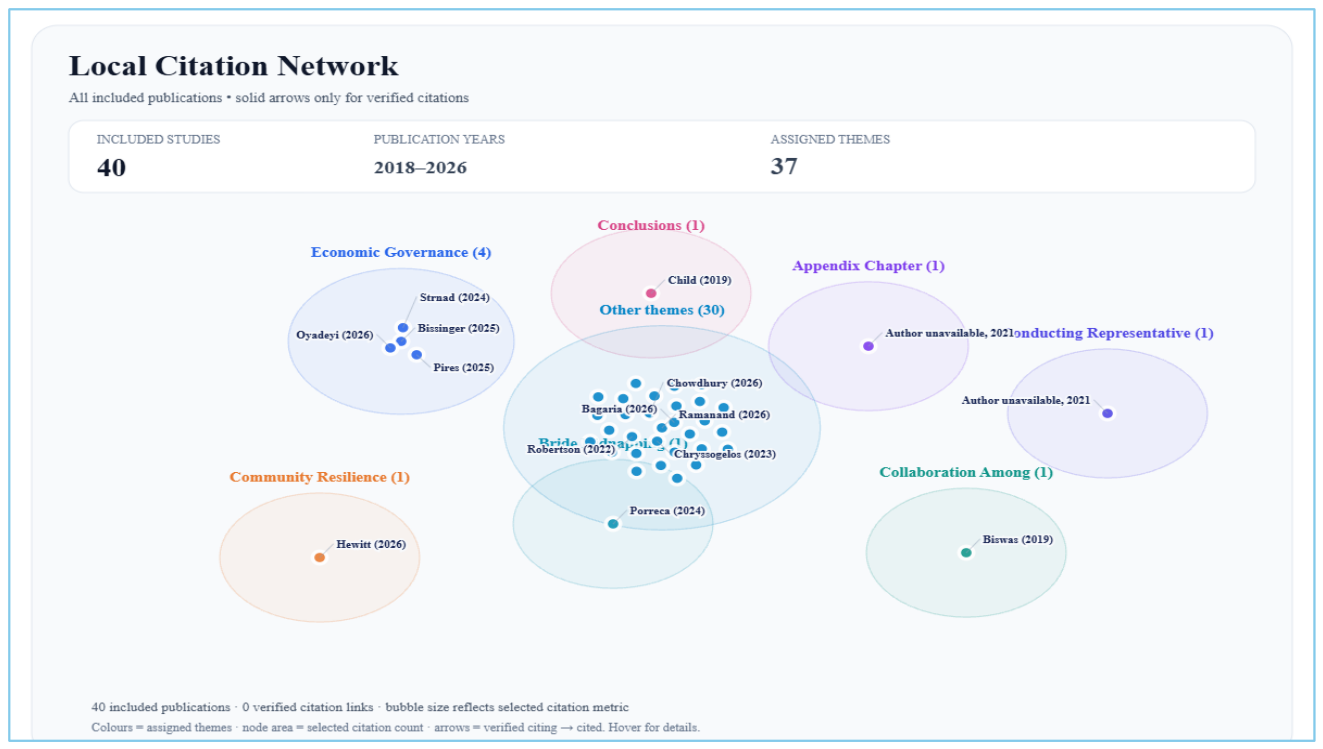
The Local Citation Network maps citation relationships within the included evidence base. It shows how studies are connected within the review corpus and supports examination of intellectual connectedness, centrality, bridging and isolation. These citation relationships describe the structure of the literature and do not, by themselves, establish methodological quality or validity.
Figure 3.
Local Citation Network. Source: COSTAQDA PRISMA Workflow, navigation item 12: Bibliometric Intelligence — Local Citation Network.
Figure 3.
Local Citation Network. Source: COSTAQDA PRISMA Workflow, navigation item 12: Bibliometric Intelligence — Local Citation Network.
3.8.2. Influence Pyramid
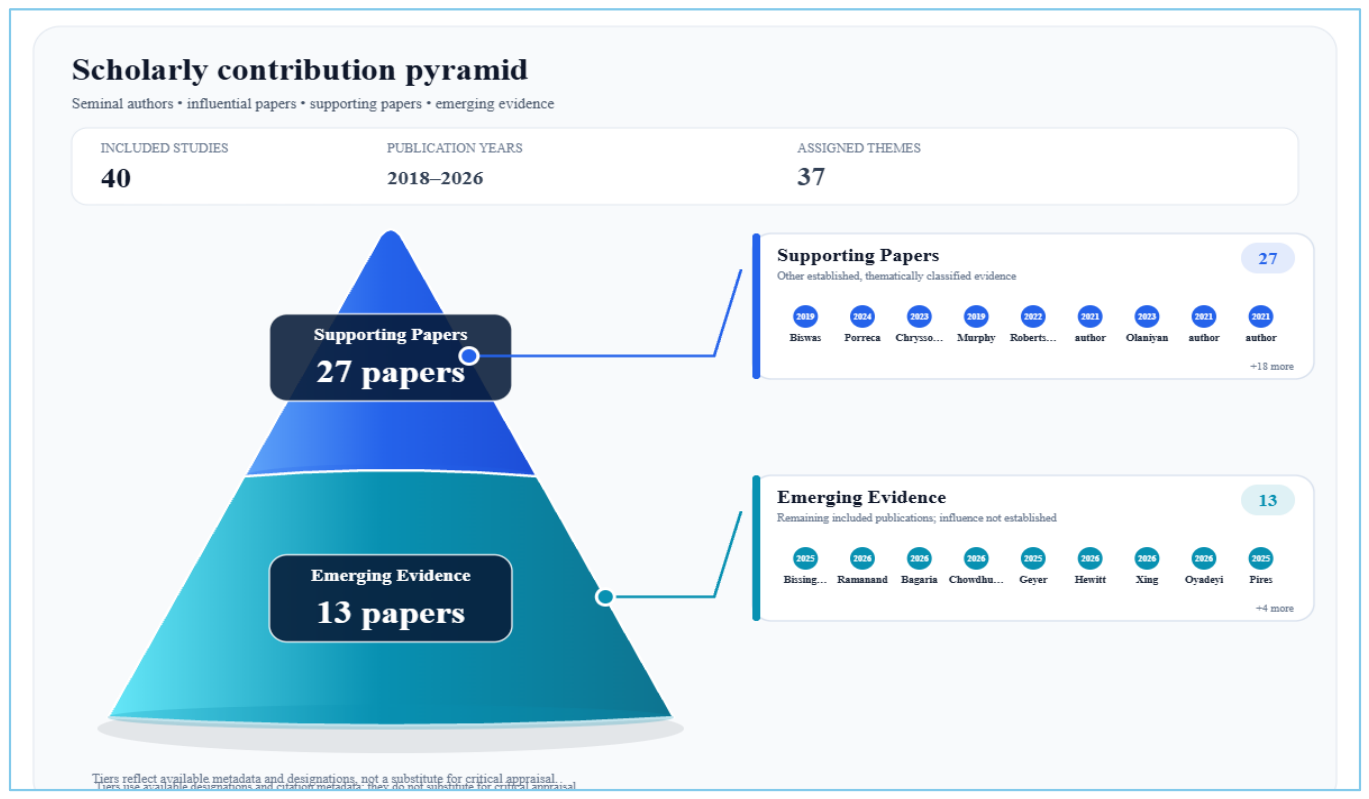
The Influence Pyramid represents the distribution of scholarly influence within the included evidence base. It helps identify how bibliometric prominence is distributed across the reviewed studies. Influence is interpreted separately from methodological quality, which is assessed through critical appraisal.
Figure 4.
Influence Pyramid. Source: COSTAQDA PRISMA Workflow, navigation item 12: Bibliometric Intelligence — Influence Pyramid.
Figure 4.
Influence Pyramid. Source: COSTAQDA PRISMA Workflow, navigation item 12: Bibliometric Intelligence — Influence Pyramid.
3.8.3. Evidence Strength
The Evidence Strength analysis examines the structure and strength of relationships within the evidence ecosystem assembled for the review. It complements, but does not replace, CASP methodological appraisal and must not be interpreted as a direct estimate of causal effect.
Figure 5.
Evidence Strength Network. Source: COSTAQDA PRISMA Workflow, navigation item 12: Bibliometric Intelligence — Evidence Strength Network.
Figure 5.
Evidence Strength Network. Source: COSTAQDA PRISMA Workflow, navigation item 12: Bibliometric Intelligence — Evidence Strength Network.
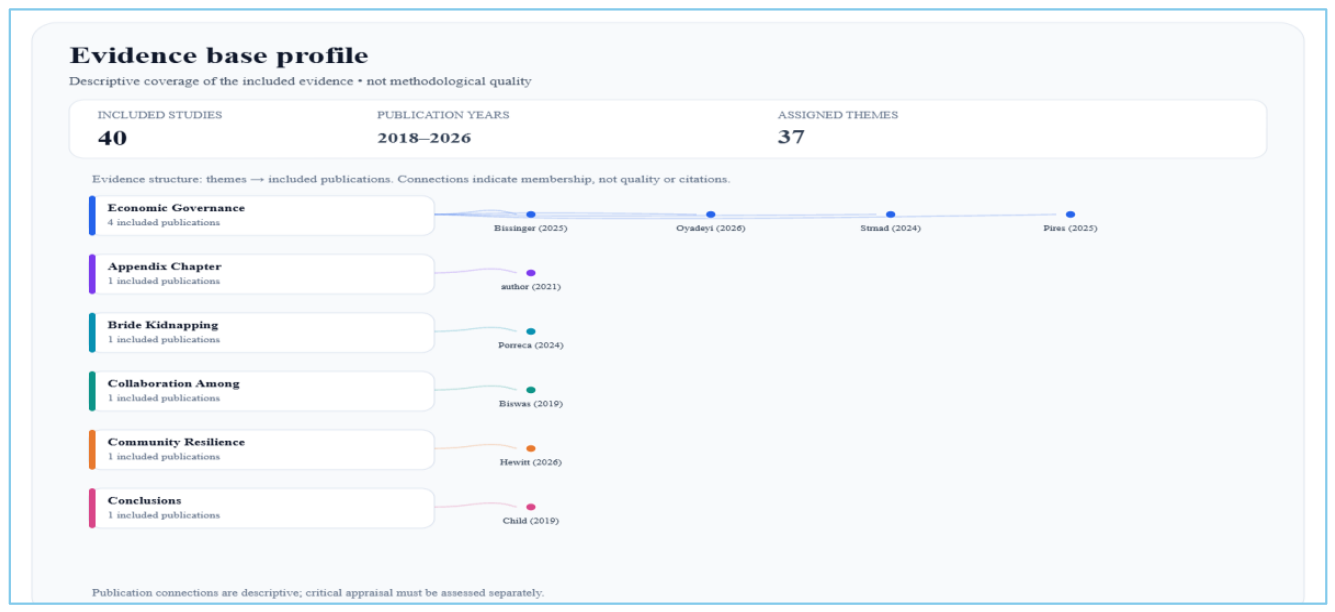
3.8.4. Knowledge Evolution
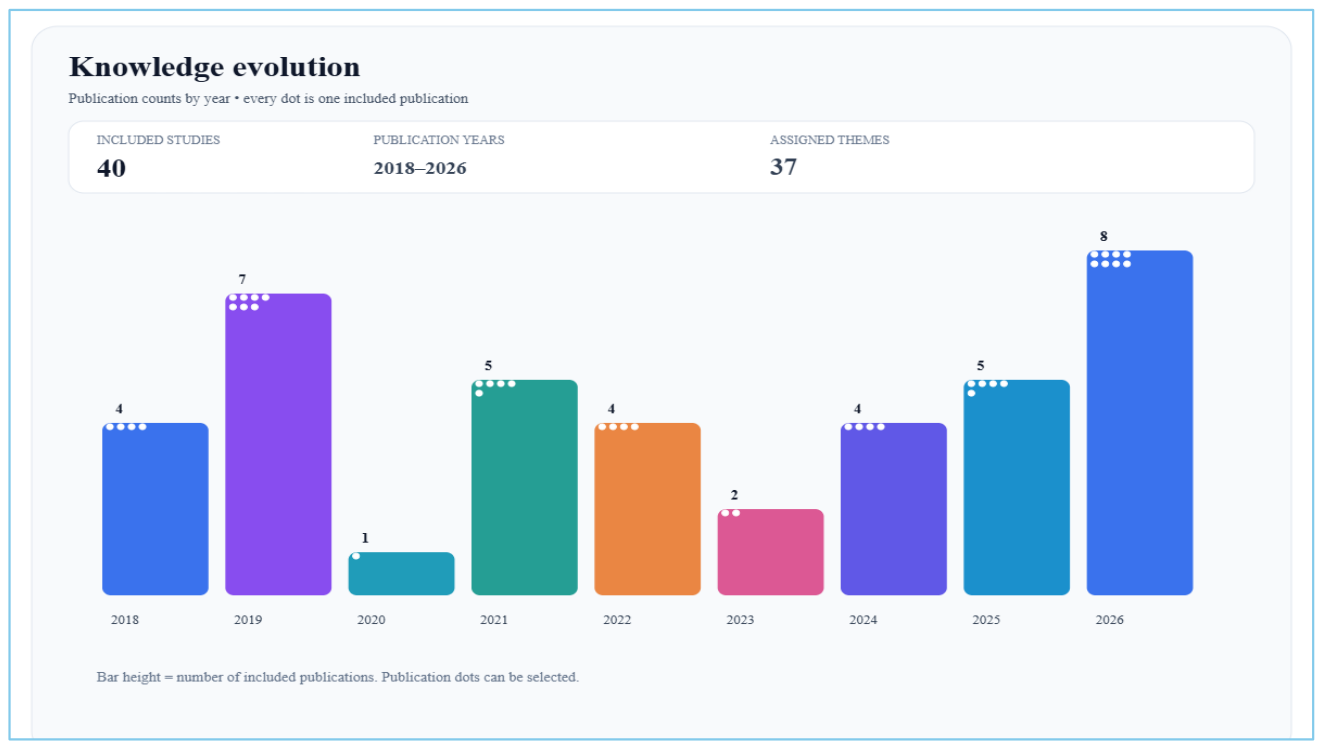
Knowledge Evolution examines the temporal and intellectual development of the included evidence base. It traces how research contributions develop over time and, where supported by the Step 12 data, how later studies extend, connect, challenge or consolidate earlier contributions.
Figure 6.
Knowledge Evolution. Source: COSTAQDA PRISMA Workflow.
3.8.5. Integrated Confidence in the Synthesised Evidence
A separate finding-level confidence method was not recorded. CASP was used for methodological appraisal, but CASP scores were not converted into confidence ratings, and no GRADE-CERQual assessment was conducted. Bibliometric outputs were treated as contextual evidence maps rather than as components of a validated confidence score. Trustworthiness was therefore considered through convergence and divergence of extracted findings, contextual fit, appraisal limitations and traceability, without assigning a formal confidence label.
4. Findings
4.1. Search and Selection Results
The recorded selection workflow included 41 records after screening and full-text assessment, but the 41-record inclusion count should not be treated as a substantive finding. The workflow contains an unresolved arithmetic discrepancy between identification and screening counts, and the title and abstract decision rule was not preserved in the verified audit. These limitations affect confidence in the completeness and reproducibility of selection, although they do not alter the extracted thematic synthesis.
4.2. Characteristics of Included Studies
The 41 included records were highly heterogeneous. The 16 studies contributing to the verified thematic synthesis included evidence from South Africa, India and Nepal, Nigeria, Mongolia, Tanzania, Sudan and other international settings. The extracted material was concentrated in six codes and 137 findings, but most direct thematic support came from Bagaria's (2026) India–Nepal border-trade study, Child's (2019) community-based natural-resource governance material and Olaniyan's (2023) Nigeria study. Only limited extracted material directly concerned South African settings, including the Cape Town governance record by Geyer (2025) and the South African community-resilience record by Hewitt and Botha (2026), and the supplied synthesis did not identify direct evidence addressing the specified township actors and resource contests.
4.3. Methodological Strengths and Limitations of Included Studies
A strength of the evidence process is that finding-level records were linked to study identifiers and retained through codes, categories and themes, enabling a traceable thematic chain. CASP appraisal was completed for all 41 included records, although the appraisal record contains conservative text-based judgments and incomplete criterion-level rationales. The substantive limitation is contextual and evidential: several included records are not direct South African township studies, some supplied records contain bibliographic or website material rather than substantive findings, and the extracted material does not document contestation over particular township resources, spaces, licences or revenues.
4.4. Thematic Synthesis
Thematic synthesis is a systematic qualitative evidence-synthesis method used to integrate findings across multiple studies while retaining a transparent connection to the underlying evidence. The process moves iteratively from extracted study findings to coding, the grouping of related codes into descriptive categories or themes, and the development of higher-order analytical themes that answer the review question and research objectives. Its purpose is not merely to count how often an idea appears, but to identify patterned meaning across studies, examine convergence and divergence, preserve contextual differences, and develop an auditable interpretation that remains traceable to the contributing evidence.
In this review, thematic synthesis was applied to the verified extracted findings retained in the active COSTAQDA project. Findings were compared across eligible studies, coded and grouped according to conceptual similarity, and then developed into 5 analytical themes represented across 5 evidence-contributing studies. The active synthesis retained 16 verified theme-to-study support assignments, allowing the analytical interpretation to remain traceable to the underlying studies rather than being reconstructed from titles or bibliographic prominence. The resulting analytical themes include “State power, informal governance and control of local economic resources”, “Livelihood benefits and enabling conditions for inclusive governance”, “Barriers, risks and implementation failures”, “Institutional and contextual conditions shaping effective governance”, with the widest cross-study support recorded for “Evidence gaps and implications for future inquiry” (5 contributing studies). Table 1 therefore operationalises the synthesis as an auditable evidence map linking each analytical theme to the studies that supplied verified supporting findings.
Table 1 presents the thematic synthesis matrix linking the verified analytical themes only to studies with verified extracted evidence supporting at least one of the themes displayed in the matrix. Any study with no verified supporting contribution to any displayed theme is excluded, even if it was included elsewhere in the systematic review or qualitative evidence base. Rows represent analytical themes and columns represent theme-contributing studies. A check mark (✓) indicates that at least one verified extracted finding from that study was assigned to the theme; an em dash (—) indicates that the study contributed evidence to the synthesis overall but no supporting extracted finding from that study was assigned to that particular theme. The absence of a supporting assignment must not be interpreted as contradictory evidence. The totals report the number of evidence-contributing studies providing verified support to each theme. The matrix therefore functions as an audit trail between thematic interpretation and the underlying finding-level evidence rather than as a measure of methodological quality or effect size.
The most widely supported analytical theme was "Evidence gaps and implications for future inquiry", with verified support from 5 of 5 studies. The least widely distributed theme was "Livelihood benefits and enabling conditions for inclusive governance", with verified support from 2 of 5 studies. Differences in the number of supporting studies indicate the distribution of traceable thematic evidence across the included literature, not the relative importance or quality of a theme. Themes supported by fewer studies may still be analytically important when the underlying findings are conceptually rich, contextually distinctive or directly relevant to the review question. Conversely, wider study support indicates cross-study recurrence but does not by itself establish stronger methodological quality. The thematic patterns shown in Table 1 should therefore be interpreted alongside critical appraisal, contextual variation, contradictory findings where verified, and the detailed theme-led discussion that follows.
4.5. RO1: State Power, Informal Governance and Control of Local Economic Resources
The synthesis indicates that informal economic activity can support household livelihoods while simultaneously reflecting exclusion from formal systems. In the extracted India–Nepal evidence, informal trade income supported children's education, but traders also reported restricted access to credit, storage, predictable pricing and formal procedures (Bagaria, 2026). This pattern suggests that control over economic resources is shaped not only by ownership or enforcement, but also by access to infrastructure, finance and administrative channels. However, this is evidence from a non-South African border-trade setting and cannot demonstrate how state power operates in South African townships.
The analytical synthesis further indicates that governance intervention is oriented toward managed inclusion rather than simple suppression of informality. Suggested measures included simplified and digitised documentation, reduced duties, designated small-trader corridors and markets combining formal and informal vendor sections (Bagaria, 2026). These measures show how state-designed access rules may structure participation in economic spaces, but the supplied evidence does not establish whether they redistribute control or resources to township traders.
Community governance adds a second route through which authority and resources may be organised. Child (2019) identifies member rights, constitutions, revenue-distribution procedures, financial-management rules and defined roles as devices for making collective governance more accountable. Olaniyan (2023), however, indicates that formal policy and legal commitments may not be matched by implementation. The combined evidence therefore supports a conditional account: formal and informal institutions can structure control, but their effects depend on enforceability, transparency and practical implementation.
4.6. RO2: Livelihood Benefits and Enabling Conditions for Inclusive Governance
The clearest recorded benefit is the livelihood value of informal trade. Bagaria (2026) reports that 69% of surveyed informal traders used informal-trade income to support their children's education. The same study identifies potential enabling measures including access to micro-credit, simplified documentation, designated trading corridors, joint markets and reduced duties. These findings suggest that informal markets may contribute to household investment when governance arrangements reduce procedural and economic barriers.
The community-governance evidence identifies institutional conditions that may enable collective accountability. Member bills of rights, constitutions, operational procedures, revenue-distribution rules and role manuals provide mechanisms through which participants can know what information they may demand and how decisions should be made (Child, 2019). These are enabling conditions in the supplied evidence, but they are derived largely from community-based natural-resource governance rather than township economies.
4.7. RO3: Barriers, Risks and Implementation Failures
The principal barriers identified in the synthesis are limited formal finance, price instability, inadequate storage, competition, procedural inaccessibility and the costs of participating in formal systems (Bagaria, 2026). These conditions may make informality economically necessary while also exposing traders to uncertainty and weak institutional protection. The supplied findings do not directly examine ethical risks or harms experienced by South African township traders, so conclusions about those dimensions remain limited.
The evidence also identifies implementation failure as a governance risk. Olaniyan (2023) reports that policy and legal frameworks intended to engage communities may not be supported by actual action, contributing to dissatisfaction with local government. Child (2019) similarly presents long-term investment, education, health care and women's empowerment as necessary for livelihood diversification, implying that institutional rules alone are insufficient. No contradictory empirical findings were identified in the supplied thematic material, but the absence of contradiction may reflect the narrow and heterogeneous extraction base rather than genuine consensus.
4.8. RO4: Institutional and Contextual Conditions Shaping Effective Governance
Across the synthesis, effective governance is associated with the fit between institutional procedures and the practical conditions of economic activity. For traders, relevant conditions include accessible documentation, affordable duties, finance, storage and designated spaces (Bagaria, 2026). For community governance, relevant conditions include clearly allocated roles, transparent revenue procedures, accessible information and rules that can be used to manage disputes (Child, 2019).
The evidence also shows that institutional presence is not equivalent to institutional effectiveness. Olaniyan (2023) describes dissatisfaction where policy commitments are not matched by implementation. The analytical theme therefore gives priority to enforceability, transparency and practical uptake. Because the supplied evidence does not compare municipalities, townships, trader groups, genders, migrant statuses or resource types, it cannot identify which contextual configurations are most effective in South Africa.
4.9. RO5: Evidence Gaps and Implications for Future Inquiry
The dominant evidence gap is the absence of direct, finding-level evidence on contestation between South African state authorities and township economic actors over specific resources, spaces, licences, revenues or market-control arrangements. The supplied synthesis also cannot assess differences by gender, age, migrant status, trader scale, municipality, location or resource type. Several records contain bibliographic fragments, website text or methodological material rather than substantive findings and were not used to generate themes.
The review therefore contributes a bounded conceptual proposition rather than a definitive township-specific account: state power and informal governance should be studied together as interacting mechanisms that structure access, authority and accountability. Future research must test this proposition with primary, comparative and context-specific studies of township economies.
5. Discussion
The review addressed RO1 by showing that the supplied evidence connects local resource control to administrative access, economic infrastructure, spatial arrangements and community procedures. It did not, however, establish how these mechanisms operate in South African townships. The strongest direct evidence in the synthesis came from Bagaria's (2026) border-trade study, which documents livelihood benefits and market barriers, while Child (2019) and Olaniyan (2023) provide transferable observations about institutional design and implementation. This distribution of evidence means that the review answers the conceptual dimensions of the question more securely than its South Africa-specific empirical dimensions.
For RO2, the evidence suggests that livelihood benefits arise where informal economic activity supports household investment and where governance arrangements reduce procedural and financial barriers (Bagaria, 2026). Community governance may also create enabling conditions through rights documents, constitutions and transparent revenue procedures (Child, 2019). These benefits should not be interpreted as evidence that informality is uniformly empowering. The same evidence depicts informal actors as operating under restricted access to credit, storage and predictable prices, indicating that livelihood value coexists with institutional disadvantage.
For RO3, barriers and implementation failures are more consistently documented than ethical consequences or direct resource contestation. Bagaria (2026) identifies economic and procedural obstacles, while Olaniyan (2023) identifies the gap between formal commitments and actual action. The absence of contradictory findings in the extracted material should not be read as consensus because the evidence is sparse, contextually diverse and concentrated in a small number of studies. The review therefore avoids claims that particular state interventions cause inclusion, exclusion or redistribution in South African townships.
For RO4, the synthesis indicates that effective governance depends on contextual fit, practical enforceability and transparency. This interpretation is consistent across the trader-focused and community-governance material, although the settings differ substantially (Bagaria, 2026; Child, 2019; Olaniyan, 2023). The implications for RO5 are consequently clear: township-specific research must investigate how municipal practices, trader organisations, community structures and state authorities interact around concrete economic resources. The review's contribution is to make that empirical deficit visible while offering a cautious framework for future inquiry.
6. Conclusions
The review concludes that state power and informal economic governance are plausibly related to local resource control through administrative access, spatial regulation, livelihood opportunities, community procedures and implementation capacity. Informal activity can support livelihoods, while exclusion from formal finance, infrastructure and procedures creates vulnerability. Codified community governance may improve accountability, but formal recognition without implementation may fail to produce inclusive governance.
The review cannot determine how these mechanisms redistribute control, allocation or contestation within South African township economies because the extracted evidence contains little direct township-specific material and no clear account of particular conflicts over resources, spaces, licences or revenues. RO1–RO4 are therefore answered conditionally, while RO5 is answered by identifying a substantial need for direct, comparative and contextually grounded research.
7. Recommendations
Practice recommendations should be limited to approaches supported by the transferable evidence: where local authorities and community organisations design interventions for informal economies, they should consider accessible documentation, transparent procedures, designated trading arrangements, financial-management rules, defined organisational roles and mechanisms for accountability. These approaches should be treated as context-sensitive options rather than universally validated solutions (Bagaria, 2026; Child, 2019).
Policy recommendations should prioritise implementation assessment. Formal recognition of community or informal economic structures should be accompanied by clearly assigned responsibilities, accessible information, monitoring of practical uptake and mechanisms for addressing dissatisfaction when commitments are not enacted (Olaniyan, 2023). No policy recommendation should assume that formalisation alone will redistribute control or improve livelihoods in South African townships.
Future research should conduct primary, township-specific studies involving informal traders, township businesses, community governance structures, municipalities and other state authorities. Research should examine concrete resources and spaces, compare municipalities and governance arrangements, and report differences by gender, age, migrant status, trader scale, location and resource type. Studies should also document implementation processes, ethical risks and competing interpretations of control.
Declarations
Funding
No funding sought.
Data Availability Statement
Competing interests
No Competing interest.
AI-assisted technology and COSTAQDA declaration
COSTAQDA was used as an AI-assisted evidence-synthesis and manuscript-development environment. AI-assisted functions supported the organisation, synthesis and presentation of verified project evidence and manuscript preparation within the documented COSTAQDA workflow. AI did not replace researcher responsibility for study selection, eligibility decisions, critical appraisal, verification of extracted evidence, interpretation of findings or final scholarly judgement. The human authors reviewed and approved the final manuscript and remain responsible for its accuracy, integrity, interpretations, citations and conclusions.
References
- Bagaria, R(2026). Informal Trade at Raxaul-Birgunj Trade Point along India-Nepal Border: Socio-Economic Dynamics, Governance Challenges and Policy Pathways. International Journal of Academic Excellence and Research. [CrossRef]
- Child, B(2019). Sustainable Governance of Wildlife and Community-Based Natural Resource Management. Other. [CrossRef]
- Costa, K., & Costa, A. P(2024). Qualitative evidence synthesis using COSTAQDA. In J. Ribeiro, C. Brandão, M. Ntsobi, J. Kasperiuniene, & A. P. Costa (Eds.), Computer supported qualitative research (Lecture Notes in Networks and Systems, Vol. 1061). Springer. [CrossRef]
- Costa, K., & Mfolo, L(2024). Qualitative evidence synthesis using the COSTAQDA online software [Preprint]. Research Square. [CrossRef]
- Grant, M. J., & Booth, A(2009). A typology of reviews: An analysis of 14 review types and associated methodologies. Health Information and Libraries Journal, 26(2), 91–108. [CrossRef]
- Hewitt, L., & Botha, C(2026). Community resilience in South Africa: Navigating governance crisis and local economic vulnerability. Sustainability and local economic development. [CrossRef]
- Lewin, S., Booth, A., Glenton, C., et al(2018). Applying GRADE-CERQual to qualitative evidence synthesis findings: Introduction to the series. Implementation Science, 13(Suppl 1), Article 2. [CrossRef]
- Long, H. A., French, D. P., & Brooks, J. M(2020). Optimising the value of the critical appraisal skills programme (CASP) tool for quality appraisal in qualitative evidence synthesis. Research Methods in Medicine & Health Sciences, 1(1), 31–42. [CrossRef]
- Noyes, J., Booth, A., Flemming, K., Garside, R., Harden, A., Lewin, S., Pantoja, T., Hannes, K., Cargo, M., & Thomas, J(2018). Cochrane Qualitative and Implementation Methods Group guidance series—Paper 3: Methods for assessing methodological limitations, data extraction and synthesis, and confidence in synthesized qualitative findings. Journal of Clinical Epidemiology, 97, 49–58. [CrossRef]
- Olaniyan, F(2023). Filling the gaps in local governance: An analysis of the structure and process of informal community governance in Ibadan, Nigeria. Commonwealth Journal of Local Governance. [CrossRef]
- Page, M. J., et al(2021). The PRISMA 2020 statement: An updated guideline for reporting systematic reviews. BMJ, 372, n71. [CrossRef]
- Zupic, I., & Čater, T(2015). Bibliometric methods in management and organization. Organizational Research Methods, 18(3), 429–472. [CrossRef]
- Olaniyan, F(2023). Filling the gaps in local governance: An analysis of the structure and process of informal community governance in Ibadan, Nigeria. Commonwealth Journal of Local Governance. [CrossRef]
- Child, B(2019). Conclusions. Sustainable Governance of Wildlife and Community-Based Natural Resource Management. [CrossRef]
- Child, B(2019). The emergence of man, governance, and rules. Sustainable Governance of Wildlife and Community-Based Natural Resource Management. [CrossRef]
- Child, B(2019). Participatory governance and revenue distribution in practice. Sustainable Governance of Wildlife and Community-Based Natural Resource Management. [CrossRef]
- Donthu, N., Kumar, S., Mukherjee, D., Pandey, N., & Lim, W. M(2021). How to conduct a bibliometric analysis: An overview and guidelines. Journal of Business Research, 133, 285–296. [CrossRef]

Table 1.
Thematic Synthesis Matrix.
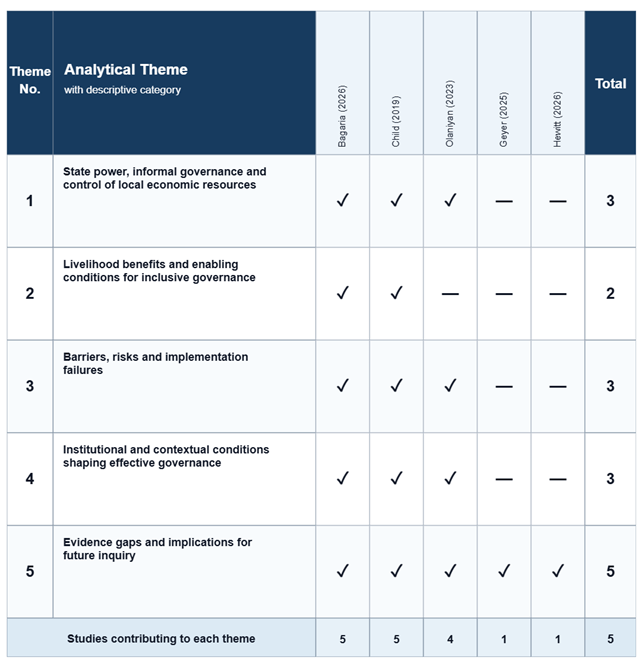 |
Table 1 legend: Only studies contributing verified extracted qualitative evidence are displayed. ✓ = verified extracted evidence from the study supports the theme; — = the study contributed to the synthesis but no supporting extracted finding from that study was assigned to this theme. An em dash does not indicate contradictory evidence.
Disclaimer/Publisher’s Note: The statements, opinions and data contained in all publications are solely those of the individual author(s) and contributor(s) and not of MDPI and/or the editor(s). MDPI and/or the editor(s) disclaim responsibility for any injury to people or property resulting from any ideas, methods, instructions or products referred to in the content. |
© 2026 by the authors. Licensee MDPI, Basel, Switzerland. This article is an open access article distributed under the terms and conditions of the Creative Commons Attribution (CC BY) license (http://creativecommons.org/licenses/by/4.0/).
Copyright: This open access article is published under a Creative Commons CC BY 4.0 license, which permit the free download, distribution, and reuse, provided that the author and preprint are cited in any reuse.